

I’ve been traveling
Gone a long, long time
Don’t know what I’ll find
Scared of what I’d find
I just can’t
Just can’t walk down this road
— “Road to Cairo” (Track 1 of David Ackles’ first record)
May I write you from time to time
A picture postcard from the five and dime?
Nothing fancy, just a simple line:
‘I miss you.’
— “Postcards” (Last track of Ackles’ last record)
David Ackles was one of the most gifted and original songwriters of the last century, but relatively few know his work today. Coming of age when the American songbook was being reshaped by the fresh subject matter and unusual song structures of artists ranging from Randy Newman and Brian Wilson to Joni Mitchell and Laura Nyro, Ackles didn’t really fit the accustomed categories. Some said “folk,” some said “pop.” One critic called his music “religiously-oriented Jazz.” A British reviewer thought “he looks like a gentler, smoother Bob Dylan, with a piano instead of a guitar, … but his smoky voice and sad, bitter songs of life and love belong to the longer tradition of French chanson.” The Chicago Tribune praised Ackles’ repertoire as “Edgar Lee Masters poems set to music … by Charles Ives.” And the Village Voice was equally dazzled:
“I heard everything from Jelly Roll Morton to Kurt Weill and Charles Ives in his piano—polytonalities, freaky counterpoint, multi-rhythms and all sorts of other ‘technical’ things that make his music fascinating … He writes the kind of stuff … that owes more to the poetry of Brecht than to the usual pop influences.” [i]
Ackles’ eponymous first album in 1968 made a strong impression on rising British artists Elton John, Bernie Taupin, Phil Collins and Elvis Costello. In the U.S., Elektra Records, the hippest label in L.A. (Love, The Doors, Tim Buckley), signed him up, promoting him heavily despite disappointing early sales. As music historian Mark Brend notes, “[Elektra executives Jac Holzman and David Anderle] saw something special in Ackles and his strange songs. Songs of originality and daring, and yet songs, too, that you could have just about imagined then as hits. Songs that almost were hits, in some cases.” [ii]
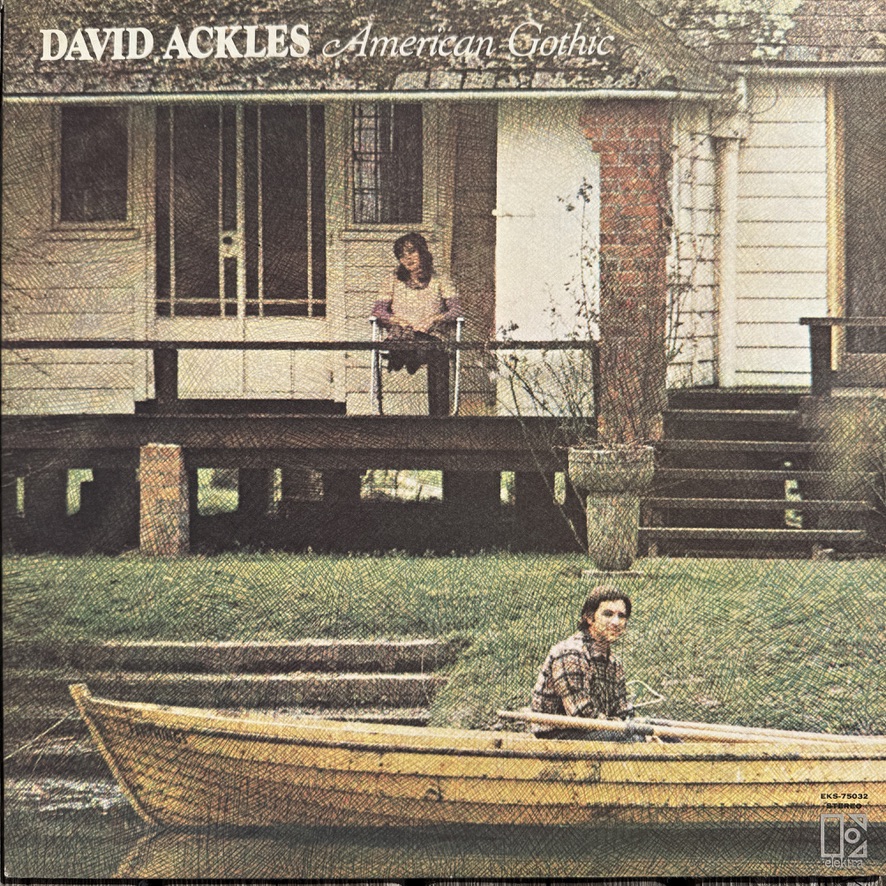
Released on the Fourth of July in 1972, Ackles’ next album, American Gothic, produced by Bernie Taupin and meticulously arranged by the composer, received ecstatic reviews:
“I never really thought that anyone could ever come along and make another album that would be as important—and for the same reasons that Sgt. Pepper was … but someone has. His name is David Ackles, and the album (his third) is called American Gothic.” [iii]
“With American Gothic David Ackles has pulled together the best elements of American pop music—jazz, ‘serious composers,’ the musical theater and film music, and combined them with exquisite taste … The best album of the year? Undoubtedly. The best of the decade? Probably.” [iv]
In the London Sunday Times, Derek Jewell noticed a pantheon of influences in Ackles’ album: Gershwin, Ellington, Count Basie, Frank Sinatra, Leonard Bernstein, Elvis Presley, Burl Ives, Aaron Copland, and Benjamin Britten:
“It’s a masterpiece. Its achievement is comparable with Sgt. Pepper … Never has popular music sounded more dramatic … The beauty, surprise and sheer perfection of his songs will confound you.” [v]
But when sales of American Gothic proved tepid, Elektra dropped their brilliant protégé. Proclaimed a genius early in 1972, by year’s end he was “trailing around inappropriate small venues, playing out-of-tune pianos to dwindling audiences, wondering if he’d ever make another record.” [vi] In 1973, he managed, on a pittance from Columbia Records, to make one more album: Five & Dime—“a smaller, warmer, even happier record” than its predecessors. [vii] It quickly disappeared, and Columbia dropped him in early 1974. David Ackles vanished from the public eye, and never made another recording.
Why did such brilliance not have the impact it deserved? Should Ackles’ failure to “make it” as a pop icon be the principal theme of a life that was in so many ways full of grace? And what is it about his music that demands our attention and respect today? In Down River: In Search of David Ackles (London: Jawbone Press, 2025), writer/musician Mark Brend explores these questions in depth. And if you want a detailed account of the sessions that produced each album, Brend’s research, including interviews with the musicians, is fascinating and thorough.
Ackles’ American debut was in 1968 at Canterbury House in Ann Arbor, Michigan, an intimate club venue which was part of the Episcopal Church’s campus ministry. He was appreciated in that university setting not only for the quality and intellect of his songs, but also for their spiritual themes of struggle, search and the workings of grace. Ackles was a committed Christian who looked honestly and compassionately at the brokenness of the world, and even his bleakest songs had cracks to let the light through.
When David returned to Canterbury House in February 1970, I myself was one of the campus ministers, fresh out of seminary, collecting the $2 tickets at the door and pouring free coffee and cider for the audience. David’s performance made a deep impression on me, and seven months later he kindly agreed to sing a couple of his songs at my ordination to the priesthood in Los Angeles. [viii]

September 17, 1970 (Photo by Marilyn Robertson).
A month before my ordination, David had been the opening act for Elton John’s first performance in America, which I have written about in A Night at the Troubadour: Discovering David Ackles (and Elton John). His musical future seemed so bright on that magical summer evening in a club packed with the elite of West Coast music.
But David’s uniqueness would prove too challenging for a wider public. As Brend observes, “The further Ackles went on his journey, the harder it became to relate him to anyone else and fit him into what was happening.” [ix]
His music was often too complex to be catchy, and the breadth of his themes taxed the attention of many. Although he wrote some gorgeous love songs, he was more storyteller than balladeer, and many of his tales were replete with regret and loss. But as the New York Times noted after seeing him at Greenwich Village’s The Bitter End in 1969, “His habit of singing these [sad] songs through the smile of a very intense cherub is quite effective.” [x]
Some of his songs verge on the apocalyptic—a mining disaster (“Aberfan”), political turbulence (“Ballad of the Ship of State”), environmental disaster (“Oh, California!”), and society’s descent into collective madness (“Inmates of the Institution”). Brend describes the latter as a chaos of “lurching tempo changes, discords, scurrying piano, declamatory singing, mirthlessly jaunty melodic choruses, abrupt stops,” with arranger Fred Myrow leading the charge “like Bernard Herrmann conducting a Las Vegas showband in a nightmare.” [xi]

“Why did Ackles, who was by most accounts optimistic and cheerful, populate his albums with sorrowful tales of the lost and the lonely? People on the slide, ex-cons, drug addicts, drifters and divorcees, confused spiritual seekers, mourners. There’s no easy answer to that.”
— Mark Brend [xii]
One of Ackles’ most harrowing songs is on his first album. “His Name Is Andrew” recites a pilgrim’s progress from a happily innocent faith into the dark night of the soul, where the solemn chant of the vocal and the funereal pulsations of the accompaniment take us into the pit of despairing unfaith, where Andrew’s only choice is “to wait alone for this life to end.” But Ackles does not leave us there. Grace returns with the album’s final song, “Be My Friend.”
Sometimes you wake up feeling nothing but fear.
Sometimes you wonder why God put you here.
Then all at once, there comes a word—
What was that you heard?
Why someone said, from Gilead:
“Be my friend.”
This all makes David’s albums sound like hard work, and in the sense that they tend to engage the hardest things and the biggest questions, that is true. But there is also considerable wit, playfulness and warmth in his repertoire. You never doubt that he is on the side of life. And the sheer beauty of the musical arrangements delivers grace even amid the bleakest lyrics. Ackles’s recordings, in my experience, are endlessly engaging. Most reviewers of his albums—and many listeners since—have spoken of living with an Ackles album for weeks, playing it over and over. [xiii]
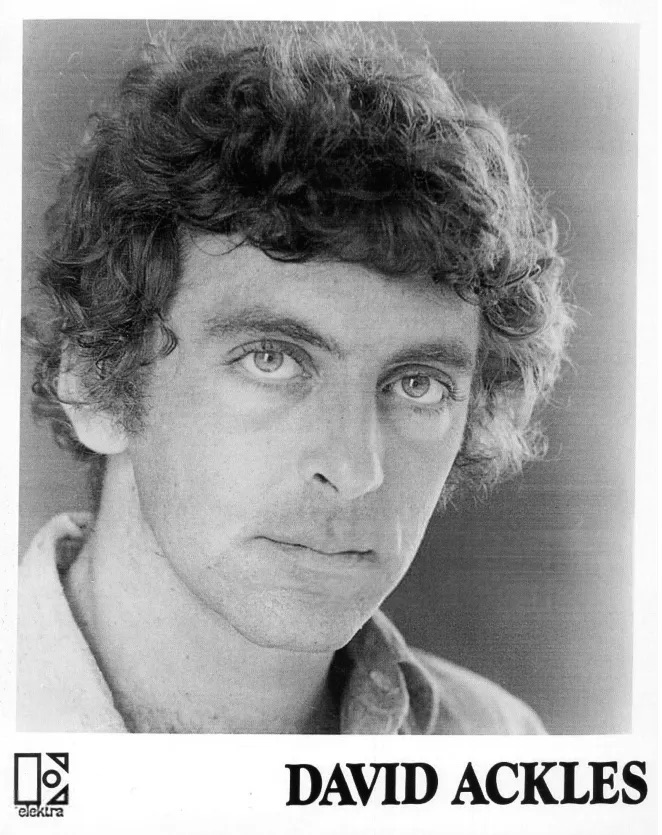
With Mark Brend’s marvelous book as a guide, you may find yourself doing the same. You can find the four albums online, or even score an original LP in a used vinyl bin. Start perhaps with “Down River” (David Ackles). After you wipe away your tears, work your way up to “Montana Song” (American Gothic), a 10-minute “elegaic widescreen tone poem” (Brend). As Bernie Taupin has said of it, “You’d have to be dead inside not to be moved.” [xiv]
David was one of the most joyful and gracious people I’ve ever met, and he didn’t harbor bitterness about his musical career. “I don’t believe anything more could have been done to make me a commercial success,” he said in 1998, a year before he died of cancer at 62. “It just wasn’t in the cards.” [xv] His friend Douglas Graham, a screenwriter who had managed folksinger Odetta in the Sixties, summed it up as well as any:
“He wasn’t in it for stardom. He was in it for music … He probably could have compromised and gone a more popular route. But maybe not, because his music was authentic and anything else would have been inauthentic.” [xvi]
I began this post with lyrics from the first and last songs of David’s recording career. Like every pilgrim into the unknown, the singer sets out with fear and trepidation in a disconnect from everything familiar. But in his last words, delivered from wherever he has ended up, he reaches back with a tender desire for reconnection: “May I write? … I miss you.”
Isn’t that the same narrative arc we find in the Bible, stretching from the Expulsion from Eden to the “world made new”? At the end of the road, we are gathered back into to divine community around the Tree of Life. Or as David put it so hopefully in “Family Band” (American Gothic):
And I will cherish the faith in the songs we knew then,
Till we all sing together,
Till we all sing together,
Till we sing them together again.
[i] Reviews quoted in Mark Brend, Down River: In Search of David Ackles (London: Jawbone Press, 2025). Page numbers refer to Brend’s text: “jazz” (Albuquerque Journal, Oct. 3, 1968), p. 54; “French chanson” (Croydon Advertiser, Oct. 10, 1968), p. 62; “Edgar Lee Masters” (Chicago Tribune, Feb. 15, 1970), p. 93; “Jelly Roll Morton (Village Voice, Jan. 8, 1970), p. 93.
[ii] Ibid., 35.
[iii] Chris Van Ness (Los Angeles Free Press, May 19, 1972), quoted in Brend, p. 138.
[iv] John Weisman (Detroit Free Press, June 25, 1972). q. in Brend, p. 139.
[v] Derek Jewell (Sunday Times, June 18, 1972). q. in Brend, p. 141.
[vi] Brend, 147.
[vii] Brend, 167.
[viii] The songs performed that night at All Saints, Beverly Hills, “Be My Friend” and “Family Band,” were the same ones that would be be chosen from his recorded works for his requiem 29 years later at All Saints, Pasadena. All saints indeed!
[ix] Brend, 34.
[x] Mike Jahn (New York Times, Dec. 16, 1969), q. in Brend, p. 77.
[xi] Brend, 84. Myrow, who arranged and conducted the recordings for Ackles’s second album, was a respected composer (classical, world, and film music) whom David knew from the University of Southern California. I had the pleasure of working with Myrow as my music director for “L.A. Night,” an evening of music, spectacle and inspiration for 5000 Episcopalians at the church’s General Convention of 1985.
[xii] Brend, 67.
[xiii] The current band of Ackles devotees may be relatively small, but his fans—myself among them—are quite passionate about his work. On the Facebook page, David Ackles, the forgotten legend, people share images of old reviews, posters, master tape boxes from Elektra and other artifacts with the excitement of archaeologists discovering a rare manuscript fragment from a vanished world.
[xiv] Brend, 132.
[xv] Brend, 150. From his interview with David Ackles in 1998.
[xvi] Brend, 171. From his 2022 interview with Graham. Speaking of Odetta, she was at my table on that legendary night with Ackles and John at the Troubadour. Perhaps Graham was with her.
 The religious imagineer
Really good story.