Down River: In Search of David Ackles

I’ve been traveling
Gone a long, long time
Don’t know what I’ll find
Scared of what I’d find
I just can’t
Just can’t walk down this road

— “Road to Cairo” (Track 1 of David Ackles’ first record)

May I write you from time to time
A picture postcard from the five and dime?
Nothing fancy, just a simple line:
‘I miss you.’

— “Postcards” (Last track of Ackles’ last record)

David Ackles was one of the most gifted and original songwriters of the last century, but relatively few know his work today. Coming of age when the American songbook was being reshaped by the fresh subject matter and unusual song structures of artists ranging from Randy Newman and Brian Wilson to Joni Mitchell and Laura Nyro, Ackles didn’t really fit the accustomed categories. Some said “folk,” some said “pop.”  One critic called his music “religiously-oriented Jazz.” A British reviewer thought “he looks like a gentler, smoother Bob Dylan, with a piano instead of a guitar, … but his smoky voice and sad, bitter songs of life and love belong to the longer tradition of French chanson.” The Chicago Tribune praised Ackles’ repertoire as “Edgar Lee Masters poems set to music … by Charles Ives.” And the Village Voice was equally dazzled:

“I heard everything from Jelly Roll Morton to Kurt Weill and Charles Ives in his piano—polytonalities, freaky counterpoint, multi-rhythms and all sorts of other ‘technical’ things that make his music fascinating … He writes the kind of stuff … that owes more to the poetry of Brecht than to the usual pop influences.” [i]

Ackles’ eponymous first album in 1968 made a strong impression on rising British artists Elton John, Bernie Taupin, Phil Collins and Elvis Costello. In the U.S., Elektra Records, the hippest label in L.A. (Love, The Doors, Tim Buckley), signed him up, promoting him heavily despite disappointing early sales. As music historian Mark Brend notes, “[Elektra executives Jac Holzman and David Anderle] saw something special in Ackles and his strange songs. Songs of originality and daring, and yet songs, too, that you could have just about imagined then as hits. Songs that almost were hits, in some cases.” [ii]
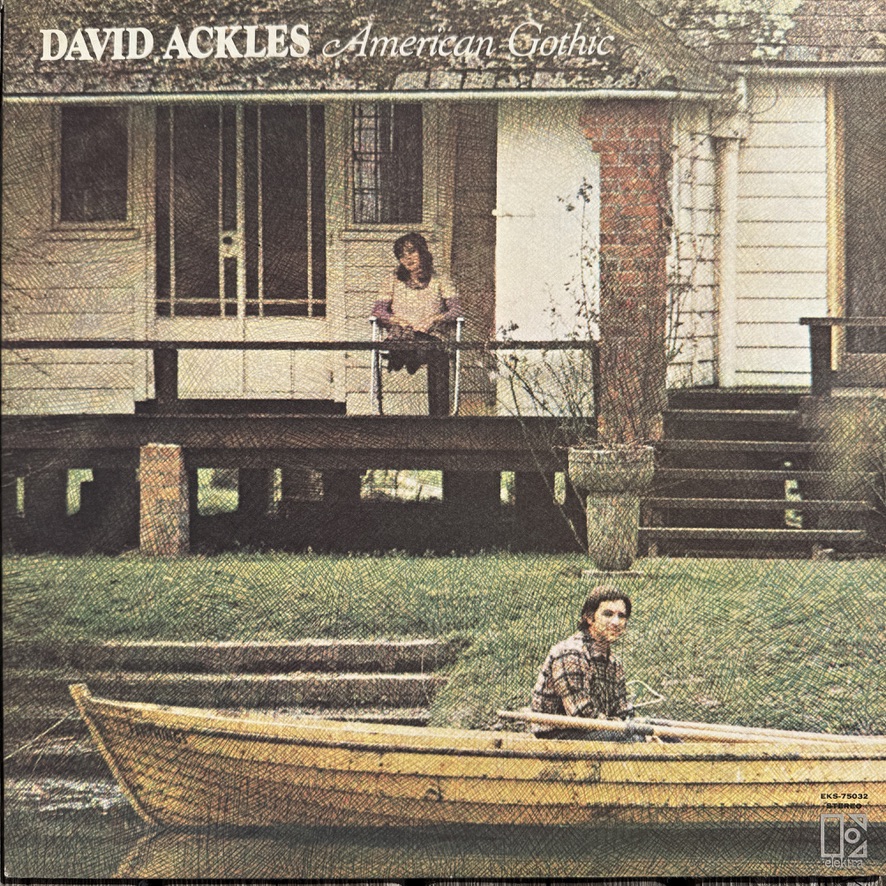
The photograph for Ackles’ third album cover was taken by Michael Ross at the English country house on the Thames where David retreated to arrange the songs in a peaceful setting, far from the pressures of Los Angeles.

Released on the Fourth of July in 1972, Ackles’ next album, American Gothic, produced by Bernie Taupin and meticulously arranged by the composer, received ecstatic reviews:

“I never really thought that anyone could ever come along and make another album that would be as important—and for the same reasons that Sgt. Pepper was … but someone has. His name is David Ackles, and the album (his third) is called American Gothic.” [iii]

 “With American Gothic David Ackles has pulled together the best elements of American pop music—jazz, ‘serious composers,’ the musical theater and film music, and combined them with exquisite taste … The best album of the year? Undoubtedly. The best of the decade? Probably.” [iv]

In the London Sunday Times, Derek Jewell noticed a pantheon of influences in Ackles’ album: Gershwin, Ellington, Count Basie, Frank Sinatra, Leonard Bernstein, Elvis Presley, Burl Ives, Aaron Copland, and Benjamin Britten:

“It’s a masterpiece. Its achievement is comparable with Sgt. Pepper … Never has popular music sounded more dramatic … The beauty, surprise and sheer perfection of his songs will confound you.” [v]

But when sales of American Gothic proved tepid, Elektra dropped their brilliant protégé. Proclaimed a genius early in 1972, by year’s end he was “trailing around inappropriate small venues, playing out-of-tune pianos to dwindling audiences, wondering if he’d ever make another record.” [vi] In 1973, he managed, on a pittance from Columbia Records, to make one more album: Five & Dime—“a smaller, warmer, even happier record” than its predecessors. [vii] It quickly disappeared, and Columbia dropped him in early 1974. David Ackles vanished from the public eye, and never made another recording.

Why did such brilliance not have the impact it deserved? Should Ackles’ failure to “make it” as a pop icon be the principal theme of a life that was in so many ways full of grace? And what is it about his music that demands our attention and respect today? In Down River: In Search of David Ackles (London: Jawbone Press, 2025), writer/musician Mark Brend explores these questions in depth. And if you want a detailed account of the sessions that produced each album, Brend’s research, including interviews with the musicians, is fascinating and thorough.

Ackles’ American debut was in 1968 at Canterbury House in Ann Arbor, Michigan, an intimate club venue which was part of the Episcopal Church’s campus ministry. He was appreciated in that university setting not only for the quality and intellect of his songs, but also for their spiritual themes of struggle, search and the workings of grace. Ackles was a committed Christian who looked honestly and compassionately at the brokenness of the world, and even his bleakest songs had cracks to let the light through.  

When David returned to Canterbury House in February 1970, I myself was one of the campus ministers, fresh out of seminary, collecting the $2 tickets at the door and pouring free coffee and cider for the audience. David’s performance made a deep impression on me, and seven months later he kindly agreed to sing a couple of his songs at my ordination to the priesthood in Los Angeles. [viii]

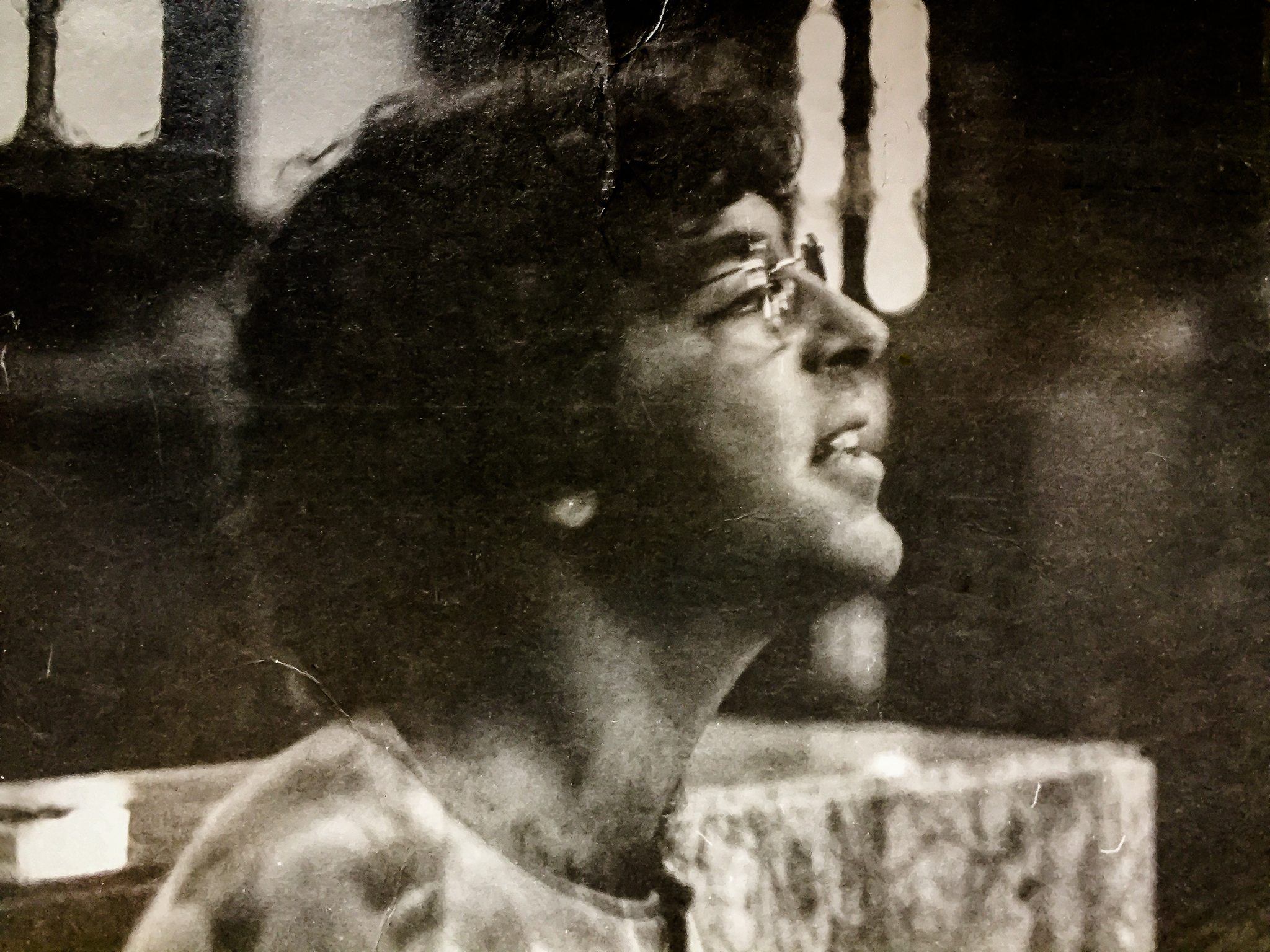
David Ackles singing for the author’s ordination at All Saints Episcopal Church in Beverly Hills,
September 17, 1970 (Photo by Marilyn Robertson).

A month before my ordination, David had been the opening act for Elton John’s first performance in America, which I have written about in A Night at the Troubadour: Discovering David Ackles (and Elton John). His musical future seemed so bright on that magical summer evening in a club packed with the elite of West Coast music.

But David’s uniqueness would prove too challenging for a wider public. As Brend observes, “The further Ackles went on his journey, the harder it became to relate him to anyone else and fit him into what was happening.” [ix]

His music was often too complex to be catchy, and the breadth of his themes taxed the attention of many. Although he wrote some gorgeous love songs, he was more storyteller than balladeer, and many of his tales were replete with regret and loss. But as the New York Times noted after seeing him at Greenwich Village’s The Bitter End in 1969, “His habit of singing these [sad] songs through the smile of a very intense cherub is quite effective.” [x]  

Some of his songs verge on the apocalyptic—a mining disaster (“Aberfan”), political turbulence (“Ballad of the Ship of State”), environmental disaster (“Oh, California!”), and society’s descent into collective madness (“Inmates of the Institution”). Brend describes the latter as a chaos of “lurching tempo changes, discords, scurrying piano, declamatory singing, mirthlessly jaunty melodic choruses, abrupt stops,” with arranger Fred Myrow leading the charge “like Bernard Herrmann conducting a Las Vegas showband in a nightmare.” [xi]

Cover for Ackles’ first album. The noirish design was by William S. Harvey, who had created an equally brooding cover for The Doors’ first album. Photo by Joel Brodsky.

“Why did Ackles, who was by most accounts optimistic and cheerful, populate his albums with sorrowful tales of the lost and the lonely? People on the slide, ex-cons, drug addicts, drifters and divorcees, confused spiritual seekers, mourners. There’s no easy answer to that.”

— Mark Brend [xii]

One of Ackles’ most harrowing songs is on his first album. “His Name Is Andrew” recites a pilgrim’s progress from a happily innocent faith into the dark night of the soul, where the solemn chant of the vocal and the funereal pulsations of the accompaniment take us into the pit of despairing unfaith, where Andrew’s only choice is “to wait alone for this life to end.” But Ackles does not leave us there. Grace returns with the album’s final song, “Be My Friend.”

Sometimes you wake up feeling nothing but fear.
Sometimes you wonder why God put you here.
Then all at once, there comes a word—
What was that you heard?
Why someone said, from Gilead:
“Be my friend.”

This all makes David’s albums sound like hard work, and in the sense that they tend to engage the hardest things and the biggest questions, that is true. But there is also considerable wit, playfulness and warmth in his repertoire. You never doubt that he is on the side of life. And the sheer beauty of the musical arrangements delivers grace even amid the bleakest lyrics. Ackles’s recordings, in my experience, are endlessly engaging. Most reviewers of his albums—and many listeners since—have spoken of living with an Ackles album for weeks, playing it over and over. [xiii]
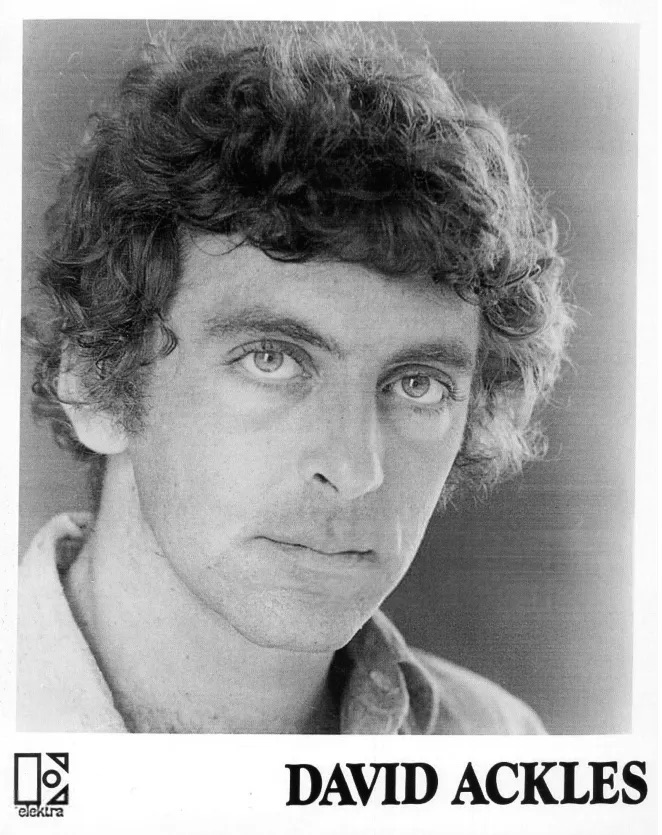
Publicity still for Elektra Records.

With Mark Brend’s marvelous book as a guide, you may find yourself doing the same. You can find the four albums online, or even score an original LP in a used vinyl bin. Start perhaps with “Down River” (David Ackles). After you wipe away your tears, work your way up to “Montana Song” (American Gothic), a 10-minute “elegaic widescreen tone poem” (Brend). As Bernie Taupin has said of it, “You’d have to be dead inside not to be moved.” [xiv]

David was one of the most joyful and gracious people I’ve ever met, and he didn’t harbor bitterness about his musical career. “I don’t believe anything more could have been done to make me a commercial success,” he said in 1998, a year before he died of cancer at 62. “It just wasn’t in the cards.” [xv]  His friend Douglas Graham, a screenwriter who had managed folksinger Odetta in the Sixties, summed it up as well as any:

“He wasn’t in it for stardom. He was in it for music … He probably could have compromised and gone a more popular route. But maybe not, because his music was authentic and anything else would have been inauthentic.” [xvi]  

I began this post with lyrics from the first and last songs of David’s recording career. Like every pilgrim into the unknown, the singer sets out with fear and trepidation in a disconnect from everything familiar. But in his last words, delivered from wherever he has ended up, he reaches back with a tender desire for reconnection: “May I write? … I miss you.”

Isn’t that the same narrative arc we find in the Bible, stretching from the Expulsion from Eden to the “world made new”? At the end of the road, we are gathered back into to divine community around the Tree of Life. Or as David put it so hopefully in “Family Band” (American Gothic):

And I will cherish the faith in the songs we knew then,
Till we all sing together,
Till we sing them together again.
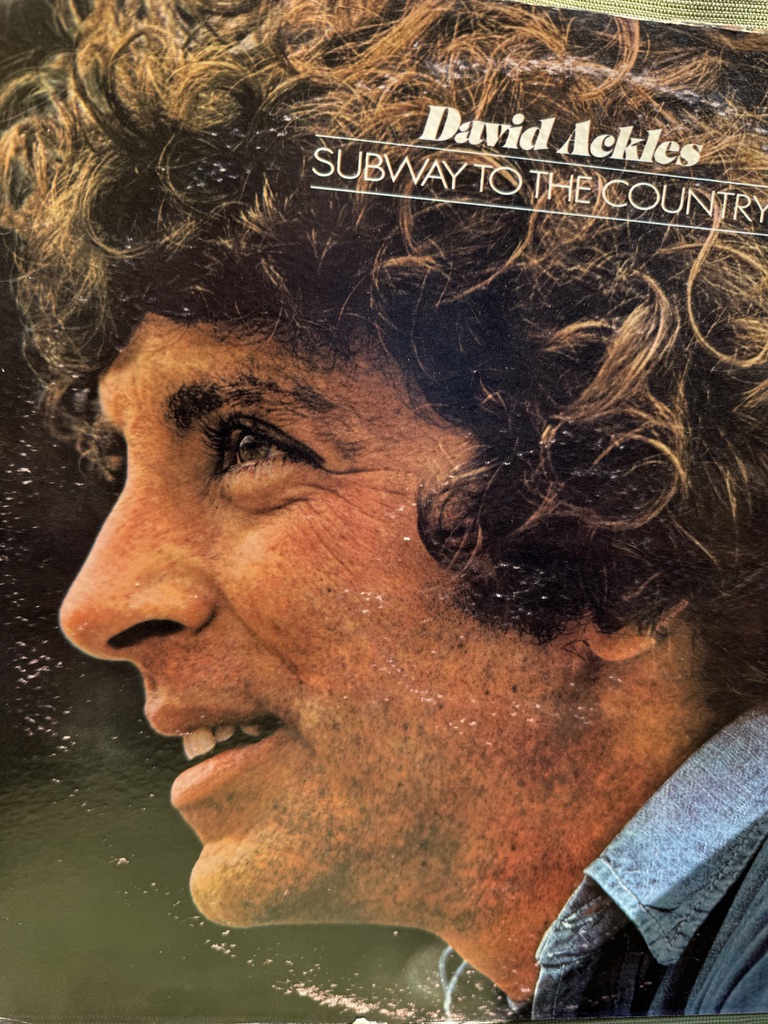
William S. Harvey’s more upbeat cover for the second album, Subway to the Country. Photo by Frank Bez.


[i] Reviews quoted in Mark Brend, Down River: In Search of David Ackles (London: Jawbone Press, 2025). Page numbers refer to Brend’s text: “jazz” (Albuquerque Journal, Oct. 3, 1968), p. 54; “French chanson” (Croydon Advertiser, Oct. 10, 1968), p. 62; “Edgar Lee Masters” (Chicago Tribune, Feb. 15, 1970), p. 93; “Jelly Roll Morton (Village Voice, Jan. 8, 1970), p. 93.

[ii] Ibid., 35.

[iii] Chris Van Ness (Los Angeles Free Press, May 19, 1972), quoted in Brend, p. 138.

[iv] John Weisman (Detroit Free Press, June 25, 1972). q. in Brend, p. 139.

[v] Derek Jewell (Sunday Times, June 18, 1972). q. in Brend, p. 141.

[vi] Brend, 147.

[vii] Brend, 167.

[viii] The songs performed that night at All Saints, Beverly Hills, “Be My Friend” and “Family Band,” were the same ones that would be be chosen from his recorded works for his requiem 29 years later at All Saints, Pasadena. All saints indeed!

[ix] Brend, 34.

[x] Mike Jahn (New York Times, Dec. 16, 1969), q. in Brend, p. 77.

[xi] Brend, 84. Myrow, who arranged and conducted the recordings for Ackles’s second album, was a respected composer (classical, world, and film music) whom David knew from the University of Southern California. I had the pleasure of working with Myrow as my music director for “L.A. Night,” an evening of music, spectacle and inspiration for 5000 Episcopalians at the church’s General Convention of 1985.

[xii] Brend, 67.

[xiii] The current band of Ackles devotees may be relatively small, but his fans—myself among them—are quite passionate about his work. On the Facebook page, David Ackles, the forgotten legend, people share images of old reviews, posters, master tape boxes from Elektra and other artifacts with the excitement of archaeologists discovering a rare manuscript fragment from a vanished world.

[xiv] Brend, 132.

[xv] Brend, 150. From his interview with David Ackles in 1998.

[xvi] Brend, 171. From his 2022 interview with Graham. Speaking of Odetta, she was at my table on that legendary night with Ackles and John at the Troubadour. Perhaps Graham was with her.
An Unforgettable Night at the Troubadour (50th Anniversary)

Fifty years ago tonight, I was lucky enough to hear a legendary concert by two extraordinary songwriters and performers, David Ackles and Elton John. A fanciful depiction of that night in the 2019 biopic Rocket Man shows the audience rising ecstatically to float above the floor. Actually, we were all sitting around big tables, but that is pretty much how it felt to be there. For the fiftieth anniversary of that unforgettable evening, I reprise my tribute written in 2016. 

David Ackles singing at the author’s ordination, Sept. 17, 1970 (Photo by Marilyn Robertson)

I have no explanation as to why the David Ackles albums spoke to me so intensely, but it was with those records that I probably spent the most time when I was about sixteen, listening in a darkened room, trying to imagine how everything had come to exist.” 

— Elvis Costello, Unfaithful Music and Disappearing Ink

They suffer least who suffer what they choose.

— David Ackles, “American Gothic”


The Troubadour, an intimate club in West Hollywood, has seen some pretty special nights over the years. Joni Mitchell, Leonard Cohen, Randy Newman, Prince, Tom Petty, Pearl Jam and so many others have performed on its stage. Neil Young and James Taylor each made their solo debut there. The Byrds sang “Mr. Tambourine Man” for the first time in public. Tom Waits was discovered during amateur night. Springsteen, Dylan and Led Zeppelin dropped by after hours for legendary jams. Miles Davis and Van Morrison recorded there.[i]

When Elton John made his smashing American debut at the Troubadour on August 25, 1970, he was not yet widely known. He was originally booked as the opening act for David Ackles, a Los Angeles musical artist greatly admired by Elton John and his lyricist Bernie Taupin. But John’s record company pulled some strings to get the bill reversed. In conjunction with the release of his first album, John would become the headline act.

He would admit later to some embarrassment at being promoted above Ackles on the billing, since Ackles was one of his heroes, “one of the best that America has to offer.” Elvis Costello was also a fan, “It’s a mystery to me why his wonderful songs are not better known,” he has said.[ii] When Costello interviewed John on his Sundance cable series, Spectacle, they both voiced generous tributes to Ackles’ genius and influence, and closed the show with a duet of his great song of loss and longing, “Down River.” [iii]

Ackles put out four memorable albums between 1968 and 1973. His masterpiece, American Gothic (1972), generated critical raves. “The Sergeant Pepper of Folk,” gushed a noted British critic, astonished at its thematic brilliance, structural complexity and musical originality. Rolling Stone called it “moving” and “eloquent.” A retrospective appraisal in 2005 acclaimed it “a largely unrecognized work of genius, one of the most unfashionable and uncompromising American albums ever. . . Crafted layer upon layer, it reveals itself more as a dramatic work than a conventional rock or pop release, drawing on modern American classical composers such as Charles Ives and Aaron Copland as well as gospel, rock, blues, and soul. Imagine an art-folk album that bridges Woody Guthrie’s passionate storytelling and Kurt Weill’s orchestrations.” [iv]

Rolling Stone said at the time that American Gothic “deserves a wide audience,” but when sales proved weak, his recording company, Elektra, lost interest. Ackles made one more album on the Columbia label, but his music seemed too hard to categorize in an industry driven by identifiable genres. Was it folk, pop, classical, musical theater, or what? His originality didn’t fit the system. A ten-minute elegy to a lost past (“Montana Song”) was not going to get much radio time. And you couldn’t dance to it. But however neglected, the heartbreaking beauty of Ackles’ imagery still blooms like wildflowers on a deserted prairie:

The fallen barn, the broken plow,
the hoofprint-hardened clay;
where is the farmer, now,
who built his dream this way ?
Who felled the tree and cut the bough
and made the land obey,
who taught his sons as he knew how,
but could not make them stay. [v]

Disappointed by the lack of tangible support for his work, Ackles abandoned his recording career, but not his joie de vivre. “I’m not bitter about a thing that’s happened to me,” he told an interviewer in 1998. “I would hate for people to think I’m over here getting all twisted up about what happened 20 years ago. All that feels like another life, lived by someone else.” [vi]

Although he could write an achingly beautiful love song like “Love’s Enough,” he was at heart a storyteller, weaving poetic and sometimes tragic narratives of American dreamers and strivers, who “joined the circus, worked the fields,” but “never saved a dime.” And even when they had to “learn to dance to someone else’s song,” they managed to endure:

But I hold on to my dreams, anyway.
I never let them die.
They keep me going through the bad times,
while I dream
of the good times coming by. [vii]

Bernie Taupin, who produced American Gothic, summed up Ackles’ intensity and conviction in a 2008 remembrance: “Man! If you didn’t believe every word this guy was singing, you were dead inside.” [viii]

I first met David Ackles in early 1970, when I was working at Canterbury House in Ann Arbor, Michigan, an Episcopal campus ministry and coffeehouse known as one of the premiere folk music venues in the country. I was just out of seminary, working with two priests as an intern during the year of my “transitional diaconate,” the prelude to priestly ordination. While I was in residence, Canterbury House featured Neil Young, Doc Watson, Ramblin’ Jack Elliott, and David Ackles.

David was one of Canterbury’s most popular performers, loved not only for his music but also for his manifest warmth and wry humor. He was a lifelong Christian, deeply spiritual and theologically astute, an authentic and generous man. And though some of his songs revealed a profound empathy with the suffering of displaced souls, there was an essential core in him—a comedic faith in resurrection—which survived the harrowing descent of the artist into the nether regions of the human condition.

By summer of 1970, I was back home in Los Angeles, awaiting my ordination to the priesthood in September. When I saw that David was playing at the Troubadour, I knew I had to be there. Meanwhile, the radio was starting to preview a few unreleased songs by the other guy on the bill, and he sounded quite good as well. Word got around, excitement grew, and on August 25 the house was packed. We shared a table with Odetta, the “queen of American folk music.” [ix]

Before the show, I went backstage to ask David if he would consider singing at my ordination, and he graciously consented. While we were talking, Elton John entered the dressing room, wearing denim overalls with a cartoon duck patch on the front, to tell David how much he admired his work and how honored he was to share the stage with him.

And the concert? It’s been nearly fifty years now. Details grow hazy; I can’t recite the set lists anymore. But I can still feel the electricity of that Hollywood night, the passion of the performers, the visceral connection they made with their audience.

Stacy Sullivan, a jazz singer who once worked with David, is currently performing, in small New York clubs, “A Night at the Troubadour: Presenting Elton John and David Ackles.” While showing the brilliance of two stars aligning, her re-imagining of that night suggests the strangeness of fate: one singer became an international superstar, the other remained largely undiscovered.

The New York Times has called Sullivan’s tribute a “tour de force” which “interweaves more than a dozen Ackles songs with several of Mr. John’s hits, radically deconstructed, into a dual portrait in which their opposite sensibilities (Mr. John’s gregarious showmanship, and Mr. Ackles’ dignified introspection) eventually merge.” [x] Lucky Easterners can still see her at Manhattan’s Metropolitan Room on September 10 and October 8 [Note: this was in 2016]. I can only pray that she will do a West Coast reprise. I promise to come.

A few weeks after the Troubadour show, David sang two songs for my ordination at All Saints, Beverly Hills, where the opening hymn was “Let It Be” and large projected images filled the wall behind the altar. Those were the days! During communion, David sang “Be My Friend.” At the Dismissal, he led the congregation in “Family Band,” which he said was autobiographical, since he grew up in a musical family of church-going Presbyterians. I still play that song on my guitar every ordination anniversary:

I remember the songs we sang Sunday evening . . .
when my dad played the bass, mom played the drums,
I played the piano,
and Jesus sang the song.

David got lung cancer in the late nineties. When he went into remission, he and his wonderful wife Janice rented a Pasadena mansion, filled it with musicians, and threw a grand party for their friends, to celebrate the gifts of life and love. Then, in 1999, David departed this world, far too soon. He is dearly missed. But that gathering in Pasadena remains a joyous foretaste of the blessedness which awaits us all.

And I will cherish the faith in the songs we knew then,
till we all sing together, till we all sing together,
till we sing them together again.


[i] For a more extensive historical list: http://www.troubadour.com/history

[ii] Reuters obituary in March, 1999, cited in Kenny MacDonald interview: http://www.terrascope.co.uk/MyBackPages/David%20Ackles.htm

[iii] YouTube has a version of their duet: https://www.youtube.com/watch?v=sXvlCjrlHCQand their conversation about David is at https://www.youtube.com/watch?v=Qbt1Cee7Usw

[iv] George Durbalau, 1001 Albums You Must Hear Before You Die, 2005. Along with other review quotes, found at http://www.superseventies.com/spacklesdavid.html

[v] David Ackles, “Montana Song,” on American Gothic. Some of David’s songs can be heard on YouTube, and his albums can be found online as well.

[vi] Kenny MacDonald interview

[vii] “Another Friday Night,” American Gothic

[viii] Bernie Taupin’s blog, Dec. 3, 2008

[ix] Attributed to Martin Luther King, Jr.: http://entertainment.time.com/2011/10/24/the-all-time-100-songs/slide/take-this-hammer-odetta/

[x] New York Times, July 16, 2016: http://www.nytimes.com/2016/07/16/arts/music/stacy-sullivan-david-ackles-review.html?_r=1


It Ain’t Me, Babe: Dylan Wins the Nobel Prize

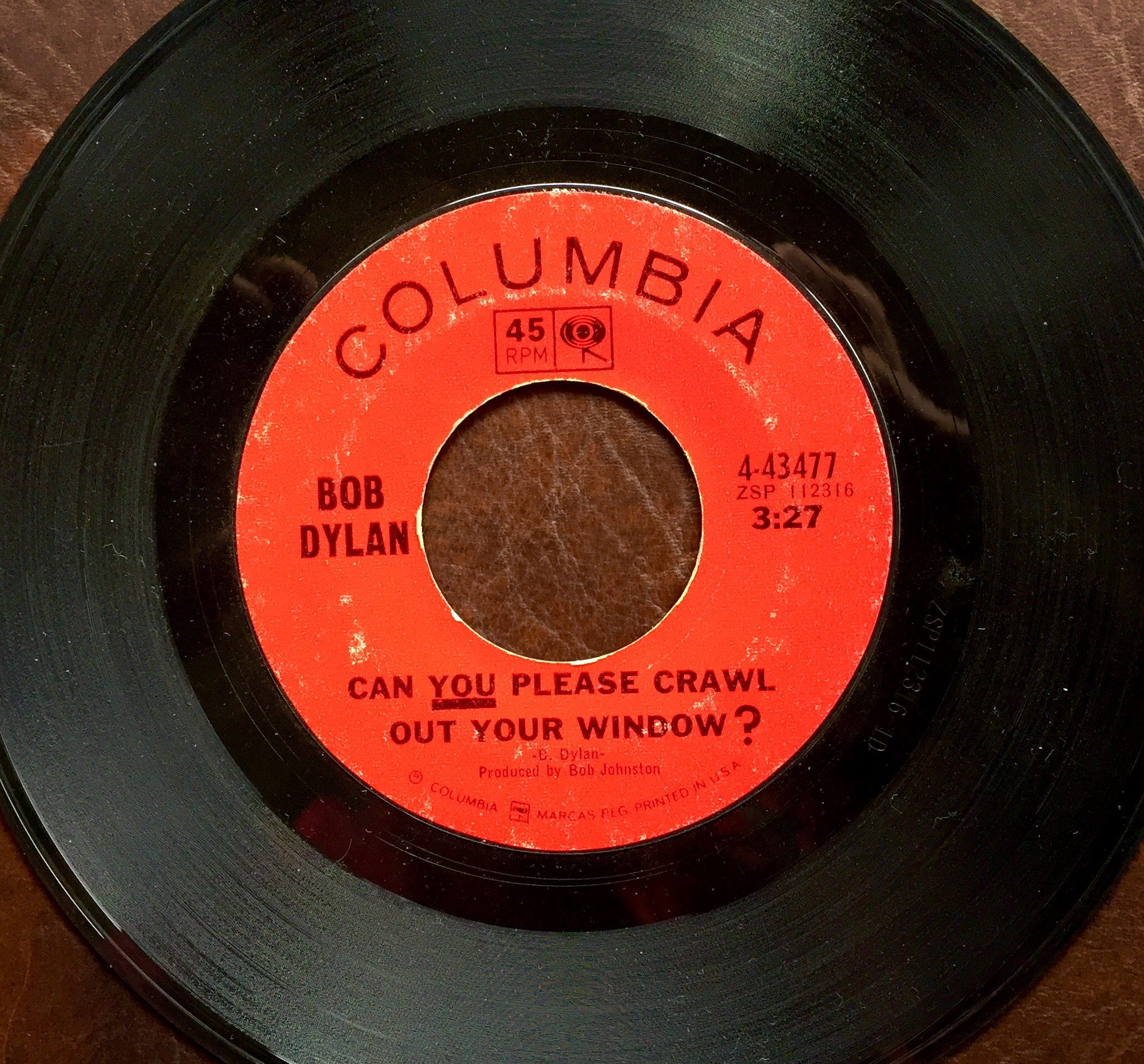
One of my prized 45s is this obscure single, released Dec. 21, 1965.

One of my prized 45s is this obscure single, released Dec. 21, 1965.

Well, I try my best
To be just like I am
But everybody wants you
To be just like them
They say sing while you slave and I just get bored
I ain’t gonna work on Maggie’s farm no more.[i]

All these people that you mention, yes, I know them, they’re quite lame
I had to rearrange their faces and give them all another name
Right now, I can’t read too good, don’t send me no more letters no
Not unless you mail them from Desolation Row [ii]

Little red wagon, little red bike
I ain’t no monkey but I know what I like [iii]

Whenever the Nobel Prize for literature is announced, the American response is often “Who?” In our cultural insularity, few of us know their work or even their names. Not this year. Everybody’s heard of Dylan, and many can recite his lyrics.

The surprise in 2016 stems from the bursting of old academic wineskins. What constitutes literature, anyway? Some of the literary establishment are unhappy that a songwriter tainted with lower-brow genres of popular culture (and currently performing in Las Vegas!) should steal the laurels from more “serious” candidates such as Syrian poet Adonis or Kenyan novelist Ngugi Wa Thiong’o. It’s “a joke,” fumed one French writer. A Scottish novelist dismissed the Nobel committee as “gibbering hippies.” [iv]

But if the linguistic arts trace their origins to the sung poetry of shared rituals, and Homer, the father of western literature, was a blind singer-songwriter who never put pen to paper, then Dylan can justly claim an ancient lineage, and stretching the definition of literature to include his work seems more restoration than innovation.

While Dylan’s jumping the queue ahead of American writers like Philip Roth, Joyce Carol Oates, and Don DeLillo might seem inappropriate to some, it is at least defensible. Oates herself calls the award “an inspired and original choice. His haunting music and lyrics have always seemed, in the best sense, ‘literary.’” [v]

Dylan has certainly had his down periods of uneven albums and terrible concerts. I myself have endured one too many evenings of mumbled words, mangled melodies, and an almost contemptuous stage presence. But to sustain such an influential and ever-evolving body of work over half a century, bridging the cultural divide between high and low, making the play of language a lever to move the world, is an astonishing achievement. His poetic and musical gifts have so often given voice to the collective longing of our “subterranean homesick blues.” They have also taken us inward, to the places of the heart where “we sit here stranded, though we’re all doing our best to deny it.” [vi]

As Bruce Springsteen has written, “Bob pointed true north and served as a beacon to assist you in making your way through the new wilderness America had become. He planted a flag, wrote the songs, sang the words that were essential to the times, to the emotional and spiritual survival of so many young Americans . . .” [vii]

Dylan was the soundtrack for my own coming of age. During my first year of college in 1963, a classmate thrust Dylan’s first album into my hands. “You’ve got to hear this,” he said. As soon as that growling, barbaric yawp started blasting out of the speakers, I was spellbound. Like so many others, I took up the guitar just so I could play his songs. “Blowin’ in the Wind” (from his second album), was my first attempt (key of D with its easy chords). By my senior year, dozens of Dylan songs were in my repertoire. I even learned the ten-minute “Desolation Row” by heart, once performing it on Rome’s Spanish Steps, by the house where Keats died, during a post-graduate summer of hitchhiking Europe with my guitar.

In Berkeley on March 28, 1965, I caught one of Dylan’s final all-acoustic concerts, just before the release of Bringing It All Back Home, the first album in his unmatched trilogy (Highway 61 Revisited and Blonde on Blonde would follow). Ken Kesey and Allen Ginsberg were sitting up front. Hippies and Hell’s Angels mixed with students and professors. The hall was charged with anticipation. From “Gates of Eden” to “It’s All Over Now, Baby Blue,” it was an amazing night.

It was the first time I ever heard “Mr. Tambourine Man.” Top 40 radio, or even Dylan’s previous work, had not really prepared me for the trippy ride “upon that magic swirling ship.” Behind its dazzling succession of vivid images, I recognized something primal and urgent, the call to leave everything and to follow, to look everywhere for the “windy beach, far from the twisted reach of crazy sorrow.”

As a poetic equivalent of the kingdom of God, the windy beach where the Spirit blows, the space of supreme aliveness, is too little found, and never possessed. And yet, now and then, I have danced beneath its diamond sky with one hand waving free, and hope to do so again as grace permits.

I was also in the crowd on September 3 of that same year, when Dylan played the Hollywood Bowl, backed by The Hawks (later The Band) along with Al Kooper on organ. There all the songs from Highway 61 Revisited were performed in public for only the second time (after a New York concert the previous week). Since the album had yet to hit the stores, it was my indelible first communion with the image world of Dylan’s surrealism. “There’s something happening here, but you don’t know what it is.”[viii]  Indeed.

The encore was “Like a Rolling Stone,” the one song we already knew from the radio. Before beginning, Dylan searched among his harmonicas in vain, then spoke into the microphone, “Anyone got a C harmonica?” As I remember it, 17,000 harmonicas came flying onto the stage, and soon we were all shouting with one voice, “HOW DOES IT FEEEEEEEL?”

When, in 1966, I crossed the country to study at the Episcopal Theological School in Cambridge, Massachusetts, my guitar and my Dylan records came with me. In a school play, I sang an adapted version of “With God On Our Side” to parody the horrific biblical conquest narratives. I wrote an article on the prophetic theology of Dylan’s lyrics in the seminary journal. And I incorporated fragments of his haunting religious poetry from John Wesley Harding into a multimedia senior sermon (you can hear the audio collage here).

In later years, Dylan’s preeminence in my life’s soundtrack receded, although his masterpiece of anguish and longing, Time Out of Mind, managed perfectly to coincide with my own midlife dark night of the soul. Lines like “It’s not dark yet, but it’s getting there” may not have been balm in Gilead, but they kept me company until the dawn.

These days I occasionally sing old favorites like “Ramona,” “She Belongs To Me,” “Chimes of Freedom” and “Buckets of Rain.” And I never tire of leading friends and retreat groups in heartfelt renderings of “Knockin’ on Heaven’s Door” and “I Shall Be Released.”

Everyone’s got their Dylan stories, but at their core is a mysterious absence. Dylan’s identity has always been veiled by a succession of fictions, evasions, conversions and withdrawals. He has given interviews full of absurd biographical narratives.[ix] Even before he was famous, he invented personae to protect himself from the prying projections of others. From fixtures and forces and friends your sorrow does stem, that hype you and type you, making you feel you gotta be just like them. [x]

Does it matter whether we ever know the real Dylan, or find him a relatable personality? Or are the songs enough? Is their mysterious power to speak to us and for us enough?

“It’s like a ghost writing a song like that,” Dylan said about “Like a Rolling Stone” 40 years after recording his greatest hit. “It gives you the song and then it goes away. It goes away.”[xi] The ghost, the geist, the spirit blows where it will. The artist prepares to receive it, and learns how to give it away.

Another Nobel Laureate, poet Czeslaw Milosz, concurs, insisting that the artist’s vocation is to be “a secretary of the invisible.” Deliver the message entrusted to your keeping, then get the hell out of the way. It ain’t me, babe. This has been the essential kenosis of both art and spirit since the beginning.

Take Caedmon, for example. An illiterate herdsman in seventh-century Britain, he was suddenly commanded in a dream to sing the story of creation. Without learning or training, he began to sing words unknown to him, gifts from the same ghost who visited Dylan. Thus was English poetry born.

Denise Levertov imagines Caedmon’s in-spiriting in a poem of her own. He is huddling for warmth at night with the beasts of the barn, when suddenly the air is filled with “feathers of flame, sparks upflying.” The cows remain oblivious and calm, not seeing what the poet sees as “that hand of fire / touched my lips and scorched my tongue / and pulled my voice / into the ring of the dance.” [xii]


[i] Bob Dylan, “Maggie’s Farm” (Bringing It All Back Home)

[ii] Bob Dylan, “Desolation Row” (Highway 61 Revisited)

[iii] Bob Dylan, “Buckets of Rain” (Blood on the Tracks)

[iv] “Writers divided on whether Dylan deserves Nobel prize”: https://www.yahoo.com/news/writers-divided-whether-dylan-deserves-nobel-prize-180943929.html

[v] ibid.

[vi] Bob Dylan, “Visions of Johanna” (Blonde on Blonde)

[vii] Bruce Springsteen autobiography, Born To Run, q. on Springsteen’s website: http://brucespringsteen.net/news/2016/bruce-springsteen-on-bob-dylan

[viii] Bob Dylan, “Ballad of a Thin Man” (Highway 61 Revisited)

[ix] To delve into the strange world of Dylan interviews: http://www.vulture.com/2007/10/the_ten_most_incomprehensible.html

[x] Bob Dylan, “Ramona” (Another Side of Bob Dylan)

[xi] Robert Hilburn, “Rock’s Enigmatic Poet Opens a Long-Private Door,” Los Angeles Times, April 4, 2004

[xii] Denise Levertov, “Caedmon”, q. in Edward Hirsch, Poet’s Choice (New York: Harcourt, Inc., 2006), 15

A Night at the Troubadour: Discovering David Ackles (and Elton John)

David Ackles singing at the author's ordination, Sept. 17, 1970 (Photo by Marilyn Robertson)

David Ackles singing at the author’s ordination, Sept. 17, 1970 (Photo by Marilyn Robertson)

I have no explanation as to why the David Ackles albums spoke to me so intensely, but it was with those records that I probably spent the most time when I was about sixteen, listening in a darkened room, trying to imagine how everything had come to exist.” (Elvis Costello, Unfaithful Music and Disappearing Ink)

 They suffer least who suffer what they choose. (David Ackles, “American Gothic”)

The Troubadour, an intimate club in West Hollywood, has seen some pretty special nights over the years. Joni Mitchell, Leonard Cohen, Randy Newman, Prince, Tom Petty, Pearl Jam and so many others have performed on its stage. Neil Young and James Taylor each made their solo debut there. The Byrds sang “Mr. Tambourine Man” for the first time in public. Tom Waits was discovered during amateur night. Springsteen, Dylan and Led Zeppelin dropped by after hours for legendary jams. Miles Davis and Van Morrison recorded there.[i]

When Elton John made his smashing American debut at the Troubadour on August 25, 1970, he was not yet widely known. He was originally booked as the opening act for David Ackles, a Los Angeles musical artist greatly admired by Elton John and his lyricist Bernie Taupin. But John’s record company pulled some strings to get the bill reversed. In conjunction with the release of his first album, John would become the headline act.

He would admit later to some embarrassment at being promoted above Ackles on the billing, since Ackles was one of his heroes, “one of the best that America has to offer.” Elvis Costello was also a fan, “It’s a mystery to me why his wonderful songs are not better known,” he has said.[ii] When Costello interviewed John on his Sundance cable series, Spectacle, they both voiced generous tributes to Ackles’ genius and influence, and closed the show with a duet of his great song of loss and longing, “Down River.” [iii]

Ackles put out four memorable albums between 1968 and 1973. His masterpiece, American Gothic (1972), generated critical raves. “The Sergeant Pepper of Folk,” gushed a noted British critic, astonished at its thematic brilliance, structural complexity and musical originality. Rolling Stone called it “moving” and “eloquent.” A retrospective appraisal in 2005 acclaimed it “a largely unrecognized work of genius, one of the most unfashionable and uncompromising American albums ever. . . Crafted layer upon layer, it reveals itself more as a dramatic work than a conventional rock or pop release, drawing on modern American classical composers such as Charles Ives and Aaron Copland as well as gospel, rock, blues, and soul. Imagine an art-folk album that bridges Woody Guthrie’s passionate storytelling and Kurt Weill’s orchestrations.” [iv]

Rolling Stone said at the time that American Gothic “deserves a wide audience,” but when sales proved weak, his recording company, Elektra, lost interest. Ackles made one more album on the Columbia label, but his music seemed too hard to categorize in an industry driven by identifiable genres. Was it folk, pop, classical, musical theater, or what? His originality didn’t fit the system. A ten-minute elegy to a lost past (“Montana Song”) was not going to get much radio time. And you couldn’t dance to it. But however neglected, the heartbreaking beauty of Ackles’ imagery still blooms like wildflowers on a deserted prairie:

The fallen barn, the broken plow,
the hoofprint-hardened clay;
where is the farmer, now,
who built his dream this way ?
Who felled the tree and cut the bough
and made the land obey,
who taught his sons as he knew how,
but could not make them stay.[v]

Disappointed by the lack of tangible support for his work, Ackles abandoned his recording career, but not his joie de vivre. “I’m not bitter about a thing that’s happened to me,” he told an interviewer in 1998. “I would hate for people to think I’m over here getting all twisted up about what happened 20 years ago. All that feels like another life, lived by someone else.” [vi]

Although he could write an achingly beautiful love song like “Love’s Enough,” he was at heart a storyteller, weaving poetic and sometimes tragic narratives of American dreamers and strivers, who “joined the circus, worked the fields,” but “never saved a dime.” And even when they had to “learn to dance to someone else’s song,” they managed to endure:

But I hold on to my dreams, anyway.
I never let them die.
They keep me going through the bad times,
while I dream
of the good times coming by.[vii]

Bernie Taupin, who produced American Gothic, summed up Ackles’ intensity and conviction in a 2008 remembrance: “Man! If you didn’t believe every word this guy was singing, you were dead inside.”[viii]

I first met David Ackles in early 1970, when I was working at Canterbury House in Ann Arbor, Michigan, an Episcopal campus ministry and coffeehouse known as one of the premiere folk music venues in the country. I was just out of seminary, working with two priests as an intern during the year of my “transitional diaconate,” the prelude to priestly ordination. While I was in residence, Canterbury House featured Neil Young, Doc Watson, Ramblin’ Jack Elliott, and David Ackles.

David was one of Canterbury’s most popular performers, loved not only for his music but also for his manifest warmth and wry humor. He was a lifelong Christian, deeply spiritual and theologically astute, an authentic and generous man. And though some of his songs revealed a profound empathy with the suffering of displaced souls, there was an essential core in him—a comedic faith in resurrection—which survived the harrowing descent of the artist into the nether regions of the human condition.

By summer of 1970, I was back home in Los Angeles, awaiting my ordination to the priesthood in September. When I saw that David was playing at the Troubadour, I knew I had to be there. Meanwhile, the radio was starting to preview a few unreleased songs by the other guy on the bill, and he sounded quite good as well. Word got around, excitement grew, and on August 25 the house was packed. We shared a table with Odetta, the “queen of American folk music.” [ix]

Before the show, I went backstage to ask David if he would consider singing at my ordination, and he graciously consented. While we were talking, Elton John entered the dressing room, wearing denim overalls with a cartoon duck patch on the front, to tell David how much he admired his work and how honored he was to share the stage with him.

And the concert? It’s been nearly fifty years now. Details grow hazy; I can’t recite the set lists anymore. But I can still feel the electricity of that Hollywood night, the passion of the performers, the visceral connection they made with their audience.

Stacy Sullivan, a jazz singer who once worked with David, is currently performing, in small New York clubs, “A Night at the Troubadour: Presenting Elton John and David Ackles.” While showing the brilliance of two stars aligning, her re-imagining of that night suggests the strangeness of fate: one singer became an international superstar, the other remained largely undiscovered.

The New York Times has called Sullivan’s tribute a “tour de force” which “interweaves more than a dozen Ackles songs with several of Mr. John’s hits, radically deconstructed, into a dual portrait in which their opposite sensibilities (Mr. John’s gregarious showmanship, and Mr. Ackles’ dignified introspection) eventually merge.” [x] Lucky Easterners can still see her at Manhattan’s Metropolitan Room on September 10 and October 8. I can only pray that she will do a West Coast reprise. I promise to come.

A few weeks after the Troubadour show, David sang two songs for my ordination at All Saints, Beverly Hills, where the opening hymn was “Let It Be” and large projected images filled the wall behind the altar. Those were the days! During communion, David sang “Be My Friend.” At the Dismissal, he led the congregation in “Family Band,” which he said was autobiographical, since he grew up in a musical family of church-going Presbyterians. I still play that song on my guitar every ordination anniversary:

I remember the songs we sang Sunday evening . . .
when my dad played the bass, mom played the drums,
I played the piano,
and Jesus sang the song.

David got lung cancer in the late nineties. When he went into remission, he and his wonderful wife Janice rented a Pasadena mansion, filled it with musicians, and threw a grand party for their friends, to celebrate the gifts of life and love. Then, in 1999, David departed this world, far too soon. He is dearly missed. But that gathering in Pasadena remains a joyous foretaste of the blessedness which awaits us all.

And I will cherish the faith in the songs we knew then,
till we all sing together, till we all sing together,
till we sing them together again.


[i] For a more extensive historical list: http://www.troubadour.com/history

[ii] Reuters obituary in March, 1999, cited in Kenny MacDonald interview: http://www.terrascope.co.uk/MyBackPages/David%20Ackles.htm

[iii] YouTube has a version of their duet: https://www.youtube.com/watch?v=sXvlCjrlHCQ and their conversation about David is at https://www.youtube.com/watch?v=Qbt1Cee7Usw

[iv] George Durbalau, 1001 Albums You Must Hear Before You Die, 2005. Along with other review quotes, found at http://www.superseventies.com/spacklesdavid.html

[v] David Ackles, “Montana Song,” on American Gothic. Some of David’s songs can be heard on YouTube, and his albums can be found online as well.

[vi] Kenny MacDonald interview

[vii] “Another Friday Night,” American Gothic

[viii] Bernie Taupin’s blog, Dec. 3, 2008

[ix] Attributed to Martin Luther King, Jr.: http://entertainment.time.com/2011/10/24/the-all-time-100-songs/slide/take-this-hammer-odetta/

[x] New York Times, July 16, 2016: http://www.nytimes.com/2016/07/16/arts/music/stacy-sullivan-david-ackles-review.html?_r=1