Remembering Gratitude at Thanksgiving

Now that we come to the setting of the sun, and our eyes behold the vesper light,
we sing your praises, O God.
(Book of Common Prayer)

Piglet noticed that even though he had a Very Small Heart,
it could hold a rather large amount of Gratitude
.

— A. A. Milne

Gratitude calls us to sit together, to imagine the world as a table of hospitality. To feed one another. To feast, to dance in the streets. To know and celebrate abundance.

— Diana Butler Bass

1500 years ago, the Rule of Benedict noted the toxic effects of grumbling on both community and the soul. Monastics “should bless God and not grumble. Above all else we admonish them to refrain from grumbling.”[i]Above all else? We may not count grumbling among the most destructive sins, but we have seen it nurture bitterness and despair in people we know. And in our common life, the political manipulation of dissatisfaction in recent years has been like an arsonist’s match.

The antidote to grumbling, rage and despair, say our wisest guides, is quite simple: gratitude. As many studies have shown, gratitude “drives out toxic emotions of resentment, anger and envy.”[ii] It fosters contentment, balance, well-being and, some say, longevity. And it strengthens the health of communities as well. As researcher Robert Emmons explains, “Gratitude takes us outside ourselves, where we see ourselves as part of a larger, intricate network of sustaining relationships, relationships that are mutually reciprocal.”[iii]

In her richly woven book on the subject, Grateful: The Transformative Power of Giving Thanks, Diana Butler Bass explores the foundational dynamic of gift and response. “The first act of being human,” she writes, “is receiving the gift of breath, and as we go through life we continually receive. We sit at a table of gifts; we pass gifts on to others … to pass on gifts, to live gratefully, is to liberate ourselves and humanity from the slavery of payback and debt, of entitlement, privilege, and superiority.”[iv]

We continually receive. Everything is gift. And our response to every gift should be threefold. We need to notice the gift; give thanks for it; and pass it on.

Noticing requires being awake and alive to whatever is given. Don’t take anything for granted. Pay attention to “the music of what happens.”[v]

Thankfulness isn’t just a feeling, it’s a practice, a disposition, a way of being. As St. Paul encouraged us, “Rejoice always, pray without ceasing, give thanks in all circumstances” (I Thessalonians 5:16-18).

Passing it on is an essential part of the gift economy. It’s not a matter of obligation and debt (you give me something, so I have to give you something back). It is a circulation system where giving and receiving flow continuously and in every direction, freely and unearned. It is the nature of gifts to keep moving, taking ever new forms to manifest the divine self-giving that began the universe and continues to uphold it. As Lewis Hyde describes the process in his seminal book on the subject, gratitude is a “labor undertaken by the soul to effect the transformation after a gift has been received … Passing the gift along is the act of gratitude that finished the labor.”[vi]

What about the hard things, the dark times? Can we still be grateful when the road is rough and steep? Ask the ones who have suffered most. Elie Wiesel, a concentration camp survivor, told an interviewer,

“Right after the war, I went around telling people, ‘Thank you for just living, for being human … For me, every hour is grace.”[vii]

Henri Nouwen, a theologian who experienced his own dark night of the soul, admitted that being grateful for everything our lives give us is hard spiritual work. “Still,” he said, “we are only truly grateful people when we can say thank you to all that has brought us to the present moment.”[viii]

Anne Lamott says there are three kinds of prayer: Help! Thanks! and Wow! When “Help!” predominates, don’t forget the others. As the Anglican writer Charles Williams advised, look for God in every situation. Even in the times of trial say this:

“This also is Thou.”

In retrospect, I would say those very words about my closest brush with death. On the day before Thanksgiving nearly 60 years ago, somewhere on the New York State Thruway, I was sleeping in the back of a Volkswagen bus, with a university student at the wheel. He had offered to help me drive to get a free ride from Michigan to Boston.

We had been driving all night from Ann Arbor, where I was doing campus ministry, to get to Massachusetts for Thanksgiving. Having graduated from the Episcopal Theological School in Cambridge the previous spring, I wanted to spend the holiday with the good friends I had left behind.

Did the student behind the wheel doze off? Or was there a strong gust of crosswind? All I know is that a sudden and violent swerve at 65 miles an hour threw us into a wild spin. The bus rolled over and over—six times—until it finally came to rest, upside down on the grassy highway median. If we had gone the other direction, into a treacherous ravine, I wouldn’t be writing this.
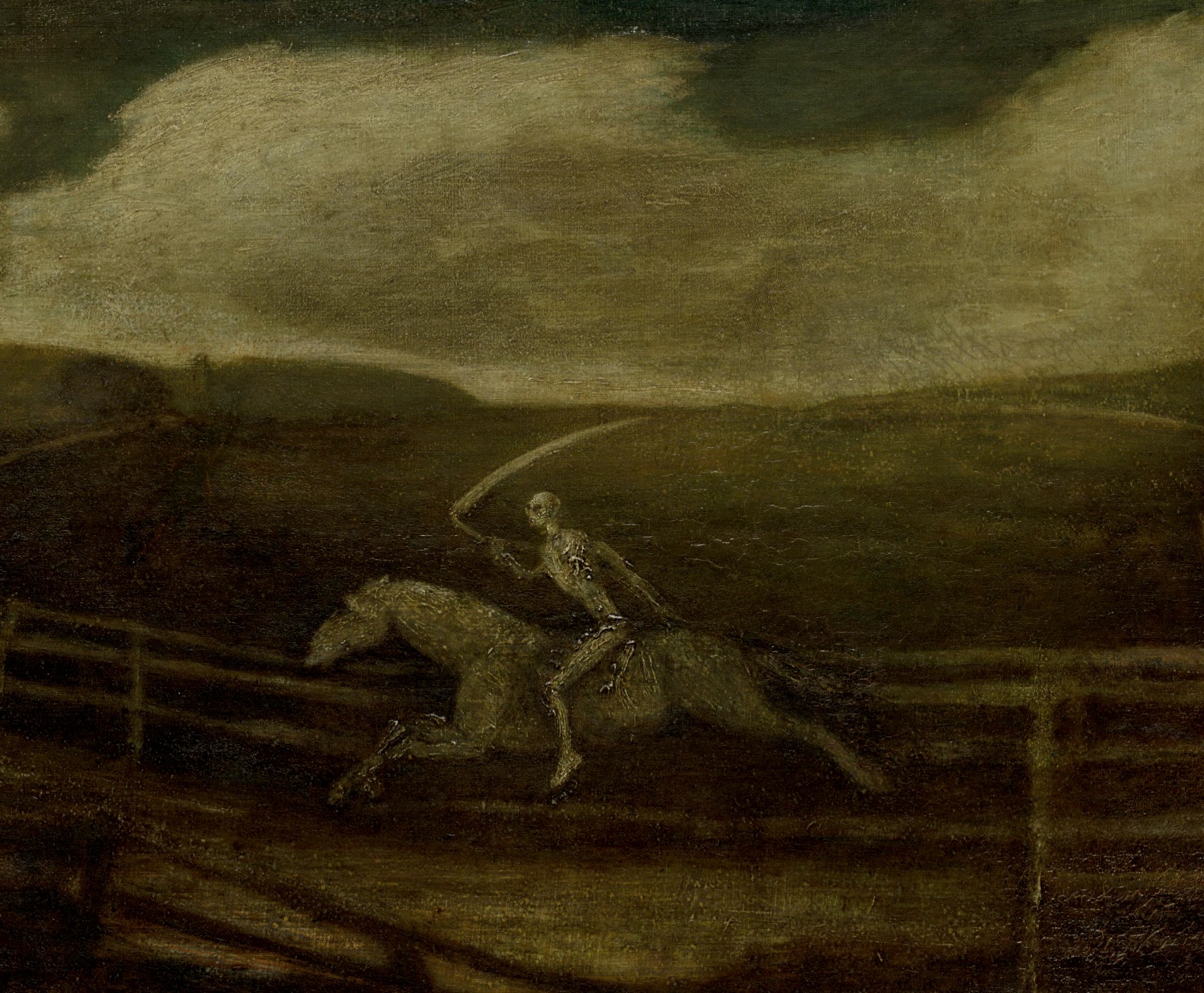
Albert Pinkham Ryder, The Race Track (Death on a Pale Horse), c. 1896-1908.

Those six rolls took forever. My mind, shocked from sleep into high alert, threw everything into slow motion. I noticed everything: the guitars, suitcases—even some croquet balls and mallets (I’d planned a holiday game on a Cambridge lawn)—began to fly out of the dislodged windows and sunroof, while my strangely relaxed body rose up and slipped back, rose up and slipped back, just the way it had in the giant revolving barrel at the amusement park funhouse of my childhood. I recall no sense of panic. I observed all those motions with a kind of curiosity. So this is how an automobile accident feels. So this is what it’s like to face death.

I may have blacked out by the time we came to a stop. I was revived by the voices of witnesses who had stopped their cars and run over to see if we were still alive. Evidently our tumbling bus had made an alarming spectacle. “Are you all right?” someone asked. I was lying face down, motionless, on the ceiling of the overturned bus. Was I, in fact, all right? I felt a reluctance—a fear, really—to find the answer. What if I were too broken to move?

I couldn’t just go on lying there. It wouldn’t be polite to keep those people in suspense. So I moved my hands, then my arms, then my legs. I sat up. I was, thanks be to God, all right. And so was my friend. Nothing broken. Only the bus was beyond mending. Halfway to Boston at that point, we caught a Greyhound the rest of the way, and the next day I experienced the most grateful Thanksgiving of my life.

I kept the feast with a few dear friends in the eighteenth-century house of Henry Wadsworth Longfellow, next door to my seminary. One of my friends, a descendent of the famous poet, was living in her ancestor’s house. During the siege of Boston in the American Revolution, George Washington had also stayed there. It’s now part of the National Park Service.

Longfellow House (1759), Cambridge, Massachusetts.

Our gathering at Longfellow House had all the lovely qualities we anticipate in a holiday feast with the ones we love. But my narrow brush with death had intensified my receptivity, bathing those precious hours with an almost transcendent glow of gratitude and wonder and indescribable joy. The Thanksgiving of 1969 was, in a strikingly literal way, the first day of the rest of my life, and my awareness of the gifts of aliveness and friendship and grace was focused and deepened and perfected as never before—and perhaps never again.

After our meal, we adjourned to the parlor as the late sun cast its parting rays through the wavy glass of Georgian windows. I remember that light as golden. Someone moved to the grand piano, and began to play one of Chopin’s Nocturnes. We fell into a companionable silence to let the music carry us away. And within.

I may not have died; but I had gone to heaven.
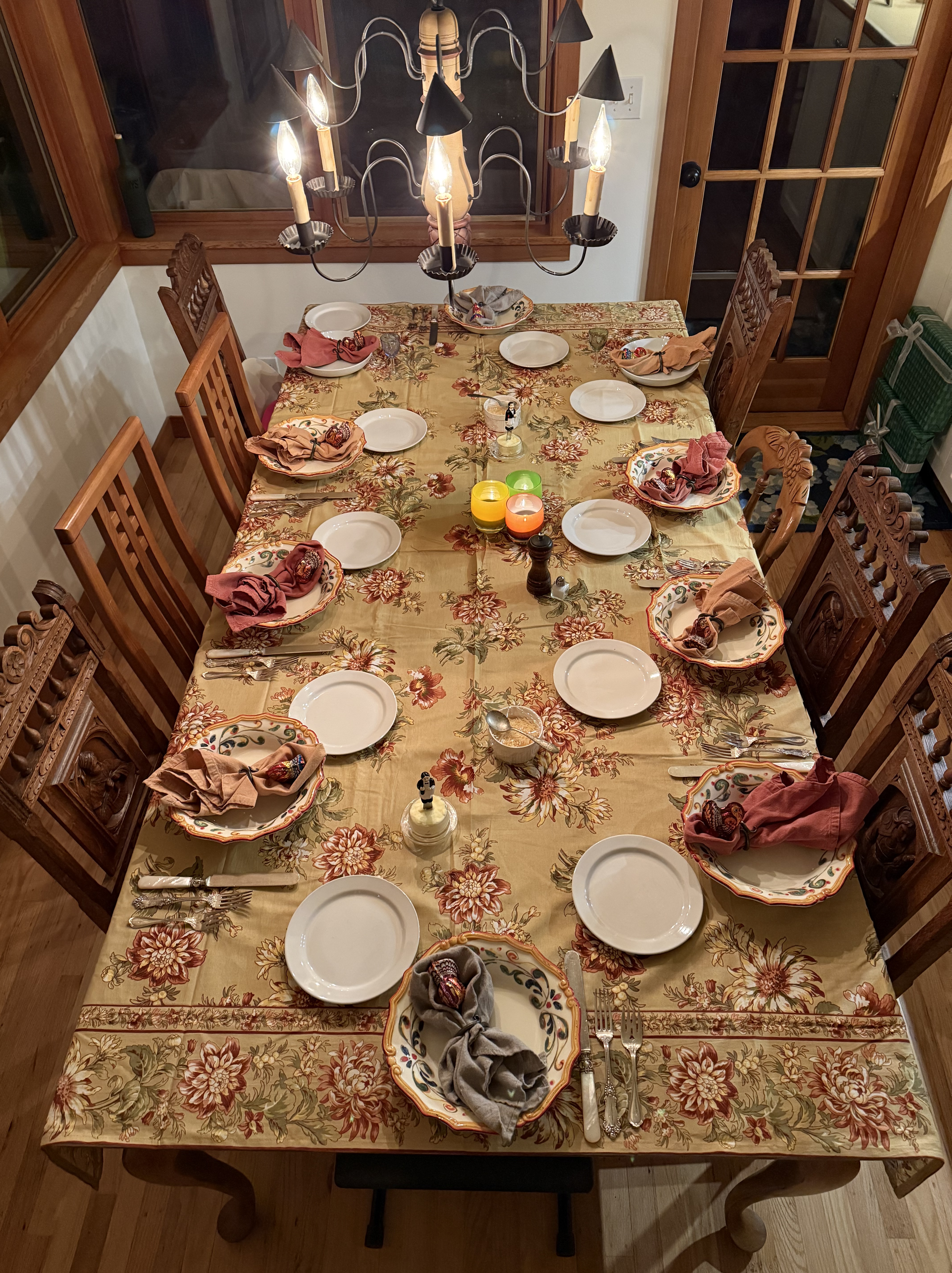
“Gratitude calls us to sit together, to imagine the world as a table of hospitality.” (Diana Butler Bass)


[i] Joan Chittister OSB, The Rule of Benedict: A Spirituality for the 21st Century (New York: Crossroad, 1992/2010), 190.

[ii] Robert Emmons, q. in Diana Butler Bass, Grateful: The Transformative Power of Giving Thanks (New York: Harper One, 2018), 29.

[iii] Ibid., 97.

[iv] Bass, ibid., 186.

[v] In an Old Irish tale, a chieftain is asked to name the finest music in the world. “The music of what happens, that is the finest music in the world,” he says. Cited in John Burnside, The Music of Time: Poetry in the Twentieth Century (Princeton, NJ: Princeton University Press, 2020), 12.

[vi] Lewis Hyde, The Gift: Imagination and the Erotic Life of Property (New York: Vintage, 1979). This classic is a must-read. It has influenced many liturgists, artists and theologians.

[vii] Quoted in Bass, 44.

[viii] Ibid., 39-40.
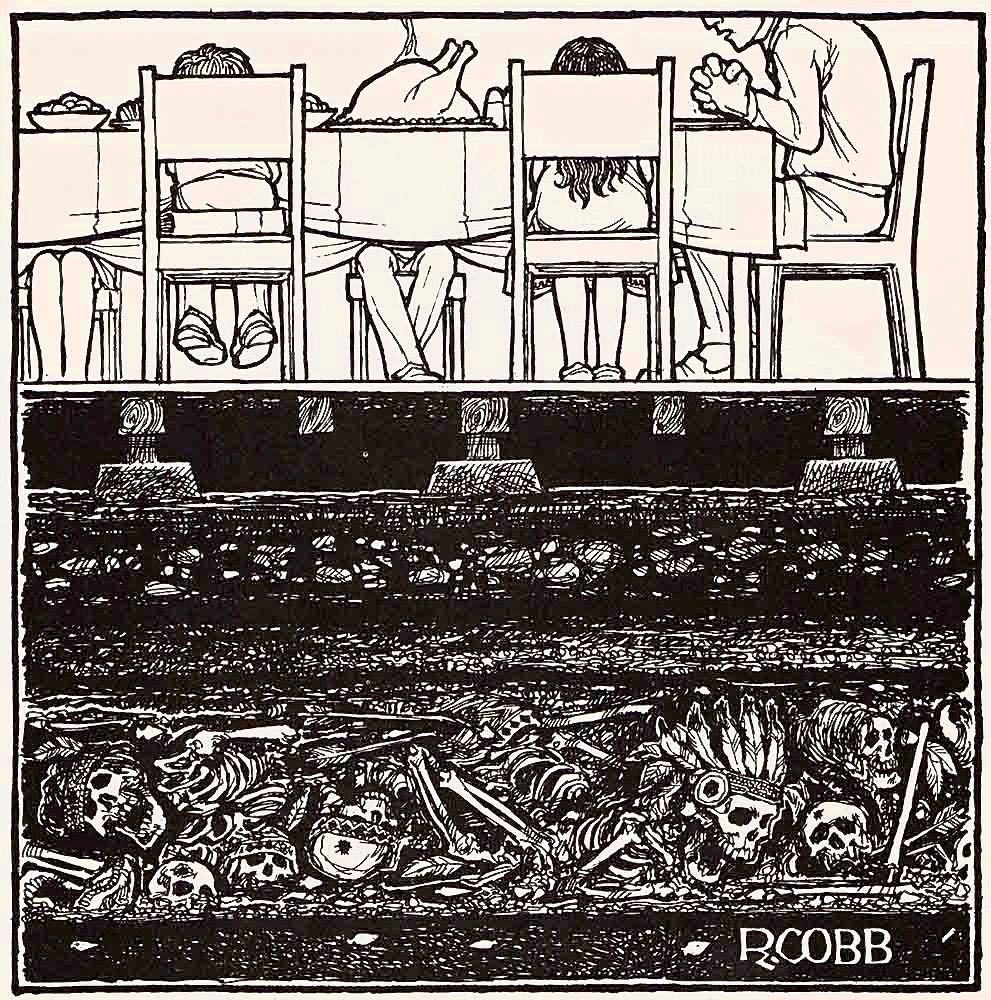
“Don’t mess with our myths!” — Thoughts on Thanksgiving Eve

Ron Cobb’s troubling cartoon in the Los Angeles Free Press has been in my Thanksgiving file for 50 years.

This new Israel the Lord brought by a mighty hand and an outstretched arm over a greater than the Red Sea, and gave them these ends of the earth for their habitation. In a day, with a wonderful alteration such as was never heard of in the world, the remote, rocky, bushy, wild-woody wilderness became for fertileness the wonder of the world, a second Eden, rejoicing and blossoming as a Rose, Beautiful as Tizrah, Comely as Jerusalem.   

— A New England sermon, 17th century

Adam saw it in a brighter sunshine, but never knew the shade of pensive beauty which Eden won from his expulsion. 

— Nathanael Hawthorne, The Marble Faun

Forty years ago, traveling in an old school bus with four other humans and two dogs, I visited New England communes to engage in dialogue about the nature of community. The project, funded by the Episcopal Church, was conceived by the Rev. Bill Teska, a fellow priest who thought the Church had something to learn from grassroots experiments in the nurturing of a common life. 

It was November. Snow was beginning to blanket the land. Whenever we had to sleep in our chilly bus, I regretted that we were one animal short of a three-dog night. New England freezes will test the soul. At a newly-formed commune in Maine, we wondered how their experiment was going. “Ask us in the spring,” they told us. “We haven’t gone through our first winter yet. A commune hasn’t proved it can survive until it’s been through a winter.”

The United States of America has survived some pretty severe winters of discontent, but the storms brewing now have us all on edge in a way that feels unprecedented. We have begun to doubt our survival. 

In reading Colm Toíbín’s The Magician, a novel about the life of Thomas Mann, I was struck by a couple of paragraphs describing Germany in 1934. With a few word changes, they could have been ripped from the headlines of America today:

“Each morning, as they read the newspapers over breakfast, one of them would share an item, a fresh outrage committed by the Nazis, an arrest or confiscation of property, a threat to the peace of Europe, an outlandish claim against the Jewish population or against writers and artists or against Communists, and they would sigh or grow silent. On some days, while reading out an item of news, Katia would say that this was the worst, only to be corrected by Erika, who would have found something even more outrageous.” 

“The Nazis … were street fighters who had taken power without losing their sway over the streets. They managed to be both government and opposition. They thrived on the idea of enemies, including enemies within. They did not fear bad publicity—rather, they actually wanted the worst of their actions to become widely known, all the better to make everyone, even those loyal to them, afraid.” [i]

Sound familiar? What decent soul has not been worn down by the relentless succession of lies, madness, and evil acts over the past five years?  And who does not now tremble at the increasingly overt embrace of violence, fear and hatred as acceptable political tools by a major political party? 

I was born 6 weeks after D-Day. Although I have lived through some troubled times in America, I have never doubted my country’s ability to survive its sins—until this year. Suddenly the American experiment seems shockingly fragile and strangely impermanent. While the majority of Americans may still desire the greater good, the proliferation of bad actors, along with their enablers and dupes, has metastasized into the tens of millions. Our democracy managed to survive January 6th, but not by what anyone could call a comfortable margin. The party that enabled and even fomented insurrection not only refuses to show a shred of shame or remorse, it is actively working to undermine whatever defenses—like voting rights, or an impartial judiciary—remain against future coup attempts.

There is not yet a majority in Congress willing to overturn an election. Nor is a military takeover currently in the cards. But such scenarios are no longer utterly inconceivable. The smell of burning books is already in the air. Where do we go from here?

When the demons run wild in our common life, we cry, “This is not who we are!” The myth of American innocence has been a prevalent theme since the first colonists arrived in the “New World.” Freed of the dead weight of the past, armed with a sense of limitless possibility and buoyant resilience, we (i.e., white Americans) have preferred to think of ourselves as forever young. 

The American, according to the myth, is the new Adam (or Eve) in the new Eden, a “radically new personality, the hero of the new adventure: an individual emancipated from history, happily bereft of ancestry, untouched and undefiled by the usual inheritances of family and race; an individual standing alone, self-reliant and self-propelling, ready to confront whatever awaited him with the aid of his own unique and inherent resources.” [ii]   

However, the preservation of this myth requires an immense labor of forgetting. Slavery, racism, the Native American genocide, xenophobia, mob violence, misogyny, environmental destruction and countless other sins do not fit the narrative of innocence. If myth’s stabilizing power lies in both conscious and unconscious agreement about our collective memory (“This is who we are!”), stirring up the troubling ghosts of historical evidence poses a threat to our sense of cohesion and identity. Tradition loses its binding force if it is allowed to be put into question. 

“Don’t mess with our myths!” is the rallying cry of the far right, who have shown their willingness to destroy America in order to save their version of it. But the rest of us should not feel too secure within our own fictions of innocence. We have yet to resolve our legacy of racism. We seem incapable of addressing our propensity for violence. And our lifelong assumptions about American democracy have been plunged into doubt. When fascism infected Europe in the 1930s, Americans said, “It can’t happen here.” In these latter days, we know better. It can. 

Okay, this all seems a little grim for Thanksgiving Eve. But if our current crisis forces us to reexamine and reform the foundations of our common life, perhaps we can be thankful for that. For people of faith, the survival of life as we know it is never the highest good. As we reminded ourselves last Sunday on the Feast of Christ the King, we are not in charge of history, and don’t have to be in love with particular outcomes of transitory events. Empires rise, empires fall. The Kingdom of God—the reign of self-diffusive love—is the only thing that endures, because it knows the secret of dying and rising. Therefore, even at the grave we make our song: Alleluia, alleluia, alleluia! [iii]

Even as the mountains tumble into the sea, the holy Mystery whispers “Rise! Rise!” into every moment, even the most forlorn. For that, I give thanks.

God is our refuge and strength,
a very present help in trouble.
Therefore we will not fear, though the earth be moved, 
or the mountains tumble into the sea; 
though the waters of chaos rage and foam, 
though the mountains tremble at its tumult,
the Lord of hosts is with us; the God of Jacob is our stronghold. 

— Psalm 46: 1-4

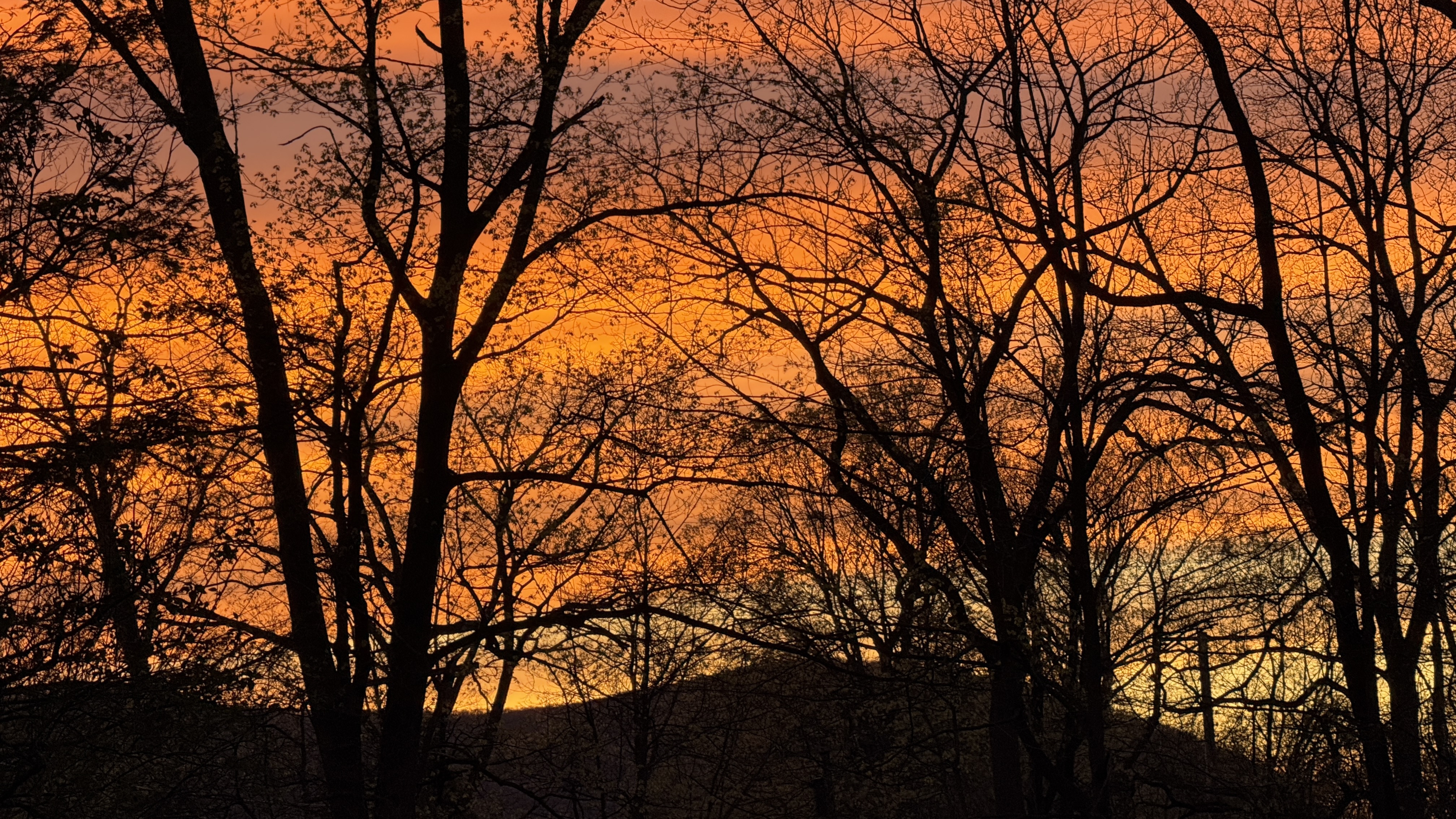
Mount Rainier dawn (March 4, 2015)

Previous Thanksgiving posts:

Utopian Dreams and Cold Realities: A Thanksgiving Homily

Trying to Get Home for Thanksgiving


[i] Colm Toíbín, The Magician (New York: Scribner, 2021), 229 & 231.

[ii] R. W. B. Lewis, The American Adam: Innocence, Tragedy, and Tradition in the Nineteenth Century (Chicago: University of Chicago Press, 1955), 5.

[iii] The Burial Office, Episcopal Book of Common Prayer, 499.

Utopian Dreams and Cold Realities: A Thanksgiving Homily

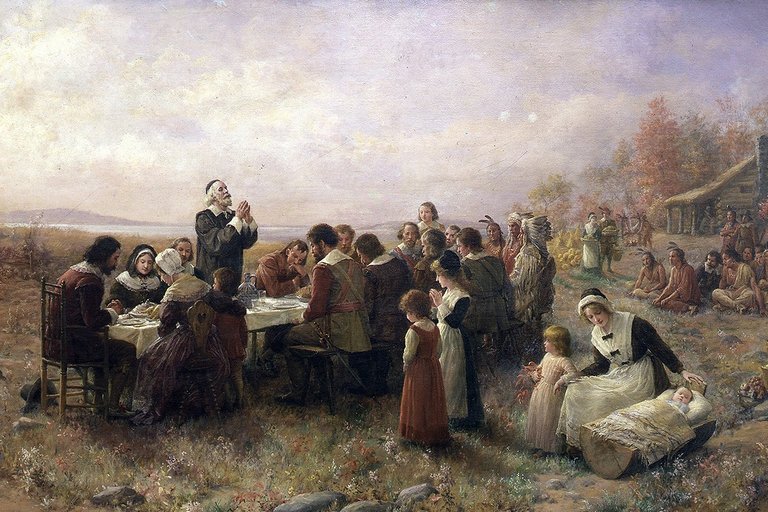
“The First Thanksgiving at Plymouth,” Jennie Augusta Brownscombe (1914)

The faithful all lived together and owned everything in common; they sold their goods and possessions and shared out the proceeds to all, according to what each one needed. They went as a body to the Temple every day, but met in their houses for the breaking of bread, sharing their food with glad and generous hearts.

–– Acts 2:44-46


In November of 1972 I participated in an Episcopal Church project to engage with American communal movements in a process of dialogue and mutual learning. For three weeks in the snow and cold of New England, five people and a couple of dogs wandered the back roads of Maine, New Hampshire and Vermont in a 1953 school bus with a rebuilt, unreliable engine. Amid occasional breakdowns and blizzards, we visited a series of communes, ranging from an upscale geodesic dome to an isolated farm with neither plumbing nor electricity. The nights we spent on the bus were cold, and we were one dog short!

As people of faith, committed to watch the horizon where divine intention meets human possibility, we wanted to learn from the modern pilgrims who were making their exodus in search of a new society. What did they hope for? What had they learned? Did their utopian experiments in communal living bear any resemblance to the gospel message?

The Rev. Bill Teska, the priest behind the project, saw in the communal impulse an apocalyptic rejection of the political and economic structures which have been so fatal for both love and justice. The communards, he believed, were saying NO to this world for the sake of something better.

“By thousands, and tens of thousands, they are walking out of this world into a new one. . . In their capacity of standing as living examples of communities whose lives are ordered according to values entirely different from, and in many ways opposed to, the values of this world, the new communes fulfill for our society the same role which monasteries have performed in past centuries.”[i]

Exploring new worlds isn’t for the uncommitted. The trash bin of history is full of failed utopian quests. Even in Eden, there is always a snake or two. And the work can be strenuous. The transformation of consciousness is as daunting as the reformation of society. Every exodus feels the gravitational pull of the “Egypt” in its rearview mirror. But the biblical God has always encouraged the risk-takers: Do not be afraid. I will go with you.

And as Teska wrote at the time about the redemptive hope shared by both church and commune: “The future which the communards envision is one in which triumphant and transfigured Humanity reigns in Love.”

That was many years ago, and I have no idea whether any of those collectives still exist, or to what extent they made a difference in the lives of their members or in the world around them. But I have never forgotten their idealism––or their courage. Blessed are the pure in heart.

At a fairly new communal farm in Maine, I asked someone how their experiment was going. “Ask us in the spring,” he said. “We haven’t gone through our first winter yet. A commune hasn’t proved it can survive until it’s been through a winter.”

In the Plymouth Colony of Puritan immigrants to Massachusetts in 1620, only half made it through their first winter. The ones who survived threw the famous feast of Thanksgiving legend in the fall of 1621, with some combination of European wheat and native corn. About ninety locals––the Wampanoag people––showed up for the potluck, which included some deer meat but no turkey. They outnumbered the immigrants by two to one, but everyone seemed to get along. It would be an example too little followed in the years to come.

However tragic the subsequent history would prove, the early Puritan immigrants idealized their story as a great communal experiment, a chance to revise the tired narratives of the Old World in “a second Eden, rejoicing and blossoming as a Rose, Beautiful as Tizrah, Comely as Jerusalem.”[ii] In that sense, the New England communes we visited in 1972 were heirs of that Pilgrim vision. Liberated from the structures of the past, they hoped to forge a new kind of society and perhaps a new kind of humanity.

But America has always had its dissenters from the glowing narrative of a new people in a new Eden. As Alexander Hamilton would grumble in November of 1787:

“Have we not already seen enough of the fallacy and extravagance of those idle theories which have amused us with promises of an exemption from the imperfections, the weaknesses and the evils incident to society in every shape? Is it not time to awake from the deceitful dream of a golden age?”[iii]

In an America now ruled by a billionaire oligarchy, a raging lunatic, and an unprincipled Congressional majority verging on treason, Hamilton’s cynical doubts would seem to carry the day. The utopian dream of the Pilgrims, or the 1970s communards, has no where to take place in a land so polluted by ignorance, hate and greed. From sea to shining sea, where is Eden now?

For those of us who still dream of a just and loving society, this is a winter of the utmost testing. Many may wither in its icy blast. And yet, come what may, I still believe in divine imagination and human potential. God has a better idea than our despair.

This eschatological idea has been described with biblical eloquence in a poem by Judy Chicago.[iv] May it be sacramentally reimagined at every Thanksgiving feast, and then fulfilled in fact through our daily prophetic acts of compassion, justice, and hope:

And then all that has divided us will merge
And then compassion will be wedded to power
And then softness will come to a world that is harsh and unkind
And then both men and women will be gentle
And then both women and men will be strong
And then no person will be subject to another’s will
And then all will be rich and free and varied
And then the greed of some will give way to the needs of many
And then all will share equally in the Earth’s abundance
And then all will care for the sick and the weak and the old
And then all will nourish the young
And then all will cherish life’s creatures
And then all will live in harmony with each other and the Earth
And then everywhere will be called Eden once again.


Related post: No Place Like Home


[i] From a report on the project, written in Advent, 1972, by the Rev. William J. Teska, Eleanor Leiper Hall, and the Rev. Jim Friedrich.

[ii] Sacvan Bercovitch, The American Jeremiad (Madison: University of Wisconsin Press, 1978), 71.

[iii] Alexander Hamilton, The Federalist Papers No. 6, “Concerning Dangers of Dissensions Between the States.”

[iv] Judy Chicago, “Merger Poem,” 1979.