
“The tables outside the cantina were full of beautiful laughing men and women. I didn’t like the cantina at night: it was hard to book a table, and everyone who sat there looked on display, the women in their lovely summer dresses, the men with their hair oiled back on their heads, their tanned bare feet resting proprietorially on top of their Gucci loafers. One wanted to applaud them for presenting such a successful vision of life: you could almost believe they had lived their whole lives, had been reared and groomed from birth, for this one particular night: that this was the pinnacle, this golden summer evening they had all reached simultaneously.
“Yet it made me a little sad to see them there, laughing and drinking champagne, for you knew it was all downhill from here.”
— Peter Cameron, Andorra [i]
The beautiful laughing men and women in Cameron’s cantina do not arouse our envy. Their self-display seems shallow, narcissistic and unreal. They appear ignorant of time. Golden summer evenings do not last forever. Having achieved the pinnacle, what Wallace Stevens called “the barrenness of the fertile thing that can attain no more,”[ii] they have nowhere to go but down.
The traditional lore of Midsummer Eve shares this suspicion. To mark the year’s longest day, bonfires were lit on British hilltops to assist and encourage the sun at the outset of its long inevitable decline into the winter dark. And “Midsummer Night”—blessedly short—was said to be a time of both mischief and danger, when chaotic pressures cracked open the stability of the world and wild spirits were abroad.
In A Midsummer Night’s Dream, Shakespeare explores these themes with a complicated plot in which the normal order of the world is unraveled for a night, and confusion rules until the dawn. Rulers find their commands thwarted. Lovers aim their desire at mistaken targets. The beautiful queen of the fairies falls madly in love with a low-born mortal who, by magic spell, has the monstrous head of an ass. Puck, the fairy trickster, multiplies the mischief by both design and error. And even words of dialogue take on altered and contradictory meanings.
All this takes place in an enchanted forest, a wild, liminal state outside the civilized order, where societal assumptions and rules are suspended or reversed, hierarchies are overturned, and identities become fluid and changeable. As Bottom says to Titania, “reason and love keep little company together these days.”
In Shakespeare, such liminal spaces serve a critical purpose. Their disorder offers a freedom to reshuffle and reconsider accepted realities, inviting transformation at both a personal and social level. Removed for a time from the customary rules and roles, characters discover new possibilities for themselves and society before returning to “reality.”
However, once you leave your given world for a time, you can never again accept its reality as absolute. You realize that there is more than one way to do both the self and the world. Any single version of reality is but an alternative. In this sense, life itself is but a dream. This refusal to absolutize the given world is the foundation of social justice: we can live better lives and make a better world. It also, however, can open the door to irrationality and madness, exemplified by the millions who live, happily and hatefully, in the fact-free world of American fascism..
At the end of Shakespeare’s play, Puck delivers an epilogue to the audience, those “who have slumbered here, / While these visions did appear.” It’s all been a dream, he assures us, as if we had never really crossed the boundary into the transformative space of a visionary world.
But can we be so sure? Have we not ourselves been touched, perhaps even transformed? Within A Midsummer Night’s Dream, there is a play-within-a-play (the comically performed tragedy of Pyramus and Thisbe). The actors in Midsummer watch the actors playing actors in Pyramus, just as we the audience watch all these permutations from our safe position outside the “fourth wall” which separates the stage from reality. But are we so different from the players on the stage? As Shakespeare scholar Marjorie Garber writes,
“A play is a fiction, art is an illusion, ‘no more yielding but a dream.’ Can we be blamed if we wonder—now that we have been told that we are reality—when someone will wake and recognize that we are only a dream? Can we be blamed for looking over our shoulders, and wondering who is watching the play in which we are acting, while we watch, onstage, actors watching actors who play actors performing a play?” [iii]
Two weeks after Midsummer Eve, I saw a magical outdoor production of A Midsummer Night’s Dream at the Bloedel Reserve, an Arcadian refuge of woods and meadows on my island. Beginning before sunset, it utilized the fading of the day to intensify our immersion into the dreamworld. By play’s end, it was almost night. The narrow path across a rolling meadow to the exit prevented an immediate return to reality. For a few precious minutes more we lingered in the dream, making our ghostly procession of shadows in the twilight.
Every play comes to an end. Every actor must make an exit. I have no plans to do so any time soon (God willing). There are more lines to deliver! However, since I begin my ninth decade tomorrow, time may not be on my side—but it’s on my mind.
Medieval thinkers divided a human lifetime into “ages.” Some had just four: Childhood, Youth, Maturity, and Old Age. Isadore of Seville (c. 560-636) expanded that to six: infancy (up to 7), childhood (7-14), adolescence (14-28), youth (28-50), gravitas (50-70), and, for anything beyond 70, senectum (the same root as senior and senility).
[Of course, senectum is a hot topic in this election year. Is the President too old to govern? Perhaps a better question would be: Why can’t the other guy act his age? As the Bible says, “Woe to you, land, if your king is a child!” (Ecclesiastes 10:16). But I digress.]
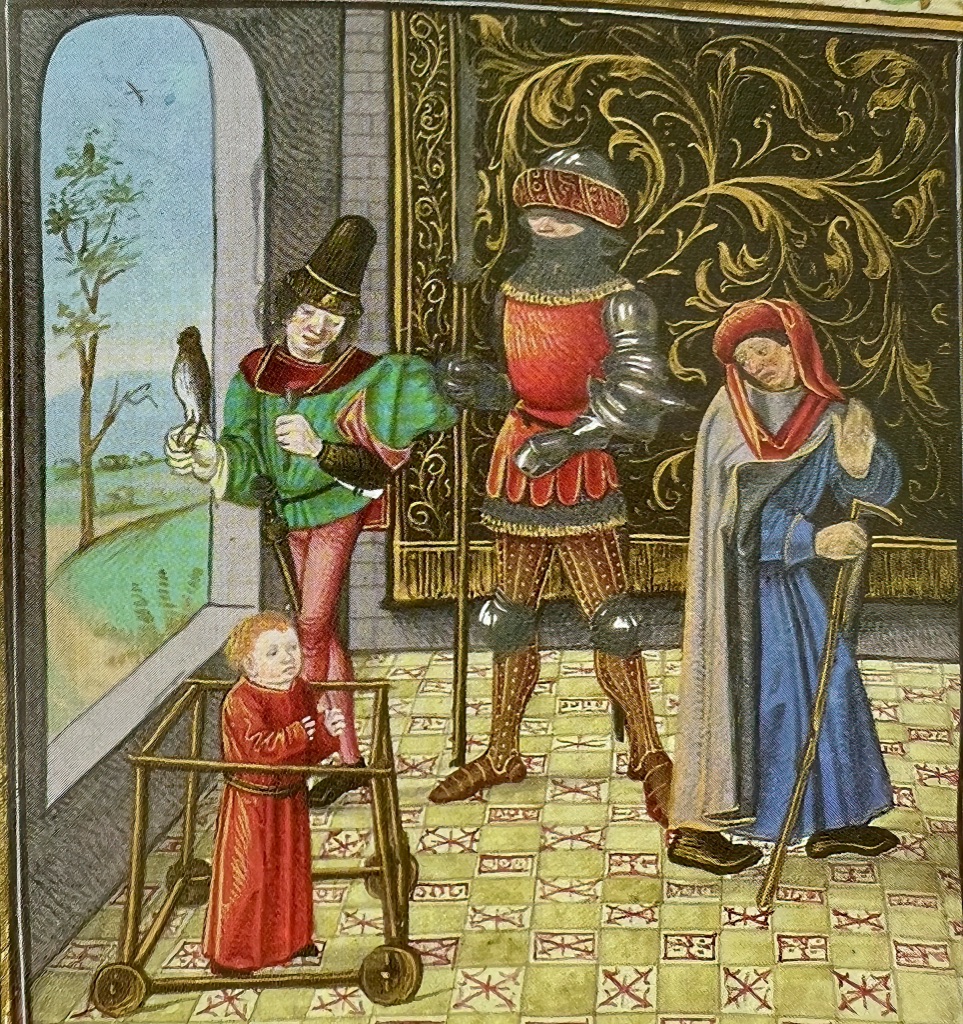
In this fifteenth-century illumination by Bartholomaeus Anglicus, the four ages of the human life-cycle stand in the same room, as if each of us is all the ages we have ever been. Childhood is clothed in red, the color of sanguinity (eager hopefulness). Youth is into fashion and sports, while Maturity dresses for battle. Old Age, warmly attired for the wintry years, glances back at all his past selves, hopefully with gratitude rather than regret.

A later image by the same artist depicts seven ages standing in two groups. On the right, Childhood plays with a stick and ball, Adolescence clasps his schoolbooks, and Youth carries a spear, perhaps dreaming of competitive glory. The first three stages of Maturity are not radically distinct from one another, but Old Age, shorter and bearded, is starting to separate his body from the group. Yet he still keeps an eye on the Child he once was.

Time is a gift, and I am truly grateful for my years so far—the dreams as well as the realities. Je ne regrette rien. As for the road ahead (even if it’s all downhill), I wish not to be the man on the donkey, idly dozing along the pilgrim way. Like the figure gazing at the view from the bridge, I want to keep taking it all in. As an old man advised a younger friend in Henry James’ The Ambassadors:
“Live all you can; it’s a mistake not to.”
[i] Peter Cameron, Andorra (New York: Farrar Strauss Giroux, 1997), 149-150.
[ii] Wallace Stevens, “Credences of Summer.”
[iii] Marjorie Garber, Shakespeare After All (New York: Anchor, 2005), 237.
 The religious imagineer