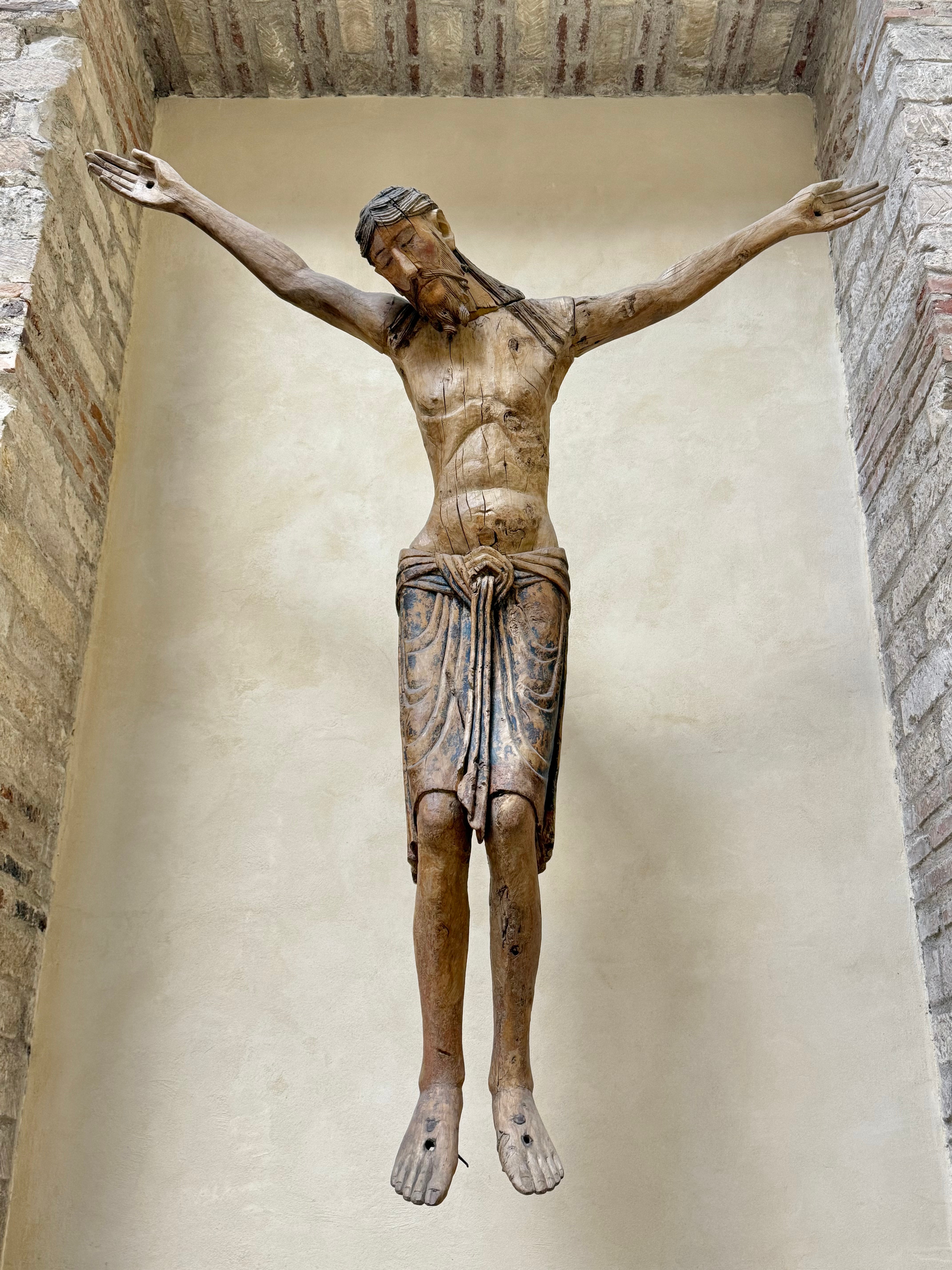
Crucified Christ (northern France, late 12th century).
Isaiah 53:5 But he was wounded for our transgressions, crushed for our iniquities; upon him was the punishment that made us whole, and by his bruises we are healed.
Was it really necessary for Jesus to be pierced and crushed? And how exactly did his suffering and death make us whole? There has never been a conclusive single answer, because any attempt to “solve” the Paschal Mystery with a reductive formula is missing the point. The cross is an experience to enter, not an idea to be explained. “I wonder as I wander out under the sky,” says the old Nativity carol, “why Jesus our Savior did come for to die / for poor ornery people like you and like I. . .” And now, this Holy Week, we come again to the foot of the cross, and we wonder.
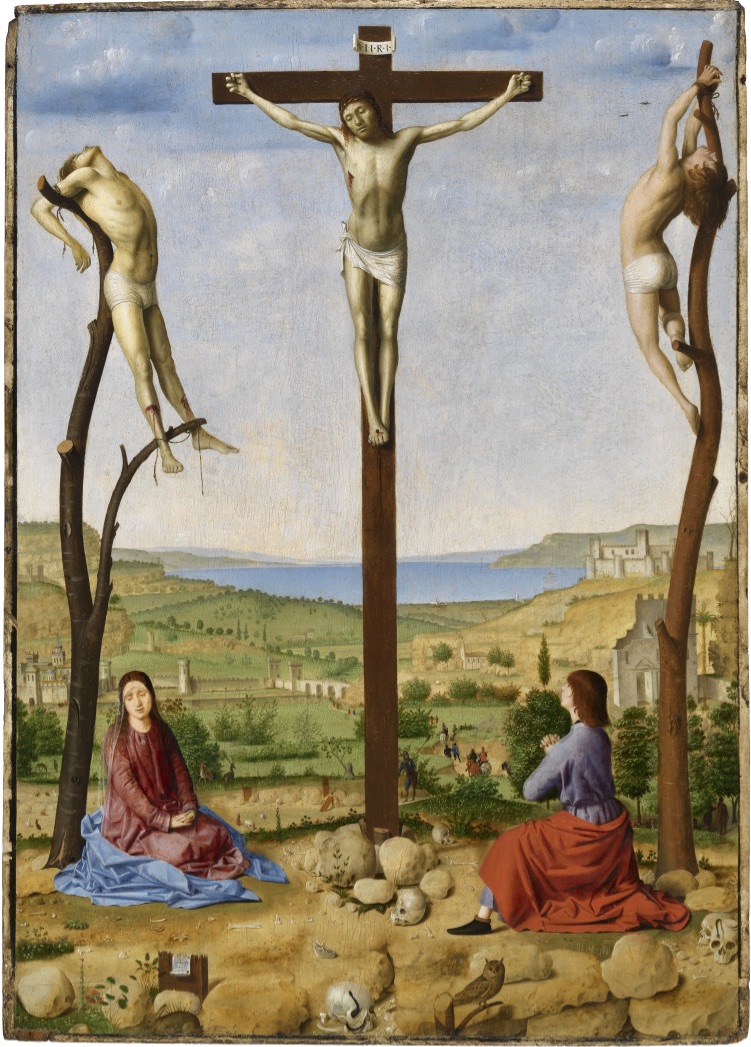
Antonello da Messina, The Antwerp Crucifixion (1475).
Let us discard any crude notions of the cross as a transaction, as if somebody had to pay for all the damage wrought by human sin, so Jesus stepped up like a big spender to declare, “This one’s on me.” Such “substitution” theology either trivializes the cost of sin (can Auschwitz or Gaza be so lightly dismissed?) or risks masochism by stressing the pain of the Passion, as Mel Gibson did in his notorious movie. The sacredness of God’s Friday is not in the violence or the blood, but in the Love that rewrites the darkest story.
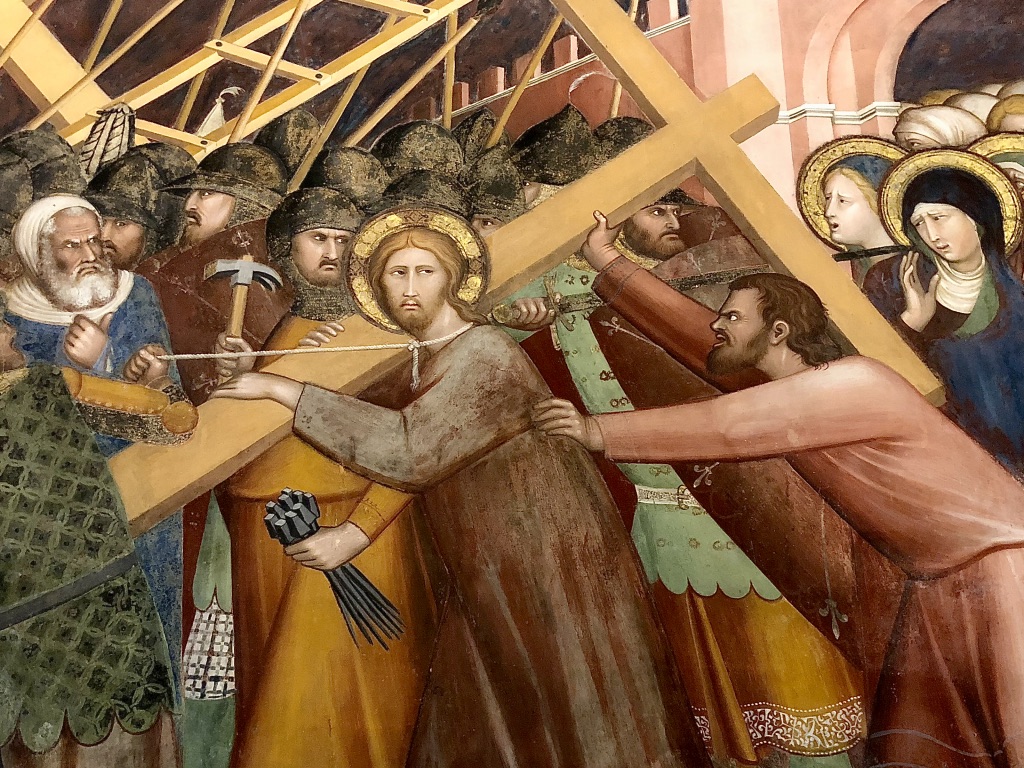
Lippo Memmi, Christ carrying the cross, Duomo di San Gimignano, Tuscany (1335-1345).
And let us not reduce the salvific death of Jesus to a simple case of human cruelty claiming one more victim. Something more than human tyranny and human tragedy—something divine—was at work in the cross. But the divine presence on Calvary’s hill was not in the form of any punishment dished out by an angry God. God was there in the vulnerable, suffering body of Jesus, the Incarnate Word of self-diffusive love, who chose to share the human condition in all its forms—even the bleakest and most wretched. Jesus didn’t suffer instead of us. Jesus suffered with us. And through the humanity of Jesus, our own experience of alienation and affliction has been absorbed into the trinitarian life of God, where it is held in love’s eternal embrace and drained of its toxicity. As the prophet said, By his wounds we are healed.
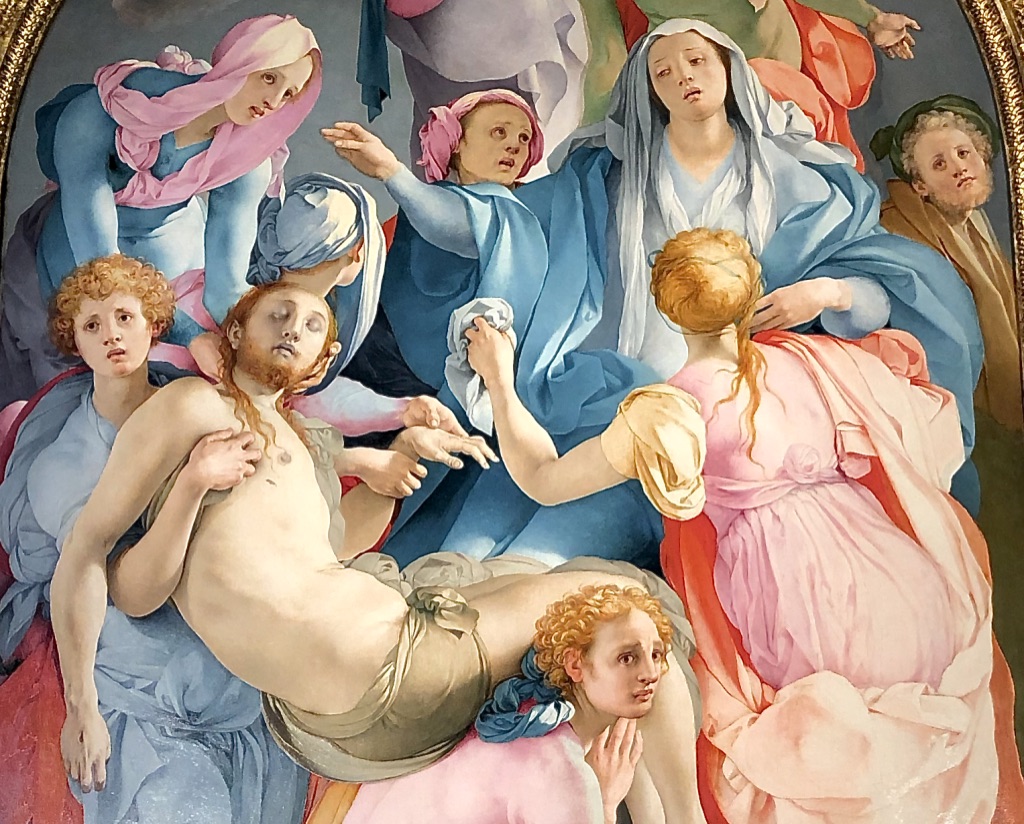
Jacopo Pontormo, Deposition from the Cross, Santa Felicita, Florence (1525-1528).
Or as theologian Paul Fiddes put it, “Far from simply forgetting about the sins of the world, [God] journeys deeply into the heart of [the human] condition. . . God participates in our brokenness, to win us to the offer of healing.” In our own evil time, when hate and cruelty are running wild, sometimes we feel overwhelmed, discouraged, or powerless. But that’s exactly where Jesus comes to join us, not simply to keep us company on the countless crosses of this world, but to transform our sufferings into the seeds of resurrection.
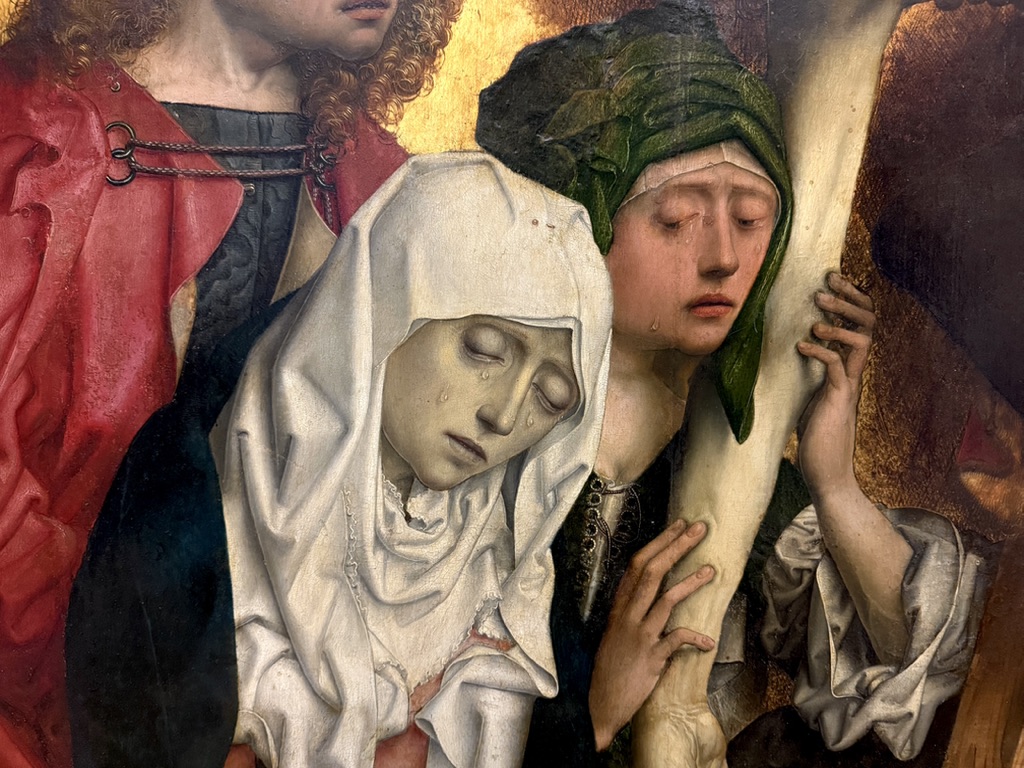
Anonymous “Master of St. Bartholomew,” The Descent from the Cross, Cologne, c. 1480-1510 (detail).
The title is from a hymn by W. H. Vanstone, “Morning Glory, Starlit Sky” (585 in the Episcopal Hymnal 1982)
The Easter Vigil is the molten core of Christian worship: a multisensory passage from darkness to light, death to life. With fire and water, stories and prayers, hymns and chants, candles and incense, bread and wine, it is the most luminous and wondrous of liturgies. The morning rites of Easter Sunday celebrate Resurrection, but the Easter Vigil on the night before feels almost like Resurrection itself. When it’s over, you come away a little dazed, wondering “oh what is that beautiful thing that just happened?” [ii]
After the New Fire is lit at sunset on Holy Saturday, one of the first things that happens at the Easter Vigil is the recitation of narratives and prophetic texts [iii] from the Hebrew Scriptures, beginning with the Creation story (Genesis 1:1—2:4a). In most churches, the texts are read from a lectern, but for nearly four decades, in a dozen different West Coast churches, I have curated the performance of the Vigil lectionary using drama, storytellers, music and projected media.
There’s nothing wrong with a well-read passage of canonical text—I’m quite fond of a good reading by a practiced and thoughtful voice—but sometimes a telling or dramatization can reach places which a reading cannot. Instead of a reader as a passive, transparent window for a sacred text to pass through without inflection or distortion, a teller embodies the text in breath, intonation, gesture and movement, making it alive and present and urgent in the moment of its speaking. And a dramatization can make a familiar story be freshly encountered. A story told or performed rather than read has a unique kind of authority, coming from the heart instead of a book.
The Easter Vigil is the Christian dreamtime, and we try to engage its lectionary accordingly. Biblical stories aren’t just memories about the past. They are living words meant to guide and shape our own responses to the present. As we become steeped in the stories, they begin to dwell in us, and we in them.
When we hear of the world drowning in its own evil, while a faithful remnant tries to navigate the sea of chaos, we recognize ourselves aboard the ark. When we hear of an evil regime trying to crush the ones who are “not like us,” the deliverance of the oppressed at the Red Sea encourages our own struggle to break free of the dark. When we hear of dry bones resurrected by divine breath, our own dead hopes begin to breathe again.
In the darkest days of the Second World War, W. H. Auden wrote a “Christmas Oratorio” [iv] which had no illusions about the world into which God was made flesh:
The evil and the armed draw near; The weather smells of their hate And the houses smell of our fear …
Such days are upon us again, and we truly need our sacred stories—the ones that remember divine intention and a habitable future—more than ever. At our Episcopal parish of St. Barnabas on Bainbridge Island, Washington, where my wife is the rector, I’ve been developing fresh versions of the stories, listening carefully for whatever they want to say to us in the year of our Lord 2025.
We will begin with a pair of texts projected on a screen after the ancient Exultet is chanted. The first says, For God so loved our stories. This is of course a blend of Elie Wiesel’s “God made man because he loves stories” and John 3:16’s “For God so loved the world …” The theology of Incarnation says that God’s own self entered fully into the human story. And the theology of salvation says that we in turn are meant to participate in the divine story. Both meanings are implied in the preface to our Vigil story time, grounding the performed narratives in the conviction that we can meet God in them.
The second text is a verse from Jeremiah (29:11): For surely I know the purpose I have for you, says the Holy One: plans for peace and not for evil, to give you a future and a hope. At a time when our future is in question and hope is stretched thin, God invites us to sit around the Paschal fire and let the stories of promise speak to our hearts once more.
Here is how the telling will go at this year’s Paschal fire:
The Creation: After the voice of e.e. cummings says, “When God decided to invent everything, he took one breath bigger than a circus tent, and everything began,” a big screen lights up with spectacular footage of the natural world, taking us through the first seven days in seven minutes. In response, the congregation is urged “to pray fervently for all the people of the earth, and for ourselves, that we may repent of our careless and arrogant abuse of creation, and find our proper and constructive place within its fragile and balanced harmonies.”
The Flood: Four people at a table engage in Bible study. Some of them resist the story (“Why do we even tell this story? No one wants to believe in an angry God” … “In the beginning, God says everything’s so great. Then suddenly he wants to call the whole thing off?”). Others see a kind of learning going on—God learning to live with an imperfect creation. Then somebody argues that the story is not really about God’s choices or God’s emotional life. It’s about the ark.
“The people who first told this story were just like us. They were adrift in a sea of chaos. Everything they had hoped and believed was underwater, washed away in the blink of an eye, and they wanted to know if they still had a future.”
As the discussion winds down, someone says, “Well, I’d better go feed the animals.” Wild waves appear on the screen behind them. It turns out that they have been on their own ark the whole time. The story they were discussing was happening to them. That’s often true of Bible stories.
The exhortations to prayer that follow each story reiterate the themes of the narrative. After The Flood, the Presider reminds the assembly that “God remains deeply committed to our story … God will not forget us, though we be sinking in a sea of chaos.” And the Deacon bids us pray for victims of natural disasters, all whose lives are beset by chaos, those drowning in the dark waters of doubt and fear, and those who cling to the precious ark of faith.
The Red Sea:
Noirish images of anonymous figures (from a bleak Hungarian film) shuffle through an imprisoning corridor on the screen, while three dancers on the stage express the experience of oppression with their bodies. A narrator explains:
Three thousand years ago, in the land of Egypt, there were people who had no name. They were the faceless many, exploited by the powerful, forgotten by the privileged: slaves, immigrants, the poor, the homeless, the vulnerable, the invisible, the outcast.
Then dismissive terms for the oppressed appear on the screen in stark animated graphics: Not like us … worthless … horrible people … trash … less than human. More images of “the faceless many” are shown as the dancers writhe in despair and an offstage choir sings a verse of “Go down, Moses.”
Suddenly, the divine breaks into this dark world: the screen flashes red, and we see the words from Psalm 68 that are always used in Orthodox Paschal liturgies:
Let God arise! Let the foes of Love be scattered! Let the friends of justice be joyful!
Then we hear a verse of a Civil Rights song: “They say that freedom is a constant struggle … Oh Lord, we’ve struggled so long, we must be free.” The dancers’ bodies shift from oppression to liberation, while the screen shows powerful footage of crowds on the march for justice. As we hear a repeating loop of Martin Luther King saying “We cannot walk alone,” the dancers begin their own march across the stage to the “Red Sea,” where they halt while the narrator declares:
This too is a creation story: On this day, God brought a new people into existence. On this day, God became known as the One who delivers the oppressed, the One who remembers the forgotten and saves the lost , the One who opens the Way through the Sea of Impossibility, leading us beyond the chaos and the darkness into the Light. When the world says No, the power of God is YES!
As the dancers begin to cross the Sea, the choir sings, “We are not alone, God is with us …” After the song, the bidding to prayer begins:
Pray now for the conscience and courage to renounce our own complicity in the workings of violence, privilege and oppression. Pray in solidarity with all who are despised, rejected, exploited, abused, and oppressed. Pray for the day of liberation and salvation.
The Fiery Furnace: This story from the Book of Daniel is borrowed from the Orthodox lectionary for the Paschal Vigil, and its humor (yes, the Bible can be funny) provides some comic relief after the Red Sea. The story’s mischievous mockery of a vain and cruel king, outwitted in the end by divine intention, feels quite timely. The idol shown on the screen is a golden iPhone, which will be destroyed by a cartoon explosion from Looney Tunes. The humorously tedious repetition of the instruments signaling everyone to bow is performed with the following (admittedly unbiblical) instruments: bodhran, bicycle horn, slide whistle, chimes, train whistle, and Chinese wind gong. The Song of the three “young men” in the furnace is recited by three women in an abbreviated rap version. At the end, the cast of twelve exit happily, singing the old Shape Note chorus, “Babylon is fallen, to rise no more!”
The Fall of Babylon, Tapestry of the Apocalypse, Angers, France (1377-1382).
Then we give thanks “for the saints who refuse to bow down to the illusions and idolatries of this world” and pray for “the grace and courage to follow their example, resisting every evil, and entrusting our lives wholeheartedly to the Love who loves us.”
Valley of Dry Bones: Unlike the embellished retellings of the other stories, this one sticks closely to the biblical text, but is delivered in a storytelling mode by a single teller (me) in a spooky atmosphere of dim blue light. The voice of God is a college student on a high ladder. The sound of the bones joining together is made by an Indonesian unklung (8 bamboo rattles tuned to different pitches). When the story describes the breath coming into the lifeless figures sprawled across the valley, I get everyone in the assembly to inhale and exhale audibly a few times so that we can hear the spirit-breath entering our own bodies. Then I move among them, bidding one after another to rise until everyone is standing, completing the story with their own bodies: the risen assembly itself becomes a visible sign of hope reborn.
Then the Presider says,
Dear People of God: There are those who tell our story as a history of defeats and diminishments, a narrative of dashed hopes and inconsolable griefs. But tonight we tell a different story, a story that inhales God’s own breath and sings alleluia even at the grave. By your baptism, you have been entrusted with this story, to live out its great YES against every cry of defeat.
And then, with our sacred stories of faith and hope freshly written on our hearts, we will process from the Story Space to the church for the Renewal of Baptismal vows, followed by the festive first eucharist of Easter, replete with Alleluias. And God willing, by the time it’s all done, none of us will be the same.
May all of you who make the Paschal journey this weekend come to “see and know that things which were cast down are being raised up, and things which had grown old are being made new, and that all things are being brought to their perfection by the One through whom all things were made, our Savior Jesus Christ.” [v]
Resurrection of Christ, Brittany (c. 1425-1430).
All liturgical texts, unless otherwise cited, are by the author. The Easter Vigil at St. Barnabas Episcopal Church (Bainbridge Island, WA) is on April 19, 2025.
[i] The Exultet (“rejoice”) is a chanted praise sung before the Paschal Candle at the Easter Vigil. Dating back to the 7th or 8th century, it is one of the most beautiful chants in the western rite, and its text is packed with striking images and metaphors of Christ’s passage through death to resurrection, and its implications for our own salvation. Singing it at the Vigil has been one of my greatest priestly joys over the years.
[ii] The line is taken from Mary Oliver’s poem, “At Blackwater Pond.”
[iii] The Vigil lectionary is not all stories. Beautiful texts from Isaiah, Baruch, Ezekiel, and Zephaniah are options as well. During the “Story Time” of the Vigil, we stick to the narratives. The non-narrative texts are then recited by readers along the way between the Story Space and the church, so that the people process through a corridor of continuous audible texts on their way to the font of rebirth.
[iv] W. H. Auden began writing For the Time Being: A Christmas Oratorio in the autumn of 1941. It was published in September, 1944). Dark times indeed.
[v] Quoted from the collect (prayer) that concludes the Old Testament readings in the Episcopal Book of Common Prayer.
Jan van Scorel, Woman with the jar of nard (c. 1530).
In all four gospels, there’s a story about a woman who interrupts an intimate dinner party to kneel at the feet of Jesus and make an act of devotion. Luke’s story differs from the others in significant ways, so it may be based on a different incident. But Mark, Matthew and John all seem to be describing the same event. It was a moment which clearly had an indelible impact on the memory of the early Church.
John’s version is the only one which names the woman: Mary of Bethany, whose brother Jesus had just raised from the dead in the gospel’s previous chapter. Coming between the dramatic raising of Lazarus from the tomb and the violent clamor of the Passion, the story is a striking contrast to what came before and what comes after.
Instead of a public event with lots of people, it is quiet and intimate. No wailing mourners, no crowd shouting “Hosanna!” or “Crucify him!” Just Jesus, a few disciples, and his hosts, the siblings of Bethany: Martha, Mary, and Lazarus.
We don’t know what they talked about during that dinner, but the moment had to have been highly charged, given the people around the table: The sisters whose grief had driven the harsh confrontation with Jesus at their brother’s tomb (If you had been here, my brother would not have died!) … the rabbi from Nazareth who had wept his own tears over the death of his friend (and perhaps some tears for the human condition in general) but who also found himself channeling the awesome life-giving power of the divine through his own mortal body …and the stunned man who had been so suddenly snatched from the land of the dead, experiencing what had to be a volatile mixture of awe, gratitude, and PTSD.
Perhaps no one said very much at all. Perhaps they were all still processing the shock of their shared experience at the tomb, letting a profound silence hold their feelings in order to preserve the mystery of it from being reduced to the poverty of language. But at some point, Mary was inspired to acknowledge the sacredness of the moment—not with words, but with a sacramental action.
The text doesn’t give the details, but I imagine her rising from the table, leaving the room for a moment, then returning with a jar of nard, a fragrant oil originating in the Himalayas and transported at great expense along the ancient trade route from Asia to the Middle East. It was worth a year’s wages, so when Mary, without saying a word of explanation, poured it all out over the feet of Jesus, it was quite shocking, like throwing a bag of gold into the sea or setting fire to a pile of paper money.
Then Mary compounded the shock by letting down her hair and using it to rub the oil into Jesus’ skin. No reputable woman would have done such a thing, nor would a religious teacher have permitted himself to be touched in such a way. Nevertheless, that’s how it went.
Judas was at that table, and he couldn’t bear to watch. He was the apostles’ money man, and he objected to wasting wealth that could have done some real good. John’s gospel doubts his sincerity, accusing Judas of embezzling the very funds he was claiming to protect.
I suspect that Judas’ discomfort had more to do with Jesus rewriting the social codes of his culture by endorsing Mary’s action. “Leave her alone,” Jesus tells him. Jesus, unlike Judas, understood that this was a very precious and significant moment, and he wanted to let it happen.
Mary’s extraordinary action, both sensual and symbolic, overflowed with meanings. For one thing, anointing with oil was a way to mark the special vocation and identity of authoritative figures, whether powerful rulers or holy persons. It consecrated them as chosen and set apart. The title of “Messiah” or “Christ” means “the anointed one.”
It was revolutionary to have a woman be the one to anoint Jesus as priest and ruler, but the kingdom of God was all about revolution: the revolution of transforming a disordered and broken world into a more perfect expression of divine intention and human possibility.
Anointing was also part of the culture’s preparation of a body for burial. Performed in the week before Jesus’ death, Mary’s gesture inaugurates the sequence of sacrificial acts culminating with her Lord’s burial in the stone-cold tomb. The feet she anoints will soon walk the Way of the Cross for the salvation of the world. That was Jesus’ chosen destiny, and the oil is an outward and visible sign of his inward consent to perform that destiny.
The story’s third meaning is in its foreshadowing of the foot-washing, when Jesus, on the night before he died, knelt at the feet of his friends to perform the work of a servant, surrendering his power for love’s sake. The foot-washing marked the turning point from a paradigm of domination to a paradigm of communion.
By kneeling at the feet of his friends, Jesus was showing them, and us, an image of humanity’s best version of itself. In that sacramental act, Jesus was saying: This is how we must be with one another, because this is exactly how God is with us.
And in today’s story, just a few days before Jesus would teach this explicit lesson at the Last Supper, Mary of Bethany, foreshadows the foot-washing when she offers, in her own way, all she has, holding nothing back.
And her devotional act of kneeling down to pour out the precious oil not only anticipated the foot washing on Maundy Thursday, it was an image of the divine nature as revealed in the incarnation and crucifixion of Jesus. As one theologian has put it, “The self-giving extravagance of Mary’s actions point to the way Jesus would expend himself completely through his crucifixion.” [i]
In our Palm Sunday liturgy next Sunday, Paul’s Epistle to the Philippians will declare that Jesus emptied himself for us, poured himself out for us, and in so doing he revealed who God is and what God does. Whether in the costly pouring out of the Son’s life on the cross, or in the lavish pouring out of Spirit on Pentecost, God is the One who never ceases to pour out God’s own self.
And when, before his own self-offering, Jesus allowed Mary to anoint him in such a costly manner, she herself became an icon who shows us God with her own body, bowing before Jesus to wipe his feet so tenderly with her hair.
At the time, the disciples did not grasp the full significance of Mary’s act. Nor did Mary herself, I’d imagine. How could they?
As we say around here about Holy Week: The journey is how we know. The disciples had to learn by doing: following Jesus all the way to the cross—and beyond—before they could begin to understand—through memory and reflection—what it was all about. And that is what we will be doing as well during the seven days of Holy Week, not wanting to miss a single step along that sacred way. The journey is how we know.
Before we leave this story, consider the one sentence that stands out from the rest of the text:
The house was filled with the fragrance of the perfume.
There’s nothing else quite like it in the canonical gospels. The Bible in general is short on description and long on action. We never hear about the weather in Jerusalem or the colors of spring in the Galilean hills or the way light falls on the walls of the temple courtyard in late afternoon. So why does John invite us to pause and take in the sweet smell of nard?
In her fascinating book on the olfactory imagination in the ancient Mediterranean, Susan Ashbrook Harvey points out that aromatic spices were thought of as souvenirs of Paradise. When Adam and Eve were expelled from the Garden of Eden, it was said, they were allowed to take away a few fragrant plants to remind them of what they had lost.
Smells are a powerful trigger of memory, and the sweet odors of plants, spices and aromatic oils not only reminded people of Paradise Lost, they were thought to alert our senses to divine presence in a fallen world. They help us remember God. As Harvey writes, fragrance is something like God:
“Unseen yet perceived, smells traveled and permeated the consciousness, transgressing whatever boundaries might be set to restrict their course … Odors could transgress the chasm that separated the fallen order from God; they could elicit an unworldly sensation of beauty.” [ii]
And so we hear St. Paul speak of the fragrance that comes from being “in Christ,” so that we ourselves begin to give off the “aroma of Christ” from our own bodies (2 Corinthians 2:14-16). A few centuries later, Gregory of Nazianzus, in his treatise on the effects of our baptism, wrote:
“Let us be healed also in smell, that we … may smell the Ointment that was poured out for us, spiritually receiving it; and [that we may be] so formed and transformed by it, that from us too a sweet odor may be smelled.” [iii]
And St. Chrysostom, in his 5th-century sermon on today’s gospel, urged his congregation to become like thuribles, sweetening wherever they happen to be with the incense of heaven:
Now the one who perceives the fragrance knows that there is ointment lying somewhere; but of what nature it is he does not yet know, unless he happens to have seen it. So also we. [That God is, we know, but what in substance we know not yet.] We are then, as it were, a royal censer, breathing whithersoever we go of the heavenly ointment and spiritual sweet fragrance.” [iv]
In the spirit of such olfactory tropes, John’s verse about the sweet smell of the nard in that Bethany dining room endow that moment with divine peace and blessing. And the verse is especially vivid in contrast with the stench of mortality hovering around the tomb of Lazarus a few days earlier. Don’t roll away the stone, his sister pleaded. After 4 days inside, the body will smell terrible. Or as the King James Bible memorably put it, “by this time he stinketh.”
But in that sweet-smelling dining room with Jesus and his friends, death and decay are held at bay for a few precious hours. Outside, the world is wild and raging, on the verge of murdering the incarnation of Love. But inside, a woman is imaging the peace of heaven at the feet of her Lord.
For me, this beautiful moment calls to mind a scene from Ingmar Bergman’s classic 1957 film, The Seventh Seal, set in the fourteenth century when the Black Plague is ravaging Europe. A wandering knight is trying to get back home before the plague catches him, stalling for time by engaging Death in a game of chess. He’ll never win, of course, but at one point he meets a kind of holy family: a man, Jof; his wife Mia; and their baby, Michael. They are traveling players who embody the vitality of the life force.
Antonius Block, the knight (Max von Sydow), plays chess with death.
The film ends with the knight taking his inevitable place in the dance of Death, disappearing over the horizon with his fellow mortals. But the “holy family” are not seen among the dead souls, for they have been spared to carry on in this life, untroubled by death because they belong to grace. They know how to accept the music of what happens, and not live in fear.
The knight finds grace in a fallen world: “I shall remember this hour of peace.”
In the sweetest moment of this anguished film, Jof and Mia share their strawberries and milk with the knight, who receives it like a sacrament, a taste of unconquerable life:
“I shall remember this hour of peace,” he tells them. “The strawberries, the bowl of milk, your faces in the dusk, Michael asleep, Jof with his lute. I shall remember our words, and shall bear this memory between my hands as carefully as a bowl of fresh milk. And this will be a sign and a great content.”
An hour of peace, an experience of great content in a world that is coming apart—isn’t that a perfect description of the dinner at Bethany? And are we not in that same place now, with Mary, Jesus, and the rest? The powers of death and malice and mindless destruction are raging outside. We know that. Yet here we are, tasting the bread of heaven, inhaling the fragrance of divine presence.
It’s not about escaping. Not at all. It’s about renewal, so that when we go back out into the world, we can be clear about our vocation: to exude that fragrance—God’s sweetness—in every place we go. And when it gets hard out there—and it will—just call to mind the fragrance of those sacred moments when we dwell in God, and God in us.
This homily was preached at St. Barnabas Episcopal Church on Bainbridge Island in Washington State, on the Fifth Sunday in Lent.
[i] Craig R. Koester, Symbolism in the Fourth Gospel: Meaning, Mystery, Community (Minneapolis: Fortress Press, 1995), 114.
[ii] Susan Ashbrook Harvey, Scenting Salvation: Ancient Christianity and the Olfactory Imagination (Berkeley: University of California Press, 2006), 53.


 The religious imagineer