“[Humanity] is suspended in the present, between the past and the future, as if on a rock between two chasms. Behind and ahead, all is darkness.” — Chateaubriand
A year ago, on the eve of 2025, America and the world faced the prospect of evil times ahead. In my New Year’s Eve post of 2024, I tried to look beyond the imminent calamities to the luminous horizon of divine intention.
“The evils of the coming days will be phenomenal and accidental. Though they will hurt, they will never be quite solid or real or enduring in the way that the Love, Justice and Mercy of God are, now and forever. We shall not remain silent about the damage, or complacent about the consequences of those evils. But we must not give them the power and glory which are God’s alone.”
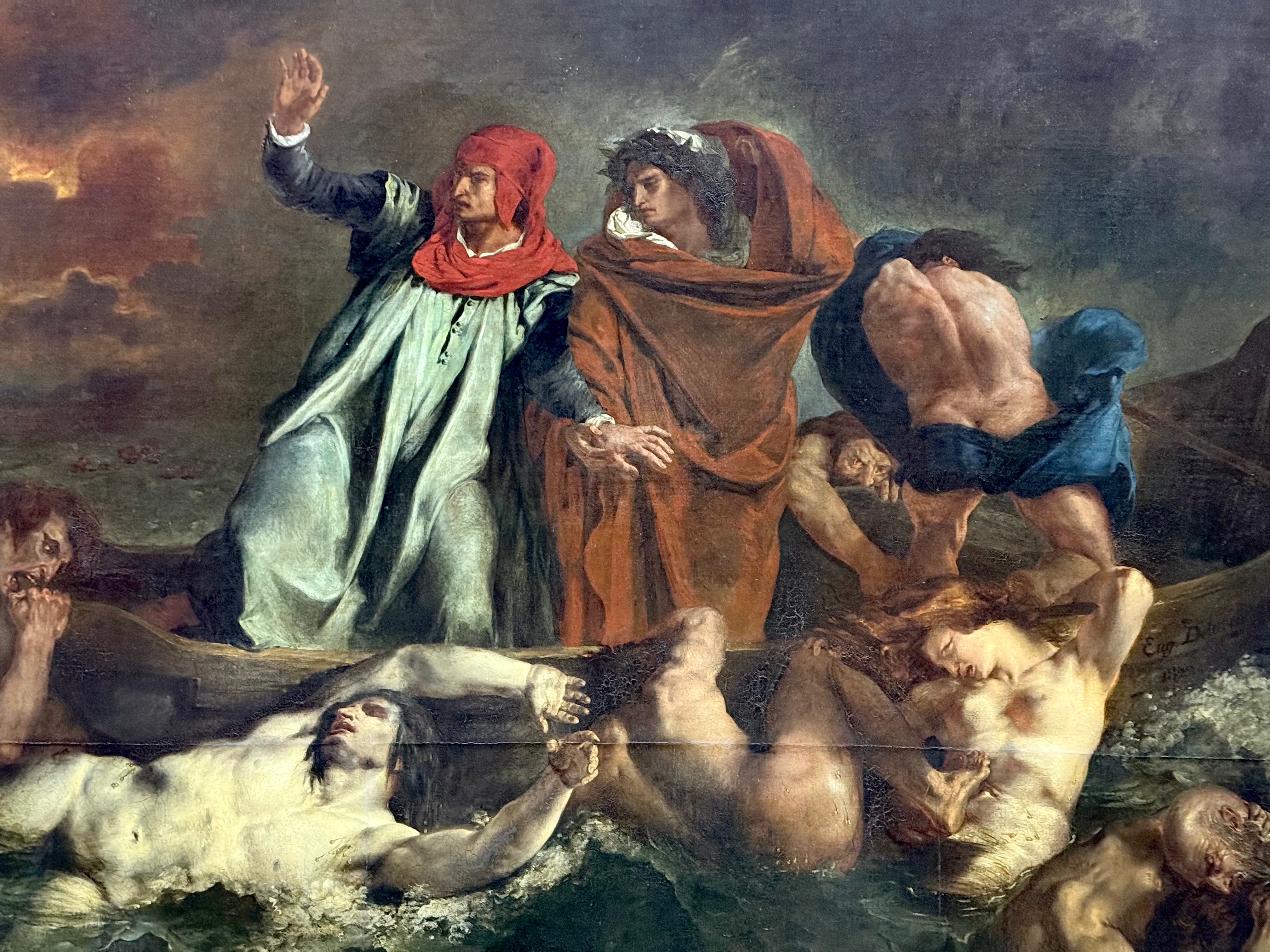
We all know how hard it has been to remain grounded and trusting in the carnival of cruelty and madness that was 2025. The way forward appears equally perilous. It is hard not to feel ourselves in Delacroix’s frail boat with Dante and Virgil, tossed by the turbulence of hell, struggling with outer demons and inner fears.
Eugène Delacroix, Dante and Virgil Cross the Lake of Hell (1822).
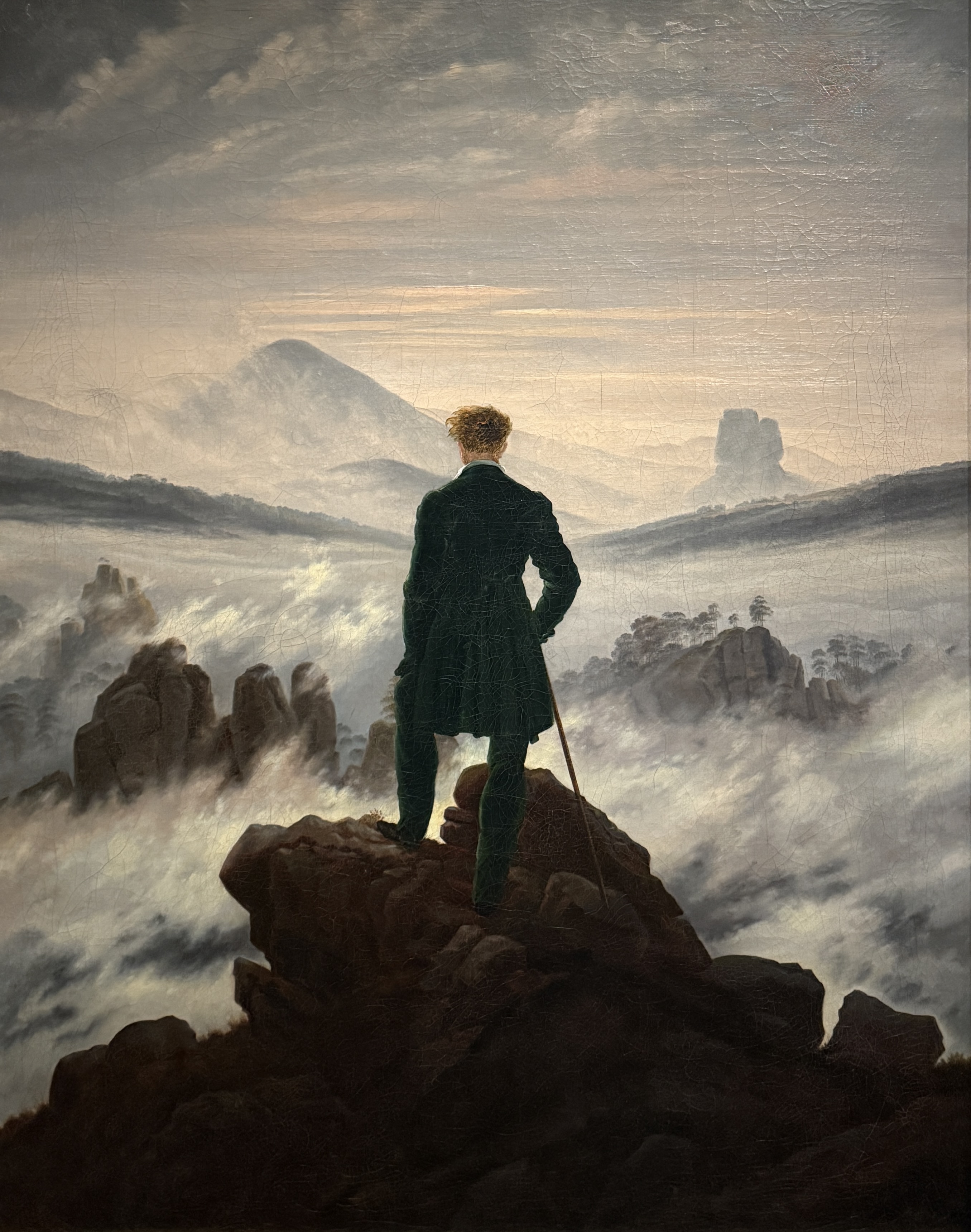
But on the eve of a New Year, I choose to dwell in a different image: Caspar David Friedrich’s Wanderer Above the Sea of Fog. The hiker has risen above the fray of history to stand on a lofty summit, surveying the world before him. We can’t see his facial expression or know his inner thoughts, but his body language conveys a state of contemplative stillness. He is not contorted by fear of what is, or what may come.
Caspar David Friedrich, Wanderer Above the Sea of Fog (c. 1817).
What is out there in the mist, hidden from his eyes and ours? If it’s the future, will it be better, or worse? Or more of the same? Whatever it may be, will we—can we—meet it with hope, courage, and love?
One of Friedrich’s contemporaries, the Romantic poet Joseph von Eichendorf, said that we can, and that doing so will make a difference in the outcome.
“There is a sleeping song in all endlessly dreaming things, and the world will begin to sing if you find the master word.”
Dear reader, in the New Year 2026 may you find that word, and make it your own.
I am so grateful for all of you who have stopped here to read and reflect in 2025, and for all the comments and sharing you do to keep the thoughts circulating. May the days to come bring you many graces and blessings. Happy New Year!
In the dark days of 1943, Hugh Martin and Ralph Blane wrote the most melancholy Christmas song I know, “Have Yourself a Merry Little Christmas.” It made its debut in the 1944 film, Meet Me in St. Louis, when Judy Garland sang it to cheer up her little sister. Their father had taken a job in New York, and the world they knew was about to end. The fact that it was Christmas—their last Christmas in St. Louis—only intensified their sense of loss. As the sisters gaze down from an upstairs window at the family of moonlit snow figures in the front yard, Garland, her moistened eyes seen in gorgeous Technicolor close-ups, delivers the song.
The film’s director, Vincente Minnelli (who would marry Garland the next year), thought the original lyrics too depressing, so he told the writers to make some changes. The line, “It may be your last / Next year we may all be living in the past,” became “Let your heart be light / Next year all our troubles will be out of sight.” But that did little to stop the tears of homesick soldiers viewing the film in distant war zones. In 1957, Frank Sinatra requested another change when he included the song on his holiday album, A Jolly Christmas. He asked Hugh Martin if he could “jolly up” the lyrics a bit more. Thus “until then we’ll have to muddle through somehow,” became “hang a shining star upon the highest bough.” Even so, the tune’s slow pace and moody melody have continued to suffuse the song with the seasonal melancholy which for some is the shadow side of Christmas cheer. If you’re feeling alone, sad, lost, anxious, or afraid, it’s hard to share in the holiday spirit. When your personal world—or our public world—lies in darkness, how do you “let your heart be light?”
A few centuries ago, Turlough O’Carolan, the blind harper and last of the Irish bards, was sitting in a tavern with his friend, the poet Charles McCabe, who said, “Your music, sir, is grand and lovely stuff; but it’s too light-hearted. This is a dark time we live in, Mr. Carolan, and our songs should reflect that.” The harper replied, “Tell me something, McCabe. Tell me this: Which do you think is harder—to make dark songs in the darkness, or to make brilliant ones that shine through the gloom?” [ii]
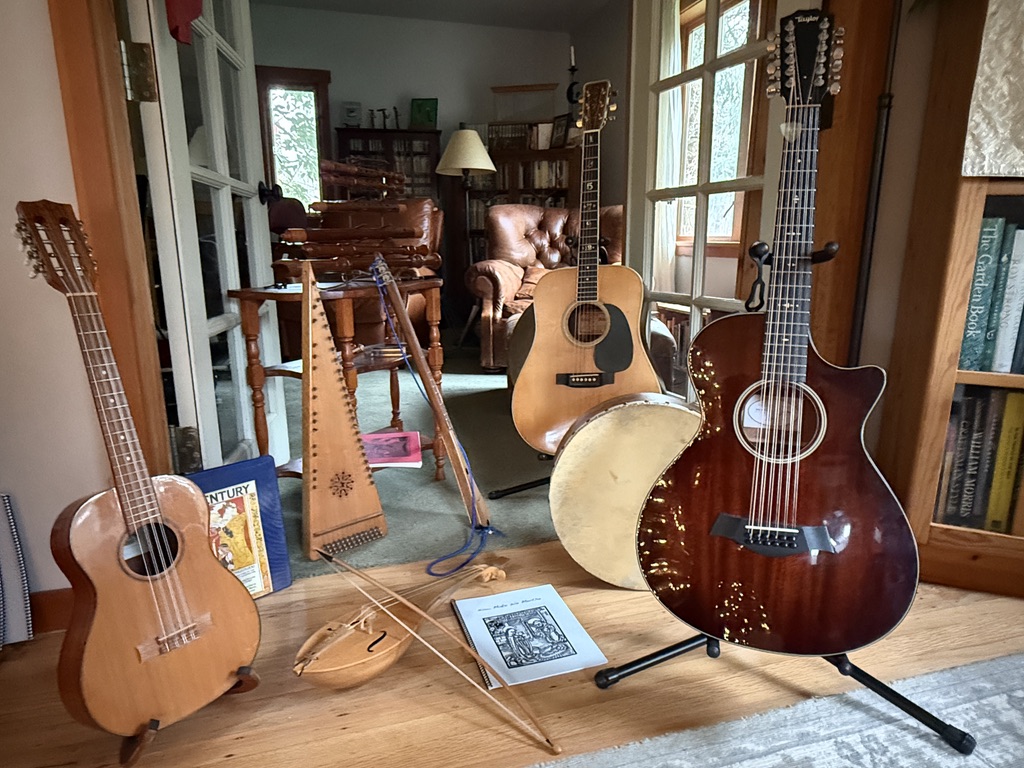
Some of the instruments from our caroling party.
For the last half-century, I have gathered instrumentalists, singers and friends to lighten up the long night with carols and wassails from seven centuries and a dozen countries. “The Praise of Christmas” sums up the spirit of these evenings:
This time of the yeare Is spent in good cheare; Kind neighbors together meet To sit by the fire With friendly desire Each other in love to greet; Old grudges, forgot, Are put in the pot, All sorrowes aside they lay; The old and the yong Doth carol their song To drive the cold winter away.
The old tune is appropriately vigorous, and the lyric by Thomas d’Urfey (1653-1723) is from his aptly titled songbook, Pills to Purge Melancholy. We do sing our share of quiet songs (“Hush! Hush! See how the child is sleeping.”), as well as wistful and mysterious carols in minor keys and medieval modes. But the predominant note is one of joy and wonder. As William Morris declared in his Victorian carol, “Masters in This Hall,”
Christmas is come in And no folk should be sad.
Of course, no one should, but many are. Even in the best of times, there’s going to be some sadness in the room. As Henry Nouwen said, “No one escapes being wounded.” So we don’t sing our carols expecting present reality to be suddenly freed from every sorrow. But singing touches and heals the mind and heart, offering relief and comfort to “those who sit in darkness, and in the shadow of death” (Luke 1:79). As Robert Burton insisted in The Anatomy of Melancholy (1621), music is “the sovereign remedy against despair and melancholy … a “tonick to the saddened soul.” And W.E.B. DuBois, writing in the last century about “The Sorrow Songs” of African-American spirituals, said that “they grope toward some unseen power and sigh for rest in the End.” In other words, even laments can be agents of hope. As DuBois put it,
“Through all the sorrow of the Sorrow Songs there breathes a hope—a faith in the ultimate justice of things. The minor cadences of despair change often to triumph and calm confidence.” [iii]
Compared with the emotional and social realism of black spirituals, what can we say about Christmas carols? Do they have a similar healing power? Or is their bright spirit in denial of the “two thousand years of wrong” which have followed the miraculous “midnight clear” in Bethlehem? Can we who dwell in the shadow of death still sing about joy and peace with whole-hearted conviction? As the Psalmist wondered, “How can we sing the Lord’s song in a strange land?” And yet, we sing. We sing because carols gladden the heart and bring us together. And we sing because carols are eschatological anticipations of God’s unfolding future. They don’t put an end to our troubles, but they give us a foretaste of glory, reminding us that we belong not to what is dying, but to what is being born.
Gabriel’s message does away Satan’s curse and Satan’s sway; Out of darkness brings our Day: So behold, All the gates of heav’n unfold.
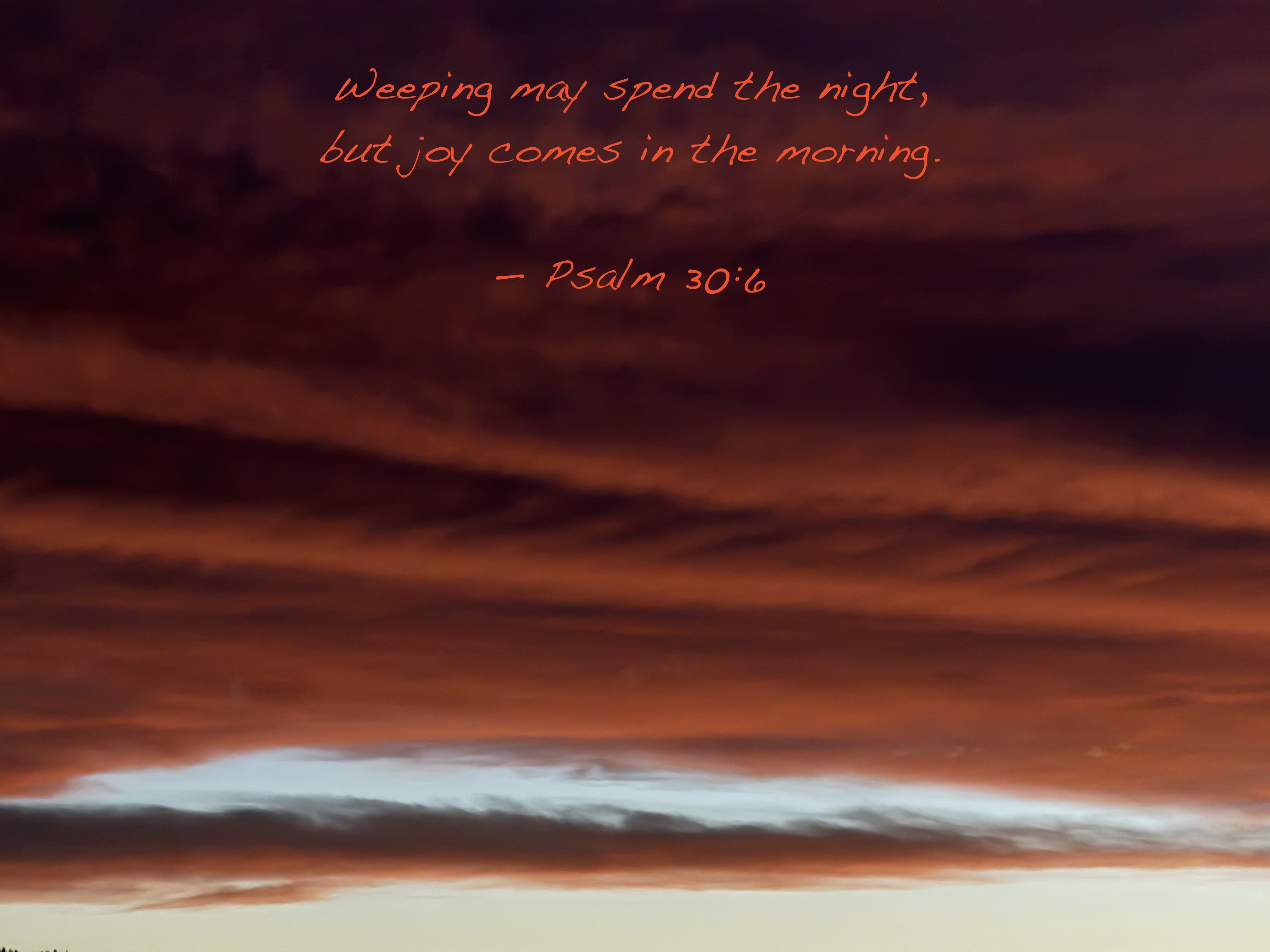
“O radiant dawn, bright splendor of the light eternal.” (8th century ‘O Antiphon’ for December 21).
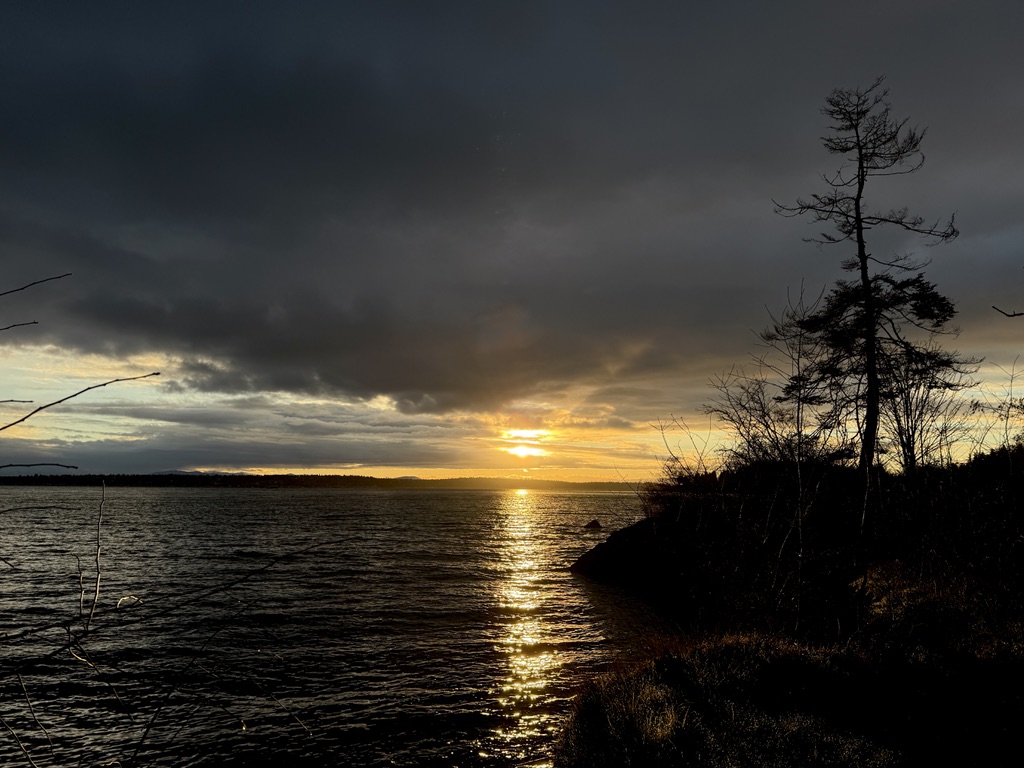
In my Los Angeles days, I’d rise at 4 a.m. at the Winter Solstice, toward the end of the longest night, and drive to a peak above the ocean in the Santa Monica Mountains, where I could see the newborn sun rise over desert peaks 100 miles to the east. But in the Northwest where I live now, a winter sunrise can be a rare sight. This December’s relentless stretch of rain and thick clouds seemed to doom my chances. Still, I awoke at sunrise out of habit, and when I glimpsed the Douglas firs on a hilltop ablaze with fiery light. I jumped in my car and raced to the edge of the island to see the gloom on the run. It was the perfect Advent sign: The people who have lived in darkness, and in the shadow of death (umbra mortis, as the 8th-century O antiphons put it), have seen a great light.
Did it matter that by the end of the day the sun had vanished and rain was pouring down? Not at all. I had received the gift of light as an eloquent sign: Don’t forget what you have seen. Remember hope.
Sunrise after the year’s longest night (Puget Sound, Washington).
Dear reader, I wish you a most blessed and merry Christmas. Let your heart be light!
[ii] I heard this story in the California Revels CD, Christmas in an Irish Castle (2001).
[iii] The Nouwen, Burton, and DuBois quotes are from Kay Redfield Jamison’s powerful and moving book, Fires in the Dark: Healing the Unquiet Mind (New York: Alfred A. Knopf, 2003). It is a fascinatingly documented and beautifully written treatise on the spiritual and imaginative dimensions of healing body and soul.


 The religious imagineer