Three things you should know about the Trinity (Part 2)

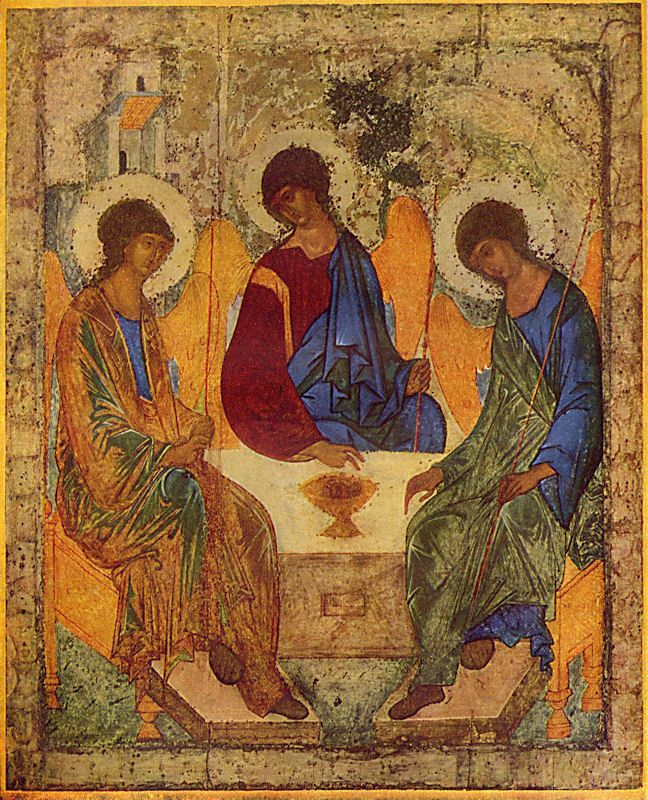
Andrei Rublev, The Holy Trinity (1425)

Andrei Rublev, The Holy Trinity (1425)

Trinitarian doctrine, like other key Christian doctrines, was hammered out, not in sterile study, but rather in the midst of lived spirituality, prayer, and the worship life of the church.[i]

                                                                        – Veli-Matti Kärkkäinen

The Trinity has to do with the lives of each of us, our daily experiences, our struggles to follow our conscience, our love and our joy, our bearing the sufferings of the world and the tragedies of human existence; it also has to do with the struggle against social injustice, with efforts at building a more human form of society, with the sacrifices and martyrdom that these endeavors so often bring. If we fail to include the Trinity in our personal and social odyssey, we shall have failed to show the saving mystery[ii]

– Leonardo Boff

Part 2: You can’t make this stuff up

Early in the twelfth century, a German monk named Rupert of Deutz went into a church where mass was being said by a white-haired bishop. At the offertory procession he experienced a vision of the Holy Trinity:

On the right at the edge of the altar stood three persons of such revered bearing and dignity that no tongue could describe them. Two were quite old, that is, with very white hair; the third was a beautiful youth of royal dignity …[iii]

A century later, Hadewijch of Antwerp, one of those remarkable women mystics who flourished in the late middle ages, also had a vision of the Trinity. But instead of three white males, what she saw was a dark whirlpool, which she described as “divine fruition in its hidden storms.” Hovering over this whirlpool was a spinning disc, on which sat a figure wearing the countenance of God – the face of God – on whose breast were written the words, “The Most Loved of All Beloveds.”

We may find Hadewijch’s vision more congenial: it is genderless, and less crudely specific than Rupert’s. And the tempestuous whirlpool, a flood of energy ceaselessly flowing through the universe, conveys a dynamic image of divinity that resembles the postmodern cosmologies of process theology and quantum physics. It’s probably easier for most of us to believe in a divine whirlpool than in three white guys.

But the crucial difference between Rupert and Hadewijch is not in the relative resonance of their imagery, but rather in what happens next. Rupert remains an observer, one who stands apart and sees God as an object. But Hadewijch does not remain separate from what she sees:

Then I saw myself received in union by the One who sat there in the whirlpool upon the circling disc, and there I became one with him in the certainty of union… In that depth I saw myself swallowed up. Then I received the certainty of being received, in this form, in my Beloved, and my Beloved also in me.

Rupert’s knowledge of God remained conceptual. Hadewijch’s knowledge of God became experiential. She was gathered into the circulating current of divinity. She became part of its flow, and that divine flow became part of her.

The language she uses for this experience is not mathematical or philosophical. Her language is the language of the heart. She describes being “swallowed up… in my Beloved, and my Beloved also in me.”[iv] Love, she discovered, is the way the soul knows. Love is the way the soul sees.

I begin this reflection with a mystic’s personal testimony because Trinitarian theology was not forged by inventive theorists, but by faithful Christians trying to make sense of the concrete, experiential data of salvation, beginning with the biblical narrative and continuing in the ongoing history of believing communities. Based on our collective and personal experience of being “saved” (or, if you prefer: healed, forgiven, reborn, renewed, resurrected, empowered), what can we say about the God who has done this? Trinitarian reflection began within an ancient community deeply grounded in the monotheism of Judaism, which had, over the centuries, found ultimate reality to be not a plurality of disconnected or contradictory energies but a coherent unity. But once the early Christians began to attribute divinity to both Jesus and the Holy Spirit, a simple self-contained oneness was no longer sufficient to describe the Reality.

Without losing the unity of God, how could they account for the divine diversity revealed in the saving activities of Christ and the Spirit? Once they began to call Jesus “Lord” (Kyrios), which happened very early in their worship and their storytelling, traditional monotheism was radically destabilized. The growing perception of the Holy Spirit as a guiding and empowering presence of deity in their communities only compounded the problem.

There were various attempts to solve the problem by downgrading Jesus and Spirit to subordinate, derivative, or semi-divine realities, by no means equal to the eternal and uncreated God. Such “heresies” were popular with those who wanted to keep God simple. But “orthodoxy” was unwilling to deny the fullness of divinity to either Christ or the Spirit. Only God can save us. Christ and Spirit, in the biblical revelation and Christian experience, are integral and essential to salvation. Therefore, they must be equally integral to the Holy One who is the Creator and Redeemer of all things.

The question wasn’t only metaphysical (What is the relation between the one and the many or the finite and the infinite?) or logical (How can One be Three and Three be One?). Trinitarian reflection was also a deep engagement with the question of suffering. If God incarnate in Christ chose to share the human condition, to live and die as one of us, does that mean that vulnerability and suffering have become part of God’s own history? And if these human elements have been added to the divine life through specific temporal events, has time itself disturbed the perfect calm of eternity? If God has been affected and changed by events in time and history, what can we then say about the consistency and transcendence of the divine nature? How can God be decisively linked to the history of the world without losing freedom or transcendence? Can a changeless God weep? Can we be saved by a God without weapons?

In his comprehensive survey of contemporary Trinitarian thought, Veli-Matti Kärkkäinen argues that “the assumption of humanity by God, the Son, means that human capacity to suffer is not foreign to the being of God. How else could one speak of God as love? … It is more biblical to think of God as passionate love, the Father who chooses to engage the suffering of the world, than as a Transcendent One whose separation from the world’s suffering guards his freedom.”[v] Robert Jenson, a foremost North American authority on the Trinity, rejects the notion of divine detachment from creation in dramatically succinct terms: “God … is what happens with Jesus… God is what will come of Jesus and us, together.”[vi]

The problems and paradoxes that arise from such far-reaching assertions have been debated and puzzled over throughout Christian history, and the recent profusion of Trinitarian theology has become an incredibly rich conversation. There is, of course, no final version of God awaiting discovery, no definitive outcome to all this reflection, only an endless attentiveness to the Mystery which may consent to dance with language, but always outruns it in the end.

So why presume to talk about the Trinity at all? Why can’t we simply say and think and pray to “God” and leave it at that? We can’t do that because Christians don’t belong to a theoretical God, a reasonable and logical divine construct worked up by professional philosophers. We belong to the self-revealing but complicated God of the Bible who has, in the form and activity of Christ and the Holy Spirit, rescued us from our own folly and gathered us into the communion that is the very life of God. And no matter what diverse strategies of insight and understanding we may employ, what we can actually say about the Trinity is always grounded in experience, both the experience of our ancestors encoded in Scripture and tradition and the contemporary revelations of communal and personal life.

Trinitarian thought isn’t made out of thin air or abstract speculation. It is produced and nourished by the concrete, tangible history of Christian experience. However each day manifests for us “the means of grace” and “the hope of glory,” whatever the myriad ways by which we love and serve and witness, we need the threefold name to account for the diversity of God’s relations with us. Anything less would impoverish our prayer and considerably reduce the scope of our attention.

For most theologians, our experience of God as threefold also reflects a Trinitarian life within God’s own self. Since God’s inner life is beyond our sight, this can only be an assumption. But it is a crucial one. If God is trustworthy and self-revealing, it must be that when we meet God as Trinity, we get the real thing. God isn’t just pretending to be Three for us; God’s own inner life is constituted by relationality and communion.

Finally, how shall we address or invoke this Mystery, which a Japanese theologian intriguingly calls “Three Betweennesses in One Concord?”[vii] The traditional “Father, Son, and Holy Spirit,” despite its authoritative pedigree, is distractingly masculine for many, and various substitutes have arisen, each with their own impediments. “Creator, Redeemer, Sanctifier,” for example, is a bit impersonal, and risks reducing the three Persons to job descriptions. Likewise, “Source, Word, Spirit,” “Creator, Liberator, Comforter,” “Parent, Child, Paraclete,” “Mother, Daughter, Spirit,” and “Mother, Lover, Friend” all have their particular assets and liabilities. My own current preference, since I suspect that God is more verb than noun, is “Love who loves us[viii], Word who saves us, Spirit who revives us.”

I leave the last word to 16th century reformer Philip Melanchthon, who said, “We adore the mysteries of the Godhead. That is better than to investigate them.”[ix]

[This is the second of three reflections on the Trinity. The first, on the essential relationality of God, may be found here.]

[i] Veli-Matti Kärkkäinen, The Trinity: Global Perspectives (Louisville: Westminster John Knox Press, 2007), 35

[ii] ibid., xv-xvi

[iii] Bernard McGinn, The Growth of Mysticism: Gregory the Great Through the 12th Century (New York: The Crossroad Publishing Company, 1994), 330

[iv] ibid., The Flowering of Mysticism (New York: The Crossroad Publishing Company, 1998), 212-16

[v] Veli-Matti Kärkkäinen, 99

[vi] Robert W. Jenson, The Triune Identity: God According to the Gospel (Philadelphia: Fortress Press, 1982), 22-3

[vii] Nozumu Miyahira, in Kärkkäinen, 314

[viii] I take this resonant phrase from Terrence Malick’s transcendent film, To the Wonder.

[ix] Kärkkäinen, xvi

Just a dream? – Reflections on the Easter Vigil

Byz Res mosaic

On Holy Saturday in Jerusalem, an hour past sunset 26 years ago, I greeted the Resurrection with the Ethiopian community in their courtyard on the roof above the Church of the Holy Sepulchre. Processing around a small cupola representing the empty tomb, they sang and danced with torches and umbrellas. Their graceful, white-robed bodies and joyful faces were vivid icons of the risen life, producing in me a state of dreamlike wonder. As I later made my way through the deserted stone passages of the old city in search of the midnight liturgy at the Russian church, I fell into an apocryphal reverie.

I imagined the risen Jesus quietly reversing the steps of his Via Dolorosa, away from the cross, away from the mindless crowd now sleeping off its orgiastic fury, away from the city of betrayals and farewells, away from the awful time of trial. Going home. To Galilee.

Of course we don’t know how the Resurrection actually happened, nor do we grasp the concept of passing out of existence only to return the same yet different. Perhaps the closest we come is our daily rising from sleep, when it may take a moment before we remember who we are and reconnect with the continuity of personal identity that somehow survives the abyss of unconsciousness. Even so, there sometimes remains a strange sense that we have crossed over into a new space and time full of unimagined possibilities. We are not quite the same person who closed his or her eyes the night before. Behold, says Jesus, I make all things new.

The sublime intensity of Holy Week, culminating in the Triduum, or Great Three Days of Maundy Thursday, Good Friday and the Easter Vigil, can produce a similar effect on the faithful who make the long journey from the Last Supper to the first Alleluia. We not only learn something along the Way of the Cross to the place of Resurrection, we become something as well. When it’s over, we are somebody else. Forgiven. Set free. Made new.

As I said in the Vigil homily on Saturday night, “we have made an exodus from our tired old stories of death and loss into God’s new story of possibility and promise.” Any Vigil worth its salt will enable us to dwell for a few hours in the light of that new story, the light that penetrates our shadows with the bright splendor of God’s future. And when it’s over, we may wonder: What just happened? Was it only a dream?

One of the striking things about the Easter Vigil is that there is no single representation of the Resurrection. The gospel reading might describe dazzling messengers announcing it after the fact, but the event itself is never described in the text. The closest the liturgy gets to a specific resurrection moment is when the Presider launches the eucharist with a shout of Christ is risen, and a holy tumult is made with chimes, bells and drums while all the lights switch on to banish the darkness. But the victory of Life and Love is actually manifested repeatedly throughout the liturgy in symbol, word and sacrament, as well as in the faces and gestures of the assembly. The liturgy as a whole is an experiential analog of the Paschal Mystery.

Here are a few of this year’s many resonant manifestations for me:

  • The New Fire: It is always moving, after we have all been scattered from the bare and mournful church interior of Good Friday, to see how many return the next night to gather outside around the New Fire with expectant faces. Death has done its worst, and we have come to make our reply: Love wins anyway. I especially rejoiced to see the children, already dressed for the Ark story in their animal costumes, standing right up front with their floppy ears and shaggy coats. As St. Paul said, not just humanity, but the whole creation, eagerly awaits the day of renewal.
  • The Creation: “Once upon a time, human beings had no story. Only the gods did things worth telling.” So began the Prologue to our sacred stories, concluding with the discovery, by an ancient “tribe of nobodies” that their own lives were, in fact, part of something much, much larger. “Human beings had become a story told by God.” Then out of the darkness a voice said, “Let there be light!” Projected on a 15’ screen, we saw the first light of the creation, from Terence Malick’s film, Tree of Life, continuing with spectacular cinematic images of earth’s evolution up through the arrival of the birds. Then the film switched off and a monkey and frog entered to cavort among the assembly, until a flute sounded, and the musical “breath of God” turned them into the first humans. They straightened up, removed their wooden Indonesian masks, and became suddenly conscious of their own humanity. “Adam and Eve” were played by pre-teens, but when they cautiously crossed the gap between them to touch hands and connect with the strange and unknown “other,” they gave us a transcendent image far beyond their years.
  • The Red Sea: This central metaphor for the Paschal Mystery of “crossing over” from death to life was a complex interplay of live actors, projected images (documentary-looking Exodus images from DeMille’s 1927 silent, The Ten Commandments, plus Civil Rights footage from the Selma to Birmingham march of 1965), soundscapes (6 separate cues to mark different stages of the story), and dramatic theatrical lighting. After the Red Sea had been crossed, the narrator concluded by saying, “When the world says no, the power of God is …”. The Israelites, all played by children, completed the sentence by shouting, “YES!” The brave sound of those young voices will long stay with me.
  • “Hallelujah”: After each story, we sang a song and said a prayer to reflect the story’s themes. The last story, The Valley of Dry Bones, was followed by Leonard Cohen’s “Hallelujah,” with powerful Easter lyrics by Scott Lawrence. Our hand candles were relit as we sang: “no darkness can conceal the light within you … hallelujah, hallelujah…” All those candlelit faces, all those beautiful voices raised in song, said Resurrection as powerfully as anything else we did that night.
  • The Dance: At the end, following communion, we invited people to come out of their seats to gather in a great circle to dance. I had been warned to expect only a half-hearted response. Episcopalians are reserved, I was told. Dancing in church might be outside some people’s comfort level. But as we sang a couple of choruses of “I will raise them up” from the Bread of Life hymn, everyone did in fact rise up and come out of their pews. We joined hands, and off we went, circling and spiraling as we sang the Easter Troparion (“Christ is risen from the dead, trampling down death by death”) and “Jesus Christ is risen today.” Resurrection wasn’t just something we heard about or thought about, it was something we embodied, something we danced. As Christ shows us every Easter, “I am the Dance and I still go on.” Amen to that! We proved it with our bodies.

When the Vigil was over, we each went our separate ways. The Vigil “set” was struck, like a circus tent, leaving behind little trace of what had taken place. Had it all – not just the Vigil but the entire Triduum – been just a dream, soon to fade in the glare of everyday life and ordinary time? Or had our extraordinary journey together, soaked in Paschal images, revealed something essential, enduring and profoundly transformative?

Whether in this year’s Triduum, in my Jerusalem Holy Week long ago, or in many other memorable traverses of the Paschal Mystery, I do believe I have encountered, embodied, and imbibed the core of our faith: Christ lives. Love wins. We shall be changed.

The resonant images and experiences of the Triduum have been planted deep within me, year by year. They may still have to struggle in my poor soil or compete with the choking thorns of my world, but as the collect-prayer for Thursday of Easter Week asks, “Grant that all who have been reborn into the fellowship of Christ’s Body may show forth in their lives what they profess by their faith.”

God, bring that day closer!

Grace me guide

Holy Saturday dawn at Laguna Beach, California (2005)

Holy Saturday dawn at Laguna Beach, California (2005)

My wife recently asked me what my favorite prayer was. Interesting question. We are both Episcopal priests, steeped in a tradition of eloquent prayers, so there were plenty to choose from (the Lord’s Prayer was ruled ineligible in order to make the competition fair). But one particular “collect” from the Book of Common Prayer came immediately to mind, not only because I know it by heart and begin most days with it, but also because I am drawn to the theology and spirituality that underlie it.

O God, the King eternal, whose light divides the day from the night and turns the shadow of death into the morning: Drive far from us all wrong desires, incline our hearts to keep your law, and guide our feet into the way of peace; that, having done your will with cheerfulness during the day, we may, when night comes, rejoice to give you thanks; through Jesus Christ our Lord. Amen.[i]

In three beautiful clauses, this Collect for the Renewal of Life from the Office of Morning Prayer spans the daily round from night to day to night. Its origins lie in the Benedictine practice of creating liturgies to fit each period of the passing day. Like time-lapse photography, this collect compresses the temporal flow into a single unity of beginning, middle and end. The ordinary succession of the hours is sanctified by the simple act of attention.

But the prayer casts its net into deeper pools as well. The light dividing the day from the night recalls the first day of creation, making every dawn the renewal of the world. And the shadow of death turning into morning invokes the Resurrection, when creation is restored and the wound of death is healed at last.

Having turned our attention to the divine source of this perpetual renewal, the prayer then asks for the grace to become conformed to the shaping pattern or formative way of that originating and empowering source. The first request addresses the obstacles to that conformity – the things that misshape or distort our truest selves.

Drive far from us all wrong desires.

Religion is sometimes caricatured as the repression of desire. It’s not only the mockers who do this; many of the devout have striven for a passionless existence in imitation of a supposedly passionless God. But wanting to want nothing is itself a form of desire, and it doesn’t always end well.

We are made of desire. We come into the world reaching for a larger source of sustenance, nurture and love. Everbody’s got a hungry heart. Springsteen said that. Or was it St. Augustine? Some argue that our primal maternal nurturing is then projected onto the void to produce the consolations of religion, but Christian faith insists that our longing never ceases to thirst for something actual and real, from our first breath to our last.

But desire is easily misdirected to fix on easier, less demanding objects, unworthy of our true nature. In one of Jean-Luc Godard’s early films, a worldly couple is given a ride in a convertible. When the driver reveals that he happens to be God, they immediately ask him for things: Can I own a hotel on Miami Beach? Can you make me more beautiful? God is disgusted. “Is that all you want? I don’t do miracles for jerks like you.” He throws them out of the car and drives away.

As Gregory of Nyssa said, our task is not the eradication of desire, but the education of desire. How do we live in such a way that our desire may find its proper object? It is not desire that is wrong, but only its misdirection. And so we pray for whatever it takes to steer us toward our ultimate goal, “the great meeting with being which one way or another everything in our life strains to achieve.”[ii]

Incline our hearts to keep your law,
and guide our feet into the way of peace.

There may be times in our life when God’s will feels radically disruptive. “Thus says the Lord: I am going to tear down what I have built, and pluck up what I have planted.” (Jer. 45:4) Or John Donne: “Batter my heart, three-person’d God …. / and bend / Your force to break, blow, burn, and make me new.”

But in this prayer said at the start of each day, “incline” and “guide” propose a much gentler formational process than the cataclysmic upheavals of Jeremiah and Donne. An inclination may only be a slight tipping from the vertical, just enough so everything leans or flows in a particular direction. And the act of guiding does not itself create momentum; it only steers a motion which is already underway. These are subtler influences than earthquake, wind and fire, but their long-term effect on us is no less profound.

The entire prayer assumes a dailiness about grace, and the constancy of prayerful attention that allows it to work on us over time. This quiet, steady, cumulative spirituality is so very Anglican. I once found a perfect motto for this habitual spirituality in an old English church. Painted in golden Gothic lettering, repeated in every panel of the coffered ceiling, are the words, Grace me guide. Even a bored worshipper, glancing upward to relieve the tedium of a poor sermon, could not miss this summons to the beauty of holiness.

The prayer’s third clause assumes a happy outcome for a day given over to God’s shaping influence. Throughout the passing hours, God’s will is done “with cheerfulness.” Does this word appear anywhere else in the history of formal Christian prayer? There are plenty of texts to remind us how hard the journey, how recalcitrant the will. But how rare to make the Christian life sound so easy, so effortless, so fun!

But perhaps the prayer has in mind the ease of the ballet dancer, whose extraordinary physical grace, while appearing effortless, is achieved through a sometimes painful and always demanding discipline. Or maybe “cheerfulness” refers to the saintly joy that St. Francis spoke of – the ability to accept even life’s hardest blows with a grateful and trusting heart. Who can say?  I only know that whenever I say this prayer, it is hard not to smile, at least inwardly. Cheerfulness is an attractive quality in the Christian life.

The entire prayer assumes that we are capable, that we can be conformed to divine intention, that this day has potential for us. We may not make it to nightfall without lapses major and minor. The cheerfulness may fail us, more than once. We are well acquainted with that scenario. But to begin each morning by visualizing a day that will end with thanksgiving for what God has done in us and through us – this expresses the incredible hope of Christian faith. God has amazing plans for us, no matter what.

The gratitude the prayer envisions is not contingent on what we manage to accomplish in any given day. Perfection is a process, not a possession. But as this prayer puts it so beautifully, we are nevertheless invited to begin each morning as if we are actually capable of living into the full humanity for which are made. And at the close of a day begun with this kind of mindfulness, even though it be fraught with imperfections, there will be reason enough for thanksgiving.

Saying this prayer was one of the very last things I did with my mother. I had been visiting her in Santa Barbara, and it was always our custom to read Morning Prayer whenever we were together. After our prayers, we said farewell and I headed for home a thousand miles north. A few hours after I left, her 96-year-old heart suddenly gave out. She died three days later. I didn’t quite make it back in time, but we had already made the perfect goodbye, with the cheerfulness of our morning prayers.

We each had our own copy of The Daily Office Book, containing services and Scripture readings for the entire year. After she died, I started using her copy instead of mine. It seemed a way to stay in touch, acknowledging the unbroken connection of the communion of saints. And one day I happened to look at the inside back cover. She had written a prayer on the blank endpaper. Whether she had made it up, or found it somewhere, I don’t know. But it perfectly expressed her own faithful spirit. It also seemed to echo my own favorite prayer. In her distinctive hand, familiar from so many letters over the years, she had written:

God, whatever …. Thanks.

[i] Book of Common Prayer (New York, Oxford University Press, 1979) 99

[ii] Ann & Barry Ulanov, Primary Speech: A Psychology of Prayer (Louisville, KY: Westminster John Knox Press, 1983) 14