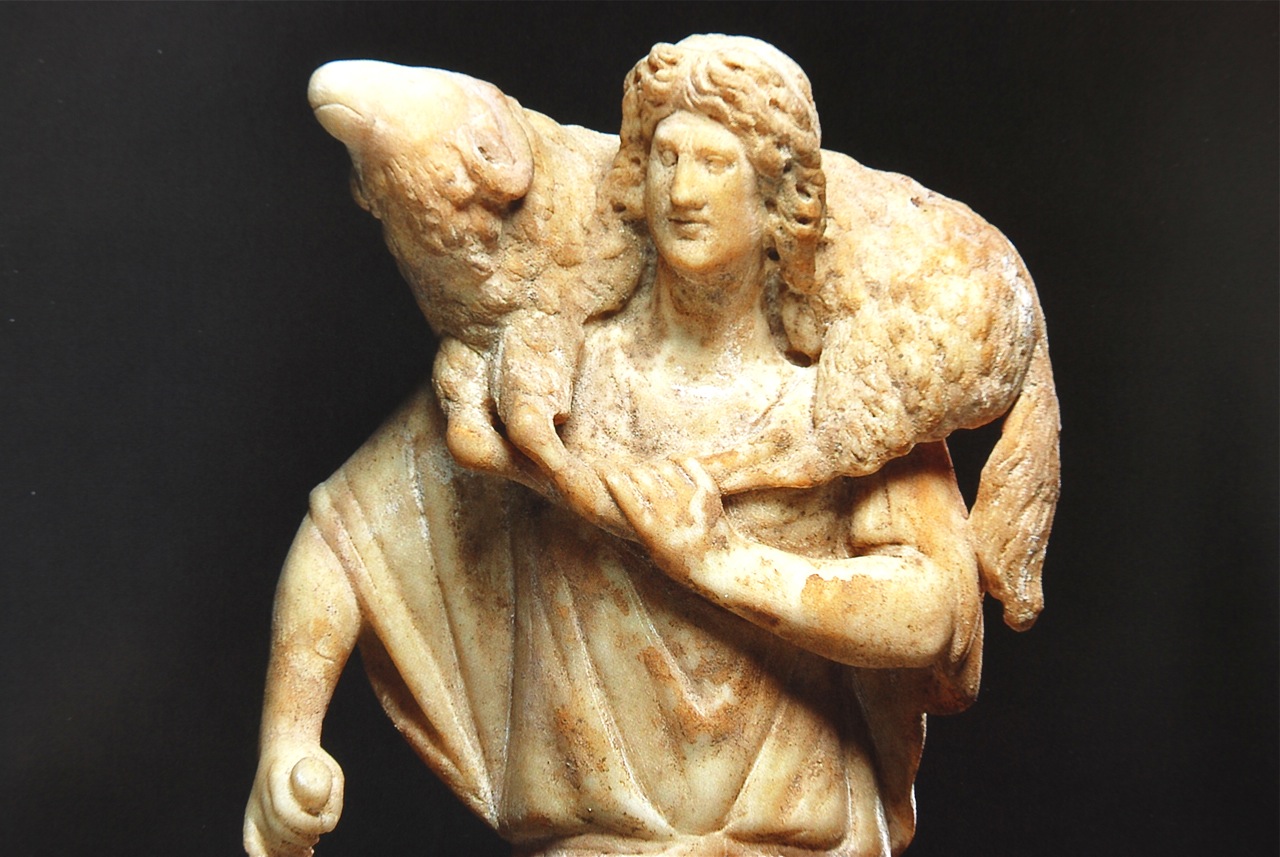
The Voice That Calls us: A Reflection for Good Shepherd Sunday

The Good Shepherd (Asia Minor, c. 390; Cleveland Museum of Art)

The Good Shepherd (Asia Minor, c. 390; Cleveland Museum of Art)

The gospel image for today, the Fourth Sunday of Easter, is the good shepherd who “calls his own sheep by name and leads them out” (John 10: 3). Unlike the hired hand who cares little for the sheep, Jesus loves his flock. He will lay down his own life for them. And they in turn know exactly where to put their trust. “I know my own and my own know me” (John 10: 14). “The sheep that belong to me hear my voice … and they follow me” (John 10:27).

Sheep are not a part of my daily life, so I didn’t fully appreciate the metaphor until I visited a sheep market in Jerusalem in 1989. Starting at 6 a.m. on Fridays, shepherds would bring their sheep in trucks, vans and even the back seats of cars to a stone-walled corral to begin spirited negotiations with potential buyers.

Once the corral had been crammed with wall to wall sheep, I wondered how the different shepherds would ever keep track of their own. But it soon became clear what Jesus was talking about: I know my own and my own know me. Although many human voices were speaking and calling simultaneously, each of the sheep responded only to the distinctive voice of its own shepherd.

Our own shepherd’s voice can still be heard, calling us every time we open the Bible. The attentive reception of Scripture is a form of real presence. When the gospel is read in the Eucharistic assembly, or meditated upon faithfully, Christ speaks – not from the past, but addressing us now in our own present with words of challenge and refreshment: Turn your lives around … Follow me … Take up your cross … Don’t be afraid … Your sins are forgiven … Peace be with you … Love one another.

Countless Christians through the centuries have heard and answered the voice of Jesus mediated in this way through the written texts of Scripture. But are there other ways of hearing the shepherd’s voice? Does it still find ways to speak in the now, without the mediation of ancient texts? Or is the God who spoke long ago now wrapped in permanent silence?

In the first book of the Bible, God speaks directly to human beings. Although we are never given a location or visual description of the speaking God, the words themselves seem as naturally delivered as any of the human speeches in the text. In the second book, the divine voice becomes less “natural,” uttered mysteriously from a stormy cloud or burning bush. By the fifth book, divine speech is largely of the past, something remembered and taught instead of heard directly: “Yahweh then spoke to you from the heart of the fire; you heard the sound of words but saw no shape; there was only a voice” (Deut. 4:12).

By the time we reach the First Book of Kings, the God whose voice had thundered commandments to Moses is reduced to “a still small voice,” or more accurately translated, “a sound of thin hush” (I Kings 19:12). The voice of God has become the sound of silence.

Thereafter, God’s biblical speeches are secondhand reports from the mouths of the prophets. The whole narrative arc of the Hebrew Scriptures “from Eve to Esther,” as Richard Elliott Friedman puts it, may be described as a “step-by-step diminishing of God’s apparent presence.”[i] As Isaiah says, “Truly, you are a God who hides himself.”[ii] Or as the Psalmist complains, “My God, my God, why have you left me?”[iii] In the public, shared experience of God’s people, the face of God becomes hidden and the voice of God grows silent. God disappears as a speaking character in the Bible.

However, incarnational faith understands this not as a process of divine withdrawal from the world, but an ever deeper embedding of God within it, until the Word of God is delivered not in thunder and lightning, but in the ordinary human speech of the man named Jesus. It turns out that the eventual disappearance of the God of power and might was a way for God to draw ever closer to us, so that now, as Bonhoeffer said, “God is in the facts themselves.”[iv]

For those attached to a more majestic divine self-disclosure, this has made God much harder to see. As Pascal put it, “when it was necessary for [God] to appear, he hid himself more deeply yet, by wrapping himself in humanity. He was much more easily recognizable when he was still invisible than when he made himself visible.”[v] But for those with ears to hear, the still small voice may be heard every day from our neighbor’s mouth.

Still, I wonder. Can God yet speak, not just in sacred text or through the mouth of friend and stranger, but more directly? Is there still an audible Voice that calls us each by name? John Milton argued that God makes a “general vocation” to all “in various ways” but sometimes “invites certain selected individuals … more clearly and insistently than is normal.”[vi] His seventeenth century contemporary, George Herbert, described such a moment of address and response in his poem, “The Collar,” whose very title uses the sartorial sign of priestly vocation to make a pun about “calling”:

But as I rav’d and grew more fierce and wild
At every word,
Methought I heard one calling, Child!
And I reply’d, My Lord.

But as the word “methought” indicates, the experience of being addressed by God, undoubtedly a real one for the prayerful Herbert, was filtered through imagination, reflection and poetic language. We can’t assume it to be verbatim.

Three centuries earlier, English mystic Julian of Norwich, while gravely ill, had an intense visual and auditory experience of the suffering Christ, which she would later recount in the first book written by a woman in English. The book’s title, Showings, categorizes her visions as something received, not simply produced in her own mind. The things Christ said to her were not simply variations on gospel texts, but words never before heard, directed specifically to Julian.

As Veronica Mary Rolf has noted, Julian was careful to specify “which of Christ’s words she heard spoken distinctly within her mind, and which words arose in her mind ‘as If’ Christ were addressing her directly, according to what she understood to be his meaning.”[vii] Julian’s experience is compelling, and when Jesus tells her that “all shall be well,” who can say she was not hearing her shepherd’s voice?

“Jesus calls us,” the hymn says. “Day by day his clear voice soundeth.”[viii] How literally should we take this? Have you, dear reader, ever heard the Voice that calls you by name? I myself have never heard it in an auditory way, as an actual sound. But I can remember one particular occasion when, I believe, the Voice addressed me, simply and directly.

In preparation for my fiftieth birthday, I spent four days at the Taize community in France. The chanted worship was very beautiful, but something about the place left me ill at ease. Most people had come to spend an entire week, but I had only arrived on Thursday, missing out on the natural bonding process of the hundreds who had been together since Sunday. I felt like an outsider. And the prevailing European reserve didn’t exude any of the warmth I associated with religious retreat. As one of my British roommates told me, “Oh, you Americans! You expect everyone to smile and say howdy.”

For whatever reason, I was not having the uncomplicatedly beautiful experience I had anticipated. I felt disappointed. On my second night, the two-hour liturgy centered around a large painted Byzantine cross. All who wanted could draw near for a time of prayer and adoration. When my turn came, I leaned my forehead against the cross and prayed, “Well, God, here I am at Taize. It’s not at all what I hoped for. Now what?” I waited, not really expecting an answer. But then these words came into my thoughts, precise and clear like something given, rather than any halting formulation of my own: Stop looking for a gift for yourself. Look for the gift you can give another.

It was an awakening. Tears filled my eyes. Tongues of flame danced in the red votives around the cross. A thousand voices chanted in the German tongue of my ancestors, “Stay with me, remain here with me, watch and pray, watch and pray.” After that moment, everything was different. My remaining days at Taize were full of grace.

When the liturgy ended, I went out into the summer night. People were sitting in small groups on the lawn, watching spectacular bolts of lightning play across the far horizon. First the still small voice, then the fire from heaven. Theophany indeed.

[i] Richard Elliott Friedman, The Hidden Face of God (San Francisco: Harper San Francisco, 1995) 79

[ii] Isaiah 45:15

[iii] Psalm 22:1

[iv] Dietrich Bonhoeffer, Letters and Papers from Prison (New York: Macmillan, 1971) 191

[v] quoted in Gerardus van der Leeuw, Sacred and Profane Beauty: The Holy in Art (Nashville: Abingdon Press, 1963) 326

[vi] De Doctrina Christiana, q. in David Lyle Jeffrey, ed., A Dictionary of Biblical Tradition in English Literature (Grand Rapids, Michigan: Eerdmans) 815

[vii] Veronica Mary Rolf, Julian’s Gospel: Illuminating the Life and Revelations of Julian of Norwich (Maryknoll, NY: Orbis Books, 2013) 262

[viii] Cecil Frances Alexander, The Hymnal 1982 (New York: The Church Hymnal Corporation) #549

Just a dream? – Reflections on the Easter Vigil

Byz Res mosaic

On Holy Saturday in Jerusalem, an hour past sunset 26 years ago, I greeted the Resurrection with the Ethiopian community in their courtyard on the roof above the Church of the Holy Sepulchre. Processing around a small cupola representing the empty tomb, they sang and danced with torches and umbrellas. Their graceful, white-robed bodies and joyful faces were vivid icons of the risen life, producing in me a state of dreamlike wonder. As I later made my way through the deserted stone passages of the old city in search of the midnight liturgy at the Russian church, I fell into an apocryphal reverie.

I imagined the risen Jesus quietly reversing the steps of his Via Dolorosa, away from the cross, away from the mindless crowd now sleeping off its orgiastic fury, away from the city of betrayals and farewells, away from the awful time of trial. Going home. To Galilee.

Of course we don’t know how the Resurrection actually happened, nor do we grasp the concept of passing out of existence only to return the same yet different. Perhaps the closest we come is our daily rising from sleep, when it may take a moment before we remember who we are and reconnect with the continuity of personal identity that somehow survives the abyss of unconsciousness. Even so, there sometimes remains a strange sense that we have crossed over into a new space and time full of unimagined possibilities. We are not quite the same person who closed his or her eyes the night before. Behold, says Jesus, I make all things new.

The sublime intensity of Holy Week, culminating in the Triduum, or Great Three Days of Maundy Thursday, Good Friday and the Easter Vigil, can produce a similar effect on the faithful who make the long journey from the Last Supper to the first Alleluia. We not only learn something along the Way of the Cross to the place of Resurrection, we become something as well. When it’s over, we are somebody else. Forgiven. Set free. Made new.

As I said in the Vigil homily on Saturday night, “we have made an exodus from our tired old stories of death and loss into God’s new story of possibility and promise.” Any Vigil worth its salt will enable us to dwell for a few hours in the light of that new story, the light that penetrates our shadows with the bright splendor of God’s future. And when it’s over, we may wonder: What just happened? Was it only a dream?

One of the striking things about the Easter Vigil is that there is no single representation of the Resurrection. The gospel reading might describe dazzling messengers announcing it after the fact, but the event itself is never described in the text. The closest the liturgy gets to a specific resurrection moment is when the Presider launches the eucharist with a shout of Christ is risen, and a holy tumult is made with chimes, bells and drums while all the lights switch on to banish the darkness. But the victory of Life and Love is actually manifested repeatedly throughout the liturgy in symbol, word and sacrament, as well as in the faces and gestures of the assembly. The liturgy as a whole is an experiential analog of the Paschal Mystery.

Here are a few of this year’s many resonant manifestations for me:

  • The New Fire: It is always moving, after we have all been scattered from the bare and mournful church interior of Good Friday, to see how many return the next night to gather outside around the New Fire with expectant faces. Death has done its worst, and we have come to make our reply: Love wins anyway. I especially rejoiced to see the children, already dressed for the Ark story in their animal costumes, standing right up front with their floppy ears and shaggy coats. As St. Paul said, not just humanity, but the whole creation, eagerly awaits the day of renewal.
  • The Creation: “Once upon a time, human beings had no story. Only the gods did things worth telling.” So began the Prologue to our sacred stories, concluding with the discovery, by an ancient “tribe of nobodies” that their own lives were, in fact, part of something much, much larger. “Human beings had become a story told by God.” Then out of the darkness a voice said, “Let there be light!” Projected on a 15’ screen, we saw the first light of the creation, from Terence Malick’s film, Tree of Life, continuing with spectacular cinematic images of earth’s evolution up through the arrival of the birds. Then the film switched off and a monkey and frog entered to cavort among the assembly, until a flute sounded, and the musical “breath of God” turned them into the first humans. They straightened up, removed their wooden Indonesian masks, and became suddenly conscious of their own humanity. “Adam and Eve” were played by pre-teens, but when they cautiously crossed the gap between them to touch hands and connect with the strange and unknown “other,” they gave us a transcendent image far beyond their years.
  • The Red Sea: This central metaphor for the Paschal Mystery of “crossing over” from death to life was a complex interplay of live actors, projected images (documentary-looking Exodus images from DeMille’s 1927 silent, The Ten Commandments, plus Civil Rights footage from the Selma to Birmingham march of 1965), soundscapes (6 separate cues to mark different stages of the story), and dramatic theatrical lighting. After the Red Sea had been crossed, the narrator concluded by saying, “When the world says no, the power of God is …”. The Israelites, all played by children, completed the sentence by shouting, “YES!” The brave sound of those young voices will long stay with me.
  • “Hallelujah”: After each story, we sang a song and said a prayer to reflect the story’s themes. The last story, The Valley of Dry Bones, was followed by Leonard Cohen’s “Hallelujah,” with powerful Easter lyrics by Scott Lawrence. Our hand candles were relit as we sang: “no darkness can conceal the light within you … hallelujah, hallelujah…” All those candlelit faces, all those beautiful voices raised in song, said Resurrection as powerfully as anything else we did that night.
  • The Dance: At the end, following communion, we invited people to come out of their seats to gather in a great circle to dance. I had been warned to expect only a half-hearted response. Episcopalians are reserved, I was told. Dancing in church might be outside some people’s comfort level. But as we sang a couple of choruses of “I will raise them up” from the Bread of Life hymn, everyone did in fact rise up and come out of their pews. We joined hands, and off we went, circling and spiraling as we sang the Easter Troparion (“Christ is risen from the dead, trampling down death by death”) and “Jesus Christ is risen today.” Resurrection wasn’t just something we heard about or thought about, it was something we embodied, something we danced. As Christ shows us every Easter, “I am the Dance and I still go on.” Amen to that! We proved it with our bodies.

When the Vigil was over, we each went our separate ways. The Vigil “set” was struck, like a circus tent, leaving behind little trace of what had taken place. Had it all – not just the Vigil but the entire Triduum – been just a dream, soon to fade in the glare of everyday life and ordinary time? Or had our extraordinary journey together, soaked in Paschal images, revealed something essential, enduring and profoundly transformative?

Whether in this year’s Triduum, in my Jerusalem Holy Week long ago, or in many other memorable traverses of the Paschal Mystery, I do believe I have encountered, embodied, and imbibed the core of our faith: Christ lives. Love wins. We shall be changed.

The resonant images and experiences of the Triduum have been planted deep within me, year by year. They may still have to struggle in my poor soil or compete with the choking thorns of my world, but as the collect-prayer for Thursday of Easter Week asks, “Grant that all who have been reborn into the fellowship of Christ’s Body may show forth in their lives what they profess by their faith.”

God, bring that day closer!

The Desert and the Flood (Homily for Lent 1)

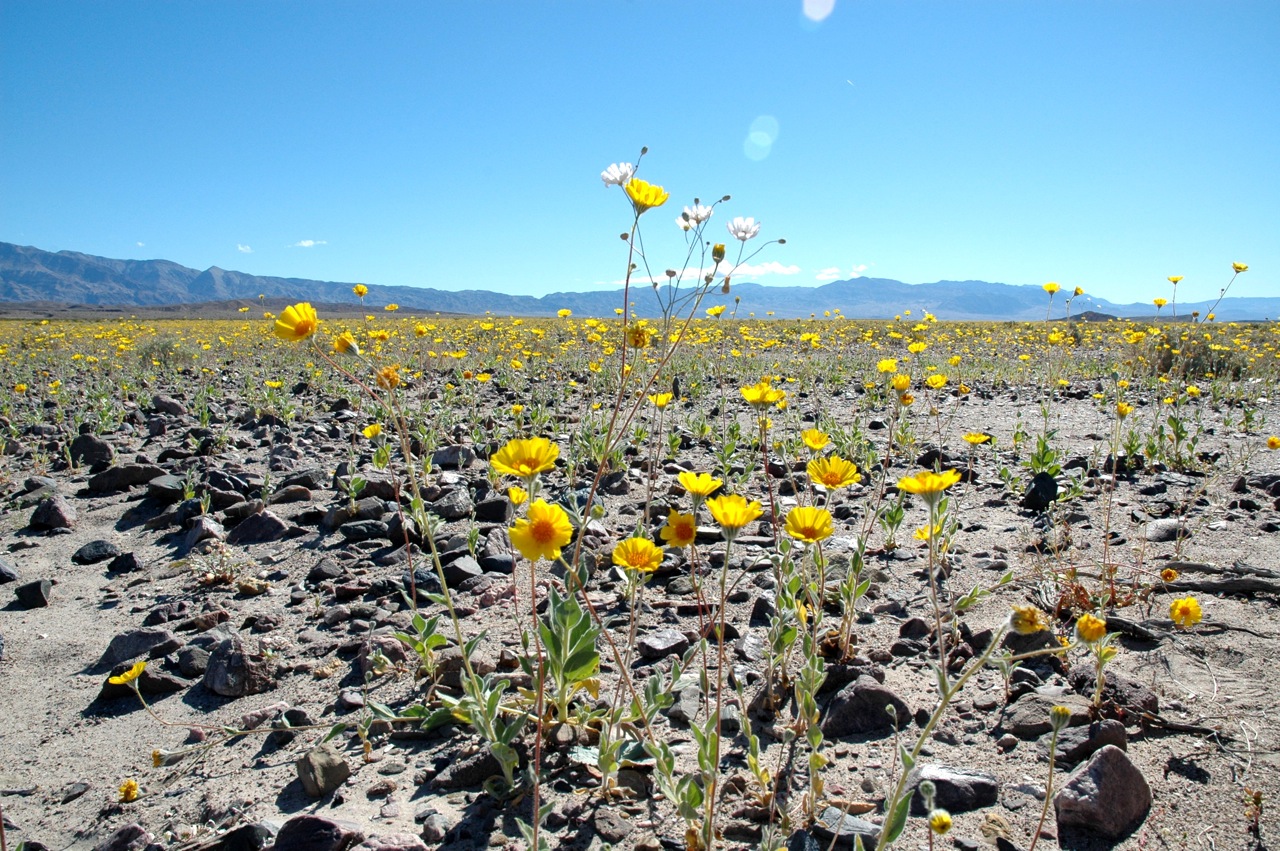
Death Valley flowers

Today’s Old Testament reading takes us to the end of the great Flood in Genesis. Many people have trouble with this story, because they read it as a tale of crime and punishment, with an angry father god who will get us if we don’t behave.

But the rest of Scripture won’t let us read it that way. The rest of Scripture, including the ending of the Flood story itself – the rainbow and the promise – shows us the face of God as the face of love. God doesn’t want to kill us. God wants to make a covenant with us. God wants to marry us.

So what is the Flood story really about? It actually generates a multitude of meanings, but one of the central ones has to do with violence. Genesis says that God looked upon the earth and saw that it was filled with violence. Sound familiar?

Violence is what happens when we put ourselves in the center instead of God, and try to make the world over in our own image. We are unable to honor or even see the existence of other beings as independent of our own desire. We lose all curiosity for anything outside ourselves.

Violence is intolerance of difference: other selves, other perspectives, other cultures are treated as obstacles to our desire, and must be made either to serve us or be swept away. This intolerance of difference, of otherness, may be seen in the rhetoric of terrorists, as well as its mirror image in the anti-Muslim ranting of certain American politicians. It is may also be seen in the recent outbreaks of overt racism in this country. Fear and hatred of those not like us has become far too common.

Such boundless self-assertion, says the Bible, is the foundational violence that threatens to swallow the whole earth. The Flood is not a punishment imposed from the outside; it is what we have made of ourselves.

When we are hostile to those who are not like us, who are not useful in the boundless expansion of our swelling desire, we destroy the balances and boundaries of which the world is made. You can see this violence in relationships, on the freeway, in the crucifixion of Nature, in the current phenomenon of endless war. If we let creation’s harmonious balance be smashed by human violence, we will all be washed away, the innocent and guilty alike. Not even the billionaire profiteers will be able to hide on that day.

A world drowning in its own violence.
Is this an ancient myth, or the daily news?

But the Flood story has a surprise ending. Instead of destruction, new possibility. Instead of anger, love. Instead of violence, reverence for all beings with whom we share the planet. God tears up all the sad old tragedy scripts and gives us a comedy instead. God invites us to join in the re-imagination of the world. God writes a new story in our hearts.

This is why the Epistle of Peter links the waters of the Flood to the waters of baptism. Both are the ending of an old story and the birthing of a new one. When our old selves drown in the depths of the font, we are reborn in Christ. No longer I, but Christ in me, as Paul says.

But before Christ could become our future, he first had to become himself. We are all tempted to live some other life than our own, to wear other people’s faces instead of becoming what God made us to be. Jesus was no exception. He could have lived some other life. Tradition says that he was tempted to dominate others and to escape the Way of the Cross.

“You don’t have to suffer,” Satan told him. “Not you. You were born King of the World. Think of the good you could do with all that power.”

But if Jesus had not lived with the poor and the outcast, if he had spent his time making rich and powerful friends, would he have been Jesus? If he had led a violent uprising to overthrow Roman tyranny, if he had devoted his life to reforming the religious establishment, would he have been Jesus? If he had turned stones into bread, or not risen from the dead, would he have been Jesus?

“Ask me whether what I have done is my life.”
writes poet William Stafford.[i]
Ask me whether what I have done is my life.

Well, what Jesus did was his life. So, we may wonder, how do we do our own lives? To answer that question, we must go, with Jesus, to the desert.

The desert is the emptiness where there’s no place to hide. In the desert, you come face to face with yourself, your demons, and your God. Nothing is defined there, nothing known in advance. Your scripts are no good in the desert. Your evasions are futile. Whatever makes you want to turn around and run back to the safety of your old illusions is the very thing that is trying to kill you.

Only in the desert is the silence deep enough for you to hear the whisper of your innermost heart. And what is your heart trying to tell you? Listen. Listen to your heart.

As Parker Palmer says:

“Before you tell your lives what you intend to do with it, listen for what it intends to do with you … Vocation does not come from willfulness. It comes from listening. I must listen to my life and try to understand what it is truly about – quite apart from what I would like it to be about… Vocation does not mean a goal that I pursue. It means a calling that I hear. Before I can tell my life what I want to do with it, I must listen to my life telling me who I am…”[ii]

We’re always making up stories about ourselves. Sometimes we’re heroes, sometimes we’re victims. But all of these stories are fictions that make us deaf and blind to what our life is actually trying to tell us. What are the stories that you need to let go of in order to let your life speak? If you are going to give up anything this Lent, give up those tired old stories about yourself. They are no longer true.

When we are baptized, we die to our old fictions; we let go of the old stories by which we try to direct our lives. That’s why the Flood story is one of the great images for baptism. There are all those people of Noah’s time clinging to their own fictions, sinking down under the weight of their false identities just as we ourselves sink under the weight of our own fictions.

And when in baptism we are freed from the burden of our false selves, we rise, newly buoyant, to the surface; we are pulled out of the water and given a new story, a new name, which is our true self, our true life, which has been wanting to speak to us all these years.

That is the work we have come to do, as we begin our long Lenten journey, as we step out into that desert where every fiction will be stripped away. At first it will feel like loss, like too much giving up. We may even want to turn around and quit, like the Israelites who complained in the midst of their own desert journey: Let’s go back! It wasn’t so bad, being slaves in Egypt!

But with God’s help, we will keep going, deeper and deeper into that desert, determined to save the only life we can save,[iii] and there will come a day, some 40 days hence, when we will reach the other side. And there we will hear a voice, a voice that calls us each by name.

Come to the waters, the voice will say.
Come to the life-giving pool of the baptismal font.
Come to the Easter waters, and dive in.
Wash yourselves clean of the old fictions, the tired stories,
and rise again out of the watery depths,
newborn, with a new name,
a name which is: Not I but Christ in me.
And this new name, this new self,
is what our life has been trying to tell us all these years.

As Derek Walcott describes it,

The day will come when with elation you will greet
yourself arriving at your own door, in your own mirror,
And each will smile at the other’s welcome
Saying, “Sit here, eat, you will love again
the stranger who was yourself …
the stranger who has loved you all your life …
who knows you by heart.[iv]

The desert is wide, the journey long, but keep on keeping on, because it will lead you, step by step, into the heart of the Beloved who has loved you all your life, who knows you by heart.

And when we finally draw near the end of our Lenten journey, everything that the desert is about, everything the Christian faith is about, everything our very lives are about, will be intensified and distilled in the incomparable passage from death to life which we call the Paschal Mystery: the life-giving mystery experienced both ritually and personally in the Great Three Days of Holy Week: Maundy Thursday, Good Friday, and the Easter Vigil.

Right now, in these first lean and hungry days of the Lenten desert, the transformative joy of the Easter feast may seem unimaginable. But beyond the hunger and thirst, beyond the trials and temptations, the doubts and the stumbles, beyond even the faded Hosannas and the terrible shouts of “Crucify! Crucify!,” there will rise the jubilant Alleluias of the Easter Vigil, breaking at last the stony silence of defeat and death.

The great journey begins here. Now.
And when it’s over,
you will be somebody else:
Not I, but Christ in me.

[i] William Stafford, “Ask Me”

[ii] Parker Palmer, Let Your Life Speak: Listening for the Voice of Vocation (San Francisco: Jossey-Bass, Inc. 2000) 3-4

[iii] Mary Oliver, “The Journey”

[iv] Derek Walcott, “Love after Love”

Sauntering

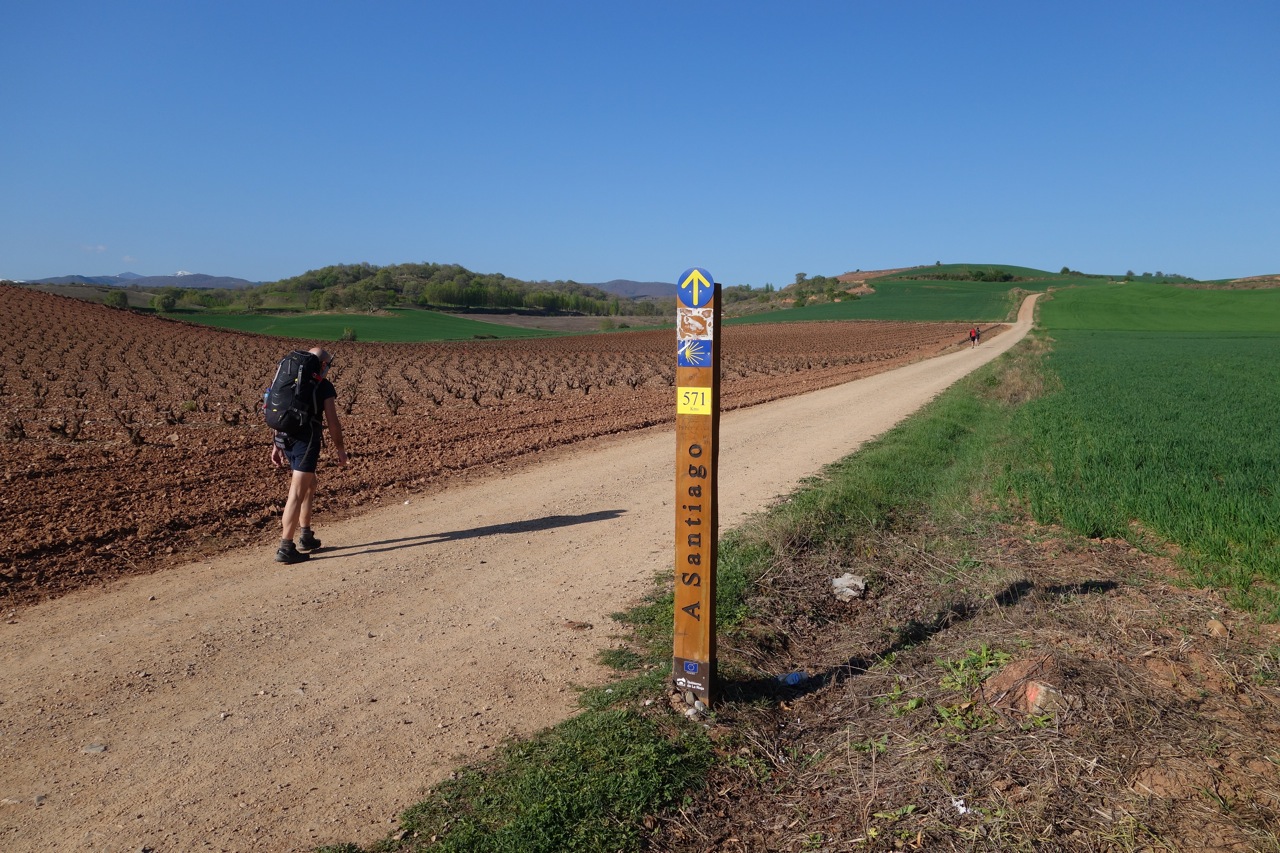
Early morning on the Camino de Santiago

Early morning on the Camino de Santiago

To walk [somewhere] is to earn it, through laboriousness and through the transformation that comes during a journey … We are eternally perplexed by how to move toward forgiveness or healing or truth, but we know how to walk from here to there, however arduous the journey…. In pilgrimage, the journey is radiant with hope … geography has become spiritualized.  – Rebecca Solnit[i]

Henry David Thoreau, reflecting on the verb “to saunter,” suggested two possible word origins. Sans terre, meaning “without land or a home,” describes those who are perpetually on the road, literally or metaphorically. Sainte Terre, meaning “Holy Land,” was applied in the Middle Ages to pilgrims with a specific destination, on their way to the place where the Sacred has uniquely showed itself. Anyone who has been on pilgrimage, or who understands life itself to be one great pilgrimage, would acknowledge both meanings at work in their own sauntering.

As the Bible says, we are all “strangers and aliens on this earth,” ever “in search of a homeland.”[ii] The first humans exiled from Eden; Abraham called to abandon country, home and kindred; the Hebrews wandering in the wilderness; the displaced Israelites weeping by the rivers of Babylon; Jesus having no place to lay his head; Paul continuously on the move or on the run: so many biblical stories display an abiding sense of being on the way to God knows where.

The actual place of arrival often remains beyond the horizon and over the rainbow – distant, unknown, unattained, not here, not yet. The Dark Age Celtic monks adopted this biblical outlook in their own far flung travels. Setting out on wild seas in little rudderless boats, they entrusted their journey to the (providential) vagaries of wind and currents. They had no idea where they would finally land. They simply set out “away from here” and left the rest to God.

I once told a fellow priest what I had read about those monks, and he liked their example so much he tried preaching about them to an upscale congregation of economically empowered people enjoying a high degree of control their own lives. They hated his sermon. Those crazy Celts, consenting to be swept away by larger, unpredictable forces, made them very uncomfortable.

But the monks, like their ancestors in the faith, were never headed for nowhere in particular. They were always looking for the Promised Land, wherever and whenever that might be for them. The last book of the Bible calls this place the new Jerusalem, a new heaven and a new earth, paradise restored. The Celtic wanderers called it “the place of resurrection.”

It is the place we were made for. We’ll know it when we get there. As Frederick Buechner famously describes it, “The place God calls you to is the place where your deep gladness and the world’s deep hunger meet.”[iii] This sense of ultimate destination and purpose, however indeterminate in time or space, made those seafaring monks more than sans terre. They were Sainte-Terrers as well, Holy-Landers bound for glory.

And so are we all. Even though Thoreau claimed to have met “but one or two persons” in his life who had a “genius” for sauntering, his exhortation to the “faint-hearted” majority expresses the hope that we may all hear – and obey – the call to pilgrimage.

We should go forth on the shortest walk, perchance, in the spirit of undying adventure, never to return – prepared to send back our embalmed hearts only as relics to our desolate kingdoms. If you are ready to leave father and mother, and brother and sister, and wife and child and friends, and never see them again, – if you have paid your debts, and made your will, and settled all your affairs, and are a free man, then you are ready for a walk.[iv]

I keep a walking stick by our front door as a perpetual reminder that the pilgrimage road always begins just outside the house. For years it was a pine branch I first used to traverse the Sierra Nevada mountains of California in 1976. Now it is the sturdy staff I acquired last April in St. Jean Pied-de-Port for my 500-mile pilgrimage on the Camino de Santiago (dispatches from that journey may be found in this blog’s April and May archives).

In Lord of the Rings, Bilbo Baggins began his fateful journey out of the Shire with a song: “The Road goes ever on and on, / Down from the door where it began … Until it joins some larger way / Where many paths and errands meet. / And whither then? I cannot say.”[v] But Bilbo already knew the risks of setting out into the unknown and unfamiliar: “It’s dangerous business, Frodo, going out of your door.” But he went anyway. It’s what pilgrims do. To refuse the journey is to refuse our story.

We may not always know where the road leads or what will happen along the way. But with the best and longest journeys, that kind of knowledge can fade to insignificance. For every saunterer, the road itself, with its perpetual motion “away from here” toward the land of promise, provides a greater sense of belonging than whatever we left behind. I walk, therefore I am. As Catherine of Siena put it, “All the way to heaven is heaven, because Jesus said, ‘I am the Way.’”

For many years I worked with a wonderful storyteller, Angela Lloyd, on creative variations of the Exodus narrative performed at the Easter Vigil liturgy. And one year she played an Israelite who was starting to wonder how long they would have to wander before they finally arrived at the place God had prepared for them. She pulled out a battered postcard and held it up. “I’ve been carrying this postcard a long time,” she said, “I was planning to mail it when we got to the Promised Land. But now I think I should just mail it from here. And you know, maybe it doesn’t matter where I mail it from. Maybe everywhere we stand is already holy ground.”

[i] Rebecca Solnit, Wanderlust: A History of Walking (NY: Viking Penguin, 2000) 50

[ii] Hebrews 11:13-14

[iii] Frederick Buechner, Wishful Thinking: A Theological ABC (NY: Harper & Row, 1973)

[iv] Henry David Thoreau, “Walking,” The Natural History Essays (Salt Lake City: Peregrine Smith, Inc., 1980) 94

[v] J.R.R. Tolkien, The Fellowship of the Ring (London: The Folio Society, 1977) 51

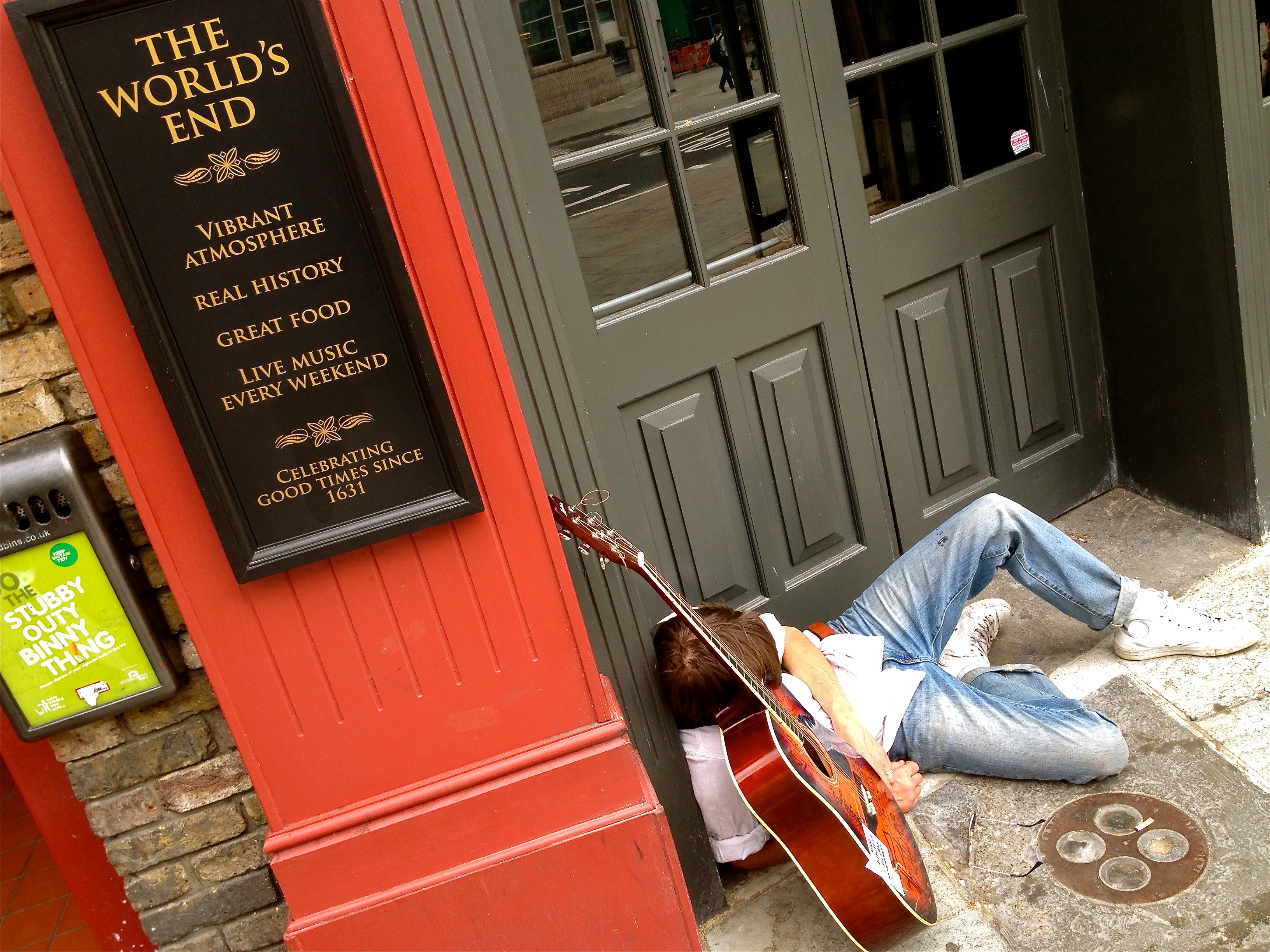
The World’s End

The World's End

When I was 8 years old, I read in LIFE magazine that in so many millions of years, the sun would burn out and life on earth would cease. This worried me, so I asked my parents, “If the world is going to end, how come we say “world without end” when we pray?” And they told me what the Bible says, that heaven and earth may pass away, but God remains. That relieved some of my anxiety, but I still wasn’t sure I liked the idea of the world ending, even if God was in charge.

Of course the world ends all the time. When I moved from California to Puget Sound in the 1990’s, my first Northwest winter felt like today’s gospel: the sun was darkened and the moon gave no light.

Who among us has not seen their world end? Adolescents exiled from childhood. Black teenagers robbed of their future. Elders deprived of their health. Unemployment …retirement …divorce … the death of a parent, a spouse, a child — in every one of these, a world comes to an end.

For anyone who has known serious loss, this is more than metaphor. The experience of grief can be so total and unrelenting that you can’t see anything beyond it. You can’t imagine the future. It feels like the end of the world.

The stars are not wanted now: put out every one;
Pack up the moon and dismantle the sun;
Pour away the ocean and sweep up the wood;
For nothing now can ever come to any good. [i]

W.H. Auden was invoking apocalyptic metaphors to express personal loss, but shared, public worlds also come to an end. As in 1789, or 1914. The Holocaust. Hiroshima. 9/11. My Lord, what a morning, when the stars begin to fall.

But why bring up such dreary stuff on this first day of the new Christian year? Shouldn’t we be breaking out the party hats, blowing horns and shouting “Happy New Year?” The wisdom of the Advent season is that it never begins with “A Holy Trinity Production,” or “The Creator of the World Presents.” No, it always opens with “The End.” Advent knows that every beginning involves some kind of ending. In this season’s Scripture, preaching and prayers, the present arrangements of collective and personal life are judged and found wanting. God’s imagination is far too rich and fertile to settle for our barren and diminished versions of human possibility.

Selfishness, greed, consumerism? Fear, racism and violence? Poverty, militarism, war, environmental degradation? That’s the best we can do? Really? God must be saying, “Come on, people. I made you a little lower than the angels, and this is what you came up with?”

George Eliot said “it is never too late to become what you might have been.” But to get to that “might have been” requires an Exodus into the wilderness beyond the way things are; an Exodus beyond even the best we can imagine for ourselves, into a place of unknowing, where only God possesses the language to speak our future into being.

So much of what we hear and pray and sing in Advent is profoundly disruptive. Bob Franke’s great Advent song, “Stir up your power,” gets right to it in the first line: This world may no longer stand. We are meant to be unsettled, to be driven beyond our narrow boundaries, our constricted realities, toward a beckoning horizon. The Christian life is a perpetual series of departures for a better place.

The world as it is – the world of racial hatred and toxic violence and economic injustice and perpetual war and addictive consumerism and pollution for profit and all the other evils which poison our common life – this world has no future in the emergent Kingdom of God. This world may no longer stand.

But the story doesn’t stop there. In my end is my beginning.[ii] Even when we have gone far astray, even when our story seems over, God remains deeply present in the processes of creation, tenderly leading and luring us into newness of life, making a way where there is no way, opening doors that none can shut.

Advent people do not just wring their hands or shake their heads over the latest news from Ferguson or the Middle East. We work and pray for something better. What we can do on our own is limited, but when we offer our priorities and energies to the larger purposes of God, Love will have its way with us.

As the Christian mystic Hadewijch put it in the thirteenth century:

Since I gave myself to Love’s service,
Whether I lose or win,
I am resolved:
I will always give her thanks,
Whether I lose or win;
I will stand in her power. [iii]

It is not always easy to stand in Love’s power and keep the faith. In some situations it is almost unimaginable. Forty years ago the African-American author James Baldwin wrote:

To be an Afro-American, or an American black, is to be in the situation, intolerably exaggerated, of all those who have ever found themselves part of a civilization which they could in no wise honorably defend – which they were compelled, indeed, endlessly to attack and condemn – and who yet spoke out of the most passionate love, hoping to make the kingdom new, to make it honorable and worthy of life. [iv]

This passionate mixture of protest and love sounds a lot like the Old Testament prophets who permeate our Advent lectionary. The very first reading of the season begins with a prophetic plea for history to be broken open by divine justice:

O that you would tear open the heavens and come down …
to make your name known to those who resist you,
so that the nations might tremble at your presence! [v]

Advent is not just a season of quiet waiting. It is also a time of protest and vision. Advent announces an insurgency against the way things are, a revolution to scatter the proud, cast down the mighty, raise the lowly, gather the lost, free the captive, and bind up the brokenhearted. Advent re-imagines the world as paradise restored, a new heaven and new earth suffused with the peace of God.

this is the day of broken sky
this is the space of conflagration-breath
speaking border-trespass
this is the feathered swoop of heaven
on the wing of now …
forking lightning into language …
breaking god into prison …
breaking the truth from jail! …

This is the fire-tongued fork of holy-ghost howl
making love on the tongue …
spitting flames of reconciliation
in the sky of war
making messiah-praise out of the air itself!

this is pentecost in your head
like becoming what you never dared
for the first time and forever

This ecstatic prophecy is from a poem by Jim Perkinson. [vi] He was talking about Pentecost, but his theme fits Advent as well:

“the day of broken sky”
the earth in conflagration
God breaking into the prisons
the truth being set loose at last
and “the fire-tongued fork of holy-ghost howl
making love on the tongue …
making messiah-praise out of the air itself!”

And each of us, all of us, becoming what we never dared.

When Jesus tells us to stay awake, he is warning us not to sleep through the day of God’s coming. Stay alert. Pay attention. Don’t miss it! Become what you never dared. Shake off the sleep of complacency, the sleep of complicity, the sleep of despair. Awake and greet the new dawn.

Jan Richardson describes this dawning reality in her beautiful poem, “Drawing Near.” [vii]

It is difficult to see it from here,
I know,
but trust me when I say
this blessing is inscribed
on the horizon.
Is written on
that far point
you can hardly see…

Richardson accurately expresses the sense of distant horizon that prevents the dominant reality of the moment from closing in on us and locking us in. That reality wants to be believed as fixed and final, permanent and stable. But the horizon calls every finality into question, disrupting its stability with the boundlessness of divine possibility. The horizon draws our attention from what is given to what may yet be. Keeping our eye on the horizon, feeling its pull, is the spiritual practice of Advent. Richardson’s poem expresses the deep longing produced by the distance between the already and the not-yet.

And then the poet discovers what every pilgrim knows: the goal of our long journey is something that has already been inscribed deep within us even before our journey began. Even before the day we were born, we were marked as God’s own forever.

And that is where Advent ultimately leaves us – finding that the thing we have been seeking so long has been with us all the time – within us, and all around us. While we have been walking our Camino to the Promised land, our feet have already been on holy ground, every step of the way. And the God of the far horizon turns out to be the path as well, keeping us company as we stride deeper and deeper into the world.

So when Advent people talk about the end of the world, we are speaking about end in the sense of purpose rather than termination. The word “apocalypse” means “unveiling,” and the apocalypse in our future will not be an annihilation, but a revealing of the world’s ultimate purpose and destiny.

Yes, all the inadequate, incomplete versions of world will come to an end (some of them kicking and screaming!), but creation as it was intended will be restored, not discarded. Like a poet who creates a new language out of old words, Love will remake the ruins and recover the lost. And the Holy One who is the mystery of the world will be its light and its life forever.

This Advent faith is expressed memorably in a short story by British writer Carol Lake, “The Day of Judgment.” On the Last Day of the world, God sails into England aboard a new Ark. But instead of bringing history to a close and pronouncing judgment on everyone, God leaves the Ark to enter the city of Derby. Heading for the run-down inner city neighborhood of Rosehill, he joins the crowd at a local pub, a multi-ethnic mix of the working poor and the unemployed. And there God gets so caught up in being with these people that he loses track of time, and the Ark sails away without him, heading off for the horizon of eternity. As the story describes it:

The Ark is on the edge of the horizon now, its destination the heartlessness of perfection. Most of the inmates already know what they are going to find – endless fruit, endless harmony, endless entropy, endless endless compassion, black and white in endless inane tableaux of equality. It sails off to a perfect world; the sky has turned into rich primary colors and in the distance the Ark bobs about on a bright blue sea.” [viii]

Meanwhile, God is still in that Rosehill pub, in the very heart of imperfection. If you had walked in there, you would have had a hard time picking him out. He blended right in. But if you were paying attention, you might notice that there was now something different about Rosehill. The old non-descript streets and dilapidated buildings had taken on a strange beauty. Maybe it was the warm slant of afternoon light, but people were beginning to see their neighborhood in a new way. And their own faces, too, seemed to glow with an inner radiance, as if they were carrying a wonderful secret, tacitly shared with everyone around them, as if they suddenly knew there was more to life than meets the eye.

They were still poor, the world was still a mess, but something new was in the air, a spirit of change was awakening. And from that day on, the people of Rosehill found themselves becoming what they’d never dared, for the first time and forever.

[i] W.H. Auden, “Twelve Songs (ix)”, Collected Poems, ed. Edward Mendelson (NY: Random House, 1976), 120

[ii] T.S. Eliot, “East Coker,” Collected Poems 1909-1962 (London: Faber and Faber Ltd, 1974), 191

[iii] Hadewijch: The Complete Works, trans. Mother Columba Hart, Classics of Western Spirituality (Mahwah, NJ: Paulist Press, 1980), 213

[iv] James Baldwin, No Name in the Street (NY: Dell, 1972), 194

[v] Isaiah 64:1-2

[vi] Jim Perkinson, “tongues-talk,” q. in Catherine Keller, On the Mystery: Discerning God in Process (Minneapolis: Fortress Press, 2008), 157-8

[vii] Jan Richardson, “Drawing Near” (http://adventdoor.com/2012/11/25/advent-1-drawing-near)

[viii] Carol Lake, Rosehill: Portraits from a Midlands City (London: Bloomsbury, 1989), 119

Dies Irae

Biblical prophet at Moissac Abbey on Le Chemin de St. Jacques

Biblical prophet at Moissac Abbey on Le Chemin de St. Jacques

Mr. McCleery, my seventh grade Latin teacher, had us memorize verses of the Dies Irae, a medieval chant describing the Last Judgment in strikingly lurid language. Most boys in junior high do not walk around chanting Latin poetry about the end of the world, but I rather enjoyed it. The tune was catchy, and those terse rhyming triplets beat time like the sensuous energy of a drum circle.

Dies irae, dies illa, 
Solvet saeclum in favilla,
Teste David cum Sibylla.

Day of wrath, O day of mourning,
See fulfilled the prophet’s warning,
Heav’n and earth in ashes burning.

The text of Dies Irae is inspired by the first chapter of Zephaniah, which was one of the eucharistic readings last Sunday. I sometimes wonder what churchgoers think about when asked to consider “a day of wrath, a day of distress and anguish, a day of ruin and devastation, a day of darkness and gloom.” In Syria or Ukraine, it’s just the latest news. But for those of us not living in one of history’s infernos, Zephaniah might be dismissed as a colorful crank carried away by the thrill of his own hyperbole.

The effect of the Bible’s more fiery rhetoric is often muted by the flat, inexpressive way it is usually read – or worse, mumbled – in the typical liturgy, as though no one really means it. Readers of prophetic texts should be given bullhorns. They should walk among the people as they shout, looking them in the eye.

I will bring such distress upon people
that they shall walk like the blind;
because they have sinned against the LORD,
their blood shall be poured out like dust,
and their flesh like dung.[i]

The church growth people might have something to say about that sort of messaging, but there is no denying that the prophets are working hard to get our attention. And in these last weeks of the Christian year, both the Sunday lectionary and the daily liturgical readings resound with the trumpet blasts of biblical warnings. People get ready. History’s chickens are coming home to roost.

Those prophetic rants have sometimes been read as endorsements of sacred violence – angry outbursts of a moody and unpredictable god – but God’s best friends have long rejected that crude picture as a tragic misreading of the divine. Nevertheless, there is no denying the violent imagery woven into some biblical texts, and we must find a way to make sense of it.

Walter Brueggemann explains that the prophets “speak in images and metaphors that aim to disrupt, destabilize, and invite to alternative perceptions of reality … [They] speak in outrageous and extreme figures because they intend to disrupt the ‘safe’ construals of reality, which are sponsored and advocated by the dominant opinion makers.”[ii] In other words, prophets blow up the old paradigms in order to make room for the new. They take seriously the power of language both to enslave and to liberate.

Zephaniah targets those “who rest complacently on their dregs,” who are blinded by their illusions, who assume divine indifference to the damage they do to the poor, the vulnerable, and the whole interdependent system of life on earth. We can find similar voices in our own time.

German writer W. G. Sebald’s apocalyptic poem, After Nature, is as harrowing as anything in the Bible. As he contemplates the dark and barren landscape of Matthias Grünewald’s Crucifixion, painted in 1505, Sebald finds a predictive warning of the planet’s own death unless we change our ways.

Here in an evil state of erosion
and desolation the heritage of the ruining
of life that in the end will consume
even the very stones has been depicted.[iii]

Today the United States Senate came just one vote shy of approving the Keystone XL pipeline, a massive fossil fuels project to enrich a few people at the expense of the whole earth. The effects of exploiting the Canadian tar sands, according to climate scientist James Hansen, could well be of biblical proportions.

Canada’s tar sands, deposits of sand saturated with bitumen, contain twice the amount of carbon dioxide emitted by global oil use in our entire history. If we were to fully exploit this new oil source, and continue to burn our conventional oil, gas and coal supplies, concentrations of carbon dioxide in the atmosphere eventually would reach levels higher than in the Pliocene era, more than 2.5 million years ago, when sea level was at least 50 feet higher than it is now. That level of heat-trapping gases would assure that the disintegration of the ice sheets would accelerate out of control. Sea levels would rise and destroy coastal cities. Global temperatures would become intolerable. Twenty to 50 percent of the planet’s species would be driven to extinction. Civilization would be at risk.[iv]

Hansen concludes that Keystone and its aftermath “will be game over for the climate.” The apocalypse was defeated today in the Senate, but there will be another vote early next year, when many of the “no” votes will be out of office. Alarmingly, the next head of the Senate Committee on Environment and Public Works will be a climate change denier who believes in a god who would never allow earth’s climate to be affected by the actions of mortals. If the senior senator from Oklahoma were to study his Bible, he might find that God takes human freedom far more seriously than he does. We do have the power to destroy God’s creations and disrupt the fragile balances of life.

The prophets are trying to make us renounce that power before it is too late. When Zephaniah warns of “a terrible end” he isn’t simply condemning us; he’s trying to save us. The “day of wrath” will not be an arbitrary vengeance from the sky, but the sum of innumerable bad choices here on earth. Zephaniah and his fellow prophets hold before us a chillingly graphic picture of where those choices are headed. What has been called the wrath of God is really something bearing our own signature.

Will God ride to the rescue? In a poem called “Emmanuel’s Nightmare,” African-American poet Gwendolyn Brooks wonders what it might be like if we were simply left to our own devices. She imagines the Second Coming of a Christ who would “clean the earth / of the dirtiness of war.” But the Savior finds himself thwarted. Humans love war too much. It is “what they lived for.” So God’s Son gives up and goes home. Mission not accomplished. “He had not the heart / To take away their chief sweet delectation.”[v] 346

The prospect of being abandoned to our own suicidal impulses is not a happy one, but – thankfully – it is not in fact the story we tell. God has destined us not for wrath but for salvation.[vi] The means of that better destiny will turn out to be quite surprising, not at all like the terrible clamor of the Dies Irae. But that is a tale for another day.

[i] Zephaniah 1:17

[ii] Walter Brueggemann, Theology of the Old Testament: Testimony, Dispute, Advocacy (Minneapolis: Fortress Press, 1997), 625

[iii] W.G. Sebald, After Nature, q. in Colin Riordan, “Ecocentrism in Sebald’s After Nature,” in W.G. Sebald – A Critical Companion, eds. J.J. Long & Anne Whitehead (Seattle: University of Washington Press, 2004), 51

[iv] New York Times, May 9, 2012

[v] Robert Atwan, George Dardess, Peggy Rosenthal, eds., Divine Inspiration: The Life of Jesus in World Poetry (New York: Oxford University Press, 1998), 346

[vi] I Thessalonians 5:9

The ambush of the marvelous

Jacob wrestling

Come, O Thou traveler unknown,
Whom still I hold, but cannot see;
My company before is gone,
And I am left alone with Thee.
With Thee all night I mean to stay,
And wrestle till the break of day.

The Sacred Harp

A century ago, Scottish theologian P.T. Forsyth described prayer as a kind of spiritual tempest blowing away all our complacencies. While giving a nod to the contemplative and aesthetic dimensions of spirituality, he was blunt about its capacity to rupture the settled proportions of daily life:

We do need more reverence in our prayer, more beauty in our praise, less dread of tried and consecrated form. But still more do we want the breathless awe, and the stammering tongue, and the solemn wonder, and the passionate gratitude, which are the true note of grace, and the worship of a soul plucked from the burning and snatched by a miracle from the abyss.

Prayer is not for the timid. Better wear a crash helmet, as Annie Dillard advised. But the fierce energies of prayer are not God’s alone. We must bring the strong force of our own desire to the encounter, pressing God to keep the ancient promise of a world made new. Every prayer may inevitably end with “thy will be done,” but it often begins in a place of struggle, if we are honest. “Hear my voice when I complain,” prayed the Psalmist. Even Jesus argued vehemently for an alternative to the cross. We were not made to go quietly. God wants us to put up a good fight. “Prayer is wrestling with God,” wrote Forsyth. “It is a resistance that God loves.”

The Bible never names the stranger who jumps Jacob in the dark and wrestles him till daybreak (Genesis 32), but interpreters have always suspected his divinity. Delmore Schwartz, in his poem “Jacob,” describes the assault as “the ambush of the marvelous, / unknown and monstrous, / at the very heart of surprise.” Jacob couldn’t see his opponent’s face, but all his inner conflicts must have risen up to give him a name:

– It is the ghost of my father Isaac, from whose deathbed I stole the blessing, and he’s come to take the blessing back.

– No. It is the spirit of my brother, with whom I wrestled in my mother’s womb, with whom I must fight in the flesh tomorrow.

– No. It is my own shadow, the unloved child and desperate trickster, here to unmask the pretense of my so-called success.

– No. It is the angel of death come to mock all God’s promises of protection and future.

– No. It is God’s own self, that merciless opponent who will not let me be until I am broken open and made new.

All night long, Jacob fought against this stranger, this Other. The stranger wounded him, dislocating the socket of his thigh, but Jacob would not give up. When dawn came, the stranger tried to flee, but Jacob held on tight.

“Let me go,” said the stranger. “I do not live in the glare of your well-lit thoughts, but only in the shadows of your intuitions.”

“I will not let you go until you bless me.”

“What is your name?” asked the stranger.

“Jacob.”

“It is Jacob no more. Your name shall be Israel – the one who wrestles with God.”

“Then what is your name?” asked Jacob.

“Ah!” said the stranger. Then he gave Jacob the blessing, and vanished.

The sun began to rise as Jacob limped away from the river, forever wounded, but ready at last to meet his future.

I once led a workshop on this story at a church retreat. After digging into the passage for a while, participants were invited to retell it in their own way. One young woman, who was differently abled and emotionally troubled, did exactly what the Bible wants us to do with its narratives. She put herself into the story.

Jacob was having a lot of problems with his family. He needed to get away from them, to get his head together. He felt a great struggle inside himself. “Why can’t I deal with my anger and frustration?” After a while he began to realize that he was wrestling with God.

He wrestled with God all night long, but when dawn came he began to think God must be pretty tired of him by now, that God must be so sick of listening to his problems that he was just going to go away. Jacob felt afraid and alone but he didn’t give up. He held on tight and wouldn’t let go. He begged God to stay and to bless him.

“What is your name,” God asked him.

“Jacob.”

“I don’t think so,” God said. “I think it’s Israel, because you’ve had the guts to face up to your problems.”

Then the sun came up and God was gone. And as Jacob began to walk away from that place, he noticed he was limping. Suddenly he remembered that he had always had this limp, but it didn’t bother him anymore. It was okay. It was just part of who he was.