The Importance of Tables—A Maundy Thursday Reflection

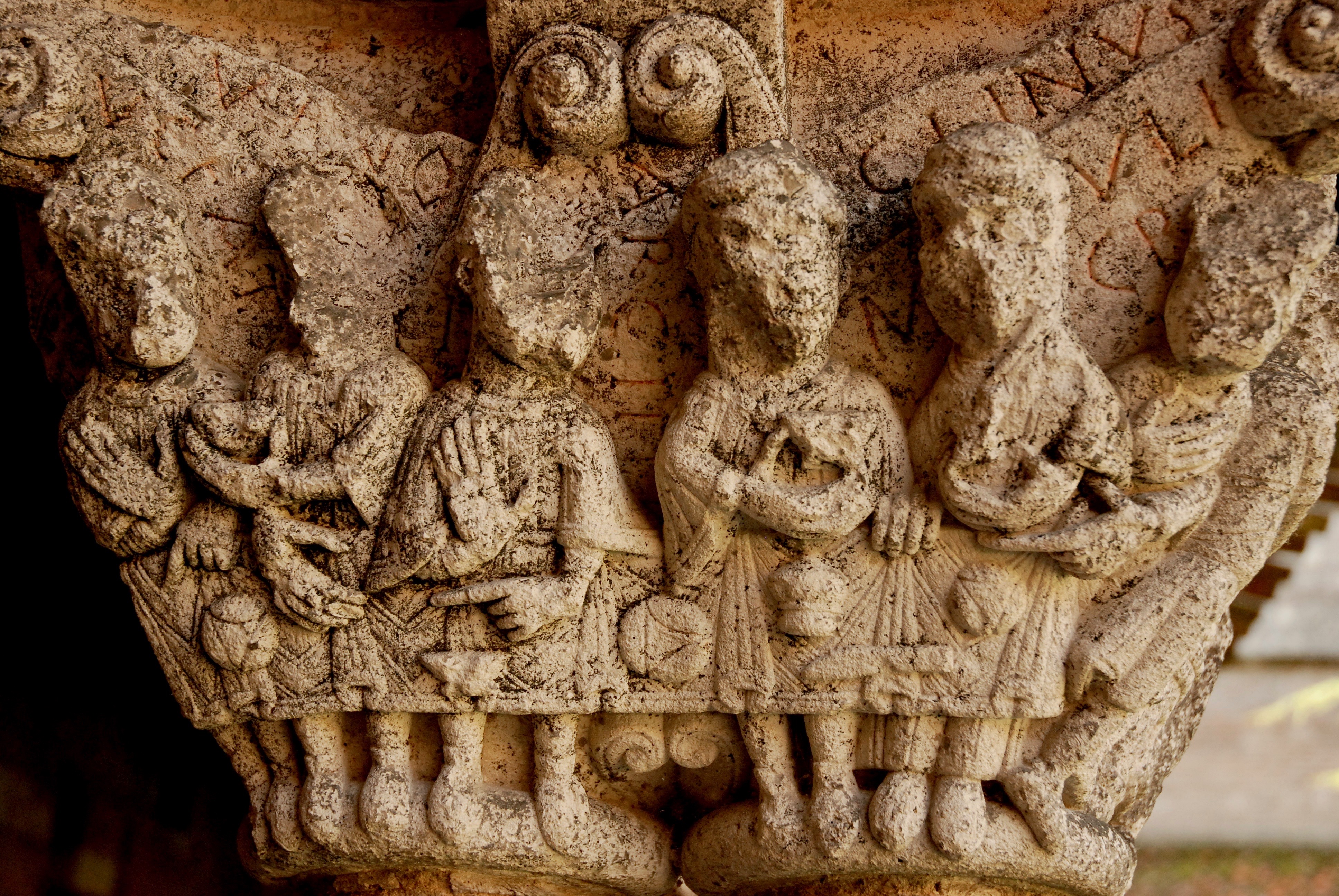
The Last Supper, Cloister of Moissac (12th century).

If this were the last night of your life, what would you do?
On his last night, Jesus gathered at table with his friends.

Jesus loved tables. He spent a lot of time sitting at tables.
At a table, Jesus ate and drank with sinners,
so that you and I would know we are always welcome at God’s feast.
At a table a woman became a teacher to the apostles
when she anointed Jesus with oil.
At a table Jesus presented a startling image of God
as slave and servant of all, when he washed his disciples’ feet.
At a table our Lord gave us, in bread and wine,
the means of tasting his sweetness forever.

I think Jesus liked tables because they are places of intimacy.
Everyone is close together—
it’s a place to let your guard down.
Jesus probably did more teaching quietly around a table
than he did shouting from boats or mountaintops to vast multitudes.

And I don’t think Jesus just walked into a room
and started telling people about God.
I think he sat down with them, and learned their names,
and listened to their stories.
And after a while, they would open up to him,
sharing their broken dreams and broken hearts,
their longings and their demons.
And it was there, responding to their particular stories,
that he would bring God to them, casting out their demons,
unbinding them with forgiveness,
empowering them to stand up and walk through that open door into God’s story,
proclaiming them—even the most prodigal sinner—the beloved children of God.

Tables also got Jesus into deep trouble.
In the Temple of Jerusalem, he overturned the tables of the old paradigm,
the tables of the smug and comfortable religionists
who can’t see the fault lines running through their ecclesiastical constructions
and their lifeless pieties.
He overturned the tables where some are in and some are out,
where some are welcome and some are not.

“This isn’t what God wants!” said the carpenter from Nazareth,
and he made a new table,
a table where all divisions and discriminations are put aside,

where enemies are embraced,
where outcasts and fools are honored as our wisest teachers,
where the abundant life of God’s future is as close
as the food you see before you tonight.

The world was not ready to sit at such a table –
the world didn’t even want to know there was such a table.
So it stretched its maker upon another piece of wood,
hoping to bury the dream before it could infect the general population.

But the table survived, and we sit round it tonight.
How costly and precious it is!
Gathered around Christ’s table,
we will do simple things—wash feet, share a meal, tell stories.

And as we do, we will begin,
as St. Augustine says,
to say Amen to the mystery we have become.

The Footwashing, Cloister of St. Trophime, Arles (12th century).

Living by the Sword: Putin and the Perils of Messianic Politics

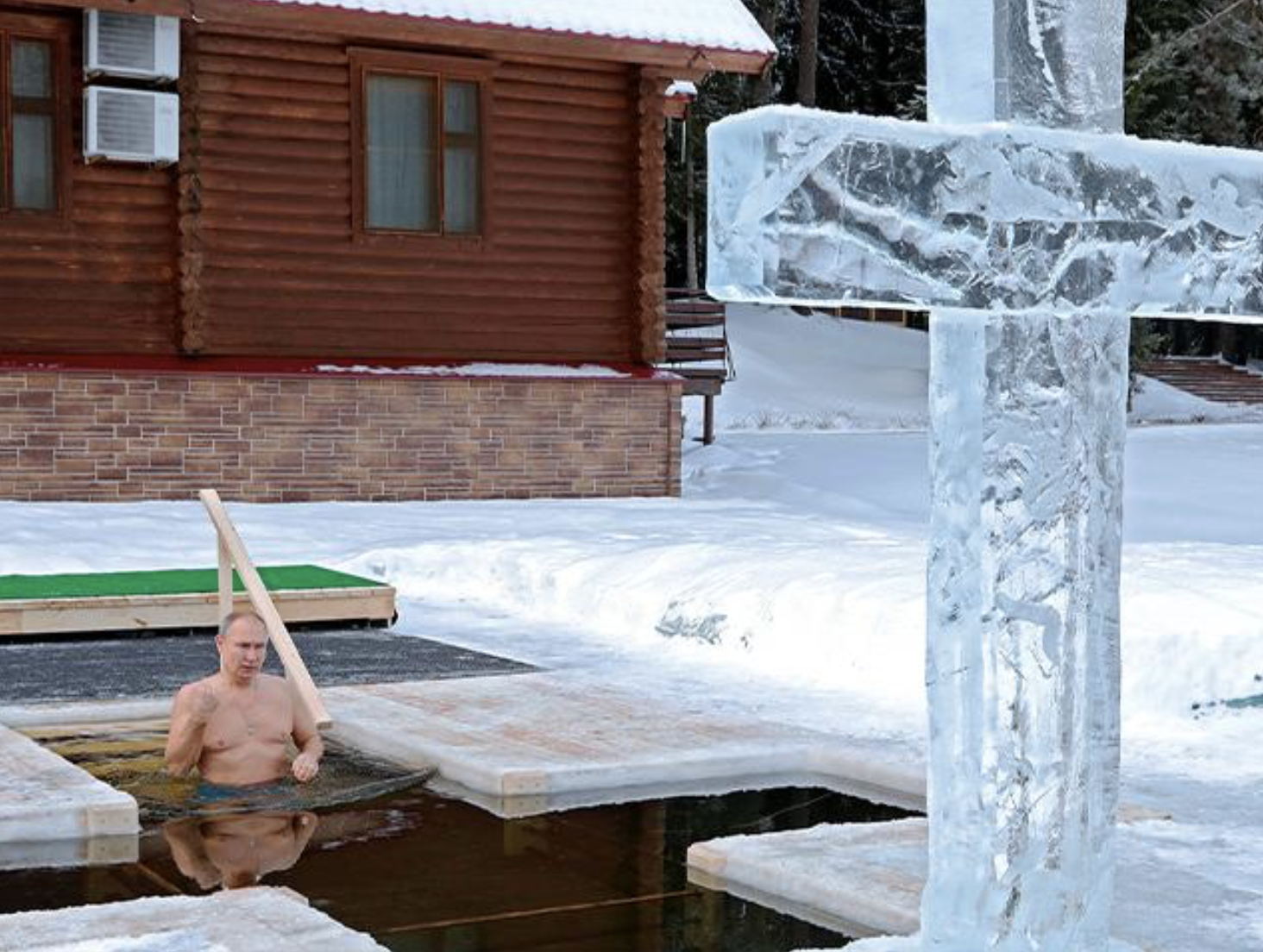
Vladimir Putin and the icon of the Savior “not made by hands,” (Attibution: AP Photo/RIA Novosti, Alexei Nikolsky, Pool)

“The hour is late. The world is choked with weapons, and dreadful is the mistrust peering from all men’s eyes. The trumpets of war may blow tomorrow. Who knows if we shall see each other in another year? What are we waiting for? Peace must be dared. Peace is the great venture.”

— Dietrich Bonhoeffer (August 1934)

At a pro-war rally in Moscow last month, Vladimir Putin praised his troops for their embodiment of Christian love. “And this is where the words from the Scriptures come to mind,” he said. “‘There is no greater love than if someone gives up his soul for his friends.’ The heart of the message is that this is a universal value for all the people and all the confessions of Russia …. Shoulder to shoulder they are helping and supporting each other and when it’s necessary they cover as if it was their own brother, they cover each other from the bullets. We haven’t had such unity in a long time.”[i]

The crowd loved the speech. “Forward Russia!” they chanted. Jesus! Love! Unity! Was this a political rally, or a religious revival? Some of each, I would think. For a thousand years of Russian history, politics and religion have been closely entwined. In 988, after the Christian conversion of Prince Vladimir of Kievan Rus’—the original Russian state—his subjects waded into the Dnieper River to be baptized en masse.

The fact that this birth narrative of Slavic Orthodoxy took place in Kyiv helps explain the lingering Russian attachment to the Ukrainian capital. It’s their Jerusalem. Even though the Ukrainian Orthodox Church was granted independence from its Russian counterpart in 2018, one third of the Orthodox churches still loyal to the Moscow Patriarchate are situated in the Ukraine, and Putin has argued that his army is coming to their defense. 

The mythology of Holy Rus’, a divinely ordered “kingdom” of Slavic believers—a “Third Rome” inheriting the world-transforming mission of its failed predecessors in Europe and Constantinople—became a staple of Russian identity. In contrast to the perceived decadence, individualism, and secularism of the West, Holy Rus’ was thought to preserve communal spiritual values for the sake of all humankind. In a famous speech given in 1880, Dostoevsky said:

“[T]o be a true Russian does indeed mean to aspire finally to reconcile the contradictions of Europe, to show the end of European yearning in our Russian soul, omni-human and all-uniting, to include within our soul by brotherly love all our brethren, and at last, it may be, to pronounce the final Word of the great general harmony, of the final brotherly communion of all nations in accordance with the law of the gospel of Christ!”[ii]

When Russia seized Crimea in 2014, such Third Rome mythology seemed alive and well when Foreign Minister Sergei Lavrov dismissed the protests of the “godless West, hostile to the Russians because we [remain] Christian traditionalists.”[iii] Many observers think the invasion of Ukraine is fueled by the same mythology. If so, Putin’s nostalgia for the old Russian Empire would be more than the product of personal and political ambition. It would amount, in that case, to a crusade to recover the lost lands of Holy Rus’ and restore the Third Rome to its proper glory. To let Ukraine drift away into western decadence would betray the myth.

Historian Anna Geifman dismisses any speculation about Putin’s mental stability:

“He’s not crazy — he’s messianic,” she says. “What Putin says is logical, and consistent with his entire policy since 2008 … To sustain his legitimacy, the regime chose to delineate a more national-patriotic and anti-Western direction, grounding its appeal on a strong conservative, Orthodox [Christian] foundation …  He may not use that term [the Third Rome], but he talks about the corruption of the West, with its ‘everything goes’ lifestyle that no longer differentiates between good and evil … Disregarding historical evidence to the contrary, Putin views Ukraine as part of the Russian family. Their independence is a slap in the face to his ideology.”[iv]

Vladimir Putin observers an Orthodox Epiphany ritual imitating the baptismal immersion of Christ.(Attribution: Mikhail Klimentyev, Sputnik, Kremlin Pool Photo)

Putin is coy about his personal beliefs, though he wears a cross around his neck and makes a public display of his Orthodox rituals. Is his employment of Holy Rus’ rhetoric just a cynical ploy to move the masses, or is he a religious crusader at heart? And which would be worse? Either way, the resulting atrocities have been horrifically evil. The Russian messiah is a war criminal.

Empty strollers in Lviv represent the children killed in the war’s first 3 weeks.

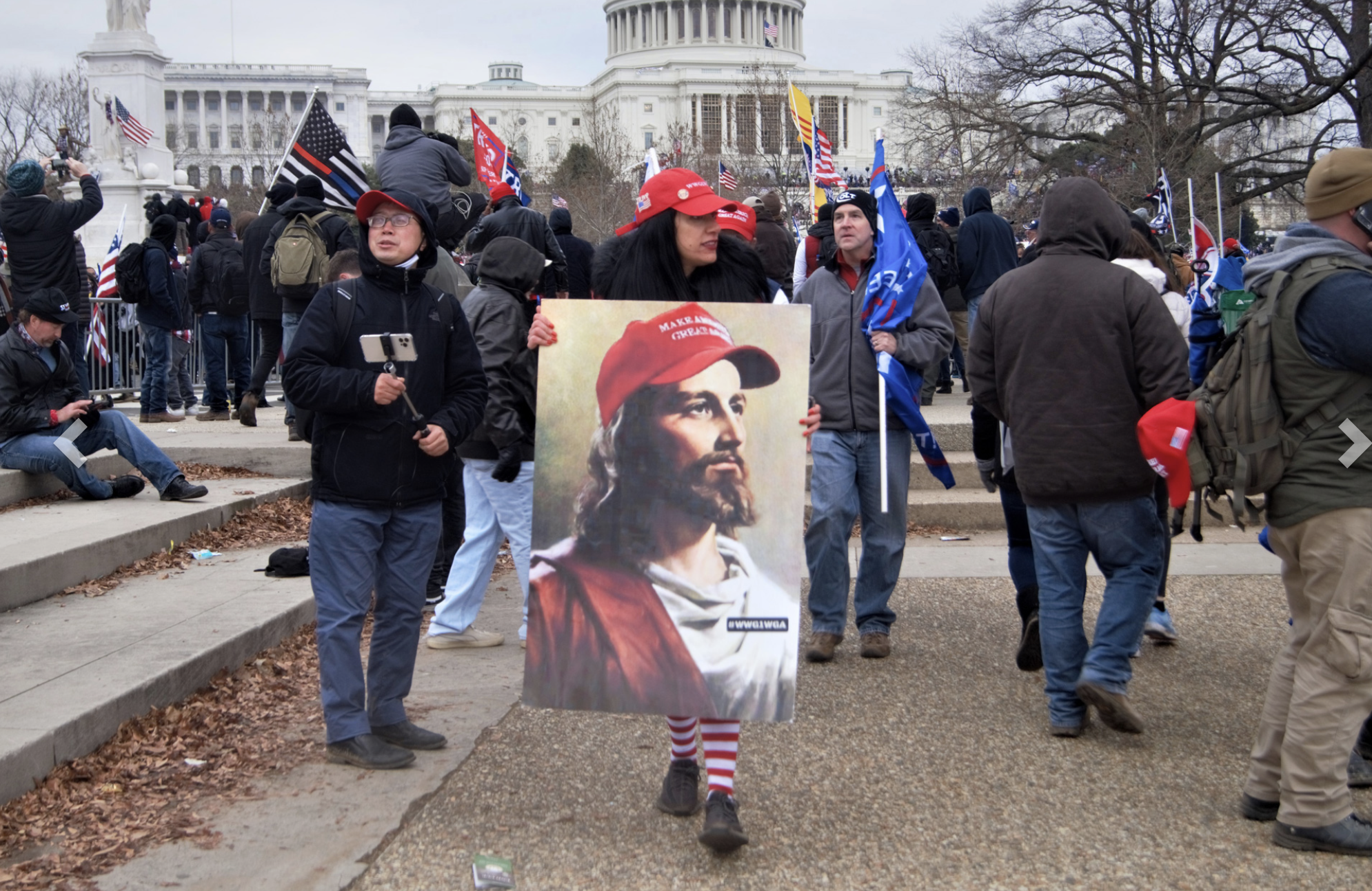
The unholy matrimony of religion and violence is always toxic, poisoning both church and world. We have seen too much of that right here in the United States. Many of the violent seditionists who stormed the Capitol on January 6, 2021, thought they were enacting God’s will. They blew shofars to make “the walls of corruption crumble.” They waved Jesus banners and Bibles, dragged large crosses into the fray, erected a gallows for their enemies. Their madness was driven by a core belief: “God, guns, and guts made America.”[v]

MAGA Jesus at the January 6 insurrection.

It wasn’t just the confused angers of the mob at work. The madness was deployed by the highest levels of government. As Capitol police were being beaten and killed and politicians were running for their lives, the President’s Chief of Staff sent an email from the White House to the sedition-enabling wife of a Supreme Court justice: 

“This is a fight of good and evil … Evil always looks like the victor until the King of Kings triumphs. Do not grow weary in well doing. The fight continues …”[vi]

For the seditionists, and a majority of white Evangelicals overall, Trump was a messianic figure, seeming to offer deliverance and rebirth to a desperate and despised people. “Donald Trump is in the Bible,” a rioter told a journalist. “Get yourself ready.”[vii]

The moral and theological collapse of right-wing Christianity in America echoes the capitulation of the Protestant German Church to the Third Reich. In the 1930s, most German clergy and theologians joined the Nazi party. Some were just playing it safe, but others were swept up in the nationalistic fervor. It became customary to conclude the baptismal rite by praying “that this child may grow up to be like Adolf Hitler.” And the head of the government Ministry of Church Affairs declared in 1935 that the Führer was “the bearer of a new revelation … Germany’s Jesus Christ.”[viii]

In the face of such absurd and blasphemous perversions of Christianity as we have seen in Russia, Germany, and the United States, what are God’s friends to do? Some would have us abandon religion altogether. Recent American studies have shown that many of the “nones” cite bad politics as their primary reason for rejecting Christianity, while many churches are themselves retreating from public life to avoid the contaminating risks of political action.[ix]

Dietrich Bonhoeffer

Dietrich Bonhoeffer was a German theologian and pastor who came of age during the rise of the Nazis. During a fellowship year at Union Theological Seminary in New York, he absorbed Professor Reinhold Niebuhr’s Christian realism. If you avoid history’s messy struggles to preserve your purity, Niebuhr warned, the vacuum you leave will be filled by the demonic. 

Attending an activist black church in Harlem also had an enormous impact on young Bonhoeffer. As his superb biographer Charles Marsh has written, “No longer would he speak of grace as a transcendent idea but as a divine verdict requiring obedience and action. The American social theology … had remade him into a theologian of the concrete.”[x] When, a decade later, he joined a conspiracy to assassinate Hitler, “he would abandon any hope of innocence, incurring the guilt of responsible action. Of the two evils, it was the one he could abide.”[xi] The failed plot would cost him his life. He died in a concentration camp two weeks before it was liberated by the Allies. His body was never found. 

Bonhoeffer had assented to a selective use of violence in order to interrupt mass murder. The unspeakable suffering of the many outweighed his own need for innocence. But he did not do it lightly, and the political captivity of the German Church made him keenly aware of how religion’s engagement with culture can easily go off the rails. He thought deeply about the ambiguities involved in repairing a broken world, but he knew that we cannot just think our way out of the human condition. We need something more, something divine. And words he wrote during the dark days of World War II still point the way:

“Who stands firm amidst the tumult and cataclysms? … The huge masquerade of evil has thrown all ethical concepts into confusion … The failure of ‘the reasonable ones’—those who think, with the best of intentions and in their naïve misreading of reality, that with a bit of reason they can patch up a structure that has come out of joint—is apparent. With their ability to see impaired, they want to do justice on every side, only to be crushed by the colliding forces without having accomplished anything at all. Disappointed that the world is so unreasonable, they see themselves condemned to unproductiveness; they withdraw in resignation or helplessly fall victim to the stronger … Who stands firm? Only the one whose ultimate standard is not their reason, their principles, conscience, freedom, or virtue; only the one who is prepared to sacrifice all of these when, in faith and relationship to God alone, they are called to obedient and responsible action. Such a person is the responsible one, whose life is to be nothing but a response to God’s question and call.”[xii]


[i] https://www.thenationalnews.com/world/europe/2022/03/18/putin-rallies-stadium-crowds-and-lauds-troops-fighting-in-ukraine/ The quotation is a paraphrase of Jesus’ words in John 15:13, just after he says, “Love one another as I have loved you.” Putin used the Russian word for soul (душу (dushu) instead of the biblical “life.”

[ii] Dostoevsky’s speech, given in honor of Russian poet Aleksandr Pushkin (1799-1837), can be found here: http://web.archive.org/web/20050207093332/http://www.dwightwebber.com/pushkinspeech.html

[iii] Quoted in Binyamin Rose, “Russia’s Deep-Seated Messianic Complex,” Mishpacha: Jewish Family Weekly (Mar. 15, 2022) https://mishpacha.com/russias-deep-seated-messianic-complex/

[iv] Ibid.

[v] Emma Green, “A Christian Insurrection” (The Atlantic, Jan. 8, 2021).

[vi] David French, “The Worst Ginni Thomas Text Wasn’t from Ginni Thomas (The Atlantic, March 25, 2022).

[vii] Jeffrey Goldberg, “Mass Delusion in America” (The Atlantic, Jan. 6, 2021).

[viii] Charles Marsh, Strange Glory: A Life of Dietrich Bonhoeffer (New York: Vintage Books, 2014), 283, 271.

[ix] Ruth Braunstein, “The Backlash against rightwing evangelicals is reshaping American politics and faith” (The Guardian, Jan. 25, 2022).

[x] Marsh, 135.

[xi] Ibid., 346.

[xii] Ibid., 341.

On the Morning After the Nativity

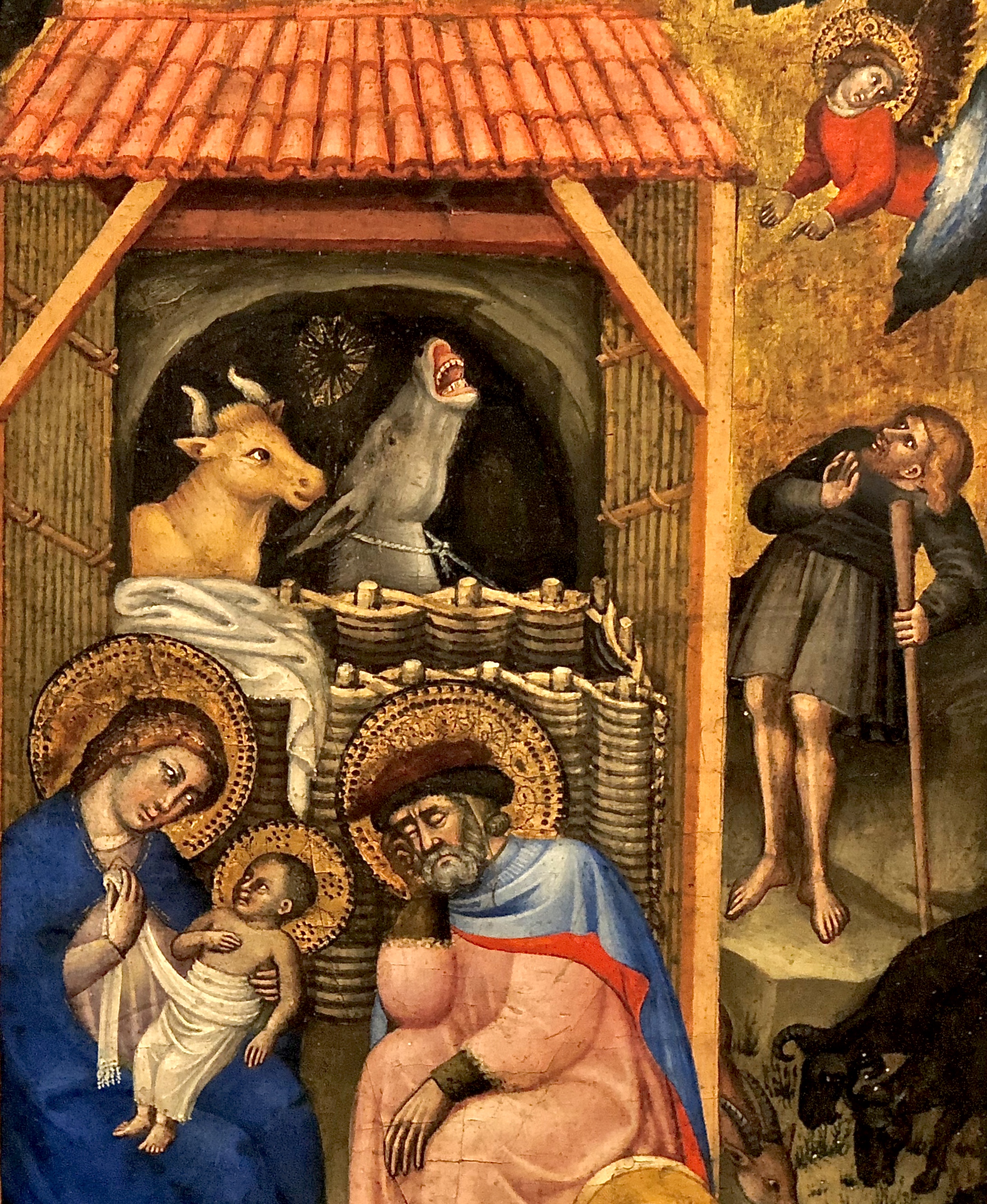
Simone di Filippi, Nativity (c. 1380, Uffizi Gallery, Florence).

That glorious Form, that Light unsufferable, 
And that far-beaming blaze of Majesty, 
Wherewith he wont at Heav’n’s high council-table, 
To sit the midst of Trinal Unity, 
He laid aside, and here with us to be, 
Forsook the courts of everlasting day, 
And chose with us a darksome house of mortal clay. 

— John Milton, “Ode on the Morning of Christ’s Nativity”

What on earth happened last night—at that little stable on the edge of town? It was all so strange, so unbelievable. Some of us are still sleeping it off. Some of us didn’t get any sleep at all, or maybe we were asleep the whole time and it was all just a dream. 

There was a really bright star, and then the sky started singing: Gloria in excelsis Deo! It was angels, someone said. I don’t know about that, but it was so beautiful, as if music were being invented for the very first time. 

And suddenly, we all started running, don’t ask me why, until we came to this cave––it was a stable with a cow and a couple of donkeys––and in the back there was a woman lying down on some hay, and a man kneeling beside her. And between them there was a little baby, just a few hours old, I’d say. What a place to begin your life! They must have been pretty desperate to end up there. Maybe they were refugees. Or undocumented. I don’t know. But they didn’t look scared or out of place. They seemed to belong there. And you know, I had the feeling that I belonged there too. We all did. 

I can’t really explain it, but I got this feeling that everything in my life before that had just been waiting around for this moment, as if after a long and pointless journey I had finally come home. 

And I know it sounds weird, but I swear that little baby looked right at me, as if he knew who I was––or who I was going to be, because when I left that stable I knew––I knew!––that my life was never going to be the same. Pretty crazy, right? Part of me hopes it was just a dream, because if it’s not, I have no idea what happens next. But I have to admit I’m a little nervous about where all this is going to take me.[i]

That’s how I imagine the “morning after” speech of a Bethlehem shepherd. After such a vision, he’s intoxicated by wonder, struggling to make sense of it, and feeling both curious and anxious about what happens now, after this wondrous birth. What will happen now—to me, to you, to the whole wide world? A change gonna come, yes it will.[ii] Yes it will, because what happens in Bethlehem doesn’t stay in Bethlehem. It goes home with us, it gets in our blood, it becomes part of our story. Nothing in the world will ever be the same again. Nothing in our lives will ever be the same again. 

And that is why, on the morning after, we listen to St. John’s grand prologue to the Fourth Gospel. Its cosmic perspective on the birth of Christ reminds us how vast and consequential was that humble birth in a lowly stable. 

In the beginning was the Word, and the Word was with God, and the Word was God. He was in the beginning with God. All things came into being through him, and without him not one thing came into being. . . And this divine Word became flesh and lived among us (John 1:1-14).

In other words, God was not content to remain purely within the confines of the divine self. God desired to go beyond the inner life of the divine, to enter the confines of time and space and history, to become incarnate as the mortal subject of a human life and experience the human condition from the inside. The Word was made flesh and dwelt among us.

What a fantastic thought: God wants to be with us—not just love us at a distance but to be intimate with us. Joy to the world, the Lord is come … let every heart prepare him room. But perhaps we have some doubts about our capacity to receive such a guest. 

I’ve been reading a couple of 17th-century poets who expressed their own doubts our capacity to host divinity. Matthew Hale (1609-1676) in a poem titled “Christmas Day” (1659), said:

                                    I have a room
‘Tis poor, but ‘tis my best, if thou wilt come
Within so small a cell, where I would fain [willingly]
Mine and the world’s Redeemer entertain … 

Here he’s speaking about his heart as the place he would entertain the Redeemer. He goes on to describe sweeping up the dust and cleaning up the mess, just as we would if we expected an important houseguest. The poet even attempts to wash this “room”—with his own penitent tears.

And when ‘tis swept and washed, I then will go,
And with Thy leave, I’ll fetch some flowers that grow
In Thine own garden [i.e., the flowers of faith and love];
With those I’ll dress it up …
yet when my best
Is done, the room’s [still] not fit for such a Guest. 

Well, if we can’t make our hearts fit dwellings to house the divine, who can?
Only God can make us so:

            Thy presence, Lord, alone
Will make a stall a court, a cratch [manger] a throne.  

The poet/priest George Herbert, in his own “Christmas” poem (1633), expresses the same need for divine assistance:

O thou, whose glorious, yet contracted light,            
Wrapt in nights mantle, stole into a manger;
Since my dark soul and brutish is thy right,    
To Man of all beasts be not thou a stranger:             

Herbert’s poetry is always resonant with Scriptural references. “Beasts” recalls Psalm 49:12—prideful humans are like “the beasts that perish”—while “a stranger” evokes Ephesians 2:12—without Christ, we remain “strangers to the covenants of promise.”

Then Herbert, like Hale, calls upon God as the only one who can complete his moral and spiritual remodeling project: 

Furnish & deck my soul, that thou mayst have         
A better lodging, than a rack, or grave. 

“Rack” is another word for a manger, but it can also mean an instrument of torture, suggesting the cross. In other words, the first time Christ came, humanity provided him the cross and the grave. The poet prays that next time Christ comes to us, we may give him better lodging—a newly furnished soul, adorned with God’s grace. 

Both of these poets were saying: Let every heart prepare him room. But they were also confessing that such preparation is more than we can do by ourselves. However, with God’s help, we may yet become fit lodging for divine presence. 

In the 20th century, whose atrocities left our confidence in human potential badly shaken, the Catholic contemplative Thomas Merton could still claim that we “exist solely for this, to be the place God has chosen for the divine Presence. The real value of our own self is the sign of God in our being, the signature of God upon our being.” 

Merton wrote this after a life-changing experience at the corner of Fourth and Walnut in downtown Louisville. As he was studying all the faces of the milling crowd, he suddenly felt an overwhelming love for all of them, even though they were all strangers to him. It was like what the shepherds experienced in the Bethlehem stable, where, as W. H. Auden said in his own Christmas poem, “everything became a You and nothing was an It.” [iii]  Merton would later put his street-corner epiphany at into words.

“It is a glorious destiny to be a member of the human race, though it is a race dedicated to many absurdities and one which makes many mistakes: yet, with all that, [God’s own self] glorified in becoming a member of the human race. 

“I have the immense joy of being [a human person], a member of a race in which [God’s own self] became incarnate. As if the sorrows and stupidities of the human condition could overwhelm me, now I realize what we all are. And if only everybody could realize this! But it cannot be explained. There is no way of telling people that they are all walking around shining like the sun.” [iv]

Just so, on that wondrous Christmas night in Bethlehem, our human nature was lifted up as the place where God chooses to dwell. We are still works in progress no doubt, but we are bound for glory. St. Paul believed this when he said that “all of us, with our unveiled faces like mirrors reflecting the glory of the Lord, are being transformed into the image that we reflect in brighter and brighter glory” (II Cor. 3:18).

A thousand years later, St. Symeon the New Theologian echoed Paul’s luminous text: “As they who behold the light are within the light and partake of its brightness, so they who behold God are within God, partaking of God’s brightness.”

They who behold the light are within the light and partake of its brightness. Our pale mirrors are made to contain the most impossible brilliance. And even when we turn away from the Light, the Light comes looking for us. No matter how shadowy the path we have taken, the Light will find us, and fill us with divine radiance. That is our destiny, says the Child in the manger. 

What happens in Bethlehem does not stay in Bethlehem.

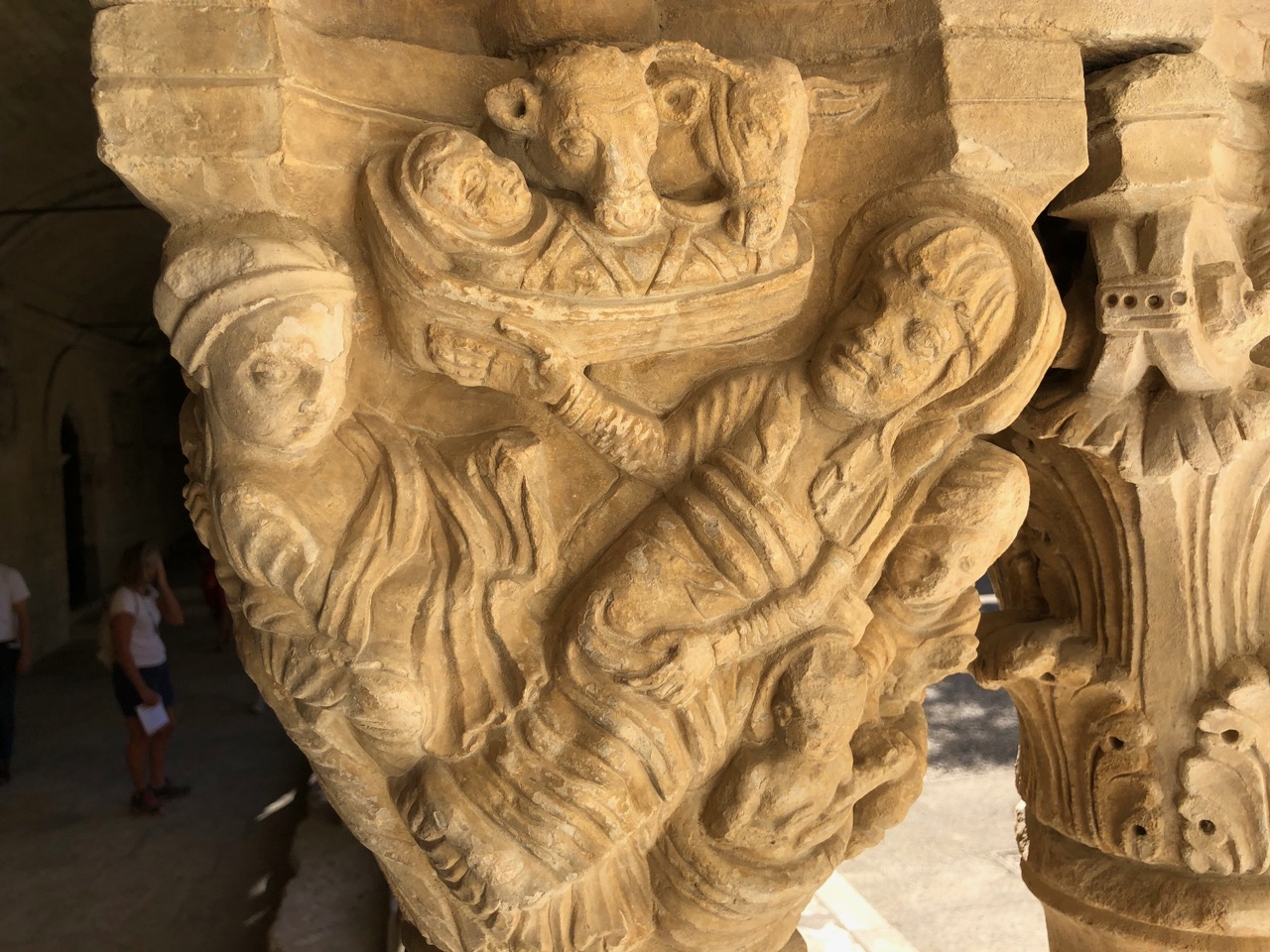
Nativity (12th century), Cloister of St. Trophime, Arles, France. 

Bethlehem is not a dream fading away into the past. It is the human future. And Christmas Day is not the morning after. It is the first day of the rest of our journey deeper and deeper into God. And whether we know it or not, as we walk that pilgrim road, we are all shining like the sun.

As we used to say back in the day, “Can you dig it?” Can you embrace the wonder of the holy birth: the immensity of heaven cloistered in one small room, be it the Virgin’s womb, the Bethlehem stable, the human heart, or whatever place you’re in right now? Can you embrace the wonder? Will you?

The world wants you to believe far less. 
But why would you want to do so?  

In a novel by the Anglican writer Charles Williams, a young woman goes to church with her aunt on Christmas morning. She is a seeker, not quite a believer, but she finds herself touched by a carol they are singing:

Christians, awake, salute the happy morn
Whereon the Savior of the world was born;
Rise to adore the mystery of love, 
Which hosts of angels chanted from above. 

The young woman leans over and whispers to her aunt, “Is it true?” Her aunt, one of those quiet saints who has spent her life submitting to divine love, turns to her niece with a smile and says simply, “Try it, darling.”[v]


[i] It’s a risky thing to follow Jesus. At the end of the Fourth Gospel, Jesus tells Peter that “someone else will put a belt around you and take you where you would rather not go” (John 21:18).

[ii] Sam Cooke’s prophetic cry for social transformation was influenced by Martin Luther King’s “I have a dream” speech and Bob Dylan’s “Blowin’ in the Wind.” Cooke said the song came to it in a dream. Listen to it and imagine a shepherd singing it after the Nativity: https://youtu.be/fPr3yvkHYsE

[iii] W. H. Auden, For the Time Being: A Christmas Oratorio. The line is from the Narrator’s concluding speech. Auden’s marvelous poetic dramatization of the Nativity, written during the dark days of World War II, is imbued with hope. Alan Jacobs’ helpful annotated edition is highly recommended (Princeton University Press, 2015).

[iv] Thomas Merton, Conjectures of a Guilty Bystander (1966).

[v] Charles Williams’ Christmas novel is The Greater Trumps (1932).

Say Yes: A Homily for Advent 4

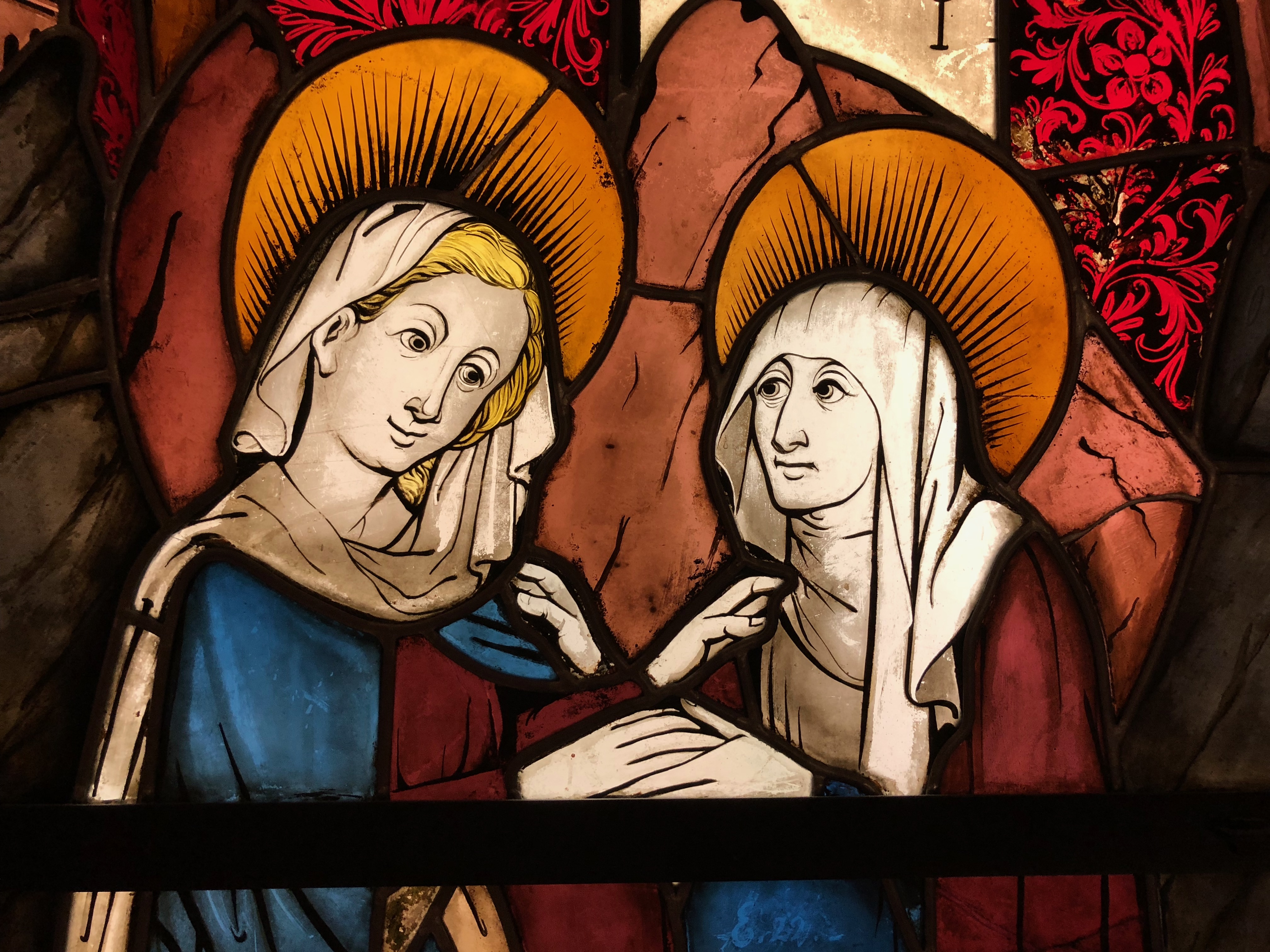
The Visitation, German c. 1444.

In calling me, the call does not leave me intact; it surges only by opening a space in me to be heard, and therefore by shattering something of what I was before I felt myself to be called.

— Jean-Louis Chrétien

In Mahler’s Third Symphony, the first movement is an eruption of massive orchestral sounds: horns, drums, fanfares and marches, a shaking of the foundations to make way for a new world to appear. And for the next four movements, the music rarely takes a breath. The adagio, the slow, contemplative movement which usually comes in the middle of a symphony, is delayed until the very end. And what an ending it is—23 minutes long!—taking us with unhurried solemnity ever deeper into the mystery of the world. Mahler called it “the higher form in which everything is resolved into quiet being. I could almost call the Third’s finale ‘What God tells me,’” he added, “in the sense that God can only be understood as love.” [i]

Advent is like that symphony, it seems to me. Over the first three Sundays, the prophets roar, the heavens shake, the voices cry. Repent! Make way! Stay awake! Cast away the works of darkness! Put on the armor of light! But on the Fourth Sunday, it’s suddenly quiet. No more cosmic thunder. No more urgent warnings. The Baptist’s big crowds have drifted on home. Advent’s adagio finale is a miniature: two pregnant women in a humble courtyard, having an intimate conversation. 

But what a conversation it is! “Blessed are you among women, and blessed is the fruit of your womb!” says Elizabeth. “My soul magnifies the Lord, and my spirit rejoices in God my Savior.” replies her cousin Mary. Their ecstatic words have been on our lips in worship ever since.[ii]

The cousins had a lot to process. One was carrying the last of the Old Testament prophets, John the Baptist. The other was carrying the founder and pioneer of a transformed humanity. They held creation’s future within them, ever since they had each said “Yes” to a story that was no longer their own. They now belonged to God, come what may. I imagine they both did a lot of laughing and crying that day.

The Rev. Mark Harris, a dear friend I first met in seminary a half-century ago, began last year’s challenging Advent by writing a poem about Mary’s consent. It’s called “Implications of Yes.”

The neighbors talked about it for a while,
How the young girl who was beginning to show 
Came back from meeting her cousin
And seemed kind of quiet,

How she was seen leaving her house 
Early one morning with a small sapling 
Bundled in rough cloth in one hand, 
And a shovel in the other.

Later she was seen coming back,
No sapling, the shovel over her shoulder, 
Her hands and dress smeared with dirt, 
Her eyes red and swollen.

Later, sitting with the others, she spoke 
Of her longing for a lost simplicity
And her preparations for realities 
that follow from her quiet Yes .

Years from now, she said, 
There will be need for this tree grown,
Just as there is need now 
for this Child that grows in me. 

The tree will bear the body of the Man, 
As I bear the Child.
We will each be ready in our turn
To do as the Holy One requires.

We will, with the Holy One we bear, 
Be broken by the bearing, 
And will give our lives
For the healing of the nations. [iii]

The poet gives us a stunning image here. Mary, pregnant with Jesus, plants the tree that will become his cross! Both mother and tree will, like Jesus, offer all that they have and all that they are for the healing of the nations, the repair of the world. That’s how the story goes in a fallen, broken world, and if you say ”Yes” to this story, it will cost no less than everything. 

When Mary said “Yes” to the angel of the Annunciation, it was neither the first nor the last time she would do so. Her whole life up to that point had been a series of consents that would prepare her to receive the Holy One into herself. And in the years that followed, she never renounced her acceptance of the story that would one day take her weeping to the foot of the cross. It is no light thing to say Yes to such a story.

We will each be ready in our turn
To do as the Holy One requires.

Mary was ready in her turn. But now it’s our turn. 

The Incarnation of the Divine Word was a singular event. Only Jesus could be who he was and do what he did as the unique conjunction of human and divine—God in the flesh. But in another sense, the Incarnation is a continuing event to the degree that we ourselves become open and receptive to the divine that wants to be born in us.

The Russian Saint Seraphim of Sarov (1759-1833) put it this way: The purpose of human life is the acquisition of the Holy Spirit. In other words, our human destiny is to be filled with Divinity, to dwell in God and let God dwell in us. What did we ask in today’s collect-prayer? May our own souls and bodies become “a mansion prepared for Godself.”[iv] We weren’t kidding around. It’s our most serious Advent prayer, committing ourselves to becoming God-bearers. 

The first Christians made some strikingly bold claims for humanity’s potential for “divinization” (becoming like God). The Second Letter of Peter (1:4) says: “God has given you such precious and majestic promises, that you may become partakers of the divine nature.” The First Letter of John (3:2) says, “We know that when God appears, we shall be like God, because we shall see God as God is.” And St. Paul, in Second Corinthians 3:18, insists that “all of us, with faces unveiled, mirroring the Lord’s glory, are being transformed into the same image from one degree of glory to another.” 

The two most famous summations of divinization as corollary to incarnation were made by Irenaeus in the second century and Athanasius in the fourth. “In God’s immense love,” said Irenaeus, “God became what we are, that he might make us what he is.” Athanasius was even more explicit: “The Divine Word became human that humans might become God.”

Now many have argued against this whole idea of divinization. There’s too great a gulf between Creator and creature, some say. Who can hope to cross that infinite abyss? Others say that humanity is simply not up to it. Just look at world history over the past century, or the last few years in America. On the Feast of the Epiphany, January 6, 2021, for example, did anyone see Christ’s glory being reflected from those tormented faces at our nation’s Capitol? [v]

But if we believe that the Divine Word was truly made flesh, and that Jesus was both fully human and fully divine, then we must acknowledge the existence of an innate human capacity to receive and embody God. Absent that capacity, Mary could never have conceived our Lord and Savior. There is an integral part of our human makeup which is designed to answer when God calls. In other words, our humanity always contains a mansion prepared for Godself. That receptive capacity to say Yes to God may be buried beneath multiple layers of ego and sin, but it cannot be destroyed. It’s a feature, not a bug.

One of the greatest Orthodox theologians of the last century, Sergius Bulgakov, insisted on the indispensable role of humanity in the Incarnation: 

Christ did not bring His human nature down from heaven, and He did not create it anew from the earth; rather, He took it from “the most pure flesh and blood of the Virgin Mary”… [T]he Incarnation of Christ is realized not in one Person but in two: in Christ and in the Virgin Mary. The icon of the Mother of God with Infant is therefore the true icon of the Incarnation.[vi]

To become fully human, the only-begotten of God did not destroy human nature, making it something it was not. Rather, Christ fulfilled human nature, manifesting our human potential to dance with God. But we need help to realize our full humanity. It’s not just that our wills are impaired by sin. The fact is that we are not made to function as autonomous beings at all. We are choral beings at heart. We need the full choir, the whole company of heaven and earth, in order to be our truest selves and exist not in isolation but in holy communion.  

So let us admit that Mary was capable of divinization. She could contain and give birth to the holy in our midst. But what about the rest of us? Are we capable of embodying divinity? Many Christians have said yes, absolutely! The great hymn writer Charles Wesley put it this way:

Heavenly Adam, life divine, 
Change my nature into Thine;
Move and spread throughout my soul,
Actuate and fill the whole;
Be it I no longer now
Living in the flesh, but Thou.[vii]

That’s a high bar for sure. But it happens. The saints prove that every day. And we ourselves are here because we are engaged in the same transformational project.

Be it I no longer now
Living in the flesh, but Thou.

Less me, more God.

Our parish hosted a film series this Advent, and last week’s feature, Of Gods and Men (2010), told the true story of French Trappist monks who served an impoverished Muslim village in Algeria. Their monastery, Our Lady of Atlas, had been there since 1938, but in the decades after the end of French colonial rule in 1962, their community was threatened by civil unrest and a lingering suspicion of Europeans. In the 1990s, returning to France was clearly the safest choice, but the village leaders begged them to stay. They depended on the monks, not only for medical care, but for their stabilizing and loving presence.

On Christmas Eve, 1993, terrorists broke into the monastery and held the monks at gunpoint, making it clear that they were now in mortal danger. The terrorists eventually departed without incident (even apologizing for disturbing the holy feast of Jesus’ birth), and the monks celebrated Midnight Mass with special intensity. But the threat remained.

Two years later (March 1996), that Christmas Eve of both fear and deliverance was still reverberating in their hearts. Dom Christian, the prior, told the brothers in a Lenten reflection: 

… through that experience we felt invited to be born again. The life of a man goes forth from birth to birth … In our life there is always a child to be born; the child of God who each of us is … We have to be witnesses of the Emmanuel, that is, of “God with us.” There is a presence of “God among us” which we ourselves must assume.[viii]

A few weeks after Dom Christian wrote these lines about giving birth to God, the monks were taken hostage just before Holy Week. They would be martyred during Eastertide. If they had fled the country when they had the chance, they could have preserved their lives. But the brothers would not abandon the people they served. And their writings and their actions made it clear that they had already surrendered their lives long before, in both their baptismal vows and their monastic vows. They were people who knew what it meant to say yes when Jesus calls, come what may. 

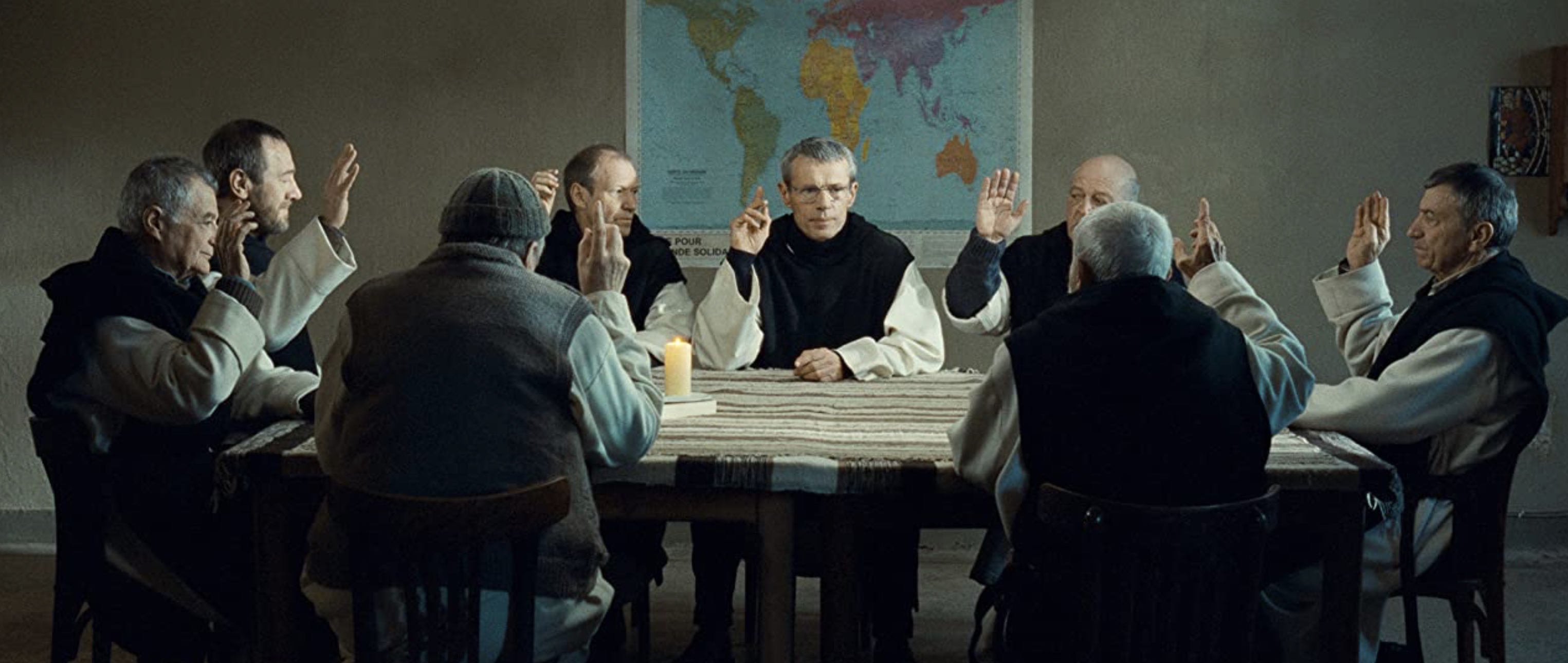
Of Gods and Men (2010). The monks say yes to remaining in harm’s way.

If any of you still have doubts about the human capacity to embody divinity, listen to what Dom Christian wrote after that pivotal Christmas Eve, imagining what he would say to his future killer at the hour of his death: 

And also you, my friend of the last moment,
who will not have known what you are doing:
Yes, I want this thank you and this “a-dieu
to be for you, too,
because in God’s face I see yours.
May we meet again as happy thieves 
in Paradise, if it please God, the Father of us both. 
Amen! In h’allah! [ix]

Who could write such a thing had God not filled him to the brim! Another monk, Fr. Christopher, wrote in his journal during that same Christmastide: “We are in a state of epiclesis.”[x] Epiclesis is a Greek term denoting the invocation of the Holy Spirit in the eucharistic prayer, asking for the sanctification of our lives as well as the holy gifts on the altar. 

We are all in a state of epiclesis—the acquisition of Spirit. And indeed, it is God’s desire to give us more spirit, more grace, more love, more humanity and more divinity. All we need to do is say Yes


[i] Gustav Mahler, letter to Bruno Walter in 1896, the year he composed the Third Symphony.

[ii] Elizabeth’s words are part of the “Hail Mary” prayer used in the Rosary; Mary’s Magnificat (“Song of Mary”) is one of the oldest Christian hymns, and draws upon the Song of Hannah (I Samuel 2:1-10) and other Old Testament texts. This scene of the two cousins only appears in Luke 1:39-55.

[iii] Mark Harris is an Episcopal priest, poet and artist living in Lewes, Delaware. The poem, written December 1, 2020, is used by permission. 

[iv] The Collect for Advent 4 in the Book of Common Prayer reads: Purify our conscience, Almighty God, by your daily visitation, that your Son Jesus Christ, at his coming, may find in us a mansion prepared for himself; who lives and reigns with you, in the unity of the Holy Spirit, one God, now and for ever. Amen.

[v] January 6, the Feast of the Epiphany, celebrates the manifestation of Christ to the world. It is a bitter irony that that date has now been corrupted by the violence, hate and delusion of the insurrection. A similar irony taints the Feast of the Transfiguration, when the brilliant light of Christ’s divinity must share August 6 with the incinerating explosion of the atomic bomb at Hiroshima. 

[vi] Sergius Bulgakov, The Lamb of God (Grand Rapids, MI: Eerdmans, 2008), 200, 202.

[vii] Charles Wesley (1707-1788), Since the Son Hath Made Me Free.

[viii] Dom Christian de Chergé, Reflections for Lent (March 8, 1996), in Bernardo Olivera, How Far to Follow: The Martyrs of Atlas (Petersham, MA: St. Bede’s Publications, 1997), 103, 99. 

[ix] Testament of Dom Christian, dated Dec. 1, 1993 & Jan. 1, 1994, opened, after his death, on Pentecost Sunday, May 26, 1996, in Olivera, 127.

[x] Fr. Christopher Lebreton (January, 1994), in Olivera 111.

“I mean to be one too”: A Homily for All Saints

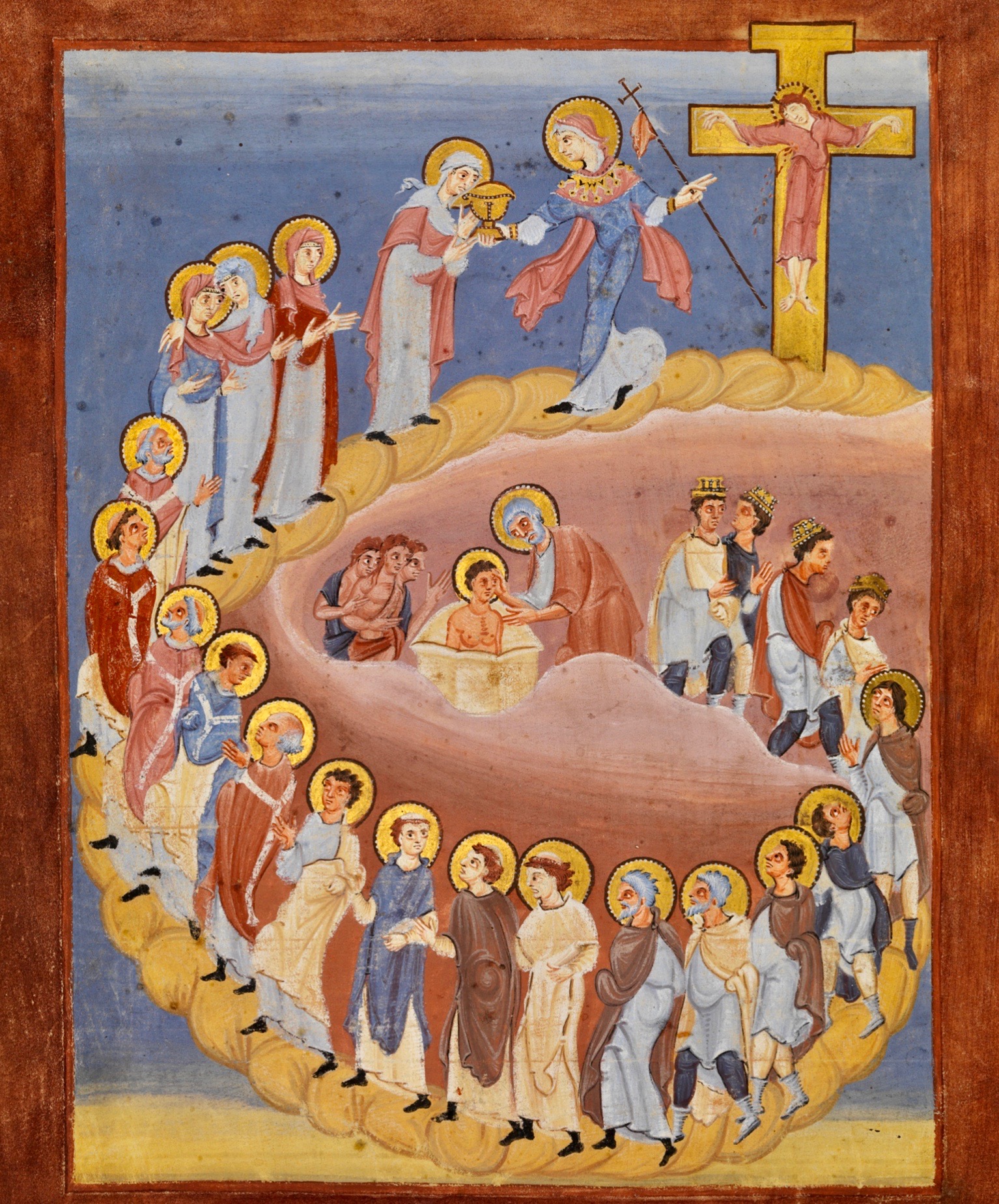
Procession of the Faithful from Baptism to Eucharist, Bamberg Commentaries, c. 1000.

There is only one sadness; it is the sadness of not being saints. 

— Leon Bloy [i]

In a 1998 New York Times interview, Gregory Peck reflected on the challenge of playing Ahab in Moby Dick. “I think I should have been more ferocious in pursuit of the whale, more cruel to the crew,” he said, “and I think I’d have a better grasp now of what Melville was talking about. Ahab focused all his energies on avenging himself against the whale, but he was trying to penetrate the mystery of why we are here at all, why there is anything. I wasn’t mad enough, not crazy enough, not obsessive enough. I should have done more.” He paused, took a long breath, and added: “At the time, I didn’t have more in me.” [ii]

When you hear the stories of the saints, do you say, “I mean to be one too!”—or do you feel you’re not quite ready for the part? Maybe you’re not crazy enough, not obsessive enough, not pure enough, not loving enough. You may think, “I don’t have it in me.” 

Well, you’re right. You don’t. But that’s the point. The saints don’t have it in them either. Saintliness comes from a source deeper than their own solitary selves. The true hero or heroine of a saint’s life is not the individual person, but the divine intention taking flesh in his or her story. As St. Paul said of his own life’s protagonist, “Not I, but Christ in me” (Gal. 2:20).

As Wendy Wright has written, saints “are people who have had the imagination and audacity to allow themselves to be remade slowly in the image of the living God, people who have so opened their hearts to God that God’s own story is in them once again … retold.” [iii] Every saint’s life is a unique retelling, shaped by the particulars of heredity, personality and environment, but down deep it’s always the same story, over and over again: the story of “love’s endeavor, love’s expense,”[iv] perpetually pouring itself out for the life of the world. 

When I graduated from high school, my parents gave me a gilt-edged copy of one the great classics of Christian devotion, Of the Imitation of Christ, written by Thomas à Kempis in the early 15th century. My father wrote in the front, “We hope that this book will bring you closer to the knowledge and love of God, and of his Son, Jesus Christ our Lord. Love, Mom & Dad.”

Although not all of Thomas’ late medieval spirituality resonates today, much of it still hits home.

Blessed are the ears that catch the pulse of the Divine whisper, and give no heed to the whisperings of this world … Blessed are they that prepare themselves more and more, by daily exercises, for the receiving of heavenly secrets. Blessed are they who are glad to have time to spare for God.[v]

O my friend, lose not thy confidence of making progress toward the things of the Spirit; still thou hast time, the hour is not yet past. Why wilt thou defer thy good purpose from day to day? Arise, and in this very instant begin, and say, Now is the time to be doing, now is the time to be striving, now is the fit time to be amending myself.[vi]

(Mom, Dad, I’m still working on it!)

Every saint’s life is an imitation of Christ. The very structure of Christian sacred biographies reflects this theological point. In the Book of Acts, the martyrdom of Stephen—the first biography of a Christian saint—deliberately mirrors the Passion of Christ. Like Jesus, Stephen is an innocent killed by a world which refuses his message. Like Jesus, Stephen uses his final breaths to forgive his enemies and surrender his spirit to the divine. “Lord Jesus, receive my spirit,” he prays at the end. Perhaps it’s not enough to say that Stephen was imitating Christ in his martyrdom. He was, in truth, repeating Christ, in the Pauline sense of “Christ in me.” We suggest the same sense of return and presence in the Words of Institution at every eucharist: Whenever you perform these actions, I am with you once again.

Eleven centuries after the death of Stephen, St. Aelred, abbot of Rievaulx in the north of England, lay on his deathbed, eyes closed. His friend and fellow monk, Walter Daniel, leaned over to whisper in his ear, “Look on the cross; let your eye be where your heart is.” Aelred opened his eyes for just a moment, and spoke his last words: “In manus tuas commendo spiritum meum” (“Into your hands I commend my spirit.”) Once again, the surrender of spirit by a dying saint echoes the last words of Jesus from the cross in Luke 23:46. 

In fact, unlike Stephen’s paraphrase, it was a direct quote. Did Walter, Aelred’s biographer, insert the verse from Luke into his abbot’s mouth as a pious fiction, or had Aelred in fact repeated Christ’s words verbatim? In the genre of sacred biography, we don’t need to know the factual answer. Holy stories are always about more than what a camera or microphone can record. As narratives straddling the mysterious boundary between the human and the divine, their language dives beneath the empirical surface to explore the hidden depths. Hyperbole, metaphor, miracle—these are all rhetorical tools to convey the inherently mysterious nature of religious experience. 

As Thomas J. Heffernan points out in his seminal study of sacred biographies, “Walter would argue, and his monastic audience would agree, that Aelred’s death has become more memorable because it is now able to arouse in us the memory of another death, the death of Christ, which is the paradigm for the manner in which all Christian martyrs are meant to surrender to God.” [vii]

When it comes to saints, it is not in the historical particulars of their stories, however interesting, edifying, or inspiring, that the central meaning of their lives is to be found, but rather in the way their stories imitate, or repeat, the Christ event, as divine love takes place anew in the flesh of our human existence. As hymn writer Isaac Watts summarized this process:

“The image of Christ is transcribed upon our natures, we go from one degree of it to another, we are changed from glory into glory, from one degree of glorious holiness to another: thereby the gospel appears to have a fairer, brighter, and a stronger evidence.” [viii] We, having Christ in us, become the evidence for the truth of Christian faith.

In other words, saints are living icons, radiant with the light of heaven—even if they sometimes have messy and complicated lives.  Take, for example, Elizaveta Pilenko. Born to a wealthy Russian family in 1891, she was caught up in the revolutionary movement during her late teens. She briefly flirted with a plot to assassinate Trotsky (Russian politics were deadly even then). But at the same time, her Orthodox faith was beginning to deepen. She fled the Stalinist regime for Paris in the 1920s, by which time her second marriage, like her first, had failed, and a daughter had died of influenza. 

In her new home, she began a ministry to the poor, and her bishop encouraged her to take vows as a nun. She did so, receiving her religious name, Maria Skobtsova. She was permitted to continue to live and work among the people, and her rented Parisian house had an open door for refugees and lost souls. Her bishop called her faux monastery “the desert of human hearts.” 

She wasn’t exactly easy for her sister nuns. She wore odd clothes, and hung out in cafes and bars late into the night, counseling people on the brink of despair. She also missed many liturgies while off scrounging food for her soup kitchens in the markets of Las Halles. She’s been called the Orthodox Dorothy Day.

St. Mary of Paris (Maria Skobtsova).

When France fell to the Nazis in 1940, Mother Maria sheltered many Jews, supplying them with baptismal certificates and assisting their escape. Eventually arrested by the Gestapo, she died in the gas chamber at Ravensbrück on Holy Saturday, 1945. She was canonized as St. Mary of Paris in 2004.

Mother Maria was also a writer of poetry and theology. Listen to what she said about the Christian life as a continual self-emptying:  

“Renunciation teaches us not only that we not greedily seek advantages for our soul but that we not be stingy, that we always be extravagant in our love, that we achieve a spiritual nakedness, that our soul hold nothing back, that we not hold back anything sacred and valuable which we would not be ready to give up in Christ’s name to those who need it …That which was given away returns. The love which was expended never diminishes the source of that love, because the source of love in our hearts is Love itself, Christ… Here we are speaking about a genuine emptying out, in a partial imitation of how Christ emptied himself by becoming incarnate in humanity. We must likewise empty ourselves out completely, becoming, so to speak, incarnate in another human soul, offering it to the full measure of God’s image which is contained in ourselves.” [ix]  

Now when we hear a prescription like that, we may worry, as Gregory Peck did over Melville’s Ahab, about our capacity to perform such a demanding role. What we need to remember is this: the subject of our life is not our individual, autonomous self, but the transcendent, empowering Christ who dwells within us. In a recent podcast, Mark Harris, one of my most eloquent priestly friends, made this point perfectly. “When I look at the heroes I have in terms of justice ministries,” he said, “they are people who live into this to the point of self-emptying. They get out of the way finally. It’s not about their being good; it’s about good being done. So it’s God’s justice that’s done, not them doing justice.” [x]

Heavenly Adam, Life divine
Change my nature into Thine;
Move and spread throughout my soul;
Activate and fill the whole;
Be it I no longer now
Living in the flesh, but Thou. 

— Charles Wesley

Our own holiness practice may not entail the rigors or reach the heights of the greatest saints. Most of us are called to what Thérèse of Lisieux described as “the Little Way.” As a dreamy teenager, Thérèse thought it would be simply thrilling to be a saint:

“I would be a Martyr … I would be a Missionary. I would be flayed like St. Bartholomew, plunged into boiling oil like St. John, or, like St. Ignatius of Antioch, I would be ground by the teeth of wild beasts into bread worthy of God. With St. Agnes and St. Cecilia I would offer my neck to the sword of the executioner, and like St. Joan of Arc I would murmur the name of Jesus at the stake.” [xi]

Thérèse of Lisieux.

However, such heroic drama would be denied her. After a brief and uneventful life hidden within a Carmelite cloister, she died from tuberculosis at 24. But her autobiography, detailing her efforts to respond to the smallest, most ordinary moments with a loving, patient and generous heart, would inspire countless faithful around the world.  “I am only a very little soul,” she said, “who can only offer very little things to the Lord.”

Fr. Alban Butler, who in the 18th century compiled the most extensive compendium of saintly lives in the English language, also made the point that sanctity can be a practical, everyday kind of holiness: 

“Perfection consists not in raptures and lofty contemplation; nor in austerities, or any extraordinary actions: for thus, it would have been above the reach of many. But God has placed it in what is easy, and in every one’s power. The rich and poor, the learned and unlearned may equally aim at perfection: for it requires only that we perform our daily actions in a spirit of true Christian virtue … we must be holy not by fits, but by habit … it is then our ordinary actions performed in a true spirit of virtue … which must sanctify our lives.” [xii]

We must be holy not by fits, but by habit, 
performing our ordinary actions in a true spirit of virtue.

Blessed are those who rise and shine.
Blessed are those who lend a hand. 
Blessed are those who listen.
Blessed are those who take the time.
Blessed are those who speak kindly.
Blessed are those who smile at strangers.
Blessed are those who plant.
Blessed are those who raise children.
Blessed are those who teach.
Blessed are those who provide our meals.
Blessed are those who do the hard things.
Blessed are those who look with compassion.
Blessed are those who do justice. 
Blessed are those who wonder.
Blessed are those who welcome.
Blessed are those who nurture.
Blessed are those who care. 
Blessed are those who struggle with failing bodies. 
Blessed are those who suffer.
Blessed are the broken.
Blessed are those who know loss. 
Blessed are those who persist.
Blessed are those who surrender.
Blessed are those who remember hope.
Blessed are those who practice resurrection. 

“To be a saint,” says Frederick Buechner, “is to live not with hands clenched to grasp, to strike, to hold tight to a life that is always slipping away the more tightly we hold it; but it is to live with the hands stretched out both to give and receive with gladness.” [xiii]  You see, it’s very simple to be a saint. Just open your hands, and your heart.

Claude Laydu, Diary of a Country Priest (Robert Bresson, 1951).

The greatest cinematic depiction of sainthood is Robert Bresson’s Diary of a Country Priest, based on George Bernanos’ novel of the same name. The unnamed priest is rejected by many in his village, but it is clear to a few—and to the viewer—that Christ is truly in him. The priest experiences what he calls “the miracle of our empty hands!—that we may give what we do not possess!” Claude Laydu, the non-professional who played the part, threw himself into the role, living with working-class priests, adopting an austere diet, studying the novel throughout the shoot, and submitting without question to Bresson’s strict direction. As critic Tony Pipolo writes, “The very qualities this behavior manifests—obedience, obsessive concentration, a combination of fire and composure, and genuine dedication—were exactly those Bresson sought for his curé.”[xiv] But only after viewing the finished film would Laydu recognize the true nature of his role. “I didn’t know I was playing a saint,” he confessed. I think all the saints would say pretty much the same thing. 

I’ll give the last word to Buechner, who writes about saints as well as any. In a novel about Brendan of Ireland, his protagonist sums it up beautifully: 

“[God] wants each one of us to have a loving heart …
When all’s said and done, perhaps that’s the length and breadth of it.” [xv]


[i] Cited in Tony Pipolo, Robert Bresson: A Passion for Film (Oxford/New York: Oxford University Press, 2010), 71.

[ii] Gregory Peck New York Times interview in 1988, quoted in William Grimes’ New York Times obituary for Mr. Peck, June 13, 2003. 

[iii] Wendy Wright, “For all the saints,” in Weavings: A Journal of the Christian Spiritual Life (Vol. III, No. 5, Sept.-Oct. 1988), 17-18.

[iv] From W. H. Vanstone’s hymn, “Morning glory, starlit sky” (Episcopal Hymnal 1982, #585). The endeavor and expense are spelled out in verse 3: “Love that gives, gives evermore, / gives with zeal, with eager hands, / spares not, keeps not, all outpours, / ventures all, its all expends.”

[v] On the Imitation of Christ, Book 3, ch. I.

[vi] Ibid., Book 1, ch. XXII.

[vii] Thomas J. Heffernan, Sacred Biography: Saints and Their Biographers in the Middle Ages (Oxford/New York): Oxford University Press, 1988), 79.

[viii] Isaac Watts (1674-1748), cited in Gordon Mursell, English Spirituality: From 1700 to the Present Day (London, SPCK, 2008), 69.

[ix] Maria Skobtsova, in Michael Plekon, Living Icons: Persons of Faith in the Eastern Church (Notre Dame 2002), 76.

[x] The Rev. Mark Harris, speaking about the Beatitudes on the video podcast, Circuosity .21https://youtu.be/6V6zGsX9yqA

[xi] Thérèse of Lisieux (1873-1897), cited in Jill Haak Adels, The Wisdom of the Saints: An Anthology (Oxford/New York: Oxford University Press, 1987), 7.

[xii] Alban Butler (1710-1773), Meditations and Discourses, cited in Mursell, 36.

[xiii] Frederick Buechner, The Magnificent Defeat (New York: Seabury Press, 1966), 119.

[xiv] Pipolo, op. cit., 71.

[xv] Buechner, Brendan (New York: Atheneum, 1987), 216.

Words Fail: Thinking the Divine Name(s)

“… “to think God without any conditions, not even that of Being.” — Jean-Luc Marion

It seems that we can use no words at all to refer to God.

— Thomas Aquinas [i]

As soon as there are words … direct intuition no longer has any chance. 

— Jacques Derrida [ii]   

Dionysius the Areopagite, a sixth-century Syrian mystic, made the classic case for theological modesty. We should not presume to say too much about God. When it comes to what he called the “Unutterable,” he said, words fail. An encounter with divine reality leaves us speechless. 

“Reject all that belongs to the perceptible and intelligible … and lift yourself as far as you are able to the point of being united in unknowing with the One who is beyond all being and all knowledge.” [iii]

Dionysius’ insistence on divine ineffability was a subversive counterbalance to the theological project of the ancient ecumenical councils, which devoted intense intellectual energy to the pursuit of dogmatic precision. Words, phrases, even individual letters had been fiercely debated over the course of several centuries. With the stakes so high, no one wanted to get it wrong. But Dionysius’ caution about saying too much would have a lasting influence on both mystics and theologians from the Middle Ages to post-modernity. 

Thomas Aquinas, whose exhaustive systematic theology, Summa Theologica, used 1.8 million words to speak of God, issued a striking caution in one of his shorter works: “as to the mode of signification [for God] goes, every name is defective.” [iv] A modern Catholic theologian, Karl Rahner, agreed, since transcendence “presents itself to us in the mode of withdrawal, of silence, of distance, of being always inexpressible, so that speaking of it, if it is to make sense, always requires listening to its silence.” [v]  That kind of listening without making words is hard, when our heads are so full of ideas. But if we desire accuracy, we must try, as Jean-Luc Marion has said, “to think God without any conditions, not even that of Being.” [vi]

It’s not just that God is unknowable; language itself is chronically imprecise—“a raid on the inarticulate,” T. S. Eliot called it, “with shabby equipment always deteriorating.” [vii] But of the One who is “the Wholly Other, for whom we have no words, and whom all our poor symbols insult,” can we say anything at all? [viii]

The “veil” before the Altar of Presence in the author’s worship installation, “Via Negativa.”

Even Dionysius admitted the necessity of God-talk. We need to understand something about ultimate Reality if we are to be in relation with it. In Divine Names, Dionysius wrote at length about the attributes of God, and so have countless Christian thinkers before or since. While God is always beyond our conceptual reach, we still have religious experiences through which we learn something of who—and how—God is for us. Sometimes we speak in literal terms, as when we say that God loves us. God’s love may be more perfect than human love and mediated in a different way, but it’s love all the same. 

Metaphors, on the other hand, use something familiar to tell us about the unfamiliar. God is not literally a shepherd, a shield, or shade from the heat, but God has been known to be like these things in some way. Those three are all biblical images, but every age provides new metaphors. A British youth minister told me that skateboarders use their experience of what they call “flow” as a kind of divine name. But metaphors are only provisional—“scaffoldings around invisible reality,” in Jerzy Peterkiewicz’s aptly metaphorical image, “liable to vanish” when pressed to become literal. [ix]

What can I say, my God, my life, my holy joy?
Or what can anyone say who speaks of you?”

— St. Augustine, Confessions [x]

St. Augustine’s questions were on my mind when I composed an experimental “creed” for an alternative liturgy at our local Episcopal parish.[xi] The Nicene Creed, crafted by the fourth-century Council of Nicaea to be a concise summary of orthodox belief, is still recited in the Sunday rites of most liturgical churches. Its insertion into the liturgy 150 years after the Council resulted from a now-forgotten doctrinal quarrel, and some of today’s liturgical theologians question its continued use in the rite. [xii]

My own intent, however, was not to critique the Nicene Creed per se, but to explore God-talk in terms of the One and the Many, drawing upon something Thomas Aquinas said about the names of God:

“[We] see the necessity of giving to God many names. For, since we cannot know Him naturally except by arriving at Him from His effects, the names by which we signify His perfection must be diverse, just as the perfections belonging to things are found to be diverse. Were we able to understand the divine essence itself as it is and give to it the name that belongs to it, we would express it by only one name. This is promised to those who will see God through His essence: “In that day there shall be one Lord, and His name shall be one” (Zech. 14:9). [xiii]

I divided the assembly into three parts. Each droned the same Latin text, slowly, in 4 beats: Crèdo in ùnum Dè-ùm (“I believe in one God,” the opening words of the Nicene Creed). They sang on a single tone in unison, but in three harmonizing pitches, with a 2-beat silence between the repetitions. As they continued their droning ground, I both chanted and spoke a descant of divine names.

The people’s repeated line was the One; my recitation of diverse names was the Many. The division of parts was a reverse complementarity: many sang the One and one sang the Many. I drew the names from many sources—hymns, prayers, theologians, mystics, poets, and one filmmaker—absorbed into my own prayer and preaching over the years. I can’t remember exactly where all of the names came from. Some you will recognize. A few sprang from my own religious experience. 

A divine name?

The torrent of words, coming and going so quickly, evoked multiple associations, perspectives and meanings without letting any single “name” linger long enough to permit an idolatrous fixation, as if it alone were the one most accurate or true. No sooner did a “name” appear than it was replaced by another—affirmation and negation in a perpetual dance, just the way Dionysius liked it. People told me later that they stopped trying to grasp individual words and simply sank into the flow, surrendering to the meditative state generated by their repetitive chanting and silent breathing. 

If any liturgists and musicians out there want to try your own variations, please feel free. Trained singers might add more complex harmonies (think Arvo Pärt), and a speech choir could explore creative arrangements of the many names. And of course, you or your community might want to compile a fresh list of names from your own traditions and personal experiences. That this particular list is woefully incomplete is part of the point.

Credo in unum Deum …

Holy and eternal God, 
Beauty so ancient and so new,
Source and sustainer of everything that is. 

Author of life, mender of destinies, 
desire of every heart, the meaning of every story.

Mystery of the world,
most deeply hidden and yet most near,
fount of our being, inexhaustible and overflowing. 
Grace abounding.

Constant and just, wiser than despair, 
joyful Yes against all negation.  

The great I am, beyond all knowing,
yet called by many names:

Creator, Sustainer, Pardoner, Gift-giver,
Goodness, Wisdom, Mercy, Truth, Faithfulness, Blessing,
Alpha and Omega, Ruler of time and history,
ineffable and untamable Spirit.

Presence. 
The depth in every moment.

Eloquent silence, dazzling darkness, blinding radiance,
so far beyond us—and so deep within us, 
in whom we live and move and have our being.

Holy One: Thou—Abba! ThouAmma! 
Love who loves us. 

Our true and lasting home. 

+

Jesus Christ, the Given One, eternally begotten,
who by the power of the Holy Spirit
became incarnate from the Virgin Mary:
fully human and fully divine.

Word made flesh, to live and die as one of us,
that we might see and know the self-diffusive love of God,
and realize the fullness of our humanity. 

As God’s icon, the face of love for us, 
Jesus renounced privilege and power,
living without weapons or self-protection,
giving himself away for the sake of others:
servant and sufferer, healer and helper,
Savior and friend! 

Handed over to the enemies of life,
Jesus died on the cross.
But on the third day he rose again,
breaking the power of death,
opening the way for us
to live in God forever.

+

Holy Spirit, Love’s consuming flame,
the eager, wild wind of divine surprise: 

Quickening power, creative energy, inner light,
divine imagination, disturber of the peace,
dearest freshness deep down things,
the strong force of love, drawing the universe into communion.

Sustainer, Sanctifier,
Counselor, Comforter,
Dancer.

The breath in every prayer, 
the longing in every heart.

+

Holy and undivided Trinity, 
your catholic and apostolic Church belongs to you alone.
We give thanks for the renewing power of our baptism,
making us Christ’s own forever—forgiven and free.

Grant us to live always in the light of resurrection,
overflowing with love and steadfast in hope.

May the faith we confess in this assembly
be visible in the lives we lead and the choices we make. 

Let all the people say: Amen!


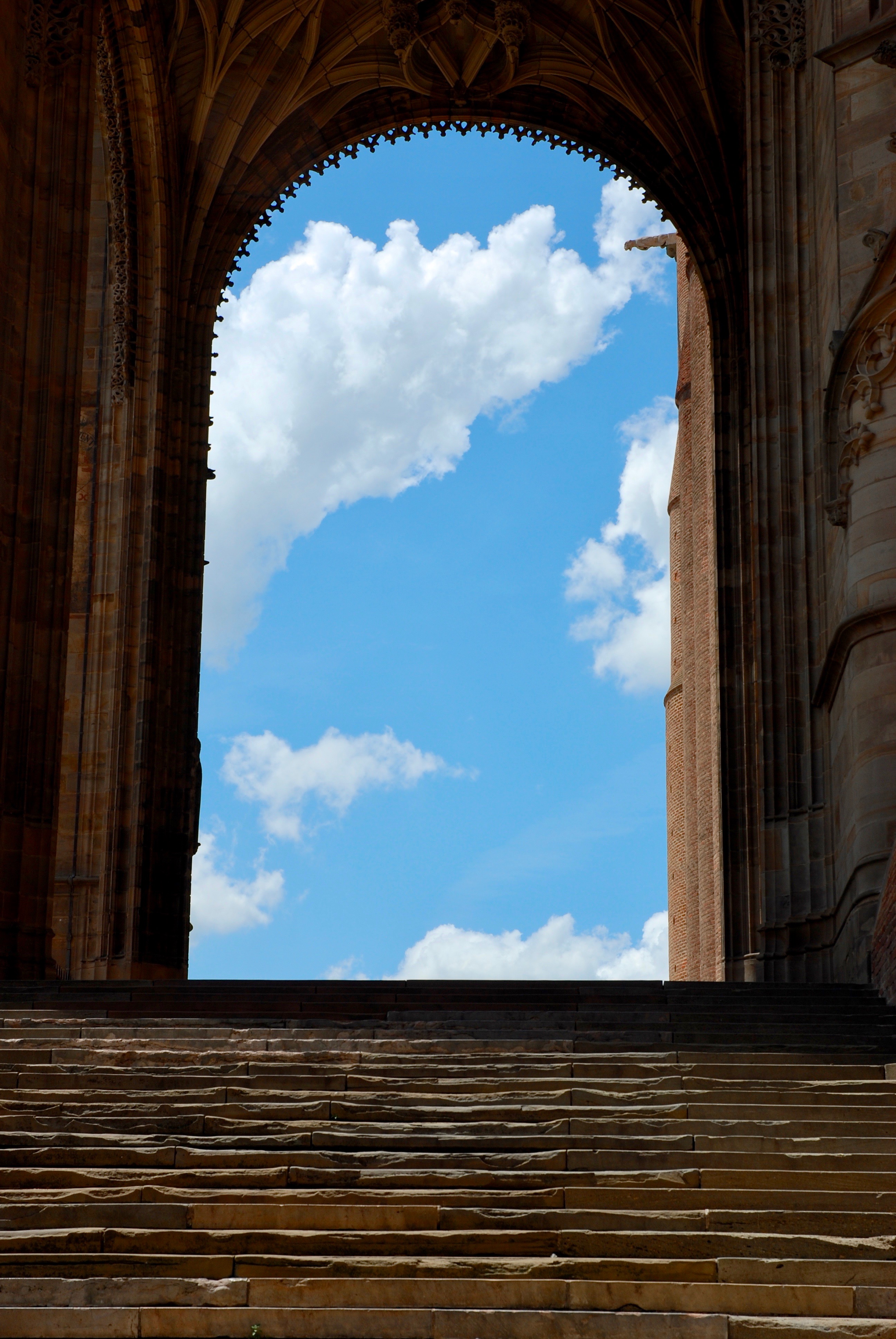
Photographs by the author. The view of the sky through the arch of the south porch baldaquin of the Cathedral Basilica of St. Cecilia in Albi, France, is an image for the limits of theological speech: the stairs of language take us upward, but only so far. After that: a wordless sky. You can read about the “Via Negativa” installation here. Arne Pihl’s “Gentle” sculpture (2014-15) was part of an installation in a razed lot in Seattle, responding to questions about the future of a changing neighborhood.

[i] Thomas Aquinas, Summa Theologica 1a.13.1. Thomas quotes from Dionysius to support this statement.

[ii] Jacques Derrida cited in The Oxford Handbook of Philosophy and Religion, ed. William J. Wainwright (Oxford & New York: Oxford University Press, 2005), 489.

[iii] Dionysius the Areopagite, Mystical Theology 1.1, cited in Olivier Clément, The Roots of Christian Mysticism (Hyde Park, NY: New City Press, 1993), 247. The anonymous mystic’s name is a pseudonym taken from Acts 17:34 to suggest apostolic authority.

[iv] Thomas Aquinas, Summa contra Gentiles 30.3. Italics mine.

[v] Karl Rahner, S. J., Foundations of Christian Faith (1983), p. 64, cited in Thomas M. Kelly, Theology at the Void: The Retrieval of Experience (Notre Dame, IN: Notre Dame University Press, 2002), 130.

[vi] Jean-Luc Marion, God Without Being (1991), p. 45, cited in The Oxford Handbook of Philosophy and Religion, 484.

[vii] T. S. Eliot, “East Coker,” in Four Quartets.

[viii] Evelyn Underhill, Mysticism: The Nature and Development of Spiritual Consciousness (Oxford: Oneworld Publications 1999/2008, orig. published 1911), 337.

[ix] Jerzy Peterkiewicz, The Other Side of Silence: The Poet at the Limits of Language (London: Oxford University Press, 1970), 45.

[x] St. Augustine, Confessions 1.4. The full passage has a wonderful list of divine names: Summe, optime, potentissime, omnipotentissime, misericordissime et justissime, secretissime et presentissime, pulcherrime et fortissime; stabilis et incomprehensibilis; immutabilis, mutans omnia. Numquam novis, nunquam vetus, … Semper agens, semper quietus; colligens et non egens: portans et implens et protogens; creans et nutrigens et perficiens: quaerens cum nihil desit tibi … Quid dicimus, Deus meus, vita mea, dulcedo mea sacnta? Aut quid dicit aliquis, cum de te dicit? (“Highest, best, most potent, most omnipotent [transcendent], most merciful and most just, most deeply hidden and yet most near, fairest, yet strongest, steadfast, yet ungraspable, unchangeable, yet changing all things; never new, yet never old.… ever busy, yet ever at rest; gathering yet needing not; bearing, filling, guarding; creating, nourishing, and protecting; seeking though you have no wants … What can I say, my God, my life, my holy joy? Or what can any say who speaks of you?”).

[xi] St. Barnabas Episcopal Church, Bainbridge Island, WA.

[xii] In his 1995 commentary on the liturgy at St. Gregory of Nyssa Episcopal Church in San Francisco, Richard Fabian writes that Peter the Fuller, Patriarch of Antioch, whose Monophysite party was defeated at the Council of Chalcedon (451), inserted the creed into the cathedral liturgy to show his loyalty to the earlier Council of Nicaea (325). Though he was soon deposed, the creed remained, “a massive monument to doctrinal quarrels ever since.” Its inclusion was resisted in the western church, especially in England, but slipped into English worship in the 15th century, and incorporated into the Book of Common Prayer in the 16th. Today, some question its lack of inclusive language as well as the ancient Greek terminology whose original meanings are obscure to many. And some liturgists wonder about its effect on the natural flow of the rite. (Worship at St. Gregory’s, All Saints Company, 25-26).

[xiii] Summa contra Gentiles, 31.4. As to just how many names there are, I’ve always liked the number from Arthur C. Clarke’s short story, “The Nine Billion Names of God.”

What is God? — A Trinity Sermon

Abbey at Conques on Le Chemin de St. Jacques de Compostelle, France (Jim Friedrich)

What is God? When the biblical Jews asked that question, they responded from their experience of salvation history.  God is the one who told me to leave behind everything I knew and set out for God-knows-where, says Abraham. God is the one who asked me to go back to the land of oppression and enslavement so I could speak truth to power, says Moses. God is the one who made a covenant with us on Mount Sinai, in the cloud of unknowing. God is the one who remembered us in the days of exile. God is the one who brought us home from Babylon. 

Then Jesus came along, and even though he lived and died as a human being, there were those who experienced the fullness of God in the unique particularity of his life, death, and resurrection. The risen Lord, who said “I am with you always,” would become an object of worship very early in the life of the Church. 

And after the Ascension of Jesus came the Holy Spirit, not only as an indwelling presence but also as a radically transformative force, in whom divine fullness was equally and uniquely manifest.  

For the early Christians, then, the One they called God had been revealed to have three distinct ways of being: Source, Savior, and Spirit. Love who loves us; Word who saves us; Spirit who renews us. And before long they were offering worship not only to the God of Israel, but to Jesus and the Holy Spirit as well. 

They were not polytheists. They rejected pagan notions of a heaven and earth populated by competing deities. But their experiences of God in Christ and God in the Spirit were unique enough to differentiate them from the Holy One who sent Jesus into the world. 

At the same time, the second and third Persons were not understood to be partial or lesser versions of God. Only the true God can save us, as Christ did. Only the true God can sanctify us, as the Spirit does. 

Those first Christians couldn’t deny their experience, or the witness of Scripture. Christ was God. The Spirit was God. But that posed a conceptual problem. 

How can the Three be One? How can the One be Three? Mathematics or logic can’t solve this puzzle. Several centuries of ecumenical councils struggled with the questions, doing their best to preserve the paradox of Three in One and One in Three from collapsing into the simplicity of God as “One is One and all alone.” 

Although it would have put a lot of theologians out of work, It would have been a lot easier just to stick with the Oneness. But that would not have been true to Christian experience. The Threeness is essential to our informed—and formative—encounters with God. As contemporary Catholic theologian Catherine LaCugna puts it, “The doctrine of the Trinity is ultimately a practical doctrine with radical consequences for Christian life.” [1]

Does that mean that the friends of God have to master the bewildering terminology and complicated nuances of ancient dogma in order to live the Christian life? Will heaven admit only the most sophisticated thinkers? Let’s hope not. 

I’ve read a lot of theology and Church history over the last fifty years, and I still have trouble remembering the differences between Monophysites, Monothelites, Monarchians, Modalists, Ebionites and Sabellians. As Japanese theologian Kosuke Koyama wonders, what if we were to exchange the metaphysical tangles of the West for more down-to-earth analogies. For example, he asks, what might the yin-yang of “pepper” and “salt” tell us about the divine nature? [2] Or St. Patrick’s shamrock, for that matter. 

For the Offertory anthem at the liturgy for Trinity Sunday, Mozart’s Laudate Dominum, I’ve assembled 26 concrete images of persons and objects grouped in threes. As you watch the video, I invite you to contemplate the Christian koan of Three-in-One and One-in-Three. 

Now then, what shall we say about the Trinity? One of the sixteenth-century reformers counseled intellectual modesty. “We adore the mysteries of the Godhead,” he said. “That is better than to investigate them.” [3] In a similar vein, a contemporary theologian reminds us that the “triune God is not simply unknown, but positively known to be unknown and unknowable—which is a dear and profound knowledge.” [4]

But on Trinity Sunday, it is the preacher’s ritual duty to offer a sacrifice of ignorance on the altar of unknowing. So here we go.

Back in the day—the fourth century, that is—when the Council of Nicaea was parsing theories of the divine life, theology was a popular sport, and people kicked around trinitarian doctrines the way some of us recite the arcane numbers of baseball metrics today. But in the late Middle Ages, the doctrine of the Holy Trinity went into cold storage. By the time of the Enlightenment, Immanuel Kant could say that Trinitarian theology had “no practical relevance at all, even if we think we understand it.” [5]

In recent centuries, any sort of God talk has been drained of content for many people. We live in a secular age, where a divine power who is in but not of the world has become increasingly unthinkable. Religion, in the world’s eyes, has become more of a private matter than a public truth. 

And yet, the Spirit continues to work, and in the last few decades we have seen a remarkable resurgence of attention and thought devoted to the meaning and relevance of the Trinity. It’s not just white, western males doing this work. Feminists, Africans, Asians, Middle Easterners and Latin Americans are all bringing fresh and urgent perspectives to Christianity’s core doctrine of God. And their work is of enormous consequence for both our personal faith and our common life.

The Nicene Creed declares that the three Persons are “of one substance.” In other words, whatever God is made of, Father, Son, and Holy Spirit have all got it—and in equal measure. 

But what is that “substance?” Is it a divine essence which existed prior to, or in addition to, the Persons themselves? Is there a one God hidden behind or beyond the Trinity? Such a notion would undercut the completeness of the Trinity, making it dependent on something external—in other words, less than fully divine in itself. 

Or is the divine substance like a pie which has been cut into three equal pieces? That would divide God into parts and lose the unity of the whole. It would also make the Persons less than eternal, since the whole pie would have to precede the creation of the separate pieces. 

But what if we were to give up the idea of divine “substance” as some kind of stuff which exists on its own and gets divided into three, or possesses a reality in addition to whatever the three Persons consist of? What if being the divine Trinity does not mean to have a divine substance, a kind of primordial stuff. What if being a Trinity means to be in relation with one another? 

Perhaps the Trinitarian God is best described not as a fixed, objective entity, but as an event or activity, an eternal communion shared between the Persons. The Greek word perichoresisdescribes the divine communion as a dance where the partners are in continuous motion, weaving in and out of one another. 

This conceptual shift from substance to relation is a central theme of contemporary theology. As feminist theologian Elizabeth Johnson writes (using inclusive terms for the Persons):

“The mutual coinherence, the dancing around together of Spirit, Wisdom and Mother; or of mutual Love, Love from Love, and unoriginate Love; or of the three divine persons – this defines who God is as God. There is no divine nature as a fourth thing that grounds divine unity in difference apart from relationality. Rather, being in communion constitutes God’s very essence.” [6]

A couple of British theologians elaborate this point when they say that the divine Persons do not “exist over against the others as self-enclosed centers of consciousness, as with human persons … but rather each dwells in the other through a kind of inter-permeation.” Then they sum it up this way: “The consciousnesses are fused but not confused.” [7]

This is not a new idea. The First Epistle of John assures us that “God is love” (4:8). And love, as we all know, cannot exist alone, without an “other” to share with, give to, receive from. Love exists only by going beyond the self in a process of perpetual self-offering.

Love is not a secondary or optional property of God. Love is who God is, and how God exists. Simply put: “the Trinity is not derived from God’s essence; the Trinity is God’s essence.” The communion and community of the Persons is God’s nature and essence.” [8]

Jürgen Moltmann notes the impossibility of a loving God being otherwise. “God cannot find bliss in eternal self-love,” he writes, “if selflessness is part of love’s very nature. God is in all eternity self-communicating love.” [9] A Kenyan Christian, John Mbiti, who comes from a more communal culture, puts this even more succinctly:

“I am because we are, and since we are, therefore I am.”[10]

We may struggle with this interdependent Trinitarian model because our culture has taught us to think of a person as an autonomous individual, whose identity, mind and will are separate and independent from every other person. 

But what the doctrine of the Trinity tells us is that you cannot be a person alone. You can only be a person in relationship with others. Addressing another, listening to another, conversing with another, loving one another, offering ourselves to one another—these are the means of becoming a person and existing as a person, if we are to live in the image of the relational personhood of the divine, in whom the one does not exist without the many. 

When we hear Jesus say, you must lose yourself to find yourself,[11] we may think he’s speaking of death, either metaphorical or physical, some kind of painful stripping away. And sometimes that is the case. 

But I think Jesus is also describing the divinely grounded process of communion and community. “I am because we are, and since we are, therefore I am.” St. Athanasius had a wonderful term for this state of being in communion. He called it “reciprocal delight.”[12]  We are all in this together, God says, and so say God’s friends as well.  

It seems especially fitting at this particular moment to contemplate communion as the essential and constitutive fact of divine life, for in one week’s time we will gather together, in person at last, as the Body of Christ at St. Barnabas. It has been fourteen months since we last did this. What joy it will be to share the sacrament of God’s self-diffusive love once again and celebrate the bonds between us.

After so many words about the Holy Trinity, let me conclude with an image. Thirty years ago, Polish film director Krzysztof Kieslowski made a series of 10 one-hour films called Decalogue. Each of the films is based on one of the Ten Commandments, and the series is one of the masterpieces of spiritual cinema. [13]

Pawel (Wojciech Klata), Decalogue 1

In the first film, there’s an exchange between Pawel, an eleven-year-old boy, and his aunt Irena. Pawel has a great curiosity about God, which his single-parent father, an unbeliever, cannot satisfy. So Pawel takes his questions to Irena, his devout Catholic aunt: 

Pawel: Do you believe that God exists?
Irena:  Yes.
Pawel: What is God?

Irena doesn’t answer with words. 
Instead, she puts her arms around Pawel and pulls him close.

Irena:  What do you feel now?
Pawel: I love you.
Irena:   Exactly. That’s what God is.


[1] Catherine M. LaCugna, cited in Veli-Matti Kärkkäinen, The Trinity: Global Perspectives (Louisville, KY: Westminster ]ohn Knox Press, 2007), 179.. This is the opening sentence of LaCugna’s God for Us: The Trinity and Christian Life (1991). As you will see, I found Kärkkäinen’s study of recent Trinitarian theology to be an invaluable resource. 

[2] Veli-Matti Kärkkäinen, 312.

[3] Philip Melanchthon, in Veli-Matti Kärkkäinen, xvi.

[4] Elizabeth Johnson, in Veli-Matti Kärkkäinen, 212, from Johnson’s She Who Is: The Mystery of God in Feminist Theological Discourse(1993).

[5] Immanuel Kant, in Veli-Matti Kärkkäinen, 206.

[6] Elizabeth Johnson, in Veli-Matti Kärkkäinen, 56.

[7] Ninian Smart & Steven Konstantine, in Veli-Matti Kärkkäinen, 249, from their Christian Systematic Theology: Theology in a World Context (1991).

[8] Richard Rice, in Veli-Matti Kärkkäinen, 140.

[9] Jurgen Moltmann, in Veli-Matti Kärkkäinen,106;  from Moltmann’s classic Trinity and the Kingdom: The Doctrine of God (1981)

[10] John Mbiti, in Veli-Matti Kärkkäinen, 352.

[11] Matthew 10:38.

[12] St. Athanasius (c. 296-373), a bishop in Roman Egypt, was a key defender of Trinitarianism. Cited in in Veli-Matti Kärkkäinen, 39.

[13] See my post, Kieslowski’s Decalogue: A Masterpiece of Religious Cinema (Jan. 28, 2017): https://jimfriedrich.com/2017/01/28/kieslowskis-decalogue-a-masterpiece-of-religious-cinema/

The Spirit That Moves Us All: A Pentecost Reflection

Piero di Cosimo, Incarnation (detail), 1500-1505. “Holy Ghost over the bent / World broods with warm breast and with ah! bright wings.” (Gerard Manley Hopkins)

In spite of all the destructive forces [we] let loose against life on this planet, the Spirit of Life is at work in ever new and unforeseeable ways, countering and circumventing the obstacles we put in its path. In spite of my strong tendencies to complacency and despair, I experience the Spirit in myself as calling forth the realistic hope apart from which there is no hope, and I am confident that what I find in myself is occurring in others also … what makes for life and love and hope is not simply the decision of one individual or another but a Spirit that moves us all. 

— John Cobb [1]

Of perfect love thou art the ghostly flame.
Emperor of meekness, peace and tranquility,
My comfort, my counsel, my perfect charity,
O water of life, O well of consolation,
Against all storms of hard adversity …

— 15th century English lyric 

On the fiftieth day of Easter, our liturgical prayer addresses the Holy Spirit more than on any other day. Most of the time our words of supplication and praise address an “other” who is metaphorically outside or beyond: God, Jesus, Father, Mother …. But the dominant prayer of Pentecost calls upon the most obscure and elusive of the divine “Persons”—One who is not “out there” but “in here.”

Veni Sancte Spiritus. Come, Holy Spirit.

The tricky thing about such a prayer is that it is not prayed to the Spirit. It is prayed in the Spirit and by the Spirit. The Spirit is not the object of our prayers, but the subject, dwelling within our inmost parts more surely and substantially than the transitory, constructed “I” produced by the particular confluence of history, biology, and personality which has sculpted our individuality over time. When truth speaks through us, when our energies are directed toward the well-being of all, when our lives are written and rewritten as narratives of divine love, the Spirit isn’t just in us—the Spirit is us. 

This is to claim nothing for ourselves. Only those driven by unholy spirits make that mistake. Participation in the divine reality—life “in the Spirit”—is always a matter of giving yourself away, becoming part of something larger. The Holy Spirit’s proper name is communion. When we’re in the Spirit, that’s our name too.  

Compared to writings about “God” and “Christ,” theological expositions on the Holy Spirit can seem relatively thin. The early creeds didn’t have much to say either, making the Spirit seem like an afterthought—oh yeah, and the Holy Spirit too. But this isn’t due to neglect so much as it is to the Spirit’s way of disappearing into the world as anonymous giftedness. As Orthodox theologian Vladimir Lossky put it: 

“[T]he Holy Spirit effaces himself, as Person, before the created persons to whom he appropriates grace … He mysteriously identifies himself with human persons while remaining incommunicable. He substitutes Himself, so to speak, for ourselves.” [2]

Canadian poet Margaret Avison addresses the Spirit’s indescribability in her poem “… Person or A Hymn on and to the Holy Ghost.” 

How should I find speech 
to you, the self-effacing
whose other self was seen
alone by the only one,

to you whose self-knowing
is perfect, known to him,
seeing him only, loving
with him, yourself unseen?

Let the one you show me
ask you, for me,
you, all but lost in
the one in three,

to lead my self, effaced
in the known Light,
to be in him released 
from facelessness,

so that where you 
(unseen, unguessed, liable
to grievous hurt) would go
I may show him visible.

The poem’s profusion of pronouns makes it hard, at first, to tell which divine Person is doing what. “You” is clearly the Holy Spirit, but who is “him?” Is it Christ, or the Father, or God in general who releases us from “facelessness,” or whom we ourselves make visible in the practice of holy living? The “unseen, unguessed” Spirit may be “all but lost in / the one in three,” but without it (or him, or her, or they), Love Divine could not do its proper work in the world and in the heart.

O fiery Spirit, come burn in us.
O sacred breath, come breathe in us.
O blazing love, come flame in us.…
O delight of life, come live in us. [3]

This past year has generated its share of anxiety, fear, madness and grief, but as John Cobb reminds us, “the Spirit of Life is at work in ever new and unforeseeable ways, countering and circumventing the obstacles we put in its path.” It is in this Spirit that I have shaped my retelling of Ezekiel’s vision in the Valley of Dry Bones (see video below). When the divine breath comes into the lifeless bodies, I layer multiple inhalations and exhalations to make a chorus of breaths. For me that collective sound symbolizes the Spirit’s fierce resistance to every power that would silence and choke us. As the Psalmist says, You send forth your Spirit, and the people are created; and so you renew the face of the earth (Psalm 104:31).


[1] Cited in Marjorie Suchocki, “Spirit in and through the World,” in Suchocki and Joseph A. Bracken, S.J., Trinity in Process: A Relational Theology of God (New York: Continuum, 1997), 180. And yes, masculine pronouns are problematic. Depending on the language, Spirit has been feminine and neuter as well. Do you think She minds?

[2] Vladimir Lossky cited in Paul S. Fiddes, Participating in God: A Pastoral Doctrine of the Trinity (Louisville, KY: Westminster John Knox Press, 200), 261.

[3] Jody L. Caldwell, after Hildegard of Bingen, in Voices Found (New York: Church Publishing, 2003), #62.

“The deepest kind of life”—Is Religion Dying?

St. Mary’s, Fairford, Gloucestershire, England (Jim Friedrich)

For most of my life, a majority of Americans—around 70%—identified with a religion. In the twenty-first century, that stability in religious affiliation has collapsed, falling by 20 points in just two decades. The United States, long one of the world’s most religious countries, has become, rather suddenly, one of the least.

Rapid changes in society, technology, mobility and time management, along with the reluctance of younger generations to make institutional commitments of any kind, have contributed to this erosion. So have the manifold sins of believers and religious institutions, which publicly discredit the transformational claims of faith communities. If religious people behave badly, what’s the point?

The major religions have survived comparable challenges in the past. What may be different in these latter days is the degree to which the secular age has flattened reality into a strictly horizontal dimension, excluding the verticals of transcendence and depth. For growing numbers of Americans, God is neither felt nor thought. Religion’s windows into the divine invisible have been replaced by mirrors.

At least since the Enlightenment, critics and skeptics have been writing obituaries for religion. By the nineteenth century, doubt was in full flood. An appraisal in 1878 was typical: “one can hear faith decaying … This decay has been maturing for three hundred years, and their effects prophesied for fifty; indeed, not prophesied only but in some degree accomplished.” [i]  

Thirty years later, Thomas Hardy would write “God’s Funeral,” a somber poem about the death of belief. As the “strange and mystic form” of the expired deity passes by, borne by a great procession of mourners, the poet confesses the object of faith to be a delusion:

… tricked by our own early dream
And need of solace, we grew self-deceived,
Our making soon our maker did we deem,
And what we had imagined we believed.

Till, in Time’s stayless stealthy swing,
Uncompromising rude reality
Mangled the Monarch of our fashioning,
Who quivered, sank; and now has ceased to be.[ii]

At least Hardy felt sad about the demise of divinity (“Sadlier than those who wept in Babylon, / Whose Zion was a still abiding hope.”). These days, unbelief is more a matter of indifference than sorrow. How many people still take God into account, or think theologically, and shape their lives accordingly? Once God is gone, what’s the use of religion? 

The precipitous decline of religious affiliation in America has prompted anxious speculations about what’s next. In “America Without God,” Shadi Hamid, a senior fellow at the Brookings Institute, sees religious fervor being sublimated into political conviction.[iii] As we have seen in the case of the recent Trump cult, with its sociopathic savior, this can go very wrong. At least religion attempts to temper the zeal of believers with mandates of repentance and forgiveness, as well as the humility of unknowing in the presence of mystery. Politics, not so much.

In an article on the “Death of Faith,” journalist Murtaza Hussain deems the extinction of traditional religion in America to be only a matter of time. “Older expressions of religion are not completely absent in public, to be sure. But compared with the past, their influence over events feels akin to the light of a dead star.… The slow-rolling death of religion in American life begs the question, then, what type of new world will emerge from the wreckage of the old?” 

Hussain hopes that any emergent communal expressions will not repeat what he calls “the worst aspects of the old religions, including the moral censoriousness, judgmentalism, heresy-hunting and the persecution of those who think differently.” We should construct a new social imaginary, he suggests optimistically, “with the self-conscious idea of improving on the mistakes of organized religion.”[iv]   

Personally, I am not prepared to exchange Jesus, the sacraments, saints, centuries of wisdom, sacred conversation, communal prayer, or the Paschal Mystery for a mistake-free startup. While I may lament the Church’s manifold sins and grumble over its frustrations, I will continue to feast on its visions and receive its graces. Even the soul’s darkest nights are preferable to a world without divine depth or holy wonder. As Meister Eckhart said, “I would rather be in hell and have God, than in heaven and not have God.”[v]

Baron von Hügel (1852-1925)

In concluding his illuminating study of religious defections by the Victorians and their successors, A. N. Wilson quotes one of the era’s greatest religious thinkers, Baron von Hügel (1852-1925), who insisted that “religion was the deepest kind of life.” And to that, Wilson adds his own Amen: “And I am bound to say that compiling this study of those who tried to live without religion, or who chose to live within the limitations of a purely materialistic explanation for the problems of metaphysics, has not made me wish to revise the baron’s viewpoint.”[vi]

How, then, should the Church respond to declining numbers, or address widespread indifference to its priorities and practices? Shall we attempt to shape a social imaginary more congenial to “the deepest kind of life?” Do we welcome the death of antiquated forms in order to practice resurrection? Or should we wait and listen in faithful silence for a word not yet spoken? 

George Tyrrell (1861-1909)

George Tyrrell was an Irish Jesuit who urged the Church at the dawn of the 20th century to adapt and evolve in response to the challenges of modernity. His progressive views were out of step with his contemporaries, and when the anti-modernist Pius X became pope in 1903, Tyrrell’s fate was sealed. He was expelled from the Jesuits in 1906, denied the sacraments in 1907, excommunicated in 1908, and forbidden a Catholic burial in 1909. Half a century later, his views would be mostly vindicated at the Second Vatican Council. 

The fact that Tyrrell was wrong in 1906 and right in the 1960s demonstrates the tension between stability and innovation which is unavoidable—even necessary—within a living tradition. A great religious institution may not be able to turn on a dime, but it still contains within itself an ultimate loyalty to its transcendent and ineffable core, enabling it to adapt and survive. The secret of Christianity’s longevity is its rootedness in a reality which exceeds any particular institutional or theological expression. Transition, revolution, or even apparent catastrophe do not signify ultimate defeat if you are in covenant with the God of infinite surprise.  

As Orthodox theologian David Bentley Hart puts it, “the proof that any tradition is a living one is precisely that it does not fiercely cling to every aspect of what it has inherited but instead exhibits an often astonishing ruthlessness in shedding the past, out of obedience to some still more original spiritual imperative.”[vii]

Grave at Wesley’s Chapel, London (Jim Friedrich)

Dying to the old and rising into the new is a costly and painful process, but it is the ultimate vocation of every believer and every church. In a letter to a friend in April 1906, Tyrrell movingly expressed both the anguish and the hope of trusting in the unknown futurity of God: 

“I quite understand your desire for a life of prayer—the nostalgia for the old days ‘when His lamp shone about my head.’ God knows I feel it. But I think they will return for us all in some better form. I find the Breviary lives for me again after a long transition period of death. One has to pass through atheism to faith; the old God must be pulverized and forgotten before the new can reveal himself to us.” [viii]

Tyrrell’s “pulverized and forgotten” God sounds little different from Hardy’s “mangled Monarch,” except for one thing: resurrection. Hardy thought death was the end of the story. Tyrrell knew it was only the beginning. 


[i] W. H. Mallock, The Nineteenth Century, cited in A. N. Wilson, God’s Funeral (New York: W. W. Norton & Company, 1999), 164.

[ii] Full text and notes for Hardy’s poem: http://greatpoetryexplained.blogspot.com/2019/01/gods-funeral-by-thomas-hardy.html

[iii] Shadi Hamid, “America Without God,” The Atlantic (April 2021): https://www.theatlantic.com/magazine/archive/2021/04/america-politics-religion/618072/

[iv] Murtaza Hussain, “How the Death of Faith Will Hurt the Left,” Wisdom of Crowds (Sept. 15, 2020): https://wisdomofcrowds.live/death-of-faith-hurt-the-left/

[v]Meister Eckhart (c. 1260 – c. 1328), cited in Evelyn Underhill, Mysticism: The Nature and Development of Spiritual Consciousness, originally published 1911 (Oxford: Oneworld Publications, 1993), 209.

[vi] A. N. Wilson, 336.

[vii] David Bentley Hart, Theological Territories: A David Bentley Hart Digest (Notre Dame, IN: Notre Dame University Press, 2020), 106.

[viii] George Tyrrell, cited in A. N. Wilson, 351.

“When I begin the long work of rising”—A Tribute to David Fetcho

David Fetcho.

“So my expectations are modest: that for some folks unknown to me, my music and poetry might open a window–maybe just a little bit–and allow them to get a glimpse of the secrets of their own heart as it tries to make sense of this world.”

— David Fetcho

I last saw David Fetcho at a funeral one year ago. I had flown to California to preach at the requiem for Stephen O’Leary, a fellow shape note singer. At the reception afterward, David and his wife Susan joined me in singing “Farthest Field,” a parable of resurrection and reunion beyond this mortal life.

I know one day I’ll leave my home
Here in the valley and climb up to that field so fair
And when I’m called and counted in
That final tally, I know that I will see you there.
Oh, walk with me and we will see the mystery revealed
When one day we wend our way up to the farthest field. 

The three of us had worked out the harmonies years before, and we loved to sing that song whenever we met up. When David and Susan dropped me at the Oakland airport that evening, we had no idea we had sung together for the last time. A few days later, the pandemic began to enclose us in our respective bubbles, two states apart. Then, a week ago, David had a massive stroke. He died yesterday afternoon. 

I first met David and Susan at the California Shape Note Convention in January 2000. They introduced themselves at the lunch break. After hearing my opening prayer that morning, they suspected we were kindred spirits. We quickly discovered a multitude of common bonds, including creative liturgy, filmmaking, music, theater and dance, theology, and radical Christianity. We met for a long conversation the next day, sharing our dreams of provoking a renaissance of wonder among God’s friends. Most of our grand collaborative hopes never materialized, but our periodic exchanges of ideas and passions always nourished our own ongoing projects. We were like an ancient trading culture. I’d show a film they hadn’t seen. They’d read me a poet I didn’t know. Whenever we met, we’d find ourselves taking notes, exchanging the names of works or artists to explore. And when we did manage a collaboration—a creative liturgy, a workshop, a video production—it was always a joy, with a surplus of invention and a minimum of ego. 

David Fetcho, late 1973.

Music was at the heart of David’s many creative gifts. He sang Gregorian chant as a Catholic choir boy, and mastered the accordion in the polka culture of his native Pittsburgh. Coming of age in the 1960s, he breathed the experimental air of the psychedelic San Francisco sound and the “new music” avant garde. His influences ranged from Meredith Monk and David Byrne to late medieval Ars Nova, contemporary world music, and American Sacred Harp singing. In 1970 he got access to a sophisticated Moog synthesizer left over from a Jefferson Airplane project, and began a lifelong exploration of electronic music. But his embrace of complex synthesized music never eclipsed his love of acoustic simplicity. He recently called the alto recorder his primary instrument.

For many years, David collaborated with Susan, an accomplished dancer and choreographer, to create 14 dance productions, touring in Australia, New Zealand, Bali, the U.S. and Canada. He also composed scores for various dance and theater companies, as well as film and television productions. But after decades as a collaborator, David made the courageous decision, at age 67, to produce his first solo work, using the name of his Slovak grandparents before it was Americanized: Fečo. The resulting song cycle, Watch It Sparkle, is a deep river of sounds and rhythms carrying his distinctive vocals and haunting lyrics through an immense cognitive terrain. 

David resisted terms like “experimental” or “avant-garde” for his new venture. He preferred to call it “medieval folk music for the 21st century.” It’s not easy or casual listening, but the listener who consents to the journey will be richly rewarded, perhaps even transformed. Critic Brian Leak encourages us to take the plunge: “As thematically dark as some of the songs are, there’s still a joyful complexity holding it all together.” And Layla Marino writes, “dsfečo’s first solo album has it all: complex song composition, beautiful, emotive melodies, just the right amount of dissonance and well-placed syncopation and vocals which drive home the point of all this strange music.” 

The final song of the cycle, “Just Another Good Day,” celebrates the eternal Now where we can, even in this life, rest in the stillness of Being, where transcendence and immanence meet in the arrested moment. It was the first thing I put on when I heard the news of David’s death. 

I want to go with you
to the other side of the light
where we’ll see
what the shadow reveals
will be such a relief …

time in its disguises 
won’t fool us anymore …

Days tumble on with minds of their own
they breathe in our lives, and make them their own
and time, time disappears
like the wind from a sail …
and every good day will be 
just another good day
of eternal life. 

Susan and David Fetcho, May 2006 (Jim Friedrich)

“Time of Quarantine,” recorded in his basement in June 2020, knows no such lightness of being. The present moment is heavy with longing for the return of a lost world: “dearest friends may fall / and sorrow’s tide wash over all.” The unwavering close-up of David singing is powerfully intimate (especially so now that he’s gone), yet we see a certain inexpressiveness in his face (but not his voice!), as though another power is speaking through him. This is not a performance, but a message. And the message is hope: 

If there’s a meaning to be found, 
it’s that love can still abound 
in this time of quarantine … 

What is the meaning of this plague we see? 
Even in our shelters we are not alone: 
our hearts can bridge the distance 
although we stay at home. 

Oh where is the time and place 
when I can finally touch your face 
and hold you like I did before 
this time of quarantine? 

And when we look back upon these days, 
we’ll remember how it felt to say, 
“We’re all in this together. 
We’ll make it through together.”

All of David’s work was grounded in a deep faith, a questioning mind, and a compassionate heart. In the 1970s, he and Susan belonged to the Bartimaeus Community in Berkeley, a communal experiment of the Evangelical left which included influential theologian/activist Ched Myers. Over the years, the Fetchos have worked creatively with many different church bodies, but in the years I have known them they have never had a lasting church home. I suspect that their belief in the deep connection between art, faith and imagination has never quite found a satisfactory institutional shelter. As David wrote to me in 2015:

“I want to look for a future shape of the Church unbound from the arbitrary conventions and protocols of manufactured traditions, and converted back to the one deep and abiding tradition of God’s self-expression in the multi-sensual forms of the world, and through the expression of human creative imagination lifted into the prophetic dimension.”

But to some extent, David and Susan found their true “church” in the community of singers who gather regularly to make a joyful noise with the expressive choral tradition of American shape note music. As a faithful supporter of singings in the San Francisco Bay Area, David was known not only for his strong voice, but also for his warm and welcoming encouragement to novice singers.  

Shape noters from all over have been posting fond remembrances. A Bay Area singer wrote: “David’s resounding voice was one of the first that truly stirred me at a local singing. I matched his tone next to me, in the lower tenor octave, and discovered the full sound in my own chest that you all have heard roaring from the alto bench in years since. He has driven me to countless Healdsburg singings, when I haven’t taken the weekend to cycle to them, and soothed me with such a gentle presence, calm with grounded wisdom.” 

In the following video, David and Susan lead a 2013 Palo Alto gathering in singing Rainbow: “Thy ways abound with blessings still, / Thy goodness crowns the years.” David’s radiant joy was a familiar sight at so many singings. He will be dearly missed.  

At last Sunday’s annual Seattle Sacred Harp Convention (on Zoom), 75 singers sang “Christian’s Farewell” for David. The final verse ends, “When I am done, I will go home / Where Jesus is smiling and bids me to come.” Dante’s Commedia reaches a similar conclusion, envisioning “the whole universe alight with a single smile” (Par. xxvii.4-5). To connect two such diverse sources to find a shared meaning is the kind of intertextual play that David’s brilliant mind was always quick to produce. But now he no longer needs to conceive the smile. He can enjoy it face to face. 

The ladder between earth and heaven (Daniel Cooney)

The shocking suddenness of David’s physical absence is hard to accept. I will be a long time sounding his name into the silence. But a Mary Oliver poem he sent me years ago brings comfort: 

When death
carts me off to the bottomlands,
when I begin
the long work of rising—

Death, whoever and whatever you are, tallest king of
tall kings, grant me these wishes: unstring my bones;
let me be not one thing but all things, and wondrously
scattered; shake me free from my name. Let the wind, and
the wildflowers, and the catbird never know it. Let
time loosen me like the bead of a flower from its wrappings
of leaves. Let me begin the changes

Slowly
up the hill,
like a thicket of white flowers
forever
is coming.

This video, perhaps the last recording David made, was shot at sunset on January 18, 2021.