O Clavis David (Dec. 20)

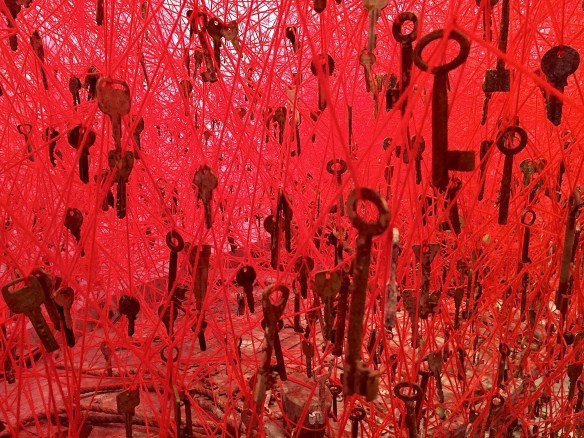
Chiharu Shiota, Keys in the Hand (Venice Biennale 2015).

O Key of David, 
you open, and none can shut;
you shut, and none can open.

Come, lead us out of the prisons
that oppress body, mind and soul;
welcome us into the open space of possibility;
let us breathe again.

This antiphon begins, O Clavis David (“O key of David). The Latin word for “key” was a favorite pun among medieval preachers. Clavis means “key,” but clavus means “nail.” The key that opens the door for us is the nail of Calvary, where Christ died to conquer death and sin.

Jesus, and the divine way of self-diffusive love which he embodied, is the key that unlocks every human prison, from the metal cages on our southern border to the oppressive interior confines of fear, guilt, sin, despair. 

Has you ever been in some kind of prison? Do you remember what you felt when you found the key? What was it like when the door swung open and you walked through it? Perhaps some who read this are still waiting for this key. 

O Clavis, come and lead those who sit in darkness, who live in the shadow of death––or grief, or fear, or addiction. Deliver us all into the place of light and joy and freedom.

Be the key that sets us free.
Open the door and welcome us home.

In Brighton, UK, an alternative worship group, Beyond, turned 24 beach huts into an Advent calendar. Every evening a different hut was opened to reveal an art installation about the coming of Christ. This hut was opened on Christmas Eve, radiating “love’s pure light” into the December night.

O Radix Jesse (Dec. 19)

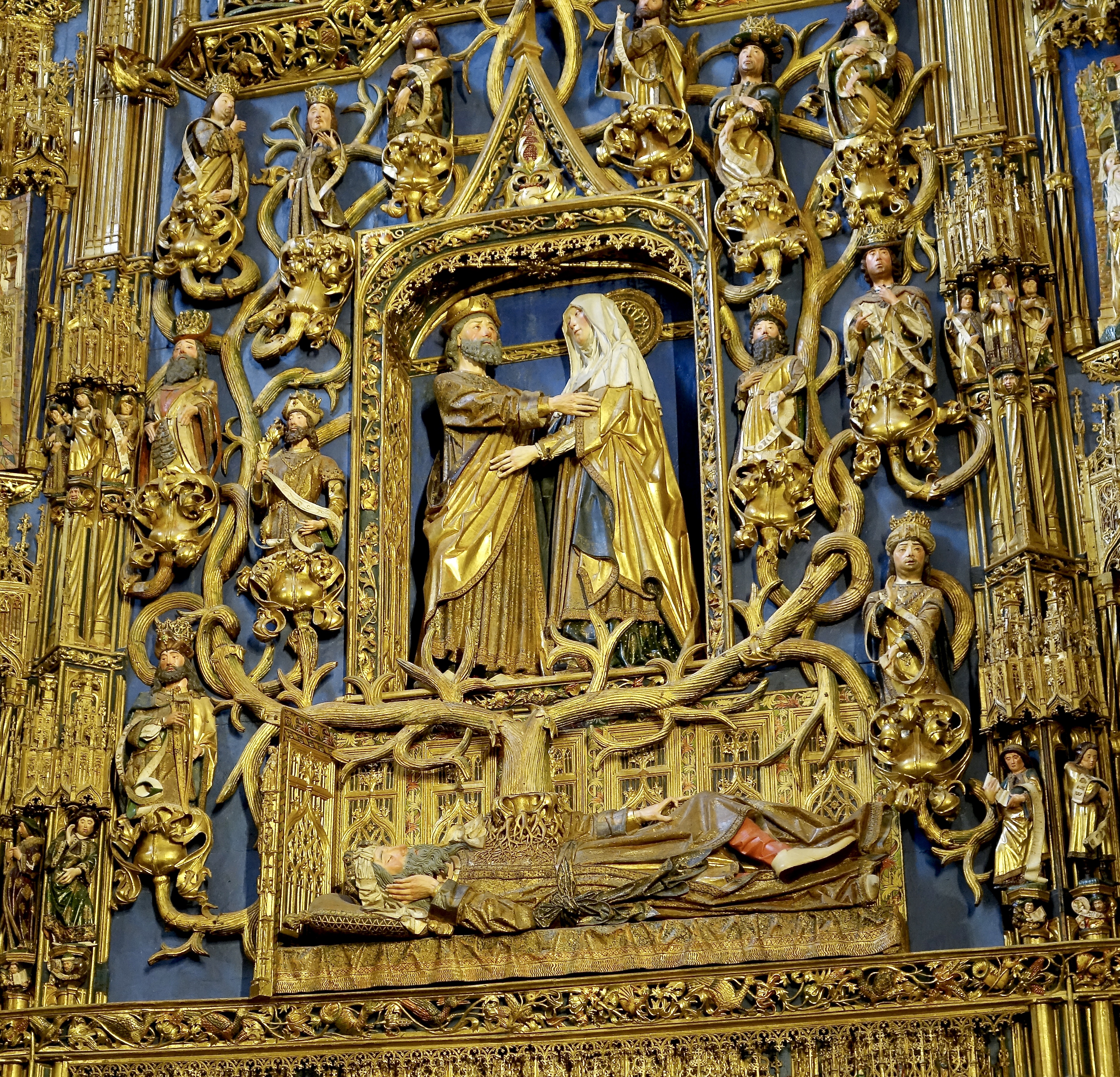
Gil de Siloé, Tree of Jesse (detail) on the altar retablo in the Chapel of St. Anne, Burgos Cathedral, Spain (c. 1498). The family tree of Jesus grows from the body of King David’s father.

O Root of Jesse, 
coming to flower in Jesus,
who in turn bears fruit
in all who are grafted
into the royal line of God’s family.

Come: let us never be severed
from the roots and branches
that nourish us in every moment.

The “Tree of Jesse,” a frequent motif in Christian art since the 11th century, is Jesus’ family tree, linking him to the Davidic line (Jesse of Bethlehem was David’s father). The genealogies of Jesus in Matthew and Luke span 28 and 43 generations respectively, but the number of figures shown on the tree is usually far less due to spatial constraints. 

The prophet Isaiah wrote, “A shoot shall come out from the stump of Jesse, and a branch shall grow out of his roots” (Isaiah 11:1), and most artists have provided a literal version of that image. The Tree of Jesse thus affirms Jesus’ pedigree as the heir of divine promises given to David, as well as Abraham and others before him. 

But the larger meaning of the root and branch image is that Jesus did not come out of nowhere, disconnected from the long course of human history. He was rooted in an ongoing spiritual evolution of humanity since the dawn of consciousness. His appearance, the product of nature and culture as instruments of the Holy Spirit, was the first flowering of creation’s immense journey toward union with its Creator. 

The New Testament says that Jesus is “the pioneer and perfecter of our faith”
(Hebrews 12:2). In the 20th century, the Jesuit Teilhard de Chardin expressed this developmental image in terms of a cosmic evolution: “the presence of something greater than ourselves moving forward within us and in our midst.” We are all destined to be blossoms and fruit on the Jesse Tree.

If we are all truly grafted into the royal line of God’s family, how shall we then live––and grow––accordingly? Let us never be severed from the roots and branches that nourish us in every moment. 

This is the third of seven in a daily series on the O Antiphons for the last week of Advent.

O Adonai (Dec. 18)

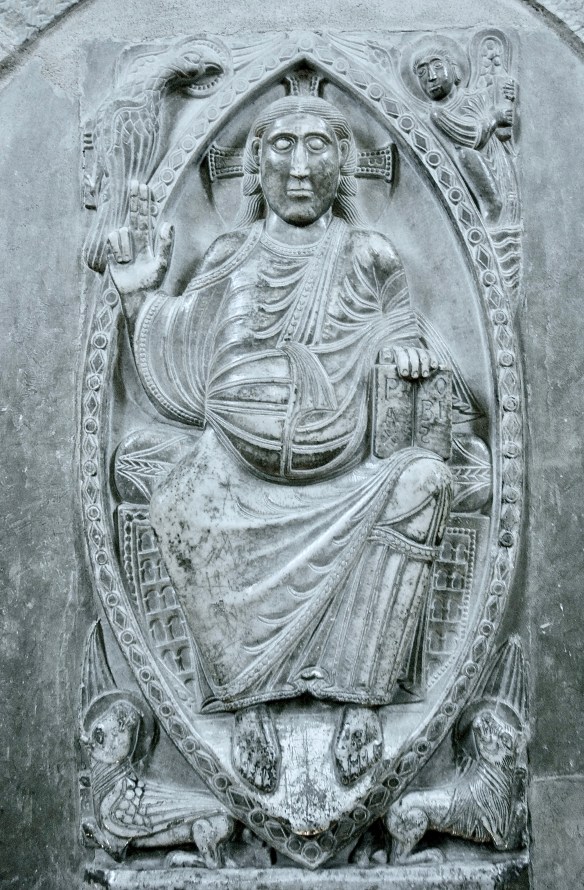
Christ in Majesty, Basilica of Saint-Sernin, Toulouse, France (12th century).

O Adonai, 
ruler of time and history,
manifestation of divine dominion
to your chosen people,
may your presence be our burning bush.

Come: bring justice to the poor,
food to the hungry, shelter to the homeless
protection to the vulnerable
,
freedom to the prisoner.

For the ancient Jews, the divine name revealed to Moses at the burning bush was too holy to be spoken, so they substituted the word Adonai (“my Lord”) when addressing God in their worship. This became Kyrios in the Greek translation of the Hebrew Scriptures. We still pray Kyrie eleison (“Lord have mercy”) in Christian ritual.

Will Campbell, the Baptist preacher who wrote The Cotton Patch Gospels, once asked, “What’s the biggest lie told in America?” The answer he gave was: “Jesus is Lord.” What would our lives––and our neighborhoods, our nation, our economy, our politics––look like if we really believed that the Lord of love and justice, the divine defender of the poor and vulnerable, is in fact the ultimate ruler of time and history? 

Adonai, bring that day closer!

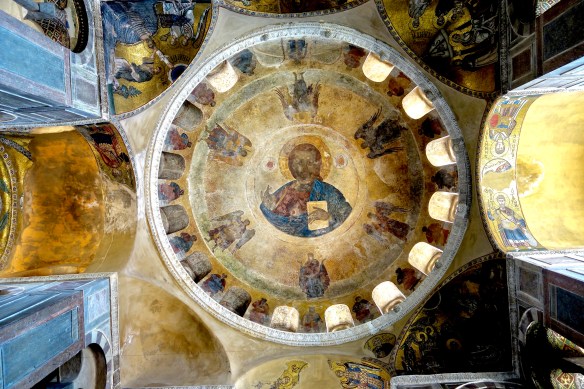
Christ as Pantocrator (ruler of the universe) on the dome of the Katholikon, Hosios Loukas monastery, Greece.

O Sapientia (Dec. 17)

One of the joys of Advent’s final days is the praying of the O Antiphons, seven eloquent prayers based on biblical images suggesting attributes of the divine. Liturgically, they begin and end the Magnificat at Vespers from December 17th to December 23rd, but they are also a rich resource for personal prayer as Christmas draws near. Each antiphon is both a greeting and a supplication, awakening our attention and shaping our intention.

Over the next seven evenings, I will post a brief reflection on the Antiphon for the coming day.
As you journey to Bethlehem, may you walk in beauty.

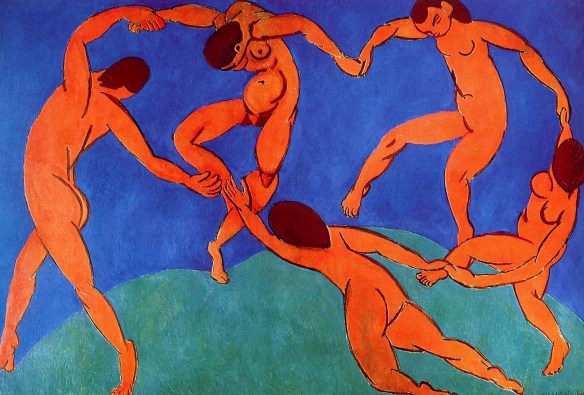
Henri Matisse, Dance (1909-1910).

O Sophia,
you are the truth of harmonious form,
the pattern of existence, the shapeliness of love.

Come: illumine us, enable us, empower us
to live in your Wisdom, your Torah, your Way.

The life of faith is not an invention of our own. Rather, we are invented by the Creator, invented by Love. There is a pattern that preexists us, a pattern born of divine love and woven into the structure of the universe. Sophia (wisdom), Torah (teaching), and Tao (principle) are ancient words for this pattern. 

Holy Wisdom is like a dance. If we are attentive to the music, and surrender ourselves to its rhythms, we will be caught up in the divine choreography. It is what we were made for. If we fight the pattern, we get out of step, and our bodies, our souls, and our societies become awkward and clumsy. 

But do not be discouraged. Sophia is a patient and gentle teacher. Call upon her, and she will guide your feet into the way of peace. 

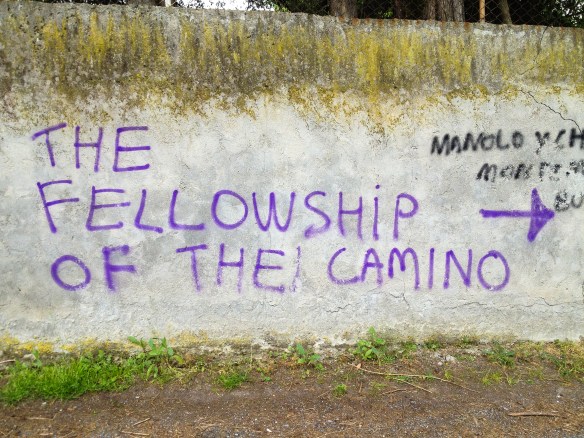
Blessed are those who walk in the Way (Camino de Santiago, May 2014).

The Virgin of Guadalupe

The welcoming Virgin above the portal of Our Lady of the Angels, Los Angeles (sculpture by Robert Graham).

She is reaching out her arms tonight;
Lord, my poverty is real:
I pray roses shall rain down again
from Guadalupe on her hill.

Who am I to doubt these mysteries,
cured in centuries of blood and candle smoke?
I am the least of all your pilgrims here,
but I am most in need of hope.

 –– Tom Russell, “Guadalupe”


We entered the old adobe mission by starlight, hours before dawn. The church was packed with countless worshippers, celebrating mass for the Feast of the Virgin of Guadalupe. After the final blessing, we all kept our places, anticipating the mystery play to come––an Advent tradition performed by El Teatro Campesino, an acting troupe whose roots go back to the fields of central California. Founded by Luis Valdez (“Zoot Suit”) in the 1960s, they performed guerilla theater during protests by Cesar Chavez and the United Farm Workers, and over the years they have continued to develop community-based theater. Now, in the 18th-century church of San Juan Bautista, they were about to perform La Virgen del Tepeyac.

It began with a thunder of drums. Dozens of players in Aztec regalia danced up the aisle, casting huge shadows on the walls of the nave. But their celebration would soon give way to a darker theme: the subjugation of Mexico’s indigenous people by Spanish conquistadores and friars. Aztec costumes were replaced by peasant garb, Franciscan robes and Spanish armor, and the native people were baptized into a new faith––submitting to the grievous inequities of the culture that imposed it. As the play proceeded, the audience took the side of the oppressed, and waited anxiously for God to do the same.

Countless millions throughout the Americas know what happened next. In December of 1531, on a barren hill in a place called Guadalupe, the Virgin Mary appeared to Juan Diego, an Aztec Christian convert. Speaking in his native language, she told him to deliver a message to the bishop: He must build a church not for the rich and powerful, but for the poor and the oppressed.

Juan Diego managed to get an audience with the prelate, but it did not go well. The message was absurd, and the messenger even more so. Would God choose a lowly peasant for divine revelation? Mary’s humble ambassador was quickly shown the exit. Nevertheless, spurred on by more visitations from the Virgin, Juan Diego pressed the message entrusted to him. Exasperated, the bishop demanded a miraculous proof, thinking that would end the matter.

In her final appearance, Mary told Juan Diego to return to that hill one more time. When he reached the summit, he found the barren ground covered with roses––in December! He gathered as many as his cloak could hold, and took them to the episcopal palace. When he poured the roses out at the feet of the astonished bishop, the Virgin’s image was revealed, imprinted on Juan Diego’s cloak.

The roses and the image were the stuff of miracles, but even more miraculous was the dignity accorded Juan Diego and all the indigenous poor by the Queen of Heaven. The story quickly spread, and the Virgin of Guadalupe became the patron saint of the Americas. The famous image of the brown-skinned mother of Jesus has become a ubiquitous sign of the God who raises up the poor and lowly, who works miracles in unexpected places.

On this feast day of the Virgin of Guadalupe, so many people in the Americas continue to suffer from the horrific cruelties of ruthless oppressors and unjust systems. Tragically, the United States government, polluted by white nationalism, has become one of the more notorious offenders. Juan Diego’s successors once again sit in darkness and the shadow of death. Let us pray that Guadalupe’s roses may rain down again upon the barren hills of a heartless world.

I saw El Teatro Campesino’s play twenty years ago, but its conclusion offered an image of grace which has never left me. When the play was over, the whole cast processed down the aisle, singing together as they walked. Actors who had played the oppressors went arm in arm with those who had played the peasants. The people who had been on opposite sides––the lions and lambs of a tragic history––now shared a joyful song, as if they were marching together into God’s redemptive future.

The great doors of the church swung open, and the light of the rising sun flooded into the dark interior like water through a bursting dam. Just outside, the cast turned and stopped, forming a corridor for the audience to pass through. As we made our way into the brilliance of morning, it seemed like the gate of heaven––all those shining brown faces, blessing us with smiles and singing.

And I thought: This is how history will end. Neither a bang nor a whimper, but a song.


Here is one of the Virgin’s appearances to Juan Diego in El Teatro Campesino’s La Virgen del Tepeyac.

Blinded by the Light –– An Advent Meditation

spectra III, an installation by Ryoji Ikeda at Venice Biennale 2019: “a blinding excess, rendering the space itself almost invisible.” (Photo by Jim Friedrich)

Orthodox theologian David Bentley Hart describes atheism as “a fundamentally irrational view of reality, which can be sustained only by a tragic absence of curiosity or a fervently resolute will to believe the absurd. . . [T]rue philosophical atheism,” he says, “must be regarded as a superstition, often nurtured by an infantile wish to live in a world proportionate to one’s own hopes or conceptual limitations.”[1]

For the people of Advent, “a world proportionate to our own hopes” is too mean a thing. The mystery of the world and the destiny of mortals are too deep, too immense, to be contained by language or thought. They exceed everything we can ask or imagine. They explode our limited notions of what is real and what is possible.

Not for the people of Advent that “tragic absence of curiosity” so common in a complacent secular culture too busy amusing itself to consider the deepest questions of human existence. Advent people want to know who we are, why we’re here, where we’re going, and how long we’ve got. Most of all, we want to know whether we matter, and whether we are loved.

But are such questions answerable? Our thoughts and concepts only take us so far, like a compass pointing north. “North” is a pretty useful guide––until you reach the North Pole, where the very concept of north loses its meaning. Just so, the closer our thoughts take us toward the divine center, the less they are able to tell us.

At the end of The Divine Comedy, when Dante beholds the presence of God unveiled at last, words fail him:

What then I saw is more than tongue can say.
Our human speech is dark before the vision.
The ravished memory swoons and falls away. [2]

The mystery we call God is always beyond us. Beyond our grasp, beyond our language, beyond our sight. The mystics and great spiritual teachers sometime use the word darkness to convey their experience in close encounters with the divine.

But what they call the darkness of God is not so much a matter of cognitive deprivation, where divinity simply hides its incommunicable essence from finite minds and hearts unprepared to receive it. No, they say, the darkness of God is not deprivation, but saturation. It is not an absence of light, but an excess of glory, that makes our eyes become so dim to divine presence.

It sounds paradoxical––to be blinded by the light of God––but only paradox has the wings to carry us beyond the prosaic into the heavenly place where all contraries are reconciled. The metaphysical poets of the seventeenth century, like John Donne and George Herbert, reveled in such holy paradox. Henry Vaughan, for example, wrote that

There is in God (some say)
A deep, but dazzling darkness; As men here
Say it is late and dusky, because they
See not all clear;
O for that night! where I in him
Might live invisible and dim. [3]

Was Vaughan just playing with words, or was he on to something? At this year’s Venice Biennale, I had a very literal experience of being blinded by the light in an installation by Japanese artist Ryoji Ikeda. What happened to me there is perfectly described by the text posted at the entrance:

“spectra III” consists of a corridor of bright fluorescent tubes. This all-encompassing installation bathes the visitor in light so bright it is difficult to see. Akin to a blizzard of data, the experience short-circuits our ability to process what we are seeing, and results paradoxically in a sensory wipe-out. Ryoji Ikeda sees this state of overload as opening the door to an experience of the sublime––a landscape of light too complex to comprehend. The installation functions in parallel to the experience of total darkness, yet inverts this experience. We are similarly disoriented but instead of an absence of light by which to see, there is a blinding excess, rendering the space itself almost invisible.

That’s exactly what happened to me in that corridor. I had never before experienced such a literal analogue to the blinding luminosity described by the mystics. It was truly a “deep and dazzling darkness.” Almost painful, to tell the truth. Certainly too much for my mortal eyes to take in.

It may seem paradoxical to speak of the darkness of God at the beginning of Advent, when we light candles against the lengthening nights, and pray for the “grace to cast away the works of darkness, and put on the armor of light,” as if the soul’s journey were a straightforward itinerary from deepest midnight to eternal day. But as the mystics and poets insist, God-talk must be paradoxical to be useful and true. “God draws straight with crooked lines,” they say. God is the burning bush and the cloud of unknowing. You can’t have one without the other.

“God goes belonging to every riven thing,” says the poet Christian Wiman.

He’s made
the things that bring him near,
made the mind that makes him go.
A part of what man knows,
apart from what man knows,
 
God goes belonging to every riven thing he’s made. [4]

God is “apart” from what we know, transcendent to our empirical minds––minds which themselves keep God at a distance through our forgetfulness, idolatry, and egoism. And yet God wants to be near, wants to be known. God “goes belonging” to every riven thing: the broken, the wounded, the lost. God goes belonging to us all. And in so doing God’s own self is riven into the contraries of darkness and light, near and far, infinite and incarnate, present and absent, visible and invisible.

Advent’s great themes are seeking and waiting, hoping and expecting, longing and desiring. We go looking for God, searching for signs of God’s appearing.

Sometimes, in our search, we seem only to find darkness, silence, or absence, because we are looking in the wrong place, or in the wrong way. Or we are simply looking for the wrong thing, and need to be denied the fulfillment of inadequate expectations because they are too small or ill-proportioned to fit the immeasurable desire of God. For example, we might expect a well-armed conqueror instead of a servant and sufferer. Or we might expect an irresistible righter of wrongs instead of a helpless refugee child lying in a manger­­––or, these days, lying in a cage.

We were made to be in union with God, and our desire for that union is the deepest truth within us. We feel incomplete and unfinished without it. But our desire often goes astray and misses its mark, attaching itself to something well short of God. If our desire gets stuck on anything less than God, we will waste our lives worshipping the wrong thing,

In a 1967 film by Jean-Luc Godard, a well-dressed couple in a sporty convertible pick up a hitchhiker who tells them he is God. They are very excited to meet him. “Can you do miracles?” asks the man, “Can you make me richer?” His wife adds her own requests: “Can you make me young and beautiful?” And “God” replies, “Really? Is that all you want? I don’t do miracles for idiots like you!” [5]

One of the reasons that Christians worship together and pray together and learn together is to train our desire, so we don’t wait for the wrong thing, or hope for the wrong thing, or love the wrong thing, but always keep our eyes on the prize. Admittedly, God isn’t all that easy, and God is certainly not tame. As Emily Dickinson said, the divine “invites––appalls––endows–– / Flits––glimmers––proves––dissolves–– / Returns––suggests––convicts––enchants / Then––flings in Paradise––“[6]

Still, we are not deterred. Still, we cry Maranatha! Come, Lord, come! At least some of us do. There are those who don’t, for they think God is too invisible or too impossible to take into account. But isn’t that the point? Nothing we can see can save us. Nothing that is possible can rescue us. Paradox, paradox…

The human condition, suspended somewhere between the finite and the infinite, is a complicated puzzle, a question with no clear answer. As for the times we live in, Humphrey Bogart summed it up nicely in the film Beat the Devil:

“What’ve you got to worry about? We’re only adrift on an open sea with a drunken captain and an engine that’s likely to explode any moment.”

Is God coming to save us? As we know, that question is often answered by delay. Or worse, silence. We peer toward an uncertain horizon, looking for the One who comes with clouds descending, or at least for the comforting glow of dawn. But the horizon is hidden by what Nicholas of Cusa, a fifteenth-century German theologian, called “that obscuring haze of impossibility.”

And the darker and more impossible that obscuring haze of impossibility is known to be, the more truly the Necessity shines forth and the less veiledly it draws near and is present… I give You thanks, my God, because… You have shown me that You cannot be seen elsewhere than where impossibility appears and faces me.” [7]

I love Nicholas’ name for God: “the Necessity.” And I love his image of divine revelation as the moment when “impossibility appears and faces me.” The impossibility, the beyondness of God––beyond all knowing, beyond all saying, beyond all seeing––abolishes our limiting notions of what is possible, making a way where there is no way. O for that Night! where I in him may live invisible and dim.

All this talk of the darkness of God, the hiddenness of God, the elusiveness of God, may seem to run counter to the more affirmative language we usually employ in the liturgy as well as in the conversations we have together as people of faith.

We call ourselves God’s friends. We experience God’s closeness in times of gratitude and times of need. We see God’s hand in works of justice and mercy, and feel God’s Spirit in the reconciling and sacrificial love of human relationships. We meet God in Scripture, in community, in nature, and in beauty. We meet God in the poor, the vulnerable, and the dispossessed.

But sometimes God is hard to find or hard to perceive, and in those times we must speak the Advent language of not-exactly, not-here, and not-yet. That’s why the gospel for the First Sunday of Advent always has Jesus warning us to be on the ready. “Out with the old and in with the new! The world of the past is falling down, falling down. Whatever is going to happen next, expect the unexpected.”

Faced with the collapse of old ways and familiar certainties, where shall we look for God in the brave new world?

There’s a story about a man who dreams he is wandering among the labyrinthine stacks of the immense Clementine library in Prague. A librarian wearing dark glasses approaches him to ask, “What are you looking for?”

“I am looking for God,” he says.

“Ah,” said the librarian. “God is one of the letters on one of the pages of one of the four hundred thousand volumes in the Clementine Library. My parents and my parents’ parents searched for that letter. I myself have gone blind searching for it.” [8]

We’re all searching for that word, that moment, that appearing. It may bring the holy blindness of the mystics, or it may bathe you in the gentler glow of illumination. God only knows. Either way, you will not be left comfortless. God goes belonging to every riven heart.

In this season of Advent, I invite you to contemplate the paradoxical depths of the divine, to immerse yourselves in periods of wordless prayer within God’s luminous darkness. Set aside your concepts and your dogmas, and wait in the stillness of unknowing for the Word to speak. The God who is beyond all language and beyond all knowing wants to disclose Godself to us, wants to give Godself to us. That is the divine desire––the siege of God at the gates of our heart.

Stay awake. Pray for grace. Do not lose faith. As Jackson Browne exhorts us in his great Advent song, “For a Dancer”:

Keep a fire burning in your eye,
and pay attention to the open sky––
you never know what will be coming down.

One last thing.

Paul Celan was a Romanian Jewish poet who survived the Holocaust. It has been said that his difficult poetry “is not willed obscurity” but “comes out of lived experience and is ‘born dark.’” [9]  Celan knew the darkness of hell, but he also knew another kind of darkness, a darkness which paradoxically contains the seeds of light.

His poem called “The Narrowing” [10] includes a stanza of four short lines that express the spirit of Advent people––the people who sit in darkness without losing faith in the light to come. In just 16 words, the verb “came” is spoken 5 times, like an incantation in response to our beseeching prayer, “O come, O come, Emmanuel.” What comes, comes in the dark, but it brings a desire for light:

Came, came.
Came a word, came,
came through the night,
wanted to glow, wanted to glow.


This post was delivered as a sermon on the First Sunday of Advent, 2019, at St. Barnabas Episcopal Church, Bainbridge Island, WA 98110.

For links to other Advent resources: How Long? Not Long!––The Advent Collection


[1] David Bentley Hart, The Experience of God: Being, Consciousness, Bliss (New Haven: Yale University Press, 2013), 16.

[2] Dante Alighieri, Paradiso xxxiii: 55, trans. John Ciardi.

[3] Henry Vaughan, “The Night,” cited in Peter O’Leary, Thick and Dazzling Darkness: Religious Poetry in a Secular Age (New York: Columbia University Press, 2018), 85.

[4] Christian Wiman, “Every Riven Thing,” in Every Riven Thing (New York: Farrar, Strauss & Giroux, 2011).

[5] Jean-Luc Godard, Weekend (1967).

[6] Emily Dickinson, “The Love a Life can show Below.”

[7] Cited in Didier Maleuvre, The Horizon: A History of Our Infinite Longing (Berkeley: University of California Press, 2011), 143.

[8] From “The Secret Miracle,” a story by Jorge Luis Borges.

[9] From Shoshana Olidort’s Chicago Tribune review of Breathturn into Timestead: The Collected Later Poetry of Paul Celan, cited on the Poetry Foundation website: https://www.poetryfoundation.org/poets/paul-celan

[10] The original German title is “Engführung.”
“I Once Was Lost”: Rethinking Jesus’ Most Beloved Parable

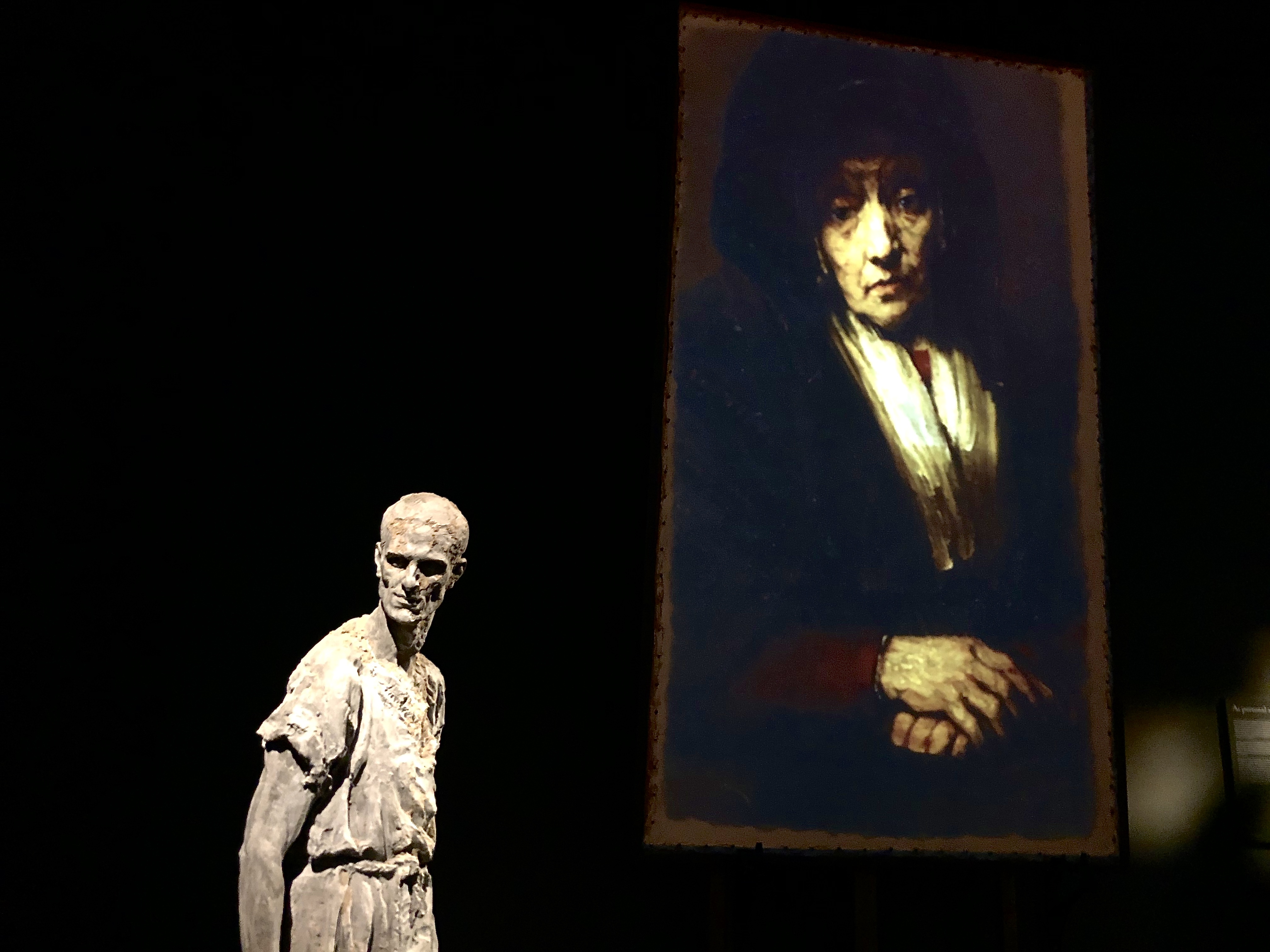
Alexander Sokurov, “Lc. 15:11-32” (Prodigal Son installation, 2019). Sculptures by Vladimir Brodarsky & Katya Pilnikova.

 Life is a dialectic of dwelling and wayfaring, in the world yet not of it.

––– Erazim Kohák

I once was lost, but now I’m found.

––– John Newton


Jesus’ parable of the Prodigal Son is the Bible’s preeminent tale of forgiveness and reconciliation. The welcoming father’s embrace of his foolish and errant son is a vividly concise summary of the gospel message: We can never be so lost that we cannot be found. We can never be so wrong that we cannot be loved.

Rembrandt’s celebrated painting, The Return of the Prodigal Son, would be one of his final works. He was bankrupt, his style no longer in vogue. His wife and three of their children were long dead, and he would have to sell his wife’s grave to pay his debts. His only surviving son Titus, age 27, died of the plague even as the parable’s “lost son” was taking form on canvas. As Rembrandt struggled with his own sadness and despair, he created the most indelible image of mercy in the history of art.

Rembrandt van Rijn, “The Return of the Prodigal Son” (c. 1167-1669).

Father and son emerge from a world of shadows, for compassion is the light of the world which no darkness can comprehend. The arch formed by the father’s welcoming arms is echoed by the arched doorway in the background, showing love to be the true way home. And unlike most other artistic depictions of this scene, there is no happy glance between the reunited pair. The prodigal’s repentant posture delays the moment when their eyes will meet.

Kierkegaard wrote at length about the “infinite qualitative abyss” between God and humanity, a condition due not only to the uncrossable difference between finite and infinite, but also to the profound estrangement from the holy wrought by human sin. Given the magnitude of the gulf between ourselves and the divine, how could we ever be in relation with One who is so totally other? “The danger,” said Kierkegaard, “is that God becomes so dreadfully and irreconcilably Other to the self that one is swallowed up by the horror of this infinite qualitative abyss.” [1]

The modern solution to the gulf between human and divine has been to ignore (or forget entirely) the Holy Other and concentrate on the human situation in solely human terms, permanently severing the problem of earthly existence from the problem of God. How well that works is a matter of some debate, but for the faithful, such a strategy omits far too much of value. Exiling God from the world is not a solution for our own condition of exile.

The Prodigal Son under the melancholy gaze of Rembrandt’s “Portrait of an Old Woman” (1654) in Sokurov’s installation.

We all long to go home, to find the place where we are loved and known and welcomed, the place where all wanderings cease, and we can finally know what it means to dwell. But with the longing comes doubt. Is there such a place? Can we ever get there? And how will the journey change us?

For the unbeliever, human life concludes with annihilation. After our last breath––nothing. But the future of the believer may also be described as a kind of annihilation. As we draw near the absolute center of all that is, the egocentric self can no longer maintain its pretentious fictions. The really Real exposes our own unreality. The gaze of God is fatal to our illusions.

When Moses asked to see God’s face, God told him that “no human may look upon Me and live” (Exodus 33:20). This crucial Hebrew text reflects an ancient fear of direct contact with the divine, whose infinite voltage could fry the circuits of finite beings. But the biblical God posed an additional, even greater threat: the penetrating gaze which sees us for what we are.

Day of wrath! . . .
What a great tremor there will be,
when the Judge is to come,
who will examine all things strictly  . . .
I groan, as if accused;
my face blushes because of my fault . . . [2]

Who among us is ready to have every story told, every failure examined, every blemish known? Therapeutic honesty is hard and painful work. Kierkegaard wrote in his Journal that “to see yourself is to die, to die to all illusions and all hypocrisy––it takes great courage to look at yourself.” And, he added, this “can only take place in the mirror of the Word.” [3]

The Christian goals of illumination and divine union must be preceded by confession and purgation. “If we say we have no sin, we deceive ourselves, and the truth is not in us” (I John 1:8). Even the saints are not exempt; the best of them are brutally honest about their own incompleteness. St. John of the Cross, speaking from personal experience, said that the journey of faith “does not consist in consolations, delights, and spiritual feelings, but in the living death of the cross, sensory and spiritual, exterior and interior.” [4]

This annihilation of self––“the living death of the cross”––is not morbid self-hatred (fixating on my sin is just another form of ego), but the abandonment of everything false or misshapen as the necessary prelude to profound transformation. The death of self becomes the beginning of Self.

I abandoned and forgot myself,
laying my face on my Beloved;
all things ceased;
I went out from myself,
leaving my cares
forgotten among the lilies. [5]

In Rembrandt’s painting, the Prodigal Son presses his face against his father’s comforting body. He is still in the confessional stage, kneeling with downcast eyes, not yet daring to stand face-to-face with the one he has hurt so deeply. But consciousness of his fault is overcome by grace––the leap of faith which accepts the “impossible possibility” of being forgiven. Only by knowing ourselves as sinners needing mercy can we become aware of forgiveness. The eyes which were cast down by shame will soon be raised up to see the welcoming father face-to-face. “By surrendering its despair before God, the self becomes open to forgiveness: the gift from the divine which is the impossible possibility of coming to know oneself as one is known by God.” [6]

The Kierkegaardian surrender of existential despair in order to receive the gift of mercy applies perfectly to Rembrandt’s painting:

“Justice looks judgingly at a person, and the sinner cannot endure its gaze; but love, when it looks at him––yes, even if he avoids its gaze, looks down, he nevertheless does perceive that it is looking at him, because love penetrates far more inwardly into life, deep inside life, in there where life emanates, than justice does, which repellingly establishes a chiasmic abyss between the sinner and itself, whereas love is on his side, does not accuse, does not judge, but pardons and forgives.” [7]

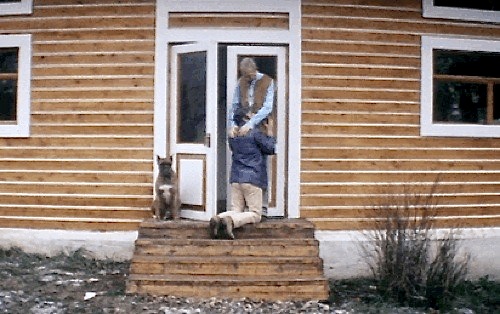
The Return of the Prodigal Son, acquired by St. Petersburg’s Hermitage Museum over 250 years ago, has long haunted the imagination of Russian visual artists. In his metaphysical sci-fi film Solaris (1972), Andrei Tarkovsky returns his cosmonaut protagonist from the “far country” of outer space to the door of his childhood house, where he is embraced like Rembrandt’s prodigal. But his father, we have learned, is deceased, and his son remains somewhere out in space, light years from earth. Tarkovsky’s moving image of ultimate reunion with both parent and planet earth turns out to be only memory or dream. It is in fact “impossible”––which only deepens the desire to make it so.

The son returns home (in his imagination), from the closing scene of Andrei Tarkovsky’s “Solaris” (1972).

Another Russian filmmaker, Alexander Sokurov, included Rembrandt’s actual painting in Russian Ark (2002), a meditation on Russia’s troubled history filmed entirely inside the Hermitage in a single 87-minute shot, with the camera moving through the galleries to encounter both paintings and people from different centuries. The pensive French aristocrat we follow from room to room stops for a long time in front of Rembrandt’s great canvas, silently paying homage to its power. For the Russian Pavilion at this year’s Venice Biennale, Sokurov himself returns to the painting, rethinking its themes with sculpture, video, music, lighting, a mirror, and various objects from an artist’s studio. His installation is called “Lc. 15:11-32,” after the biblical citation for Luke’s telling of the parable.

The sorrowful father in the first room of Alexander Sokurov’s installation, “Lc. 15:11-32.”

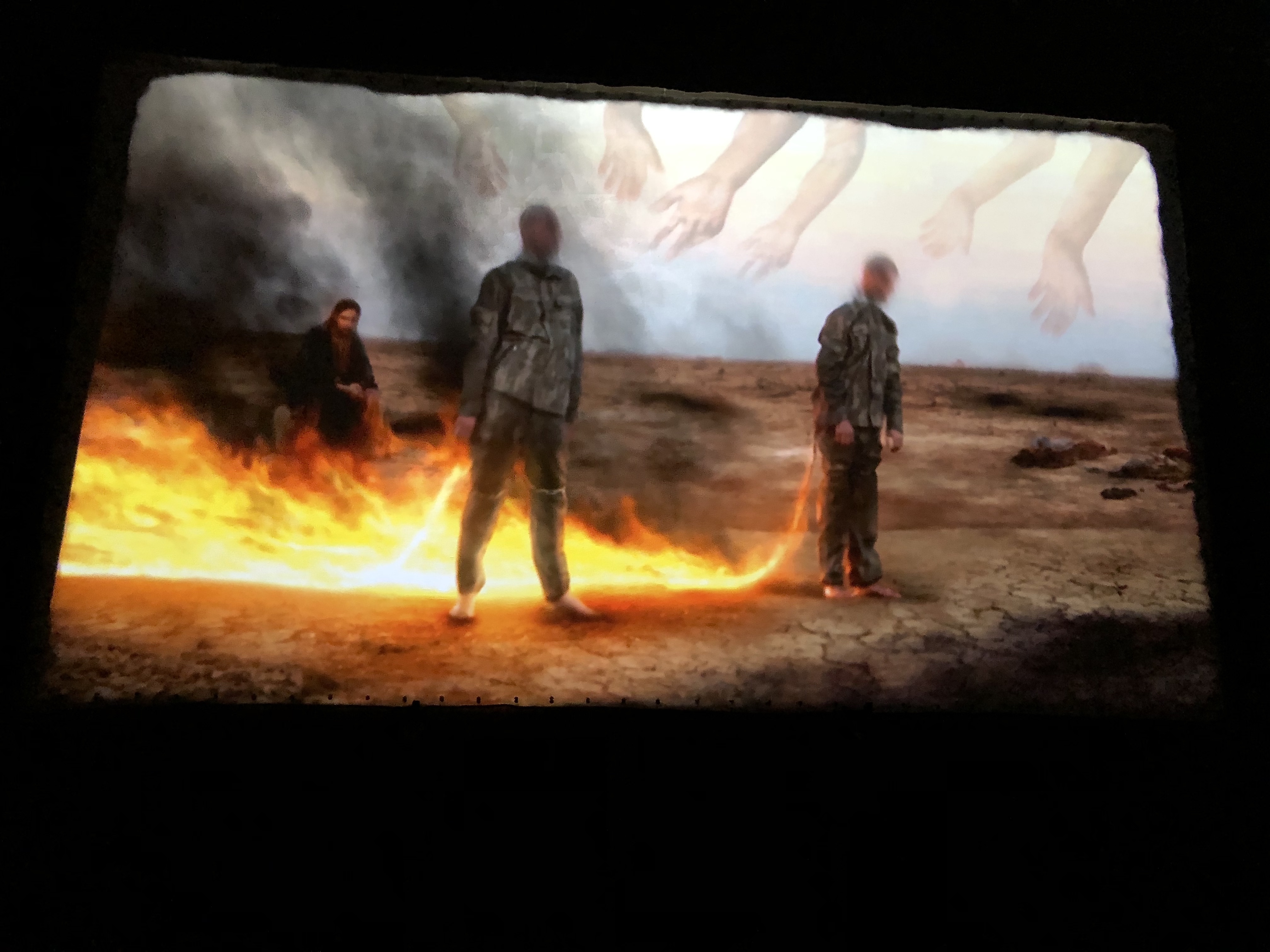
In the first of two dark rooms, father and son stand far apart in the gloom. It is not clear whether they even see each other across the black abyss that separates them. Behind the father are two large video projections representing a world gone wrong. One shows a blurred image of a city dissolving in flames, like an apocalypse by Hieronymus Bosch. The other shows Christ sitting in a desert as soldiers enter with flame throwers to fill the screen with fire and smoke. We realize that not just the son, but the whole world has gone astray. Not even a divine father can fix it. Grace and redemption remain an impossibility in this terrifying darkness.

Ivan Nikolaevich Kromskoy, “Christ in the Wilderness” (1872).

The Christ in the video image is taken from a nineteenth-century Russian painting, Christ in the Wilderness (1872), by Ivan Nikolaevich Kromskoy, whose humanized Jesus, unlike the serenely transcendent Savior of Orthodox iconography, reflected the revolutionary and questioning mood of the painter’s generation. In an age of religious doubt, traditional understandings seemed out of touch with experience. For Kromskoy, a self-assured Christ radiant with divinity was too detached from human suffering. “My God––Christ––is the greatest of atheists,” he said, “a person who has destroyed God in the universe and shifted him directly to the center of the human spirit and who, therefore, goes calmly to his death.” [8]

One of the video projections in the first room of Alexander Sokurov’s installation, “Lc. 15:11-32.”.

But how calm can such a Christ really be, sitting now, according to Sokurov, amid the flames and smoke of our endless desert wars? He may be the “fellow sufferer who understands,”[9] but he appears to be as lost as the Prodigal Son, exiled to the far country of human sin. His inheritance of divine power has been squandered by incarnation. He may share our griefs––does he also share our helplessness?

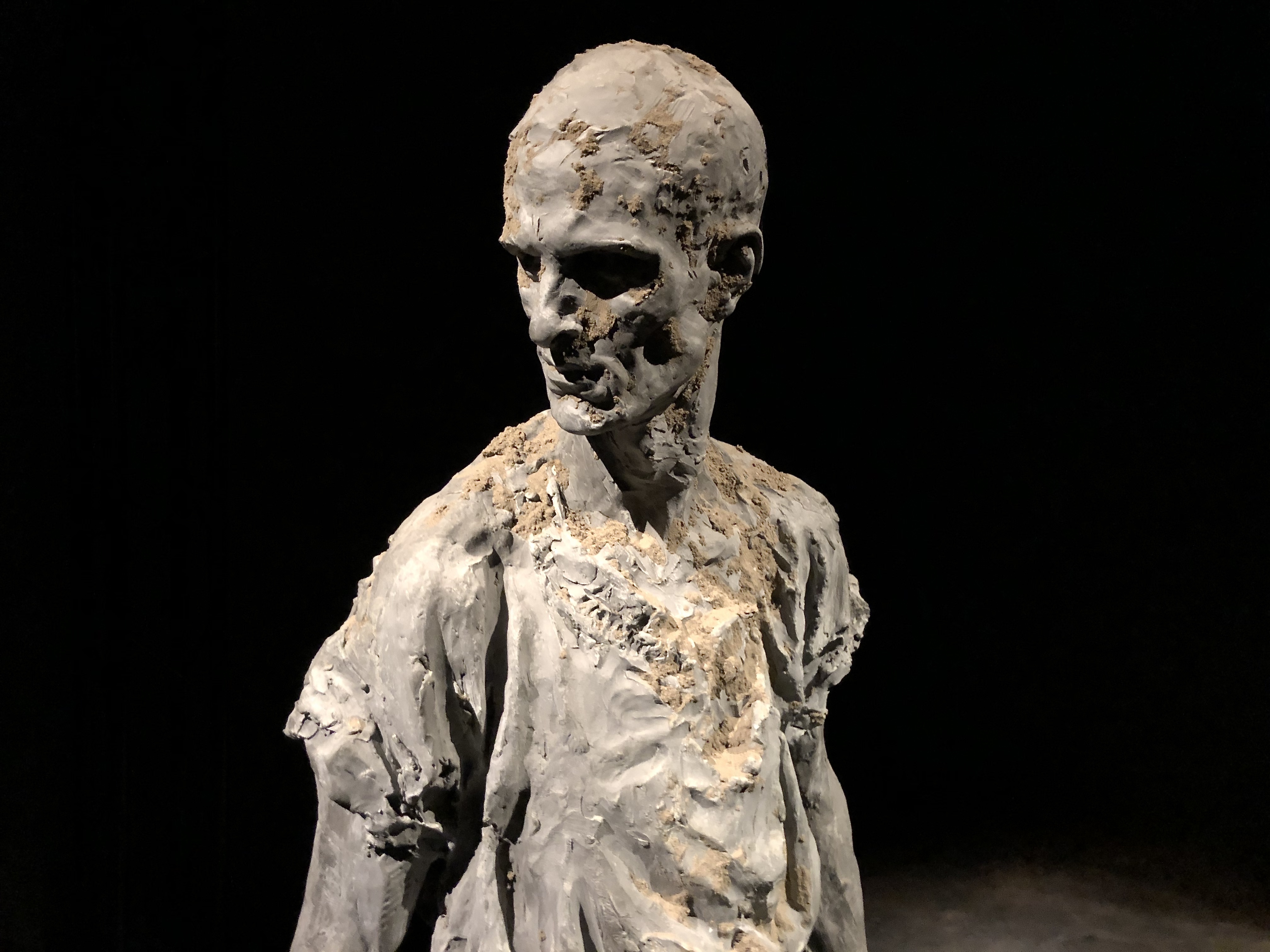
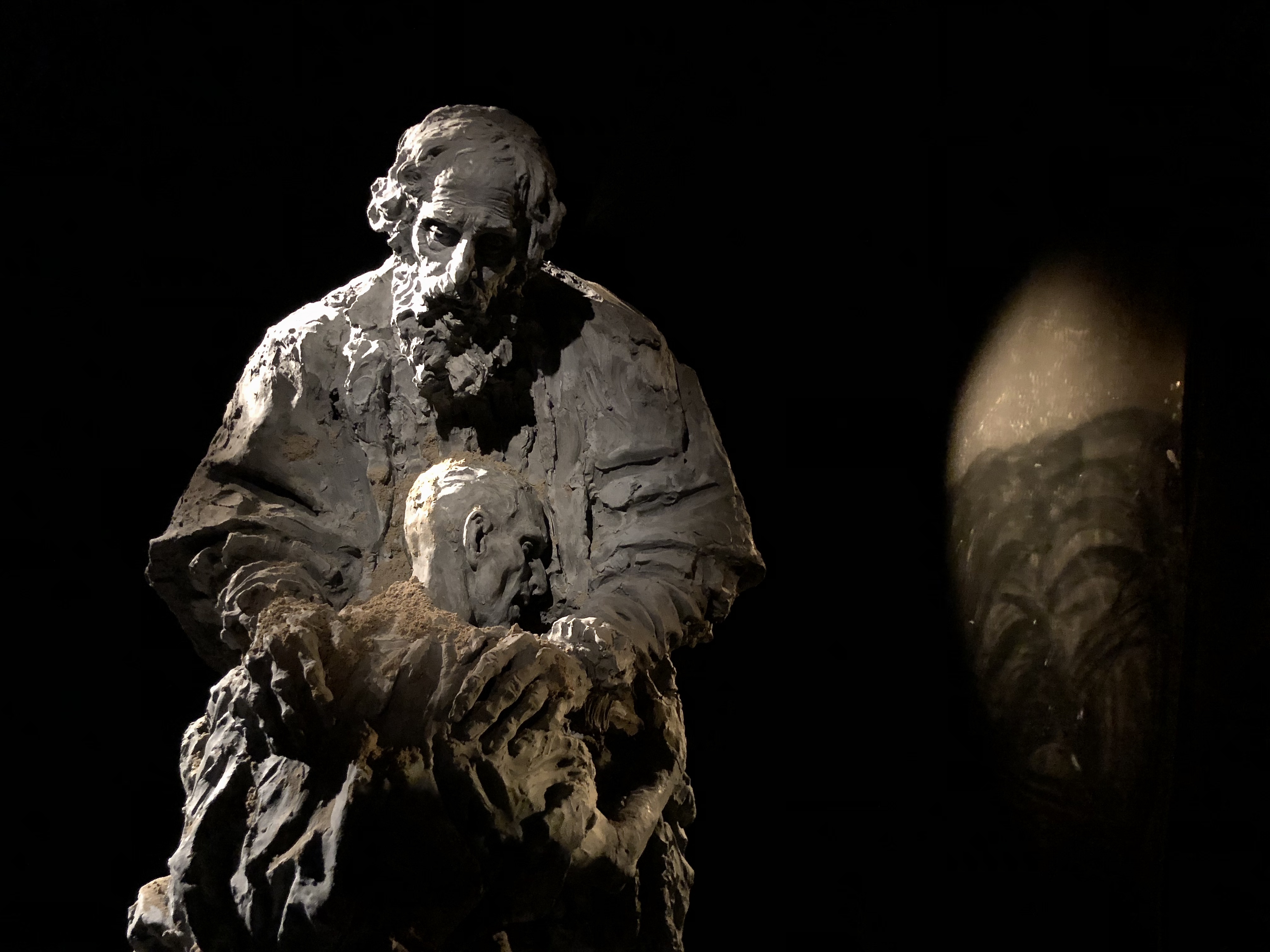
In the vast first room of Sokurov’s installation, estrangement is absolute and unchanging. But beyond it lies a second room, like a small cave, where the abyss of sin and separation is overcome at last. In a sculpted restaging of Rembrandt’s painting, the lost son comes home to the father’s compassionate embrace.

In the second room of Sokurov’s installation, father and son are reunited.

Behind the figures there is a large mirror, whose reflected image repeats the scene, reminding us that every retelling of the parable is but a version of an original which cannot be grasped directly, but only experienced in the second-hand reflections of Luke, Rembrandt, Sokurov, and all the rest of us who engage Jesus’ story. The mirror’s surface is slightly wavy, and it sways slowly back and forth, producing a continuously distorted image, suggesting the instability and uncertainty of every interpretation.

The figures are reflected in a distorting mirror.

The mirror also includes the viewer, allowing each of us to know ourselves as witnesses to the impossible mystery of divine mercy. But such seeing does not always come naturally. While I stood transfixed in this cave of revelation, two young women entered. After a brief glance at the sculpture, they became absorbed with photographing their own misshapen reflections in the mirror, giggling at the funhouse gag.

In my mind, I judged their heedless frivolity, and the moment I did so I became equally blind to the meaning of The Return. I forgot my own prodigal culpability, my own need to kneel with downcast eyes. I forgot the unconditional nature of the father’s embrace. I had become the elder brother.

No matter, says the parable. The prodigal, the proud, the penitent, the foolish––we’ll all be gathered in eventually. And the conclusion of all our wandering stories will be a home of abiding welcome. The door is open. The feast is ready. Love is waiting. Come.


Related Posts:

The Return of the Prodigal Son

Venice Biennale 2019: “A wound in a dance with love”


[1] Søren Kierkegaard, Without Authority, cited in Simon D. Podmore, Kierkegaard and the Self Before God: Anatomy of the Abyss (Bloomington, IN: Indiana University Press, 2011), 8.

[2] Dies Irae (“Day of Wrath”), a thirteenth-century Latin poem about the Last Judgment and our collective plea for forgiveness. It became a traditional part of requiem masses, but its vivid images of doom and “wrath” sound jarring to modern ears accustomed to a kinder and gentler eschatology. However, when we consider the moral and apocalyptic implications of climate change, the notion of a “day of reckoning” when “nothing will remain unpunished” and “even the just can scarcely be secure” seems uncomfortably apt, as does the poem’s anguished cry for rescue and “the gift of forgiveness.”

[3] Kierkegaard Journal, cited in Podmore, 155.

[4] John of the Cross, cited in Hans Boersma, The Beatific Vision in Christian Tradition (Grand Rapids, MI: Eerdmans, 2018), 184.

[5] John of the Cross, “The Dark Night,” cited in Boersma, 178.

[6] Podmore, 179.

[7] Kierkegaard, Without Authority, cited in Podmore, 173-174.

[8] Ivan Kromskoy in a letter to a friend, quoted in Walther K. Lang, “The ‘Atheism’ of Jesus in Russian Art: Representations of Christ by Ivan Kromskoy, Vasily Polenov, and Nikolai Ghe,” I recommend the entire article for those interested in art and faith. It is found on the website Nineteenth-Century Art Worldwide: http://www.19thc-artworldwide.org/autumn03/272-the-qatheismq-of-jesus-in-russian-art-representations-of-christ-by-ivan-nikolevich-kramskoy-vasily-polenov-and-nikolai-ghe

[9] Alfred North Whitehead’s famous description of God has provided a moving and influential image of a divinity deeply affected by human suffering, a God who takes our pain into Godself. Critics of such theology wonder whether too much divine power has been relinquished. Can a vulnerable God still save us?

Backpacking with the Saints (Part 3)

Osservanza Master (Siena), St. Anthony the Abbot in the Wilderness, c. 1435

“The saints I travel with are more than companions on the trail. When I’m backpacking, I listen to their silences, their laughter, their readiness to jolt me out of my distractions. Back home I ask them for their prayers, for help in understanding and interpreting them aright. We even work together at letting the wilderness take us places where neither of us might have gone before in our thinking. Ours is a vigorous, intimate discourse. We wrangle back and forth; they humble me by the depth of their passion. I sense the weight of my responsibility to them, but I love them as well. The ‘communion of saints’ is far more than a line in the creed for me. These endearing trail-weathered mavericks are my teachers––giant sequoias that fill me with awe.”

–– Belden C. Lane

The fourth and final theme of Belden C. Lane’s Backpacking with the Saints returns us to the place where we started. But we are no longer the same. The journey has changed us. “Delight (Returning Home with Gifts)” invokes a quartet of spirited and joyous saints to help us discern the gifts we have found in the wild, not only for ourselves but for the whole human community.

Lane’s first gift for the return is discernment, the clarity to realize our deepest desire. And our teacher here is the thirteenth-century Sufi poet and God-intoxicated mystic Jelaluddin Rumi, whose playful and earthy metaphors sweep us past our distractions and evasions to take us where more cautious and “serious” language cannot go. We are flutes blown with divine breath, or dry tinder for Love’s fire. We are chickpeas tossed into a boiling pot until we are made soft and flavorful. We are lovers crazy to get lost in the Beloved. “I became Him,” Rumi said. “Then he threw myself out of me.”

For both the mystic and the soulful hiker, God is everywhere, including the inmost self. A pilgrimage out into the wild is also a journey inward, toward the revelation of our true desire. Once we drink from the source of all our yearning, we can return with an awakened heart. “You are the Kaaba,” Rumi tells us. “Walk around yourself in wonder.”

Palouse Falls, Washington (August 21, 2014)

The second gift to take home is community, and Lane’s teacher is Teilhard de Chardin (1881-1955), the Jesuit scientist and theologian who saw Christ as the strong force of the cosmos, drawing all things together in an evolutionary process of convergence. “Love alone,” he wrote, “is capable of uniting living beings in such a way as to complete and fulfill them, for it alone takes them and joins them by what is deepest in themselves.”

Teilhard was officially silenced by a hierarchy uneasy with his visionary breadth, but he never ceased to celebrate the holiness woven into every atom and every star. As disciples of the one who said, “This is my body,” we must treat matter with proper reverence, he insisted. “By means of all created things, without exception, the divine assails us, penetrates us, and molds us. We imagined it as distant and inaccessible, when in fact we live steeped in its burning layers.”

God is the mystery of the world, whose interdependent ecology mimes the trinitarian dance of eternal self-offering. Everything depends on everything else. Community in its purest form is communion. The wilderness wants to tell us this, and Lane is a good listener. Out in the wild on a starry night, a raucous Compline of bullfrogs and peepers signifies for him the perpetual liturgy of praise in which we all have a voice. “We join together as fragments of a greater whole, standing in awe at the immense and holy company that constitutes our common life.”

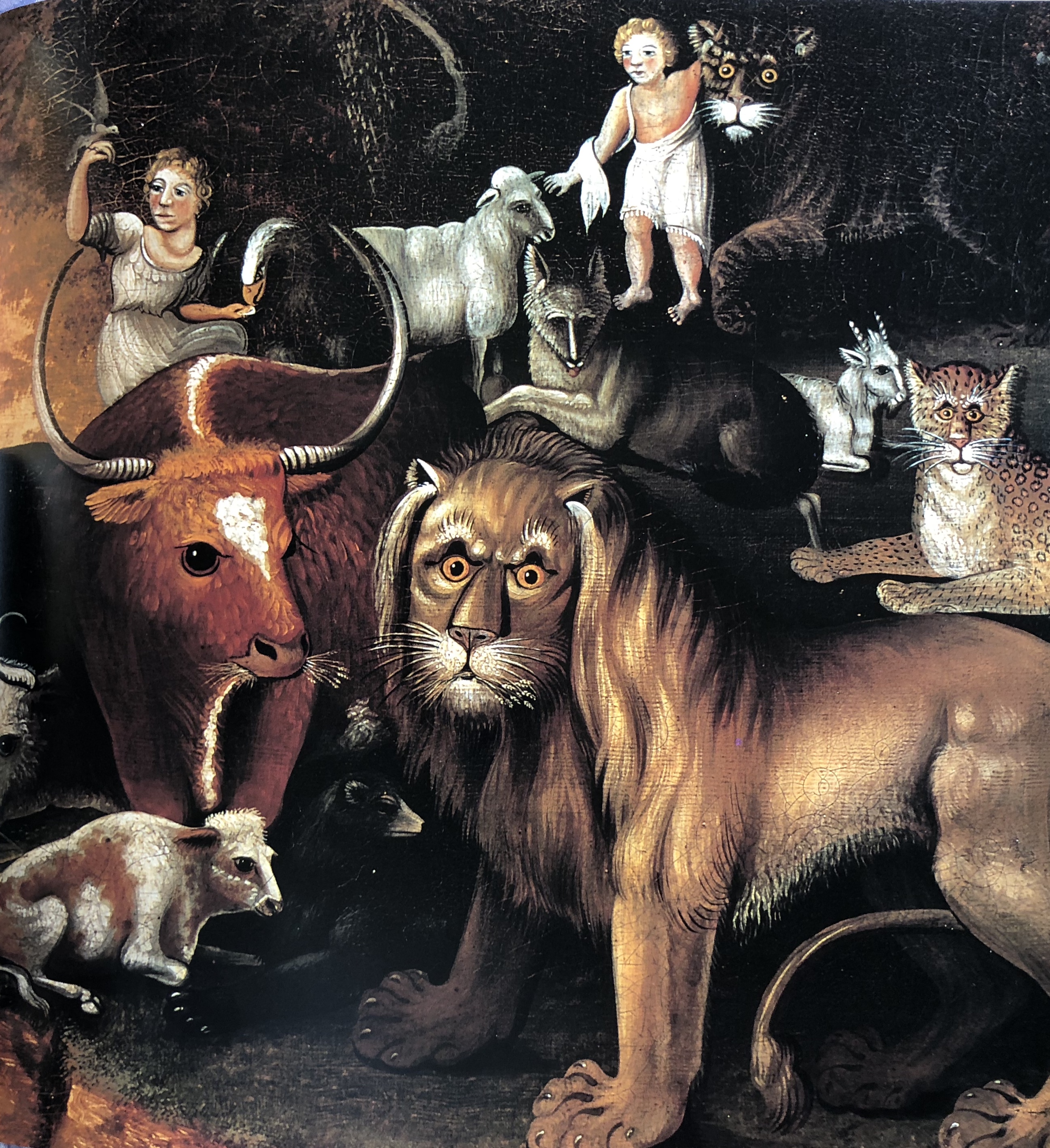
Edward Hicks, The Peaceable Kingdom (c. 1837)

Mohandas Gandhi is the next guide, and the gift is justice. Gandhi’s reverence for all living things, his compassionate attention to suffering, and his willingness to put himself at risk to restore community, all model just and loving practice in our endangered global habitat.

It’s hard not to spend time in the natural world without falling in love. Like all love affairs, it brings joys and blessings, but also great responsibility. Love is a fierce protector. We who love Creation must guard what is vulnerable and restore what is damaged. We must confess our complicity in the wounding of Creation, and refrain from further harm. We must speak and act on behalf of the whole community of created beings, loving our neighbors––both human and nonhuman––as ourselves. We must walk gently and reverently upon God’s earth.

Lane argues that a passion for earth justice is one of the greatest gifts we bring home from our wilderness encounters. His quote from Edward Abbey says it all: “Sentiment without action is the ruin of the soul.”

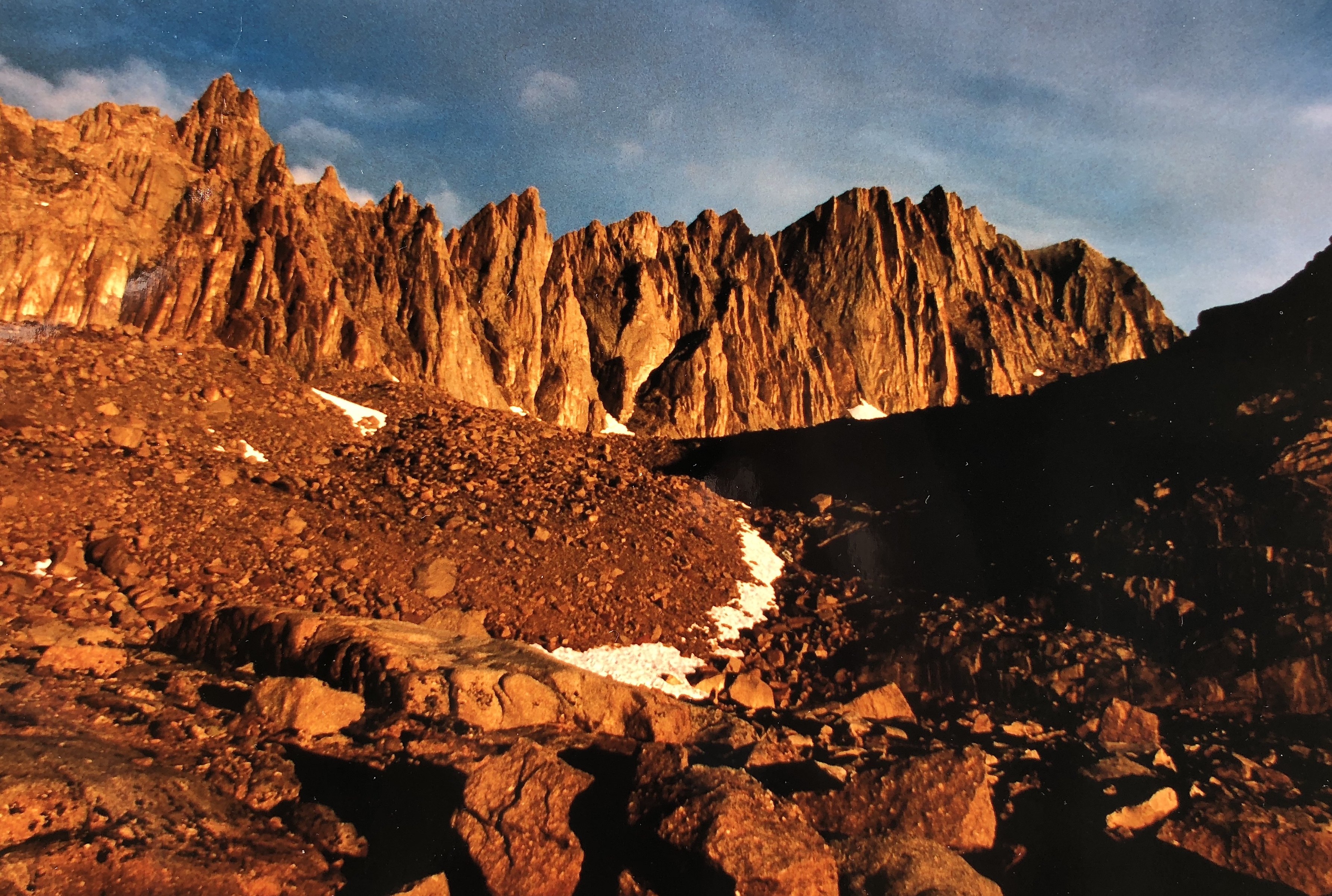
Fernandez Pass, west of the Minarets, Yosemite National Park (Sept. 8, 2008)

Holy Folly is the final gift, and Thomas Merton is the perfect guide. When Merton became the most famous monk of the twentieth century, his comic spirit laughed off the demon of self-importance. “If you see a meditation going by, shoot it,” he said.

Lane calls Merton a “Zen clown,” and links the monk’s notorious playful side to the tradition of holy fool, whose vocation is to mock our complacencies, subvert every oppression, and celebrate surprise. As Lane says, the holy fool “invites you to laugh at yourself and the silly pretensions that crowd your life. The gift of the fool may be the most telling of all the benefits that derive from backpacking as spiritual practice. There’s no end to the stories you can tell of dumb mistakes you’ve made on the trail. Self-effacement is easy, even for gearheads and hard-core hikers.”

Every spiritual journey is an embrace of profound folly. You leave the safe harbor of the familiar for the wild sea of unknowing. You trust in something you can’t see or even name. You sail off the edge of the maps, into God knows where.

From Via Negativa: A Worship Installation (text adapted from Richard Shelton)

My vicarious walks with Lane through the wild terrain of his book have illumined not only my hiking life, but the rest of my story as well. And what moves me most about him is a hard-won ability to embrace the gifts of the wild with both humility and courage.

He tells a story of going on a men’s retreat with Franciscan contemplative Richard Rohr in the Arizona desert. Rohr sent each of the group into the dry depths of Aravaipa Canyon for a solo overnight, a kind of vision quest. He told them to listen to whatever teachers might appear, and not to be surprised if they are given a new name in their place of solitude.

After dark, the desert wind kicked up, the kind of wind that bores into your nervous system with “an incessant, disturbing presence.” Unable to sleep, Lane suddenly “felt an urge to tell a story, as if the stars and whirling cottonwood leaves were asking for relief from the monotony of the wind.”

Perched on a sandstone ledge, face to the tempest, he began to recite every story he could think of, plus the many more which welled up from the forgotten places in his mind. “Then,” he writes, “in the darkness before dawn, I heard it.”

“A voice carried on the wind that seemed to speak inside my body. I didn’t think it. I simply received it, with an undeniable certainty. Four words addressed to me: “Speaks with the Wind.” Nothing more. But I knew in that moment that I had been called . . . I had been named.”

His account deflects the solemnity of that wilderness baptism with some self-deprecation. Who did he think he was, Kevin Costner dancing with wolves? But he knew the voice within spoke truly. And, to our great benefit, he consented to be “one that could speak in, with, and for the places I had learned to love and the saints who had taught me there.”

“It wasn’t about me,” he says. “But it required me.”


Joe Golowka, my backpacking mentor, Sespe Creek Wilderness (March 29, 1981)

All quotations are from Backpacking with the Saints: Wilderness Hiking as Spiritual Practice by Belden C. Lane (Oxford University Press, 2015).

 All photographs by Jim Friedrich


Backpacking with the Saints (Part 2)

Death Valley National Park, Holy Week 2005

You do not go into the desert to find identity but to lose it, to lose your personality, to become anonymous. You make yourself void. You become silence. It is very hard to live with silence. The real silence is death and this is terrible. It is very hard in the desert. You must become more silent than the silence around you. And then something extraordinary happens: you hear silence speak.

–– Edmond Jabés

In Part 1 of my commentary on Belden C. Lane’s book about “wilderness hiking as spiritual practice,” we explored his first two themes: Departure and Discipline. Here we shall look at his third theme.

The Philosophical Promenade, Keith Beckley / Dennis Evans (Seattle’s I-90 Trail, March 17. 2014)

Descent (When the Trail Gets Rough)

As a longtime backpacker, Lane knows that not every hike is a victory march. In fact, if you don’t encounter obstacles, setbacks, tribulations and the occasional failure, you’re kind of missing the point. Dante, history’s most famous trekker, discovered on his very first day in the wild that the experience of “descent” is not only inevitable, but necessary. Over the years, Lane has learned to welcome the hard parts as his teachers.

“Backpacking as a spiritual practice is about making yourself vulnerable in order to be stretched into something new. It’s the need to recognize your limits, to be taken to the end of yourself where resources are exhausted and you stumble in blind faith toward that which is more than you. In the beauty-mixed-with-terror of a backcountry wilderness, you begin to discover that for which the mystics had no language.”

Fear, failure, and death are Lane’s categories of descent. As with his other subjects, he chooses appropriate saints to guide him. His companion in the way of fear is John of the Cross, the sixteenth-century Spanish mystic who spent nine months locked in a dark space too small to stand up in. Abused by his ecclesiastical captors and frequently beaten, he struggled with boredom, doubt and despair. When he was close to death, he made a miraculous escape in the dead of night. But his cruel experience of confinement ultimately clarified and deepened his praise of the soul’s “dark night” as the passage into the place where love abides.

To reach the place you know not, John realized, you must go by a way which you know not. Satisfaction, assurance––even divine presence––will seem to go missing in the dark night, because whatever you “know” and the consolations you’re attached to are being stripped away to make room for something unimaginably greater. As T. S. Eliot would put it four centuries later, “wait without hope, for hope would be hope for the wrong thing.” Only thus did the suffering saint become the passionate singer of divine love.

When you are in the dark night, you don’t yet know it to be a passage into the light. The darkness feels real and absolute, full of terror. You are not yet the future self who has made it through. When Lane hiked the Maze, a bewildering and dangerous array of interlocking canyons in Utah, its confusing paths and frequent dead ends triggered an unsettling engagement with his personal demons. A confined, horizonless space where you can get permanently lost, or washed away by a flash flood, was the perfect place to descend to one’s inner depths.

The suicide of a father when Lane was thirteen, his mother facing death with Alzheimer’s, a mentor taken by cancer, the heart attack of a close friend––all the terrible losses came to visit in that arid canyon, whispering their ancient fears. But that’s not where the story ends, because the dark night doesn’t just take away. It also gives, and as John of the Cross discovered, it seems to know exactly what you need. Lane’s own story bears witness:

“There in the dark night, wandering through a maze, the impossible may happen. You find yourself moving beyond the fear and confusion you’ve been carrying for years. It’s no longer necessary to ‘fix’ what was unresolved in your parents’ lives. You can leave the past––there at the canyon wall, on the floor of the Maze, finally and for good.”

Mt. Whitney summit, 30 minutes before lightning and snow (September 5, 1998)

Failure is the next layer in Lane’s archaeology of descent. His pilgrimage to climb the highest American peak outside Alaska came short by 1700 vertical feet. California’s Mt. Whitney (14,505’) may not pose the same technical challenges as the glacial summits of higher or more northerly mountains. In summer the trail can be snow-free all the way. But the air is thin, the way steep, and the weather fickle. When I climbed Whitney twenty-one years ago, the sky went from sunshine to lightning to snow in half an hour.

Lane ascended Whitney with a friend in late spring, when lingering snow made footing unsure and an enveloping cloud reduced visibility to zero. He could barely see his own feet, and a sudden panic about falling into an unseen abyss forced him to turn back. His friend continued on, and later reported on the stunning views Lane had missed. To make it worse, some 12-year-old boy scouts back at base camp regaled him with their own tales of reaching the top. “Failure,” Lane writes, “felt like an indictment of my own worth as a person, confirmation of a deeper defect in character.”

His unsuccessful climb has stuck with him as a vivid metaphor for his own struggles to prove himself. Whether he was feeling out of place in a demanding graduate school, or worrying about being good enough as a teacher or writer, he felt the pressure of high expectations. Whether we’re trying to live up to our own ideas of perfection or somebody else’s, the pinnacle of “success” is a killer climb. What happens when you just can’t go all the way?

Martin Luther is Lane’s companion on this particular trail. Tortured by angst, guilt and a damaging penitential system, the great reformer learned the hard way that when we come short, when we mess up, we remain the beloved of God. “All of his life, Luther had feared an angry, demanding God, only to discover in the end that God had been wanting to love and forgive all along.” The life of grace has nothing to do with striving for perfection. It is, rather, an economy of perpetual forgiveness and compassion. God’s love is not earned, nor is it ever withdrawn. All we have to do, as Paul Tillich said, is to “accept our acceptance.”

For Lane, the most important mountains are the ones we don’t climb. “Every failure is an invitation to growth. Mistakes are occasions for grace, opportunities to choose a different path. They make forgiveness possible. Only in the absence of success can you know yourself to be loved without cause.”

Banff National Park, Alberta, Canada (August 21, 2012)

Lane’s trajectory of descent concludes with death, the point of no return. The literal end of our mortal span is not the only death we face. We all experience many little deaths throughout our life, as one stage or condition ends and another takes its place. And for the spiritually adventurous, there is the hardest death of all: the annihilation of the inauthentic self.

Letting go of the old life, the old self, or the old story is always challenging. Sometimes we have to be dragged kicking and screaming into the new life, even if it’s infinitely better. What Lane calls “the wild and reckless beauty” of untamed places can help us transcend our limiting self-descriptions and receive an identity far more luminous and vast.

“Inherently we sense that the uncaring majesty of wilderness has the potential of breaking us open to love. Each passage to a new self begins with an allurement that threatens to kill, even as it ignites a new fire within.”

A few years before his retirement from thirty years of university teaching, in the company of his dog and the anonymous author of The Cloud of Unknowing, Lane ascended a wild section of Missouri’s Ozark Plateau to undergo a ritual death, releasing his hold on an identity which was passing away. On Mudlick Mountain, named for some of the oldest exposed rock in the world, he chose a primitive stone shelter as his “death lodge”––a place to bid farewell to the old life and prepare himself for the new.

“My hope was to trade the mind of the scholar for the heart of a vagabond poet. . . In my backpack I’d brought along the last few pages of a scholarly book I’d been writing. I read these to the dog and the hickory trees, offered thanks for the work I’d been given, and then burned the pages in the fireplace.”

Finally, like the prophet Ezekiel, he shaved his head to welcome old age and celebrate his imminent freedom from “impression management.” It’s a poignant image. The aging scholar consenting to vanish. The ashes of his writings now cold in the fireplace. His faithful dog––whose  last breath would come during Lane’s drafting of the death chapter––quietly living in the moment.

It’s like a quatrain from Li Po, an 8th-century poet cited in Lane’s book. On a mountain overlooking China’s Shuiyan River, Li Po wrote:

The birds have vanished into the sky,
and now the last cloud drains away.
We sit together, the mountain and I,
until only the mountain remains.

Sunrise view of Mt. Whitney from Trail Camp at 12,000′ (September 5, 1998)


Except for the epigraph, all quotations are from Backpacking with the Saints: Wilderness Hiking as Spiritual Practice by Belden C. Lane (Oxford University Press, 2015).

All photographs were taken on my own hikes.

 Lane’s final theme, Delight (Returning Home with Gifts), will be the subject of my next post.

Backpacking with the Saints (Part 1)

Sky Top Creek carries glacial meltwater from Montana’s highest peak.

I am going to allure her, and bring her into the wilderness,
where I will speak tenderly to her heart.

–– Hosea 2:14

We all need to get away––beyond the noise of history and culture, the deafening roar of the social imaginary, the insistent obsessions of the constructed self, the blinding glare of the familiar. We all need to go into the wild. But the exodus “away from here” is not merely escape. It is also quest. We lose in order to find.

The Desert Fathers and Mothers knew that the trouble with wilderness is that you risk meeting God there. That’s exactly why they went. Celtic monks put to sea in rudderless boats, surrendering personal control to the unpredictable wildness of wind and tides. Only a power beyond themselves could show them the way to an unmapped reality. John Muir had to disappear into California’s Sierra Nevada to find a “church” commensurate with his praises. True pilgrimage always takes us away from here. And even should we return, we will be somebody else.

Belden C. Lane, an American theologian and scholar, writes about the deep connections between geography and spirituality. Landscapes of the Sacred (1988) examines the “spirit of place” in various American religious movements and traditions. The Solace of Fierce Landscapes (1998) focuses on the physical and spiritual extremes of desert and mountain. Backpacking with the Saints (2015) draws on his personal outdoor adventures to explore “wilderness hiking as a spiritual practice.” His most recent book, The Great Conversation: Nature and the Care of the Soul (2019), models the vital and necessary dialogue between the human soul and all the voices of creation.

Believing that transformative works are best read in transformative places, Lane always throws a spiritual classic in his backpack before setting out. In my own 49 years of backpacking, I too have taken other voices along, and Backpacking with the Saints, drawing on a variety of wisdom teachers from St. Columba and John of the Cross to Thomas Merton and Thich Nhat Hanh, has been my choice for a number of backcountry walks, including a recent week in the Beartooth Mountains of Montana. Even though it’s only available in hardback (1 pound!), its abundant riches are worth the extra weight.

In each chapter, Lane links a personal wilderness experience to the life and writings of a particular saint. Whether a venture into the wild produces fear or wonder, discouragement or exhilaration, joy or grief, the saints know what he is going through. But the holy teachers are not always consoling. Sometimes Lane feels the reproof in their words, which can “slap me upside the head as may be required.”

After an introduction to the virtues of walking, reading and being in places of silence, solitude and natural beauty, Backpacking explores the fourfold pattern of wilderness spirituality: Departure, Discipline, Descent, and Delight.

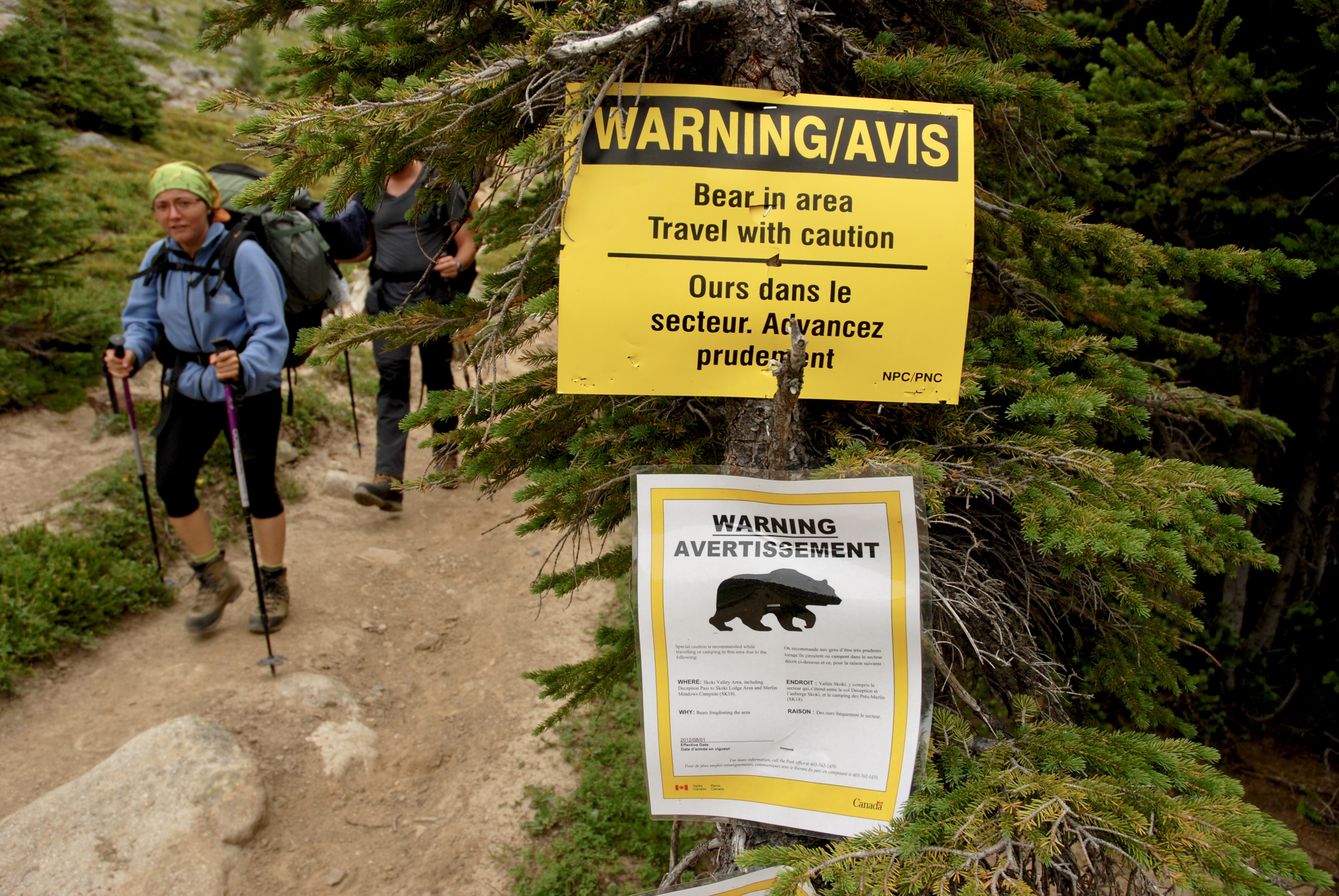
Badger Pass Trail, Banff National Park, Canada (2012).

1) Departure (Leaving the trailhead)

The call to venture out may come from dissatisfaction: something is wrong, or something is missing. Or its source may be a hunger for mystery, a thirst for renewal. “The mountains are calling and I must go,” said John Muir. But getting out of the house (or routine, or to-do list) can be the hardest part. I keep a walking stick by the front door to remind me that the path is always waiting just outside. But the gravitational pull of the safe and familiar is a strong force. Sometimes a great leap is required.

Lane draws on the Celtic wanderers to help him out the door and into the wild. “Well does the Fair Lord show us a course, a path,” they said. The Sufi poet Hafiz employed a more violent image: “Love wants to reach out and manhandle us, breaking all our teacup talk of God. . . It wants to drag you by the hair and rip from your grip all the toys in the world that bring you no joy.” Whether the leaving is gentle or wrenching, there’s a lot of letting go and leaving behind, if one is to travel light and venture far.

But once you are on your way, disillusionment will greet you sooner or later. You’re not the hero you imagined. You make mistakes. You get tired. Romantic illusions crash and burn. There are no shortcuts. As the mountaineers warn, ““It’s always farther than it looks. It’s always taller than it looks. And it’s always harder than it looks.”

Lower Aero Lake and Mt. Villard, Beartooth Mountains, Montana.

Feeling strangely vulnerable in the “vast loneliness” of a Wyoming peak after dark, hemmed in by the impenetrable shadows of a place where humans don’t belong, Lane had the sensation of being watched, of being exposed to a dread he couldn’t name. “[M]y image as professor, spiritual seeker, and self-styled ‘wilderness backpacker’ counted for nothing.” I’ve had similar experiences out in the lost and lonely places. Nature doesn’t always smile back.

Lane found comfort in Thérèse of Lisieux, the “warrior saint” whose desire for spiritual greatness was tempered by an acceptance of her own littleness. In the last months of her short life, her characteristic lightness gave way to desolation. “If you only knew what darkness I am plunged into. . . the night of utter nothingness! I feel no joy. I sing only of what I wish to believe.” But Thérèse’s dark night of abandonment was where she became best acquainted with divine mercy.

Once disillusionment has stripped us of grandiosity, we can begin to examine our desire. The first step is to release our attachment to all the “unmet desires of the past,” that insatiable “yearning that lingers in unhealed wounds.” Just as the forests act as a sink for carbon emissions, the “quiet presence” of trees is also “able to receive whatever we need to release in terms of misspent passion.”

Born into a family shadowed by disappointments, failures, betrayals, abandonment, alcoholism, sexual abuse and suicide, Lane’s testimony to wilderness healing is authentic and moving.

“We hike into wilderness with the accumulated desires of the past. We carry our own twisted longings and those of our parents, our lovers, and our children as well. We’re the ‘walking wounded,’ battle-scarred by desires we’ve carried throughout our lives. More than once I’ve lugged a wounded father on my back up Rockpile Mountain. Father and mother wounds are handed down to us, filled with frustrated desires we still try to satisfy.”

Over time, Lane says, he has been able “to release these wounds back into the wilds. I let them go, like injured animals. . . It’s not far wrong to think of our wounds as creatures who’ve wandered into our lives from out in the wilds. Doing so gives them the respect they deserve. It also allows us to identify ourselves as separate from them.” And once we do that, our deepest desire––for the one true thing worth having––begins to speak.

Pink monkey flowers along Sky Top Creek.

2) Discipline (The practice of the wild)

Just like the Christian life, it is possible to drift unchanged through a wilderness walk. You may enjoy it, or learn from it, and still return pretty much the same as when you left. If you want to invite a deeper transformation, the saints would encourage you to practice certain disciplines: solitude, simplicity, and mindfulness.

Kierkegaard is Lane’s saint of solitude. The 19th-century Danish theologian refused to be part of the herd. He sharply criticized both church and culture, and was ridiculed and scorned in return. He even broke his engagement to the love of his life, choosing “to stand like a lonely pine tree” for the rest of his life. But his personal solitude produced the existentialist understanding of Christian faith as no collective generality, but a specifically personal risk––demanding no less than everything.

Solitude, in its freedom from external forces and the need for approval, makes space for our truest self to emerge. “I want to be the person that I am when I’m alone in wilderness,” says Lane. At the same time, solitude can remove the hindrances to a deeper communion with the mystery of God and the interconnectedness of creation––“the common life that binds our separate solitudes into one.”

Traveling light is the second essential discipline in the wild. “The only indispensable item I pack is a capacity for amazement,” Lane writes. As a hiker who carries more than one book, journal, camera, binoculars, bear canister, tent, sleeping bag, rain suit, cooking gear and a few extra treats beyond the basic meals, I have yet to attain ultra-lightness. I have, however, trimmed 2 inches from the end of my toothbrush as well as the white space from the edges of my maps.

Dag Hammarskjöld, the United Nations Secretary-General whose profound inner life was unknown to the world until his spiritual testament, Markings, was discovered after his untimely death. As a powerful and famous world figure, he wrestled with both self-importance and despair. But his mountain hikes, and his writings, helped him to release those burdens.

“To be free,” he wrote, “is to be able to stand up and leave everything behind––without looking back––to say ‘Yes’ to whatever comes.”

Traveling light not only means to leave behind burdens, hindrances and negativities. It also means to renounce expectations and outcomes. I’ve met walkers on the Camino de Santiago and the Pacific Crest Trail who were in such a hurry to accomplish the journey that they missed exquisite moments of Now along the way. And perhaps we could even renounce language––stop naming and labeling what we see, receiving everything in its indescribable fullness. As Hammarskjöld put it, “In the point of rest at the center of our being, we encounter a world where all things are at rest. . . Then a tree becomes a mystery, a cloud a revelation.”

The third discipline in Lane’s wilderness praxisis mindfulness, “a rigorous practice of welcoming the moment, whatever it brings.” Be present to the presences around you. Don’t let your feet take a walk without you. Receive the bird’s song, cloud’s shadow, wildflower colors, sunlight on your skin, wind in the pines, the steepness of the trail––all the gifts of the moment––as they happen. Do not grasp, but “catch and release.”

“People usually consider walking on water or in thin air a miracle,” says Buddhist monk Thich Nhat Hanh. “But I think the real miracle is not to walk either on water or in thin air, but to walk on earth.” Whenever I climb a steep trail, I try not to think of how hard it is, or how far I have to go. I simply attend to the act of lifting my foot, swinging my leg, lowering my foot, step by step. If I am fully present to these actions, I am free from longing for a future state of rest.

Walk “as if you are kissing the earth with your feet,” Hanh says. Mindfulness is the best form of reverence. And it is also the key to perfect presence. In the words of an old Celtic prayer,

May I arrive at every place I enter.

In my next two posts, I’ll cover Lane’s final two pillars of wilderness spirituality: Descent (When the trail gets rough) and Delight (Returning home with gifts). But for now, I leave you with my favorite story from Backpacking with the Saints.

In the chapter on desire, the saint is Thomas Traherne, a 17th-century Anglican metaphysical poet whose Centuries of Meditations celebrates unbounded desire and delight. “You must Want like God,” he urged, “that you may be satisfied like God.” For Traherne, enjoyment of God and God’s world was not a matter of feelings, occasional and intermittent like gusts of wind. They were chosen practices, a form of faithful participation in divine delight.

“Your enjoyment of the world, is never right, until every morning you awake in Heaven. . . You never enjoy the world aright, till the Sea itself floweth in your veins, till you are clothed with the heavens, and crowned with the stars. . . Yet further, you never enjoy the world aright, till you so love the beauty of enjoying it, that you are covetous and earnest to persuade others to enjoy it.” (Centuries I: 28-31)

When Lane tossed Centuries into his pack for a Good Friday overnight in the St. Francois Mountains of southeast Missouri, he was not in the best of moods. Out of sorts physically (a tiring trail, empty stomach, headache and sleeplessness), stressed by thoughts of work and family, and feeling the Holy Week darkness of crucifixion and tomb, he “grudgingly read Traherne by candlelight,” as if daring the poet to cheer him up.

The next morning, his body felt better, but his soul was bored, restless, fraught with “all the unsatisfied longings of the past.” Still, he resumed his reading of Centuries, on a sloping rock at the edge of a “shimmering pool.” Traherne reminded him that those who “put off felicity with long delays are to be much suspected.” It was like a resurrection summons to Lane’s buried heart.

Sky Top Creek on my last night in the Beartooths.

“He was urging that I give myself to Joy,” Lane says. “To embrace what he called felicity despite a world of endlessly unmet needs.” His mind stubbornly resisted the call, but his body could not. He found himself pulling off shoes and clothes. But in his haste, he failed to notice the precarious balance of the book on the sloping rock.

“To my horror, the university library’s copy of the Clarendon Press edition of Traherne’s Centuries began sliding down the rock and into the water ahead of me! As if the author and his book were crying out, “HERE’S how it’s done!! THIS is what felicity looks like!! Wheeeeeeee, follow me!!” And so I did, screaming as I hit the ice-cold water, grabbing the book before it sank out of sight.”

Lane spent the next hour naked on that rock, sponging the book cover to cover with his T-shirt: “I imagined Traherne laughing with me on every page.”


Most quotations, either by Belden C. Lane or the saints cited, are from Backpacking with the Saints: Wilderness Hiking as Spiritual Practice (Oxford University Press, 2015)

All photographs are by Jim Friedrich. Except for the the Canadian Rockies trail, they were all taken last month on my backpack in Montana’s Beartooth Mountains. 

Related posts: 

Solitude (Part 1)

Solitude (Part 2)