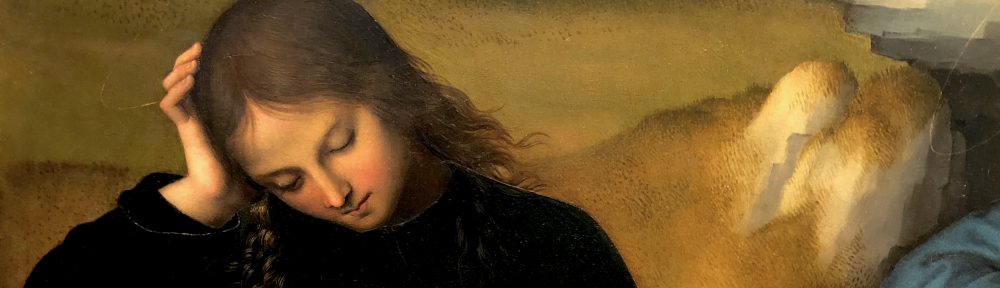

“Whatever else California was, good or bad, it was charged with human hope. It was linked imaginatively with the most compelling of American myths, the pursuit of happiness.”
— Kevin Starr, Americans and the California Dream: 1850-1915
“Hell, we threw in the land and sold ‘em the climate.”
— Los Angeles developer, c. 1880
At the end of the nineteenth century, southern California was being sold as an earthly paradise: Mediterranean light, salubrious climate, lush gardens, orange groves beneath snow-capped mountains. An eastern visitor in 1900 wrote home about the idyllic lifestyle of homeowners among the orange groves:
“[T]hey sit on the verandas of their pretty cottages—the refined essences of abstract existences—inhaling the pure air of the equal climate, reading novels or abstruse works of philosophy, according to their mental activity, from day to day, and waiting from year to year for their oranges to grow.” [i]
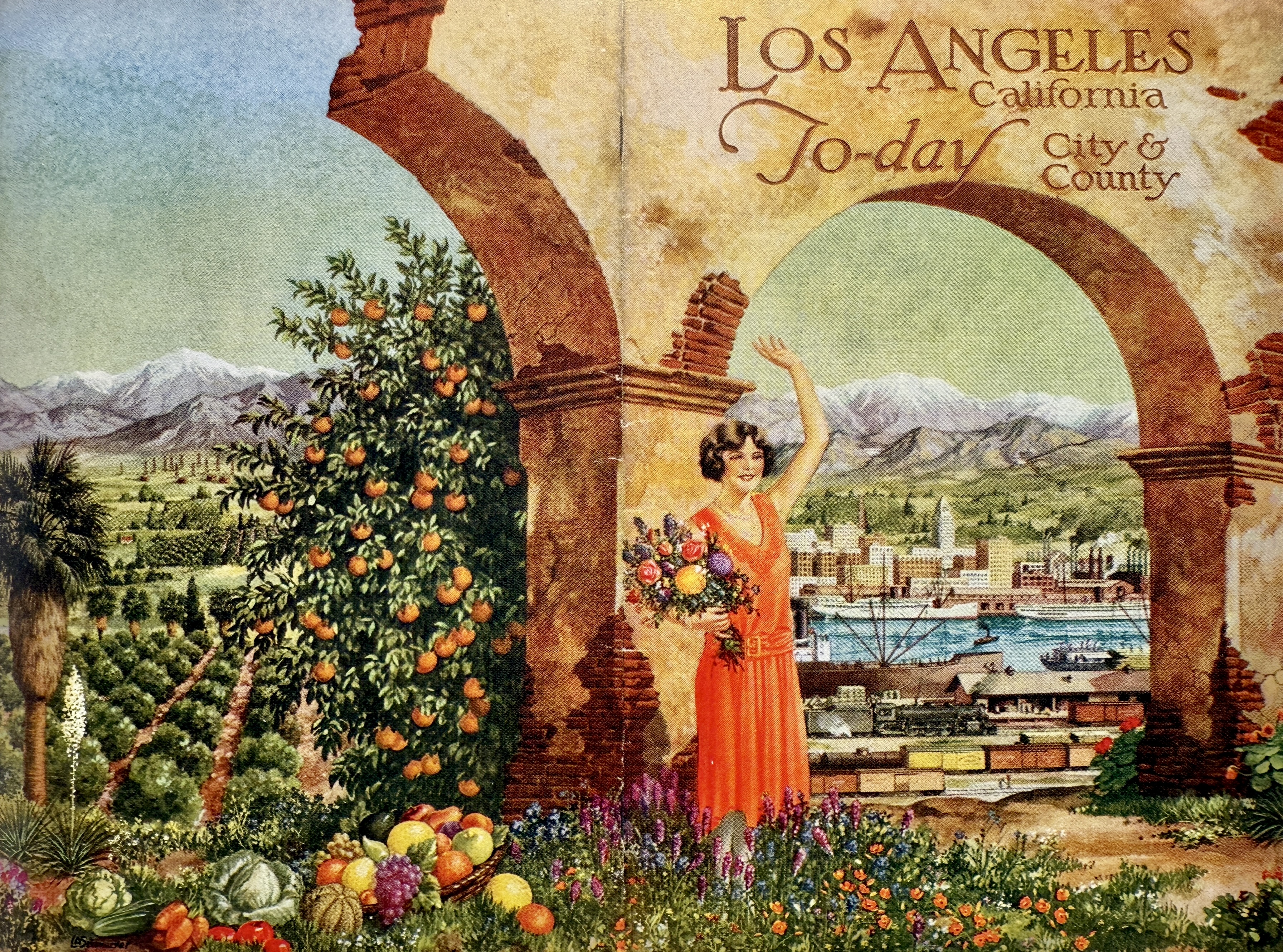
Who wouldn’t want to live there? My parents left the snows of Minnesota in December, 1937, to pursue their dreams in Los Angeles, landing in an apartment behind Grauman’s Chinese Theater. By the time I was born, they had bought the house I grew up in, on the Valley side of the Hollywood hills, in a new development with more vacant lots than homes. There was an orange tree in the backyard, and a big sycamore to climb in the front. You could enjoy being outside all through the year. Every Fourth of July, six other families who had also moved West from my parents’ home town would come over for the “Red Wing picnic.” No one talked about going back to Minnesota. They were Californians now.
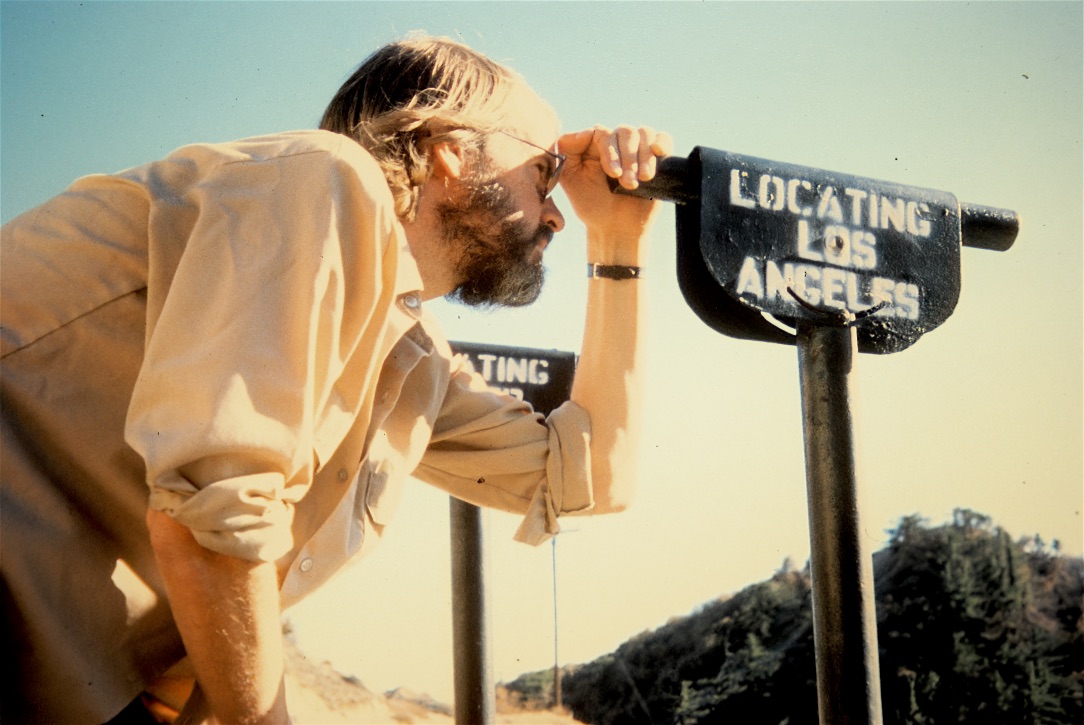
Los Angeles was home for my first fifty years. I loved the light, the proximity of mountains and sea, the cultural and artistic energy, the eccentric diversity of architectural styles, and the freedom to explore new ways of being and doing. Where else, with some heroic driving, could you ski, surf, and hear a world-class symphony on the same day?

But the boosters’ dream has been repeatedly contradicted by harsher realities. A sorry legacy of racism, greed, corruption, and violence is also part of the L.A. story. So are the broken dreams of the hopeful seekers who have come from somewhere else to make their mark. And then there are the natural disasters. Those who went there for the climate also got the Santa Ana winds.
Over the past 100 years, at least 150 novels and films have pictured the destruction of Los Angeles by earthquake, fire, flood, tsunami, volcano, nuclear war, and extraterrestrials. In Imagining Los Angeles: A City in Fiction, David Fine explains the phenomenon:
“Disaster fiction … established itself in a city that was positioned literally at the edge of the continent, a place where an unstable physical geography collided with an unstable human geography of displaced migrants and inflated expectation … From the late 1920s to the present the dominant theme in Los Angeles fiction has been the betrayal of hope and the collapse of dreams. Writing against the optimistic booster literature produced just before and after the turn of the century, the city’s novelists constructed a counterfable about loss … the city as the place where dreams founder against the edge of the continent.” [ii]
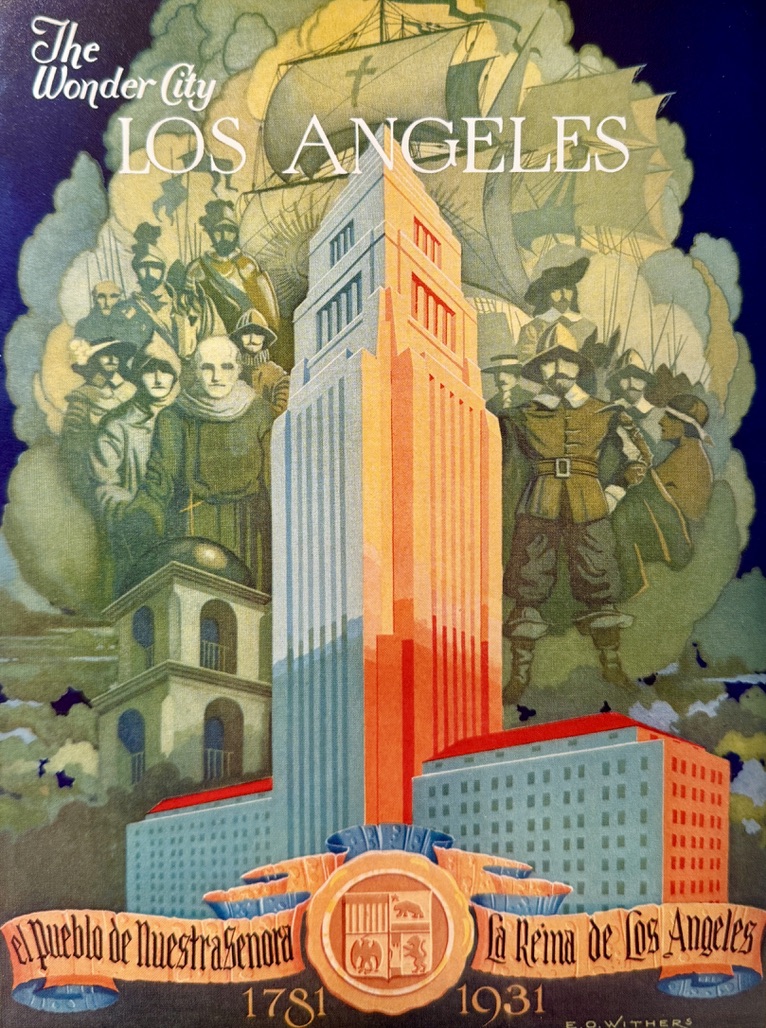

I remember a moment during the Los Angeles Film Exposition in the early seventies, when a trailer for their science fiction movie marathon ended with a famous shot from War of the Worlds (1953): a death ray from a flying saucer decimating the Los Angeles City Hall. Watching one of our city’s most famous landmarks crumble into dust prompted an eruption of cheering and applause. On one level we were enjoying the sheer spectacle of the falling tower, but in retrospect I wonder whether we were also feeling a momentary liberation from our illusions about the permanence of things. Perhaps we were, in that brief moment, able to confront not only the fragility of our city, but our own brevity as well—accepting it, embracing it like the saints who know the art of surrender. The awareness of not being in charge, they tell us, is what makes perfect freedom. Resting in God changes everything.
But homilies and metaphors about letting go and moving on seem premature, even heartless, while so many thousands continue to suffer and grieve the burning of Los Angeles. Roger Magoulas, who lost his own house in the Oakland Hills fire of 1991, has written a helpful article about what he wishes he had known at the time, including how to handle the comments of those who haven’t been through an apocalypse.
“While well-meaning and sincere, those not affected by the fire will often say things that you may perceive as offensive, insensitive, or upsetting (such as, ‘I wish my house had burned down so I could start over’). Figure out how you want to deal with these types of comments, as you can expect them for years. If you can, keep in mind that those not affected often cannot grasp the enormity of your experience, and thank them for trying to help and remind them that fire victims are extra sensitive and have a lot to process.” [iii]
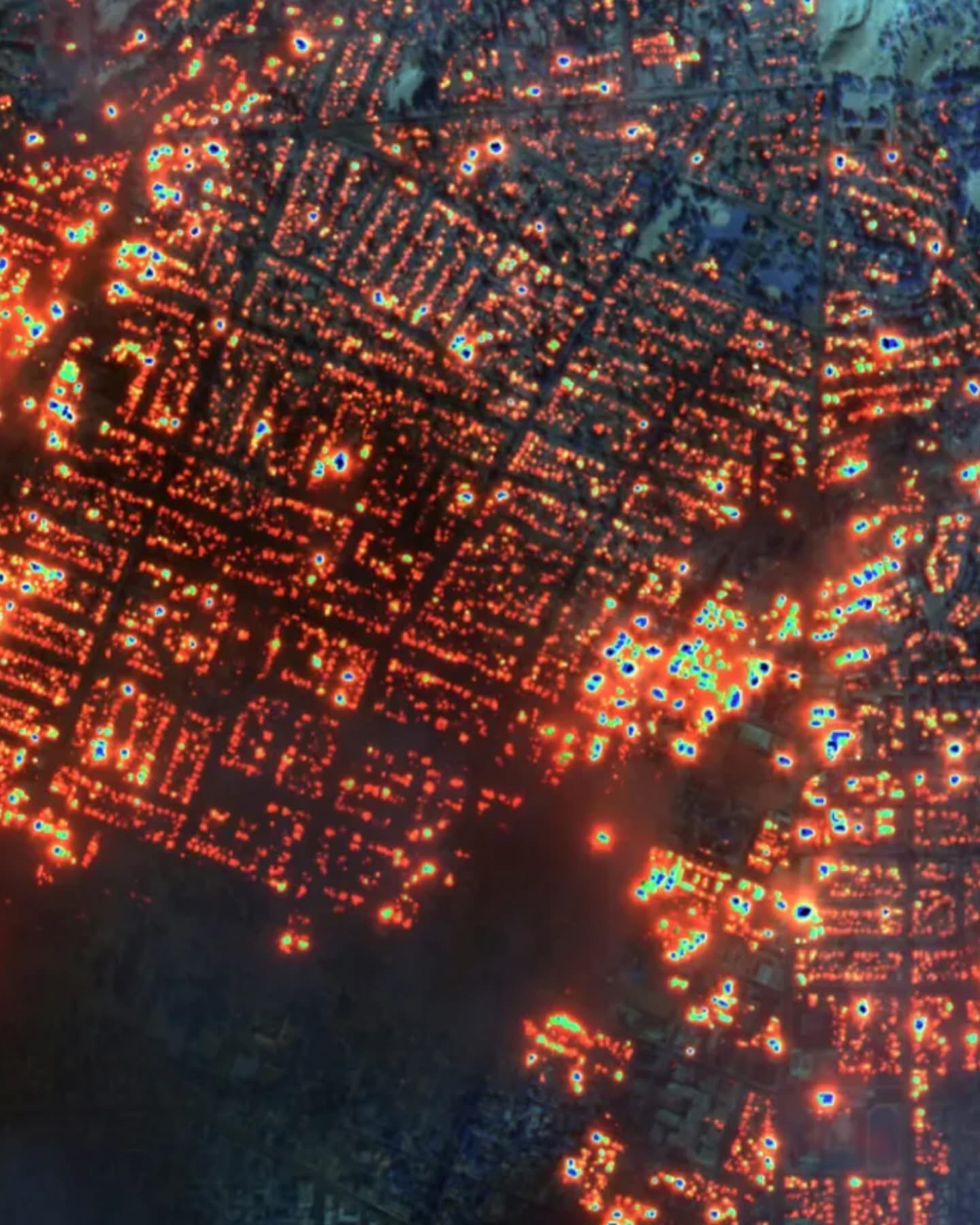
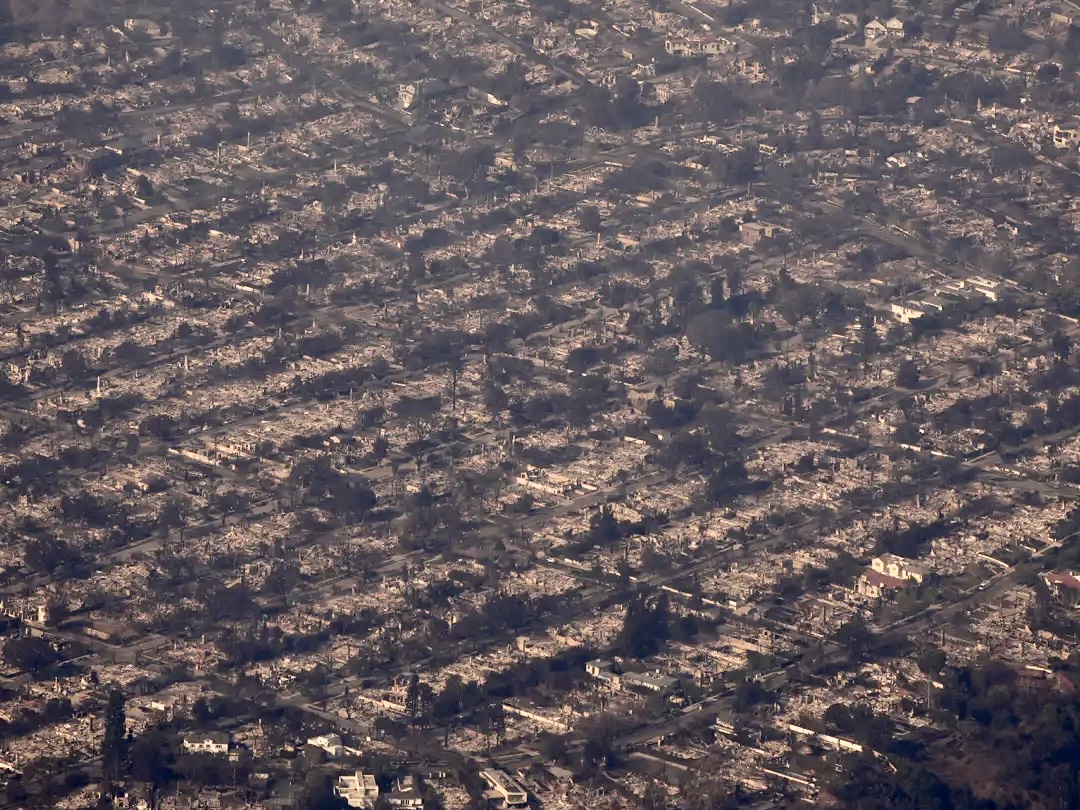
As I write this, my beloved native city continues to burn. I have friends and family whose cars are packed and ready for evacuation. Everyone’s breathing polluted air. For many people, daily needs like food, water and medicine are hard to come by. And after the flames die, the challenges of recovery will go on for years. In the Los Angeles Times, Anita Chabria has written about the unequal distribution of returning to normal:
“The Palisades, clearly, is wealthy. But even within its wealth, there are degrees. There are plenty of folks in the area who don’t have to worry about rebuilding costs, or even losing another home to fire in the future. They can afford it.
“There were also many families living in those glamorous streets who had been in the neighborhood for decades or even generations. Their homes may have been paid off or close to it, their life savings sunk into that plot of ground. And there are many living in Altadena and other affected areas who are just working Angelenos, paying off a mortgage — this was a neighborhood that drew Black and Latino families for its affordability …
“There’s also a trickle-down economic effect, even for those who weren’t displaced. Gone also are thousands of yards that had gardeners. Cleaning ladies, cooks, even nannies are now without work, but still have rent due. How do we include them in recovery?
“And there’s only so long survivors can camp out in hotels and on couches. The housing crunch that is surely coming holds the risk of pushing everyone down a notch, as the most desirable housing is taken up by those with the independent wealth or insurance checks to cover it.” [iv]
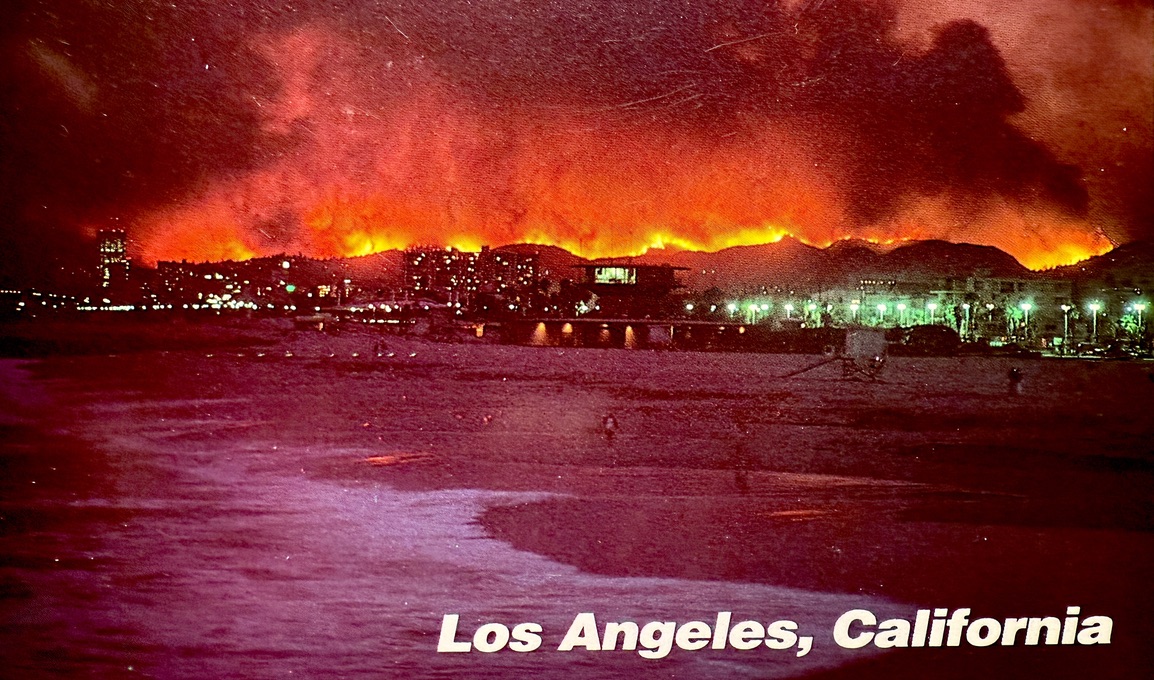
Los Angeles has seen wildfires before. It’s always been part of the life. But climate change—and our culture’s suicidal inability to deal with it—is upping the ante. Atmospheric rivers increase vegetation, then drought turns it into fuel. The whole Los Angeles basin is becoming a fire trap. To make it livable for the long term will require the kind of planning and rebuilding that seems economically and politically daunting, if not impossible.
In his magisterial environmental history of fire in Europe, Stephen J. Pyne notes that civilization may try to tame fire, but can never abolish it:
“Europe sought fire, seized it, remade it, nurtured, feared, distrusted, craved, shackled, and unleashed it. As with the rest of its natural endowment, Europe sought above all to domesticate fire, to subject it to the discipline of the garden, to subordinate it to the order of society. Anthropogenic fire replaced natural fire. Fire became a tool, a tamed beast, a sacred symbol, an obedient servant. It knew its place in the social order and kept to it. In truth, civilization was impossible without fire; and the tended fire became Western civilization’s most elementary image of itself.”
But when the balance is disrupted, by wars, revolution, changing land practices, or climate change, it becomes clear that “fire is a good servant, but a bad master.”
“Then wildfire reappeared like a monstrous birth, and became a feral force that, savage with the memory of its suppression, revolted violently against its warders. Desired fire belonged on hearth and altar; unwanted fire appeared along the rough fringes of an unraveling society, in the cracks of disintegrating cities, amid the rubble of collapsed civilizations. Intellectual Europe saw fire as an atavism, as disorder and destruction, as nature gripped by delirium tremens. But wild or tame, fire persisted. Humans could neither wholly control it nor live without it. Now here, now there, now quiescently, now violently, Europe burned.” [v]


Writing in the 1960s, California native Joan Didion described the wildfires stoked by Santa Ana winds as a formative part of Los Angeles living.
“The city burning is Los Angeles’s deepest image of itself … Los Angeles weather is the weather of catastrophe, of apocalypse, and, just as the reliably long and bitter winters of New England determine the way life is lived there, so the violence and the unpredictability of the Santa Ana affect the entire quality of life in Los Angeles, accentuate its impermanence, its unreliability. The wind shows us how close to the edge we are.” [vi]
But in a 2005 interview, Didion strikes a typically Californian note of hope: “[M]ixed up with this tolerance for apocalyptic notions in which the world is going to end dramatically is this belief that the world can’t help but get better and better. It’s really hard for me to believe that everything doesn’t improve, because thinking like that was just so much a part of being in California.” [vii]
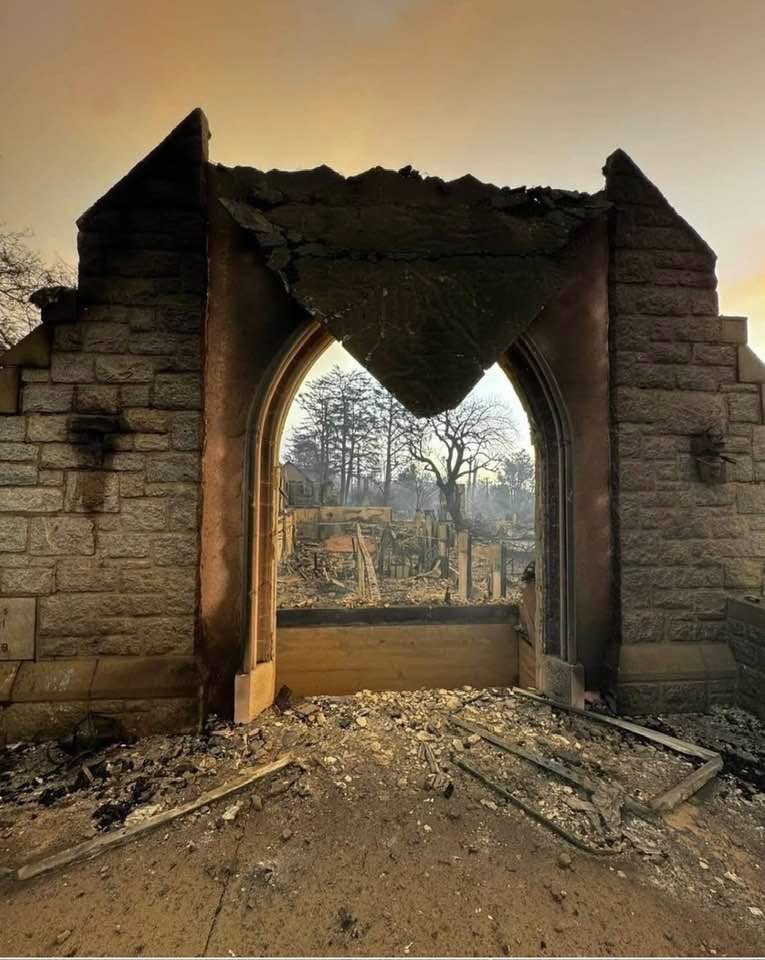
In the Episcopal Diocese of Los Angeles, where I am canonically (but no longer physically) resident, two parishes have been hit hard by the fires. In the Palisades Fire, 75% of the members of St. Matthew’s have lost their homes. In the Eaton Canyon Fire, the historic church of St. Mark’s, Altadena has been completely destroyed. Although the Body of Christ resides in the people, not the building, every sacred space is soaked with the prayers and praises of generations, and its loss is always deeply felt.
My friend Brad Karelius, a priest in the Diocese of Los Angeles, has written movingly about the ways he was spiritually formed in that vanished place, where so much of its physical structure had been charged with accumulated meaning:
“[W]hen I would visit St. Mark’s in later years, wherever I looked within the church: the pulpit, the choir stalls, the memorial windows, the Blessed Sacrament, conjured precious memories and deep gratitude for how St. Mark’s drew me into the loving arms of Jesus and sent me forth as a priest into the world.” [viii]
But God’s friends don’t linger long in “bare, ruin’d choirs.” [ix] There is work to do, people to care for, hope to nurture, hearts to lift, and resurrections to embody. In last Sunday’s Zoom worship with her homeless congregation, St. Mark’s rector, the Rev. Carri Grindon, spoke a word of resurgent life:
“Whether you’re in hotels or AirBnbs, driving in your car, staying in the homes of family or friends or strangers who aren’t strangers anymore, the bonds among us are bonds that cannot be severed. We are the latest in a long list of God’s people put on the road by disaster and displacement. We are still one in love. We are still one in Christ.” [x]

I am grateful to the Rt. Rev. John H. Taylor, Episcopal Bishiop of Los Angeles, for his leadership in this crisis. His daily dispatches have provided some of the links that inform this post.
[i] Claire Perry, Pacific Arcadia: Images of California, 1600-1915 (New York/Oxford: Oxford University Press, 1999), 93.
[ii] David Fine, Imagining Los Angeles: A City in Fiction, David Fine (Reno: University of Nevada Press, 2000), 233, 236-237.
[iii] Roger Magoulas, “What I Wish I Knew After My House Burned Down,” The Bold Italic (Aug. 24, 2020): https://thebolditalic.com/what-i-wish-i-knew-before-my-house-burned-down-c306b1f2382b
[iv] Anita Chabria, “Recovery will be tempered by hard decisions and, if we aren’t careful, inequality,” Los Angeles Times (Jan. 12, 2025): https://www.latimes.com/california/story/2025-01-12/column-chabria-palisades-eaton-altadena-fire-rebuild?fbclid=IwY2xjawH0uCdleHRuA2FlbQIxMQABHU9v4AMpCoGDOhEEMnXqfMroJ4QD8XM6A2nR-89jYrM9jHXqyCjnR7nc8g_aem_pkaB4VMlgFjaqFrCHCB4ZQ
[v] Stephen J. Pyne, Vestal Fire: An Environmental History, Told through Fire, of Europe and Europe’s Encounter with the World (Seattle: University of Washington Press, 1997), 3-4.
[vi] Joan Didion, “Los Angeles Notebook,” excerpt from Slouching Toward Bethlehem, in Didion: The 1960s & 70s (New York: Library of America, 2019), 378.
[vii] Joan Didion, interview with Barbara Isenberg in State of the Arts: California Artists Talk About Their Work (2005).
[viii] Fr. Brad Karelius, “Remembering St. Mark’s Church, Altadena, which burned yesterday in Eaton Canyon Fire,” Desert Spirit Press (Jan. 9, 2025): https://desertspiritpress.net/2025/01/09/remembering-st-marks-church-altadena-california-which-burned-yesterday-in-eaton-canyon-fire/?fbclid=IwY2xjawH0_3JleHRuA2FlbQIxMQABHcWYXCWcuRo12uZXw432filoldgeU2o-ipNHX0uxLwqwz3_UZH14bN1VAA_aem_xPMvFG8gKZVTr45n6bNMrA
[ix] William Shakespeare, Sonnet 73.
[x] The Rev. Carri Grindon, homily for the First Sunday after the Epiphany (Jan. 12, 2025). For information about the St. Mark’s Rebuilding Fund: https://www.saintmarksaltadena.org/?fbclid=IwY2xjawH1AlNleHRuA2FlbQIxMAABHfsx01P90-PcycJiWfnx6naHclAnQQVdjaD2YNyHjKzN3NVg584NifKk1Q_aem_Rr8cBCVUJ1VTZPf8Ccdg5w









 The religious imagineer