The Terrible Parable: Making Sense of the Dishonest Steward

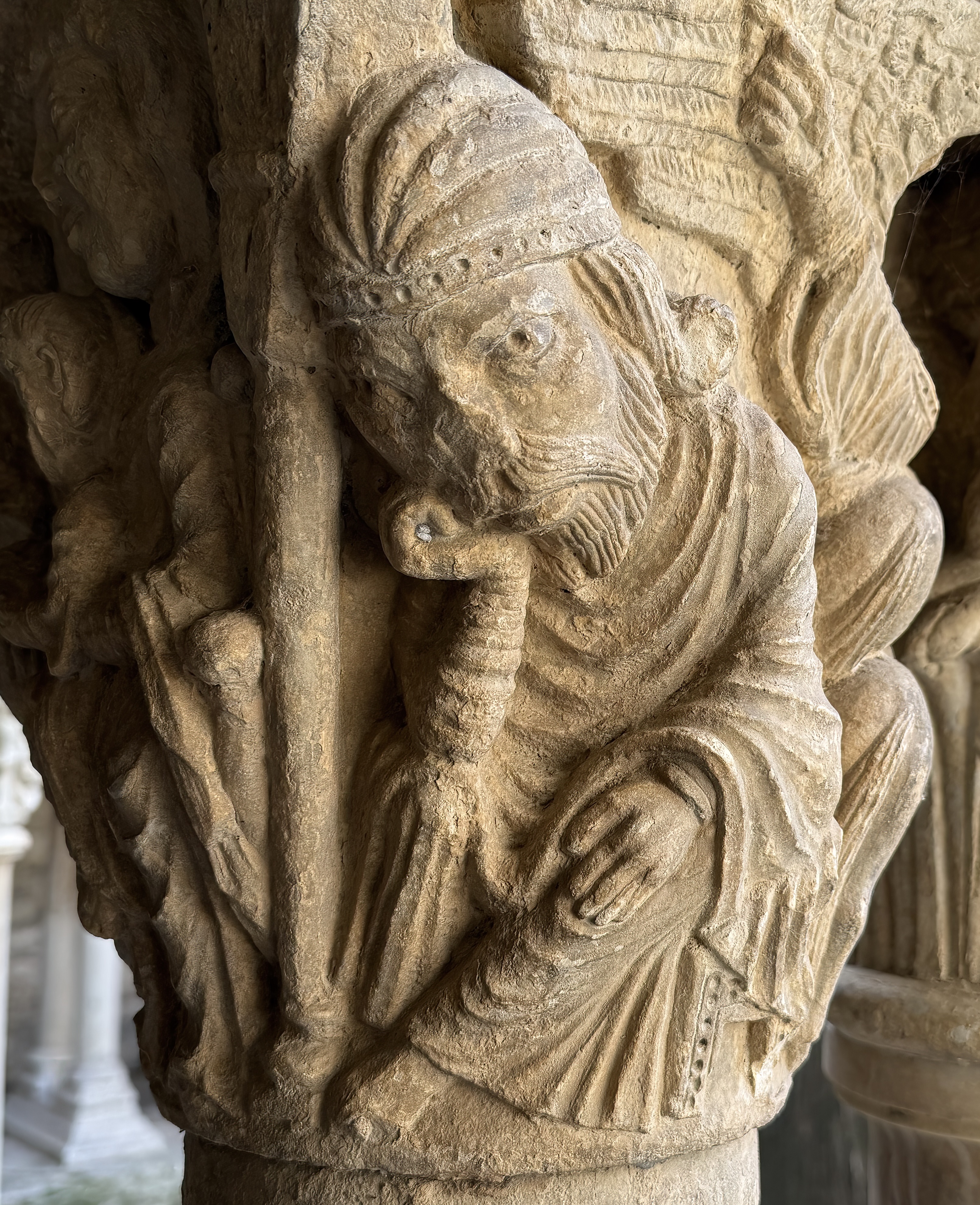
A perplexed man in the cloister of Saint Trophime, Arles, France (12th century)

In the liturgical churches, we don’t get to choose the Scripture for our homilies. We have to take what the Lectionary gives us. I’ve been preaching for a long time, but I’ve always been lucky enough to miss the Sundays when the Parable of the Unjust Steward turns up. Until now. Some scholars have labeled it the hardest parable. I prefer to call it the “terrible parable.” But I made a stab at it, and pass on the results here.

A parable functions a little like a Zen koan. What is the sound of one hand clapping? What is your original face before you were born? Such imaginative constructions of language are meant to disrupt habitual ways of thinking and open us to new perspectives. Just so, when a prodigal son is welcomed home with open arms, or the laborers who work the fewest hours are paid the same wages as the ones who work all day, we are forced, or at least invited, to question our presuppositions and prejudices about how life works, or how God desires life to work.

That said, let’s consider the Parable of the Unjust Steward (Luke 16:1- 8). It’s not an easy one to interpret. Nor is it easy to like. There have been many efforts to explain what this story about a dishonest steward tricking his boss is even doing in Luke’s gospel, set down in the midst of far more memorable teachings and far more beloved parables. But most of those explanations fail in one way or another, either making assumptions not justified by the text or reducing its meanings to something of little value to preacher or disciple.

So what shall we make of the “terrible parable” this time around?

Let’s review what happens. A rich man, presumably an absentee landowner, discovers his property manager has been “squandering” his property, whether by mismanagement or financial monkey business we aren’t told. But he’s put on notice that he’s about to be fired.

Now the steward considers himself either too old or too scrawny for manual labor, and he’s too proud to beg, so he’s desperate for a way to avoid utter destitution. What does he do? He summons all his master’s debtors and offers to write down their debts to an affordable level. By so doing, he earns the good will of those debtors.

Maybe someday, when he’s out of work and looking for help, they’ll return the favor. And, by collecting at least some return from all those past due accounts for his master, maybe he can get back in the master’s good graces. In the end, we are told, the rich man “commended the dishonest manager because he had acted shrewdly.” The odds of the steward keeping his job are looking up, but the story stops before we find out about that.

At first glance, it’s hard to find anyone to identify with in this parable. In the Bible, rich men are rarely liked, since economic inequality in biblical times was even worse than it is today. When a story begins, “There was a rich man,” you might imagine the immediate boos and hisses from Jesus’ audience, which hopes it’s going to be a story about his comeuppance. But as soon as the steward is introduced, his own character is dragged through the mud, and the rich man gains a bit of sympathy for having been cheated.

The steward stands accused of squandering his master’s property—whether through incompetence or dishonesty is not quite clear, but his actions later, cooking the books to write down the debts owed to his master, tag him as “unjust” or “dishonest”—terms which can connote either shaky bookkeeping or outright fraud. In any case, he plays fast and loose with the numbers. And, to our surprise, he is praised for doing so. This commendation may reflect the master’s relief in recovering at least some of his bad loans. It also may indicate his delight in discovering how clever his steward is. If such a man can get things done, who cares if his methods are not always on the up and up?

Some commentators have discerned a Christ figure in the rule-breaking steward. Hoping for a different kind of future, Jesus subverts the rules of the old world, where the rich get everything and the system punishes the poor, so that the rich man gets less and the debtors finally get a break. The unjust system may consider his actions to be improper, but in God’s eyes he’s an agent of economic justice, constructing a fairer and kinder form of human community.

At the same time, the steward’s actions transform relationships. The debtors, for whom the steward might have seemed an enforcer of unpayable obligations, turns out to be a forgiver of debts. And the rich man, tricked into generosity by his steward’s unorthodox moves, is given the opportunity to forego domination and greed in his own relationships with others.  

That’s the story. But then the storyteller, who is Jesus, tacks a puzzling moral onto the end of his tale. He says the steward’s ingenuity, and the praise he receives for it, demonstrates that “the children of this age are more shrewd in dealing with their own generation than are the children of light.”  

What could this mean? Of course, to reduce a parable to a single meaning implies that you can throw out the story and just keep the meaning. That’s like Woody Allen’s joke about reading War and Peace in an hour after taking a speed-reading course. When someone asked him what the novel was about, he said, “It’s about Russia.”

His joke mocks the idea that the experience of full immersion in Tolstoy’s thousand-page epic can be replaced by a brief summary. It’s the same with Jesus’ parables. Don’t reduce them to a single meaning. Experience them, begin to wonder about them, and then—just keep on wondering.

So instead of offering the best interpretation of today’s parable—there is no best interpretation, just a story which continues to puzzle us—I will simply try out some observations with no presumption of giving you the definitive last word about it.  

The “children of light” is a New Testament term for the early Christians, the followers of the Way of Jesus, who belong not to “this age” but to the age to come, the future which God is in the process of bringing about. The steward’s ability to game the system of this age, operating successfully within its parameters with improvisation, cleverness and flexibility, should make the followers of Jesus ask themselves,

“Am I operating within the parameters of the age to come—the kingdom of God—with the same creativity and resourcefulness as the steward displays within the parameters of his story? Are my actions and choices in line with the world that is dying, or with the world that is being born?”

In living out the Christian life, which is rooted not in this age but in the age to come, we should embody the Kingdom’s precepts and pursue its goals with the same single-mindedness, the same commitment, the same shrewdness that the steward in the parable employs to navigate the crisis described in his story. His world is about to come crashing down, he’s about to lose everything, but he survives through the actions he takes and the relationships he cultivates. He doesn’t cling to the old world and its old rules to suffer its predetermined outcomes. He discovers a way to be part of what is about to happen next. He discovers a way to have a future.

Now if we are indeed the children of light, claiming allegiance to the divine future which is being born amidst the ruins of our fallen world, do we possess a comparable level of creativity and resourcefulness to survive the collapse of the old and join ourselves wholeheartedly to the emergence of the new? Can we be as good as that steward was in slipping through the present time of crisis into a future of divine intent and human flourishing?

That’s the question I hear the parable asking us today. That’s the question I leave you with today. Let me say it one more time:

If we are indeed the children of light,
claiming allegiance to the divine future
which is being born amidst the ruins of our fallen world,
do we possess a comparable level of creativity and resourcefulness
to survive the collapse of the old
and join ourselves wholeheartedly to the emergence of the new?

Can we be as good as that steward was
in slipping through the present time of crisis
into a future of divine intent and human flourishing?
Love’s Endeavor, Love’s Expense — A Good Friday Meditation

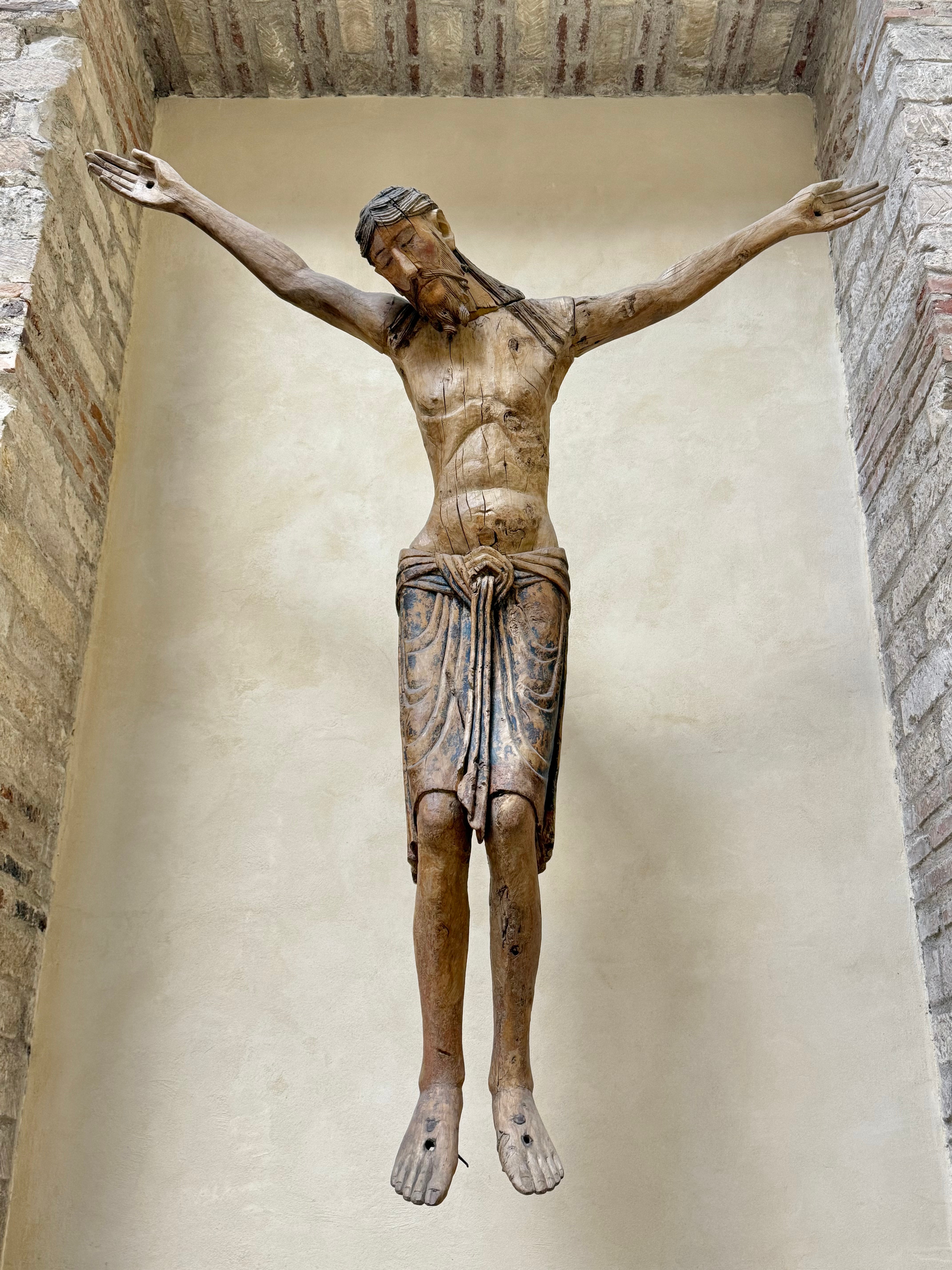
Crucified Christ (northern France, late 12th century).

Isaiah 53:5 But he was wounded for our transgressions, crushed for our iniquities; upon him was the punishment that made us whole, and by his bruises we are healed.

Was it really necessary for Jesus to be pierced and crushed? And how exactly did his suffering and death make us whole? There has never been a conclusive single answer, because any attempt to “solve” the Paschal Mystery with a reductive formula is missing the point. The cross is an experience to enter, not an idea to be explained. “I wonder as I wander out under the sky,” says the old Nativity carol, “why Jesus our Savior did come for to die / for poor ornery people like you and like I. . .” And now, this Holy Week, we come again to the foot of the cross, and we wonder.

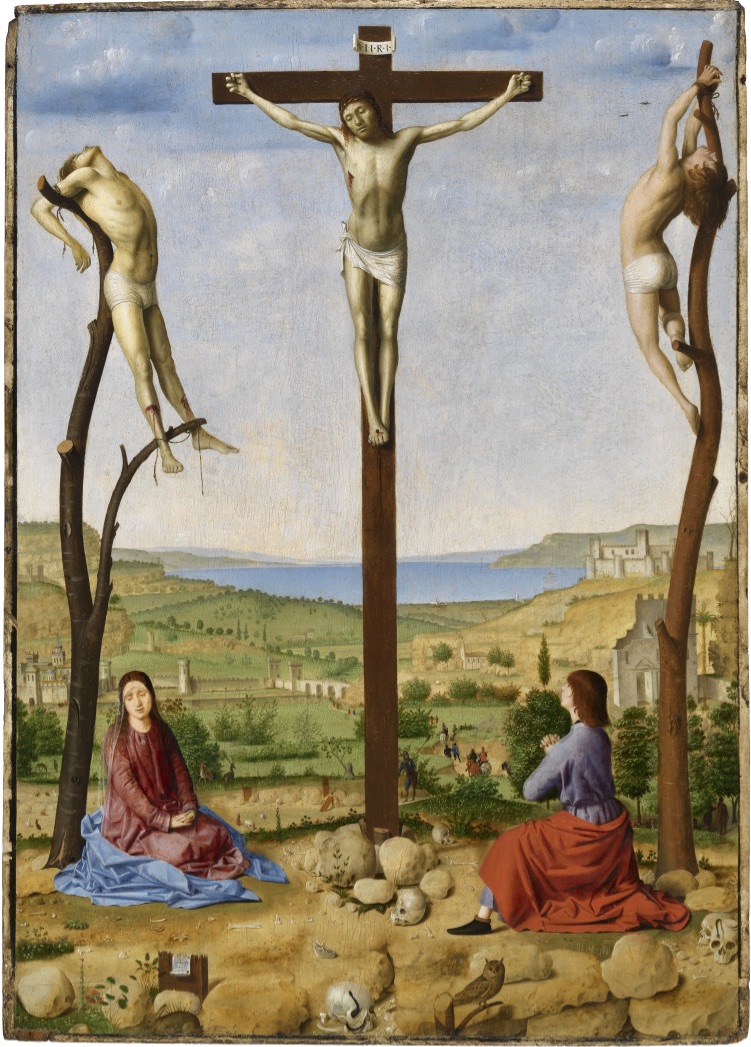
Antonello da Messina, The Antwerp Crucifixion (1475).

Let us discard any crude notions of the cross as a transaction, as if somebody had to pay for all the damage wrought by human sin, so Jesus stepped up like a big spender to declare, “This one’s on me.” Such “substitution” theology either trivializes the cost of sin (can Auschwitz or Gaza be so lightly dismissed?) or risks masochism by stressing the pain of the Passion, as Mel Gibson did in his notorious movie. The sacredness of God’s Friday is not in the violence or the blood, but in the Love that rewrites the darkest story.

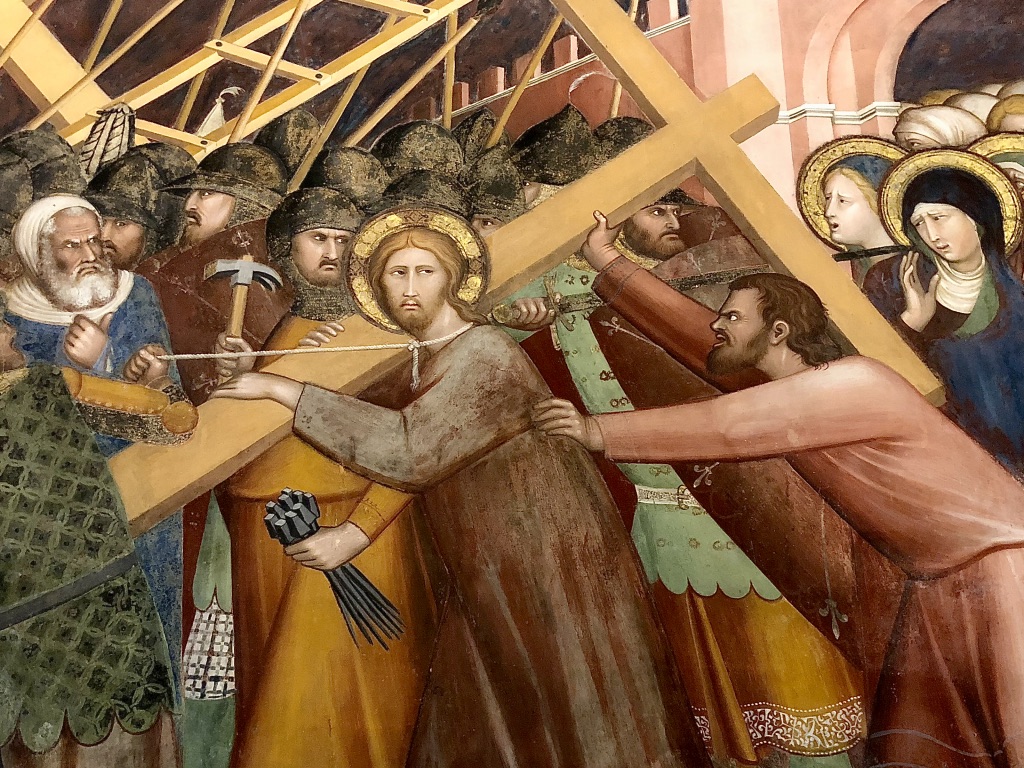
Lippo Memmi, Christ carrying the cross, Duomo di San Gimignano, Tuscany (1335-1345).

And let us not reduce the salvific death of Jesus to a simple case of human cruelty claiming one more victim. Something more than human tyranny and human tragedy—something divine—was at work in the cross. But the divine presence on Calvary’s hill was not in the form of any punishment dished out by an angry God. God was there in the vulnerable, suffering body of Jesus, the Incarnate Word of self-diffusive love, who chose to share the human condition in all its forms—even the bleakest and most wretched. Jesus didn’t suffer instead of us. Jesus suffered with us. And through the humanity of Jesus, our own experience of alienation and affliction has been absorbed into the trinitarian life of God, where it is held in love’s eternal embrace and drained of its toxicity. As the prophet said, By his wounds we are healed.

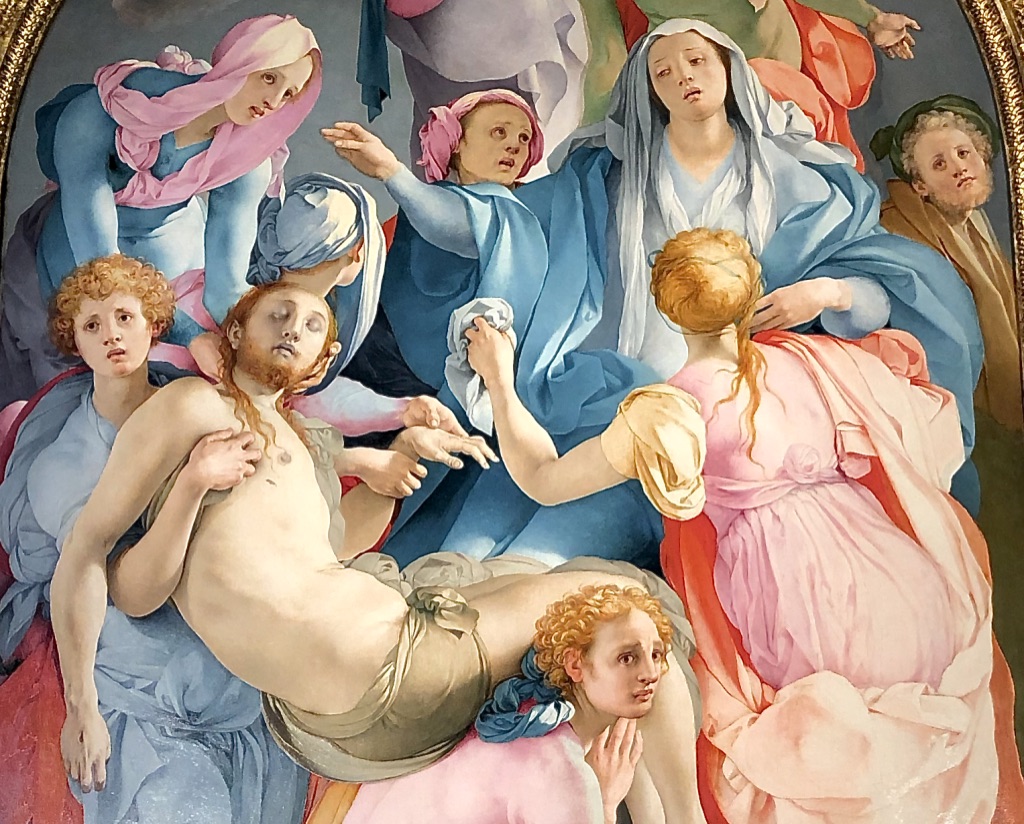
Jacopo Pontormo, Deposition from the Cross, Santa Felicita, Florence (1525-1528).

Or as theologian Paul Fiddes put it, “Far from simply forgetting about the sins of the world, [God] journeys deeply into the heart of [the human] condition. . . God participates in our brokenness, to win us to the offer of healing.” In our own evil time, when hate and cruelty are running wild, sometimes we feel overwhelmed, discouraged, or powerless. But that’s exactly where Jesus comes to join us, not simply to keep us company on the countless crosses of this world, but to transform our sufferings into the seeds of resurrection.

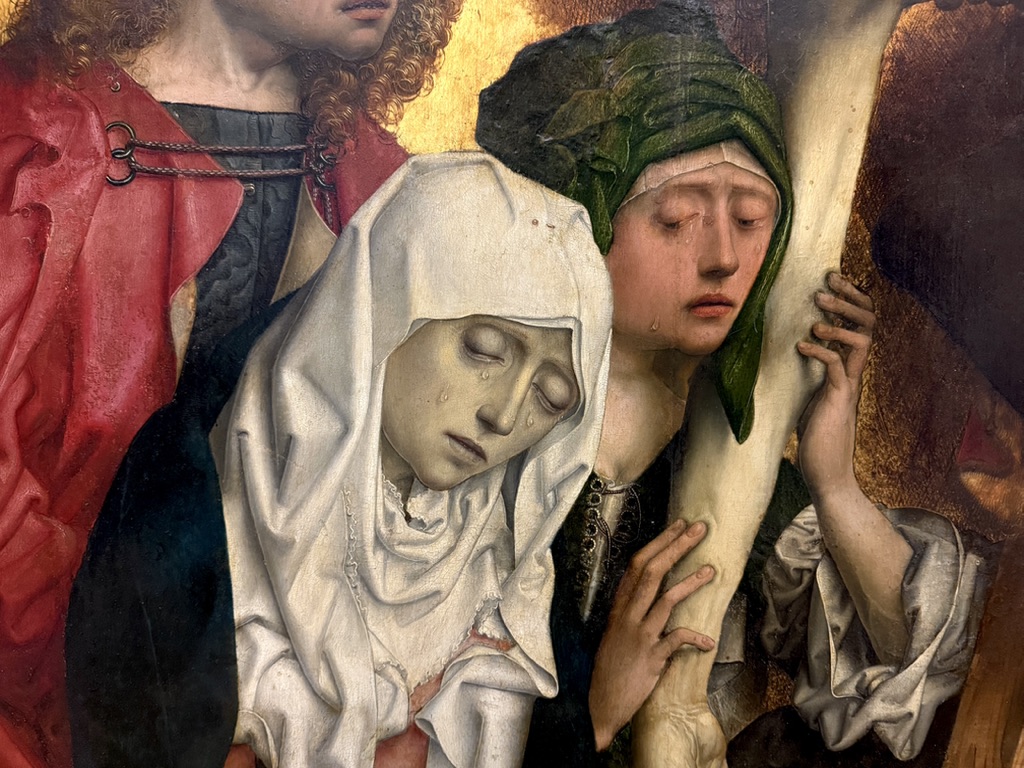
Anonymous “Master of St. Bartholomew,” The Descent from the Cross, Cologne, c. 1480-1510 (detail).

The title is from a hymn by W. H. Vanstone, “Morning Glory, Starlit Sky” (585 in the Episcopal Hymnal 1982)

“A sweet fragrance filled the room” — A Homily on John 12:1-8

Jan van Scorel, Woman with the jar of nard (c. 1530).

In all four gospels, there’s a story about a woman who interrupts an intimate dinner party to kneel at the feet of Jesus and make an act of devotion. Luke’s story differs from the others in significant ways, so it may be based on a different incident. But Mark, Matthew and John all seem to be describing the same event. It was a moment which clearly had an indelible impact on the memory of the early Church.

John’s version is the only one which names the woman: Mary of Bethany, whose brother Jesus had just raised from the dead in the gospel’s previous chapter. Coming between the dramatic raising of Lazarus from the tomb and the violent clamor of the Passion, the story is a striking contrast to what came before and what comes after.

Instead of a public event with lots of people, it is quiet and intimate. No wailing mourners, no crowd shouting “Hosanna!” or “Crucify him!” Just Jesus, a few disciples, and his hosts, the siblings of Bethany:  Martha, Mary, and Lazarus.

We don’t know what they talked about during that dinner, but the moment had to have been highly charged, given the people around the table: The sisters whose grief had driven the harsh confrontation with Jesus at their brother’s tomb (If you had been here, my brother would not have died!) … the rabbi from Nazareth who had wept his own tears over the death of his friend (and perhaps some tears for the human condition in general) but who also found himself channeling the awesome life-giving power of the divine through his own mortal body …and the stunned man who had been so suddenly snatched from the land of the dead, experiencing what had to be a volatile mixture of awe, gratitude, and PTSD.

Perhaps no one said very much at all. Perhaps they were all still processing the shock of their shared experience at the tomb, letting a profound silence hold their feelings in order to preserve the mystery of it from being reduced to the poverty of language. But at some point, Mary was inspired to acknowledge the sacredness of the moment—not with words, but with a sacramental action.

The text doesn’t give the details, but I imagine her rising from the table, leaving the room for a moment, then returning with a jar of nard, a fragrant oil originating in the Himalayas and transported at great expense along the ancient trade route from Asia to the Middle East. It was worth a year’s wages, so when Mary, without saying a word of explanation, poured it all out over the feet of Jesus, it was quite shocking, like throwing a bag of gold into the sea or setting fire to a pile of paper money.

Then Mary compounded the shock by letting down her hair and using it to rub the oil into Jesus’ skin. No reputable woman would have done such a thing, nor would a religious teacher have permitted himself to be touched in such a way. Nevertheless, that’s how it went.

Judas was at that table, and he couldn’t bear to watch. He was the apostles’ money man, and he objected to wasting wealth that could have done some real good. John’s gospel doubts his sincerity, accusing Judas of embezzling the very funds he was claiming to protect.

I suspect that Judas’ discomfort had more to do with Jesus rewriting the social codes of his culture by endorsing Mary’s action. “Leave her alone,” Jesus tells him. Jesus, unlike Judas, understood that this was a very precious and significant moment, and he wanted to let it happen.

Mary’s extraordinary action, both sensual and symbolic, overflowed with meanings. For one thing, anointing with oil was a way to mark the special vocation and identity of authoritative figures, whether powerful rulers or holy persons. It consecrated them as chosen and set apart. The title of “Messiah” or “Christ” means “the anointed one.”

It was revolutionary to have a woman be the one to anoint Jesus as priest and ruler, but the kingdom of God was all about revolution: the revolution of transforming a disordered and broken world into a more perfect expression of divine intention and human possibility.

Anointing was also part of the culture’s preparation of a body for burial. Performed in the week before Jesus’ death, Mary’s gesture inaugurates the sequence of sacrificial acts culminating with her Lord’s burial in the stone-cold tomb. The feet she anoints will soon walk the Way of the Cross for the salvation of the world. That was Jesus’ chosen destiny, and the oil is an outward and visible sign of his inward consent to perform that destiny.

The story’s third meaning is in its foreshadowing of the foot-washing, when Jesus, on the night before he died, knelt at the feet of his friends to perform the work of a servant, surrendering his power for love’s sake. The foot-washing marked the turning point from a paradigm of domination to a paradigm of communion.

By kneeling at the feet of his friends, Jesus was showing them, and us, an image of humanity’s best version of itself. In that sacramental act, Jesus was saying: This is how we must be with one another, because this is exactly how God is with us.

And in today’s story, just a few days before Jesus would teach this explicit lesson at the Last Supper, Mary of Bethany, foreshadows the foot-washing when she offers, in her own way, all she has, holding nothing back.

And her devotional act of kneeling down to pour out the precious oil not only anticipated the foot washing on Maundy Thursday, it was an image of the divine nature as revealed in the incarnation and crucifixion of Jesus.  As one theologian has put it, “The self-giving extravagance of Mary’s actions point to the way Jesus would expend himself completely through his crucifixion.” [i]

In our Palm Sunday liturgy next Sunday, Paul’s Epistle to the Philippians will declare that Jesus emptied himself for us, poured himself out for us, and in so doing he revealed who God is and what God does. Whether in the costly pouring out of the Son’s life on the cross, or in the lavish pouring out of Spirit on Pentecost, God is the One who never ceases to pour out God’s own self.

And when, before his own self-offering, Jesus allowed Mary to anoint him in such a costly manner, she herself became an icon who shows us God with her own body, bowing before Jesus to wipe his feet so tenderly with her hair.

At the time, the disciples did not grasp the full significance of Mary’s act. Nor did Mary herself, I’d imagine. How could they?

As we say around here about Holy Week: The journey is how we know. The disciples had to learn by doing: following Jesus all the way to the cross—and beyond—before they could begin to understand—through memory and reflection—what it was all about. And that is what we will be doing as well during the seven days of Holy Week, not wanting to miss a single step along that sacred way. The journey is how we know.

Before we leave this story, consider the one sentence that stands out from the rest of the text:

The house was filled with the fragrance of the perfume.

There’s nothing else quite like it in the canonical gospels. The Bible in general is short on description and long on action. We never hear about the weather in Jerusalem or the colors of spring in the Galilean hills or the way light falls on the walls of the temple courtyard in late afternoon. So why does John invite us to pause and take in the sweet smell of nard?

In her fascinating book on the olfactory imagination in the ancient Mediterranean, Susan Ashbrook Harvey points out that aromatic spices were thought of as souvenirs of Paradise. When Adam and Eve were expelled from the Garden of Eden, it was said, they were allowed to take away a few fragrant plants to remind them of what they had lost.

Smells are a powerful trigger of memory, and the sweet odors of plants, spices and aromatic oils not only reminded people of Paradise Lost, they were thought to alert our senses to divine presence in a fallen world. They help us remember God. As Harvey writes, fragrance is something like God:

“Unseen yet perceived, smells traveled and permeated the consciousness, transgressing whatever boundaries might be set to restrict their course … Odors could transgress the chasm that separated the fallen order from God; they could elicit an unworldly sensation of beauty.” [ii]

And so we hear St. Paul speak of the fragrance that comes from being “in Christ,” so that we ourselves begin to give off the “aroma of Christ” from our own bodies (2 Corinthians 2:14-16). A few centuries later, Gregory of Nazianzus, in his treatise on the effects of our baptism, wrote:

“Let us be healed also in smell, that we … may smell the Ointment that was poured out for us, spiritually receiving it; and [that we may be] so formed and transformed by it, that from us too a sweet odor may be smelled.” [iii]

And St. Chrysostom, in his 5th-century sermon on today’s gospel, urged his congregation to become like thuribles, sweetening wherever they happen to be with the incense of heaven:

Now the one who perceives the fragrance knows that there is ointment lying somewhere; but of what nature it is he does not yet know, unless he happens to have seen it. So also we. [That God is, we know, but what in substance we know not yet.] We are then, as it were, a royal censer, breathing whithersoever we go of the heavenly ointment and spiritual sweet fragrance.” [iv]

In the spirit of such olfactory tropes, John’s verse about the sweet smell of the nard in that Bethany dining room endow that moment with divine peace and blessing. And the verse is especially vivid in contrast with the stench of mortality hovering around the tomb of Lazarus a few days earlier. Don’t roll away the stone, his sister pleaded. After 4 days inside, the body will smell terrible. Or as the King James Bible memorably put it, “by this time he stinketh.”

But in that sweet-smelling dining room with Jesus and his friends, death and decay are held at bay for a few precious hours. Outside, the world is wild and raging, on the verge of murdering the incarnation of Love. But inside, a woman is imaging the peace of heaven at the feet of her Lord.

For me, this beautiful moment calls to mind a scene from Ingmar Bergman’s classic 1957 film, The Seventh Seal, set in the fourteenth century when the Black Plague is ravaging Europe. A wandering knight is trying to get back home before the plague catches him, stalling for time by engaging Death in a game of chess. He’ll never win, of course, but at one point he meets a kind of holy family: a man, Jof; his wife Mia; and their baby, Michael. They are traveling players who embody the vitality of the life force.

Antonius Block, the knight (Max von Sydow), plays chess with death.

The film ends with the knight taking his inevitable place in the dance of Death, disappearing over the horizon with his fellow mortals. But the “holy family” are not seen among the dead souls, for they have been spared to carry on in this life, untroubled by death because they belong to grace. They know how to accept the music of what happens, and not live in fear.

The knight finds grace in a fallen world: “I shall remember this hour of peace.”

In the sweetest moment of this anguished film, Jof and Mia share their strawberries and milk with the knight, who receives it like a sacrament, a taste of unconquerable life:

“I shall remember this hour of peace,” he tells them. “The strawberries, the bowl of milk, your faces in the dusk, Michael asleep, Jof with his lute. I shall remember our words, and shall bear this memory between my hands as carefully as a bowl of fresh milk. And this will be a sign and a great content.”

An hour of peace, an experience of great content in a world that is coming apart—isn’t that a perfect description of the dinner at Bethany? And are we not in that same place now, with Mary, Jesus, and the rest? The powers of death and malice and mindless destruction are raging outside. We know that. Yet here we are, tasting the bread of heaven, inhaling the fragrance of divine presence.

It’s not about escaping. Not at all. It’s about renewal, so that when we go back out into the world, we can be clear about our vocation: to exude that fragrance—God’s sweetness—in every place we go. And when it gets hard out there—and it will—just call to mind the fragrance of those sacred moments when we dwell in God, and God in us.


This homily was preached at St. Barnabas Episcopal Church on Bainbridge Island in Washington State, on the Fifth Sunday in Lent.

[i] Craig R. Koester, Symbolism in the Fourth Gospel: Meaning, Mystery, Community (Minneapolis: Fortress Press, 1995), 114.

[ii] Susan Ashbrook Harvey, Scenting Salvation: Ancient Christianity and the Olfactory Imagination (Berkeley: University of California Press, 2006), 53.

[iii] Ibid., 75.

[iv] Ibid., 115.

What Happens in Bethlehem Doesn’t Stay in Bethlehem

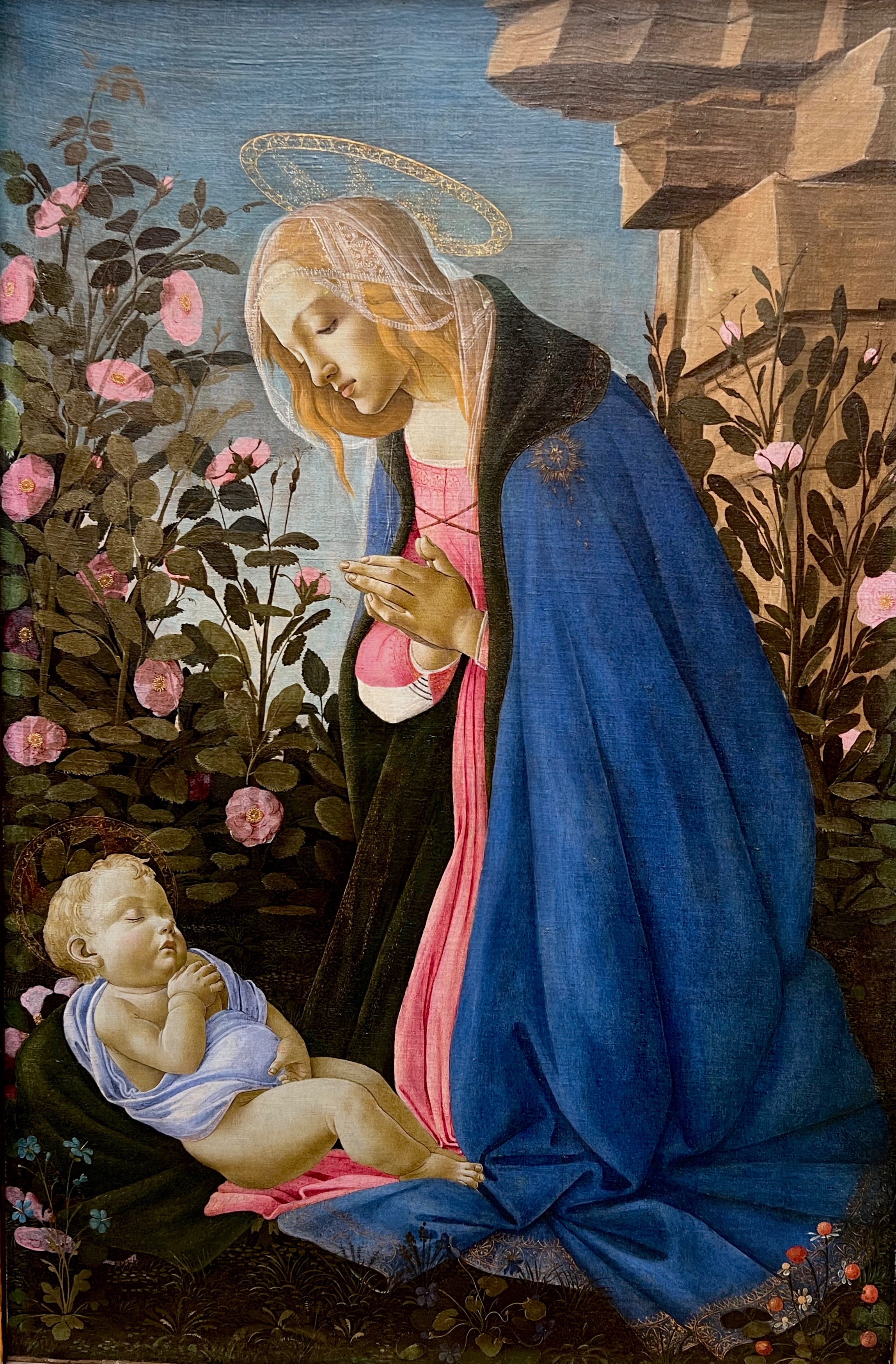
Sandro Botticelli, The Virgin adoring the sleeping Christ Child (c. 1485), Scotland National Gallery, Edinburgh.

What on earth happened last night—at that little stable on the edge of town? It was all so strange, so unbelievable. Some of us are still sleeping it off. Some of us didn’t get any sleep at all, or maybe we were asleep the whole time and it was all just a dream. 

There was a really bright star, and then the sky started singing: Gloria in excelsis Deo! It was angels, someone said. I don’t know about that, but it was so beautiful, as if music were being invented for the very first time. 

And suddenly, we all started running, don’t ask me why, until we came to this cave––it was a stable with a cow and a couple of donkeys––and in the back there was a woman lying down on some hay, and a man kneeling beside her. And between them there was a little baby, just a few hours old, I’d say. What a place to begin your life! They must have been pretty desperate to end up there. Maybe they were refugees. Or undocumented. I don’t know. But they didn’t look scared or out of place. They seemed to belong there. And you know, I had the feeling that I belonged there too. We all did. 

I can’t really explain it, but I got this feeling that everything in my life before that had just been waiting around for this moment, as if after a long and pointless journey I had finally come home. 

And I know it sounds weird, but I swear that little baby looked right at me, as if he knew who I was––or who I was going to be, because when I left that stable I knew––I knew!––that my life was never going to be the same. Pretty crazy, right? I kind of hope it was just a dream, because if it’s not—where is all this going to take me?

That’s how I imagine the morning after speech of a Bethlehem shepherd. Intoxicated by wonder, struggling to make sense of it, and feeling both curious and anxious about what happens now, after this wondrous birth. What happens to me, to you, to the whole wide world? A change is gonna come, yes it will. Yes it will, because what happens in Bethlehem doesn’t stay in Bethlehem. It goes home with us, it gets in our blood, it becomes part of our story. Nothing in the world will ever be the same again. Nothing in our lives will ever be the same again. 

And that is why, on the morning after, we listen to St. John’s grand prologue to the Fourth Gospel. Its cosmic perspective on the birth of Christ reminds us how vast and consequential was that humble birth in a lowly stable. 

In the beginning was the Word, and the Word was with God, and the Word was God. He was in the beginning with God. All things came into being through him, and without him not one thing came into being. . . And this divine Word became flesh and lived among us. (John 1:1-14)

In other words, God was not content to remain purely within the essence of the divine self. God desired to go beyond the inner life of the divine, to enter the confines and contingencies of time and space and history, to become incarnate as the mortal subject of a human life and experience the human condition from the inside. The Word was made flesh and dwelt among us.

What a fantastic thought: God wants to be with us—not just love us at a distance but to be intimate with us, in communion with us, participating in our humanity while enabling us to participate in divinity, because Incarnation means that divinity and humanity are now and forever inextricably joined.  Joy to the world, the Lord is come … let every heart prepare him room.

But perhaps we have some doubts about our capacity to receive such a guest. A 17th-century poet named Matthew Hale worried about this in a poem called “Christmas Day” (1659):

                           I have a room
‘Tis poor, but ‘tis my best, if thou wilt come
Within so small a cell, where I would fain [willingly]
Mine and the world’s Redeemer entertain; 

[He’s speaking about his heart here as the place he might entertain the world’s Redeemer;
Then he describes sweeping up the dust and cleaning up the mess, just as we would if we expected a houseguest. The poet will even try to wash this “room”—with his own penitent tears:]

And when ‘tis swept and washed, I then will go,
And with Thy leave, I’ll fetch some flowers that grow
In Thine own garden, [these flowers being faith and love];
With those I’ll dress it up …

yet when my best
Is done, the room’s [still] not fit for such a Guest. 

[Well, if we can’t make our lives and our souls fit dwellings to house the divine, who can? God. God can make us fit, the poet says:]

            Thy presence, Lord, alone
Will make [an oxen] stall a court, a cratch [manger] a throne.  

These days, it’s not very easy to believe that humanity is a fit habitation for the God of love and the Prince of Peace. It’s a sign of our sad times that Christmas got cancelled in Bethlehem this year. The war, you know. No liturgies in the Church of the Nativity, no pilgrims crowding Manger Square. They say Bethlehem is like a ghost town now. 

Posted on the Internet during the 2023 Gaza invasion (source unknown).

Sixty years ago, the Catholic contemplative Thomas Merton, who was not blind to the atrocities committed in his own time, could still say that we “exist solely for this, to be the place God has chosen for the divine Presence. The real value of our own self is the sign of God in our being, the signature of God upon our being.” [i] The Word indelibly inscribed on our own hearts and souls!

Some—theologians, poets, mystics—go even further, insisting that the Word becoming flesh means that the whole world is “charged with the grandeur of God.” [ii]  Maximus the Confessor, perhaps the greatest Byzantine theologian, put it this way in the 7th century: 

“For having hidden Himself for us in the inner principles of existent things, [God] is correspondingly spelled out by each visible thing as if by letters. [The Divine] is wholly present in all together in the fullest possible way and completely in each individually, whole and undiminished.”  [iii]

Contemporary songwriter Peter Mayer makes this point more simply: 

When I was a boy in Sunday school, we would learn about the time 
that Moses split the sea in two,
And Jesus made the water wine.
And I remember feeling sad miracles don’t happen still.
But now I keep track ‘cause everything’s a miracle:
Everything, everything, everything’s a miracle.…

This morning outside I stood and saw a little red-winged bird
Shining like a burning bush, singing like a scripture verse: 
It made me want to bow my head …
‘cause everything is holy now.
Everything, everything, everything is holy now. [iv]

In other words, what happens in Bethlehem doesn’t stay in Bethlehem.
It wants to happen everywhere.

We might call this the Bethlehem effect—discovering the Word made “flesh” in the concrete stuff of our world, our stories, our very lives. The great Christian poet of the 4th century, Ephrem the Syrian, describes the Bethlehem effect in one of his poems. He begins by proclaiming his Christmas joy:

Blessed be the Child Who today delights Bethlehem.
Blessed be the Newborn Who today made humanity young again.

[Then he describes the effect this holy birth wants to have on us:] 

On this day of the Humble One let us be neither proud nor haughty.
On this day of forgiveness let us not avenge offenses.
On this day of rejoicing let us not share sorrows.
On this sweet day let us not be vehement.
On this calm day let us not be quick-tempered.
On this day on which God came into the presence of sinners, 
let not the righteous look down on any sinner.
On this day on which the Lord of all came among servants, 
let the powerful bow down to the powerless.
On this day when the Rich One was made poor for our sake, 
let the rich share their table with the poor. [v]

On that holy night in Bethlehem, our human nature was lifted up when God chose to be one of us, to live and die as one of us. And we in turn may now share in the divine life. We are still works in progress no doubt, but we are bound for glory. St. Paul put this so beautifully: “All of us,” he said, “all of us, with our unveiled faces like mirrors reflecting the glory of the Lord, are being transformed into the image that we reflect in brighter and brighter glory” (II Cor. 3:18).

Another ancient theologian said it this way: “As they who behold the light are within the light and partake of its brightness, so they who behold God are within God, partaking of God’s brightness.” [vi]

They who behold the light are within the light and partake of its brightness. That’s the Christmas miracle! Our pale mirrors are made to contain the most impossible brilliance. And even when we turn away from the Light, the Light comes looking for us. No matter how shadowy the paths we have taken, the Light will find us, and fill us with divine radiance. That is our destiny, says the Child in the manger. To walk around “shining like the sun.” [vii]

 However … Before we get too carried away with our glorious destiny, listen to a line from the Victorian poet Mary Elizabeth Coleridge. When she imagines coming to the stable, and seeing the babe in the manger, she says:

The safety of the world was lying there.
And the world’s danger. [viii]

The babe in the manger is the world’s danger? What does she mean? I think she is saying that giving our lives to the Holy One will change everything. It will change who we are, what we care about, and how we live. In other words, participation in the divine life (which is the only way to become fully human) is not just a matter of “walking around shining like the sun.” 

It also means letting go of certain cherished things and taking up our cross. The story of the Incarnation is more than the beautiful new-born child away in the manger. The child will become a man, and he is going to ask some difficult things of us someday. 

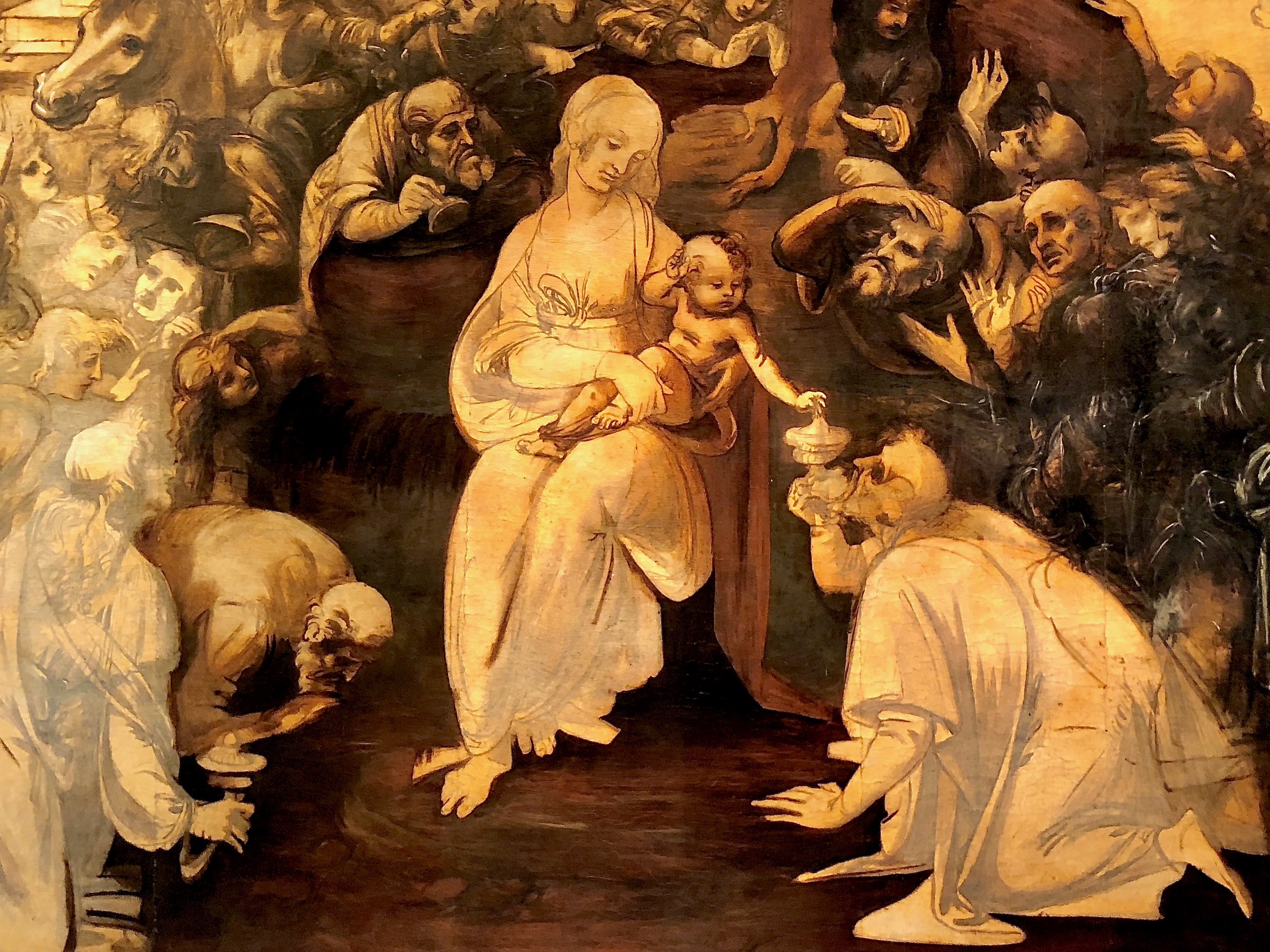
Leonardo da Vinci, Adoration of the Magi (1481-2).

I don’t want to go very far down that road on Christmas Day. The twelve days of Christmas are a time for celebration and feasting, carols and good cheer, light hearts and extravagant hopes, joy and wonder, and lots of love. But I do want to share a poem by Luci Shaw, a Christian writer now in her 90s. She reminds us that the lovely babe of Bethlehem is going to grow up, and that we’re going to have to grow up with him.

One time of the year
the new-born child
is everywhere,
planted in madonnas’ arms
hay mows, stables
in palaces or farms,
or quaintly, under snowed gables,
gothic angular or baroque plump,
naked or elaborately swathed,
encircled by Della Robia wreaths,
garnished with whimsical
partridges and pears,
drummers and drums,
lit by oversize stars,
partnered with lambs,
peace doves, sugar plums,
bells, plastic camels in sets of three
as if these were what we need
for eternity.

But Jesus the Man is not to be seen.
We are too wary, these days,
of beards and sandalled feet.

Yet if we celebrate, let it be
that He
has invaded our lives with purpose,
striding over our picturesque traditions,
our shallow sentiment,
overturning our cash registers,
wielding His peace like a sword,
rescuing us into reality
demanding much more
than the milk and the softness
and the mother’s warmth
of the baby in the storefront creche,
(only the [grown] Man would ask
all, of each of us)
reaching out
always, urgently, with strong
effective love
(only the [grown] Man would give
his life and live
again for love of us).

Oh come, let us adore him—
Christ—the Lord[ix]

Okay, I can’t leave you there, not on Christmas Day. So let me end on a note of wonder, with a poem by G. K. Chesterton. It was sung at this year’s Christmas Eve Lessons and Carols at Kings College, Cambridge. [x]

The Christ-child lay on Mary’s lap,
His hair was like a light.
(O weary, weary were the world,
But here is all aright.)

The Christ-child lay on Mary’s breast,
His hair was like a star.
(O stern and cunning are the kings,
But here the true hearts are.)

The Christ-child lay on Mary’s heart,
His hair was like a fire.
(O weary, weary is the world,
But here the world’s desire.)

The Christ-child stood at Mary’s knee,
His hair was like a crown.
And all the flowers looked up at Him,
And all the stars looked down.

Church of St. Mary the Virgin on Holy Island, Northumbria.

This sermon was preached at St. Barnabas Episcopal Church on Bainbridge Island, Washington, on Christmas Day, 2023.


[i] Thomas Merton, “A Letter on the Contemplative Life” (August 1967), in Lawrence S. Cunningham, ed., Thomas Merton: Spiritual Master—The Essential Writings (Mahwah, NJ: Paulist Press, 1992), 425.

[ii] Gerard Manley Hopkins, “God’s Grandeur.” 

[iii] Maximus the Confessor (c. 580-662). Quoted in Nikolaos Loudovikos, A Eucharistic Ontology: Maximus the Confessor’s Eschatological Ontology of Being as a Dialogical Reciprocity (Brookline, MA: Holy Cross Press, 2010), 125.

[iv] Peter Mayer, “Holy Now.”

[v] Ephrem the Syrian (c. 306-379), Hymns on the Nativity (trans. Kathleen E. McVey, Paulist Press, 1989), adapted from a citation in Wendy M. Wright, The Vigil: Keeping Watch in the Season of Christ’s Coming, Nashville, TN: Upper Room Books, 1992), 95-96. 

[vi] Irenaeus (c. 130-202), Against Heresies, IV.20.

[vii] The phrase is from Thomas Merton’s famous revelatory experience at the corner of Fourth & Walnut in Louisville in March 1958. “And if only everybody else could realize this! [the dignity of humanity conferred by the Incarnation]. But it cannot be explained. There is no way of telling people that they are all walking around shining like the sun.”

[viii] Mary Elizabeth Coleridge (1861-1907), “Salus Mundi.”  She was the great-grandniece of Samuel Taylor Coleridge. 

[ix] Luci Shaw, “It is as if infancy were the whole of incarnation,” quoted in Sarah Arthur, ed., Light Upon Light: A Literary Guide to Prayer for Advent, Christmas, and Epiphany (Brewster, MA: Paraclete Press, 2014), 125-126.

[x] G. K. Chesterton, “A Christmas Carol,” was sung in a lovely setting by John Rutter on the 2023 Lessons and Carols from Kings College, Cambridge, during the annual live BBC broadcast with which I begin every Christmas Eve at 7 a.m. Pacific Time.

August 6: Light Eternal or Light Infernal?

The Transfiguration of Christ (Sr. Abraham, Ethiopian community in Jerusalem, 1990)

I spent only one year in a world without nuclear weapons. My first birthday fell on July 16, 1945, the day of the initial atomic bomb test in New Mexico. A few weeks later, my country used the bomb to extinguish countless human lives on the Feast of the Transfiguration. With Transfiguration falling on a Sunday as Oppenheimer is playing in the theaters, a few comments are in order.

In an interpretive retelling of the Transfiguration by a 17th-century Anglican bishop, Moses and Elijah discuss the paradoxical mixture of evil and glory that permeates the Way of the Cross:

A strange opportunity … when [Jesus’] face shone like the sun, to tell him it must be blubbered and spat upon;… and whilst he was Transfigured on the Mount, to tell him how he must be Disfigured on the Cross! [i]

In the twentieth century, that paradox was tragically deepened when we dropped the atomic bomb at Hiroshima on the Feast of the Transfiguration. Two kinds of light, diabolic and divine, contending forever after for the soul of this world. Whose world is it, anyway? To which light do we belong? To which light do we pledge our allegiance?

In his novel Underworld, Don DeLillo chillingly mixes and confuses the primal images of divine and diabolical light when a nun, swept out of her conscious self into the informational totality of the Internet, has a visionary experience on a website devoted to the H-bomb:

She sees the flash, the thermal pulse . . . . She stands in the flash and feels the power. She sees the spray plume. She sees the fireball climbing, the superheated sphere of burning gas that can blind a person with its beauty, its dripping christblood colors, solar golds and red. She sees the shock wave and hears the high winds and feels the power of false faith, the faith of paranoia, then the mushroom cloud spreads around her, the pulverized mass of radioactive debris, eight miles high, ten miles, twenty, with skirted stem and platinum cap.

The jewels roll out of her eyes and she sees God . . . . 

No, wait, sorry. It is a Soviet bomb she sees . . . . [ii]

Seattle Times, July 16, 1995 (50th anniversary of the first atomic bomb).

I’ve not yet seen Oppenheimer, the film about the creator of the atomic bomb. But I was struck by this paragraph in a review by Adam Mullins-Khatib:

Oppenheimer … is a searing portrait of a man plagued by visions of a world that can’t be seen, a theoretical world composed of the literal particles of his ideas. Driven by an unyielding need to bring his visions to light, J. Robert Oppenheimer (Cillian Murphy) struggles with the notion of bringing theory into practice … It’s a film about the creation of something not before seen and the consequences this entails.” [iii]

Something not before seen and the consequences this entails. That could describe both the coming of Christ and the invention of the Bomb: each brought into the world something not before seen, manifested in a moment of blinding brilliance. And each has had enormous consequences which are still very much with us. But only one of them is the Light eternal, pure brightness of the everlasting Love who loves us. 

To paraphrase the divine Voice in Deuteronomy 30:19, 

This day I set before you life and death, blessing and curse, 
the light eternal and the light infernal. 
Choose life. 
Or else. 

In 1944, one year before Hiroshima, Orthodox theologian Vladimir Lossky, wrote these words: 

“We live in a world of suffering, a world broken and disintegrated, in which Christ’s Transfiguration uncovers reality and reveals to our skeptical minds a new humanity that has either entered into the light of the Risen One or is still called to do so … [W]e need to put on a robe of light, the apparel of those who live without fear, since they have already conquered death and the multiple anxieties associated with it.” [iv]

In this troubled and darkened age, that is exactly how the friends of God must live. 

Let us put on the robe of light, 
and live without fear.

.


[i] Bishop Hall Joseph Hall, Contemplations upon the principal passages of the Old and New Testaments, 1612-28, found on Google Books, p. 383.

[ii] Don DeLillo, Underworld (New York: Scribner, 1997), 825-6.

[iii] Adam Mullins-Khatib, Chicago Reader, July 26, 2003: https://chicagoreader.com/film/review-oppenheimer/

[iv] Vladimir Lossky, The Mystical Theology of the Eastern Church (Crestwood, NY: St. Vladimir’s Seminary Press, 2002, Originally published in French in 1944)), 151, 244.

Whose World Is It?—Rethinking the Problem of Evil

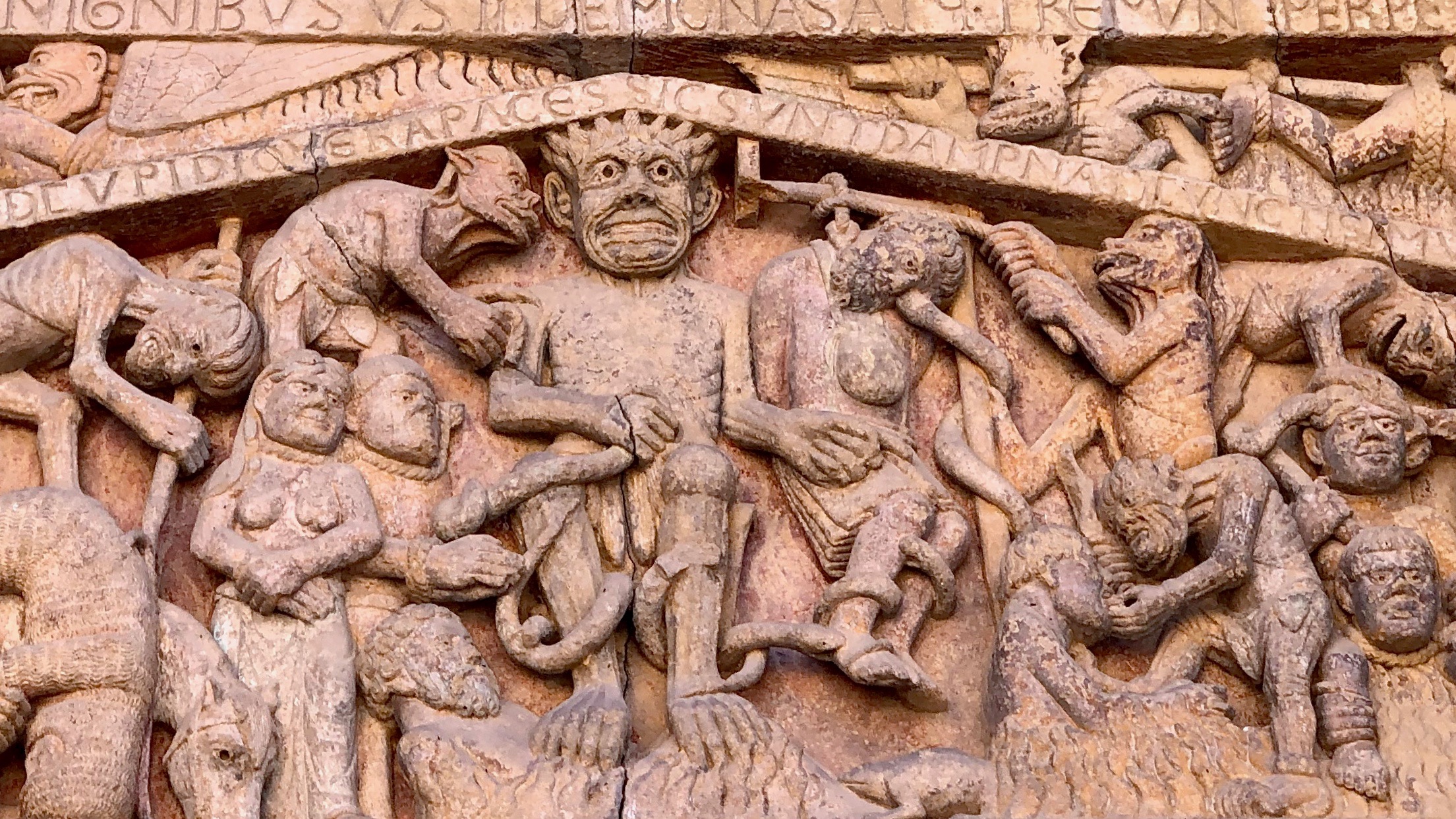
The Last Judgment (detail), Tympanum of the Abbey of Sainte-Foy, Conques, France (c. 1107).

God isn’t the prime mover of every natural catastrophe and human ill; inexplicable tragedies are never a so-called act of God. Life is more complicated than that; so is the universe; so is God. 

— Gary Commins

Lord, if you had been here, my brother would not have died (John 11:21).

In Son of Man, a 2006 film retelling the Jesus story in a 21st-century African country, Jesus and Satan are sitting side by side atop a tall sand dune. After putting up with the three temptations, an exasperated Jesus turns suddenly toward his adversary and gives him a hard shove. As Satan tumbles down the dune, Jesus shouts after him, “This is my world!” But Satan is unbowed. When he reaches the bottom, he picks himself up, dusts himself off, and cries up to Jesus, “NO! THIS IS MY WORLD.” The film cuts to the country’s ongoing civil war, where a mass shooting of schoolchildren proves Satan’ point. 

One night last week, a drunken man was shooting a gun in his front yard—reportedly a form of recreation in his Texas neighborhood. But his next-door neighbor had a baby who was trying to sleep. He asked the shooter to stop. The shooter refused. Instead, he fetched a deadlier weapon—an assault rifle—took it into his neighbor’s house, and slaughtered five people, including a nine-year-old boy. The police found a few survivors—children shielded beneath the bodies of their mothers—uninjured, but covered with maternal blood.  

Such unspeakable evil has become a regular occurrence in my country. Mass shootings are setting a record pace this year. Twenty years ago, there were 200 million guns in America. Now there are 400 million. Twenty years ago, assault rifles were 2% of the market. Now they are 25%[i] The man who pulled the trigger in Texas is not alone in his guilt. He is joined by the gunmakers who make themselves rich from the carnage, the right-wing lawmakers who fetishize guns to get votes, the cable propagandists who stoke fear, rage and hate, and a dysfunctional society incapable of exorcising its legion of demons.

The Last Judgment (detail), Tympanum of the Abbey of Sainte-Foy, Conques, France (c. 1107).

I have written about our capacity for denial in “The Murderous Hypocrisy of ‘Thoughts and Prayers.’” If we say we have no sin, we deceive ourselves, and the truth is not in us (I John 1:8). Or as a modern theologian puts it, “It is only when our capacity for evil has been rendered explicit that we have a realistic basis for understanding that transformation or metanoia, that healing, which constitutes our salvation.” [ii]

Zooey Zephyr, a representative in the Montana state legislature, recently provided a perfect image of the cognitive dissonance inherent in pious self-deception. She was speaking against a Republican anti-trans bill which she believes will increase suicide among the young; but her words could apply to every political misuse of “thoughts and prayers”: “If you vote yes on this bill and yes on these amendments, I hope the next time there’s an invocation when you bow your heads in prayer, you see the blood on your hands.” [iii]

The Republican majority, like Pilate washing his hands of innocent blood, voted to silence Zephyr. They expelled her from the house. It’s easy to mock their fear of truth-telling, but when we look at our own hands, what do we see? 

Evil is woven not only into the fabric of the world, but into each and every soul. In Terrence Malick’s great (anti)war movie, The Thin Red Line, we are shown the violence and death of a terrible battle, but the realistic sounds of gunfire, grenades and human screams are muted beneath the elegiac music of Charles Ives’ “The Unanswered Question,” as though we are watching human evil through an impartial God’s tear-stained eyes. Then we hear the voice-over questions of an American soldier, seeking to penetrate the surface of the visible: 

“This great evil, where does it come from? How does it still enter the world? What seed, what root did it grow from? Who’s doing this, who’s killing us, robbing us of life and light, mocking us with the sight of what we might have known? Does our ruin benefit the earth? Is this darkness in you too?” [iv]

Who’s doing this? Who’s killing us? Is this darkness in you, too? The problem of evil is not only an unanswered question; it is unanswerable as well. In his valuable and insightful new book, Evil and the Problem of Jesus, Episcopal priest and theologian Gary Commins invites us to set aside the philosophical conundrums, engaging evil not as a theoretical puzzle but as a practical challenge.  

Since ancient times, the existence of evil has raised unsettling questions about the nature of God. If God is good, why is so much evil allowed to happen? Is God indifferent to our suffering, or somehow powerless to eliminate it? Can divine purpose ever justify evil, turning it to the good? Or must we conclude that a good God, or any God at all, is a logical impossibility, given the prevalence and persistence of evil?

Theodicy is the philosophical or theological attempt to reconcile the goodness of God with the existence of evil. It has produced a vast amount of profound intellectual reflection over the centuries. But Commins, drawing on his own pastoral experience, calls the whole enterprise into question. It’s not just that a rational explanation for evil offers little real comfort to its victims (Who wants to hear “It’s God’s will” at a funeral?). It also strips both God and evil of their complexity. The sources of evil are multifarious and impossible to trace with precision. And the activity of God within our temporal, finite existence is not a unilateral and unfettered exercise of power. The self-emptying God chooses to work within incarnational limits. The vulnerable babe in the manger grows up to die on a cross, and in between does what he can to address evil, not always successfully. 

“Traditional Western theodicy,” says Commins, “jams billions of people, or the planet, millions of millennia, and the infinite intricacy of subatomic matter into a solitary, simplistic enigma of God-and-evil. By tapering all its energy into one worn-out query, it diverts us away from more illuminating questions. Not only does it boil down a myriad of meanings into one conundrum of divine power or love. It concentrates on what is, in all likelihood, the least fruitful of many mysteries.” [v]

Instead of defending God’s honor or solving the ancient enigma of good and evil, we should accept the sheer givenness of “a wild, wondrous, chaotic creation [we] can’t comprehend or control.” [vi]  Instead of wondering why the world is so, we should devote our energies to the divine project of making it better. 

“The causes of evil and suffering are personal, social, structural, and cosmic: human delusions, collective misbehaviors, institutional grandiosity, and spiritual malice .… Until the End, suffering and evil will neither cease nor desist—they are inherent in creation and intensified by social ills; we can decrease them by aligning ourselves with God’s will.” [vii]

We may never understand why the world must be an unstable mixture “of storms and stillness, gloom and brightness,” where “suffering, evil, and chaos commingle with glory, love, and joy.”[viii]  But it’s the world we’ve got, and what we really need to figure out is how to live in it.

And for that, Commins says, we must turn to Jesus, who shows us “what it means to be human.” If we seek a Christian understanding of God’s response to evil, we should start not with metaphysics, but with the gospel.

“Jesus never waxes philosophical. Rather than offering an ‘explanation’ for evil, he gives his followers ‘a charge and a benediction’: the charge to stand in solidarity with the oppressed, the benediction to empower his followers to resist evil.” [ix]

“Nowhere does Jesus construct a system of ethics or author a theology of evil. In broad terms, what we can do to undo evil is clear—act on his words, treat all as equals, seek the kingdom, go and do likewise, repent, follow, forgive, and love—but unless we face the evils within us, we won’t have a positive influence on the world around us and, even then, nothing is a sure thing.” [x]

At the same time that Jesus is showing us how to be fully human, he is revealing who God is and what God does. Jesus’ own responses to evil are “epiphanies into God’s relationship with evil.… what Jesus does in time, God does in eternity; the ways Jesus responds to evil in his lifetime—confronting, undoing, and erasing it; bending, circling, and transforming it—are ways God always engages evil.” [xi]

No metaphysical speculation needed. Just keep an eye on Jesus, and the Way will show itself. In a beautifully succinct summation of this Way, Commins says that “Jesus embodies compassion, challenges judgments, reverses fates, levels inequalities, frees from demons, forgives sins, tells truths, and plants seeds of shalom.” [xii]

So whose world is it, after all? We wonder every time we watch the news. But ultimately, it’s a question to be answered not within our minds, but in the activity of our lives. As the song says, “It may be the devil or it may be the Lord, but you’re gonna have to serve somebody.”[xiii]

The late German theologian Dorothee Soelle (1929-2003) found this paradigm of Christian discipleship perfectly expressed in The Brothers Karamazov, where Ivan and his younger brother Alyosha are earnestly discussing theodicy. Both agree that no long-range divine purpose could ever justify the torture of children in the here and now. Where the brothers differ is in their personal response to evil. Ivan blames and rejects a God who consents to the immense sufferings of history. But Alyosha, notes Soelle, does not shake his fist at heaven. He is too busy attending to the needs of earth, just like the God who became one of us.

“[Alyosha] directs his attention not to the power above but to the sufferers. He puts himself beside them. He bears their pain with them. He listens with agony as Ivan introduces examples of suffering he had assembled against the compassion of God … He is silent, he shares the suffering, he embraces the others.” [xiv]

Compassion’s embrace: from Alexander Sokurov’s “Lc. 15:11-32” (Prodigal Son installation,Venice Biennale 2019). Sculptures by Vladimir Brodarsky & Katya Pilnikova.

Photographs by the author. For more on the Tympanum at Conques, including a video of what the original painted colors might have been: https://www.tourisme-conques.fr/en/en-conques/the-tympanum

[i] These statistics were cited in a televised interview with Fred Guttenberg, speaking about the new book he has co-authored with Thomas Gabor: American Carnage: Shattering the Myths That Fuel Gun Violence. 

[ii] Kenneth Surin, Theology and the Problem of Evil (Oxford & New York: Basil Blackwell Ltd., 1986), 157.

[iii] https://apnews.com/article/montana-trans-lawmaker-silenced-zooey-zephyr-d398d442537a595bf96d90be90862772

[iv] The Thin Red Line (1998), adapted by Terrence Malick from James Jones’ 1962 novel. 

[v] Gary Commins, Evil and the Problem of Jesus (Eugene, Oregon: Cascade Books, 2023), 14. Full disclosure: Gary is an old friend. We meet up periodically in Eugene for national track & field championships, but never discuss evil during the meets. His new book not only offers a fresh and timely take on a central theological question, it does so through an illuminating method of reading Scripture and tradition in general.

[vi] Commins, 68.

[vii] Ibid., 194.

[viii] Ibid., 155, 194.

[ix] Ibid., 41. The quoted phrases are from Susan R. Garrett’s article, “Christ and the Present Evil Age,” Interpretation 57 (2003), 370-383.

[x] Ibid., 129-130.

[xi] Ibid., 159.

[xii] Ibid., 149.

[xiii] Bob Dylan, “Gotta Serve Somebody,” on Slow Train Coming (1979). 

[xiv] Dorothee Soelle, Suffering (London: Darton, Longman and Todd, 1975), 175.

Extravagant Sacrifice: A Holy Week Reflection

Jan van Scorel (c. 1530)

Mary took a pound of costly perfume made out of pure nard, anointed Jesus’s feet, and wiped them with her hair. The house was filled with the fragrance of the perfume. But Judas Iscariot, one of his disciples (the one who was about to betray him) said, “Why was this perfume not sold for three hundred denarii and the money given to the poor?” — John 12:3-5  

Judas raises a troubling question for everyone who is not destitute. As long as there is human need, how dare we spend our money on anything else? And Jesus’ answer—“The poor are always with you”—might seem equally troubling, if taken to accept economic inequality as inevitable. But Jesus was never complacent about the status quo. In both word and deed he lifted up the lowly—the ones either ignored or shamed by their culture—declaring them worthy of blessing and honor. As Jesus himself put it, he came to bring good news to the poor: Injustice has no future. God’s kingdom of loving interdependence is at hand. 

Here’s how I read this text: “You can help the destitute any time you want, Judas. If your concern is sincere, they’ll still be around after I’m gone. But I won’t be. So don’t be so quick to judge this woman. If you could only understand what’s going on here, it would save your life.”

So what is going on here? A woman, Mary of Bethany, whose brother Lazarus had recently been rescued from death by Jesus, pours very expensive oil over the feet of her Lord, and then wipes those feet with her hair. It’s an extravagant gesture of devotion, gratitude and love. The oil, worth a year’s wages for a common laborer, may have cost Mary most of her wealth, while letting down her hair to do the work of a towel was, in that culture, a shocking display of abasement and vulnerability. In other words, she was offering all that she had and all that she was to honor Jesus. 

This act, both sensory and symbolic, overflowed with meanings. Anointing with oil was a way to mark the special vocation and identity of authoritative figures, whether powerful rulers or holy persons. It consecrates them as chosen and set apart. The title of “Messiah” or “Christ” means “the anointed one.” It was revolutionary to have a woman be the one to anoint Jesus as priest and ruler, but so was the kingdom he came to manifest and embody. 

Anointing was also part of the culture’s preparation of a body for burial. Performed in the week before Jesus’ death, Mary’s gesture inaugurates the sequence of sacrificial acts culminating with her Lord’s burial in the stone-cold tomb. The feet she anoints will walk the Way of the Cross for the salvation of the world. This was his chosen destiny. 

The story’s third meaning is in its foreshadowing of the foot-washing, when Jesus, on the night before he died, knelt at the feet of his friends to perform the work of a servant, surrendering his power for love’s sake. He was teaching by showing: This is how we must be with one anotherThis is exactly how God is with us. Just a few days before Jesus taught this explicit lesson at the Last Supper, Mary of Bethany had performed it instinctively, offering all she had, holding nothing back. 

At the time, the disciples did not grasp the full significance of Mary’s act. Nor did Mary herself. How could they? As we like to say about Holy Week, the journey is how we know. The disciples had to follow Jesus all the way to the cross—and beyond—before they could begin to understand—through memory and reflection—what it was all about. 

One of the strongest triggers for memory is our sense of smell. When John’s gospel tells us that “the house was filled with the fragrance of the perfume,” it sounds like a vivid personal memory. Recalling the fragrance, the disciples could revisit that moment to absorb all the meanings which had escaped them at the time. 

As we make our own personal and communal journey through Holy Week, may we too immerse ourselves extravagantly in the sensory images and sounds of the Passion narratives and rituals, allowing them, by our faithful participation, to take us deeper and deeper into the Paschal Mystery of dying and rising in Christ. 

As for Judas’ sour complaint, Sydney Carter’s Passion carol, “Said Judas to Mary,” nicely disposes of its false premise of either/or. Devotion to Jesus and loving service to “the least” of God’s family are not opposed. They are inseparable:

Said Jesus to Mary, “Your love is so deep, 
 today you may do as you will. 
Tomorrow, you say, I am going away, 
but my body I leave with you still.”

“The poor of the world are my body,” he said,
“to the end of the world they shall be.
The bread and the blankets you give to the poor
 you’ll know you have given to me.”

Here is a lovely rendition of Carter’s Holy Week carol sung by Fiona Dunn:


Celebrating the Holy Name on New Year’s Day

To the Name that brings Salvation
Honour, worship, laud we pay.

— John Mason Neale

Aelfric of Eynsham, an Anglo-Saxon monk around the turn of the first millennium, thought January 1 a poor choice for New Year’s Day because it lacked the inherent significance worthy of time’s annual renewal. The birthday of Jesus on December 25, or late March, when the land starts to wake from Winter’s sleep, seemed more propitious, and were each widely observed in the Middle Ages as the year’s true beginning. In the Church calendar, the year began in late autumn, on the First Sunday of Advent. In Britain, the First of January did not become the officially accepted New Year’s Day until 1752.

As Eleanor Parker explains in Winters in the World, her charming study of early English understandings of the seasons, monastic writers like Aelfric “wanted to read and interpret the natural world, to learn to recognize the meaning God had planted in it. They saw time and the seasons, from the very first day of the world, as carefully arranged by God with method and purpose—so they believed it should be possible to organize the calendar not according to the randomness of custom and inherited tradition, but in a way that reflected that divine plan.” [i]

But January 1 did mark a singular event in the life of Jesus. As the octave, or eighth day of Christmas, it was the date of the Christ Child’s circumcision, based on Luke’s description of the timing (“When the eighth day came …”— Luke 2:21). The Feast of the Circumcision was celebrated in Spain and Gaul as early as the 6thcentury, but Rome, reluctant to associate with the chaotic excess of popular New Year celebrations, waited until the 11th century to adopt the feast. While modernity has found the circumcision of Jesus a peculiar choice for liturgical celebration (it was finally suppressed in the Roman Catholic calendar revisions of 1969), the Middle Ages saw significance in the first shedding of the Savior’s sacred blood. It not only proved his fully vulnerable humanity; it also foreshadowed the sacrificial offering of Calvary. 

St. Paul’s spiritualization of the physical ritual, making it an interior, metaphorical image of severing ourselves from the old body of death (“circumcision of the heart”—Romans 2:29), helped perpetuate the liturgical observance beyond the Middle Ages, but our own era has found more profitable meaning in the other thing that happened on the octave of the Nativity: Jesus got his name. 

When the eighth day had come and the child was to be circumcised, they gave him the name Jesus, the name the angel had given him before his conception (Luke 2:21).

The Feast of the Holy Name of Jesus is celebrated on various dates in early January, but the Episcopal calendar, following Luke’s account, puts it properly on New Year’s Day. And while many of us usually spend January 1 watching the Rose Parade and bowl games instead of keeping the sacred feast, whenever the year begins on a Sunday, the secular traditions are transferred to January 2, leaving Episcopalians free to gather on January 1 to observe Holy Name.

Although the Hebrew name “Yeshua” (“Iesus” in the 4th-century Latin Bible, becoming “Jesus” in the 17th-century Geneva Bible) was fairly common in 1st-century Palestine, it was given special weight by divine authority (both Mary and Joseph were told by God’s messenger, “You must name him Jesus.”) And its literal meaning, “Yahweh is salvation,” became fully embodied and expressed in the life, death and resurrection of the son of Mary. Jesus is the one who saves.   

St. Paul defined Christians as “those who in every place call upon the name of our Lord Jesus Christ” (I Cor. 1:2). The whole New Testament attributed great power to the name of Jesus. The first Christians prayed in his name (John 14:14), baptized in his name (Romans 6:3), and healed in his name (Acts 3:6). The Prologue to the Fourth Gospel declares that “to all that received him, who believed in his name, he gave power to become children of God” (John 1:12). And in Paul’s famous tribute in Philippians, no other name can compare:

Therefore God also highly exalted him and gave him a name that is above every name, so that at the name of Jesus every knee should bend, in heaven and on earth and under the earth, and every tongue should confess that Jesus Christ is Lord, to the glory of God the Father” (Philippians 2: 9-11),

Medieval theologians sang exuberant praises of the Holy Name. St. Bernard wrote: “The name Jesus is food. Are you not strengthened every time you recall it? What else builds up the spirit of the one pondering it as this name does? What so refreshed the tired heart, strengthens the virtues, fosters chaste loves?” Richard of St. Victor said that “Jesus is a sweet name, a name of delight, a name that comforts the sinner, a name of blessed hope. Therefore Jesus, be to me Jesus!” And Peter of Ravenna equated the name with the effects of salvation: “You shall call his name Jesus—the name that gave sight to the blind, hearing to the deaf, walking to the lame, speech to the mute, life to the dead; and the power of this name drove all the might of the devil from the bodies of the possessed.” [ii]

Eastern Christianity developed a repetitive recitation of the Holy Name into the transformative practice of centering prayer.[iii] And countless hymn writers have hailed “the power of Jesus’ name.” 

John Newton (1725-1807), author of “Amazing Grace,” celebrated the Holy Name’s healing power:

How sweet the name of Jesus sounds
In a believer’s ear!
It soothes his sorrows, heals his wounds,
And drives away his fear.[iv]

Even at our end, he believed, “the music of thy name” will “refresh my soul in death.” An expanded list of the Name’s effects was given by John Mason Neale (1818-1866):

Name of gladness, Name of pleasure,
By the tongue ineffable,
Name of sweetness passing measure,
To the ear delectable.

‘Tis our safeguard and our treasure,
‘Tis our help ‘gainst sin and hell.
‘Tis the Name for adoration,
‘Tis the Name of victory;

‘Tis the Name for meditation
In the vale of misery:
‘Tis the Name for veneration
By the Citizens on high.

‘Tis the Name that whoso preaches
Finds its music in his ear:
‘Tis the Name that whoso teaches
Finds more sweet than honey’s cheer …[v]

Such praises of the Holy Name do not mistake its invocation as a magic charm detached from any concrete meaning. When we say “Jesus” with prayerful, sacred attention, we call up a vast array of transformative forces, from the salvific events of the gospels to the abiding energies of divine presence. As a young Palestinian woman put it to me once, in her imperfect but brilliantly accurate English: 

Jesus is a big word. You can never come to the end of it.”

Episcopal theologian William Porcher Dubose (1836-1918) made the same point this way:

“Jesus Christ is to me, not a name, or a memory or tradition, nor an idea or sentiment, nor a personification, but a living and personal reality, presence, and power. He is God for me, to me, in me, and myself in God … And ‘in His name’ means ‘in Him,’ and ‘in Him’ means ‘in his death and resurrection.’” [vi]

The attempt to grasp the reality represented by the Holy Name is vividly imagined by Charles Wesley (1707-1788) in the figure of Jacob wrestling with the Divine stranger whose name he struggles to know:

Come, O thou Traveller unknown,
Whom still I hold, but cannot see! …

I need not tell thee who I am,
My misery or sin declare;
Thyself hast called me by my name,
Look on thy hands, and read it there.

But who, I ask thee, who art thou?
Tell me thy name, and tell me now.…

Art thou the Man that died for me?
The secret of thy love unfold:
Wrestling, I will not let thee go
Till I thy name, thy nature know.…

The wrestling with the nameless Transcendent continues, and even though its ungraspable essence departs with the dawn, there is a personal, relatable presence that remains, and can be named. 

I know thee, Savior, who thou art—
Jesus, the feeble sinner’s friend.
Nor wilt thou with the night depart,
But stay, and love me to the end …

And in this abiding, enfolding presence, the poet discovers yet another name behind (within?) the name of Jesus. It is the Holy Name above all others:

Thy nature, and thy name, is LOVE. [vii]


[i] Eleanor Parker, Winters in the World: A Journey Through the Anglo-Saxon Year (London: Reaktion Books, 2022), 76.

[ii] The quotations are cited in the 13th-century collection by Jacobus de Voragine, The Golden Legend, Volume 1, trans. William Granger Ryan (Princeton, NJ: Princeton University Press, 1993), 73.

[iii] The “Jesus Prayer” (Lord Jesus Christ, Son of God, have mercy on me) is often synchronized in its repetitions with a pattern of slow, deep breathing. 

[iv] John Newton, “The Name of Jesus.”

[v] John Mason Neale, “The Name of Jesus.”

[vi] Wiliam Porcher Dubose, The Reason of Life (London 1911), cited in Love’s Redeeming Work: The Anglican Quest for Holiness, eds. Geoffrey Rowell, Kenneth Stevenson, & Rowan Williams (Oxford: Oxford University Press, 2001), 493.

[vii] Charles Wesley, “Wrestling Jacob.” The original biblical story is in Genesis 32:24-33.

You Gonna Have to Serve Somebody: Thoughts on Christ the King

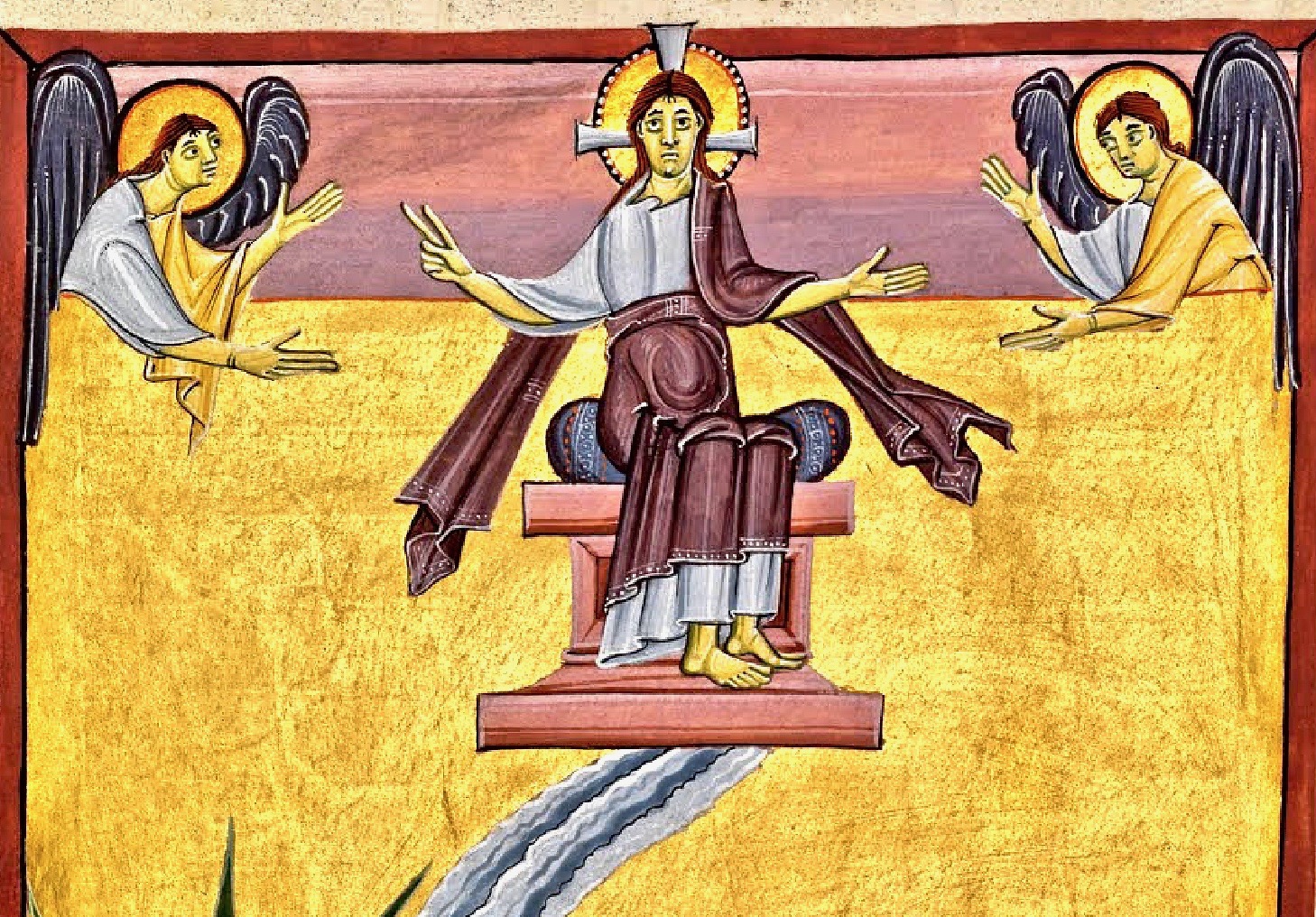
The Enthronement of Christ (Bamberg Apocalypse, early 11th century).

The extremists in American politics say that God is on their side, but such statements are lacking in content. Their “God” is not really expected to supply any concrete assistance, such as plagues or angelic legions, to carry them to victory. “God-on-our-side” language is just a dramatic way to say that “we are right and you are evil.” 

However, a new video ad is selling the startling idea that God has indeed, in these latter days, directly intervened in history by anointing a human messiah to enforce divine will through political power. Over God’s-eye aerial views of land and sea, we hear a caricature of Charlton Heston recite a text with biblical cadences and a lot of reverb:

“And on the 8th day, God looked down on his planned paradise, and said, ‘I need a protector.’ So God made a fighter.… God said, ‘I need someone to be strong, advocate truth in the midst of hysteria, someone who challenges conventional wisdom, and isn’t afraid to defend what he knows to be right and just.… someone who will take the arrows, stand firm in the face of unrelenting attacks.’” 

As we hear these words, photographic images of the Chosen One fill the screen. The new messiah is revealed to be—wait for it—Ron DeSantis, the governor of Florida! I knew he had presidential ambitions, but now he’s in the running for the Antichrist! Are there really enough rubes out there to fall for the old false messiah gag? [i]

About 60 years ago a southern preacher named Clarence Jordan liked to ask his fellow Christians: “What’s the biggest lie told in America today?” He’d let that sink in for a bit, and then he’d say, “The biggest lie told in America today is: ‘Jesus is Lord.’”

In other words, if you say “Jesus is Lord” and foster racism, you’re a liar. If you say “Jesus is Lord” and support white supremacy, you’re a liar. If you say “Jesus is Lord” and foment bigotry and hate, you’re a liar. If you say “Jesus is Lord” and afflict the vulnerable, you’re a liar. If you say “Jesus is Lord” and do harm to your fellow beings, you’re a liar. 

Someone recently posted a short video on the internet depicting Jesus as the incarnation of our worst politics. It shows Jesus teaching his disciples in a variety of settings: 

“I was hungry, and you gave me something to eat. I was thirsty, and you gave me something to drink. And behold: Now I’m all lazy and entitled. You shouldn’t have done that.”

“What is a man profited, if he gains the whole world, but loses his own soul? A lot! He has profited a lot. One soul for the whole world, that is an amazing deal!” [ii]

Sad to say, some people would prefer the anti-Jesus who does nothing but reflect their own pitiful values. In any case, as the song says, “You gonna have to serve somebody: Well, it may be the devil or it may be the Lord, but you gonna have to serve somebody.” [iii]

So who’s it going to be?
Whom do we serve?
Who—or what—rules our life?
To whom do we belong?
To what do we surrender?

In a culture of hyper-individualism, the idea of submission to a larger reality, a greater good, goes against the grain. But we are all governed by something, maybe even a whole crazy stampeding herd of somethings, pulling us here, driving us there. Whether we are conscious of it or not, there are voices, inside us and outside us, which direct and rule our hearts in every moment.

A hundred years ago, Scottish theologian P. T. Forsyth suggested that “The first duty of every soul is not to find its freedom, but its Master.” And then he added: “If within us we find nothing over us, we succumb to what is around us.” [iv]  When that is the case, there is no shortage of impulses, passions, ambitions, ideologies, agendas and distractions to swallow us up and sweep us away.

On the last Sunday of the Christian year, the Feast of Christ the King, we pledge allegiance to the Divine Love that governs the universe. As Frederick Denison Maurice, nineteenth-century Anglican priest and social reformer, reminds us, the reign of Christ extends into every province of our common life: 

When we say, ‘Thy kingdom come,’ we desire that the King of kings and Lord of lords will reign over our spirits and souls and bodies, which [belong to God]… We pray for the extinction of all tyranny…; [we pray] for the exposure and destruction of corruptions inward and outward; [we pray] for truth in all departments of government, art, science; [we pray] for the true dignity of professions [and labor]; [we pray] for right dealings in the commonest transactions of trade; [we pray] for blessings that shall be felt in every [dwelling].[v]

“Crown him Lord of all,” we sing at the Feast of Christ the King. But the gospel for the day does not show us a mighty ruler, but only a naked man nailed to a tree. Soldiers mock the pathetic absurdity of his “kingship.” The sign above his head—“King of the Jews”—is a mocking irony. His only apparent subject is the dying thief hanging next to him. “Jesus,” he gasps, “remember me when you come into your kingdom.” [vi]

Some kingdom!
Some king!

Does Christ’s kingdom exist only in the future? Or is it somehow breaking into the here and now, even in the killing fields of history, where you need the faith of a dying thief to see it? 

The question we began with—whose world is it?—is, alas, undecidable within the flux of history. You can’t choose on the basis of the evidence, because for the time being the evidence is mixed, like the wheat and the tares.

But you can decide who’s got the better story—Jesus or Satan.
And you can choose which story you want to belong to:
The story which overflows with life, 
or the one that ends in death.

Your choice.


[i] You can see the video here: https://youtu.be/U9oTBA-MvZk

[ii] The “GOP Jesus” video, produced by Friend Dog Studios, is here: https://youtu.be/SZ2L-R8NgrA

[iii] Bob Dylan, “Gotta Serve Somebody,” on Slow Train Coming (1979).

[iv] Quoted in Leander E. Keck, Who is Jesus? History in the Perfect Tense (Columbia, SC: University of South Carolina Press, 2000), 164, 167.

[v] Goeffrey Rowel, Kenneth Stevenson, Rowan Williams, eds., Love’s Redeeming Work: The Anglican Quest for Holiness (Oxford: Oxford University Press, 2001), 416.

[vi] Luke 23:33-43.

Crossing the Great Divide: A Homily on Dives and Lazarus

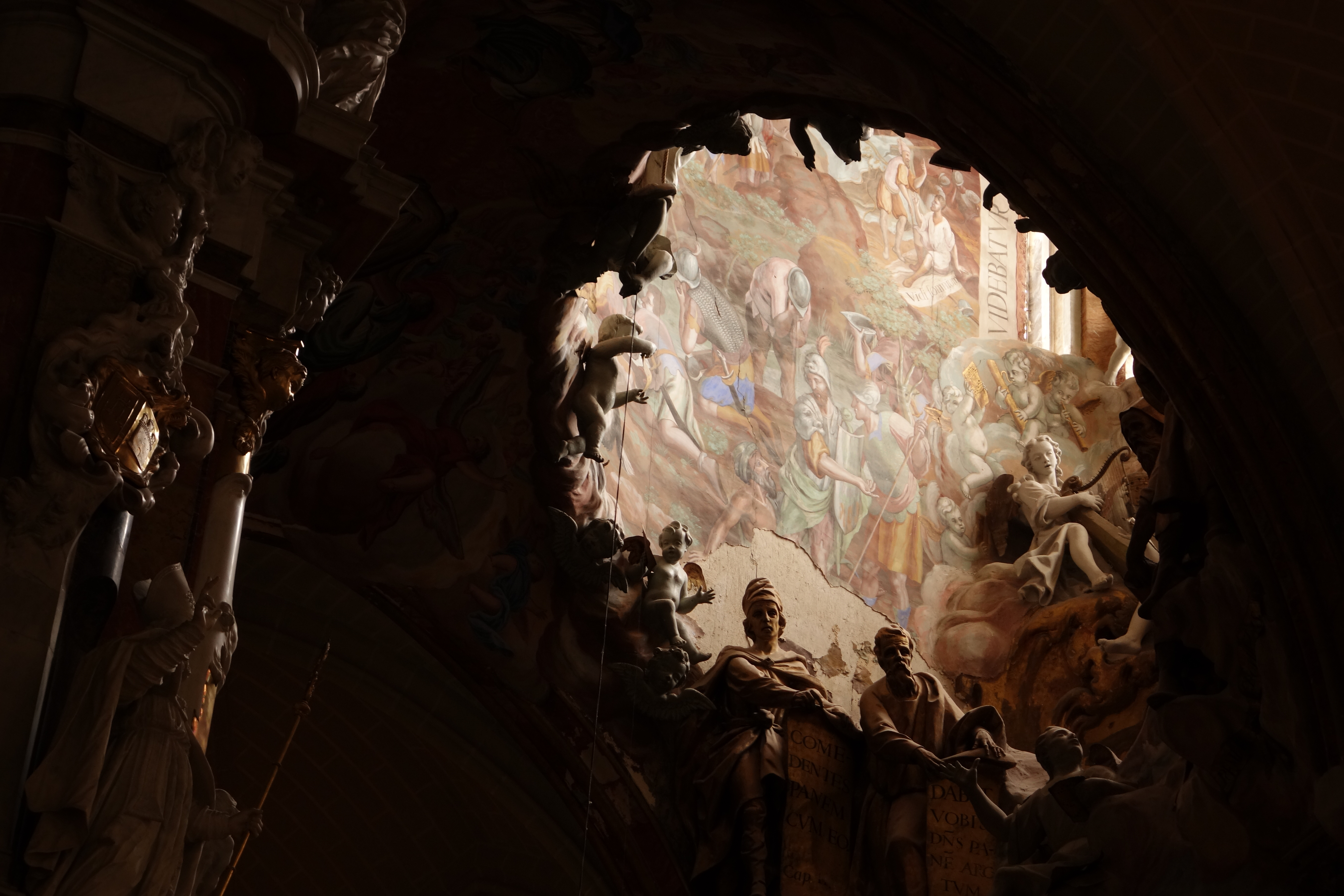
Skylight (1732) for the high altar of the cathedral in Toledo, Spain .

Only a tramp was Lazarus’ sad fate
He who lay down by the rich man’s gate
To beg for some crumbs from the rich man to eat
But he left him to die like a tramp on the street

— Grady and Hazel Cole, 1939

Jesus was a great storyteller. He knew how to use a good story not just to make a point, but to change lives. But today’s story isn’t quite like any other parable. It’s the only one where a character is given a name. The poor man is called Lazarus, a variant of Eleazar, which means “God helps.” The rich man is unidentified in Scripture, but tradition has given him the name Dives. That’s Latin for “rich guy,” so readers of the Latin Bible began to treat it as his proper name.

This is also the only gospel parable about the afterlife.[i] Most scholars suspect it to be a version of a popular Egyptian folk tale widely told the in the first century. The fact that it makes it into Luke’s gospel suggests that Jesus liked the story well enough to use it in his own preaching.

It’s easy to see why people loved the story in a time when economic inequality was as appalling as it is in America today, where the 3 richest billionaires have more money between them than the bottom 50%. In first-century Palestine, the rich had scooped up most of the land and money, leaving tenant farmers with pretty much nothing of their own, while those who hired out as laborers got only starvation wages. So the idea of a great reversal of fortune was an appealing and consoling image. 

The reversal theme certainly resonated with St. Luke, whose gospel, more than any other, expresses a “preferential option for the poor.” [ii]  We hear this in Mary’s Magnificat: “He has cast down the mighty from their thrones, and has lifted up the lowly. He has filled the hungry with good things, and the rich he has sent away empty.” And we hear it in the Beatitudes: “Blessed are you poor, for yours is the kingdom of heaven.”

A twelfth-century Italian bishop, Bruno di Segni, said of this parable, “These words are most necessary both for the rich and for the poor, because they bring fear to the former and consolation to the latter.” [iii] In Herman Melville’s 19th-century novel Redburn, his protagonist invokes the parable when he cries, “Tell me, oh Bible, that story of Lazarus again, that I may find comfort in my heart for the poor and forlorn.” [iv]    

We all love reversal stories, where the bad get their comeuppance and the lowly are given a happy ending. I have to confess that I myself would take pleasure in a story where, say, the governor of Florida is tricked into boarding an airplane, only to find himself dropped in the middle of a burning desert, with nothing but the desperate hope that a passing migrant might appear with a canteen of water. “Oh Señor, have mercy on me! I beg you, give me a drop of your water to cool my tongue!”

So is Jesus telling a reversal story in the parable of Dives and Lazarus? Or is he doing something else? The Bible certainly can be critical of wealth’s dark side. We’ve heard plenty of that in today’s readings:

Woe to those who are at ease in Zion, 
and for those who are complacent on the mount of Samaria…
Woe to those who lie on beds of ivory, 
and sprawl on their couches,
stuffing themselves with lamb and veal, 
singing idle songs and drinking wine by the bowlful,
who anoint themselves with the finest oils,
but are not grieved over the ruin of Joseph. (Amos 6: 1, 4-6)

And St. Paul, in his first letter to Timothy, warns that “those who want to be rich fall into temptation and are trapped by many senseless and harmful desires that plunge people into ruin and destruction. For the love of money is a root of all kinds of evil, and in their eagerness to be rich some have wandered away from faith and pierced themselves with many pains.” (I Timothy 6:9-10)

But while the parable presents a strong contrast between situations of extreme wealth and extreme poverty, between high social status and low social status, between easy pleasure and terrible suffering, the point is not about changing places, or even about trying to reduce the contrast to some extent—a little less for the rich, a little more for the poor. This parable isn’t about making the game fairer, but about changing the game entirely. 

Right now, in our time, our country, the game is so much about individual winning. The lucky ones win the lottery, invent the Internet, crush the competition, or throw more touchdowns than interceptions. The rest must fend for themselves. Dog eat dog. There have been notable attempts to counter the personal, social, and environmental damage of our careless individualism, but in the absence of a more widely supported vision of the common good, it continues to be an uphill battle. Can we order our lives and our society to be more in accord with divine intention? We’d better. As W. H. Auden put it on the eve of World War II, “We must love one another or die.” [v]

We all enjoy the hymn, “All things bright and beautiful,” celebrating the wonderful world God has made: “Each little flower that opens, each little bird that sings,” and so on. But one verse—thankfully scrubbed from our hymnal—celebrates an archaic social order as divinely ordained:

The rich man in his castle,
The poor man at his gate,
He made them, high or lowly,
And ordered their estate.

In the kingdom of God, the economy of God, such sundering of neighbor from neighbor is definitely not bright and beautiful. We all belong to one another; we are all intended to share God’s gifts in just measure. To forget this is to choose death and hell. 

Kathleen Hill, an American writer, lived in Nigeria when the traditional cooperative social ethic was being eroded by the lingering effects of colonial rule. She tells of a driver who sped by a hit-and-run victim lying on the side of the road. He didn’t stop because he was afraid that if he put the wounded man into his car, he’d get bloodstains on his new seat covers. “He’d felt no need to apologize,” Hill said, “no need to feel ashamed. It was a culture of money that was growing in Nigeria, a new emphasis on personal wealth.… [N]ow, without the play of traditional values that had connected one person to another, there seemed no limits to self-interest, to the tendency to regard someone else exclusively in the light of one’s own personal imperatives.” [vi]

Where there are no limits to self-interest, no one is my neighbor. Dives feasts inside his mansion, while Lazarus starves on the street. And never the twain shall meet. I think that Jesus would say that Dives was in hell from the start. He didn’t have to die to get there. 

But is this state of separation and disconnection the way things must always remain, now and forever, Amen? Is there any chance for the twain to meet? I think the key to this parable is the gate. The rich man is on one side; Lazarus is on the other. In the story, the gate never opens. In fact, its role as a barrier eventually translates into an uncrossable chasm in eternity.

Narciso Tome’s dramatic skylight seems to visualize a glimpse of heaven from a dark abyss,
like Dives’ view of Abraham and Lazarus across the great chasm.

In the parable, Dives in hell is able to see, across that chasm, Lazarus at ease in the bosom of Abraham. But the gap between them is uncrossable. If only he had opened his gate and experienced Lazarus as a fellow child of God—not just a tramp on the street—there would be no uncrossable chasm between them now. He wouldn’t be stuck in the lonely hell of self-interest and self-isolation. It turns out that the closed gate keeping Lazarus out has also been keeping the rich man in. Even after death he remains in the prison he built for himself, behind the locked gate preventing the communion for which every person is made. 

New Testament scholar Bernard Brandon Scott says this about the gate: “In this parable the rich man fails by not making contact.… The gate is not just an entrance to the house but the passageway to the other.… In any given interpersonal or social relationship there is a gate that discloses the ultimate depths of human existence. Those who miss that gate may, like the rich man, find themselves crying in vain for a drop of cooling water.” [vii]  

“I came that you might have life,” Jesus said, “and that you may have it more abundantly” (John 10:10). So is there abundant life in the rich man’s future? Can the chasm ever be bridged by repentance and mercy? Ebenezer Scrooge, after being shown what a mess he was making of his own future, put this question to the final spirit in A Christmas Carol,: 

“Are these the shadows of the things that Will be, or are they shadows of things that May be, only? Men’s courses will foreshadow certain ends, to which, if persevered in, they must lead. But if the courses be departed from, the ends will change. Say it is thus with what you show me.” [viii]

Can there be a different outcome to the story of Dives and Lazarus? A couple of poets have explored interesting options. James Kier Baxter (1926-1972) of New Zealand concentrates on Dives, who is far worse off than Lazarus even before he departs this life:

Two men lived on the same street
But they were poles apart
For Lazarus had crippled bones
But Dives a crippled heart

In an intriguing twist, Baxter leaves Lazarus on earth and puts Dives in the Divine Presence. ‘My poor blind crippled son, [God] said, / ‘Sit here beneath My Throne.” And instead of eternity in Hades, Dives is given a chance to change his life: 

‘Go back and learn from Lazarus
To walk on My highway
Until your crippled soul shall stand
And bear the light of day,
And you and Lazarus are one
In holy poverty.’ [ix]

Canadian William Wilfred Campbell (1860-1918) focused his poem on Lazarus, giving him a voice he never had in the original parable. While enjoying the bliss of the afterlife, Lazarus is suddenly troubled by a “piercing cry of one in agony, / That reaches me here in heaven.” It’s the rich man’s anguished plea from hell, drowning out the more amiable sounds of heaven.

So calleth it ever upward unto me
It creepeth in through heaven’s golden doors;
It echoes all along the sapphire floors;
Like smoke of sacrifice, it soars and soars;
It fills the vastness of eternity.…

No more I hear the beat of heavenly wings,
The seraph chanting in my rest-tuned ear;
I only know a cry, a prayer, a tear,
That rises from the depths up to me here;
A soul that to me suppliant leans and clings.

O, Father Abram, thou must bid me go
Into the spaces of the deep abyss;
Where far from us and our God-given bliss,
Do dwell those souls that have done Christ amiss;
For through my rest I hear that upward woe.

Lazarus can’t ignore the sinner’s plea, nor does he want to. In a replication of both the Incarnation and the Harrowing of Hell, he begs “Father Abram” to let him descend to the uttermost depths on a mission of redemptive love. The journey is immense, and when the poem ends Lazarus is still on the downward way, with cries of pain ahead, shouts of glory behind. As he traverses the infinite gap between heaven and hell, we suspect this outward motion of self-diffusive love will go on and on, until that day when the tears are wiped from every eye and “God is all in all” (I Corinthians 15:28).  

Hellward he moved like radiant star shot out
From heaven’s blue with rain of gold at even…
Hellward he sank, followed by radiant rout…

‘Tis ages now long-gone since he went out,
Christ-urged, love-driven, across the jasper walls,
But hellward still he ever floats and falls,
And ever nearer come those anguished calls;
And far behind he hears a glorious shout. [x]

It’s a striking image: Love perpetually reaching for the hopeless and the lost, opening every gate, overcoming every obstacle that separates us from God. However, in the original parable, the rich man’s repentance is not off to a promising start. In his cry from hell, Dives doesn’t deign to speak to Lazarus at all. Instead, he asks Abraham, a personage he considers of equal status, to treat Lazarus like a common servant. “Have him dip a finger into cool water and come to me, so he can drip it onto my tongue.” Even in his agony, the rich man’s arrogant self-interest is unabated. 

In Luke’s gospel, this parable always ends the same way, no matter how many times we read it. Dives will stay stuck in the prison of his own making for as long as the story is told. If we want a new ending, we must write it with our own lives and times, as we push through the gate into a deeper union, a more loving communion with our fellow creatures. This is not only radically personal work, it is also the collective endeavor of Church and society. In a time when the common good and neighborly love are in acute peril, love and mercy ceaselessly call us to choose the better way. 

This homily was written for the Sixteenth Sunday after Pentecost at St. Barnabas Episcopal Church, Bainbridge Island, Washington.


[i] Matthew 25: 31-46 (The sheep and the goats) is also about the afterlife, but many scholars say it does not fit the definition of a parable. 

[ii] The term was popularized by Liberation theologians and activists in Latin America in the 1960s as a key element of Catholic social teaching.

[iii] Cited in Stephen L. Wailes, Medieval Allegories of Jesus’ Parables (Berkeley & Los Angeles: University of California Press, 1987), 255.

[iv] Herman Melville, Redburn (1849), ch. 37.

[v] W. H. Auden, “September 1, 1939.”

[vi] Kathleen Hill, She Read to Us in the Late Afternoons (Encino, CA: Delphinium Books, 2017), 57.

[vii] Bernard Brandon Scott, Hear Then the Parable: A Commentary on the Parables of Jesus (Minneapolis: Fortress Press, 1989), 159.

[viii] Charles Dickens, A Christmas Carol (18­­43), Stave IV. 

[ix] James Kier Baxter, “Ballad of Dives and Lazarus,” in Divine Inspiration: The Life of Jesus in World Poetry, eds. Robert Atwan, George Dardess, & Peggy Rosenthal (New York/Oxford: Oxford University Press, 1998), 260-261.

[x] William Wilfred Campbell, “Lazarus.” For complete text: https://www.poetryexplorer.net/poem.php?id=10045686