“Show me a coin” – A stewardship reflection

Roman coin with the head of the emperor Tiberius. The inscription may contain a claim of divinity.

Roman coin with the head of the emperor Tiberius. The inscription may contain a claim of divinity.

When the temple clergy in Jerusalem sent their stooges to ask Jesus a loaded question, they thought they had him cornered: Should we pay taxes to Caesar or not? If Jesus endorsed the Roman tax, he’d lose the crowd. If he encouraged nonpayment, he’d lose his freedom. His famous answer, of course, outsmarted his opponents and postponed his arrest for a few precious days.

“Show me a coin,” he said. One of them dug into his pockets and pulled out a coin, stamped with the image of the Roman emperor. “Whose picture is on it?” They all looked at the coin, straight men headed for a fall. “Caesar,” they said. Duh! “Well then,” Jesus said. “Give to Caesar the things that are Caesar’s, and to God the things that are God’s.”

We always smile at the Teacher’s wit. I like to think that Jesus pocketed the coin with a wink before walking away. But when the amusement fades, we are left with a puzzle. What does this saying mean for us? Is it a teaching, or even a commandment? What are we being asked to do with the money in our own pockets? The colorful Southern theologian Will Campbell, himself a country preacher, once said to me that if we give to God what belongs to God, there won’t be anything left for Caesar!

I loved what Will said – it had his characteristic prophetic edge – but it didn’t really solve the practicalities of being faithful to God while sharing in the costs and benefits of a complex economy. Most of us are not among the brave few who refuse participation by taxation in the military-industrial complex. We send in our check and accept our complicity in the mixed blessings of the system, which does provide for much common good along with its regrettably baneful effects (drones, for instance).

It’s like Monty Python’s Life of Brian, where a dissident complains, “The Romans took everything from us, and what have they ever given us in return?” His followers, to his chagrin, come up with a long list of benefits, including the aqueducts, sanitation, roads, irrigation, education, public baths, and even the absence of war in the Pax Romana.

While we live in this world, Jesus’ aphorism on taxes will never be an “answer” in the sense of an unambiguous guide for specific action. Instead, it persists as a question that interrogates every individual as well as every system. What does belong to God, exactly? And how then do we return to God what is God’s own?

Pooling our resources through taxation in order to educate our children, feed the hungry, protect the environment, provide universal health care and so on, might be regarded as one form of return, to which we subscribe as citizens with varying degrees of enthusiasm. Common good requires common action. Pooling our resources through church pledging to sustain a community of faith and grow God’s mission to the world is a less messy and more direct form of “giving to God what belongs to God.” Charitable giving is yet another kind of return.

This is how we live as citizens of heaven: we keep the gifts moving – in circulation – rather than hoard them for ourselves.

And did you notice that in this gospel story of the coin the notion of “belonging to” refers only to God or Caesar? We ourselves own nothing. We are but recipients and stewards. The only thing that really belongs to us, Jesus says, is the giving.

The Woven Light: Reflections on the Transfiguration

James Turrell, Arrowhead (2009)

James Turrell, Arrowhead (2009)

We would have thrown our clothes away for lightness,
But that even they, though sour and travel stained,
Seemed, like our flesh, made of immortal substance.
And the soiled flax and wool lay light upon us.
Like friendly wonders, flower and flock entwined
As in a morning field. Was it a vision?
Or did we see that day the unseeable
One glory of the everlasting world
Perpetually at work, though never seen
Since Eden locked the gate that’s everywhere
And nowhere?…

– Edwin Muir, “The Transfiguration”

Martin Scorcese’s 1988 film, The Last Temptation of Christ,” was criticized by many for its eccentric portrayal of a Jesus deeply conflicted by the fierce struggle between his two natures. As one reviewer wondered, “Is he God or is he nuts?” Scorcese, who specializes in tormented, confused male characters full of nervous intensity, defended his approach as an attempt to explore Christ’s humanity without the blinding glow of divine self-assurance that made many movie Jesuses seem stiff, complacent and unreal.

“What we were taught in Catholic schools emphasized the divine side of Jesus,” said Scorcese, who had considered priesthood in his adolescence. “Jesus would walk into the room and you would know he was God. Maybe he glowed in the dark or something, I don’t know, but this is the impression they gave us as children.”

The Jesus of Matthew, Mark and Luke does not glow, except in that strange moment called the Transfiguration, celebrated on August 6th in the liturgical calendar. This feast day goes largely unnoticed now in the western churches, who have essentially transferred it to the last Sunday of Epiphany. This neglect of August 6 is in part a concession to the decline of weekday celebrations, but it may also reflect a discomfort with the story itself, which feels like myth or vision rather than actual history. Not even the risen Christ matched the glow of the Transfiguration. What are we being asked to believe here?

We can never know the phenomenon behind the reported perceptions by Peter, James and John. But the symbolic dimensions of the narrative are clear, linking the incident to the ancestral epiphanies of Moses and Elijah. There is a mountain, where earth below meets heaven above. There is a cloud of unknowing, veiling divine presence in hiddenness and mystery. And there is a voice, making contact with human sense, rupturing the boundary between holy and profane to affirm the unique filial status of Jesus as God’s Beloved “Son.”

But what about that “dazzling” glow? What did the disciples actually see in Jesus on that mountain? Was it an unrepeatable moment, a temporary endowment bestowed upon Jesus to make a point to doubting disciples, or was it something Jesus always possessed?

Gregory of Palamas, a 14th century Orthodox theologian, argued the latter. He based his influential meditation practice of Hesychasm on contemplation of the “uncreated light” first seen at the Transfiguration. This light, he taught, was not an ephemeral experience of the senses but the unmediated presence of God. Although this holy light could be seen through physical eyes, it was not a natural light. It was, in fact, the uncreated energies of the Godhead, the splendor of the age to come, a light shining from God’s future into the present moment.

Christ is transfigured, not by putting on some quality he did not possess previously, nor by changing into something he never was before, but by revealing to his disciples what he truly was, in opening their eyes and in giving sight to those who were blind. For while remaining identical to what he had been before, he appeared to the disciples in his splendor; he is indeed the true light, the radiance of glory.[i]

Whatever we make of Gregory’s metaphysical claims, which were disputed by many of his contemporaries, the spiritual resonance of light is undeniable and universal. It is always seems to be about something more than physics. It seems inevitably imbued with Spirit.

Annie Dillard describes “mornings, when light spreads over the pastures like wings, and fans a secret color into everything, and beats the trees senseless with beauty…Outside it is bright…It is the one glare of holiness; it is bare and unspeakable. There is no speech or language; there is nothing, no one thing, nor motion nor time. There is only this everything.”[ii]

Where does such light come from? Is it something that happens to our eyes but is not really in the world, or is it somehow there, in the heart of things, “born of the one light Eden saw play?” Is it not just a simulacrum of divinity, but a direct manifestation?

James Turrell, Breathing Light (2013)

James Turrell, Breathing Light (2013)

James Turrell, one of the most celebrated of the contemporary “Light and Space” artists nurtured under California skies, has been exploring light and its effects since the 1960s. His mesmerizing spaces invite participants to experience not objects made visible by light, but light itself in an astonishing repertoire of varying colors and brightness. If there are walls, they seem to dissolve into the immateriality of radiance. If there is a ceiling, it may have a large opening inviting us to contemplate the luminous canopy of sky. “Light,” says Turrell, “is not so much something that reveals as it is itself the revelation.”

We eat light, drink it in through our skins. With a little more exposure to light, you feel part of things physically. I like the power of light and space physically because then you can order it materially. Seeing is a very sensuous act – there’s a sweet deliciousness to feeling yourself see something.[iii]

For many of us fortunate to have savored the deliciousness of Turrell’s light spaces, feeling ourselves see something is not just an intellectual or psychological act. It is spiritual – the “glare of holiness … beating us senseless with beauty.”

Turrell’s own Quaker tradition says that prayerful attention is “going inside to greet the light.” But is the radiance of divine beauty just in our souls, or does it permeate the universe? Does it show itself to us here, there and everywhere, as it did to Peter, James and John?

David Bentley Hart, an Orthodox theologian, proposes creation as a manifestation of God’s infinite luminosity, what he calls “the agile radiance of the Spirit.”[iv] We see this radiance not by looking away from the world, but by looking more deeply into it. But when the light is in eclipse, what then? “Sometimes,” says Bruce Cockburn, “you have to kick the darkness till it bleeds daylight.” Even at the Transfiguration, according to an Anglican midrash by a seventeenth-century bishop, Moses and Elijah felt impelled to warn Jesus about the suffering and darkness awaiting him once he descended the mountain:

A strange opportunity … when his face shone like the sun, to tell him it must be blubbered and spat upon;… and whilst he was Transfigured on the Mount, to tell him how he must be Disfigured on the Cross![v]

The poet Kathleen Raine perfectly describes the utter bleakness when “the curtain is down, the veil drawn” over the world’s deep radiance. “Nothing means or is,” she says.[vi]

Yet I saw once
The woven light of which all these are made
Otherwise than this. To have seen
Is to know always.

[i] St. Gregory Palamas, The Triads, in Richard Harries, Art and the Beauty of God: A Christian Understanding (London: Mowbray, 1993), 85

[ii] Annie Dillard, Holy the Firm (New York: Harper Perennial, 1998), 67-8

[iii] q. in Michael Govan, “Inner Light: The Radical Reality of James Turrell”, James Turrell: A Retrospective (New York: DelMonico Books, 2014), 13

[iv] The Beauty of the Infinite: The Aesthetics of Christian Truth (David Bentley Hart, Eerdmans 2003), 292

[v] Joseph Hall, Contemplations upon the principal passages of the Old and New Testaments, 1612-28, found on Google Books, p. 383

[vi] Kathleen Raine, in Harries, 87

We are not alone

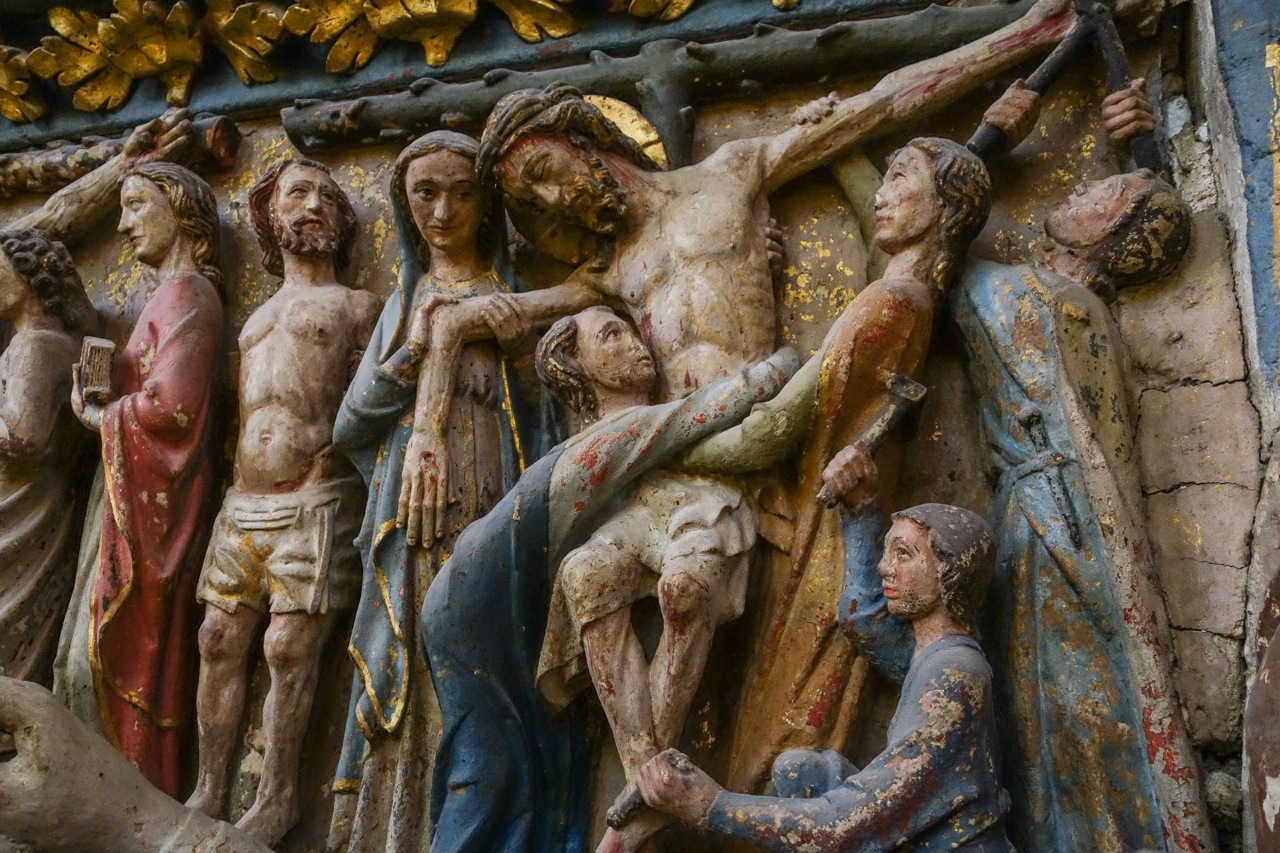
The Deposition (early Gothic; Leon cathedral on the Camino de Santiago)

The Deposition (early Gothic; Leon cathedral on the Camino de Santiago)

My God, my God, why have you forsaken me?

This cry from the cross is the most terrible verse in the Bible. God’s own Beloved, whose intimacy with God was so foundational to his existence that he could say “I and the Father are one,” here experiences the inexplicable loss of the Presence in which he has lived and moved and had his being. And God’s reply to Jesus is even more chilling: Silence.

Uncomfortable with this image of a Christ seemingly abandoned to the void of a godless universe, some have said that Jesus is merely quoting the first verse of Psalm 22, as though his piety outweighs his pain even on the cross. But Jesus was not just quoting Psalm 22; he had become Psalm 22. The Christ who was truly human had to taste even the most painful extremities of the human condition in order to redeem us fully. The one revealed to be God-with-us had to become, in that most bitter hour, us-without-God.

Have we not been there ourselves? Whether in the personal hour of trial when our own cries go unanswered, or in modernity’s cultural house of mirrors where the interventions of a loving God seems not only unnecessary but unthinkable, there are times when the Presence feels beyond our reach.

But as Paul says, Jesus became sin itself in order to save us from it (II Cor. 5:21). Sin is wherever God is shut out and we are walled in. And in making even the hellish absence of God as integral a part of his own experience as the intimacy of divine communion, Jesus performed the ultimate paradox: even when God seems most absent, God is yet present.

Good Friday means that whatever happens to us happens to God. From now on there is no place where God is not, for God has taken into Godself even the experience of separation and forsakenness. The Presence now includes the absence.

And we who have turned from God, or lost God, we who have cried out into the SILENCE, can yet live in hope. The One who died abandoned and bereft now keeps us company on our own crosses. As the Psalmist affirms with his possessive pronoun (“My God, my God!”). the relationship remains firm and unbroken even when God seems most mute and distant. We are not alone.

The Desert and the Flood (Homily for Lent 1)

Death Valley flowers

Today’s Old Testament reading takes us to the end of the great Flood in Genesis. Many people have trouble with this story, because they read it as a tale of crime and punishment, with an angry father god who will get us if we don’t behave.

But the rest of Scripture won’t let us read it that way. The rest of Scripture, including the ending of the Flood story itself – the rainbow and the promise – shows us the face of God as the face of love. God doesn’t want to kill us. God wants to make a covenant with us. God wants to marry us.

So what is the Flood story really about? It actually generates a multitude of meanings, but one of the central ones has to do with violence. Genesis says that God looked upon the earth and saw that it was filled with violence. Sound familiar?

Violence is what happens when we put ourselves in the center instead of God, and try to make the world over in our own image. We are unable to honor or even see the existence of other beings as independent of our own desire. We lose all curiosity for anything outside ourselves.

Violence is intolerance of difference: other selves, other perspectives, other cultures are treated as obstacles to our desire, and must be made either to serve us or be swept away. This intolerance of difference, of otherness, may be seen in the rhetoric of terrorists, as well as its mirror image in the anti-Muslim ranting of certain American politicians. It is may also be seen in the recent outbreaks of overt racism in this country. Fear and hatred of those not like us has become far too common.

Such boundless self-assertion, says the Bible, is the foundational violence that threatens to swallow the whole earth. The Flood is not a punishment imposed from the outside; it is what we have made of ourselves.

When we are hostile to those who are not like us, who are not useful in the boundless expansion of our swelling desire, we destroy the balances and boundaries of which the world is made. You can see this violence in relationships, on the freeway, in the crucifixion of Nature, in the current phenomenon of endless war. If we let creation’s harmonious balance be smashed by human violence, we will all be washed away, the innocent and guilty alike. Not even the billionaire profiteers will be able to hide on that day.

A world drowning in its own violence.
Is this an ancient myth, or the daily news?

But the Flood story has a surprise ending. Instead of destruction, new possibility. Instead of anger, love. Instead of violence, reverence for all beings with whom we share the planet. God tears up all the sad old tragedy scripts and gives us a comedy instead. God invites us to join in the re-imagination of the world. God writes a new story in our hearts.

This is why the Epistle of Peter links the waters of the Flood to the waters of baptism. Both are the ending of an old story and the birthing of a new one. When our old selves drown in the depths of the font, we are reborn in Christ. No longer I, but Christ in me, as Paul says.

But before Christ could become our future, he first had to become himself. We are all tempted to live some other life than our own, to wear other people’s faces instead of becoming what God made us to be. Jesus was no exception. He could have lived some other life. Tradition says that he was tempted to dominate others and to escape the Way of the Cross.

“You don’t have to suffer,” Satan told him. “Not you. You were born King of the World. Think of the good you could do with all that power.”

But if Jesus had not lived with the poor and the outcast, if he had spent his time making rich and powerful friends, would he have been Jesus? If he had led a violent uprising to overthrow Roman tyranny, if he had devoted his life to reforming the religious establishment, would he have been Jesus? If he had turned stones into bread, or not risen from the dead, would he have been Jesus?

“Ask me whether what I have done is my life.”
writes poet William Stafford.[i]
Ask me whether what I have done is my life.

Well, what Jesus did was his life. So, we may wonder, how do we do our own lives? To answer that question, we must go, with Jesus, to the desert.

The desert is the emptiness where there’s no place to hide. In the desert, you come face to face with yourself, your demons, and your God. Nothing is defined there, nothing known in advance. Your scripts are no good in the desert. Your evasions are futile. Whatever makes you want to turn around and run back to the safety of your old illusions is the very thing that is trying to kill you.

Only in the desert is the silence deep enough for you to hear the whisper of your innermost heart. And what is your heart trying to tell you? Listen. Listen to your heart.

As Parker Palmer says:

“Before you tell your lives what you intend to do with it, listen for what it intends to do with you … Vocation does not come from willfulness. It comes from listening. I must listen to my life and try to understand what it is truly about – quite apart from what I would like it to be about… Vocation does not mean a goal that I pursue. It means a calling that I hear. Before I can tell my life what I want to do with it, I must listen to my life telling me who I am…”[ii]

We’re always making up stories about ourselves. Sometimes we’re heroes, sometimes we’re victims. But all of these stories are fictions that make us deaf and blind to what our life is actually trying to tell us. What are the stories that you need to let go of in order to let your life speak? If you are going to give up anything this Lent, give up those tired old stories about yourself. They are no longer true.

When we are baptized, we die to our old fictions; we let go of the old stories by which we try to direct our lives. That’s why the Flood story is one of the great images for baptism. There are all those people of Noah’s time clinging to their own fictions, sinking down under the weight of their false identities just as we ourselves sink under the weight of our own fictions.

And when in baptism we are freed from the burden of our false selves, we rise, newly buoyant, to the surface; we are pulled out of the water and given a new story, a new name, which is our true self, our true life, which has been wanting to speak to us all these years.

That is the work we have come to do, as we begin our long Lenten journey, as we step out into that desert where every fiction will be stripped away. At first it will feel like loss, like too much giving up. We may even want to turn around and quit, like the Israelites who complained in the midst of their own desert journey: Let’s go back! It wasn’t so bad, being slaves in Egypt!

But with God’s help, we will keep going, deeper and deeper into that desert, determined to save the only life we can save,[iii] and there will come a day, some 40 days hence, when we will reach the other side. And there we will hear a voice, a voice that calls us each by name.

Come to the waters, the voice will say.
Come to the life-giving pool of the baptismal font.
Come to the Easter waters, and dive in.
Wash yourselves clean of the old fictions, the tired stories,
and rise again out of the watery depths,
newborn, with a new name,
a name which is: Not I but Christ in me.
And this new name, this new self,
is what our life has been trying to tell us all these years.

As Derek Walcott describes it,

The day will come when with elation you will greet
yourself arriving at your own door, in your own mirror,
And each will smile at the other’s welcome
Saying, “Sit here, eat, you will love again
the stranger who was yourself …
the stranger who has loved you all your life …
who knows you by heart.[iv]

The desert is wide, the journey long, but keep on keeping on, because it will lead you, step by step, into the heart of the Beloved who has loved you all your life, who knows you by heart.

And when we finally draw near the end of our Lenten journey, everything that the desert is about, everything the Christian faith is about, everything our very lives are about, will be intensified and distilled in the incomparable passage from death to life which we call the Paschal Mystery: the life-giving mystery experienced both ritually and personally in the Great Three Days of Holy Week: Maundy Thursday, Good Friday, and the Easter Vigil.

Right now, in these first lean and hungry days of the Lenten desert, the transformative joy of the Easter feast may seem unimaginable. But beyond the hunger and thirst, beyond the trials and temptations, the doubts and the stumbles, beyond even the faded Hosannas and the terrible shouts of “Crucify! Crucify!,” there will rise the jubilant Alleluias of the Easter Vigil, breaking at last the stony silence of defeat and death.

The great journey begins here. Now.
And when it’s over,
you will be somebody else:
Not I, but Christ in me.

[i] William Stafford, “Ask Me”

[ii] Parker Palmer, Let Your Life Speak: Listening for the Voice of Vocation (San Francisco: Jossey-Bass, Inc. 2000) 3-4

[iii] Mary Oliver, “The Journey”

[iv] Derek Walcott, “Love after Love”
My 10 favorite Jesus movie moments

My father, the Rev. James K. Friedrich, with Joanne Dru on the set of "Day of Triumph" (1954).

My father, the Rev. James K. Friedrich, with Joanne Dru on the set of “Day of Triumph” (1954).

In my last post, I listed my “ten best Jesus movies.” Here now are my ten favorite moments, scenes which not only succeed cinematically but also provide fresh and resonant images of the Christ who, as the Jesuit poet said, “plays in ten thousand places.” But my ultimate criterion is that each of these scenes, after countless viewings, never fails to engage and move me.

No single image can capture the mystery of the Word made flesh. No actor will make you think he has become the perfect movie Jesus. But whenever the gospel story is retold and re-experienced, we may yet see something we had previously missed. We may even partake of a new revelation that has been waiting all these years to be received.

1927: The little blind girl (The King of Kings)

Most of the Jesus films invent dialogue to fill the gaps, but the incidents involving Jesus remain mostly Scriptural. But this scene, performed with silent cinema’s eloquent language of faces and gestures, is entirely invented. And it’s marvelous. A boy just healed by Jesus wants to share his blessing with a blind girl. “Take my hand – let me lead thee to him.” He guides her to a window and gives her a boost. Inside, the mother of Jesus gently receives the girl, who feels Mary’s face with her hands. “Please, I have come to find Jesus.” In the original score, the string section plays “Fairest Lord Jesus” here, imploring every sentiment. Mary takes the girl to stand before her son, who has not yet appeared on screen. “Lord, I have never seen the flowers nor the light. Wilt thou open my eyes?” The pleadingly expressive girl (played unforgettably by Muriel McCormack) stands in for all of us who long to see the Light of the world. The air around her grows luminous, and then, through her own eyes, we see a blurry glow gradually become the loving face of Christ, whom we, like her, now see for the first time. It perhaps the grandest entrance in the genre, and the perfect metaphor for a medium trying to bring the reality of Christ to light.

1954: The Lost Sheep (Day of Triumph)

I admit special affection for this film because my father produced it and I got out of school for a week to play an extra (who ended up on the cutting room floor). And this sequence, employing the traditional (though unbiblical) conflation of Mary Magdalene with repentant female sinners, has moved me ever since I first saw it as a child. Magdalene, a wealthy courtesan (played by the beautiful Joanne Dru), happens to hear Jesus teaching in Jerusalem. When he tells the parable of the Lost Sheep, he looks pointedly at her. Back in her house, she asks her servant – an early follower – what she knows about Jesus, masking her spiritual longing as idle curiosity. As the conversation unfolds, something in Magdalene breaks, and we cut to a Pharisee’s house, where Jesus has been invited to dine. A repentant Magdalene, now in humble attire, arrives to wash Jesus’ feet with her tears. The Pharisee is shocked, the disciples bewildered. When Jesus speaks the words of forgiveness over her, we get the first close-up of Mary Magdalene’s tear-stained face. Every close-up in effect isolates the face from the external particularities of body, environment and social context, conveying something both universal and purely inward. For me, this intimate view of Mary’s magnified face as she raises her downcast eyes toward Jesus evokes salvation history in a single glance.

1965: The Annunciation to Joseph (The Gospel According to St. Matthew)

How do you tell the story of Joseph coming to terms with Mary’s pregnancy when you are restricted to Matthew’s actual text, which provides neither dialogue nor psychological description? Pasolini begins his film with a close-up of Mary, then of Joseph, each face suggesting an unresolved tension between them. After two more awkward close-ups, we finally see a full shot of a pregnant Mary (full of dis-grace) and the problem becomes clear. The scene moves toward resolution through entirely visual means, like silent cinema, omitting even Matthew’s sparse narration. When speech (the angel’s “annunciation” to Joseph) finally does intrude into this silent world, it feels like the shock of the transcendent. In the beginning was the Word.

1969: Jesus the teacher (Son of Man)

The Jesus in this rarely seen British television production is neither meek nor mild. In his Sermon on the Mount, he moves energetically among the crowd, prodding and challenging them to think in new and uncomfortable ways. First he invites them to embrace the kinfolk around them as a sign of love. “That’s nice, isn’t it?” he says, noting how easy it is to love those who love you. It’s nothing extraordinary. “Do you want me to congratulate you for that?” Then he delivers the kicker: “Love your enemy!” As he lists specific examples of the enemies they should love, the crowd begins to murmur its dissent, to which Jesus responds emphatically: “Did I come to tell you easy things? Do you want me to tell you easy things?”

1973: Resurrection? (Godspell)

The dead Jesus is taken down from the chain link fence where he hangs suspended. As his followers carry his body through the strangely empty streets of New York, their song turns from sorrow to joy. Some begin to dance while they process, as if Jesus has risen anew in the bodies of his disciples. As for the body which had once called “Jesus,” it is taken around a corner, out of our sight. When the camera itself finally rounds that corner, the disciples and the body they carried are gone. Instead, we see hundreds of people walking toward us – the people you would see any day on a busy city street. The body we knew has “ascended” out of our sight, and Jesus returns in the form of everyone.

1977: The Prodigal Son (Jesus of Nazareth)

Jesus invites himself to a party at Matthew’s house. The disciples are shocked that he would dine with sinners. Peter, who really hates the “blood-sucking” tax collector, tries to stay away entirely, but curiosity finally brings him to stand just outside the door. When Jesus spots him peering in, he decides to tell a parable about two sons. Not only is this scene cinema’s best example of Jesus as storyteller, it makes the parable contextual, aimed directly at Peter (the “elder brother”) and Matthew (the “prodigal”). Both get the point; both are changed by it. The whole scene is perhaps the most moving “resurrection story” in the entire genre.

1988: Christ before Pilate (The Last Temptation of Christ)

David Bowie plays a blasé, sardonic Pilate in his interrogation of Jesus, whom he dismisses as just another Jewish troublemaker. This is not a conflicted, timorous official afraid of the crowd or hesitant to condemn an innocent man, but a cold-eyed realist who knows how the world works. When Jesus explains that he wants to bring change through love, not violence, Pilate recites the creed of the status quo: “Killing or loving, it doesn’t matter how you want to change things. We don’t want them changed.”

1998: Jesus returns (The Book of Life)

The only Jesus movie about the Second Coming begins with a shabbily dressed man outside a New York airport terminal, speaking in a loud voice to no one in particular: “Forgive me, Jesus, for I have sinned. Have mercy on us now and at the hour of our death.” Over and over he cries out in the flat, mechanical tone of a mind in disarray. Passersby give him a wide berth. Suddenly a man in a nice suit enters the frame to put a hand on the vagrant’s shoulder, silencing his repetitive plea with a touch and a look. This healing stranger turns out to be Jesus, who has just flown in – on New Year’s Eve, 1999 – to judge the living and the dead (though it later turns out he just wants to forgive everyone). Then Jesus moves on to catch a taxi, followed by Mary Magdalene, who in passing reassures the stunned vagrant. “It’s OK,” she says, before hurrying on to the apocalypse.

2004: The Agony in the Garden (The Passion of the Christ)

While many find this film unwatchable for its excessive violence and uncritical use of Passion Play caricatures, it begins with a memorably haunting Gethsemane sequence. Dimly lit in the olive grove, Jesus shows real agony. “I’ve never seen him like this,” whispers a worried disciple. The horror movie tropes – full moon, deep shadows, the anxious expectancy of a camera in motion – contribute to the sense of something beyond the ordinary taking place, as though we are in a supernatural thriller. And when Jesus falls to the ground to beg the cup of suffering to pass him by, we see Satan watching him closely. Together they enact a mythic prologue to the Passion narrative: Gethsemane becomes the Garden of Eden, but this time the human will not fall to the demonic. The snake will be crushed beneath the Savior’s foot. When Satan leans down over the anguished Jesus praying to his Father, he asks him, “Who is your Father?” This seems less like a taunt than a perfect expression of evil’s blindness. Not only is it unable to see the good; it is unable even to conceive it.

2006: The Annunciation (Son of Man)

This South African film’s prologue is a Temptation scene where Jesus rebukes Satan by saying, “This is my world.” “No!” Satan replies, “This is my world.” As if to prove Satan’s point, the film cuts to a 21st-century African country torn by violent civil strife. In a small town, armed guerillas are killing everyone in sight. A young woman, fleeing the violence, hides in a schoolroom, where she is horrified to find a pile of murdered students. She lies down among them to play dead until the killers pass by. When she finally opens her eyes, there is the angel Gabriel (a shirtless boy adorned with white feathers), announcing the birth of the Savior. Mary responds with the Magnificat, sung in a powerful South African idiom. Here is the gospel absolutely in the present tense.

The ten best Jesus movies

Enrique Irazoqui and Pier Paolo Pasolini on location for "The Gospel According to St. Matthew"

Enrique Irazoqui and Pier Paolo Pasolini on location for “The Gospel According to St. Matthew”

The Feast of the Epiphany, recalling the journey of the Magi to adore the Christ child, ultimately celebrates the “showing” of Christ to the world. It seems the perfect day to post my list of the “ten best” Jesus movies, a genre which has fascinated me ever since I was a child extra in my father’s production of “Day of Triumph.” Surprisingly, that independent film by an Episcopal priest was the only Jesus film produced in the 1950’s, a decade packed with every other kind of biblical film.

For the last twenty-five years, I have taught “Jesus and the Movies” in seminaries, churches and retreat centers. I use clips from 19 feature films made between 1912 and 2014. The films always provoke rich conversations about biblical studies, Christology, religious art and film studies. Perennial issues of representation and interpretation are both repeated and transformed by the film medium, and the Jesus films, for all their limitations and imperfections, ask each viewer: “Who do you say that I am?” Even you don’t like a particular movie Jesus, you are compelled to think about the Jesus movie in your own head, your own heart. How does it differ from (or resonate with) what is on the screen?

As I noted in a prior post on the ten best religious films, top ten lists are subjective, revisable and always questionable, which is what makes them fun. And the Jesus film genre, burdened by religious expectations, commercial considerations, artistic pretensions and cultural controversies, has not produced any completely great films (each has its flaws, and the gospels themselves resist translation into perfect narratives), but it has given us many great scenes. I’ll list my favorite scenes in another post, but for now, in chronological order, here are my ten recommendations for your Epiphany binge-watching.

King of Kings (1961) Nicholas Ray’s uneven, studio-butchered epic was savaged by reviewers (“Incontestably the corniest, phoniest, ickiest and most monstrously vulgar of all the big Bible stories,” thundered Time Magazine). Blue-eyed fan-mag cover boy Jeffrey Hunter, although 33 years old, was dismissed as the “teenage Jesus,” though other saw echoes of JFK, inspiring and youthful, or “James Dean without the delinquency” (Ray had also made Rebel Without a Cause). And religious critics found too much humanity, not enough divinity. So what’s it doing on my list? Well, Ray was a terrific director, and the film is very watchable. It is also a prime example of cultural context shaping both the making and the reception of a Jesus film. Released at a time when both the biblical epic and the dominant Protestant metanarrative were on the wane in America, it failed for interesting reasons. At the same time, a Jesus constantly preaching “peace and love” reflected the ongoing anxieties of the Cold War era. And where else can you get narration by Orson Welles, a marvelous epic score by Miklos Rozsa (of Ben Hur fame), and the longest traveling shot in film history (160 feet of track on a steep Spanish hillside)?

The Gospel According to St. Matthew (1965) Pasolini’s black & white, hand-held, documentary “you are there” style, the rough-hewn faces of Italian non-actors, and the first dark-eyed Jewish Jesus all created an illusion of realism that instantly overthrew the conventions of biblical cinema. It is the first Jesus movie not to blend all four gospels or invent new dialogue and narration, though it significantly edits Matthew’s text (apocalyptic sayings, the Transfiguration, and some miracles are omitted). The director treats Jesus as a “revolutionary whirlwind” sweeping through Palestine. For some the protagonist is too strident, humorless and emotionally remote, but his relentless otherness nicely resists our domestication.

Jesus Christ Superstar/Godspell (1973) Permit me to link the Jesus musicals together: they came out in the same year, each is dated in its own way (singing and dancing on top of the World Trade Center, for example), and both remain strangely affecting, at least for persons of a certain age. In breaking the conventions of literal treatments, they not only opened new options for the genre, but influenced a rising generation of liturgists who brought street theater, comic play and contemporary music into the churches. Some critics glowered from the other side of a generational divide (“Jesus is just a teeny-bopper stoned on himself”), but there were more substantial controversies as well (in Superstar, a black Judas, an erotic Magdalene, Jewish villains caricatured as vultures, and a doubting Jesus). But each film provides a lively retelling with some very moving scenes.

Jesus of Nazareth (1977) Franco Zefferelli’s beautiful 6-hour miniseries on NBC, while shunning the artificial grandeur of Hollywood sets for a humbler, dustier Palestine, is suffused with its own pictorial conventions: Catholic iconography and Italian painting. Robert Powell’s engaging and self-assured Jesus, whose divine nature is clearly on display in key scenes, gives one of the most popular portrayals, though the film has been criticized for an overly interior spirituality that leaves the sociopolitical world untouched. Rather than trying to make Powell carry the entire burden of his character’s significance, Jesus of Nazareth focuses on the faces, reactions and emotions of his followers. Peter and Mary Magdalene, standing in for all of us who hear and follow, are unforgettable.

The Last Temptation of Christ (1988) The most controversial film of the genre prior to Mel Gibson’s Passion, Scorcese’s energetic, visceral take on the Kazanzakis novel is really a mashup of three bible characters: Jonah (the reluctant prophet resisting his inevitable vocation), Jesus of the gospels (creatively retold with a few quirky additions), and the Prodigal Son (who leaves the cross for the “far country” of a long, ordinary life, only to return “home” to Calvary at the end). This flawed but fascinating film has many firsts: the interior thoughts of Jesus, New York accents, sexuality, a restless camera always on the move, Peter Gabriel’s world music soundtrack, women at the Last Supper, and a novelistic source that exacerbates the confusions of fact and fiction.

Jesus of Montreal (1989) Denys Arcand’s postmodern play within a play furthered the transformation of a genre freeing itself from the restrictive conventions of piety and/or box-office caution. A group of contemporary actors, invited to reinvigorate a staid annual Passion Play, do so in wonderfully imaginative ways. At the same time, they find their personal lives starting to embody the characters they play. Earnest, clever and compelling, the film asks us to consider what it might mean to “play” Jesus in our own place and time.

Jesus (1999) This 4-hour television special offers a Jesus who seems quite modern in manner, speech and outlook. Jeremy Sisto is a “California slacker” type whose identity quest seems very American. This is often effective in putting us in the story, as if it’s something that could happen to us. But does it also reflect our own cultural selves so much that we can no longer believe we are seeing anything resembling history? An unprecedented use of special effects for the miraculous and mythic elements of the gospels is visually interesting, but it does create significant questions about what we are being asked to believe, since a special effect is transparently fictional, undermining the real but unseen content of faith.

The Miracle Maker (2000) Fresh, creative and often moving, this film uses claymation figures by Russian orthodox artists. Parables, dreams and inner experience are contrastingly rendered in two-dimensional animation. The engaging script, written by an Anglican, tells the Jesus story through the eyes of a child. The clay Jesus, resembling an eastern Christian icon (but with a ready smile) is more charismatic than many of his live-action brethren. The voice of Ralph Fiennes is part of the reason, but the animation itself engages us directly with the story in a way that real human faces do not. A dramatic film is always both a scripted fiction and also a kind of documentary about what the actors themselves are doing while the camera is rolling. With animation, you see only the story, not the actors, and that works beautifully here.

The Gospel of John (2003) This film gave itself a uniquely challenging task. Most Jesus movies invent dialogue to fill gaps in the narrative or articulate meanings left unsaid in gospel texts, but such a strategy is renounced here. The script uses only the words of the Fourth Gospel (in modern translation), forcing ingenious, if occasionally labored, strategies to keep the story moving and the viewer involved. The long speeches of the “Farewell Discourses” (John 13-17) are the supreme example. Ian Cusick’s Jesus is warm and passionate. You may never again hear “I am the bread of life” without seeing his smile.

Son of Man (2006) Produced in South Africa, it sets the Jesus story within a fictional 21st century African country beset by the horrendous legacy of colonialism, corporate exploitation, and factionalism. The first black movie Jesus is deeply embedded in contemporary times, teaching nonviolence to his disciples while speaking out against corrupt and evil powers. But we never lose sight of the original gospel story. The stunning depictions of Annunciation, Pieta and Resurrection will knock you flat. And the singing! So exhilarating. Here is a film where you really “meet Jesus again for the first time.”