Is the American Dream a Con Game?

L.A. Times TV Guide cover, June 2, 1968, two days before Robert Kennedy's assassination in Los Angeles (Jim Friedrich personal archive)

L.A. Times TV Guide cover, June 2, 1968, two days before Robert Kennedy’s assassination in Los Angeles (Jim Friedrich personal archive)

Oftener it falls, that this winged man, who will carry me into the heaven, whirls me into the clouds, then leaps and frisks about with me from cloud to cloud, still affirming that he is bound heavenward and I, being myself a novice, am slow in perceiving that he does not know the way into the heavens, and is merely bent that I should admire his skill to rise …

— Herman Melville, The Confidence Man

In Melville’s final novel, a ‘mysterious stranger’ boards a Mississippi riverboat on April Fools Day, initiating a series of scams upon the gullible passengers. Appearing in various guises, the stranger collects money for distant charities, solicits investments in get-rich-quick schemes, and sells miracle cures, all the while encouraging his marks to have confidence in the dream of better lives and a better world. He is the “winged man” who promises to carry them “heavenward.”

However, the marks soon learn that the hopes and dreams on offer are a total fraud. Melville describes the inevitable disillusion: “I tumble down again soon into my old nooks, and lead the life of exaggerations as before, and have lost the faith in the possibility of any guide who can lead me thither where I would be.”[i]

That riverboat still haunts the American imagination. We fall in love with dreams and schemes of better futures, better selves, a “life of exaggerations,” and invest our confidence in those who promise to deliver. This may work out for some, but more often there is the sting of disappointment, a sense of betrayal. As Greil Marcus has written, “America is a trap: its promises and dreams … are too much to live up to and too much to escape.”[ii]

Unattainable promises. Impossible dreams. The lonely crowd grows sullen, resentful, angry, like Nathanael West’s California dreamers in Day of the Locust (1939). Lured by the prospect of a New Eden out West, over the rainbow, they slave and save until they can afford to move to “the land of sunshine and oranges.”

Once there, they discover that sunshine isn’t enough. They get tired of oranges . . . Nothing happens. They don’t know what to do with their time . . . They realize that they’ve been tricked and burn with resentment . . . They have been cheated and betrayed. They have slaved and saved for nothing.[iii]

W. H. Auden described West’s novel as a parable “about a Kingdom of Hell whose ruler is not so much a Father of Lies as a Father of Wishes.”[iv] Either way, it’s a figure we all recognize: the Confidence Man, duping the suckers with his promise to make America great again. “Believe me. Believe me. It’s going to be terrific.”

And what happens when the dreamers tumble back to earth? Most of us muddle on as best we can, but in Stephen Sondheim’s darkly comic musical, Assassins[v], nine embittered and unbalanced Americans find a single target for their anger: the President of the United States. In a carnival of lost souls, a smirking barker (the Confidence Man in disguise!) doles out handguns like cotton candy to a new crop of eager marks. If you keep your goal in sight,” he sings, “you can climb to any height. Everybody’s got the right to their dreams.”

No job? Cupboard bare?
one room, no one there?
Hey, pal, don’t despair-
You wanna shoot a president?
c’mon and shoot a president…

John Wilkes Booth, Leon Czolgosz, Charles Guiteau, Squeaky Fromme, Sara Jane Moore, John Hinckley and a couple more broken dreamers line up to claim a gun as their means of grace and hope of glory.

And all you have to do
Is move your little finger,
Move your little finger and
You can change the world.

The climax takes us to Dallas, where the gang of murderous misfits pressures Lee Harvey Oswald to join their ranks and assuage their shared malady: “a desperate desire to reconcile intolerable feelings of impotence with an inflamed and malignant sense of entitlement.”[vi]

In the finale, all nine assassins come to the front of the stage, singing out with all the confident uplift we expect from our musicals:

Everybody’s got the right to some sunshine!
Not the sun, but maybe one of its beams.
Rich man, poor man, black or white,
Everybody gets a bite,
Everybody’s got the right
to their dreams……

The smiling cast stretches out the last word, “dreams,” for a full twelve seconds as they raise their guns high. The moment the music ends, they all fire at once, a deafening volley, and the stage goes black.

When Assassins premiered in 1990, it was not well received. It seemed too dark and crazy at the time. But when I saw a rare revival this month at Seattle’s ACT Theater, it somehow made perfect sense, so dark and crazy has America become in these latter days.

We all clapped and cheered, of course. It was a fabulous production. The cast was great. It wasn’t all grim. There was plenty of humor. And Sondheim’s songs! But I had tears in my eyes as well. As Jefferson said, “I tremble for my country…”

As the applause went on, I thought of Kierkegaard’s story of a theater which had caught fire backstage as the show was about to begin. The manager grabbed the first actor he found to step through the curtain and warn the audience to evacuate. That actor, alas, was dressed as a clown. “The theater is burning!” he cried. “You must leave immediately!” The audience roared with laughter at the clown’s performance. Such pathos! Such irony! The more he shouted and pleaded, the more they laughed, until they were all consumed by the flames.


[i] Herman Melville, The Confidence Man: His Masquerade in Pierre, Israel Potter, The Piazza Tales, The Confidence-Man, Uncollected Prose, Billy Budd, Sailor (New York: Library of America, 1984), 452

[ii] Greil Marcus, Mystery Train: Images of America in Rock ‘N’ Roll Music (New York: E.P. Dutton, 1975), 22

[iii] Nathanael West, Day of the Locust (from my personal transcription in a 1968 commonplace journal, original page unknown)

[iv] Wikipedia reference: Barnard, Rita. “‘When You Wish Upon a Star’: Fantasy, Experience, and Mass Culture in Nathanael West” American Literature, Vol. 66, No. 2 (June 1994), pgs. 325-51

[v] 1990, music & lyrics by Stephen Sondheim, book by John Weidman

[vi] John Weidman interview, quoted in Misha Berson’s Seattle Times review, March 9, 2016

The summer’s final mass

A perfect summer moment: Blue moon rises on the last day of July 2015.

A perfect summer moment: Blue moon rises on the last day of July 2015.

T-shirts, cut-offs and a pair of thongs,
We’ve been having fun all summer long.

– Brian Wilson & Mike Love

Piecemeal the summer dies ….
The field has droned the summer’s final mass.

– Richard Wilbur

In seventeenth century landscape painting, there was a tendency to idealize, to suspend change and death by capturing an eternal present. Through meticulous depiction of nature’s details, the fantasy of a deathless Arcadia was made concrete for the viewer. Inside the frame, there was no time, no death. Gazing upon one of these pictures, a character in Dostoevsky exclaims,

Here lived beautiful men and women! They rose, they went to sleep, happy and innocent; the groves rang with their merry songs, the great overflow of unspent energies poured itself into love and simple-hearted joys… The sun poured its rays upon these isles and the sea, rejoicing in its fair children. Oh, marvelous dream, lofty illusion![i]

The painting in question was Claude’s “Acis and Galatea.” And indeed, as the lovers embrace in their tent along the shore of a lovely harbor, it seems a perfect moment of harmony and bliss. But will it last? Claude has placed subtle harbingers of change within the scene. The sun is about to set. Polyphemus, the giant who will soon despoil the lovers of their happiness, lurks in the distance – not yet arrived, but on his way. Claude seems to find a heightened sweetness in such mortality; brevity breeds intensity. But Acis and Galatea might take a different view. We’ve been having fun all summer long. Why can’t it go on forever? But there you have it: golden ages, lovers, summer idylls, T-shirts, cutoffs, thongs – all carried off by time’s merciless flow.

Last night another summer slipped away. I was sorry to see it go. If only I could make it stay a little longer. And in fact, here on my island, these first hours of autumn seem no less radiant than yesterday. A warm afternoon is promised. But the idea of summer – marvelous dream, lofty illusion! – is unsustainable. Days shorten. Vacations end. Travelers return. Work calls. Schedules resume. The Sabbath rest of carefree hours and idle days is overruled by necessity. We can no longer enjoy the fiction of having all the time in the world.

In “real” life, a perfectly carefree interval of beach time, lawn parties and magical vacations is an unattainable myth. But now and again, when we do pause to breathe, to notice, to play, to be; when we forget time, giving ourselves wholly to the present moment; when we are attentive and receptive to whatever the universe wants to show us, summer draws near to bathe us in radiance.

All we need is the gift of reverie. Henry David Thoreau spent many a summer morning by his cabin door at Walden Pond, sitting quietly in the sun, listening to birdsong, feeling the warmth on his skin. To those afflicted by the pressures of a 24/7 world, this may seem an incredible waste of time. But like the saints who aspired to pray without ceasing, Thoreau dreamt of even more radical experiments in multi-sensory contemplation:

Would it not be a luxury to stand up to one’s chin in some retired swamp for a whole summer’s day, scenting the sweet-fern and bilberry blows, and lulled by the minstrelsy of gnats and mosquitoes?… Say twelve hours of genial and familiar converse with the leopard frog. The sun to rise behind alder and dogwood, and climb buoyantly to his meridian of three hands’ breadth, and finally sink to rest behind some bold western hummock. To hear the evening chant of the mosquito from a thousand green chapels, and the bittern begin to boom from his concealed fort like a sunset gun![ii]

It’s a comic exaggeration, typically deadpan New England humor, but it makes a point. The luxuriance of summer is a standing invitation to surrender to sensation, to unlearn the cultural imperatives of useful employment in order to pay close attention, moment by moment, to the poetry of the given world. Don’t just look. Dive in and get soaked.

Jesus said, “Unless you throw away your phones and cancel your appointments, unless you go outside and let a wandering cloud be your guide, you cannot enter the kingdom of heaven.” Those who have ears to hear, let them hear.

As a child, Mary Oliver “spent all summer forgetting what I’d been taught.” When she was summoned back to the chalky classroom in the fall, she still treasured the epiphanies of leisure in her heart:

the way the river kept rolling its pebbles,
the way the wild wrens sang though they hadn’t a penny in the bank,
the way the flowers were dressed in nothing but light.[iii]

And if the rest of us have been likewise receptive, we too will exit the summer laden with the gifts of deeply-lived moments. Some will call them memories and be done with them, but that would be a mistake. They can endure within us as a renewing source. Wordsworth called them “spots of time,” potent concentrations of aliveness by which we are ever “nourished and invisibly repaired.”[iv] And as Emerson recommended, on every such epiphany we should “rear a temple of wonder and joy.”[v]

This summer I never stood neck-deep in a swamp to hear mosquitoes chant, but I did keep watch in a field from midnight to dawn as meteors fell from an August sky. Some were brief flashes in the corner of my eye. Others left bright fiery trails lasting long enough for a good look. The profound nocturnal silence was broken only twice. A coyote howled in the brush around three a.m., and at four-thirty an owl whooshed close over my head – twice. That was it. Nothing much “happened.”

Or everything happened, and that night became a temple of wonder and joy I can return to again and again. Even now, as autumn sweeps in with all its portents of vanishing and loss, there is still a summer inside me.

[i] Fyodor Dostoevsky, The Devils

[ii] Thoreau’s Journal, June 16, 1840

[iii] “Just as the Calendar Began to Say Summer,” in Mary Oliver, Long Life: Essays and Other Writings (Cambridge, MA: Da Capo Press, 2004), 35

[iv] William Wordsworth, The Prelude (1799: 1.288-294)

[v] Ralph Waldo Emerson, Lecture (Dec. 19, 1838) in Ashton Nichols, The Poetics of Epiphany: Nineteenth Century Origins of the Modern Literary Movement (Tuscaloosa, AL: University of Alabama Press, 1987), 8

Every day, a miracle

image

The Greek island of Santorini is famous for its singular beauty, shaped by ancient catastrophe. Like many of Greece’s treasures, it is a ruin, the curved remnant of an immense volcanic crater. When the caldera collapsed, the sea poured in, leaving only a few bits of the crater still above water. Santorini is the largest and tallest of these, with vertical walls rising a thousand feet above the Aegean. And perched along the edge of its towering cliffs are several whitewashed settlements, shining bright and cheerful against the fierce dark rock beneath them.

The village of Oia on the island’s western tip is the picturesque mecca for romantic travelers hoping for a travel poster moment. It has always drawn honeymooners, but it is also increasingly popular for destination weddings. The fairytale warren of cliffside dwellings, the dizzying prospect of the vast Aegean blue, the vivid sunsets and candlelight dining can persuade even the forlorn and forsaken to recover the idea of happiness.

image

“The secret for harvesting from existence the greatest fruitfulness and the greatest enjoyment,” said Nietzsche, “is to live dangerously! Build your cities on the edge of Vesuvius!” So on Santorini, after one of the biggest cataclysms in recorded history, humans returned to the edge of disaster and pitched their precarious towns. It’s been the isle of romance ever since.

Perhaps it has been loved too much. Since I first came here in 2001, the main pedestrian avenue has been developed into a trendy corridor of shops that feels more like a generic consumerist mall than a local village. We couldn’t see Greece for all the shoppers funneled in from the cruise ships. We resolved to retreat to our quiet balcony just outside town, to while away our time with reading and gazing.

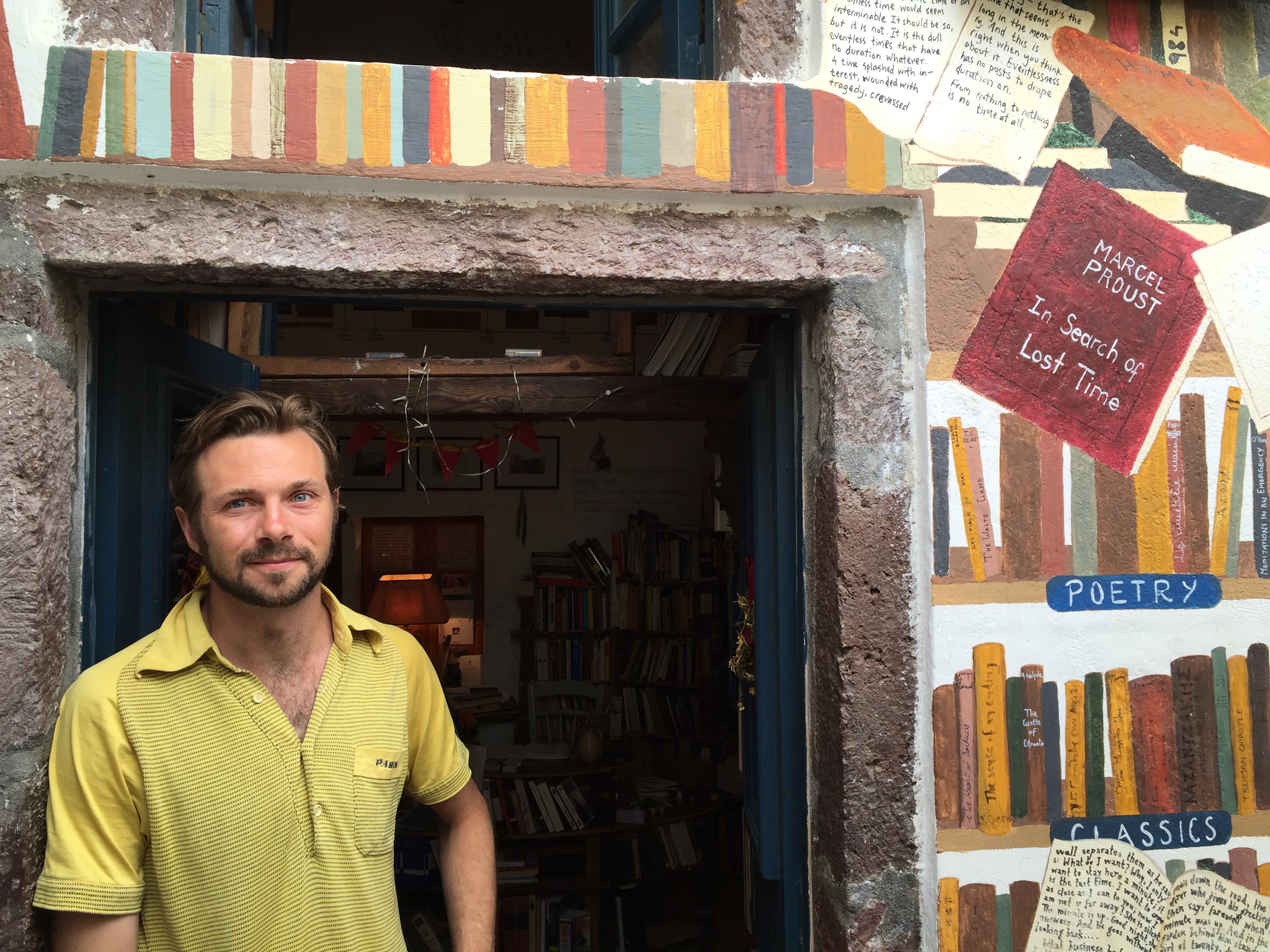
But grace had other plans. Santorini had more to give us. The first gift was Atlantis Books, ensconced In the cozy quarters of an old sea captain’s house. You must descend steps to enter. Painted on the handrail: “Books are no more threatened by Kindle than stairs by elevators.” The music playing inside was Texas legend Townes Van Zandt’s “Pancho and Lefty”; Living on the road, my friend, was gonna keep you free and clean …” 

Great song, but not widely known. I knew I was onto something here. I struck up a conversation with Nick Hunt, a writer from London visiting for a few months to help mind the store. Painted in an expanding spiral on the ceiling above us were the names of hundreds like him who have worked here during its eleven-year history, drawn by its literary fervor and high-spirited whimsey. There are quotes on the walls in several languages. Charles Bukowsi’s caught my eye: “Find what you love and let it kill you.” The book inventory was rich and full of unexpected treasures, such as a first edition in red leather of Lewis Carroll’s logical conundrums, The Game of Logic.

I had just been reading Patrick Leigh Fermor’s riveting account of his walk across Europe, at the age of eighteen, from Britain to Byzantium (Istanbul) in the 1930’s. It’s some of the greatest travel writing of the twentieth century, and I was delighted to learn that Nick had recently retraced Fermor’s journey on foot to see what may have changed in 80 years. His own book about what he found, Walking the Woods and the Water, will be at the top of my reading list when I get home.


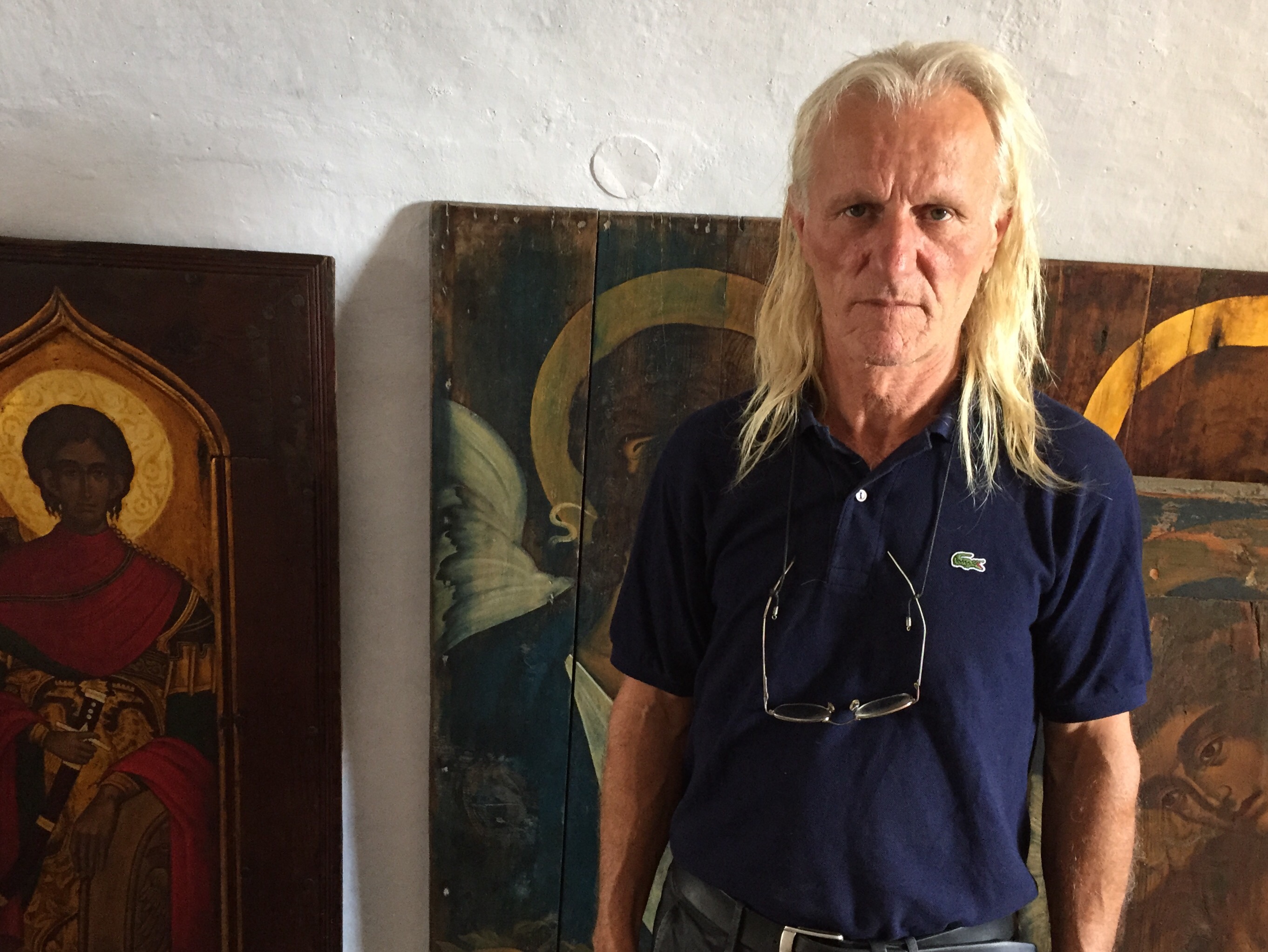
It was lovely to make such resonant connections, both musical and literary, in such an unexpected place. But the day had even more to give us. Just down the street we stopped in at the workshop of the celebrated icon “writer,” Dimitris Kolioussis, a man of great heart and generous spirit. His exquisite icons, painted meticulously with traditional methods, but often on found materials from old doors to cutting boards, are profoundly moving. His workshop, filled with these holy images, seems a kind of church, and his calling is clearly sacramental: bringing the invisible into visibility.


“I started making icons when I was a boy,” he told us. “Then I discovered it was my job.” He paused thoughtfully before adding, “Every day, a miracle. Every day, I give thanks.”

A guitar leaned against his easel. I picked it up and sang him a couple of American folk songs as a modest thank offering. He replied with some tasty blues licks.

It was a day of gifts which never would have happened had we remained on our beautiful balcony and kept to ourselves. Once again, Santorini, you have taught us happiness.