Category Archives: Nature
Merry it is while summer lasts
Such tenderness, those afternoons and evenings,
saying blackberry, blackberry, blackberry.
— Robert Hass, “Meditation at Lagunitas”
Mirie it is while somer y-last. “Merry it is while summer lasts.” So goes the 13th-century lyric, one of the earliest known secular English songs (the other being Summer is icumen in). But while such praise of summer lacks the explicit theological or liturgical character of its pious predecessors, is not the idealized notion of a happy summer a plausible echo of the joys of Paradise? History takes a vacation. Ambition is deposed. The temporal flow slows its onward rush, deepening into a placid pool of unhurried being. The poet’s longing for “world enough, and time” is fulfilled at last in a sabbath of playful ease. Children romp in the sea, lovers stroll bright gardens, readers open their books, friends converse at evening. Mirie it is.
It should always be so in August, that we might agree with Emerson: “this refulgent summer, it has been a luxury to draw the breath of life.” But of course Thoreau did a better job than his bookish friend at getting outside to see what summer was actually doing day by day. Summer in fact is not a general idea, but an aggregate of particulars.
On this date in 1856, Thoreau wandered the fields and woods of Concord, Massachusetts. His Journal tells us that “Ambrosia pollen now begins to yellow my clothes.” He was surprised to find the cassia “so obvious and abundant.” In an old garden gone wild from British days, he became “intoxicated with the fragrance” of spearmint, hounds-tongue, and bergamot. He named those plants he could, while each new discovery filled him with curiosity and wonder. He bathed in the river, registering how strong the current seemed for mid-August. And he lamented the recent dampness of the weather, causing his pressed plant specimens to mildew. “Give me the dry heat of July,” he wrote.
Reading Thoreau’s Journal entry prompted me to look up August 16 in my own yearly journals. It turns out that I honored the spirit of August by playing more than writing, but I did find one entry for this date in 1989, when I hiked at sunset to the top of Mt. Tallac, a 10,000’ peak above Lake Tahoe in California’s Sierra range, to watch the rise of a full moon in total eclipse. I carefully noted the changes as the reddish lunar disc slipped slowly out of the earth’s shadow to flood the mountain with intense milky light. Then I descended through a ghostly forest of moonlit junipers, grateful to have been present to see and to know. If I had not been there, that night would not have become part of me, nor I of it.
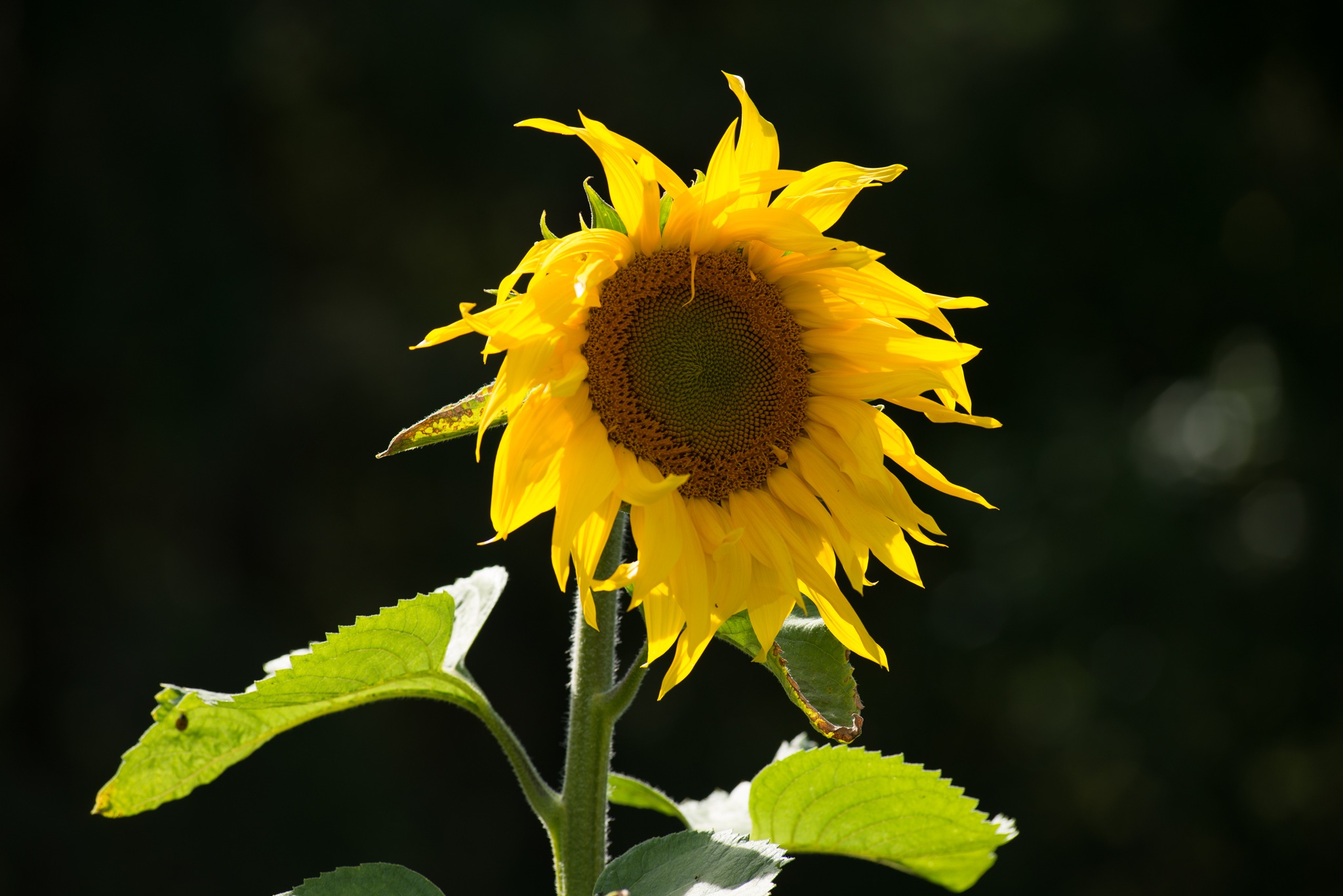
So now I must leave my desk to see what this summer day wants to offer the senses. I will linger in the shade of the peach tree with a book, keeping my eye on the finches, chickadees, juncos and hummingbirds who shelter and sing in its branches. I will praise the sunflowers, each a miniature daystar, towering above the flower garden, and hear the soft music of quivering aspens. I will taste blackberries ripening beyond the drying lawn, plus whatever strawberries the squirrels have spared. My skin will feel the reddish warmth of the late sun as it drops between the Douglas-firs. And when night comes, I will stroll among the lilies and dahlias, so white—and fragrant!—beneath the gibbous moon. Mirie it is.
Related Posts
The summer’s final mass
T-shirts, cut-offs and a pair of thongs,
We’ve been having fun all summer long.
– Brian Wilson & Mike Love
Piecemeal the summer dies ….
The field has droned the summer’s final mass.
– Richard Wilbur
In seventeenth century landscape painting, there was a tendency to idealize, to suspend change and death by capturing an eternal present. Through meticulous depiction of nature’s details, the fantasy of a deathless Arcadia was made concrete for the viewer. Inside the frame, there was no time, no death. Gazing upon one of these pictures, a character in Dostoevsky exclaims,
Here lived beautiful men and women! They rose, they went to sleep, happy and innocent; the groves rang with their merry songs, the great overflow of unspent energies poured itself into love and simple-hearted joys… The sun poured its rays upon these isles and the sea, rejoicing in its fair children. Oh, marvelous dream, lofty illusion![i]
The painting in question was Claude’s “Acis and Galatea.” And indeed, as the lovers embrace in their tent along the shore of a lovely harbor, it seems a perfect moment of harmony and bliss. But will it last? Claude has placed subtle harbingers of change within the scene. The sun is about to set. Polyphemus, the giant who will soon despoil the lovers of their happiness, lurks in the distance – not yet arrived, but on his way. Claude seems to find a heightened sweetness in such mortality; brevity breeds intensity. But Acis and Galatea might take a different view. We’ve been having fun all summer long. Why can’t it go on forever? But there you have it: golden ages, lovers, summer idylls, T-shirts, cutoffs, thongs – all carried off by time’s merciless flow.
Last night another summer slipped away. I was sorry to see it go. If only I could make it stay a little longer. And in fact, here on my island, these first hours of autumn seem no less radiant than yesterday. A warm afternoon is promised. But the idea of summer – marvelous dream, lofty illusion! – is unsustainable. Days shorten. Vacations end. Travelers return. Work calls. Schedules resume. The Sabbath rest of carefree hours and idle days is overruled by necessity. We can no longer enjoy the fiction of having all the time in the world.
In “real” life, a perfectly carefree interval of beach time, lawn parties and magical vacations is an unattainable myth. But now and again, when we do pause to breathe, to notice, to play, to be; when we forget time, giving ourselves wholly to the present moment; when we are attentive and receptive to whatever the universe wants to show us, summer draws near to bathe us in radiance.
All we need is the gift of reverie. Henry David Thoreau spent many a summer morning by his cabin door at Walden Pond, sitting quietly in the sun, listening to birdsong, feeling the warmth on his skin. To those afflicted by the pressures of a 24/7 world, this may seem an incredible waste of time. But like the saints who aspired to pray without ceasing, Thoreau dreamt of even more radical experiments in multi-sensory contemplation:
Would it not be a luxury to stand up to one’s chin in some retired swamp for a whole summer’s day, scenting the sweet-fern and bilberry blows, and lulled by the minstrelsy of gnats and mosquitoes?… Say twelve hours of genial and familiar converse with the leopard frog. The sun to rise behind alder and dogwood, and climb buoyantly to his meridian of three hands’ breadth, and finally sink to rest behind some bold western hummock. To hear the evening chant of the mosquito from a thousand green chapels, and the bittern begin to boom from his concealed fort like a sunset gun![ii]
It’s a comic exaggeration, typically deadpan New England humor, but it makes a point. The luxuriance of summer is a standing invitation to surrender to sensation, to unlearn the cultural imperatives of useful employment in order to pay close attention, moment by moment, to the poetry of the given world. Don’t just look. Dive in and get soaked.
Jesus said, “Unless you throw away your phones and cancel your appointments, unless you go outside and let a wandering cloud be your guide, you cannot enter the kingdom of heaven.” Those who have ears to hear, let them hear.
As a child, Mary Oliver “spent all summer forgetting what I’d been taught.” When she was summoned back to the chalky classroom in the fall, she still treasured the epiphanies of leisure in her heart:
the way the river kept rolling its pebbles,
the way the wild wrens sang though they hadn’t a penny in the bank,
the way the flowers were dressed in nothing but light.[iii]
And if the rest of us have been likewise receptive, we too will exit the summer laden with the gifts of deeply-lived moments. Some will call them memories and be done with them, but that would be a mistake. They can endure within us as a renewing source. Wordsworth called them “spots of time,” potent concentrations of aliveness by which we are ever “nourished and invisibly repaired.”[iv] And as Emerson recommended, on every such epiphany we should “rear a temple of wonder and joy.”[v]
This summer I never stood neck-deep in a swamp to hear mosquitoes chant, but I did keep watch in a field from midnight to dawn as meteors fell from an August sky. Some were brief flashes in the corner of my eye. Others left bright fiery trails lasting long enough for a good look. The profound nocturnal silence was broken only twice. A coyote howled in the brush around three a.m., and at four-thirty an owl whooshed close over my head – twice. That was it. Nothing much “happened.”
Or everything happened, and that night became a temple of wonder and joy I can return to again and again. Even now, as autumn sweeps in with all its portents of vanishing and loss, there is still a summer inside me.
[i] Fyodor Dostoevsky, The Devils
[ii] Thoreau’s Journal, June 16, 1840
[iii] “Just as the Calendar Began to Say Summer,” in Mary Oliver, Long Life: Essays and Other Writings (Cambridge, MA: Da Capo Press, 2004), 35
[iv] William Wordsworth, The Prelude (1799: 1.288-294)
[v] Ralph Waldo Emerson, Lecture (Dec. 19, 1838) in Ashton Nichols, The Poetics of Epiphany: Nineteenth Century Origins of the Modern Literary Movement (Tuscaloosa, AL: University of Alabama Press, 1987), 8
Paying attention
Day creeps after day, each full of facts … And presently the aroused intellect finds … that a fact is an epiphany of God, that on every fact of his life he should rear a temple of wonder and joy. – Ralph Waldo Emerson
One of today’s first facts was a blackberry that called to me as I ran by at dawn. Blackberries normally ripen in August, but here was one, dark and soft to the touch, ready for harvest in mid-July. Like Moses turning aside from his path to investigate a revelatory shrub, I interrupted my run to taste that precocious berry. How delicious! Sweet sacrament of summer.
This is the day I was born, long ago in another century, and I am celebrating by setting aside tasks and plans to slow down and take time, giving over the hours to what poet Mary Oliver calls “noticing and cherishing.” There are birds to watch, poetry to read, music to play, water to swim in, trails to explore. Or maybe, like Thoreau in his cabin’s sunny doorway, I will just sit among the trees, rapt in reverie, “in undisturbed solitude and stillness.”
After the blackberry, what else will offer itself to my attention?
Never in eternity the same sound –
a small stone falling on a red leaf.
So wrote Jane Kenyon in her poem, “Things,” which shares Emerson’s awareness of facts as epiphanies. But Kenyon, whose own time on earth was all too brief, was keenly aware that such joys are always on the verge of disappearance.
Things: simply lasting, then
failing to last: water, a blue heron’s
eye, and the light passing
between them: into light all things
must fall, glad at last to have fallen.
So much beauty, so many epiphanies. Do we have enough time? Robert Louis Stevenson said that “you have no idea, unless you have tried it, how endlessly long is a summer day.” So today I will try it. I will make an experiment in attentiveness and wonder, gratitude and joy. It is, I know, a luxurious waste of time. But it seems “meet and right so to do.” As photographer and writer Walker Evans reminds us, paying attention is what we were made for:
Stare. Educate the eye.
Die knowing something.
You are not here long.
Solitude (Part 2)
This evening, an inner light shone up from within, and a voice called, “Come to me, trust me, depend on me. You cannot do it yourself. You’re trapped where you are, and your struggling efforts to free yourself enmesh you more deeply. Come to me.” “Yes,” I answered, and surrendered. Yet my pride was soon fighting back. This is the work I came to do.
— Robert Kull[i]
In Solitude (Part 1), I described one man’s experiment of living in total solitude for one year on a remote island in southern Chile. On this Ash Wednesday, the beginning of the 40-day Christian retreat from habitual living and pesky attachments, it seems a good time to ask what Robert Kull’s experience might teach us about spending time in the “desert.” What happens out there? Will it change us?
Kull has few pretensions about being a hero. One of his first journal entries expresses a feeling of utter weakness and vulnerability: “Alone. A tiny solitary speck completely vulnerable in the face of an infinite universe intent on my annihilation.”[ii] Over the next twelve months he suffers frequent bouts of anxiety, loneliness, rage, depression, emptiness, grief, and self-doubt – all those demons that have nowhere to hide without the constructions and distractions of the social world. “What is this core I’m knotted around?” he wrote after three months. “What painful wound am I protecting? I want nothing to touch me there – but rain, wind, cold, and Cat [his feline companion] keep battering the walls I build.”[iii]
The solution, as he must learn over and over, is not to fight and overcome his human condition, but to surrender: “My goal in the wilderness was not to conquer either the external world or my own inner nature, but to give up the illusion of ownership and control and to experience myself as part of the ebb and flow of something greater than individual ego.”[iv]
He was never entirely free of the hero’s quest to attain a goal, to find the Holy Grail of a perfected self. “It’s painful to feel I’m failing,” he wrote halfway through his year.[v] He worried he was just going round in circles instead of making real progress. He felt like Sisyphus. But isn’t that how the soul dance goes? It’s not the attainment of a final cure for what ails us, but a lifelong process of continual care and self-compassion. As the monks say when asked what they do all day in the monastery, “We fall down and get up, fall down and get up.” Or as a Zen patriarch once put it, “One enlightened thought and one is a Buddha, one foolish thought and one is again an ordinary person.”[vi]
We should rejoice that enlightenment and foolishness (or grace and sin) remain so intertwined in this life. It reminds us that grace is a gift, not a possession. It frees us from pretension and pride, and makes us ever grateful.
In his last days on the island, Kull wrote:
I’m not sure what enlightenment is, but I believe there have been moments. If so, enlightenment is not something I can get. It’s the process of abandoning myself to the world. There have been times when, like a clear bell, I could hear the sound of one hand clapping and feel the sacredness of everything. It’s the sound of the world, once I remember in my heart that there is truly nothing to get. What I’m looking for, I already have.[vii]
In his year of solitude, Kull experienced many moments of enlightenment to go with the many foolish ones. Some of his best thoughts are framed in the language of his adopted Buddhist tradition, but his struggles with self-will and ego are resonant with Christian spirituality as well. “Surrendering the ego to Something Greater is at the heart of spiritual practice, and the process is endlessly subtle and challenging.”[viii]
Kull’s wilderness year did not fix him. He returned home still a work-in-progress. But he had definitely been changed by his sojourn in solitude, and the meaning of that change will only be revealed over the rest of his life. As I often heard when I walked the Camino de Santiago, “when you reach Santiago, your real Camino begins.”
Kull’s relationship with the wind is my favorite example of his spiritual growth. When he began his year in the southern summer, the winds were intense and seemingly endless. If you have ever camped in high winds, you know how wearying, even terrifying, a continuous barrage of turbulence can be. For a long time, Kull regarded the wind as his enemy – an attacking, malevolent force trying to break him down. But as he gradually learned to surrender to the world, to accept the way things are and not take them personally, he recognized the wind had been his teacher all along. In his final weeks on the island, he began to fly a kite on calmer days. The wind had become his playful companion.
For those of us beginning our Lenten retreat today, Kull’s valuable experiment in solitude has much to teach us. The subtractions of retreat – doing without, giving up, setting aside, getting away – can free us from the clutter, noise, addictions, distractions and deceptions that drown out the still, small voice calling our name in every moment. And the unaccustomed hardships of the “desert” – severity, deprivation, emptiness, loneliness, demons – can break the spell of self-sufficiency, returning us to the honest condition of primal need. Few of us will spend a year on a Patagonian island, but a faithful keeping of Lent may take us to a place of similar learning and growth.
Perhaps the best thing we can take from Kull’s journals is the gift of self-compassion. We don’t have to be heroes. We don’t have to be cured. We don’t have to pretend at spiritual competence or perfection. We don’t even have to be “good,” as Mary Oliver reminds us. We “only have to let the soft animal of [our] body / love what it loves.”[ix] And every now and then, as Kull duly notes, we get it: “Finally I am – if only briefly – the flowing All.”[x]
Tonight I will kneel in church for the imposition of ashes. A priest will trace a charred cross on my forehead and say to me, “Remember that you are dust, and to dust you shall return.”
What a relief! Only dust, neither hero nor angel. And yet, is not dust the very material God selected to fabricate a physical image of the divine self? This dust may yet shine with glory not its own.
Whether I flie with angels, fall with dust,
Thy hands made both, and I am there;
Thy power and love, my love and trust,
Make one place ev’ry where.[xi]
[i] Robert Kull, Solitude: Seeking Wisdom in Extremes – A Year Alone in the Patagonian Wilderness (Novato, CA: New World Library, 2008) 98
[ii] Kull, 4
[iii] Kull, 70
[iv] Kull, 47
[v] Kull, 141
[vi] Hui Neng, Sixth Zen Patriarch, q. in Kull, 288
[vii] Kull, 293
[viii] Kull, 271
[ix] Mary Oliver, “Wild Geese,” in New and Selected Poems (Boston: Beacon Press, 1992) 110
[x] Kull, 283 (italics mine)
[xi] George Herbert, “The Temper”
Solitude (Part 1)
Go, sit in a cell, and your cell will teach you everything.
— Abba Moses (4th century)
Great liking I had in wilderness to sit, that I, far from noise, sweetlier might sing, and with quickness of heart likingest praising I might feel.
— Richard Rolle (14th century)
A man that Studies Happiness must sit alone like a Sparrow upon the House Top, and like a Pelican in the Wilderness.
— Thomas Traherne (17th century)
I went to the woods because I wished to live deliberately, to front only the essential facts of life, and see if I could not learn what it had to teach, and not, when I came to die, discover that I had not lived.
— Henry David Thoreau (19th century)
In the seclusion of a cell… the troubled waters of the mind grow still and clear, and much that is hidden away and all that clouds it floats to the surface and can be skimmed away; and after a time one reaches a state of peace that is unthought of in the ordinary world.
— Patrick Leigh Fermor (20th century)
I wondered how I could stop feeling attacked by the elements, and then remembered that I came here to be shaped by the experience of solitude in nature. In that moment, I relaxed my grip on who I think I should be and how the world should treat me, and opened myself to the process of change and growth.
— Robert Kull (21st century)
We don’t know the names of the first hermits, or exactly what drove them to flee their social world for the solitude of wilderness. Not every reason was spiritual, nor did every hermit aspire to higher consciousness. The woods and wastelands have seen their share of outlaws and misanthropes. But for many whose names we revere (such as Moses, Buddha and Jesus), as well as for countless saints who have successfully achieved anonymity, the desert, the mountaintop, the island and the forest primeval have been crucial habitats for the work of the soul.
You go to the wilderness both to lose and to gain. You lose habitual patterns and social roles, along with addictive comforts, clocks, calendars, distractions, noise, news, and the various stresses of public and personal life. You gain time, silence, solitude, freedom, wild nature, and the occasional attention of both angels and demons. If you don’t leave too soon, you may also discover a voice which has kept you company since the day of your birth, a voice which has waited patiently until your inner silence grew deep enough to hear it.
When Robert Kull was a young man, an American expatriate living in Canada, he quit his logging job and paddled a canoe deep into the interior of northern British Columbia, where he lived alone for three months. Psychologically and spiritually unprepared for such extended isolation, he almost “lost it” out there, consumed with fear of the vast unknown as his stable sense of self began to crumble. One night he left his campfire to lie down unprotected in the forest darkness. When a bear drew near, he was terrified, with no recourse but to call upon a higher power. “In that moment of surrender, I felt lifted and found myself floating in a pool of clear light. Looking down, I sensed myself lying peacefully on the forest floor. The world was no longer a hostile alien place, but my home. No true separation remained between me and the world.”[i]
During the weeks that followed, Kull felt so joyful, so “deeply integrated into the universe,” that he resolved to spend an entire year in wilderness solitude at some future time. But soon after returning to the world, “I lost my way, and the clear inner light faded.” It would be 25 years before he would keep that promise to himself, a long stretch during which he sought to recapture that original but elusive state of grace through meditation, self-analysis, and spiritual exploration.
Finally, in February, 2001, Kull set up camp on a remote island off the coast of southern Chile, where he would spend a year alone in the Patagonian wilderness. An abridged form of his journals, interspersed with later reflections about the experience, was published by New World Library in 2008 as Solitude: Seeking Wisdom in Extremes. It’s a marvelous read. By shunning a grand narrative thread or an authoritative single voice, Kull let his recorded thoughts, observations and experiences stand just as they were written, paragraph by paragraph, full of changing moods and contradictory voices. This documentary restraint allowed me to be in the moment with him. Each time I picked up the book over the past few weeks, I was immediately returned to that island solitude, its hardships and its beauties, its frustrations and its revelations. When the “year” was finally up and I resumed my accustomed life, I was left with the same question that Kull returned with: what happened out there, and has it left a permanent mark on me?
As the Lenten journey into metaphoric wilderness looms near, I want to explore the implications of Kull’s spiritual experiment for the rest of us. I will do this over the course of a few posts. Let me conclude this first installment with some thoughts about his approach.
Raised as a fundamentalist Christian, Kull eventually migrated to Buddhism. He still uses the word “God” at times, but speaks more often of a felt Presence, Something Greater, or mystery. His favorite term is alive or aliveness, always rendered vibrant with italics. Shorn of traditional theist attributes which might divorce the divine from the given world, this Presence is often interchangeable with “nature” or “universe.” Sometimes it has a voice, and responds to our attention, while sometimes it seems a more impersonal, all-embracing flow.
But constructing a coherent systematic theology is not Kull’s design. While he brings his own presuppositions to his observing, as do we all, his aim is ontologically humble. He is not trying to make an objectively comprehensive model of Being, but to describe his own experience when he opens himself to larger spiritual realities. While he draws on the wisdom of various teachers, his knowledge remains largely personal.
As he tells us, he wanted “to explore, through living, the physical, psychological, emotional, and spiritual effects of deep wilderness solitude.”[ii] Formally, his project was an academic study for a doctorate at the University of British Columbia. But as he later wrote, “although my intention at the beginning of this retreat was to explore solitude through a purely secular lens, [I] have had to admit that I cannot fully live nor write about what is happening without using spiritual terminology.”[iii]
A Christian of the last century, having spent considerable time praying in a cave in North Africa, said that “the trouble with going to the desert is that you risk meeting God there.” And as the series of epigraphs at the top of this post demonstrate, there have always been a few of us willing to take that risk. Those who stay home are all grateful for anything they can tell us afterward.
What Kull learned on that Patagonian island is valuable for several reasons. One is the sheer length of his solitude. The Desert Fathers had visitors, and said mass together on Sundays. Thoreau also enjoyed visitors, and dropped off laundry at his mom’s house in town. But Kull had only one brief visit from park rangers. The rest of the time he was entirely bereft of human presence. He thus provides an uncommon source of data about human consciousness.
Such data is hard to come by. I once heard the scholar-writer Stephen J. Pyne read a brilliant paper on the otherworldly environment of Antarctica. White on white, often without any visible separation between ice and sky, the polar landscape is stripped of the visual cues and details by which we orient ourselves in space. Being there is like dwelling in an abstract painting. I asked Pyne whether prolonged exposure to such strange phenomenology might produce interesting forms of consciousness. Shouldn’t the polar outposts be treated like monasteries where the far edges of human perception could be explored? “Maybe,” he laughed. “But the fact is, everyone just stays inside the sheds watching videos and drinking.”
Kull’s experiment is also valuable for his suspicion of preconceptions. He tried to stay open to whatever happens, as free as possible from abstract ideas about the nature of psychological and spiritual experience. Of course this is not entirely possible. We are all products of culture, language, personal history, social location and other contextual factors. But while I would be interested to see what a theologian could do with the raw data, I am glad it was Kull and not the theologian (myself included!) who did the empirical work. Fewer ideas to get in the way.
Finally, Kull’s report is imbued with his own frailty and vulnerability. He’s neither saint nor guru, just a slob like one of us. Afflicted at times by feelings of spiritual failure, and liable to follow an experience of the oneness of all beings with an angry swipe at his whining cat, we feel the camaraderie of a fellow beginner. When he comes across Merton’s sweeping assertion that the “hermit’s whole life is a life of silent adoration…. a prolonged communion … ever in the presence of God,” Kull can’t contain himself: “[N]owhere does Merton’s statement find support,” he argues. “On the contrary. The mind and heart are all over the place, from the most trivial, mundane, and negative to the joyful, peaceful, and sacred. Solitude is like the rest of life, only with less opportunity for escape into diversion.”[iv]
I like to imagine Merton laughing in agreement.
To be continued in the next post …
[i] Robert Kull, Solitude: Seeking Wilderness in Extremes (Novato, CA: New World Library, 2008) xiv
[ii] Kull, 54
[iii] Kull, 214
[iv] Kull, 103
Dies Irae
Mr. McCleery, my seventh grade Latin teacher, had us memorize verses of the Dies Irae, a medieval chant describing the Last Judgment in strikingly lurid language. Most boys in junior high do not walk around chanting Latin poetry about the end of the world, but I rather enjoyed it. The tune was catchy, and those terse rhyming triplets beat time like the sensuous energy of a drum circle.
Dies irae, dies illa,
Solvet saeclum in favilla,
Teste David cum Sibylla.
Day of wrath, O day of mourning,
See fulfilled the prophet’s warning,
Heav’n and earth in ashes burning.
The text of Dies Irae is inspired by the first chapter of Zephaniah, which was one of the eucharistic readings last Sunday. I sometimes wonder what churchgoers think about when asked to consider “a day of wrath, a day of distress and anguish, a day of ruin and devastation, a day of darkness and gloom.” In Syria or Ukraine, it’s just the latest news. But for those of us not living in one of history’s infernos, Zephaniah might be dismissed as a colorful crank carried away by the thrill of his own hyperbole.
The effect of the Bible’s more fiery rhetoric is often muted by the flat, inexpressive way it is usually read – or worse, mumbled – in the typical liturgy, as though no one really means it. Readers of prophetic texts should be given bullhorns. They should walk among the people as they shout, looking them in the eye.
I will bring such distress upon people
that they shall walk like the blind;
because they have sinned against the LORD,
their blood shall be poured out like dust,
and their flesh like dung.[i]
The church growth people might have something to say about that sort of messaging, but there is no denying that the prophets are working hard to get our attention. And in these last weeks of the Christian year, both the Sunday lectionary and the daily liturgical readings resound with the trumpet blasts of biblical warnings. People get ready. History’s chickens are coming home to roost.
Those prophetic rants have sometimes been read as endorsements of sacred violence – angry outbursts of a moody and unpredictable god – but God’s best friends have long rejected that crude picture as a tragic misreading of the divine. Nevertheless, there is no denying the violent imagery woven into some biblical texts, and we must find a way to make sense of it.
Walter Brueggemann explains that the prophets “speak in images and metaphors that aim to disrupt, destabilize, and invite to alternative perceptions of reality … [They] speak in outrageous and extreme figures because they intend to disrupt the ‘safe’ construals of reality, which are sponsored and advocated by the dominant opinion makers.”[ii] In other words, prophets blow up the old paradigms in order to make room for the new. They take seriously the power of language both to enslave and to liberate.
Zephaniah targets those “who rest complacently on their dregs,” who are blinded by their illusions, who assume divine indifference to the damage they do to the poor, the vulnerable, and the whole interdependent system of life on earth. We can find similar voices in our own time.
German writer W. G. Sebald’s apocalyptic poem, After Nature, is as harrowing as anything in the Bible. As he contemplates the dark and barren landscape of Matthias Grünewald’s Crucifixion, painted in 1505, Sebald finds a predictive warning of the planet’s own death unless we change our ways.
Here in an evil state of erosion
and desolation the heritage of the ruining
of life that in the end will consume
even the very stones has been depicted.[iii]
Today the United States Senate came just one vote shy of approving the Keystone XL pipeline, a massive fossil fuels project to enrich a few people at the expense of the whole earth. The effects of exploiting the Canadian tar sands, according to climate scientist James Hansen, could well be of biblical proportions.
Canada’s tar sands, deposits of sand saturated with bitumen, contain twice the amount of carbon dioxide emitted by global oil use in our entire history. If we were to fully exploit this new oil source, and continue to burn our conventional oil, gas and coal supplies, concentrations of carbon dioxide in the atmosphere eventually would reach levels higher than in the Pliocene era, more than 2.5 million years ago, when sea level was at least 50 feet higher than it is now. That level of heat-trapping gases would assure that the disintegration of the ice sheets would accelerate out of control. Sea levels would rise and destroy coastal cities. Global temperatures would become intolerable. Twenty to 50 percent of the planet’s species would be driven to extinction. Civilization would be at risk.[iv]
Hansen concludes that Keystone and its aftermath “will be game over for the climate.” The apocalypse was defeated today in the Senate, but there will be another vote early next year, when many of the “no” votes will be out of office. Alarmingly, the next head of the Senate Committee on Environment and Public Works will be a climate change denier who believes in a god who would never allow earth’s climate to be affected by the actions of mortals. If the senior senator from Oklahoma were to study his Bible, he might find that God takes human freedom far more seriously than he does. We do have the power to destroy God’s creations and disrupt the fragile balances of life.
The prophets are trying to make us renounce that power before it is too late. When Zephaniah warns of “a terrible end” he isn’t simply condemning us; he’s trying to save us. The “day of wrath” will not be an arbitrary vengeance from the sky, but the sum of innumerable bad choices here on earth. Zephaniah and his fellow prophets hold before us a chillingly graphic picture of where those choices are headed. What has been called the wrath of God is really something bearing our own signature.
Will God ride to the rescue? In a poem called “Emmanuel’s Nightmare,” African-American poet Gwendolyn Brooks wonders what it might be like if we were simply left to our own devices. She imagines the Second Coming of a Christ who would “clean the earth / of the dirtiness of war.” But the Savior finds himself thwarted. Humans love war too much. It is “what they lived for.” So God’s Son gives up and goes home. Mission not accomplished. “He had not the heart / To take away their chief sweet delectation.”[v] 346
The prospect of being abandoned to our own suicidal impulses is not a happy one, but – thankfully – it is not in fact the story we tell. God has destined us not for wrath but for salvation.[vi] The means of that better destiny will turn out to be quite surprising, not at all like the terrible clamor of the Dies Irae. But that is a tale for another day.
[i] Zephaniah 1:17
[ii] Walter Brueggemann, Theology of the Old Testament: Testimony, Dispute, Advocacy (Minneapolis: Fortress Press, 1997), 625
[iii] W.G. Sebald, After Nature, q. in Colin Riordan, “Ecocentrism in Sebald’s After Nature,” in W.G. Sebald – A Critical Companion, eds. J.J. Long & Anne Whitehead (Seattle: University of Washington Press, 2004), 51
[iv] New York Times, May 9, 2012
[v] Robert Atwan, George Dardess, Peggy Rosenthal, eds., Divine Inspiration: The Life of Jesus in World Poetry (New York: Oxford University Press, 1998), 346
[vi] I Thessalonians 5:9
All creatures great and small
In the 13th century, what you did with animals was either avoid them, cook them, or work them to death. You certainly didn’t preach to them, pray with them, or receive spiritual gifts from them. Unless you were Francis of Assisi. He called animals his brothers and sisters. He saw them as our teachers. Such countercultural regard for the non-human was seen by his biographers as a restoration of a fallen creation, a renewal of the lost paradise where all creatures, great and small, might live in peace. As Bonaventure wrote,
So it was, that by God’s divine power the brute beasts felt drawn towards him and inanimate creation obeyed his will. It seemed as if he had returned to the state of primeval innocence, he was so good, so holy.
But Francis wasn’t just a dreamer. He was an environmental activist. He lobbied the officials, the governors, and even the Emperor for laws against the abuse of animals. He urged farmers to treat cattle humanely, and convinced towns to scatter seeds on the roads in winter so the birds wouldn’t starve (this is still done in Assisi today). He called for hostels for homeless strays, and raged against the caging of larks.
His love and respect for creation continues to nurture and challenge our own evolving sensibilities about the interdependence of all beings. He wasn’t quite calling for a democracy of creation – one beast, one vote. He remained distinctly medieval in his chivalrous notions of honor, deference and courtesy among the various levels of creation.
Nevertheless, Francis expanded the perimeter of love’s circle far beyond the human tribe, and his example pushes us to do the same.
On the Feast of St. Francis (Oct. 4) in 2012, a group of Episcopal clergy and laity blessed the animals at Seattle’s Woodland Park Zoo. In writing the blessings, I tried to honor and bless the qualities of each species, and name the ways in which those qualities in turn might inform and bless their human kin.
I documented the blessings on video, which you may view here.
A tender doom
The fictions of summer are so persuasive: the constancy of fair weather, the treasure of unhurried time, the allure of nature’s green paradise, the willful suspension of care and duty. In hammock or kayak, who can imagine anything but endless bliss and smiling skies?
Summer’s last full day in Puget Sound was as perfect as they come – brilliant light, delicious warmth. Even after sundown, we lingered outside in summer clothes as if it were still August. But the harbingers of autumn had already begun to intrude. Darkness which delayed until bedtime six weeks ago was now arriving for dinner. The clamor of songbirds at our feeders has dwindled to a lonely remnant. And it’s now almost impossible to find a blackberry worth eating.
In the hours before the equinox yesterday, clouds rolled in and the temperature dropped, like a set change between acts – or, in poet Penelope Shuttle’s fine image, it was “the year changing its mind.”
But as John Burroughs noted, fall “comes like a tide running against a strong wind; it is ever beaten back, but ever gaining ground, with now and then a mad push upon the land.” There are still some lusciously brilliant days to come, but we can no longer claim them as our seasonal right. We may only receive them as gifts of increasing rarity, now that the earth has tipped toward winter.
Describing the mechanisms of autumnal change, Peter J. Marchand points out that the seasonal senescence of plants is not simply a matter of loss. The process of dormancy is just the flip side of growth, and there is “as much life as there is death in the browning of meadows and the drying of leaves in autumn.”
If we could sit under a maple or aspen in the fall and observe all that is going on within the plant, we would witness a remarkable communication of chemicals and flow of materials: a bustling hubbub of messenger molecules and hormones directing complex metabolic processes, a train of nutrients and waste materials being shuttled into storage compartments; a clatter of metabolic machinery being disassembled (Autumn: A Season of Change, p. 14).
We each have our own versions of this slowing down, letting go, turning inward, growing quiet. We can’t hold summer forever. The leaf falls, the year dies, the heart submits to a process beyond its control. In Marchand’s wonderful book on autumn, he catalogs the poetics of the season as well as the science, and his citation of Martha McCulloch Williams, a 19th century American writer, makes a lovely overture to the days before us now.
September, she said, is a “fair month, truly – golden fair, spiced with breath of the orchards, the vineyards’ winy smell,” with the earth “smiling peace to a perfect heaven.” But she knew that beneath the exhilarating splendor of early autumn there sounds “an under-note – a wailing minor of loss and waste. Faint, ah, so faint!” So savor this mellow time while it lasts, and when it goes for good, do not forget the promise of returning spring.
Walk afield [then] every day … Whether sun shines, or rain drips, or white frost bites and stings, you should find a liberal education in the hectic beauty of death; not cruel death, but a tender doom, sweet with the glory of full harvest, and spanned with the rainbow of resurrection.
The ministry of nature
I am losing precious days… I am learning nothing in this trivial world.
I must break away and get out into the mountains to learn the news. – John Muir
Every year I observe two holy weeks. One is the Christian Holy Week, the densely liturgical mimesis of Jesus’ last days of mortal life. The other is an annual solo backpack in the mountains of the American West. Both are total immersions into the sacred without which my year would be incomplete.
The sacredness of the American landscape has long been a powerful theme in American thought and feeling. To see the sacred in a Massachusetts pond, a Southwest canyon, or an old growth forest is not a denial of the physical in favor of a spiritual “elsewhere,” but a penetration to creation’s inherent depth. The material is not the opposite of spiritual, but its mediation, its container.
In the mid-nineteenth century, the American landscape painters known as “Luminists” made their canvases glow with a divine transparency, while the literary circle of Transcendentalists translated nature’s otherness into language. Emerson insisted that “the noblest ministry of nature is to stand as an apparition of God … A leaf, a drop, a crystal, a moment of time is related to the whole, and partakes of the perfection of the whole.” And when Thoreau withdrew from contemporary society to his Walden refuge, he found “something true and sublime,” where “the morning wind forever blows, the poem of creation is uninterrupted.” Is not everyone who ventures “outside” seeking a similar epiphany?
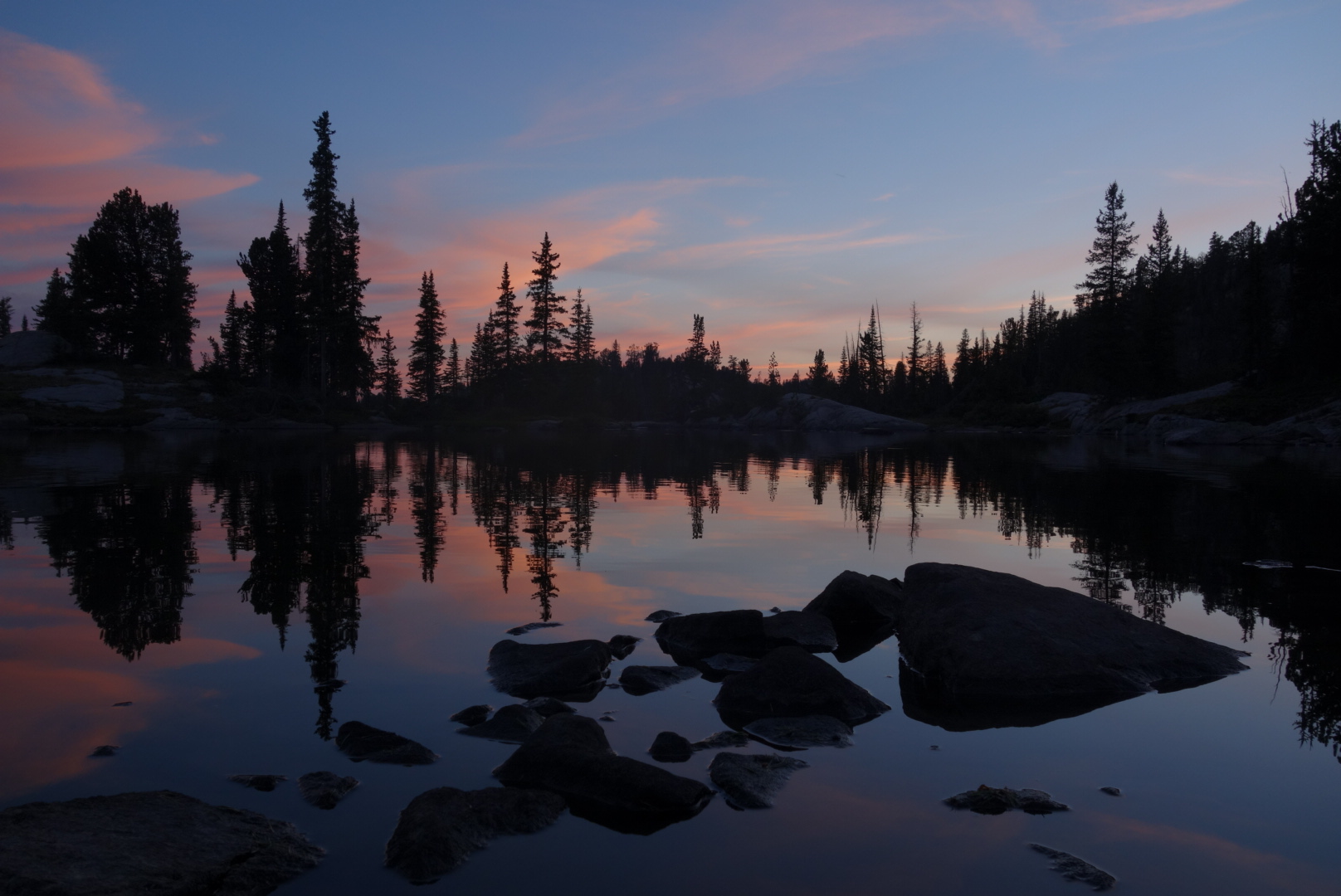
I keep my walking stick by the front entrance of our home, a daily reminder that the path to God-knows-where is always just on the other side of the door. Two weeks ago I tossed the stick in my car, along with my backpack, and headed for Montana. After a couple of days hiking into the Beartooth mountains north of Yellowstone, I reached a large alpine lake, set in a rocky bowl above treeline, with splendid views of several 12,000’ peaks. From there I made a joyous ramble into the high country beyond the lake, where cumulus shadows glided slowly across immense sunlit walls. Three bald eagles circled over a stream-watered basin. Lush gardens of paintbrush, bluebells, asters and buttercups occupied the hollows vacated by melting snowfields. I dangled my legs over a precipice for a better view of the world below. I lay back in the fragrant grass to consider the radiant sky. I knew again the plenitude of summer, that timeless contentment where one feels, as Wallace Stevens felt, “complete in an unexplained completion.”
That night around 1 a.m., I got out of my tent to see the stars, but clouds had gathered since sunset, so I secured the rain fly over my tent and crawled back inside. I had just drifted off when a couple of large animals entered my campsite, their heavy footsteps awakening me to full alert. The rain fly only allowed a narrow view directly forward from the tent, so I could not identify my visitors, who were off to the side. I could only listen as they explored the camp. I heard breathing just beyond the tent’s nylon wall, a snorting sound that put an image of a bear in my mind. Was it a black bear or the more dangerous grizzly?
Then one of the creatures jumped past the front of the tent. The moon had not yet risen, so I saw only a shadowy blur. It was the size of a large dog, probably a juvenile. And its coat seemed to reflect light, even in the gloom. Could it be the white of a mountain goat, or the light gray fur of a grizzly cub? I just wasn’t sure, and I decided to remain still and silent within my tent rather than provoke an encounter by sticking my head out for a look, especially since I was now situated between parent and child, never a good thing with wild animals.
Imagination and solitude are a potent combination in the middle of the night. I breathed. I prayed. I tried to remember what I had read years ago in Bear Attacks: Their Causes and Avoidance. I thought about St. Francis making peace with the wolf. I had enjoyed the wildness of the place as a spectator in the light of day. But now the wild had come to call on me directly. In the dark of night. What did it want to tell me: You don’t belong here? Your precious subjectivity is meaningless to the appetite of carnivores? What did you expect to find, so far from your human world?
Or: Be not afraid.
After a long hour and a half, the creatures departed. Just before they did so, I saw the silhouetted head of the juvenile, backlit by the rising quarter moon, pop up from behind a rock. It bleated, then vanished. No ursine growl, only a rather playful goodbye. When dawn finally came, I found tufts of fine white wool snagged on the branches of shrubs around my camp. Mountain goats indeed.
I drove out of the mountains through Yellowstone National Park, where wild animals are often visible along the paved roads – bison, bears, deer and elk. At every sighting, people abandon their cars, running toward a vantage point with their cameras and phones to collect a digital simulation of wilderness – something to keep and take back home. This commodification of the wild as consumable experience is a fascinating spectacle that only underlines our everyday alienation from nature. I can’t criticize. I did it too. I got a nice shot of a bull elk when the skittish tourists fled out of frame while I stood my ground.
But wildness can’t be adequately encountered a few feet from your car, or in short stops at viewpoints along an asphalt road. You need to go deeper, further, dwell in its otherness for a time, risk its strangeness, wait patiently until it is ready to deliver the news.