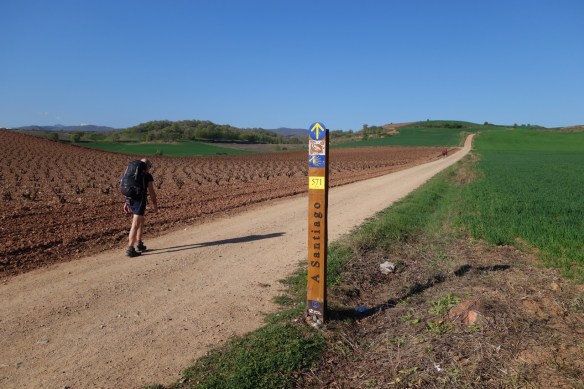
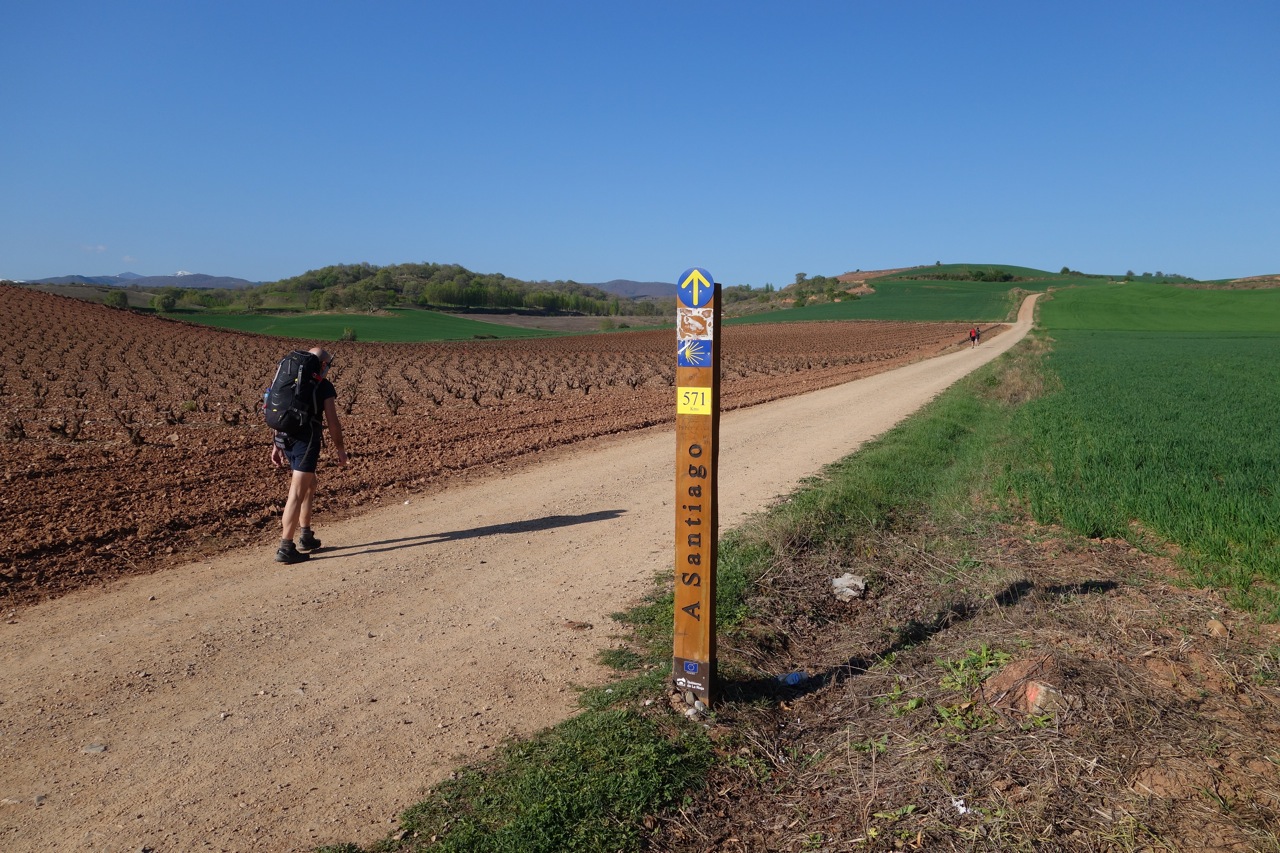
Early morning on the Camino de Santiago
To walk [somewhere] is to earn it, through laboriousness and through the transformation that comes during a journey … We are eternally perplexed by how to move toward forgiveness or healing or truth, but we know how to walk from here to there, however arduous the journey…. In pilgrimage, the journey is radiant with hope … geography has become spiritualized. – Rebecca Solnit[i]
Henry David Thoreau, reflecting on the verb “to saunter,” suggested two possible word origins. Sans terre, meaning “without land or a home,” describes those who are perpetually on the road, literally or metaphorically. Sainte Terre, meaning “Holy Land,” was applied in the Middle Ages to pilgrims with a specific destination, on their way to the place where the Sacred has uniquely showed itself. Anyone who has been on pilgrimage, or who understands life itself to be one great pilgrimage, would acknowledge both meanings at work in their own sauntering.
As the Bible says, we are all “strangers and aliens on this earth,” ever “in search of a homeland.”[ii] The first humans exiled from Eden; Abraham called to abandon country, home and kindred; the Hebrews wandering in the wilderness; the displaced Israelites weeping by the rivers of Babylon; Jesus having no place to lay his head; Paul continuously on the move or on the run: so many biblical stories display an abiding sense of being on the way to God knows where.
The actual place of arrival often remains beyond the horizon and over the rainbow – distant, unknown, unattained, not here, not yet. The Dark Age Celtic monks adopted this biblical outlook in their own far flung travels. Setting out on wild seas in little rudderless boats, they entrusted their journey to the (providential) vagaries of wind and currents. They had no idea where they would finally land. They simply set out “away from here” and left the rest to God.
I once told a fellow priest what I had read about those monks, and he liked their example so much he tried preaching about them to an upscale congregation of economically empowered people enjoying a high degree of control their own lives. They hated his sermon. Those crazy Celts, consenting to be swept away by larger, unpredictable forces, made them very uncomfortable.
But the monks, like their ancestors in the faith, were never headed for nowhere in particular. They were always looking for the Promised Land, wherever and whenever that might be for them. The last book of the Bible calls this place the new Jerusalem, a new heaven and a new earth, paradise restored. The Celtic wanderers called it “the place of resurrection.”
It is the place we were made for. We’ll know it when we get there. As Frederick Buechner famously describes it, “The place God calls you to is the place where your deep gladness and the world’s deep hunger meet.”[iii] This sense of ultimate destination and purpose, however indeterminate in time or space, made those seafaring monks more than sans terre. They were Sainte-Terrers as well, Holy-Landers bound for glory.
And so are we all. Even though Thoreau claimed to have met “but one or two persons” in his life who had a “genius” for sauntering, his exhortation to the “faint-hearted” majority expresses the hope that we may all hear – and obey – the call to pilgrimage.
We should go forth on the shortest walk, perchance, in the spirit of undying adventure, never to return – prepared to send back our embalmed hearts only as relics to our desolate kingdoms. If you are ready to leave father and mother, and brother and sister, and wife and child and friends, and never see them again, – if you have paid your debts, and made your will, and settled all your affairs, and are a free man, then you are ready for a walk.[iv]
I keep a walking stick by our front door as a perpetual reminder that the pilgrimage road always begins just outside the house. For years it was a pine branch I first used to traverse the Sierra Nevada mountains of California in 1976. Now it is the sturdy staff I acquired last April in St. Jean Pied-de-Port for my 500-mile pilgrimage on the Camino de Santiago (dispatches from that journey may be found in this blog’s April and May archives).
In Lord of the Rings, Bilbo Baggins began his fateful journey out of the Shire with a song: “The Road goes ever on and on, / Down from the door where it began … Until it joins some larger way / Where many paths and errands meet. / And whither then? I cannot say.”[v] But Bilbo already knew the risks of setting out into the unknown and unfamiliar: “It’s dangerous business, Frodo, going out of your door.” But he went anyway. It’s what pilgrims do. To refuse the journey is to refuse our story.
We may not always know where the road leads or what will happen along the way. But with the best and longest journeys, that kind of knowledge can fade to insignificance. For every saunterer, the road itself, with its perpetual motion “away from here” toward the land of promise, provides a greater sense of belonging than whatever we left behind. I walk, therefore I am. As Catherine of Siena put it, “All the way to heaven is heaven, because Jesus said, ‘I am the Way.’”
For many years I worked with a wonderful storyteller, Angela Lloyd, on creative variations of the Exodus narrative performed at the Easter Vigil liturgy. And one year she played an Israelite who was starting to wonder how long they would have to wander before they finally arrived at the place God had prepared for them. She pulled out a battered postcard and held it up. “I’ve been carrying this postcard a long time,” she said, “I was planning to mail it when we got to the Promised Land. But now I think I should just mail it from here. And you know, maybe it doesn’t matter where I mail it from. Maybe everywhere we stand is already holy ground.”
[i] Rebecca Solnit, Wanderlust: A History of Walking (NY: Viking Penguin, 2000) 50
[ii] Hebrews 11:13-14
[iii] Frederick Buechner, Wishful Thinking: A Theological ABC (NY: Harper & Row, 1973)
[iv] Henry David Thoreau, “Walking,” The Natural History Essays (Salt Lake City: Peregrine Smith, Inc., 1980) 94
[v] J.R.R. Tolkien, The Fellowship of the Ring (London: The Folio Society, 1977) 51
 The religious imagineer