Footsteps and shadows: Inscribing our traces on the Camino

This spring I find my mind often returning to the Camino de Santiago. A year ago today I began my tenth day of walking: 140 miles down, 360 to go. But by then I had stopped counting. It was better – and less tiring – to be in the moment, to “cherish every step” as one pilgrim advised me early on.

When I run long distance, or backpack up a steep mountain pass, I try to apply the mindfulness of Zen walking. Don’t think about some other time, in the past or the future, when you are in a more comfortable state of rest. And stop wondering how far you have left to go. Simply be here now. Concentrate your attention on the physical act of lifting your foot, swinging it forward, setting it down. Take note of your breath. It’s not about forgetting the pain so much as accepting your present state of being-in-motion, not wishing you were doing something less strenuous or challenging.

When you walk ten to twenty miles day after day for over a month, this kind of attention becomes more automatic. Walking becomes what you do and who you are. As I wrote in one of my Camino posts, “Walking”:

The past week was spent traversing the immense agricultural plateau of the Meseta and Tierra de Campos. Few trees, big sky, only occasional villages, and long stretches where the only human presence was the long procession of pilgrims migrating westward. The lack of distractions and variations tends to make the very act of walking to be the mind’s principal occupation. As Robert Macfarlane puts it in The Old Ways: A Journey on Foot, walking becomes “sensational” – it isn’t just conducive to thought; it becomes the form thought takes. I walk, therefore I am. Perhaps it is similar to the way that cinema thinks through the movement of the camera. It isn’t forming propositional thought, but is simply absorbing through its attentive motion the shape of the world, the textures of existence.

I have noticed that I have fewer thoughts out here than I do at home when I run for an hour, or go on a week-long backpack. On the Camino, instead of a lot of thoughts, I simply have thought: not so much words or ideas as awareness. As Thich Nhat Hanh once put it to a walking companion who asked what he was thinking about: “I’m not thinking about anything. I’m aware of the sunlight.”

Macfarlane provides a memorable image of walking as a form of writing on the earth, with every traveler leaving his or her own imprint of dreams, stories and memories as they go. Centuries of pilgrims have been leaving such traces along the Camino, traces which now lie beneath our own feet every step of the Way.

The brief video clip records my shadow and footsteps leaving their faint traces: on the Meseta west of Burgos, on the 13th century bridge of Puente de Orbigo, and among the blooming shrubs of the Alto Predela, a high ridge west of Villafranca. I hope these few steps bring back happy memories for my fellow pilgrims. And for those who want to experience our cumulative act of walking in real time, just replay the 80-second video 11,000 times!

Grace me guide

Holy Saturday dawn at Laguna Beach, California (2005)

Holy Saturday dawn at Laguna Beach, California (2005)

My wife recently asked me what my favorite prayer was. Interesting question. We are both Episcopal priests, steeped in a tradition of eloquent prayers, so there were plenty to choose from (the Lord’s Prayer was ruled ineligible in order to make the competition fair). But one particular “collect” from the Book of Common Prayer came immediately to mind, not only because I know it by heart and begin most days with it, but also because I am drawn to the theology and spirituality that underlie it.

O God, the King eternal, whose light divides the day from the night and turns the shadow of death into the morning: Drive far from us all wrong desires, incline our hearts to keep your law, and guide our feet into the way of peace; that, having done your will with cheerfulness during the day, we may, when night comes, rejoice to give you thanks; through Jesus Christ our Lord. Amen.[i]

In three beautiful clauses, this Collect for the Renewal of Life from the Office of Morning Prayer spans the daily round from night to day to night. Its origins lie in the Benedictine practice of creating liturgies to fit each period of the passing day. Like time-lapse photography, this collect compresses the temporal flow into a single unity of beginning, middle and end. The ordinary succession of the hours is sanctified by the simple act of attention.

But the prayer casts its net into deeper pools as well. The light dividing the day from the night recalls the first day of creation, making every dawn the renewal of the world. And the shadow of death turning into morning invokes the Resurrection, when creation is restored and the wound of death is healed at last.

Having turned our attention to the divine source of this perpetual renewal, the prayer then asks for the grace to become conformed to the shaping pattern or formative way of that originating and empowering source. The first request addresses the obstacles to that conformity – the things that misshape or distort our truest selves.

Drive far from us all wrong desires.

Religion is sometimes caricatured as the repression of desire. It’s not only the mockers who do this; many of the devout have striven for a passionless existence in imitation of a supposedly passionless God. But wanting to want nothing is itself a form of desire, and it doesn’t always end well.

We are made of desire. We come into the world reaching for a larger source of sustenance, nurture and love. Everbody’s got a hungry heart. Springsteen said that. Or was it St. Augustine? Some argue that our primal maternal nurturing is then projected onto the void to produce the consolations of religion, but Christian faith insists that our longing never ceases to thirst for something actual and real, from our first breath to our last.

But desire is easily misdirected to fix on easier, less demanding objects, unworthy of our true nature. In one of Jean-Luc Godard’s early films, a worldly couple is given a ride in a convertible. When the driver reveals that he happens to be God, they immediately ask him for things: Can I own a hotel on Miami Beach? Can you make me more beautiful? God is disgusted. “Is that all you want? I don’t do miracles for jerks like you.” He throws them out of the car and drives away.

As Gregory of Nyssa said, our task is not the eradication of desire, but the education of desire. How do we live in such a way that our desire may find its proper object? It is not desire that is wrong, but only its misdirection. And so we pray for whatever it takes to steer us toward our ultimate goal, “the great meeting with being which one way or another everything in our life strains to achieve.”[ii]

Incline our hearts to keep your law,
and guide our feet into the way of peace.

There may be times in our life when God’s will feels radically disruptive. “Thus says the Lord: I am going to tear down what I have built, and pluck up what I have planted.” (Jer. 45:4) Or John Donne: “Batter my heart, three-person’d God …. / and bend / Your force to break, blow, burn, and make me new.”

But in this prayer said at the start of each day, “incline” and “guide” propose a much gentler formational process than the cataclysmic upheavals of Jeremiah and Donne. An inclination may only be a slight tipping from the vertical, just enough so everything leans or flows in a particular direction. And the act of guiding does not itself create momentum; it only steers a motion which is already underway. These are subtler influences than earthquake, wind and fire, but their long-term effect on us is no less profound.

The entire prayer assumes a dailiness about grace, and the constancy of prayerful attention that allows it to work on us over time. This quiet, steady, cumulative spirituality is so very Anglican. I once found a perfect motto for this habitual spirituality in an old English church. Painted in golden Gothic lettering, repeated in every panel of the coffered ceiling, are the words, Grace me guide. Even a bored worshipper, glancing upward to relieve the tedium of a poor sermon, could not miss this summons to the beauty of holiness.

The prayer’s third clause assumes a happy outcome for a day given over to God’s shaping influence. Throughout the passing hours, God’s will is done “with cheerfulness.” Does this word appear anywhere else in the history of formal Christian prayer? There are plenty of texts to remind us how hard the journey, how recalcitrant the will. But how rare to make the Christian life sound so easy, so effortless, so fun!

But perhaps the prayer has in mind the ease of the ballet dancer, whose extraordinary physical grace, while appearing effortless, is achieved through a sometimes painful and always demanding discipline. Or maybe “cheerfulness” refers to the saintly joy that St. Francis spoke of – the ability to accept even life’s hardest blows with a grateful and trusting heart. Who can say?  I only know that whenever I say this prayer, it is hard not to smile, at least inwardly. Cheerfulness is an attractive quality in the Christian life.

The entire prayer assumes that we are capable, that we can be conformed to divine intention, that this day has potential for us. We may not make it to nightfall without lapses major and minor. The cheerfulness may fail us, more than once. We are well acquainted with that scenario. But to begin each morning by visualizing a day that will end with thanksgiving for what God has done in us and through us – this expresses the incredible hope of Christian faith. God has amazing plans for us, no matter what.

The gratitude the prayer envisions is not contingent on what we manage to accomplish in any given day. Perfection is a process, not a possession. But as this prayer puts it so beautifully, we are nevertheless invited to begin each morning as if we are actually capable of living into the full humanity for which are made. And at the close of a day begun with this kind of mindfulness, even though it be fraught with imperfections, there will be reason enough for thanksgiving.

Saying this prayer was one of the very last things I did with my mother. I had been visiting her in Santa Barbara, and it was always our custom to read Morning Prayer whenever we were together. After our prayers, we said farewell and I headed for home a thousand miles north. A few hours after I left, her 96-year-old heart suddenly gave out. She died three days later. I didn’t quite make it back in time, but we had already made the perfect goodbye, with the cheerfulness of our morning prayers.

We each had our own copy of The Daily Office Book, containing services and Scripture readings for the entire year. After she died, I started using her copy instead of mine. It seemed a way to stay in touch, acknowledging the unbroken connection of the communion of saints. And one day I happened to look at the inside back cover. She had written a prayer on the blank endpaper. Whether she had made it up, or found it somewhere, I don’t know. But it perfectly expressed her own faithful spirit. It also seemed to echo my own favorite prayer. In her distinctive hand, familiar from so many letters over the years, she had written:

God, whatever …. Thanks.

[i] Book of Common Prayer (New York, Oxford University Press, 1979) 99

[ii] Ann & Barry Ulanov, Primary Speech: A Psychology of Prayer (Louisville, KY: Westminster John Knox Press, 1983) 14

Heart work and heaven work

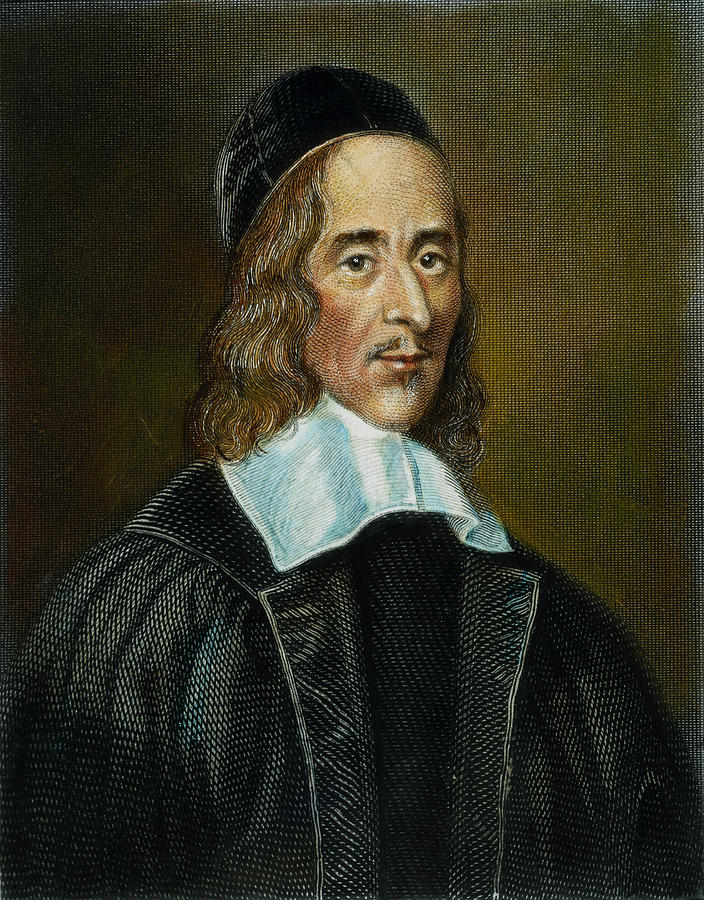
Robert White portrait of George Herbert painted 41 years after his death.

Robert White portrait of George Herbert painted 41 years after his death.

Today is the feast day of George Herbert, the seventeenth-century Anglican poet and priest whose remarkable verse was inseparable from his prayer life. As one admirer put it, “Herbert wrote most of it, but God wrote quite a lot.” That’s a proportionality to which every creative, and every priest, might aspire.

Izaak Walton tells a story about a time Herbert set out for a walk with some friends. Suddenly, without saying why, he excused himself and returned to his church. His friends assumed he’d only be a moment, but they waited and waited and he still didn’t come back out. So they went up to a window and peered in. As Walton relates, they “saw him [lying] prostrate on the ground before the Altar; at which time and place (as he after told [his friend Mr. Woodnot] he set some Rules to himself, for the future management of his life.”

The “holy Mr. Herbert,” they called him around his parish. It was a term of affection. In his late thirties he had given up worldly ambitions to enter the priesthood, and he spent the rest of his life at a country parish in the English village of Bemerton. He died of consumption only four years after being ordained. But his famous manual of advice to country parsons proved a lasting legacy, shaping the self-understanding of clergy for generations to come.

And his poetry! Such astonishing verbal images in a century famous for great language, where words could be bent to the subtlest purposes without losing a speck of passion or truth. Herbert’s art, as the Puritan Richard Baxter put it, was “heart work and heaven work.”

He was both poet and priest; indeed, he showed that poet and priest have similar business, the sacramental work of paying close attention, and enabling others to do the same. Another poet, Mary Oliver, has put this perfectly: “I don’t know exactly what a prayer is, but I do know how to pay attention.”

Herbert liked puns. It wasn’t just a cleverness with language. It was the way he saw the universe: one thing becomes another, like bread becoming God. He often starts with a word or an image, and morphs it into a multiplicity of resonant meanings, or as one critic put it, “he breaks the host of language.” The one is broken into the many so that all the scattered fragments may one day again be made one when God is all in all.

In ‘Church Monuments,’ he’s sitting in church, his mind wandering, and he starts looking at the big marble tombs all around him. First he thinks of his own mortality, “this heap of dust,” but in a few more lines he makes us see the marble monuments themselves crumble into dust, pressing upon us the awareness that everything on this earth must pass away. We are all passing away. And then in one stunning final image, Herbert makes our dust to be the sand in an hourglass, where time is always running out.

flesh is but the glass, which holds the dust
That measures all our time; which also shall
Be crumbled into dust… (‘Church Monuments’)

And in the process he makes a nice pun: “flesh is but the glass” makes the biblically literate reader think of “all flesh is grass,” one of the most vivid evocations of mortality in all of literature.

Herbert believed in words. Language was held more dear in his day, and he used it as a ladder to bridge earth and heaven. Grammar itself became a finely tuned instrument of praise. In ‘Prayer I,’ there are almost no verb forms. It’s mostly nouns, conveying a changelessness transcending the busy world of doing: Prayer the Churches banquet, Angels age, Gods breath … The soul in paraphrase, heart in pilgrimage … Engine against th’ Almightie, sinner’s towre, Reversed thunder … Heaven in ordinairie, man well drest … The land of spices, something understood. And in ‘The Call,’ it is nouns that dominate both the stresses and the structure of every verse: Way, Truth, Life  … Light, Feast, Strength … Joy, Love, Heart.

Some of Herbert’s imagery speaks of humankind misreading or misspelling reality, and it was the poet’s job to put it right, to give everything its proper name once again.

We say amisse
This or that is:
Thy word is all, if we could spell. (‘The Flower’)

When Herbert lay dying, he entrusted his poems to his friend Nicholas Ferrar. They were, he said, “a picture of the many spiritual Conflicts that have passed betwixt God and my soul, before I could subject mine to the will of Jesus my master, in whose service I have found perfect freedom.” As to whether to publish his manuscript, he left that to Ferrar. “If he think it may turn to the advantage of any poor dejected soul, let it be made public; if not, let him burn it.” Thank God for Ferrar’s good judgment!

The Herbert whom we meet in his poems is a person very much in process: unfinished, imperfect, always aspiring to something higher. He cared deeply about formation and growth – his own as well as that of his congregation. As poet and priest he used all possible art to move those with ears to hear.

Hearken unto a Verser, who may chance
Ryme thee to good, and make a bait of pleasure.
A verse may finde him, who a sermon flies,
And turn delight into a sacrifice. (‘The Church Porch’)

As the subject of many of his poems, he used his own life, his own wrestling with God, as a lens for examining the frailty of mortals and the workings of grace. And as his own audience, he used the very process of writing as a form of prayer and self-examination. His poems are both the record of a soul and a source of instruction.

Herbert was extremely honest – even ruthless – about his prayer life. His mind was a “case full of knives,” as he put it, and he was no stranger to doubt, particularly doubt about traversing the abyss between human frailty and divine glory.

He wrestled with God, he wrestled with his own frail and mortal nature. “My searches are my daily bread,” he wrote, “but never prove.” He doesn’t get proof. He gets something better – faith.

Perhaps his signature poem is ‘Love III,’ which Simone Weil called “the most beautiful poem in the world.” I often use it to begin the liturgy of Maundy Thursday, with the congregation taking the part of the guest, and a solo voice speaking for Christ the host.

In the poem, the guest is full of self-abasement: not worthy to be here, not worthy even to look upon the One who invites him to the feast. And yet, the calmly insistent voice of Love will not be denied. There is nothing the guest can say or do that can ever separate him or her from that Love.

Love bade me welcome: yet my soul drew back,
Guilty of dust and sin.
But quick-ey’d Love, obeserving me grow slack
From my first entrance in,
Drew nearer to me, sweetly questioning,
If I lacked anything.

A guest, I answer’d, worthy to be here:
Love said, You shall be he.
I, the unkind, ungrateful? Ah my dear,
I cannot look on thee.
Love took my hand, and smiling did reply,
Who made the eyes but I?

Truth Lord, but I have marr’d them: let my shame
Go where it doth deserve.
And know you not, says Love, who bore the blame?
My dear, then I will serve.
You must sit down, says Love, and taste my meat:
So I did sit and eat.
Praying the O Antiphons

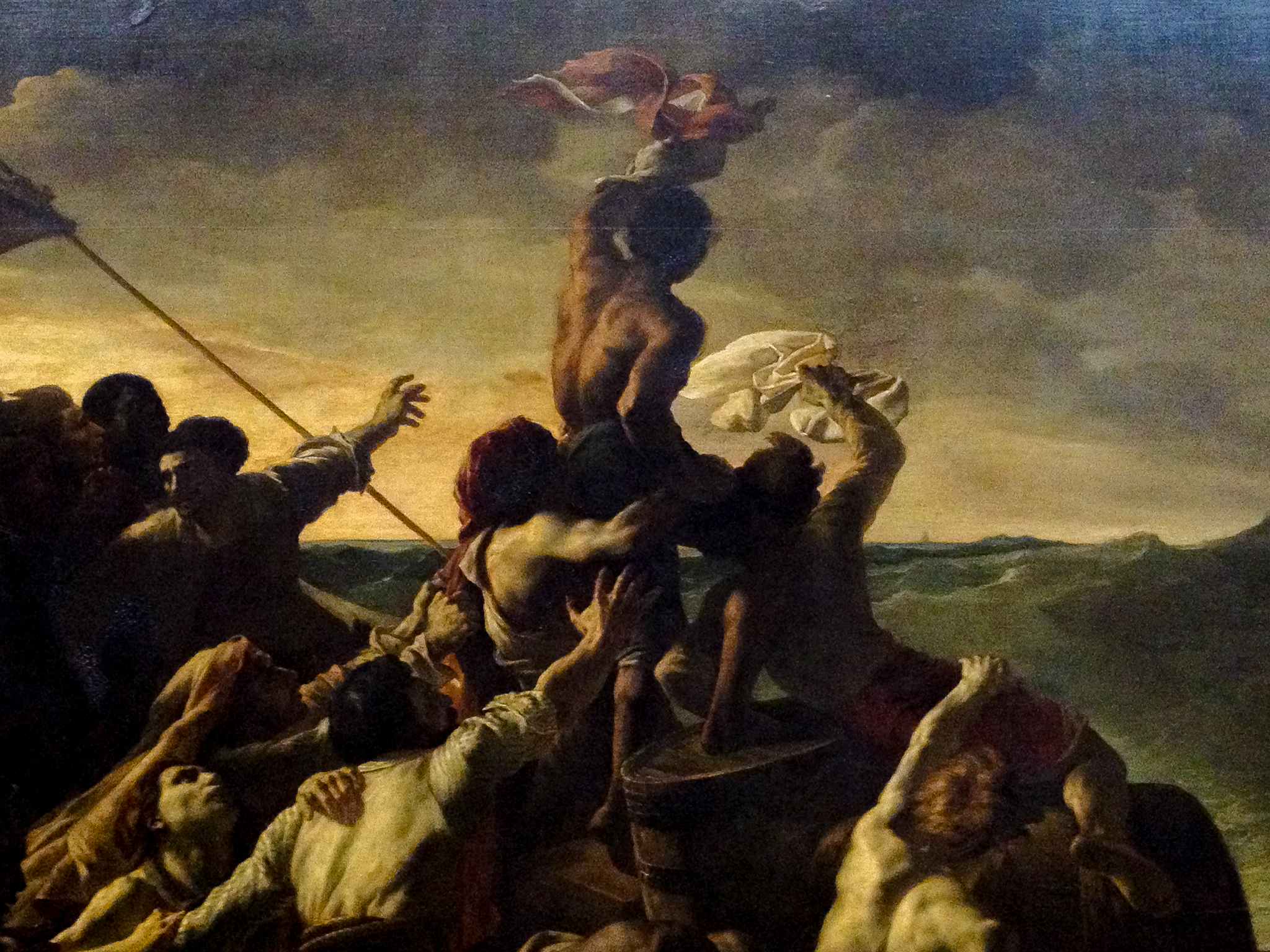
Théodore Géricault, The Raft of the Medusa (1818-19). Paris, Musée du Louvre.

Théodore Géricault, The Raft of the Medusa (1818-19). Paris, Musée du Louvre.

Today the O Antiphons begin. Part of the Church’s Advent prayer for at least12 centuries, they employ seven images from the prophet Isaiah to engage us with the names and attributes of the Holy One whose coming (‘Advent’) we await. Originally sung before and after the Magnifcat at Vespers, I find them to be a marvelous way to pray during these final days before Christmas.

There is one antiphon for each day from December 17 to December 23. Copy them on seven slips of paper, and put each day’s antiphon on a mirror, refrigerator, dashboard, screen or bedpost. Carry it with you during the day. Pray it at dawn, noon, sunset and night, in the midst of activity and the midst of quiet, in solitude and in the company of others.

Each antiphon is both greeting and supplication to the God who comes to save us:

O Sapientia, O Adonai, O Radix Jesse, O Clavis David,
O Oriens, O Rex Gentium, O Emmanuel … O … O … O …

O is such an evocative word. We use it when we come upon something outside ourselves, often unexpected; something that engages us face to face.

  • “O” can be an inhalation, a gasp, the cry of astonishment at the heart of every encounter with the Holy. If our place of prayer were suddenly filled with smoke and angels, or if the Holy called to us out of a burning bush, our first response might well be “O!”
  • There is also the O of understanding, or recognition: O, now I see, now I get it. Or even: O, it’s you!
  • And then there is the ecstatic O, expressing delight, wonder, the sigh of surrender: Ohhhhhhhh!

Each of these is a fitting response when we meet the divine:

Astonishment
Recognition
Surrender

You can find both the original Latin texts and English translations online. The best known paraphrase of the Antiphons is the hymn, “O come, O come, Emmanuel.” The following are my own variations. Use whatever version suits you best, or write your own.

(Dec. 17)          O Sophia, you are the truth of harmonious form, the pattern of existence, the shapeliness of love. Come: illumine us, enable us, empower us to live in your Wisdom, your Torah, your Way.

(Dec. 18)         O Adonai, ruler of time and history, manifestation of divine purpose to your chosen people, may your presence be our burning bush. Come: bring justice to the poor, food to the hungry, shelter to the homeless, protection to the vulnerable, freedom to the prisoner.

(Dec. 19)         O Root of Jesse, coming to flower in Jesus, who in turn bears fruit in all who  are grafted into the royal line of God’s family. Come: let us never be severed from the roots and branches that nourish us in every moment.

(Dec. 20)         O Key of David, you open, and none can shut; you shut, and none can open. Come: lead us out of the prisons that oppress body, mind and soul; welcome us into the open space of possibility; let us breathe again.

(Dec. 21)         O Rising Dawn, bright splendor of the light eternal, illumining all things with Love’s radiance. Come: enlighten those who sit in darkness, who dwell in the shadow of death.

(Dec. 22)         O Desire of all nations and peoples, you are the strong force that draws us toward you, the pattern which choreographs creation to Love’s bright music. Come: teach us the steps that we may dance with you.

(Dec. 23)         O Emmanuel, you show us the face of divinity; you reveal the fullness of our humanity. Come: enable us to become who we are.

Ten ways to keep a holy Advent

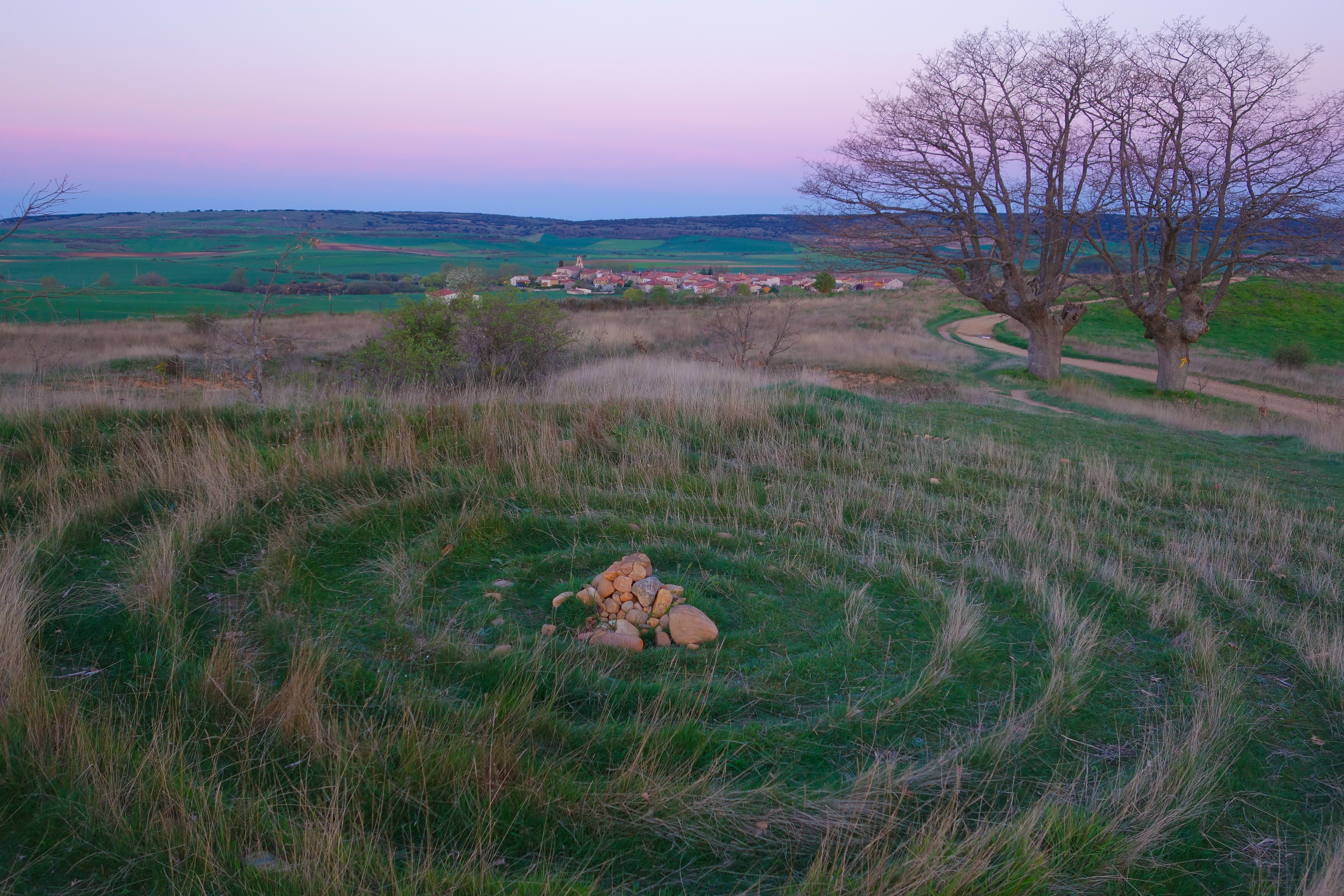
Camino de Santiago near Atapuerca

Camino de Santiago near Atapuerca

Advent is a time to keep watch for the unexpected comings of God, to prepare our own hearts to make room for the Blessed One, and to be ourselves signs to the world around us of divine compassion and justice.

Here is a list of ten general practices, each with some specific suggestions for the keeping of this holy season.

In a month that is already far too busy and rushed, these are not offered as one more to-do list to work through, but as ways to slow down, take a breath, pay attention, and make room in our lives for the birth of the Holy. These practices do not begin to exhaust the possibilities, but I hope they may stimulate your own thoughtful and prayerful responses. If anything here speaks to you, or prompts your own variation, try it out – for a minute, an hour, a day, and leave the rest to God.

Let every heart prepare him/her room.

1) Interrupting

Breaking the flow of habitual patterns can prompt new kinds of noticing and stimulate awareness. Once a week, or once a day, practice difference, welcome surprise.

Take a route to work/school/errands you have never used before. What do you see?

Take a walk in a place or a time that is not customary, and pay attention, trying to notice details of color, movement, and shape before words and labels start to fill your head.

Wear your watch on the “wrong” wrist, or not at all. Every time you look at the time and feel the interruption of automatic behavior, turn your attention to God’s presence in the here and now.

2) Silencing

Schedule a fixed time each day (between 1 and 10 minutes) for wordless silence in the presence of God.

Unplug yourself from all media one day a week, or at least for an evening. Pay attention to how your soul wants to use that quiet time.

Spend one whole evening during Advent, or at least one hour, in total stillness and silence. Turn everything off, light a candle or a fire, abstain from books and music, stop talking in your head. Listen. Who is knocking at the door of your heart? What does your deepest desire want to tell you?

3) Waiting

Make every experience of waiting in daily life a time of prayerful attention to the hope and desire within you. What are all the things your are waiting for? But what are you really waiting for?

Practice attentive and patient waiting. Sit or lie by a window where you can see only the sky. Wait for something to pass by: a cloud, a plane, a bird, an angel…

Wait for the full moon to rise (tonight). Wait for the first star to appear on Christmas Eve.

4) Listening

When you are out in the world, pause and close your eyes sometimes. What do you hear? Make those sounds the subject of a prayer.

Spend some time each day in a place of stillness where you can listen to your heart, and listen for God.

In conversations with friends, family, spiritual director, or stranger, listen for what wants to be heard.

Spend some time each day with music that awakens your heart and evokes the beauty of holiness for you.

5) Watching

Rise early one morning to watch night turn to day. Fit your prayer to the slow rhythm of dawning.

Pick a day to watch both the sunrise and the sunset, from a viewpoint that is unusual for you.

Notice the faces of strangers. Can you see in them icons of the holy?

Take a photograph of something that catches your prayerful eye. Write an Advent reflection, poem or haiku to go with it, and post on social media.

Watch a film that focuses your attention on the traces of God in our world or in our lives.

6) Praying

For at least part of one day each week, every time you enter a new space or begin a new activity, say this prayer: “Maranatha, come Lord Jesus.”

Four times a day (rising, midday, evening, bedtime), face the horizon and pray, “Maranatha, come Lord Jesus.”

Four times a day (rising, midday, evening, bedtime) say the Collect-prayer for the week from the Sunday liturgy.

Cultivate a daily prayer practice, at a set time if possible, and keep it faithfully, even when (or especially when) you are pressed or distracted.

7) Reflecting

Select a book for daily spiritual reading. Don’t skip a single day.

Meditate on the daily readings for Advent (Year 2) provided in lectionaries, Advent books, or online sources.

Journal at least a few times each week. Try beginning with “I am waiting for…” or “I am longing for…” and write what comes to mind.

8) Loving

Visit the sick, the lonely, the sad, the prisoner.

Practice random acts of kindness. Pray that you may be a sign of Christ to everyone you meet.

Pray every day for the person who is hardest for you.

Whenever you are in public space, spend some time praying for everyone you see around you.

For one day, or at least one hour, make a conscious act of seeing Christ in every face.

9) Giving

Do an act of volunteering which you have never done before.
Do something to make more justice and peace.
Send money to a good cause.
Take something to a food bank.

Make a change in your own way of living that will be a vote for “a new heaven and a new earth.”

Pick one social concern that engages your energetic attention, and pray every day that God’s will be done. You don’t have to list possible solutions – they are usually beyond our own imagining. Just entrust the object of your concern to God’s mercy and God’s imagination.

Give yourself to deep conversation with family and friends about the Advent season, the feelings it brings, the action it inspires.

10) Receiving

Pay attention.
Stay awake.
Be ready.

Open the door of your heart
to welcome
the Stranger who knows you by heart.

The ambush of the marvelous

Jacob wrestling

Come, O Thou traveler unknown,
Whom still I hold, but cannot see;
My company before is gone,
And I am left alone with Thee.
With Thee all night I mean to stay,
And wrestle till the break of day.

The Sacred Harp

A century ago, Scottish theologian P.T. Forsyth described prayer as a kind of spiritual tempest blowing away all our complacencies. While giving a nod to the contemplative and aesthetic dimensions of spirituality, he was blunt about its capacity to rupture the settled proportions of daily life:

We do need more reverence in our prayer, more beauty in our praise, less dread of tried and consecrated form. But still more do we want the breathless awe, and the stammering tongue, and the solemn wonder, and the passionate gratitude, which are the true note of grace, and the worship of a soul plucked from the burning and snatched by a miracle from the abyss.

Prayer is not for the timid. Better wear a crash helmet, as Annie Dillard advised. But the fierce energies of prayer are not God’s alone. We must bring the strong force of our own desire to the encounter, pressing God to keep the ancient promise of a world made new. Every prayer may inevitably end with “thy will be done,” but it often begins in a place of struggle, if we are honest. “Hear my voice when I complain,” prayed the Psalmist. Even Jesus argued vehemently for an alternative to the cross. We were not made to go quietly. God wants us to put up a good fight. “Prayer is wrestling with God,” wrote Forsyth. “It is a resistance that God loves.”

The Bible never names the stranger who jumps Jacob in the dark and wrestles him till daybreak (Genesis 32), but interpreters have always suspected his divinity. Delmore Schwartz, in his poem “Jacob,” describes the assault as “the ambush of the marvelous, / unknown and monstrous, / at the very heart of surprise.” Jacob couldn’t see his opponent’s face, but all his inner conflicts must have risen up to give him a name:

– It is the ghost of my father Isaac, from whose deathbed I stole the blessing, and he’s come to take the blessing back.

– No. It is the spirit of my brother, with whom I wrestled in my mother’s womb, with whom I must fight in the flesh tomorrow.

– No. It is my own shadow, the unloved child and desperate trickster, here to unmask the pretense of my so-called success.

– No. It is the angel of death come to mock all God’s promises of protection and future.

– No. It is God’s own self, that merciless opponent who will not let me be until I am broken open and made new.

All night long, Jacob fought against this stranger, this Other. The stranger wounded him, dislocating the socket of his thigh, but Jacob would not give up. When dawn came, the stranger tried to flee, but Jacob held on tight.

“Let me go,” said the stranger. “I do not live in the glare of your well-lit thoughts, but only in the shadows of your intuitions.”

“I will not let you go until you bless me.”

“What is your name?” asked the stranger.

“Jacob.”

“It is Jacob no more. Your name shall be Israel – the one who wrestles with God.”

“Then what is your name?” asked Jacob.

“Ah!” said the stranger. Then he gave Jacob the blessing, and vanished.

The sun began to rise as Jacob limped away from the river, forever wounded, but ready at last to meet his future.

I once led a workshop on this story at a church retreat. After digging into the passage for a while, participants were invited to retell it in their own way. One young woman, who was differently abled and emotionally troubled, did exactly what the Bible wants us to do with its narratives. She put herself into the story.

Jacob was having a lot of problems with his family. He needed to get away from them, to get his head together. He felt a great struggle inside himself. “Why can’t I deal with my anger and frustration?” After a while he began to realize that he was wrestling with God.

He wrestled with God all night long, but when dawn came he began to think God must be pretty tired of him by now, that God must be so sick of listening to his problems that he was just going to go away. Jacob felt afraid and alone but he didn’t give up. He held on tight and wouldn’t let go. He begged God to stay and to bless him.

“What is your name,” God asked him.

“Jacob.”

“I don’t think so,” God said. “I think it’s Israel, because you’ve had the guts to face up to your problems.”

Then the sun came up and God was gone. And as Jacob began to walk away from that place, he noticed he was limping. Suddenly he remembered that he had always had this limp, but it didn’t bother him anymore. It was okay. It was just part of who he was.