I have come to understand that this small ring is the most dangerous place in the world, but also a place where everything is possible, where eyes are opened.
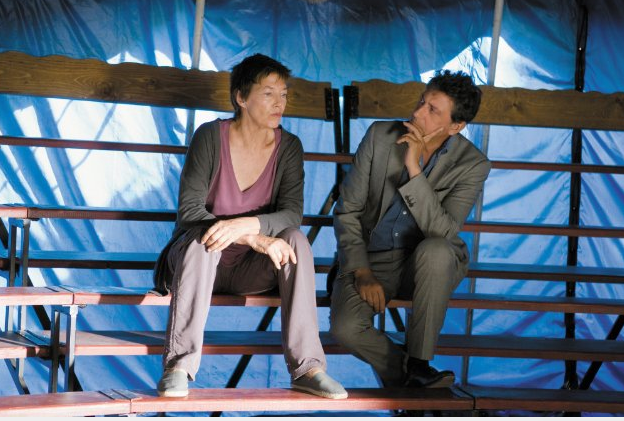
In Jacques Rivette’s magical film, Around a Small Mountain (2009), a footloose Italian named Vittorio, wandering Europe’s back roads in a sports car, chances upon a small French circus on tour in the backwater of Languedoc. Although the story is set in our own time, it is really a medieval romance. Vittorio is the knight errant questing for that nameless object of desire perpetually beyond his grasp. And the enchanted world of the cirque, curiously untouched by modernity, is the place where the knight will be tested.
When Vittorio encounters the enigmatic Kate, a woman who is “a prisoner to what happened” in the circus ring years ago, he lingers in her domain long enough to attempt a rescue. “All the dragons in our lives may be hurt princesses,” he says, echoing Rilke’s famous line: Perhaps everything terrifying is deep down a helpless thing that needs our help.
As Vittorio attempts to break the spell cast over Kate by the lingering presence of a dead father and the haunting absence of a dead lover, he has to face his own dragon, which is never specifically identified. The secret of his being remains a mystery, unknown to himself and to the actor who plays him, unknown to the audience and the director as well. The sentimentality of a conventionally romantic conclusion – man and woman settling down happily ever after – would betray this mystery, and Rivette rejects such an option. The ultimate fate of Kate and Vittorio is not revealed to themselves or us. “Will I start living again?” she wonders. “I don’t know if I am alive,” he says. Might the future perhaps return them to each other? “Who knows?” is the last line of the film.
We exit this cinematic world still mesmerized by its embrace of uncertainty, its refusal of resolution. Like the knight errant, we remain prisoners of unsatisfied longing. We wouldn’t have it any other way. As C. S. Lewis noted, an unsatisfied desire is “more desirable than any other satisfaction.”
Nevertheless, something transformational has happened to Kate and Vittorio and, vicariously, to us, in that “most dangerous place,” the circus ring. They have each stepped into the exposed and empty space where they must perform the truth of themselves, put themselves at risk, wrestle their demons, without really knowing in advance how they’ll ever get through it. But they have already taken their first steps into a new life. In the words of the German Romantic Friedrich Hölderlin, quoted in another Rivette film, “Where danger is, there grows the saving power also.”
I recently saw Around a Small Mountain for the first time, and I was particularly struck by the hermetic quality of the circus. It seems sealed within its own world, having minimal interaction with contemporary life. The landscape it travels remains little changed from the Middle Ages, as if forgotten by modernity. Though the circus is touring the towns around the perimeter of a small mountain, there is little sense of movement from place to place. Wherever the troupe pauses in their circuit, the mountain’s solitary peak still looms in the background, as if the land itself casts a spell they cannot escape.
In the course of the film, we see a number of performances, but they seem to have no public. The first time we enter the tent, there are only a few people in the audience as the camera sweeps over mostly empty seats. After that, the camera doesn’t even bother to look away from the ring to the surrounding bleachers, so we are never sure whether we are viewing a rehearsal or an actual show.
The acts are performed in an almost eerie silence, without applause or any other sounds to indicate the presence of an audience. This melancholy absence of witnesses seems of no concern to the acrobats, jugglers and clowns who carry out their rituals with as much devotion and attention as a priest saying mass in an empty church. Whether what they do is of any relevance to the outside world does not seem an issue for them. What matters is the faithful performance of the circus rites.
As I watched the ritualized actions in the circus ring, skills and gestures passed down through many centuries, imbued with the strangeness of a premodern sensibility, I could not help thinking about the Christian liturgy. We too perform rites forged in a distant past, shaped by a social imaginary largely unintelligible to secular modernity. And like the circus in the film, our “audience” has largely deserted us.
In his audio commentary on the DVD, Chris Fujimara describes the circus as “an end state, a final repository, a gathering and summation. Everything in life is being distilled and evoked from this ring in a way that has to do with aging, with memory, with death, with the imminent end of things, with the suggestion that the circus, this mode of entertainment and spectacle, already belongs to the past.”
There are those who see Christianity’s own pastness as prelude to extinction, and believe everything alien to the present social imaginary should be jettisoned as quickly as possible. I myself have spent over forty years adding radically contemporary elements to the worship mix. But that has never, I hope, been at the expense of the strangeness of what we do and the mystery of what we worship.
In some future posts I will have more to say about the implications of this strangeness for the concrete practices of worship as well as the need to connect with an absent public. But for now, like the ringmaster, may I simply direct your attention to the center ring, the most dangerous place in the world, the empty space where everything is possible, where eyes are opened. To paraphrase Jacques Rivette, “there is no other subject.”

 The religious imagineer