Thinking About America on Bastille Day

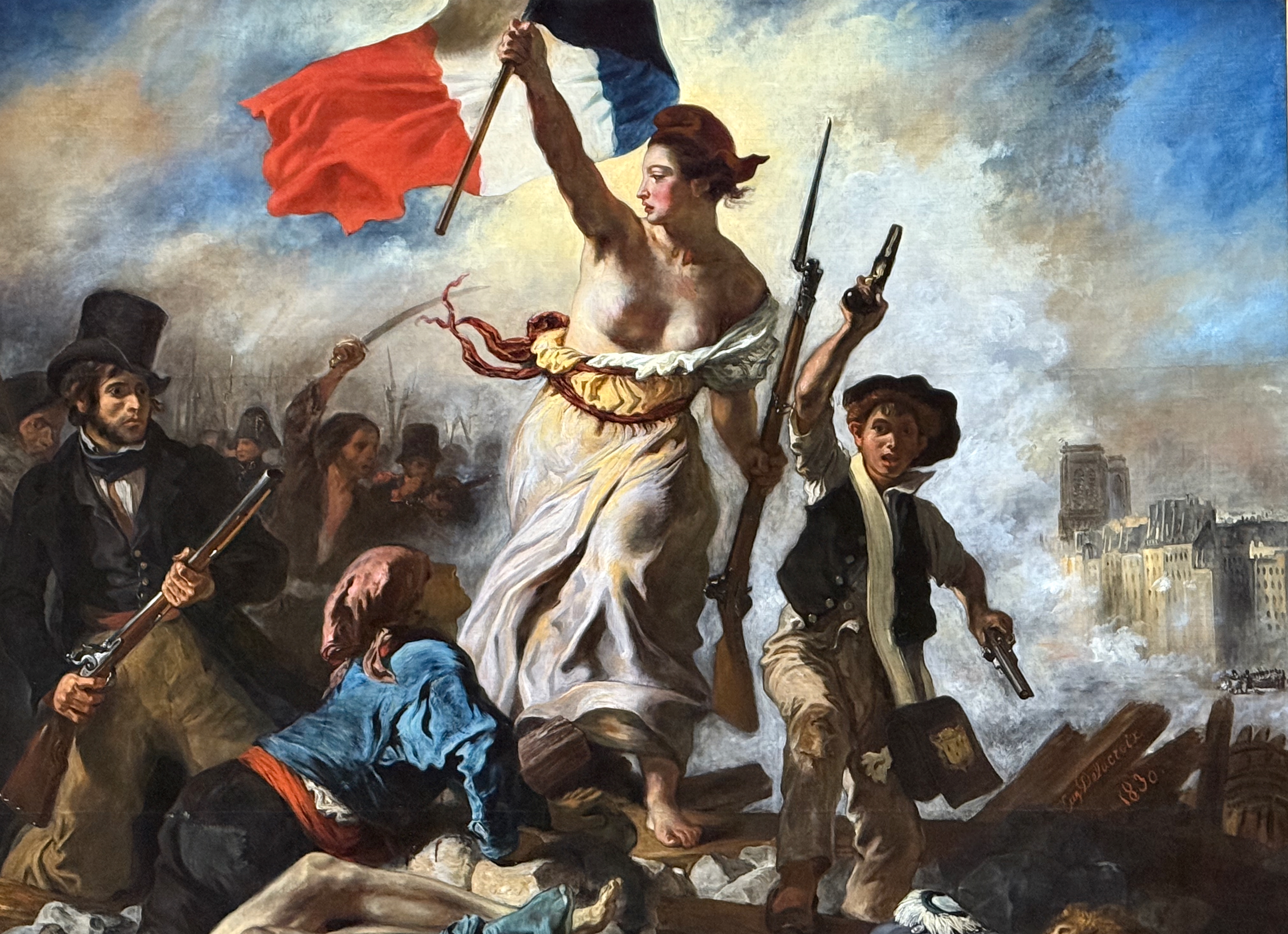
Eugène Delacroix, LIberty Leading the People (1830).

“Nothing collapses more quickly than civilization during crises like this one [the French Revolution of June 1848]; lost in three weeks is the accomplishment of centuries. Civilization, life itself, is something learned and invented … After several years of peace men forget it all too easily. They come to believe that culture is innate, that it is identical with nature. But savagery is always lurking two steps away, and it regains a foothold as soon as one stumbles.”

— Sainte-Beuve [i]

When an inflamed crowd of Parisian citizens stormed the Bastille on July 14, 1789, the obsolete medieval fortress had long outlived its usefulness as an instrument of royal tyranny. It was destined for demolition, and a mere seven prisoners inhabited its dungeons when the crowd broke through the gates. A year later, Lafayette presented the key for the Bastille to President George Washington, honoring the quest for liberty by both countries. The key still resides at Washington’s Mount Vernon home.

Historians have suggested that the king’s capitulation to the political power of commoners (the ‘Third Estate’) on July 9 marks the true beginning of the French Revolution, but the bloody drama of Bastille Day proved a more potent symbol than the parliamentary negotiations being conducted at the king’s palace of Versailles. In any case, the once unthinkable destruction of the Ancien Régime had been decades in the making.

In The Revolutionary Temper: Paris, 1748-1789, American historian Robert Darnton traces the growth of revolutionary sentiment as it was expressed in the Paris street: café conversations (often transcribed by police spies), underground gazettes and pamphlets, street songs, sidewalk speeches, public demonstrations and processions, and personal diaries. Eighteenth-century Paris had its own version of an information society, where “the ebb and flow of information among ordinary Parisians” was shared widely in cafés, marketplaces, wineshops, street corners and salons. [ii]

When the 72-year reign of Louis XIV ended in 1715, it was hard to imagine an alternative to absolute monarchy. His successor, Louis XV, would still be claiming dictatorial authority as late as 1766:

“In my person alone resides the sovereign power: from me alone my courts derive their existence and their authority, without any dependence and any division.” [iii]

“Although the words were printed on paper, the messages of pamphlets flew through the air and mixed in the cacophony known as bruits publics [‘public rumors’]. Pamphlets were bruited about. They were read aloud, performed, applauded, rebutted, and assimilated in the talk that filled lieux publics [“public places”]. Readers also pondered tracts in the quiet of their studies, but when they went outside they encountered other Parisians, in marketplaces, along the quais, in the courtyard of the Louvre, on benches in the gardens of the Palais-Royal, the Tuileries, and the Luxembourg palace. Like smoke from thousands of chimneys gathering over the city, a climate of opinion gradually took shape.” [v]

It took half of the eighteenth-century to produce such a climate of opinion in France, a ”revolutionary temper” which was perfected, like tempered steel, through repeated heating and cooling. People would complain about this tax or that scandal, this outrage or that cruelty, but the tectonic shift from specific complaints to general discontent and clamor for change was a process of decades. Only when the climate of opinion attained sufficient density was it possible to imagine the impossible. Once revolution became conceivable, the leaps from absolute monarchy to constitutional monarchy to no monarchy at all were breathtakingly swift.

Revolution doesn’t necessarily require the refinements of political theory. By 1788, the high cost of bread by itself (like our egg or gas prices) was enough to elicit calls for radical change. One angry woman in a boulangerie was heard to say, “They should march on Versailles and burn the place down.” [vi]  She was not alone, and by then the people of Paris were beginning to conceive of themselves as part of a movement, and act accordingly.

“Whether or not they followed the arguments of the theoreticians, Parisians were swept up in the conviction of becoming a nation, a sovereign body that would defy privileged orders and take charge of its own destiny. This way of constructing reality—the drawing of lines, the identification of a common enemy, the creation of a collective self-awareness—can be understood as a process of radical simplification. Although it had origins that went far back in the past, it came together with unprecedented force in 1788 and underlay a revolutionary view of the world: us against them, the people against the grands, the nation against the aristocracy.” [vii]

I could not read Darnton’s illuminating account without thinking of my own deeply troubled country. Although there are of course countless dissimilarities between 18th-century France and 21st-century America, some parallels got me thinking.

First of all, I found the accounts of a Paris alive with ardent conversations about public life to be inspirational. There was an urgency and a passion which feels lacking in America’s current collective consciousness. “Everyone writes, everyone reads,” said one of those pre-revolutionary Parisians. “Even the coachman reads the latest work on his perch,” said another. “Every person down to domestic servants and water carriers is involved in the debating.” [viii] But in America, 2025, while we may consume volumes of news in private, most of us carry on as if life is pretty much normal, even as our would-be dictator dispatches masked thugs to terrorize our communities, trains the military to act as his personal army, and builds concentration camps to torture and disappear his “enemies.”

Like 18th-century Paris, we need to converse with one another in earnest, employing a reliable flow of factual information and strategic thought to shape a collective consciousness for the common good. The forces of tyranny and greed have worked for decades to create its opposite, a seductive web of lies and rage to poison and incapacitate the consciences of millions of Americans. Those who care about the common good are still, I believe, in the majority, but that means nothing if we lack the means and the will to be connected with one another in public truth-telling, mutual encouragement, and collective action. As long as we feel isolated, alone and discouraged, tyranny will flourish.

I was also struck by the importance of imagining alternatives to consensus reality in our public life. A sense of inevitability is the mother of inaction. In France under Louis XIV, the monarchy seemed inevitable—until it didn’t. In America, at least until Trump, democracy and the rule of law were assumed to be inevitable. And while many of us have come to realize how fragile and conditional our democracy actually is, the press, along with many Democratic politicians, continue to play the game of “Let’s Pretend.”

Let’s pretend that everyone is playing by the same rules. Let’s pretend the president is not fascist, childish, ignorant, cruel, and increasingly incoherent and nonsensical. Let’s pretend that normal protocols are the best way to engage with him. Let’s pretend we don’t have an American gestapo, or a White House dominated by racists, white nationalists and shameless liars. Let’s pretend our government isn’t supporting genocide in Gaza, or robbing millions of their health care. Let’s pretend that climate change is nothing to worry about. Let’s pretend it’s all just politics as usual and both sides do the same thing, so there’s no cause for alarm.

Finally, I was intrigued by the theatricality of what the French called emotions populaires [mass protests]. Straw effigies of unpopular or disgraced officials were mocked, paraded through the streets, and forced to kneel before statues of honored officials and beg divine pardon. On one occasion, the crowd seized a passing priest, demanding that he hear the dummy’s confession. Eyed with suspicion as a symbol of the Ancien Régime, the priest was careful not to anger the crowd by refusing to play. He put his ear to the effigy’s mouth for a few moments, then declared to all that it had so many sins to confess that it would take all night! The people laughed, applauded the priest’s wit, and let him go. As for the dummy official, he “was pitched into a giant feu de foie [‘fire of joy’].” [ix]

I suspect that setting fire to effigies of our American tyrants would not be a safe practice these days, and I am aware that the emotions populaires in revolutionary Paris often led to serious violence. But I wonder if there might be, in our own acts of resistance and witness, creative theatrical ways to engage with flanks of armed soldiers or gangs of ICE agents using guerilla theater, humor, song, ritual, and even clowning and mime—anything to subvert, disarm, or transcend the deadly Punch and Judy face-off of venomous gazes. Is there any way to make the other laugh, or wonder, or think, if only for a moment? Send in the clowns! Could you still want to shoot someone who made you laugh—or cry?

You may say that I’m a dreamer, but I’m not (I hope) the only one.


[i] Charles Augustin Sainte-Beuve (1804-1869), a French literary critic, is quoted by George Eliot in Impressions of Theophrastus Such; cited in Frederick Brown, The Embrace of Unreason: France, 1914-1940 (New York: Anchor Books, 2014), 3.

[ii] Robert Darnton, The Revolutionary Temper: Paris, 1748-1789 (New York: W. W. Norton & Company, 2024), xix.

[iii] Ibid., 131.

[iv] Ibid., 333.

[v] Ibid., 390.

[vi] Ibid., 366.

[vii] Ibid., 400.

[viii] Ibid., 391.

[ix] Ibid., 371.

“We are America!” — Poetic Voices of an Immigrant Nation

Illustration by Shepard Fairey from a photograph by Delphine Diallo.

Last night, at a campaign rally in Pennsyvlania, Donald Trump told the crowd that immigrants are “changing the character of small towns and villages all over our country and changing them forever. They will never be the same … And I’ll say it now: You have to get ’em the hell out! You have to get ’em out … Can’t have it! They’ve destroyed us.” The MAGA mob responded with a chant that would make Hitler smile: SEND THEM BACK! SEND THEM BACK!

At the beginning of this century, the Episcopal Diocese of Chicago asked me to compile texts of the immigrant experience for a public reading in celebration of America’s rich diversity. I first posted these here in 2018. May these eloquent American voices remind us of our common origins as strangers and sojourners. In a country beset with what Canadian scholar Henry A. Giroux has called the “violence of organized forgetting,” remembering is a crucial act of resistance.

Sing to me, call me home in languages I do not yet
understand, to childhoods I have not yet experienced,
to loves that have not yet touched me.
Fill me with the details of our lives.
Filling up, emptying out
and diving in.
It is the holy spirit of existence, the flesh, the blood,
the naked truth that will not be covered.
Tell me everything, all the details – flesh, blood, bone.

– Lisa Kahaleole Chang Hall

From Asia, you crossed a bridge of land,
now called the Bering Strait, now swallowed
in water. No human steps to follow,
you slowly found your way on pathless grounds…
Travelers lost in time – walking, chanting, dancing –
tracks on mapless earth, no man-made lines,
no borders. Arriving not in ships, with no supplies,
waving no flags, claiming nothing, naming
no piece of dirt for wealthy lords of earth.
You did not come to own; you came to live.

– Benjamin Alire Sáenz

America is also the nameless foreigner,
the homeless refugee,
the hungry boy begging for a job,
the illiterate immigrant…
All of us, from the first Adams
to the last Filipino,
native born or alien,
educated or illiterate –
We are America! 

– Carlos Bulosan

She is the woman hanging from the 13th floor window
in east Chicago…
She sees Lake Michigan lapping at the shores of
herself…She sees other
women hanging from many-floored windows
counting their lives in the palms of their hands
and in the palms of their children’s hands.

She is the woman hanging from the 13th floor window
on the Indian side of town…
crying for the lost beauty of her own life.

– Joy Harjo

I am not any of the faces
you have put on me america

every mask has slipped
i am not any of the names

or sounds you have called me
the tones have nearly

made me deaf
this dark skin, both of us have tried to bleach…

– Safiya Henderson-Holmes

I know now that I once longed to be white.
How? you ask.
Let me tell you the ways.

when I was growing up, people told me
I was dark and I believed my own darkness
in the mirror, in my soul, my own narrow vision.

when I was growing up, my sisters
with fair skin got praised
for their beauty and I fell
further, crushed between high walls.

when I was growing up, I read magazines
and saw blonde movie stars, white skin, sensuous lips,
and to be elevated, to become
a woman, a desirable woman, I began to wear
imaginary pale skin.

when I was growing up, I was proud
of my English, my grammar, my spelling,
fitting into the group of smart children,
smart Chinese children, fitting in,
belonging, getting in line.

– Nellie Wong

These men died with the wrong names,
Na’aim Jazeeny, from the beautiful valley
of Jezzine, died as Nephew Sam,
Sine Hussin died without relatives and
because they cut away his last name
at Ellis Island, there was no way to trace
him back even to Lebanon, and Im’a Brahim
had no other name than mother of Brahim
even my own father lost his, went from
Hussein Hamode Subh’ to Sam Hamod.
There is something lost in the blood,
something lost down to the bone
in these small changes. A man in a
dark blue suit at Ellis Island says, with
tiredness and authority, “You only need two
names in America” and suddenly – as cleanly
as the air, you’ve lost
your name. At first, it’s hardly
even noticeable – and it’s easier, you move
about as an American – but looking back
the loss of your name
cuts away some other part,
something unspeakable is lost.

– Sam Hamod

I am Marilyn Mei Ling Chin…
Of course, the name had been changed
somewhere between Angel Island and the sea,
when my father the paper son
in the late 1950’s
obsessed with some bombshell blonde
transliterated “Mei Ling” to Marilyn…
and there I was, a wayward pink baby,
named after some tragic
white woman, swollen with gin and Nembutal.

– Marilyn Chin

“This is my country,” we sang,
And a few years ago there would have been
A scent of figs in the air, mangoes,
And someone playing the oud along a clear stream.

But now it was “My country ’tis of thee”
And I sang it out with all my heart…
“Land where my fathers died,” I bellowed,
And it was not too hard to imagine
A host of my great uncles and -grandfathers
Stunned from their graves in the Turkish interior
And finding themselves suddenly
On a rock among maize and poultry
And Squanto shaking their hands.

– Gregory Djanikian

If I am a newcomer to your country, why teach me about my ancestors? I need to know about seventeenth-century Puritans in order to make sense of the rebellion I notice everywhere in the American city. Teach me about mad British kings so I will understand the American penchant for iconoclasm. Teach me about cowboys and Indians; I should know that tragedies created the country that will create me.

– Richard Rodriguez

Names will change
faces will change
but not much else
the President will still be white
and male
and wasp
still speak with forked tongue…
still uphold the laws of dead white men
still dream about big white monuments
and big white memorials
ain’t nothin’ changed
ain’t nothin’ changed at all.

– Lamont B. Steptoe

My dream of America
is like dà bính lòuh
with people of all persuasions and tastes
sitting down around a common pot
chopsticks and basket scoops here and there
some cooking squid and others beef
some tofu and watercress
all in one broth
like a stew that really isn’t
as each one chooses what she wishes to eat
only that the pot and fire are shared
along with the good company
and the sweet soup
spooned out at the end of the meal.

– Wing Tek Lum

today
we will not be invisible nor silent
as the pilgrims of yesterday continue their war of attrition
forever trying, but never succeeding
in their battle to rid the americas of us
convincing others and ourselves
that we have been assimilated and eliminated,

but we remember who we are

we are the spirit of endurance that lives
in the cities and reservations of north america
and in the barrios and countryside of Nicaragua, Chile
Guatemala, El Salvador

and in all the earth and rivers of the americas.

– Victoria Lena Manyarrows

We are a beautiful people
with African imaginations
full of masks and dances and swelling chants
with African eyes, and noses, and arms,
though we sprawl in gray chains in a place
full of winters, when what we want is sun.

We have been captured,
brothers and sisters. And we labor
to make our getaway, into
the ancient image, into a new
correspondence with ourselves
and our black family.
We need magic
now we need the spells, to raise up
return, destroy, and create. What will be
the sacred words?

– Amiri Baraka

Living on borders, and in margins,
keeping intact one’s shifting and multiple identity and integrity,
is like trying to swim in a new element…
There is an exhilaration in being a participant
in the further evolution of humankind.

– Gloria E. Anzaldúa

We are connected to one another in time and by blood. Each of us is so related, we’re practically the same person living infinite versions of the great human adventure.

– Maxine Hong Kingston

When both of us look backward…we see and are devoted to telling about the lines of people that we see stretching back, breaking, surviving, somehow, somehow, and incredibly, culminating in someone who can tell a story.    

— Louise Erdrich

I am a woman who wants to go home but never figured out where it is or why to go there…I have lost the words to chant my bloodline.    

— Lisa Harris

We are the sum of all our ancestors. Some speak louder than others but they all remain present, alive in our very blood and bone.      

— Lisa Kahaleole Chang Hall

I have the same name as 1 grandfather, 3 cousins, 3 nephews, and 1 uncle. The uncle disappeared when he was 15, just took off and caught a freight (they say). He’s discussed each year when the family has a reunion, he causes uneasiness in the clan, he is an empty space. My father’s mother, who is 93, and who keeps the Family Bible with everybody’s birth dates (and death dates) in it, always mentions him. There is no place in her Bible for ‘wherabouts unknown.’    

— Etheridge Knight

When the census taker, a woman of African descent…came to my door, I looked into the face of my sister….She did not ask me my racial background but checked off the box next to Black American/African American/Afro-Cuban American/Black African….

I met her eyes and said, “I’m not Black; I’m Other, Mixed, Black and White.” …She did not smile, smirk, or frown, but checked the box marked “Other,” and lifted her eyes quickly to mine again. I wanted to see her erase “Black.” She did not do so in my presence….

I had been focused on my personal freedom, on my right to define who I am, on my responsibility to my sense of self. The dignity of the census taker was not a part of my mental equation…

She thanked me. But the price of my self-definition had been the wall I felt I’d built between us before I ever closed the door.        

— Sarah Willie

I am not African. Africa is in me, but I cannot return…I am not european. Europe lives in me,  but I have no home there. I am new. History made me….I was born at the crossroads and I am whole.  

— Sarah Willie

Auntie Raylene, an accomplished chanter and dancer, told us about the necessity of remembering and honoring where we come from….During the question-and-answer session, a worried West African immigrant brother asked her, “But…what if our parents and grandparents refuse to tell us anything? They don’t want to talk about the old days. They are afraid. Or they don’t remember.”

She looked at him with great love and said, “Then you go back further, to the source,” and her hand swept back with assurance to the beginning of time, to the birth of life.

– Lisa Kahaleole Chang Hall

Remember your birth, how your mother struggled
to give you form and breath. You are evidence of
her life, and her mother’s, and hers.

Remember your father. He is your life, also.
Remember the earth whose skin you are:
red earth, black earth, yellow earth, white earth
brown earth, we are earth….

Remember that you are all people and that all people are you.
Remember that you are this universe
and that this universe is you.

Remember that all is in motion, is growing, is you.
Remember that language comes from this.
Remember the dance that language is, that life is.
Remember.

– Joy Harjo


We the People art images are available here as free downloads. Shepard Fairey’s image of 12-year-old Menelik is from a photograph by French and Senegalese artist Delphine Diallo. The texts are drawn from several wonderful collections: UA:Unsettling America: An Anthology of Contemporary Multicultural Poetry , ed. Maria Mazziotti Gillan & Jennifer Gillan (Penguin,1994)… N: Names We Call Home: Autobiography on Racial Identity, eds. Becky Thompson, Sangeeta Tyagi (Routledge, 1995) … and another anthology which has vanished from my library and my memory, though I have traced original sources for most of its selections. In order: Hall (N 241), Sáenz (Calendar of Dust), Bulosan (http://bulosan.org/in-his-words), Harjo (UA 29-30), Henderson-Holmes (UA 60), Wong (UA 55), Hamod (UA130), Chin (UA 134), Djanikian (UA 215), Rodriguez (source unknown), Steptoe (UA 250), Lum (UA 322-23), Manyarrows (UA 330), Baraka (UA 155), Anzaldúa (Borderlands/La Frontera: The New Mestiza), Kingston & Erdrich (third anthology), Harris (N xv), Hall (N 241ff.), Knight (The Essential Etheridge Knight), Willie (N 276, 278), Hall (241ff.), Harjo (She Had Some Horses)