Seeking the Good at the End of the World (Homily for Advent 1)

Extra! Extra! Read all about it.
SUN GOES OUT!
STARS FALL FROM HEAVEN!
THOUSANDS FAINT FROM FEAR!

On the first day of the Christian Year, do we break out the champagne and shout “Happy New Year.” No we do not. What we say is, “The end is near!”

We don’t get all Fundamentalist about it. We don’t walk around wearing signboard warnings. We don’t declare a fixed date for the end of history. We prefer to keep our end time theology more metaphorical than literal. Worlds end all the time. Personal worlds. Public worlds.

Still, this year, from Gaza and Ukraine to Washington, D.C., the end of the world feels closer to being literal than any other time in my 80 years on the planet. To borrow some lines from W. H. Auden’s Good Friday poems, lately it feels as if the world we know has been “wrecked, / Blown up, burnt down, cracked open, / Felled, sawn in two, hacked through, [and] torn apart.”

For Christians, the end of the world should not come as a total surprise. Every gospel on the First Sunday of Advent includes a forecast of the apocalypse—the end of the world as we know it. It’s not that uncommon, actually. Who has not experienced apocalypse on a personal level—the exit from childhood, the loss of a job or a loved one, a scary diagnosis? And throughout history, apocalyptic episodes have periodically disrupted the stability of humanity’s collective life: the fall of empires, economic crashes, military invasions, revolutions, authoritarian nightmares, environmental crises, and the like.

In the Humphrey Bogart movie, Beat the Devil, a ship is floundering on a stormy sea. In his typical wise-cracking manner, Bogie says to a panicky passenger, “What have you got to worry about? We’re only adrift on an open sea with a drunken captain and an engine that’s liable to explode at any moment!”

A crewman chimes in: “Perfectly ordinary situation. It happens every day.”

Like it or not, we’re all on board that sinking ship at the close of 2024, praying desperately with the Psalmist, “Save me, O God! The water has risen up to my neck; I’m sinking into the mire” (Psalm 69:1-2) Perfectly ordinary situation. It happens every day.

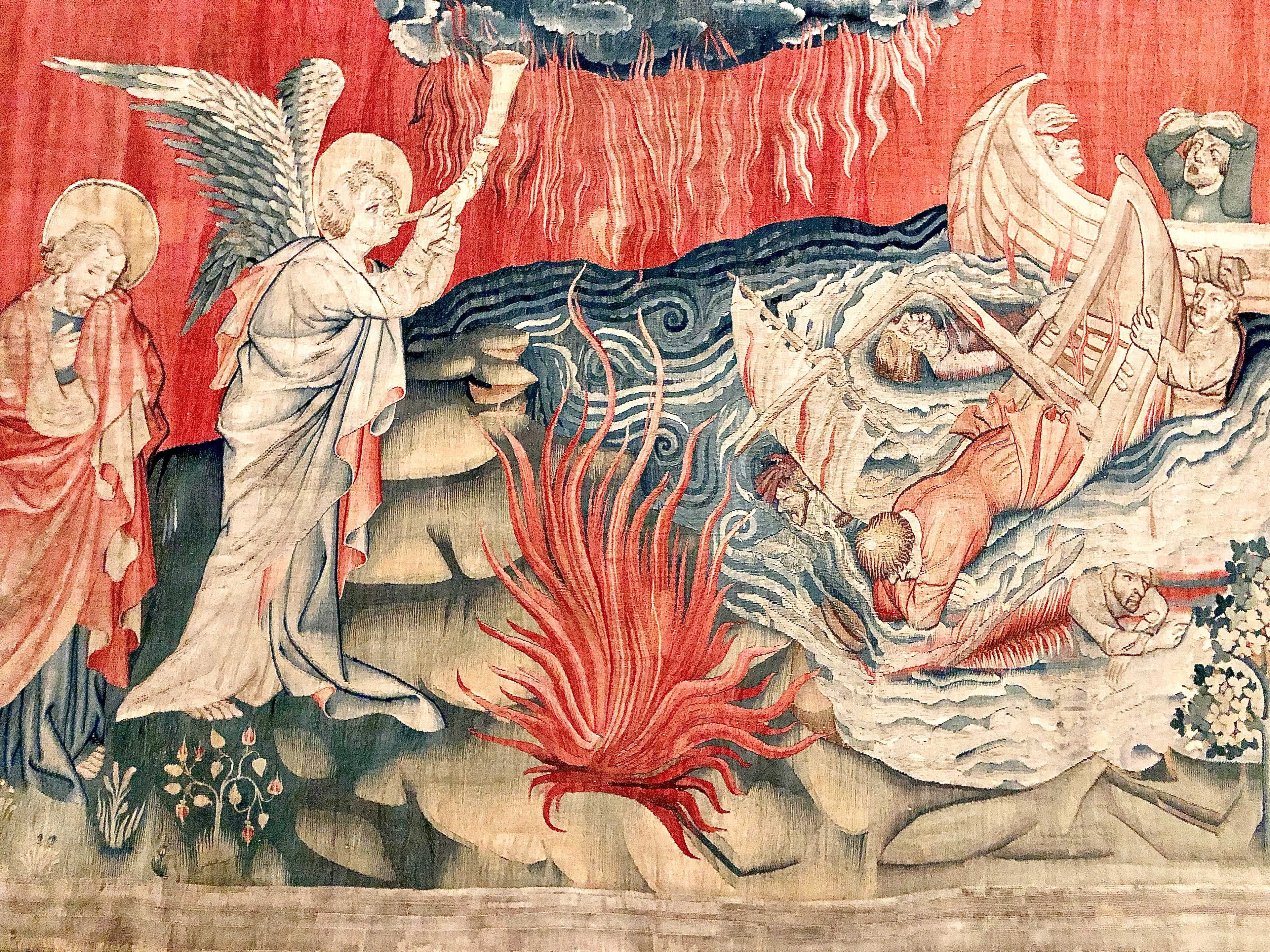
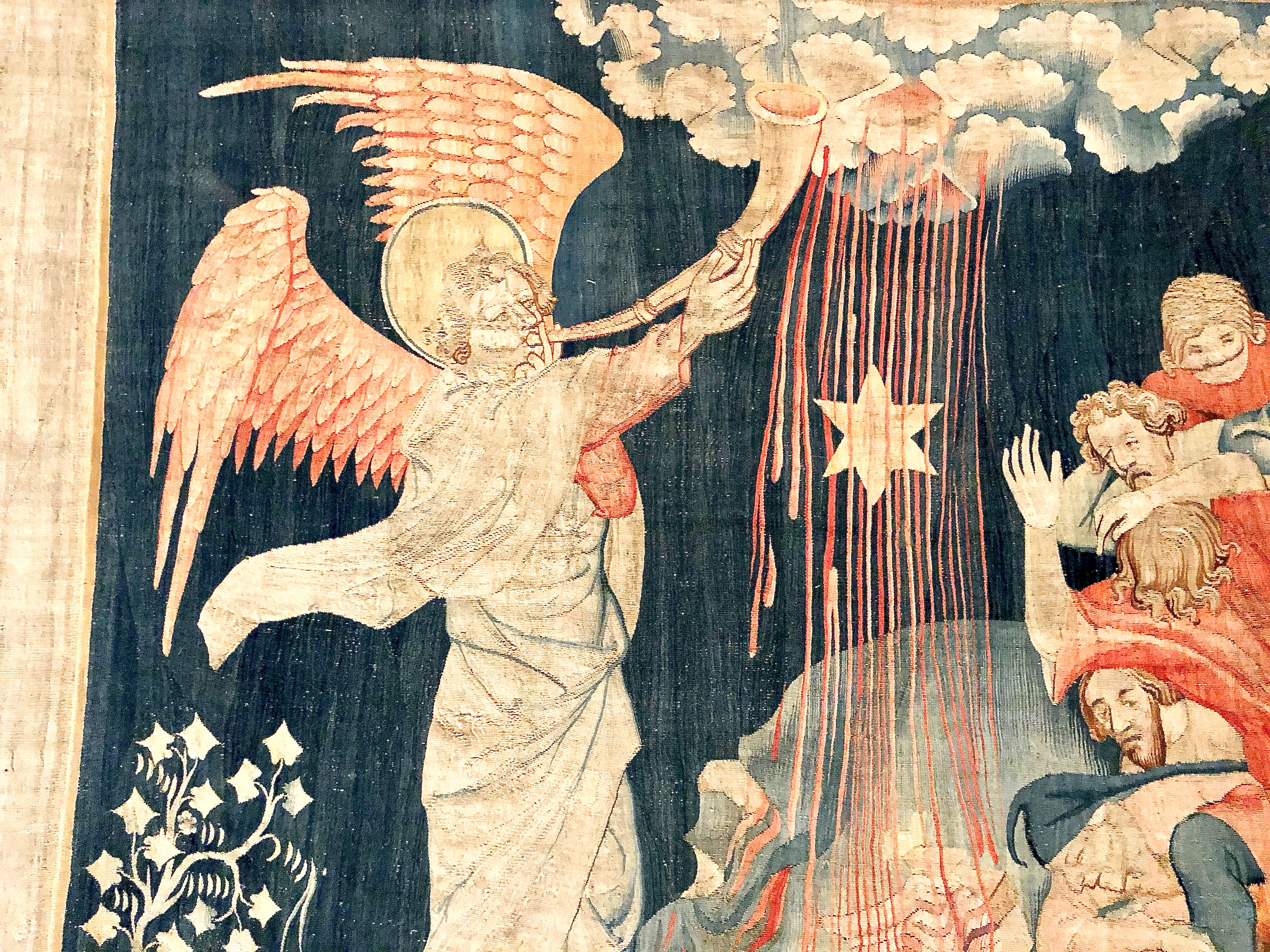
Angel blowing the 2nd trumpet as the sea swallows ships and sailors (Revelation 8:8). The Apocalypse Tapestry of Angers (1373-1382). Photograph by the author.

When I was younger, I had a crushing experience of my personal world coming undone. A spiritual director summed up my situation as being washed overboard into a wild sea, where I’m flailing to keep my head above water.” “Sounds about right,” I said mournfully. “Well, congratulations!” he told me. “You’re exactly where you need to be.” I had to laugh at the aptness of his metaphor. My apocalypse had indeed revealed the unsustainability of my former state, even as it hurled me into the formless chaos from which my new world would be born.

Saint Michael weighing souls (c. 1180), Saint-Trophime, Arles, France. Photograph by the author.

Apocalypse can be an unwelcome judgment on the way things are. It weighs the world in the scales of justice and finds it wanting. The judgment is not punitive, simply accurate. As a 14th-century English poem on the end of the world put it, the apocalypse judges “without revenge or pity.” It just tells it like it is. Still, it’s a hard thing to face the truth about our flawed condition. However, the end of an old reality can also be life-giving, freeing us to discover a better version of self and world.  

But where can we put our feet when the ground is crumbling beneath us?  We stand on God’s word, God’s promise, God’s hope. “Heaven and earth will pass away,” Jesus says, “but my words will not pass away.” Let the Savior’s words guide us. Let them encourage us. As he told his disciples,

“When the chaos comes, keep your heads high and stand your ground. Your liberation is on its way.  Don’t be distracted by thoughtless living, or get weighed down with worry,” he says. “Be alert at all times, and pray that you’ll have the strength to get through all this craziness.” [i]

This is my 55th year of preaching in Advent. It’s my favorite season, so rich with resonant and stirring themes: endings and beginnings, light and darkness, waiting and preparing, watching and hoping, expectation and, in the end, marvelous birth. But this year Advent feels decidedly more urgent and more serious to me than ever before. We aren’t just reading about a people who sit in darkness. We are those people.

We could weep and moan about being stuck in this particular moment in history. But what if the Lord of history is telling us, “Congratulations! You are just where you need to be—in the wild baptismal sea of rebirth. Come, take up your cross. Following me is about to get really real and really intense. Costly? Yes. Suffering? Yes. Dying? Yes. Rising? Yes! Start to live the risen life like you mean it!

Okay, Lord. But what exactly is that going to entail? This question came up when I ran into friend from church on the ferry last week. “What are we supposed do if they begin to round up the most vulnerable in our midst?” she asked. “Join hands to block their way with our bodies?” The strangeness of such a hypothetical even being asked in our peaceful corner of the world prompted a helpless shrug.

Seeking some guidance from my library, I pulled out a book published a few years ago: The Year of Our Lord 1943: Christian Humanism in an Age of Crisis. The author, Alan Jacobs, examins the responses of Christian intellectuals to the violent chaos of the Second World War. What did some of the most articulate of God’s friends have to say about being faithful in a dark and dangerous time?  

When the war broke out in 1939, Anglican poet W. H. Auden put the case bluntly: We must love one another or die. A year later, he wrote New Year Letter (January 1, 1940), a long poem considering “what is possible and what is not” in such a time.

Most of the poem is addressed to Elizabeth Mayer, a supportive maternal figure who was a key source of peace and happiness in Auden’s life.

We fall down in the dance,” he wrote. “We make
The old ridiculous mistake,
But always there are such as you
Forgiving, helping what we do.
O every day in sleep and labour
Our life and death are with our neighbor.

In other words, we are all in this together. The end of New Year Letter is addressed to God, asking for divine help in making a better world, since we humans are too muddled to do it on our own.

“Send strength sufficient for our day,” he wrote. “And point our knowledge on its way.”[ii]

His friend C. S. Lewis worried about the Church endorsing the violence in its prayers. On September 10, 1940, he wrote to his brother, “In the litany this morning we had some extra petitions, one of which was ‘Prosper, O Lord, our righteous cause.’ I ventured to protest against the audacity of informing God that our cause was righteous—a point on which He may have His own view.” [iii]

Lewis preferred the wartime collect of Thomas Cranmer, the Archbishop of Canterbury who made the first Book of Common Prayer. During hostilities with Scotland in 1548, Cranmer wrote this extraordinary collect:

“Most merciful God, the Granter of all peace and quietness, the Giver of all good gifts, the Defender of all nations, who hast willed all men to be accounted as our neighbours, and commanded us to love them as ourself, and not to hate our enemies, but rather to wish them, yea and also to do them good if we can: … Give to all us desire of peace, unity, and quietness, and a speedy wearisomeness of all war, hostility, and enmity to all them that be our enemies; that we and they may, in one heart and charitable agreement, praise thy most holy name, and reform our lives to thy godly commandments.” [iv]

In other words, in times of conflict, Christians must take care not to mirror the violence we oppose. We must find a way toward peace and reconciliation. But what if there are no good choices available?

The German theologian Dietrich Bonhoeffer knew how bitter conflict corrodes the human heart. In a 1942 letter to fellow members of the German resistance, he wrote:

“Unbearable conflicts have worn us down or even made us cynical. Are we still of any use? We will not need geniuses, cynics, people who have contempt for others, or cunning tacticians, but simple, uncomplicated and honest human beings.” [v]

In the desperate hope of derailing the Nazi horror, Bonhoeffer reluctantly joined a conspiracy to assassinate Hitler. The plot failed and he was executed for his role in it. A new film about him depicts him going to the gallows confident in his own purity of heart, but the fact is he never stopped feeling guilty for his participation the way of violence. He felt corrupted by the whole milieu of bloody conflict: shooting, wrecking, bombing—none of it is untainted by evil.

Simone Weil, French philosopher and activist, agreed that everyone is a victim of war. No one involved in the application of force escapes its toxicity. “To the same degree,” she said, “though in different fashions, those who use it and those who endure it are turned to stone.” When the Second World War started, Weil warned that

“We should not think that because we are less brutal, less violent, less inhuman than those we are confronting, we will prevail.” We must find a way, she insisted, to exercise the opposing virtues.

In late 1942, when Weil was working in the London office of the French Resistance, she proposed a plan to parachute hundreds of white-uniformed nurses onto battlefields, not only to tend to the wounded but also to provide an image of self-sacrificial goodness in the midst of cruelty and violence. She herself wanted to be in the first wave of this non-violent invasion. In submitting her plan to the Free French authorities, she made a visionary argument:

A small group of women exerting day after day a courage of this kind would be a spectacle so new, so significant, and charged with such obvious meaning, that it would strike the imagination more than any of Hitler’s conceptions have done.” [vi]

Charles de Gaulle thought her quite mad, and her plan of course went nowhere. But her saintly resistance to the application of force was a bright candle in the wind of war.

I am moved by all the stories of faithful people trying to follow the light in an age of shadows. Their wsdom can guide us. Their endurance can encourage us.

Now saintly virtues may not be the way of the world, but as Thomas Merton liked to say, we are not called to be successful. We are called to be faithful. “Perfect hope,” he wrote, “is achieved on the brink of despair when, instead of falling over the edge, we find ourselves walking on air.” [vii]

Remember those old Sherlock Holmes movies with Basil Rathbone> In 1942, when the outcome of the war was still uncertain, Universal Studios modernized Holmes, recruiting the Victorian detective for the war effort in Sherlock Holmes and the Voice of Terror. After a successful takedown of Nazi spies, Holmes and Watson walk to edge of Dover’s cliffs to gaze across the English Channel. Watson begins the conversation that concludes the film:

—“It’s a lovely morning, Holmes.”
—“There’s an east wind coming, Watson.”
—“Oh, I don’t think so. It looks like another warm day.”
—“Good old Watson. The one fixed point in a changing age. There’s an east wind coming, all the same. Such a wind as never blew in England yet. It will be cold and bitter, Watson. And a good many of us may wither before its blast. But it’s God’s own wind, none the less. And a greener, better, stronger land will lie in the sunshine when the storm has cleared.”

That bit of wartime propaganda, pep talk for a battered nation, came to mind as I pondered on today’s apocalyptic theme. “A cold and bitter wind … many of us may wither before its blast.” An accurate forecast. But beyond that, a glorious spring, when a “greener, better, stronger land will lie in the sunshine.”

God, bring that day closer. In the meantime, we pray with Emily Dickinson (#131):

Grant me, O Lord, a sunny mind—
Thy windy will to bear!  

So—How exactly do we cultivate a sunny mind in a gloomy time? We’ve all been working that problem this fall. Over the past month, I’ve found myself focusing on three spiritual practices: Do not let your hearts be troubled … Don’t get lost in the dark … Remember beauty.

First thing: Do not let your hearts be troubled. Step away from the screen. Don’t obsess on worst case scenarios, fretting over every potential bad outcome. There are too many to count, and it will only discourage and exhaust you. Sufficient unto the day is the evil thereof.

As Palestinian-American poet Naomi Shihab Nye reminds us, we must “Break the Worry Cocoon”—

To live with what we are given—
graciously, as if our windows open wide as our
neighbors’, as if there weren’t insult at every turn.
How did you do that? … 

How did you survive so much hurt and remain gracious,
… how did you believe,
then and forever, breaking out
of the endless worry cocoon,
something better might come your people’s way? [viii]

Second thing: Don’t get lost in the dark. Don’t get mesmerized by the horror. Evil is like Medusa’s face. Gaze too long and you turn to stone. How do we hate hate without becoming hateful ourselves? The rage provoked by repugnant beliefs, bad behavior and delusional assertions can become addictive. It feels good to denounce the deplorable scoundrels. It’s even entertaining to watch others do it. We think we are resisting evil, but our hate only serves to feed the beast.

Third thing: Remember beauty.

During the American Civil War, landscape painting was very popular. It offered tranquil scenes of an American Eden, unspoiled by the tragedies of history. There wasn’t the slightest hint of the violence raging in the land. When I was looking through reproductions of those works the other day, I was particularly struck by Alfred Thompson Brecher’s “Up the Hudson.” The broad river is absolutely still. The misty atmosphere glows with amber light. One tiny figure drifts quietly in his canoe. It is a picture of absolute calm and peace. I was taken by its beauty, but what really hit me was the year it was painted: 1864, the same year the painter’s brother died in one of the war’s bloodiest battles.

Alfred Thompson Brecher, Up the Hudson (1864).

And I wondered: Did Brecher paint it before or after he got the terrible news? I’d like to think it was after, as if the artist were resisting despair by pledging his allegiance to the harmonizing beauty of God’s creation, a beauty that transcends every evil.

Remember beauty. In October, 1967, 100,000 people gathered at the Lincoln Memorial in the nation’s capital for the first national demonstration against the war in Vietnam. I was there with a number of fellow seminarians. There were speeches and songs during the day, but around sunset about half the crowd marched across the Potomac to the Pentagon, which was surrounded by soldiers in gas masks holding rifles with fixed bayonets. They stood frozen like statues when young women stuck flowers in their gun barrels. I had a camera, and took some dramatic closeups of the soldiers.

Paratroopers guard the Pentagon during the first national protest against the war in Vietnam (Octobver 21, 1967). Photograoph by the author.

As the evening progressed, tensions grew, and a riot broke out, with lots of tear gas and hundreds of arrests. But I missed all that violence, because I had left early in order see the full moonrise over the reflecting pool in the National Mall. It was absolutely beautiful. I still have the photograph.
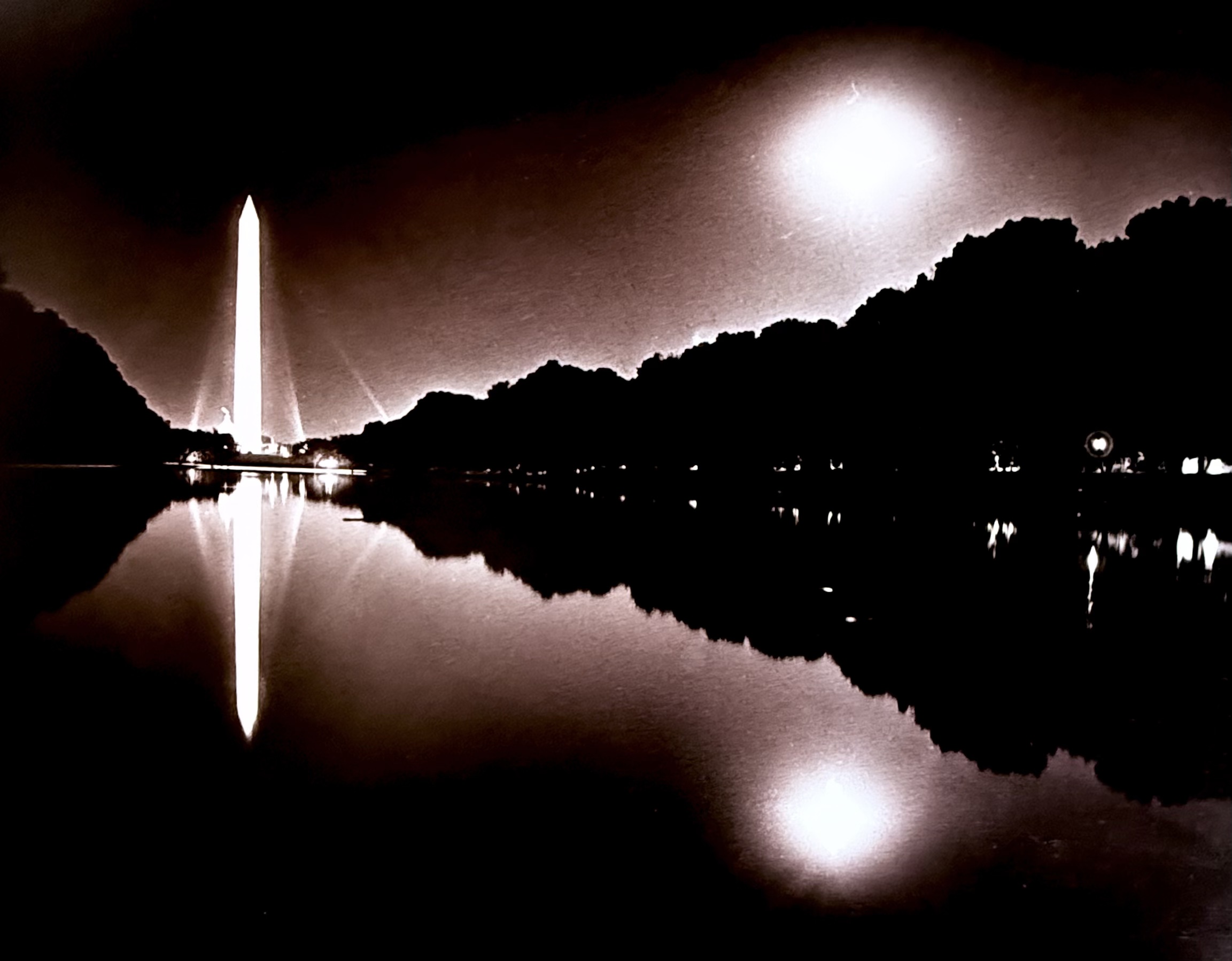
The full moonrise at the National Mall in Washington, D.C., on October 21, 1967. Across the Potomac at this moment, demonstators are clashing with paratroopers at the Pentagon. Photograph by the author.

On that day I had done my part in a public witness for peace; but when night came, the very best thing I could do was to notice the beauty of the moonrise. I like to think that both those things got recorded in the Book of Life. Come, labor on; but don’t forget the Sabbath moments.

Dear friends in Christ, let us cast away the works of darkness and put on the armor of light. Keep the faith. Fear not. Embody hope. Love one another. Trust divine intention. This is the holy work God has given us to do.

A few hundred years ago, Turlough O’Carolan, the blind harper and last of the Irish bards, was sitting in a tavern with his friend, the poet Charles McCabe. McCabe said, “Your music, sir, is grand and lovely stuff, but too light-hearted. This is a dark time we live in, Mr. Carolan, and our songs should reflect that.”

And the harper replied, “Tell me something, McCabe. Tell me this: Which do you think is harder—to make dark songs in the darkness, or to make brilliant ones that shine through the gloom?” [ix]
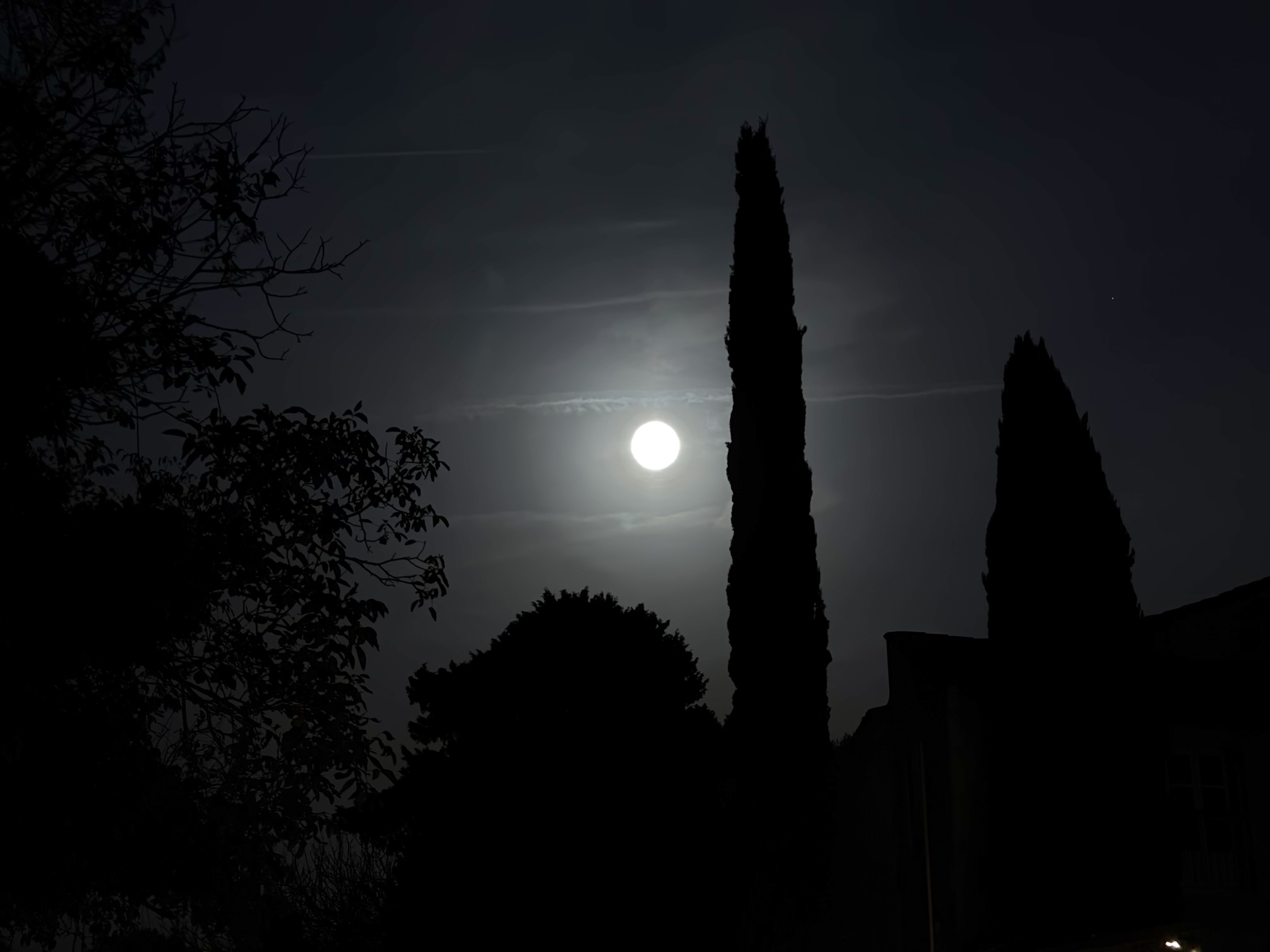
Provencal moon. Photograph by the author.

A homily for the First Sunday of Adven at Saint Barnabas Episcopal Church, Bainbridge Island, Washington.

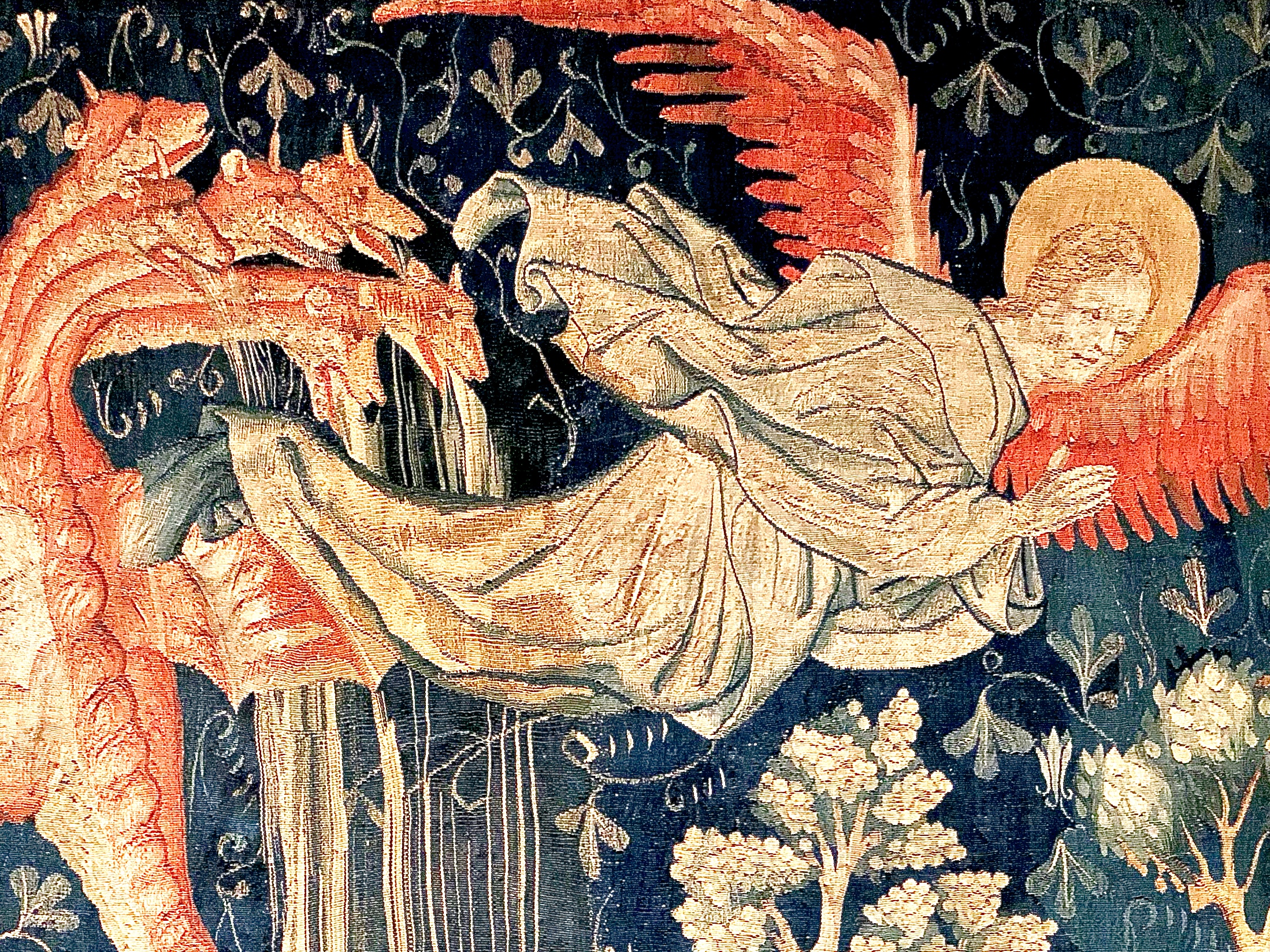
The images of the Apocalypse are from the Tapestry of the Apocalypse in Angers, France. Originally 140 meters long, over time it has been reduced by a third. Woven in the late 14th century, it offers spectacular illustrations of the Book of Revelation.

[i] My free translation of Luke 21:28, 34-36.

[ii] W. H. Auden, New Year Letter (January 1, 1940).

[iii] q. in Alan Jacobs, The Year of Our Lord 1943: Christian Humanism in an Age of Crisis (Oxford: Oxford University Press, 2018), 10.

[iv] Ibid., 11.

[v] Dietrich Bonhoeffer, “After Ten Years” in Letters and Papers from Prison (Minneapolis: Fortress Press, 2010). Translated by Barbara and Martin Rumscheidt.

[vi] Simone Weil, quoted in Robert Zaretsky, The Subversive Simone Weil: A Life in Five Ideas (Chicago: University of Chicago Press, 2021), 155.

[vii] Thomas Merton, No Man Is an Island (206), q. in The Thomas Merton Encyclopedia (Maryknoll, NY: Orbis Books, 2002), 213.

[viii] Naomi Shihab Nye, “Break the Worry Cocoon,” Voices in the Air: Poems for Listeners (New York: Greenwillow Books, 2022), 96-97.

[ix] From the play, O’Carolan’s Farewell to Music by Patrick Ball and Peter Glazer, on the California Revels CD, Christmas in an Irish Castle (2001).

“Don’t Look Up”: Laughing Till It Hurts

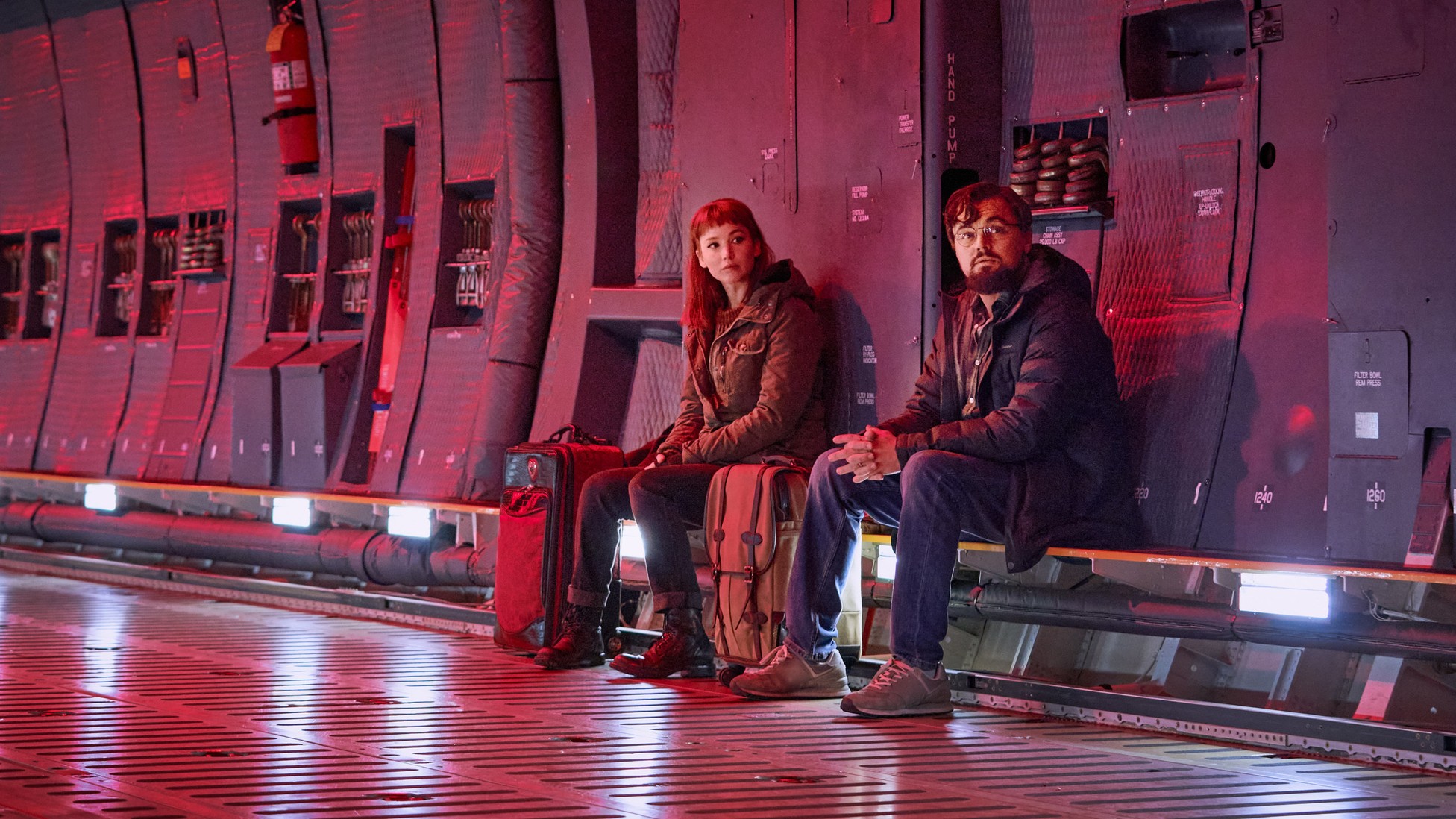
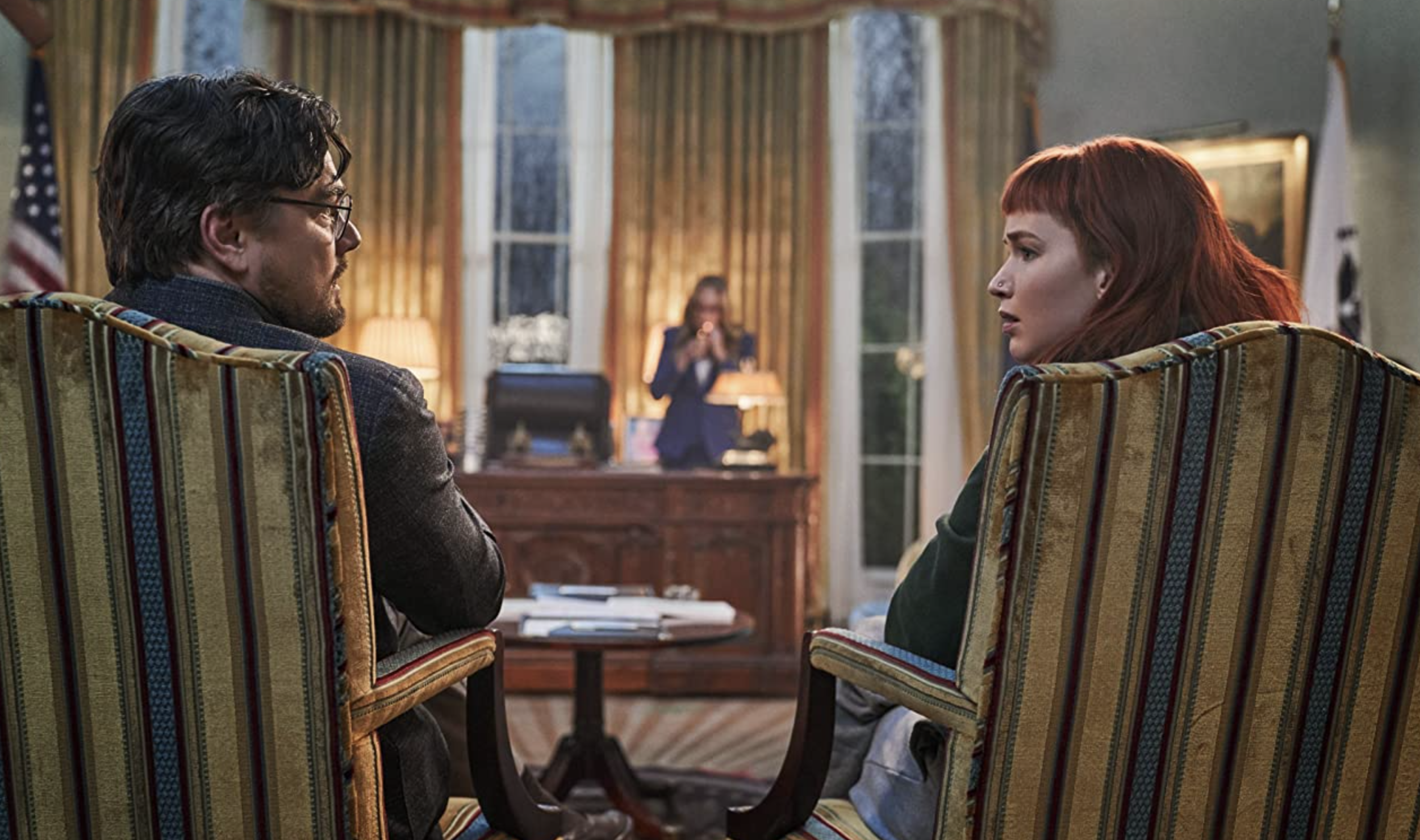
Kate Dibiasky (Jennifer Lawrence) and Dr. Randall Mindy (Leonardo DeCaprio) discover a comet in Don’t Look Up. (Niko Tavernise/Netflix)

Human narcissism and all that it has wrought, including the destruction of nature, will finally be our downfall. In the end, McKay isn’t doing much more in this movie than yelling at us, but then, we do deserve it.

— Manohla Dargis, “Tick, Tick, Kablooey!”[i]

God is our refuge and our strength,
a very present help in trouble.
Therefore we will not fear, 
though the earth be moved,
and though the mountains be toppled 
Into the depths of the sea.

— Psalm 46:1-2

Spoiler alert: If you want to see Don’t Look Up with innocent eyes, watch the movie before reading this. It is currently streaming on Netflix.

Kierkegaard once told a parable about the human capacity for denial. A fire broke out backstage in a crowded theater before the performance. With the curtains still drawn, the audience was unaware of the danger, so one of the actors stepped out to warn them. But he was dressed as a clown, and the people thought his cries of alarm must be some kind of joke. The louder he shouted “YOU’RE ALL GOING TO DIE!”, the more they laughed and cheered. By the time they realized the peril for themselves, it was too late. 

“I think,” said the Danish philosopher, “that’s just how the world will end—to general applause.” [ii]

One of the most popular current films, Don’t Look Up, is a farce about the extinction of life on our planet. It dresses its message of disaster and death in a comic premise: most of humanity is either too witless, deluded, or self-absorbed to acknowledge the threat. The more ridiculously the characters behave, the more we laugh—at least until the (literally) bitter end.

Like Kierkegaard’s clown, director and co-writer Adam McKay has serious intentions. “I’ve been really terrified about the climate, the collapse of the livable atmosphere,” he told an interviewer. “It seems to be getting faster and faster. Yet for some reason, it’s not penetrating our culture.”[iii] Since climate change is a gradual process stretching far beyond our attention span, McKay has substituted a more instantaneous disaster for our consideration. In the movie, an immense comet is headed straight for planet Earth. In six months, all living things will be destroyed. 

An astronomy professor at Michigan State, Dr. Randall Mindy (Leonardo DiCaprio), and his protégé, Kate Dibiasky (Jennifer Lawrence), discover the comet and try to warn the White House and the world. But their pleas for action go largely unheeded, and things go merrily downhill from there. As Manohla Dargis writes, Don’t Look Up is “a very angry, deeply anguished comedy freakout about how we are blowing it, hurtling toward oblivion. He’s sweetened the bummer setup with plenty of yuks — good, bad, indifferent — but if you weep, it may not be from laughing.” [iv]

In the Oval Office, Randall and Kate try to get the attention of a distracted President, played by Meryl Streep. (Niko Tavernise/Netflix)

During preproduction, the world was struck by a different disaster—the pandemic. The mismanaged Trumpian response, followed by the deadly denialism of the anti-vaxxers, added fuel to the satirical fire. McKay’s parable became as much about COVID as it is about climate change. It was hard to keep the fictional script ahead of the times. McKay said they had to make the film “20% crazier, because reality had played out crazier than the script.” [v]

In most disaster movies, human ingenuity and determination win out in the end, and the world manages to survive. But Don’t Look Up is not so forgiving. Human folly and sin guarantee global extinction. And no matter how much we have been entertained by the stellar cast and amusing scenarios, we are meant to come away unsettled. Complacency is not an option. The theater of Nature is on fire. This is not a drill.

The film has been embraced by the viewing public as well as activists, but many critics have been not only dismissive but contemptuous: “… it’s one joke, told over and over and over again”[vi] … “the attempts at mockery are broad, puerile, and obvious, unintentionally trivializing the issues it seeks to highlight”[vii] … “drowns in its own smugness”[viii] … “its simplistic anger-stoking and pathos-wringing mask the movie’s fundamental position of getting itself talked about while utterly eliding any real sense of politics or political confrontation.”[ix]

David Fear of Rolling Stone is particularly brutal: “… a righteous two-hour lecture masquerading as a satire .…  So caught up in its own hysterical shrieking that it drowns out any laughs, or sense of poignancy, or points it might be trying to make … it’s never able to find a way to crawl out of the tarpit of its own bone-deep despair … it doesn’t mean that one man’s wake-up-sheeple howl into the abyss is funny, or insightful, or even watchable. It’s a disaster movie in more ways than one. Should you indeed look up, you may be surprised to find one A-list bomb of a movie, all inchoate rage and flailing limbs, falling right on top of you.”[x]

There have been more measured critiques. Some find Don’t Look Up heavy-handed and misanthropic. Most of the characters, they say, are too cartoonishly stupid or corrupt to make us care deeply about their fate. Some think the filmmaker is too cynical about our collective capacity to counteract moral blindness and systemic evil, leaving us discouraged rather than empowered. Others, weighing the effectiveness of the relentlessly over-the-top caricatures, ponder “the question of whether our culture has become too depressing, too absurd, too lamentable to satirize.” [xi]

In a lengthy and sober analysis, Eric Levitz judges the comet scenario to be a misleading metaphor for climate change:

“In the film’s populist, polemical account of the ecological crisis, there is … no need for Americans to tolerate significant disruptions to their existing way of life, no vexing question of global redistribution, no compelling benefits from ongoing carbon-intensive growth, and thus no rational or uncorrupted opponent of timely climate action. Don’t Look Up casts the conflict between minimizing climate risk and maximizing near-term economic growth as one pitting the interests of billionaires against those of everyone else.” [xii]

What I find missing in all this criticism is a sense of genre. The lack of political nuance, psychological depth, or aesthetic rigor is beside the point. This film embraces the method of the Italian Commedia dell’Arte, where stock characters “make sport of human foibles and universal complaints while burlesquing the most socially or politically prominent members of a given community.” [xiii]

In the early 20th century, the Commedia model was adapted by Russian “agitprop” theater, “noted for its cardboard characters of perfect virtue and complete evil, and its coarse ridicule.”[xiv]  Agitprop’s aim was not to create great art, but to inspire collective action. In the American 1960s, groups like the San Francisco Mime Troupe practiced a similar “guerilla theater,” whose purpose, as stated in a 1967 manifesto by R. G. Davis, was to criticize “prevailing conditions … expressing what you (as a community) all know but no one is saying … truth that may be shocking and honesty that is vulgar to the aesthete … There is a vision in this theater, and … it is to continue … presenting moral plays and to confront hypocrisy in the society.” [xv]

It’s a playful form of politics, using laughter to dethrone the powers of this world by undermining their pretensions to ultimacy. As the Psalmist says, “God is laughing at them; the Lord has them in derision” (Psalm 2:4). Prophetic mockery is the genesis of revolution. It’s liberating and cathartic. But if it remains merely a way to blow off steam, or a refreshing but temporary lightening of spirit, that is not enough. Action must follow. We must become the change we seek. 

Kate and Randall on a mission to warn the world. (Niko Tavernise/Netflix)

Millions of people have seen Don’t Look Up. Its content and aims are being widely and passionately discussed. Is it a good movie? How accurate is its central metaphor? Which actors stand out? Is it funny? Given the film’s vast global reach and the urgency of the crisis, these become secondary questions. What I want to know is: Does it make a difference? Can it provoke repentance? Will it produce change?

Every preacher and every liturgist wonders the same things. How do our sermons, images, rituals and stories contribute to the transformational mix? In a podcast conversation about the film, Atlantic writer Spencer Kornhaber addresses this issue:

“I think this quest for movies to deliver a message that changes people’s minds is maybe quixotic. There aren’t a ton of works in history like that. But what they do do is give you a set of images and characters and metaphors and clichés that, when they work, become absorbed into our language. They help us talk about the world in ways that are hopefully progressing our discourse and society.” [xvi]

Of course, a film about global annihilation is a hard sell (and released at Christmas, no less!). The prospect of unimaginable loss opens the door to nihilism and despair. Why bother? Why go on? The director himself describes his film as a place where “absurdist, ridiculous comedy lives right next to sadness … so the trickiest part of the movie was to ramp down that tone in the last 20 minutes.” During a script conference before shooting started, one of the producers asked McKay, “Where’s faith in this movie?” And the director, whose mother was a born-again evangelical, exclaimed, “Oh, you’re right. You’re right!” [xvii]  

The last supper in Michigan. (Niko Tavernise/Netflix)

As the comet nears its collision with earth, we see people facing extinction in various ways. Some are praying, some are partying, some are weeping, some are just staring at the sky in disbelief, fear, or hopeless resignation. But in a dining room in East Lansing, Michigan, a small group of friends and family have gathered around a table for a communal last supper. Among them are Randall and Kate. For six months they had tried and failed to awaken humanity to effective action. Now they are back home, choosing neither anger nor despair for their final moments on earth, but gratitude and communion. 

As the food is shared, each of them names something they are grateful for. Then Randall says, “Well, we’re not the most religious here in the Mindy household, but, um, maybe we should say ‘amen?’ Should we do that?”

Most of them are unpracticed in prayer, so this suggestion creates an awkward pause. But Yule, a young Christian skateboarder (Timothée Chalamet), speaks up. “I’ve got this,” he says. Everyone joins hands around the table, and Yule begins to pray:

“Dearest Father, Almighty Creator, we ask for your grace tonight, despite our pride; your forgiveness, despite our doubt. Most of all, Lord, we ask for your love, to soothe us through these dark times. May we face whatever is to come in your divine will with courage and open hearts of acceptance. Amen.” 

Somewhere across the globe, the comet strikes, and an immense tsunami begins to swallow planetary life like the biblical flood. Yes, there is a parodic ark, reserved for the billionaires, bearing them to a justly ironic fate in a galaxy far, far away. But the true ark of the righteous remnant is that Michigan dining room.

In their final minute on earth, the men and women around the table discuss small, ordinary blessings like the store-bought apple pie and the delicious home-brewed coffee. In an inspired ad-lib that had occurred to DiCaprio between takes, Dr. Mindy speaks his last words: 

“Thing of it is, we really did have everything, didn’t we? 
I mean, when you think about it.” 

The simple human beauty of this last supper, more than the script’s many earnest pleadings, makes the film’s best case for preserving the world. It seems no accident that the one who sets the spiritual tone is named Yule, an old word for Christmas. Even at history’s last moment, Love is being made flesh.

Then, as the walls around them begin to disintegrate, the screen goes suddenly dark. The circle of human love has vanished into the Divine Mystery. 

After watching Don’t Look Up, I came across a poem by John Hollander which articulates for me the feeling of this moving finale. “At the New Year” is about the new beginnings that emerge from all the endings—those moments when we feel “every door in the world shutting at once.” Then the poet prays, “let it come at a time like this, not at winter’s / Night,” but “at a golden / Moment just on the edge of harvesting, ‘Yes. Now.’ / … as we go / Quietly on with what we shall be doing, and sing / Thanks for being enabled, again, to begin this instant.” [xviii]

So the apocalypse ends not with a bang, but with a softly spoken thanks for everything. Even when the worst arrives, the answering word is Yes, and the circle of love goes “quietly on with what we shall be doing,” and singing our thanks. Every moment, even the last one, is a gift to be savored. May our own precious moments on this earth be hallowed with gratitude, acceptance, and trust, now and at the hour of our death.


[i] Manohla Dargis, New York Times review of Don’t Look Up (12/23/21): https://www.nytimes.com/2021/12/23/movies/dont-look-up-review.html

[ii] Søren Kierkegaard, Either/Or, Part 1 (1843).

[iii] Adam McKay, quoted in Frederic and Mary Brussat, film review of Don’t Look Up in Spirituality and Practice (Dec. 21, 2021): https://www.spiritualityandpractice.com/films/reviews/view/29113/dont-look-up

[iv] Dargis, “Tick, Tick, Kablooey!” New York Times review (12/23/21).

[v] McKay, q. in David Sims, “Don’t Look Up is a Primal Scream of a Film,” The Atlantic (12/23/21): https://www.theatlantic.com/culture/archive/2021/12/dont-look-up-adam-mckay-netflix-movie/621104/

[vi] Max Weiss, Baltimore Magazine (12/27/21): https://www.baltimoremagazine.com/section/artsentertainment/movie-review-dont-look-up/

[vii] James Berardinelli, Reel Reviews (12/23/21): https://www.reelviews.net/reelviews/don-t-look-up

[viii] Sameen Amer, The News International, Pakistan (1/16/22): https://www.thenews.com.pk/tns/detail/925421-in-the-picture

[ix] Richard Brody, “The Crude Demagogy of Don’t Look Up,” The New Yorker (1/6/22): https://www.newyorker.com/culture/the-front-row/the-crude-demagogy-of-dont-look-up

[x] David Fear, “‘Don’t Look Up…or You Might See One Bomb of a Movie Hurtling Right Toward You,” Rolling Stone (12/24/21): https://www.rollingstone.com/movies/movie-reviews/dont-look-up-review-leonardo-dicaprio-jennifer-lawrence-1268779/

[xi] “Why Are People So Mad About Don’t Look Up?,” The Atlantic podcast (1/14/22): https://www.theatlantic.com/podcasts/archive/2022/01/dont-look-up-satire/621256/

[xii] Eric Levitz, “Don’t Look Up Doesn’t Get the Climate Crisis,” New York Magazine (1/5/22):https://nymag.com/intelligencer/2022/01/dont-look-up-climate-metaphor-review.html

[xiii] Michael William Doyle, “Staging the Revolution: Guerilla Theater as a Countercultural Practice, 1965-1968”: https://www.diggers.org/guerrilla_theater.htm

[xiv] Richard Pipes, Russia Under the Bolshevik Regime, 303, cited in “Agitprop” (Wikipedia).

[xv] Doyle, “Staging the Revolution …”

[xvi] Spencer Kornhaber, “”Why Are People So Mad …?”

[xvii] Adam McKay, interview in Variety, “Adam McKay on the Ending(s) of Don’t Look Up” (Dec. 2021): https://variety.com/2021/film/news/adam-mckay-dont-look-up-ending-spoilers-1235142363/

[xviii] John Hollander (1929-2013), “At the New Year,” in American Religious Poems: An Anthology by Harold Bloom, eds. Harold Bloom & Jesse Zuba (New York: Library of America, 2006), 442-443.

“Hopes that pointed to the clouds” — A Sermon for Advent 1

Dawn at the church in Rabanal on the Camino de Santiago (May 2, 2014).

This is a sermon I preached for the First Sunday of Advent, 2020, in the streamed liturgy at St. Barnabas Episcopal Church on Bainbridge Island, Washington. Below the video recording you will find the text with footnotes. Two corrections to the recording: Wordsworth’s account of crossing the Alps is in Book VI of The Prelude, and his celebrated line is: “Bliss was it in that dawn to be alive.” That’s exactly how I felt when I took the top photograph on my pilgrimage walk to Santiago, so I doubly regret the error in the recording!

The liturgical year is like a great story with many chapters, and every Advent we go back to the beginning and tell it all over again. But it’s an unusual story. It doesn’t begin with “Once upon a time …” No, it begins with “The End.” Whether the gospel for the First Sunday in Advent is from Matthew, Mark, or Luke, we always get the apocalyptic Jesus announcing the end of the world. The sun and moon will go dark, the stars will fall from the sky, reality itself will tremble and shake. 

It’s the ultimate disaster movie, and we usually absorb it as such. The apocalyptic images of destruction and chaos engage our fears while they’re up on the screen (or on the lips of the gospel reader), but when the lights come up and we head for the exit, we expect to find the same old safe and reliable world waiting for us outside the theater or the church. But in 2020, not so much!

The ending of worlds is far too real this year. COVID-19 has made us acutely conscious of our own impermanence, not only as individuals but as a species. Millions have seen their jobs disappear, education is in crisis, social gatherings are nearly extinct, and so many ordinary things, from restaurants to haircuts, not to mention liturgical assemblies, have vanished from daily experience. We’ve been shocked this year to discover how easily the stability of our democratic institutions can be assaulted and eroded, and we’ve been disheartened and unsettled by the fragility of our social bonds in the face of so much hatred, bigotry, demagoguery and violence. Truth itself has become an endangered species. And if all that isn’t enough, the climate apocalypse is well underway. 

“Signs of ending all around us,” says one of our Advent hymns. Then it wonders:

Can it be that from our endings, new beginnings you create?
Life from death, and from our rendings, realms of wholeness generate?[i]

How will the world end? Let me count the ways, says the apocalyptic Jesus. But Jesus isn’t trying to depress us. Jesus doesn’t want to paralyze us with despair. But he does want us to be clear about where our treasure is, where our hope lies. Put your faith in the things that endure, he says. “Heaven and earth will pass away, but my words will not pass away.”[ii]

I think what he’s getting at here is that our idolatries, our invented securities, will come to nothing in the long run. Only God endures. Only God’s Kingdom—the world of God—is built to last. So learn how to discern what lasts and what doesn’t, and how to remain faithful to the vision without getting discouraged by the obstacles and failures along the way.

A common misconception about the apocalypse is that it only comes once, at the end of history, when the broken will be made whole, all discords harmonized, all divisions reconciled. Christian faith indeed affirms that great vision of a perfected humanity and a restored creation. But our faith also calls us to make that future present wherever and whenever we can, and to notice how it’s already happening around us. At the same time, we need to recognize the ambiguities of historical existence. God and not-God are like the wheat and the weeds—hard to tell apart until the final harvest. Stay awake, Jesus says. Pay attention. Sometimes the Kingdom is where you least expect it. Sometimes it doesn’t look like anything you expected. And often it will come and go in the blink of an eye. Keep your eyes open!

Why must there be apocalypse? Why must so many things come to an end? In order for God’s future to take place now, some of what is present needs to get out of the way to make room for the new thing God wants to happen. That’s why we should speak about the end of the world not as a single, far-off event, but as the ending of worlds plural: the ending of all those things which need to pass away so we can get right with God. 

An economy where millions lose their jobs and millions go hungry while the assets of 600 billionaires increase by 1 trillion dollars during the pandemic—that’s got to go. The killing of people because they’re black—that’s got to go. The destruction of nature by greed and stupidity—that’s got to go. You get the idea. God wants a better world, and God asks us not only to pray for that world but to work for it, and, by God’s grace, to embody it and manifest it whenever and however we can. 

But for reasons we are not given to understand as finite beings, the inbreaking of the Kingdom isn’t a story of steady and relentless progress. We are indeed visionary creatures, full of desire for better selves and better worlds, but we are also finite and fallible, complicated mixtures of mud and spirit. We have our limits. We don’t always know the right thing, or when we think we know, we don’t do it, or can’t do it. Or by the time we do, maybe it’s no longer the right thing. 

Good motives tend to produce mixed outcomes. And as for bad things, Scripture tells us that a creative God can make a silk purse from a sow’s ear. Historical existence is complicated. It’s messy. A lot of the time we’re just guessing. We have to learn not to fall in love with outcomes, or get too attached to our ideas of the best future. Our God is a God of surprises, and most of our maps to the Promised Land turn out to be illusions, or at least out of date. 

In the late 18th century, the French Revolution stirred the imagination of Europe with a sense of immense possibility. Looking back on 1789 twenty-five years later, French observer Thomas Noon Talfourd described the incredible excitement in the air:

“Every faculty of the mind was awakened,” he said, “every feeling raised to an intenseness of interest, every principle and passion called into superhuman exertions. At one moment, all was hope and joy and rapture; the corruption and iniquity of ages seemed to vanish like a dream; the unclouded heavens seemed once more to ring with the exulting chorus of peace on earth and good-will to men … The most brilliant hopes were cherished … and fresh prospects were daily opening which … filled us with painful delight and with giddy rapture.”[iii]

G.W.F. Hegel, the great German idealist, was 19 years old when that revolution happened. “It was a glorious dawn,” he recalled later. “All thinking beings shared in the jubilation of the epoch. A sublime emotion ruled that age, and enthusiasm of the spirit thrilled through the world, as though the time were now come of the actual reconciliation of God with the world.”[iv]

When the English poet William Wordsworth was a young man, he went to France to begin a walking tour in the summer of 1790, when revolutionary spirits were still high. “Bliss was it in that dawn to be alive,” he wrote, “France standing on the top of golden hours, / And human nature seeming born again.”[v]

Those among us who came of age in the 1960s may remember the same exhilaration of being young and idealistic in a time of great upheaval and daring dreams. We had our “brilliant hopes” and “sublime emotion,” our visions of a new world emerging from the ruins of the old. 

But we would soon discover that a reborn humanity, reconciled to the purposes of God, was not so easily achieved. So too did the young Wordsworth grow disenchanted with the French Revolution’s dark side. The Kingdom of God may work through the movements of history, but it is not identical with them. To confuse God and history is idolatry. Misplaced hope is worship of the wrong thing.

Fifteen years after his tour of revolutionary France, Wordsworth wrote his epic poem, The Prelude, a spiritual biography of his generation of Romantics and idealists. In Book VI of The Prelude, he explored his personal struggle with hope and disillusionment through the narrative of his excursion through France to the Alps. Making his way south, he feasted and danced with happy revolutionaries, tasting the bliss of their new world. As he put it, he “found benevolence and blessedness / Spread like a fragrance everywhere, like Spring.”[vi]

But when he reached the Alps, he saw a troop of French soldiers plunder a peaceful mountain convent in the name of revolution and freedom from the oppression of religion. Actually, this desecration occurred two years later. But Wordsworth inserts it into his poem to dramatize with this single illustration his more gradual internal process of disappointment with the Revolution’s betrayal of his generation’s hopes.

In the poem, Wordsworth is shocked to witness the soldiers’ destruction of the convent and the expulsion of its “blameless inmates.” The revolutionary sword wields no justice in this act, only negation. The convent, a precious habitation of calm and spirit, set apart to remember eternity, perishes in a world gone mad.

As a disillusioned Wordsworth climbed higher in the Alps, he struggled with despair. He felt “inwardly oppress’d” by an “utter loss of hope itself, / And things to hope for.”[vii] (A loss of “things to hope for.” That is so 2020!) With the Revolution descending into the maelstrom of violence and naked power, where could he look for the true apocalypse that would break the power of the fallen world, renovate humanity, and restore the earthly paradise? 

The climb itself began to form an answer in his heart and mind. “For still,” he tells us, “[he] had hopes that pointed to the clouds.”[viii] He was a Romantic, after all, fluent in the language of Nature. The soaring peak of Mont Blanc, rising into the sky above, was an icon of Transcendent power far greater than revolutions or armies—or the countless dejections of history.  

We can imagine the music swelling here, as the poet approaches the summit to receive the grace of divine vision, reconciling in a flash all the contradictions of human existence. What actually happened was, Wordsworth got lost in the mist. Eventually, he ran into a peasant who told him that he’d already crested the pass and was in fact now going down other side. Though the poet’s hopes may have still pointed to the clouds, his body was on its way back to the complications of the world below. 

Wordsworth would find in this experience a metaphor for the life of faith. We don’t get the decisive apocalypse, the ultimate finale, in this life. God is too inventive to settle for our flawed approximations of a better world. There’s always going to be a mixture of good and ill, darkness and light, in our historical projects, as well as in the circuitous journey of every soul. Still, God has planted hope and desire deep in our hearts, and amid all the complications and setbacks of the human journey, we keep reaching for the clouds, and that in itself is something glorious. As Wordsworth put it:

And now, recovering, to my soul I say 
‘I recognize thy glory.’
… Our destiny, our nature, and our home
Is with infinitude, and only there;
With hope it is, hope that can never die,
Effort, and expectation, and desire,
And something evermore about to be.[ix]

150 years after Wordsworth crossed the Alps, another poet, W. H. Auden, articulated his own understanding of the dance between disappointment and hope. As a political idealist in the 1930s, he would face his own disillusionment at the end of that decade. Revolutionary hopes for a better world had withered, and humanity, as far from the earthly paradise as it had ever been, was plunging into the inferno of the Second World War.

We hoped, we waited for the day
The State would wither clean away,
Expecting the Millennium
That theory promised us would come,
It didn’t.

Like Wordsworth—and all of us at the end of 2020—Auden was forced to accept the limits of historical existence, and to discern, as he put it, “what / Is possible and what is not, / To what conditions we must bow / In building the Just City now.”  

And like Wordsworth, Auden finds himself on a mountain: Dante’s Mount Purgatory, where the Earthly Paradise at the top is a distant goal, for which there are no shortcuts. 

The purgatorial hill we climb,
Where any skyline we attain
Reveals a higher ridge again.
Yet since, however much we grumble,
However painfully we stumble,
Such mountaineering all the same
Is, it would seem, the only game …

We have no cause to look dejected
When, wakened from a dream of glory,
We find ourselves in Purgatory,
Back on the same old mountain side
With only guessing for a guide …

O once again let us set out,
Our faith well balanced by our doubt,
Admitting that every step we take
Will certainly be a mistake,
But still believing we can climb
A little higher every time …[x]

We’re all on that mountain with the poet, still climbing, sheltering our hope like a candle in the winds of doubt, stumbling our way onward. Sometimes we lose the path, and go astray. And if we do attain a summit, a higher one still looms before us.

And all those apocalypses along the way, all those endings great and small, the vanishings of good things and bad things alike, turn out not to be last judgments or final judgments, bringing our story to a close. They are more like doors, where we pass from a tired world into a new reality.

As long as we are creatures of time and history, that reality will never be fixed or final. And with a God who is utterly free and endlessly inventive, who can describe what is to come? But if I may switch metaphors and poets, let me give you one of my favorite Advent images.

In her poem, “Rowing,” Anne Sexton imagines herself rowing toward an island called God. 

I am rowing, I am rowing,
though the wind pushes me back
and I know that that island will not be perfect,
it will have the flaws of life,
the absurdities of the dinner table,
but there will be a door
and I will open it
and I will get rid of the rat inside me,
the gnawing pestilential rat.
God will take it with his two hands
and embrace it.

Sexton knows she’s not there yet, she is still in the Advent space of waiting and hoping. And, like Auden, she is aware of what is possible and what is not, and to what conditions she must bow as a flawed and finite being in search of Grace.

“This story,” she says, “ends with me still rowing.”[xi]

This, dear people of God, is where we begin the Advent journey. On the sea of faith, still rowing. Or maybe back on the same old mountain side, with only guessing for a guide. But always holding fast to hope that can never die, as we wait and watch for “something evermore about to be.”

“This story ends with me still rowing.”


[i] Dean W. Nelson,“Signs of endings all around us,” # 721 in Wonder, Love, and Praise: A Supplement to The Hymnal 1982 (New York: The Church Pension Fund).

[ii] The Gospel for Advent 1 (Year B) is Mark 13:24-37.

[iii] Thomas Noon Talfourd, The Poetical Talent of the Present Age, 1815), cited in M. H. Abrams, Natural Supernaturalism: Tradition and Revolution in Romantic Literature (New York: W. W. Norton & Company, 1971), 329-330.

[iv] In Abrams, 352.

[v] William Wordsworth, The Prelude: 1799, 1805, 1850, eds. Jonathsn Wordsworth, M. H. Abrams, Stephen Gill (New York: W. W. Norton & Company, 1979), X, 692 (1805), VI, 353-4 (1805). All citations from The Prelude are from this Norton Critical Edition.

[vi] The Prelude, VI, 368-369 (1805).

[vii] The Prelude, XI, 506 (1805).

[viii] The Prelude, VI, 587 (1850).

[ix] The Prelude, VI, 531-532, 538-542 (1805).

[x] W. H. Auden, “New Year Letter (January 1, 1940),” Collected Poems, ed. Edward Mendelson (New York: Random House, 1976). We hoped (175); what is possible (190); the purgatorial hill (178-179).

[xi] Anne Sexton, “Rowing,” in The Awful Rowing Toward God (New York: Houghton Mifflin, 1975). This is the first poem in the book. In the last, “The Rowing Endeth,” she finally reaches the island. God invites her to play poker. They both win, because that’s how it goes with God. The text of “Rowing is here: https://www.poemhunter.com/poem/rowing/ … “The Rowing Endeth” is here: https://opreach.org/2013/02/26/the-rowing-endeth/

“Save us from the time of trial” –– Climate Change as Apocalypse

The angel dictates a word of hope and promise to St. John: “Blessed are those who are invited to the feast of the Lamb.” (Rev 19)

 The humanist/scholar became quite emotional in conceiving of the world devoid of human beings, which was a possibility brought on by one disaster or another, due, it must be said, to our own actions. This would be the worst thing he could imagine––worlds devoid of human beings, even if these worlds were populated by other intelligent and enterprising life forms.

–– Joy Williams, Ninety-Nine Stories of God

 What have you got to worry about? We’re only adrift in an open sea with a drunken captain and an engine that’s liable to explode at any moment.

–– Humphrey Bogart in Beat the Devil


The end is near! The world as we know it is on the verge of extinction, according to the United Nations’ Intergovernmental Panel on Climate Change.[i]But where is the sense of collective alarm? Where is the will to act? Our house is burning down, but instead of shouting “Fire!” and grabbing some hoses, we carry on as usual, unable to muster a sense of emergency. Perhaps we are just too exhausted by the endless stream of horrors under Republican rule, from children’s prison camps to the spread of American fascism, to have any bandwidth left to address the environmental apocalypse.

As columnist Leonard Pitts suggests,

“So then you read where the planet is melting, dire results expected soon, and you just shrug and file it away with all the other terrible things you’ll worry about when you get a chance. That’s understandable. But it presumes a luxury we don’t have — time. Again, this report says the world has 10 years in which to save itself — and we’ll spend at least two of those under Trump.” [ii]

Don’t ask me to explain why the party in power and its corporate handlers are doing everything they can to make things worse, as if the fate of the planet––and the well-being of their own children’s children––is nothing compared to the allure of short-term power and profit for themselves. Such suicidal selfishness is utterly incomprehensible to me. But we don’t have to approve of it to be caught up in it. We are all participants in an unsustainable culture.

Death rides a pale horse. (Rev 6)

Of course, there are many people, governments and institutions who recognize the climate crisis and are working to address it. Even in the heart of Trumpian coal country, West Virginia’s Charleston Gazette-Mailis sounding the alarm:

“When today’s kindergartners are in their 20s, they may find a devastated world wracked by horrible hurricanes, droughts, floods, wildfires, tornadoes and other tragedies made worse by global warming. Coastal cities may be abandoned, sunken wrecks. Poverty and misery may result.”

The editorial goes on to note that hurricanes Florence and Michael have “inflicted more loss than the entire worth of West Virginia’s coal industry — but conservative politicians still won’t act to reduce the damage.” [iii]

The Second Trumpet: The sea is polluted by fire, blood and death. (Rev 8)

Only ten years left to avert catastrophe! The message is clear: change or die. But given the dysfunctional paralysis of the American government, the iron grip of vulture capitalism, and the enormity of scale required for worldwide transformation, the prospects for success are bleak. The Titanic can’t turn on a dime. And when the captain doesn’t even believe in icebergs, it’s time to strike up “Nearer, my God, to Thee.”

On a recent trip to France, I beheld, for the first time, the extraordinary Tapestry of the Apocalypse in Angers, whose 84 large panels depict scenes from the Revelation of St. John the Divine. This riveting medieval visual sequence­­––the largest wall-hanging ever woven in Europe–– extends in parallel rows for 104 meters down the length of a vast, dimly-lit hall. It’s like a gigantic textile comic strip. Although the 700-year-old dyes have faded over time, these visionary scenes remain compellingly vivid, dense with iconography and narrative.

The Tapestry of the Apocalypse, Angers, France.

Theologian Austin Farrer described their source, the book of Revelation, as a great work of religious imagination.  “It is the one great poem which the first Christian age produced, it is a single and living unity from end to end, and it contains a whole world of spiritual imagery to be entered into and possessed.” [iv] Gonzo journalist Hunter Thompson added his own appreciation. “I still read the Book of Revelation,” he said, “when I need to get cranked up about language.” [v]

The meaning and value of the Bible’s last book have long been debated. Was it a mystical vision, a theo-political critique of the Roman Empire, or a quasi-liturgical dramatization of eschatological themes? The violent imagery of Revelation has been misused by religious cranks and maniacs in notoriously unhealthy ways, but the text has also––more than any other biblical book––given us many sublime prayer and hymn texts. Often neglected in times of contentment or complacency, it speaks loudly in times of crisis. Dietrich Bonhoeffer said that the book never made much sense to him until the rise of the Nazis.

“Babylon” is Revelation’s code name for the Roman empire, the oppressive and sinful social consensus whose claims of absolute totality were grounded in seduction, deceit and the enforcing threat of violence. And while that particular empire is long gone, Babylon is still around. “Bellicose, selfish, self-deluded, icy, absurdly resolute––behold the Rome of the book of Revelation,” said the Jesuit prophet-poet Daniel Berrigan. And, he added, “Behold also America.” [vi] Forty years after he wrote that, it seems truer than ever.

The Babylons of every age want us to believe that resistance is futile, because “this is the way things are.” We’re all implicated in the system. Even if we don’t like it, we can’t imagine living without it. Try preaching an exit from global capitalism next Sunday and see what happens! We may dream of the “New Jerusalem” of justice, peace and universal blessedness, but it seems impossibly distant. “If the Babylon of our time is already, from God’s perspective, a smoking ruin, how and where do we find the New Jerusalem? Is it really possible to ‘come out’ of empire when it surrounds us so completely?” [vii]

“Who is like the beast, and who can fight against it?” The people worship the beast of worldly power as the Dragon (Satan) approves. (Rev 13)

Like all apocalyptic literature, Revelation is pessimistic about the present age and where it is headed. But it is also full of hope about the age to come––the unexpectedly redemptive future emerging from a time of emergency. “The apocalypticist sees meaning where the uninitiated sees only chaos or catastrophe.” [viii]

Revelation insists that Babylon’s “reality” is a lie: there is an alternative to its culture of seduction and death. This alternative, the New Jerusalem, is not to be sought in some unreachable elsewhere. It is here among us, though only visible to the eyes of faith. And in every moment, every time we choose life over death, we begin to make our exodus, however small and tentative, out of Babylon’s prison into the space of divine blessedness.

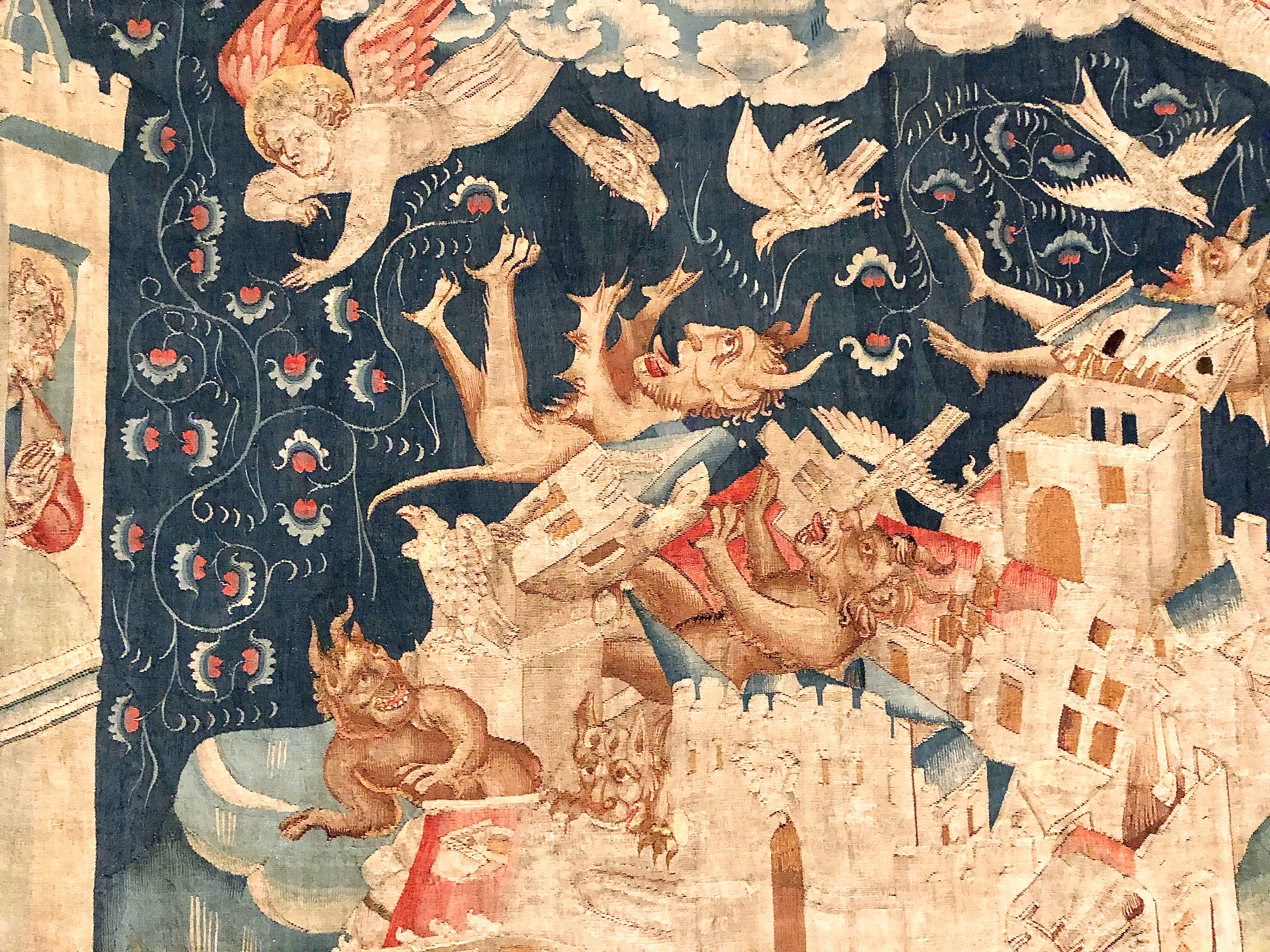
The fall of Babylon. Only its demons are left to haunt the rubble. (Rev 18)

The Tapestry of the Apocalypse was created by inhabitants of their own medieval Babylon, an exitless world fraught with anxiety and doom. As half of Europe was being struck down by the Black Plague, Revelation’s harrowing images of a death-haunted, perishing world struck home. The obsessive immensity of the tapestry project testifies to a depth of existential engagement with ultimate concerns, as if the artists and weavers were driven to create a comprehensive record of their longing––and their dread––before they themselves ran out of time.

As I processed slowly, contemplatively, through the crepuscular vastness of Angers’ tapestry hall, the strange images flickered before me like an old silent movie, as though their colors and forms were signaling across the centuries with the light of a long-vanished past. Whatever these visions first said to John the Divine in his Patmos cave, whatever they meant to the fourteenth-century French weavers, they were now pleading for my attention.

See! God is making all things new.
Death will be no more,
mourning and sadness and pain will be no more.
The world of the past is gone. [ix]


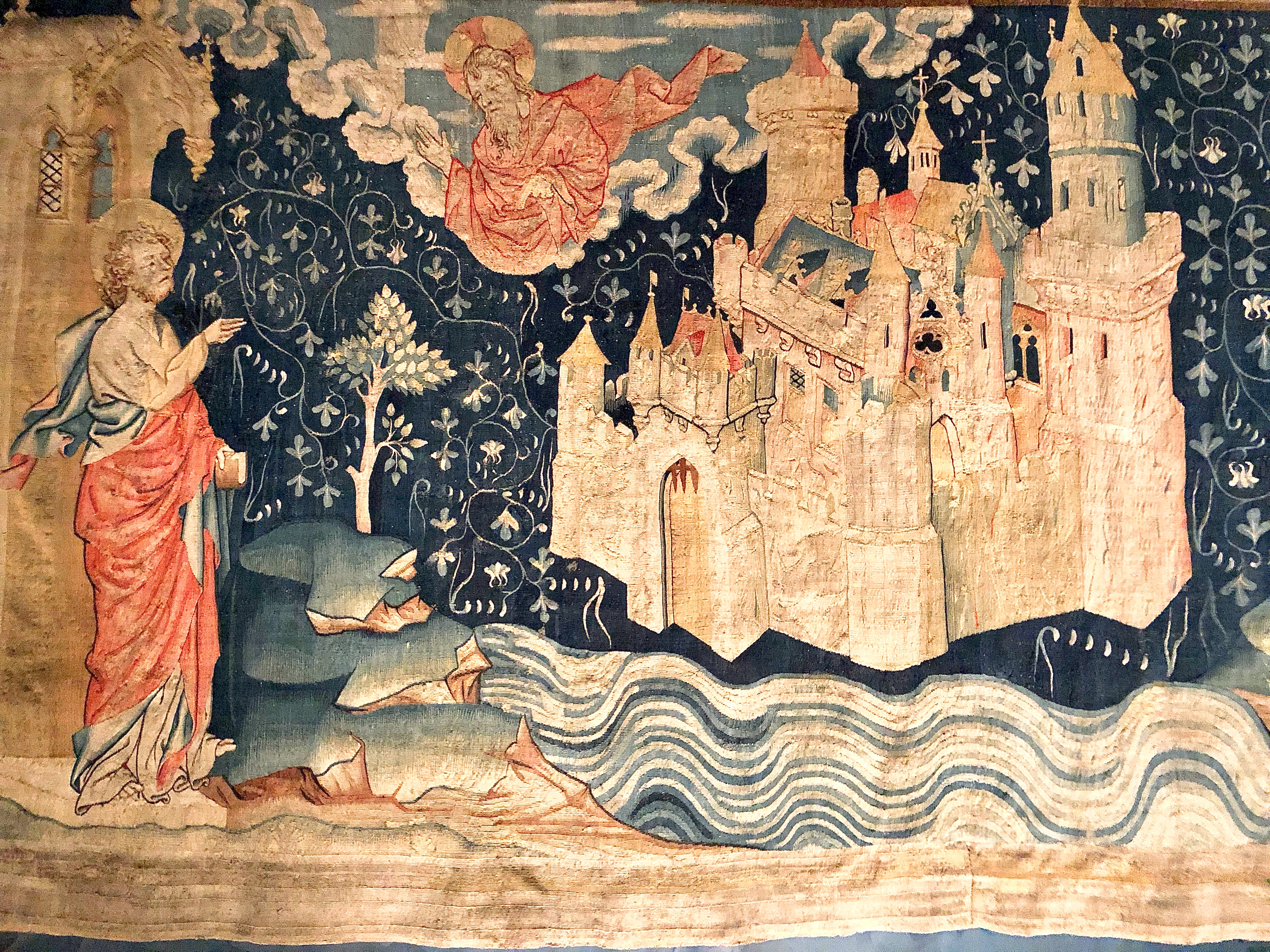
The New Jerusalem comes down from heaven, bringing divine glory into earthly presence. (Rev 21)

Babylon is fallen. The gates to God’s eternal city are open wide. And the urgent question for believers today, in the face of a climate apocalypse, is this:

How do we hold fast to the redemptive vision
of the New Jerusalem
through the long dark night of catastrophe?


The Dragon pursues the expectant mother, “robed in the sun,” into the wilderness, trying to prevent the birth of hope. (Rev 12)

In the short term, we can practice both personal and collective environmental ethics, foster alliances with environmental changemakers, and incorporate a deep love and respect for the planet––and all who dwell therein––into our worship and our spiritual formation. And, setting aside for now our differences on a multitude of political and economic questions, we absolutely need to unite in casting our votes for defenders of the earth and against every climate change denier and pollution enabler. When the Beast is on the ballot, vote no!

In the long term, people of faith may face an even more daunting challenge––to cling to hope amid almost unimaginable destruction and loss: the disappearance of coastal cities and large land masses; countless millions of climate refugees; a horrific number of human deaths; mass extinction of species and habitats; economic havoc from fires, storms and floods; an endangered food supply; global conflicts over migration and dwindling resources; and the strain on political systems as they try to cope. How shall we declare God’s blessings then?

If we fail to change and the worst does come, our greatest enemy may be despair. I don’t need to contemplate the whole catalog of loss to feel the weight of immense sadness. Just picturing a single High Sierra meadow choked in smoke, or withered into a lifeless desert, is enough to make me weep.

Save us from the time of trial. That’s what the Lord’s Prayer really means by the more familiar “lead us not into temptation.” But the prayer is not asking to be spared from difficult challenges. That would make it irrelevant in the face of planetary apocalypse. We are all going to be tested by an uncertain future. But if we can beseech God with all our hearts to bring us through the experience of loss, despair and doubt with our faith and hope still intact, then “save us from the time of trial” may prove, in the climate crisis, our most earnest and necessary plea.

Meanwhile, get out of Babylon while you still can.

The Third Trumpet: A burning star falls to earth and pollutes the water supply. (Rev 8)

All photos by Jim Friedrich


[i] Summary and links to complete report: http://www.un.org/en/sections/issues-depth/climate-change/

[ii] Leonard Pitts, Jr., “We only have 10 years to save ourselves from climage change,” Miami Herald, Oct. 12, 2018: https://www.miamiherald.com/opinion/opn-columns-blogs/leonard-pitts-jr/article219870680.html

[iii] Editorial, “Like a weather report, with time, climate change projections closer, more ominous,” Charleston Gazette-Mail, October 16, 2018: https://www.wvgazettemail.com/opinion/gazette_opinion/editorial/gazette-editorial-like-a-weather-report-with-time-climate-change/article_26d13b8a-47e3-517a-9882-037b9bff6d70.html

[iv] Austin Farrer, A Rebirth of Images: The Making of St. John’s Apocalypse(1949), q. in Richard K. Emmerson, “The Apocalypse in Medieval Culture,” in The Apocalypse in the Middle Ages, ed. Richard K. Emmerson & Bernard McGinn (Ithaca: Cornell University Press, 1992), 293.

[v] Hunter Thompson interview in Atlantic Unbound, August 26, 1997, q. in Unveiling Empire: Reading Revelation Then and Now, Wes Howard-Brook & Anthony Gwyther (Maryknoll, NY: Orbis Books, 1999), 2 n. 3.

[vi] Daniel Berrigan, S.J., The Nightmare of God (1983), q. in Unveiling Empire, 44.

[vii]Unveiling Empire, 260.

[viii] Bernard McGinn, “John’s Apocalypse and the Apocalyptic Mentality,” in The Apocalypse in the Middle Ages, 9.

[ix] Revelation 21:4-5.