For the latest No Kings March to occur on the eve of Palm Sunday seemed to me a resonant conjunction. Both yesterday’s march and the “triumphal entry” of Jesus into Jerusalem stirred the deepest hopes of people suffering under oppressive regimes. Of course not all hopes are equal, and sometimes they turn out to be, as T. S. Eliot noted, “hope for the wrong thing.” Even if the folks shouting Hosanna in Jerusalem were mistaken about what God was up to that week, I imagine Jesus still being touched by their longing, that crazy feeling that the world might just get better. The capacity for hope is one of humanity’s finest qualities.
There is some irony, of course, in linking No Kings to a biblical event suffused in royal imagery. I’ve been singing the Palm Sunday processional, “All glory, laud, and honor to thee, Redeemer, King!” ever since I was a child. But God is no stranger to irony—manifesting divinity as a helpless child, “ruling” as a servant, and dying to give life. And a line by the late great songwriter Bob Franke neatly resolves, for me at least, any tension between democracy and religious language inherited from monarchists.
Well you kneel to the Lord and you will bless yourself; Ain’t no need to kneel to no one else.
In a week when people of my tradition walk the Way of the Cross in ritual, song and story, we know that hope is no stranger to struggle and suffering. It’s a long and winding road to Easter, passing through Gethsemane and Golgotha. Yet it remains, as the Book of Common Prayer assures us, “none other than the way of life and peace.”
On yesterday’s march in Seattle, I shot video of what I saw, and in putting it together I was struck all over again by the recurrent note of joy. Not everyone would put it this way, of course, but for one gloriously sunny day, we were, as the South Africans sing, “marching in the light of God,” and the divine future of human flourishing made a significant incursion into the present moment. As the crowd chants in the opening of my video:
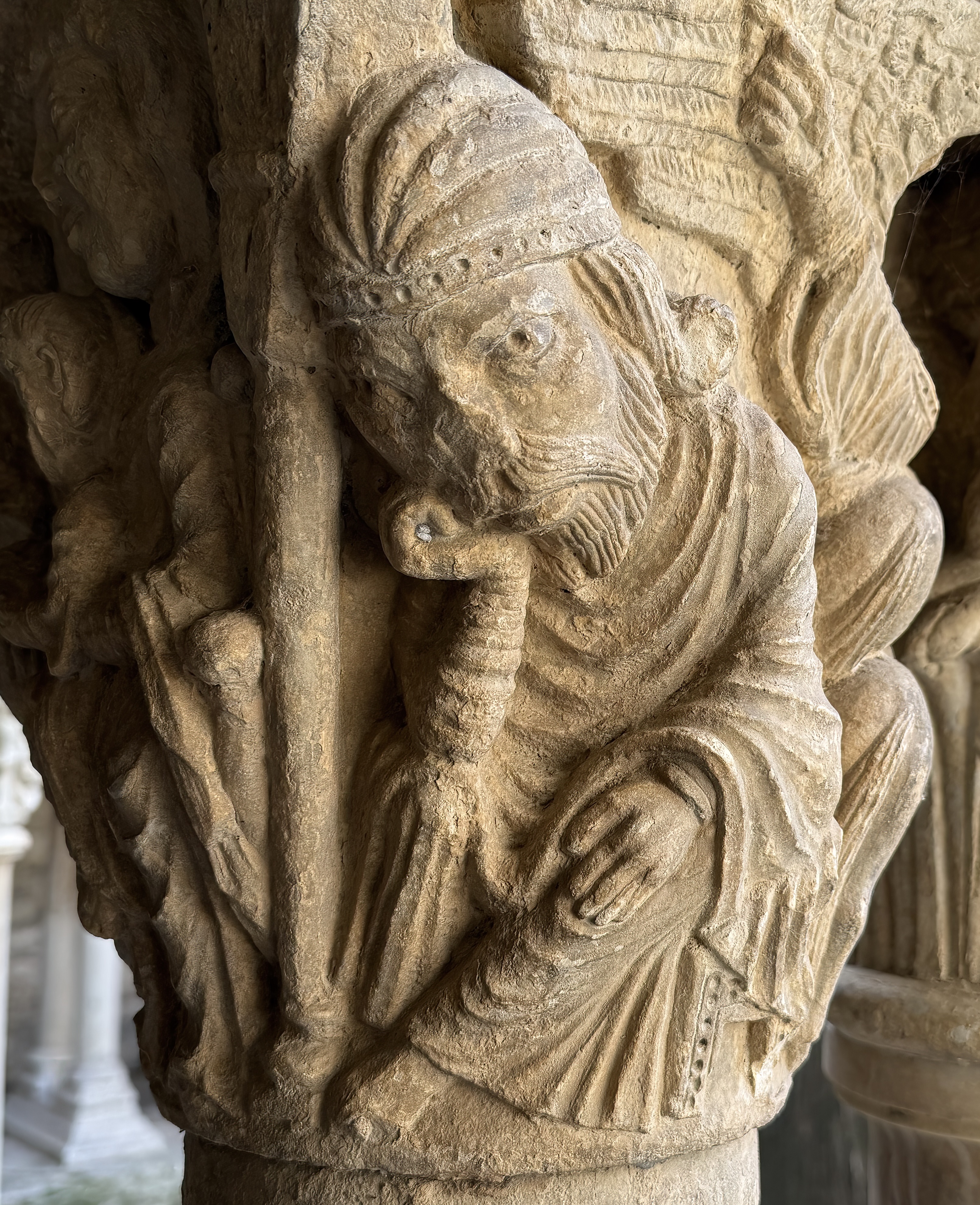
A perplexed man in the cloister of Saint Trophime, Arles, France (12th century)
In the liturgical churches, we don’t get to choose the Scripture for our homilies. We have to take what the Lectionary gives us. I’ve been preaching for a long time, but I’ve always been lucky enough to miss the Sundays when the Parable of the Unjust Steward turns up. Until now. Some scholars have labeled it the hardest parable. I prefer to call it the “terrible parable.” But I made a stab at it, and pass on the results here.
A parable functions a little like a Zen koan. What is the sound of one hand clapping? What is your original face before you were born? Such imaginative constructions of language are meant to disrupt habitual ways of thinking and open us to new perspectives. Just so, when a prodigal son is welcomed home with open arms, or the laborers who work the fewest hours are paid the same wages as the ones who work all day, we are forced, or at least invited, to question our presuppositions and prejudices about how life works, or how God desires life to work.
That said, let’s consider the Parable of the Unjust Steward (Luke 16:1- 8). It’s not an easy one to interpret. Nor is it easy to like. There have been many efforts to explain what this story about a dishonest steward tricking his boss is even doing in Luke’s gospel, set down in the midst of far more memorable teachings and far more beloved parables. But most of those explanations fail in one way or another, either making assumptions not justified by the text or reducing its meanings to something of little value to preacher or disciple.
So what shall we make of the “terrible parable” this time around?
Let’s review what happens. A rich man, presumably an absentee landowner, discovers his property manager has been “squandering” his property, whether by mismanagement or financial monkey business we aren’t told. But he’s put on notice that he’s about to be fired.
Now the steward considers himself either too old or too scrawny for manual labor, and he’s too proud to beg, so he’s desperate for a way to avoid utter destitution. What does he do? He summons all his master’s debtors and offers to write down their debts to an affordable level. By so doing, he earns the good will of those debtors.
Maybe someday, when he’s out of work and looking for help, they’ll return the favor. And, by collecting at least some return from all those past due accounts for his master, maybe he can get back in the master’s good graces. In the end, we are told, the rich man “commended the dishonest manager because he had acted shrewdly.” The odds of the steward keeping his job are looking up, but the story stops before we find out about that.
At first glance, it’s hard to find anyone to identify with in this parable. In the Bible, rich men are rarely liked, since economic inequality in biblical times was even worse than it is today. When a story begins, “There was a rich man,” you might imagine the immediate boos and hisses from Jesus’ audience, which hopes it’s going to be a story about his comeuppance. But as soon as the steward is introduced, his own character is dragged through the mud, and the rich man gains a bit of sympathy for having been cheated.
The steward stands accused of squandering his master’s property—whether through incompetence or dishonesty is not quite clear, but his actions later, cooking the books to write down the debts owed to his master, tag him as “unjust” or “dishonest”—terms which can connote either shaky bookkeeping or outright fraud. In any case, he plays fast and loose with the numbers. And, to our surprise, he is praised for doing so. This commendation may reflect the master’s relief in recovering at least some of his bad loans. It also may indicate his delight in discovering how clever his steward is. If such a man can get things done, who cares if his methods are not always on the up and up?
Some commentators have discerned a Christ figure in the rule-breaking steward. Hoping for a different kind of future, Jesus subverts the rules of the old world, where the rich get everything and the system punishes the poor, so that the rich man gets less and the debtors finally get a break. The unjust system may consider his actions to be improper, but in God’s eyes he’s an agent of economic justice, constructing a fairer and kinder form of human community.
At the same time, the steward’s actions transform relationships. The debtors, for whom the steward might have seemed an enforcer of unpayable obligations, turns out to be a forgiver of debts. And the rich man, tricked into generosity by his steward’s unorthodox moves, is given the opportunity to forego domination and greed in his own relationships with others.
That’s the story. But then the storyteller, who is Jesus, tacks a puzzling moral onto the end of his tale. He says the steward’s ingenuity, and the praise he receives for it, demonstrates that “the children of this age are more shrewd in dealing with their own generation than are the children of light.”
What could this mean? Of course, to reduce a parable to a single meaning implies that you can throw out the story and just keep the meaning. That’s like Woody Allen’s joke about reading War and Peace in an hour after taking a speed-reading course. When someone asked him what the novel was about, he said, “It’s about Russia.”
His joke mocks the idea that the experience of full immersion in Tolstoy’s thousand-page epic can be replaced by a brief summary. It’s the same with Jesus’ parables. Don’t reduce them to a single meaning. Experience them, begin to wonder about them, and then—just keep on wondering.
So instead of offering the best interpretation of today’s parable—there is no best interpretation, just a story which continues to puzzle us—I will simply try out some observations with no presumption of giving you the definitive last word about it.
The “children of light” is a New Testament term for the early Christians, the followers of the Way of Jesus, who belong not to “this age” but to the age to come, the future which God is in the process of bringing about. The steward’s ability to game the system of this age, operating successfully within its parameters with improvisation, cleverness and flexibility, should make the followers of Jesus ask themselves,
“Am I operating within the parameters of the age to come—the kingdom of God—with the same creativity and resourcefulness as the steward displays within the parameters of his story? Are my actions and choices in line with the world that is dying, or with the world that is being born?”
In living out the Christian life, which is rooted not in this age but in the age to come, we should embody the Kingdom’s precepts and pursue its goals with the same single-mindedness, the same commitment, the same shrewdness that the steward in the parable employs to navigate the crisis described in his story. His world is about to come crashing down, he’s about to lose everything, but he survives through the actions he takes and the relationships he cultivates. He doesn’t cling to the old world and its old rules to suffer its predetermined outcomes. He discovers a way to be part of what is about to happen next. He discovers a way to have a future.
Now if we are indeed the children of light, claiming allegiance to the divine future which is being born amidst the ruins of our fallen world, do we possess a comparable level of creativity and resourcefulness to survive the collapse of the old and join ourselves wholeheartedly to the emergence of the new? Can we be as good as that steward was in slipping through the present time of crisis into a future of divine intent and human flourishing?
That’s the question I hear the parable asking us today. That’s the question I leave you with today. Let me say it one more time:
If we are indeed the children of light, claiming allegiance to the divine future which is being born amidst the ruins of our fallen world, do we possess a comparable level of creativity and resourcefulness to survive the collapse of the old and join ourselves wholeheartedly to the emergence of the new?
Can we be as good as that steward was in slipping through the present time of crisis into a future of divine intent and human flourishing?
In 1776, the fourth of July became “No Kings Day.” In my lifetime, that central meaning has been largely ceremonial and festive, but in the annus horribilis of 2025 it has become profoundly existential. The crisis which provoked the Declaration of Independence is back with a vengeance. But the abuses of King George can’t hold a candle to the malignant and murderous cruelty of our current tyrants.
In the Episcopal lectionary for daily prayer, we are currently following the saga of early Israel from the First Book of Samuel, where the whole idea of kingship is up for debate. As my country rushes headlong toward the extinction of the common good, these biblical texts have felt quite timely. I am particularly struck by the eighth chapter of I Samuel as a parable of our own collective folly. [i]
In the biblical narrative, Israel’s early days in the “Promised Land” were marked by political instability. Leadership was provided by a series of charismatic figures who governed with varying degrees of cunning and force. In the ideal, the leader would be touched by the spirit of the Lord, giving the “judge” an aura of power and purpose the people could not fail to recognize. In practice, such a system of leadership was often sustained through bloodshed. As Robert Alter points out, “survival through violence, without a coherent and stable political framework, cannot be sustained, and runs the danger of turning into sheer destruction.” [ii] Indeed, the disheartening Book of Judges ends in civil war and anarchy:
In those days there was no king in Israel. Every man did what was right in his own eyes (Judges 21:25).
When I Samuel, the next book after Judges in the Hebrew Bible, takes up the narrative, the prophet Samuel is born and raised as a divinely chosen instrument for the guidance of God’s people. As it turns out, he is far from perfect, prone to anger, rigidity and ambition. But his dream of creating a prophetic dynasty out of his descendants is thwarted by the blatant corruption of his sons, who “took bribes and twisted justice” (I Samuel 8:3).
So when Samuel’s old age raises questions about succession, the elders of Israel demand a new kind of governance. “Give us a king to rule over us, just like all the other nations.” But Samuel resists their plea. No doubt he dislikes the idea of surrendering his own authority, or admitting his dream of a prophetic dynasty is doomed. But he is also clinging to the venerable idea that ancient Israel is not like any other nation. Its only king, its only absolute ruler, is God, who rules through the direct inspiration of human agents.
Then Samuel prays, laying his dilemma before the Holy One, whose answer is surprising. “Listen to the voice of the people,” God says. “And don’t take it personally. It’s my governance they are rejecting, not yours. They’ve been rejecting and ignoring me from the very first day I delivered them from Egypt.” But even while expressing disappointment over human waywardness, God seems to accept the historical situation. Forgetting the Holy One, their Creator and Savior, is what humans do. “So give them what they ask for,” God tells Samuel. “But be sure to make it clear what they’ll be getting. Remind them what kings do: abuse power, rule with violence, steal your wealth, and turn you into slaves.”
When Samuel delivers God’s warning, he adds a dismal prophecy of the endgame: “The day will come when you will cry out before your king whom you chose for yourselves; and on that day the Lord will not answer you.”
But the people refuse to heed Samuel’s voice. “WE DON’T CARE!” they cry. “We want a king to rule us!”
When Samuel returns to his prayers to report the people’s response, God replies, perhaps with a sigh of resignation, “Heed their voice and make them a king.” And so it goes.
That’s how the conversation concludes. But I can’t help imagining God adding one more thing to the biblical text as it speaks to us across the centuries:
“Let them see for themselves what kings are like. FAFO.”
[i] I use the word “parable” here not to deny the foundation of the text in historical events, but to highlight a significance for us that does not depend on our knowing exactly how things happened in the murky past. The text of Samuel is a creative fusion of diverse sources. As Robert Alter notes in his translation of the Hebrew Bible, “What matters is that the anonymous Hebrew writer, drawing on what he knew or thought he knew of the portentous historical events, has created this most searching story of men and women in the rapid and dangerous current of history that still speaks to us, floundering in history and the dilemmas of political life, three thousand years later.” Robert Alter, The Hebrew Bible: A Translation with Commentary—Volume Two: Prophets (New York: W. W. Norton & Company, 2019), 176.
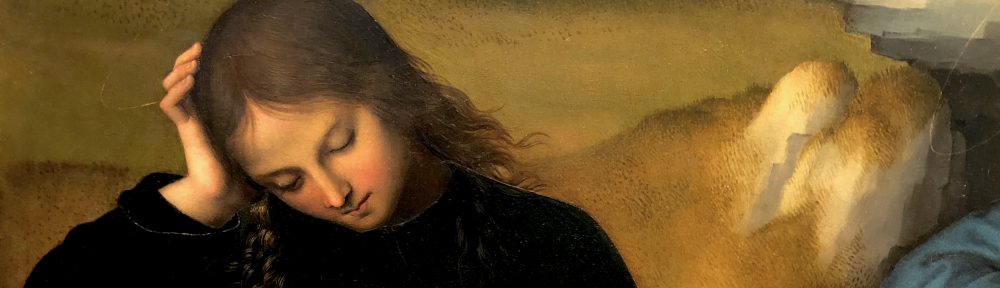
Jan van Scorel, Woman with the jar of nard (c. 1530).
In all four gospels, there’s a story about a woman who interrupts an intimate dinner party to kneel at the feet of Jesus and make an act of devotion. Luke’s story differs from the others in significant ways, so it may be based on a different incident. But Mark, Matthew and John all seem to be describing the same event. It was a moment which clearly had an indelible impact on the memory of the early Church.
John’s version is the only one which names the woman: Mary of Bethany, whose brother Jesus had just raised from the dead in the gospel’s previous chapter. Coming between the dramatic raising of Lazarus from the tomb and the violent clamor of the Passion, the story is a striking contrast to what came before and what comes after.
Instead of a public event with lots of people, it is quiet and intimate. No wailing mourners, no crowd shouting “Hosanna!” or “Crucify him!” Just Jesus, a few disciples, and his hosts, the siblings of Bethany: Martha, Mary, and Lazarus.
We don’t know what they talked about during that dinner, but the moment had to have been highly charged, given the people around the table: The sisters whose grief had driven the harsh confrontation with Jesus at their brother’s tomb (If you had been here, my brother would not have died!) … the rabbi from Nazareth who had wept his own tears over the death of his friend (and perhaps some tears for the human condition in general) but who also found himself channeling the awesome life-giving power of the divine through his own mortal body …and the stunned man who had been so suddenly snatched from the land of the dead, experiencing what had to be a volatile mixture of awe, gratitude, and PTSD.
Perhaps no one said very much at all. Perhaps they were all still processing the shock of their shared experience at the tomb, letting a profound silence hold their feelings in order to preserve the mystery of it from being reduced to the poverty of language. But at some point, Mary was inspired to acknowledge the sacredness of the moment—not with words, but with a sacramental action.
The text doesn’t give the details, but I imagine her rising from the table, leaving the room for a moment, then returning with a jar of nard, a fragrant oil originating in the Himalayas and transported at great expense along the ancient trade route from Asia to the Middle East. It was worth a year’s wages, so when Mary, without saying a word of explanation, poured it all out over the feet of Jesus, it was quite shocking, like throwing a bag of gold into the sea or setting fire to a pile of paper money.
Then Mary compounded the shock by letting down her hair and using it to rub the oil into Jesus’ skin. No reputable woman would have done such a thing, nor would a religious teacher have permitted himself to be touched in such a way. Nevertheless, that’s how it went.
Judas was at that table, and he couldn’t bear to watch. He was the apostles’ money man, and he objected to wasting wealth that could have done some real good. John’s gospel doubts his sincerity, accusing Judas of embezzling the very funds he was claiming to protect.
I suspect that Judas’ discomfort had more to do with Jesus rewriting the social codes of his culture by endorsing Mary’s action. “Leave her alone,” Jesus tells him. Jesus, unlike Judas, understood that this was a very precious and significant moment, and he wanted to let it happen.
Mary’s extraordinary action, both sensual and symbolic, overflowed with meanings. For one thing, anointing with oil was a way to mark the special vocation and identity of authoritative figures, whether powerful rulers or holy persons. It consecrated them as chosen and set apart. The title of “Messiah” or “Christ” means “the anointed one.”
It was revolutionary to have a woman be the one to anoint Jesus as priest and ruler, but the kingdom of God was all about revolution: the revolution of transforming a disordered and broken world into a more perfect expression of divine intention and human possibility.
Anointing was also part of the culture’s preparation of a body for burial. Performed in the week before Jesus’ death, Mary’s gesture inaugurates the sequence of sacrificial acts culminating with her Lord’s burial in the stone-cold tomb. The feet she anoints will soon walk the Way of the Cross for the salvation of the world. That was Jesus’ chosen destiny, and the oil is an outward and visible sign of his inward consent to perform that destiny.
The story’s third meaning is in its foreshadowing of the foot-washing, when Jesus, on the night before he died, knelt at the feet of his friends to perform the work of a servant, surrendering his power for love’s sake. The foot-washing marked the turning point from a paradigm of domination to a paradigm of communion.
By kneeling at the feet of his friends, Jesus was showing them, and us, an image of humanity’s best version of itself. In that sacramental act, Jesus was saying: This is how we must be with one another, because this is exactly how God is with us.
And in today’s story, just a few days before Jesus would teach this explicit lesson at the Last Supper, Mary of Bethany, foreshadows the foot-washing when she offers, in her own way, all she has, holding nothing back.
And her devotional act of kneeling down to pour out the precious oil not only anticipated the foot washing on Maundy Thursday, it was an image of the divine nature as revealed in the incarnation and crucifixion of Jesus. As one theologian has put it, “The self-giving extravagance of Mary’s actions point to the way Jesus would expend himself completely through his crucifixion.” [i]
In our Palm Sunday liturgy next Sunday, Paul’s Epistle to the Philippians will declare that Jesus emptied himself for us, poured himself out for us, and in so doing he revealed who God is and what God does. Whether in the costly pouring out of the Son’s life on the cross, or in the lavish pouring out of Spirit on Pentecost, God is the One who never ceases to pour out God’s own self.
And when, before his own self-offering, Jesus allowed Mary to anoint him in such a costly manner, she herself became an icon who shows us God with her own body, bowing before Jesus to wipe his feet so tenderly with her hair.
At the time, the disciples did not grasp the full significance of Mary’s act. Nor did Mary herself, I’d imagine. How could they?
As we say around here about Holy Week: The journey is how we know. The disciples had to learn by doing: following Jesus all the way to the cross—and beyond—before they could begin to understand—through memory and reflection—what it was all about. And that is what we will be doing as well during the seven days of Holy Week, not wanting to miss a single step along that sacred way. The journey is how we know.
Before we leave this story, consider the one sentence that stands out from the rest of the text:
The house was filled with the fragrance of the perfume.
There’s nothing else quite like it in the canonical gospels. The Bible in general is short on description and long on action. We never hear about the weather in Jerusalem or the colors of spring in the Galilean hills or the way light falls on the walls of the temple courtyard in late afternoon. So why does John invite us to pause and take in the sweet smell of nard?
In her fascinating book on the olfactory imagination in the ancient Mediterranean, Susan Ashbrook Harvey points out that aromatic spices were thought of as souvenirs of Paradise. When Adam and Eve were expelled from the Garden of Eden, it was said, they were allowed to take away a few fragrant plants to remind them of what they had lost.
Smells are a powerful trigger of memory, and the sweet odors of plants, spices and aromatic oils not only reminded people of Paradise Lost, they were thought to alert our senses to divine presence in a fallen world. They help us remember God. As Harvey writes, fragrance is something like God:
“Unseen yet perceived, smells traveled and permeated the consciousness, transgressing whatever boundaries might be set to restrict their course … Odors could transgress the chasm that separated the fallen order from God; they could elicit an unworldly sensation of beauty.” [ii]
And so we hear St. Paul speak of the fragrance that comes from being “in Christ,” so that we ourselves begin to give off the “aroma of Christ” from our own bodies (2 Corinthians 2:14-16). A few centuries later, Gregory of Nazianzus, in his treatise on the effects of our baptism, wrote:
“Let us be healed also in smell, that we … may smell the Ointment that was poured out for us, spiritually receiving it; and [that we may be] so formed and transformed by it, that from us too a sweet odor may be smelled.” [iii]
And St. Chrysostom, in his 5th-century sermon on today’s gospel, urged his congregation to become like thuribles, sweetening wherever they happen to be with the incense of heaven:
Now the one who perceives the fragrance knows that there is ointment lying somewhere; but of what nature it is he does not yet know, unless he happens to have seen it. So also we. [That God is, we know, but what in substance we know not yet.] We are then, as it were, a royal censer, breathing whithersoever we go of the heavenly ointment and spiritual sweet fragrance.” [iv]
In the spirit of such olfactory tropes, John’s verse about the sweet smell of the nard in that Bethany dining room endow that moment with divine peace and blessing. And the verse is especially vivid in contrast with the stench of mortality hovering around the tomb of Lazarus a few days earlier. Don’t roll away the stone, his sister pleaded. After 4 days inside, the body will smell terrible. Or as the King James Bible memorably put it, “by this time he stinketh.”
But in that sweet-smelling dining room with Jesus and his friends, death and decay are held at bay for a few precious hours. Outside, the world is wild and raging, on the verge of murdering the incarnation of Love. But inside, a woman is imaging the peace of heaven at the feet of her Lord.
For me, this beautiful moment calls to mind a scene from Ingmar Bergman’s classic 1957 film, The Seventh Seal, set in the fourteenth century when the Black Plague is ravaging Europe. A wandering knight is trying to get back home before the plague catches him, stalling for time by engaging Death in a game of chess. He’ll never win, of course, but at one point he meets a kind of holy family: a man, Jof; his wife Mia; and their baby, Michael. They are traveling players who embody the vitality of the life force.
Antonius Block, the knight (Max von Sydow), plays chess with death.
The film ends with the knight taking his inevitable place in the dance of Death, disappearing over the horizon with his fellow mortals. But the “holy family” are not seen among the dead souls, for they have been spared to carry on in this life, untroubled by death because they belong to grace. They know how to accept the music of what happens, and not live in fear.
The knight finds grace in a fallen world: “I shall remember this hour of peace.”
In the sweetest moment of this anguished film, Jof and Mia share their strawberries and milk with the knight, who receives it like a sacrament, a taste of unconquerable life:
“I shall remember this hour of peace,” he tells them. “The strawberries, the bowl of milk, your faces in the dusk, Michael asleep, Jof with his lute. I shall remember our words, and shall bear this memory between my hands as carefully as a bowl of fresh milk. And this will be a sign and a great content.”
An hour of peace, an experience of great content in a world that is coming apart—isn’t that a perfect description of the dinner at Bethany? And are we not in that same place now, with Mary, Jesus, and the rest? The powers of death and malice and mindless destruction are raging outside. We know that. Yet here we are, tasting the bread of heaven, inhaling the fragrance of divine presence.
It’s not about escaping. Not at all. It’s about renewal, so that when we go back out into the world, we can be clear about our vocation: to exude that fragrance—God’s sweetness—in every place we go. And when it gets hard out there—and it will—just call to mind the fragrance of those sacred moments when we dwell in God, and God in us.
This homily was preached at St. Barnabas Episcopal Church on Bainbridge Island in Washington State, on the Fifth Sunday in Lent.
[i] Craig R. Koester, Symbolism in the Fourth Gospel: Meaning, Mystery, Community (Minneapolis: Fortress Press, 1995), 114.
[ii] Susan Ashbrook Harvey, Scenting Salvation: Ancient Christianity and the Olfactory Imagination (Berkeley: University of California Press, 2006), 53.



 The religious imagineer