For the latest No Kings March to occur on the eve of Palm Sunday seemed to me a resonant conjunction. Both yesterday’s march and the “triumphal entry” of Jesus into Jerusalem stirred the deepest hopes of people suffering under oppressive regimes. Of course not all hopes are equal, and sometimes they turn out to be, as T. S. Eliot noted, “hope for the wrong thing.” Even if the folks shouting Hosanna in Jerusalem were mistaken about what God was up to that week, I imagine Jesus still being touched by their longing, that crazy feeling that the world might just get better. The capacity for hope is one of humanity’s finest qualities.
There is some irony, of course, in linking No Kings to a biblical event suffused in royal imagery. I’ve been singing the Palm Sunday processional, “All glory, laud, and honor to thee, Redeemer, King!” ever since I was a child. But God is no stranger to irony—manifesting divinity as a helpless child, “ruling” as a servant, and dying to give life. And a line by the late great songwriter Bob Franke neatly resolves, for me at least, any tension between democracy and religious language inherited from monarchists.
Well you kneel to the Lord and you will bless yourself; Ain’t no need to kneel to no one else.
In a week when people of my tradition walk the Way of the Cross in ritual, song and story, we know that hope is no stranger to struggle and suffering. It’s a long and winding road to Easter, passing through Gethsemane and Golgotha. Yet it remains, as the Book of Common Prayer assures us, “none other than the way of life and peace.”
On yesterday’s march in Seattle, I shot video of what I saw, and in putting it together I was struck all over again by the recurrent note of joy. Not everyone would put it this way, of course, but for one gloriously sunny day, we were, as the South Africans sing, “marching in the light of God,” and the divine future of human flourishing made a significant incursion into the present moment. As the crowd chants in the opening of my video:
In the dark days of 1943, Hugh Martin and Ralph Blane wrote the most melancholy Christmas song I know, “Have Yourself a Merry Little Christmas.” It made its debut in the 1944 film, Meet Me in St. Louis, when Judy Garland sang it to cheer up her little sister. Their father had taken a job in New York, and the world they knew was about to end. The fact that it was Christmas—their last Christmas in St. Louis—only intensified their sense of loss. As the sisters gaze down from an upstairs window at the family of moonlit snow figures in the front yard, Garland, her moistened eyes seen in gorgeous Technicolor close-ups, delivers the song.
The film’s director, Vincente Minnelli (who would marry Garland the next year), thought the original lyrics too depressing, so he told the writers to make some changes. The line, “It may be your last / Next year we may all be living in the past,” became “Let your heart be light / Next year all our troubles will be out of sight.” But that did little to stop the tears of homesick soldiers viewing the film in distant war zones. In 1957, Frank Sinatra requested another change when he included the song on his holiday album, A Jolly Christmas. He asked Hugh Martin if he could “jolly up” the lyrics a bit more. Thus “until then we’ll have to muddle through somehow,” became “hang a shining star upon the highest bough.” Even so, the tune’s slow pace and moody melody have continued to suffuse the song with the seasonal melancholy which for some is the shadow side of Christmas cheer. If you’re feeling alone, sad, lost, anxious, or afraid, it’s hard to share in the holiday spirit. When your personal world—or our public world—lies in darkness, how do you “let your heart be light?”
A few centuries ago, Turlough O’Carolan, the blind harper and last of the Irish bards, was sitting in a tavern with his friend, the poet Charles McCabe, who said, “Your music, sir, is grand and lovely stuff; but it’s too light-hearted. This is a dark time we live in, Mr. Carolan, and our songs should reflect that.” The harper replied, “Tell me something, McCabe. Tell me this: Which do you think is harder—to make dark songs in the darkness, or to make brilliant ones that shine through the gloom?” [ii]
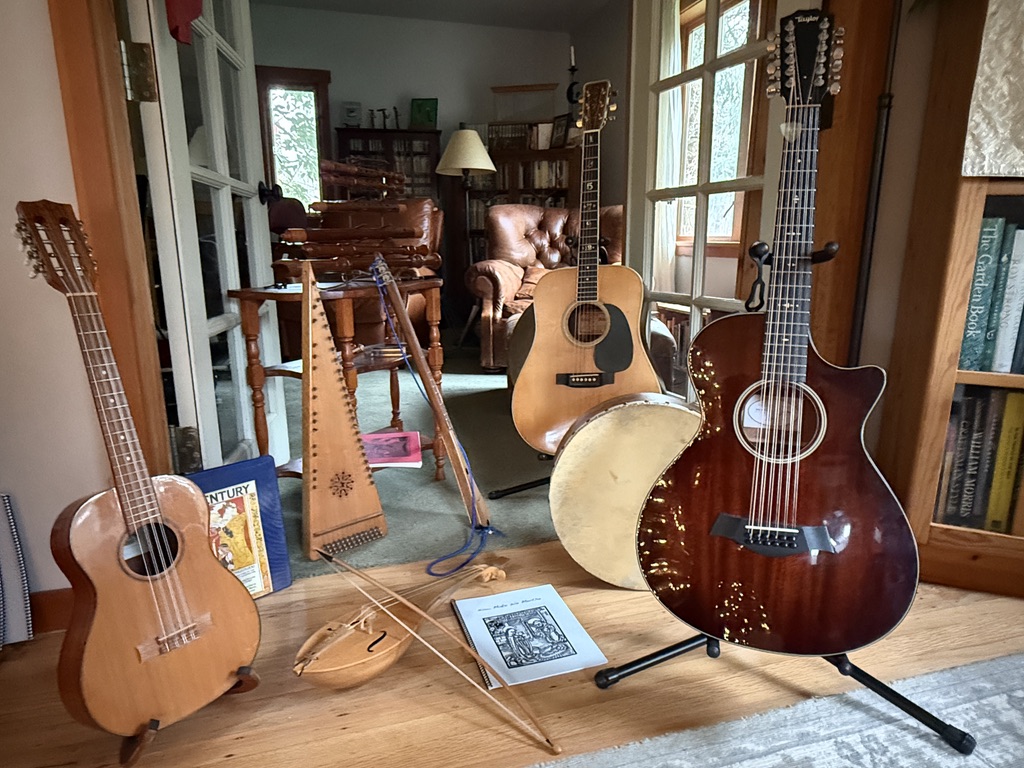
Some of the instruments from our caroling party.
For the last half-century, I have gathered instrumentalists, singers and friends to lighten up the long night with carols and wassails from seven centuries and a dozen countries. “The Praise of Christmas” sums up the spirit of these evenings:
This time of the yeare Is spent in good cheare; Kind neighbors together meet To sit by the fire With friendly desire Each other in love to greet; Old grudges, forgot, Are put in the pot, All sorrowes aside they lay; The old and the yong Doth carol their song To drive the cold winter away.
The old tune is appropriately vigorous, and the lyric by Thomas d’Urfey (1653-1723) is from his aptly titled songbook, Pills to Purge Melancholy. We do sing our share of quiet songs (“Hush! Hush! See how the child is sleeping.”), as well as wistful and mysterious carols in minor keys and medieval modes. But the predominant note is one of joy and wonder. As William Morris declared in his Victorian carol, “Masters in This Hall,”
Christmas is come in And no folk should be sad.
Of course, no one should, but many are. Even in the best of times, there’s going to be some sadness in the room. As Henry Nouwen said, “No one escapes being wounded.” So we don’t sing our carols expecting present reality to be suddenly freed from every sorrow. But singing touches and heals the mind and heart, offering relief and comfort to “those who sit in darkness, and in the shadow of death” (Luke 1:79). As Robert Burton insisted in The Anatomy of Melancholy (1621), music is “the sovereign remedy against despair and melancholy … a “tonick to the saddened soul.” And W.E.B. DuBois, writing in the last century about “The Sorrow Songs” of African-American spirituals, said that “they grope toward some unseen power and sigh for rest in the End.” In other words, even laments can be agents of hope. As DuBois put it,
“Through all the sorrow of the Sorrow Songs there breathes a hope—a faith in the ultimate justice of things. The minor cadences of despair change often to triumph and calm confidence.” [iii]
Compared with the emotional and social realism of black spirituals, what can we say about Christmas carols? Do they have a similar healing power? Or is their bright spirit in denial of the “two thousand years of wrong” which have followed the miraculous “midnight clear” in Bethlehem? Can we who dwell in the shadow of death still sing about joy and peace with whole-hearted conviction? As the Psalmist wondered, “How can we sing the Lord’s song in a strange land?” And yet, we sing. We sing because carols gladden the heart and bring us together. And we sing because carols are eschatological anticipations of God’s unfolding future. They don’t put an end to our troubles, but they give us a foretaste of glory, reminding us that we belong not to what is dying, but to what is being born.
Gabriel’s message does away Satan’s curse and Satan’s sway; Out of darkness brings our Day: So behold, All the gates of heav’n unfold.
“O radiant dawn, bright splendor of the light eternal.” (8th century ‘O Antiphon’ for December 21).
In my Los Angeles days, I’d rise at 4 a.m. at the Winter Solstice, toward the end of the longest night, and drive to a peak above the ocean in the Santa Monica Mountains, where I could see the newborn sun rise over desert peaks 100 miles to the east. But in the Northwest where I live now, a winter sunrise can be a rare sight. This December’s relentless stretch of rain and thick clouds seemed to doom my chances. Still, I awoke at sunrise out of habit, and when I glimpsed the Douglas firs on a hilltop ablaze with fiery light. I jumped in my car and raced to the edge of the island to see the gloom on the run. It was the perfect Advent sign: The people who have lived in darkness, and in the shadow of death (umbra mortis, as the 8th-century O antiphons put it), have seen a great light.
Did it matter that by the end of the day the sun had vanished and rain was pouring down? Not at all. I had received the gift of light as an eloquent sign: Don’t forget what you have seen. Remember hope.
Sunrise after the year’s longest night (Puget Sound, Washington).
Dear reader, I wish you a most blessed and merry Christmas. Let your heart be light!
[ii] I heard this story in the California Revels CD, Christmas in an Irish Castle (2001).
[iii] The Nouwen, Burton, and DuBois quotes are from Kay Redfield Jamison’s powerful and moving book, Fires in the Dark: Healing the Unquiet Mind (New York: Alfred A. Knopf, 2003). It is a fascinatingly documented and beautifully written treatise on the spiritual and imaginative dimensions of healing body and soul.
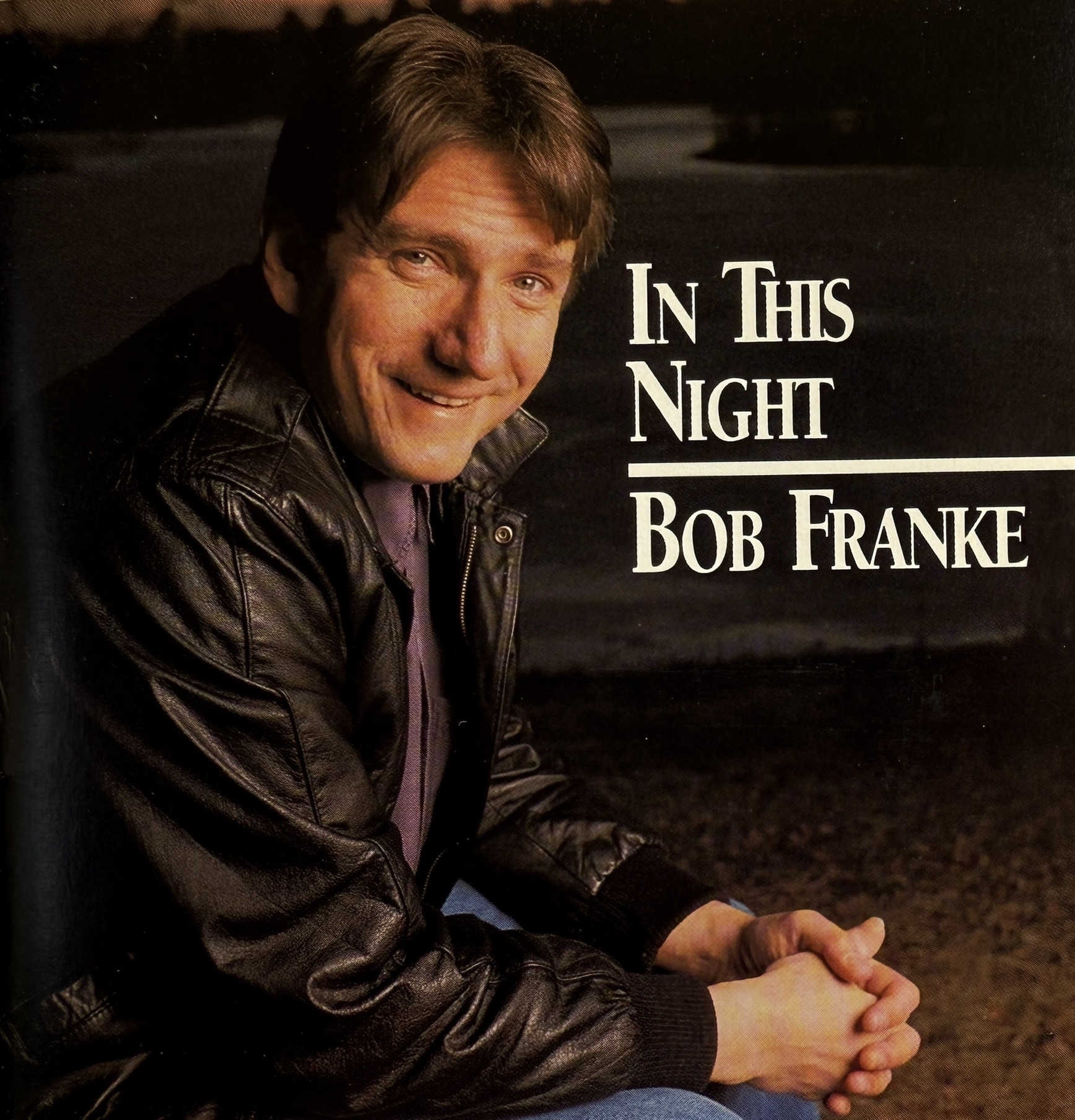
Cover of Bob Franke’s fifth album, 1991 (Photo: Susan Wilson)
And when all the stars and sentimental songs dissolved to day, There was nothing left to sing about but hard love.
— Bob Franke, “Hard Love”
Yet even at the grave we make our song: Alleluia, alleluia, alleluia.
— Burial Office, Episcopal Book of Common Prayer
“Bob Franke! Ten years ago, one of his songs literally saved my life.” That’s what a theology professor told me back in the nineties, when I was catching a ride with her to Salem from the Massachusetts coast. She taught at Harvard Divinity School and had offered to drop me at a friend’s house on her way to work. “What’s your friend’s name?” she asked. I told her, and I have never forgotten her heartfelt response. But I was not surprised by it. Bob’s songs have been a source of comfort and healing for many of us over the years.
I first met Bob in 1969, when he was a student and aspiring singer-songwriter at the University of Michigan, and I was a Cambridge seminarian visiting Ann Arbor during spring break. Bob was part of an impromptu band I helped put together for the Easter liturgy at Canterbury House, the Episcopal campus ministry coffeehouse renowned not only for its folk concerts (Neil Young, Joni Mitchell and Richie Havens were on the bill that year), but also for its wonderfully creative alternative worship. On Easter morning, about 150 students and faculty descended into the gloomy basement “tomb,” until a clown in white face appeared to announce that “Christ is risen!” As the congregation exited the tomb into the light-filled hall above, our band played the opening hymn—“Mr. Tambourine Man.” Nothing like resurrection to make a “jingle-jangle morning.”
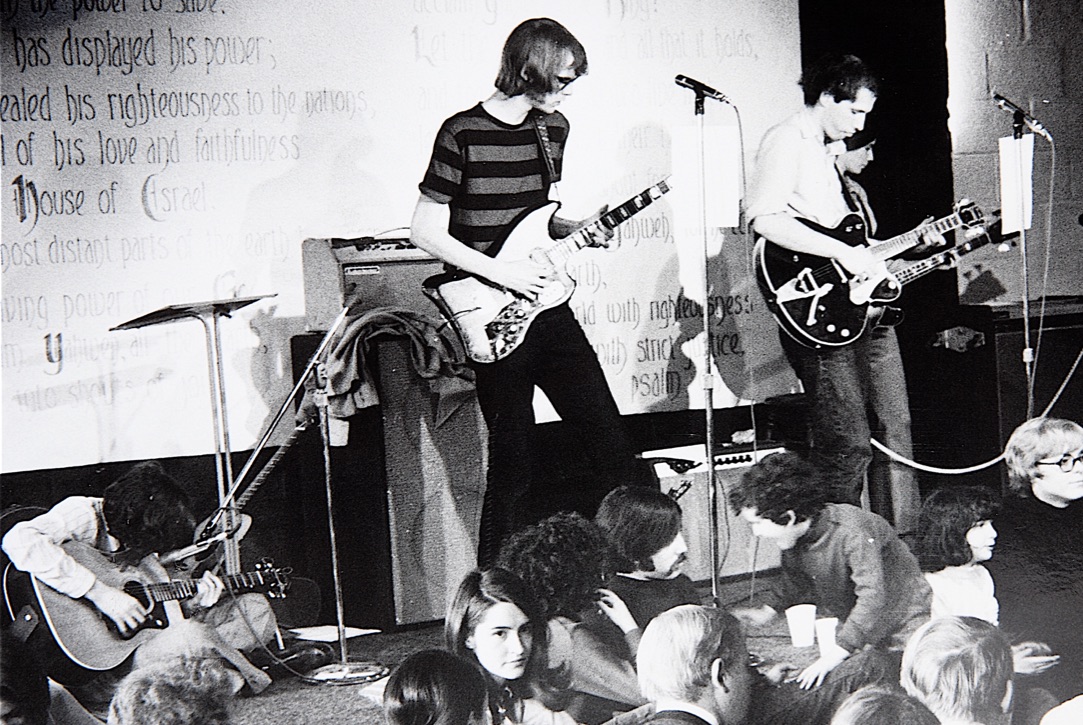
Bob Franke (seated on floor), Jim Friedrich, Ed Reynolds at Canterbury House Easter Sunday, 1969
Canterbury House was also the first place Bob sang his own songs on stage. In the previous year, the headline act—the unpredictable Ramblin’ Jack Elliott—had wandered away between sets to get ice cream in Detroit, 45 miles away. During his long absence, someone asked Bob to fill in until Jack returned. And a star was born.
Bob was a faithful friend of God, an Episcopalian by tradition. He attended my seminary in Massachusetts for a year, but it soon became clear that, in his words, “a guitar fit better around my neck than a clerical collar.” But his songs, and the way he would speak about them in concert, became a unique ministry of illumination, comfort and blessing which touched so many lives. Bob himself put it this way:
“Whenever I sing, I’m trying to create in my listeners an awareness of the beauty and sacredness of their own lives, both individually and together, as a community. A woman came up to me recently and said that my story and my song put her relationship with her dad in a new light, gave her insight into her dad’s love for her. That’s all I need to take home from a show.”
Some of his work engages biblical topics, such as his Nativity carol, “Straw Against the Chill,” or “We’re Walking in the Wilderness.” Some lyrics incorporate Scriptural references (“new streams in the desert, new hope for the poor”). But most of his songs, whatever the topic, touch on fundamentally religious questions: yearning, journey, justice, death, loss, mercy, gratitude, love.
But it was always more than the songs with Bob, whose own authenticity, depth, humility and warmth made every concert an event of the heart. As music programmer Alan Korolenko describes the Bob Franke experience:
“No matter the size of the audience, you’re going to get an intimate evening with Bob. He just pulls everybody in, which is the key. You’ll meet other artists, and they’re not the same as their work. That’s not the case with Bob. He appeals to folk fans and general audiences, because he knows how to create a full, emotional journey, and how to share that journey. By the end, you’ve laughed and thought and cared; you’ve gotten to know the guy. He’s a class act.”
In the folk world, Bob’s songwriting has long been held in high esteem. Peter, Paul and Mary, David Wilcox, John McCutcheon, Sally Rogers, Martin Simpson, Lui Collins, Garnet Rogers, June Tabor and countless others have all recorded from his songbook. Claudia Schmidt has a beautiful version of “Hard Love,” one of the most truthful and hard-earned songs ever written on the subject.
Yes, it’s hard love, but it’s love all the same Not the stuff of fantasy, but more than just a game And the only kind of miracle that’s worthy of the name For the love that heals our lives is mostly hard love
Bob’s melodies have a way of drawing you into a place of receptivity, where his words, so precise, truthful and unafraid, whisper their truth to your heart.
For the Lord’s cross might redeem us, but our own just wastes our time. (“Hard Love”)
There’s a hole in the middle of the prettiest life, so the lawyers and the prophets say … (“For Real”)
But there are ears to hear me in my softest voice, There are hands to hold and point the way … (“A Healing in This Night”)
Over the years, Bob’s songs have been woven like bright threads into the fabric of my own life. When my grandmother died three months short of a hundred, my folk-singing sister Marilyn wasn’t sure what to perform at her funeral. Then one of Bob’s songs arrived by chance (or grace) in the mail. A friend had just come across “Alleluia, the Great Storm is Over,” and thought Marilyn would like it. It proved the perfect choice, heaven-sent, to sing our dear Nana home.
Sweetness in the air, and justice on the wind, laughter in the house where the mourners had been. The deaf shall have music, the blind have new eyes, the standards of death taken down by surprise.
In a very low-def 2010 video of Bob and friends singing the song in a Massachusetts coffeehouse, you can hear the audience jumping in with the chorus before Bob even sings a word. His lyrics were so deeply planted in their hearts, they could not keep silent.
Bob wrote a cantata on Christ’s Passion, performing it with musician friends every Good Friday at his home parish, St. Andrew’s Episcopal Church in Marblehead, Massachusetts. One of those songs, “Roll Away the Waters,” a rousing celebration of the Exodus, became a regular part of the storytelling portion of my creative Easter Vigils over the years. Here is Bob’s version.
And when we hear again the Annunciation story in Advent, it’s time for Bob’s “Say Yes,” an artfully succinct summary of spirituality’s essence: receptivity and consent. Here’s a version I did during the pandemic for one of my church’s worship streams:
The author performs Bob Franke’s “Say Yes.”
And whenever I need serious picking up, I’ll play “A Healing in This Night.” Here’s a fine version by Annie Patterson and Peter Blood:
“I always think of Bob as if Jefferson and Thoreau had picked up acoustic guitars and gotten into songwriting. There are touches of Mark Twain and Buddy Holly in there, too.” — Tom Paxton
Bob’s songs, and his spirit, are deeply rooted in American tradition—musically, culturally, politically. He sang on radio shows like Prairie Home Companion and A Mountain Stage, and traveled down many roads to perform in festivals, coffeehouses, churches and living rooms. His songs are imbued with the questions, dreams, struggles and shadows of American life. Even the hardest times are seen with a measure of possibility and redemption.
But in recent years he and his wife Joan saw the country they loved disintegrating into madness and rage. Feeling that the United States was becoming unsafe, and mindful of those who waited too long to exit Nazi Germany in the 1930s, Bob and Joan emigrated to Guatemala in September. They were barely into their second month in a new land when Bob was hit by a speeding motorcycle while crossing a road. Yesterday, October 16, a few days after surgery to repair the damage, he died in hospital of a heart attack. He was 78.
What can you do with your days but work and hope, Let your dreams bind your work to your play. What can you do with each moment of your life But love till you’ve loved it away?
When the news of Bob’s death reached me around midnight, it hit hard. I lit a candle before an icon of the Theotokos, and picked up my guitar: “Thanksgiving Eve,” of course, “Alleluia, the Great Storm is Over,” and “A Healing in This Night.” I imagined people far and wide were doing the same—joining our voices withthe whole company of heaven, as we say at mass.
Give rest, O Christ, to your servant with your saints, where sorrow and pain are no more, neither sighing, but life everlasting.
As for the song which saved that Harvard theologian’s life years ago, let Bob have the last word:
Caravaggio, The Calling of St. Matthew (1599-1600)
Any number of things can happen when we encounter Jesus. We might be comforted—or we might be uncomfortable. We might be healed—or we might be wounded. We might be instructed—or we might be turned upside down. Jesus is a difference maker. For better or worse, he comes to interrupt—and disrupt—our lives.
Sometimes Jesus speaks to our heart. Sometimes he speaks to our mind. But every time, he speaks to our will, as he puts the crucial question:
Will you come and follow me if I but call your name? Will you go where you don’t know and never be the same? Will you let my love be shown? Will you let my Name be known? Will you let my life be grown in you and you in me? [i]
We can always say no, of course. Many people have; many people do. Or we may profess our unreadiness or our inadequacy. “Are you kidding me?” said Moses at the Burning Bush. “Who am I to go and talk to Pharoah? I am slow of speech and slow of tongue.” In the same way, the prophet Jeremiah also resisted his call: “No way, Lord! Don’t ask me to be a prophet. I don’t know how to speak. I’m only a child.” God has heard all the excuses, but the Divine Intention is not easily dissuaded. “Just do it,” God says.
When Jesus tries to recruit a few followers in Luke 9:51-62, he hears plenty of excuses. “Lord, let me first go home and bury my father,” says one. This sounds reasonable enough, if he’s talking about a corpse back at the house that needs some prompt attention. But this line can also be understood to mean, “I can’t go anywhere as long as my parents are still living. Family obligations come first.”
Another makes a similar excuse: “I will follow you, Lord, but first I must go home to take my leave. I need to get permission from my family before I can come with you. And that may take some time.”
I don’t think Luke’s gospel is telling us to walk out of important relationships. Rather, it is prompting us to ask ourselves: What is so important in my life that I need its permission before I can follow Jesus? My true master might be something as big as the security of having somewhere comfortable to lay my head at night, or as trivial as my habitual routines. I’d love to follow you, Jesus, but let me check my calendar first.
The excuses in Luke’s passage suggest a world of expectations, obligations, and best-laid plans that prevent us from running away to join the Jesus circus. Today we may enjoy far more social mobility than a first-century Middle-Easterner, but we each have our own version of situations and circumstances that delay and distract us. Some things just won’t let us go. It might be something lingering from our past, like unhealed anger or grief. Or it might be a present concern, like a steady income, emotional needs, or personal ambition.
Jesus says: If you want to follow me, nothing can have more authority over you than the will of God. As for the things that hold you back, just let them go. Let the dead bury the dead. It’s time to move on, deeper and deeper into God. Seek ye first the kingdom of God. And once you’ve put your hand to the gospel plow, don’t look back. Keep your eyes on the prize, hold on!
The call to be a follower of Jesus may arrive unexpectedly. It may seem inconvenient, or even impossible. But as the saints all tell us, it’s what we are made for. To borrow a line from songwriter Bob Franke,
I can’t really say it’s the thing I do best, but it’s the best thing that I do. [ii]
True vocation is not so much surrender to an outside force as it is the recognition of an internal capacity. In his book, Let Your Life Speak, Parker Palmer makes this point beautifully. “Vocation does not come from a voice ‘out there’ calling me to be something I am not,” he writes. “It comes from a voice ‘in here’ calling me to be the person I was born to be, to fulfill the original selfhood given me at birth by God.”
“Vocation does not come from willfulness. It comes from listening. I must listen to my life and try to understand what it is truly about—quite apart from what I would like it to be about.… The word vocation … is rooted in the Latin for “voice.” Vocation does not mean a goal that I pursue. It means a calling that I hear. Before I can tell my life what I want to do with it, I must listen to my life telling me who I am.” [iii]
When Jesus calls me, it is, as it were, “my life telling me who I am.” And Jesus has many voices. You may hear him in the Scriptures or the liturgy, or when you enter the prayerful state of “absolute unmixed attention.”[iv] He will speak through the need of your neighbor, or in your deepest longing. His voice may come as dissatisfaction with the old, or as the intuition of fresh possibility. It may proceed from the mouth of friend and stranger. It may thunder like the transcendent Other, or whisper like the intimate inward presence who has known you all your life.
However Jesus may call us, what happens if we say yes? How do we put our hands to the plow, keep our eyes on the prize, and not look back?When we decide to follow Jesus, when we consent to lose our old lives in the Paschal Mystery of dying and rising, we are born again into a new way of being. No turning back, no turning back. But what will that new being look like? How will we be different? How will we make a difference?
St. Paul gives us a good list to start with in his letter to the Galatians (5:1, 13-25). Everything that binds, enslaves, and weighs you down, forget it. Instead of indulging yourselves, start loving one another. Say goodbye to enmities, strife, jealousy, anger, quarrels, dissensions, factions, envy and licentiousness. Practice love, joy, peace, patience, kindness, generosity, faithfulness, gentleness, and self-control. Let the Spirit dance in you.
Paul’s advice seems radically countercultural in an America so sickened by hatred, division, malice, and fear—a contagion which has spread to a degree unimaginable just five years ago. As Judge Michael Luttig recently lamented in his testimony before the January 6th Select Committee, “In the moral, catatonic stupor America finds itself in today, it is only disagreement we seek, and the more virulent that disagreement, the better.” [v]
In such a country, such a world, such a time, what is a disciple to do? Well, there’s no easy answer, no single method or path. We must figure it out as we go, the way the saints of old did amid crumbling empires, or as Dietrich Bonhoeffer did in 1930s Germany, or as Martin Luther King did in a Birmingham jail. It will certainly require steadfast faith and boundless love, but perhaps it is courageous hope we will need most of all.
In the worst of times, hope is the engine of persistence and the antidote for despair. Never forget: God makes a way where there is no way, and as God’s friends we are called to shine with that truth every day, “planting the seeds of resurrection amid the blind sufferings of history.” [vi]
[i] “The Summons,” a song from the Iona Community in Scotland (GIA Publications, 1987).
[ii] Bob Franke, “Boomerang Pancakes” (Telephone Pole Music, 1986).
[iii] Parker J. Palmer, Let Your Life Speak: Listening for the Voice of Vocation (San Francisco: Jossey-Bass, 2000), 10, 4.
I teach a course on “Jesus and the Movies,” examining nineteen features made on the life of Jesus between 1912 and 2014. And one of my favorites is a South African production, Son of Man (2006), which sets the gospel story in a fictional twenty-first century African country.
It begins in the desert, with Jesus and Satan sitting side by side atop a tall sand dune. There Satan offers Jesus the familiar temptations: use your power, dazzle the world, bow down to me and I will give you everything you desire.
Jesus listens for a while in silence. Suddenly he turns to Satan and shoves him off the ridge. As Satan tumbles downward – Milton’s fall of Lucifer comes to mind – Jesus shouts after him: “This is my world!”
Satan comes to a stop at the foot of the dune. He picks himself up and looks back defiantly at Jesus. “No,” he cries. “It’s my world!”
The film cuts abruptly to a village caught in the crossfire of a civil war. Terrible atrocities are taking place, making Satan’s point perfectly. It’s his world after all.
Tomorrow is the Feast of Christ the King, created by Pope Pius XI in 1925. Originally observed at the end of October as a prelude to All Saints Day, it was later moved to the last Sunday of the liturgical year, where it provides both a grand finale to the calendrical Christ narrative and a dramatic overture to Advent. In 1970 it was adopted by other churches using the Common Lectionary, including Anglicans, Lutherans, Methodists, and Presbyterians.
The pope was responding to the apocalyptic violence of World War I, where evil and madness seemed to have seized control of the world. He wanted to establish a clear reminder that it is Christ to whom the future belongs; it is Christ whom we must follow and serve.
Or in the words of Bob Dylan, “It may be the devil or it may be the Lord, but you gotta serve somebody.”
While the imagery of Christ as Lord of all may require some unpacking for interfaith dialogue, the pope’s original encyclical was clearly focused on Christian practice. If we profess Christ as our way, our truth, our life, then, in the pope’s words, “none of our faculties is exempt from his empire.”
But what do we do when Christ’s “empire” is in conflict with our other allegiances? How much do we give to Jesus, and how much do we hold back? Jesus gets Sunday mornings; does he get the working week? He gets our spiritual life; does he get our worldly affairs? Does he get our relationships, or our stewardship of time? Does Jesus get our politics, our economics?
Clarence Jordan was a Baptist preacher, New Testament teacher, and farmer in rural Georgia. In his celebrated Cotton Patch Gospels, he translated the Jesus story into a southern idiom, explaining that “the Scriptures should be taken out of the classroom and stained-glass sanctuary and put out under God’s skies where people are toiling and crying and wondering; where the mighty events of the good news first happened and where they alone feel at home.” [i]
In the 1940’s, in the middle of “the Good War,” in the heart of the segregated South, Jordan founded Koinonia, an interracial, pacifist farming collective using a communitarian model more like early Christianity than late capitalism. For his faithfulness to the dominion of Christ, he and his community were harassed, shot at, and bombed. The local church expelled him.
He was often invited to speak to groups around the country, and he would ask them, “What’s the biggest lie told in America today?” He’d let the question sink in for a bit, and then he’d say, “The biggest lie told in America today is: Jesus is Lord.”
I first heard this story when I visited Koinonia in 1980 and had a long conversation with his widow Florence (Clarence died in 1969). And in these latter days his words ring truer than ever.
Last year the Ohio legislature, hoping to derail the Affordable Care Act, blocked an expansion of Medicaid that would provide health care to 275,000 people who had no coverage. But the governor, John Kasich, made an end run around the legislature and got it done anyway.
As he said at the time: “For those who live in the shadows of life, for those who are the least among us, I will not accept the fact that the most vulnerable in our state should be ignored.”
The lawmakers howled. How dare he put the needs of the poor above our political agenda! So this is how the governor explained it to one those legislators, whom he knew to be a fellow Christian:
“Now when you die and get to the meeting with St. Peter, he’s probably not going to ask you much about what you did to keep government small; but he is going to ask you what you did for the poor. Better have a good answer.”
Governor Kasich, himself a Republican, was denounced by many in his party for appealing to a power higher than their ideology. The Wall Street Journal, wanting to make it clear that Jesus, lover of the poor, was not in fact Lord in America, offered a tart response: “Republicans get a vote before St. Peter.”
In Matthew’s gospel, the last parable Jesus tells before his arrest and crucifixion pictures all of humanity gathered before the glorified ‘Son of Man’ – the Lord of history – who reveals that he has always been among them in the bodies of the poor and needy: “I was starving … I was naked … I was an undocumented alien … I had AIDS … I was a convict …”
Everyone is of course quite surprised. But they all take his point. When you kneel before Christ the King, it won’t be at the foot of a mighty throne, but before the holy icons of “the least of these” – the vulnerable, the marginalized, the broken, the forgotten.
Well you kneel to the Lord and you will bless yourself…
Ain’t no need to kneel to no one else. [ii]
[i] G. McCleod Bryan, “Theology in Overalls: The Imprint of Clarence Jordan”, Sojourners (Dec. 1979, vol. 8, no. 12)






 The religious imagineer