Isaiah 53:5 But he was wounded for our transgressions, crushed for our iniquities; upon him was the punishment that made us whole, and by his bruises we are healed.
Was it really necessary for Jesus to be pierced and crushed? And how exactly did his suffering and death make us whole? There has never been a conclusive single answer, because any attempt to “solve” the Paschal Mystery with a reductive formula is missing the point. The cross is an experience to enter, not an idea to be explained. “I wonder as I wander out under the sky,” says the old Nativity carol, “why Jesus our Savior did come for to die / for poor ornery people like you and like I. . .” And now, this Holy Week, we come again to the foot of the cross, and we wonder.
Let us discard any crude notions of the cross as a transaction, as if somebody had to pay for all the damage wrought by human sin, so Jesus stepped up like a big spender to declare, “This one’s on me.” Such “substitution” theology either trivializes the cost of sin (can Auschwitz or Gaza be so lightly dismissed?) or risks masochism by stressing the pain of the Passion, as Mel Gibson did in his notorious movie. The sacredness of God’s Friday is not in the violence or the blood, but in the Love that rewrites the darkest story.
And let us not reduce the salvific death of Jesus to a simple case of human cruelty claiming one more victim. Something more than human tyranny and human tragedy—something divine—was at work in the cross. But the divine presence on Calvary’s hill was not in the form of any punishment dished out by an angry God. God was there in the vulnerable, suffering body of Jesus, the Incarnate Word of self-diffusive love, who chose to share the human condition in all its forms—even the bleakest and most wretched. Jesus didn’t suffer instead of us. Jesus suffered with us. And through the humanity of Jesus, our own experience of alienation and affliction has been absorbed into the trinitarian life of God, where it is held in love’s eternal embrace and drained of its toxicity. As the prophet said, By his wounds we are healed.
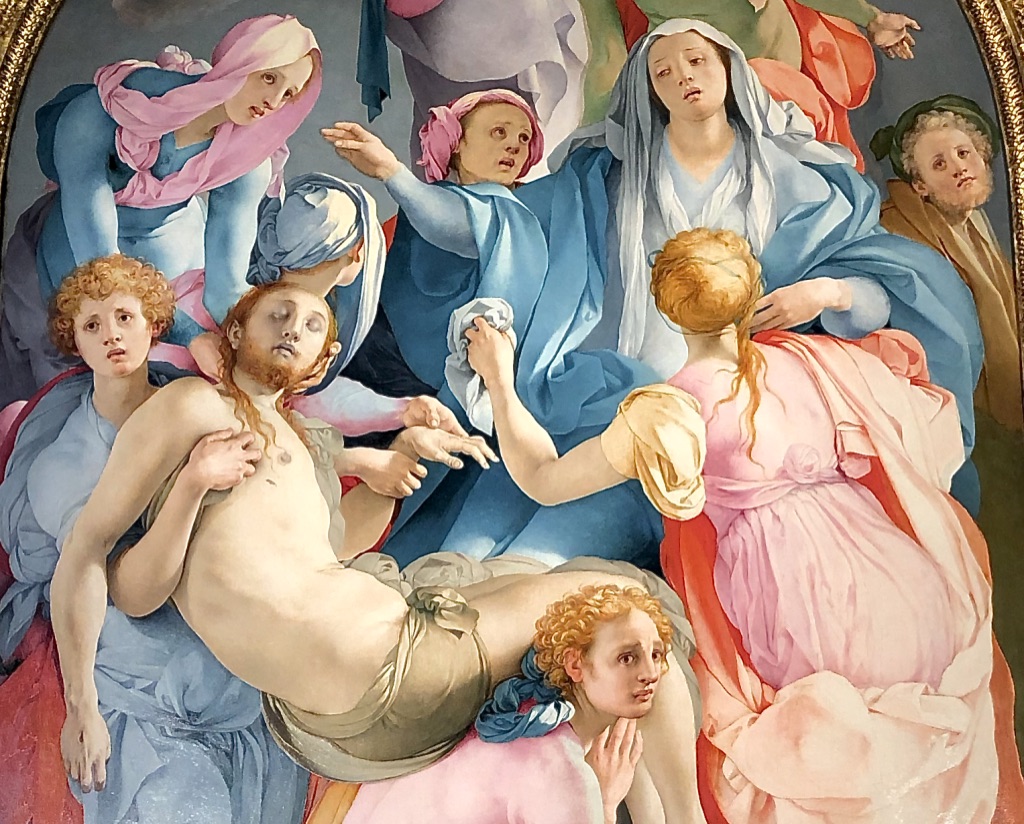
Or as theologian Paul Fiddes put it, “Far from simply forgetting about the sins of the world, [God] journeys deeply into the heart of [the human] condition. . . God participates in our brokenness, to win us to the offer of healing.” In our own evil time, when hate and cruelty are running wild, sometimes we feel overwhelmed, discouraged, or powerless. But that’s exactly where Jesus comes to join us, not simply to keep us company on the countless crosses of this world, but to transform our sufferings into the seeds of resurrection.
The title is from a hymn by W. H. Vanstone, “Morning Glory, Starlit Sky” (585 in the Episcopal Hymnal 1982)
 The religious imagineer