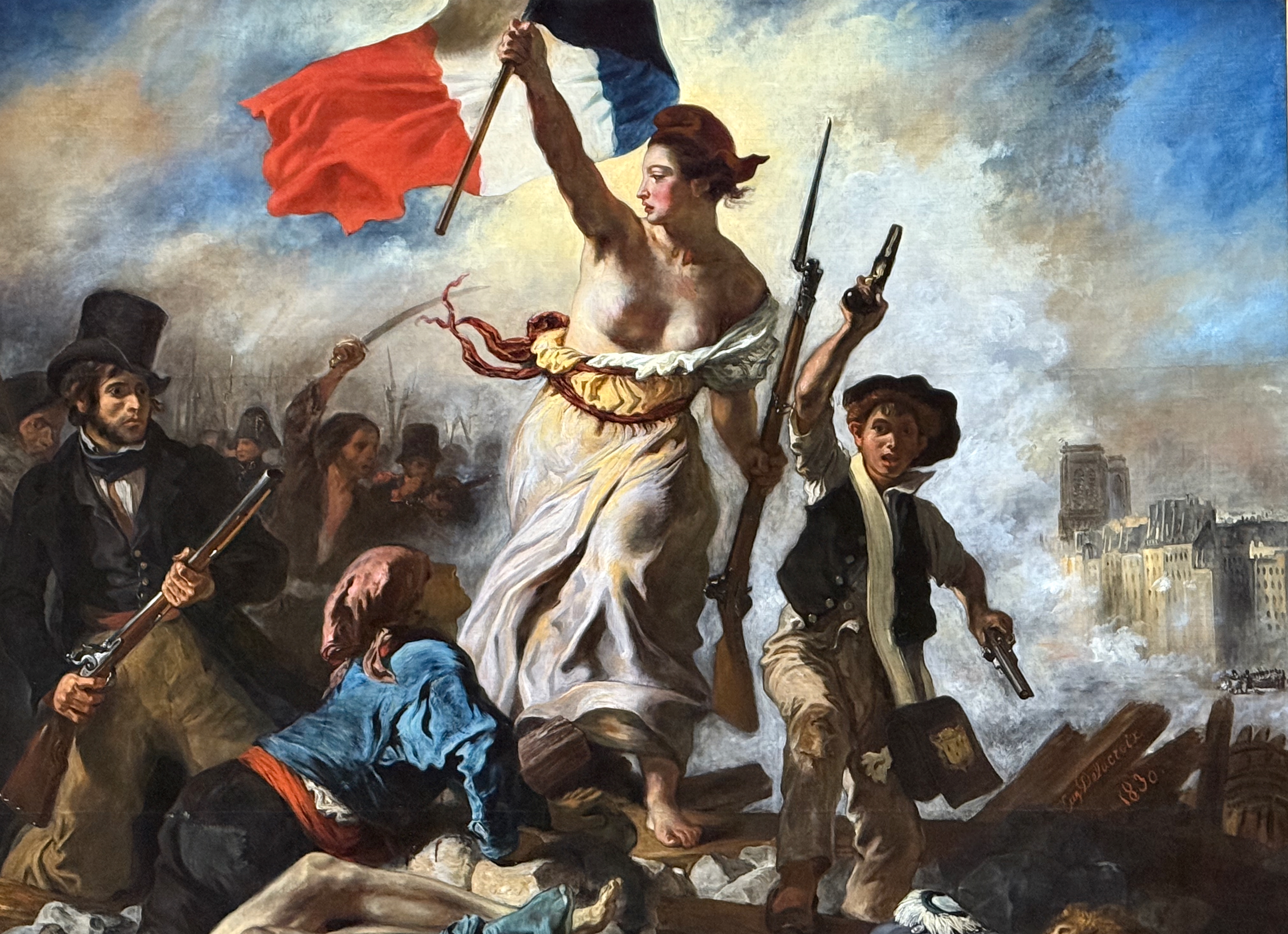
Thinking About America on Bastille Day

Eugène Delacroix, LIberty Leading the People (1830).

“Nothing collapses more quickly than civilization during crises like this one [the French Revolution of June 1848]; lost in three weeks is the accomplishment of centuries. Civilization, life itself, is something learned and invented … After several years of peace men forget it all too easily. They come to believe that culture is innate, that it is identical with nature. But savagery is always lurking two steps away, and it regains a foothold as soon as one stumbles.”

— Sainte-Beuve [i]

When an inflamed crowd of Parisian citizens stormed the Bastille on July 14, 1789, the obsolete medieval fortress had long outlived its usefulness as an instrument of royal tyranny. It was destined for demolition, and a mere seven prisoners inhabited its dungeons when the crowd broke through the gates. A year later, Lafayette presented the key for the Bastille to President George Washington, honoring the quest for liberty by both countries. The key still resides at Washington’s Mount Vernon home.

Historians have suggested that the king’s capitulation to the political power of commoners (the ‘Third Estate’) on July 9 marks the true beginning of the French Revolution, but the bloody drama of Bastille Day proved a more potent symbol than the parliamentary negotiations being conducted at the king’s palace of Versailles. In any case, the once unthinkable destruction of the Ancien Régime had been decades in the making.

In The Revolutionary Temper: Paris, 1748-1789, American historian Robert Darnton traces the growth of revolutionary sentiment as it was expressed in the Paris street: café conversations (often transcribed by police spies), underground gazettes and pamphlets, street songs, sidewalk speeches, public demonstrations and processions, and personal diaries. Eighteenth-century Paris had its own version of an information society, where “the ebb and flow of information among ordinary Parisians” was shared widely in cafés, marketplaces, wineshops, street corners and salons. [ii]

When the 72-year reign of Louis XIV ended in 1715, it was hard to imagine an alternative to absolute monarchy. His successor, Louis XV, would still be claiming dictatorial authority as late as 1766:

“In my person alone resides the sovereign power: from me alone my courts derive their existence and their authority, without any dependence and any division.” [iii]

“Although the words were printed on paper, the messages of pamphlets flew through the air and mixed in the cacophony known as bruits publics [‘public rumors’]. Pamphlets were bruited about. They were read aloud, performed, applauded, rebutted, and assimilated in the talk that filled lieux publics [“public places”]. Readers also pondered tracts in the quiet of their studies, but when they went outside they encountered other Parisians, in marketplaces, along the quais, in the courtyard of the Louvre, on benches in the gardens of the Palais-Royal, the Tuileries, and the Luxembourg palace. Like smoke from thousands of chimneys gathering over the city, a climate of opinion gradually took shape.” [v]

It took half of the eighteenth-century to produce such a climate of opinion in France, a ”revolutionary temper” which was perfected, like tempered steel, through repeated heating and cooling. People would complain about this tax or that scandal, this outrage or that cruelty, but the tectonic shift from specific complaints to general discontent and clamor for change was a process of decades. Only when the climate of opinion attained sufficient density was it possible to imagine the impossible. Once revolution became conceivable, the leaps from absolute monarchy to constitutional monarchy to no monarchy at all were breathtakingly swift.

Revolution doesn’t necessarily require the refinements of political theory. By 1788, the high cost of bread by itself (like our egg or gas prices) was enough to elicit calls for radical change. One angry woman in a boulangerie was heard to say, “They should march on Versailles and burn the place down.” [vi]  She was not alone, and by then the people of Paris were beginning to conceive of themselves as part of a movement, and act accordingly.

“Whether or not they followed the arguments of the theoreticians, Parisians were swept up in the conviction of becoming a nation, a sovereign body that would defy privileged orders and take charge of its own destiny. This way of constructing reality—the drawing of lines, the identification of a common enemy, the creation of a collective self-awareness—can be understood as a process of radical simplification. Although it had origins that went far back in the past, it came together with unprecedented force in 1788 and underlay a revolutionary view of the world: us against them, the people against the grands, the nation against the aristocracy.” [vii]

I could not read Darnton’s illuminating account without thinking of my own deeply troubled country. Although there are of course countless dissimilarities between 18th-century France and 21st-century America, some parallels got me thinking.

First of all, I found the accounts of a Paris alive with ardent conversations about public life to be inspirational. There was an urgency and a passion which feels lacking in America’s current collective consciousness. “Everyone writes, everyone reads,” said one of those pre-revolutionary Parisians. “Even the coachman reads the latest work on his perch,” said another. “Every person down to domestic servants and water carriers is involved in the debating.” [viii] But in America, 2025, while we may consume volumes of news in private, most of us carry on as if life is pretty much normal, even as our would-be dictator dispatches masked thugs to terrorize our communities, trains the military to act as his personal army, and builds concentration camps to torture and disappear his “enemies.”

Like 18th-century Paris, we need to converse with one another in earnest, employing a reliable flow of factual information and strategic thought to shape a collective consciousness for the common good. The forces of tyranny and greed have worked for decades to create its opposite, a seductive web of lies and rage to poison and incapacitate the consciences of millions of Americans. Those who care about the common good are still, I believe, in the majority, but that means nothing if we lack the means and the will to be connected with one another in public truth-telling, mutual encouragement, and collective action. As long as we feel isolated, alone and discouraged, tyranny will flourish.

I was also struck by the importance of imagining alternatives to consensus reality in our public life. A sense of inevitability is the mother of inaction. In France under Louis XIV, the monarchy seemed inevitable—until it didn’t. In America, at least until Trump, democracy and the rule of law were assumed to be inevitable. And while many of us have come to realize how fragile and conditional our democracy actually is, the press, along with many Democratic politicians, continue to play the game of “Let’s Pretend.”

Let’s pretend that everyone is playing by the same rules. Let’s pretend the president is not fascist, childish, ignorant, cruel, and increasingly incoherent and nonsensical. Let’s pretend that normal protocols are the best way to engage with him. Let’s pretend we don’t have an American gestapo, or a White House dominated by racists, white nationalists and shameless liars. Let’s pretend our government isn’t supporting genocide in Gaza, or robbing millions of their health care. Let’s pretend that climate change is nothing to worry about. Let’s pretend it’s all just politics as usual and both sides do the same thing, so there’s no cause for alarm.

Finally, I was intrigued by the theatricality of what the French called emotions populaires [mass protests]. Straw effigies of unpopular or disgraced officials were mocked, paraded through the streets, and forced to kneel before statues of honored officials and beg divine pardon. On one occasion, the crowd seized a passing priest, demanding that he hear the dummy’s confession. Eyed with suspicion as a symbol of the Ancien Régime, the priest was careful not to anger the crowd by refusing to play. He put his ear to the effigy’s mouth for a few moments, then declared to all that it had so many sins to confess that it would take all night! The people laughed, applauded the priest’s wit, and let him go. As for the dummy official, he “was pitched into a giant feu de foie [‘fire of joy’].” [ix]

I suspect that setting fire to effigies of our American tyrants would not be a safe practice these days, and I am aware that the emotions populaires in revolutionary Paris often led to serious violence. But I wonder if there might be, in our own acts of resistance and witness, creative theatrical ways to engage with flanks of armed soldiers or gangs of ICE agents using guerilla theater, humor, song, ritual, and even clowning and mime—anything to subvert, disarm, or transcend the deadly Punch and Judy face-off of venomous gazes. Is there any way to make the other laugh, or wonder, or think, if only for a moment? Send in the clowns! Could you still want to shoot someone who made you laugh—or cry?

You may say that I’m a dreamer, but I’m not (I hope) the only one.


[i] Charles Augustin Sainte-Beuve (1804-1869), a French literary critic, is quoted by George Eliot in Impressions of Theophrastus Such; cited in Frederick Brown, The Embrace of Unreason: France, 1914-1940 (New York: Anchor Books, 2014), 3.

[ii] Robert Darnton, The Revolutionary Temper: Paris, 1748-1789 (New York: W. W. Norton & Company, 2024), xix.

[iii] Ibid., 131.

[iv] Ibid., 333.

[v] Ibid., 390.

[vi] Ibid., 366.

[vii] Ibid., 400.

[viii] Ibid., 391.

[ix] Ibid., 371.

Tending Faith’s Flame in the American Gloom

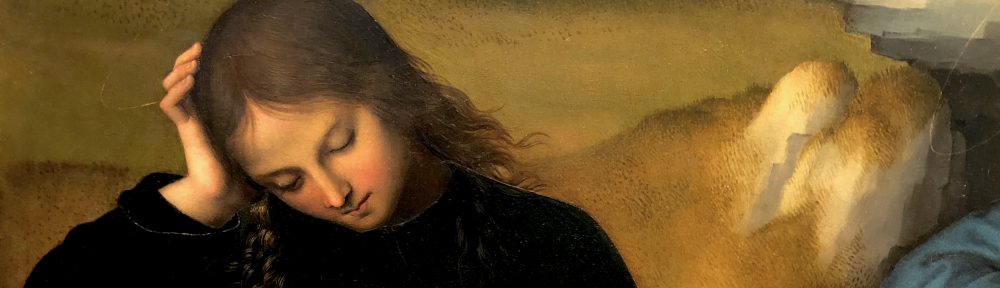
Anonymous, The Descent from the Cross (detail), German c. 1500.

The evil and the armed draw near;
The weather smells of their hate
And the houses smell of our fear.

— W. H. Auden, For the Time Being

“ … because all you of Earth are idiots!”

Plan 9 from Outer Space (Ed Wood, 1957)

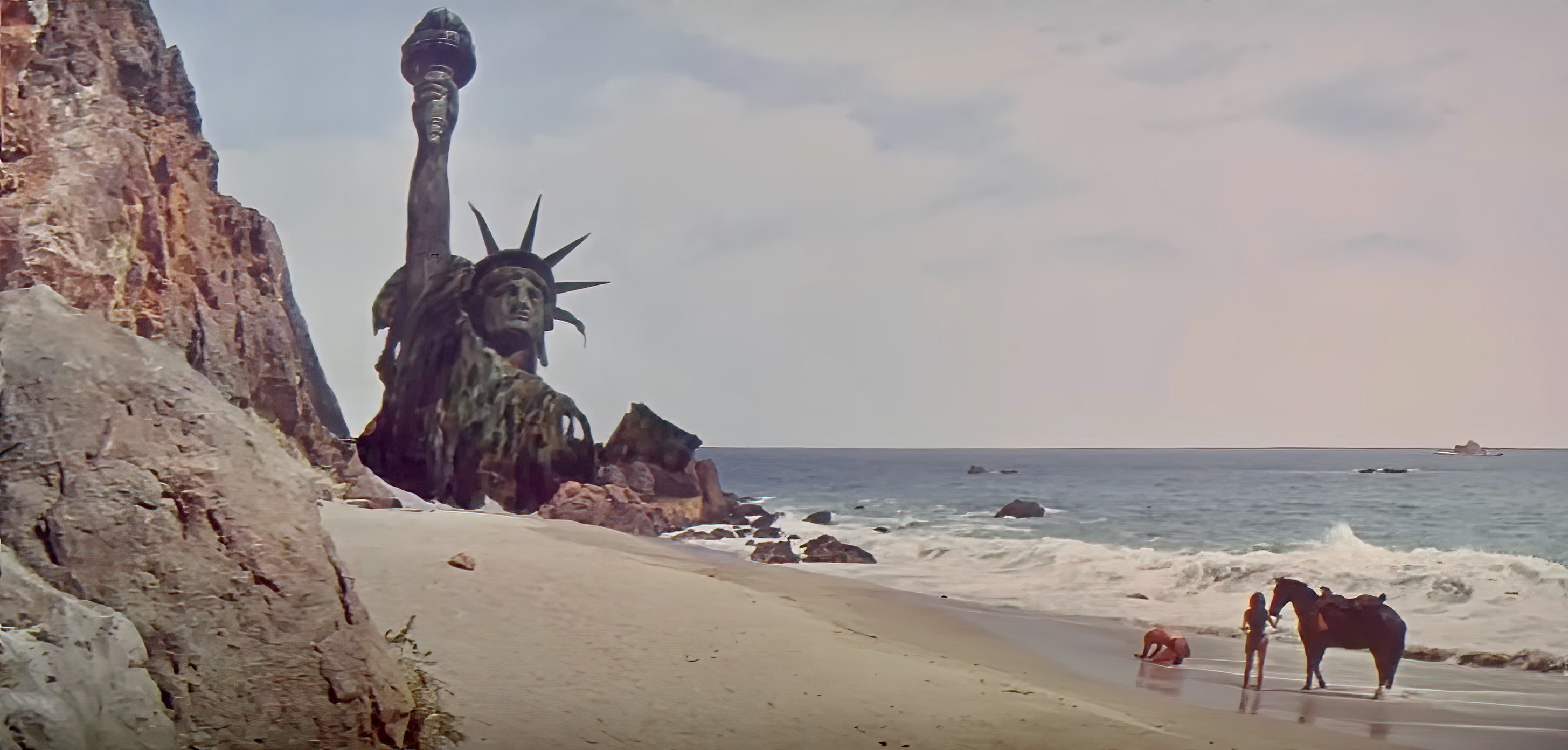
How bad is it, anyway? In the first hours of the new Amerika last Tuesday, the original Planet of the Apes (1968) came to mind. Finding a half-buried Statue of Liberty on a deserted beach, space-and-time traveler Charlton Heston realizes he has not landed on some distant planet, but on his own earthly home, where humanity has evidently committed nuclear suicide. Literally pounding the sand, he cries out to his long-vanished fellow mortals, “You really, finally, did it! You maniacs! You blew it up! Damn you! God damn you all to hell!”

A ruined earh: The final image of Planet of the Apes (1968).

In the Year of our Lord 2024, a decisive majority of Americans have chosen to blow up democracy, the rule of law, the common good, civil liberty, women’s rights, health care, international stability, public sanity, and our last hopes of staving off climate apocalypse. Did they know what they were doing? I confess to zero interest in their motivation at this point. Their decision, measured by its inevitable consequences, was neither rational nor moral. The harm it will do is immeasurable. Even if they thought they were trying to make a point about their personal economic pain, the mad embrace of a fascistic, unstable sociopath and the MAGA dream of demolishing the American experiment—not to mention the livability of our planet—will impose a price none of us can afford.

The American minority, meanwhile, has spent the past week trying to cope with the shock and the horror of the Antichrist’s second coming (I use that name not in a mythical sense, but in a moral one, describing the Trump who in every respect is against the way of Jesus).

Some have engaged in second-guessing the Democratic campaign, as if putting the argument differently could have penetrated the thick shields of delusion and hate erected by right-wing propagandists and their carefully crafted algorithms. Some have sought comfort in the long view, looking toward the distant horizon where hope and history will someday rhyme. Some see the moment as a sobering diagnosis of our national maladies, putting an end to further denial. There’s no use pretending we’re still healthy. Some are tuning out, or contemplating flight to saner climes. Some, sadder and wiser, are vowing to carry on the fight for the common good. God help them.

Marc Chagall, Adam and Eve Expelled from Paradise (detail), 1961.

Many people have been passing poems around on social media, lighting candles of gentleness and peace for one another in this dark night. I have taken comfort in these tender gestures, offered like balm in Gilead for the sin-sick soul. But I also have found myself browsing post-WWII poems that register the shock of brutal conflict. “The Last War” by Kingsley Amis (1948) touched a chord in me with its opening line: “The first country to die was normal in the evening.” By morning it was disfigured and dead

The poem narrates a kind of Agatha Christie murder story in a country house. No one, in the end, survives the weekend. When the sun (the light of Reason? the eye of God?) shows up to survey the damage and “tidy up,” he is unable to separate “the assassins from the victims.” Sickened by the folly and horror of human self-destruction, the sun goes back to bed. The last two stanzas begin with the sound of gunfire and end with a deathly quiet:

Homicide, pacifist, crusader, tyrant, adventurer, boor
Staggered about moaning, shooting into the dark.
Next day, to tidy up as usual, the sun came in
When they and their ammunition were all finished,
And found himself alone.

Upset, he looked them over, to separate, if he could,
The assassins from the victims, but every face
Had taken on the flat anonymity of pain;
And soon they’ll all smell alike, he thought, and felt sick,
And went to bed at noon.

The sense of recognition I felt in reading the poem oddly eased my post-election malaise. Though I dwell in the valley of the shadow, I’m not alone. Like Dante in hell, I’ve got a good poet for company.

Virgil and Dante in the 8th Circle of Hell The Roman poet would guide Dante through the infernal regions until they found the way out.

Well, what now? If there were ever a time demanding religious imagination—the ability to see resurrection light even on Good Friday—this is it. Such envisioning will be one of the ongoing tasks of The Religious Imagineer. But we can’t just leap into Easter. We must first do our time at the foot of the cross, living in solidarity—and risk?—with the victims and the vulnerable, tuning our hearts to the bells that toll for every human tear:

Tolling for the luckless, the abandoned and forsaked,
Tolling for the outcast, burning constantly at stake …
Tolling for the aching ones whose wounds cannot be nursed,
For the countless confused, accused, misused, strung-out ones and worse,
And for every hung-up person in the whole wide universe. [1]

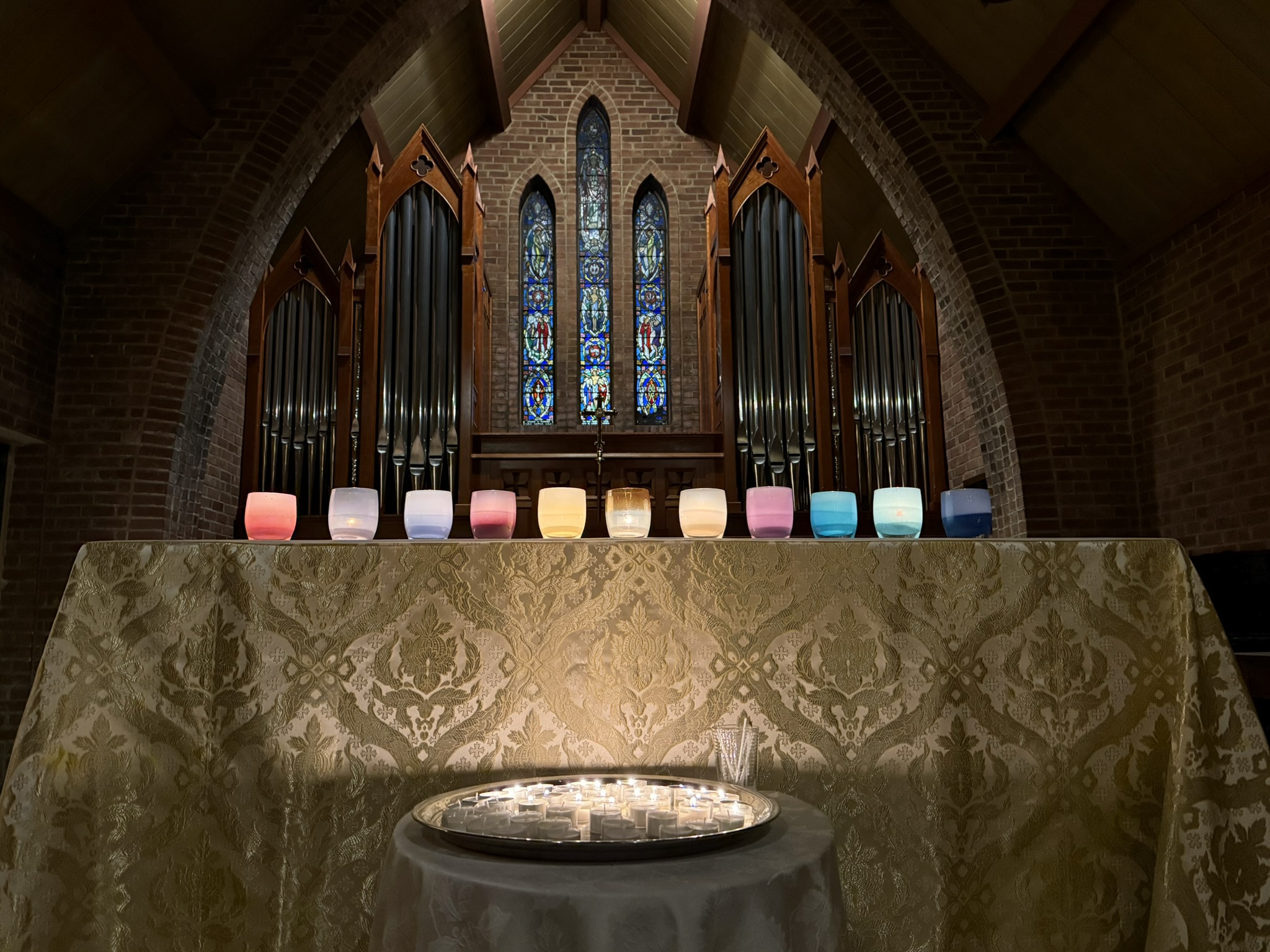
St. Barnabas Episcopal Church, Bainbridge Island, Washington. Prayers silent and aloud were offered here the night before and the night after the election.

I feel blessed to be in Christian community during this time of trial. It is better to hold hands than clench fists. It restores the soul to share our griefs and voice our hopes in sacred discourse and common prayer. Preachers are encouraging our renewed commitment to the Baptismal Covenant: to persevere in resisting evil; seek and serve Christ in all persons; strive for justice and peace among all people; and respect the dignity of every human being.[2] Pastors, meanwhile, are reminding us to love those who voted against most of those things.

(I confess to my own struggle with the Christly precept of loving the haters. Yes, we all fall short, but the so-called Christians cheering the triumph of our basest impulses are, IMHO, falling short with unseemly enthusiasm. As Henry James noted, “when you hate you want to triumph.”) [3]

Tom Tomorrow always nails it: MAGA House of Horror (October 28, 2024).

Many of us, like the desert monks of Late Antiquity, are feeling the need to go on retreat from the public square, to hush the noise and attend the still small voice of holy wisdom. Our spiritual practices seem more necessary than ever.

For me over the past week, that has taken the form of Daily Offices, running, watching the birds in the garden, reading Henry James, a Monteverdi concert, and a splendid evening of Balanchine works by the Pacific Northwest Ballet. I have also been fasting from political news, limiting myself to a small amount of reflective commentary from trusted sources. Such self-care through withdrawal from the fray is “meet and right so to do.” But unless we are contemplatives whose job is to provide for the rest of us what Jesuit activist Dan Berrigan called “large reserves of available sanity,” we can’t stay in the desert forever.

Old Testament scholar Walter Brueggemann has responded to the election with a fine reflection on Elijah’s flight from the danger and exhaustion of public justice-making to the solitude and safety of the holy mountain. After a while, God tracks him down to ask, “What are you doing here, Elijah?”  

“Go back to your proper place; you can linger here in self-pity only so long and then you must remember your call and perform your responsibility.” So Elijah is freshly dispatched back to his dangerous work. He is dispatched by the one who has lordly authority for him. The only assurance he is offered is that there are others—7000—who stand alongside in solidarity.[4]

We are not alone. God is with us. The night after the election, some of our local parish church gathered for Evening Prayer, with generous pauses for quiet resting in the Divine Presence. When words fail, let silence speak. Afterward, we had a deep and earnest conversation about the effect of the election on our hearts, minds, and bodies. The empowering richness of that exchange, a gift of the Holy Spirit, raised us from the depths to remember our vocation as God’s friends: to plant the seeds of resurrection amid the blind sufferings of history.  

Henri Matisse, The Rosary Chapel in Vence, French Riviera.

Let me close with an encouraging story from the desert monks.

The disciple of a great old man was once attacked by the demons within him. The old man, seeing it in his prayer, said to him, ‘Do you want me to ask God to relieve you of this battle?’ The other said, ‘Abba, I see that I am afflicted, but I also see that this affliction is producing fruit in me; therefore ask God to give me endurance to bear it.’ And his Abba said to him, ‘Today I know you surpass me in perfection.’” [5]

Throughout this time of trial and affliction, God grant each of us, and our communities, the endurance to bear what we must bear, and do what we must do, that our lives may prove both faithful and fruitful in due season.


[1] Bob Dylan, “Chimes of Freedom,” from Another Side of Bob Dylan (Columbia Records, 1964).

[2] From the Baptismal Covenant, Episcopal Book of Common Prayer (1979).

[3] Henry James, The Ambassadors (New York: Modern Library, 2011), 427.

[4] Walter Brueggemann’s reflection on I Kings 19, “Beyond a Fetal Position,” Nov. 7, 2024 on Church Anew: https://churchanew.org/brueggemann/beyond-a-fetal-position

[5] Cited in John Moses, The Desert: An Anthology for Lent (Norwich: The Canterbury Press, 1997), 62.

Fourth of July

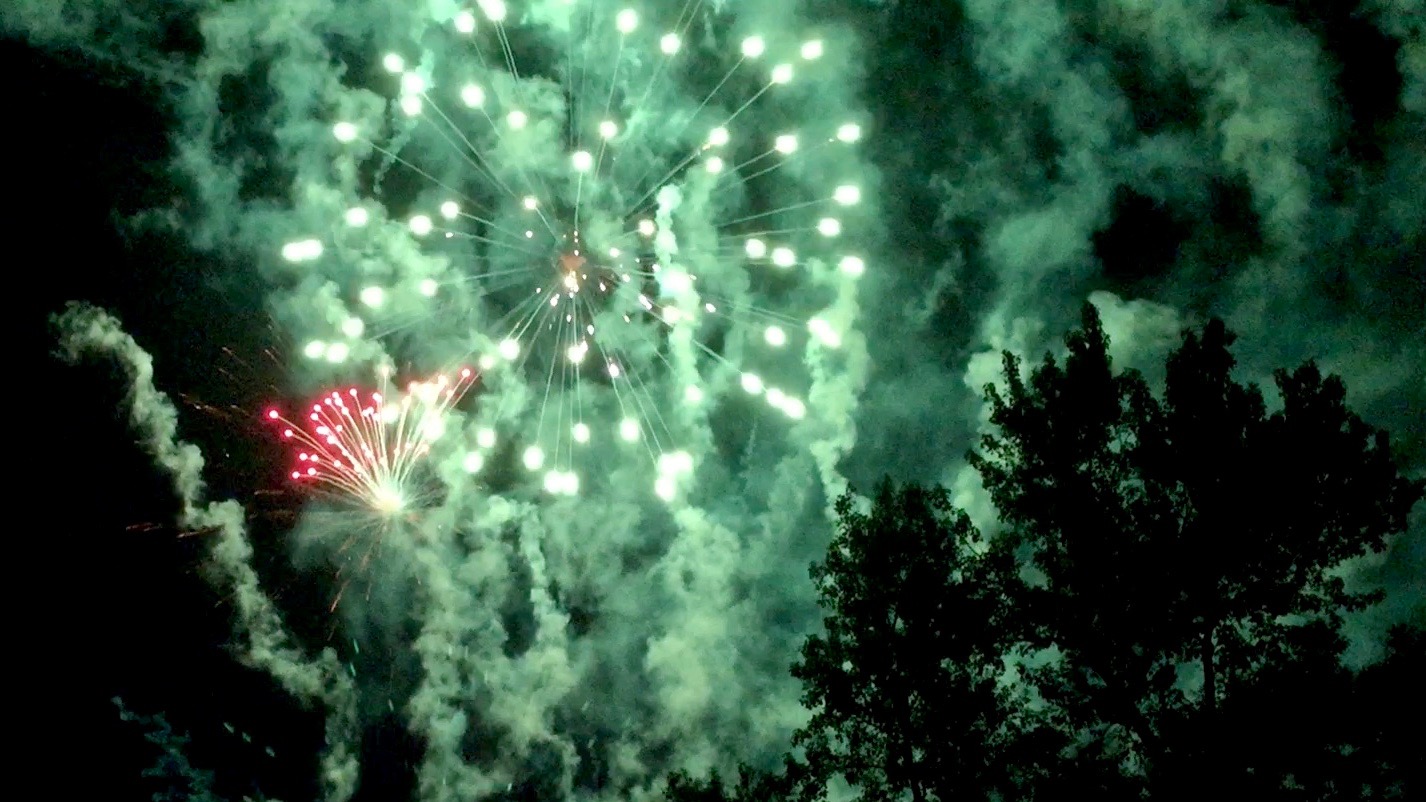
Eugene fireworks 2016 (1)

July 4th fireworks (Eugene, Oregon, 2016)

I love the Fourth of July. After beginning the day in the company of Charles Ives and Emily Dickinson, I will run a 5K, watch the ragtag town parade, take in some local baseball, gather with friends for croquet, barbecue and American folk tunes sung around an outdoor fire, and join the annual procession of neighbors to the end of our street for fireworks over the harbor. This in itself is enough to honor the day – life and community affirmed with our fellow citizens as we sound the resonant notes of tradition.

But the liturgist in me wonders if we might do something more consciously formative with our American holiday, as our forebears did. Throughout the nineteenth century and well into the twentieth, the Fourth of July was an occasion not only to celebrate our ideals, but also to educate the public in the habitual virtues of public life by which those ideals might continue to be realized. A central part of this educative function was the Fourth of July oration, a long-winded address that recalled the great deeds of the past, tabulated the growth and progress achieved over the years, and exhorted the listener toward the same zeal for liberty and the common good that had inspired our founders.

The speakers all tried to tune their themes to the situation of their time. An oration given in 1838 before an abolitionist society noted the ironies of church bells and cannons sounding in celebration of liberty while in the same land could be heard the clanking of chains on the limbs of a million slaves. Another, given on the eve of World War I, called upon America to lead the way in the overthrow of war as an instrument of policy.

As a longtime lover of California’s mountains, I am especially fond of Thomas Starr King’s oration of 1860, delivered to the Episcopal Sunday School Mission Celebration in San Francisco, celebrating the fact that California had not seceded from the Union. “Thank heaven,” he declared, “there is no doubt of our geography. The Sacramento is an American river. The San Joaquin is not held by traitors. San Diego is an American port…” King then described the red alpenglow and azure shadows on the white glacier of Mt. Shasta as Nature’s emphatic salute to the Red, White and Blue!

The one thing these orations have in common is their assumption of a people, a public, who are committed to working together to implement the ideals that gave us birth. “We swear,” cried a young John Quincy Adams on July 4, 1793, “we swear by the precious memory of the sages who toiled and of the heroes who bled in her defense, that we will prove ourselves not unworthy of the prize which they so dearly purchased; that we will act as the faithful disciples of those who so magnanimously taught us the instructive lesson of republican virtue.”

In other words, keep your eyes on the prize. The watchwords of the Revolution – liberty and the common good – are powerful ideas. Even the most corrupt and cynical among us must still give them lip service if they aspire to political power. As Daniel Ellsberg once said, the best thing that you can say about the American people is that you have to lie to us.

The American experiment is not over. We no longer conduct it with the illusion that we are innocent of the old corruptions, that humanity’s darker impulses are somehow absent from the American heart. Holden Caulfield and Daisy Miller have grown older and wiser. And yet there are many among us who refuse to give up, who refuse to retreat from public life and the common good. There are many among us who continue to dream, continue to strive, continue to believe that we shall overcome, that “America the beautiful” is still a possibility.

I do not imagine that Americans will ever again submit to the custom of lengthy orations under a hot sun, but might there be other ways to mark the day with experiences, images and rituals which reconnect us with our ideals and with each other? I wouldn’t put any politicians on that planning committee, or preachers either. Instead, I would entrust the task to artists, musicians, poets and activists. My vote to head the enterprise would be the 8-year-old Hopi girl whose recurring daydream of a redeemed public life is recorded in Robert Coles’ The Spiritual Life of Children:

All the people are sitting in a circle, and they are brothers and sisters, everyone! That’s when all the spirits will dance and dance, and the stars will dance, and the sun and moon will dance and the birds will swoop down and they’ll dance, and all the people, everywhere, will stand up and dance, and then they’ll sit down again in a big circle, so huge you can’t see where it goes, or how far, if you’re standing on the mesa and looking into the horizon, and everyone is happy. No more fights. Fights are a sign that we have gotten lost, and forgotten our ancestors, and are in the worst trouble. When the day comes that we’re all holding hands in the big circle – no, not just us Hopis, everyone – then that’s what the word ‘good’ means…and the whole world will be good when we’re all in our big, big circle. We’re going around and around until we all get to be there!