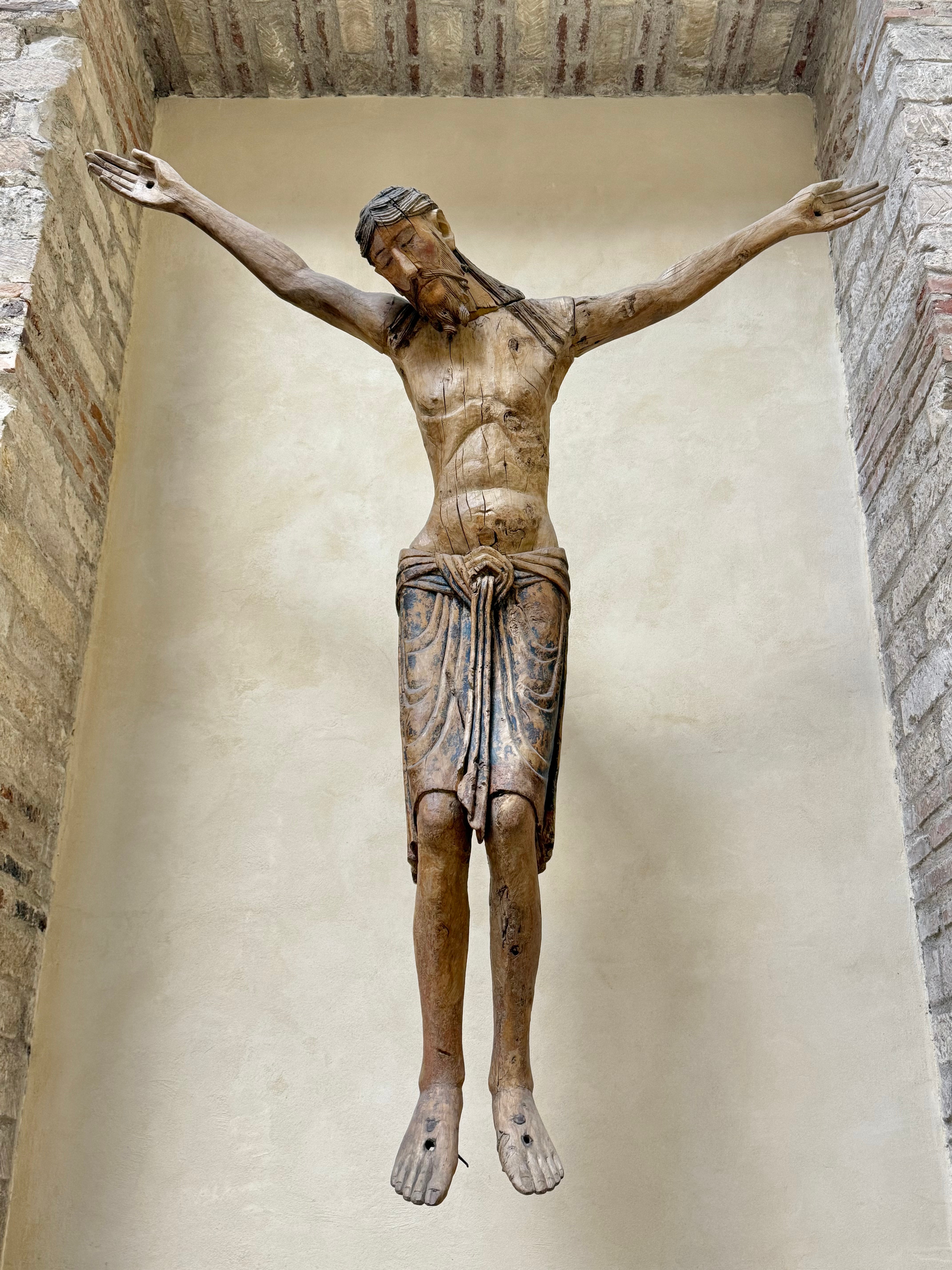
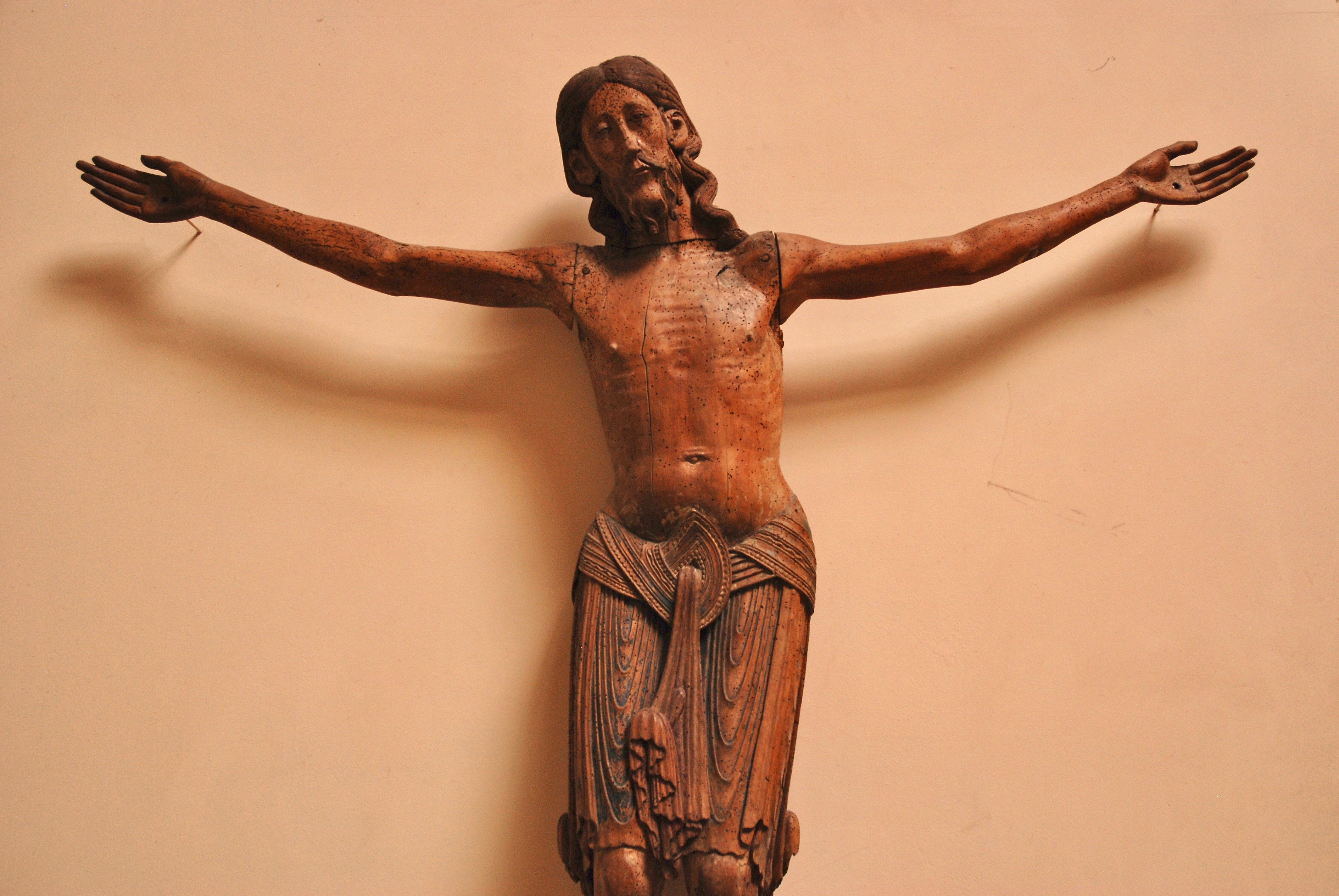
Crucified Christ (northern France, late 12th century).
Isaiah 53:5 But he was wounded for our transgressions, crushed for our iniquities; upon him was the punishment that made us whole, and by his bruises we are healed.
Was it really necessary for Jesus to be pierced and crushed? And how exactly did his suffering and death make us whole? There has never been a conclusive single answer, because any attempt to “solve” the Paschal Mystery with a reductive formula is missing the point. The cross is an experience to enter, not an idea to be explained. “I wonder as I wander out under the sky,” says the old Nativity carol, “why Jesus our Savior did come for to die / for poor ornery people like you and like I. . .” And now, this Holy Week, we come again to the foot of the cross, and we wonder.
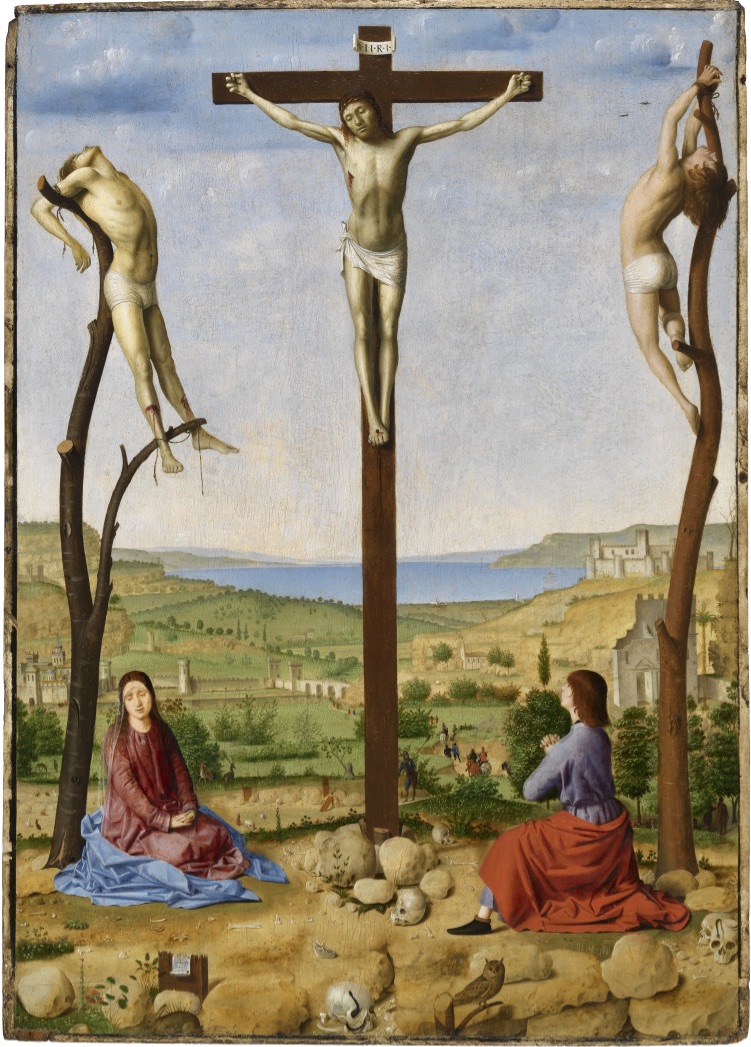
Antonello da Messina, The Antwerp Crucifixion (1475).
Let us discard any crude notions of the cross as a transaction, as if somebody had to pay for all the damage wrought by human sin, so Jesus stepped up like a big spender to declare, “This one’s on me.” Such “substitution” theology either trivializes the cost of sin (can Auschwitz or Gaza be so lightly dismissed?) or risks masochism by stressing the pain of the Passion, as Mel Gibson did in his notorious movie. The sacredness of God’s Friday is not in the violence or the blood, but in the Love that rewrites the darkest story.
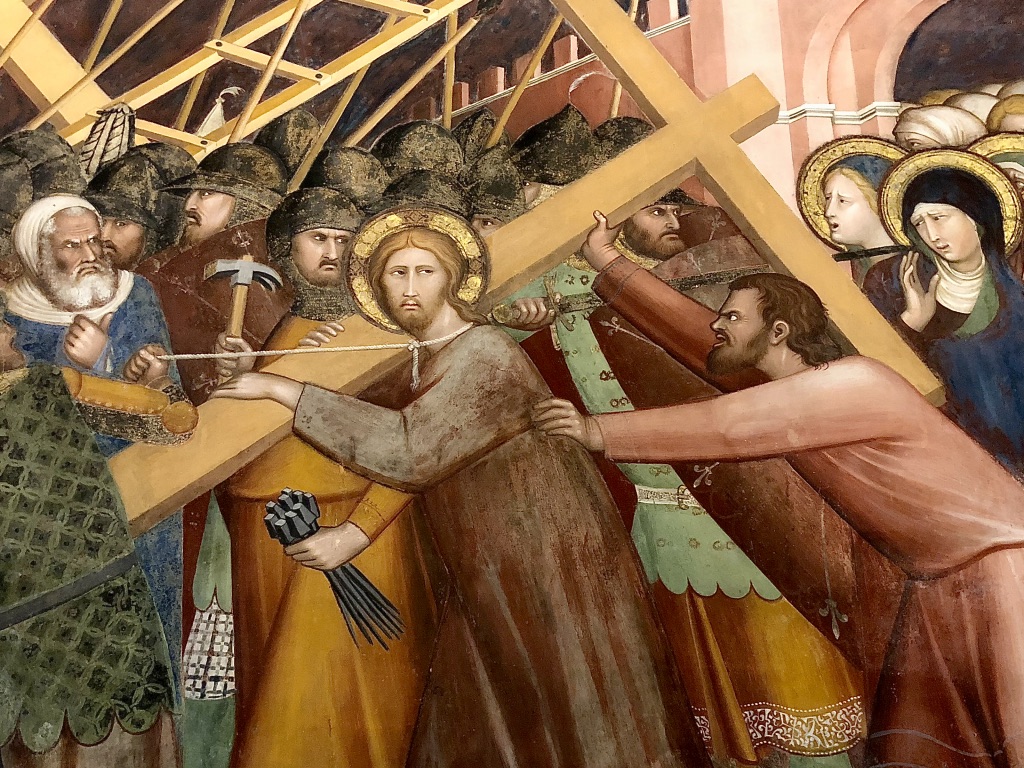
Lippo Memmi, Christ carrying the cross, Duomo di San Gimignano, Tuscany (1335-1345).
And let us not reduce the salvific death of Jesus to a simple case of human cruelty claiming one more victim. Something more than human tyranny and human tragedy—something divine—was at work in the cross. But the divine presence on Calvary’s hill was not in the form of any punishment dished out by an angry God. God was there in the vulnerable, suffering body of Jesus, the Incarnate Word of self-diffusive love, who chose to share the human condition in all its forms—even the bleakest and most wretched. Jesus didn’t suffer instead of us. Jesus suffered with us. And through the humanity of Jesus, our own experience of alienation and affliction has been absorbed into the trinitarian life of God, where it is held in love’s eternal embrace and drained of its toxicity. As the prophet said, By his wounds we are healed.
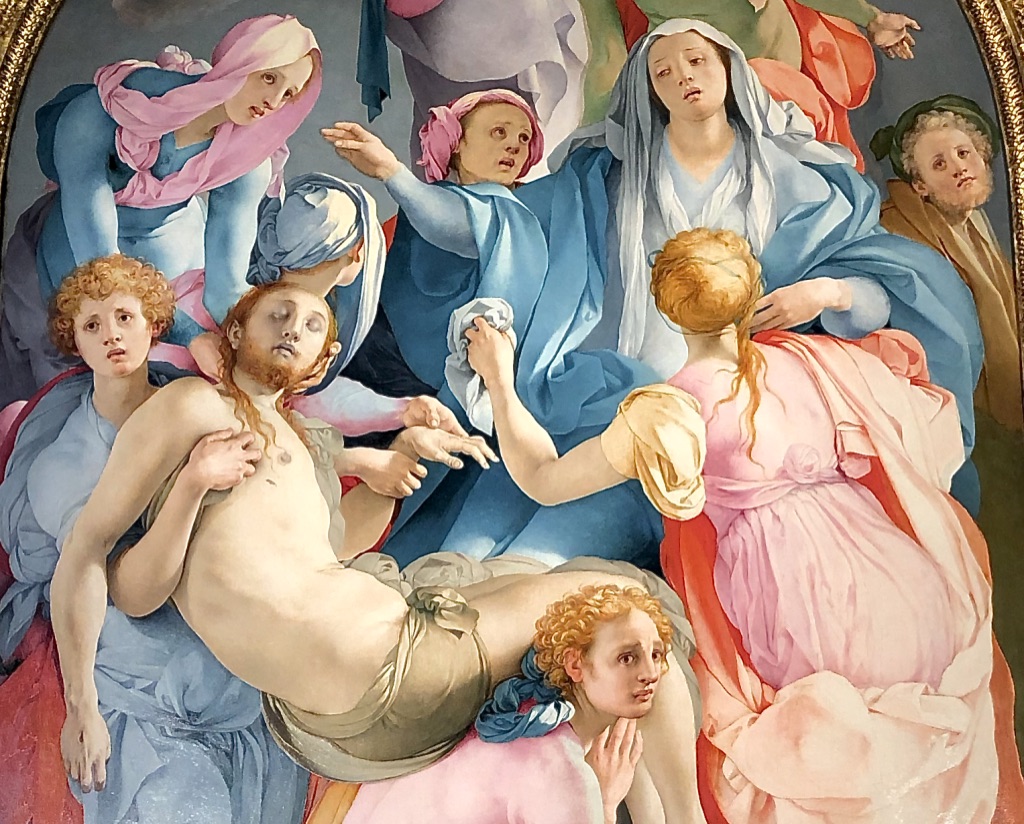
Jacopo Pontormo, Deposition from the Cross, Santa Felicita, Florence (1525-1528).
Or as theologian Paul Fiddes put it, “Far from simply forgetting about the sins of the world, [God] journeys deeply into the heart of [the human] condition. . . God participates in our brokenness, to win us to the offer of healing.” In our own evil time, when hate and cruelty are running wild, sometimes we feel overwhelmed, discouraged, or powerless. But that’s exactly where Jesus comes to join us, not simply to keep us company on the countless crosses of this world, but to transform our sufferings into the seeds of resurrection.
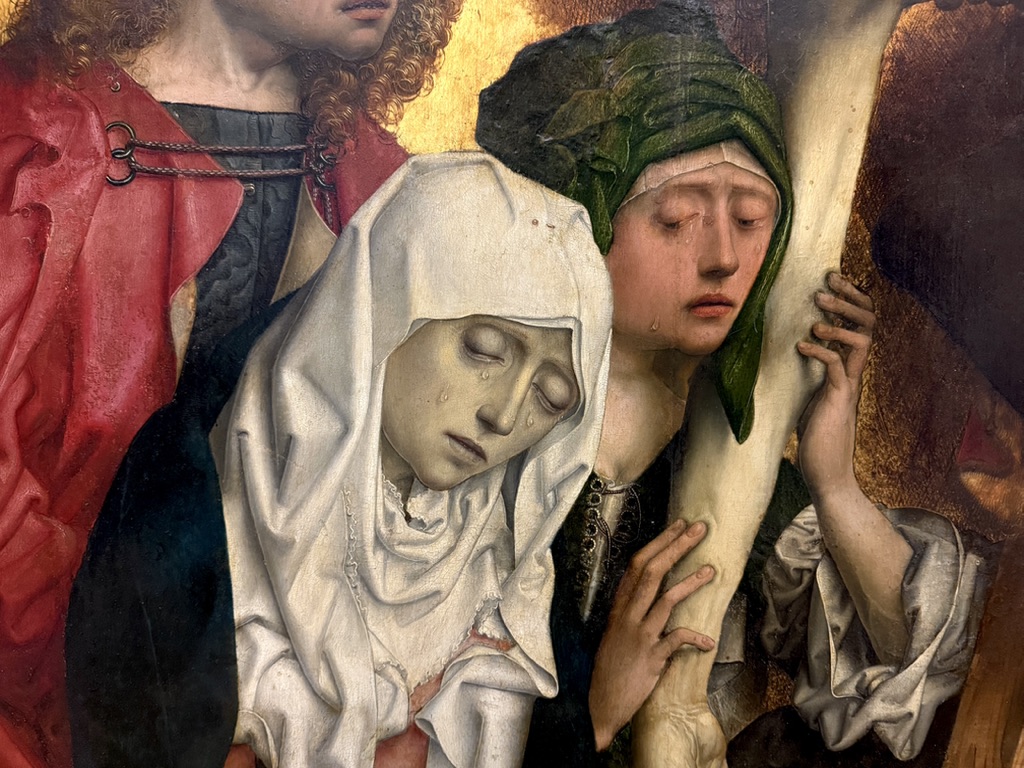
Anonymous “Master of St. Bartholomew,” The Descent from the Cross, Cologne, c. 1480-1510 (detail).
The title is from a hymn by W. H. Vanstone, “Morning Glory, Starlit Sky” (585 in the Episcopal Hymnal 1982)
Anonymous, The Descent from the Cross (detail), German c. 1500.
The evil and the armed draw near; The weather smells of their hate And the houses smell of our fear.
— W. H. Auden, For the Time Being
“ … because all you of Earth are idiots!”
— Plan 9 from Outer Space (Ed Wood, 1957)
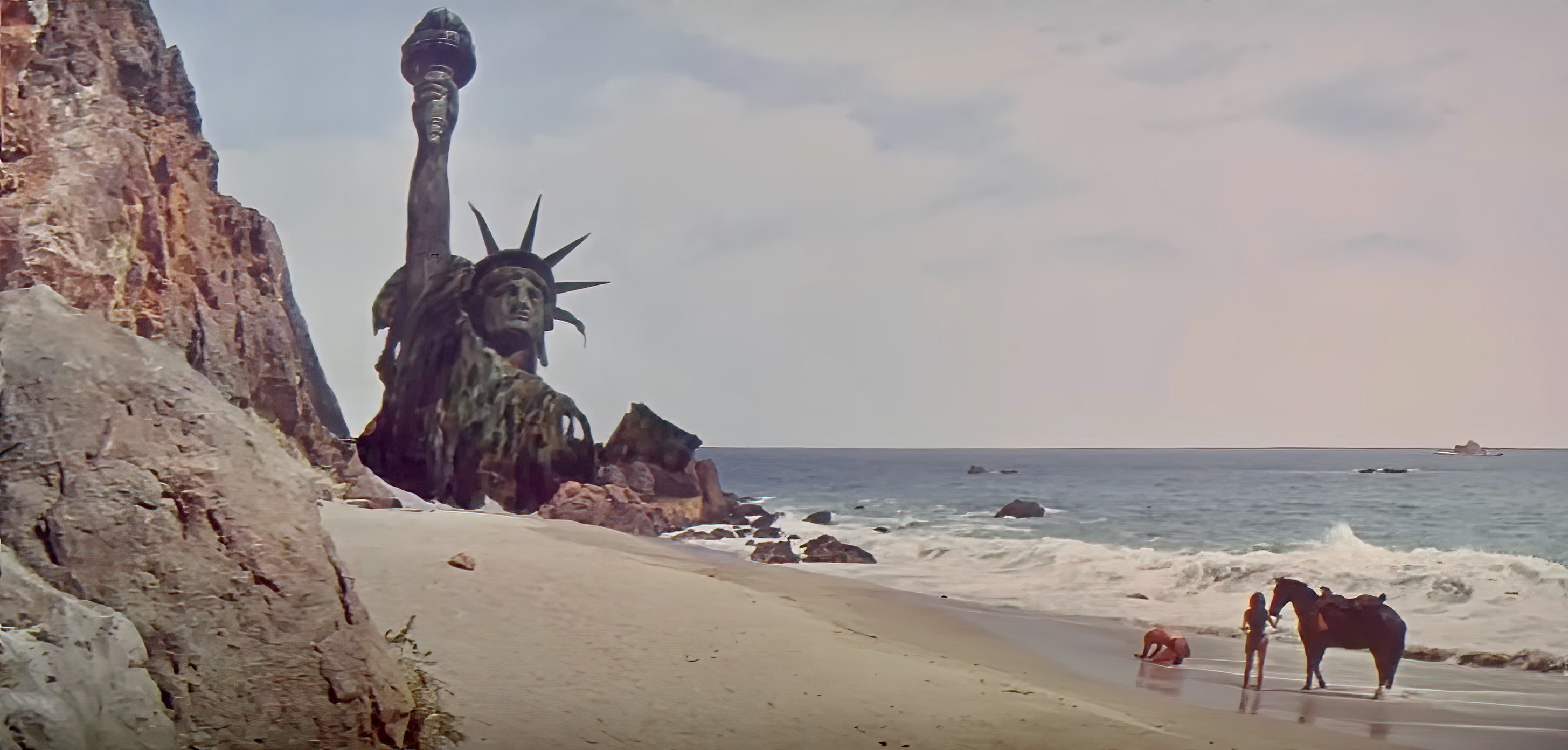
How bad is it, anyway? In the first hours of the new Amerika last Tuesday, the original Planet of the Apes (1968) came to mind. Finding a half-buried Statue of Liberty on a deserted beach, space-and-time traveler Charlton Heston realizes he has not landed on some distant planet, but on his own earthly home, where humanity has evidently committed nuclear suicide. Literally pounding the sand, he cries out to his long-vanished fellow mortals, “You really, finally, did it! You maniacs! You blew it up! Damn you! God damn you all to hell!”
A ruined earh: The final image of Planet of the Apes (1968).
In the Year of our Lord 2024, a decisive majority of Americans have chosen to blow up democracy, the rule of law, the common good, civil liberty, women’s rights, health care, international stability, public sanity, and our last hopes of staving off climate apocalypse. Did they know what they were doing? I confess to zero interest in their motivation at this point. Their decision, measured by its inevitable consequences, was neither rational nor moral. The harm it will do is immeasurable. Even if they thought they were trying to make a point about their personal economic pain, the mad embrace of a fascistic, unstable sociopath and the MAGA dream of demolishing the American experiment—not to mention the livability of our planet—will impose a price none of us can afford.
The American minority, meanwhile, has spent the past week trying to cope with the shock and the horror of the Antichrist’s second coming (I use that name not in a mythical sense, but in a moral one, describing the Trump who in every respect is against the way of Jesus).
Some have engaged in second-guessing the Democratic campaign, as if putting the argument differently could have penetrated the thick shields of delusion and hate erected by right-wing propagandists and their carefully crafted algorithms. Some have sought comfort in the long view, looking toward the distant horizon where hope and history will someday rhyme. Some see the moment as a sobering diagnosis of our national maladies, putting an end to further denial. There’s no use pretending we’re still healthy. Some are tuning out, or contemplating flight to saner climes. Some, sadder and wiser, are vowing to carry on the fight for the common good. God help them.
Marc Chagall, Adam and Eve Expelled from Paradise (detail), 1961.
Many people have been passing poems around on social media, lighting candles of gentleness and peace for one another in this dark night. I have taken comfort in these tender gestures, offered like balm in Gilead for the sin-sick soul. But I also have found myself browsing post-WWII poems that register the shock of brutal conflict. “The Last War” by Kingsley Amis (1948) touched a chord in me with its opening line: “The first country to die was normal in the evening.” By morning it was disfigured and dead
The poem narrates a kind of Agatha Christie murder story in a country house. No one, in the end, survives the weekend. When the sun (the light of Reason? the eye of God?) shows up to survey the damage and “tidy up,” he is unable to separate “the assassins from the victims.” Sickened by the folly and horror of human self-destruction, the sun goes back to bed. The last two stanzas begin with the sound of gunfire and end with a deathly quiet:
Homicide, pacifist, crusader, tyrant, adventurer, boor Staggered about moaning, shooting into the dark. Next day, to tidy up as usual, the sun came in When they and their ammunition were all finished, And found himself alone.
Upset, he looked them over, to separate, if he could, The assassins from the victims, but every face Had taken on the flat anonymity of pain; And soon they’ll all smell alike, he thought, and felt sick, And went to bed at noon.
The sense of recognition I felt in reading the poem oddly eased my post-election malaise. Though I dwell in the valley of the shadow, I’m not alone. Like Dante in hell, I’ve got a good poet for company.
Virgil and Dante in the 8th Circle of Hell The Roman poet would guide Dante through the infernal regions until they found the way out.
Well, what now? If there were ever a time demanding religious imagination—the ability to see resurrection light even on Good Friday—this is it. Such envisioning will be one of the ongoing tasks of The Religious Imagineer. But we can’t just leap into Easter. We must first do our time at the foot of the cross, living in solidarity—and risk?—with the victims and the vulnerable, tuning our hearts to the bells that toll for every human tear:
Tolling for the luckless, the abandoned and forsaked, Tolling for the outcast, burning constantly at stake … Tolling for the aching ones whose wounds cannot be nursed, For the countless confused, accused, misused, strung-out ones and worse, And for every hung-up person in the whole wide universe. [1]
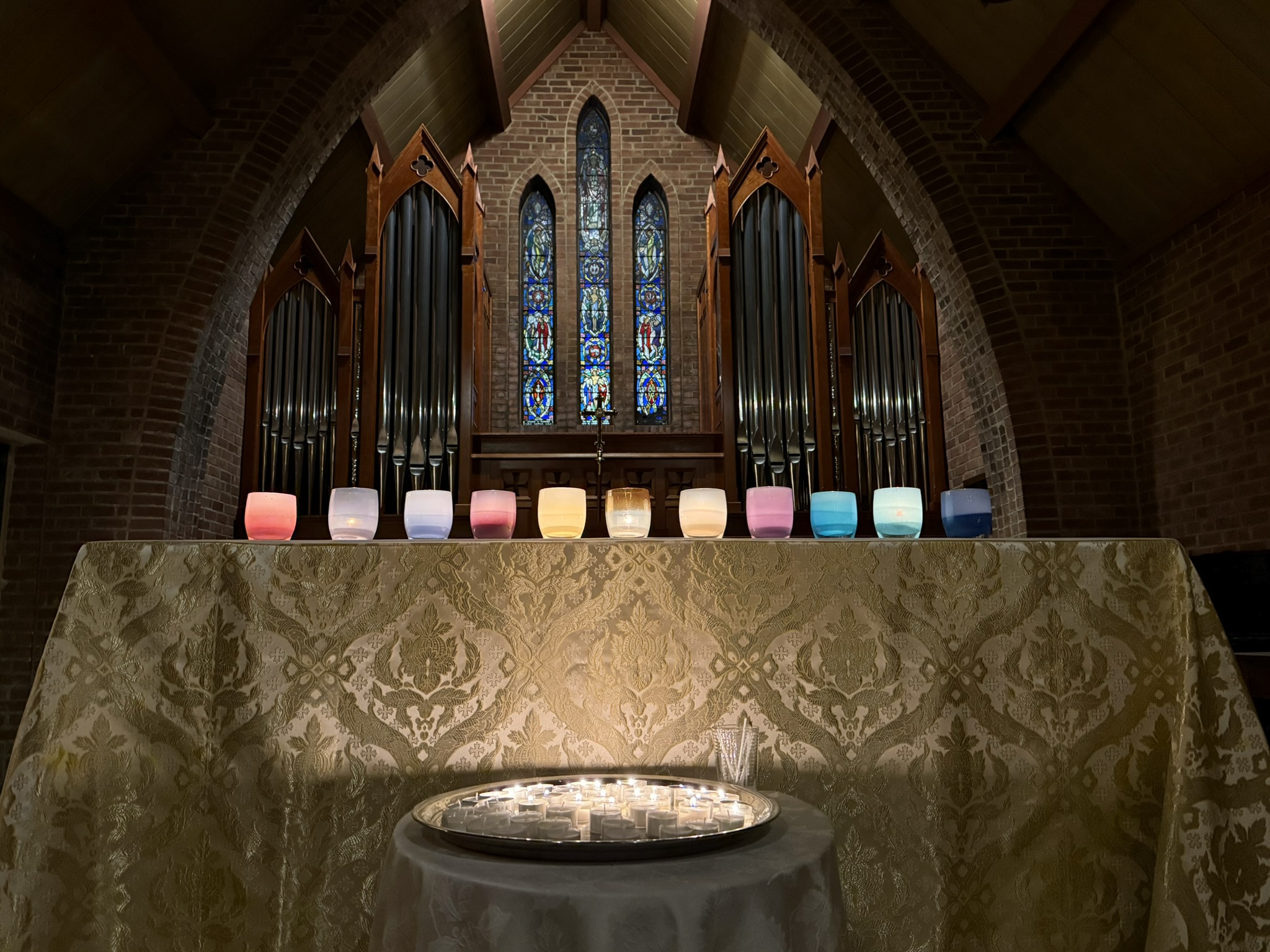
St. Barnabas Episcopal Church, Bainbridge Island, Washington. Prayers silent and aloud were offered here the night before and the night after the election.
I feel blessed to be in Christian community during this time of trial. It is better to hold hands than clench fists. It restores the soul to share our griefs and voice our hopes in sacred discourse and common prayer. Preachers are encouraging our renewed commitment to the Baptismal Covenant: to persevere in resisting evil; seek and serve Christ in all persons; strive for justice and peace among all people; and respect the dignity of every human being.[2] Pastors, meanwhile, are reminding us to love those who voted against most of those things.
(I confess to my own struggle with the Christly precept of loving the haters. Yes, we all fall short, but the so-called Christians cheering the triumph of our basest impulses are, IMHO, falling short with unseemly enthusiasm. As Henry James noted, “when you hate you want to triumph.”) [3]
Tom Tomorrow always nails it: MAGA House of Horror (October 28, 2024).
Many of us, like the desert monks of Late Antiquity, are feeling the need to go on retreat from the public square, to hush the noise and attend the still small voice of holy wisdom. Our spiritual practices seem more necessary than ever.
For me over the past week, that has taken the form of Daily Offices, running, watching the birds in the garden, reading Henry James, a Monteverdi concert, and a splendid evening of Balanchine works by the Pacific Northwest Ballet. I have also been fasting from political news, limiting myself to a small amount of reflective commentary from trusted sources. Such self-care through withdrawal from the fray is “meet and right so to do.” But unless we are contemplatives whose job is to provide for the rest of us what Jesuit activist Dan Berrigan called “large reserves of available sanity,” we can’t stay in the desert forever.
Old Testament scholar Walter Brueggemann has responded to the election with a fine reflection on Elijah’s flight from the danger and exhaustion of public justice-making to the solitude and safety of the holy mountain. After a while, God tracks him down to ask, “What are you doing here, Elijah?”
“Go back to your proper place; you can linger here in self-pity only so long and then you must remember your call and perform your responsibility.” So Elijah is freshly dispatched back to his dangerous work. He is dispatched by the one who has lordly authority for him. The only assurance he is offered is that there are others—7000—who stand alongside in solidarity.[4]
We are not alone. God is with us. The night after the election, some of our local parish church gathered for Evening Prayer, with generous pauses for quiet resting in the Divine Presence. When words fail, let silence speak. Afterward, we had a deep and earnest conversation about the effect of the election on our hearts, minds, and bodies. The empowering richness of that exchange, a gift of the Holy Spirit, raised us from the depths to remember our vocation as God’s friends: to plant the seeds of resurrection amid the blind sufferings of history.
Henri Matisse, The Rosary Chapel in Vence, French Riviera.
Let me close with an encouraging story from the desert monks.
The disciple of a great old man was once attacked by the demons within him. The old man, seeing it in his prayer, said to him, ‘Do you want me to ask God to relieve you of this battle?’ The other said, ‘Abba, I see that I am afflicted, but I also see that this affliction is producing fruit in me; therefore ask God to give me endurance to bear it.’ And his Abba said to him, ‘Today I know you surpass me in perfection.’” [5]
Throughout this time of trial and affliction, God grant each of us, and our communities, the endurance to bear what we must bear, and do what we must do, that our lives may prove both faithful and fruitful in due season.
[1] Bob Dylan, “Chimes of Freedom,” from Another Side of Bob Dylan (Columbia Records, 1964).
[2] From the Baptismal Covenant, Episcopal Book of Common Prayer (1979).
[3] Henry James, The Ambassadors (New York: Modern Library, 2011), 427.
In the Garden, an icon by the hand of the artist, Angelica Sotiriou, 2009.
I’m writing this on Maundy Thursday, the night of Jesus’ tender farewell supper with his friends—and the night he was handed over to malevolent powers. The beautiful icon from the hand of California sacred artist Angelica Soteriou [i] captures the wrenching moment between the solidarity of his loving community and the fatal desolation of his Passion. He is alone. Neither friends nor enemies share his existential space. He’s kneeling in prayer, arms stretched out, beseeching his Father for whatever is needed to make it through the night. But his hands remain open, receptive to a will not his own. Not my will, but thine. And though an annihilating blackness surrounds him, his body is held safely within the warm color of the mountain of God. Even when we feel alone, even abandoned, we are still enfolded within divine love and mercy. Our divine milieu is not an exemption from trouble, but an assurance against trouble’s finality.
On this holy Thursday, many churches, including mine, do the eucharist in the context of an actual shared meal. It is is our custom to eat in silence, which monastics know is a profound way to be together. Our silence is punctuated by a series of meditative readings from the Farewell Discourses, the words of encouragement, comfort and challenge which, in John’s gospel, Jesus speaks to his friends on the night before his execution. It’s not a reenactment of a past event. Those words are spoken directly to us, in our own fraught time.
Tonight, however, we added a word from one of Jesus’ more recent friends, the theologian Dietrich Bonhoeffer, who was facing his own Gethsemane in a German prison. At Christmastide, 1944, a few months before he would be executed by the Nazis, he wrote a poem which was smuggled out of prison in a letter to his mother. Its expression of confidence and hope in the midst of an evil time not only echoes the spirit of Jesus’ Farewell Discourses, but it speaks strongly to our own latter days, when so many things are in peril.
Here is the versified translation of Bonhoeffer’s poem by the British hymn writer Fred Pratt Green:
By gracious powers so wonderfully sheltered, and confidently waiting come what may, we know that God is with us night and morning, and never fails to greet us each new day.
Yet is this heart by its old foe tormented; still evil days bring burdens hard to bear; O give our frightened souls the sure salvation for which, O Lord, you taught us to prepare.
And when this cup you give is filled to brimming with bitter suffering, hard to understand, we take it thankfully and without trembling, out of so good and so beloved a hand.
Yet when again in this same world you give us the joy we had, the brightness of your Sun, we shall remember all the days we lived through, and our whole life shall then be yours alone.[ii]
Yes, we too are living through “evil days” which weigh down “our frightened souls” with “burdens hard to bear.” But our brother Dietrich, like our brother Jesus, reminds us that there is an alternative to fear and despair, if we can find the courage to live into God’s future, come what may, and the Paschal wisdom to walk the Way of the Cross “thankfully and without trembling,” because we know that death doesn’t get the last word.
Now, as we move into Good Friday, listen to what Rowan Williams, former Archbishop of Canterbury, says about the cross:
Jesus crucified is God crucified; so we believe. Jesus is the total and final embodiment in history of God’s loving mercy; and so this cross is a unique, terrible, extreme act of violence—a summary of all sin. It represents the human rejection of love. And not even that can destroy God; with the wounds of the cross still disfiguring his body, he returns out of hell to his disciples and wishes them peace. There is our hope—the infinite resource of God’s love, the relationship with God’s creatures that no sin can finally unmake. God cares what we do because God suffers what we do. God is forever wounded, but forever loving. The possibilities of our relationship to God are indeed ‘new every morning.’” [iii]
In other words, says Williams, “we have a future because of God’s grace.” Bonhoeffer said the same thing, and he said it from death row. That’s what the Paschal Mystery of dying and rising is trying to tell us—not only in the rituals and narratives of Holy Week, but in the kind of lives we live when we fully embody the archetypal pattern of surrender and transformation. The way down is the way up. Lose your life to find it. Let go and let God.
There’s always more to say about this, of course, but it’s almost midnight, and tomorrow is the rigorous journey to the foot of the cross. And beyond that, there’s the Easter Vigil, a night of wonders when heaven and earth are joined and liturgical curators are left exhausted yet exultant in its wake. If you want to read more about the cross, try What Will the Cross Make of Us?, written in 2022 by my less tired self. For more on the Easter Vigil, try Just a Dream?—Reflections on the Easter Vigil.
I’m going to bed now, but let me leave you with a 3-minute trailer for the Triduum, pushing the point that the Triduum is not a la carte, but a 3-part connected sequence that wants to be experienced in full. The three-day Paschal passage from Passion to Resurrection isn’t just bingeing on liturgy. It’s a profound way of knowing that delivers you to a different place. As we say at my church every Holy Week, “The journey is how we know.”
[iii] Rowan Williams, from a sermon excerpted in A Time to Turn: Anglican Readings for Lent and Easter Week (Harrisburg, PA: Morehouse Publishing, 2004), 99.
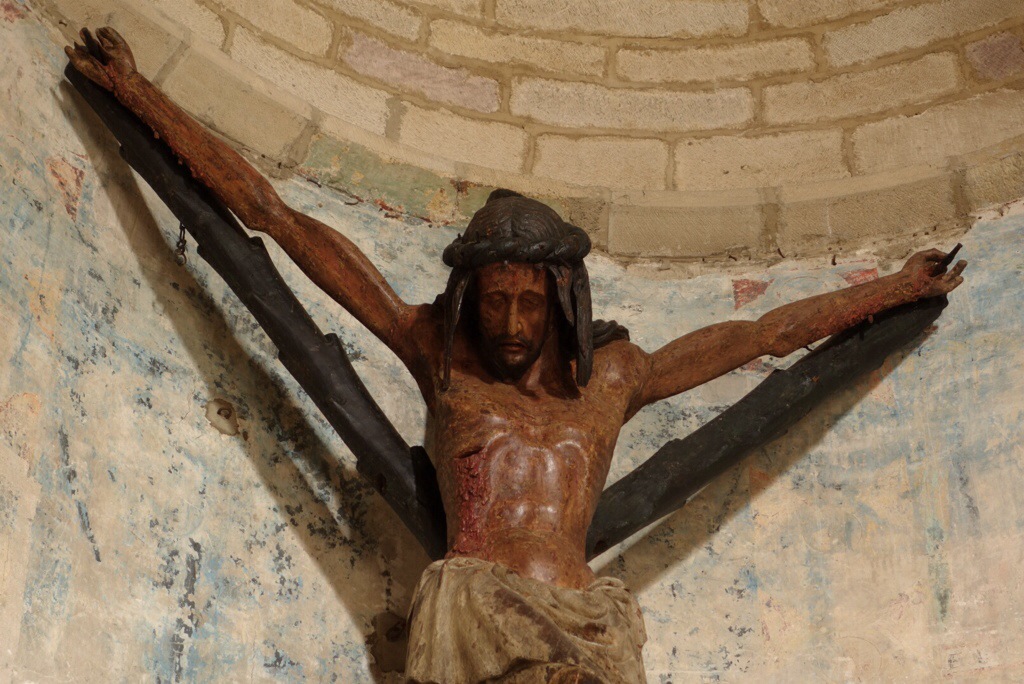
Christ on the Cross (Auvergne, 12th century), Cluny Museum, Paris.
A sermon preached on Good Friday at St. Barnabas Episcopal Church, Bainbridge Island, WA
I’m going to ask you some questions, and the answer you will give is, “I am here”.
Judas, slave of jealousy, where are you?… Peter, slave of fear, where are you?… Thomas, slave of doubt, where are you?… Men and women of Jerusalem, enslaved by mob violence, where are you?… Pilate, slave of expediency, where are you?…
You’re all here, then. Good. Because the crucified God has something to say to you:
Mercy.
Let us pray.
God, we pray you, look upon your family for whom our Lord Jesus Christ was willing to undergo the torture of the cross. Amen.
I find this opening Collect for Good Friday so moving, because it doesn’t make any requests for particular outcomes. It simply asks God to look at us—just look at us—with the loving gaze of mercy. In the middle of a terrible war, with a million dead from COVID in this country alone, and a pandemic of hate and racism and sheer folly leaving us dispirited and exhausted: Lord, have mercy. That’s our prayer at the foot of the cross. Lord, have mercy.
In the 1965 Jesus movie, The Greatest Story Ever Told, the Holy Family is returning from Egypt after the death of Herod. And when they’re back in their own country, on their way home, they come up over a rise, and there before them are dozens of crosses along the road, with a man dying on every one—human billboards advertising Roman justice and the cruel fate awaiting anyone who might trouble the tranquility of the empire. In those days, it was an all too common sight.
The camera gives us a good look at those suffering victims, anonymous in their pain, and then cuts to a closeup of the two-year-old Jesus, riding on a donkey in his mother’s arms, looking at those crosses with wide and wondering eyes.
Thirty years later, another donkey would bring Jesus toward his own cross, and there he would be cradled one last time in the arms of his grieving mother.
Can’t we have a better story? Why couldn’t the people have been transformed and the authorities converted and the Anointed Son of God lived to a ripe old age teaching and healing and wisely overseeing the first generation of God’s Kingdom on earth as it is in heaven?
That’s what the disciples expected of the Messiah. Of course, you and I know better. We expect the good to die young. We’ve seen enough of it in our own day. As someone says in an A.S. Byatt novel: “There will always be people who will slash open the other cheek when it is turned to them. In this life love will not overcome, it will not, it will go to waste and it is no good to preach anything else.”
But it could have been otherwise. Everyone had choices. That was the problem, of course. God let everybody choose, and God’s own choices were limited by the choices that his creatures made. When Jesus fell upon the ground and begged for an alternative to the cross, God remained silent. There was no reversing the choices already made by Judas and the clergy and the police who were already closing in on the garden.
But God never stopped working to bring good out of the situation, to accomplish the purpose for which Christ was sent into the world. An illuminating perspective on this can be found in that notable theological work, The Joy of Cooking, In its advice to the host of a party, it says,
“Satisfy yourself that you have anticipated every possible emergency…Then relax and enjoy your guests….If, at the last minute, something does happen to upset your well-laid plans, rise to the occasion. The mishap may be the making of your party…[As the Roman poet] Horace observed, ‘ A host is like a general: it takes a mishap to reveal genius.”
The mishap of sin revealed God’s genius. O felix culpa, as Augustine said. O happy fault. God never gave up on the party we call the Kingdom. But since God refused to control others’ free will, God had to improvise, to work with whatever hand God was dealt by the choices made by human beings. And the hand God was dealt was the cross. But God said, “The cross will not foil my plan. In fact, I will make of it the cornerstone of salvation.” And so it was that Jesus could say with his dying breath: “It is accomplished.”
A century ago, Russian theologian Sergei Bulgakov described the accomplishment of the cross this way:
God tells His creation: you are created by My hands. You are my work, and you would not exist if I did not will it. And, since I am responsible for you, I take upon Myself the responsibility for your guilt. I forgive you; I return your glory to you, for I take your sin upon Myself; I redeem it with My suffering.[i]
There are those who recoil at the idea that the death of one innocent man somehow atones for humanity’s collective guilt. But the death of Jesus was not a crude transaction where Jesus just picks up the check for our feast of follies when we prove unable to pay the debt ourselves. Admittedly, there is some language in our tradition which might prompt such a misreading of the cross. For example, in the beautiful Easter Vigil chant, the Exultet, there is the line,
“O blessed iniquity, for whose redemption such a price was paid by such a Savior.”
That may be true poetically, but not theologically. There’s plenty of guilt to atone for, no doubt. Just watch the news. And by ourselves we can never hope to set it right. But redemption has nothing to do with accounting. It has to do with love. For God so loved the world, and there is no love without vulnerability—and sacrifice. Anyone who has ever suffered because of their love for another knows the truth of this.
Christ’s death didn’t just happen on Golgotha. It took place in God’s own heart. And the salvation wrought on the cross wasn’t because somebody named Jesus got punished for our crimes, but because love proved greater than sin and death.
The powers of hell have done their worst to God this day, but Christ their legions hath dispersed. The victory didn’t have to wait for Easter. Love wins today—on the cross—because it absorbs every evil without returning the violence, and it refuses to give up on any of us—not even the killers who know not what they do.
David Bentley Hart, a contemporary Orthodox theologian, sums this up beautifully:
“The only true answer to the scandal of this blood-soaked cosmos is the restoration of the very One who was destroyed … the only horizon of hope is that of the humanly impossible; and the only peace for which [we] can now properly long is not that which can be bought by a victim’s blood, which is a plentifully available coin, but that which can be given solely by that One who has borne the consequences of human violence and falsehood all the way to the end and then miraculously returned, still able and willing to forgive …”[ii]
Therefore, kind Jesus, since I cannot pay thee, I do adore thee, and will ever pray thee, Think on thy pity, and thy love unswerving, Not my deserving.[iii]
One of my Facebook friends, an Episcopal priest in Delaware, posted a story this week about a young woman, a newcomer to her parish, who asked her, “What are the qualifications to carry the cross in church? Because, you know, well, see? I was homeless for about five years. Yeah, and you know, see? I did some things I’m not proud of, but it was really the best choice between some really bad choices. So, I’m kinda embarrassed and I don’t want a lot of people asking a lot of questions so, you know, am I qualified?”
“Oh, sweetheart,” said the priest, “I don’t know anyone in this congregation who is more qualified than you are to carry the cross. I have no doubt that you will be one of the best-qualified crucifers in the history of crucifers in The Episcopal Church.”
“Well, I don’t know about that,” she said. “But thank you. Just one more question: Do I get to wear white gloves?”
“Absolutely, my friend. Let’s go find you a pair.”[iv]
That’s such a perfect story because Jesus made his own cross an act of solidarity with people just like her—with the outcast, the homeless, the powerless, and the survivors of bad choices. He shared their condition and he suffered their pain. He bore their griefs and carried their sorrows. He made the sin, alienation, and brokenness of the world his own, so that no human experience would ever be alien to God.
As a Franciscan scholar has written:
“The Crucified is the diffusing center of God’s love in the world whereby he reaches down to that which is furthest from [God] to draw all into [the divine] goodness and thus into the love of the Trinity.” [v]
And an Anglican theologian puts it this way:
“In [God’s] own Trinitarian history of suffering, God opens [Godself] to include the uproar of all human history; oppressed and forsaken people can find themselves within the situation of a suffering God, and so can also share in [God’s] history of glorification.”[vi]
I love the image of that young woman carrying the cross as she herself, I would say, is being drawn into the divine goodness and sharing in the history of Christ’s glorification. And it being an Episcopal church, she got to do it with white gloves!
So here we are on God’s Friday, at the foot of the holy cross, puzzling over its multiple meanings. Why did Jesus have to die? How exactly has that death broken the power of sin and death? What does the cross tell us about God’s love for us?
These are all profound questions, but I will let the liturgy’s hymns and prayers speak to those questions rather than my trying to reduce the mystery of Good Friday to a few paragraphs. Just open your heart and the liturgy will speak the word you need to hear today. It may come in a hymn, or when you venerate the cross, or receive Sacrament. But it will come.
So rather than explore what we make of the cross, I will conclude with a few thoughts about what the cross wants to make of us.
On Palm Sunday, we heard St. Paul urge us to “Let the same mind be in you that was in Christ Jesus … who humbled himself and became obedient to death—even death on a cross” (Philippians 2:8). This isn’t telling us to try harder, but to see differently, or as Paul says in Romans, “be transformed by the renewing of your minds so that you may discern what is the will of God—what is good and acceptable and perfect” (Romans 12:2).
When we start to put on the mind of Christ Jesus, when we begin to think God’s thoughts instead of our own, not only will the world become different, but we will begin to live differently—not in fear of death, despairing over the uproar of the times, or retreating into our fortress egos—but in self-diffusive love, offering all that we have and all that we are for the sake of others, as we move deeper and deeper into the holy communion with God and one another that is our destiny. The cross proves that Jesus lived that way until his last breath. And the cross invites us to do the same.
The gospels never tell us what’s going on in the mind of Christ. They simply show us what kind of life that mind produced. But if I were to venture a glimpse into Christ’s mind, I might choose a passage from The Brothers Karamazov, where young Alyosha, the most saintly of those memorable siblings, is out looking at the stars when he is suddenly seized, as it were, by the mind of Christ:
The silence of the earth seemed to merge with the silence of the heavens, the mystery of the earth touched the mystery of the stars. . . Alyosha stood gazing and suddenly, as if he had been cut down, threw himself to the earth.
He did not know why he was embracing it, he did not try to understand why he longed so irresistibly to kiss it, to kiss all of it, but he was kissing it, weeping, sobbing, and watering it with his tears, and he vowed ecstatically to love it, to love it unto ages of ages. “Water the earth with the tears of your joy, and love those tears. . . ,” rang in his soul.
What was he weeping for? Oh, in his rapture he wept even for the stars that shone on him from the abyss, and “he was not ashamed of this ecstasy.” It was as if threads from all those innumerable worlds of God all came together in his soul, and it was trembling all over, “touching other worlds.” He wanted to forgive everyone and for everything, and to ask forgiveness, oh, not for himself! but for all and for everything. . .[vii]
[i] Sergius Bulgakov, The Lamb of God (Grand Rapids, MI: Eerdmans, 2008), 364.
[ii] David Bentley Hart, Theological Territories: A David Bentley Hart Digest (Notre Dame, IN: Notre Dame University Press, 2020), 23.
[iii] “Ah, holy Jesus,” verse 5, text by Johann Herrmann, tr. Robert Seymour Bridges.
[iv] Thanks to the Rev. Elizabeth Kaeton for letting me use her story.
[v] Ilia Delio, Crucified Love: Bonaventure’s Mysticism of the Crucified Christ (Fransciscan Media, 1999), 165.
[vi] Paul Fiddes, The Creative Suffering of God (Oxford: Oxford University Press, 1988), 151.
[vii] Fyodor Dostoevsky, The Brothers Karamazov, tr. Richard Pevear & Larissa Volokhonsky (New York, Vintage Classics, 1990), 362.
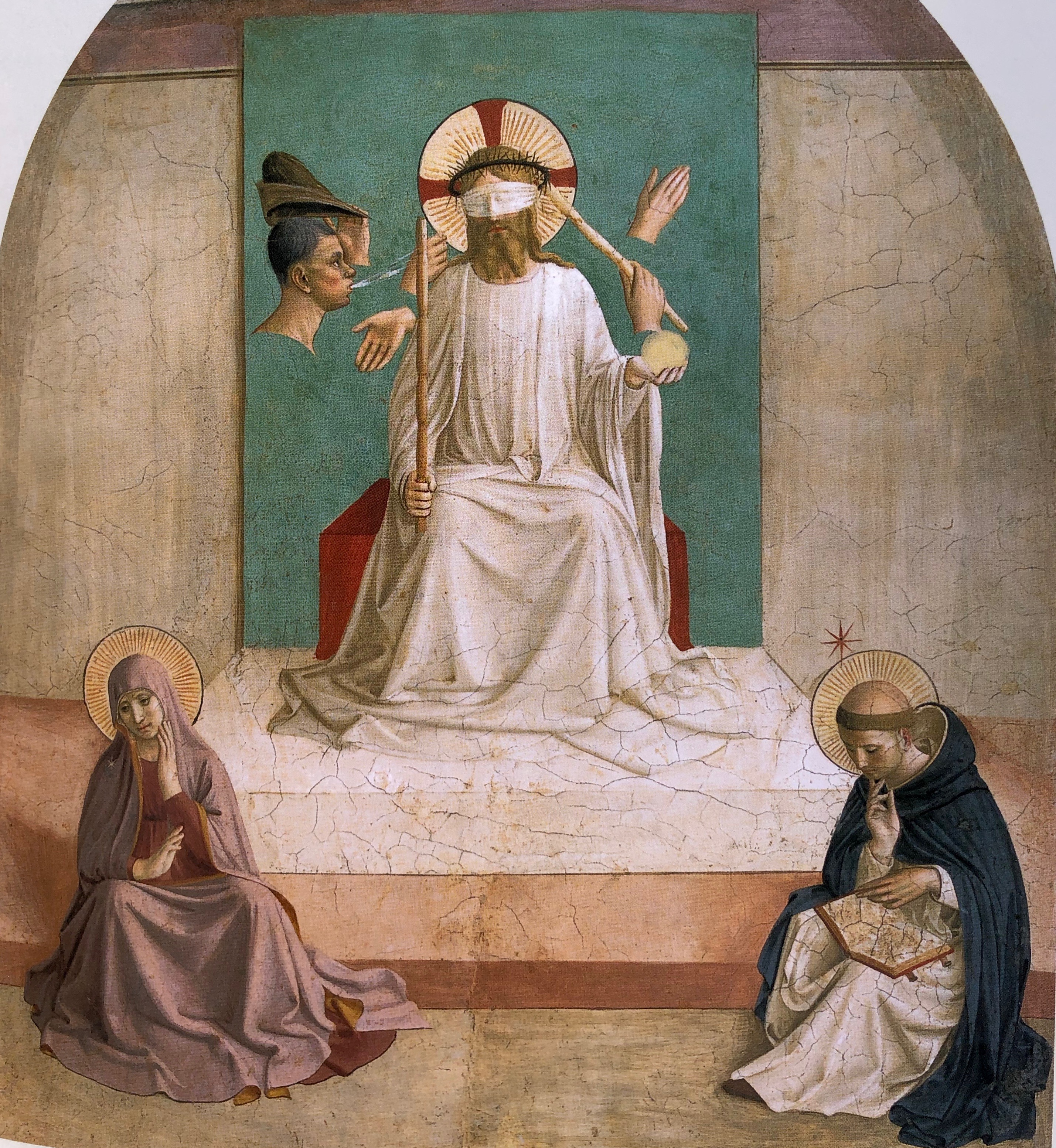
In the convent of San Marco in Florence, Fra Angelico painted a fresco of the mocking of Christ. The cruelties of Christ’s tormenters are represented as fragments, floating in the space around the white-robed, blindfolded victim: a disembodied head spits at our Lord, a floating hand strikes him with a rod. These fragments are very flat, two-dimensional, as though pasted on the image’s surface. But Christ himself is not restricted to the plane of the image. It projects forward in an illusion of three-dimensionality, into the space occupied by two saints. The suffering Christ emerges from his own time into theirs.
But neither saint is looking at him. They face away from the scene, toward us. The mocking is not something they look at with their physical eyes. It is for them an interior contemplation. And their devotion to the Passion takes two different forms. On the right, St. Dominic, the great intellect and preacher, is looking at a book, open in his lap. The Passion is something he is reading about, and processing in his mind. On the left side, the mother of Jesus, sitting in an attitude of quiet sorrow, has no book. She is apprehending the Passion through the medium of her heart. Dominic is thinking about the suffering of Christ. Mary is feeling it.
On God’s Friday we bring both head and heart to the foot of the cross. We may want to puzzle over the why of it: Why did this have to happen? Why do we keep returning to this bloody act? Why does it matter? Or maybe we just prefer to watch and weep over a mystery beyond all comprehension.
In any case, here we are again, at the foot of the cross. A lot has happened since the last Good Friday—so much suffering, so much struggling, so much dying. We bring all that with us to the cross today, along with our questions, our wounds, our laments. Finding the right words for this strange time is a daunting task.
Wiliam Sloane Coffin, one of the great Christian voices of the twentieth century, once told a young minister not to worry too much about his Holy Week sermon. “Anybody can preach on Good Friday,” he said. “Hell, read the newspaper!”[i]
On Good Friday, 2021, we don’t need a crucifix to remind us of a premature death which should never have happened. We’ve seen it replicated over half a million times in this country alone—worldwide, nearly 3 million times.
We don’t need an ancient form of execution, designed to cause asphyxiation in a sagging body, to remind us of human cruelty. This very week, in a Minneapolis courtroom, a congregation of judge and jury is meditating on the last words—of George Floyd: “I can’t breathe.”
We don’t have to go back 2000 years to learn the story of hatred, violence, and innocent victims. We’ve got Atlanta and Boulder and far too many other examples.
As for the mindless mob shouting “Crucify! Crucify!” in Pilate’s courtyard, we’ve got our own version from January 6th, that epiphany of collective rage by the ones who “know not what they do.”
Yes, we still see crucifixions every day. So why do we keep returning to Golgotha? How is the death of Jesus not like any other? In one sense, it is like every death. In choosing to embrace human experience, to live and die as one of us, the Divine identified completely with our suffering as well as our joy.
Anglican poet Thomas Traherne expressed this truth with 17th-century fluency:
“O Christ, I see thy cross of thorns in every eye, thy bleeding naked wounded body in every soul, thy death lived in every memory. Thy crucified person is embalmed in every affliction, thy pierced feet are bathed in everyone’s tears ….” [ii]
Jesus is not only the icon of God but also the representative human, our “Everyman” and “Everywoman,” who bears our griefs and carries our sorrows. A folksong from back in the day said it this way:
If somehow you could pack up your sorrows, and give them all to me, you would lose them, I know how to use them, give them all to me.[iii]
Why did, and why does, Jesus want to carry the full weight of our human condition? Love. Love so amazing, so divine. God thirsts for us even more than we thirst for God. And as the incarnation of that love, as the divine thirst for communion in human form, Jesus was willing to drink the bitter as well as the sweet.
Why on earth does God desire us so much? It’s not because we’re so easy to love—God knows we’re not. It’s because love is God’s nature, love is who God is. When the eternal self-offering, self-giving, that constitutes the Holy Trinity, got narrowed down into human shape, that loving nature came with it. Jesus loves me, this I know, because Jesus is love incarnate. It’s who Jesus is, and what Jesus does.
And what happens to love in a world gone so wrong? It suffers. Love hurts. On Palm Sunday we sang about “love’s agony, love’s endeavor, love’s expense:”
Drained is love in making full, bound in setting others free; poor in making many rich, weak in giving power to be.
Therefore he who shows us God, helpless hangs upon the tree; and the nails and crown of thorns tell of what God’s love must be.[iv]
Antonello da Messina, The Antwerp Crucifixion (1475)
Nobody wants to suffer, but it seems to be part of the deal. As Julian of Norwich said in the century of Europe’s most deadly plague:
If there be anywhere on earth a lover of God who is always kept safe from falling, I know nothing of it — for it was not shown me. But this was shown: that in falling and rising again, we are always held close in one love.[v]
In early 19th century Kentucky, 3 women founded a religious community called the Friends of Mary at the Foot of the Cross. They were dedicated, in their words, “to bring the healing spirit of God into our world.” One of their current sisters, Elaine Prevallet, has written some very helpful words about suffering:
Suffering is always about change — either something needs to change, or something is changing. And changing means letting go of the way things are, the way I know them, the way I have put and held my life together…The idol of control holds out to us the hope that suffering and death can be eliminated. ..That false hope, in turn, has the effect of setting suffering up as an enemy to be avoided at all costs. [But] if we are unwilling to suffer, we are unwilling to love.[vi]
Nobody gets off lightly on God’s Friday, not God, not the world, not us. But we get through, we all get through—it is the way, the only way in this mysterious universe of freedom and risk, dying and rising.
You can do several things with suffering. You can try to avoid it or at least repress your awareness of it. Some people make that their life’s work. But avoiding suffering means you avoid a lot of love and a lot of life. Jesus considered this strategy of avoidance, in the desert Temptation and in the agony of Gethsemane. But that “adamant young man”[vii] chose instead to embrace the consequences of his divine nature and his human vocation.
Another way to deal with suffering is to struggle against its causes, to work for its elimination. As both healer and prophet, Jesus demonstrated this way, even onto death at the hands of the oppressive powers. But like the weeds among the wheat, violence and suffering remain a persistent part of the fabric of creation, despite our best efforts. We do what we can, but suffering remains.
And so we, with Jesus, come to the third way: to undergo suffering as a means, not an end. To see suffering not as life-threatening, but life-giving. Suffering, instead of thwarting God’s purposes, becomes part of the repertoire of salvation. God does not create suffering, but does deal creatively with it. Suffering becomes, in God’s hands, formative rather than destructive. The Passion is not a detour. It is the way. As a recent hymn puts it, God is “wiser than despair.” [viii]
I once read about a Quaker meeting held on Easter Day. The assembled Friends were speaking, as the Spirit moved them, about the Resurrection. Then one woman got up and said that her only son had been killed in a car crash some months before. A chord of shared grief was struck in every heart. We know about that, don’t we, here on Bainbridge Island, thinking about Hannah, Hazel and Marina.[ix] But then this sorrowing mother said, “My heart is broken, but it is broken open—this is my resurrection and my hope.” [x]
To speak of the way of the cross as the way of life is not to deny its pain or its horror—Jesus himself cried out in deep protest from the cross: Why? Why? And the way of the cross is more than a simple homily about building character or learning compassion or awakening our own vocations to relieve the world’s pain where we can. Those are all valuable outcomes of our suffering, but on this day, at the foot of this cross, we must say something deeper and more difficult to grasp.
For this dying man, this Jesus upon the cross, is not just one more victim ground up by the teeth of history. This Jesus “bears in His Heart all wounds”[xi] carries our griefs and our sorrows, carries them into the divine heart, into the deepest place of God. Our pain has become God’s own pain, and however long we must dwell in that Pit where there seems to be suffering without end, God dwells there with us. The One who died abandoned and alone now keeps us company on our own crosses—for as long as it takes.
Jane Kenyon, the poet who died too young of leukemia, knew the truth of this:
The God of curved space, the dry God, is not going to help us, but the son whose blood spattered the hem of his mother’s robe.[xii]
God does not create suffering. But God is the place where all suffering comes to rest. “Give it to me, ” God says. “I can take it. I will transform it.” When our suffering becomes God’s suffering, something new happens. It is no longer the tomb of dead hopes. It is the place of new birth.
How does this happen? How does God bring forth good from evil? How does the cross of Christ make all our crosses into trees of life? How does God turn our abyss into a redemptive journey?
We could discuss theologies of atonement and sacrifice, or reflect upon the spiritual and psychological and social implications of Christ’s death. But on this day, we don’t come to the cross for ideas. We come for love.
In Antonello da Messina’s Crucifixion we see, as in Fra Angelico’s Mocking, two witnesses in the foreground: Mary, the mother of Jesus, and John, the beloved disciple. John is gazing intently at his Crucified Lord, while Mary looks inward, to her pierced heart. For me this image expresses something written by a present-day friend of Jesus, Virginia Stem Owens:
“Good Friday is the day when you can do nothing. Bewailing and lamenting your manifold sins does not in itself make up for them. Scouring your soul in a frenzy of spring cleaning only sterilizes it; it does not give it life. On Good Friday, finally, we are all, mourners and mockers alike, reduced to the same impotence. Someone else is doing the terrible work that gives life to the world.” [xiii]
So here we are, at the foot of the cross on God’s Friday, while Jesus does the terrible work that gives life to the world.
“Give me your pain,” Jesus says. “Give me your sorrow. I will make it the place where your healing begins. I work good in all things. That is my nature. There is nothing that I cannot make into the means of new life.
“Suffering…fear…grief…illness…anger…depression…despair…abandonment…. whatever your burden, give it to me, join your pain to mine, and I promise you: You shall rise up with me.
For there is only one death in the history of the world, and I have made it mine. And there is only one life in God’s universe, and from now until forever it is yours. I give it to you.
“Die with me today…rise with me tomorrow…It is accomplished.”
This sermon may be seen on video in the Liturgy for Good Friday at St. Barnabas Episcopal Church (Bainbridge Island, WA), available on YouTube starting at noon on Good Friday, 2021.The link is here.
[i] Personal reminiscence by Will Willimon, in “Stunned observers: A Conversation between Richard Lischer and Will Willimon, The Christian Century (March 24, 2021), 35.
[ii] Thomas Traherne, Centuries of Meditations, i.86.
[iii] Richard Fariña and Paula Marden, “Pack up your sorrows” (1965). I heard Farina and his wife Mimi sing this in concert in my college years. They were local favorites, and I often played their songs on my campus radio show. A promising writer and novelist, Fariña died in a motorcycle accident a year after writing this song. He was 29. To hear the song: https://youtu.be/NHRNqjOcaMM
[iv] W. H. Vanstone, “Morning glory, starlit sky.” This powerful text is set to a beautiful tune, Bingham, by Dorothy Howell Sheets, in The Episcopal Hymnal 1982, #585.
[v] Julian of Norwich, Showings (the Long Text), 14th century.
[vi] Elaine Prevallet, Weavings: A Journal of the Christian Spiritual Life (“Letting Go,” Vol. 12, No. 2, March/April 1997), 14.
[vii] I love Dag Hammarskjöld’s use of adamant, a Greek word for a hard stone or diamond. This term for a resistant substance came to mean “invincible.” Jesus’ refusal to let his love be misshapen by the world makes this an apt adjective for him. I found Hammarskjöld’s phrase in Bread and Wine: Readings for Lent and Easter (Maryknoll, NY: Orbis Books, 2003), 163.
[viii] Brian Wren, “Bring many names” (1989): “calmly piercing evil’s new disguises, glad of good surprises, wiser than despair.”
[ix] The tragic death of these three teenagers in an automobile accident last month has deeply shaken my local community.
[xi] The line is from Edith Sitwell’s poem, “Still Falls the Rain.” Written during the bombing of London in 1940, it does not single out the enemy, but laments the collective guilt of a warring humankind. The last lines: “Then sounds the voice of One who like the heart of man / Was once a child who among beasts has lain—/ ‘Still do I love, still shed my innocent light, my Blood, for thee.’”
[xiii] Virginia Stem Owens, cited in “It Is Done,” a reflection on the Passion by Watchman Nee in Bread and Wine, p. 244. Nee (1903-1972) was a Chinese Christian who spent his final 20 years imprisoned for his faith.
Monday in Holy Week: for a liturgist, the next few days comprise the precious last bit of calm before hitting the rapids of the Triduum, the Great Three Days of Maundy Thursday, Good Friday, and the Easter Vigil.
For those who undertake this marathon ritual experience, it is the molten core of our worship life, a sacramental immersion into the Paschal Mystery of dying and rising with Christ. It is where we do our best theology and our most heartfelt common prayer. Richly layered, multi-sensory, dramatic and moving, the Triduum is a liturgy like no other.
I say “liturgy” singular, even though there are three distinctive rites between sundown Thursday and the late hours of Saturday night. It is one single liturgy with successive parts, like a three-act play or a symphony in three movements. At the end of the first two parts, there is no blessing or dismissal. The people simply exit in silence to rest up until the liturgy continues the next day.
Each of the parts has an integral relation to the other two. There is of course a narrative relationship: the three parts follow the sequence of Jesus’ last days. But there is also a theological relationship: each part finds its full meaning only in relation to the others. “No rising without dying” is the prime example of this interrelationship, but there are many others, such as the theme of community. The disciples gathered so memorably on Thursday evening, then scattered by Friday’s betrayals and denials, are themselves resurrected from the isolation of sin and shame by the Christ who returns as Forgiveness. We learn this all over again by being in the story.
These aren’t things we just hear about or think about. We enact them with our bodies and emotions. We taste the warm table fellowship of the Last Supper, and the bitter cup of Gethsemane. We ascend Golgotha’s hill to gaze Wondrous Love in the face and kiss the wood which proved the “tree of glory” for the “healing of the nations.” We wait out the long silence of Holy Saturday until the New Fire contradicts the darkness and the Easter Acclamation (“Christ is risen!”) ignites a miracle of collective joy that was barely conceivable the day before.
To treat the Triduum as a la carte, or to skip it altogether, would be to miss the richness of the interrelated whole. Imagine only seeing one act of Hamlet, or skipping the final movement of Beethoven’s Ninth. There are things we can only find out by entering into them fully. The journey is how we know.
This is, of course, the passionate liturgist talking. If I were a parish priest, I would acknowledge the many demands of my parishioner’s lives and the realities of a 24/7 secularized culture, where going to church three nights in a row is not just rare – it’s incomprehensible. And we don’t want to shame the faithful, or call them wrong because they only do Palm Sunday and Easter, bypassing the Triduum entirely. Lives get busy.
But still, every year, even the most indulgent and compassionate pastor continues to issue the invitation to exit ordinary time and habitual existence in order to “enter with joy upon the contemplation of those mighty acts, whereby [God has] given us life and immortality,” because the Triduum is too good, too important, not to share. Something very specific to the process happens to those who make the journey. It’s like the Camino de Santiago in that respect. Even the most casual pilgrim is affected by the simple fact of going all the way from beginning to end, whatever their state of mind and heart when they first set out. The journey is how they know.
For me, a year without the Triduum experience is unimaginable. I have done it with the Orthodox in Jerusalem (no problem with attendance there!) and last year observed it with a small group of believers as we walked the Camino. But mostly I have done it as liturgical artist-in-residence at various parishes in California and Washington.
This year I’m collaborating with St. Stephen’s Episcopal Church in Seattle, where we will add some distinctive touches to the tradition. On Maundy Thursday, Sidney Carter’s “Bitter Was the Night” will be sung over a didgeridoo drone during the Stripping of the Altar. The sacred stories at the Easter Vigil will employ drama, film and soundscapes. God will be played by a 7-year-old girl in the Valley of Dry Bones. Music will mix medieval chant and Holy Week hymns with folk traditions and contemporary songwriters. You can read more about it here.
In the apocryphal Acts of John, Jesus leads his disciples in a dance. Some are resistant, but he tells them, “Those who do not dance do not know what happens.” By the time we reach the Vigil finale Saturday night, dancing around the altar to “Jesus Christ is Risen Today,” we will all know what happens.
The jeweler has a shop
On the corner of the boulevard
In the night, in small spectacles
He polishes old coins
He uses spit and cloth and ashes
He makes them shine with ashes
He knows the use of ashes
He worships God with ashes
The coins are often very old
By the time they reach the jeweler
With his hands and ashes
He will try the best he can
He knows he can only shine them
Cannot repair the scratches
He knows that even new coins
Have scars so he just smiles
He knows the use of ashes
He worships God with ashes
In the darkest of the night
Both his hands will blister badly
They will often open painfully
And the blood flows from his hands
He works to take from black coin faces
Thumbprints from so many ages
He wishes he could cure the scars
When he forgets he sometimes cries
He knows the use of ashes
He worships God with ashes







 The religious imagineer