Now Welcome Summer!

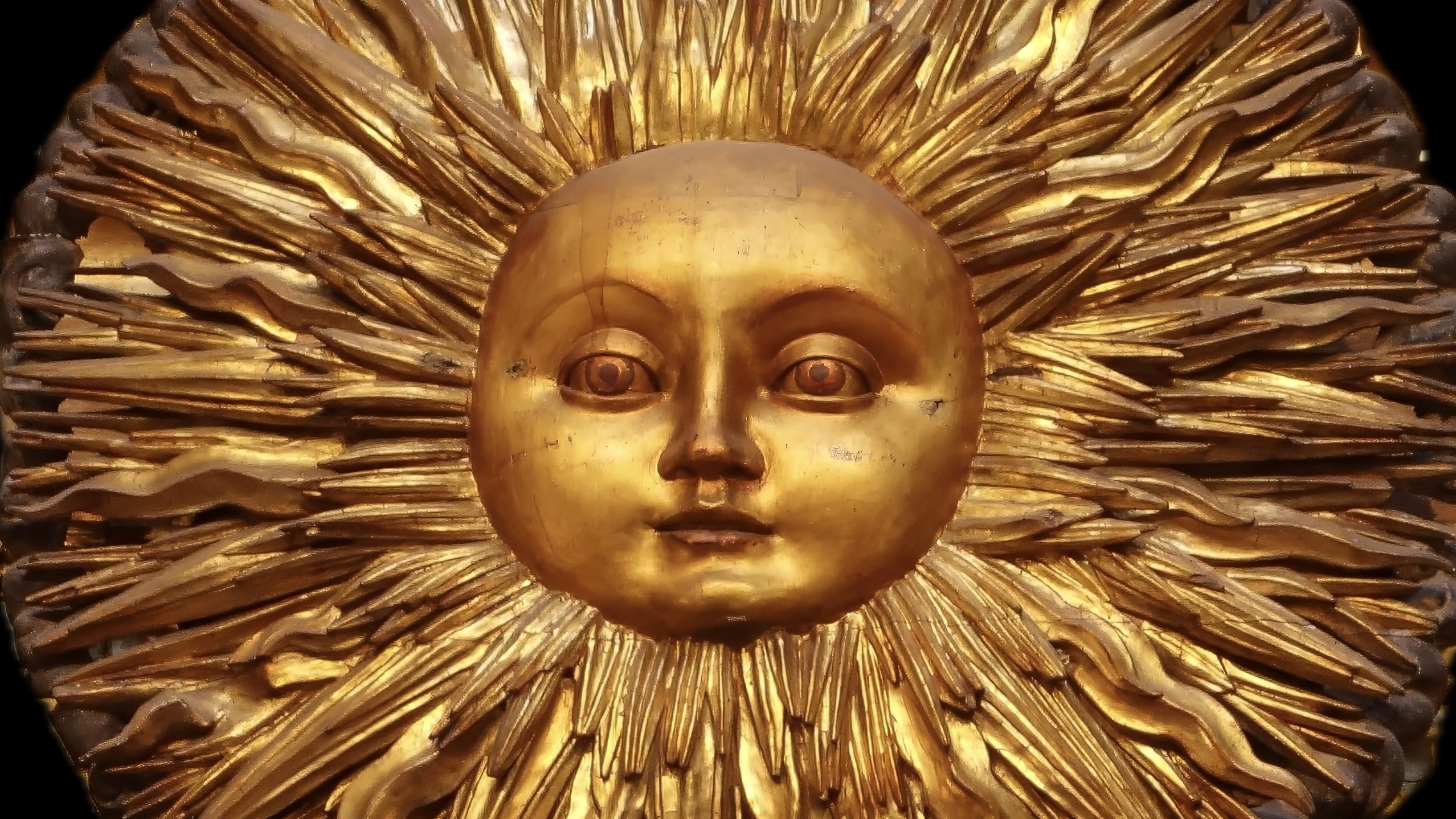
18th-century altarpiece (detail), San Martin Pinario, Santiago, Spain.

“I implore you—be calmer.” — Goethe

I know the world is a hot mess at the moment, but I’m taking the rest of the day off to welcome summer. I’m not even going to compose a long-overdue new post (more of those soon). Instead, before I retire to the garden with a pleasurable book, I’ll do the lazy thing and share a few paragraphs from something I wrote years ago, after my first journey to Greece. I posted the following words on the Summer Solstice in 2001. A few months later, the world as we knew it would come to an end. But the lesson I learned in Greece still speaks to my heart, even in (or especially in) our fractious and fallen present condition.
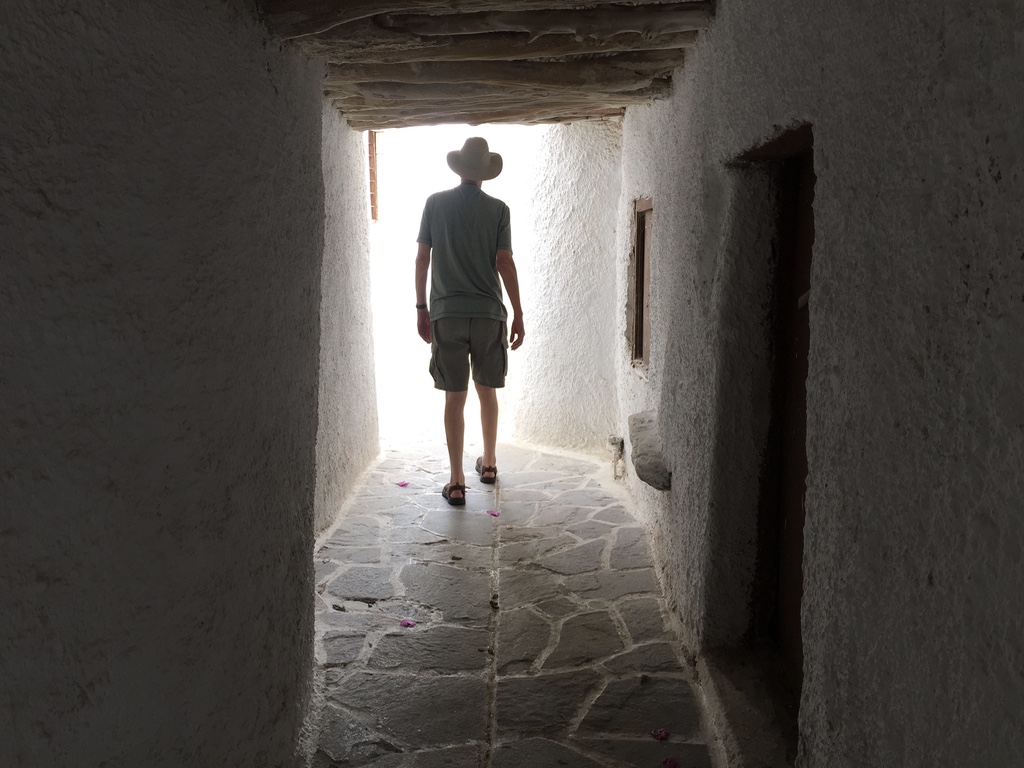
The author on Naxos, Greece.

After a few weeks of history, culture and religion on the mainland, I boarded a ferry for the Greek islands, only to be put off by the scene on the sun-drenched deck. Everyone was a tourist, slathered with sun block; the Greeks had vanished. We were like an occupying army, obliterating the local culture with our foreign speech, our alien ways, our crass desires. But there was something else that bothered me. We lacked seriousness. We were a ship of fools.

During the first half of my journey, I had contemplated the noble remnants of classical culture, walked in the footsteps of Socrates and Paul, hiked to Byzantine monasteries scattered along the summits of towering rock formations, breathed the incense of exotic rituals, conversed passionately about ideas late into the night. It had felt something like pilgrimage. But now the only quest was for the perfect tan, the languorous cafe, the idle beach. I feared a loss of purpose. Had I come all this way to fall into a resort mentality, and forget the Greece of myth and history, liturgy and philosophy?

In the end, my Puritan rigor succumbed to the regime of pleasure. I rediscovered summer mind. Time to be, not do. Sink down into the deep pool of the moment. Enjoy the sun-dazzled days and fairy tale nights without anxiety, as though they will last forever. I am not perfect at this. At times I am likely to rush from place to place, acquiring experiences greedily, not wanting to miss anything. But a brisk pace is fatal to deeper forms of attention.

On my first day hike on Naxos, the greenest isle in the Cyclades, I took a quick look inside one of the little Byzantine churches that frequent its charming hills and valleys. I saw only bare stones inside, not too interesting. I soon returned into the sunlight, where I heard a voice calling to me. It was a German hiker, looking for the entrance into the churchyard. I showed her the way in.

“Look at these wonderful old frescoes!” she said. “What frescoes?” I thought to myself as I peered into the shadows. Once I had given my sun-blinded eyes time to adjust, I began to see what I had missed in my hasty first glances—the faint images of saints. Some of the figures were clearly defined, while others had weathered into dreamlike blurs, like background figures in a Munch painting.
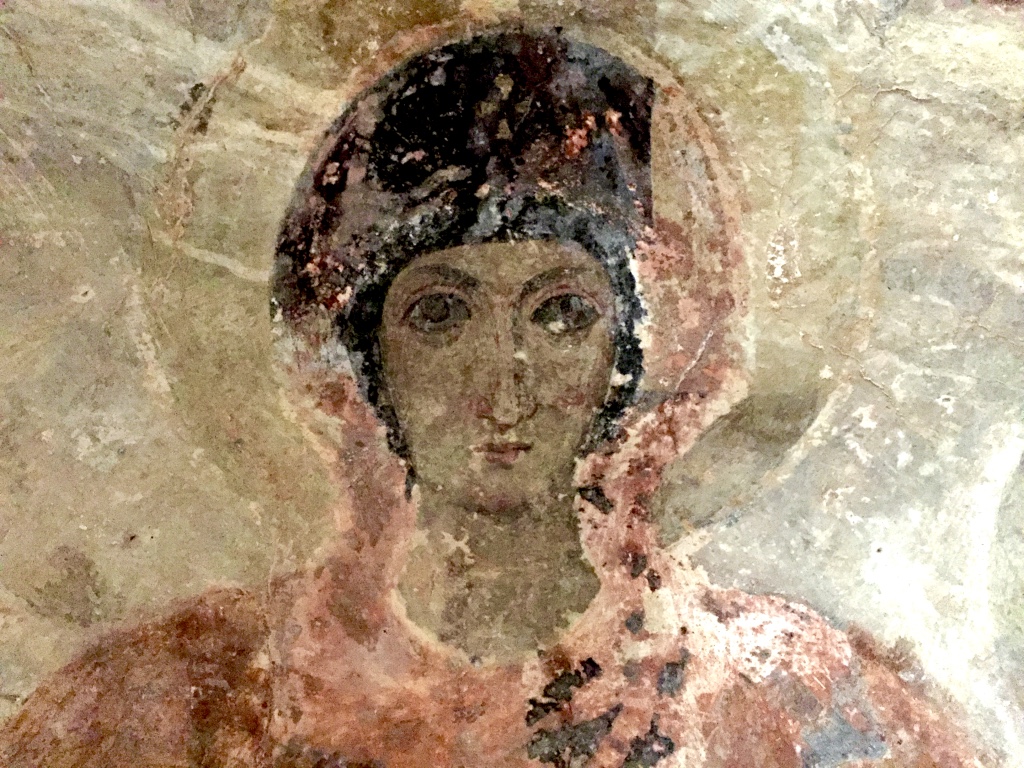
Sixth-century fresco in a Naxos church.

Early in that journey, I had read these words by Thomas Merton in the shaded balcony of a clifftop monastery:  “In prayer we discover what we already have. You start where you are and you deepen what you already have. And you realize that you are already there … All we need to do is experience what we already possess. The trouble is, we aren’t taking the time.”
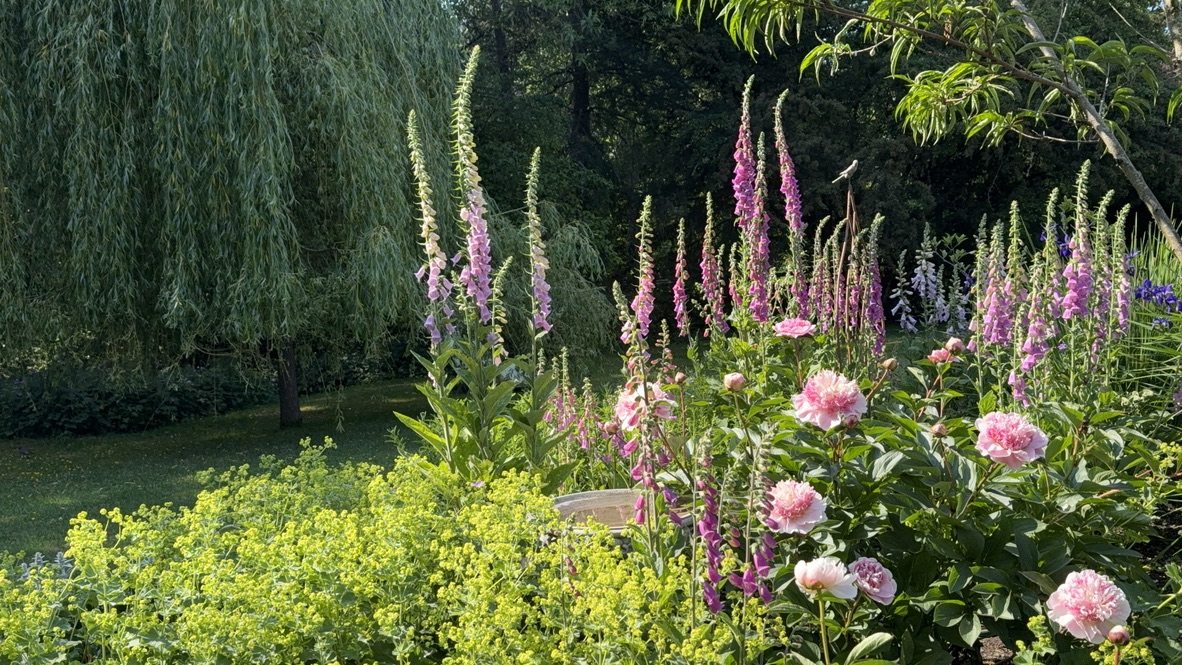
Now welcome summer. Let the heavy fragrance of its green world release you from obligations. Let it be enough for now to wander aimlessly around the neighborhood, linger over relaxed conversations, or lie in the hammock and wait for falling stars. Idleness is the incense we offer the gods of summer.

Every day, a miracle

image

The Greek island of Santorini is famous for its singular beauty, shaped by ancient catastrophe. Like many of Greece’s treasures, it is a ruin, the curved remnant of an immense volcanic crater. When the caldera collapsed, the sea poured in, leaving only a few bits of the crater still above water. Santorini is the largest and tallest of these, with vertical walls rising a thousand feet above the Aegean. And perched along the edge of its towering cliffs are several whitewashed settlements, shining bright and cheerful against the fierce dark rock beneath them.

The village of Oia on the island’s western tip is the picturesque mecca for romantic travelers hoping for a travel poster moment. It has always drawn honeymooners, but it is also increasingly popular for destination weddings. The fairytale warren of cliffside dwellings, the dizzying prospect of the vast Aegean blue, the vivid sunsets and candlelight dining can persuade even the forlorn and forsaken to recover the idea of happiness.

image

“The secret for harvesting from existence the greatest fruitfulness and the greatest enjoyment,” said Nietzsche, “is to live dangerously! Build your cities on the edge of Vesuvius!” So on Santorini, after one of the biggest cataclysms in recorded history, humans returned to the edge of disaster and pitched their precarious towns. It’s been the isle of romance ever since.

Perhaps it has been loved too much. Since I first came here in 2001, the main pedestrian avenue has been developed into a trendy corridor of shops that feels more like a generic consumerist mall than a local village. We couldn’t see Greece for all the shoppers funneled in from the cruise ships. We resolved to retreat to our quiet balcony just outside town, to while away our time with reading and gazing.

But grace had other plans. Santorini had more to give us. The first gift was Atlantis Books, ensconced In the cozy quarters of an old sea captain’s house. You must descend steps to enter. Painted on the handrail: “Books are no more threatened by Kindle than stairs by elevators.” The music playing inside was Texas legend Townes Van Zandt’s “Pancho and Lefty”; Living on the road, my friend, was gonna keep you free and clean …” 

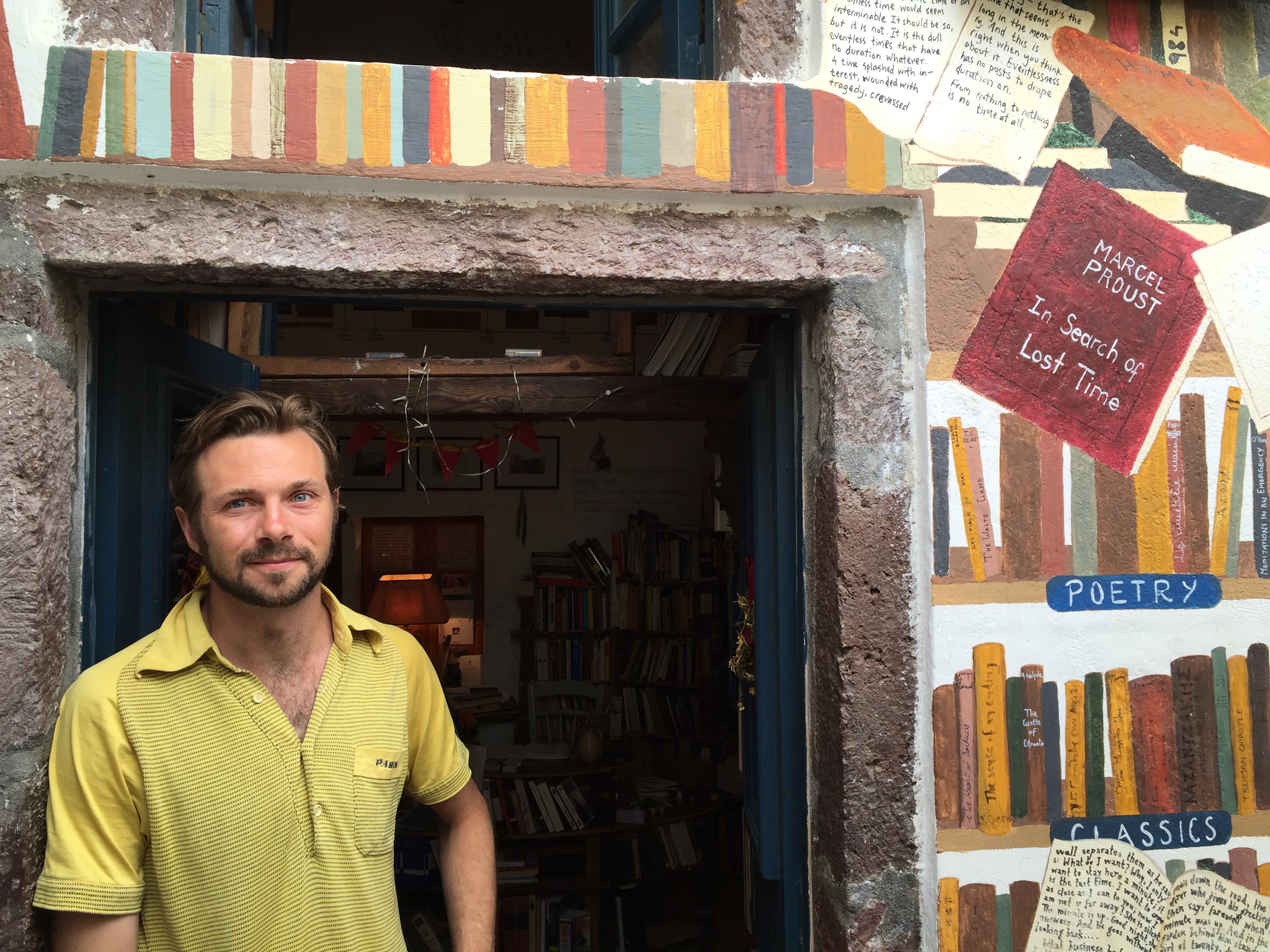
Great song, but not widely known. I knew I was onto something here. I struck up a conversation with Nick Hunt, a writer from London visiting for a few months to help mind the store. Painted in an expanding spiral on the ceiling above us were the names of hundreds like him who have worked here during its eleven-year history, drawn by its literary fervor and high-spirited whimsey. There are quotes on the walls in several languages. Charles Bukowsi’s caught my eye: “Find what you love and let it kill you.” The book inventory was rich and full of unexpected treasures, such as a first edition in red leather of Lewis Carroll’s logical conundrums, The Game of Logic.

I had just been reading Patrick Leigh Fermor’s riveting account of his walk across Europe, at the age of eighteen, from Britain to Byzantium (Istanbul) in the 1930’s. It’s some of the greatest travel writing of the twentieth century, and I was delighted to learn that Nick had recently retraced Fermor’s journey on foot to see what may have changed in 80 years. His own book about what he found, Walking the Woods and the Water, will be at the top of my reading list when I get home.


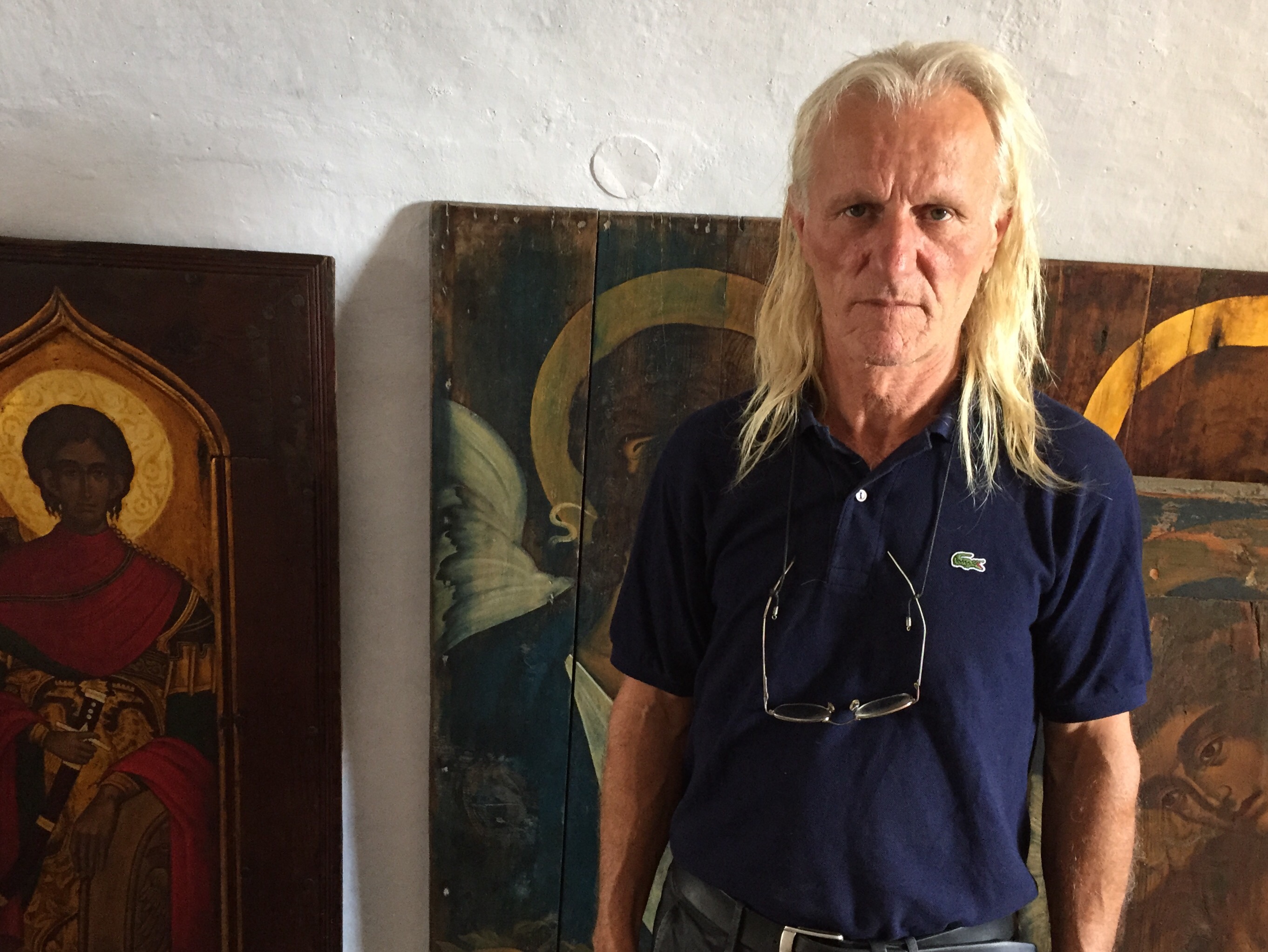
It was lovely to make such resonant connections, both musical and literary, in such an unexpected place. But the day had even more to give us. Just down the street we stopped in at the workshop of the celebrated icon “writer,” Dimitris Kolioussis, a man of great heart and generous spirit. His exquisite icons, painted meticulously with traditional methods, but often on found materials from old doors to cutting boards, are profoundly moving. His workshop, filled with these holy images, seems a kind of church, and his calling is clearly sacramental: bringing the invisible into visibility.


“I started making icons when I was a boy,” he told us. “Then I discovered it was my job.” He paused thoughtfully before adding, “Every day, a miracle. Every day, I give thanks.”

A guitar leaned against his easel. I picked it up and sang him a couple of American folk songs as a modest thank offering. He replied with some tasty blues licks.

It was a day of gifts which never would have happened had we remained on our beautiful balcony and kept to ourselves. Once again, Santorini, you have taught us happiness.