Note to reader: This is a post from 2021, revised to include comments on the moral blindness of admitting fascism into our political life.
Jesus was walking out of Jericho, surrounded by a big crowd. Like all such crowds, it was a mix of the curious and the adoring. Jesus was at the height of his popularity. He stirred people’s imaginations and raised their hopes. The excitement was palpable. But amid all the festive clamor, a single shout brought this parade to a sudden halt:
“Jesus, Son of David, have mercy on me!”
It was a blind beggar, sitting by the roadside.
His name was Bartimaeus.
“Shush,” people said. “Don’t make a scene.”
But he cried all the louder: “Son of David, have mercy on me!”
And Jesus stood still, just the way the sun had stood still in the sky for Joshua in that same city of Jericho.
“Call him here,” Jesus said. And so they did.
“Take heart!” they told him. “Get up. He is calling you.”
Immediately, Bartimaeus threw off his cloak, sprang to his feet, and came to Jesus. Then Jesus asked him a question that went straight to the point: “What do you want me to do for you?”
“Teacher,” he said, “Let me see again.”
And what Bartimaeus asked, Jesus granted. (Mark 10: 46-52)
In Mark’s gospel, this is the last miracle performed by Jesus before he goes to his death in Jerusalem. It marks the fatal turning point between his ministry and his Passion. It is our Lord’s last act, his last word, before he begins the Way of the Cross.
To the world, that looked like the path to oblivion. But to those who have been given the eyes of faith, the Way of the Cross, as we pray every Holy Week, is “none other than the way of life and peace.”
And thus the healing of Bartimaeus is not just the story of one man’s good fortune. It is an invitation to each of us to perceive and receive the vision of salvation which is about to unfold. Mark is telling us that if you want to understand the Paschal Mystery of Passion and Resurrection, you need to open your eyes.
And notice that the climactic words of this story are not “he regained his sight,” but rather, “he followed him on the way.” Once you see what God is doing through Jesus, then it’s your turn to take up your own cross and follow.
And yet, in the story leading up to this moment, even Jesus’ closest friends have suffered their own blindness. “Are your minds closed?” he chides them. “Have you eyes and do not see?” But they go on missing the point again and again.
To their credit, they continue to follow Jesus. They are drawn to him, they know something is happening here—but they don’t know what it is. “Do you not yet understand?” Jesus sighs. I’m sure he said this more than once.
And then, after repeated examples of the disciples’ blindness throughout Mark’s gospel, suddenly we hear a plaintive voice cry out from the crowd: “Jesus! Have mercy on me. Remove this grievous blindness.”
That’s our prayer too, isn’t it?
Lord, take away our blindness. Help us to see.
And Jesus replies, “I thought you’d never ask!”
St. Gregory of Nyssa, in the fourth century, was one of many theologians who have shared Mark’s diagnosis of the human condition as one of persistent blindness.
“Humanity was created for this end, that it might see ‘good,’ which is God; but because humanity would not stand in the light, [in fleeing from the light] it lost its eyes… We subjected ourselves to blindness, that we should not see the interior light.”
In other words, we are all stumbling in the dark. That is the human condition, until God brings us into the place of clarity.
St. Augustine talked about the inner eye, our capacity to see the things of God, as “bruised and wounded” by the transgression of Adam and Eve, who, he says, “began to dread the Divine light [and] fled back into darkness, anxious for the shade.”
Refusing to stand in the light… subjecting ourselves to blindness.
Is this what we do? Are we truly so “anxious for the shade?”
Arthur Zajonc is a quantum physicist who became fascinated with the literal dimensions of this question, examining case histories of blind people who recovered their sight. In his book, Catching the Light: The Entwined History of Light and Mind, he tells of an 8-year-old boy, blind at birth from cataracts, who underwent surgery in the year 1910. When the time came to remove his bandages, the doctor was very hopeful. He waved his hand in front of the boy’s eyes, which were now physically perfect.
“What do you see?” asked the doctor.
“I don’t know,” the boy replied.
“Can’t you see my hand moving?” said the doctor.
“I don’t know,” said the boy.
The boy’s eyes did not follow the doctor’s slowly moving hand, but stared straight ahead. He only saw a varying brightness before him. Then the doctor asked him to touch his hand as it moved, and when he did, the boy cried out in a voice of triumph, “It’s moving!” He could feel it move, and even, as he said, could “hear it move,” but it would take laborious effort to learn to see it move.
As that first light passed through the child’s newly clear black pupils, it called forth no echoing image from within. His sight, Zajonc tells us, began as a hollow, silent, dark and frightening kind of seeing. The light of day beckoned, but no light of mind replied within the boy’s anxious, open eyes.
“The sober truth” says Zajonc, “remains that vision requires far more than a functioning physical organ. Without an inner light, without a formative visual imagination, we are blind.” This echoes Augustine’s description of our “bruised and wounded” inner eye. What is it that makes us so unable to process what is before us, to see what is being offered to our open eyes?
The mystical Anglican poet Thomas Traherne framed an answer in the ornately vivid language of the seventeenth century:
“As my body without my soul is a carcass, so is my Soul without Thy Spirit, a chaos, a dark obscure heap of empty faculties ignorant of itself, unsensible of Thy goodness, blind to Thy glory.”
And what are the causes of this abysmal state? he asks. He names several:
“[The Light within us is eclipsed] by the customs and manners of [others], which like contrary winds blew it out: by an innumerable company of other objects, rude, vulgar and worthless things, that like so many loads of earth and dung did overwhelm and bury it: by the impetuous torrent of wrong; … by a whole sea of other matters and concernments that covered and drowned it…”
“Contrary winds” blowing out the Light within us… being overwhelmed by “an innumerable company… of rude, vulgar and worthless things”… “the impetuous torrent of wrong desires” — does any of that sound familiar in this age of consumerism, social media, and widespread disinformation?
Not long after Traherne wrote those words, another English writer, John Bunyan, told the story of two pilgrims, named Christian and Faithful, who came upon Vanity Fair, a kind of shopping mall where all the transitory pleasures of this world were on seductive display.
“What will ye buy?” cried one of the merchants.
And Christian and Faithful replied, “We buy the truth!”
This was clearly the wrong answer, for the two pilgrims were immediately set upon, beaten, smeared with mud, thrown in a cage, and finally put on trial. The jury was rigged, led by Mr. Blind Man and Mr. Hate-Light. “Guilty,” they cried, and Faithful was put to death. But Christian managed to escape, and his journey into God continued.
Bunyan’s allegorical constructs seem quaintly archaic today, but Vanity Fair is still with us, with its endless commodification of unsatisfiable desires. And Mr. Hate-Light is still at work, generating the ceaseless illusions and lies that blind us to the beauty of holiness, the beauty of one another, the beauty of loving community.
I was born in 1944, 40 days after D-Day, and a few weeks before the liberation of Paris, when the evils of Nazism and fascism were on the run. Once and for all, we thought. But now, eighty years later, Adolf Hitler—Mr. Hate-Light himself—is making a comeback. And millions—millions!—of people are just shrugging their shoulders. So many of the children, and grandchildren, and great-grandchildren of the generation who shed their blood to stop fascist tyranny, seem kind of okay with the return of Mr. Hate-Light.
Lord have mercy, we are stumbling in the dark.
So what happens to Christian in Bunyan’s allegory? He escapes Vanity Fair, but he still has to pass through the Valley of the Shadow of Death, where the light is so scarce, and the path so narrow, that he’s in constant danger of stumbling into the ditch on his right or the quagmire on his left.
But Christian is not without hope in that dark valley.
As Isaiah said, the God of light travels with us:
I shall lead the blind by a road they do not know…
I shall turn the darkness into light before them,
and turn the quagmire into solid ground. (Isa 42:16)
All of us, deep down, want the light. All of us need the light. But sometimes we resist the light, or run away from it, or shut our eyes to it. There are things we’d rather not see, in the world or in ourselves. Illuminating our dark places can feel like a judgment, as if the light were accusing our shadows.
In Franco Zefferelli’s beautiful 1977 film, Jesus of Nazareth, we meet another blind man at the pool of Bethsaida in Jerusalem, but unlike Bartimaeus, he is deathly afraid of being healed. “Leave my eyes alone!” he shouts. “Stop touching my eyes!”
After analyzing sixty-six cases of blind people who had recovered their sight, Arthur Zajonc would concur with Zeffirelli’s portrayal of our resistance to having our eyes opened.
“The project of learning to see,” he writes, “inevitably leads to a psychological crisis in the life of the patients, who may wind up rejecting sight. New impressions threaten the security of a world previously built upon the sensations of touch and hearing. Some decided it is better to be blind in their own world than sighted in an alien one… The prospect of growth is as much a prospect of loss, and threat to security, as a bounty.”
In other words, opening our eyes to a more truthful clarity can be scary—no more fictions or illusions about the state of the world or the state of our souls. If we say we have no sin, we deceive ourselves, and the truth is not in us (I John 1:8).
Seeing—clearly and accurately—the fallenness of our broken world—and our wounded selves—is a painful revelation. Once we face facts, transformation is the only way forward. We must change our life. A new way of seeing demands a new way of being. We can either fight that divine summons, like the man in the Zeffirelli film (Don’t touch my eyes!), or we can jump up and embrace it, like Bartimaeus.
But it’s not just the wrongness of things which is hidden by our blindness. The truth is, there is also so much blessing and beauty in this world, eagerly waiting to be discerned and embraced.
And whatever our doubts and fears about losing our protective blindness, the beauty revealed will be worth the price. It’s the beauty of God’s future—what Jesus called the Kingdom. We often think of the Kingdom of God as impossibly distant, but it is possible to glimpse it even now, in this present age. We only need the eyes to see.
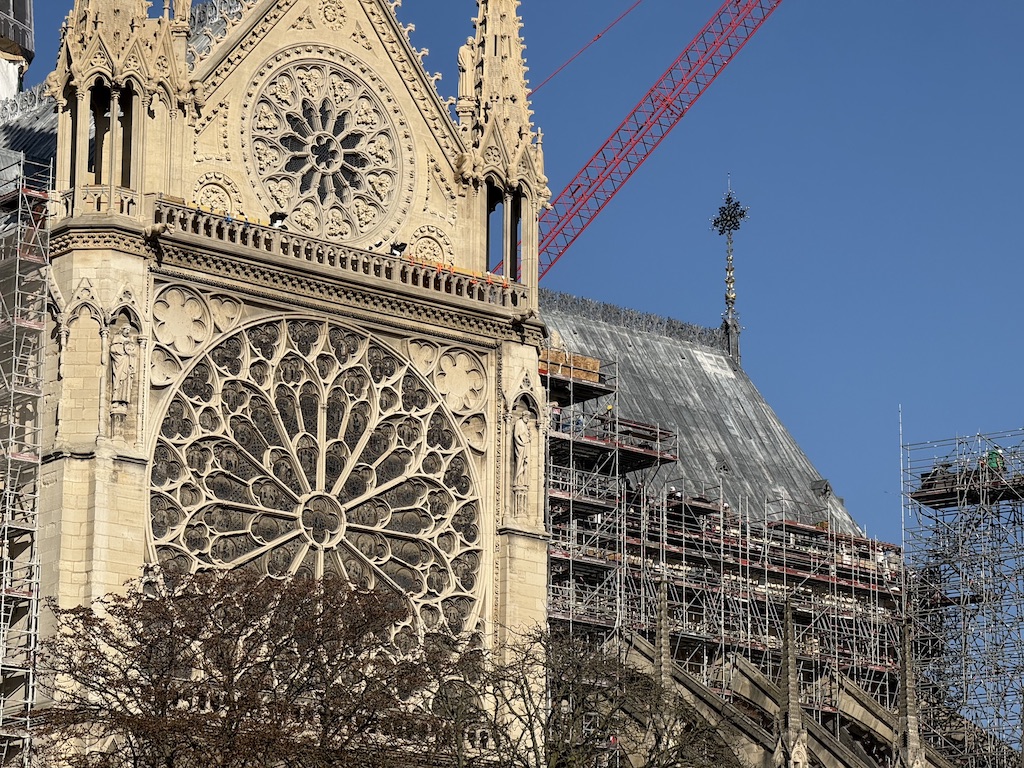
Last week my wife and I were in Paris, and it was thrilling to see the cathedral of Notre Dame in the final stages of its resurrection from the devastation of that terrible fire in 2019. There are still giant cranes and some scaffolding present, and a construction wall continues to keep the public at a distance until the house of God reopens in Advent.
And even though we could not yet go inside, it was powerful just to stand in the parvis, the open space in front of Notre Dame, joining the thousands and thousands of people who come there every day to wonder at the marriage of human creativity and divine glory.
And what made it especially moving was the beautiful photographs displayed on the temporary wall surrounding the site. In stunning black & white portraits, we saw a representative sample of the many thousands whose labor, skill and love have brought the cathedral back to life: architects, engineers, artisans, restoration experts, carpenters, stone-workers, stained glass artists, roofers, electricians, cleaners, works managers, heritage curators, scholars, liturgists, theologians, and all the service people who fed the multitude every day.


What we saw in those faces, and in the fruits of their labor, was the very best of humanity, working together to repair the world, redeeming beauty and hope from the ashes of destruction and despair.
But if you walk just behind Notre Dame, to the tiny tip of the Ile de la Cité—the small island on the Seine River where the cathedral stands—you will find some stairs, which take you down into a dim, tomb-like space. There you move through a narrow passage whose floor is inscribed with the words, “They went to the ends of the earth and did not return.”
This subterranean passage is faintly illumined by 200,000 tiny, lighted crystals, representing the 200,000 people deported from France to the death camps during the Nazi occupation of the 1940s.
It is a powerful memorial—and a painful reminder. For the mass deportation in France was not simply the act of bad Germans upon an innocent French population. It was the French police who went door to door, rounding up Jews and dissidents. And though there were many French people who resisted the evils of the Occupation, there were many more who turned a blind eye to the mass deportation. The legacy of complicity and collaboration would long haunt the postwar memory of France.
Lying in the very shadow of the glorious and aspirational cathedral, the Memorial of the Deportation stands as a warning to those of any country who want to believe that “it can’t happen here.”
Lord, remove our grievous blindness. Help us see the light.
There is a passage from Willa Cather’s novel, Death Comes for the Archbishop, which perfectly expresses the faith and the hope that we are not destined to remain in the dark—that we can, by God’s grace, recover the divine light within us. The novel’s protagonist, Jean-Marie Latour, a nineteenth-century missionary bishop to the territory of New Mexico, is discussing visions and miracles with his Vicar.
“Where there is great love,” he says, “there are always miracles. One might almost say that an apparition is human vision corrected by divine love .… The Miracles of the Church seem to me to rest not so much upon faces or voices or healing power coming suddenly near us from afar off, but upon our perceptions being made finer, so that for a moment our eyes can see and our ears can hear what is about us always.”
Human vision corrected by divine love.
How blessed are they who receive such a miracle!
“Mercy, O thou Son of David,
thus poor blind Bartimaeus prayed.
“Others by thy grace are saved,
now afford to me thine aid.”
“Lord, remove this grievous blindness,
let mine eyes behold the day.”
Straight he saw, and, won by kindness,
followed Jesus in the way.
 The religious imagineer