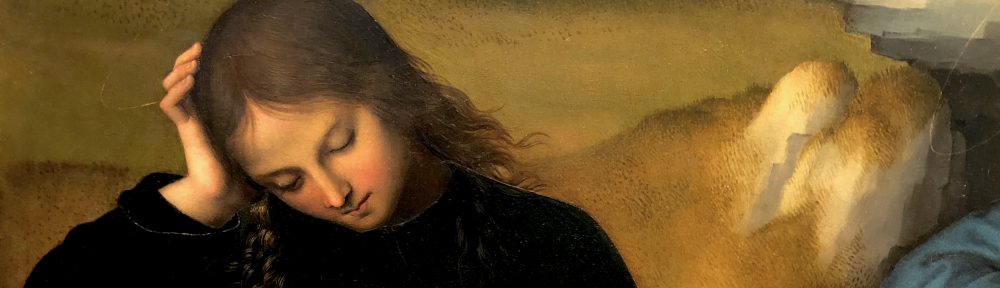
Stories That Save Us: Performing Scripture as an Act of Resistance

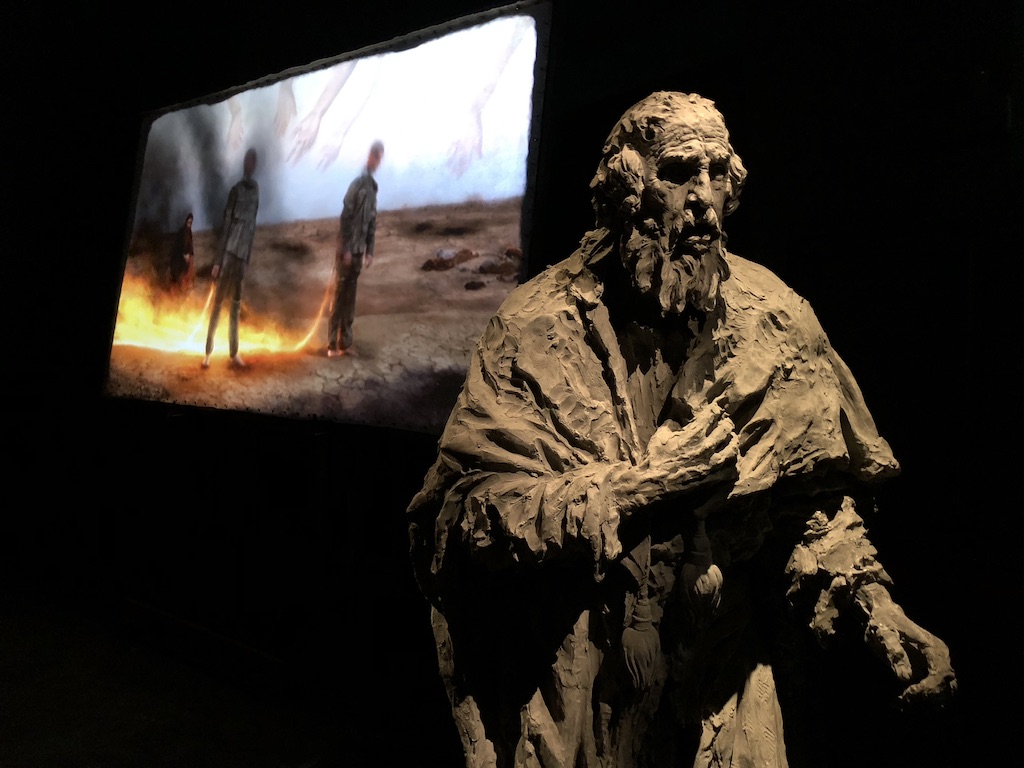
Biblical stories can be retold in many ways with a variety of media. This is part of The Prodigal Son parable in an elaborate and moving installation by Alexander Sokurov at the Venice Biennale in 2019. (Photo by the author)

This is the third in a series of posts responding to the alarming events in Minneapolis. It may be the most arcane, of interest only to worship planners and storytellers. I usually try to write posts of more general interest, but my long experience as a liturgical creative and biblical storyteller impels me to set this down, for what it’s worth, as a small personal contribution to the ongoing efforts of the faithful to resist public malice and hold fast to the good with all the means at our disposal.

In evil times such as these, how can churches be faithful to the Baptismal Covenant to “persevere in resisting evil … seek and serve Christ in all persons … strive for justice and peace among all people, and respect the dignity of every human being”? In recent weeks, we have seen many clergy and laity adding their voices and bodies to the resistance against tyranny and cruelty in Minneapolis, and to the increasingly dangerous work of loving our neighbor and protecting the vulnerable.

As a longtime liturgist, I find myself wondering how—and to what degree—our worship gatherings, in addition to our witness in the public square, might themselves be responsive to what is happening around us—and inside us—during America’s current authoritarian nightmare. Prayer and preaching are two vital ways, and I have given some striking examples in my two previous posts, White House Brutality (prayer as a “refusal to consent to an unredeemed world … It breaks the silence, awakens the passive, and cultivates action, both human and divine.”) and Murder in Minneapolis (featuring one priest’s prophetic sermon, forged in the crucible of tyranny and protest).

Singing is also a powerful weapon against evil and its sad progeny—discouragement, fear and despair. It’s been said that the Civil Rights movement succeeded in part because it had a great soundtrack. Its stirring adaptations of black spirituals, sung not only in the marches but also in the jails, kept voices high and spirits strong. As they say, the people united will never be defeated. And nothing unites like communal singing. The resistance to American fascism is taking this to heart as collective song becomes once again a vital part of public protests.

Prayer, preaching and singing are all powerful ways to say yes to God and no to evil. And to that list I would add the telling of our sacred stories. Creative engagement with Scripture deserves equal attention as a means to lift up our hearts and shine the light of hope against the darkness.  Week after week, year after year, Christians tell formative stories of sin and redemption, strife and reconciliation, despair and hope, losing and finding, oppression and liberation, death and resurrection. Then the preacher strives to connect those biblical stories with our own lives and times. But what if we were to make those connections not just in our homiletic reflections following the stories, but in the storytelling act itself?

As a young priest in Los Angeles during the Vietnam War, I staged a dramatized version of Jesus’ parable of the Unforgiving Debtor for an experimental eucharist. The man whose debt was very small was a draft resister, thrown into prison by an angry creditor dressed as Uncle Sam. That creditor was then reminded of the immensity of his own debt, illustrated by projected images of the atrocious violence in Southeast Asia.

Such a pointed retelling of Scripture might be too edgy for typical Sunday worship, but there are times when biblical stories really want to be heard in fresh and compelling ways. Holy Week 2026 can be a great opportunity to do that. How might worship planners think creatively about the Paschal journey from death to life in the context of our current experience of state-sponsored hate and violence?

The next No Kings march is scheduled for March 28, the day before Palm Sunday. How will it feel to reenact Jesus’ provocative entry into Jerusalem after millions of us will have shouted our own hopeful hosannas in the streets of America? What will be in our hearts on Maundy Thursday when our beautiful feast of loving one another concludes with the arrest our Lord by armed thugs? And when we come to the foot of the cross, will we see the God who not only shares our present suffering but also transforms it, making a Way where there is no way?

I love the traditional Scriptural texts for the Holy Week rites which take us on the Paschal journey from death into life. As containers for all the thoughts and feelings we bring to that journey, especially in times of immense public distress, they need no inventive retelling. They will be heard in fresh ways simply by virtue of what is in our minds and in our hearts throughout Holy Week 2026.

But when the sun goes down on Holy Saturday, and the Great Vigil of Easter begins to transport us from the world of sin and death into the realm of light and life, the world of the past is gone, and it is time to let imagination flourish, that we may find our own struggles and hopes vividly enacted in the performance of biblical narratives.

At the Easter Vigil, which I take to be the molten core of Christian worship, it is critical to experience those stories as if they are happening to us. We need to feel ourselves delivered from the flood of chaos and liberated from bondage to the powers-that-be. The dry bones of our damaged hopes need to rise again and inhale the breath of the Spirit. As the ancient Exultet chant declares at the outset of the liturgy,

How holy is this night, when wickedness is put to flight, and sin is washed away. It restores innocence to the fallen, and joy to those who mourn. It casts out pride and hatred, and brings peace and concord.

What does it take to do the Vigil stories justice? Well, it takes time and effort, a creative team, prayerful engagement with the stories, and openness to the Holy Spirit. Before offering a few tips for your own Vigil storytelling, let me give some examples from a Vigil I curated last year, as described in my April 2025 blog post, “For God so loved our stories”—Tales from the Easter Vigil:
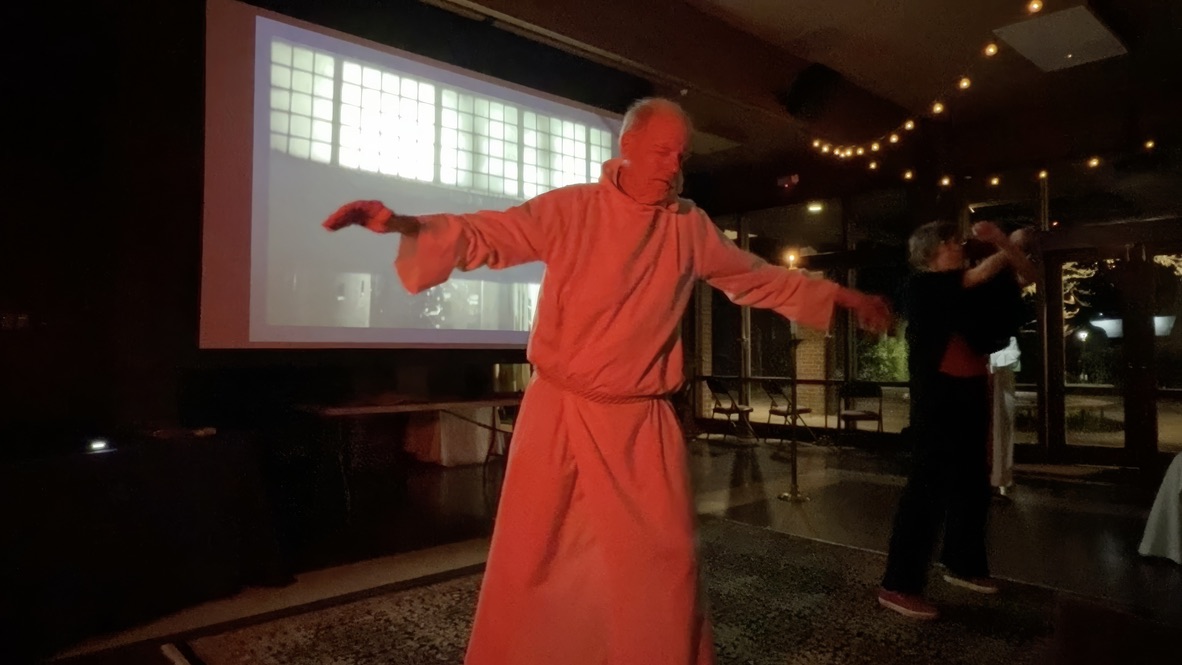
The author as one of the dancers in the Red Sea story at the Easter Vigil 2025.

The Red Sea: Noirish projected images (from Bela Tarr’s bleak film, Werckmeister Harmonies) show anonymous figures shuffling through an imprisoning corridor, while dancers on the stage express the experience of oppression with their bodies. An offstage narrator explains:

Three thousand years ago, in the land of Egypt,
there were people who had no name.
They were the faceless many,
exploited by the powerful,
forgotten by the privileged: slaves, immigrants, the poor,
the homeless, the vulnerable, the invisible, the outcast.

Then dismissive terms for the oppressed appear on the screen in stark animated graphics: Not like us … worthless … horrible people … trash … less than human. More images of “the faceless many” are shown as the dancers continue, until an offstage choir sings a verse of “Go down, Moses.”

Suddenly, the divine breaks into this dark world: the screen flashes red, and we see the words from Psalm 68 that are always used in Orthodox Paschal liturgies:

Let God arise!
Let the foes of Love be scattered!
Let the friends of justice be joyful!

Then a song from the Civil Rights movement fills the room: “They say that freedom is a constant struggle … Oh Lord, we’ve struggled so long, we must be free.” The dancers’ bodies shift from oppression to liberation, while the screen shows powerful footage of crowds on the march for justice. As we hear a dub track with a repeated phrase by Martin Luther King, Jr.(“We cannot walk alone!”), the dancers begin their own march across the stage to the “Red Sea,” where they halt while the narrator declares:

This too is a creation story:
On this day, God brought a new people into existence.
On this day, God became known as the One who delivers the oppressed,
the One who remembers the forgotten and saves the lost ,
the One who opens the Way through the Sea of Impossibility,
leading us beyond the chaos and the darkness into the Light.
When the world says No, the power of God is YES!

As the dancers, joined by a small crowd of others, begin to cross the Sea, the choir (offstage) sings Pepper Choplin’s moving anthem, “We are not alone, God is with us …” After the song, a bidding to prayer begins:

Pray now for the conscience and courage
to renounce our own complicity
in the workings of violence, privilege and oppression.
Pray in solidarity with all who are despised, rejected,
exploited, abused, and oppressed.
Pray for the day of liberation and salvation.

The Fiery Furnace: This story from the Book of Daniel is borrowed from the Orthodox lectionary for the Paschal Vigil, and its humor (yes, the Bible can be funny) provides some comic relief after the Red Sea. The story’s mischievous mockery of a vain and cruel king, outwitted in the end by divine intention, feels quite timely. The idol shown on the screen is a golden iPhone, which will be destroyed by a cartoon explosion from Looney Tunes. The humorously tedious repetition of the instruments signaling everyone to bow is performed with the following (admittedly unbiblical) instruments: bodhran, bicycle horn, slide whistle, chimes, train whistle, and Chinese wind gong. The Song of the three “young men” in the furnace is recited by three women in an abbreviated rap version. At the end, the cast of twelve exit happily, singing the old Shape Note chorus, “Babylon is fallen, to rise no more!”

Then we give thanks “for the saints who refuse to bow down to the illusions and idolatries of this world” and pray for “the grace and courage to follow their example, resisting every evil, and entrusting our lives wholeheartedly to the Love who loves us.”

Valley of Dry Bones: Unlike the embellished retellings of the other stories, this one sticks closely to the biblical text, but is delivered in a storytelling mode by a single teller (me) in a spooky atmosphere of dim blue light. The voice of God is a college student on a high ladder. The sound of the bones joining together is made by an Indonesian unklung (8 bamboo rattles tuned to different pitches). When the story describes the breath coming into the lifeless figures sprawled across the valley, I get everyone in the assembly to inhale and exhale audibly a few times so that we can feel and hear the spirit-breath entering all of us. Then I move among them, bidding one after another to rise until everyone is standing, completing the story with their own bodies: the risen assembly itself becomes a visible sign of hope reborn.
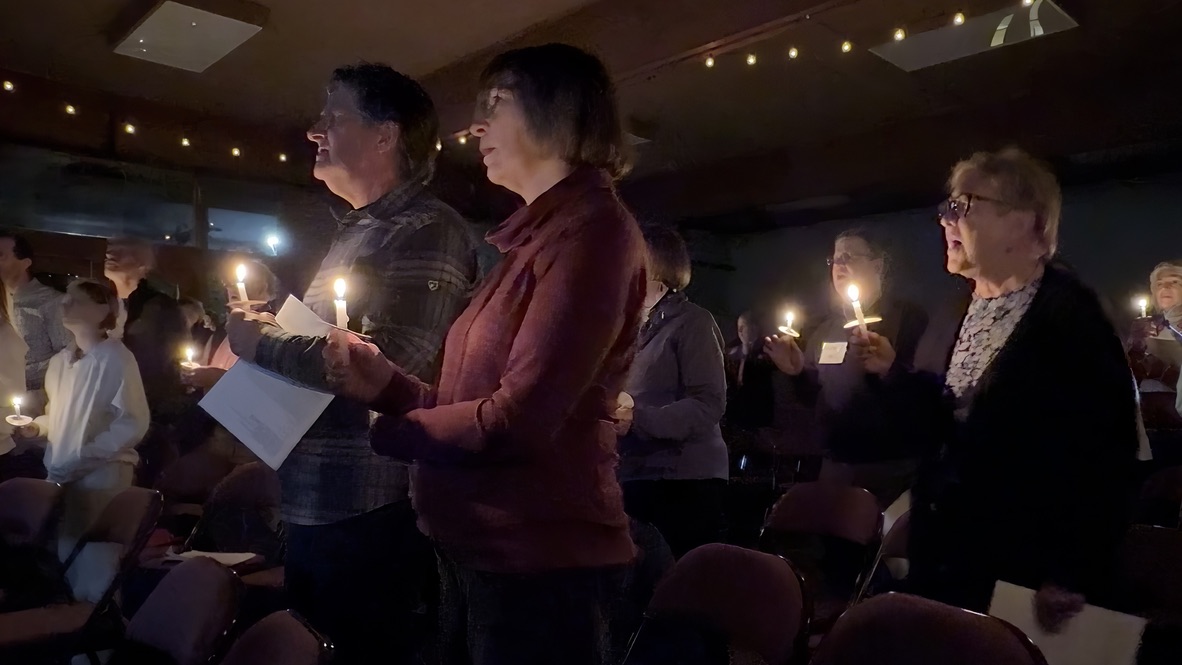
Easter Vigil 2025 at St. Barnabas, Bainbridge Island, Washington.

Many churches don’t do the Easter Vigil, and of those that do, all too few give it proper attention as the richest and most luminous liturgy of the entire year. It requires a lot of preparation, effort and energy at the end of a very labor-intensive week. It also involves a long-term project of educating a congregation to understand the Vigil as the preeminent Easter rite.

You can celebrate the Resurrection gloriously on Sunday morning, but if you want to experience Resurrection in a kind of Christian dreamtime, come to the Vigil as well. And if you are in a community which already knows the unique power of the Vigil experience, I encourage you to explore the potential of its stories to empower our bodies and restore our souls in this dark and dangerous age.

If you are not part of a community that does the Easter Vigil, I thank you for reading this far anyway. But if you are in a position to shape a creative Vigil, here are some suggestions to get you started.

You may want to begin with just one or two stories. Find the creatives in your community and form a team to study the texts and discern what they are trying to say now. And think about the connections they make with our lives and our society. For example, footage from the Minneapolis protests could be part of the Red Sea saga, or the king’s ruffians throwing their victims into the fiery furnace could be dressed like ICE agents.

Decide for each story whether to use simple storytelling (one or more voices, scripted or retelling freely) or more theatrical means (scripts, actors, visual design, visual media, singing, musical score, sound effects, etc.). Think about ways to involve children (e.g., animals on the ark, or part of the Red Sea march to freedom) and even the whole assembly, through singing or collective reading, like a Greek chorus, of projected words on a screen. Involving as many people as possible in creating and performing the stories bolsters both attendance and enthusiasm. Play with ideas, images and words until the stories take shape. Then provide sufficient time for learning lines and rehearsals.

Ideally, the Story Space will be separate from the worship space. A parish hall is usually more flexible than a church interior in terms of seating and a stage area. If there is a screen or a large white wall, large images can be projected. Strings of party lights on a dimmer and LED spotlights with variable colors are easy ways to restrict light to the stage area and establish the mood for each story. The other advantage of a separate Story Space is that a liturgy conducted in a sequence of spatial locations underscores the Vigil as a journey—from the New Fire outside to the Story Space to the font to the altar and finally back into the world.

And let each story be followed by an appropriate song (I use both folk music and contemporary songwriters to fit the relaxed spirit of “tales around the sacred campfire,” in contrast to the chant and hymnody in the church portion of the liturgy). Then comes a bidding to prayer, summarizing the themes of the particular story.

Let me close with the bidding I wrote to follow The Valley of Dry Bones. It expresses everything I want to say about the liberating power of our stories to resist evil, proclaim hope, and lift up our hearts:

Dear People of God: There are those who tell our story as a history of defeats and diminishments, a narrative of dashed hopes and inconsolable griefs. But tonight we tell a different story, a story that inhales God’s own breath and sings alleluia even at the grave. By your baptism, you have been entrusted with this story, to live out its great YES against every cry of defeat.
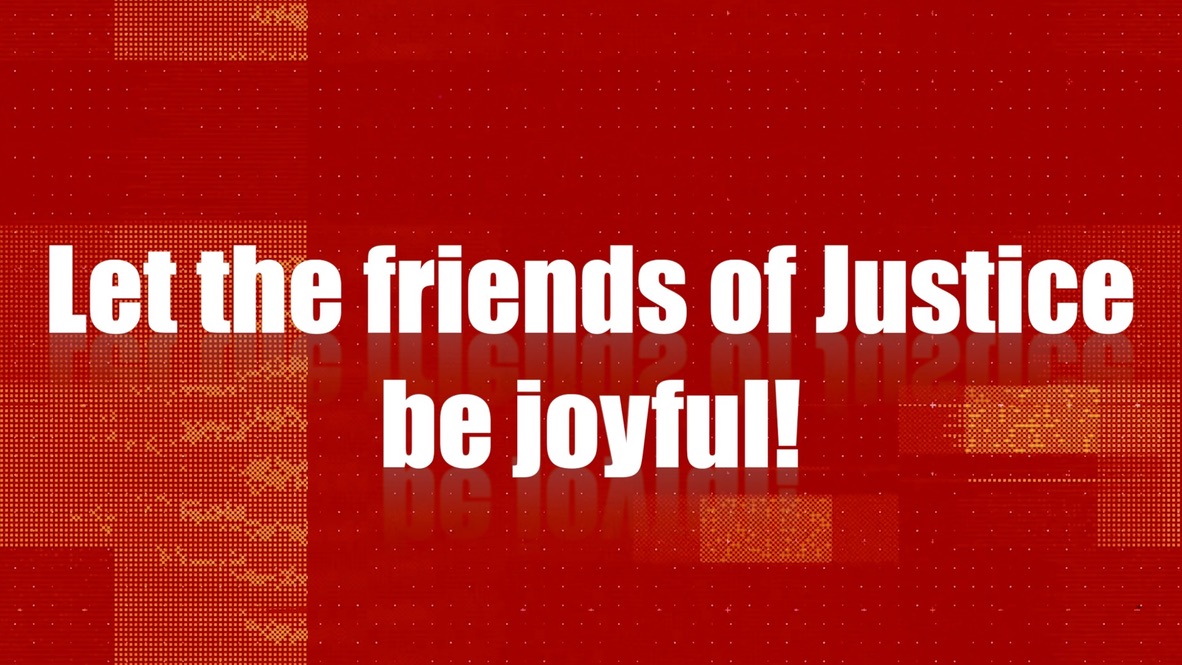
Psalm 68:3, one of the texts projected in the background of the Red Sea story.


Murder in Minneapolis: “It is not okay to be silent anymore”

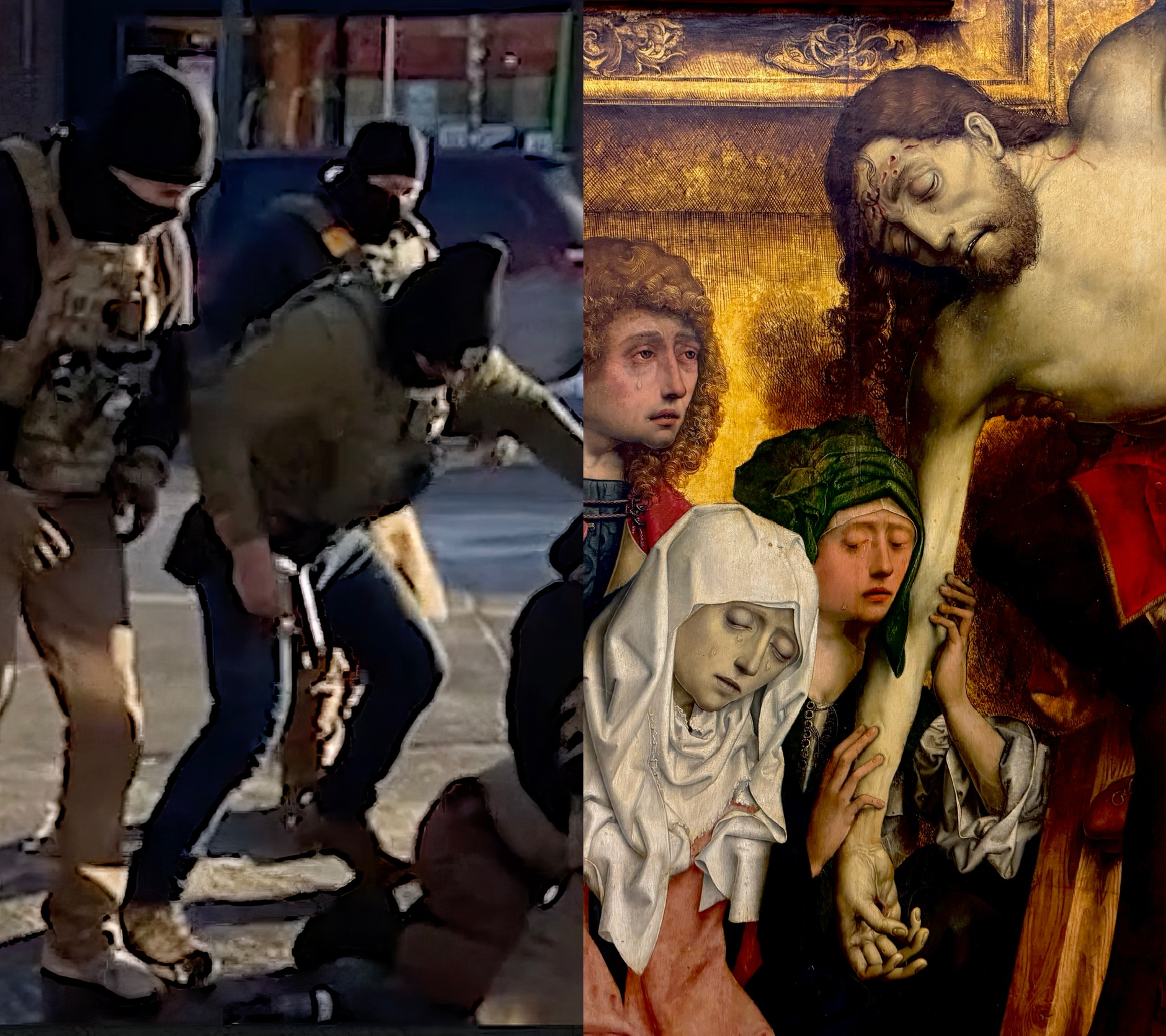
Minneapolis Diptych: ICE killers (anon. 2026) and Descent from the Cross (anon. 15th century)

There is no suffering which in the history of the world is not God’s suffering, no death which has not been God’s death in the history on Golgotha.

— Jürgen Moltmann

Jesus will be in agony even to the end of the world. We must not sleep during that time.

— Blaise Pascal

It is not okay to be silent anymore.

— Jeanelle Austin

In the face of the barbaric cruelty and violence by the lawless agents of a rogue administration, the voices of resistance, justice and love are crying “No!” That cry is taking many forms, and as a Christian I am thankful that so many people of all faiths are making their voices heard and putting their bodies—and their belief—on the line. I know that many passionate voices were raised in pulpits across the land last Sunday, one day after Alex Pretti was killed by ICE. Let me share with you one particular example from St. John the Evangelist Episcopal Church in Saint Paul, Minnesota.

January 25 was the Third Sunday after the Epiphany, whose Scripture readings included Isaiah’s “The people who walked in darkness have seen a great light,” and Jesus’ call to “Follow me.” The guest preacher was the Rev. Mike Kinman who, like many other clergy, had come from afar to join the mass protests in the Minneapolis streets. In an apostolic spirit, he told the rest of us what he had witnessed there: crucifixion, yes, but also resurrection—and the stirrings of the Spirit—in the solidarity of the people.

I encourage you to listen to Kinman’s urgent and inspired words in the 22-minute video below, and to keep the conversation going wherever you are as you continue to forge your own godly response to these harrowing times. Be yourself God’s candle in the darkness.

And don’t miss the sermon’s stunning ending, when the preacher exits the pulpit, leaving the final word to Jeanelle Austin, a theologically trained activist for racial justice in Minneapolis. She herself was not physically present. Her prophetic plea for justice, recorded a day earlier on Nicollet Avenue where Pretti died, was played through the church’s sound system.

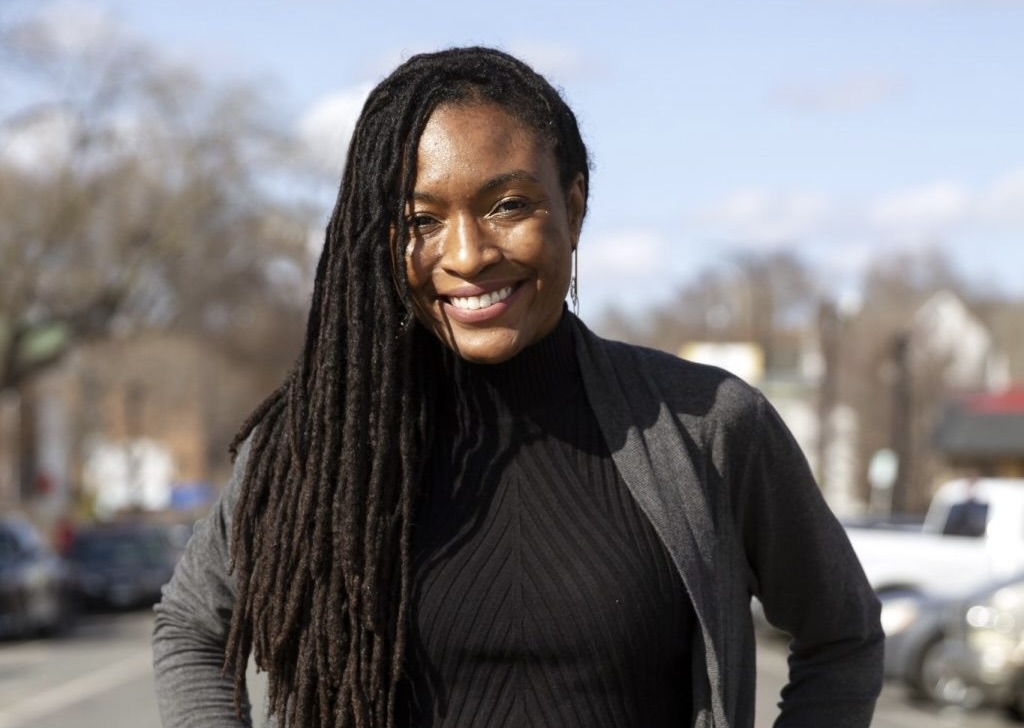
Jeanelle Austin, Executive Director, George Floyd Global Memorial.

This sermon’s striking final image—an empty pulpit as we hear Austin’s words ring out—strikes me as a compelling analogue of divine speech: a message delivered by a human voice, but coming from a transcendent source beyond our sight—not just from Nicollet Avenue, but from the heart of the crucified God.

The Rev. Mike Kinman preaches at St. John the Evangelist Episcopal Church in St. Paul, MN), on January 25, 2026, one day after Alex Pretti was killed by federal agents.

“Not dark yet, but it’s getting there” — What Can America Learn from the Nazi Occupation of Paris?

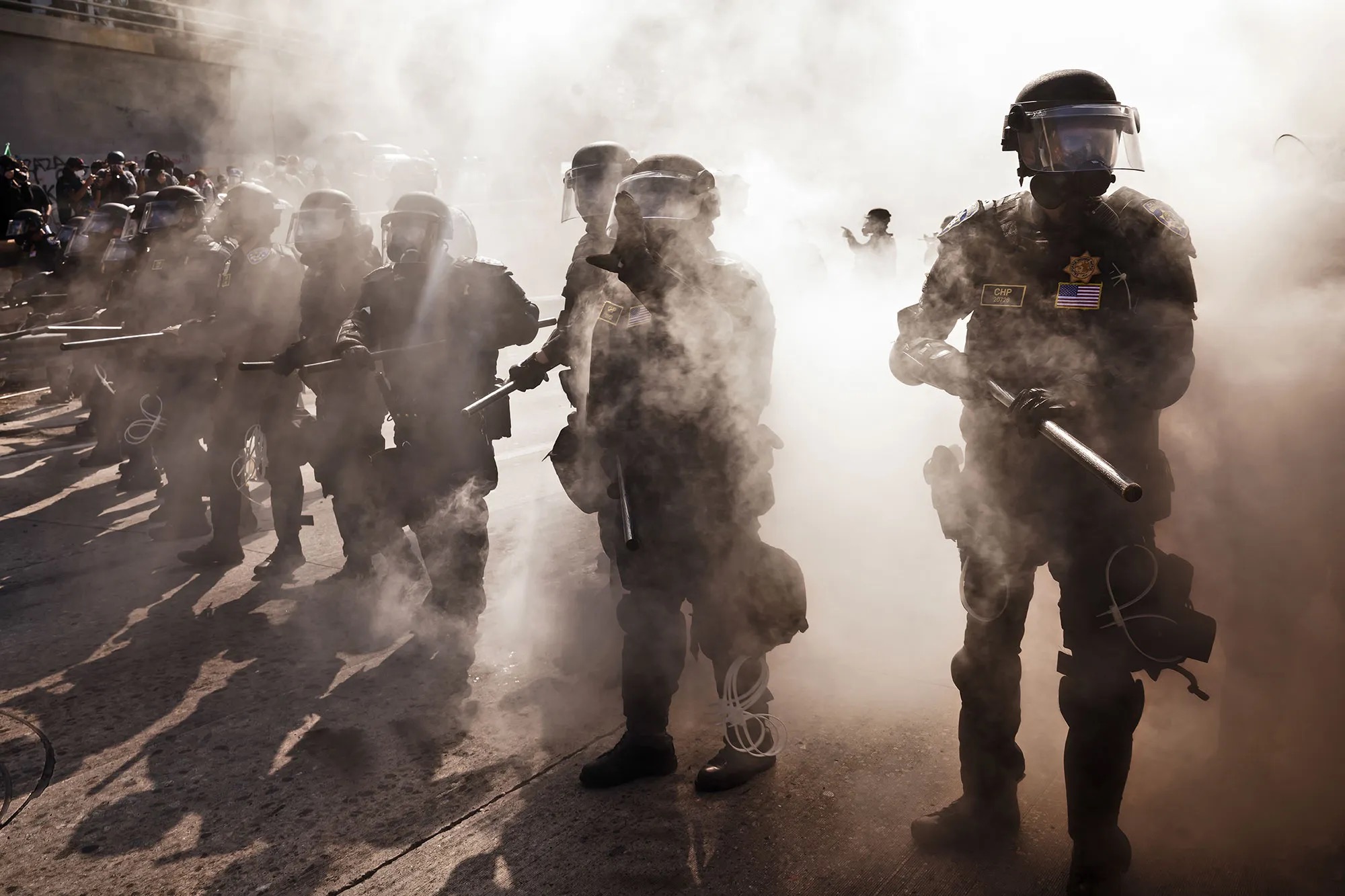
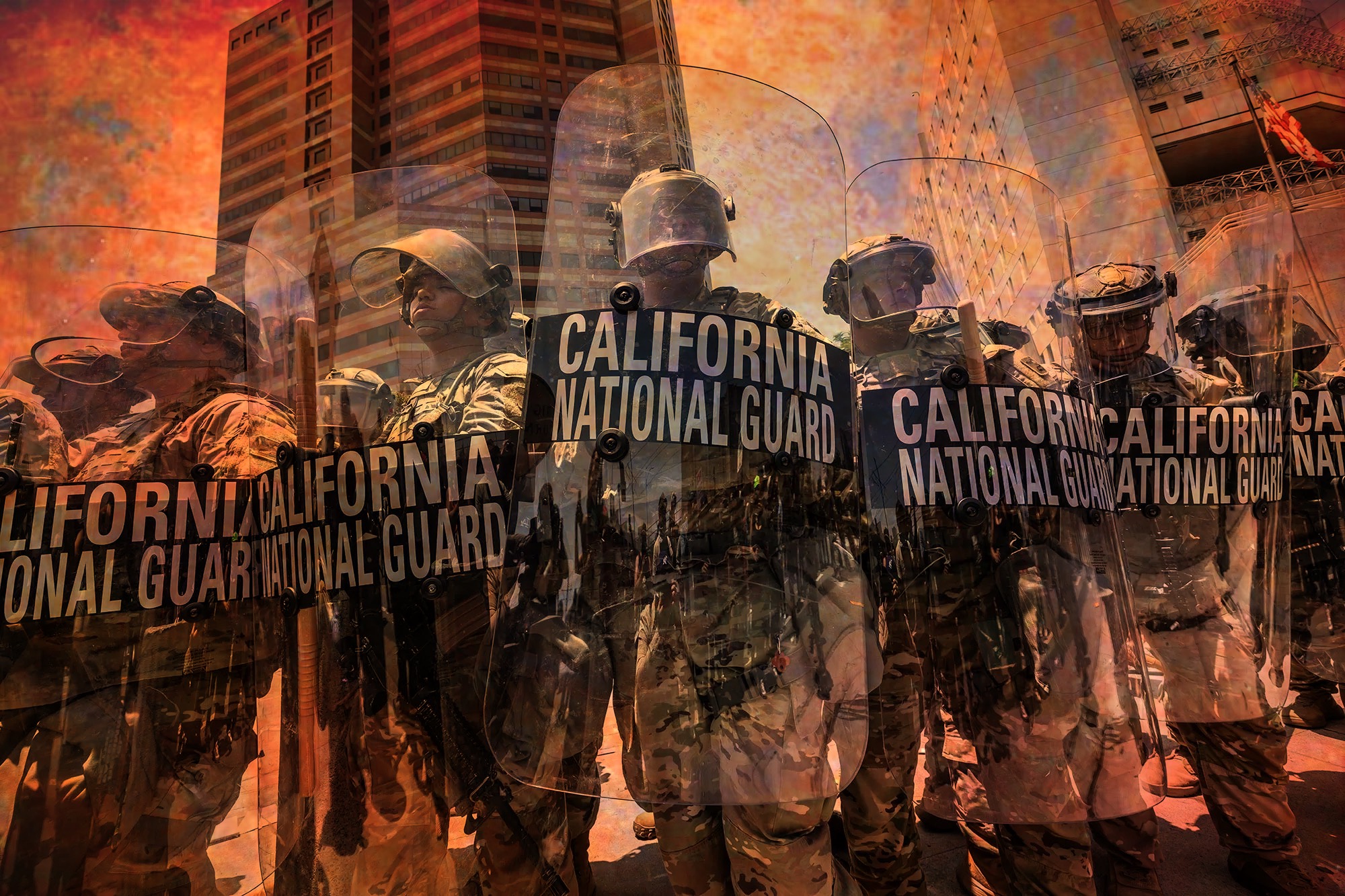
Police clear demonstrators from a freeway during the right wing occupation of Los Angeles in June 2025.

Survivors of the twentieth century, we are all nostalgic for a time when we were not nostalgic. But there seems to be no way back. — Svetlana Boym

In the Second World War, Paris was spared the physical destruction suffered by so many other cities. It surrendered without a fight to the Germans, some of whom cherished fond memories of living there as students before the war. And the Nazi government, believing itself to be the future of Europe, had no desire to smash such a cultural icon into rubble. It coveted the prestige of the City of Light for itself.

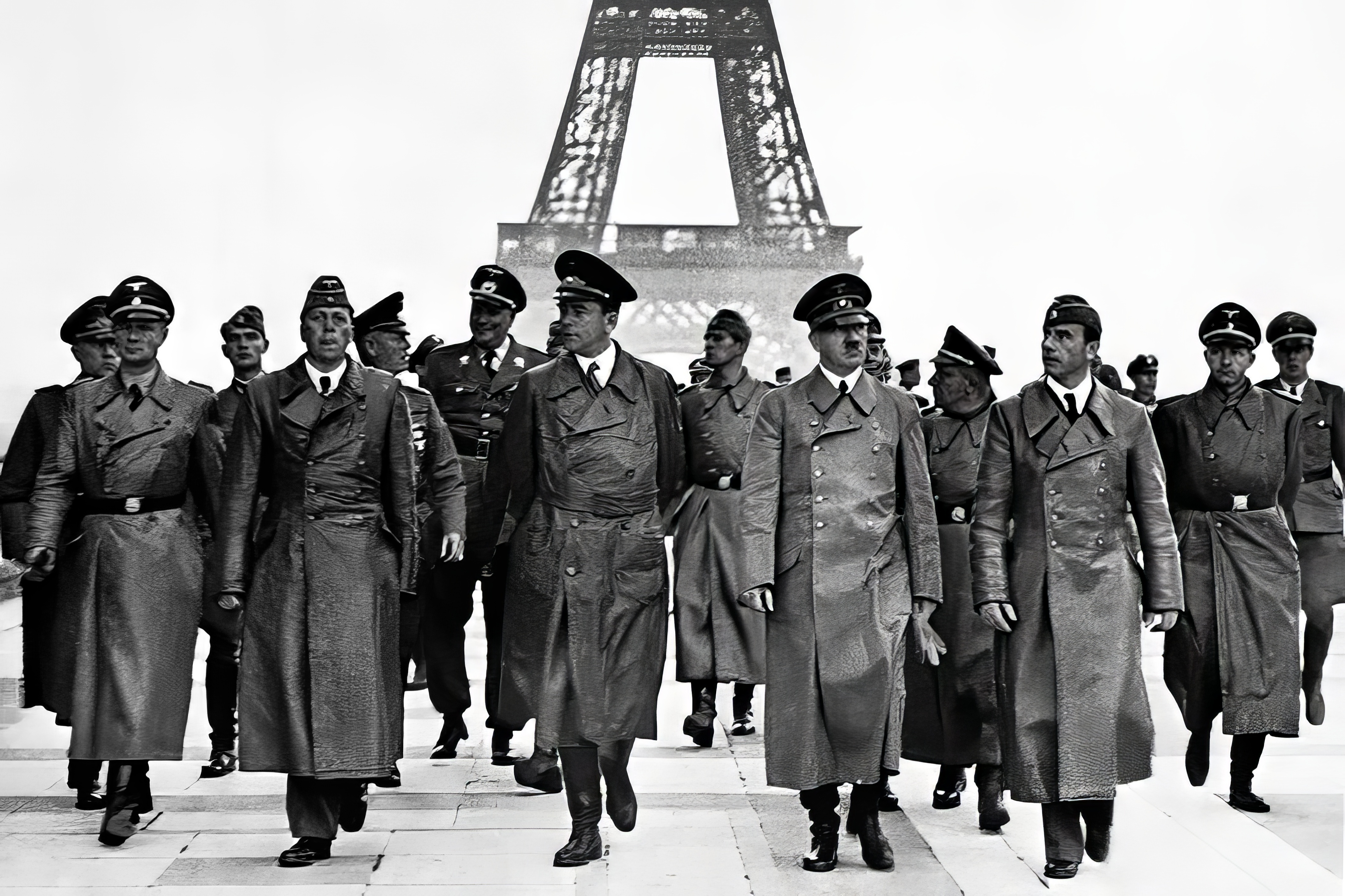
Hitler’s entourage in Paris (June 28, 1940). He was gone the next day, and never saw the city again.

The example of a city physically unchanged while suffering the invasive presence of a hostile power may have something to teach Americans, whose own cities face threats of military occupation by the dictatorial regime in Washington, D.C.. When I read Ronald C. Rosbottom’s riveting study, When Paris Went Dark: The City of Light Under German Occupation, 1940-1944, I could not help noticing some striking parallels to our own “les annes noires” (the dark years).

The radical right in the United States likes to dismiss any comparisons between Nazis and themselves as hyperbolic and slanderous, and it is fair to argue that their own movement may never go as far as the Nazis did. It’s too early to tell. But they’ve made a good start: terrorizing the vulnerable with the ICE-capades of masked thugs, demonizing and disappearing “aliens” and “enemies,” attacking the judicial system, vitiating the free press, purging opposition in the military and civil service, compelling the complicity of corporate leaders, seducing gullible and idolatrous evangelicals, and corrupting everything they touch. Fueling it all is their ceaseless stream of lies and propaganda. As Hannah Arendt warned in the aftermath of World War II:

“If everybody always lies to you, the consequence is not that you believe the lies, but, rather, that nobody believes anything any longer. And the people that no longer can believe anything cannot make up its mind. It is deprived not only of its capacity to act, but also of its capacity to think and to judge. And with such people, you can then do what you please.” [1]

Parisians tried to look the other way, but the invaders were everywhere (Photo by André Zucca for Signal, a German propoganda magazine).

Much more could be said about that, but for now our subject is the occupation of Paris. When the Germans entered the French capital in June, 1940, they encountered no resistance. Parisians were disheartened by the swift collapse of the French army and unhappy to see so many German soldiers and officials suddenly walking their streets and filling their cafés, but what could they do? Many fled Paris before the troops arrived, but most of those returned when they saw how “normal” things seemed. Daily life was not radically affected at first, and few thought the occupation would last such a long time. There was shame in defeat, certainly, and resentment of a foreign presence, but for a time passivity and resignation kept the anger of many Parisians’ turned inward.

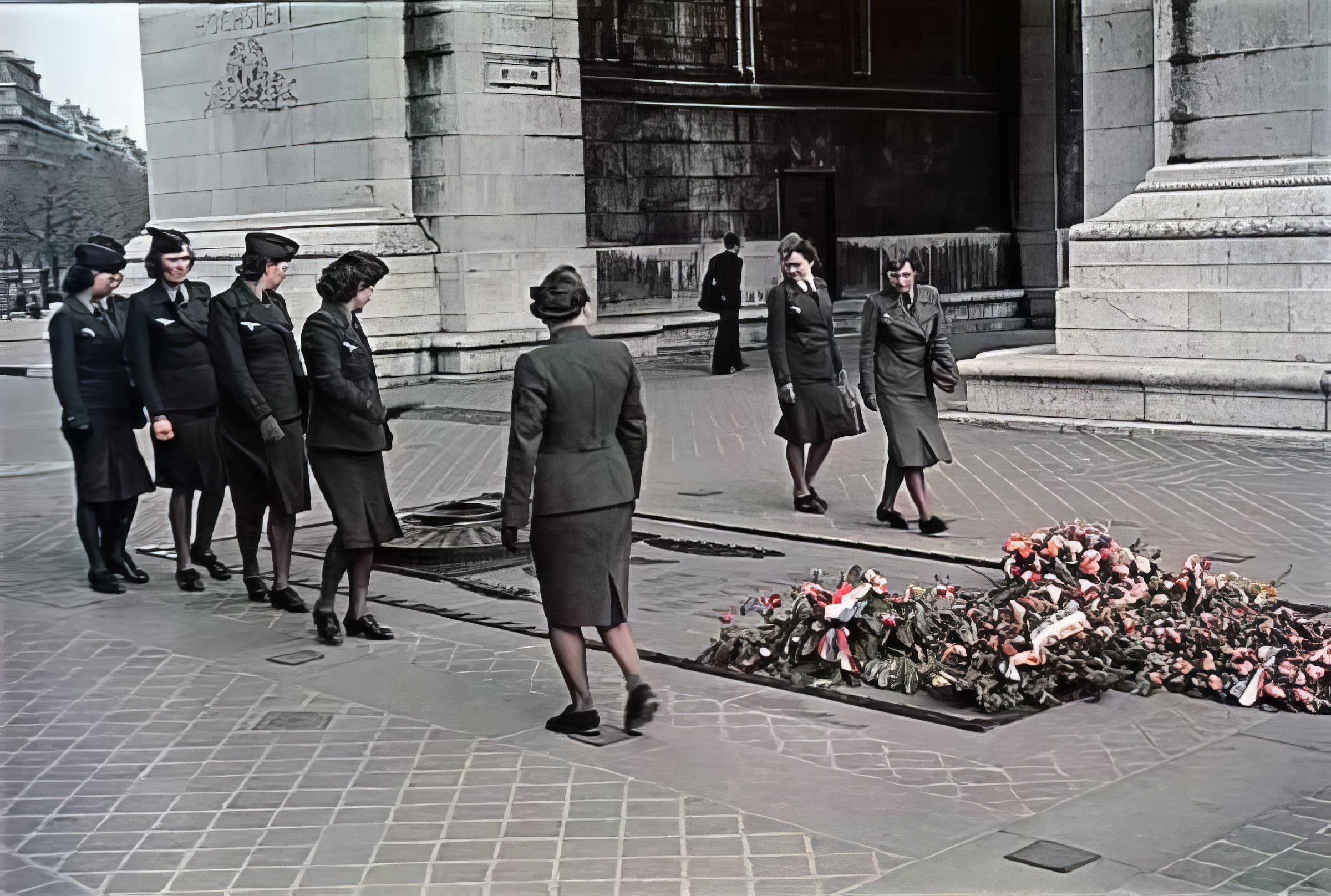
German soldiers at the Arc de Triomphe. The Occupation produced an invasion of unwanted tourists (Photo by André Zucca for Signal, a German propoganda magazine).

There was a degree of make-believe on both sides. German soldiers were instructed to be polite. If someone drops a package on the sidewalk, pick it up for them. Parisians tried not to reciprocate any such acts of kindness, but to practice what they called Paris sans regard (“Paris without looking”). As much as possible, pretend the Germans don’t exist. Over time, this depersonalization would create a great sense of loneliness among the occupiers. As for Parisians, the make-believe minuet with the occupiers was both wearying and fragile. As one young man wrote in his journal,

“In spite of oneself, one dreams, laughs, and then falls back into reality, or even into excessive pessimism, making the situation more painful.” [2]    

A month after the Germans arrived, “Tips for the Occupied,” a mimeographed flyer, began to appear in apartment mailboxes. “Don’t be fooled,” it warned. “They are not tourists … If one of them addresses you in German, act confused and continue on your way … Show an elegant indifference, but don’t let your anger diminish. It will eventually come in handy …” [3]

The sense of normality didn’t last. The restaurants, cabarets and cinemas remained crowded, but when audiences began to boo and jeer at Nazi newsreels, the houselights would be turned up. People lost their courage when they could be easily spotted. Parisians also learned to be careful about saying the wrong thing in a café. Neighbors began to denounce each other to the authorities. Singing “The Marseillaise” in public became a punishable crime.  

As the Occupation dragged on, the sense of dépaysement (“not feeling at home”) began to wear on the soul. Historian Jean-Paul Cointet describes the condition in his 2001 study of wartime Paris:

“The Parisian now knows the condition of being ‘occupied’ in a city that does not belong to him anymore and that offers him the schizophrenic images of an environment suddenly foreign to his gaze. Constraints and humiliations, restrictions and punishments accompany this disorientation and the upending of daily routine.” [4]

Troops at a federal detention center in Los Angeles (Ted Soqui for Cal Matters, June 8, 2025).

The narrowing of space—both physical and psychological—became increasingly oppressive, as Rosbottom notes:

“Whether because of the sight of German uniforms, the closed-off streets, the insufficient nourishment, the cold winters, crowded transportation, long lines—or just the suffocating feeling of being suspicious of one’s acquaintances, neighbors, or even family—the city seemed to be contracting, closing in on Parisian lives, as the Occupation dragged on.” [5]

By the bitterly cold winter of 1941, life just got harder. Shortages of food and coal brought malnutrition and sickness, especially among the lower classes. French police, willing agents of Nazi oppression, started to raid neighborhoods known for Jewish or immigrant populations. At first, Parisians in uninvaded neighborhoods could close their eyes and swallow the lie that the authorities were simply trying to control immigration and prevent terrorism.

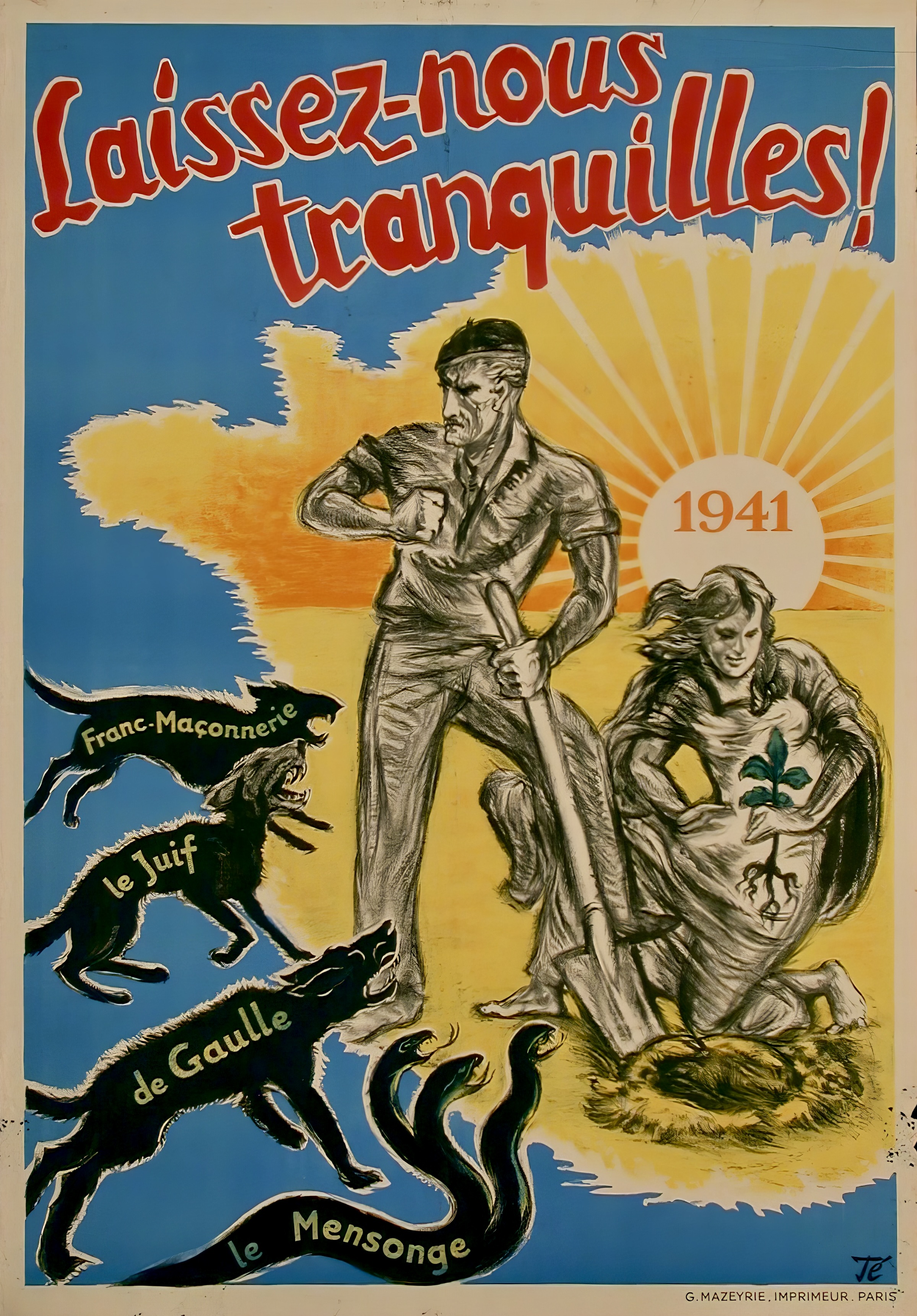
“Leave us in peace!” A German propaganda poster show Vichy France threatened by its perceived enemies: Freemasons, Jews, de Gaulle, and “lies.”

However, by mid-1942, rumors of the “final solution” began to reach Paris, and the mass roundups of Jews in France became impossible to ignore. “[Most Parisians] certainly did not know of the plans to deport them to their deaths,” writes Rosbottom, “but to their deaths they went: the last, sad convoy to carry children, three hundred of them, left Drancy for Auschwitz on July 31, 1944 … The final transport of adult deportees left on August 17, a week before Paris would be liberated.” [6]  

Ernst Jünger, a cultured writer serving as a captain in the occupying Wehrmacht, kept a journal of the Occupation. In July 1942 he wrote:

“Yesterday some Jews were arrested here in order to be deported—first they separated parents from their children, so firmly that one could hear their distressed cries in the streets. At no moment must I forget that I am surrounded by unhappy people, humans experiencing the most profound suffering. If I forgot, what sort of man or soldier would I be?” [7]  

Jünger may have shed a tear, but he continued to serve as a loyal employee of the Nazi death industry, whose business, as Hannah Arendt so bluntly noted, was “the mass production of corpses.” [8]

Hélène Berr also kept a diary, from Spring, 1942 until Spring, 1944. As a young Jewish woman, she tried to keep terror at bay by imagining herself in a Paris magically untouched by the darkness. A student at the Sorbonne, she copied out verses of Keats to calm her soul, and took refuge in her friendships. She made frequent walking tours of the city she loved, as if to reclaim possession of Paris from the occupiers who made her wear a yellow star, the mark of social exile.  

In April of 1943, Hélène wrote:

“I’ve a mad desire to throw it all over. I am fed up with not being normal. I am fed up with no longer feeling free as air, as I did last year. It seems that I have become attached to something invisible and that I cannot move away from it as I wish to, and it makes me hate this thing and deform it … I am obliged to act a part … As time passes, the gulf between inside and outside grows ever deeper.” [9]   

As Rosbottom notes, personal accounts of the period recall “the sound of police—French police—beating on the door” as their “most vivid aural memory.” [10]  In March 1944, that percussive death knell sounded in the Berr’s apartment. Hélène, along with her parents, was arrested, but she managed to slip her journal to their cook before the police barged in. Three weeks later the Berrs were on a train to Auschwitz. They never returned. Hélène’s beloved Paris would be liberated five months later.

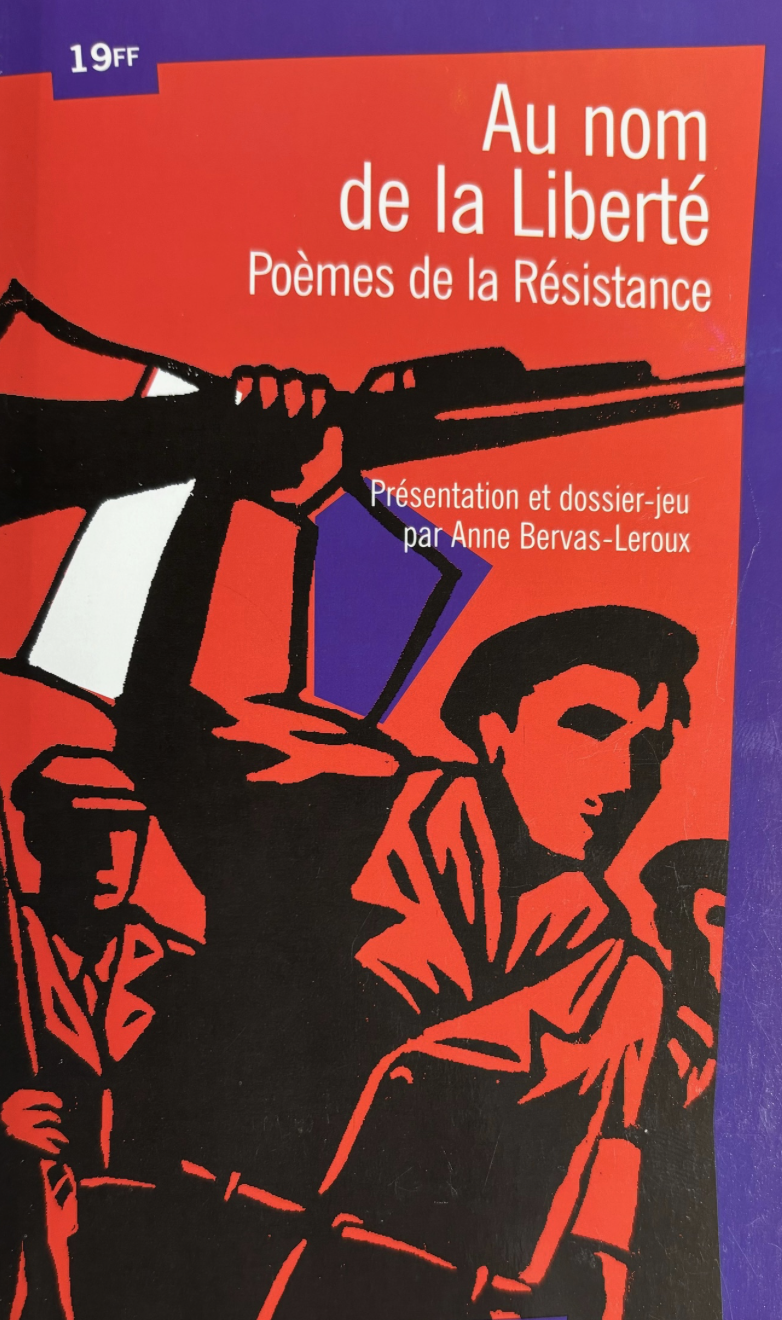
Illustration for a collection of French Resistance poetry.

There were many forms of active resistance to the Nazis in France, but the number of French patriots who risked their own lives was relatively small—less than 2% of the population. The threat of death and brutal reprisals was too daunting for most. For a visceral immersion in the anxious milieu of the French Resistance, watch Jean-Pierre Melville’s haunting film, Army of Shadows. Critic Amy Taubin’s summary of the film feels descriptive of wartime Paris: “Elegant, brutal, anxiety-provoking, and overwhelmingly sad.” [11] One resister recounted his experience in an interview decades after the war:

“Fear never abated; fear for oneself; fear of being denounced, fear of being followed without knowing it, fear that it will be ‘them’ when, at dawn, one hears, or thinks one hears, a door slam shut or someone coming up the stairs. Fear, too, for one’s family, from whom, having no address, we received no news and who perhaps had been betrayed and were taken hostage. Fear, finally, of being afraid and of not being able to surmount it.” [12] 

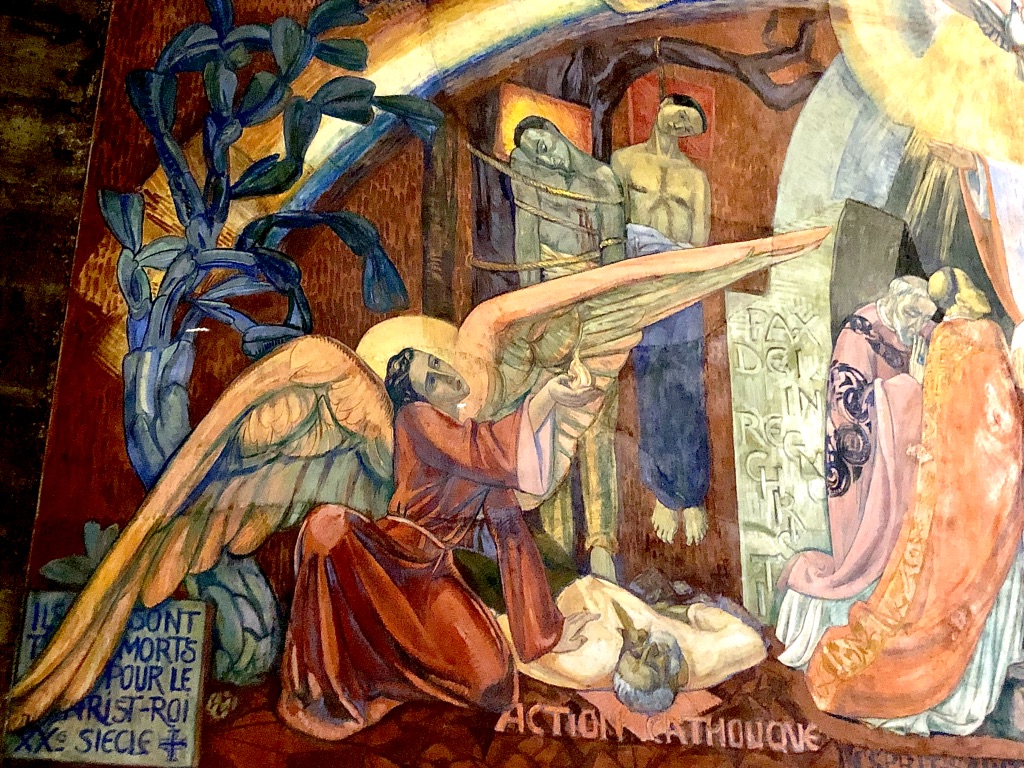
A prewar fresco of modern martyrs who refused to bow to anyone but Christ (Église du Saint-Esprit, Paris, 1930s).

As I read Paris in the Dark, I had to wonder: Is this America’s future? For many of us (to borrow a line from Bob Dylan), “It’s not dark yet—but it’s getting there.” Daily life —for now, at least—goes on pretty much as usual. But for some of our neighbors, the darkness has definitely arrived. The military occupation of cities. The terrifying knock on the door. The roundups, disappearances, and concentration camps. The shamelessly gleeful cruelty. Demonization, bigotry and hate. The repression of customary freedoms. The criminalization of dissent. The collapse of legal safeguards. The willing complicity of the powerful with the enemies of life.

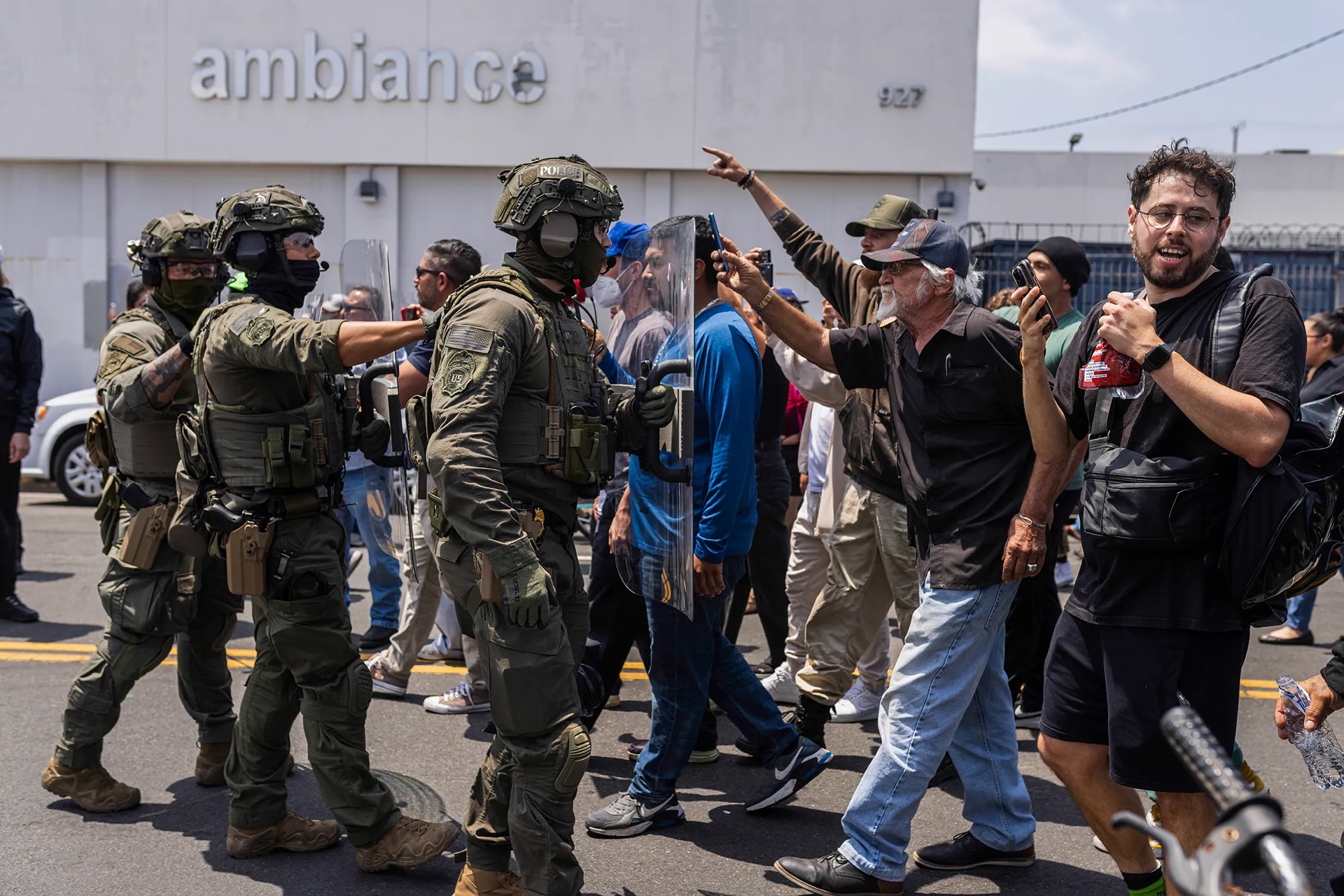
Citizens try to block an ICE roundup of immigrants at the Ambiance Apparel factory, downtown Los Angeles (J.W. Hendricks for CalMatters, June 6, 2025).

I am not without hope. Seven million protesters took to the streets on No Kings Day. Then large majorities voted against America’s reign of madness. And regardless of any political swings of the pendulum, I believe that resurrection continues to plant its seeds among the blind sufferings of history. But the oligarchs and fascists won’t go quietly. On the day after the recent election, the Episcopal Daily Office included this timely verse from the Book of Revelation:

Woe to the earth and the sea,
for the devil has come down to you
in a great rage,
because he knows that his time is short. (Rev. 12:12)

The Beast and Satan rage, but their time is short (Apocalypse Tapestries, Angers, France, 1373-1382).

This Scripture feels ripped from the headlines. We know that satanic rage all too well. It has sickened our country, and we struggle to keep it out of our own hearts. May its time be short. In the meantime, the woes are not done. God’s friends have their work cut out for them. Believe. Resist. Endure.

And guard your heart against the demons of dejection and despair. After Trump’s election in 2016, I suggested seven spiritual practices for the time of trial: pray, fast, repent, prophesy, love, serve, hope. Click the link for the details. Nine years later, these practices are more necessary than ever, and I encourage you to share the link as a small act of resistance.

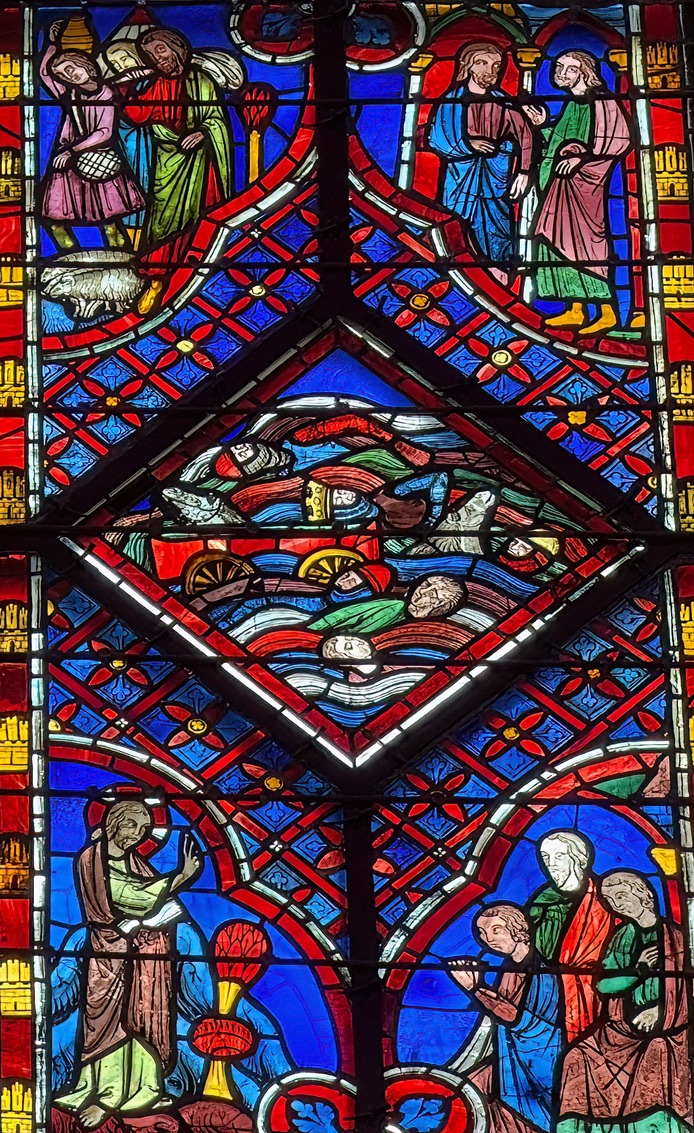
Pharoah sent his troops to round up the Israelites, but the forces of violence ended up sleeping with the fishes (13th-century window, Sainte-Chappelle, Paris).

Finally, don’t be in love with outcomes. Divine intention takes mysterious forms, and should not be confused with our own plans. Let us heed the counsel of two twentieth-century saints who were deeply committed to holy resistance and well acquainted with its challenges and ambiguities. Dietrich Bonhoeffer, martyred in a Nazi prison in 1945, believed that we must always act with deep humility, shedding our presumptions about the part we play or the difference we make. Don’t fret about your success. Just be faithful to Love’s command:

“No one has the responsibility of turning the world into the kingdom of God … The task is not to turn the world upside down but in a given place to do what, from the perspective of reality, is necessary objectively, and to really carry it out.” [13]

And Thomas Merton, who forged a delicate balance between contemplation and activism, taught that right action is not a tactic but a persistent way of being, grounded in something deeper and more enduring than any of our consequences:

“The message of Christians is not that the kingdom ‘might come, that peace might be established, but that the kingdom is come, and that there will be peace for those who seek it.’” [14]

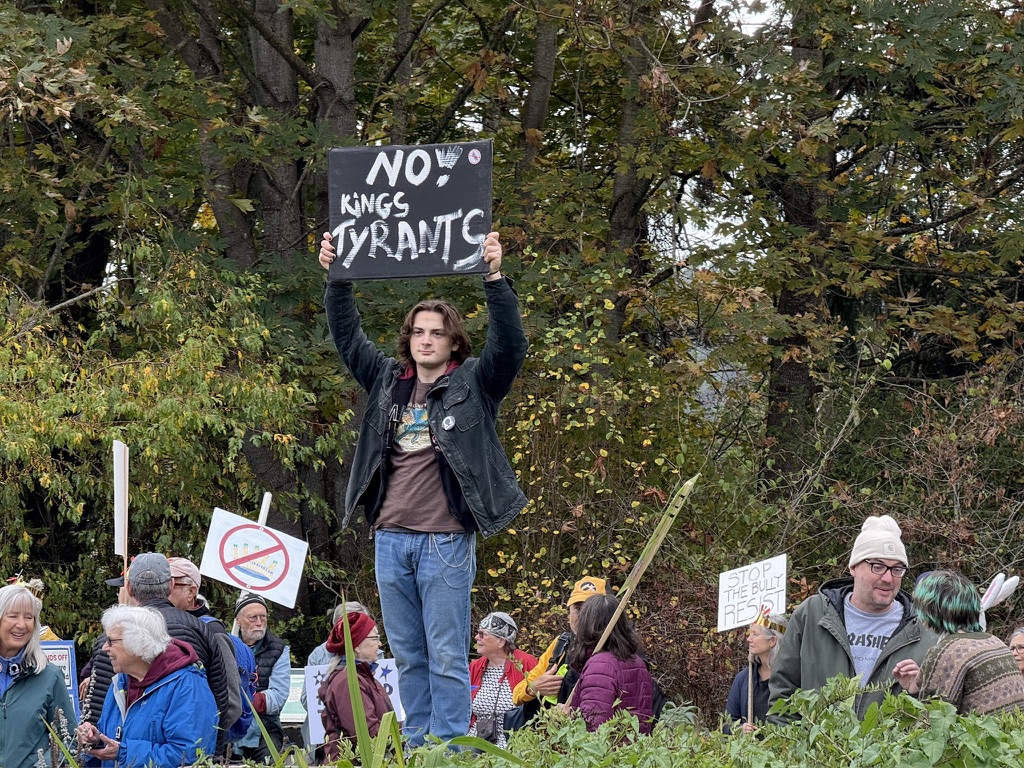
No Kings Day on Bainbridge Island, Washington (Photo by the author, October 18, 2025).


[1] Hannah Arendt, quoted in the PBS documentary, Hannah Arendt: Facing Tyranny (American Masters, 2025).

[2] Ronald C. Rosbottom, When Paris Went Dark: The City of Light Under German Occupation, 1940-1944 (New York: Back Bay Books, 2014), 106.

[3] Ibid., 196-197. The flyer was produced by Jean Texcier.

[4] Ibid., 160.

[5] Ibid., 161.

[6] Ibid., 286.

[7] Ibid., 154.

[8] Hannah Arendt: Facing Tyranny.

[9] Rosbottom, 256.

[10] Ibid., 160.

[11] Amy Taubin, ”Out of the Shadows,” Criterion booklet for their 2010 Blu-ray release of Melville’s 1969 film.

[12] Rosbottom, 223, quoted from interviews with WWII resisters published in 2012.

[13] Dietrich Bonhoeffer, q. in Christiane Tietz, Theologian of Resistance: The Life and Thought of Dietrich Bonhoeffer (Minneapolis, MN: Fortress Press), 121.

[14] Thomas Merton, Turning Toward the World: The Journals of Thomas Merton, Volume Four, 1960-1963 (New York: Harper Collins, 1996), 188.

Thinking About America on Bastille Day

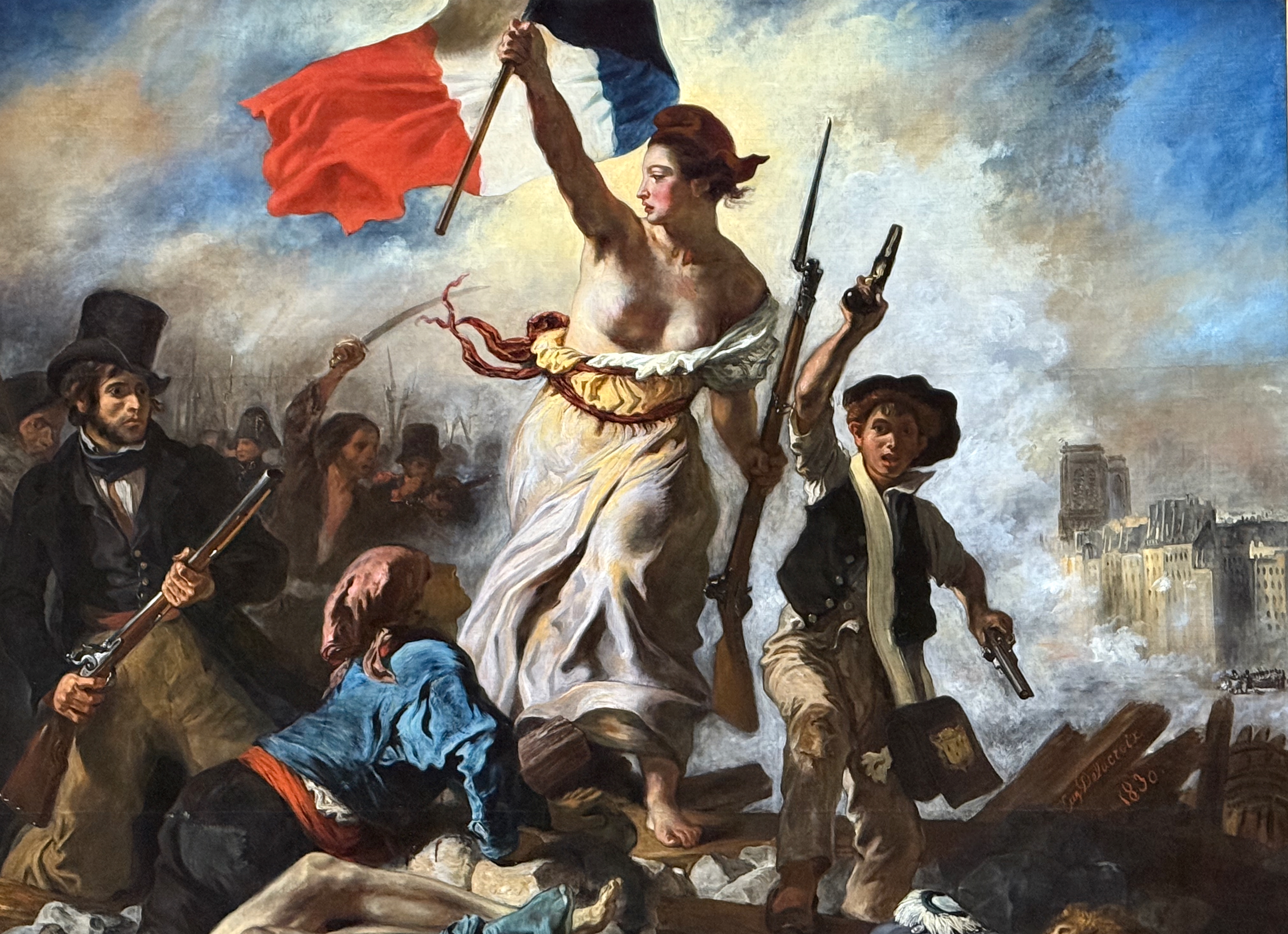
Eugène Delacroix, LIberty Leading the People (1830).

“Nothing collapses more quickly than civilization during crises like this one [the French Revolution of June 1848]; lost in three weeks is the accomplishment of centuries. Civilization, life itself, is something learned and invented … After several years of peace men forget it all too easily. They come to believe that culture is innate, that it is identical with nature. But savagery is always lurking two steps away, and it regains a foothold as soon as one stumbles.”

— Sainte-Beuve [i]

When an inflamed crowd of Parisian citizens stormed the Bastille on July 14, 1789, the obsolete medieval fortress had long outlived its usefulness as an instrument of royal tyranny. It was destined for demolition, and a mere seven prisoners inhabited its dungeons when the crowd broke through the gates. A year later, Lafayette presented the key for the Bastille to President George Washington, honoring the quest for liberty by both countries. The key still resides at Washington’s Mount Vernon home.

Historians have suggested that the king’s capitulation to the political power of commoners (the ‘Third Estate’) on July 9 marks the true beginning of the French Revolution, but the bloody drama of Bastille Day proved a more potent symbol than the parliamentary negotiations being conducted at the king’s palace of Versailles. In any case, the once unthinkable destruction of the Ancien Régime had been decades in the making.

In The Revolutionary Temper: Paris, 1748-1789, American historian Robert Darnton traces the growth of revolutionary sentiment as it was expressed in the Paris street: café conversations (often transcribed by police spies), underground gazettes and pamphlets, street songs, sidewalk speeches, public demonstrations and processions, and personal diaries. Eighteenth-century Paris had its own version of an information society, where “the ebb and flow of information among ordinary Parisians” was shared widely in cafés, marketplaces, wineshops, street corners and salons. [ii]

When the 72-year reign of Louis XIV ended in 1715, it was hard to imagine an alternative to absolute monarchy. His successor, Louis XV, would still be claiming dictatorial authority as late as 1766:

“In my person alone resides the sovereign power: from me alone my courts derive their existence and their authority, without any dependence and any division.” [iii]

“Although the words were printed on paper, the messages of pamphlets flew through the air and mixed in the cacophony known as bruits publics [‘public rumors’]. Pamphlets were bruited about. They were read aloud, performed, applauded, rebutted, and assimilated in the talk that filled lieux publics [“public places”]. Readers also pondered tracts in the quiet of their studies, but when they went outside they encountered other Parisians, in marketplaces, along the quais, in the courtyard of the Louvre, on benches in the gardens of the Palais-Royal, the Tuileries, and the Luxembourg palace. Like smoke from thousands of chimneys gathering over the city, a climate of opinion gradually took shape.” [v]

It took half of the eighteenth-century to produce such a climate of opinion in France, a ”revolutionary temper” which was perfected, like tempered steel, through repeated heating and cooling. People would complain about this tax or that scandal, this outrage or that cruelty, but the tectonic shift from specific complaints to general discontent and clamor for change was a process of decades. Only when the climate of opinion attained sufficient density was it possible to imagine the impossible. Once revolution became conceivable, the leaps from absolute monarchy to constitutional monarchy to no monarchy at all were breathtakingly swift.

Revolution doesn’t necessarily require the refinements of political theory. By 1788, the high cost of bread by itself (like our egg or gas prices) was enough to elicit calls for radical change. One angry woman in a boulangerie was heard to say, “They should march on Versailles and burn the place down.” [vi]  She was not alone, and by then the people of Paris were beginning to conceive of themselves as part of a movement, and act accordingly.

“Whether or not they followed the arguments of the theoreticians, Parisians were swept up in the conviction of becoming a nation, a sovereign body that would defy privileged orders and take charge of its own destiny. This way of constructing reality—the drawing of lines, the identification of a common enemy, the creation of a collective self-awareness—can be understood as a process of radical simplification. Although it had origins that went far back in the past, it came together with unprecedented force in 1788 and underlay a revolutionary view of the world: us against them, the people against the grands, the nation against the aristocracy.” [vii]

I could not read Darnton’s illuminating account without thinking of my own deeply troubled country. Although there are of course countless dissimilarities between 18th-century France and 21st-century America, some parallels got me thinking.

First of all, I found the accounts of a Paris alive with ardent conversations about public life to be inspirational. There was an urgency and a passion which feels lacking in America’s current collective consciousness. “Everyone writes, everyone reads,” said one of those pre-revolutionary Parisians. “Even the coachman reads the latest work on his perch,” said another. “Every person down to domestic servants and water carriers is involved in the debating.” [viii] But in America, 2025, while we may consume volumes of news in private, most of us carry on as if life is pretty much normal, even as our would-be dictator dispatches masked thugs to terrorize our communities, trains the military to act as his personal army, and builds concentration camps to torture and disappear his “enemies.”

Like 18th-century Paris, we need to converse with one another in earnest, employing a reliable flow of factual information and strategic thought to shape a collective consciousness for the common good. The forces of tyranny and greed have worked for decades to create its opposite, a seductive web of lies and rage to poison and incapacitate the consciences of millions of Americans. Those who care about the common good are still, I believe, in the majority, but that means nothing if we lack the means and the will to be connected with one another in public truth-telling, mutual encouragement, and collective action. As long as we feel isolated, alone and discouraged, tyranny will flourish.

I was also struck by the importance of imagining alternatives to consensus reality in our public life. A sense of inevitability is the mother of inaction. In France under Louis XIV, the monarchy seemed inevitable—until it didn’t. In America, at least until Trump, democracy and the rule of law were assumed to be inevitable. And while many of us have come to realize how fragile and conditional our democracy actually is, the press, along with many Democratic politicians, continue to play the game of “Let’s Pretend.”

Let’s pretend that everyone is playing by the same rules. Let’s pretend the president is not fascist, childish, ignorant, cruel, and increasingly incoherent and nonsensical. Let’s pretend that normal protocols are the best way to engage with him. Let’s pretend we don’t have an American gestapo, or a White House dominated by racists, white nationalists and shameless liars. Let’s pretend our government isn’t supporting genocide in Gaza, or robbing millions of their health care. Let’s pretend that climate change is nothing to worry about. Let’s pretend it’s all just politics as usual and both sides do the same thing, so there’s no cause for alarm.

Finally, I was intrigued by the theatricality of what the French called emotions populaires [mass protests]. Straw effigies of unpopular or disgraced officials were mocked, paraded through the streets, and forced to kneel before statues of honored officials and beg divine pardon. On one occasion, the crowd seized a passing priest, demanding that he hear the dummy’s confession. Eyed with suspicion as a symbol of the Ancien Régime, the priest was careful not to anger the crowd by refusing to play. He put his ear to the effigy’s mouth for a few moments, then declared to all that it had so many sins to confess that it would take all night! The people laughed, applauded the priest’s wit, and let him go. As for the dummy official, he “was pitched into a giant feu de foie [‘fire of joy’].” [ix]

I suspect that setting fire to effigies of our American tyrants would not be a safe practice these days, and I am aware that the emotions populaires in revolutionary Paris often led to serious violence. But I wonder if there might be, in our own acts of resistance and witness, creative theatrical ways to engage with flanks of armed soldiers or gangs of ICE agents using guerilla theater, humor, song, ritual, and even clowning and mime—anything to subvert, disarm, or transcend the deadly Punch and Judy face-off of venomous gazes. Is there any way to make the other laugh, or wonder, or think, if only for a moment? Send in the clowns! Could you still want to shoot someone who made you laugh—or cry?

You may say that I’m a dreamer, but I’m not (I hope) the only one.


[i] Charles Augustin Sainte-Beuve (1804-1869), a French literary critic, is quoted by George Eliot in Impressions of Theophrastus Such; cited in Frederick Brown, The Embrace of Unreason: France, 1914-1940 (New York: Anchor Books, 2014), 3.

[ii] Robert Darnton, The Revolutionary Temper: Paris, 1748-1789 (New York: W. W. Norton & Company, 2024), xix.

[iii] Ibid., 131.

[iv] Ibid., 333.

[v] Ibid., 390.

[vi] Ibid., 366.

[vii] Ibid., 400.

[viii] Ibid., 391.

[ix] Ibid., 371.