Now in Flesh Appearing

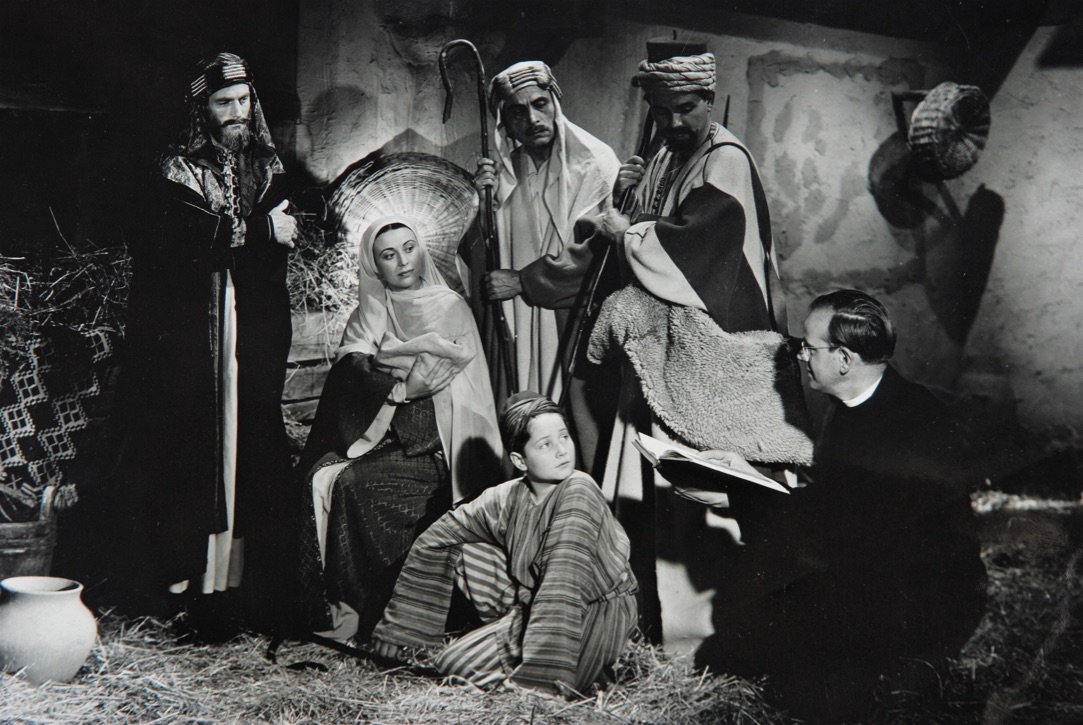
The Rev. James K. Friedrich (right) on the set of Child of Bethlehem (1940).

For he is our childhood’s pattern;
Day by day, like us He grew;
He was little, weak and helpless,
Tears and smiles like us He knew;
And He feeleth for our sadness,
And He shareth in our gladness.

— Cecil Frances Alexander, “Once in Royal David’s City”

My sisters and I each had an unusual childhood connection with the Nativity story. Our father, the Rev. James K. Friedrich, was the pioneer of Christian movie-making in America, and one of his first biblical films was Child of Bethlehem, produced in 1941. My sister Martha was a newborn child then, so she got to play the baby Jesus. Nine years later, my father made Holy Night, the first of a twelve-part series on the life of Christ. I was four years old at the time—much too old to get the leading role—so I was cast as a shepherd boy, entering the stable with several adult shepherds.

In the film, I have a dazed look on my face. I was literally blinded by the light on the Hollywood soundstage where the interiors were shot. Film stock in those days was not as light-sensitive as our camera phones. It required intense illumination to register a proper image. A big row of Klieg lights set up behind the manger threw such a blaze into my eyes that I could barely see the Holy Family. When I hear Luke’s gospel report that “the glory of the Lord shone all around” the shepherds, the indelible memory of those lights at Goldwyn Studios comes to mind.

James L. Friedrich (next to the donkey) at the manger in Holy Night (1949).

My oldest sister, Marilyn, never played in a Nativity film. Hers was a more literal reenactment. In 1936, my parents had stopped in Jerusalem during their honeymoon. In those days, as today, there was violence in the land, and they were warned not to go down the hill to Bethlehem in a car, because cars were easy targets for snipers. It was safer to ride a donkey to the place of Jesus’ birth. My dad recorded their pilgrimage with his 16mm movie camera, and now, every Christmas, I can watch the footage of my mother riding a donkey to Bethlehem, pregnant with her firstborn child.

To Marilyn’s credit, she has never made any personal claims about her origins, but there is, I believe, gospel truth in our childhood memories. Each and every one of us is called to play our part in the Nativity story, but not merely as witnesses like the shepherds or pilgrims like the Magi. God was made flesh so that our own flesh, our own story, may birth the divine intention and the divine life.

You see, the Incarnation isn’t only a matter of God wanting to share our humanity, to make our humanness part of the divine experience. It also reveals God’s desire that we in turn become partakers of the divine nature.

St. John put it this way in his gospel:

To all who received the Incarnate Word, who believed in his name, the Word gave power to become children of God, who were born, not of blood or of the will of the flesh or the will of human beings, but of God (John 1:12-13).

In the centuries that followed, this theme of theosis, or deification––becoming God-like––has pushed the envelope of anthropology by setting a very high bar for the definition of human potential.

In the early church, Irenaeus said that “God became what we are, in order to make us what he is.” Athanasius was even more explicit about the consequences of Incarnation, saying that “God became human so that humans might become God-like.” God-like! Can we even imagine this in our own day, when we are assaulted incessantly by news of human depravity.

Martin Luther, perhaps surprisingly for someone so focused on the burden of human sin, said we were all called to be “little Christs,” and in a Christmas sermon he described the Incarnation as a two-way street: “Just as the word of God became flesh,” he said, “so it is certainly also necessary that the flesh may become word. . . [God] takes what is ours to himself in order to impart what is his to us.”

In the 18th century, some of Charles Wesley’s great hymns were almost shockingly explicit about our capacity to contain divinity.

He deigns in flesh to appear,
Widest extremes to join,
To bring our vileness near,
And make us all divine.

Heavenly Adam, life divine,
Change my nature into Thine;
Move and spread throughout my soul,
Actuate and fill the whole;
Be it I no longer now
Living in the flesh, but Thou.

In the 20th-century, whose atrocities left our confidence in human potential badly shaken, the Catholic contemplative Thomas Merton could still claim that we “exist solely for this, to be the place God has chosen for the divine Presence. The real value of our own self is the sign of God in our being, the signature of God upon our being.” 

And after his famous epiphany at the corner of Fourth and Walnut in Louisville, Merton said, “It is a glorious destiny to be a member of the human race, though it is a race dedicated to many absurdities and one which makes many mistakes: yet, with all that, [God’s own self] glorified in becoming a member of the human race.

“I have the immense joy of being [a human person],” he continued, “a member of a race in which [God’s own self] became incarnate. As if the sorrows and stupidities of the human condition could overwhelm me, now that I realize what we all are. And if only everybody could realize this! But it cannot be explained. There is no way of telling people that they are all walking around shining like the sun.” 

Is this all this talk about divinization going too far? Could we really be walking around shining like the sun? Or at least have the potential for such glory, even if we’re not there yet? If the Nativity in Bethlehem means what I think it does, then the answer has to be yes.

On that wondrous night in Bethlehem, our nature was lifted up as the place where God chooses to dwell. We may still be works in progress, but we are bound for glory. St. Paul believed this when he said that “all of us, with our unveiled faces like mirrors reflecting the glory of the Lord, are being transformed into the image that we reflect in brighter and brighter glory” (II Cor. 3:18).

Another ancient theologian said, “As they who behold the light are within the light and partake of its brightness, so they who behold God are within God, partaking of God’s brightness.”

What happens in Bethlehem doesn’t stay in Bethlehem.

Adoration of the Christ Child, Flemish follower of Jan Joest of Kalkar (c. 1515)

On the Winter Solstice over 40 years ago, I was flying across the San Fernando Valley into L.A.’s Burbank airport on a brilliant December day. The noonday sun was low enough in the southern sky to be reflecting its rays off the surface of swimming pools running along a line parallel to our flight path. There are so many pools in the Valley, and each one, as it was struck by the sun, exploded with an intense dazzle of white light. In rapid succession, tranquil blue surfaces were transformed into momentary images of the sun’s bright fire. For me, it was a vision pregnant with the Christmas promise.

“They who behold the light are within the light and partake of its brightness.” Our pale mirrors are made to contain the most impossible brilliance. And though we have turned away from the Light, the Light seeks us out. No matter how shadowy the path we have taken, the Light will find us, and fill us with divine radiance. That is our destiny, says the Child in the manger.
We may not feel capable or worthy or prepared to receive the Word into the flesh of our own lives, but it is what we were made for. Paradoxical as it may sound, partaking of divinity is the only path to becoming fully human.

A month before he died, Edward Pusey, a 19th-century English priest, wrote to a spiritual friend about our God-bearing capacity:

“God ripen you more and more,” he said. “Each day is a day of growth. God says to you, ‘Open thy mouth and I will fill it.’ Only long. . . The parched soil, by its cracks, opens itself for the rain from heaven and invites it. The parched soil cries out to the living God. O then long and long and long, and God will find thee. More love, more love, more love.”

Participating in divinity doesn’t mean having superpowers or being invulnerable. We won’t be throwing any lightning bolts. Just look at Jesus. His life tells you what “God-like” means. He was born in poverty and weakness, in a stable not a palace, and he lived a life of utter self-emptying and self-offering, giving himself away for the life of the world.

In a novel by the Anglican writer Charles Williams, a young woman goes to church with her aunt on Christmas morning. She is a seeker, not quite a believer, but as they sing a carol about the mystery of the Incarnation, she leans over and whispers to her aunt, “Is it true?” Her aunt, one of those quiet saints who has spent her life submitting to Love divine, turns to her niece with a smile and says simply, “Try it, darling.”

So if you want to try it, if you want to complete your humanity by partaking of divinity, there are many ways to do that. Weep with those who weep and dance with those who dance, the Bible says. Love God with all your heart, and your neighbor as yourself. Welcome the stranger, feed the hungry, free the captive. There are plenty of to-do lists out there. Here’s an excellent one from the Dalai Lama:

May I become at all times,
both now and forever:
A protector for all who are helpless.
A guide for all who have lost their way.
A ship for all who sail the oceans.
A bridge for all who cross over rivers.
A sanctuary for all who are in danger.
A lamp for all who are in darkness.
A place of refuge for all who lack shelter.
And a servant for all those who are in need.
May I find hope in the darkest of days,
and focus in the brightest.

My friends, Bethlehem is not a dream fading away into the past.
It is the human future.
And this is not the morning after.
It is the first day of the rest of our journey into God.


A sermon for Christmas Day at Saint Barnabas Episcopal Church, Bainbridge Island, Washington.
Say Yes: A Homily for Advent 4

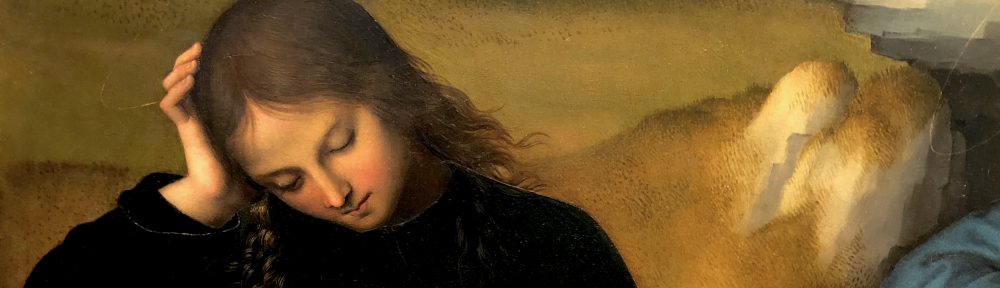
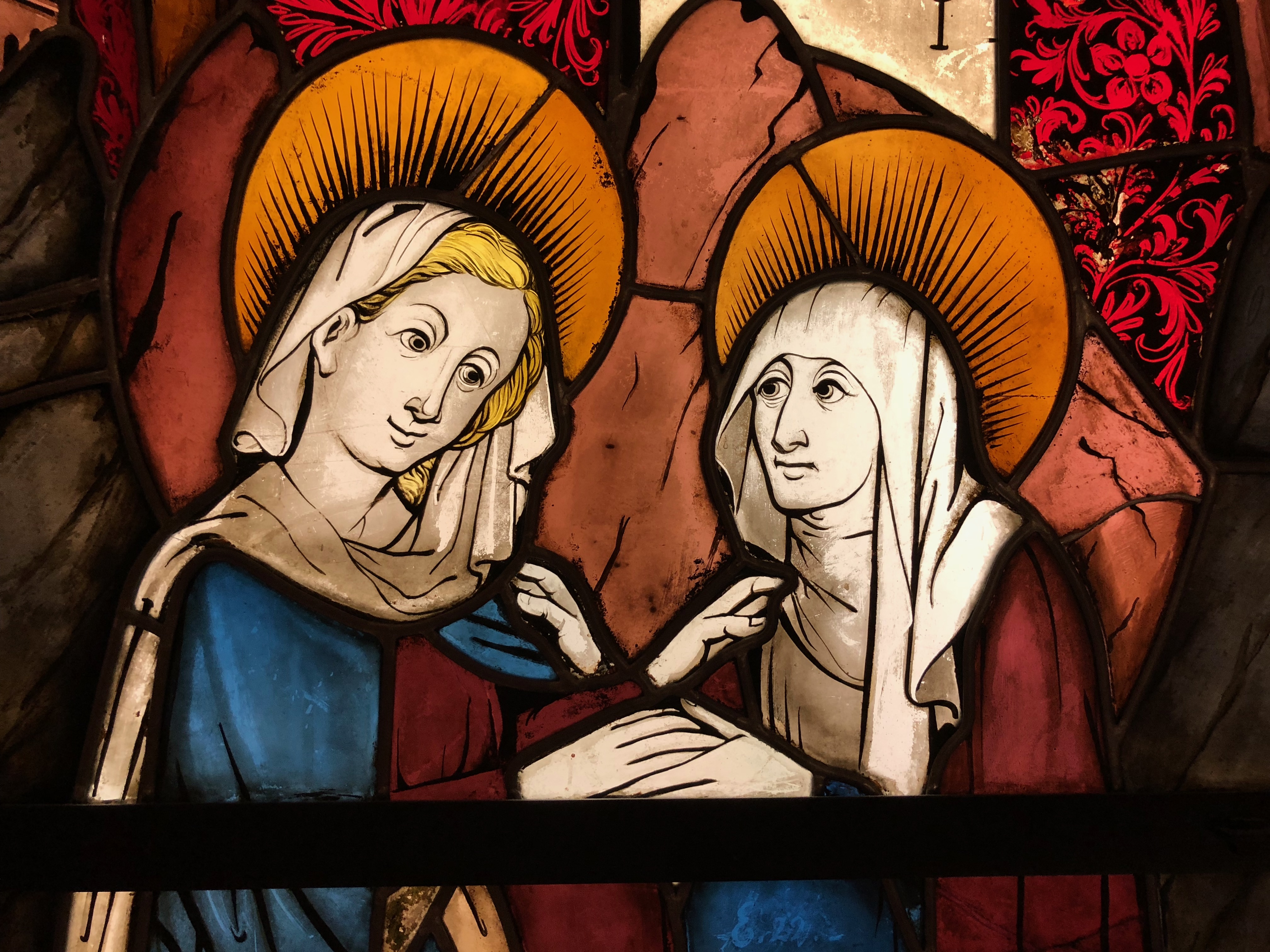
The Visitation, German c. 1444.

In calling me, the call does not leave me intact; it surges only by opening a space in me to be heard, and therefore by shattering something of what I was before I felt myself to be called.

— Jean-Louis Chrétien

In Mahler’s Third Symphony, the first movement is an eruption of massive orchestral sounds: horns, drums, fanfares and marches, a shaking of the foundations to make way for a new world to appear. And for the next four movements, the music rarely takes a breath. The adagio, the slow, contemplative movement which usually comes in the middle of a symphony, is delayed until the very end. And what an ending it is—23 minutes long!—taking us with unhurried solemnity ever deeper into the mystery of the world. Mahler called it “the higher form in which everything is resolved into quiet being. I could almost call the Third’s finale ‘What God tells me,’” he added, “in the sense that God can only be understood as love.” [i]

Advent is like that symphony, it seems to me. Over the first three Sundays, the prophets roar, the heavens shake, the voices cry. Repent! Make way! Stay awake! Cast away the works of darkness! Put on the armor of light! But on the Fourth Sunday, it’s suddenly quiet. No more cosmic thunder. No more urgent warnings. The Baptist’s big crowds have drifted on home. Advent’s adagio finale is a miniature: two pregnant women in a humble courtyard, having an intimate conversation. 

But what a conversation it is! “Blessed are you among women, and blessed is the fruit of your womb!” says Elizabeth. “My soul magnifies the Lord, and my spirit rejoices in God my Savior.” replies her cousin Mary. Their ecstatic words have been on our lips in worship ever since.[ii]

The cousins had a lot to process. One was carrying the last of the Old Testament prophets, John the Baptist. The other was carrying the founder and pioneer of a transformed humanity. They held creation’s future within them, ever since they had each said “Yes” to a story that was no longer their own. They now belonged to God, come what may. I imagine they both did a lot of laughing and crying that day.

The Rev. Mark Harris, a dear friend I first met in seminary a half-century ago, began last year’s challenging Advent by writing a poem about Mary’s consent. It’s called “Implications of Yes.”

The neighbors talked about it for a while,
How the young girl who was beginning to show 
Came back from meeting her cousin
And seemed kind of quiet,

How she was seen leaving her house 
Early one morning with a small sapling 
Bundled in rough cloth in one hand, 
And a shovel in the other.

Later she was seen coming back,
No sapling, the shovel over her shoulder, 
Her hands and dress smeared with dirt, 
Her eyes red and swollen.

Later, sitting with the others, she spoke 
Of her longing for a lost simplicity
And her preparations for realities 
that follow from her quiet Yes .

Years from now, she said, 
There will be need for this tree grown,
Just as there is need now 
for this Child that grows in me. 

The tree will bear the body of the Man, 
As I bear the Child.
We will each be ready in our turn
To do as the Holy One requires.

We will, with the Holy One we bear, 
Be broken by the bearing, 
And will give our lives
For the healing of the nations. [iii]

The poet gives us a stunning image here. Mary, pregnant with Jesus, plants the tree that will become his cross! Both mother and tree will, like Jesus, offer all that they have and all that they are for the healing of the nations, the repair of the world. That’s how the story goes in a fallen, broken world, and if you say ”Yes” to this story, it will cost no less than everything. 

When Mary said “Yes” to the angel of the Annunciation, it was neither the first nor the last time she would do so. Her whole life up to that point had been a series of consents that would prepare her to receive the Holy One into herself. And in the years that followed, she never renounced her acceptance of the story that would one day take her weeping to the foot of the cross. It is no light thing to say Yes to such a story.

We will each be ready in our turn
To do as the Holy One requires.

Mary was ready in her turn. But now it’s our turn. 

The Incarnation of the Divine Word was a singular event. Only Jesus could be who he was and do what he did as the unique conjunction of human and divine—God in the flesh. But in another sense, the Incarnation is a continuing event to the degree that we ourselves become open and receptive to the divine that wants to be born in us.

The Russian Saint Seraphim of Sarov (1759-1833) put it this way: The purpose of human life is the acquisition of the Holy Spirit. In other words, our human destiny is to be filled with Divinity, to dwell in God and let God dwell in us. What did we ask in today’s collect-prayer? May our own souls and bodies become “a mansion prepared for Godself.”[iv] We weren’t kidding around. It’s our most serious Advent prayer, committing ourselves to becoming God-bearers. 

The first Christians made some strikingly bold claims for humanity’s potential for “divinization” (becoming like God). The Second Letter of Peter (1:4) says: “God has given you such precious and majestic promises, that you may become partakers of the divine nature.” The First Letter of John (3:2) says, “We know that when God appears, we shall be like God, because we shall see God as God is.” And St. Paul, in Second Corinthians 3:18, insists that “all of us, with faces unveiled, mirroring the Lord’s glory, are being transformed into the same image from one degree of glory to another.” 

The two most famous summations of divinization as corollary to incarnation were made by Irenaeus in the second century and Athanasius in the fourth. “In God’s immense love,” said Irenaeus, “God became what we are, that he might make us what he is.” Athanasius was even more explicit: “The Divine Word became human that humans might become God.”

Now many have argued against this whole idea of divinization. There’s too great a gulf between Creator and creature, some say. Who can hope to cross that infinite abyss? Others say that humanity is simply not up to it. Just look at world history over the past century, or the last few years in America. On the Feast of the Epiphany, January 6, 2021, for example, did anyone see Christ’s glory being reflected from those tormented faces at our nation’s Capitol? [v]

But if we believe that the Divine Word was truly made flesh, and that Jesus was both fully human and fully divine, then we must acknowledge the existence of an innate human capacity to receive and embody God. Absent that capacity, Mary could never have conceived our Lord and Savior. There is an integral part of our human makeup which is designed to answer when God calls. In other words, our humanity always contains a mansion prepared for Godself. That receptive capacity to say Yes to God may be buried beneath multiple layers of ego and sin, but it cannot be destroyed. It’s a feature, not a bug.

One of the greatest Orthodox theologians of the last century, Sergius Bulgakov, insisted on the indispensable role of humanity in the Incarnation: 

Christ did not bring His human nature down from heaven, and He did not create it anew from the earth; rather, He took it from “the most pure flesh and blood of the Virgin Mary”… [T]he Incarnation of Christ is realized not in one Person but in two: in Christ and in the Virgin Mary. The icon of the Mother of God with Infant is therefore the true icon of the Incarnation.[vi]

To become fully human, the only-begotten of God did not destroy human nature, making it something it was not. Rather, Christ fulfilled human nature, manifesting our human potential to dance with God. But we need help to realize our full humanity. It’s not just that our wills are impaired by sin. The fact is that we are not made to function as autonomous beings at all. We are choral beings at heart. We need the full choir, the whole company of heaven and earth, in order to be our truest selves and exist not in isolation but in holy communion.  

So let us admit that Mary was capable of divinization. She could contain and give birth to the holy in our midst. But what about the rest of us? Are we capable of embodying divinity? Many Christians have said yes, absolutely! The great hymn writer Charles Wesley put it this way:

Heavenly Adam, life divine, 
Change my nature into Thine;
Move and spread throughout my soul,
Actuate and fill the whole;
Be it I no longer now
Living in the flesh, but Thou.[vii]

That’s a high bar for sure. But it happens. The saints prove that every day. And we ourselves are here because we are engaged in the same transformational project.

Be it I no longer now
Living in the flesh, but Thou.

Less me, more God.

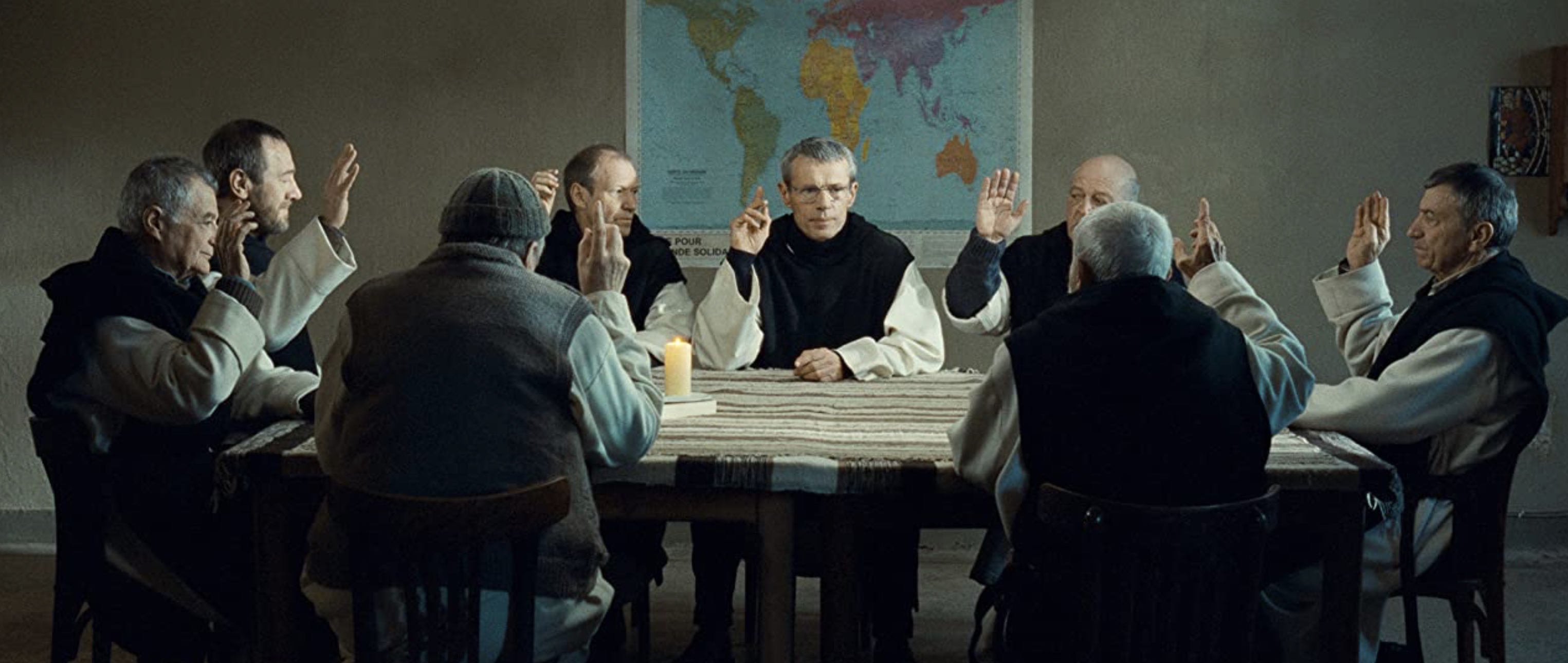
Our parish hosted a film series this Advent, and last week’s feature, Of Gods and Men (2010), told the true story of French Trappist monks who served an impoverished Muslim village in Algeria. Their monastery, Our Lady of Atlas, had been there since 1938, but in the decades after the end of French colonial rule in 1962, their community was threatened by civil unrest and a lingering suspicion of Europeans. In the 1990s, returning to France was clearly the safest choice, but the village leaders begged them to stay. They depended on the monks, not only for medical care, but for their stabilizing and loving presence.

On Christmas Eve, 1993, terrorists broke into the monastery and held the monks at gunpoint, making it clear that they were now in mortal danger. The terrorists eventually departed without incident (even apologizing for disturbing the holy feast of Jesus’ birth), and the monks celebrated Midnight Mass with special intensity. But the threat remained.

Two years later (March 1996), that Christmas Eve of both fear and deliverance was still reverberating in their hearts. Dom Christian, the prior, told the brothers in a Lenten reflection: 

… through that experience we felt invited to be born again. The life of a man goes forth from birth to birth … In our life there is always a child to be born; the child of God who each of us is … We have to be witnesses of the Emmanuel, that is, of “God with us.” There is a presence of “God among us” which we ourselves must assume.[viii]

A few weeks after Dom Christian wrote these lines about giving birth to God, the monks were taken hostage just before Holy Week. They would be martyred during Eastertide. If they had fled the country when they had the chance, they could have preserved their lives. But the brothers would not abandon the people they served. And their writings and their actions made it clear that they had already surrendered their lives long before, in both their baptismal vows and their monastic vows. They were people who knew what it meant to say yes when Jesus calls, come what may. 

Of Gods and Men (2010). The monks say yes to remaining in harm’s way.

If any of you still have doubts about the human capacity to embody divinity, listen to what Dom Christian wrote after that pivotal Christmas Eve, imagining what he would say to his future killer at the hour of his death: 

And also you, my friend of the last moment,
who will not have known what you are doing:
Yes, I want this thank you and this “a-dieu
to be for you, too,
because in God’s face I see yours.
May we meet again as happy thieves 
in Paradise, if it please God, the Father of us both. 
Amen! In h’allah! [ix]

Who could write such a thing had God not filled him to the brim! Another monk, Fr. Christopher, wrote in his journal during that same Christmastide: “We are in a state of epiclesis.”[x] Epiclesis is a Greek term denoting the invocation of the Holy Spirit in the eucharistic prayer, asking for the sanctification of our lives as well as the holy gifts on the altar. 

We are all in a state of epiclesis—the acquisition of Spirit. And indeed, it is God’s desire to give us more spirit, more grace, more love, more humanity and more divinity. All we need to do is say Yes


[i] Gustav Mahler, letter to Bruno Walter in 1896, the year he composed the Third Symphony.

[ii] Elizabeth’s words are part of the “Hail Mary” prayer used in the Rosary; Mary’s Magnificat (“Song of Mary”) is one of the oldest Christian hymns, and draws upon the Song of Hannah (I Samuel 2:1-10) and other Old Testament texts. This scene of the two cousins only appears in Luke 1:39-55.

[iii] Mark Harris is an Episcopal priest, poet and artist living in Lewes, Delaware. The poem, written December 1, 2020, is used by permission. 

[iv] The Collect for Advent 4 in the Book of Common Prayer reads: Purify our conscience, Almighty God, by your daily visitation, that your Son Jesus Christ, at his coming, may find in us a mansion prepared for himself; who lives and reigns with you, in the unity of the Holy Spirit, one God, now and for ever. Amen.

[v] January 6, the Feast of the Epiphany, celebrates the manifestation of Christ to the world. It is a bitter irony that that date has now been corrupted by the violence, hate and delusion of the insurrection. A similar irony taints the Feast of the Transfiguration, when the brilliant light of Christ’s divinity must share August 6 with the incinerating explosion of the atomic bomb at Hiroshima. 

[vi] Sergius Bulgakov, The Lamb of God (Grand Rapids, MI: Eerdmans, 2008), 200, 202.

[vii] Charles Wesley (1707-1788), Since the Son Hath Made Me Free.

[viii] Dom Christian de Chergé, Reflections for Lent (March 8, 1996), in Bernardo Olivera, How Far to Follow: The Martyrs of Atlas (Petersham, MA: St. Bede’s Publications, 1997), 103, 99. 

[ix] Testament of Dom Christian, dated Dec. 1, 1993 & Jan. 1, 1994, opened, after his death, on Pentecost Sunday, May 26, 1996, in Olivera, 127.

[x] Fr. Christopher Lebreton (January, 1994), in Olivera 111.

Easter Wings: An Ascension Homily

All the other Distance
He hath traversed first –
No new mile remaineth –
Far as Paradise –

 His sure foot preceding –
Tender Pioneer –
Base must be the Coward
Dare not venture – now –

 –– Emily Dickinson, “Life is what we make it”


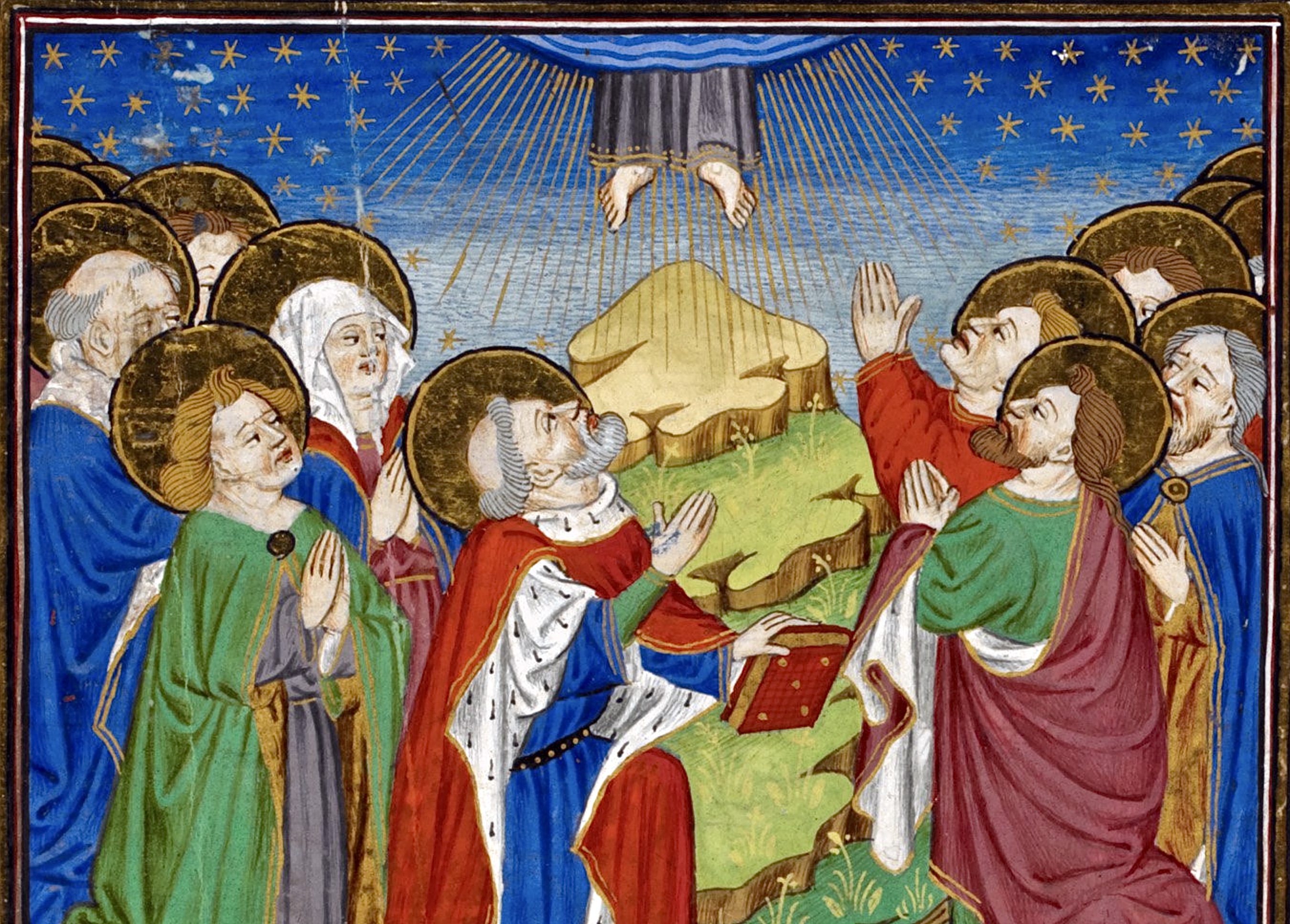
“He ascended into heaven. . .” We say this every time we recite the Creed. But what does it mean? Why do we say it, and what are we being asked to believe? Is it an embarrassing myth, a problematic metaphor, or an inexplicable fact? Many Christians would prefer to hurry past the doctrine of the Ascension, as if it were not something we should examine too closely. Nothing to see here, folks, just keep moving.

But maybe wondering what we do with the story isn’t the right question. What we really need to ask is: What is the story going to do with us?  Where does it want to take us? How might it change us?

John Calvin, the great Reformation theologian, called the Ascension “one of the chiefest points of our faith.”[i] Really? Compared to the birth, death and resurrection of Jesus Christ, the Savior’s disappearance into a cloud seems a relatively minor part of the story. How much does it matter for Christian faith and practice?

Let’s begin with three things that the Ascension is not. First of all, it is not the end of Jesus’ presence in the finite and temporal world, the world of human experience. In the sixth-century Ascension hymn by Romanos, the disciples express their anxiety about being abandoned:

Are you leaving us, O Compassionate?
Parting from those who love you?
You speak to us like someone going on a journey. . .
Do not take yourself far away from those who love you. [ii]

We know that feeling. In a secular age, sometimes is seems that all divinity has just up and left this world without a trace. But if the Ascension was the end of one kind of presence, it was the beginning of another. Jesus is still here, but in a different way.

Secondly, the Ascension is not the Incarnation in reverse, as though God was briefly one of us, and now he’s not. A human life is finite, vulnerable, dependent and particular. It’s radically different than being the infinite God of power and might. But when, as the Bible puts it, Jesus ascended to “the right hand of the Father,” he didn’t leave his humanity behind. He took it with him into the heart of God.

Finally, the Ascension is not just about Jesus.
It’s about us as well.
If we are in Christ, then wherever Jesus goes, we go too.

Let’s look at each of these themes more closely. First, the question of presence and absence. The unique particularity of Jesus of Nazareth, a first-century Jewish male who lived and died like one of us, could only be experienced the way every finite existence is experienced: in its own place and time. If it’s here, it can’t be there. If it’s then, it can’t be now. Once Jesus was laid in the tomb, he could no longer be one object alongside all the other objects in the world. That physical walking-around-the-neighborhood Jesus was gone for good.

When Jesus rose from the dead, his identity and presence were no longer bound by the rules of time and space. His risen body could be both here and there. And the reason the resurrection stories lack the chronological realism of the Passion narratives is because they occur outside historical time. Encounters with the risen Christ were not additional chapters in the life and times of the earthly Jesus. They took place outside of history, at the border between our spatiotemporal world and whatever lies beyond it.

If Easter is not a historical narrative following the rules of space and time, then Ascension was not the next thing that happened after the resurrection appearances, because things don’t happen in sequence outside of time. So instead of thinking of the Ascension as another event in time, think of it as another dimension of resurrection. In his Easter appearances, the risen Jesus assured his friends that he would be with them always. In the Ascension, however, he made it clear that his presence would now have to be experienced in new ways and different forms. First there is Jesus. Then there is no Jesus. Then there is.

Ever since the resurrection,
seeing Jesus has required an act of recognition,
a moment in which we ask, “Jesus, it that you?”

Discerning the myriad forms of Christ’s presence is a fundamental practice for God’s friends in these latter days. We find Christ in sacrament and community, prayer and Scripture. We find Christ through forgiveness and reconciliation, compassion and service, justicemaking and peacemaking. Christ meets us in our neighbor and in the stranger; in solitude and solidarity; in church and on the street. Christ hangs on every cross, and returns in every resurrection.

As Jesus said before he left,
“I am with you always, even to the end of time” (Matt. 28:20).

But if Christ now tends to appear incognito, quietly “as One unknown,”[iii] what do we make of the Ascension’s theology of exaltation, celebrating the Christ “whose glory fills the skies?”

Hail the day that sees him rise,
Glorious to his native skies;
Christ, awhile to mortals given,
Enters now the highest heaven. [iv]

Charles Wesley’s familiar hymn is one of many envisioning the enthronement of Christ as the governor of the world. And we all appreciate the theological irony: the humiliated and rejected one turns out to wear the crown. But such a dramatic reversal risks undoing the Incarnation, as though the finite and vulnerable humanity of Jesus were only a temporary thing, given back after Easter like a rented costume. But that’s not what happened. The Incarnate word came to stay.

Yes, divine and human are radically different. Infinite and finite are radically incommensurate. Creator and creature can never be confused. And yet, without God ceasing to be God or Jesus of Nazareth ceasing to be human, heaven and earth have been joined in holy union, never to be put asunder.

The understanding of Christ as the divine Word, the shaping power of love through whom all things are created and sustained in their being, is not a theological footnote. It is key to the story of redemption that our Savior not only has the whole universe at his back, but that his way, the sacrificial way of self-diffusive love, is the very truth of God, and therefore the truth of how things are meant to go in the world which God has made. To be in Christ is to conform to the most fundamental reality, and the Ascension imagery of divine enthronement celebrates this crucial fact. Christ is the way, the truth and the life. Self-diffusive love is the law of the universe.

However, too much of this and we risk highlighting the divine at the expense of the human in the story of Jesus, as if more of one means less of the other. If we fully embrace our humanity, is there less room for God? Or if we are to be more like God, must we diminish or abandon our humanity because it is essentially incapable of receiving and containing divinity?

Jesus answers these two questions with “no” and “no.” In the self-emptying act of becoming flesh, God lost nothing of the divine nature, for the essence of God is love: the ceaseless mutuality of giving and receiving that constitutes the Holy Trinity. As for human beings, whose very existence is dependent upon, and constituted by, the reception of God’s gifts of life and breath and Spirit, our creaturely nature was never more itself than when Jesus managed to receive divine fullness with an open heart.

In other words, God was never more like God than in the act of giving Godself away. And humanity was never more perfectly realized than when Jesus exercised his created capacity to receive that gift in a finite way. Communion with God does not obliterate our humanity. It fulfills it.

Irenaeus, one of the first great theologians, said in the second century that “the glory of God is a human being fully alive.”[v] And this fullness of creaturely life is attained, he said, not by “a casting away of the flesh, but by the imparting of the Spirit.”[vi] God loves us just the way God made us: finite, vulnerable, embedded in the absorbing and messy narratives  which comprise human be-ing. And what God desires is for us to live into our creaturely capacity to receive every gift, every blessing, and ascend into the divine communion which is our true and lasting home.

And this brings us to my final point. Ascension is not just about Jesus. It’s about us as well. As members of Christ’s body––with Christ and in Christ––we too are being drawn up to dwell in the vivifying presence of the Holy One––to enjoy God forever.

We call Jesus the Word made flesh because he showed, in the language of human flesh and earthly story, how the divine life could be translated into finite form as a life for others. From birth to death, Jesus was pro nobis: for us. And his Ascension was for us as well, to take us heavenward with him. Jesus did not abandon us. He went on ahead, as the “Tender Pioneer,”[vii] to prepare a place where we may join him.

John Calvin explained the Ascension’s shared, collective dimension in this way:

“Christ did not ascend to heaven in a private capacity, to dwell there alone, but rather that it might be the common inheritance of all the godly, and that in this He has also, by the power of the Holy Spirit, made it possible for us to share in the divine presence [viii]. . . . “Ascension follows resurrection: hence if we are members of Christ we must ascend into heaven.” [ix]

If we are members of Christ, we must ascend. This is the pattern of the Christian life: moving Godward. When I walked the Camino de Santiago, pilgrims encouraged one another with a wonderful word for this Godward movement: Ultreia!, which means Beyond! We are all pilgrims to the Beyond. Growth is our vocation. Transformation is our vocation.

But we can only advance with Christ and in Christ. No wings of our own can defy the gravity of our situation. The sins of the world weigh us down––all that heavy baggage that Thomas Merton called “the contagion of [our] own obsessions, aggressiveness, ego-centered ambitions and delusions.”[x] And in a time of pandemic, fear, illness and grief pile on their own crushing load.

Only the rising and ascending Christ can deliver us from so much gravity. Only Christ can give us what Anglican poet-priest George Herbert called “Easter Wings.” In his poem of that name, in which the words on the page are arranged in the shape of angels’ wings, he admits he can only fly “if I imp thy wing on mine.” He borrowed that peculiar term from falconry: to “imp” means “to engraft feathers in a wing to restore or improve its power of flight.”[xi] In other words, if we want to ascend, we need the help of Christ’s own feathers. If we’re going to fly, we need Easter wings.

As Herbert prays,

With thee
O let me rise
As larks, harmoniously,
And sing this day thy victories.

If you’ve ever heard an English lark, ascending high into the sky as it utters its ecstatic song, you will appreciate the charm of Herbert’s metaphor. A century after Herbert, hymnwriter Isaac Watts wrote my favorite Ascension lyric.

Thence he arose, ascended high,
to show our feet the way.
Up to the Lord our souls shall rise,
on the great rising day. [xii]

Of course, heaven is not susceptible to prepositions: “above,” “beyond,” or even “within” do not tell us where heaven is, since anything beyond space and time has no spatial dimension, and therefore no location. Neither heaven nor God are a place on any map. Still, by God’s grace we may discover their nearness even so, and breathe their atmosphere, in both this world and the next.

For physical and directional beings like ourselves, the imagery of ascending into the sky feels true enough. “Seek the things that are above,” St. Paul tells us (Col. 3:1). “Lift up your hearts,” says the priest at every mass. We don’t have to deny astronomy to know what these things mean. We feel the upward pull.

It’s not a matter of leaving creation behind, or shedding our bodies to become immaterial beings. “Behold, I make all things new,” says the Holy One. All things––not just our souls. The whole creation is being drawn higher and higher, further and further, deeper and deeper into God. Let everything that has breath shout “Glory!”


Related posts:

Ascension Day: Parting is Such Sweet Sorrow

Ascension Day “Charade”?––The Puzzling Exit of Jesus


[i] John Calvin, Commentary on Acts 1:9, cited in Julie Canlis, Calvin’s Ladder: A Spiritual Theology of Ascent and Ascension (Grand Rapids, MI: Eerdmans, 2010), K1249 (The Kindle edition has no page numbers, so I use the Kindle location numbers). Canlis’ rich and thoughtful book is a great read, and has increased my appreciation of Calvin immensely. My other invaluable sources for this essay were Christ the Heart of Creation (Rowan Williams, Bloomsbury 2018) and The Word Made Flesh: A Theology of Incarnation (Ian A. McFarland, WJK 2019).

[ii] Romanos, “Kontakion on the Ascension” in Kontakia: On the Life of Christ, trans. by Archimandrite Ephrem Lash (Harper Collins, 1962).

[iii] This phrase is from a famous passage by Albert Schweitzer: “He comes to us as One unknown, without a name, as of old, by the lakeside, He came to those men who knew him not. He speaks to us the same word: ‘Follow thou me!’ and sets us to the tasks which He has to fulfill for our time. He commands. And to those who obey Him, whether they be wise or simple, He will reveal Himself in the toils, the conflicts, the sufferings which they shall pass through in His fellowship, and, as an ineffable mystery, they shall learn in their own experience who He is.”

[iv] Charles Wesley, “Hail the Day That Sees Him Rise” (1739). The prolific 18th century writer composed over 6000 hymns, at least 10 of which are on the Ascension. However, his brother John, who gave some 40,000 sermons, never preached on the topic.

[v] Irenaeus (c. 130 – c. 202), Adversus Haereses IV.20.7, cited in Canlis, K2246.

[vi] Adversus Haereses V.8.1, in Canlis, K1960.

[vii] Emily Dickinson, “Life – is what we make it.” I quote the last 2 stanzas in the epigraph.

[viii] Calvin, Commentary on John 14:2, in Canlis K1218.

[ix] Calvin, Commentary on Colossians 3:1, in Canlis K991.

[x] Thomas Merton, Contemplation in a World of Action, p. 158, cited in Martin Laird, An Ocean of Light (Oxford/New York: Oxford University Press, 2019), 11.

[xi] Helen Wilcox, The English Poems of George Herbert (Cambridge, UK: Cambridge University Press, 2011), 148 n.19.

[xii] Isaac Watts, “Why do we mourn departing friends” (1707). Set to a shape note tune by Timothy Swan in 1801, it is #163b in The Sacred Harp (Bremen, GA: Sacred Harp Publishing Company, 1991). A powerful version from the 2nd Irish Shape Note Convention (2012) can be heard here: https://youtu.be/7mCFMKNJIAg