White House Brutality: The Death of Renee Nicole Good

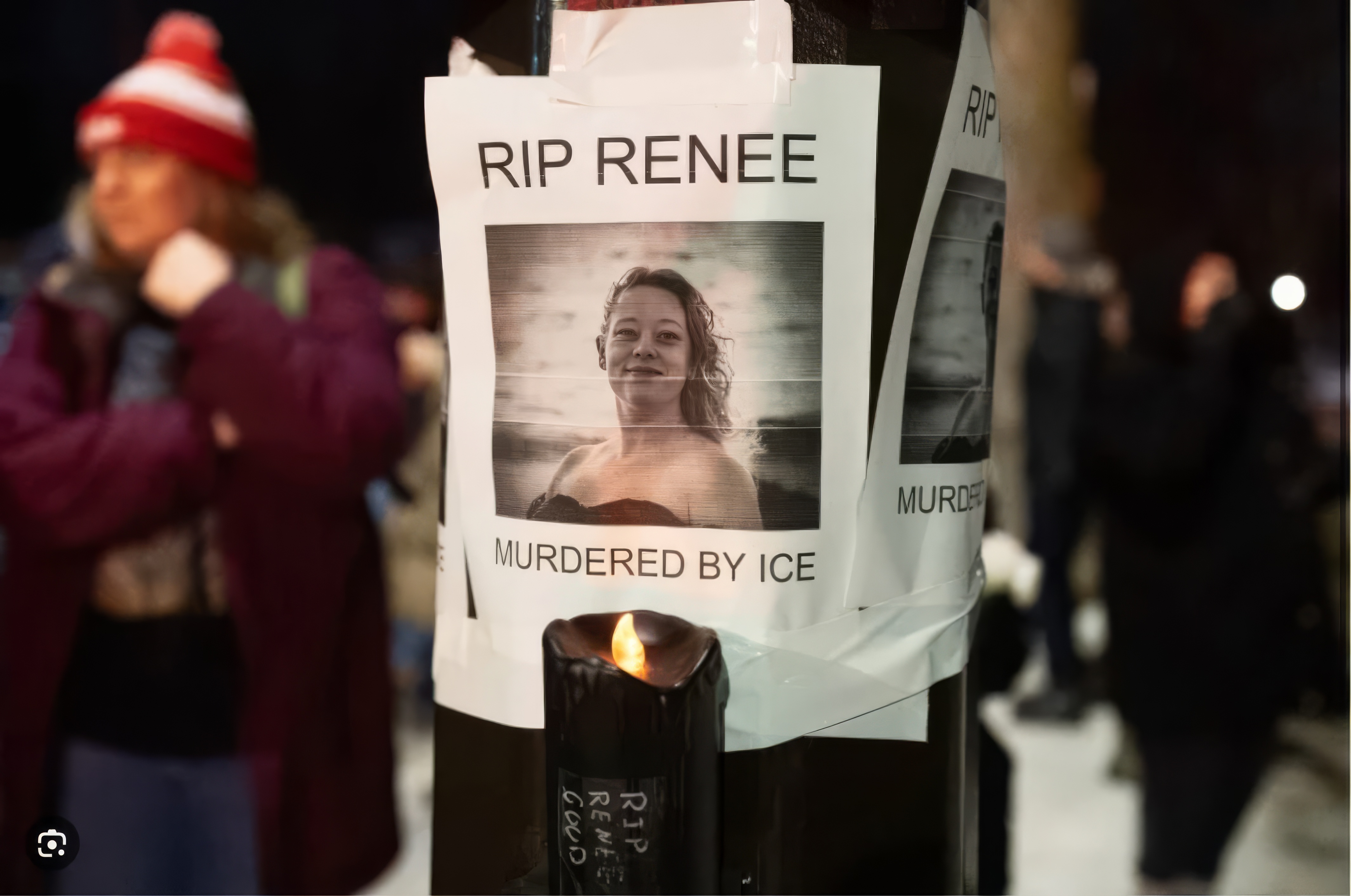
“It’s fine, dude, I’m not mad at you.” According to video allegedly taken by ICE agent Jonathan Ross, those were Renee Nicole Good’s last words, addressed directly to him, with a smile. Seconds later, Ross shot her in the face. Three times.

Ross didn’t murder her because his own life was being threatened. All the video evidence available so far contradicts that lie. Perhaps a serious investigation—if there ever is one—will uncover the details of his personal role in Renee Good’s death. But he did not act alone. The White House gave him the gun and, through its policies and its rhetoric, encouraged him to pull the trigger.

The fact that the murder of an American citizen was immediately condoned by the highest levels of government—and continues to be defended, without the slightest trace of remorse, as the right thing to have done—should be a Pearl Harbor or 9/11 moment for our country. If it isn’t, if it just further normalizes our national descent into evil and madness, then God help us.
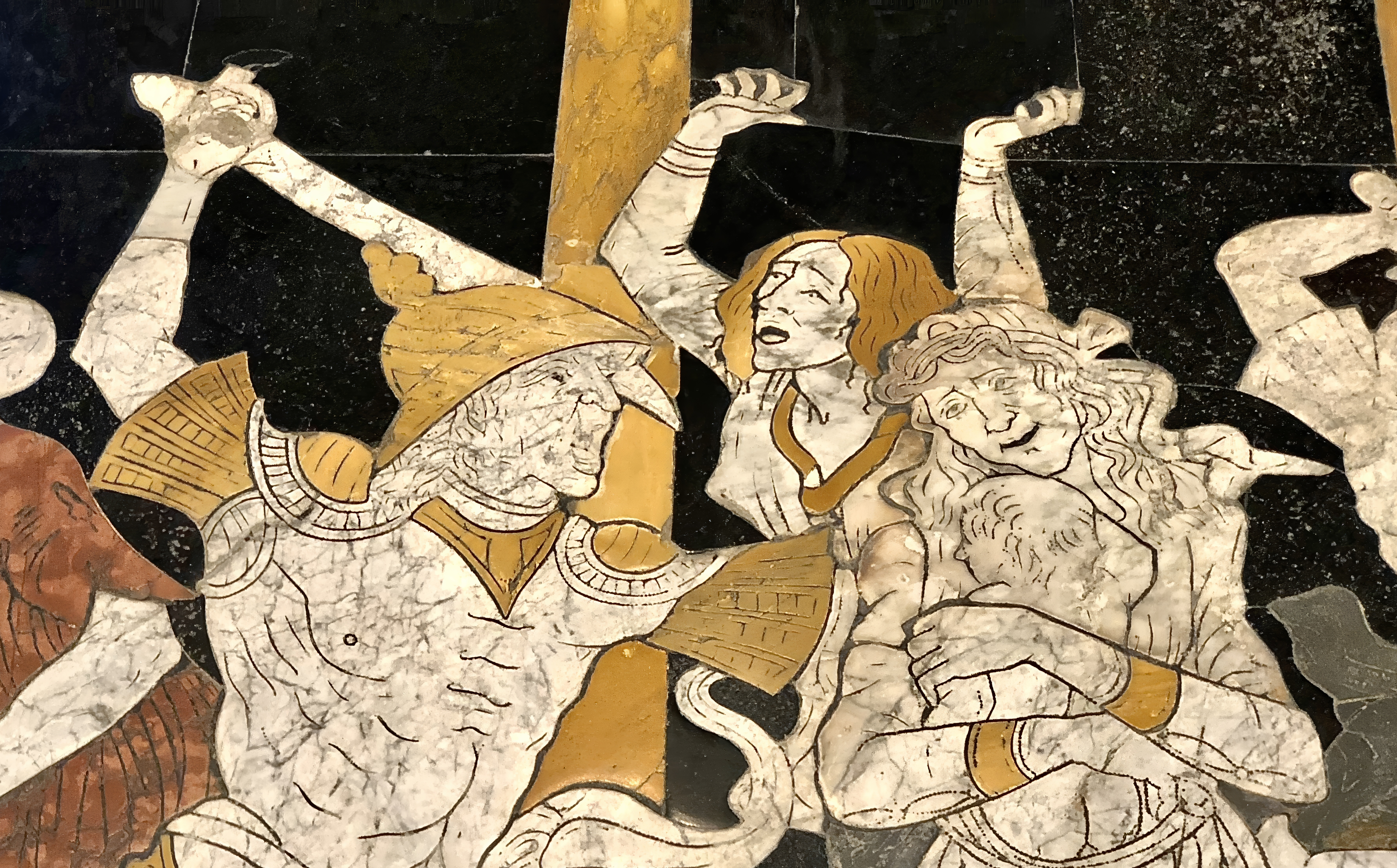
Matteo di Giovanni, Slaughter of the Innocents (c. 1480s), Siena Cathedral.

The shocking brutality of Good’s murder is not the work of a single bad actor. It is the expression of national policy under Donald Trump, whose murderous cruelty, by his own admission, knows no bounds. As he made clear in a recent New York Times interview, he is accountable not to Congress, the courts, international law, common decency, or any other norms or considerations beyond the seething cauldron of impulse and rage going by the name of Donald Trump. His only limitation, he claims, is “my own morality, my own mind. Nothing else can stop me.”

Such malignant and dangerous narcissism invites comparison with C. S. Lewis’ chilling description of Satan:

“[He is] no longer a person of corrupted will,” but “corruption itself, to which will was attached only as an instrument. Ages ago it had been a Person; but the ruins of personality now survived in it only as weapons at the disposal of a furious self-exiled negation.” [i]

For more on the dis-ease and dis-order spawned by Trump’s furious negation, see my 2019 post, “The Worm That Gnaws the World”—Trump and the Problem of Evil.

Evil is contagious, and the toxicity level among the ruling powers has become so high that it never seems enough for Trump, or his collaborators and enablers, merely to initiate, condone and encourage acts of hatred and violence. They also have an insatiable compulsion to smear and assault their victims with absurd lies and vicious abuse.

Vice President J.D. Vance, a nominal Catholic who cares little for his church’s teachings, provides one of the most egregious examples of this shameless evacuation of human decency. He shed no tears for Renee Good, preferring to revel in making vicious and unfounded attacks. He congratulated her killer and warned the rest of us, in effect, that we too must obey or die.

Religious journalist John Grosso wrote a scathing rebuke to Vance’s despicable rhetoric in the National Catholic Reporter:

“The vice president’s comments justifying the death of Renee Good are a moral stain on the collective witness of our Catholic faith. His repeated attempts to blame Good for her own death are fundamentally incompatible with the Gospel.” [ii]
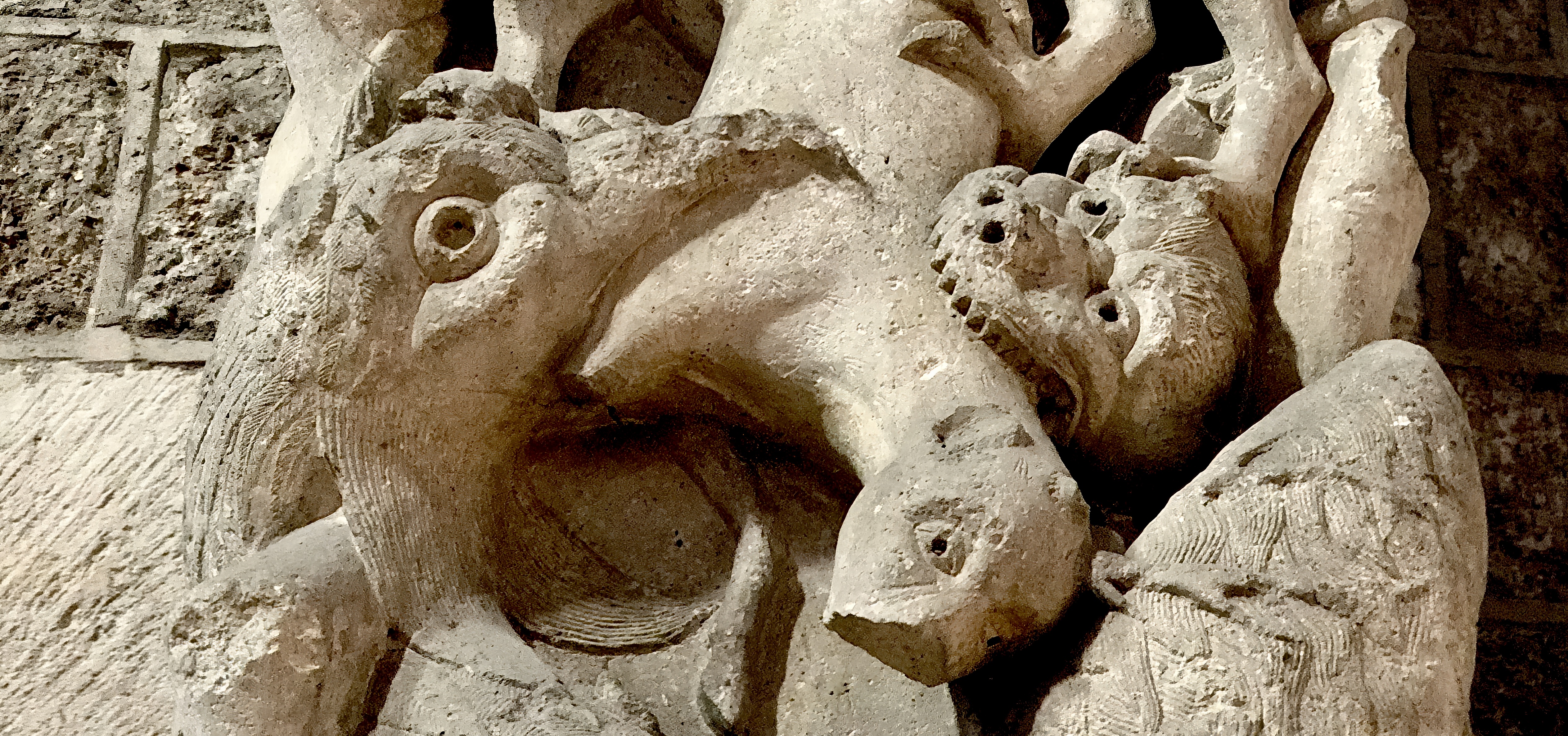
Dominant predators devour a helpless lamb (Abbey Sainte-Marie-de-Souillac, France, 12th century).

The violence done to Renee Good in Minneapolis is part of a virulent malignancy raging throughout our body politic, in both domestic concerns and our foreign policy. In defense of Trump’s imperial fantasies about Venezuela and Greenland, a Republican congressman epitomizd our sickness when he boasted that “the U.S. is the dominant predator … in the Western hemisphere.”[iii] In other words, it is the right of the rich and powerful to devour the poor, the weak, and the vulnerable. Resistance is futile, and punishable by death.

Well, we may not be quite there yet, but every day of silence or passivity moves us closer to a fascist nightmare. It is time to take on the urgency of the biblical prophets, as in the alarm sounded long ago by Joel in a text still read in the penitential rites of Ash Wednesday:

Sound the trumpet in Zion;
    consecrate a fast;
call a solemn assembly;
gather the people.
Consecrate the congregation;
    assemble the aged;
gather the children,
    even infants at the breast.
Let the bridegroom leave his room
    and the bride her canopy.

 Between the vestibule and the altar,
    let the priests, the ministers of the Lord, weep.
Let them say, “Spare your people, O Lord.”  (Joel 2:15-17)

Visiting an Episcopal church in California this past Sunday, I heard that same urgency in the Prayers of the People. After the formally composed intercessions from the Book of Common Prayer, the priest read handwritten petitions and thanksgivings submitted that morning by the assembly. There were lists of those who sought healing, compassionate pleas for those in need, and general longings for peace and justice. But there was also a notable number of prayers addressing the current outbreak of hatred and brutality.

We pray for all those unlawfully detained by ICE … for the family of Renee Good, and for the repose of her soul … for grace and healing in our nation, … for our children and grandchildren as they see our country changing … for all citizens and immigrants … and we give thanks for brave witnesses, and for the renewal of hope that loving acts inspire.

I was particularly struck by a petition asking our prayers for certain individuals with Hispanic names, followed by “and for all those who fear us.” That simple prayer made a bridge, however slight, across the void between “us” and “them.” And for one precious moment, its explicit hope for an end to fear and the beginning of reconciliation filled the church with the sweet fragrance of possibility

Prayer is a refusal to consent to an unredeemed world, and for people of faith it is foundational for an ethical existence. What St. Paul said about love applies equally to prayer. It “bears all things, believes all things, hopes all things, endures all things” (I Cor. 13:7). It breaks the silence, awakens the passive, and cultivates action, both human and divine.

So don’t despair, or give in, or give up.
Look for the ones who are called
into the righteous flow
of prayer and action.

And join them.


[i] C.S. Lewis, Perelandra (1943).

[ii] John Grosso, National Catholic Reporter online, January 8, 2026: https://www.ncronline.org/opinion/ncr-voices/catholic-vice-president-vance-takes-social-media-justify-killing-renee-good

[iii] https://www.commondreams.org/news/andy-olges-greenland-predator
“No faith, no truth, no trust”—The Cost of Lies in American Politics

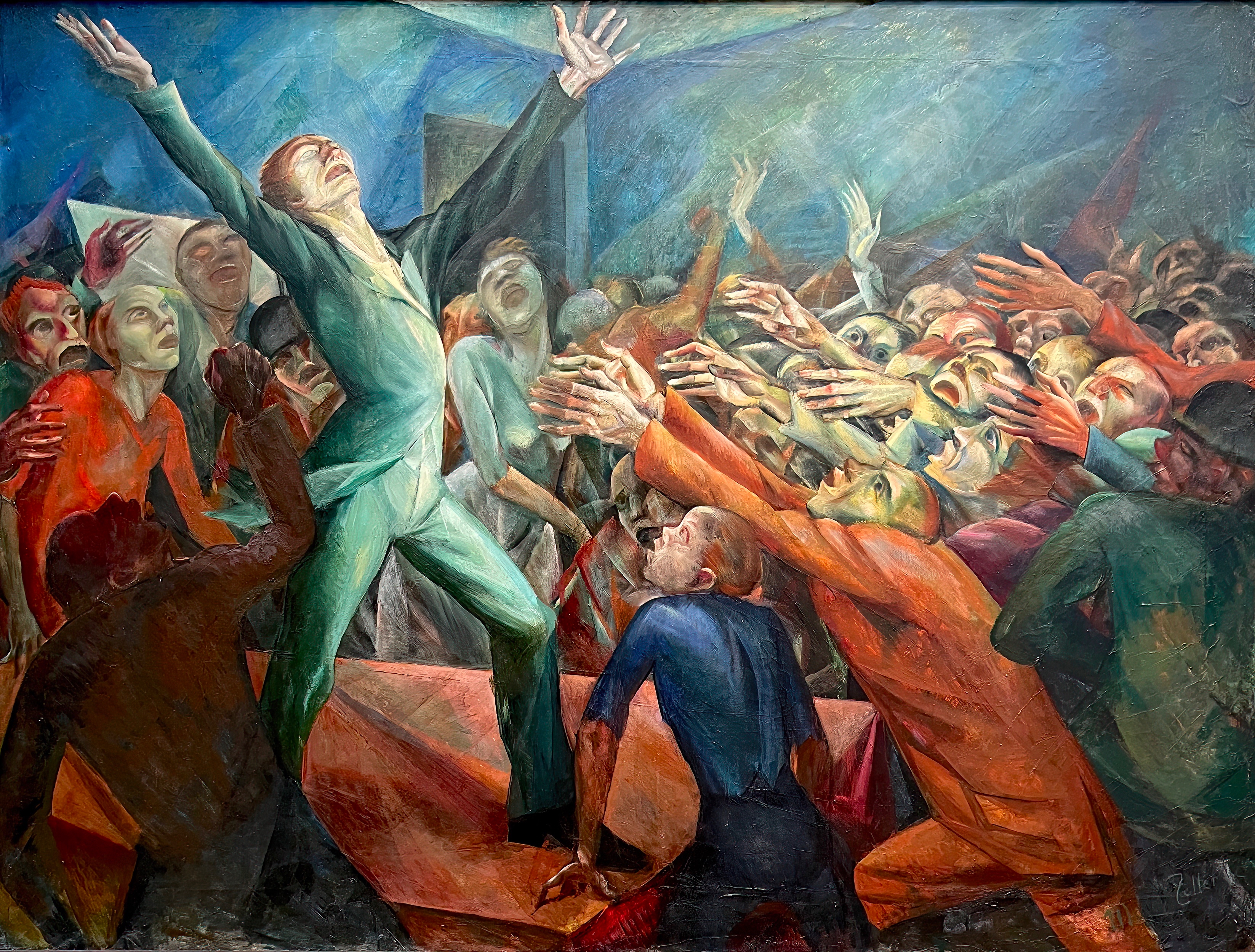
Magnus Zeller, The Orator (c. 1920). The German painter foresaw the danger of authoritarians who prey on the emotions of the mindless mob.

The problem is, when you marry intelligence
To ill will and brute force,
People are helpless against it.

— Dante, Inferno xxxi [1]

On November 5th, Guy Fawkes Day, the citizens of Great Britain will celebrate the defeat of a conspiracy to overthrow the political order in 1605. Thirty-six barrels of gunpowder hidden beneath the House of Lords were discovered before they could blow King and Parliament to kingdom come, and the plotters were brought to justice.

Also on November 5th, the citizens of the United States will vote whether to thwart or assist the overthrow of their own political order. Democracy itself is on the ballot, and the party of insurrection is determined to blow it up. If the latest polls are accurate, they have a fair chance of success.

Seventeenth-century England and twenty-first century America are dissimilar in countless ways, but the Gunpowder Plot of 1605 and the Presidential election of 2024 have one crucial thing in common: the toxic social effect of equivocation.

When the seventeenth century began, “equivocation” was a neutral, rarely used term for statements deemed ambiguous. But in the aftermath of the Gunpowder Plot, it became a widespread byword for deceitful speech. The term’s sudden prominence was triggered by the discovery of the plotters’ handbook, A Treatise of Equivocation, which detailed various ways for persecuted Roman Catholics to lie under oath without endangering their conscience.

When Catholic worship and practice were being suppressed after the English Reformation, the Roman faithful needed to conceal from the authorities the presence of priests and the saying of masses in their private homes. If asked, they could equivocate: give ambiguous or incomplete answers, or practice “mental reservation”—speaking aloud partial truths, while retaining in their minds any bits which might get them into trouble. As long as you speak the whole truth in your mind, where God can hear it, leaving your inquisitor in the dark is not a sin. In other words, the Treatise argued, it is possible to lie without guilt.

In a time when Roman priests were being hunted down and threatened with prison or the gallows, such equivocation was understandable. We do not fault the Dutch family who lied about Anne Frank hiding in their secret annex. But as the Gunpowder Plot made clear, social stability was not a given in the early days of King James’s reign. However, neither factions, plots, religious difference or the clash of ideas seemed the greatest threat to common life in Britain.  The greatest threat was thought to be equivocation, the solvent of bad faith which dissolves communal trust. As an English court put it a few years after the insurrection was foiled:

“The commonwealth cannot possibly stand if this wicked doctrine be not beaten down and suppressed, for if it once take root in the hearts of people, in a short time there will be no faith, no truth, no trust … and all civil societies will break and be dissolved.” [2]

The Earl of Salisbury, responding to A Treatise of Equivocation with a book of his own, An Answer to Certain Scandalous Papers, warned against “that most strange and gross doctrine of equivocation,” which would “tear in sunder all the bonds of human conversation.” [3]

A similar anathema was issued from a London pulpit:

“He that lyeth doth deprive himself of all credit among men (for they will also suspect him to be a liar), so that he that once deceiveth his neighbor by equivocation, shall always be suspected to equivocate … If deceit by equivocation be used, then all covenants and contracts between man and man must cease, and have an end, because all men will be suspicious of one another … So, no commonwealth can stand, no civil society can be maintained.” [4] 

 The nightmarish world of Shakespeare’s Macbeth, written just after the Gunpowder Plot, dramatizes the dread of social disintegration, as even the more admirable characters find themselves “unspeaking” truth. “Fair is foul and foul is fair,” cry the weird sisters at their cauldron of deconstruction. Once language begins to mean anything and nothing, civil discourse is mortally wounded, and it is not just Macbeth who begins “to doubt th’ equivocation of the fiend / That lies like truth.” [5]

Shakespearean scholar James Shapiro notes that the moral chaos of the play is draining not just for the characters but for the audience as well:

“Equivocation makes following Macbeth’s dialogue a mentally exhausting experience, for playgoers—much like those conversing with equivocators—must decide whether a claim should be accepted at face value, and, if not, must struggle to construct what may be suppressed through mental reservation. But with equivocators, one never knows what, if anything, is left unspoken.” [6] 

In the American election of 2024, we are well acquainted with the fiend that lies like truth. “Fair is foul, and foul is fair,” cry the weird brothers Trump and Vance, poisoning our national speech and our common life like there’s no tomorrow. The lying is in their natures—it’s who they are: hollow men without principles, shapeless hulks of impulse and ambition. But their lying, a weapon as destructive as gunpowder, is also an instrument of power. If truth and trust can be blown to bits, the weird brothers will be free to soar beyond accountability into a realm of naked, unfettered tyranny.

It will not go well for them. As Dante assures us, the lowest place in Hell is reserved for the fraudulent, because fraud is the polar opposite of love. Love nurtures community. Fraud disintegrates it. Dorothy Sayers’ eloquent notes on Dante’s Inferno describe the bleak endgame for the ones who are only in it for themselves:

“Beneath the clamor, beneath the monotonous circlings, beneath the fires of Hell, here at the center of the lost soul and the lost city, lie the silence and the rigidity and the eternal frozen cold. It is perhaps the greatest image in the whole Inferno … A cold and cruel egotism, gradually striking inward till even the lingering passion of hatred and destruction are frozen into immobility—that is the final state of sin.” [7]

Gustave Doré, Dis frozen in the lake of ice (1861). Immobilized in the pit of hell, the prince of lies is trapped in wordless solitude, dis-connected from every form of relation.

The evils of Trumpworld have multiplied ceaselessly over the years: tens of thousands of unnecessary Covid deaths, families torn apart at the border, political violence, the abuse of immigrants and women, the corruption of the Supreme Court, the stoking of anger, racism and hate, the relentless erosion of social bonds, the corrosive degradation of the rule of law, et cetera, et cetera. And so much lying. J. D. Vance’s gleeful admission that he invented the terrible stories about immigrants eating pets is just the latest example of a shamelessly destructive addiction to untruth. These people don’t care how many people they hurt.

It’s exhausting. That too is part of the Trump/Vance strategy. We’re supposed to grow weary and discouraged in the face of their unrelenting and senseless chaos. I find an apt metaphor for this moment of American politics in Washington Irving’s account of a transatlantic voyage in the early nineteenth century. Traveling by land, he said, keeps us connected with a sense of where we are and where we’ve come from.

“But a wide sea voyage severs us at once. It makes us conscious of being cast loose from the secure anchorage of settled life, and sent adrift upon a doubtful world. It interposes a gulf not entirely imaginary, but real, between us and our homes—a gulf subjected to tempest and fear and uncertainty, rendering distance palpable, and return precarious.” [8]

Winslow Homer, The Gulf Stream (1899/1906).

Irving’s harrowing journey took about as many weeks as we have left until the election. Sail on, friends, sail on. It is my hope that come November 5th, we will anchor once again in safe harbor, put the chaos behind us, and begin to mend the torn fabric of our common life.

In the meantime, citizens, we all have some serious work to do.


[1] Dante Alighieri, Inferno xxxi, 55-57, translated by Mary Jo Bang. Dante is explaining why the Creator made large creatures like elephants and whales, but abandoned the making of giants. Intelligence, granted too much size and power, could do great damage if corrupted.

[2] James Shapiro, The Year of Lear: Shakespeare in 1606 (New York: Simon & Schuster, 2015), 158.

[3] Ibid., 173.

[4] Ibid., 177-178. John Dove, sermon at St. Paul’s Cathedral, June 1, 1606.

[5] William Shakespeare, Macbeth 5.5, 41-42.

[6] Shapiro, 185-186.

[7] Dorothy Sayers, commentary on her translation of Inferno, quoted in Helen Luke, Dark Wood to White Rose: Journey and Transformation in Dante’s Divine Comedy (New York, Parabola Books, 1989), 41.

[8] Washington Irving, The Sketch Book of Geoffrey Crayon (1819-1820), quoted in David McCullough, The Greater Journey: Americans in Paris (New York: Simon & Schuster, 2011), 12.