Grace and Beauty on Holy Island

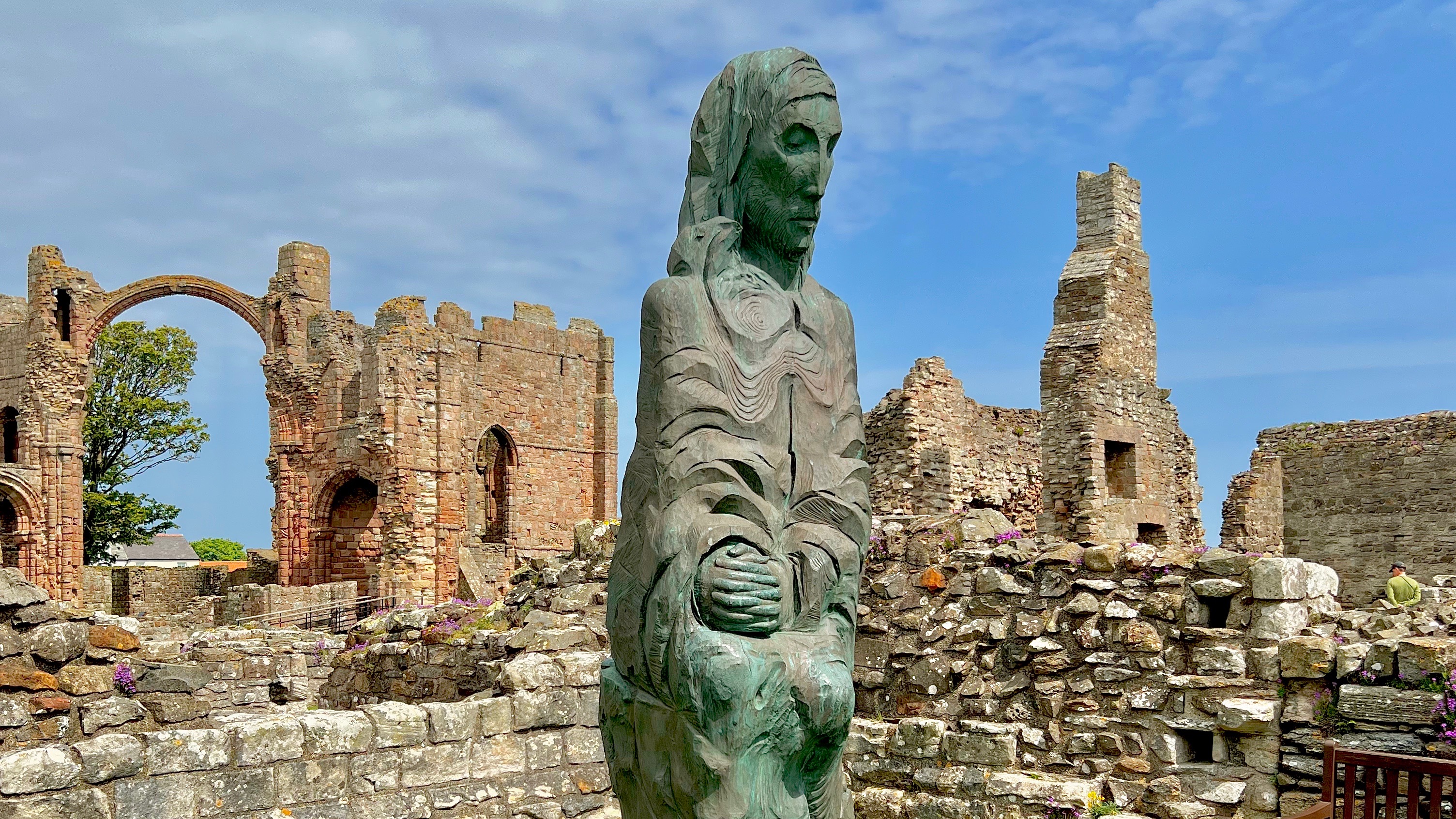
St. Cuthbert among the ruins of the 12th-century LIndisfarne Priory. Durham sculptor Fenwick Lawson carved the original from an elm tree in 1983. This bronze casting was installed in 1999.

In my recent post, Walking St. Cuthbert’s Way (7/28/2023), I described my 100-kilometer pilgrimage walk to the Northumbrian coast, where I had my first glimpse of Holy Island, where Cuthbert had been prior and bishop in the seventh century. In this installment, I cross over the tidal flats to reach my goal and discover why I had come. 

I’ve always been fascinated by the open-ended wanderings of the Dark Age Celtic monks. They journeyed without maps, trusting the way would be shown in due time. They got into little boats without oars or rudders, letting the wind and the currents be the agents of Providence. And where did they end up? Wherever it might be, they believed it was a place appointed for them by God. “The place of resurrection,” they called it. The place where they would meet Christ, the one “who knows you by heart.”[i]

But the arrival was, in a way, beside the point. The journey was the thing—the way of total abandonment and radical trust. Unlike ourselves, who think we already know who we are and where we should go, they traveled without preconception. In their eyes, you don’t know who you really are before you go on pilgrimage. Only the way of abandonment and unknowing will bring you home to your truest self. 
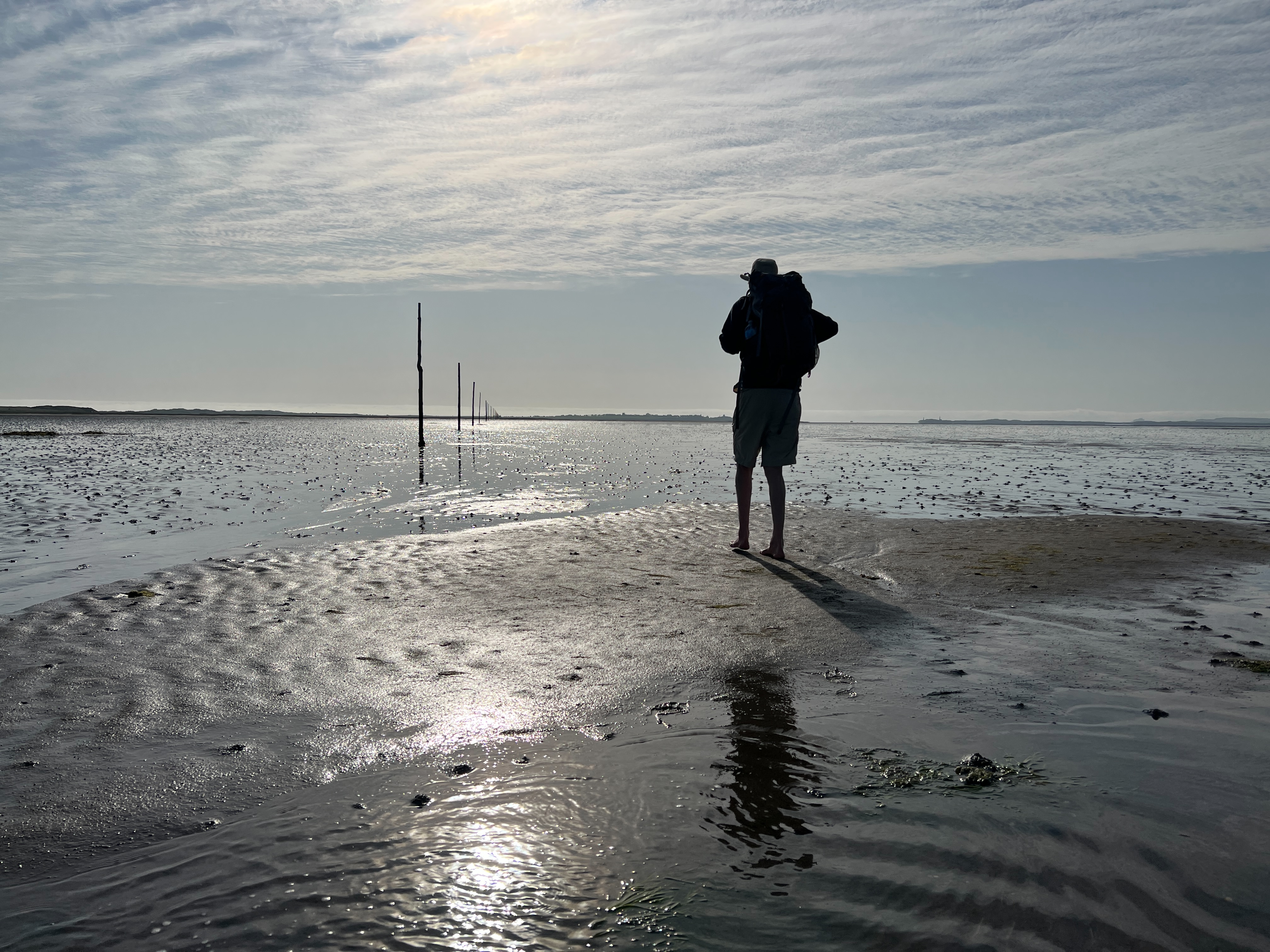
The author begins the final two miles of St. Cuthbert’s Way across the tidal sands to Holy Island.

“As a man dies many times before he’s dead,
so does he wend from birth to birth until, by grace, he comes alive at last.” 

— Frederick Buechner, Godric [ii]

Holy Island is only a part-time island. When the tide goes out, you can walk across the exposed sands, or drive over the causeway. Pilgrims properly go on foot, timing their two-mile passage to coincide with low tide. You don’t want to be caught in the middle when the waters return, swallowed like the Egyptians of old. Yes, the Red Sea comes to mind here, and the river Jordan—those great baptismal archetypes of crossing over from bondage to freedom, old to new, death to life. As I took my first steps on the wet sand, I sang one of my favorite shape note hymns:

Filled with delight, my raptured soul would here no longer stay;
Though Jordan’s waves around me roll, fearless I’d launch away.
I am bound for the Promised Land …[iii]

I had brought some rubber beach slippers, thinking I might need a barrier against cold water or sharp objects, but the sand immediately sucked them off my feet. I got the message: pilgrimage abhors self-protection. When you walk on holy ground, no shoes! 
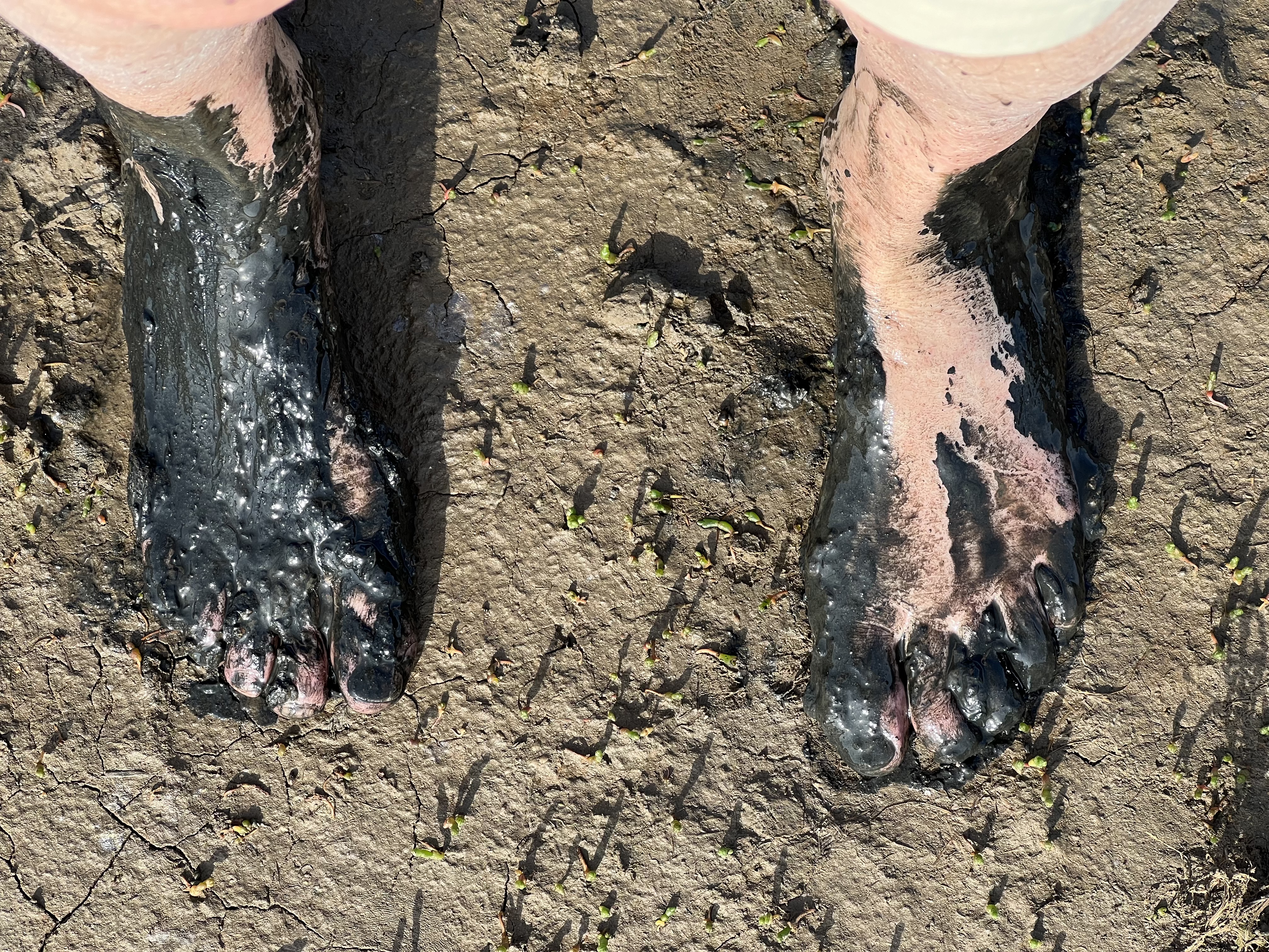
“God lifted me out of the mire and clay, set my feet upon a rock, and put a new song in my mouth.”
Psalm 40:2-3

I was the only pilgrim on the sands in the early morning. The blessed solitude sanctified my final steps on St. Cuthbert’s Way. Halfway across, I began to hear an eerie keening sound, like wind through a broken wall. But that made no sense out on the tidal flat. After looking about with binoculars, I spied a dark mass at least a mile away. It was, I realized, hundreds of beached seals, pining for their absent sea.  

The seals of Holy Island.

It took me seventy-five minutes to reach the other side, and another ten to find the parish church of St. Mary the Virgin, where I lit a candle to give thanks for the beautiful journey. 
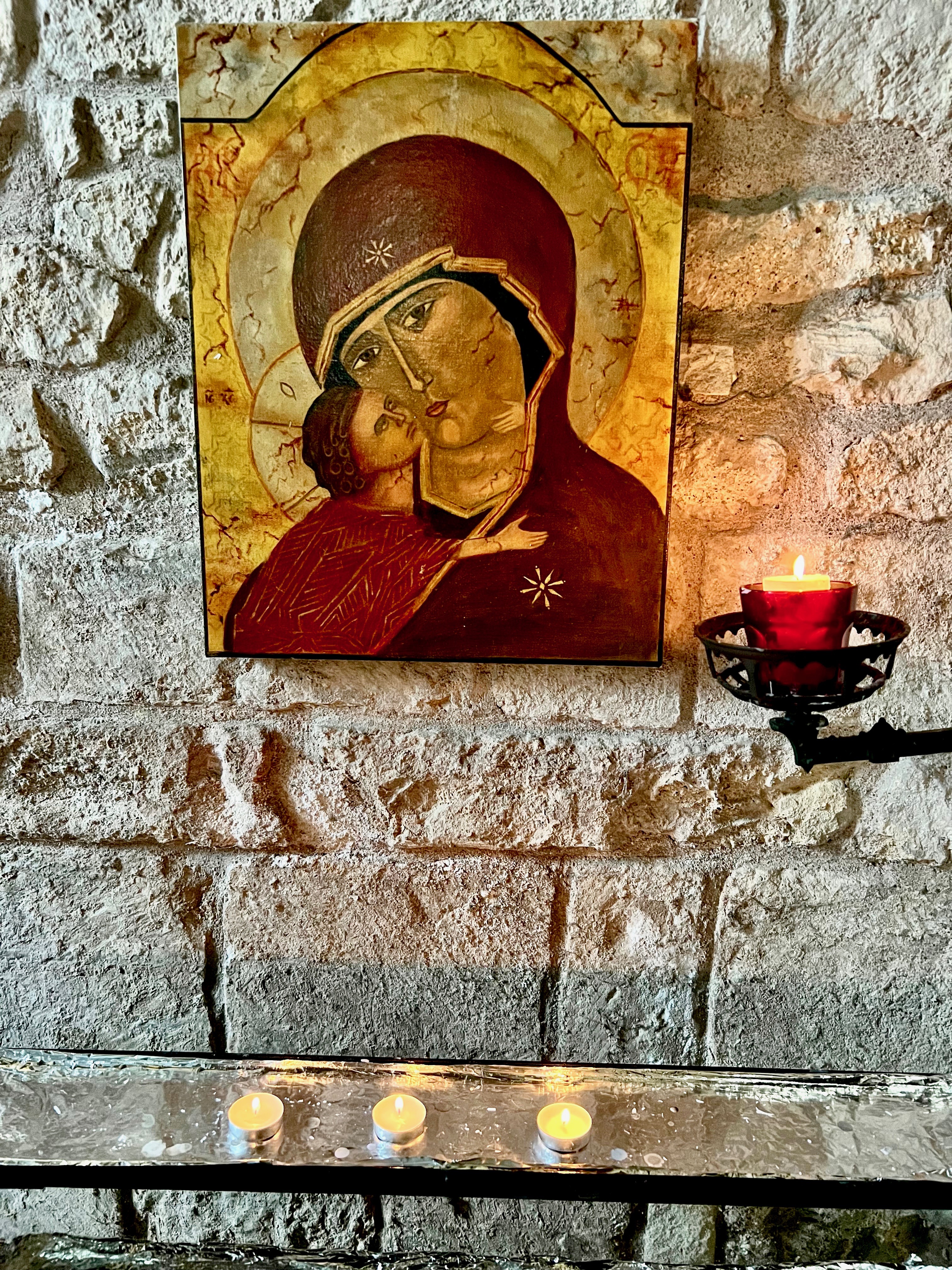
Prayer station in St. Mary’s. Public liturgies are offered daily in this (mostly) 13th-century church adjacent to the Priory ruins.
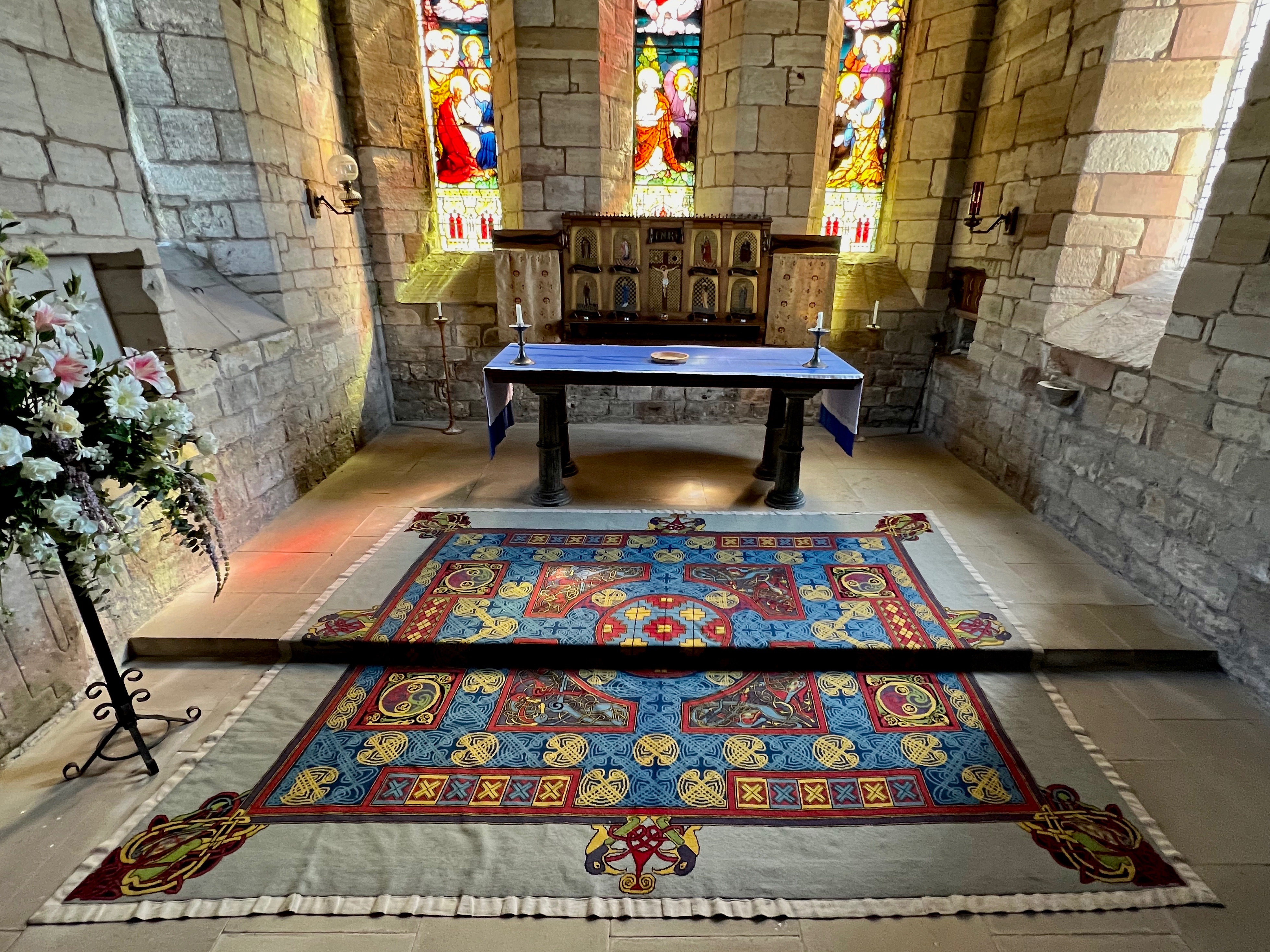
Chancel of St. Mary the Virgin, Lindisfarne’s parish church. Most of the structure is 13th century (restored in the 19th century), but some portions of an earlier building remain. The carpet, copied from a page in the Lindisfarne Gospels, was embroidered by 18 women of the parish in 1970.

The Anglican parish church stands adjacent to the ruins of the twelfth-century Lindisfarne Priory, erected on the site of the seventh-century monastery founded by St. Aidan and nurtured by St. Cuthbert. I would return to this peaceful sanctuary again and again during my three-day sojourn on Holy Island. Sarah Hills, the gracious vicar, invited me to read Scripture at Morning and Evening Prayer. One of those passages was the comic narrative of Balaam and his recalcitrant speaking donkey, perhaps the oddest story in the Bible (Numbers 22:1-39). It was a very long text, so I tried to give each character a distinctive quality to sustain interest. The donkey’s voice got a few laughs.  

On Ascension Sunday, the eucharist was crowded with pilgrims from many lands. I passed the Peace with Africans, Asians, Europeans, North and South Americans. The singing was spirited—no half-hearted voices after such a journey. Our harmonious sound enveloped me in the embrace of communal faith, and for a blessed hour my “I” became “we.” The offertory hymn happened to be “Lord of all hopefulness,” which celebrates the daily round of prayerful living: Be there at our waking … be there at our labors … be there at our homing … be there at our sleeping. I memorized it long ago in my teens, and I had sung it at the start of every day along Cuthbert’s Way. To repeat it now at Lindisfarne, with all the company of heaven, wasn’t just coincidence; it was grace. I received its gift with tears.
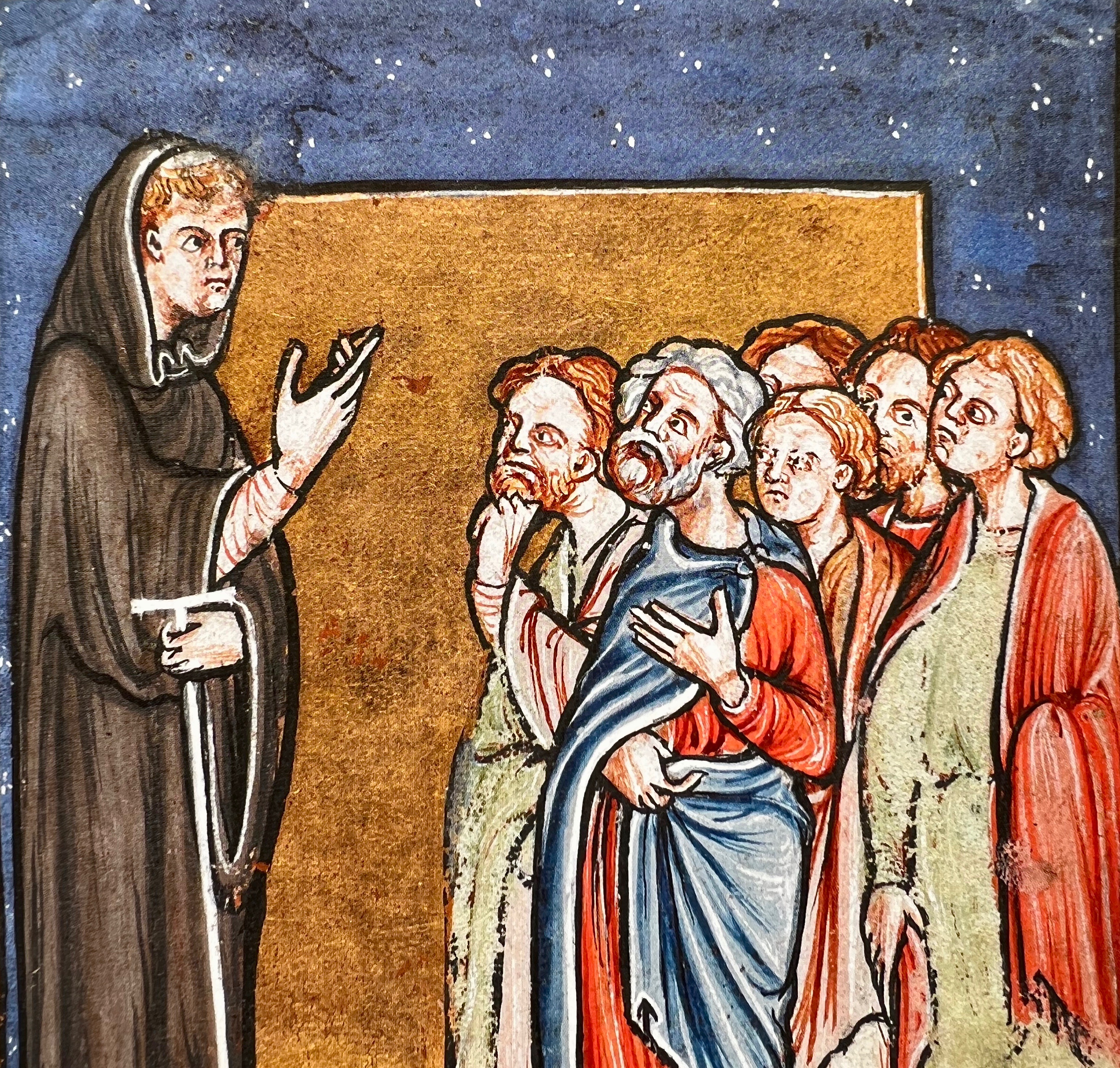
St. Cuthbert preaching to the Northumbrians (late 12th-century illustration for Bede’s Life of St. Cuthbert).

“They confessed their sins, confided in him about their temptations, and laid open to him the common troubles of humanity they were laboring under … Spirits that were chilled with sadness he could warm back to hope again … Those beset with worry he brought back to thoughts of the joys of heaven .…” [iv]   

— The Venerable Bede, Life of St. Cuthbert

Cuthbert has, through the ages, been the most beloved of Britain’s northern saints. Although he left no writings of his own, his biographers describe a humble and prayerful man, full of charm, a citizen of heaven who devoted his life to the needs of earthly folk. He had a compassionate spirit, and was a gifted listener. When the responsibilities of leadership were thrust upon him, he accepted them in a spirit of obedience. But he had a hermit’s heart, and no thirst for power. 

At age thirty, he became Prior of Lindisfarne in 664, and was assigned the difficult task of introducing the forms and practices of the Roman church to his resistant Celtic community. In a momentous decision at the recent Synod of Whitby, the Celtic churches in Britain had agreed to adopt the more universal—and hierarchical—norms of western Catholicism, surrendering the eccentricities of their more local traditions. But religious practices are hard to change, and Christian changemakers in every age have heard the same complaint, “But that isn’t the way we’ve always done it!” The seventh-century monks of Lindisfarne were no different than the Christians of our own time who fought women’s ordination or new forms of worship. They were uncomfortable. And they raised a fuss.

In Lindisfarne’s case, Cuthbert’s patient sweetness won the day. As the Venerable Bede tells the story,

“When he was wearied by the sharp contentions of his opponents he would rise up suddenly and with placid appearance and demeanor he would depart, thus dissolving the Chapter, but nevertheless on the following day, as if he had suffered no opposition the day before, he would give the same exhortations again to the same company until he gradually converted them to his own views.” [v]
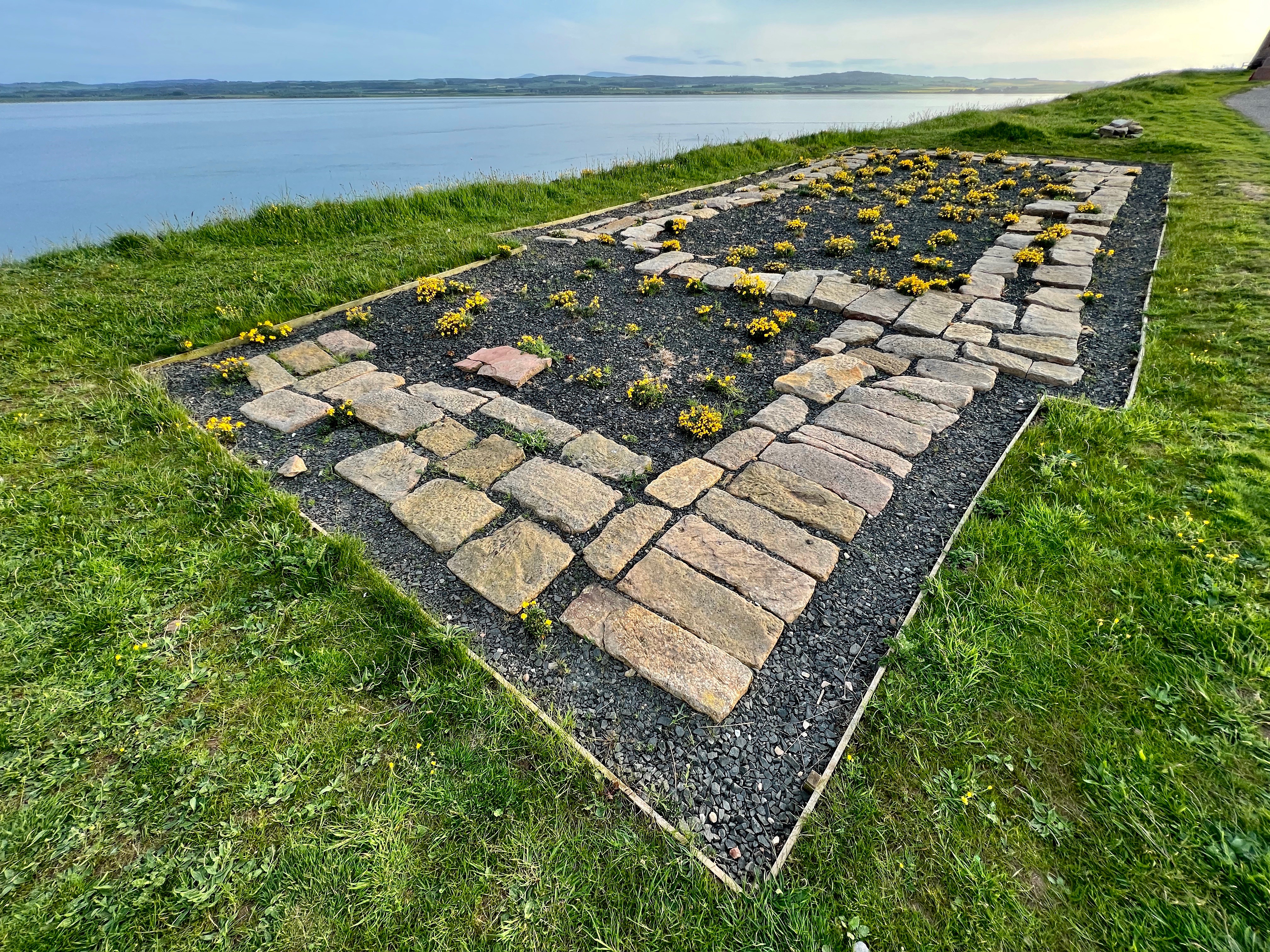
Foundation of an Anglo-Saxon church on the Heugh, the rocky ridge above the 12th-century ruins of Lindisfarne Priory. Discovered in recent excavations (2016-2018), this may have been part of the original monastery founded by St Aidan in 635.
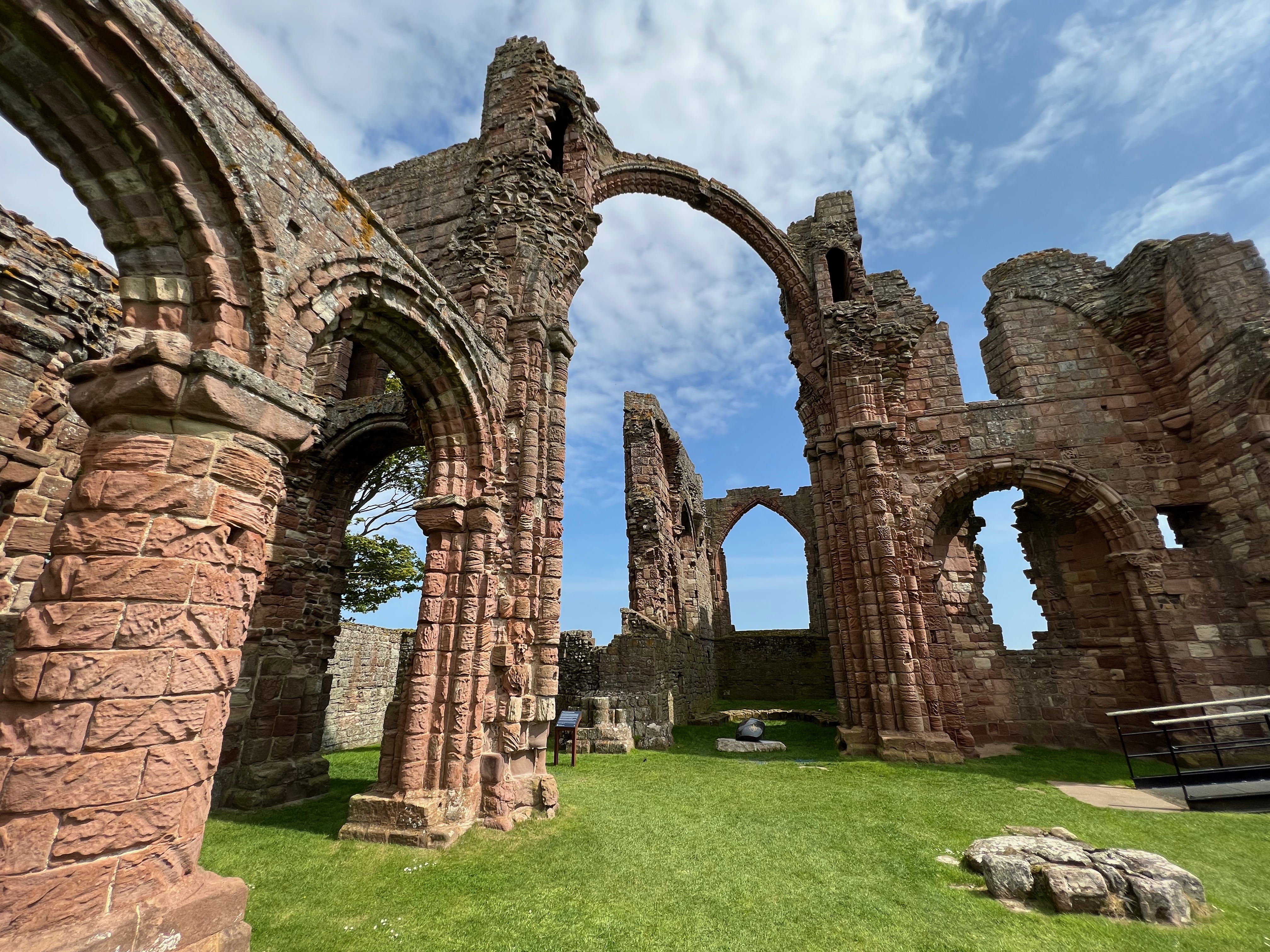
View from the nave of Lindisfarne’s Priory church (12th century, with modifications over the next 200 years). The north wall and arcade remain largely intact. The rainbow arch, a rib from the crossing vault, survived the collapse of the central tower in the 18th century. The pointed arch at the east end of the presbytery apse is a 14th-century Gothic touch.
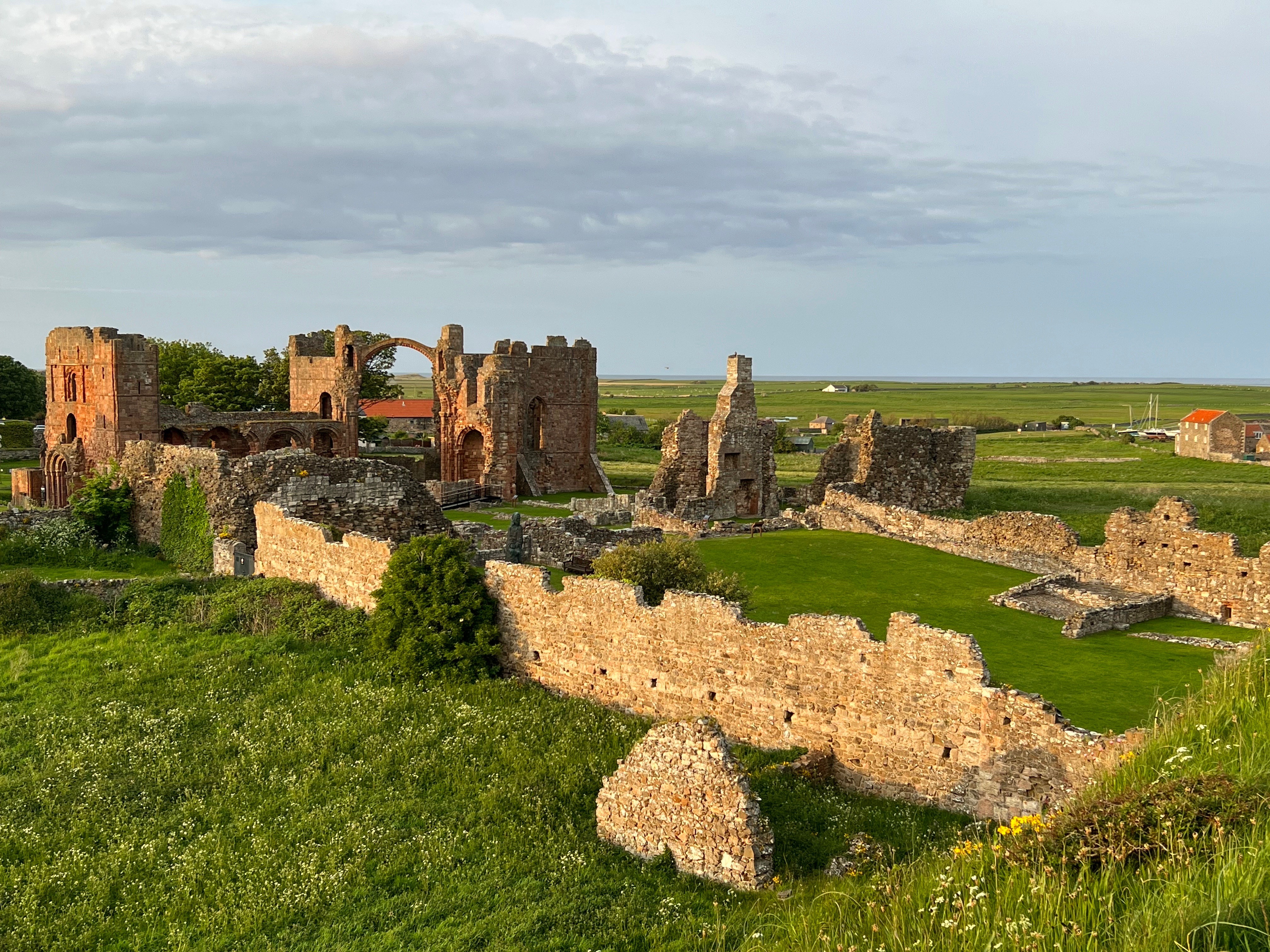
Lindisfarne Priory (12th century). The church was built first with pink sandstone.
The domestic complex was constructed later using greyer stones.
St.Cuthbert’s Isle, St. Mary’s Church, and Lindisfarne Priory from the Watchtower on the Heugh.

Time has erased the physical traces of Cuthbert’s Lindisfarne, but the impressive ruins of the Priory’s later structures still bear witness to his indelible legacy. After his death, pilgrims flocked to his shrine, thought to have been somewhere within the perimeter of the church built 500 years later. This video takes us through the ruins to the most likely spot.

Lindisfarne Priory from the north aisle to the presbytery.
The black stone marks the possible site of Cuthbert’s first burial.

After twelve years as prior here, Cuthbert felt an increasingly insistent call to solitude. For a time, he moved just offshore to a tiny island to seek the “green martyrdom” mentioned in the seventh-century Irish text, the Cambrai Homily

Precious in the eyes of God:
The white martyrdom of exile
The green martyrdom of the hermit
The red martyrdom of sacrifice.[vi]

In other words, there are different ways to take up your cross. If your faith doesn’t literally kill you or drive you into exile, you can still withdraw from the world to wage without distraction the interior struggle for authenticity, what St. Benedict called the “single-handed combat of the wilderness.” Inspired by the desert hermits of Late Antiquity, many British ascetics took flight to wild and lonely places in the early Middle Ages. 
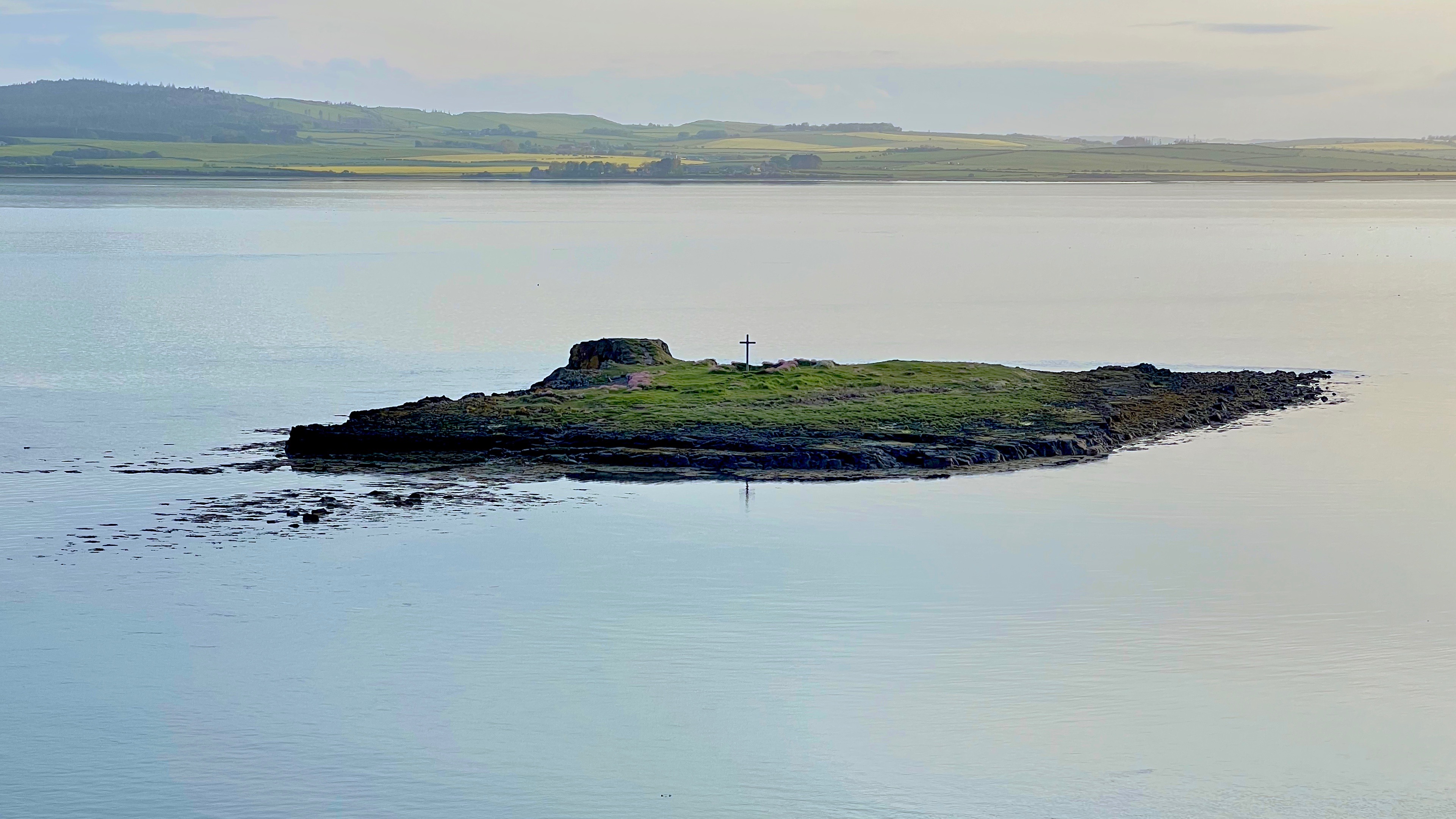
St. Cuthbert’s Isle, just offshore from Holy Island, where the saint sought prayerful solitude.
You can walk to it at low tide.

It wasn’t long before Cuthbert moved further away, to the island of Inner Farne, a seven mile row from Lindisfarne. Its rocky terrain had sparse vegetation, but was teeming with birdlife: puffins, guillemots, terns, kittiwakes, eider ducks, and numerous other species. Cuthbert loved the natural world, and there are many charming stories of his interactions with birds and animals. Here is my favorite, told by Michael York in a video I made years ago about early British Christianity: 

St. Cuthbert and the otters
From The Story of Anglicanism: Early and Medieval Foundations
Cathedral Films, 1988

What was life like for an island hermit? Was it an escape from interdependence, or could it be a way of going deeper and deeper into the world? A twelfth-century Irish poem conveys a vivid sense of belonging to a sacred ecology: 

Delightful I think it to be in the bosom of an isle, on the peak of a rock,
that I might often see there the calm of the sea.

That I might see its heavy waves over the glittering ocean,
as they chant a melody to their Father on their eternal course.

That I might see its splendid flocks of birds over the full-watered ocean;
that I might see its mighty whales, greatest of wonders…

That contrition of heart should come upon me as I watch it;
that I might bewail my many sins, difficult to declare.

That I might bless the Lord who has power over all,
Heaven with its pure host of angels, earth, ebb, flood-tide.

That I might pore on one of my books, good for my soul;
a while kneeling for beloved Heaven, a while at psalms.

A while gathering seaweed from the rock, a while fishing, 
a while giving food to the poor, a while in my cell.

A while meditating on the Kingdom of Heaven, holy is the redemption!
a while at labor not too heavy; it would be delightful! [vii]

The presbytery apse at the east end of the Lindisfarne Priory church. The high walls and absent roof, like Cuthbert’s cell on Inner Farne, block any view of the surrounding world, concentrating attention on what the saint called “higher things.”

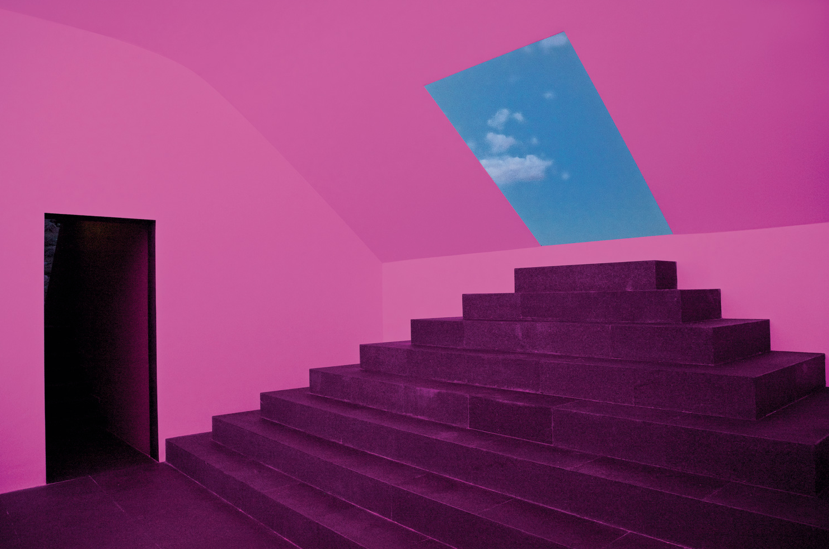
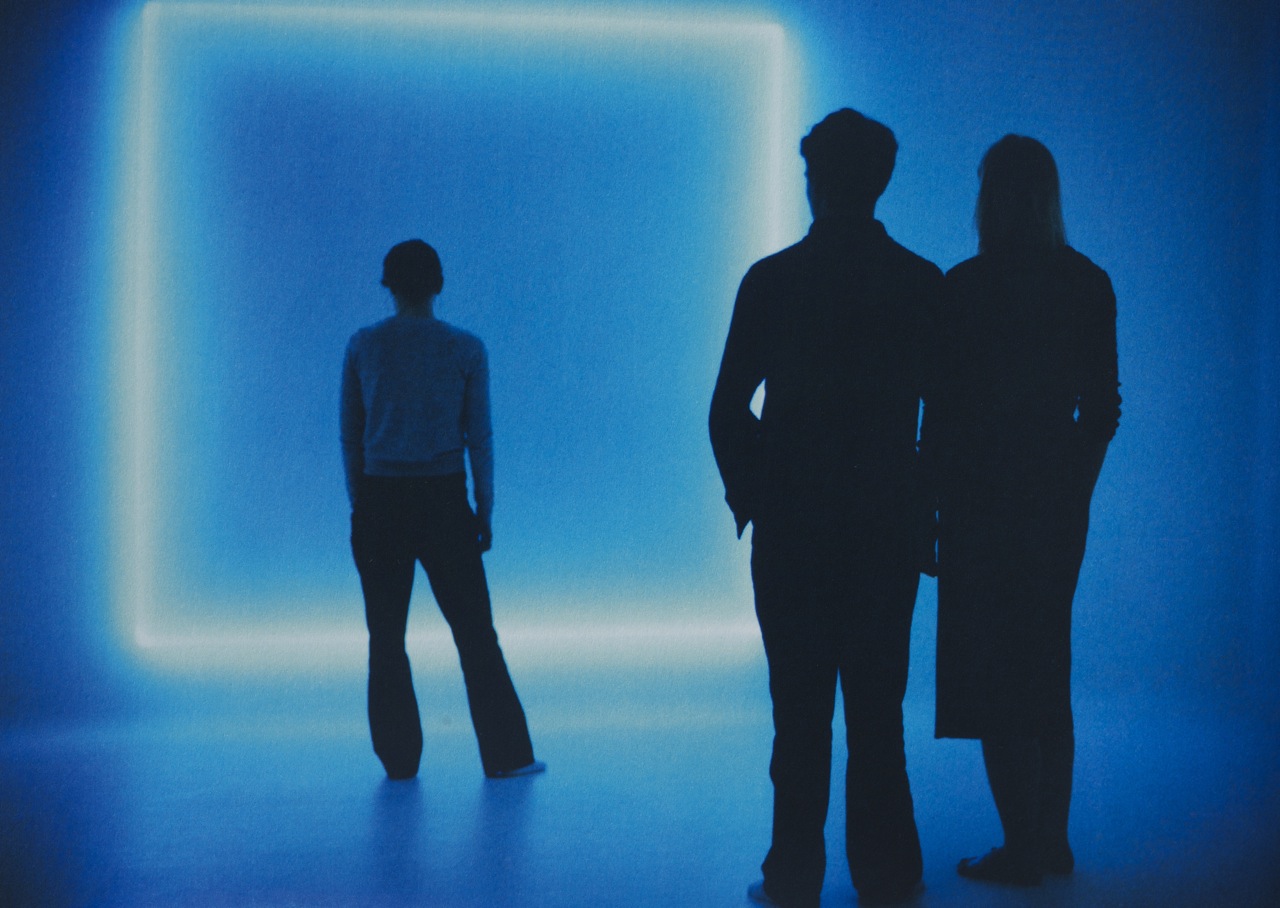
Despite his affection for the created world, Cuthbert constructed his stone cell on Farne with high walls and no windows. His only view was through an opening in the roof. The design was intended to focus his attention on the higher things of “heaven,” not just as a concept, but as a physical, sensory experience. That strikes me as similar to what contemporary Light and Space artist James Turrell achieves with his “Skyspaces,” windowless rooms with a rectangular or elliptical opening cut into the ceiling. 

“My art deals with light itself,” Turrell says. “It’s not the bearer of revelation—it is the revelation.” [viii]  Instead of looking at material objects, you gaze up though the opening, taking in the sky’s color and light during the day and the stars at night. Over time this perceptual asceticism, screening out the world of things, quiets and deepens the eye, making it more receptive to the immaterial, more open to the infinite. Could the same thing have happened to Cuthbert in his stone enclosure? “It’s not about earth. It’s not about sky. It’s about our part in the luminous fabric of the universe.” [ix]   
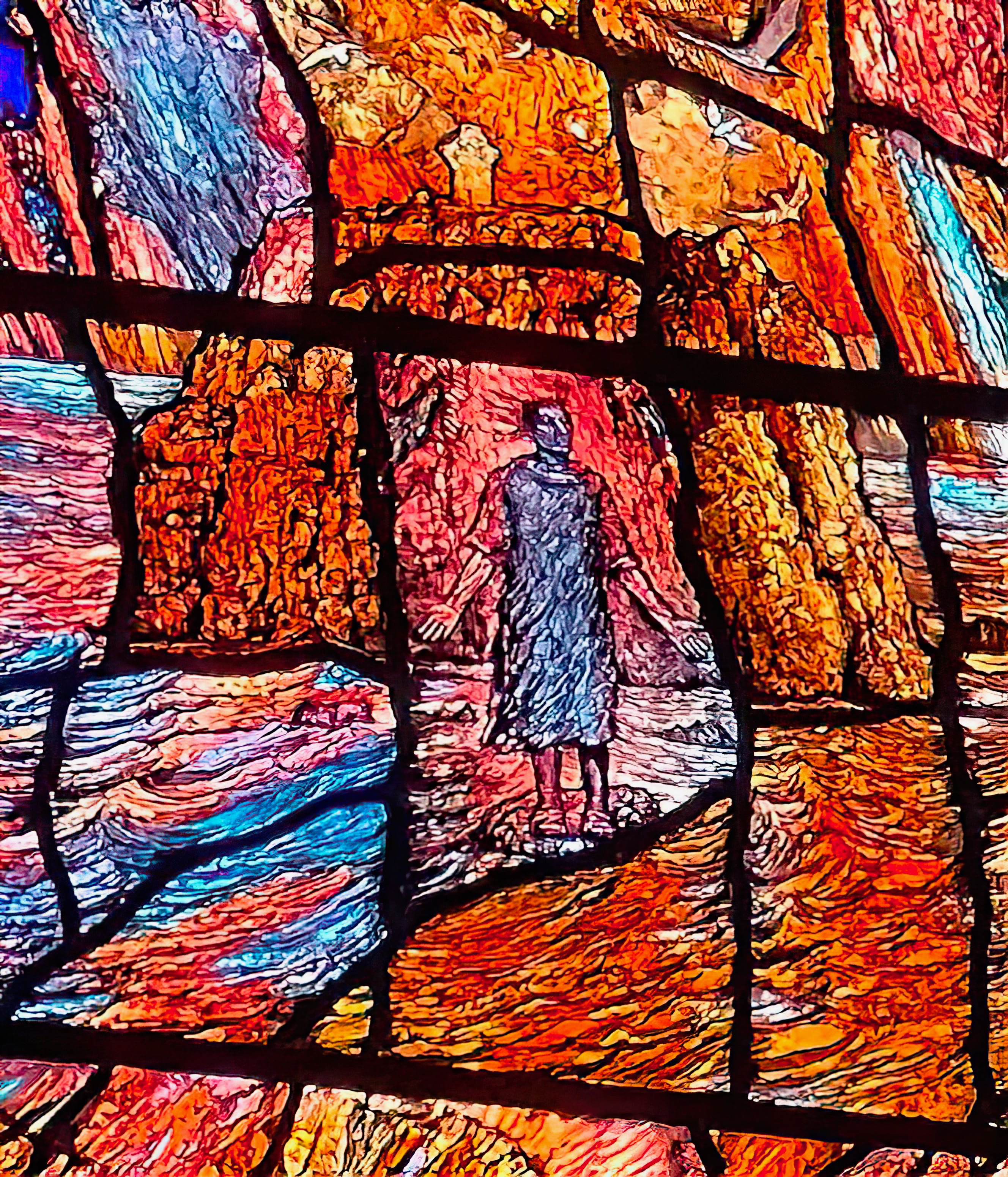
Cuthbert prays on an island in a turbulent sea (detail of Tom Denny’s Transfiguration window, Durham Cathedral (2010). “That I might bless the Lord who has power over all: Heaven with its pure host of angels, earth, ebb, flood-tide.”

We can only speculate about the experiential nature of Cuthbert’s solitude, but Frederick Buechner, imagining the thoughts of another Northumbrian hermit, gives an honest appraisal of its challenges:

What’s prayer? It’s shooting shafts into the dark. What mark they strike, if any, who’s to say? It’s reaching for a hand you cannot touch. The silence is so fathomless that prayers like plummets vanish in the sea. You beg. You whimper. You load God down with empty praise. You tell him sins that he already knows full well. You seek to change his changeless will. Yet Godric prays the way he breathes, for else his heart would wither in his breast. Prayer is the wind that fills his sail. Else waves would dash him on the rocks, or he would drift with witless tides. And sometimes, by God’s grace, a prayer is heard.[x]
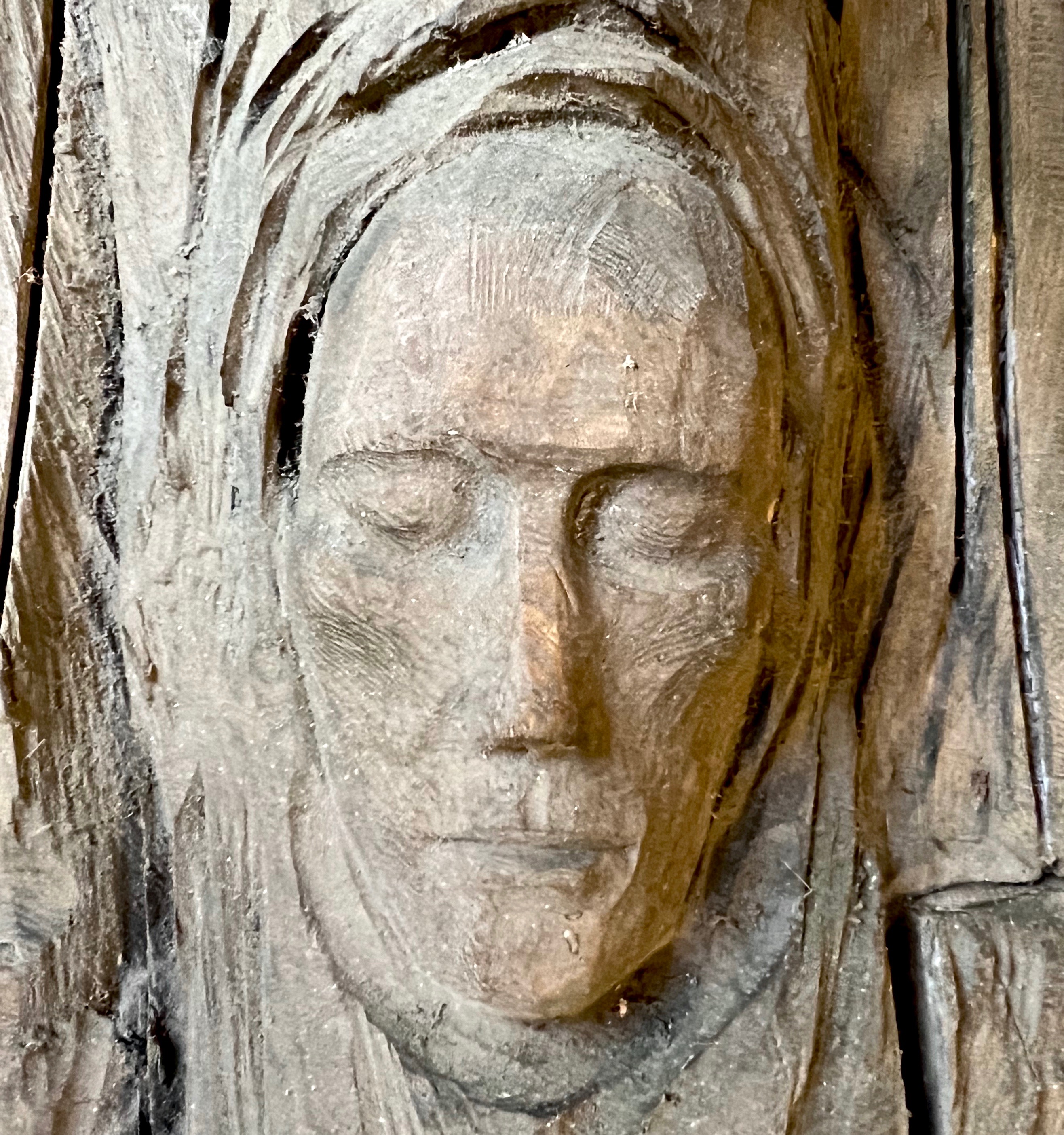
St. Cuthbert (detail from The Journey by Fenwick Lawson,1999).

One of Cuthbert’s early hagiographers described the saint’s inner life as being free of struggle, anxiety or doubt. We are assured that “in all conditions he bore himself with unshaken balance.” [xi]  But balance is hardly a prime directive for pilgrims of the Absolute. We may assume that Cuthbert knew his share of demons and dark nights on Farne. Nevertheless, the continuing stream of seekers to his island retreat found no solipsist lost in dreams or madness, but a compassionate listener who still had the gifts of a pastor. He always sent them away with lighter hearts than when they came.
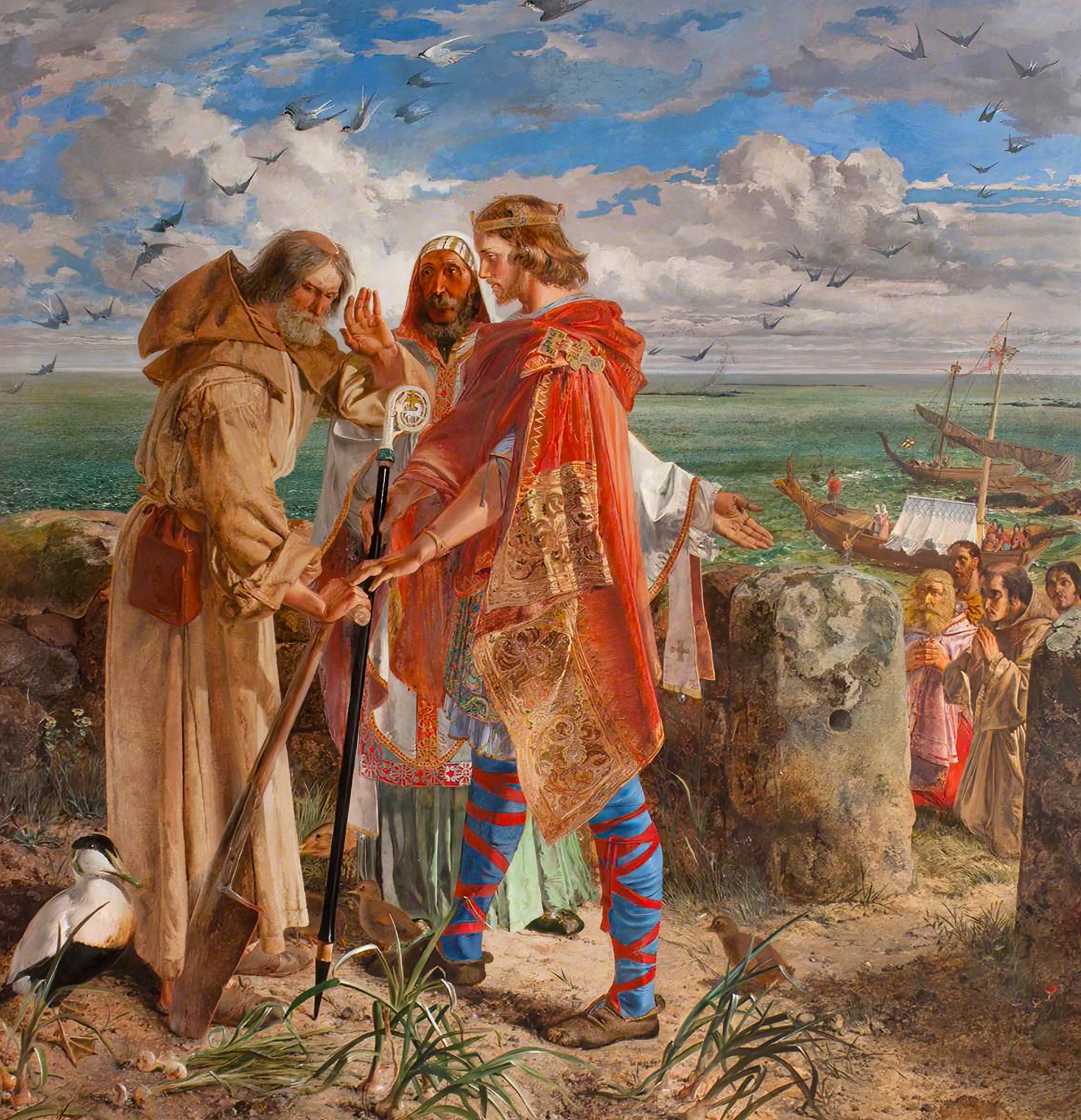
King Egfrid and Bishop Trumwine visit Inner Farne to persuade a reluctant Cuthbert to be made Bishop. (William Bell Scott, 1856)

Cuthbert spent nine years as a hermit, but in 685 the King of Northumbria and the Archbishop of Canterbury, hoping that this renowned holy man could help heal the divisive rivalries in the English Church, elected him to be the bishop of Hexham. The thought of leaving his “hiding place” on Farne made him sad, but when a distinguished delegation visited his hermitage to seek his consent, he yielded to the call. At least he managed to swap dioceses with another bishop, granting him oversight of his own beloved Lindisfarne. Whatever he lost in returning to the active life, it was not his soul. His anonymous biographer assures us that “he maintained the dignity of a bishop without abandoning the ideal of a monk.” [xii]

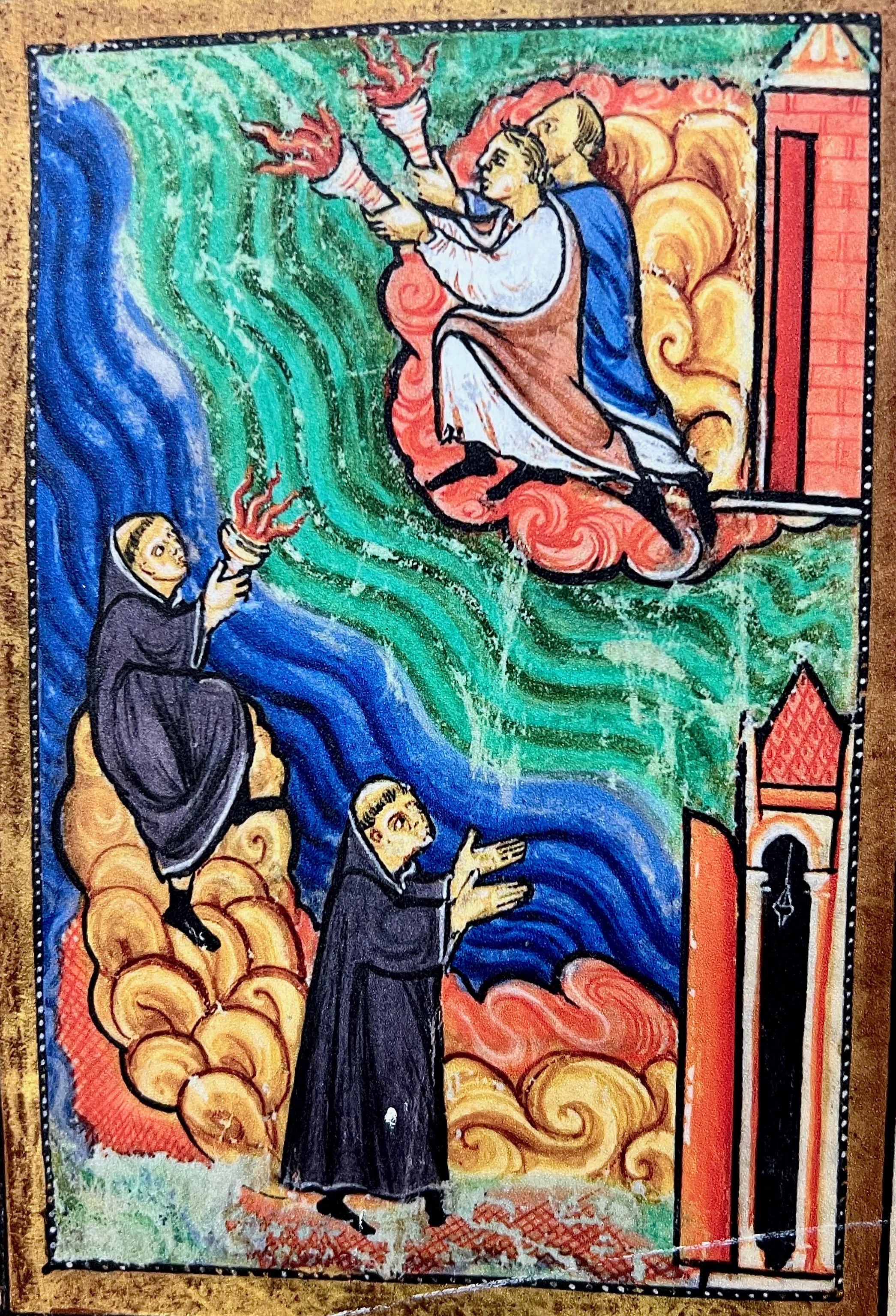
Two years later his health began to fail. At 51, he knew his days were numbered. He resigned his episcopate just after Christmas 686, then returned to his hermitage to die amidst the sound of seabirds, seals and crashing waves. He departed this life two weeks before Easter 687. The monks keeping vigil at his deathbed lit torches to signal his brothers at Lindisfarne that he had fallen asleep in Christ. His body was returned to the Priory for burial.
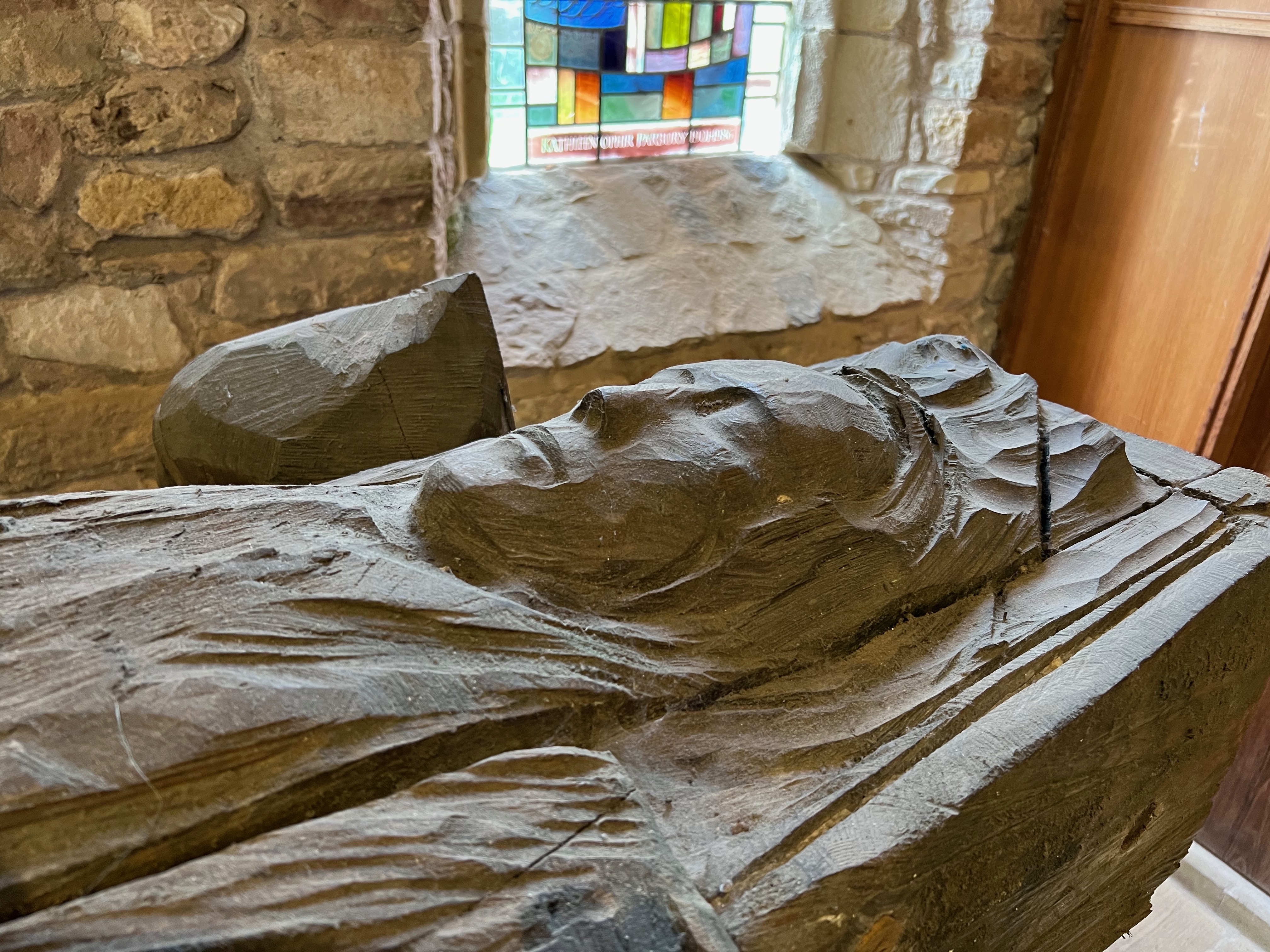
Cuthbert, who fell asleep in Christ in 687, is movingly depicted in Fenwick Lawson’s The Journey, which has been in St. Mary’s church since 2005.
In an illustration for Bede’s Life of St. Cuthbert, monks on Inner Farne use torches to signal news of the saint’s death to their brothers at Lindisfarne.

I wasn’t able to visit Inner Farne. Landings were suspended by an outbreak of Avian Flu. But the peace of Holy Island itself was blessing enough. Once the daytrippers flee back to the mainland before the tide returns, a profound calm settles in. It seemed almost deserted during the afternoons. In my days there, I sank into the solitude of grassy dunes, rambled through fields of spring color, enjoyed the tuneful chants of countless birds. Perhaps there was more Wordsworth than Cuthbert in the pleasure I took here—I suffered no rigorous austerities—but I hope that my bodily appreciation of Holy Island did honor to the saint’s own love for this place.
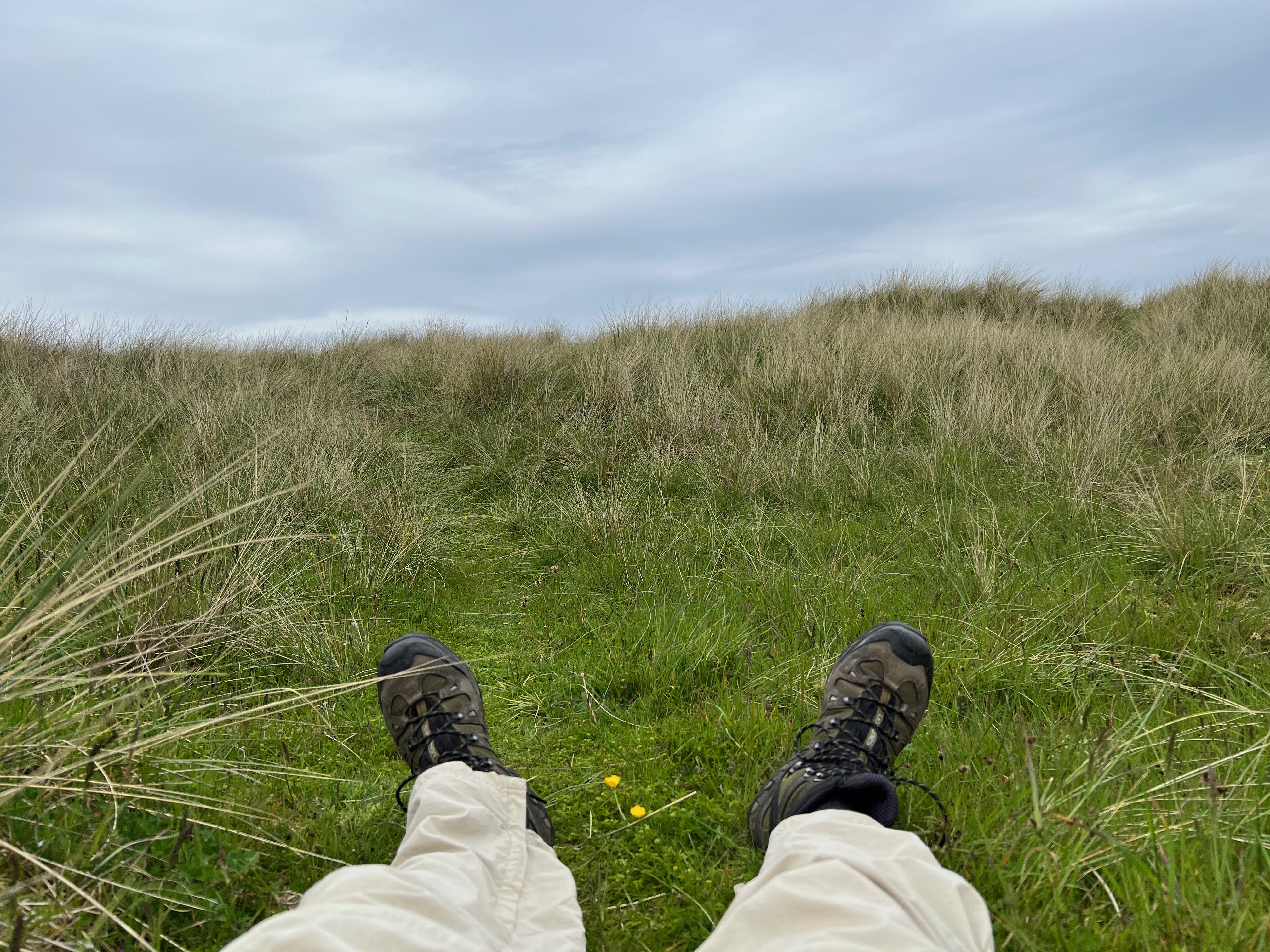
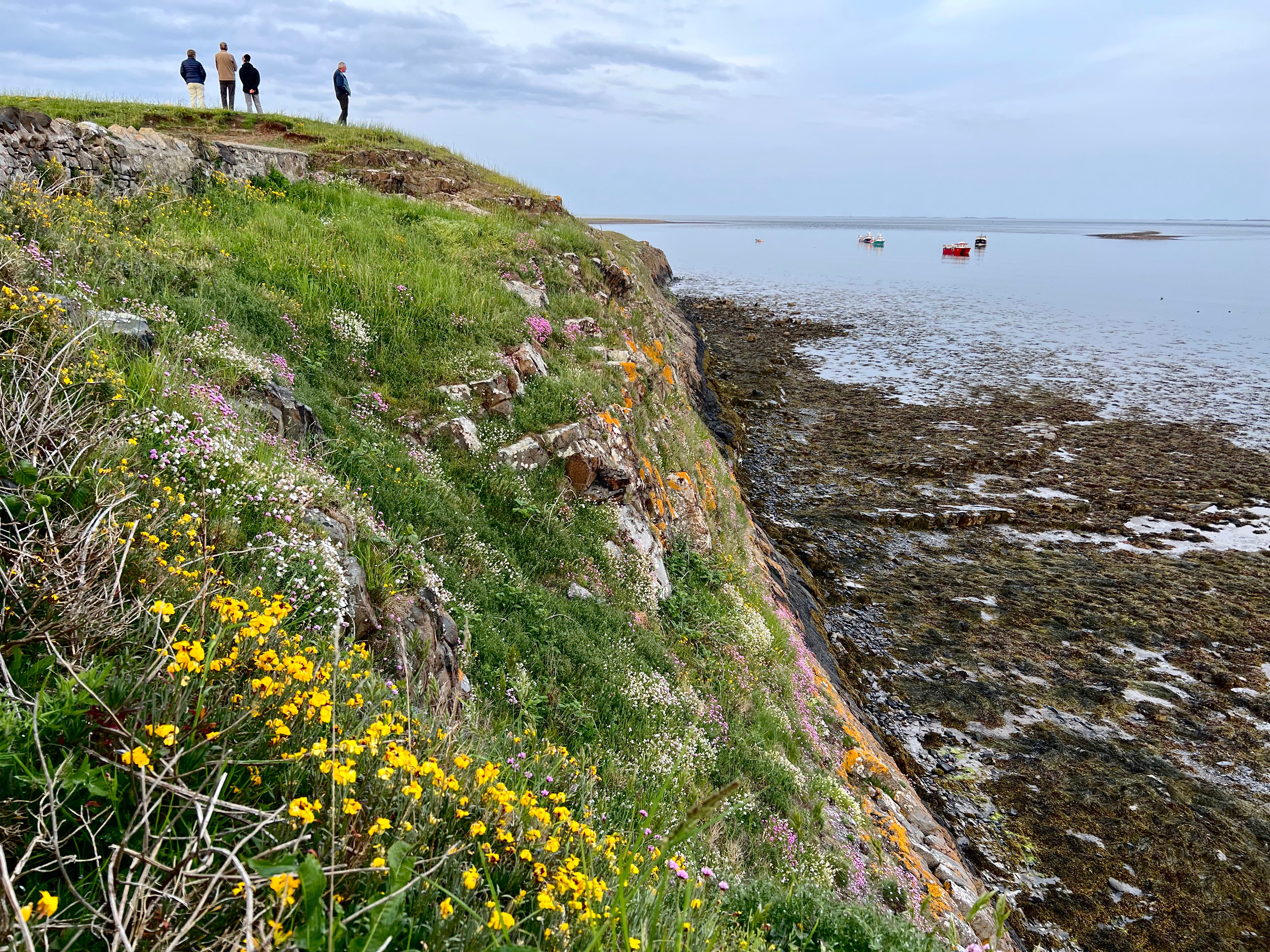
The grassy dunes of Holy Island are a refuge from the clamor of the world. If you lie down in a hollow, neither wind nor wave breaks the profound silence.
The elevated Heugh (“hee-uff”) between the Priory and the sea was formed from magma 295 million years ago. The thin soil developed on the hard whinstone grassland hosts an exceptional variety of wildflowers.
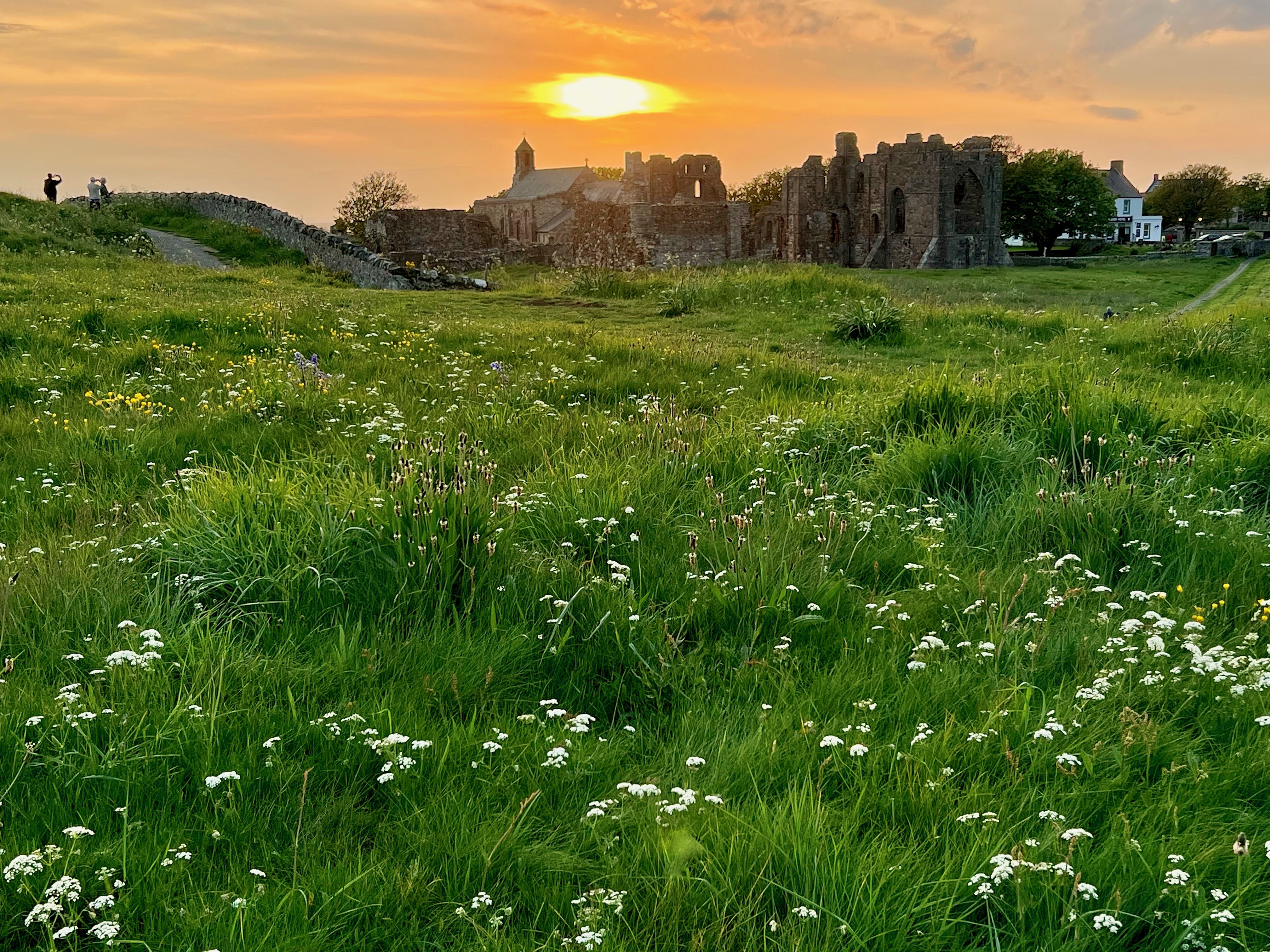
Vespers at Lindisfarne. “Now as we come to the setting of the sun, and our eyes behold the vesper light, we sing your praises, O God.”

Holy Island is a busy hub for migratory flights between Britain, Scandinavia, southern Europe, even the Arctic and Africa. Some 337 different avian species have been identified here. The following audio was recorded around the site of Lindisfarne Priory in the early evening. If you want to spend two and a half minutes on Holy Island, close your eyes and listen.

Birds of Holy Island.

According to medieval custom, the remains of saints would be exhumed ten to twenty years after their death, so that their bones could be washed, wrapped reverently in silk or linen, and placed in a shrine for veneration. 
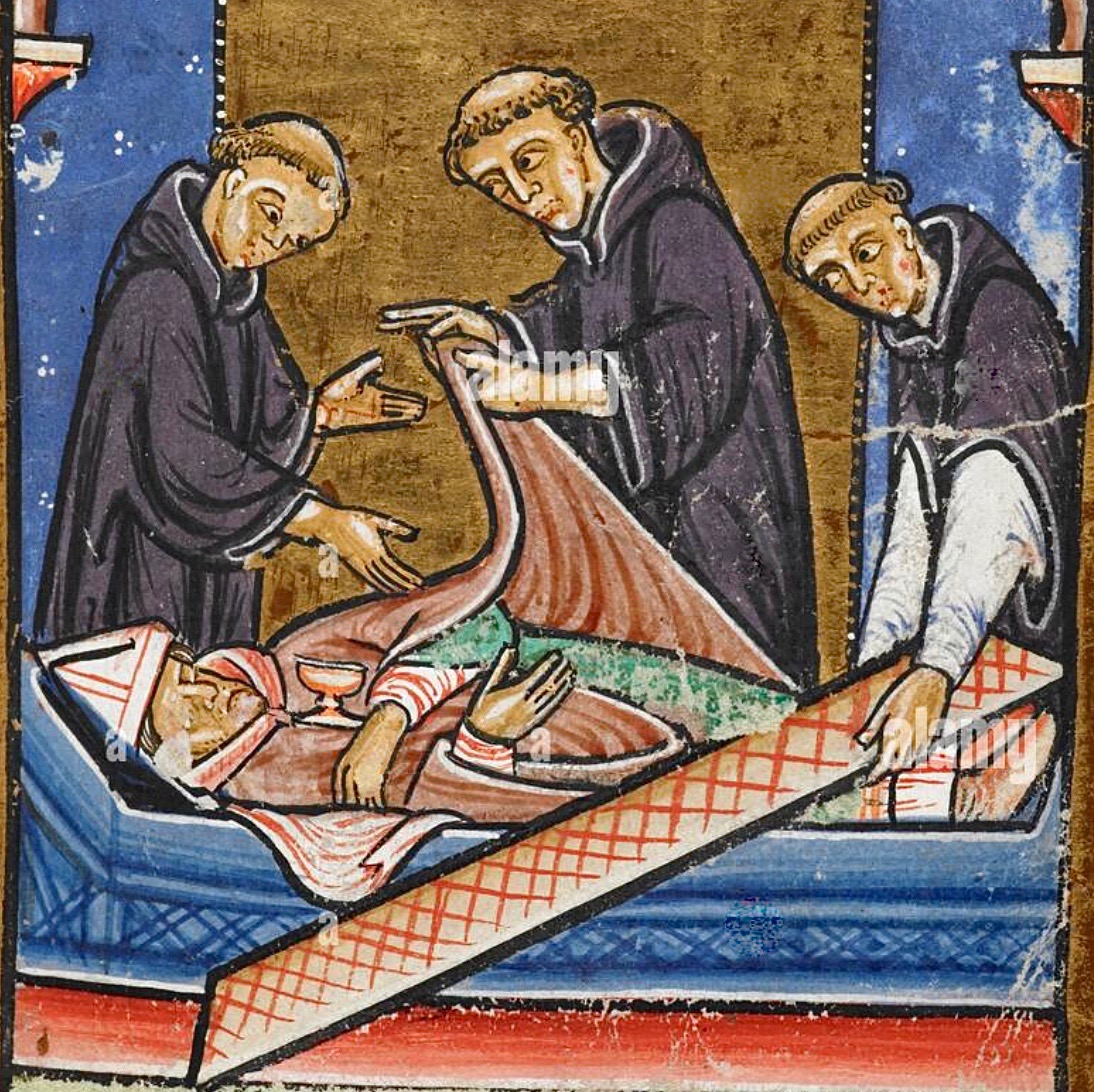
When the monks of Lindisfarne opened Cuthbert’s coffin 11 years after his death to wash his bones, they were astonished to find his body still intact (12th-century illustration for Bede’s Life of St. Cuthbert).

But when the monks of Lindisfarne opened Cuthbert’s coffin in 698, they found his body “uncorrupted” and still intact. When news of this wonder spread, the stream of pilgrims grew to a flood. Sadly, Cuthbert’s body would not rest in peace here for long. Not on a defenseless coastline in the age of the Vikings.
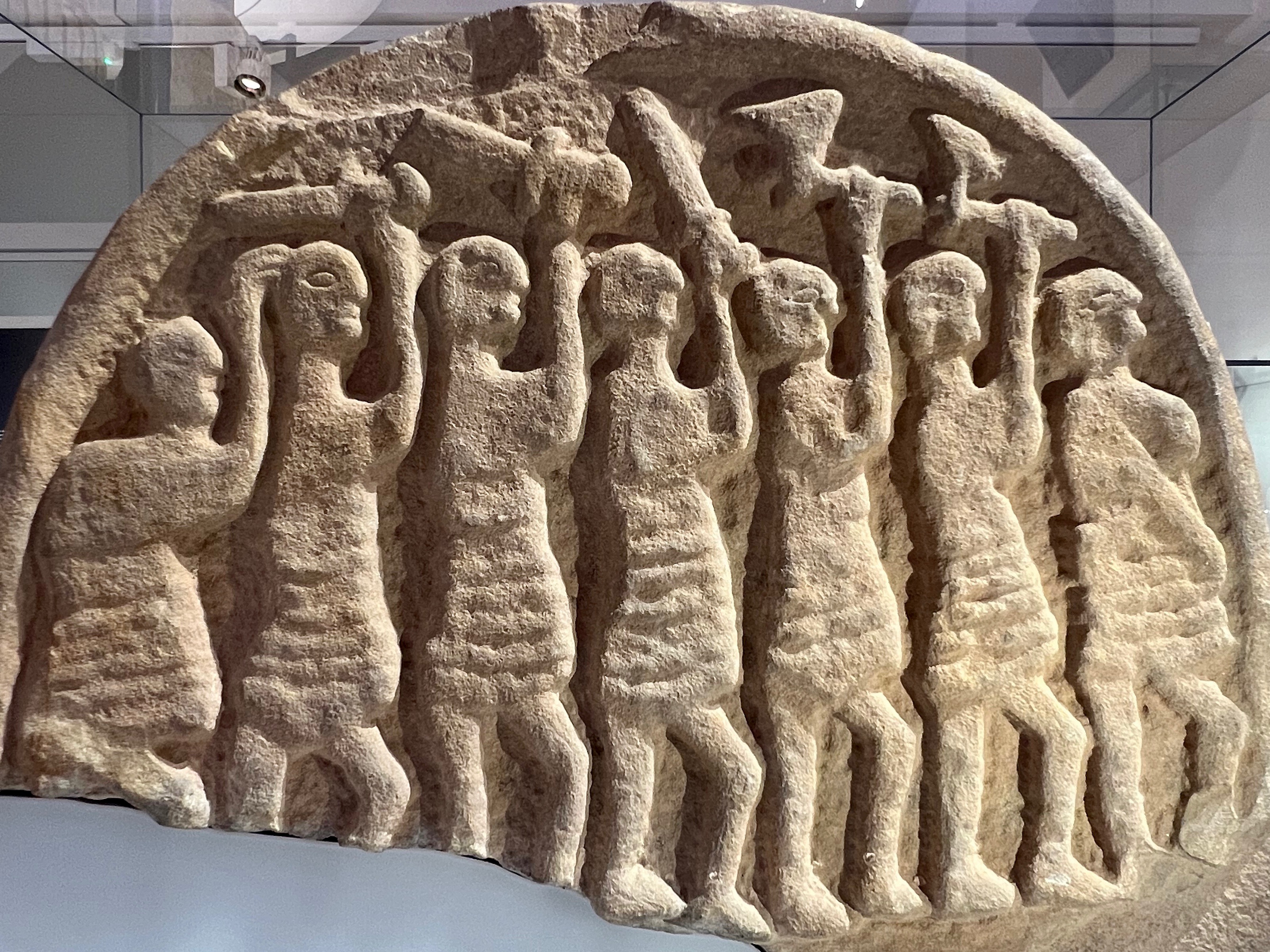
This 9th-century “Judgment Day” stone found at Lindisfarne is thought to commemorate the Viking raids, when “heathen men miserably destroyed God’s church at Lindisfarne with plunder and slaughter.”

In 793, the peace of Lindisfarne was shattered when Viking marauders sacked the Priory. Remarkably, Cuthbert’s shrine survived the damage. Eighty years later, there was a second raid. It was even worse.

“And they came to the church of Lindisfarne and laid everything waste with grievous plundering, trampled the Holy Places with polluted feet, dug up the altars and seized all the treasures of the Holy Church. They killed some of the brothers, they took some of them away in fetters, many they drove out naked and loaded with insults and some they drowned in the sea …” [xiii]

It was the end of an era for Lindisfarne, but Cuthbert’s own story had one more chapter. Just before the second Viking invasion, the saint made his getaway from Holy Island when a small band of brothers lifted his wooden coffin from the Priory shrine and carried it across the tidal flats to the mainland. Thus began two centuries of wandering in exile for Cuthbert’s remains, until he finally came to rest in the newly built cathedral at Durham in 1104. 
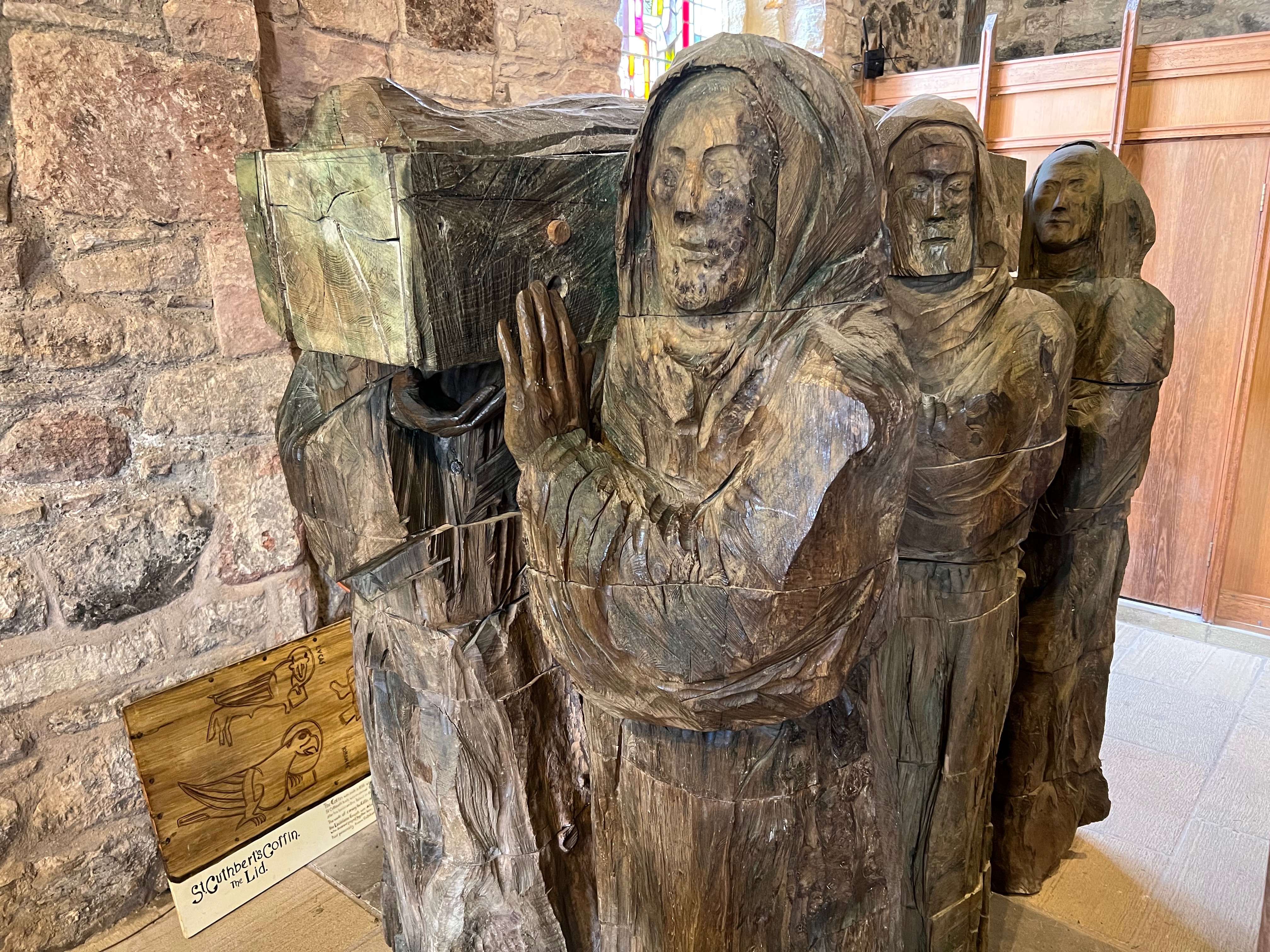
The Journey (Fenwick Lawson, 1999, now in St. Mary’s church).
Monks carry Cuthbert’s coffin away from Holy Island to protect it from Viking raiders.

On my third morning at Holy Island, I rose early to cross back over the sands. My own wandering was not yet done. I would follow the saint to Durham. 

The path I walk, Christ walks it. 
May the land in which I am be without sorrow.
May the Trinity protect me wherever I stay…
May bright angels walk with me — dear presence — in every dealing…
May every path before me be smooth. 
Well does the fair Lord show us a course, a path. [xiv]

Crossing the Holy Island Sands to the mainland.

THE ST. CUTHBERT SERIES CONCLUDES:

The Journey Ends: Durham Cathedral

Photographs, videos and nature recordings are by the author.

“For All the Saints” is sung by the choir and congregation of St. Barnabas Episcopal Church, Bainbridge Island, Washington, with Paul Roy on organ.

The first installment of this pilgrimage account, Walking St. Cuthbert’s Way, may be found at https://jimfriedrich.com/2023/07/28/walking-st-cuthberts-way/

For more on James Turrell: https://jimfriedrich.com/2015/08/06/the-woven-light-reflections-on-the-transfiguration/


[i] The line is from Derek Walcott’s poem, “Love After Love.”

[ii] Buechner’s fine novel is about a 12th century hermit saint in the north of England. It made excellent reading on St. Cuthbert’s Way.

[iii] #128 in The Sacred Harp, with lyrics by Samuel Stennet (1787).

[iv] Bede, Life of St. Cuthbert, 22, quoted in Mary Low, St. Cuthbert’s Way: A Pilgrim’s Companion (Glasgow: Wild Goose Publications, 2019). The great historian of early English Christianity is a key source for Cuthbert’s life. Born 14 years before the saint’s death, he was able to interview some who had known Cuthbert in life when he wrote his biography. 

[v] Bede’s Life of Cuthbert, quoted in Philip Nixon, St. Cuthbert of Durham (Gloucestershire: Amberly Publishing, 2012), 33.

[vi] Isabel Colgate, A Pelican in the Wilderness: Hermits, Solitaries and Recluses (New York: Counterpoint, 2002), 104. The Cambrai Homily (7th or 8th century) is the earliest known Irish homily. The “green” martyrdom refers to rigorous ascetic practice not requiring either a pilgrimage journey or a complete disconnection from the world. The Irish word glas may be translated as blue as well as green, perhaps referring to turning blue after praying the Psalter all night in a cold river, or developing a sickly complexion from too much austerity.

[vii] In a Penguin anthology of Celtic writings I had years ago. 

[viii] James Turrell, quoted in Jan Butterfield, The Art of Light and Space (New York: Abbeville Press, 1993), 73.

[ix] E. C. Krupp, writing about Turrell in James Turrell: A Retrospective (Los Angeles: County Museum of Art, 2013), 246.

[x] Frederick Buechner, Godric (New York: Harper One, 1980), 142.

[xi] Anonymous Life of Cuthbert, 3.7, quoted in Low, 47. 

[xii] Anonymous Life, quoted in Nixon, 47.

[xiii] Simeon of Durham (d. circa 1129) was an English chronicler and monk at Durham Priory. Quoted in Nixon, 59.

[xiv] Ireland, 6th century.
“Delightful! Wonderful! Incomparable!” – Thoughts about holy spaces

Doug Wheeler, RM 669 (1969)

Doug Wheeler, RM 669 (1969)

For the viewer/participant of Light and Space art, a significant outcome of this experimentation is that the works of art perceptually condition us, whether we are aware of it or not.[i]

– Dawna Schuld

In 1914 the German writer Paul Scheerbart published The Gray Cloth and the Ten Per Cent White, a novel about an architect who constructed buildings made of colored glass. For the opening of each new building, his wife always wore gray clothing containing 10 per cent white, in order to intensify by contrast the effect of all the colors. Anyone who entered these luminous environments felt enveloped by the sublime. “The splendor of the colored glass ornament was so enhanced by the sun that one was at a loss for words to praise this wonder of color. Many visitors shouted repeatedly, ‘Delightful! Wonderful! Incomparable!’”[ii]

As the architect’s fame grew, he became fond of tossing out pithy aphorisms: “Glass brings a new era.” … “Building in brick only does us harm.” … “Colored glass destroys hatred.” He would have loved Twitter. Scheerbart’s utopian dream of transforming human nature through salubrious environments would soon fade in the disillusioning violence of the Great War, but it would surface again in the idealism of Modernist architecture: Design can change the world. Better buildings will make better people.

Architectural idealism has a long history. Plato thought that measure, form and order in the built environment had significant shaping power for both the soul and the community. Eighteenth-century Anglicans applied an exacting symmetry to church buildings in the hope that regularity and order in places of worship would, over time, help produce constancy and balance in believers. Order and form would tame unruly passions.

Such ambitions are easily mocked. In his brilliant and entertaining documentary, Los Angeles Plays Itself, Thom Andersen observes that well-designed environments have become for the movies the equivalent of the bad guy’s black hat. “One of the glories of Los Angeles is its Modernist residential architecture, but Hollywood movies have almost systematically denigrated this heritage by casting many of these houses as the residences of movie villains.”

When L.A. Confidential (1997) placed the sleazy criminal Pierce Patchett in the Lovell House, Richard Neutra’s definitive manifesto for better living, the architecture critic for the Los Angeles Times wrote that the “house’s slick, meticulous form seemed the perfect frame for that kind of power. Neutra’s glass walls open up to expose the dark side of our lives. They suggest the erotic, the broken, the psychologically impure.”[iii] In fact, Andersen points out, the film’s director was a great admirer of Lovell House, whose actual history closely reflected its architect’s ideals. It produced no villains.

Of course there is no simple correlation between environment and ethics or spirituality. A beautiful space does not automatically produce beautiful people. But can more modest claims be made for the influential nature of designed environments?

In the mid-1960s, the Light and Space artists of southern California began to create works that were not objects to look at but environments to experience. “I’ve always been interested in how much I can take away,”[iv] said Bruce Nauman, who stripped a space of light and feeling to create Room with My Soul Left Out, Room That Does Not Care (1984). Its chilling title might be applied to many contemporary enclosures, from the black holes of prisons to many of the places where we shop and work. But most of the Light and Space artists, while also stripping away much of what the public expects from an artwork, preferred to create rooms that do care.

At New York’s Museum of Modern Art in 1970, Robert Irwin was offered a dingy room for whatever installation he wanted to use it for. “The room really was an unhappy space,” Irwin noted.[v] So he cleaned the skylight and installed on the ceiling alternating cool and warm fluorescents, veiled by a translucent scrim. There was nothing “in” the room except for what Irwin called a “subliminal rainbow” effect of the light. People would wander through, see nothing there, and continue on to the next room, full of Brancusi sculptures – something they actually could look at. While they didn’t notice anything in Irwin’s room and thought it empty or unfinished, they did tend to remark on how bad the lighting seemed in the Brancusi room. The pleasant glow of the first space made them critical of the less luminous space that followed. An intentional environment had changed the way they saw the world outside it. Such work has been called “an art of incremental resistances that seeks not to change the world but to sharpen our perception of it.”[vi] 21

Both art and religion – sometimes in collaboration, sometimes independently – have created physical environments designed not only to provide a refuge from the prevailing fixtures and forces of the culture, but to generate resistance to those forces by providing, through a sense of otherworldliness or unnameable presence, a critique of culture’s totalizing claim to be all there is. Such spaces pose questions about what we have settled for as reality, and about what else might lie beyond our cultural constructions.

Critic/historian/collector Melinda Wortz called the Light and Space artists “architects of nothingness,” seeing their work as transcending the purely material level. “By reducing the physical and visual incident in their art to almost nothing, or at least creating the illusion of nothingness, they challenge us to share in these perceptions. And they are important perceptions, which go beyond common sense experience of ineffable states of consciousness, giving us access to the unfamiliar, the unknown, or those levels of knowing that cannot be translated into words. These are precisely the states of being least addressed by our culture at large.”[vii]

A Zen garden has been described as a “locus of stillness, purity, and silence in the midst of ephemerality and sensation, a refuge that intentionally avoids (in the short run) any reference to the outside world.”[viii] Many of us have found such “holy” spaces not only in religious constructions, but in art and nature as well. And whether for refreshment, renewal, or revelation, we are drawn to visit them, to dwell for a time in their aura and remember what the culture has forgotten.

Orthodox icons have long striven to provide a window into a transcendent world. The Light and Space artists, while shunning any theological presumptions for their “disorienting metaphysical enigmas and wordlessly ecstatic experiences,”[ix] seem to take us right through that window to put us inside. As Eric Orr said of his Zero Mass (1972-3), “an uncanny feeling of merging with the space may occur when the viewer loses an absolute sense of the boundaries of the room and perhaps of their body.”[x] Using faint ambient light and coved corners to inhibit visual perception of edges or walls, he dematerialized the space, making it an apparently boundless void where “our selves are tenuously held together in some sort of rapprochement with the surrounding emptiness. If at first it appears that we are surrounded by nothing, to what are we responding and why?”[xi]

These artists all stress the materiality of their work. Their environments are not just metaphors for something else. They are actual physical events, even if not as solid and tangible as traditional art. Doug Wheeler, describing one work, said it “was a real space – not illusory – it was a cloud of light in constant flux. That molecular mist is the most important thing I do. It comes out of my way of seeing from living in Arizona – and the constant awareness of the landscape and the clouds.”[xii]

So is anything being intimated or shown besides the specific phenomena of these environments? Does a hidden reality or transcendent dimension lie behind the physical experience? Where does experience meet faith? And how important is it to put language to the experience? Does conscious reflection about such experience diminish or deepen its effect on us?

Whatever these artists believe, think or intend with their work, those of us who think theologically can’t help but find them revelatory, pointing beyond themselves. A sacramental view of things regards matter as the essential means of encountering Spirit. The givenness of the material world – light and water, bread and wine, flesh and blood – is how we begin to know anything, including the divine.

James Turrell, one of the best known of the Light and Space artists, has spoken of “the need and thought of spiritual sensibilities or dimensions beyond us,” though he avoids the “vocabulary of religion.”[xiii] His Quaker sensibilities prefer direct, unmediated experience. But when he speaks of the “thing-ness” of light which “becomes the revelation,” he blurs the opposition between material and spiritual, leaping across the either-or dualities as adeptly as the mystics.[xiv]

But whatever happens, whatever is encountered in these works, is it merely private experience, a matter solely of personal perception? Olafur Eliasson, an Icelandic artist, is insistent about the social dimension of his work, which is designed not only to produce wonder but also a collective “co-presence” in the sharing of the experiential space.

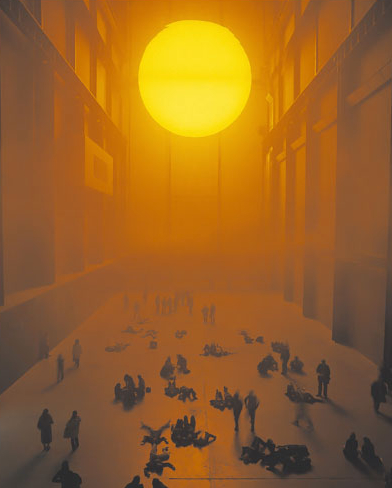
Olafur Eliason, The weather project (2003) at Tate Modern, London

Olafur Eliason, The weather project (2003) at Tate Modern, London

In The weather project (2003), he installed “a giant yellow orb like a dark winter sun” in the 500-foot long Turbine Hall at London’s Tate Modern. Sixteen nozzles sprayed mist into the atmosphere, filling the space with a light fog. Three hundred mirrored panels on the ceiling reflected the people below who glowed in the brownish-yellow haze of the sun’s two hundred sodium lamps.

During that winter season, two million people visited the museum to stand, sit or lie beneath the sun. It had the effect of Scheerbart’s fictional glass buildings: Delightful! Wonderful! Incomparable! Even if they arrived by themselves, people were immersed in provisional community. Sometimes they spontaneously arranged themselves into geometric patterns, symbols or even words. As Madeleine Grynsztejn observed, “This kind of participation calls us out of and beyond ourselves, an effect reinforced when witnessed and shared by others.”[xv]

The weather project, like many of the Light and Space artists’ “experiential processes,” bears resemblance to my ideal of church: a “holy” space, differentiated from the “ordinary” world, dedicated to the participatory experience of being called out of ourselves into an experience of wonder and praise. Not everyone shares this conception of Christian worship spaces. The stricter liturgical theologians argue that God is only present in the assembly and its liturgical actions, not in the physical space itself. Early Calvinists used to lock their churches during the week to discourage the idea that a space without a congregation at prayer retained any residue of holiness.

Peter Hammond, in his influential book, Liturgy and Architecture, argues that a church is not a place for a casual visitor to have a worship experience. It is not a shelter for an altar but for an assembly, and it has no meaning or symbolic power apart from its liturgical function. While I would agree that the primary function of a church is to shelter and enable the communal liturgy, I am sympathetic to Joseph Campbell’s view that one can be “reborn spiritually by entering and leaving a church.”[xvi]

The Light and Space artists would not make such large claims. But something unique and even significant can happen in their alternative spaces. Maybe colored glass can’t destroy hatred, but can certain kinds of experiences in certain kinds of places work on individuals and communities over time in positive, formative ways? In Dawna Schuld’s view, “we take the work with us: our heightened senses, now attuned to the subtleties of the conscious fringe, encounter a more vivid world than the one we left behind.”[xvii]

Eric Orr’s Sunrise (1976) was a nine by twelve foot room sheathed in lead, cutting off all sounds from the outer world. The space was quite dark. “I am engaged in using silence as a color,” Orr explained.[xviii] But the darkness was not total. A single bar of sunlight, guided into the space by a series of mirrors, moved slowly up the wall as time passed.

It reminded art critic Thomas McEvilley of the secret inner chamber of an Egyptian temple, and he reflected on the effect of being there: “Orr’s goal of producing spaces that will transform everyday experiences was mildly fulfilled here. Yet no one flew out the door like a bird. Rather, one walked out as one went in, but with a certain mental aura, as of secret ambiences and veiled promises of transcendence.”[xix]

Related posts

The Woven Light: Reflections on the Transfiguration

“Owl among the ruins” – What shall we do with empty churches?

[i] Dawna Schuld, “Practically Nothing: Light, Space, and the Pragmatics of Phenomenology,” in Robin Clark, ed., Phenomenal: California Light, Space, Surface (Berkeley: University of California Press, 2011), 111

[ii] Paul Scheerbart , The Gray Cloth, tr. John A. Stuart (Cambridge, MA: MIT Press), 3

[iii] Los Angeles Plays Itself (2003/2013), written and directed by Thom Andersen, Part 1, chapter 12: Modern Architecture

[iv] quoted in Michael Auping, “Stealth Architecture: The Rooms of Light and Space,” in Clark, p. 103

[v] Jan Butterfield, The Art of Light and Space (New York: Abbeville 1993), 24

[vi] Take Your Time: Olafur Eliasson, ed. Madeleine Grynsztejn (NY: Thames & Hudson, 2003), 22

[vii] Butterfield, 16

[viii] Lindsay Jones, The Hermeneutics of Sacred Architecture: Experience, Integration, Comparison, Vol. Two: Hermeneutical Calisthentics: A Morphology of Ritual-Architectural Priorities (Cambridge, MA: Harvard University Press, 2000), 280

[ix] Ross Weszsteon, referring to James Turrell, q. in Butterfield, 78

[x] Clark, 45

[xi] Schuld, 120

[xii] Butterfield, 121

[xiii] ibid., 82

[xiv] Michael Govan, “Inner Light: The Radical Reality of James Turrell,” in James Turrell: A Retrospective (Michael Govan & Christine Y. Kim, New York: DelMonico Books, 2014), 49

[xv] Take Your Time: Olafur Eliasson, ed. Madeleine Grynsztejn (NY: Thames & Hudson, 2003), 19

[xvi] I can’t find this citation, which has been in my church architecture notes for years, but it does sound like authentic Campbell!

[xvii] Schuld, 121

[xviii] Butterfield, 159

[xix] ibid., 160

The Woven Light: Reflections on the Transfiguration

James Turrell, Arrowhead (2009)

James Turrell, Arrowhead (2009)

We would have thrown our clothes away for lightness,
But that even they, though sour and travel stained,
Seemed, like our flesh, made of immortal substance.
And the soiled flax and wool lay light upon us.
Like friendly wonders, flower and flock entwined
As in a morning field. Was it a vision?
Or did we see that day the unseeable
One glory of the everlasting world
Perpetually at work, though never seen
Since Eden locked the gate that’s everywhere
And nowhere?…

– Edwin Muir, “The Transfiguration”

Martin Scorcese’s 1988 film, The Last Temptation of Christ,” was criticized by many for its eccentric portrayal of a Jesus deeply conflicted by the fierce struggle between his two natures. As one reviewer wondered, “Is he God or is he nuts?” Scorcese, who specializes in tormented, confused male characters full of nervous intensity, defended his approach as an attempt to explore Christ’s humanity without the blinding glow of divine self-assurance that made many movie Jesuses seem stiff, complacent and unreal.

“What we were taught in Catholic schools emphasized the divine side of Jesus,” said Scorcese, who had considered priesthood in his adolescence. “Jesus would walk into the room and you would know he was God. Maybe he glowed in the dark or something, I don’t know, but this is the impression they gave us as children.”

The Jesus of Matthew, Mark and Luke does not glow, except in that strange moment called the Transfiguration, celebrated on August 6th in the liturgical calendar. This feast day goes largely unnoticed now in the western churches, who have essentially transferred it to the last Sunday of Epiphany. This neglect of August 6 is in part a concession to the decline of weekday celebrations, but it may also reflect a discomfort with the story itself, which feels like myth or vision rather than actual history. Not even the risen Christ matched the glow of the Transfiguration. What are we being asked to believe here?

We can never know the phenomenon behind the reported perceptions by Peter, James and John. But the symbolic dimensions of the narrative are clear, linking the incident to the ancestral epiphanies of Moses and Elijah. There is a mountain, where earth below meets heaven above. There is a cloud of unknowing, veiling divine presence in hiddenness and mystery. And there is a voice, making contact with human sense, rupturing the boundary between holy and profane to affirm the unique filial status of Jesus as God’s Beloved “Son.”

But what about that “dazzling” glow? What did the disciples actually see in Jesus on that mountain? Was it an unrepeatable moment, a temporary endowment bestowed upon Jesus to make a point to doubting disciples, or was it something Jesus always possessed?

Gregory of Palamas, a 14th century Orthodox theologian, argued the latter. He based his influential meditation practice of Hesychasm on contemplation of the “uncreated light” first seen at the Transfiguration. This light, he taught, was not an ephemeral experience of the senses but the unmediated presence of God. Although this holy light could be seen through physical eyes, it was not a natural light. It was, in fact, the uncreated energies of the Godhead, the splendor of the age to come, a light shining from God’s future into the present moment.

Christ is transfigured, not by putting on some quality he did not possess previously, nor by changing into something he never was before, but by revealing to his disciples what he truly was, in opening their eyes and in giving sight to those who were blind. For while remaining identical to what he had been before, he appeared to the disciples in his splendor; he is indeed the true light, the radiance of glory.[i]

Whatever we make of Gregory’s metaphysical claims, which were disputed by many of his contemporaries, the spiritual resonance of light is undeniable and universal. It is always seems to be about something more than physics. It seems inevitably imbued with Spirit.

Annie Dillard describes “mornings, when light spreads over the pastures like wings, and fans a secret color into everything, and beats the trees senseless with beauty…Outside it is bright…It is the one glare of holiness; it is bare and unspeakable. There is no speech or language; there is nothing, no one thing, nor motion nor time. There is only this everything.”[ii]

Where does such light come from? Is it something that happens to our eyes but is not really in the world, or is it somehow there, in the heart of things, “born of the one light Eden saw play?” Is it not just a simulacrum of divinity, but a direct manifestation?

James Turrell, Breathing Light (2013)

James Turrell, Breathing Light (2013)

James Turrell, one of the most celebrated of the contemporary “Light and Space” artists nurtured under California skies, has been exploring light and its effects since the 1960s. His mesmerizing spaces invite participants to experience not objects made visible by light, but light itself in an astonishing repertoire of varying colors and brightness. If there are walls, they seem to dissolve into the immateriality of radiance. If there is a ceiling, it may have a large opening inviting us to contemplate the luminous canopy of sky. “Light,” says Turrell, “is not so much something that reveals as it is itself the revelation.”

We eat light, drink it in through our skins. With a little more exposure to light, you feel part of things physically. I like the power of light and space physically because then you can order it materially. Seeing is a very sensuous act – there’s a sweet deliciousness to feeling yourself see something.[iii]

For many of us fortunate to have savored the deliciousness of Turrell’s light spaces, feeling ourselves see something is not just an intellectual or psychological act. It is spiritual – the “glare of holiness … beating us senseless with beauty.”

Turrell’s own Quaker tradition says that prayerful attention is “going inside to greet the light.” But is the radiance of divine beauty just in our souls, or does it permeate the universe? Does it show itself to us here, there and everywhere, as it did to Peter, James and John?

David Bentley Hart, an Orthodox theologian, proposes creation as a manifestation of God’s infinite luminosity, what he calls “the agile radiance of the Spirit.”[iv] We see this radiance not by looking away from the world, but by looking more deeply into it. But when the light is in eclipse, what then? “Sometimes,” says Bruce Cockburn, “you have to kick the darkness till it bleeds daylight.” Even at the Transfiguration, according to an Anglican midrash by a seventeenth-century bishop, Moses and Elijah felt impelled to warn Jesus about the suffering and darkness awaiting him once he descended the mountain:

A strange opportunity … when his face shone like the sun, to tell him it must be blubbered and spat upon;… and whilst he was Transfigured on the Mount, to tell him how he must be Disfigured on the Cross![v]

The poet Kathleen Raine perfectly describes the utter bleakness when “the curtain is down, the veil drawn” over the world’s deep radiance. “Nothing means or is,” she says.[vi]

Yet I saw once
The woven light of which all these are made
Otherwise than this. To have seen
Is to know always.

[i] St. Gregory Palamas, The Triads, in Richard Harries, Art and the Beauty of God: A Christian Understanding (London: Mowbray, 1993), 85

[ii] Annie Dillard, Holy the Firm (New York: Harper Perennial, 1998), 67-8

[iii] q. in Michael Govan, “Inner Light: The Radical Reality of James Turrell”, James Turrell: A Retrospective (New York: DelMonico Books, 2014), 13

[iv] The Beauty of the Infinite: The Aesthetics of Christian Truth (David Bentley Hart, Eerdmans 2003), 292

[v] Joseph Hall, Contemplations upon the principal passages of the Old and New Testaments, 1612-28, found on Google Books, p. 383

[vi] Kathleen Raine, in Harries, 87