
The Terrible Parable: Making Sense of the Dishonest Steward

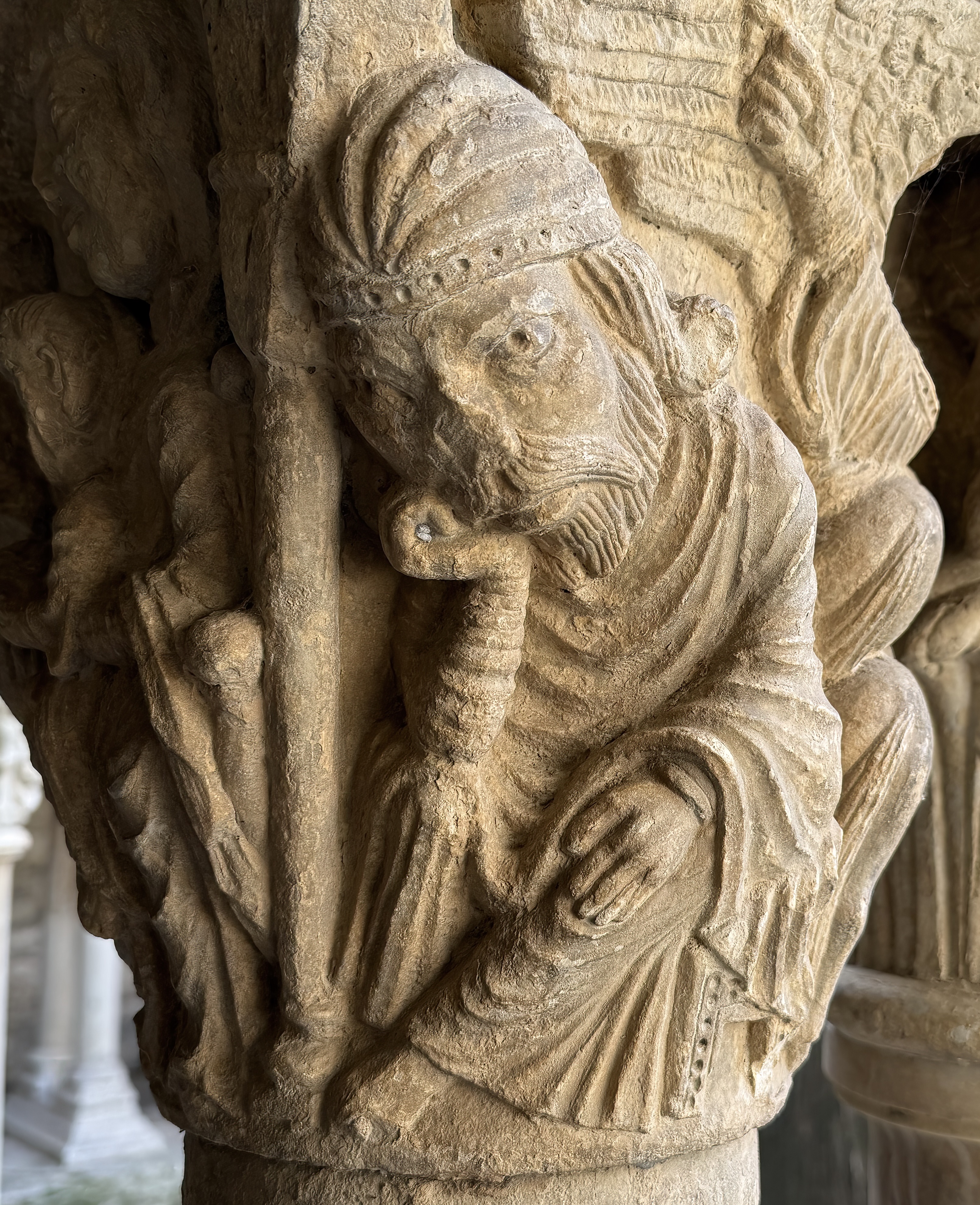
A perplexed man in the cloister of Saint Trophime, Arles, France (12th century)

In the liturgical churches, we don’t get to choose the Scripture for our homilies. We have to take what the Lectionary gives us. I’ve been preaching for a long time, but I’ve always been lucky enough to miss the Sundays when the Parable of the Unjust Steward turns up. Until now. Some scholars have labeled it the hardest parable. I prefer to call it the “terrible parable.” But I made a stab at it, and pass on the results here.

A parable functions a little like a Zen koan. What is the sound of one hand clapping? What is your original face before you were born? Such imaginative constructions of language are meant to disrupt habitual ways of thinking and open us to new perspectives. Just so, when a prodigal son is welcomed home with open arms, or the laborers who work the fewest hours are paid the same wages as the ones who work all day, we are forced, or at least invited, to question our presuppositions and prejudices about how life works, or how God desires life to work.

That said, let’s consider the Parable of the Unjust Steward (Luke 16:1- 8). It’s not an easy one to interpret. Nor is it easy to like. There have been many efforts to explain what this story about a dishonest steward tricking his boss is even doing in Luke’s gospel, set down in the midst of far more memorable teachings and far more beloved parables. But most of those explanations fail in one way or another, either making assumptions not justified by the text or reducing its meanings to something of little value to preacher or disciple.

So what shall we make of the “terrible parable” this time around?

Let’s review what happens. A rich man, presumably an absentee landowner, discovers his property manager has been “squandering” his property, whether by mismanagement or financial monkey business we aren’t told. But he’s put on notice that he’s about to be fired.

Now the steward considers himself either too old or too scrawny for manual labor, and he’s too proud to beg, so he’s desperate for a way to avoid utter destitution. What does he do? He summons all his master’s debtors and offers to write down their debts to an affordable level. By so doing, he earns the good will of those debtors.

Maybe someday, when he’s out of work and looking for help, they’ll return the favor. And, by collecting at least some return from all those past due accounts for his master, maybe he can get back in the master’s good graces. In the end, we are told, the rich man “commended the dishonest manager because he had acted shrewdly.” The odds of the steward keeping his job are looking up, but the story stops before we find out about that.

At first glance, it’s hard to find anyone to identify with in this parable. In the Bible, rich men are rarely liked, since economic inequality in biblical times was even worse than it is today. When a story begins, “There was a rich man,” you might imagine the immediate boos and hisses from Jesus’ audience, which hopes it’s going to be a story about his comeuppance. But as soon as the steward is introduced, his own character is dragged through the mud, and the rich man gains a bit of sympathy for having been cheated.

The steward stands accused of squandering his master’s property—whether through incompetence or dishonesty is not quite clear, but his actions later, cooking the books to write down the debts owed to his master, tag him as “unjust” or “dishonest”—terms which can connote either shaky bookkeeping or outright fraud. In any case, he plays fast and loose with the numbers. And, to our surprise, he is praised for doing so. This commendation may reflect the master’s relief in recovering at least some of his bad loans. It also may indicate his delight in discovering how clever his steward is. If such a man can get things done, who cares if his methods are not always on the up and up?

Some commentators have discerned a Christ figure in the rule-breaking steward. Hoping for a different kind of future, Jesus subverts the rules of the old world, where the rich get everything and the system punishes the poor, so that the rich man gets less and the debtors finally get a break. The unjust system may consider his actions to be improper, but in God’s eyes he’s an agent of economic justice, constructing a fairer and kinder form of human community.

At the same time, the steward’s actions transform relationships. The debtors, for whom the steward might have seemed an enforcer of unpayable obligations, turns out to be a forgiver of debts. And the rich man, tricked into generosity by his steward’s unorthodox moves, is given the opportunity to forego domination and greed in his own relationships with others.  

That’s the story. But then the storyteller, who is Jesus, tacks a puzzling moral onto the end of his tale. He says the steward’s ingenuity, and the praise he receives for it, demonstrates that “the children of this age are more shrewd in dealing with their own generation than are the children of light.”  

What could this mean? Of course, to reduce a parable to a single meaning implies that you can throw out the story and just keep the meaning. That’s like Woody Allen’s joke about reading War and Peace in an hour after taking a speed-reading course. When someone asked him what the novel was about, he said, “It’s about Russia.”

His joke mocks the idea that the experience of full immersion in Tolstoy’s thousand-page epic can be replaced by a brief summary. It’s the same with Jesus’ parables. Don’t reduce them to a single meaning. Experience them, begin to wonder about them, and then—just keep on wondering.

So instead of offering the best interpretation of today’s parable—there is no best interpretation, just a story which continues to puzzle us—I will simply try out some observations with no presumption of giving you the definitive last word about it.  

The “children of light” is a New Testament term for the early Christians, the followers of the Way of Jesus, who belong not to “this age” but to the age to come, the future which God is in the process of bringing about. The steward’s ability to game the system of this age, operating successfully within its parameters with improvisation, cleverness and flexibility, should make the followers of Jesus ask themselves,

“Am I operating within the parameters of the age to come—the kingdom of God—with the same creativity and resourcefulness as the steward displays within the parameters of his story? Are my actions and choices in line with the world that is dying, or with the world that is being born?”

In living out the Christian life, which is rooted not in this age but in the age to come, we should embody the Kingdom’s precepts and pursue its goals with the same single-mindedness, the same commitment, the same shrewdness that the steward in the parable employs to navigate the crisis described in his story. His world is about to come crashing down, he’s about to lose everything, but he survives through the actions he takes and the relationships he cultivates. He doesn’t cling to the old world and its old rules to suffer its predetermined outcomes. He discovers a way to be part of what is about to happen next. He discovers a way to have a future.

Now if we are indeed the children of light, claiming allegiance to the divine future which is being born amidst the ruins of our fallen world, do we possess a comparable level of creativity and resourcefulness to survive the collapse of the old and join ourselves wholeheartedly to the emergence of the new? Can we be as good as that steward was in slipping through the present time of crisis into a future of divine intent and human flourishing?

That’s the question I hear the parable asking us today. That’s the question I leave you with today. Let me say it one more time:

If we are indeed the children of light,
claiming allegiance to the divine future
which is being born amidst the ruins of our fallen world,
do we possess a comparable level of creativity and resourcefulness
to survive the collapse of the old
and join ourselves wholeheartedly to the emergence of the new?

Can we be as good as that steward was
in slipping through the present time of crisis
into a future of divine intent and human flourishing?



Jesus and the Rich Man: “Do you want me to tell you easy things?”

The Getty Villa in Malibu, California, is a careful reconstruction of a Roman villa. Funded by the estate of a 20th century oil billionaire, it is a lavish display of the wealth of two eras: the ancient world and our own Gilded Age.

The word of God is living and active, sharper than any two-edged sword, piercing until it divides soul from spirit, joints from marrow; it is able to judge the thoughts and intentions of the heart. And before him no creature is hidden, but all are naked and laid bare to the eyes of the one to whom we must render an account.

–– Hebrews 4:12-13


Is that why we come to church––to be pierced by the sharpness of God’s word, to have our innermost selves laid bare to the eyes of the one “to whom all hearts are open, all desires known, and from whom no secrets are hid?” [i]

Not all the time, surely. Who could bear that? In a world of sin and strife, we all need an oasis of rest and refreshment, a word of consolation and encouragement. But God is not always easy, as our first two readings make clear.

“Today my complaint is bitter,” cries Job. “God’s hand is heavy despite my groaning. . .
God has made my heart faint; the Almighty has terrified me.” [ii]

And the Psalmist who sings of goodness and mercy, and a soul restored by divine presence, is now heard to cry out one of the most terrible lines in all of Scripture:

My God, my God, why have you forsaken me? [iii]

No, God is not always easy. And neither is Jesus. One moment he’s the Good Shepherd, saying “Come unto me, all you who struggle and are heavily laden, and I will refresh you,” and the next moment he’s challenging you to change your life.

The poet John Berryman captures this contradictory quality when he says that Jesus’ words were “short, precise, terrible, & full of refreshment.” [iv] Another poet, James McAuley, echoes the image from Hebrews in his own poem about Jesus:

He thrust his speech among them like a sword. . .
And told them nothing that they wished to hear. [v]

Today’s gospel, Mark 10:17-31, is a case in point. A man runs up to Jesus, kneels before him, and asks, “Good Teacher, what must I do to inherit eternal life?” At first, Jesus gives the stock answer, like something out of the catechism:

“You know the commandments: ‘You shall not murder; You shall not commit adultery; You shall not steal; You shall not bear false witness; You shall not defraud; Honor your father and mother.’”

The man, impatient for an answer he has not yet found, shoots back, “Yes, Teacher. I’ve always kept those commandments, even when I was young.” This gets Jesus’ full attention. The text tells us that Jesus looked at the man and loved him. That’s such an interesting description. He looked at him and loved him. It sounds a little like love at first sight. There isn’t another sentence quite like it in the gospels.

If this were a movie we’d get a closeup of Jesus’ face, taking in the man’s truest and best self with a gaze that is both affectionate and inquisitive, as though his eyes are asking, “Are you the disciple I’ve been waiting for so long to show up, the disciple whose singleness of heart, shorn of all lesser desires, wants nothing but the only thing truly worth having?” Then we’d cut to a closeup of the man’s face, so earnest and hopeful, on the verge of finding at last his heart’s true desire.

But then Jesus says to him, “There’s just one more thing you need to do; go, sell what you own, and give the money to the poor, and you will have treasure in heaven; then come and follow me.”

We can imagine the man’s expectant face slowly collapsing into disappointment. This is not what he wanted to hear. He lowers his head and stares at the ground, trying to absorb the shock of Jesus’ shattering directive. Then he gets up and backs away slowly, like a boxer reeling from a punch, until he finally turns his back on Jesus and disappears into the crowd. As Mark reports, he “went away grieving, for he had many possessions.”

As a lifelong Episcopalian, I’ve had to listen to this gospel many, many times in the liturgy––for seven decades. And as a North American person with more privileges and possessions than most of the earth’s inhabitants, I have always shared the agonizing discomfort of that man who found it way too hard to give up everything for the sake of the gospel.

Some Christians have taken this story quite literally. In the 3rdcentury, a wealthy young man named Antony heard it read at Sunday mass. He could not escape the feeling that the words were aimed directly at him. As soon as the liturgy was over, he rushed out to sell his possessions, give the money to the poor, and move to the desert, where for the next 80 years he lived a life of radical simplicity and exemplary sanctity––a life which had a great impact on the development of monastic spirituality.

A thousand years later, another wealthy young man shocked his family and friends when he renounced his worldly goods to embrace a life of poverty, service and prayer. We are still in awe of that man, Francis of Assisi, who found himself utterly unable to say no to Jesus.

In the 20th century, Dorothy Day would sacrifice the comforts of her class to live in solidarity with the poor, founding the Catholic Worker and devoting her heart and mind and strength to the vision of a just and peaceful society.

Many other saints have done the same. And even though you and I are not going to walk out those doors this morning to give away everything we have, we cannot repress the questions which the story of the rich man poses for us. We’ve heard this gospel before, and we’ll hear it again. And each time we must wonder, what is it trying to say to us?

There is no single answer, no single response to the challenge of this gospel. It’s a story, not a rule, and most Christians have not felt compelled to take Jesus’ words to the rich man in the demandingly literal way of an Antony, Francis, or Dorothy Day. But this gospel will never cease to trouble us with questions about both personal and social economics. Is the common wealth of society justly distributed? What is true wealth in God’s eyes? And where does our own treasure lie?

In first-century Palestine, wealth was measured more by the amount of land you owned than by the number of things you had. And since land acquisition usually came through the default of debtors who could not keep up their payments, wealth at the top was accrued at the expense of those further down the economic ladder. More wealth for the rich meant more poverty for the rest.

We have a similar imbalance in our own day. Right now in America, the richest 10% own 77% of the nation’s wealth. The 20 richest individualsown more than the entire bottom half of the population. As wealth concentrates in fewer and fewer hands, the poverty of the many grows wider and deeper. As in the time of Jesus, those at the top get richer by taking from those below them. The recent tax cuts are a perfect example, siphoning huge increases in wealth to the rich, while cutting survival assistance to the needy. Fewer school lunches for poor children, more private jets for the rich.

But if ours is an age of grotesque economic inequality, it is also an age of remarkable private generosity. We have come to look upon billionaires and wealthy foundations as the solvers of public problems, as they dispense impressive grants to improve the lives of the many. So when Bill Gates or Jeff Bezos give away enormous sums or underwrite beneficial actions, are they in fact doing what the rich man fails to do in the gospel story? Are they doing what Jesus asked?

Anand Giridharadas has studied this critical question, and in his provocative book, Winners Take All: The Elite Charade of Changing the World, he argues that the powerful rich who address problems without changing the very conditions that create those problems is at best a failure of social imagination. A lot of good may be done by the rich, but the system that perpetuates the wrongs being addressed remains firmly in place. In fact, such acts of benevolence provide justification for the continuation of the status quo, making it appear more benign than it really is.

In a recent talk in Seattle, Giridharadas put it this way:

“You can tell rich people to do more good, but you can never tell them to do less harm. You can tell them to give back, but you can never tell them to take less. You can tell them to share the spoils of the system that benefitted them, but you can’t ask them to concede that system.” [vi]

If this is true, then the question that Jesus poses to the rich man, and to us, is not simply about the individual stewardship of our personal wealth, but about our willingness to work and pray for a very different kind of economy.

As biblical scholar Ched Myers has argued in his commentary on this gospel story, if you want to enter God’s kingdom, you have to make an exodus from the dominant paradigm of economic inequality. “The only way [into the Kingdom],” he says, “is to restore to the poor what is theirs by the right of community justice.” [vii]

Perhaps a better term for the Kingdom of God would be the Economy of God, something that was first described in the Book of Exodus. God delivered the people of Israel from the unjust slave economy of Egypt, and then spent the next 40 years providing a desert workshop, trying to teach them a new economy, a new way of living together––without greed, fear, or self-protective violence.

In the desert, God’s people learned to depend on what the Lord’s Prayer calls “our daily bread” – whatever each day provides for you (“give us the bread we need today”).

In Egypt, the idea was to accumulate enough stuff that you didn’t have to depend on others. You didn’t have to trust that you would be provided for as you went along. You could live without God and live without neighbor. But in the desert, you needed God and you needed each other. Whenever the Israelites tried to hoard the manna that fell from heaven each morning, the manna would rot.

Now when the people of Israel came into the Promised Land, they succumbed to the trap of accumulation like the rest of us. But they did not entirely forget their desert wisdom. In the concepts of Sabbath and Jubilee, as well as the impassioned exhortations of the prophets, the Economy of God opposed the concentration of wealth through accumulation, while advocating the circulation of wealth through redistribution.

The Economy of God is an interdependent, communal condition where there are no more divisions of rich and poor. So when Jesus says that the idea of a rich man getting into the kingdom is as absurd as a camel squeezing through the eye of a needle, is he judging individual behavior? Or is he saying that in the Economy of God the categories of rich and poor will vanish with the just distribution of divine abundance?

The Economy of God is not like our commodity economy, where things are accumulated, hoarded, and protected by the threat of force. The Economy of God is a gift economy, where the gifts of creation and the gifts of human labor and skill are freely shared, the way manna was shared in the desert by the Israelites of the Exodus.

We practice that economy in this church every Sunday. Every time we break the bread and share it at Christ’s table, we remember the economy of grace taught to our ancestors. The eucharist is a rebuke to the selfish economics of haves and have-nots. It is an invitation into a new way of living and being together.

Is this too much to ask? The rich man in the gospel thought so. But as Wendell Berry reminds us, “The great obstacle is simply this: the conviction that we cannot change because we are dependent upon what is wrong. But that is the addict’s excuse, and we know that it will not do.”

When Jesus invites the rich man to let go not only of his wealth, but also of his participation in an unjust economy, he is calling him out of his comfort zone into an entirely new way of being. That’s what Jesus did, and what Jesus continues to do. As one of my former theology professors, Harvey Cox, has said,

Meeting [Jesus] always seemed to shake people up. He constantly pushed them to think beyond their own immediate interests, to picture themselves in a variety of situations in which choice and action were required – in short, to use their imaginations.” [viii]

In 1969, BBC television aired an unusual production on the life of Jesus, written by the brilliant David Potter. [ix] My favorite scene in this film shows Jesus trying to convey another one of his most challenging teachings––in this case, to love your enemies. As he moves among the crowd, Jesus gets them to embrace one other, as in our liturgical Passing of the Peace.

“Go on,” he says, “love each other. See? It’s nice, isn’t it? It’s easy––easy to love your brother, easy to love those who love you. Even the tax collector can do that. But tell me, tell me, happy people, what is so extraordinary about holding the hands of your brothers and sisters? Do you want me to congratulate you for that, for loving only those who love you? But I say, love your enemy. Love your enemy!

[The crowd is taken aback. Some murmur in protest.]

Love those who hate you, love those who would destroy you,
love the man who would kick you and spit at you. . .

[The protests grow louder.]

Listen to me! What I’m telling you now hasn’t been said since the world began.
I bring you the Way. I am holding up a light in the darkness. . .

 We cannot divide ourselves. We must love each other. . . Pray for your enemy, love your persecutor. . . It is easy to love only those who love you. Would I come to tell you easy things? Do you want me to tell you easy things?

Jesus might have said the same to the rich man. And to us.

Do you want me to tell you easy things?


[i] Collect for Purity, The Holy Eucharist Rite Two, Episcopal Book of Common Prayer.

[ii] Job 23:2, 16.

[iii] Psalm 22:1.

[iv] John Berryman, “Eleven Addresses to the Lord,” Love and Fame (Farrar, Straus & Giroux, 1970). Berryman attributes the description to Justin Martyr (c. 100 – c. 165).

[v] James McAuley, “Jesus,” Divine Inspiration: The Life of Jesus in World Poetry (eds. Robert Atwan, George Dardess & Peggy Rosenthal (Oxford: Oxford University Press, 1998), 104. McAuley (1912-1981) was an Australian Roman Catholic.

[vi] Originally delivered September 20th, 2018, at Seattle’s Southside Commons as part of the Town Hall Civics lecture series, it was broadcast on the Seattle NPR station, KUOW, in their Speakers Forum: https://soundcloud.com/kuow/anand-giridharasdas-full-talk-at-southside-community-center

[vii] Ched Myers, Binding the Strong Man: A Political Reading of Mark’s Story of Jesus (Maryknoll, NY: Orbis Books, 1989).

[viii] Harvey Cox, When Jesus Came to Harvard (New York: Mariner Books, 2004), 25-6.

[ix] Son of Man (BBC, 1969), directed by Gareth Davies. Irish actor Colin Blakely played Jesus. Dennis Potter, who wrote the script, also wrote the strange and brilliant serial drama, The Singing Detectivein the 1980s.