Living the Dream: Thoughts at 80

William Blake, Oberon, Titania, Puck & Fairies Dancing (1786)

“The tables outside the cantina were full of beautiful laughing men and women. I didn’t like the cantina at night: it was hard to book a table, and everyone who sat there looked on display, the women in their lovely summer dresses, the men with their hair oiled back on their heads, their tanned bare feet resting proprietorially on top of their Gucci loafers. One wanted to applaud them for presenting such a successful vision of life: you could almost believe they had lived their whole lives, had been reared and groomed from birth, for this one particular night: that this was the pinnacle, this golden summer evening they had all reached simultaneously.

“Yet it made me a little sad to see them there, laughing and drinking champagne, for you knew it was all downhill from here.”

— Peter Cameron, Andorra [i]  

The beautiful laughing men and women in Cameron’s cantina do not arouse our envy. Their self-display seems shallow, narcissistic and unreal. They appear ignorant of time. Golden summer evenings do not last forever. Having achieved the pinnacle, what Wallace Stevens called “the barrenness of the fertile thing that can attain no more,”[ii] they have nowhere to go but down.

The traditional lore of Midsummer Eve shares this suspicion. To mark the year’s longest day, bonfires were lit on British hilltops to assist and encourage the sun at the outset of its long inevitable decline into the winter dark. And “Midsummer Night”—blessedly short—was said to be a time of both mischief and danger, when chaotic pressures cracked open the stability of the world and wild spirits were abroad.

In A Midsummer Night’s Dream, Shakespeare explores these themes with a complicated plot in which the normal order of the world is unraveled for a night, and confusion rules until the dawn. Rulers find their commands thwarted. Lovers aim their desire at mistaken targets. The beautiful queen of the fairies falls madly in love with a low-born mortal who, by magic spell, has the monstrous head of an ass. Puck, the fairy trickster, multiplies the mischief by both design and error. And even words of dialogue take on altered and contradictory meanings.

All this takes place in an enchanted forest, a wild, liminal state outside the civilized order, where societal assumptions and rules are suspended or reversed, hierarchies are overturned, and identities become fluid and changeable. As Bottom says to Titania, “reason and love keep little company together these days.”

In Shakespeare, such liminal spaces serve a critical purpose. Their disorder offers a freedom to reshuffle and reconsider accepted realities, inviting transformation at both a personal and social level. Removed for a time from the customary rules and roles, characters discover new possibilities for themselves and society before returning to “reality.”

However, once you leave your given world for a time, you can never again accept its reality as absolute. You realize that there is more than one way to do both the self and the world. Any single version of reality is but an alternative. In this sense, life itself is but a dream. This refusal to absolutize the given world is the foundation of social justice: we can live better lives and make a better world. It also, however, can open the door to irrationality and madness, exemplified by the millions who live, happily and hatefully, in the fact-free world of American fascism..

At the end of Shakespeare’s play, Puck delivers an epilogue to the audience, those “who have slumbered here, / While these visions did appear.” It’s all been a dream, he assures us, as if we had never really crossed the boundary into the transformative space of a visionary world.

But can we be so sure? Have we not ourselves been touched, perhaps even transformed? Within A Midsummer Night’s Dream, there is a play-within-a-play (the comically performed tragedy of Pyramus and Thisbe). The actors in Midsummer watch the actors playing actors in Pyramus, just as we the audience watch all these permutations from our safe position outside the “fourth wall” which separates the stage from reality. But are we so different from the players on the stage? As Shakespeare scholar Marjorie Garber writes,

“A play is a fiction, art is an illusion, ‘no more yielding but a dream.’ Can we be blamed if we wonder—now that we have been told that we are reality—when someone will wake and recognize that we are only a dream? Can we be blamed for looking over our shoulders, and wondering who is watching the play in which we are acting, while we watch, onstage, actors watching actors who play actors performing a play?” [iii]

Two weeks after Midsummer Eve, I saw a magical outdoor production of A Midsummer Night’s Dream at the Bloedel Reserve, an Arcadian refuge of woods and meadows on my island. Beginning before sunset, it utilized the fading of the day to intensify our immersion into the dreamworld. By play’s end, it was almost night. The narrow path across a rolling meadow to the exit prevented an immediate return to reality. For a few precious minutes more we lingered in the dream, making our ghostly procession of shadows in the twilight.

Every play comes to an end. Every actor must make an exit. I have no plans to do so any time soon (God willing). There are more lines to deliver! However, since I begin my ninth decade tomorrow, time may not be on my side—but it’s on my mind.  

Medieval thinkers divided a human lifetime into “ages.” Some had just four: Childhood, Youth, Maturity, and Old Age. Isadore of Seville (c. 560-636) expanded that to six: infancy (up to 7), childhood (7-14), adolescence (14-28), youth (28-50), gravitas (50-70), and, for anything beyond 70, senectum  (the same root as senior and senility).

[Of course, senectum is a hot topic in this election year. Is the President too old to govern? Perhaps a better question would be: Why can’t the other guy act his age? As the Bible says, “Woe to you, land, if your king is a child!” (Ecclesiastes 10:16). But I digress.]
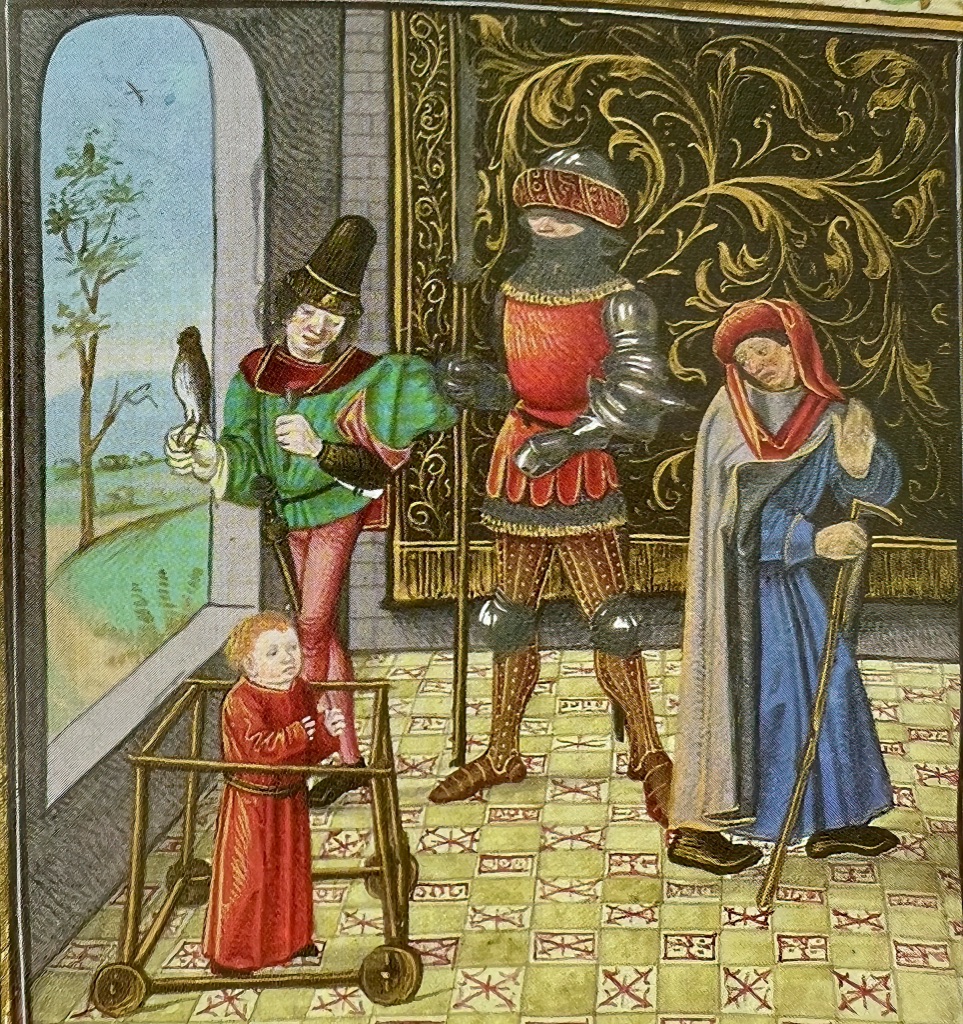
Bartholomaeus Anglicus, The Four Ages (1467-1475)

In this fifteenth-century illumination by Bartholomaeus Anglicus, the four ages of the human life-cycle stand in the same room, as if each of us is all the ages we have ever been. Childhood is clothed in red, the color of sanguinity (eager hopefulness). Youth is into fashion and sports, while Maturity dresses for battle. Old Age, warmly attired for the wintry years, glances back at all his past selves, hopefully with gratitude rather than regret.

Bartholomaeus Anglicus, The Seven Ages (1482)

A later image by the same artist depicts seven ages standing in two groups. On the right, Childhood plays with a stick and ball, Adolescence clasps his schoolbooks, and Youth carries a spear, perhaps dreaming of competitive glory. The first three stages of Maturity are not radically distinct from one another, but Old Age, shorter and bearded, is starting to separate his body from the group. Yet he still keeps an eye on the Child he once was.

Idleness, Dunois Book of Hours (c. 1439-50)

Time is a gift, and I am truly grateful for my years so far—the dreams as well as the realities. Je ne regrette rien. As for the road ahead (even if it’s all downhill), I wish not to be the man on the donkey, idly dozing along the pilgrim way. Like the figure gazing at the view from the bridge, I want to keep taking it all in. As an old man advised a younger friend in Henry James’ The Ambassadors:

“Live all you can; it’s a mistake not to.”


[i] Peter Cameron, Andorra (New York: Farrar Strauss Giroux, 1997), 149-150.

[ii] Wallace Stevens, “Credences of Summer.”

[iii] Marjorie Garber, Shakespeare After All (New York: Anchor, 2005), 237.

I Must Decrease (And Why That’s Good News)

Seattle Midsummer twilight (10:05 p.m., June 22, 2017)

The 24th of June is, in the Christian calendar, the Feast of the Nativity of John the Baptist. In Europe, it’s also known as Midsummer Day, marking the critical moment when the longest days begin the six-month journey toward the longest nights. Even though we still have months before us of warm weather and brilliant sunshine, the light is now (imperceptibly at first) beginning to slip away minute by minute. Thus in the old days, on the night before Midsummer––called Midsummer Eve or Midsummer Night––bonfires were lit to encourage the waning sun, and people were on their guard against any supernatural mischief. As we know from Shakespeare’s Midsummer Night’s Dream, it’s a good night just to stay home. Whatever you do, don’t go into that magic forest!

The ancient traditions may seem obsolete, but are we free of the anxiety they represent? This turning point in the sun’s journey is a metaphor for our own mortality. We are temporal beings––creatures of time. For us, nothing lasts forever. The very moment that we reach the peak of the Summer Solstice, savoring what the poet Wallace Stevens called “arrested peace, / Joy of such permanence, right ignorance / Of change…”, the sense of having all the time in the world starts to seep away––imperceptibly at first, as we enjoy our fun in the sun and the long unhurried twilights. As Stevens goes on to say in his great Solstice poem, “Credences of Summer”: “This is the barrenness / Of the fertile thing that can attain no more.” After the perfect moment, then what?

In a Calvin and Hobbes cartoon, Calvin is running around in a frenzy, shouting, “It’s July already! Oh no! Oh no! What happened to June? Summer vacation is slipping through our fingers like grains of sand! It’s going too fast! We’ve got to hoard our freedom and have more fun! Time rushes on! Help! Help!”

Meanwhile, his friend Hobbes the tiger is watching Calvin’s panic with studious detachment. Then he says to himself, “I don’t think I want to be here at the end of August.”

My Minnesota relatives still have the summer house my grandfather built on a bluff above Lake Pepin, a scenic stretch of the Mississippi River that becomes a lake two miles wide and thirty miles long. About fifteen years ago, in late June, I walked down to the beach from the house, passing through a grove of maple trees and birdsong. When I emerged from the woods onto the sandy lakeshore, I saw one of the great spectacles of Midwest summer: a storm of mayflies.

Thick black clouds of insects with transparent wings whirled in the air above me. Millions more covered the willows and cottonwoods, darkening the summer greenery with their densely packed masses. It was an explosion of pure fecundity: “The feast and fairy dance of life,” as one naturalist has described it.

But this dance is oh so brief. After incubating for two long years in the mud of the lake bottom, the mayflies grow wings, float up to the surface and rise into the air to mate. Within 24 hours of this eruption into ecstasy, they fall lifeless back to earth. Roads and bridges covered with their greasy remains are too slick for driving, and must be closed until a cleanup crew arrives.

Is this not a sped-up version of the human condition––here today, gone tomorrow? As they sang in medieval England, “Merry it is while summer lasts; but now draws near the wind’s cold blast.” The Bible was equally frank about our radically transient status: “All flesh is grass . . . The grass withers, the flower fades.”

Contemporary poet Mary Oliver delivers the same message, lightened by a dose of whimsey:

For years and years I struggled
just to love my life. And then

the butterfly
rose, weightless, in the wind.
“Don’t love your life
too much,” it said,

and vanished
into the world.[i]

For me, this mortal life is like the fireworks on the Fourth of July. So glorious and wondrous––and so quickly over. Every year my wife and I walk a mile down to the local harbor to watch the display, and when it’s done, as we make our way home in the darkness, I always feel the melancholy of endings. The pyrotechnics of July 4––the American version of Midsummer Night––have come and gone. Only two weeks old, summer is already beginning to slip through our fingers! This is the barrenness of the fertile thing that can attain no more.

John the Baptist knew how the story goes. He knew that his given moment on the stage was coming to an end. Remember what he said about Jesus? He must increase, I must decrease. My time is passing, but Jesus’ time is coming. Thus at the Nativity of John the Baptist the days start to decrease, while at the Nativity of Jesus the days start to increase.

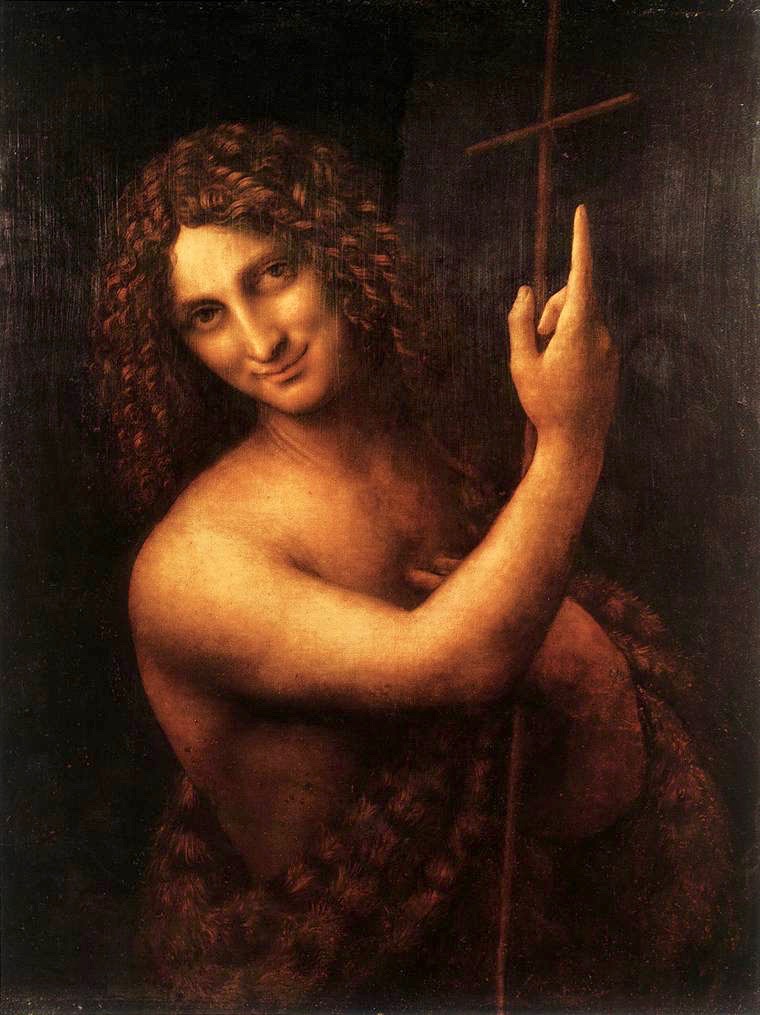
John the Baptist is rightly remembered as the voice in the wilderness, announcing that the Lord is come (let every heart prepare him room!) As his father Zechariah foretold when John was only eight days old, the Baptist was born to be “the prophet of the Most High…. to give knowledge of salvation to [God’s] people by the forgiveness of their sins.” In paintings, John is often seen pointing away from himself, toward Jesus, the “dawn from on high” who gives “light to those who sit in darkness and in the shadow of death.”

Leonardo da Vinci, John the Baptist (1513-16)

John gave us expectant hearts. But he offered us another great gift as well. He taught us the art of letting go. Jesus must increase, I must decrease. That’s what he said, and what he did. It’s what we all do. As the old shape note hymn says with such brutal honesy, “Passing away, we are passing away.”

All flesh is grass––a melancholy thought at the dawn of summer. But wait; there’s more, and it’s good news. Though the grass withers and the flower fades, Isaiah tells us, the word of God will stand forever (Isaiah 40:8). And what is this “word?” Jesus is the word, the speaking of divine reality in human be-ing. And that divine reality, which we are made to mirror, is all about self-diffusive, self-forgetting love. God is a Trinity of persons, giving themselves over to one another in an eternal circulation of gifts offered and gifts received.

So the great secret at the heart of existence, the word that stands forever, is that it’s all about letting go instead of holding on. Jesus made that perfectly clear in his death and resurrection. And John the Baptist, who was martyred before he could see that first Easter Day, intuited this truth even before it was fully revealed.

He must increase, I must decrease. Less of me, more of Christ. More of God. And the Christian life is all about making that truth our daily practice, as individuals and as communities of faith. We learn to let go of things which are passing away––and of the stories which are no longer true for us––and to remain open and grateful for the new gifts we are about to receive. Welcome every gift, but hold on to nothing but God, who is not only the Giver of every gift, but is also the only gift worth having.

God is not a thing, an object, a commodity to be possessed. God is a dance we do. We become most truly ourselves only to the degree by which we participate in, and surrender to, the choreography of that dance: the eternal giving and receiving of self-diffusive love. Letting go, not holding on, is what completes us.

As Mary Oliver reminds us,

To live in this world

you must be able
to do three things:
to love what is mortal;
to hold it

against your bones knowing
your own life depends on it;
and, when the time comes to let it go,
to let it go.[ii]


Related post:

Sacraments of Summer


[i] Mary Oliver, “One or Two Things,” New and Collected Poems (Boston: Beacon Press, 1992), 122.

[ii] ibid., 178