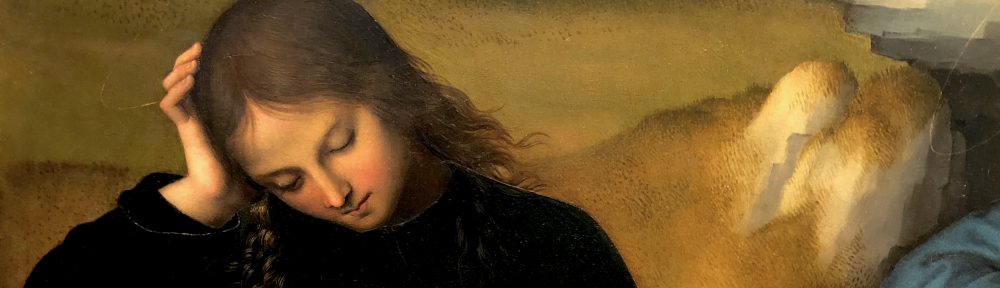
Songs That Seek Your Heart and Find It: Remembering Bob Franke

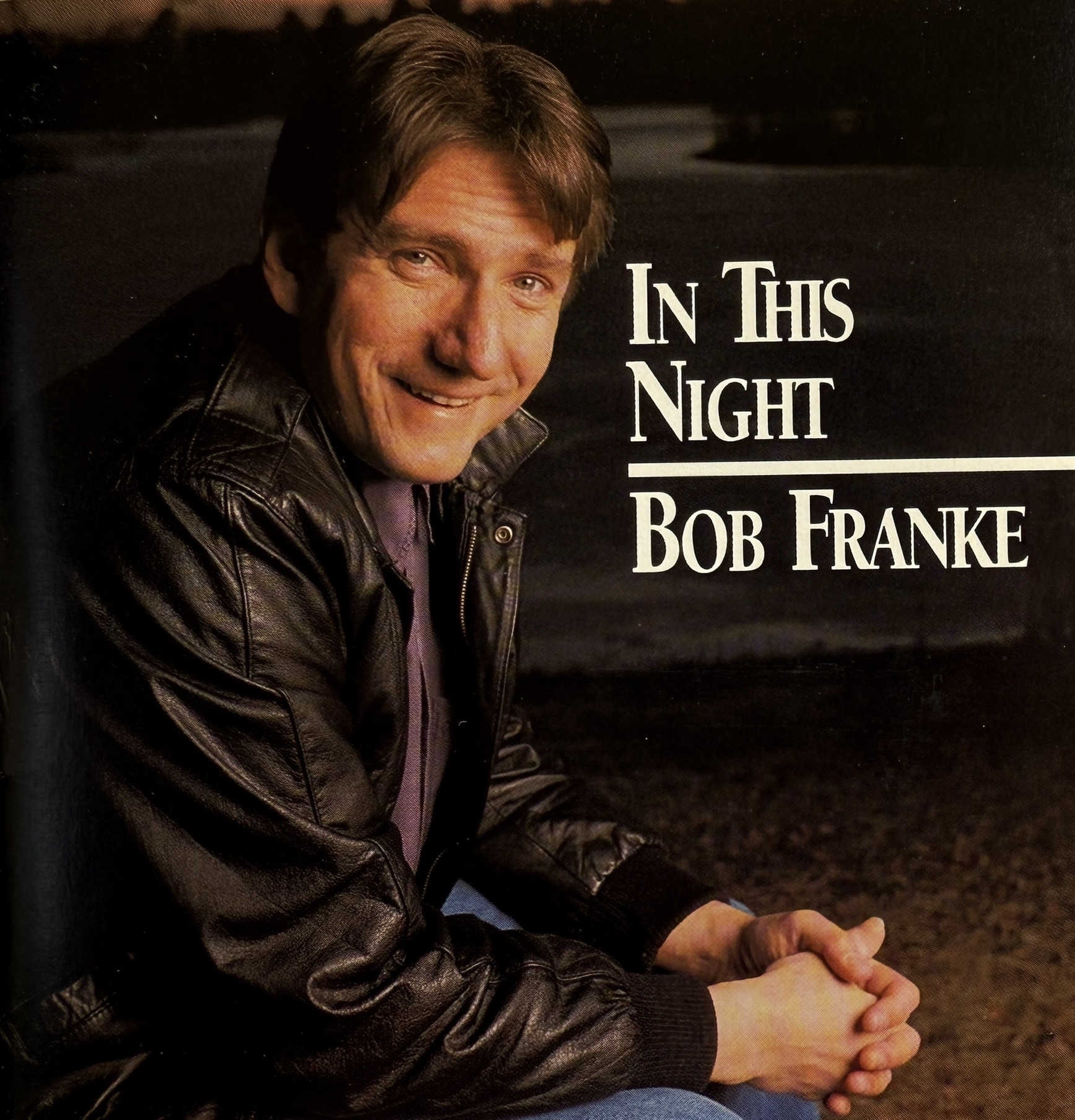
Cover of Bob Franke’s fifth album, 1991 (Photo: Susan Wilson)

And when all the stars and sentimental songs dissolved to day,
There was nothing left to sing about but hard love.

— Bob Franke, “Hard Love”

Yet even at the grave we make our song: Alleluia, alleluia, alleluia.

— Burial Office, Episcopal Book of Common Prayer

“Bob Franke! Ten years ago, one of his songs literally saved my life.” That’s what a theology professor told me back in the nineties, when I was catching a ride with her to Salem from the Massachusetts coast. She taught at Harvard Divinity School and had offered to drop me at a friend’s house on her way to work. “What’s your friend’s name?” she asked. I told her, and I have never forgotten her heartfelt response. But I was not surprised by it. Bob’s songs have been a source of comfort and healing for many of us over the years.

I first met Bob in 1969, when he was a student and aspiring singer-songwriter at the University of Michigan, and I was a Cambridge seminarian visiting Ann Arbor during spring break. Bob was part of an impromptu band I helped put together for the Easter liturgy at Canterbury House, the Episcopal campus ministry coffeehouse renowned not only for its folk concerts (Neil Young, Joni Mitchell and Richie Havens were on the bill that year), but also for its wonderfully creative alternative worship. On Easter morning, about 150 students and faculty descended into the gloomy basement “tomb,” until a clown in white face appeared to announce that “Christ is risen!” As the congregation exited the tomb into the light-filled hall above, our band played the opening hymn—“Mr. Tambourine Man.” Nothing like resurrection to make a “jingle-jangle morning.”
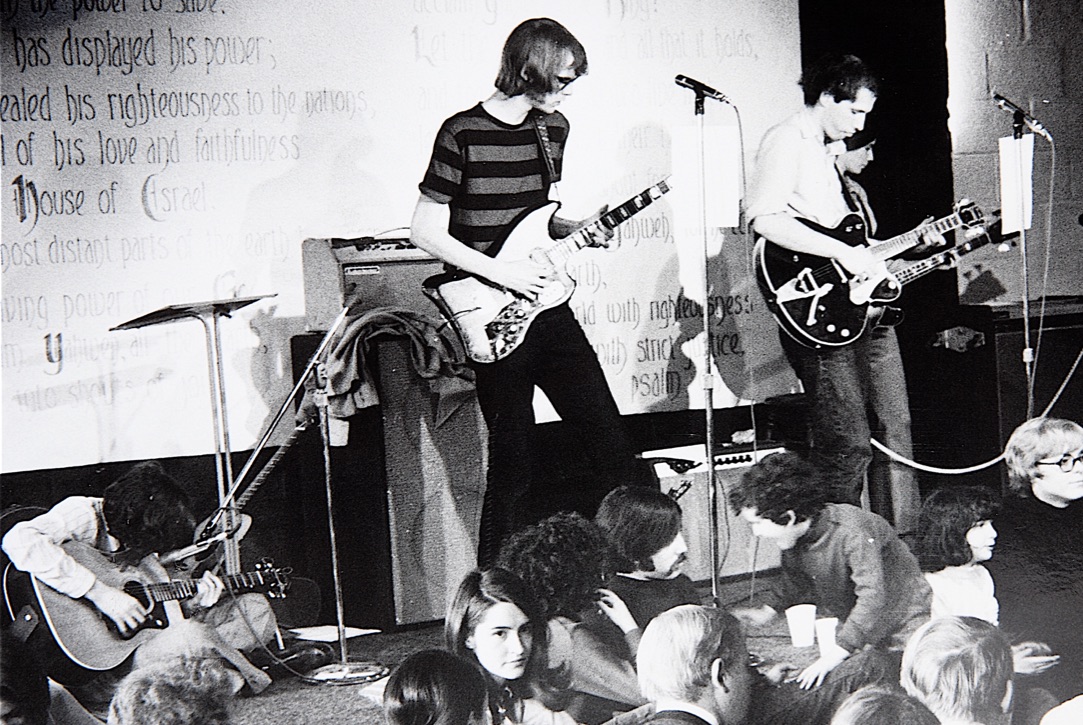
Bob Franke (seated on floor), Jim Friedrich, Ed Reynolds at Canterbury House
Easter Sunday, 1969

Canterbury House was also the first place Bob sang his own songs on stage. In the previous year, the headline act—the unpredictable Ramblin’ Jack Elliott—had wandered away between sets to get ice cream in Detroit, 45 miles away. During his long absence, someone asked Bob to fill in until Jack returned. And a star was born.

Bob was a faithful friend of God, an Episcopalian by tradition. He attended my seminary in Massachusetts for a year, but it soon became clear that, in his words, “a guitar fit better around my neck than a clerical collar.” But his songs, and the way he would speak about them in concert, became a unique ministry of illumination, comfort and blessing which touched so many lives. Bob himself put it this way:

“Whenever I sing, I’m trying to create in my listeners an awareness of the beauty and sacredness of their own lives, both individually and together, as a community. A woman came up to me recently and said that my story and my song put her relationship with her dad in a new light, gave her insight into her dad’s love for her. That’s all I need to take home from a show.”

Some of his work engages biblical topics, such as his Nativity carol, “Straw Against the Chill,” or “We’re Walking in the Wilderness.” Some lyrics incorporate Scriptural references (“new streams in the desert, new hope for the poor”). But most of his songs, whatever the topic, touch on fundamentally religious questions: yearning, journey, justice, death, loss, mercy, gratitude, love.

But it was always more than the songs with Bob, whose own authenticity, depth, humility and warmth made every concert an event of the heart. As music programmer Alan Korolenko describes the Bob Franke experience:

“No matter the size of the audience, you’re going to get an intimate evening with Bob. He just pulls everybody in, which is the key. You’ll meet other artists, and they’re not the same as their work. That’s not the case with Bob. He appeals to folk fans and general audiences, because he knows how to create a full, emotional journey, and how to share that journey. By the end, you’ve laughed and thought and cared; you’ve gotten to know the guy. He’s a class act.”

In the folk world, Bob’s songwriting has long been held in high esteem. Peter, Paul and Mary, David Wilcox, John McCutcheon, Sally Rogers, Martin Simpson, Lui Collins, Garnet Rogers, June Tabor and countless others have all recorded from his songbook. Claudia Schmidt has a beautiful version of “Hard Love,” one of the most truthful and hard-earned songs ever written on the subject.

Yes, it’s hard love, but it’s love all the same
Not the stuff of fantasy, but more than just a game
And the only kind of miracle that’s worthy of the name
For the love that heals our lives is mostly hard love

Bob’s melodies have a way of drawing you into a place of receptivity, where his words, so precise, truthful and unafraid, whisper their truth to your heart.

For the Lord’s cross might redeem us, but our own just wastes our time. (“Hard Love”)

There’s a hole in the middle of the prettiest life,
so the lawyers and the prophets say … (“For Real”)

But there are ears to hear me in my softest voice,
There are hands to hold and point the way … (“A Healing in This Night”)

Over the years, Bob’s songs have been woven like bright threads into the fabric of my own life. When my grandmother died three months short of a hundred, my folk-singing sister Marilyn wasn’t sure what to perform at her funeral. Then one of Bob’s songs arrived by chance (or grace) in the mail. A friend had just come across “Alleluia, the Great Storm is Over,” and thought Marilyn would like it. It proved the perfect choice, heaven-sent, to sing our dear Nana home.

Sweetness in the air, and justice on the wind,
laughter in the house where the mourners had been.
The deaf shall have music, the blind have new eyes,
the standards of death taken down by surprise.

In a very low-def 2010 video of Bob and friends singing the song in a Massachusetts coffeehouse, you can hear the audience jumping in with the chorus before Bob even sings a word. His lyrics were so deeply planted in their hearts, they could not keep silent.

Bob wrote a cantata on Christ’s Passion, performing it with musician friends every Good Friday at his home parish, St. Andrew’s Episcopal Church in Marblehead, Massachusetts. One of those songs, “Roll Away the Waters,” a rousing celebration of the Exodus, became a regular part of the storytelling portion of my creative Easter Vigils over the years. Here is Bob’s version.

And when we hear again the Annunciation story in Advent, it’s time for Bob’s “Say Yes,” an artfully succinct summary of spirituality’s essence: receptivity and consent. Here’s a version I did during the pandemic for one of my church’s worship streams:

The author performs Bob Franke’s “Say Yes.”

And whenever I need serious picking up, I’ll play “A Healing in This Night.” Here’s a fine version by Annie Patterson and Peter Blood:

“I always think of Bob as if Jefferson and Thoreau had picked up acoustic guitars and gotten into songwriting. There are touches of Mark Twain and Buddy Holly in there, too.” — Tom Paxton

Bob’s songs, and his spirit, are deeply rooted in American tradition—musically, culturally, politically. He sang on radio shows like Prairie Home Companion and A Mountain Stage, and traveled down many roads to perform in festivals, coffeehouses, churches and living rooms. His songs are imbued with the questions, dreams, struggles and shadows of American life. Even the hardest times are seen with a measure of possibility and redemption.

But in recent years he and his wife Joan saw the country they loved disintegrating into madness and rage. Feeling that the United States was becoming unsafe, and mindful of those who waited too long to exit Nazi Germany in the 1930s, Bob and Joan emigrated to Guatemala in September. They were barely into their second month in a new land when Bob was hit by a speeding motorcycle while crossing a road. Yesterday, October 16, a few days after surgery to repair the damage, he died in hospital of a heart attack. He was 78.

What can you do with your days but work and hope,
Let your dreams bind your work to your play.
What can you do with each moment of your life
But love till you’ve loved it away?

When the news of Bob’s death reached me around midnight, it hit hard. I lit a candle before an icon of the Theotokos, and picked up my guitar: “Thanksgiving Eve,” of course, “Alleluia, the Great Storm is Over,” and “A Healing in This Night.” I imagined people far and wide were doing the same—joining our voices with the whole company of heaven, as we say at mass.

Give rest, O Christ, to your servant
with your saints,
where sorrow and pain are no more,
neither sighing,
but life everlasting.

As for the song which saved that Harvard theologian’s life years ago, let Bob have the last word:

For more information on Bob Franke’s life and music: https://bobfranke.com
It Ain’t Me, Babe: Dylan Wins the Nobel Prize

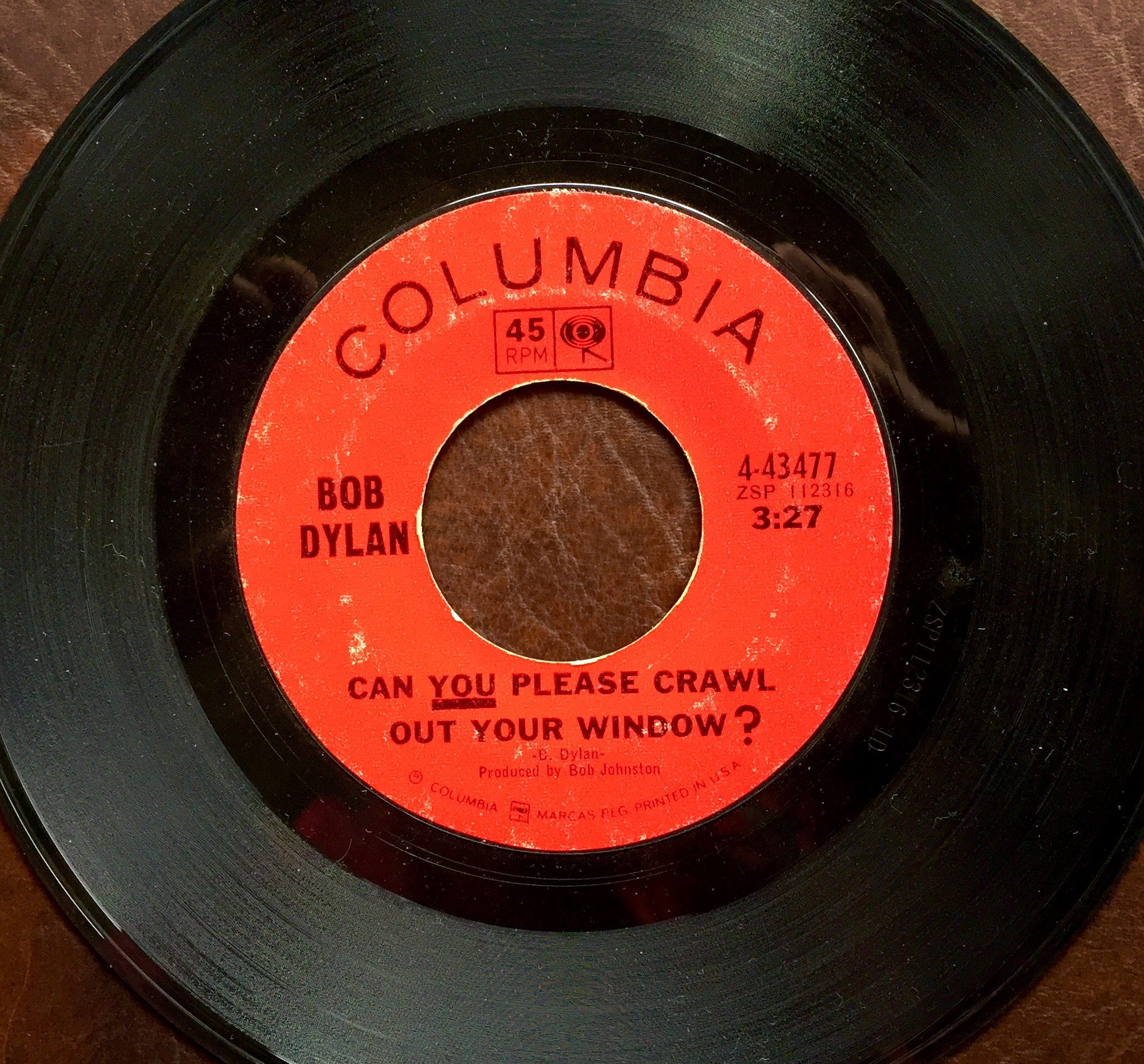
One of my prized 45s is this obscure single, released Dec. 21, 1965.

One of my prized 45s is this obscure single, released Dec. 21, 1965.

Well, I try my best
To be just like I am
But everybody wants you
To be just like them
They say sing while you slave and I just get bored
I ain’t gonna work on Maggie’s farm no more.[i]

All these people that you mention, yes, I know them, they’re quite lame
I had to rearrange their faces and give them all another name
Right now, I can’t read too good, don’t send me no more letters no
Not unless you mail them from Desolation Row [ii]

Little red wagon, little red bike
I ain’t no monkey but I know what I like [iii]

Whenever the Nobel Prize for literature is announced, the American response is often “Who?” In our cultural insularity, few of us know their work or even their names. Not this year. Everybody’s heard of Dylan, and many can recite his lyrics.

The surprise in 2016 stems from the bursting of old academic wineskins. What constitutes literature, anyway? Some of the literary establishment are unhappy that a songwriter tainted with lower-brow genres of popular culture (and currently performing in Las Vegas!) should steal the laurels from more “serious” candidates such as Syrian poet Adonis or Kenyan novelist Ngugi Wa Thiong’o. It’s “a joke,” fumed one French writer. A Scottish novelist dismissed the Nobel committee as “gibbering hippies.” [iv]

But if the linguistic arts trace their origins to the sung poetry of shared rituals, and Homer, the father of western literature, was a blind singer-songwriter who never put pen to paper, then Dylan can justly claim an ancient lineage, and stretching the definition of literature to include his work seems more restoration than innovation.

While Dylan’s jumping the queue ahead of American writers like Philip Roth, Joyce Carol Oates, and Don DeLillo might seem inappropriate to some, it is at least defensible. Oates herself calls the award “an inspired and original choice. His haunting music and lyrics have always seemed, in the best sense, ‘literary.’” [v]

Dylan has certainly had his down periods of uneven albums and terrible concerts. I myself have endured one too many evenings of mumbled words, mangled melodies, and an almost contemptuous stage presence. But to sustain such an influential and ever-evolving body of work over half a century, bridging the cultural divide between high and low, making the play of language a lever to move the world, is an astonishing achievement. His poetic and musical gifts have so often given voice to the collective longing of our “subterranean homesick blues.” They have also taken us inward, to the places of the heart where “we sit here stranded, though we’re all doing our best to deny it.” [vi]

As Bruce Springsteen has written, “Bob pointed true north and served as a beacon to assist you in making your way through the new wilderness America had become. He planted a flag, wrote the songs, sang the words that were essential to the times, to the emotional and spiritual survival of so many young Americans . . .” [vii]

Dylan was the soundtrack for my own coming of age. During my first year of college in 1963, a classmate thrust Dylan’s first album into my hands. “You’ve got to hear this,” he said. As soon as that growling, barbaric yawp started blasting out of the speakers, I was spellbound. Like so many others, I took up the guitar just so I could play his songs. “Blowin’ in the Wind” (from his second album), was my first attempt (key of D with its easy chords). By my senior year, dozens of Dylan songs were in my repertoire. I even learned the ten-minute “Desolation Row” by heart, once performing it on Rome’s Spanish Steps, by the house where Keats died, during a post-graduate summer of hitchhiking Europe with my guitar.

In Berkeley on March 28, 1965, I caught one of Dylan’s final all-acoustic concerts, just before the release of Bringing It All Back Home, the first album in his unmatched trilogy (Highway 61 Revisited and Blonde on Blonde would follow). Ken Kesey and Allen Ginsberg were sitting up front. Hippies and Hell’s Angels mixed with students and professors. The hall was charged with anticipation. From “Gates of Eden” to “It’s All Over Now, Baby Blue,” it was an amazing night.

It was the first time I ever heard “Mr. Tambourine Man.” Top 40 radio, or even Dylan’s previous work, had not really prepared me for the trippy ride “upon that magic swirling ship.” Behind its dazzling succession of vivid images, I recognized something primal and urgent, the call to leave everything and to follow, to look everywhere for the “windy beach, far from the twisted reach of crazy sorrow.”

As a poetic equivalent of the kingdom of God, the windy beach where the Spirit blows, the space of supreme aliveness, is too little found, and never possessed. And yet, now and then, I have danced beneath its diamond sky with one hand waving free, and hope to do so again as grace permits.

I was also in the crowd on September 3 of that same year, when Dylan played the Hollywood Bowl, backed by The Hawks (later The Band) along with Al Kooper on organ. There all the songs from Highway 61 Revisited were performed in public for only the second time (after a New York concert the previous week). Since the album had yet to hit the stores, it was my indelible first communion with the image world of Dylan’s surrealism. “There’s something happening here, but you don’t know what it is.”[viii]  Indeed.

The encore was “Like a Rolling Stone,” the one song we already knew from the radio. Before beginning, Dylan searched among his harmonicas in vain, then spoke into the microphone, “Anyone got a C harmonica?” As I remember it, 17,000 harmonicas came flying onto the stage, and soon we were all shouting with one voice, “HOW DOES IT FEEEEEEEL?”

When, in 1966, I crossed the country to study at the Episcopal Theological School in Cambridge, Massachusetts, my guitar and my Dylan records came with me. In a school play, I sang an adapted version of “With God On Our Side” to parody the horrific biblical conquest narratives. I wrote an article on the prophetic theology of Dylan’s lyrics in the seminary journal. And I incorporated fragments of his haunting religious poetry from John Wesley Harding into a multimedia senior sermon (you can hear the audio collage here).

In later years, Dylan’s preeminence in my life’s soundtrack receded, although his masterpiece of anguish and longing, Time Out of Mind, managed perfectly to coincide with my own midlife dark night of the soul. Lines like “It’s not dark yet, but it’s getting there” may not have been balm in Gilead, but they kept me company until the dawn.

These days I occasionally sing old favorites like “Ramona,” “She Belongs To Me,” “Chimes of Freedom” and “Buckets of Rain.” And I never tire of leading friends and retreat groups in heartfelt renderings of “Knockin’ on Heaven’s Door” and “I Shall Be Released.”

Everyone’s got their Dylan stories, but at their core is a mysterious absence. Dylan’s identity has always been veiled by a succession of fictions, evasions, conversions and withdrawals. He has given interviews full of absurd biographical narratives.[ix] Even before he was famous, he invented personae to protect himself from the prying projections of others. From fixtures and forces and friends your sorrow does stem, that hype you and type you, making you feel you gotta be just like them. [x]

Does it matter whether we ever know the real Dylan, or find him a relatable personality? Or are the songs enough? Is their mysterious power to speak to us and for us enough?

“It’s like a ghost writing a song like that,” Dylan said about “Like a Rolling Stone” 40 years after recording his greatest hit. “It gives you the song and then it goes away. It goes away.”[xi] The ghost, the geist, the spirit blows where it will. The artist prepares to receive it, and learns how to give it away.

Another Nobel Laureate, poet Czeslaw Milosz, concurs, insisting that the artist’s vocation is to be “a secretary of the invisible.” Deliver the message entrusted to your keeping, then get the hell out of the way. It ain’t me, babe. This has been the essential kenosis of both art and spirit since the beginning.

Take Caedmon, for example. An illiterate herdsman in seventh-century Britain, he was suddenly commanded in a dream to sing the story of creation. Without learning or training, he began to sing words unknown to him, gifts from the same ghost who visited Dylan. Thus was English poetry born.

Denise Levertov imagines Caedmon’s in-spiriting in a poem of her own. He is huddling for warmth at night with the beasts of the barn, when suddenly the air is filled with “feathers of flame, sparks upflying.” The cows remain oblivious and calm, not seeing what the poet sees as “that hand of fire / touched my lips and scorched my tongue / and pulled my voice / into the ring of the dance.” [xii]


[i] Bob Dylan, “Maggie’s Farm” (Bringing It All Back Home)

[ii] Bob Dylan, “Desolation Row” (Highway 61 Revisited)

[iii] Bob Dylan, “Buckets of Rain” (Blood on the Tracks)

[iv] “Writers divided on whether Dylan deserves Nobel prize”: https://www.yahoo.com/news/writers-divided-whether-dylan-deserves-nobel-prize-180943929.html

[v] ibid.

[vi] Bob Dylan, “Visions of Johanna” (Blonde on Blonde)

[vii] Bruce Springsteen autobiography, Born To Run, q. on Springsteen’s website: http://brucespringsteen.net/news/2016/bruce-springsteen-on-bob-dylan

[viii] Bob Dylan, “Ballad of a Thin Man” (Highway 61 Revisited)

[ix] To delve into the strange world of Dylan interviews: http://www.vulture.com/2007/10/the_ten_most_incomprehensible.html

[x] Bob Dylan, “Ramona” (Another Side of Bob Dylan)

[xi] Robert Hilburn, “Rock’s Enigmatic Poet Opens a Long-Private Door,” Los Angeles Times, April 4, 2004

[xii] Denise Levertov, “Caedmon”, q. in Edward Hirsch, Poet’s Choice (New York: Harcourt, Inc., 2006), 15