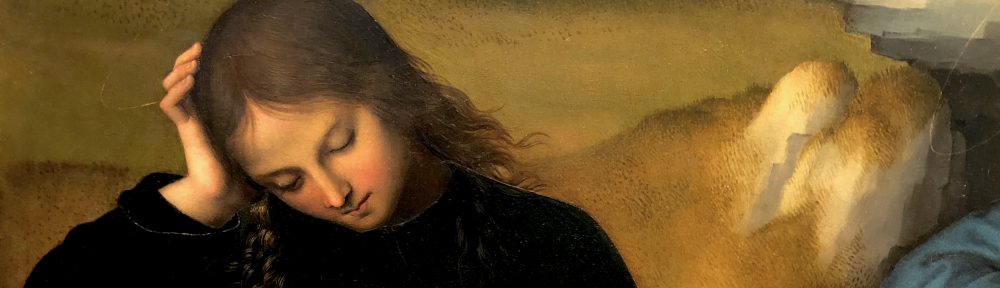

Giovanni Bellini, Madonna and Child with Saints Catherine and Magdalene (detail), c. 1500, Accademia, Venice
When belief in God is the matter to be decided, the central question is whether you can and should allow yourself to retain or be drawn into the patterns of thought that make the believer’s world what it is.
– David M. Holley
Pierced by the light of God…drenched in the speech of God,
your body bloomed, swelling with the breath of God.
– Hildegard of Bingen
One of the joys of Advent’s final days is the praying of the O Antiphons, seven eloquent supplications based on biblical images or attributes of the divine. Liturgically, they begin and end the Magnificat at Vespers from December 17th to December 23rd, but they can also be a rich resource for personal prayer as Christ-mass draws near. I tape each day’s particular antiphon to the mirror where I begin and end my day. Doors, dashboards and desks would also be good places to encounter these compelling texts, letting them awaken our attention over and over throughout the day.
Today’s antiphon, in my free paraphrase:
O Sophia, you are the truth of harmonious form,
the pattern of existence, the shapeliness of love.
Come: illumine us, enable us, empower us
to live in your Wisdom, your Torah, your Way.
The best-known version of the O Antiphons is the hymn, “O Come, O Come Emmanuel.” You can find my own variations on the seven antiphons here.
In my December 17 post last year, I wrote:
Each antiphon is both greeting and supplication to the God who comes to save us:
O Sapientia, O Adonai, O Radix Jesse, O Clavis David,
O Oriens, O Rex Gentium, O Emmanuel … O … O … O …
O is such an evocative word. We use it when we come upone something outside ourselves, often unexpected, something that engages us face to face.
“O” can be an inhalation, a gasp, the cry of astonishment at the heart of every encounter with the Holy. If our place of prayer were suddenly filled with smoke and angels, or if the Holy called us out of a burning bush, our first response might well be “O!”
There is also the O of understanding, or recognition: “O, now I see, now I get it.” Or even, “O, it’s you!”
And then there is the ecstatic O, expressing delight, wonder, the sigh of surrender: Ohhhhhhh!
Each of these is a fitting response when we meet the divine:
Astonishment
Recognition
Surrender
As the Antiphons return this year, I happen to be reading David M. Holley’s illuminating book, Meaning and Mystery: What it Means to Believe in God. In fresh and thoughtful ways, he suggests that God is not a hypothesis to be tested or a puzzle to be solved by detached observers, but an experience to be encountered by receptive participants, those who know how to say “O!”
Thinking of God as a hypothesis to be inferred from specifiable data means starting from an understanding of a world that does not presuppose God, but belief in God is not a matter of moving from such a world to a reality in which God is included. It is a matter of finding yourself within the kind of world where God is implicit already.[i]
In other words, the truth of belief isn’t something that can be decided from a position outside of the patterns of life and thought that constitute a religious view of the world. If you want to experience God, learn to genuflect, learn to pray, learn to sing and dance in the presence of the Holy.
Astonishment. Recognition. Surrender.
It is certainly possible to live inside an alternative story, where God is absent or nonexistent. But I find that a bleak and unpromising account of reality. This old world, beset by human folly, massive violence, economic injustice, and dispiriting politics, needs divine imagination more than ever.
The prophet Zephaniah responded to his own dark times with a profound hope in God’s Advent as a redemptive rewrite of the human story. Amid the current proliferation of hateful speech, faithless fear and violent bluster, how we long with Zephaniah for a new story, a better language.
At that time I will change the speech of the peoples to a pure speech, that all of them may call on the holy Name and serve God with one accord.[ii]
May that day come when we are all “drenched in the speech of God,” whose language is justice, peace, mercy, forgiveness, compassion, communion.
O Desire of all nations and peoples,
you are the strong force that draws us toward you,
the pattern which choreographs creation
to Love’s bright music.
Come: teach us the steps
that we may dance with you.
Related posts
Ten Ways to Keep a Holy Advent
[i] David M. Holley, Meaning and Mystery: What it Means to Believe in God (Malden, MA: Wiley-Blackwell, 2010), 47-48 [the epigraph is also Holley, p. 48]
[ii] Zephaniah 3:9
 The religious imagineer