Grace and Beauty on Holy Island

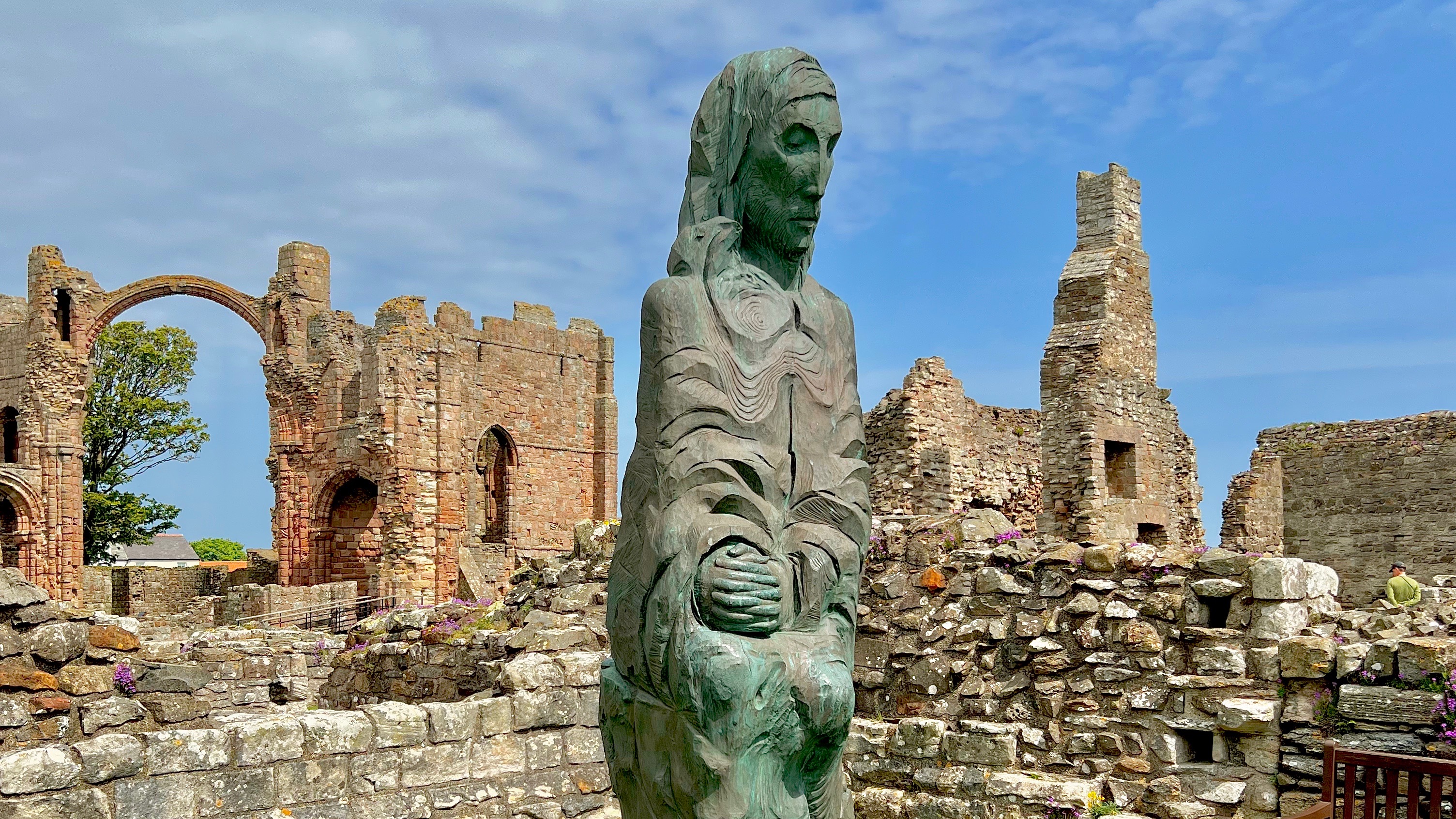
St. Cuthbert among the ruins of the 12th-century LIndisfarne Priory. Durham sculptor Fenwick Lawson carved the original from an elm tree in 1983. This bronze casting was installed in 1999.

In my recent post, Walking St. Cuthbert’s Way (7/28/2023), I described my 100-kilometer pilgrimage walk to the Northumbrian coast, where I had my first glimpse of Holy Island, where Cuthbert had been prior and bishop in the seventh century. In this installment, I cross over the tidal flats to reach my goal and discover why I had come. 

I’ve always been fascinated by the open-ended wanderings of the Dark Age Celtic monks. They journeyed without maps, trusting the way would be shown in due time. They got into little boats without oars or rudders, letting the wind and the currents be the agents of Providence. And where did they end up? Wherever it might be, they believed it was a place appointed for them by God. “The place of resurrection,” they called it. The place where they would meet Christ, the one “who knows you by heart.”[i]

But the arrival was, in a way, beside the point. The journey was the thing—the way of total abandonment and radical trust. Unlike ourselves, who think we already know who we are and where we should go, they traveled without preconception. In their eyes, you don’t know who you really are before you go on pilgrimage. Only the way of abandonment and unknowing will bring you home to your truest self. 
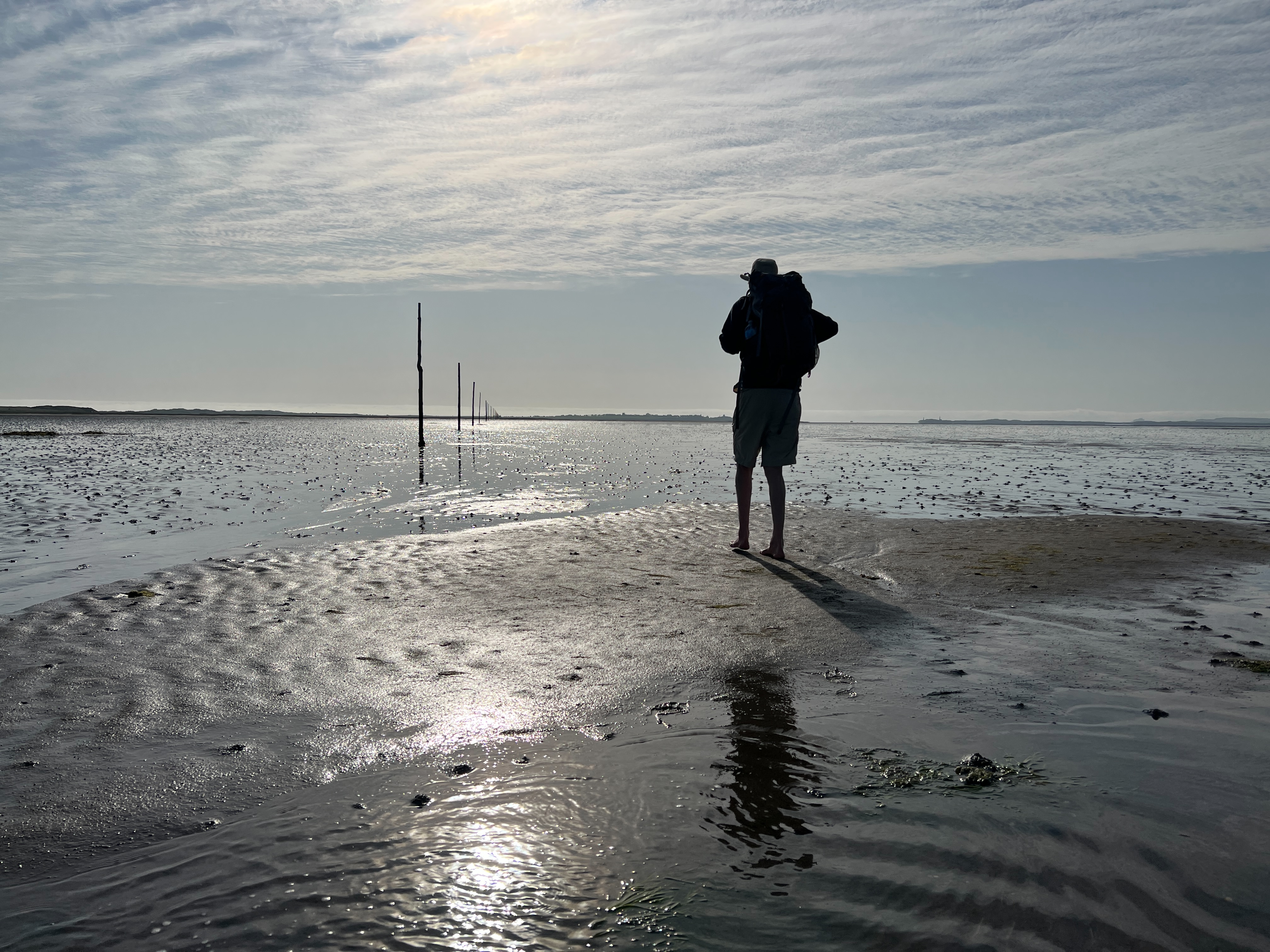
The author begins the final two miles of St. Cuthbert’s Way across the tidal sands to Holy Island.

“As a man dies many times before he’s dead,
so does he wend from birth to birth until, by grace, he comes alive at last.” 

— Frederick Buechner, Godric [ii]

Holy Island is only a part-time island. When the tide goes out, you can walk across the exposed sands, or drive over the causeway. Pilgrims properly go on foot, timing their two-mile passage to coincide with low tide. You don’t want to be caught in the middle when the waters return, swallowed like the Egyptians of old. Yes, the Red Sea comes to mind here, and the river Jordan—those great baptismal archetypes of crossing over from bondage to freedom, old to new, death to life. As I took my first steps on the wet sand, I sang one of my favorite shape note hymns:

Filled with delight, my raptured soul would here no longer stay;
Though Jordan’s waves around me roll, fearless I’d launch away.
I am bound for the Promised Land …[iii]

I had brought some rubber beach slippers, thinking I might need a barrier against cold water or sharp objects, but the sand immediately sucked them off my feet. I got the message: pilgrimage abhors self-protection. When you walk on holy ground, no shoes! 
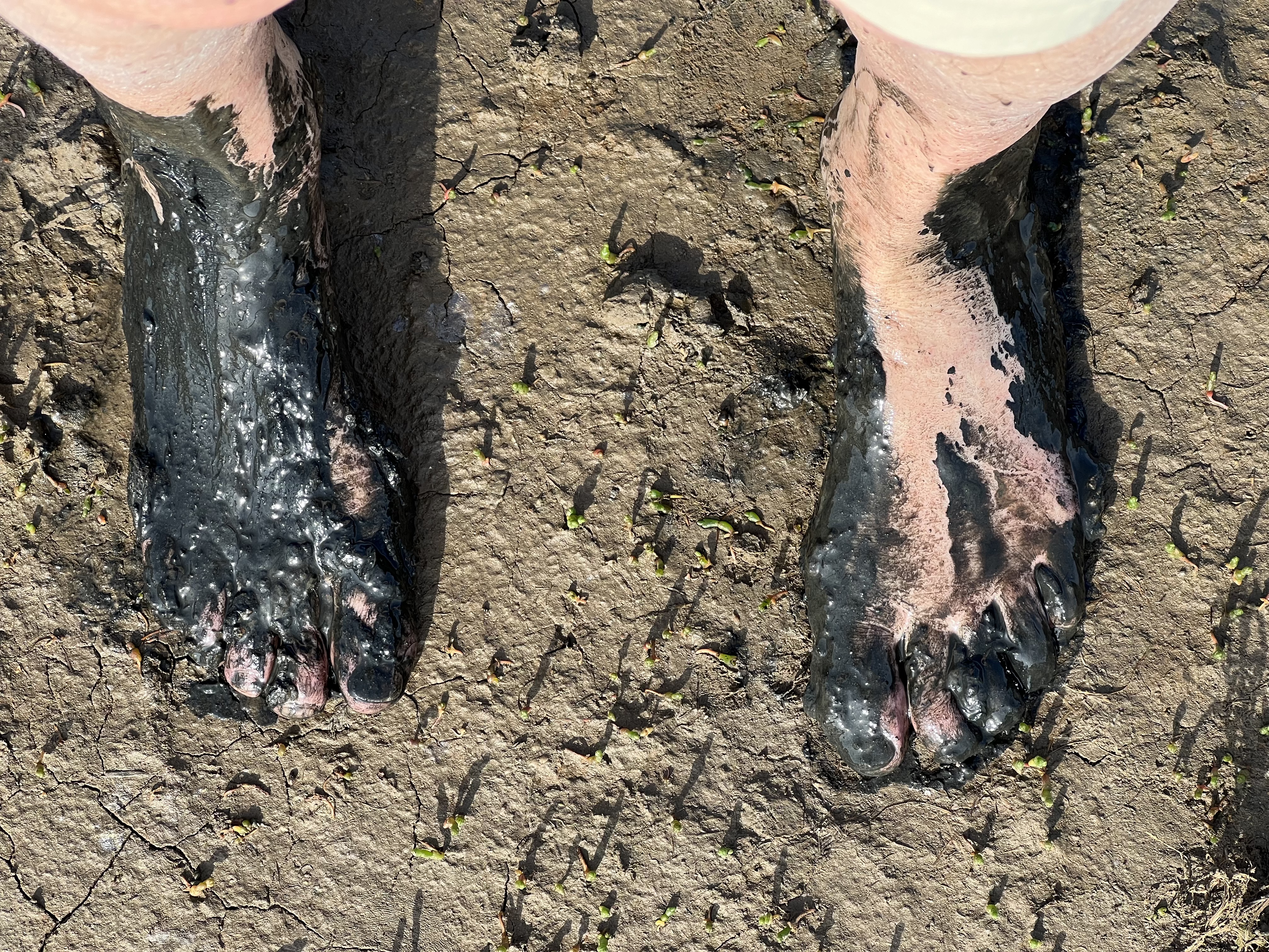
“God lifted me out of the mire and clay, set my feet upon a rock, and put a new song in my mouth.”
Psalm 40:2-3

I was the only pilgrim on the sands in the early morning. The blessed solitude sanctified my final steps on St. Cuthbert’s Way. Halfway across, I began to hear an eerie keening sound, like wind through a broken wall. But that made no sense out on the tidal flat. After looking about with binoculars, I spied a dark mass at least a mile away. It was, I realized, hundreds of beached seals, pining for their absent sea.  

The seals of Holy Island.

It took me seventy-five minutes to reach the other side, and another ten to find the parish church of St. Mary the Virgin, where I lit a candle to give thanks for the beautiful journey. 
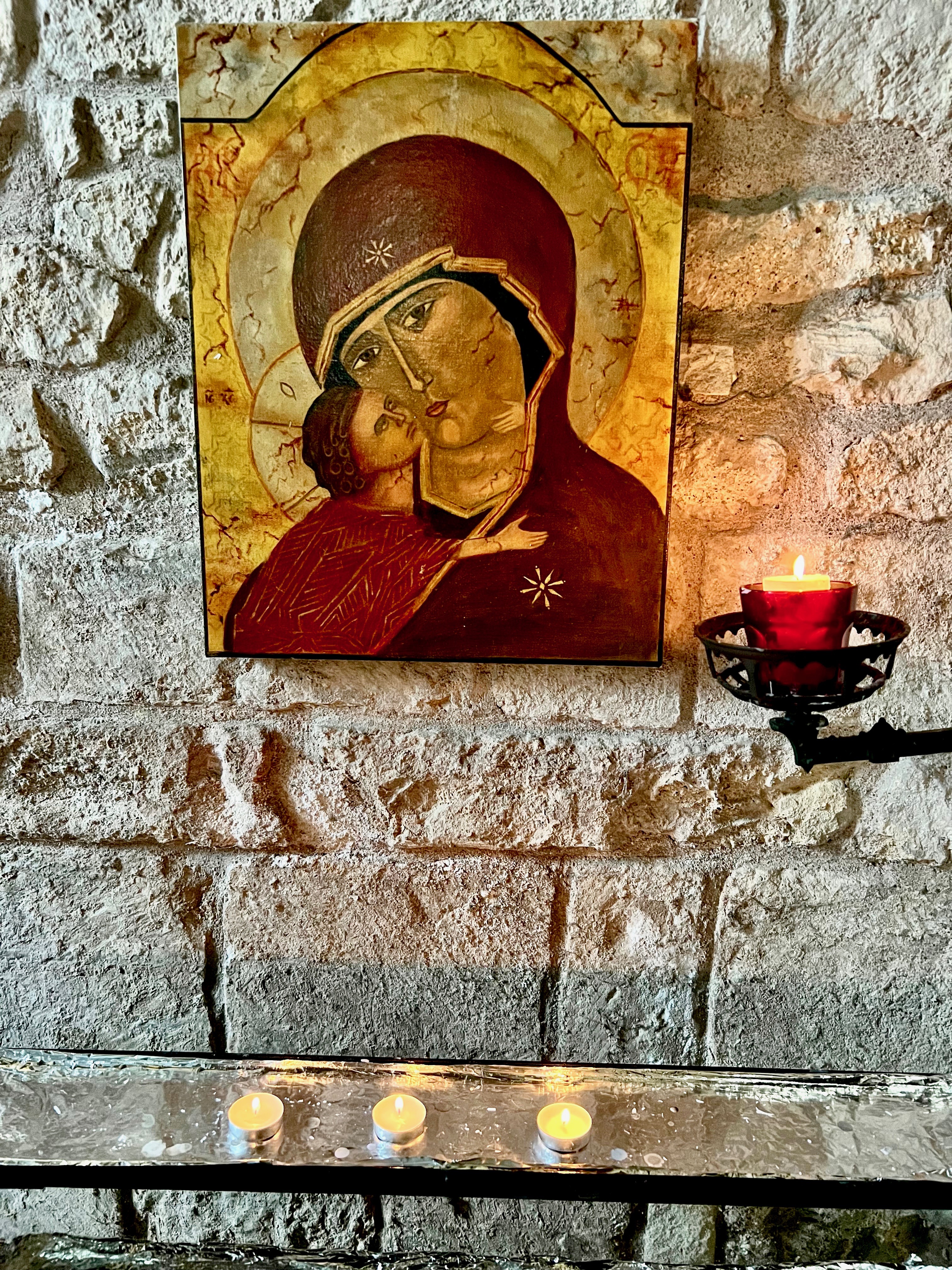
Prayer station in St. Mary’s. Public liturgies are offered daily in this (mostly) 13th-century church adjacent to the Priory ruins.
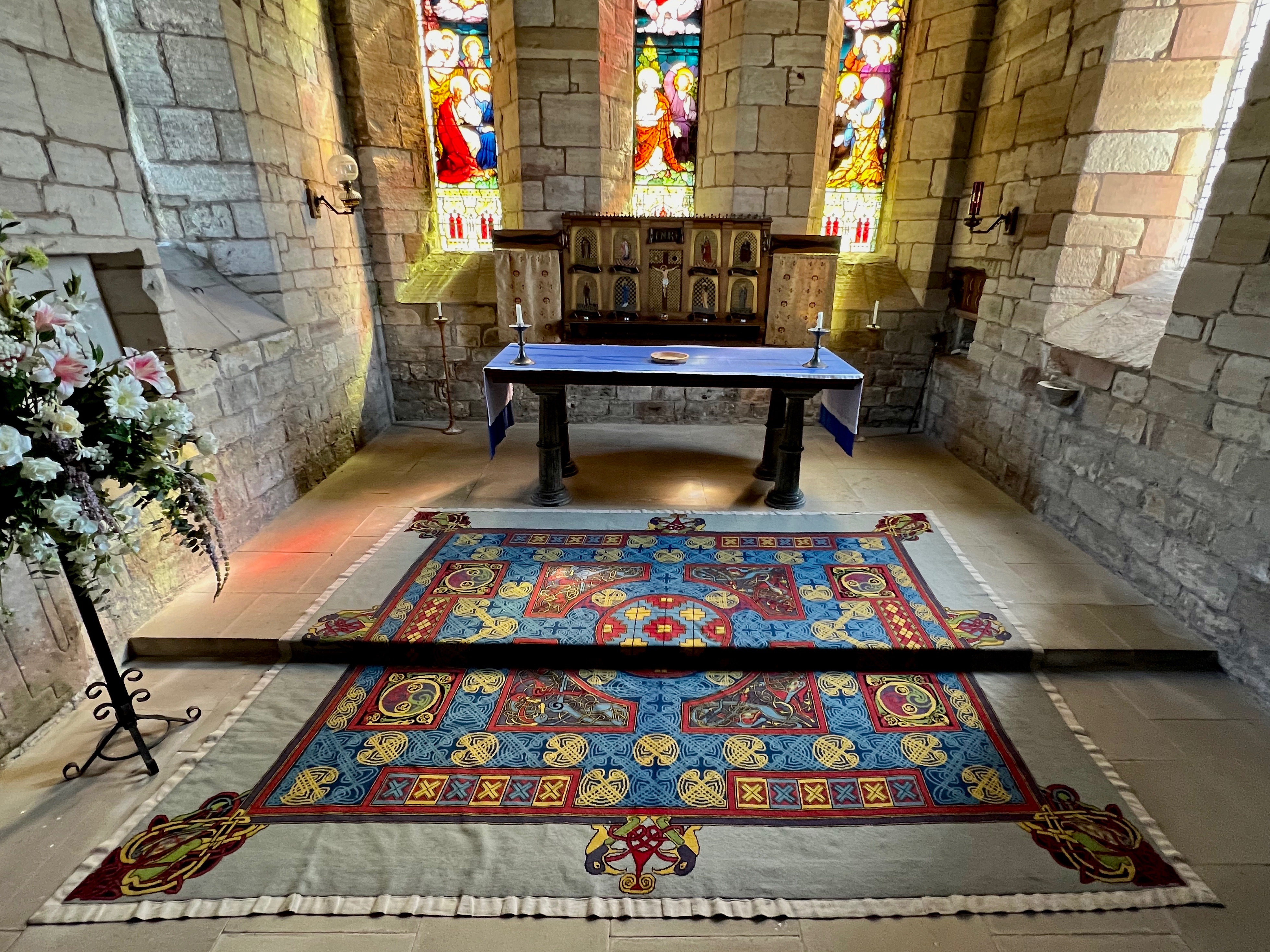
Chancel of St. Mary the Virgin, Lindisfarne’s parish church. Most of the structure is 13th century (restored in the 19th century), but some portions of an earlier building remain. The carpet, copied from a page in the Lindisfarne Gospels, was embroidered by 18 women of the parish in 1970.

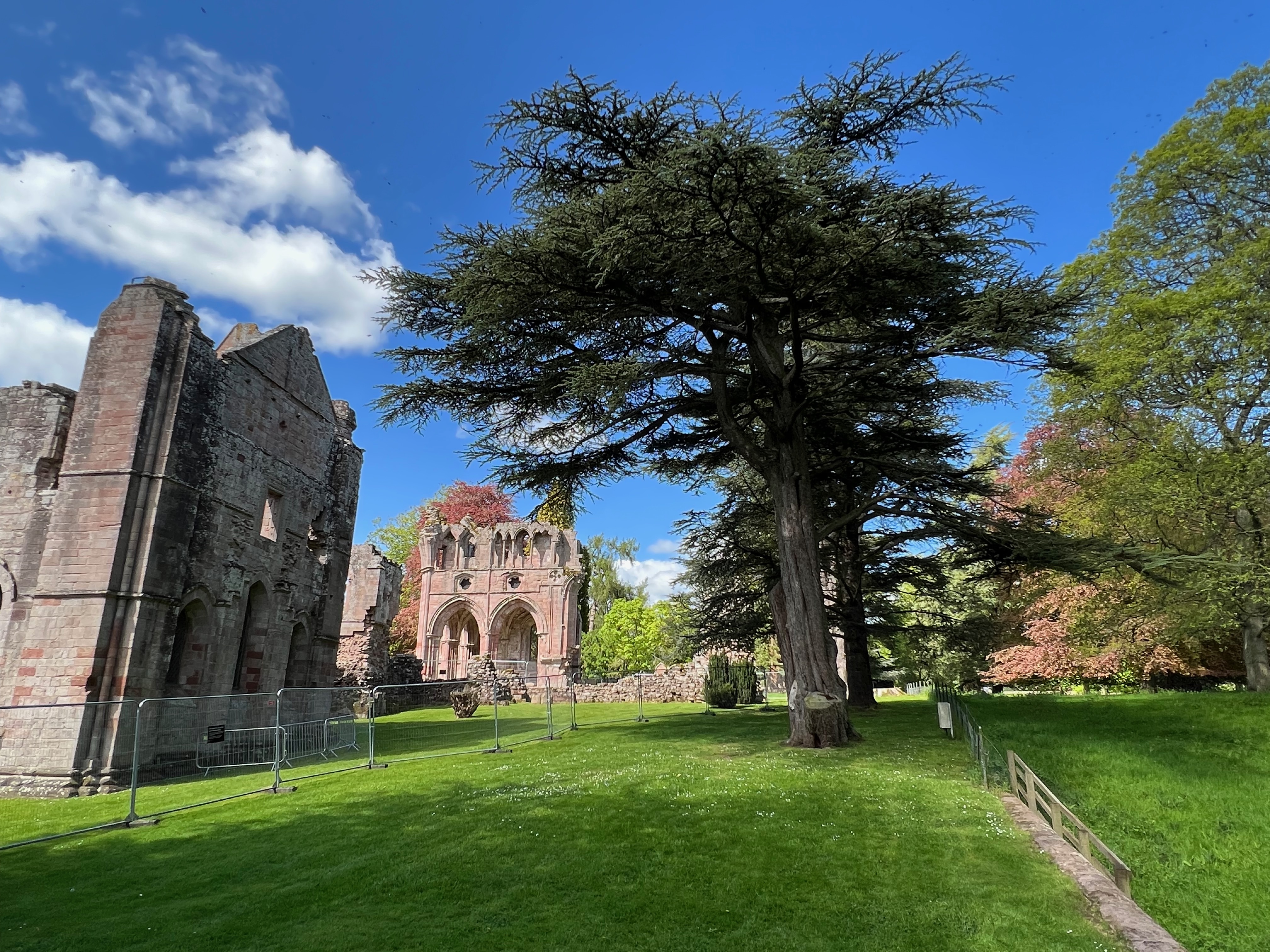
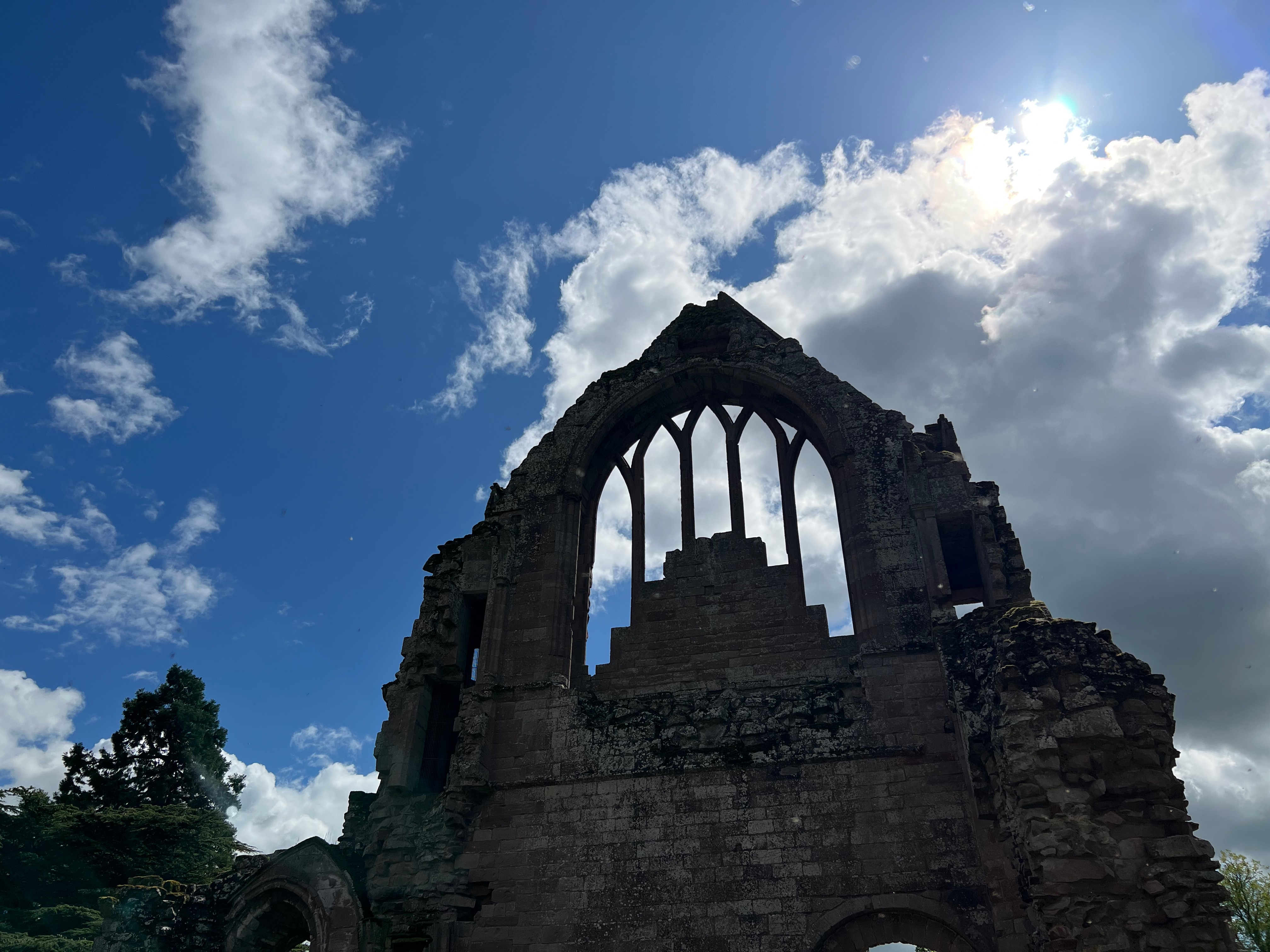
The Anglican parish church stands adjacent to the ruins of the twelfth-century Lindisfarne Priory, erected on the site of the seventh-century monastery founded by St. Aidan and nurtured by St. Cuthbert. I would return to this peaceful sanctuary again and again during my three-day sojourn on Holy Island. Sarah Hills, the gracious vicar, invited me to read Scripture at Morning and Evening Prayer. One of those passages was the comic narrative of Balaam and his recalcitrant speaking donkey, perhaps the oddest story in the Bible (Numbers 22:1-39). It was a very long text, so I tried to give each character a distinctive quality to sustain interest. The donkey’s voice got a few laughs.  

On Ascension Sunday, the eucharist was crowded with pilgrims from many lands. I passed the Peace with Africans, Asians, Europeans, North and South Americans. The singing was spirited—no half-hearted voices after such a journey. Our harmonious sound enveloped me in the embrace of communal faith, and for a blessed hour my “I” became “we.” The offertory hymn happened to be “Lord of all hopefulness,” which celebrates the daily round of prayerful living: Be there at our waking … be there at our labors … be there at our homing … be there at our sleeping. I memorized it long ago in my teens, and I had sung it at the start of every day along Cuthbert’s Way. To repeat it now at Lindisfarne, with all the company of heaven, wasn’t just coincidence; it was grace. I received its gift with tears.
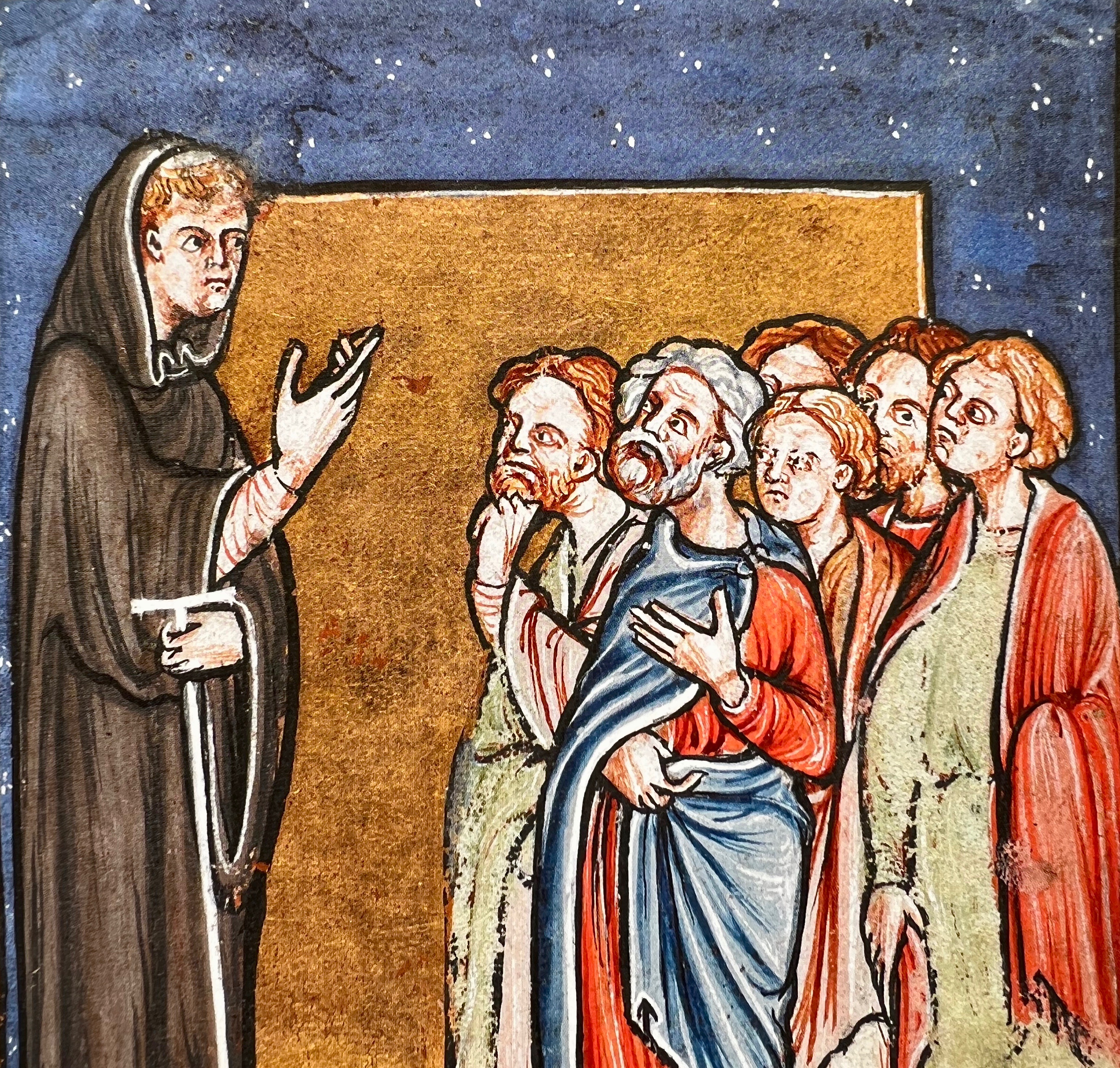
St. Cuthbert preaching to the Northumbrians (late 12th-century illustration for Bede’s Life of St. Cuthbert).

“They confessed their sins, confided in him about their temptations, and laid open to him the common troubles of humanity they were laboring under … Spirits that were chilled with sadness he could warm back to hope again … Those beset with worry he brought back to thoughts of the joys of heaven .…” [iv]   

— The Venerable Bede, Life of St. Cuthbert

Cuthbert has, through the ages, been the most beloved of Britain’s northern saints. Although he left no writings of his own, his biographers describe a humble and prayerful man, full of charm, a citizen of heaven who devoted his life to the needs of earthly folk. He had a compassionate spirit, and was a gifted listener. When the responsibilities of leadership were thrust upon him, he accepted them in a spirit of obedience. But he had a hermit’s heart, and no thirst for power. 

At age thirty, he became Prior of Lindisfarne in 664, and was assigned the difficult task of introducing the forms and practices of the Roman church to his resistant Celtic community. In a momentous decision at the recent Synod of Whitby, the Celtic churches in Britain had agreed to adopt the more universal—and hierarchical—norms of western Catholicism, surrendering the eccentricities of their more local traditions. But religious practices are hard to change, and Christian changemakers in every age have heard the same complaint, “But that isn’t the way we’ve always done it!” The seventh-century monks of Lindisfarne were no different than the Christians of our own time who fought women’s ordination or new forms of worship. They were uncomfortable. And they raised a fuss.

In Lindisfarne’s case, Cuthbert’s patient sweetness won the day. As the Venerable Bede tells the story,

“When he was wearied by the sharp contentions of his opponents he would rise up suddenly and with placid appearance and demeanor he would depart, thus dissolving the Chapter, but nevertheless on the following day, as if he had suffered no opposition the day before, he would give the same exhortations again to the same company until he gradually converted them to his own views.” [v]
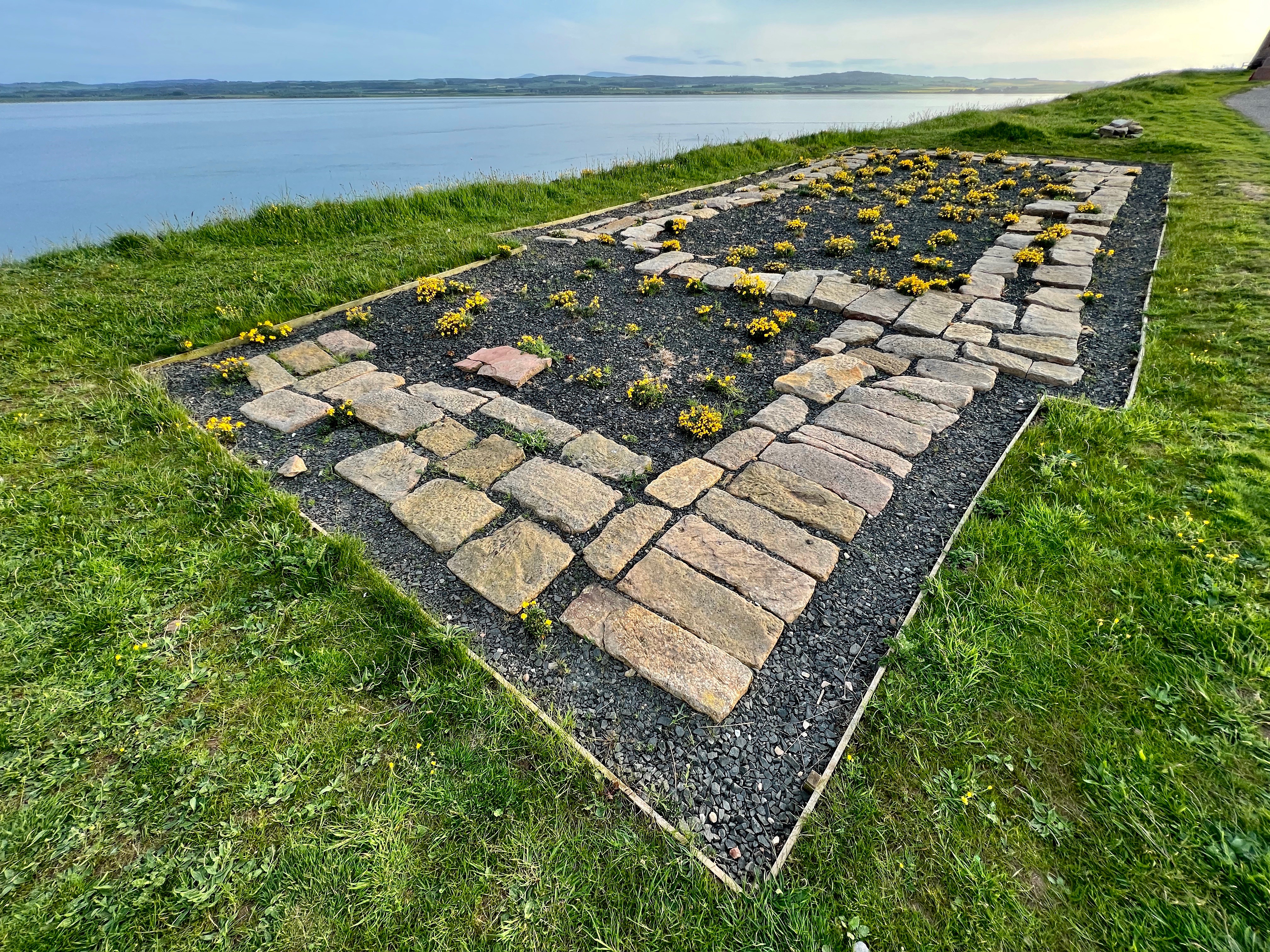
Foundation of an Anglo-Saxon church on the Heugh, the rocky ridge above the 12th-century ruins of Lindisfarne Priory. Discovered in recent excavations (2016-2018), this may have been part of the original monastery founded by St Aidan in 635.
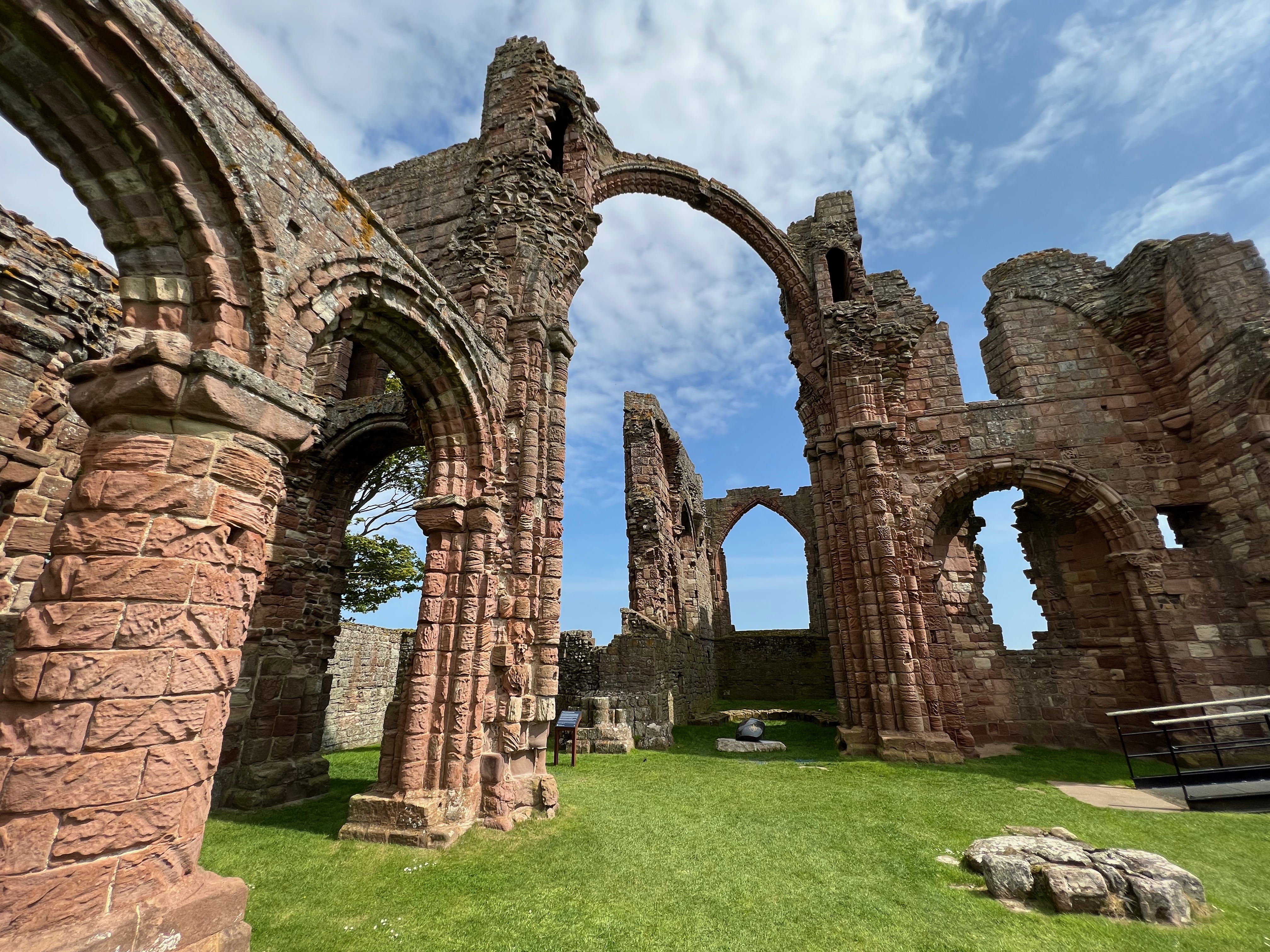
View from the nave of Lindisfarne’s Priory church (12th century, with modifications over the next 200 years). The north wall and arcade remain largely intact. The rainbow arch, a rib from the crossing vault, survived the collapse of the central tower in the 18th century. The pointed arch at the east end of the presbytery apse is a 14th-century Gothic touch.
Lindisfarne Priory (12th century). The church was built first with pink sandstone.
The domestic complex was constructed later using greyer stones.
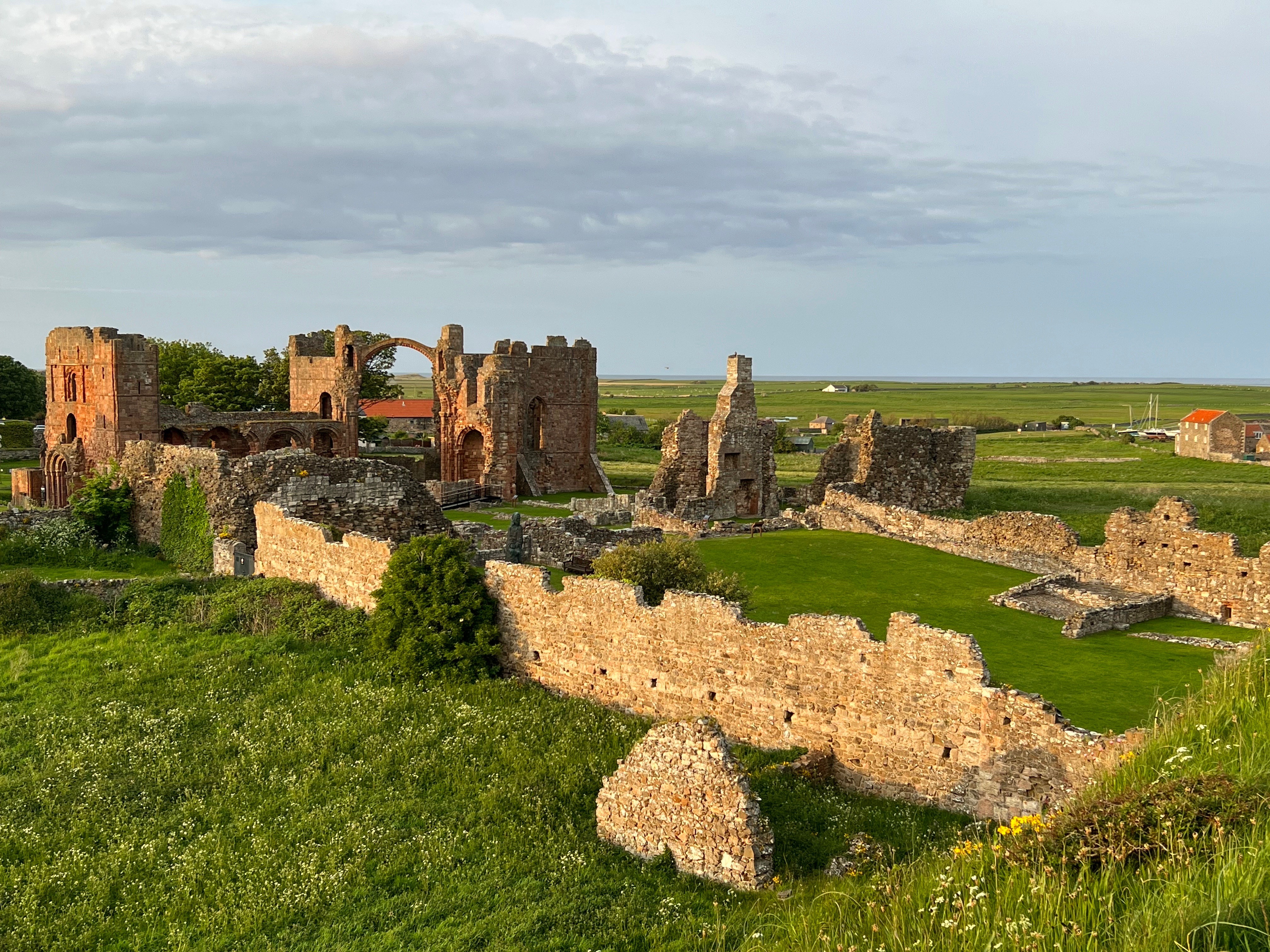
St.Cuthbert’s Isle, St. Mary’s Church, and Lindisfarne Priory from the Watchtower on the Heugh.

Time has erased the physical traces of Cuthbert’s Lindisfarne, but the impressive ruins of the Priory’s later structures still bear witness to his indelible legacy. After his death, pilgrims flocked to his shrine, thought to have been somewhere within the perimeter of the church built 500 years later. This video takes us through the ruins to the most likely spot.

Lindisfarne Priory from the north aisle to the presbytery.
The black stone marks the possible site of Cuthbert’s first burial.

After twelve years as prior here, Cuthbert felt an increasingly insistent call to solitude. For a time, he moved just offshore to a tiny island to seek the “green martyrdom” mentioned in the seventh-century Irish text, the Cambrai Homily

Precious in the eyes of God:
The white martyrdom of exile
The green martyrdom of the hermit
The red martyrdom of sacrifice.[vi]

In other words, there are different ways to take up your cross. If your faith doesn’t literally kill you or drive you into exile, you can still withdraw from the world to wage without distraction the interior struggle for authenticity, what St. Benedict called the “single-handed combat of the wilderness.” Inspired by the desert hermits of Late Antiquity, many British ascetics took flight to wild and lonely places in the early Middle Ages. 
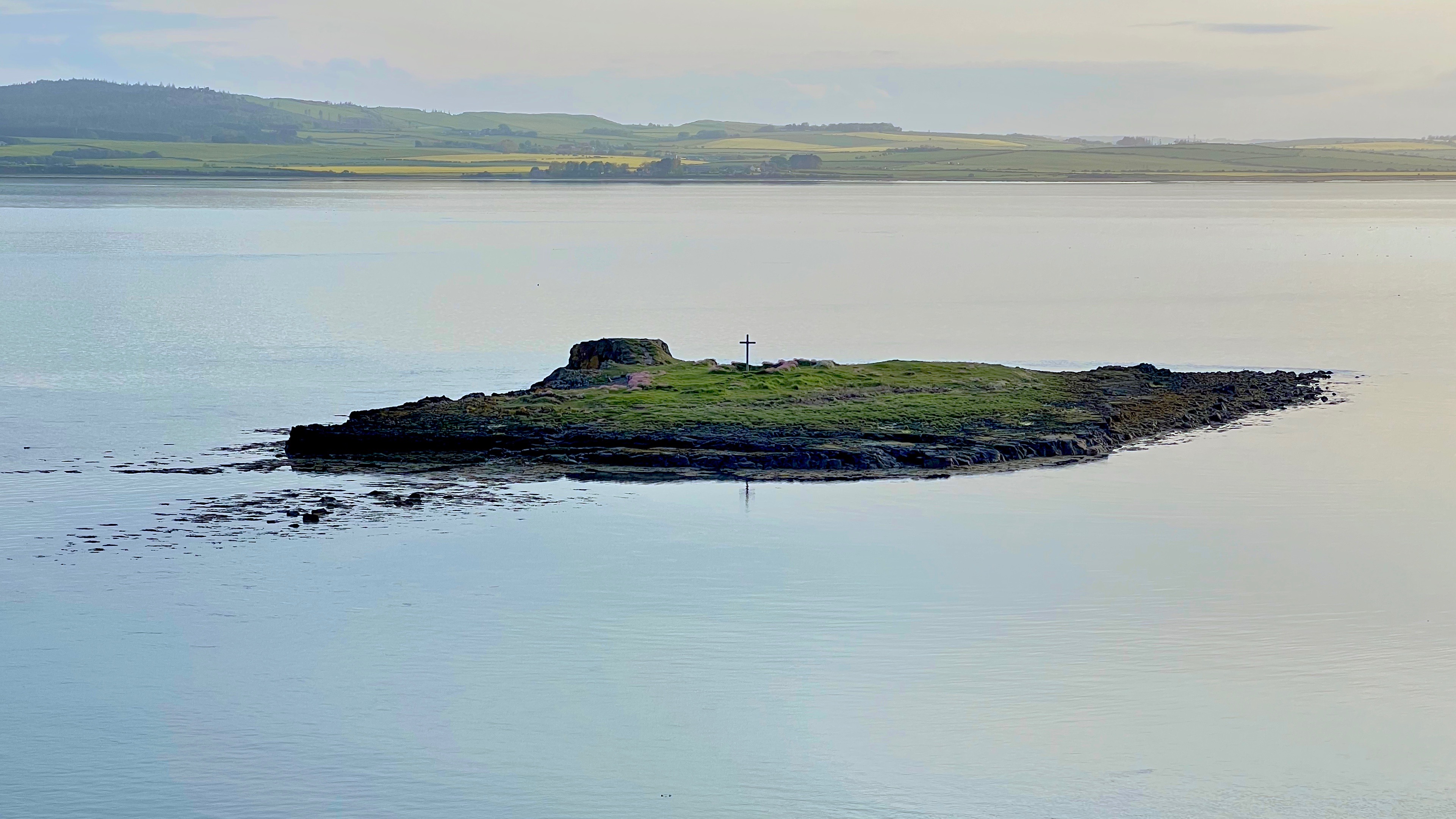
St. Cuthbert’s Isle, just offshore from Holy Island, where the saint sought prayerful solitude.
You can walk to it at low tide.

It wasn’t long before Cuthbert moved further away, to the island of Inner Farne, a seven mile row from Lindisfarne. Its rocky terrain had sparse vegetation, but was teeming with birdlife: puffins, guillemots, terns, kittiwakes, eider ducks, and numerous other species. Cuthbert loved the natural world, and there are many charming stories of his interactions with birds and animals. Here is my favorite, told by Michael York in a video I made years ago about early British Christianity: 

St. Cuthbert and the otters
From The Story of Anglicanism: Early and Medieval Foundations
Cathedral Films, 1988

What was life like for an island hermit? Was it an escape from interdependence, or could it be a way of going deeper and deeper into the world? A twelfth-century Irish poem conveys a vivid sense of belonging to a sacred ecology: 

Delightful I think it to be in the bosom of an isle, on the peak of a rock,
that I might often see there the calm of the sea.

That I might see its heavy waves over the glittering ocean,
as they chant a melody to their Father on their eternal course.

That I might see its splendid flocks of birds over the full-watered ocean;
that I might see its mighty whales, greatest of wonders…

That contrition of heart should come upon me as I watch it;
that I might bewail my many sins, difficult to declare.

That I might bless the Lord who has power over all,
Heaven with its pure host of angels, earth, ebb, flood-tide.

That I might pore on one of my books, good for my soul;
a while kneeling for beloved Heaven, a while at psalms.

A while gathering seaweed from the rock, a while fishing, 
a while giving food to the poor, a while in my cell.

A while meditating on the Kingdom of Heaven, holy is the redemption!
a while at labor not too heavy; it would be delightful! [vii]

The presbytery apse at the east end of the Lindisfarne Priory church. The high walls and absent roof, like Cuthbert’s cell on Inner Farne, block any view of the surrounding world, concentrating attention on what the saint called “higher things.”

Despite his affection for the created world, Cuthbert constructed his stone cell on Farne with high walls and no windows. His only view was through an opening in the roof. The design was intended to focus his attention on the higher things of “heaven,” not just as a concept, but as a physical, sensory experience. That strikes me as similar to what contemporary Light and Space artist James Turrell achieves with his “Skyspaces,” windowless rooms with a rectangular or elliptical opening cut into the ceiling. 

“My art deals with light itself,” Turrell says. “It’s not the bearer of revelation—it is the revelation.” [viii]  Instead of looking at material objects, you gaze up though the opening, taking in the sky’s color and light during the day and the stars at night. Over time this perceptual asceticism, screening out the world of things, quiets and deepens the eye, making it more receptive to the immaterial, more open to the infinite. Could the same thing have happened to Cuthbert in his stone enclosure? “It’s not about earth. It’s not about sky. It’s about our part in the luminous fabric of the universe.” [ix]   
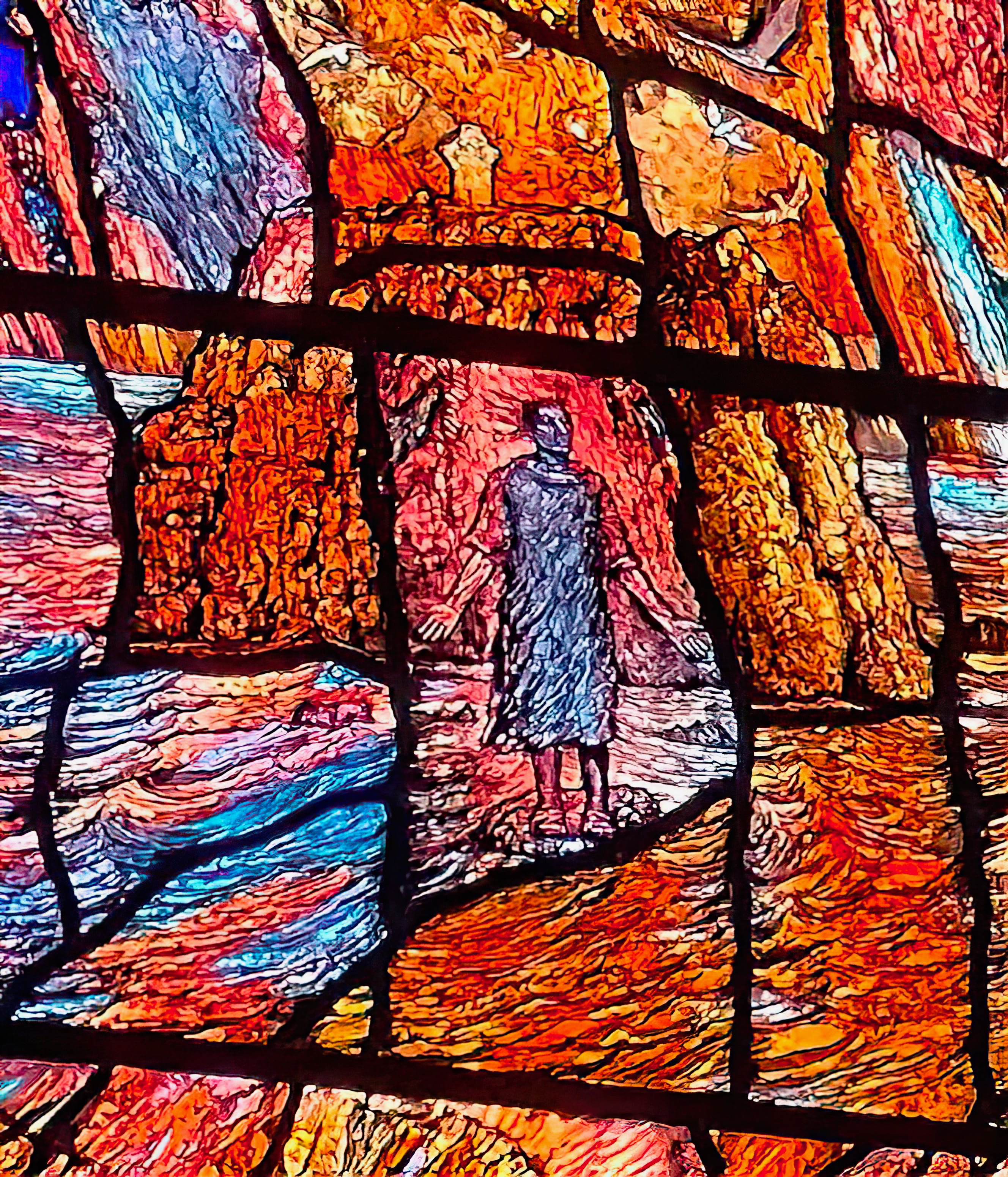
Cuthbert prays on an island in a turbulent sea (detail of Tom Denny’s Transfiguration window, Durham Cathedral (2010). “That I might bless the Lord who has power over all: Heaven with its pure host of angels, earth, ebb, flood-tide.”

We can only speculate about the experiential nature of Cuthbert’s solitude, but Frederick Buechner, imagining the thoughts of another Northumbrian hermit, gives an honest appraisal of its challenges:

What’s prayer? It’s shooting shafts into the dark. What mark they strike, if any, who’s to say? It’s reaching for a hand you cannot touch. The silence is so fathomless that prayers like plummets vanish in the sea. You beg. You whimper. You load God down with empty praise. You tell him sins that he already knows full well. You seek to change his changeless will. Yet Godric prays the way he breathes, for else his heart would wither in his breast. Prayer is the wind that fills his sail. Else waves would dash him on the rocks, or he would drift with witless tides. And sometimes, by God’s grace, a prayer is heard.[x]
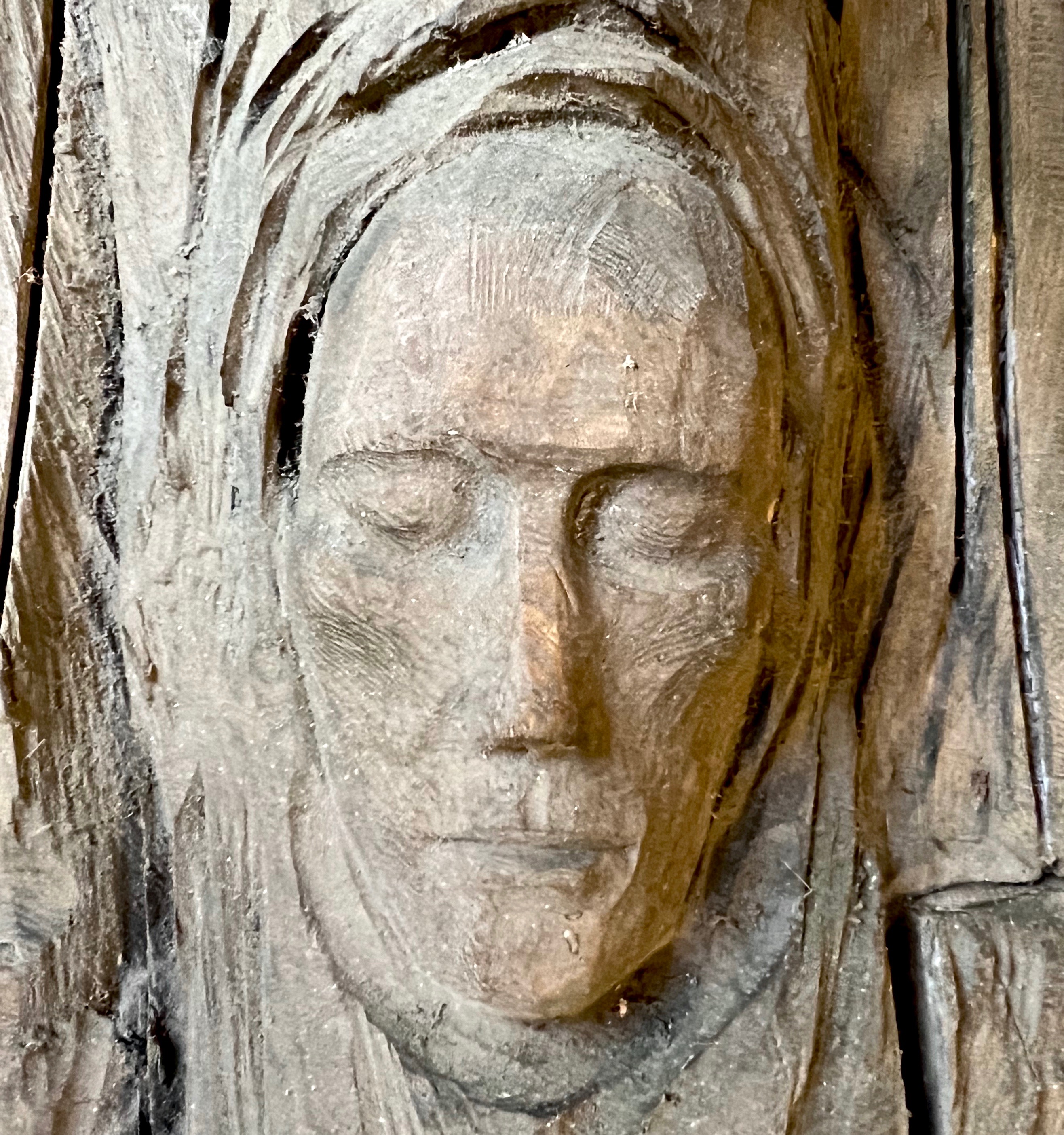
St. Cuthbert (detail from The Journey by Fenwick Lawson,1999).

One of Cuthbert’s early hagiographers described the saint’s inner life as being free of struggle, anxiety or doubt. We are assured that “in all conditions he bore himself with unshaken balance.” [xi]  But balance is hardly a prime directive for pilgrims of the Absolute. We may assume that Cuthbert knew his share of demons and dark nights on Farne. Nevertheless, the continuing stream of seekers to his island retreat found no solipsist lost in dreams or madness, but a compassionate listener who still had the gifts of a pastor. He always sent them away with lighter hearts than when they came.
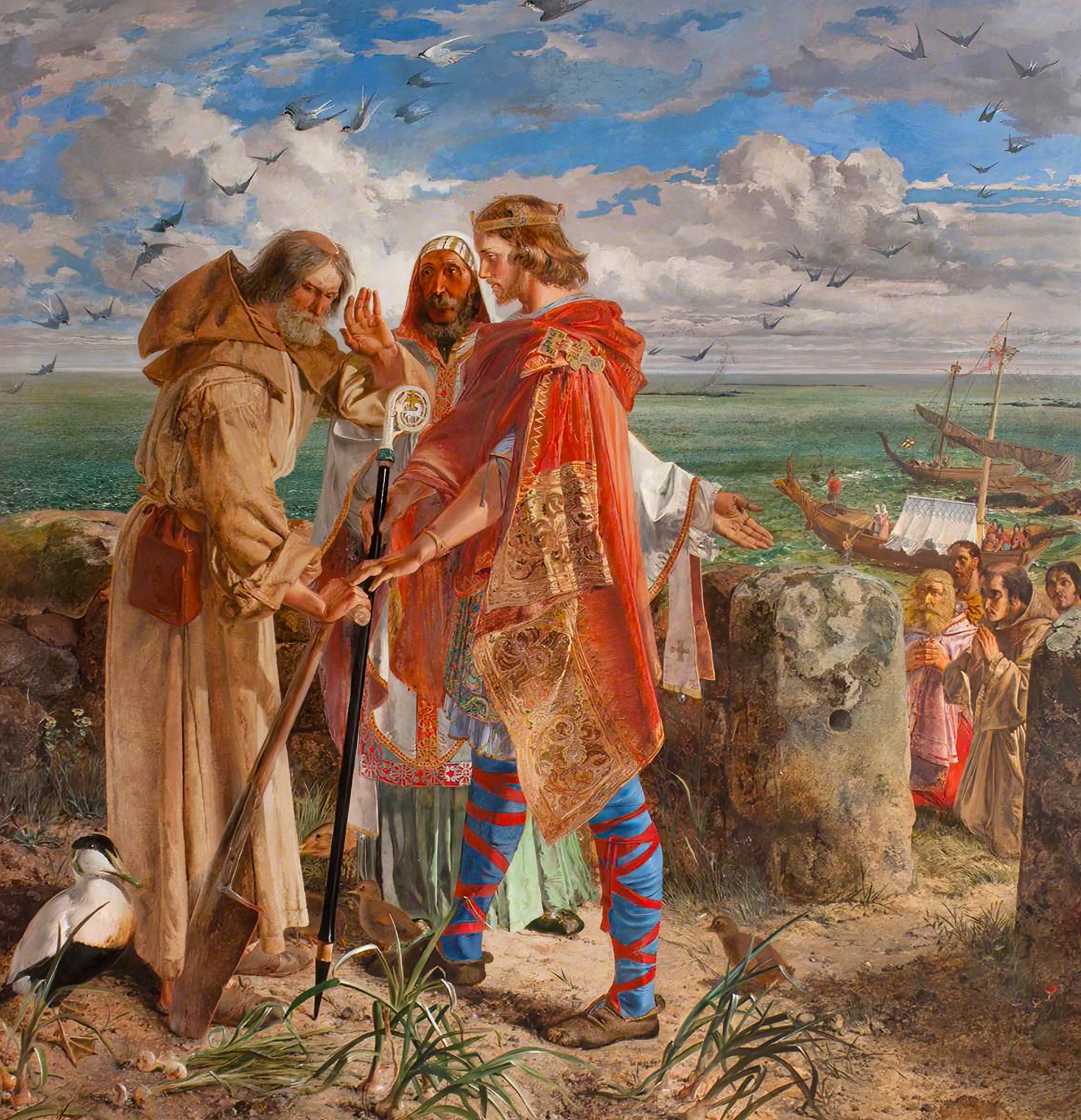
King Egfrid and Bishop Trumwine visit Inner Farne to persuade a reluctant Cuthbert to be made Bishop. (William Bell Scott, 1856)

Cuthbert spent nine years as a hermit, but in 685 the King of Northumbria and the Archbishop of Canterbury, hoping that this renowned holy man could help heal the divisive rivalries in the English Church, elected him to be the bishop of Hexham. The thought of leaving his “hiding place” on Farne made him sad, but when a distinguished delegation visited his hermitage to seek his consent, he yielded to the call. At least he managed to swap dioceses with another bishop, granting him oversight of his own beloved Lindisfarne. Whatever he lost in returning to the active life, it was not his soul. His anonymous biographer assures us that “he maintained the dignity of a bishop without abandoning the ideal of a monk.” [xii]

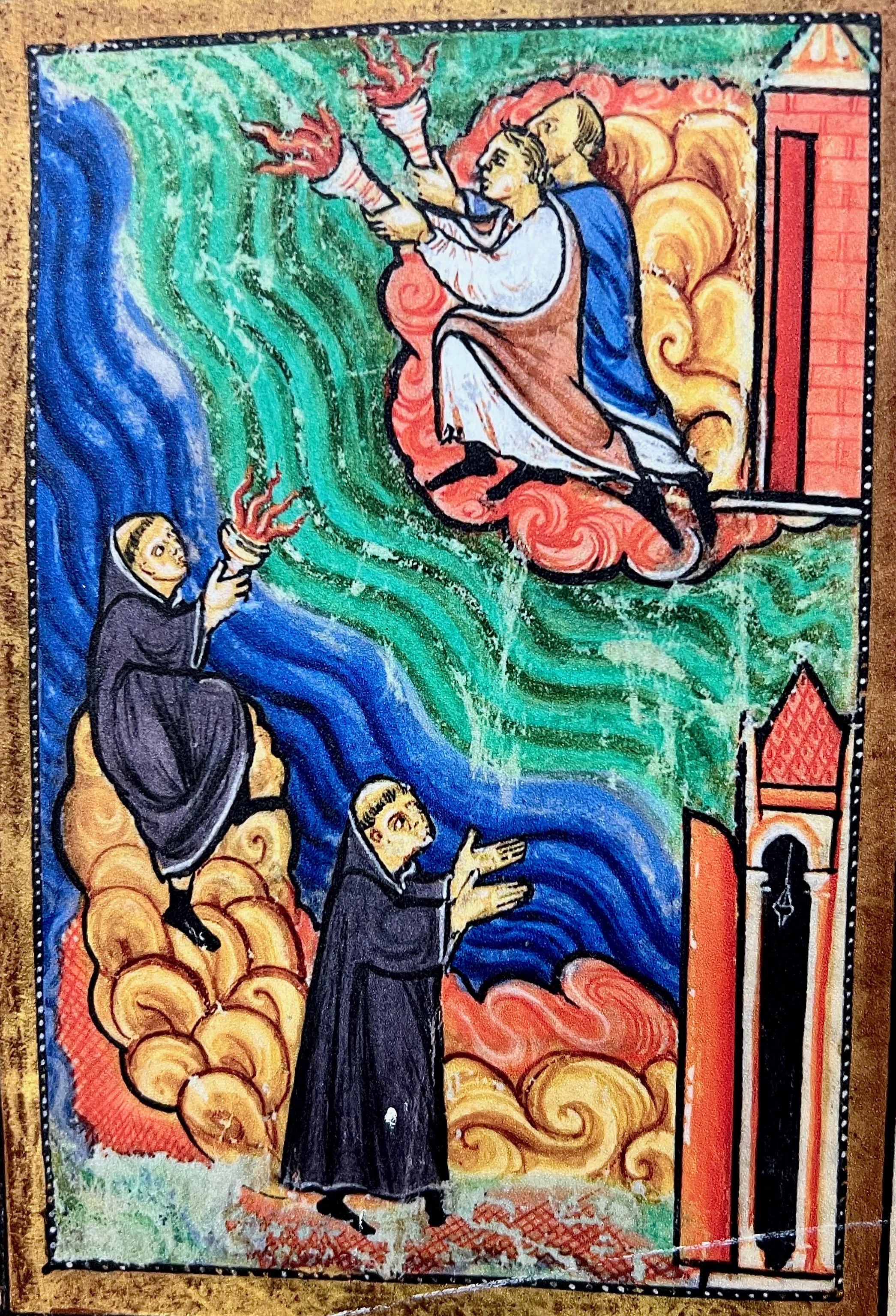
Two years later his health began to fail. At 51, he knew his days were numbered. He resigned his episcopate just after Christmas 686, then returned to his hermitage to die amidst the sound of seabirds, seals and crashing waves. He departed this life two weeks before Easter 687. The monks keeping vigil at his deathbed lit torches to signal his brothers at Lindisfarne that he had fallen asleep in Christ. His body was returned to the Priory for burial.
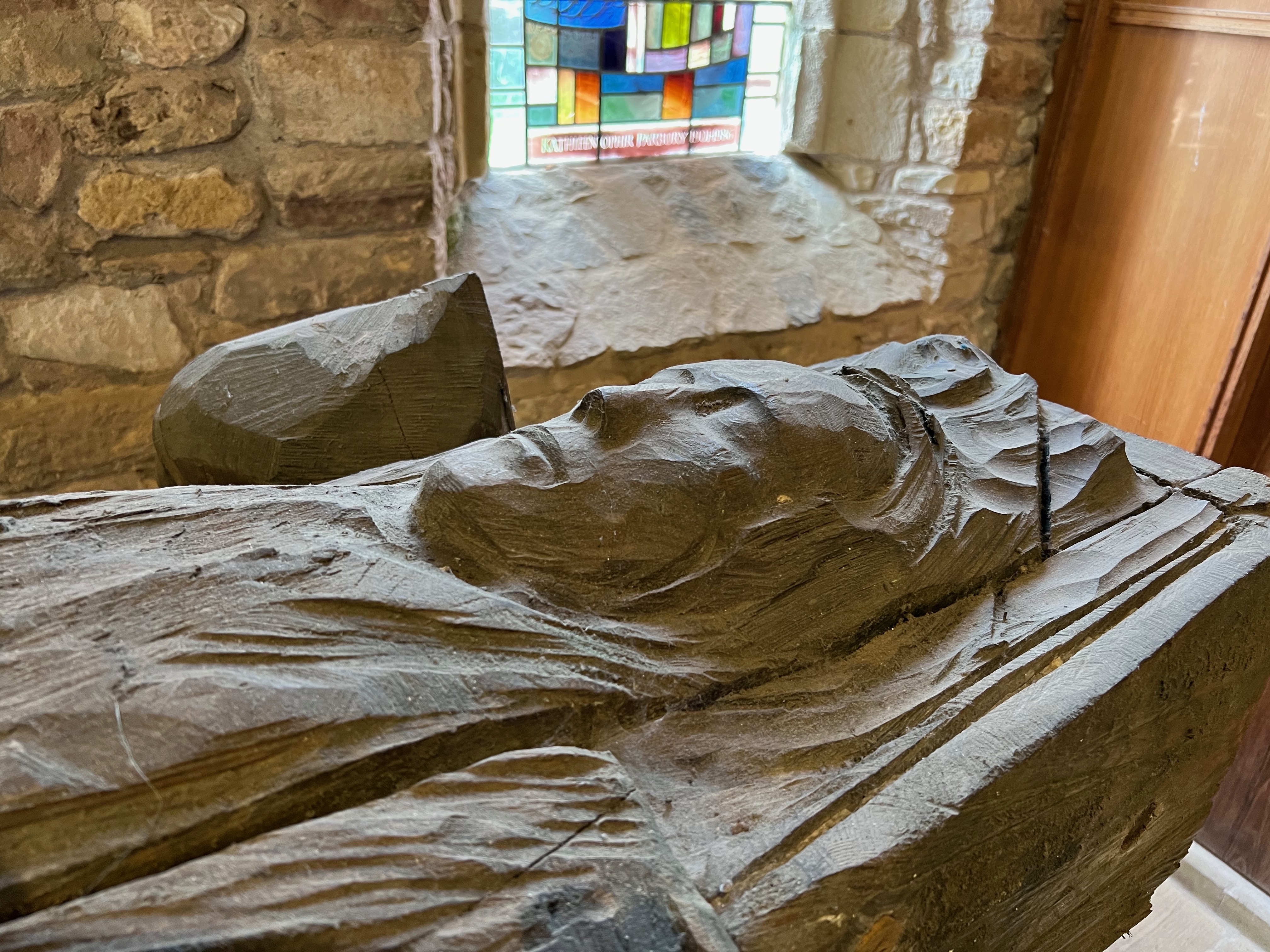
Cuthbert, who fell asleep in Christ in 687, is movingly depicted in Fenwick Lawson’s The Journey, which has been in St. Mary’s church since 2005.
In an illustration for Bede’s Life of St. Cuthbert, monks on Inner Farne use torches to signal news of the saint’s death to their brothers at Lindisfarne.

I wasn’t able to visit Inner Farne. Landings were suspended by an outbreak of Avian Flu. But the peace of Holy Island itself was blessing enough. Once the daytrippers flee back to the mainland before the tide returns, a profound calm settles in. It seemed almost deserted during the afternoons. In my days there, I sank into the solitude of grassy dunes, rambled through fields of spring color, enjoyed the tuneful chants of countless birds. Perhaps there was more Wordsworth than Cuthbert in the pleasure I took here—I suffered no rigorous austerities—but I hope that my bodily appreciation of Holy Island did honor to the saint’s own love for this place.
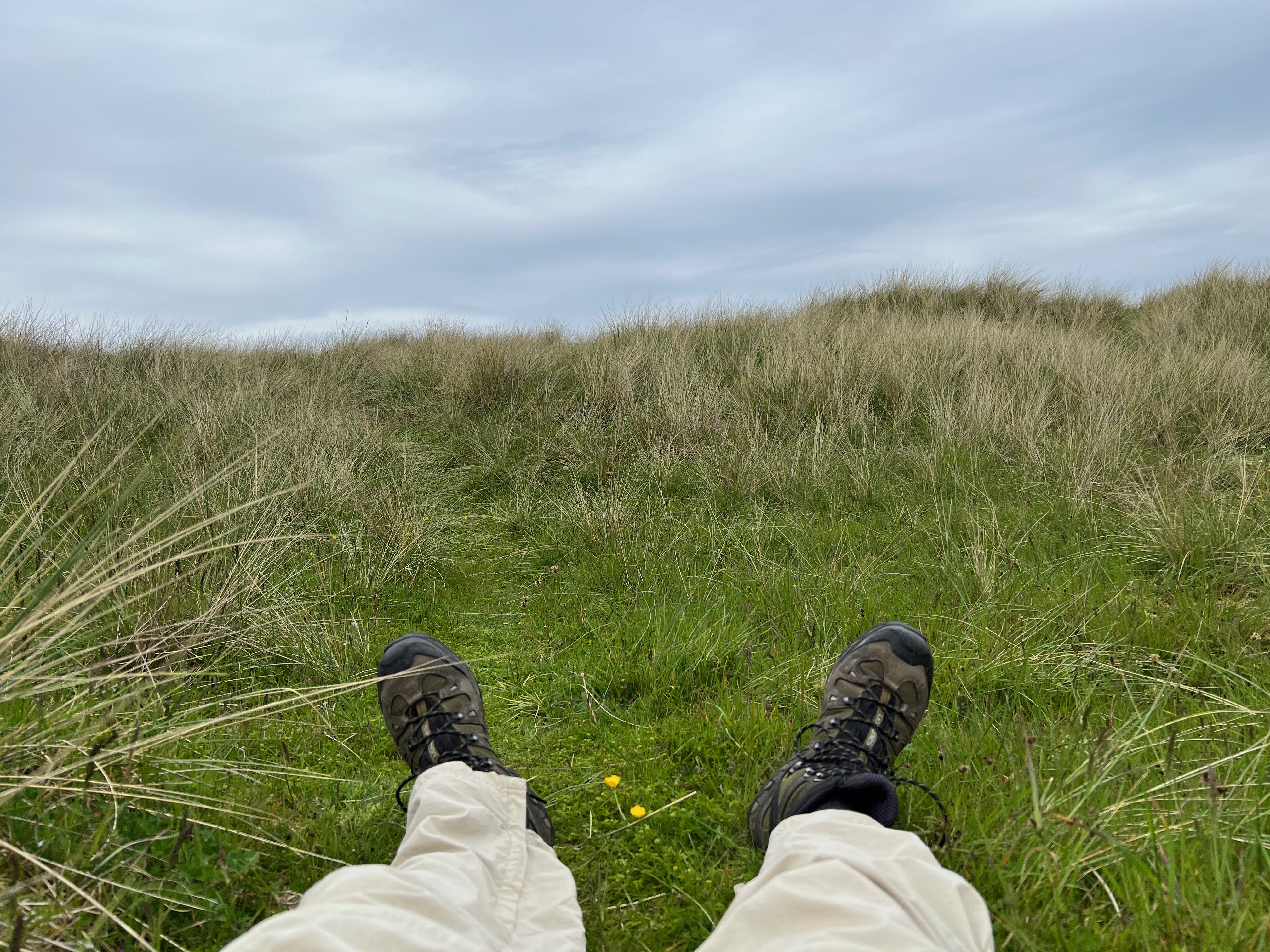
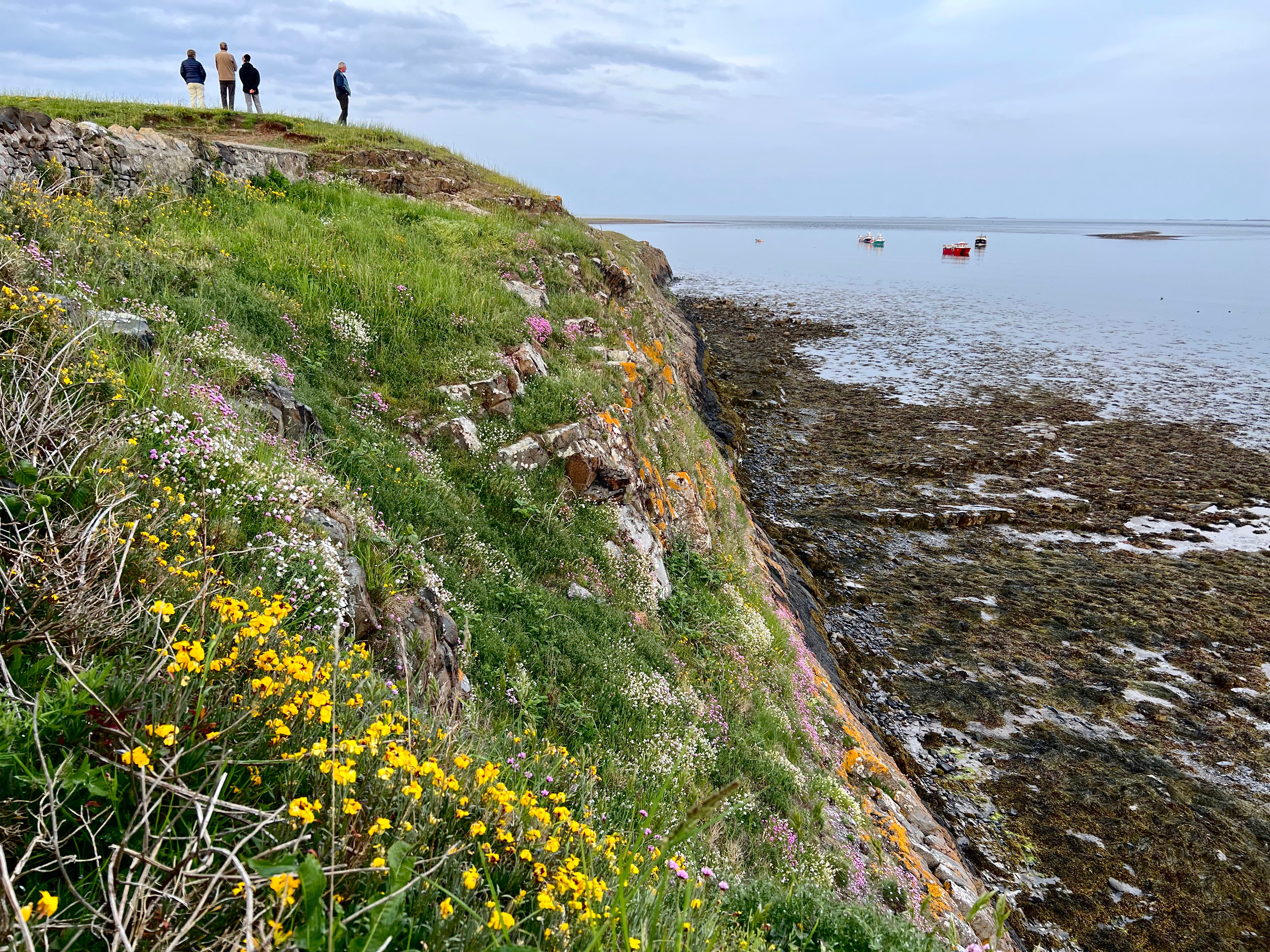
The grassy dunes of Holy Island are a refuge from the clamor of the world. If you lie down in a hollow, neither wind nor wave breaks the profound silence.
The elevated Heugh (“hee-uff”) between the Priory and the sea was formed from magma 295 million years ago. The thin soil developed on the hard whinstone grassland hosts an exceptional variety of wildflowers.
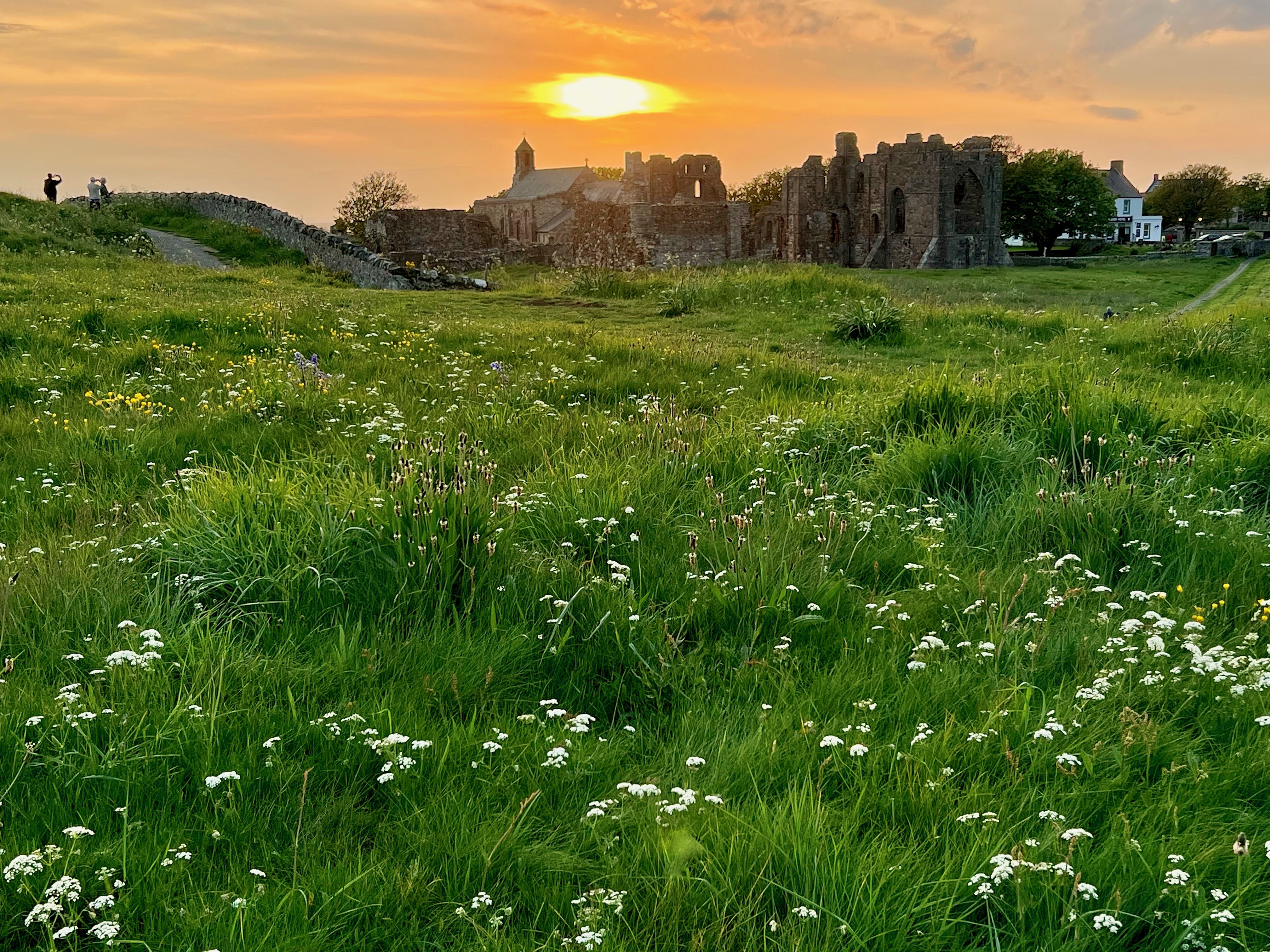
Vespers at Lindisfarne. “Now as we come to the setting of the sun, and our eyes behold the vesper light, we sing your praises, O God.”

Holy Island is a busy hub for migratory flights between Britain, Scandinavia, southern Europe, even the Arctic and Africa. Some 337 different avian species have been identified here. The following audio was recorded around the site of Lindisfarne Priory in the early evening. If you want to spend two and a half minutes on Holy Island, close your eyes and listen.

Birds of Holy Island.

According to medieval custom, the remains of saints would be exhumed ten to twenty years after their death, so that their bones could be washed, wrapped reverently in silk or linen, and placed in a shrine for veneration. 
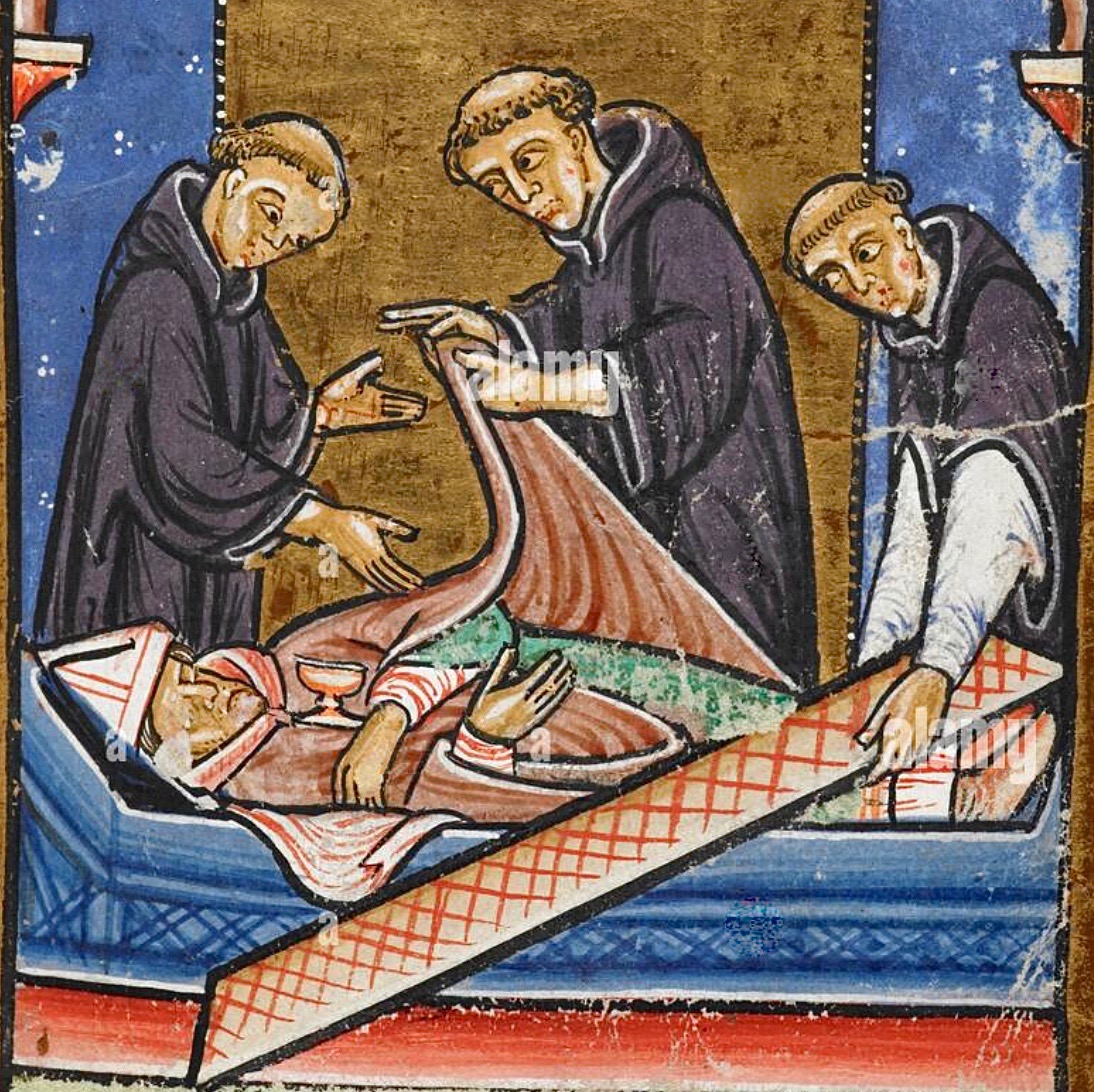
When the monks of Lindisfarne opened Cuthbert’s coffin 11 years after his death to wash his bones, they were astonished to find his body still intact (12th-century illustration for Bede’s Life of St. Cuthbert).

But when the monks of Lindisfarne opened Cuthbert’s coffin in 698, they found his body “uncorrupted” and still intact. When news of this wonder spread, the stream of pilgrims grew to a flood. Sadly, Cuthbert’s body would not rest in peace here for long. Not on a defenseless coastline in the age of the Vikings.
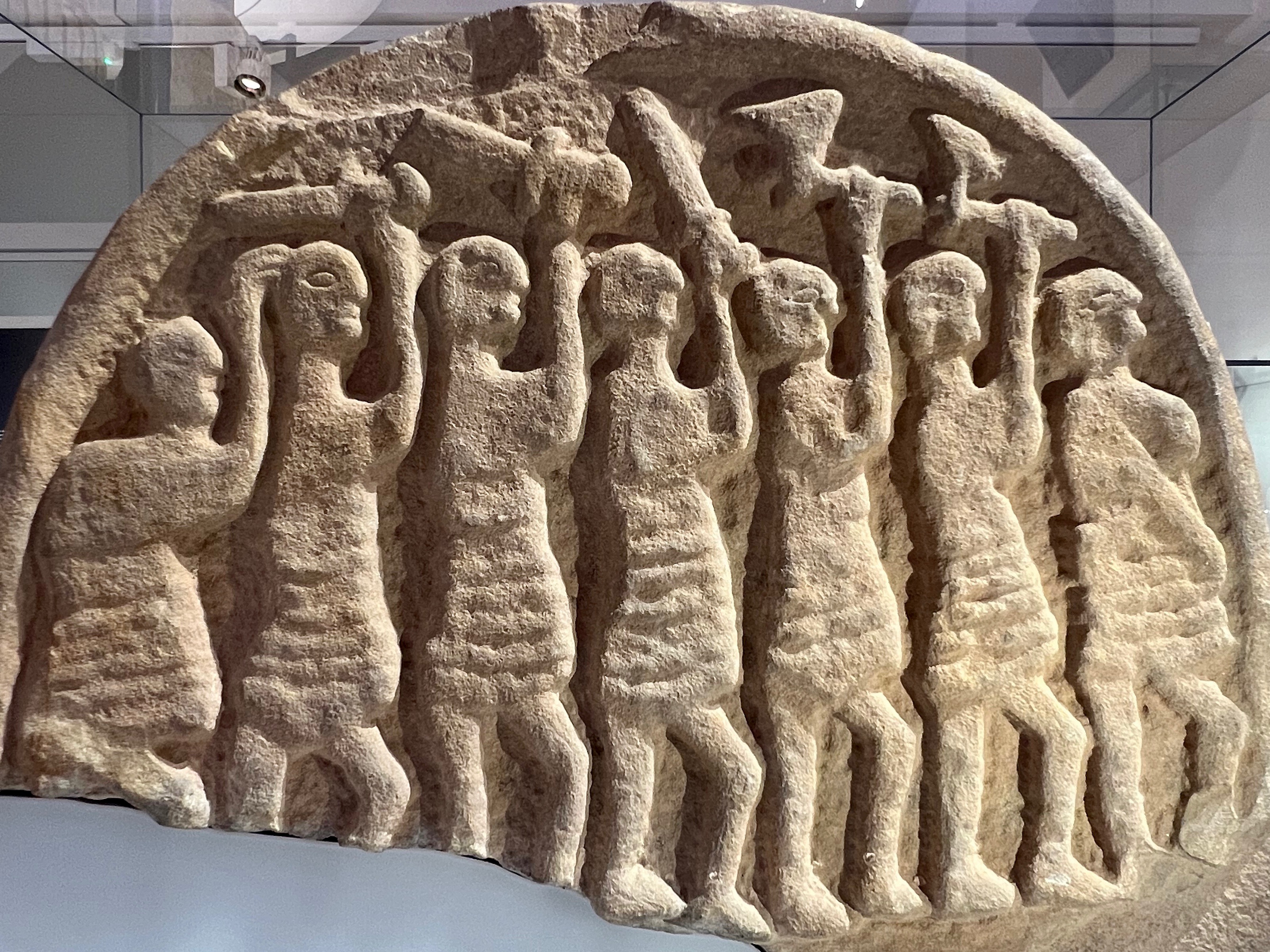
This 9th-century “Judgment Day” stone found at Lindisfarne is thought to commemorate the Viking raids, when “heathen men miserably destroyed God’s church at Lindisfarne with plunder and slaughter.”

In 793, the peace of Lindisfarne was shattered when Viking marauders sacked the Priory. Remarkably, Cuthbert’s shrine survived the damage. Eighty years later, there was a second raid. It was even worse.

“And they came to the church of Lindisfarne and laid everything waste with grievous plundering, trampled the Holy Places with polluted feet, dug up the altars and seized all the treasures of the Holy Church. They killed some of the brothers, they took some of them away in fetters, many they drove out naked and loaded with insults and some they drowned in the sea …” [xiii]

It was the end of an era for Lindisfarne, but Cuthbert’s own story had one more chapter. Just before the second Viking invasion, the saint made his getaway from Holy Island when a small band of brothers lifted his wooden coffin from the Priory shrine and carried it across the tidal flats to the mainland. Thus began two centuries of wandering in exile for Cuthbert’s remains, until he finally came to rest in the newly built cathedral at Durham in 1104. 
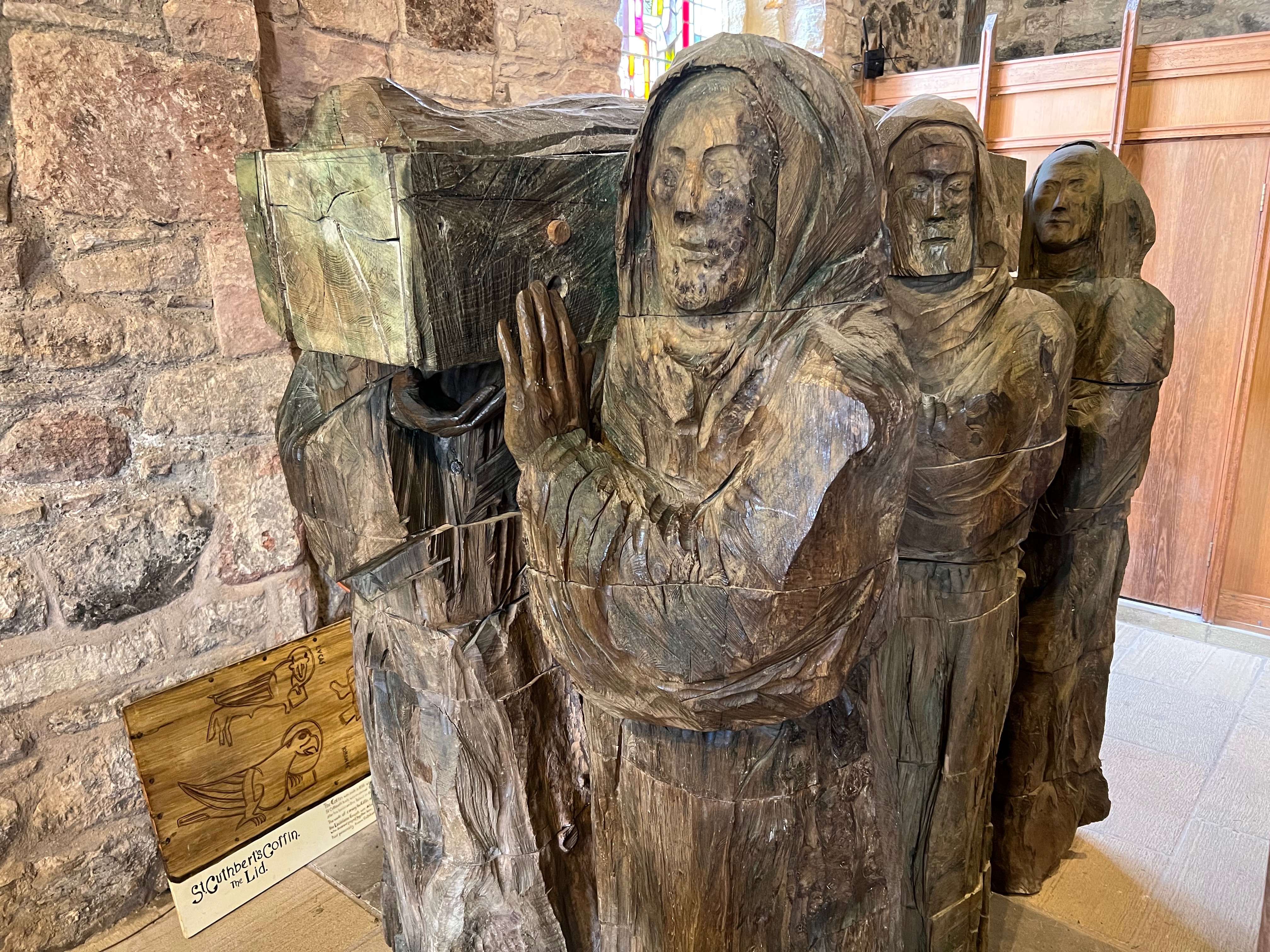
The Journey (Fenwick Lawson, 1999, now in St. Mary’s church).
Monks carry Cuthbert’s coffin away from Holy Island to protect it from Viking raiders.

On my third morning at Holy Island, I rose early to cross back over the sands. My own wandering was not yet done. I would follow the saint to Durham. 

The path I walk, Christ walks it. 
May the land in which I am be without sorrow.
May the Trinity protect me wherever I stay…
May bright angels walk with me — dear presence — in every dealing…
May every path before me be smooth. 
Well does the fair Lord show us a course, a path. [xiv]

Crossing the Holy Island Sands to the mainland.

THE ST. CUTHBERT SERIES CONCLUDES:

The Journey Ends: Durham Cathedral

Photographs, videos and nature recordings are by the author.

“For All the Saints” is sung by the choir and congregation of St. Barnabas Episcopal Church, Bainbridge Island, Washington, with Paul Roy on organ.

The first installment of this pilgrimage account, Walking St. Cuthbert’s Way, may be found at https://jimfriedrich.com/2023/07/28/walking-st-cuthberts-way/

For more on James Turrell: https://jimfriedrich.com/2015/08/06/the-woven-light-reflections-on-the-transfiguration/


[i] The line is from Derek Walcott’s poem, “Love After Love.”

[ii] Buechner’s fine novel is about a 12th century hermit saint in the north of England. It made excellent reading on St. Cuthbert’s Way.

[iii] #128 in The Sacred Harp, with lyrics by Samuel Stennet (1787).

[iv] Bede, Life of St. Cuthbert, 22, quoted in Mary Low, St. Cuthbert’s Way: A Pilgrim’s Companion (Glasgow: Wild Goose Publications, 2019). The great historian of early English Christianity is a key source for Cuthbert’s life. Born 14 years before the saint’s death, he was able to interview some who had known Cuthbert in life when he wrote his biography. 

[v] Bede’s Life of Cuthbert, quoted in Philip Nixon, St. Cuthbert of Durham (Gloucestershire: Amberly Publishing, 2012), 33.

[vi] Isabel Colgate, A Pelican in the Wilderness: Hermits, Solitaries and Recluses (New York: Counterpoint, 2002), 104. The Cambrai Homily (7th or 8th century) is the earliest known Irish homily. The “green” martyrdom refers to rigorous ascetic practice not requiring either a pilgrimage journey or a complete disconnection from the world. The Irish word glas may be translated as blue as well as green, perhaps referring to turning blue after praying the Psalter all night in a cold river, or developing a sickly complexion from too much austerity.

[vii] In a Penguin anthology of Celtic writings I had years ago. 

[viii] James Turrell, quoted in Jan Butterfield, The Art of Light and Space (New York: Abbeville Press, 1993), 73.

[ix] E. C. Krupp, writing about Turrell in James Turrell: A Retrospective (Los Angeles: County Museum of Art, 2013), 246.

[x] Frederick Buechner, Godric (New York: Harper One, 1980), 142.

[xi] Anonymous Life of Cuthbert, 3.7, quoted in Low, 47. 

[xii] Anonymous Life, quoted in Nixon, 47.

[xiii] Simeon of Durham (d. circa 1129) was an English chronicler and monk at Durham Priory. Quoted in Nixon, 59.

[xiv] Ireland, 6th century.
Walking St. Cuthbert’s Way

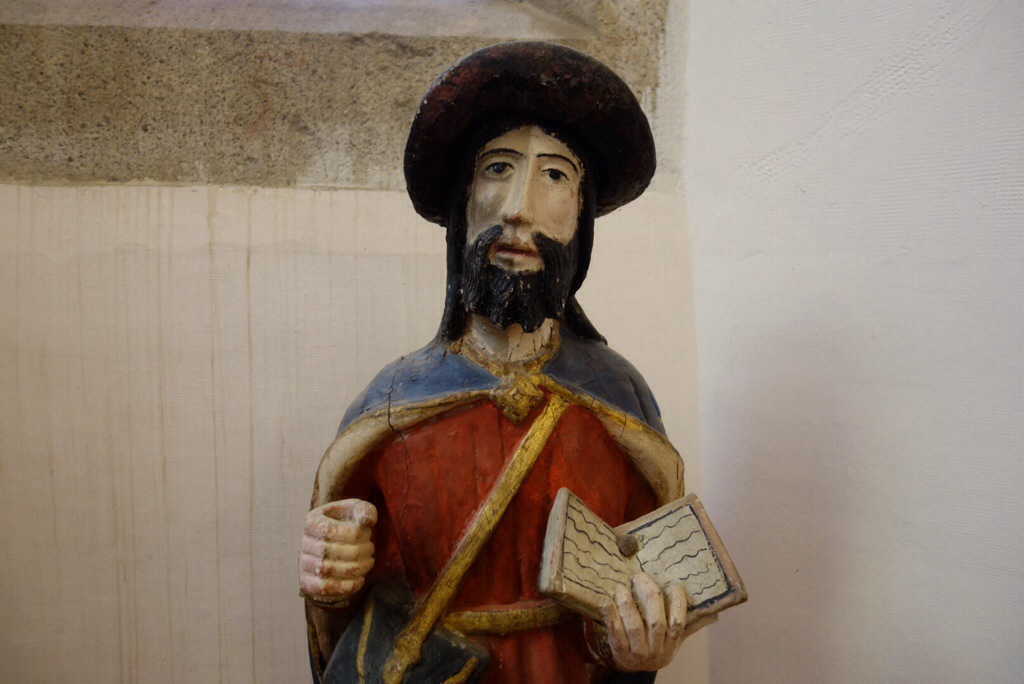
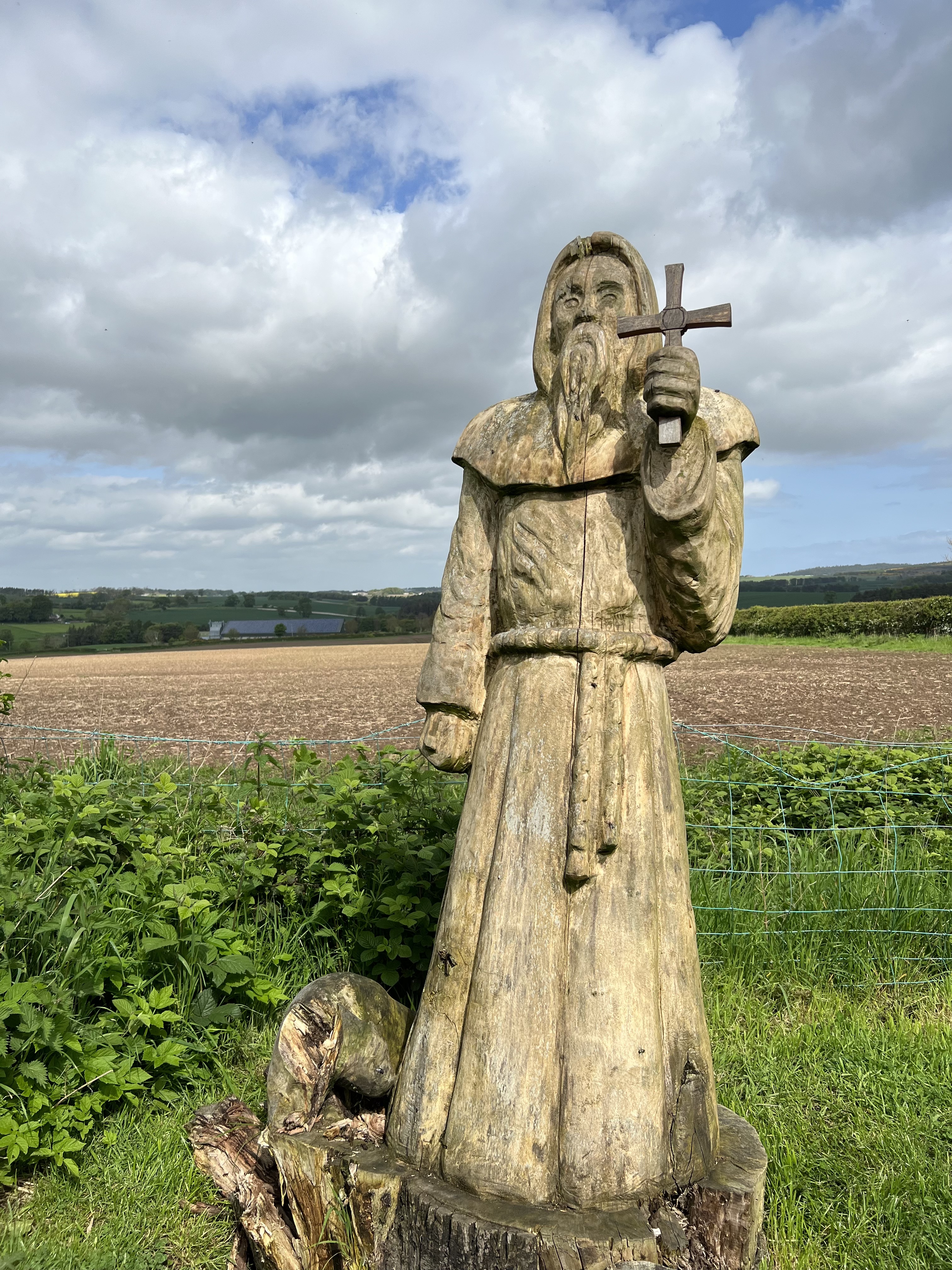
St. Cuthbert, by local sculptor Tom Fiddes (2017), blesses the wayworn traveler. The saint stands opposite a country house offering shade and water to weary pilgrims.

They confessed their sins, confided in him about their temptations, and laid open to him the common troubles of humanity they were laboring under … Spirits that were chilled with sadness he could warm back to hope again … Those beset with worry he brought back to thoughts of the joys of heaven. (The Venerable Bede, Life of Cuthbert)

Nine years ago I walked the 500-mile Camino de Santiago to the shrine of St. James. This spring I made another pilgrimage, 100-kilometers along St. Cuthbert’s Way in the north of Britain. I haven’t managed to write about it since returning home, but when this week’s Feast of St. James (July 25) brought to mind that 2014 Camino (when I first began this blog), I knew it was high time to tell my new pilgrim’s tale.  

Chaucer began his celebrated pilgrimage narrative with an eloquent praise of springtime as an awakening: not only of the dormant earth, but also of the soul’s longing for transformative journeys. After three years of staying close to home in pandemic hibernation, the call of the road felt especially urgent. 

Then people think of holy pilgrimages,
Pilgrims dream of setting foot on far-off
Lands, or worship at distant shrines, their thoughts
Reaching for grace …[i]

Some pilgrimages have no map or known destination; they are undertaken with the conviction—or at least the hope—that the act of wandering far from the familiar, along the way of unknowing, will lead to what Dark Age monks called “the place of resurrection,” where an illumination might be given or a purpose revealed. 

Another kind of pilgrimage takes a well-worn route to a specific destination such as Jerusalem, Rome, or Santiago, the most popular destinations in the Middle Ages. Both the journey and the arrival are still full of unknowns—hardships, obstacles, surprises, chance meetings, moments of grace—but their ultimate location and length are determined in advance. Both kinds of pilgrimage involve some combination of leaving behind (penance), letting go (trust), receptivity (grace), and spiritual desire (love).

My pilgrimage in May, from the Scottish Borders south of Edinburgh to Holy Island off the Northumbrian coast, traced a line across the varied landscapes of Cuthbert’s holy life. It was a popular route for two centuries after the saint’s death in 687, until the threat of Viking plunderers prompted the removal of Cuthbert’s remains from Holy Island to a safer inland site. And Cuthbert’s own travels, mostly on foot, would have ranged widely over the same terrain. 

In response to the contemporary revival of pilgrimage as a spiritual practice, St. Cuthbert’s Way, with plentiful waymarks and well-tended paths, was created in 1996. Although passing through occasional towns and villages, it offers abundant solitude and beautiful countryside both pastoral and wild. Before I left, a friend who knew the trail said, “I hope you like sheep.”

Cuthbert’s birth in 634 coincided with a turning point British religion, when King Oswald took control of Northumbria and initiated the conversion of the pagan north to Christianity by importing Celtic missionaries from Iona. Although Cuthbert’s family was Anglo-Saxon, he would be shaped by the distinctive Celtic way—earthier, more idiosyncratic, less tightly organized and less hierarchical than the universalizing Roman system which would assert its dominance in British Christianity within Cuthbert’s lifetime.

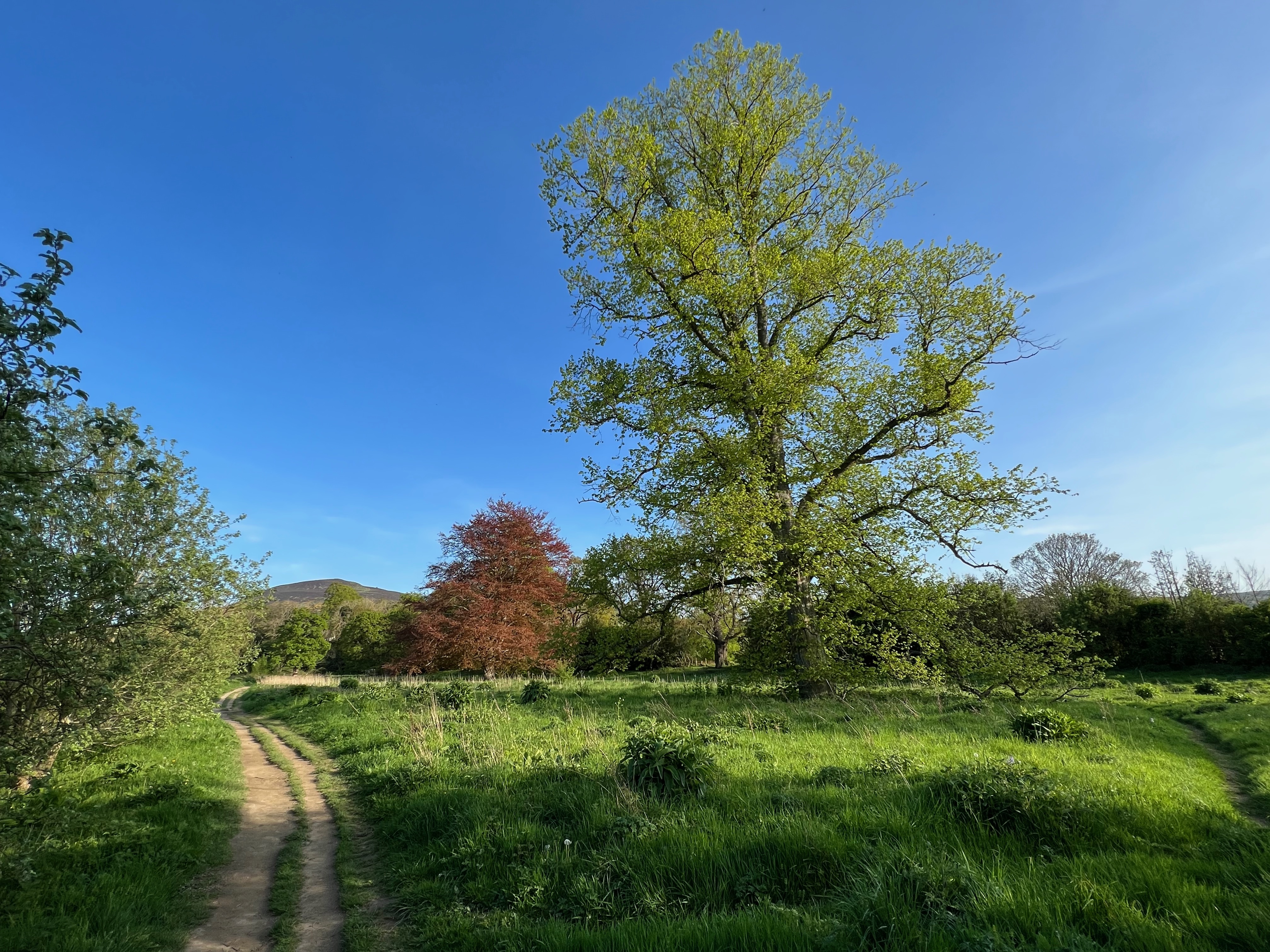
My walk began along this riverside trail from the train station into Melrose. Someone had offered me a ride in their car, but look what I would have missed! Even as a bishop, Cuthbert chose the humility of walking over the luxury of horseback, so I started my pilgrimage in the same spirit.

My pilgrimage began in Melrose, Scotland, where the River Tweed courses through the fields and hills of Cuthbert’s youth. Even as a boy he had a deeply religious sensibility. His biographers spoke of angels and miracles being part of his growing years.  Whatever we ourselves may think about the facts behind those stories, they suggest a spirit alive to ineffable encounters with the transcendent. One night, while keeping watch over a flock of sheep, the sixteen-year-old Cuthbert had a vision of a dazzling light streaming down from above as angelic hosts descended to fetch a single mortal into heaven. When the vision faded, he woke his sleeping companions to tell them what they had missed. He was convinced that some holy person must have died that night. 

The very next day, he learned that Aidan, the beloved Celtic bishop who spurred the conversion of Northumbria, had departed this life at the time of his vision. I might dismiss this tale as pious embellishment, had I not had my own dream, at age 30, of a close friend at the very moment of his tragic death. In the dream, he had moved to an island off the coast. I asked him if he were all right. He looked me in the eye and assured me he was. The dream came to me deep in a mountain wilderness. Only when I returned to the world two days later did I learn of his death by less mysterious means. Because of that profound experience, I must say that Cuthbert’s vision rings true for me.

Cuthbert’s experience prompted a decision which had been long in the making: to enter the monastic life and devote his heart and soul to prayer and service. He was soon welcomed into the community of monks near present-day Melrose. He would eventually become their prior, a role he would later assume on Holy Island. His first monastery’s seventh-century wooden structures on a grassy bend in the River Tweed are long gone, but the impressive ruins of the twelfth-century Cistercian abbey made a fitting place to begin my pilgrimage on St. Cuthbert’s Way. 

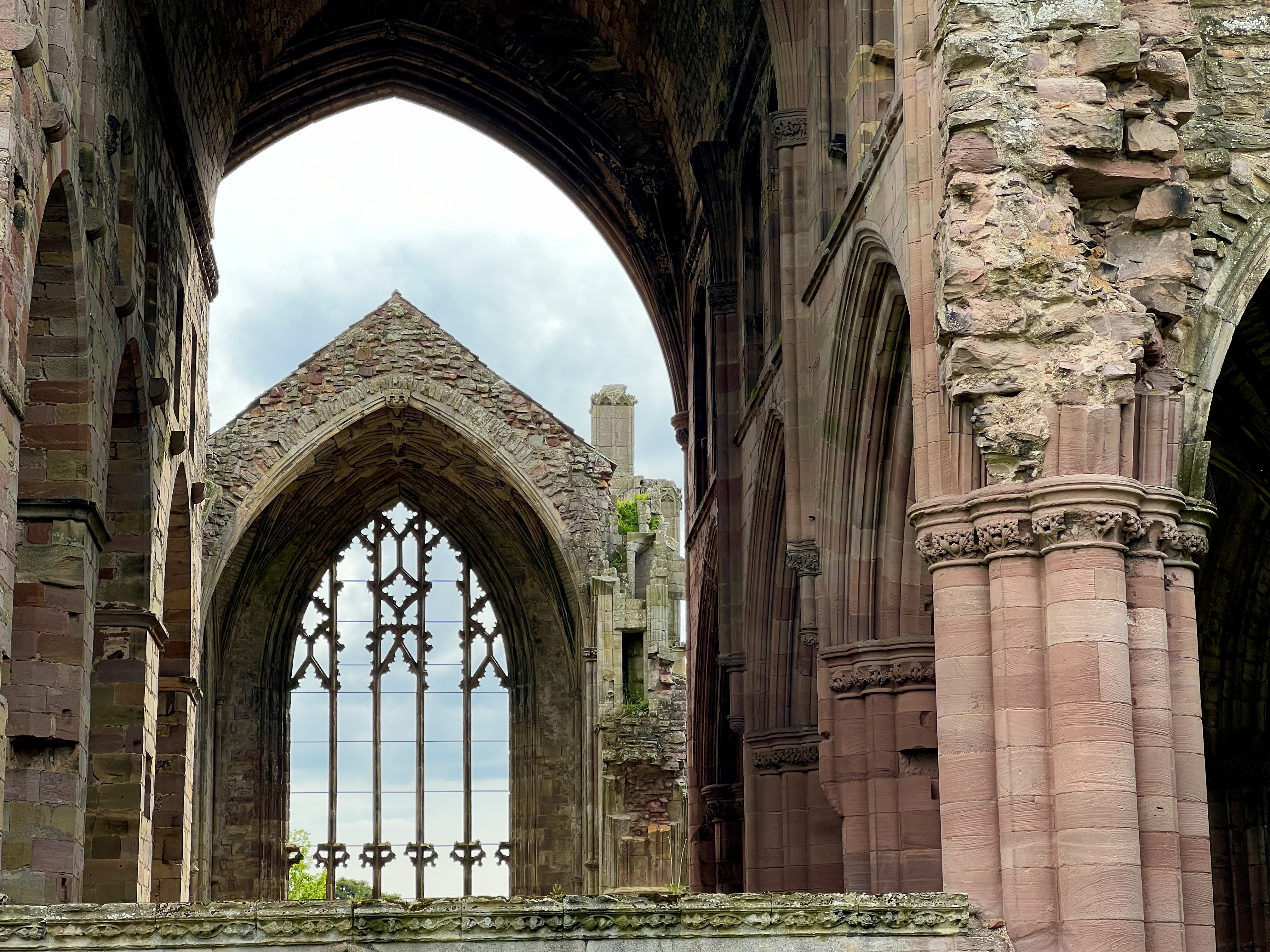
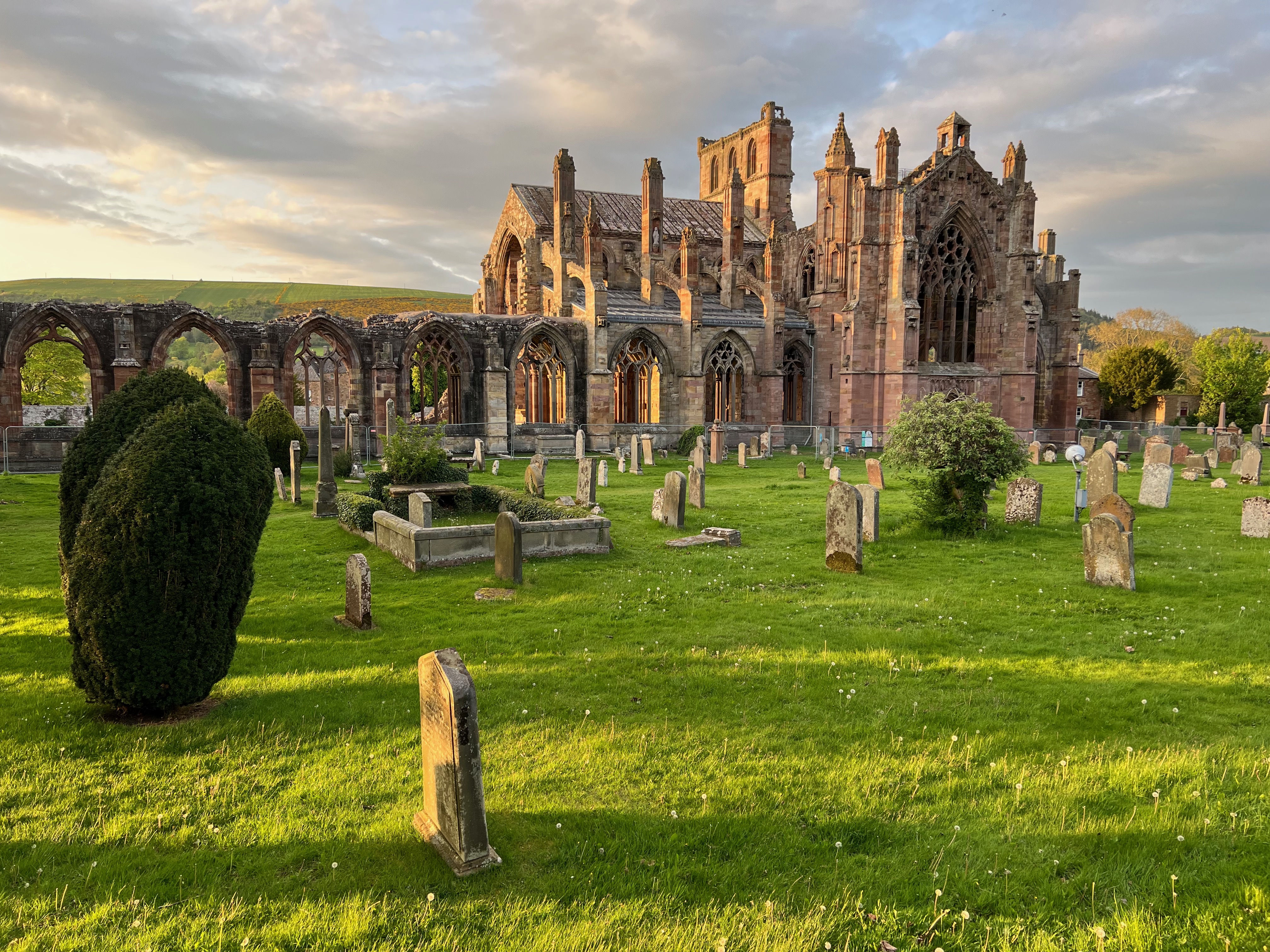
Melrose Abbey, founded by Cistercians from Rievaulx, Yorkshire, in 1136.
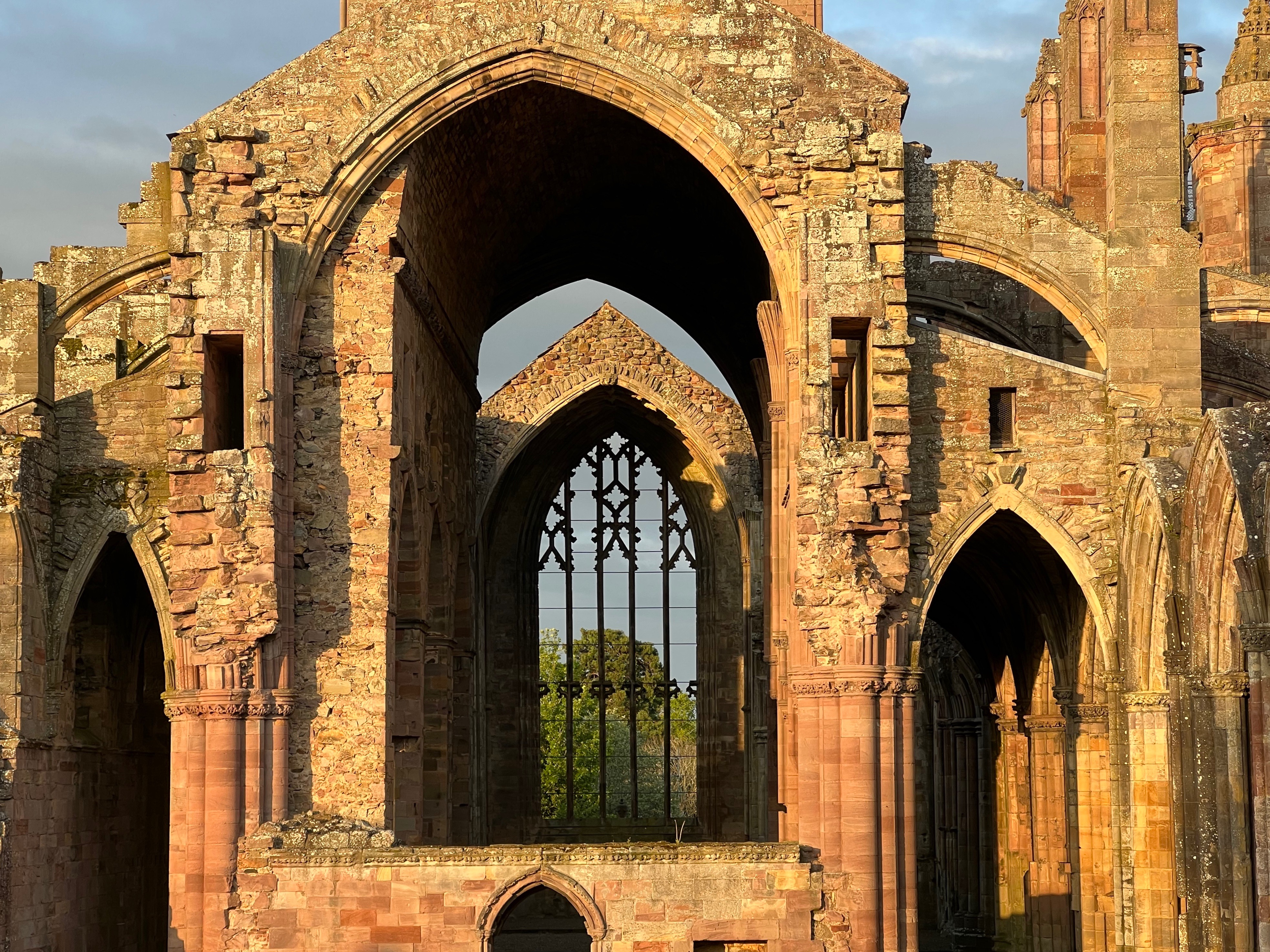
Melrose Abbey at sunset.
“My soul is like a house … It is in ruins, but I ask Thee to remake it.” — St. Augustine, City of God

Melrose Abbey was founded in the 12th century, and at its height there were a hundred monks, who wielded great influence in the Scottish Borders. But like the other Borders abbeys (Dryburgh, Jedburgh, and Kelso), the building suffered greatly in the conflicts between England and Scotland. Richard II (14th century), Henry VIII (16th century), and Oliver Cromwell (17th century) all had a hand in its destruction. The Reformation and modernity finished off its religious life, leaving only the beautiful ruins to testify to what had been. As Susan Stewart writes, “Ruined places are often haunted, and learning to read them involves managing encounters with their resident spirits.” [ii]

I was there on the Sixth Sunday of Easter. After eucharist at the local parish, I visited the abbey under the muted light of a graying sky. In the evening I went back for another look. As I arrived, the setting sun suddenly pierced the clouds to bathe the stones in gold. Pulling up my digital Book of Common Prayer, I sang Compline, adding my voice to the echoes of vanished monks. “The Lord grant us a peaceful night and a perfect end.…” By the time I was done, the gold had faded to dusk.

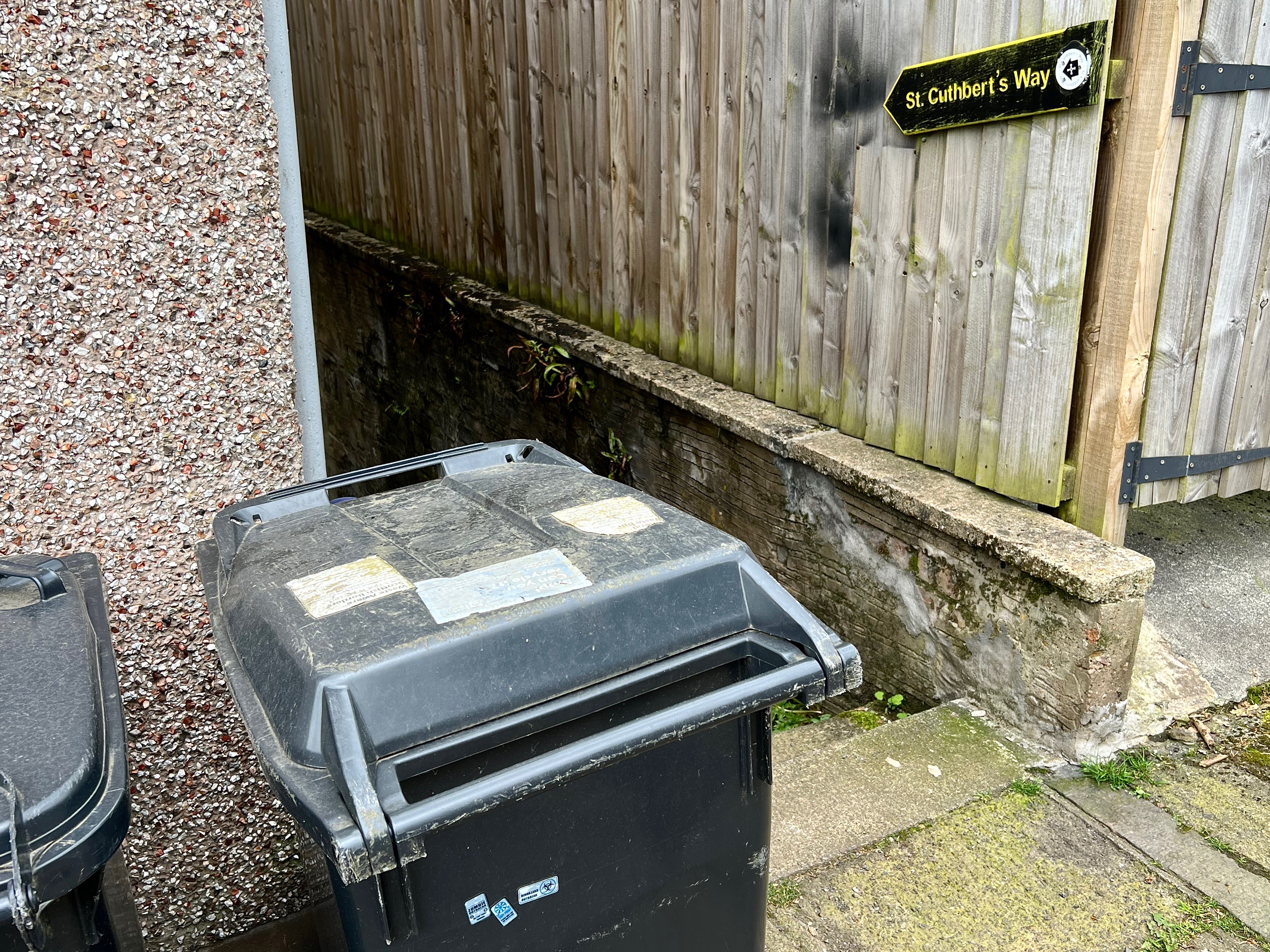
The obscure trailhead leading out of town gave no hint of the glories ahead.

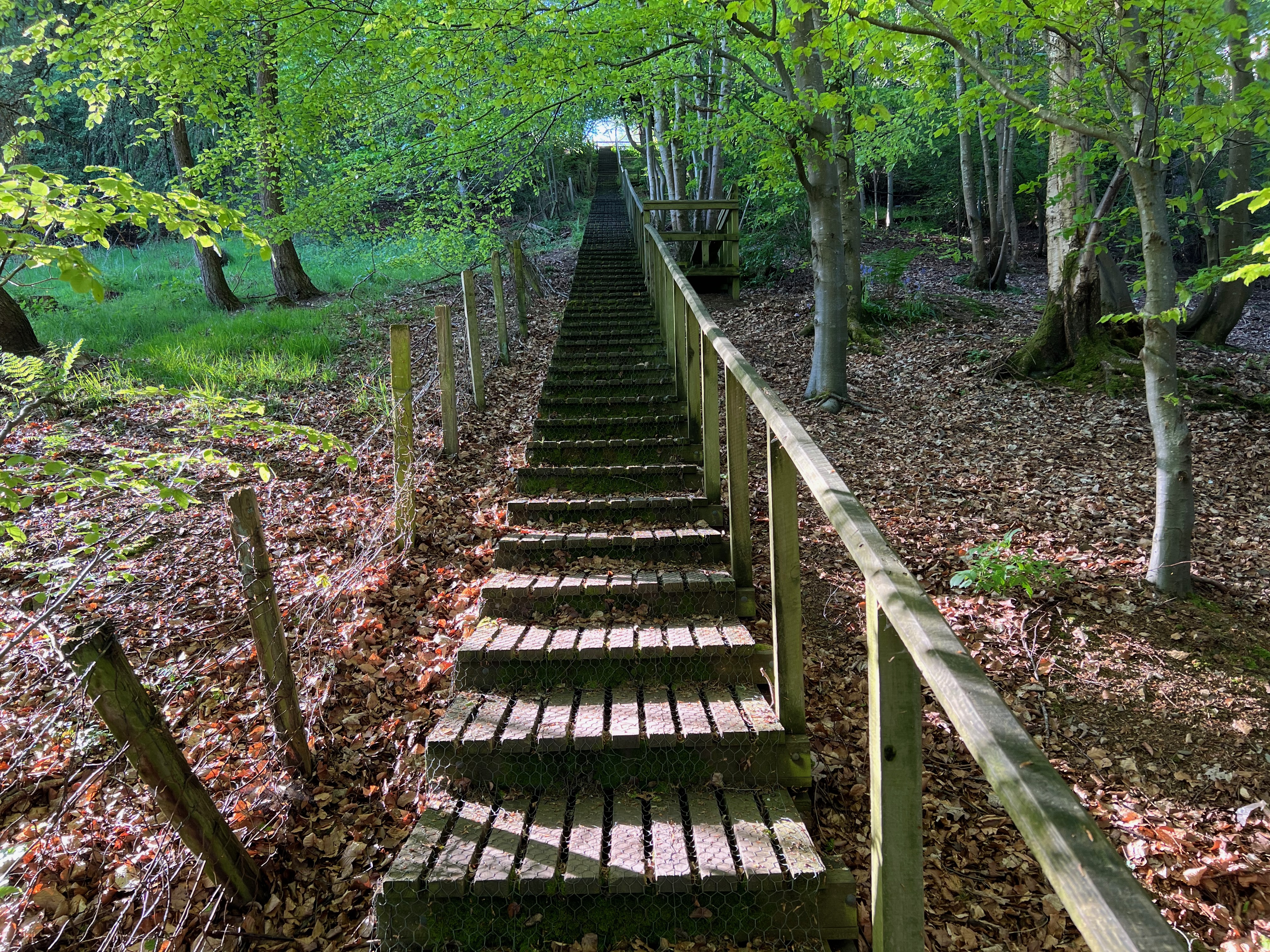
When I found this nondescript passage from a Melrose street to St. Cuthbert’s Way, it did not seem inviting. The White Rabbit came to mind—how curious a plunge!—and Dante, for whom the way down was the only way up. Before the pilgrim poet can ascend to Paradise, he is driven “down to where the sun is silent.” [iii] Thankfully, my descent into darkness was brief, and I soon found myself climbing toward the light.

Stairway to heaven.
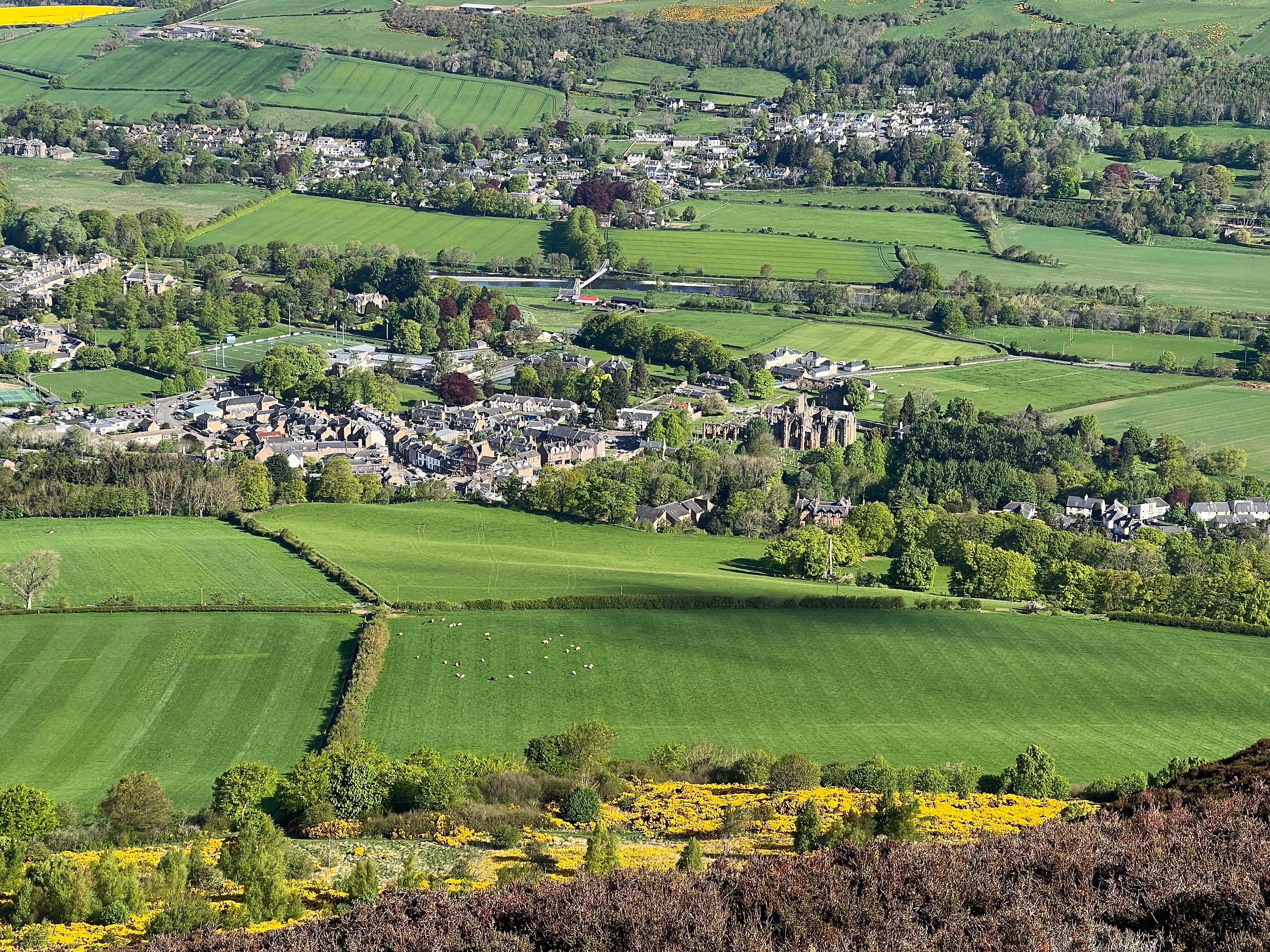
On a bright morning, I climbed up from Melrose to traverse the Eildon Hills. The abbey can be seen at the right edge of the town.
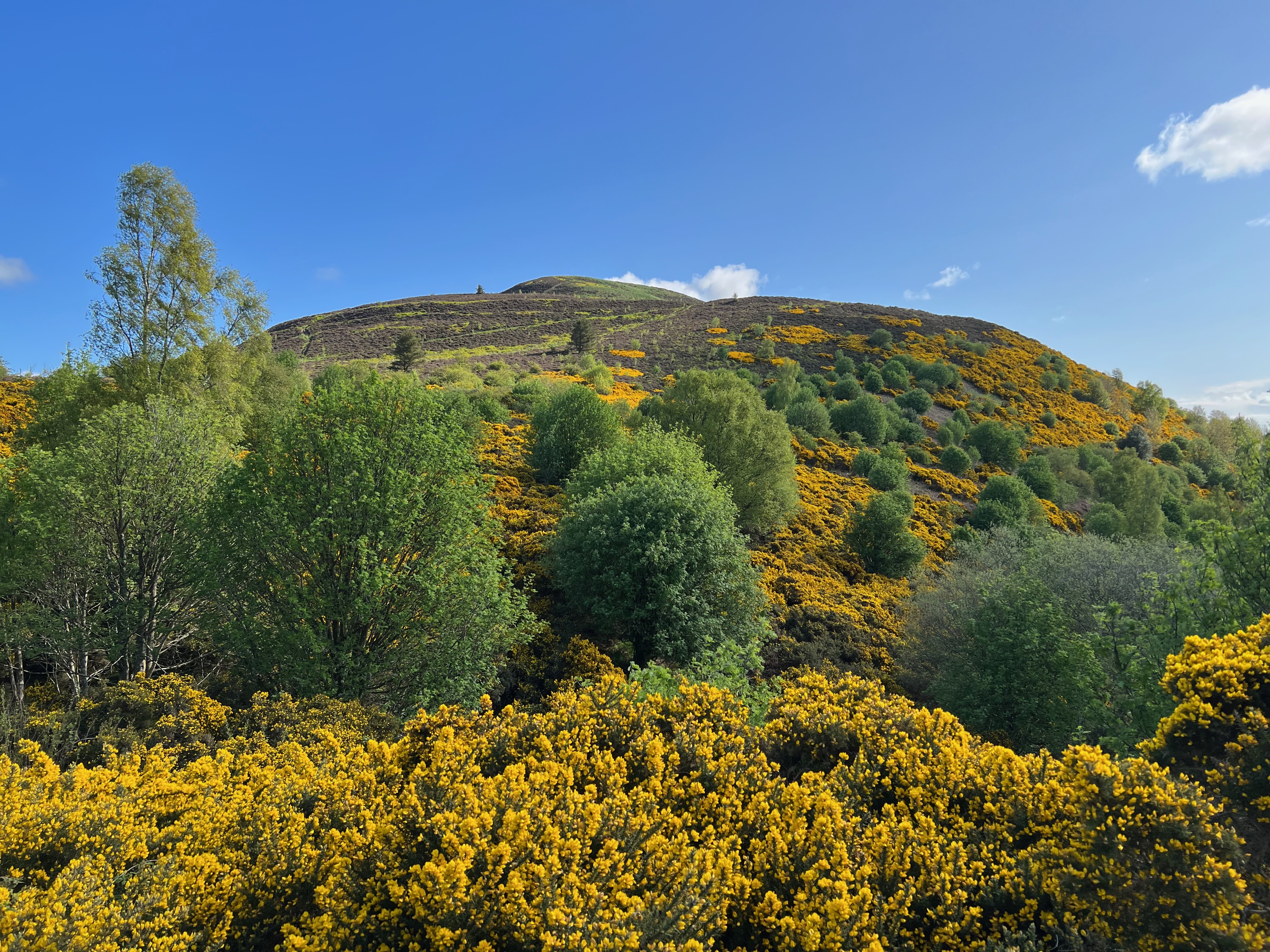
Eildon Hill North, seen from the saddle.

The Eildon Hills, a trio of rounded summits, dominate the surrounding landscape. From the saddle, I scrambled up the North Hill, a sacred ceremonial site in the Bronze Age. The Romans, before their inevitable retreat from the barbarous north, used it as a watchtower. King Arthur was said to be buried here. In the 12thcentury, monks quarried stones for Melrose Abbey on its slopes. Even into the modern era, local legends populated these hills with fairies and imagined a gateway to the Otherworld beneath them. For me the Eildons were an imposing portal to pilgrimage.

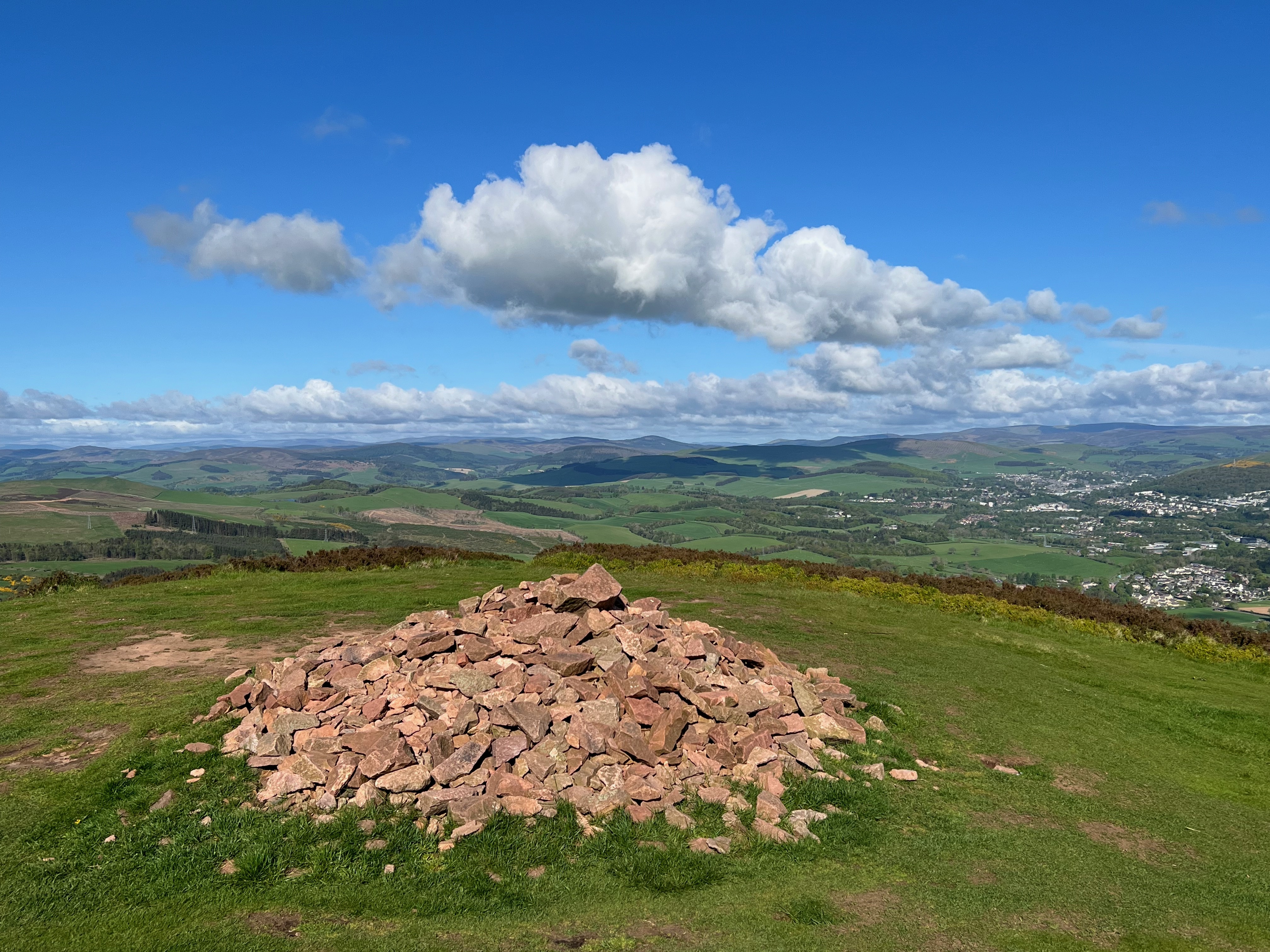
A cairn on the summit of Eildon Hill North. This has been a sacred “thin place” since pre-Christian times.
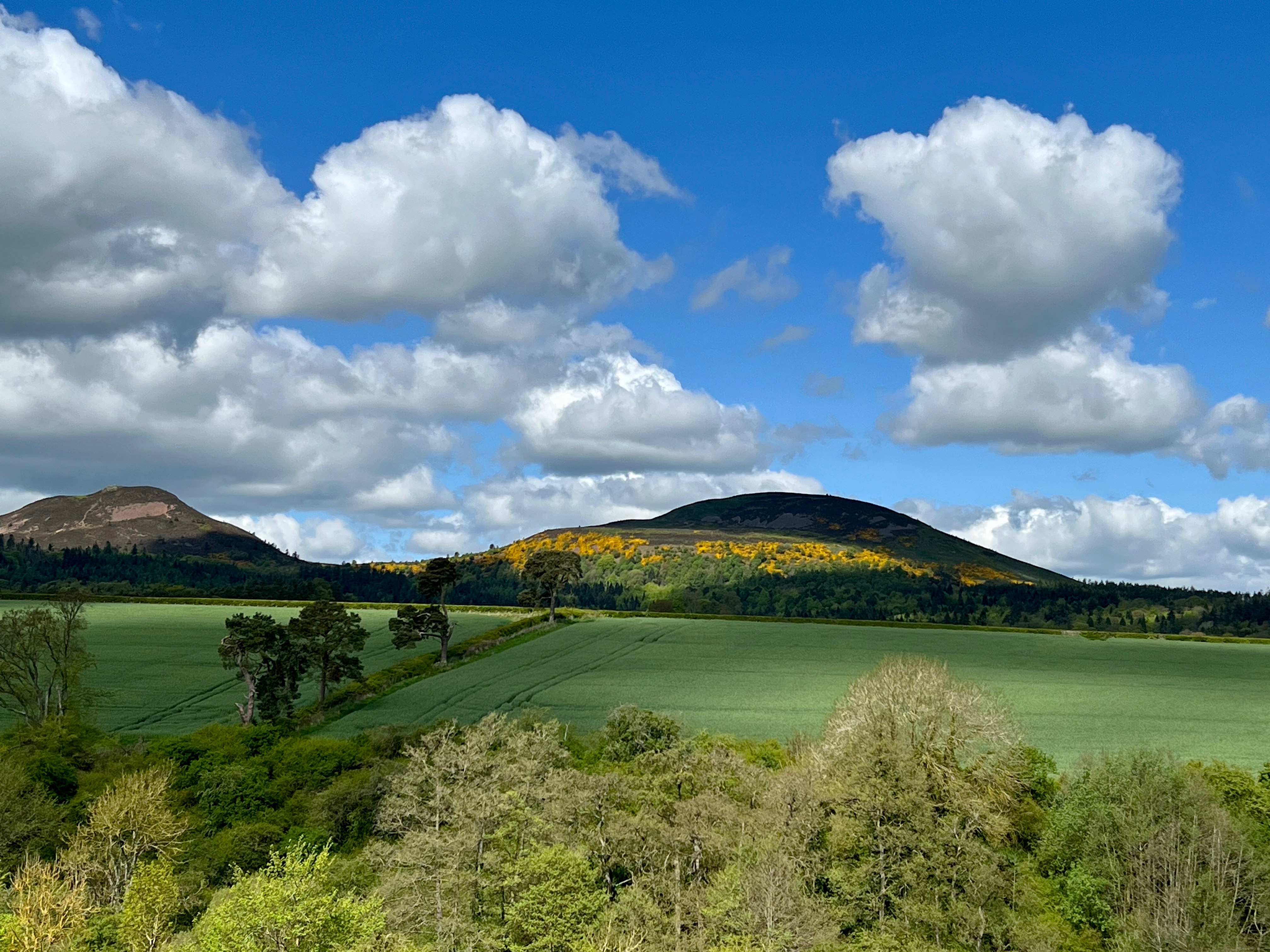
The Eildon Hills seen from the southeast. I had crossed the low saddle when I left Melrose. These distinctive peaks would remain visible for the next two days, until I passed the halfway point at 31 miles.
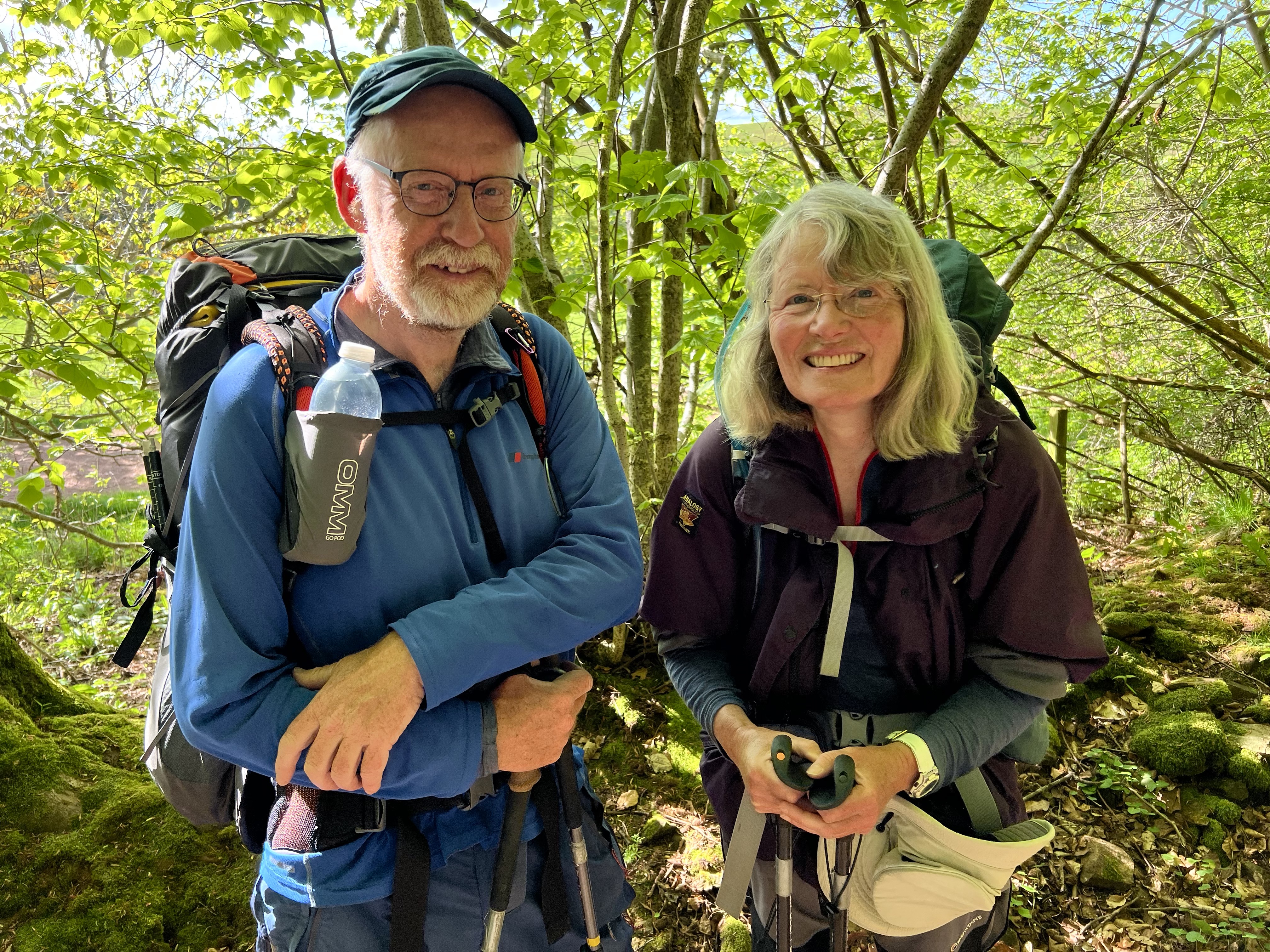
David and Julie, whom I met on my first day, were on their way to the Firth of Forth to complete a thousand-mile trek across the length and breadth of Britain.
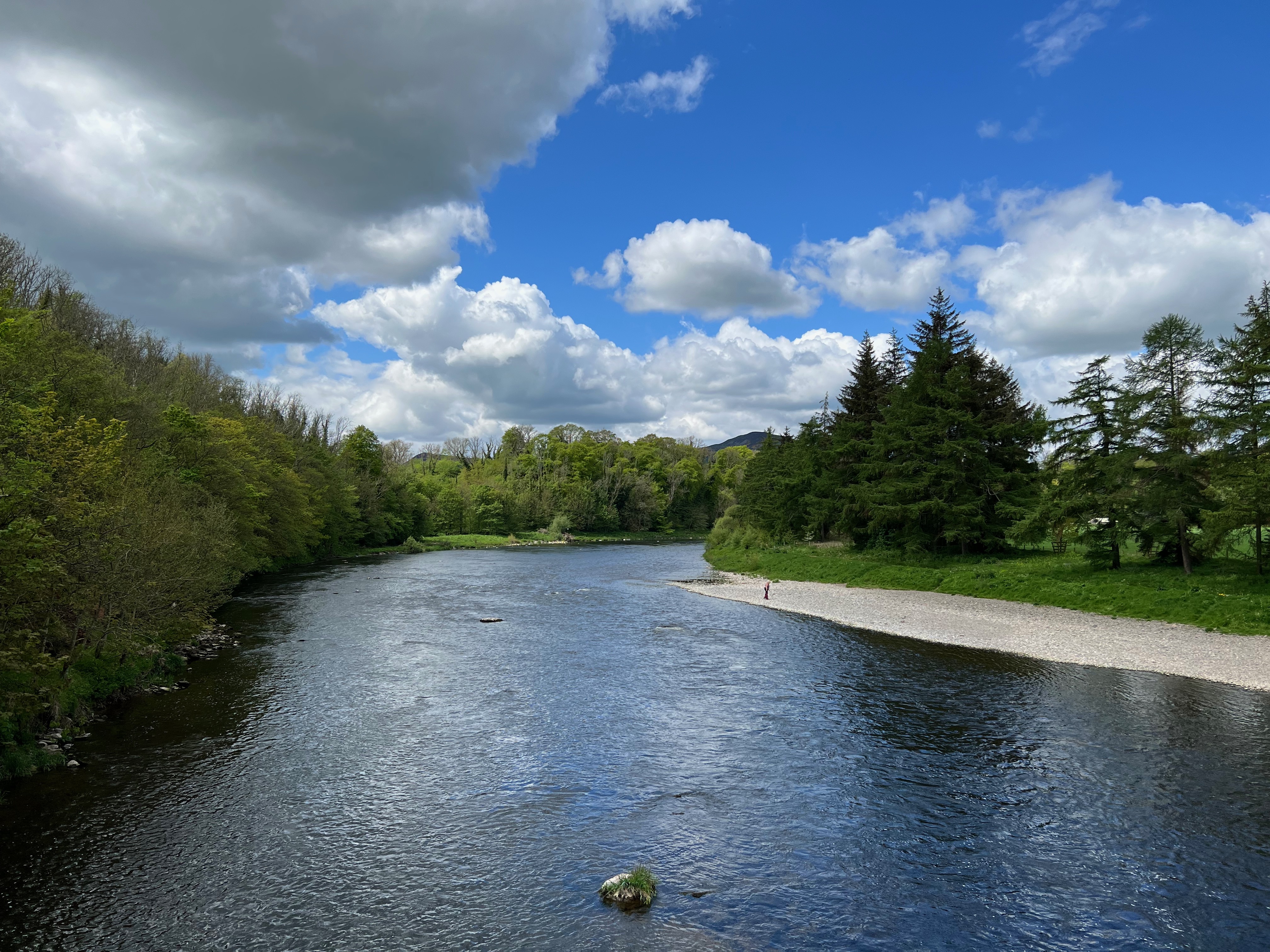
Constable, the supreme painter of clouds, said that the sky is “the chief organ of sentiment,” but rivers also touch us deeply. The River Tweed runs for 97 miles through the border country of Scotland and England. Two miles upriver from here was the site of Cuthbert’s Melrose monastery.

It would be a six-day walk to Holy Island, mostly in splendid weather—not a drop of rain, Constable skies, and only one day without sun. I felt a Wordworthian exhilaration as the road went ever on.

The earth is all before me. With a heart 
Joyous, nor scared at its own liberty,
I look about, and should the chosen guide 
Be nothing better than a wandering cloud, 
I cannot miss my way. I breathe again! [iv]

“I wandered lonely as a cloud.” — Wordsworth
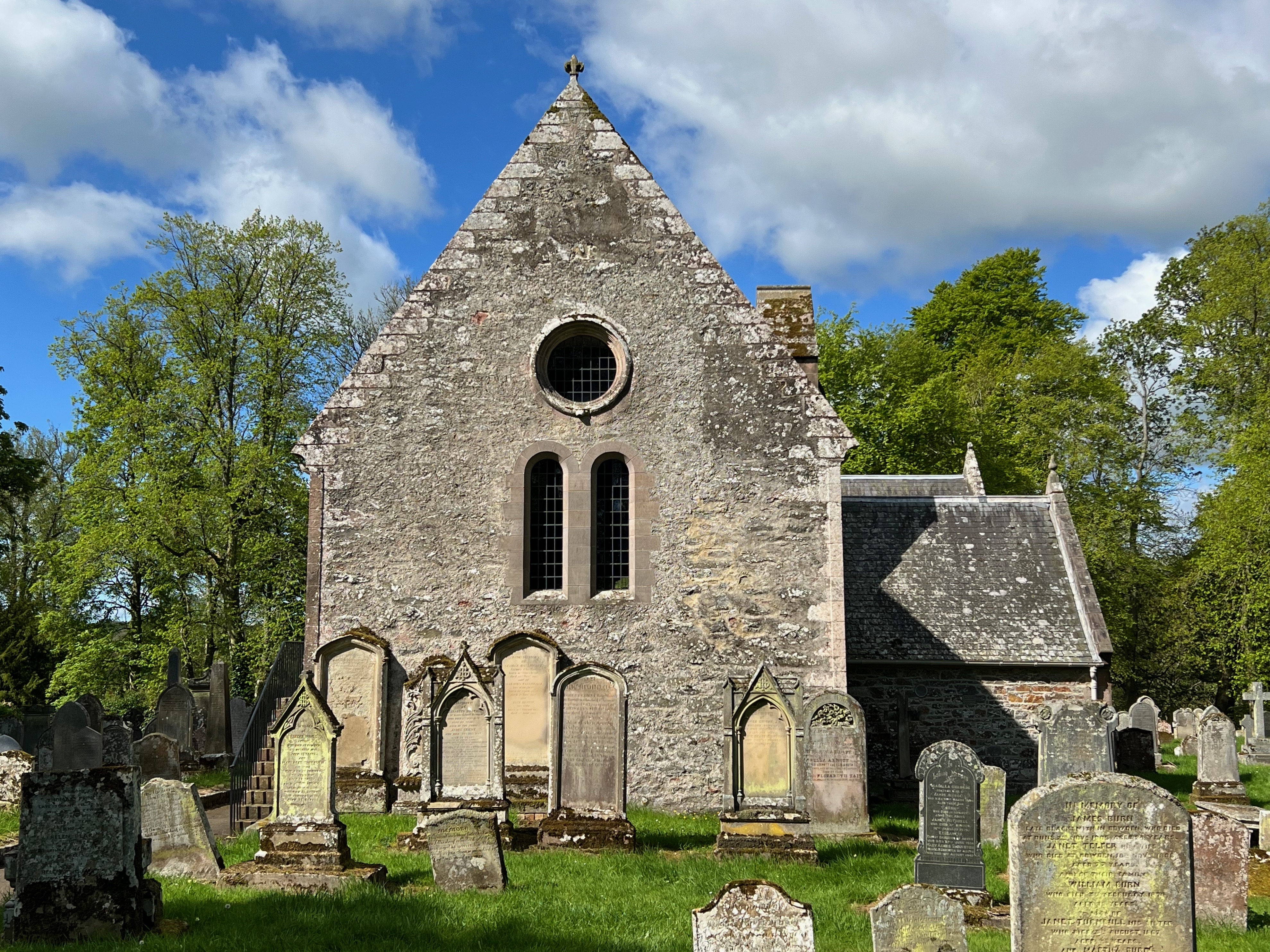
Portions of Bowden Kirk date back to the 12th century, but there have been major changes and additions over subsequent centuries. Originally Cistercian, it has been Protestant since the 16th century.
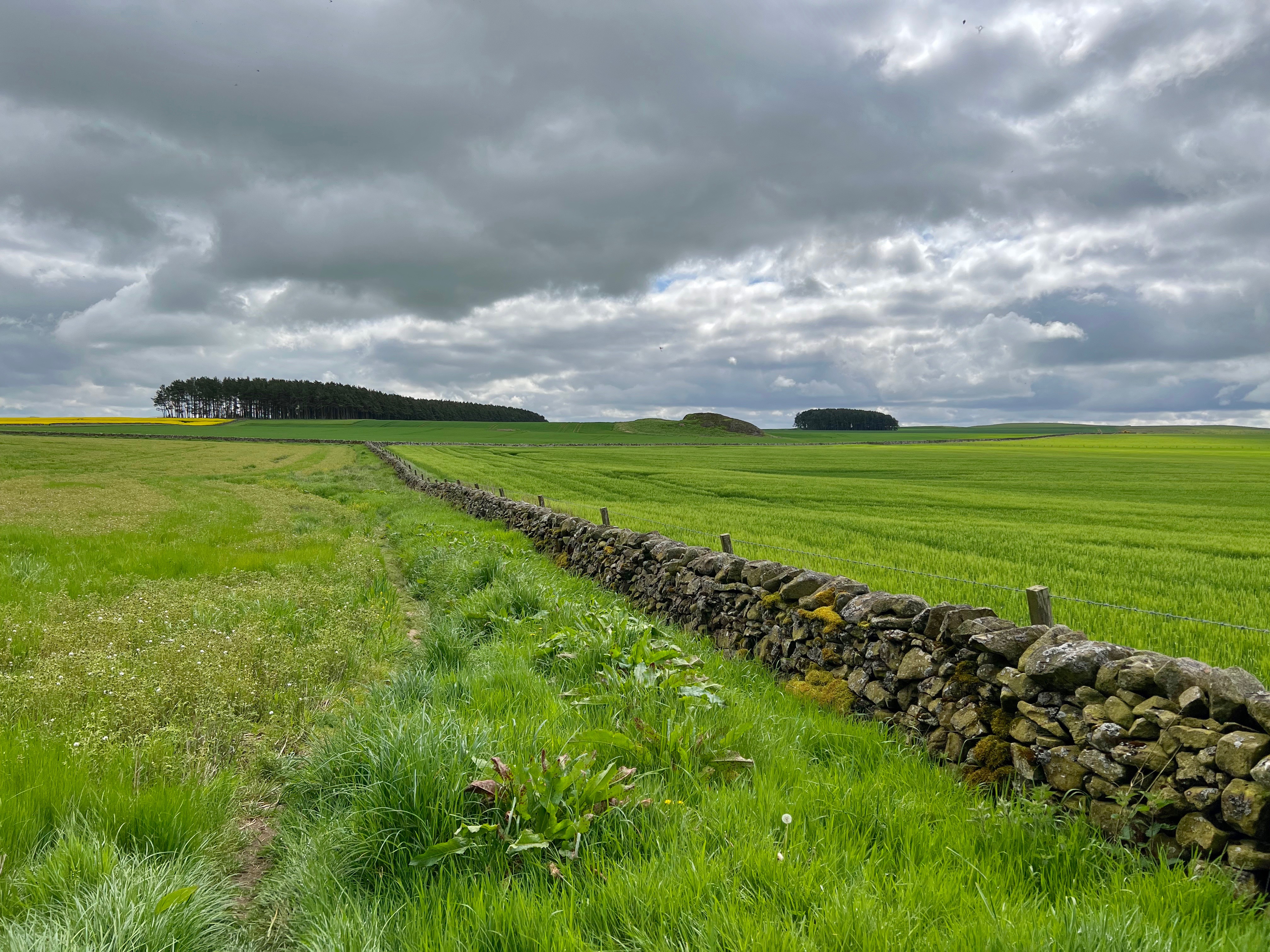
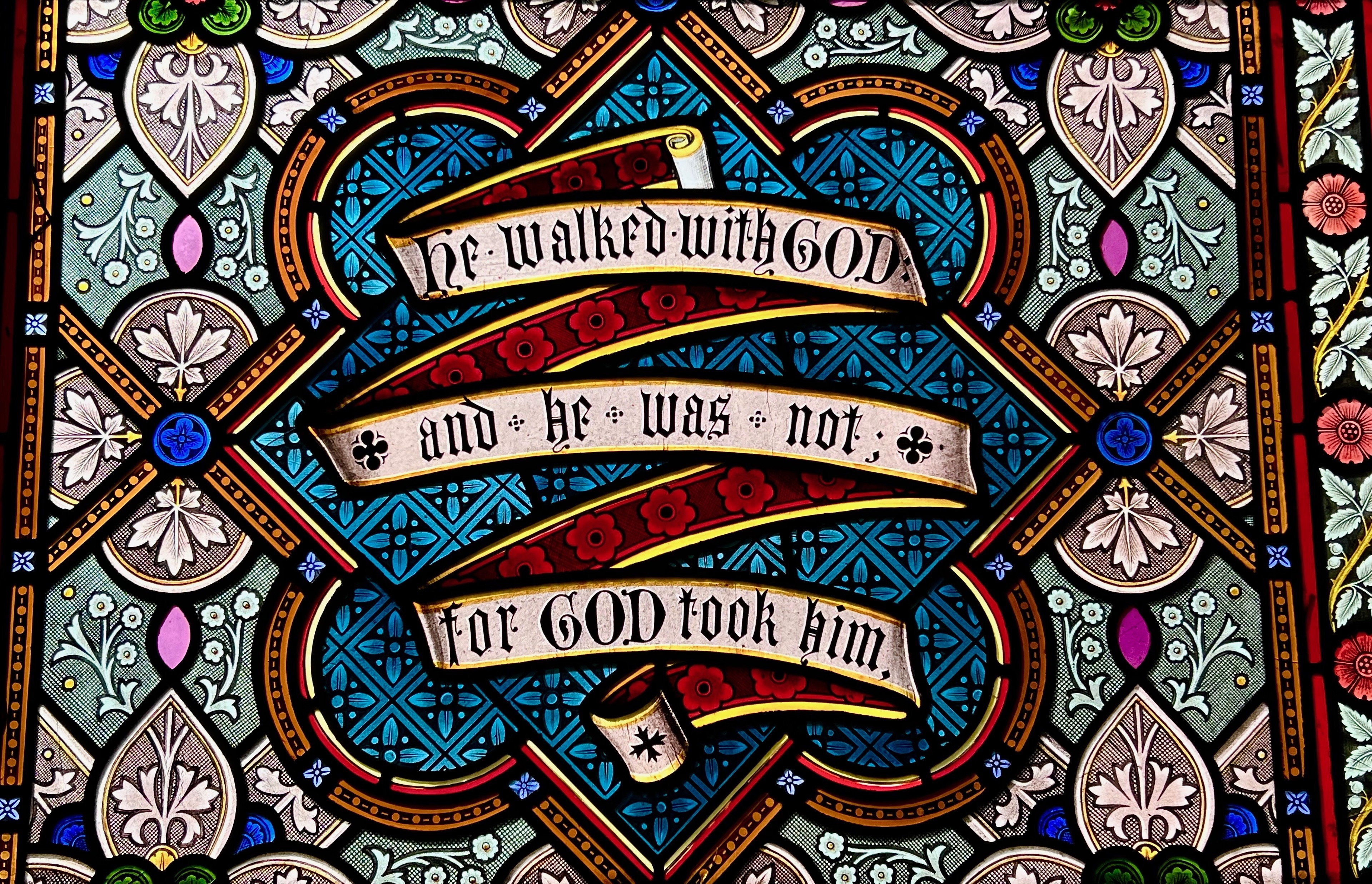
At peaceful Bowden Kirk, a medieval foundation much remodeled over the centuries, I found a window with a text from Genesis. 

Window in Bowden Kirk with text from Genesis 5:24.

This cryptic verse has been interpreted to mean that Enoch, an ancestor of Noah, was somehow taken directly to God without passing through death. To say he “was not,” or “was no more,” could mean that he simply “disappeared” from human sight without suffering an interval of nonexistence. Perhaps the window was put in Bowden Kirk as a cipher of resurrection hope, but to me it suggested the essential spirituality of pilgrimage. As we walk away from “not-God”—deeper and deeper into the divine communion—the isolating egoistic self is diminished and emptied, until it is “no more,” translated by God into its truer self: a relational participant in the divine life of self-diffusive love. That may not be achievable in this life (I certainly didn’t get there in 6 days!), but I believe it is the horizon toward which we are all headed. 

As St. John of the Cross put it:

To come to be what you are not,
you must go by a way in which you are not. [v]

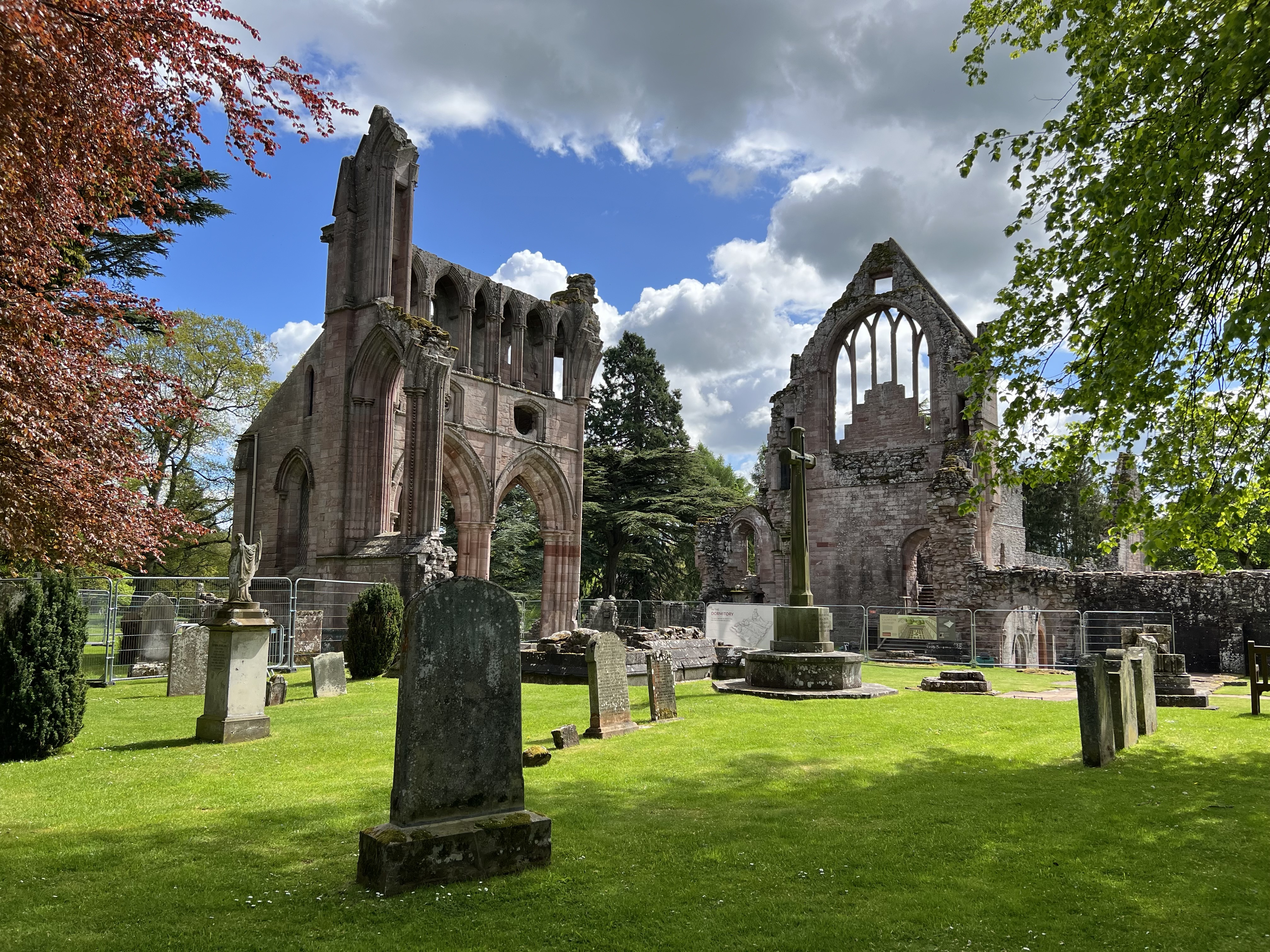
Dryburgh Abbey (12th century). Sir Walter Scott, who died on the last day of summer, 1832, is buried in the ruins of the north transept.
Dryburgh Abbey is surrounded by exotic trees, like this Cedar of Lebanon, planted by the Earl of Buchan over 200 years ago.
“Bare ruin’d choirs where late the sweet birds sang” (Shakespeare, Sonnet 73).

Dryburgh Abbey is the second of three Borders abbeys on St. Cuthbert’s Way. Far from any town, surrounded by a beautiful park next to the River Tweed, it is the most serene of the three. 
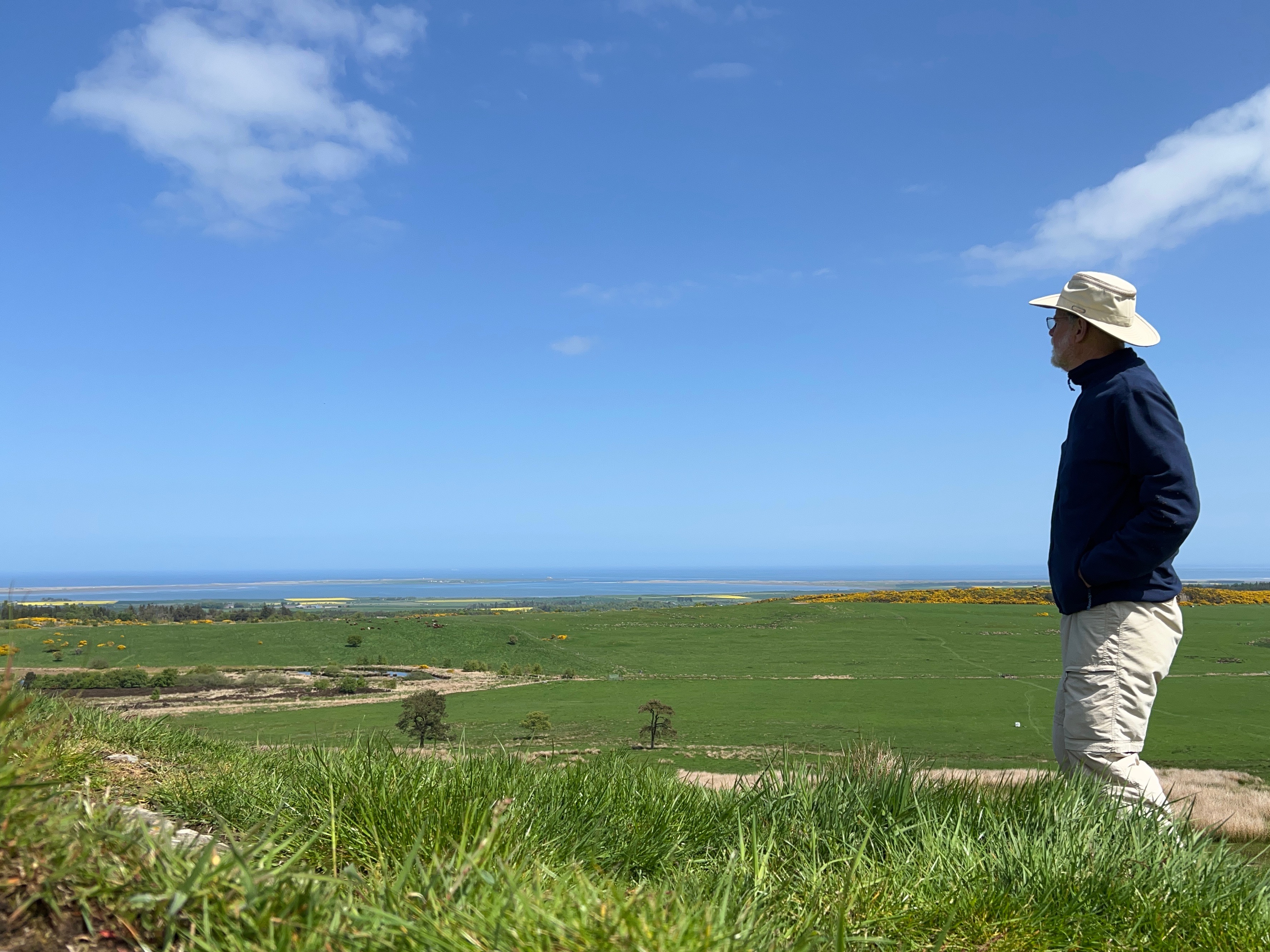
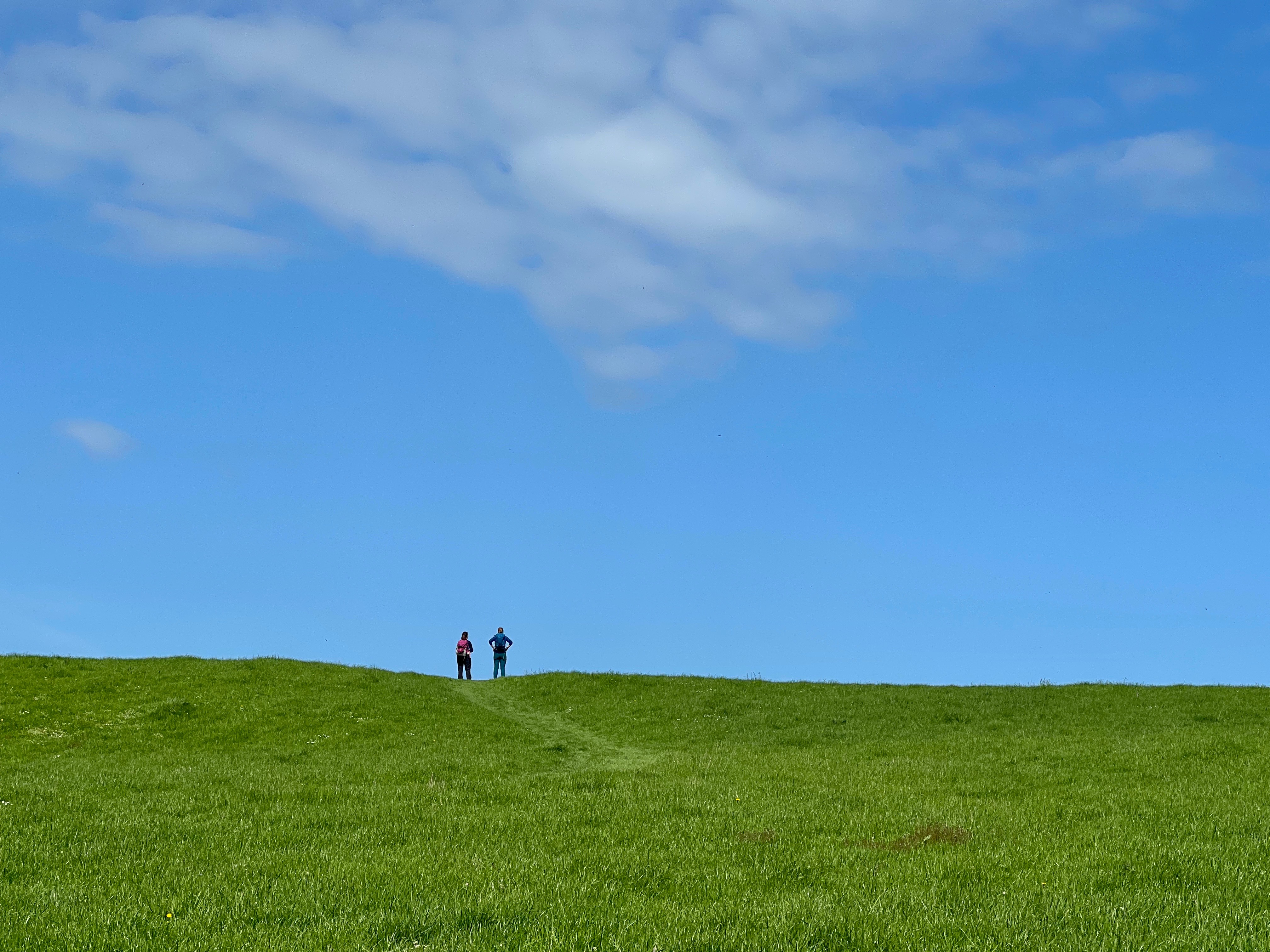
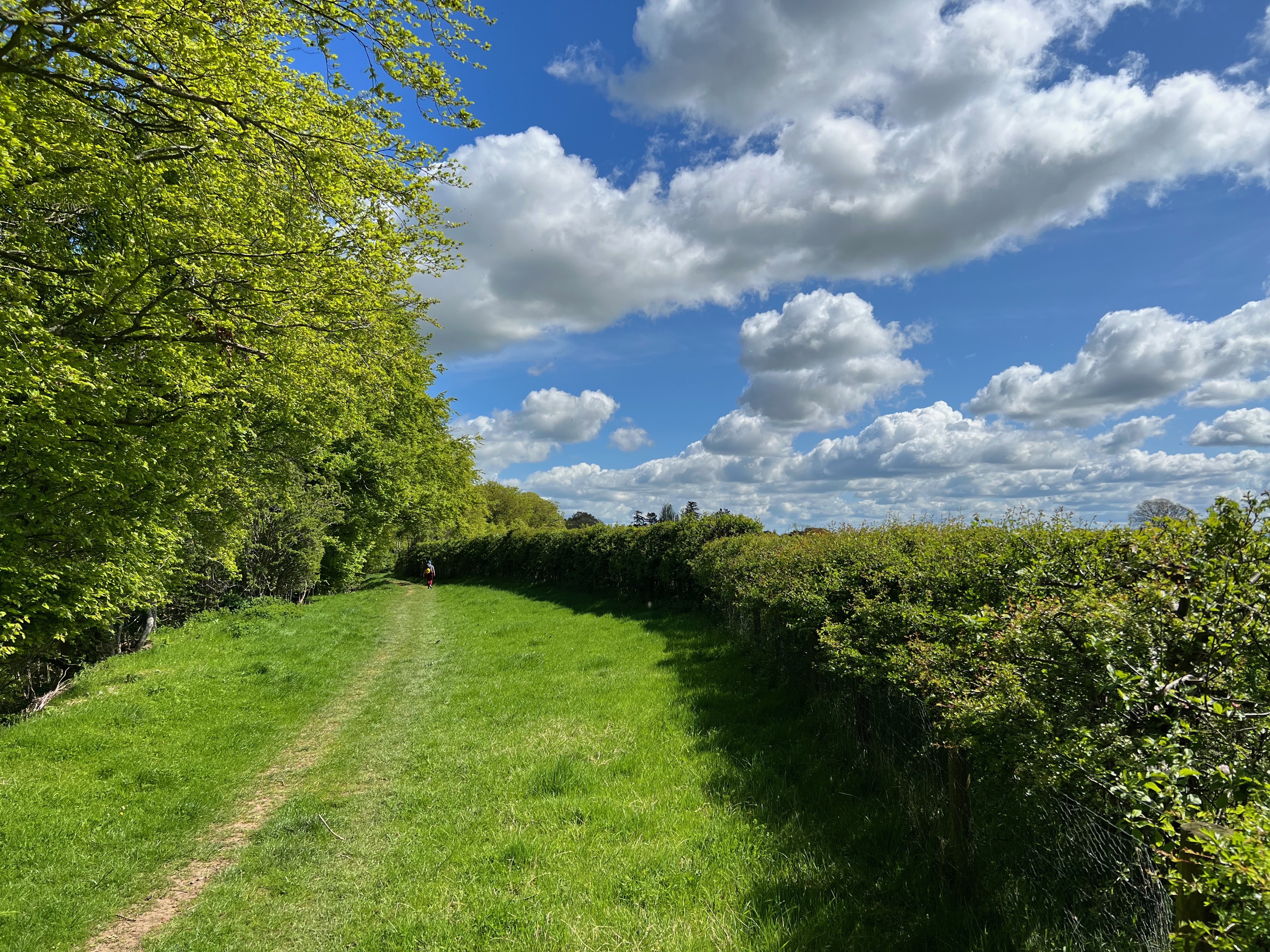
The occasional paved stretches of the Way were mostly empty.
This straight path, called Dere Street, follows part of a first-century Roman road which ran from York to Scotland’s Firth of Forth.
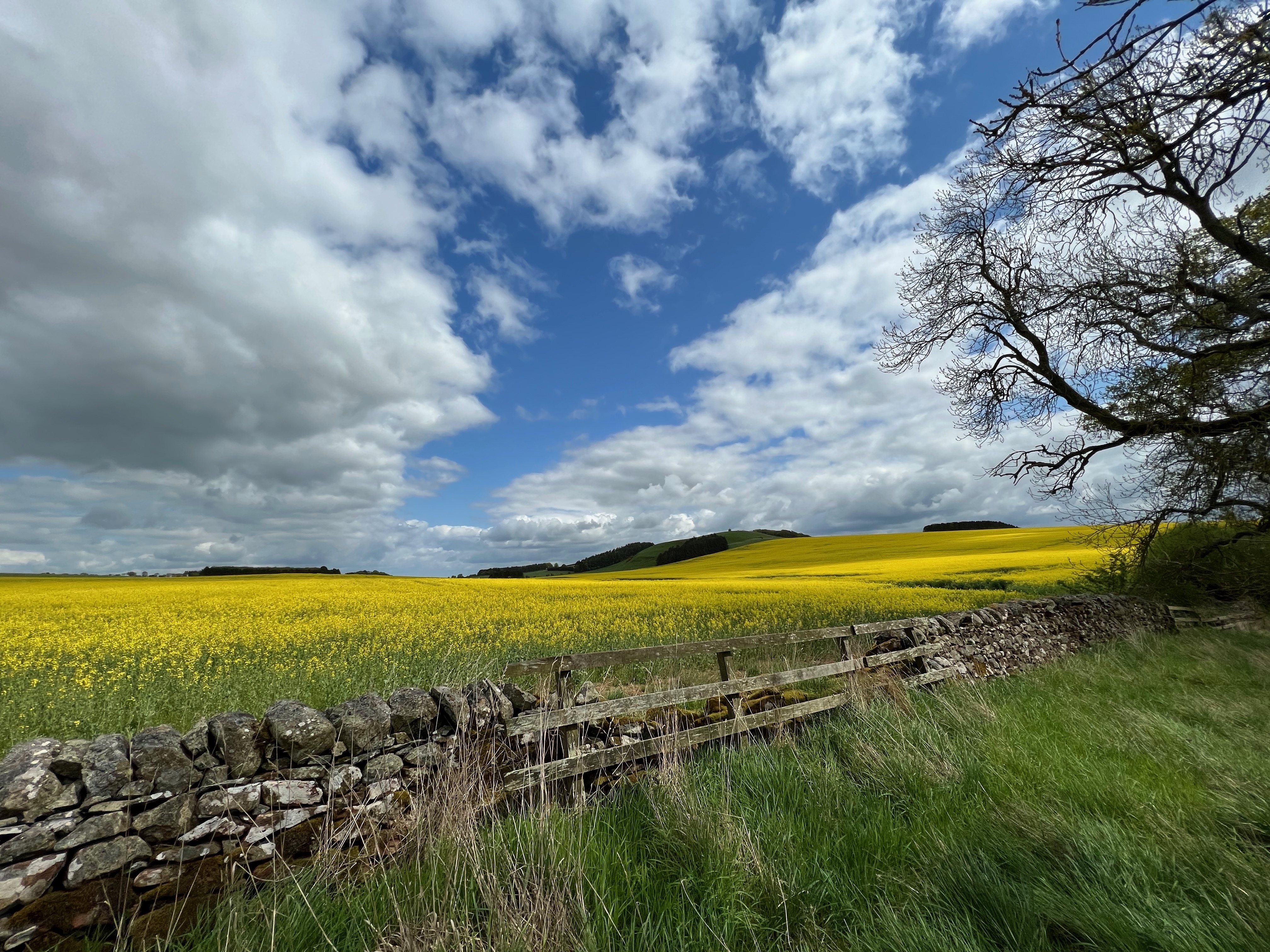
Fields of blooming rapeseed parallel the Roman road.

One day I trod the remnant of a Roman road, a faint trace of their 400-year occupation of Britain. As Gibbon observed, history “spares neither man nor the proudest of his works [and] buries empires and cities in a common grave.” [vi]

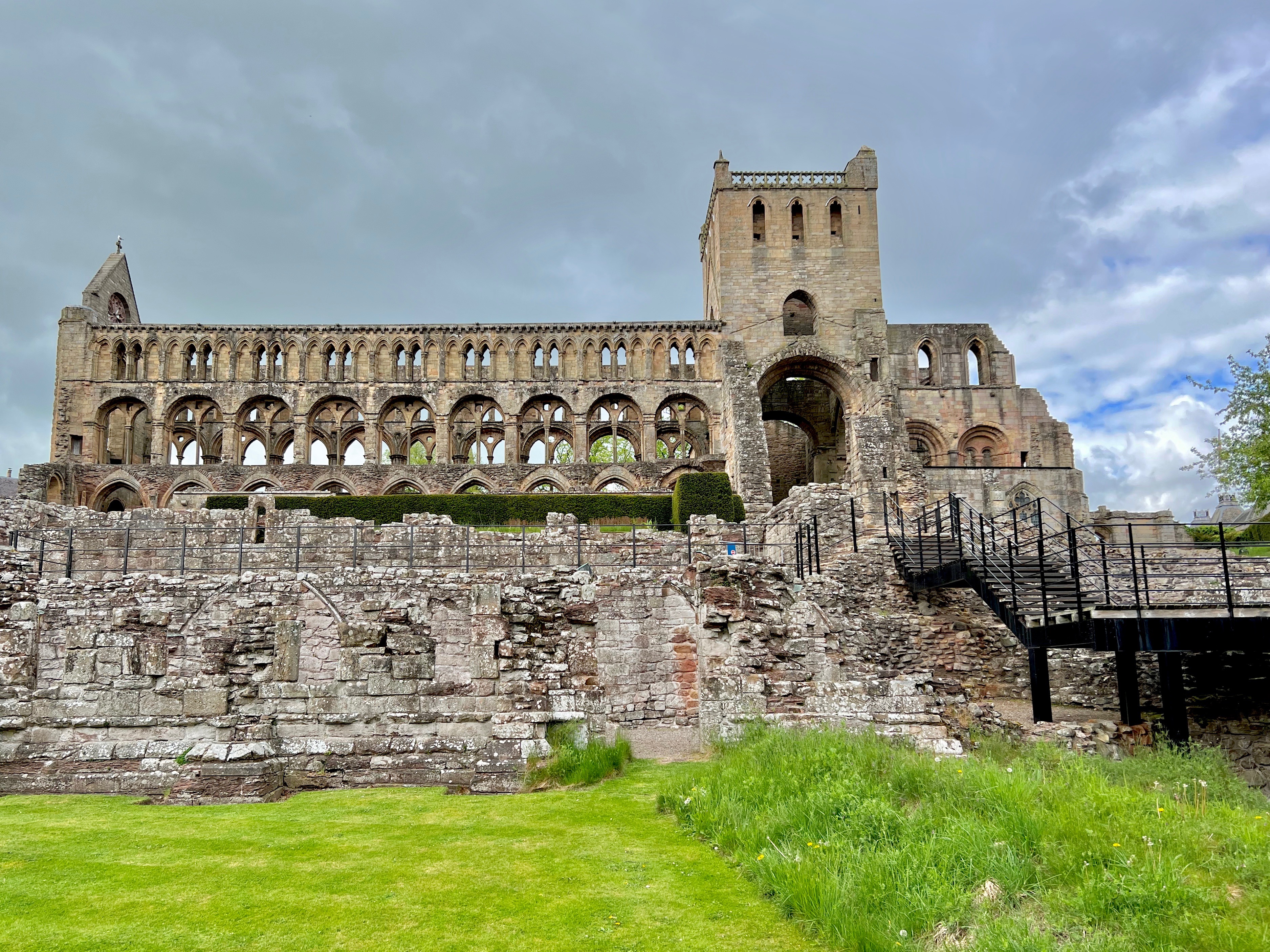
Jedburgh Abbey (12th century).
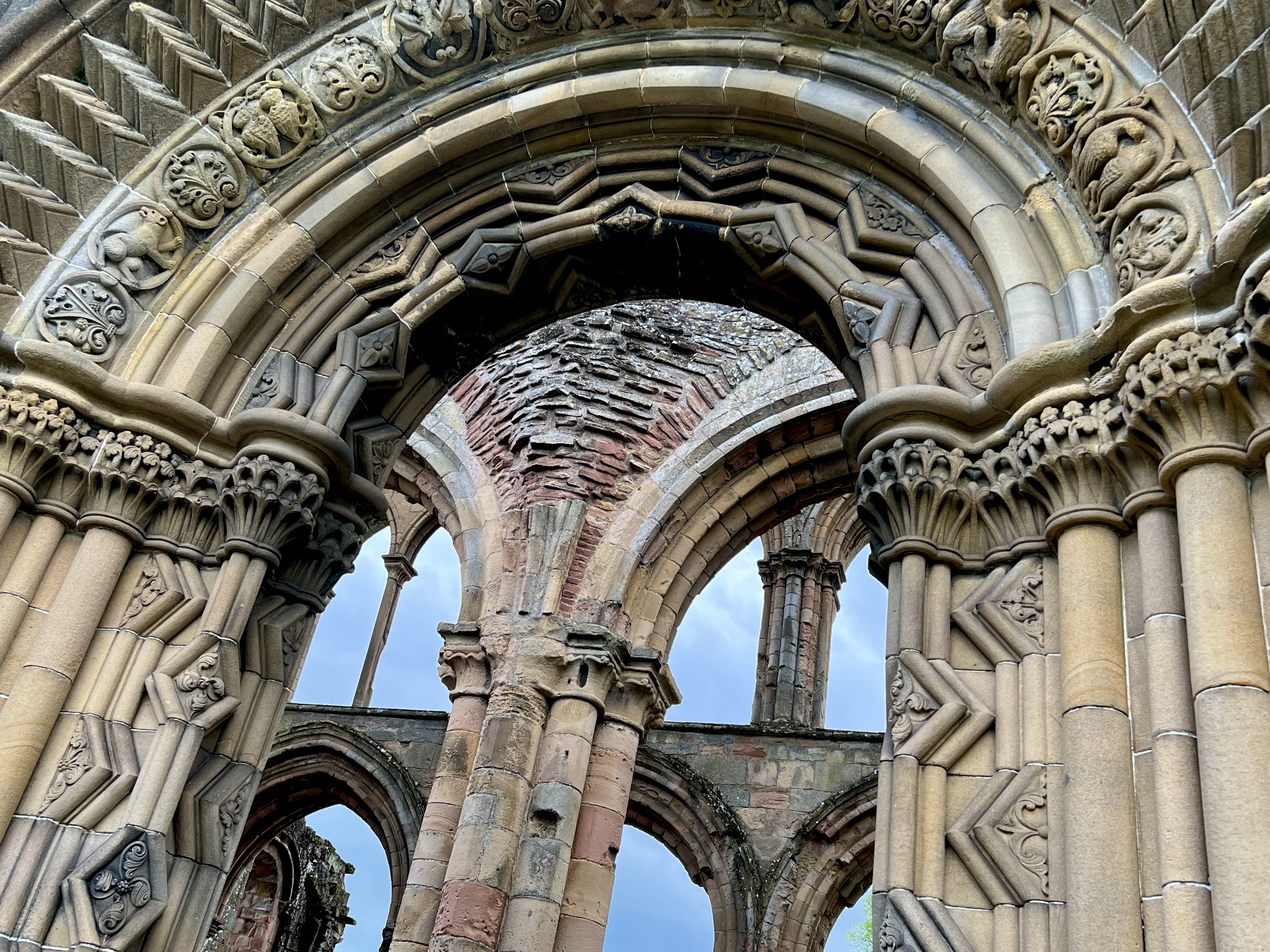
South door, Jedburgh Abbey.
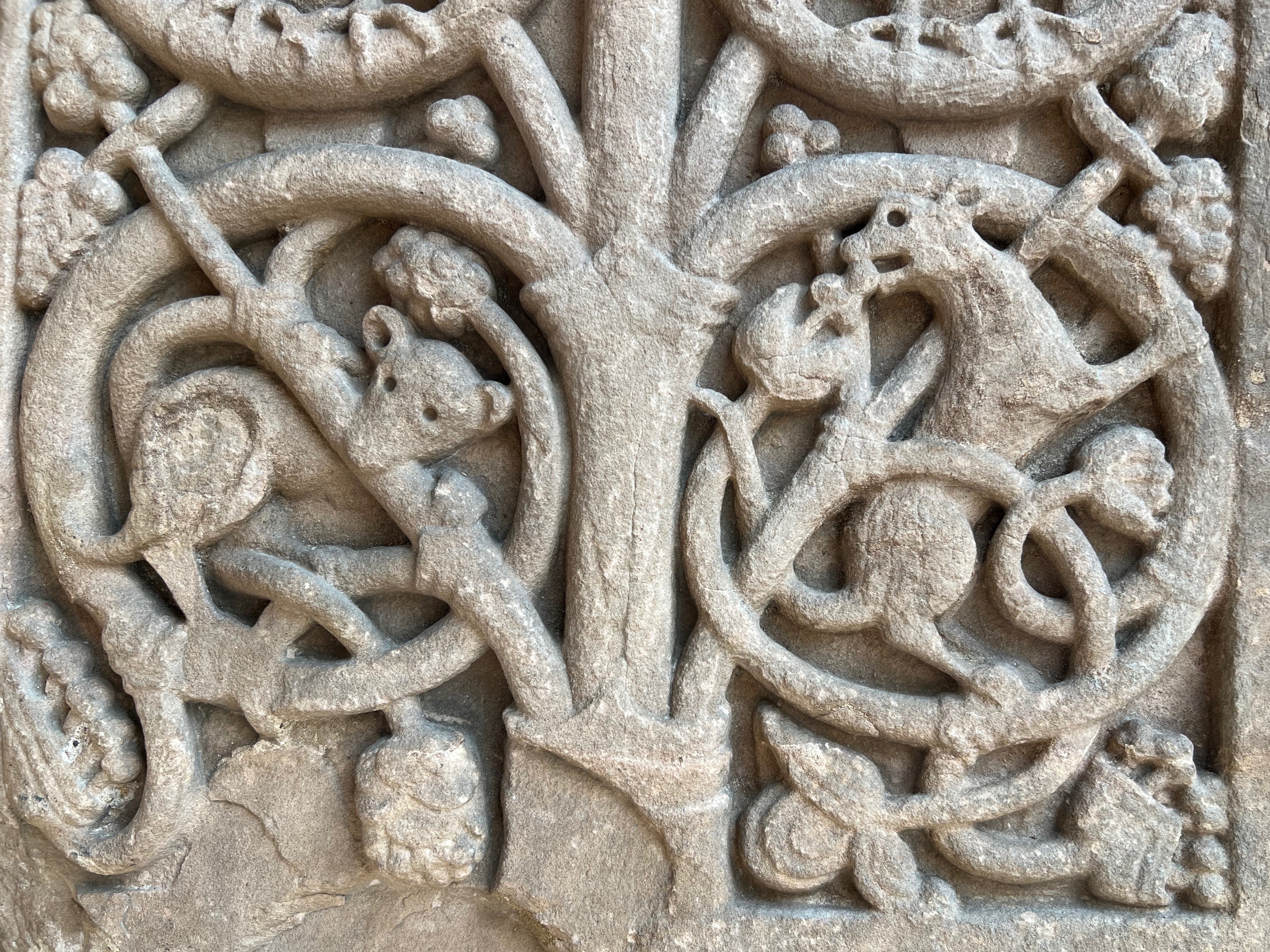
Vine-scroll panel from a saint’s shrine (8th-century, Jedburgh).

In Jedburgh (locals say “Jeddart”), the church of St. Mary the Virgin is the best preserved abbey in the Borders. Built during the shift from Romanesque to Gothic styles, it is a blend of both. And its carved stone “vine-scroll” is one of the finest examples of Anglo-Saxon art. Like the other Borders abbeys, it did not survive the Reformation, and was abandoned in 1560.

My first view of the Cheviot Hills in the distance.
When I was lost, Brian appeared to show me the way.

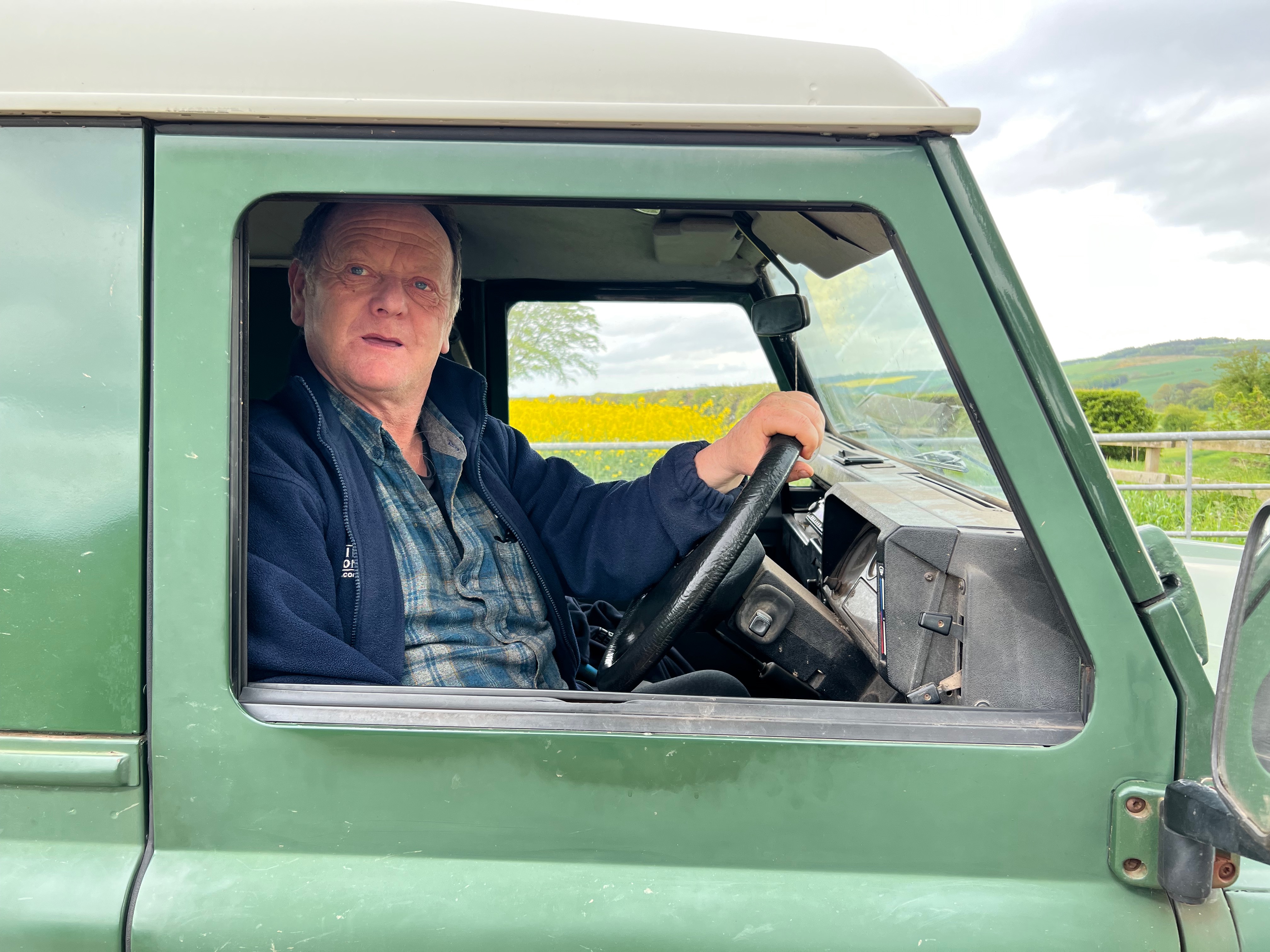
My first glimpse of the distant (and challenging) Cheviot Hills distracted me, and I missed a waymarked turn in the trail. Ten minutes later, I reached a road with no idea where to go. Like one of the angelic guides who appear out of nowhere to help Dante navigate obstacles in the Inferno, a local farmer drove up behind me to point the way. When he heard my American accent, he mentioned that his daughter was a professional golfer in California and “doing quite well.” I told him he was a gift from God. He looked bemused. Soon I was back on track, traversing broad fields of yellow and green until I reached the foot of the Cheviots, where the elevation gain got more demanding.

The path climbs toward Wideopen Hill, the halfway point of St. Cuthbert’s Way.
View from Wideopen Hill, the highest point on St. Cuthbert’s Way (1207 ft./ 368 m.).
I reached the highest point of the trail on Ascension Eve.

When I reached the top of Wideopen Hill, the highest point on St. Cuthbert’s Way, it occurred to me that it was Ascension Eve. What better way to celebrate than climb toward the sky!

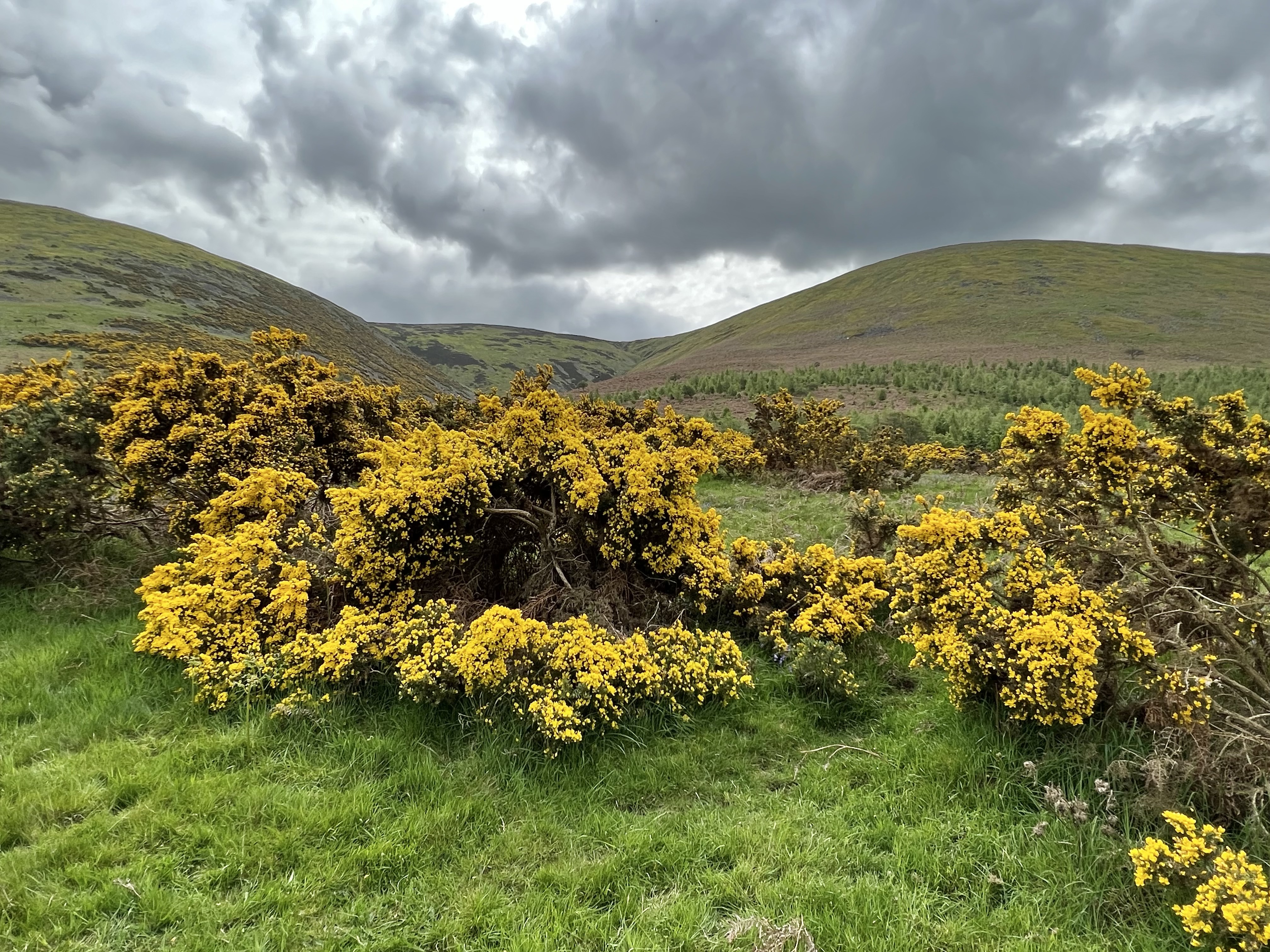
Scotch broom in the Cheviot Hills.
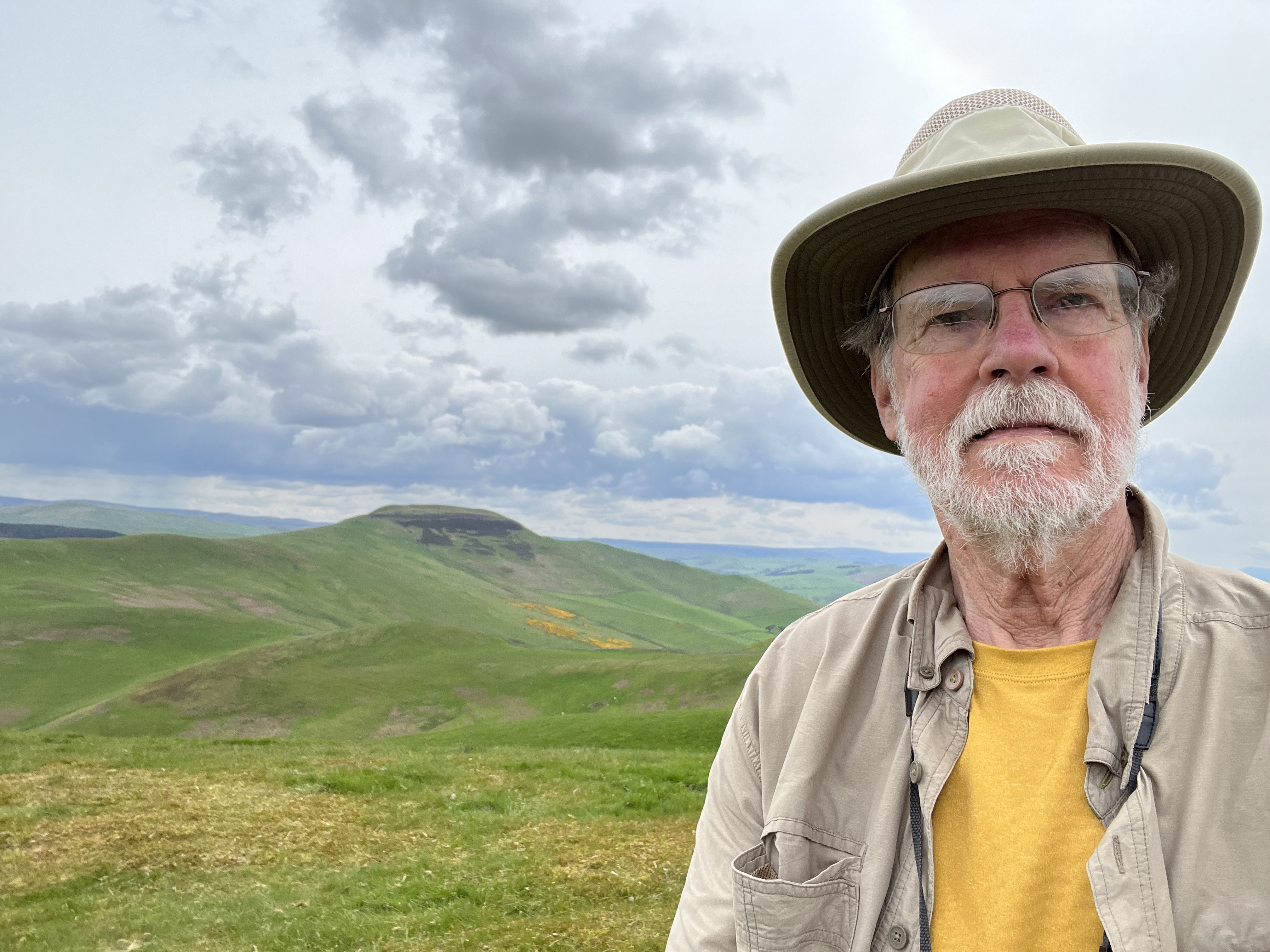
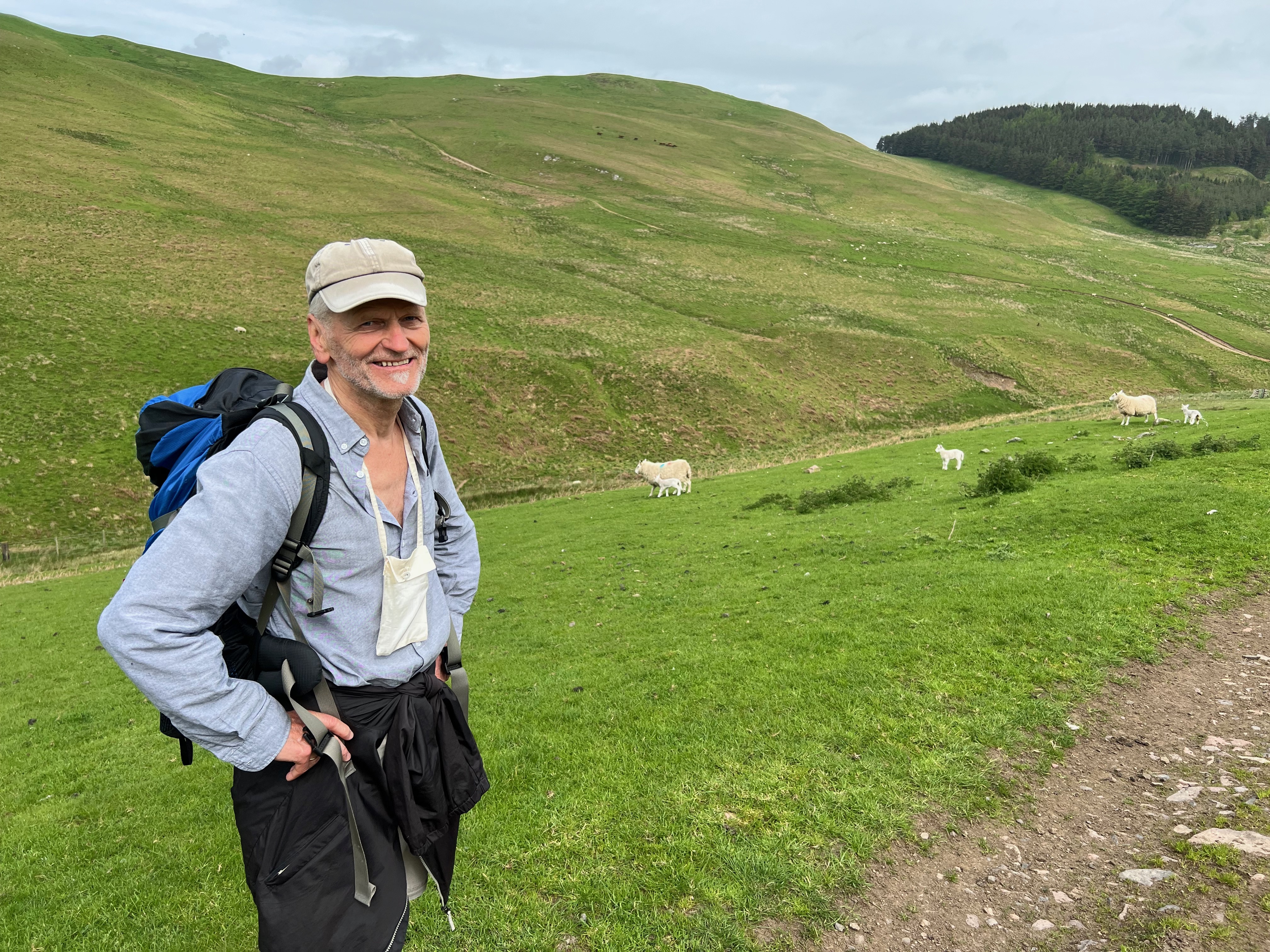
Dagfinn, a Norwegian pilgrim in the Cheviot Hills.
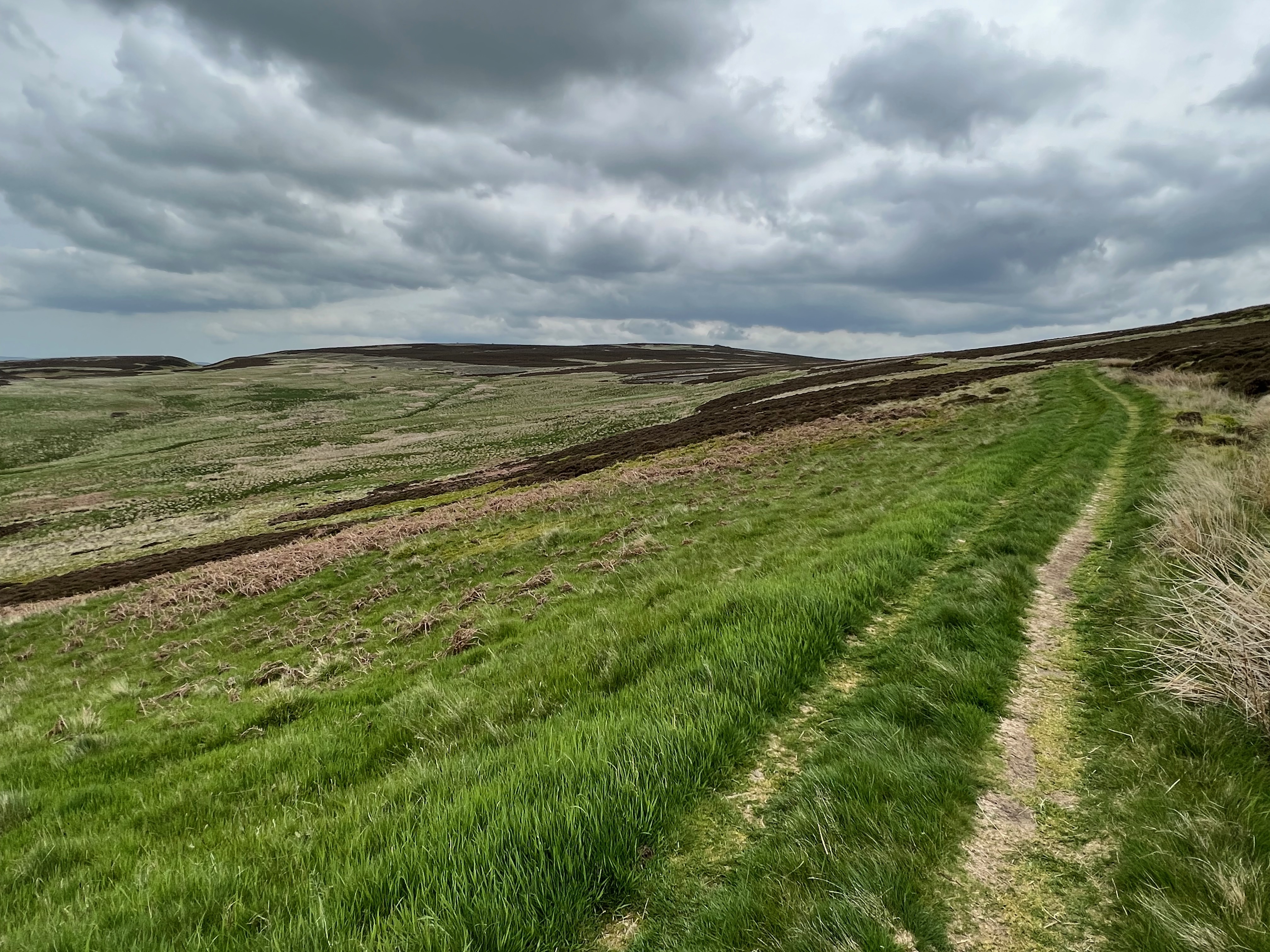
Ascending the moorland of the Cheviot Hills.

The whole next day was up and down through the Cheviots. The high country has feral goats, Iron Age forts, and a couple of crashed planes that lost their way in World War II. I didn’t see any of that. I was focused on dragging my tired body over the hump. The bleak sky and the treeless summits dampened my spirits a bit (Praise God when the road is easy! Praise God when the road is hard!). But it was still thrilling to hear the long, slowly rising whistle of the Eurasian curlews as they swooped across the heather. 

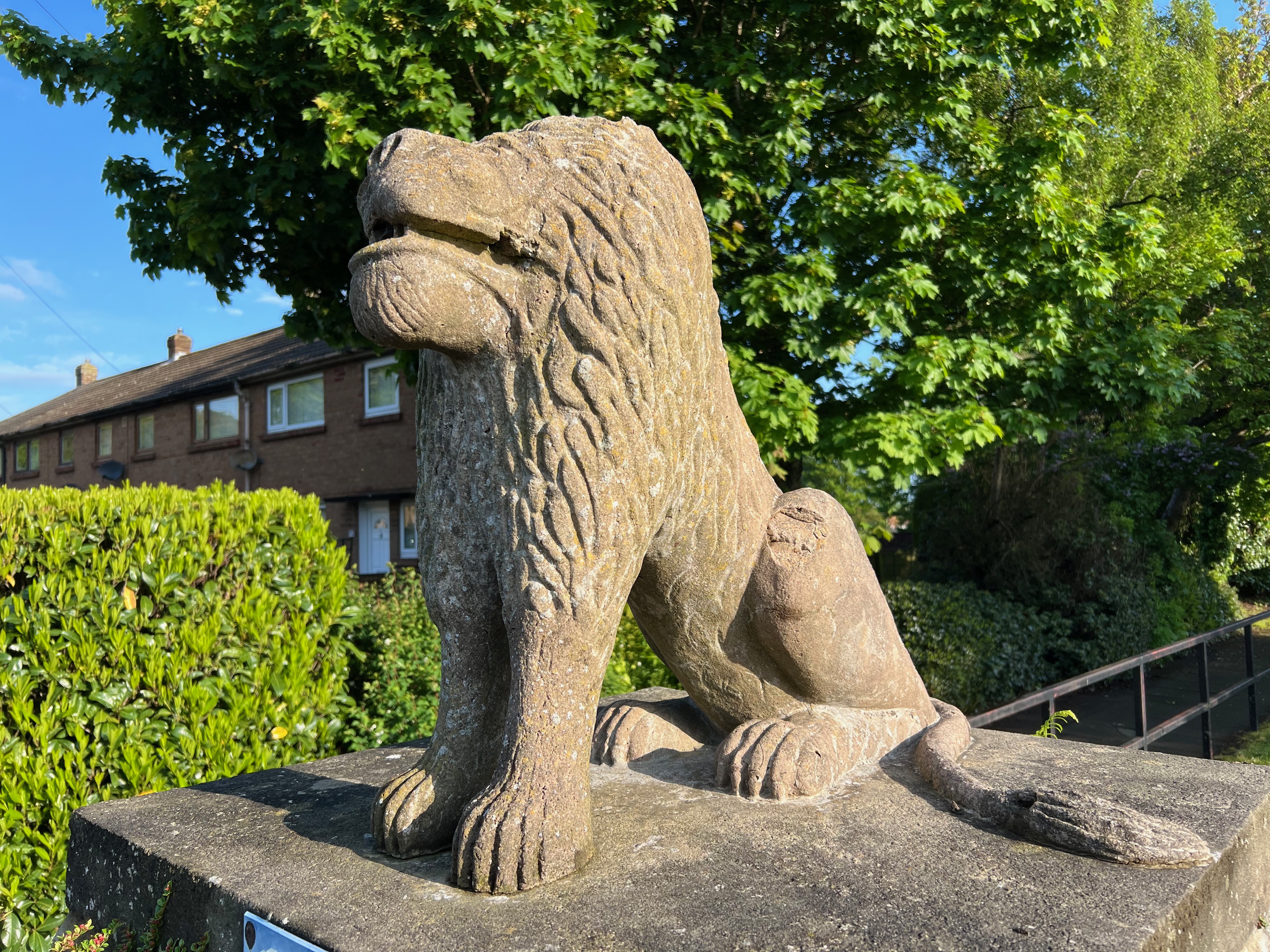
Gatepost lion in Wooler.

After a gloomy day in the Cheviot Hills, my final miles to the coast were brilliantly lit and my heart was high. This stone lion at a schoolyard entrance was carved by an Italian prisoner of war during World War II, when the facility was a POW camp. It looks like something you’d find in Venice. Thinking of that prisoner managing to make art amid the chaos of war, I’m tempted to say that art is long and war is short, but in these days of perpetual conflict I’m not so sure.

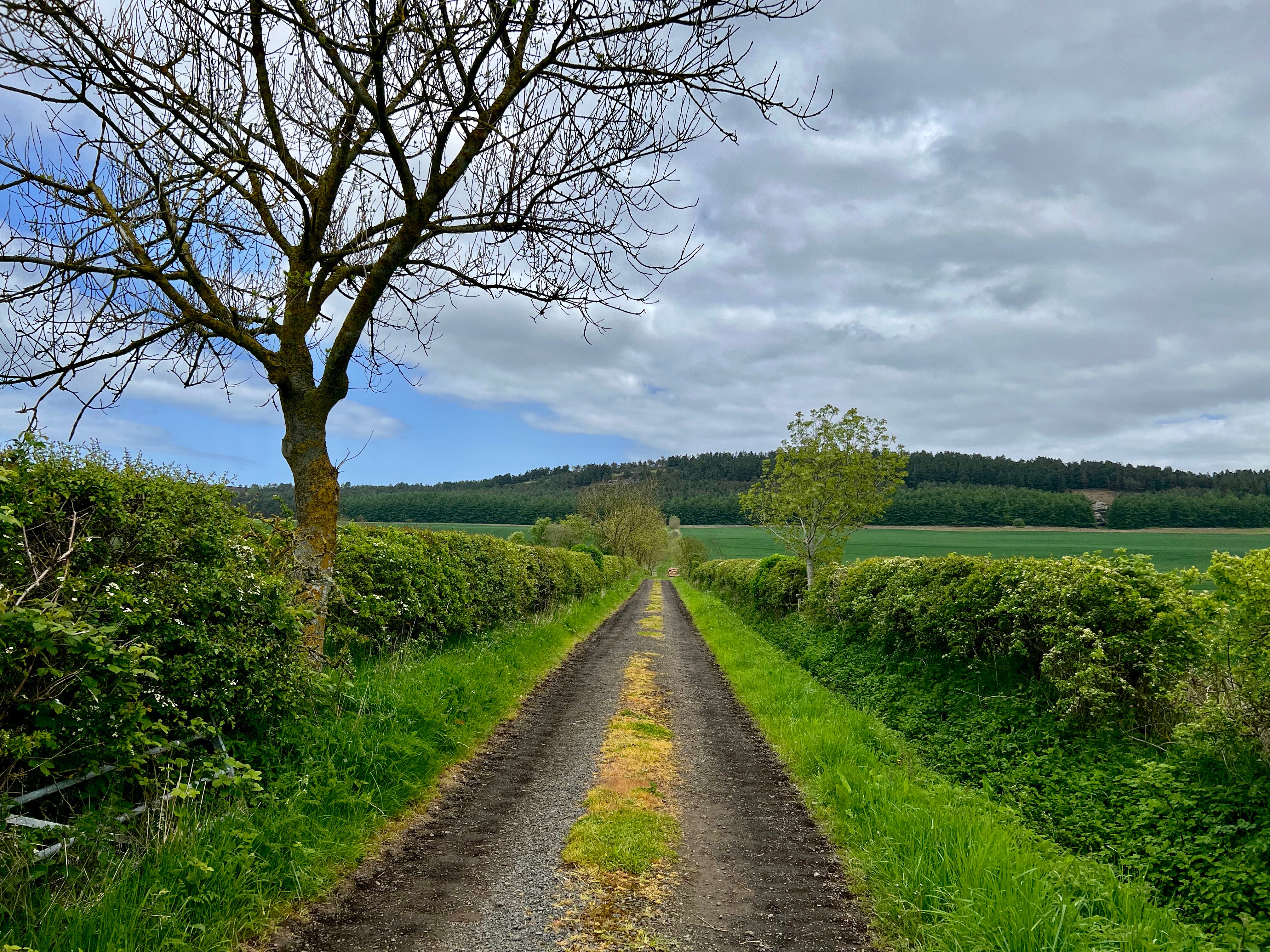
Toward the final ridge before the coast.
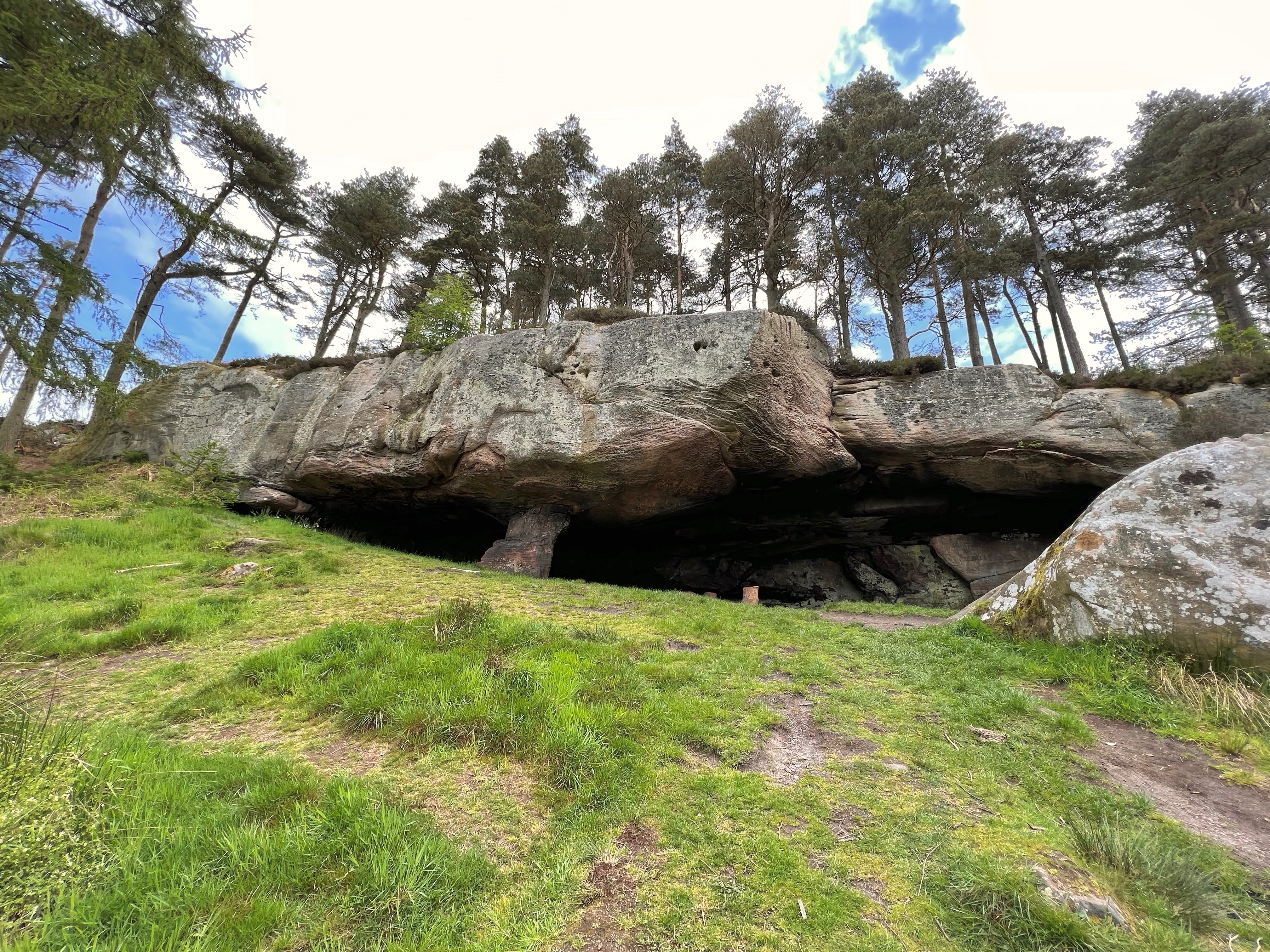
St. Cuthbert’s Cave.

The first sign that I was nearing the sea was a flock of gulls circling above me. Just one more forested ridge, and the coast would be visible. After marveling at the massive sandstone overhang of St. Cuthbert’s Cave (where monks carrying his remains are said to have sheltered while fleeing Viking raiders), I climbed to the rise just above it. And there I saw my Promised Land: Holy Island, refulgent beneath the noonday sun.

When Lewis and Clark got their first glimpse of the Pacific after 18 months crossing the American continent, Clark recorded their delight in his journal: “Ocian in view! O the joy.” When I reached that ridge above the Northumbrian sea, I spoke those words out loud.

My first view of Holy Island.
Ocean in view!

“To walk there is to earn it, through laboriousness and through the transformation that comes during a journey … We are eternally perplexed by how to move toward forgiveness or healing or truth, but we know how to walk from here to there, however arduous the journey…. In pilgrimage, the journey is radiant with hope … geography has become spiritualized.”

— Rebecca Solnit [vii]       

Walking St. Cuthbert’s Way


THE ST. CUTHBERT SERIES CONTINUES:

Grace and Beauty on Holy Island

The Journey Ends: Durham Cathedral

All photographs and video are by the author.

For links to my posts on the Camino de Santiago: https://jimfriedrich.com/2020/07/25/seek-ye-first-scenes-from-the-camino-de-santiago/


[i] Geoffrey Chaucer, The Canterbury Tales (Prologue, 11-18), trans. Burton Raffel (Modern Library, 2008).

[ii] Susan Stewart, The Ruins Lesson: Meaning and Material in Western Culture (Chicago: University of Chicago Press, 2020), 238.

[iii] Dante, The Inferno 1.60, trans. Robert Hollander & Jean Hollander (Doubleday, 2000).

[iv] William Wordsworth, The Prelude (1.14-18).

[v] John of the Cross, The Ascent of Mt. Carmel.

[vi] Edward Gibbon, from the closing chapter of History of the Decline and Fall of the Roman Empire.

[vii] Rebecca Solnit, Wanderlust: A History of Walking (Penguin, 2001).

Reading in France

Dormitory, Abbey of Senanque.

The beauty of the world is the mouth of a labyrinth. . . If [the pilgrim] does not lose courage, if he goes on walking, it is absolutely certain that he will arrive at the center of the labyrinth. And there God is waiting to eat him.  

 – Simone Weil

I’m sitting on a terrace overlooking a river in France. Late summer blooms sway in the gentle breeze. The trees resound with birdsong. Back home, my country is in turmoil. What a week to be away! 

The stakes are high in the U.S., and I celebrate the rising of the women and the trembling of the patriarchy. But to be unplugged for a time need not be escape, but renewal. As the Dordogne rolls on placidly below me, I think of a line from William Stafford:

What the river says,
that is what I say.

Dordogne River, La Roque Gageac.

It’s a vacation. And yet, the book here on the table under the umbrella is Robert Coles’ Simone Weil: A Modern Pilgrimage. A reflection on the life and thought of the uncompromising French thinker and radical believer, whose posthumous influence has been so profound, is bound to put the placidity of a pleasant afternoon into question. What is one to do with a voice that says so matter-of-factly, “Salvation is consenting to die”?  

Crucifxion, Abbey of Saint Foy, Conques.

Weil’s life was rooted in renunciation, whether it was rejecting the career path of a brilliant thinker or refusing proper nourishment when she was dying in hospital. “For God to be born is renunciation,” she wrote. “The birth of Christ is already a sacrifice. Christmas ought to be as sad a day as Good Friday.”

That may not be a winning sentiment for church growth, but Weil insisted that the life of faith demands no less than everything. Her image of God waiting to eat us is certainly unsettling. Nevertheless, she believed, it’s all about surrender:

“We must give up everything which is not grace, and not even desire grace.”

Isaiah, priory church of Souillac (12th century)

I did bring some lighter reading as well on this journey, but Weil has been an insistent companion. She will not be ignored. Her rigorous ideas, not just conceived but inhabited, beg the question, “So what are you doing with your life? Are you holding anything back?”

As I’ve read Coles’ book, I’ve discovered that some of the places visited on this trip were associated with Weil: Auxerre and Le Puy, where she taught, the Ardeche region where she worked on a farm, and the garden at her college in Paris, where her fellow students, intimidated by her philosophical brilliance, called her “the Categorical Imperative in skirts.”

So I suppose I’m on a Weil pilgrimage by accident. We’ll see where it leads.

Chapel of St. Michel-d’Aiguille, Le Puy.

My itinerary also coincides with the Camino de Santiago, visiting three of the four starting points for the French portion of that great pilgrimage: Paris, Le Puy, and Arles (Vezelay is the fourth).

I walked a 70-mile segment of the French “Way of St. James” in 2010, and all 500 miles of the “Camino Frances” culminating in northwest Spain in 2014 (you can read about the latter here and here). 

Blessing of pilgrims on Le Chemin de Saint-Jacques, Cathedral of Le Puy

When I watched a band of joyful pilgrims set out last week from Le Puy after being blessed at the cathedral mass, I felt a little wistful to be only a tourist sightseeing by car. I felt a pull to join them. But then I remembered that for the desiring heart, the pilgrimage never ends.

Pilgrimage is the image Coles used for the all-to-brief life of Simone Weil, which ended at 34 in 1943, a bleak and violent year when, in Weil’s words, “it took a special person to be hopeful.” In our own dark and foolish time, Coles’ summation has particular resonance:

Hers was a modern pilgrimage; she entertained all our assumptions, presumptions, and anticipations – her journey is ours. She experienced, in the few years she knew among us, our buoyancy, our optimism, and soon enough, our terrible discouragement and melancholy. She saw Pandora’s box open, revealing its cheap tricks, its deceptions. She saw clear skies cloud up overnight. She saw all the castles we have built in the skies; she entered them, took their measure, and left with tears or anger, bitterness. In the end only one sight was left for her eyes; in the end, that modern pilgrimage so swiftly concluded, she looked upward, affirmed unflinchingly her last hope, the hope of heaven – and died, one suspects glad it last, glad to be hurrying home, to be with God…

Dordogne River, La Roque-Gageac.


All photos by Jim Friedrich

Footsteps and shadows: Inscribing our traces on the Camino

This spring I find my mind often returning to the Camino de Santiago. A year ago today I began my tenth day of walking: 140 miles down, 360 to go. But by then I had stopped counting. It was better – and less tiring – to be in the moment, to “cherish every step” as one pilgrim advised me early on.

When I run long distance, or backpack up a steep mountain pass, I try to apply the mindfulness of Zen walking. Don’t think about some other time, in the past or the future, when you are in a more comfortable state of rest. And stop wondering how far you have left to go. Simply be here now. Concentrate your attention on the physical act of lifting your foot, swinging it forward, setting it down. Take note of your breath. It’s not about forgetting the pain so much as accepting your present state of being-in-motion, not wishing you were doing something less strenuous or challenging.

When you walk ten to twenty miles day after day for over a month, this kind of attention becomes more automatic. Walking becomes what you do and who you are. As I wrote in one of my Camino posts, “Walking”:

The past week was spent traversing the immense agricultural plateau of the Meseta and Tierra de Campos. Few trees, big sky, only occasional villages, and long stretches where the only human presence was the long procession of pilgrims migrating westward. The lack of distractions and variations tends to make the very act of walking to be the mind’s principal occupation. As Robert Macfarlane puts it in The Old Ways: A Journey on Foot, walking becomes “sensational” – it isn’t just conducive to thought; it becomes the form thought takes. I walk, therefore I am. Perhaps it is similar to the way that cinema thinks through the movement of the camera. It isn’t forming propositional thought, but is simply absorbing through its attentive motion the shape of the world, the textures of existence.

I have noticed that I have fewer thoughts out here than I do at home when I run for an hour, or go on a week-long backpack. On the Camino, instead of a lot of thoughts, I simply have thought: not so much words or ideas as awareness. As Thich Nhat Hanh once put it to a walking companion who asked what he was thinking about: “I’m not thinking about anything. I’m aware of the sunlight.”

Macfarlane provides a memorable image of walking as a form of writing on the earth, with every traveler leaving his or her own imprint of dreams, stories and memories as they go. Centuries of pilgrims have been leaving such traces along the Camino, traces which now lie beneath our own feet every step of the Way.

The brief video clip records my shadow and footsteps leaving their faint traces: on the Meseta west of Burgos, on the 13th century bridge of Puente de Orbigo, and among the blooming shrubs of the Alto Predela, a high ridge west of Villafranca. I hope these few steps bring back happy memories for my fellow pilgrims. And for those who want to experience our cumulative act of walking in real time, just replay the 80-second video 11,000 times!

The end of the world

[Note to my readers: many thanks for joining me in this journey. I am so appreciative of all the good and supportive comments you have contributed along the way. I wish I could have made individual replies, but the nature of the Camino made necessary some limitation to my online time. And if you have enjoyed these posts, know that while my Camino has ended, the Religious Imagineer will continue, with reflections and provocations concerning theology and religion, the arts, liturgy, imagination, and the beauty of the world: wherever “the fire and the rose are one.” Stay tuned.]

How do I write an ending to the Camino? Certainly with no summary remarks, for such reductions would do disservice to the complex flavors of the journey. I feel like the pianist who was asked to explain the composition he had just played. Without a word, he sat down and played it again.

On Monday afternoon, I continued on from Santiago to Finisterre (“the end of the world”), an extension of the Camino that predates the Christian shrine at Santiago. For the ancient Celts, and many pilgrims since, the natural place to make an ending is where the land is swallowed by the sea and the sun disappears over the edge of the known. Some make this journey on foot (54 miles west from Santiago), but I, alas, took a bus, needing some rest for weary legs.

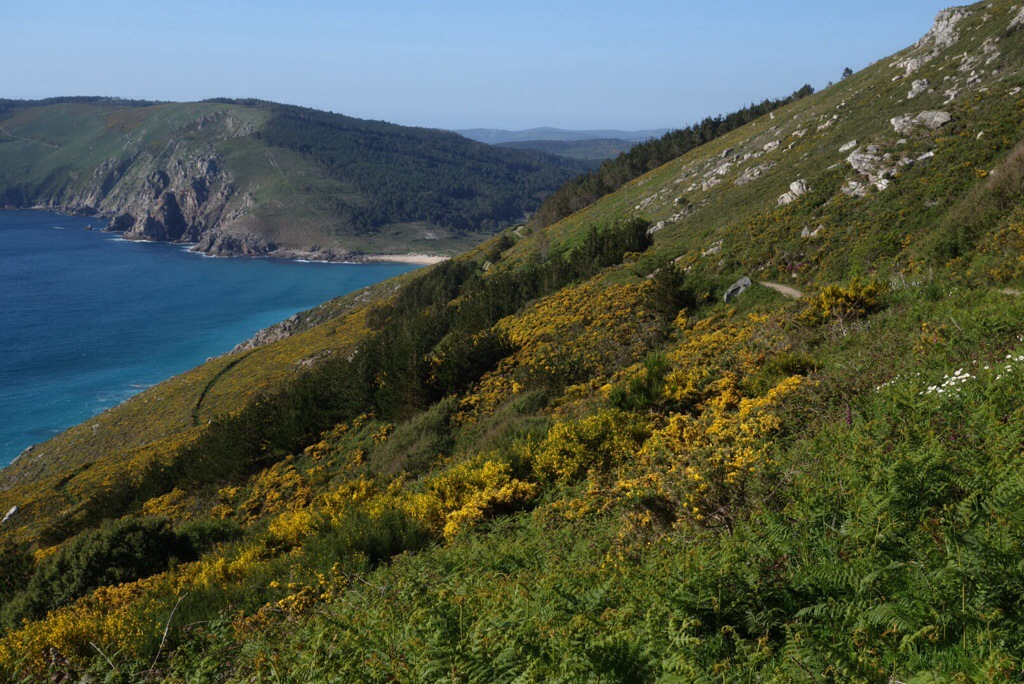
Finisterre is a high headland with a charming harbor town, wild hills and dramatic shoreline. I made the obligatory walk to the lighthouse at the southern tip, where the last Camino marker reads 0.00 K, and pilgrims can leave or even burn a symbolic offering (shirts, boots, and walking poles were among the abandoned items). But the souvenir stand and tourist buses were not contemplative aids, so I took the spectacular trail along the western side, high above the sea, bright with yellow flowers, descending finally to an isolated beach. In my own act of letting go, I wrote PEREGRINO (pilgrim) in the sand, and watched the tide erase it. Then I climbed to the rocks on the cape’s highest point to watch the edge of the world erase the sun.

I still had one more walk to do, from Finisterre north to Muxia: 18 miles of pine and eucalyptus woods, pastures and crop land, remote stone villages, flowered meadows, an estuary brimming with fish, and white sand beaches. I wanted to make this final trek not only to make intimate acquaintance with a remote corner of Galicia, but also to end my Camino just as I had begun it – on foot.

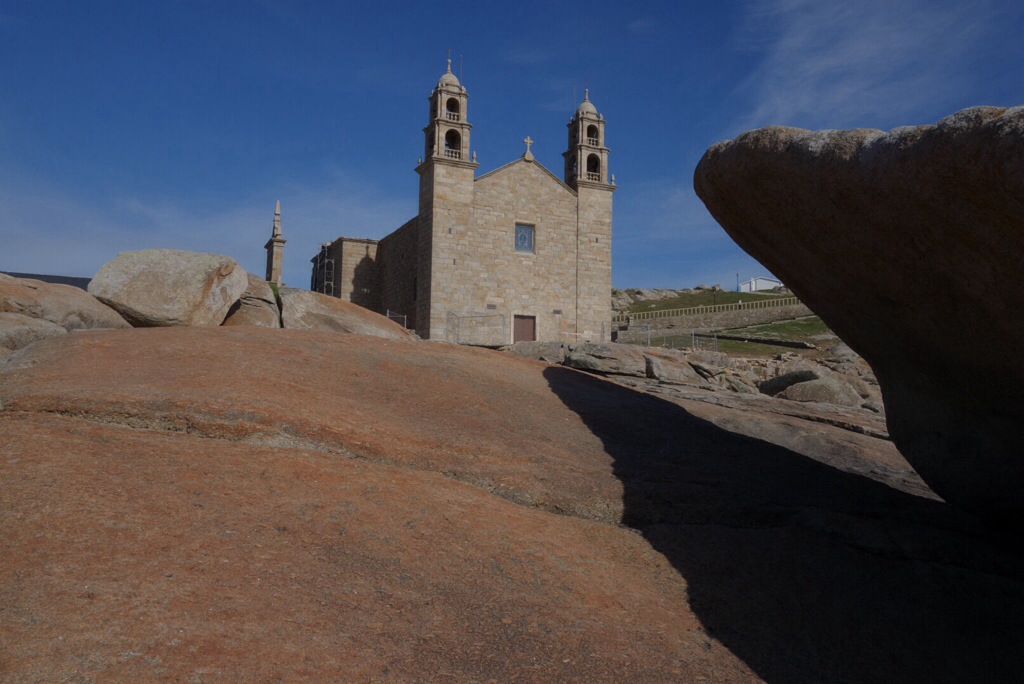
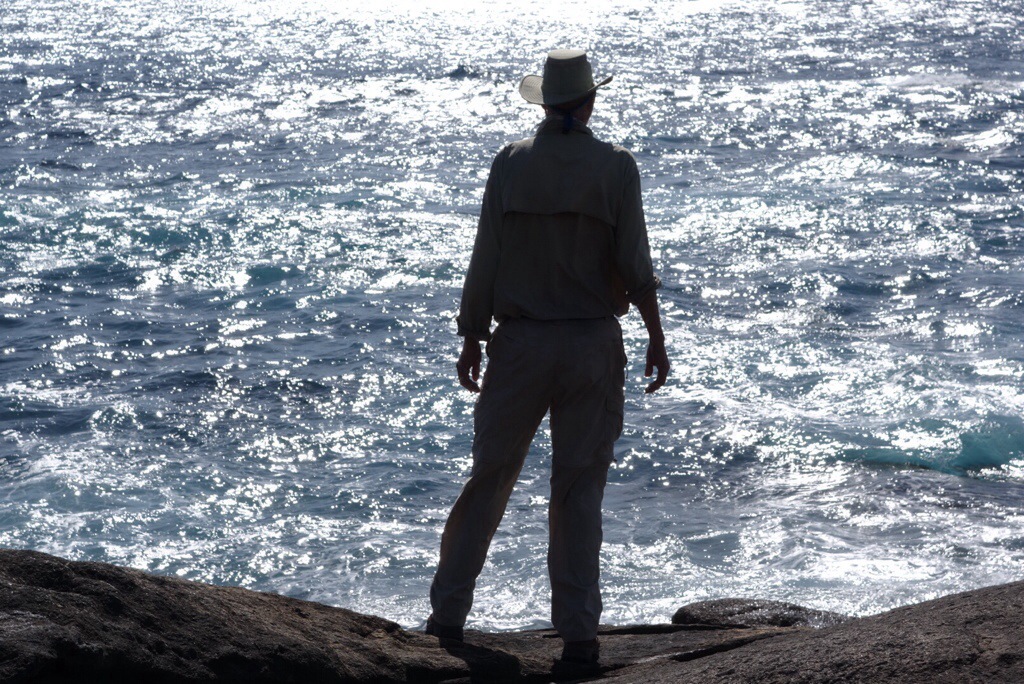
It was a hot and demanding day, but when I reached the fishing village of Muxia, I didn’t stop to shower or rest, but continued the final 800 meters to the furthest point, where massive stone slabs slide into the surf, and the Santuario da Virxe da Barca (Virgin of the Boat) faces the setting sun.

Here my Camino came to an end.

20140515-194750.jpg

20140515-194955.jpg

20140515-195019.jpg

20140515-195233.jpg

Arrival

Always keep Ithaca fixed in your mind.
To arrive there is your ultimate goal.
But do not hurry the voyage at all.
It is better to let it last for many years;
And even to anchor at the island
when you are old,
rich with all you have gained
on the way,
not expecting
that Ithaca will offer you riches.

Ithaca has given you
the beautiful voyage.
Without her you would have never
set out on the road.
But she has nothing more to give you.

– Constantine Cavafy

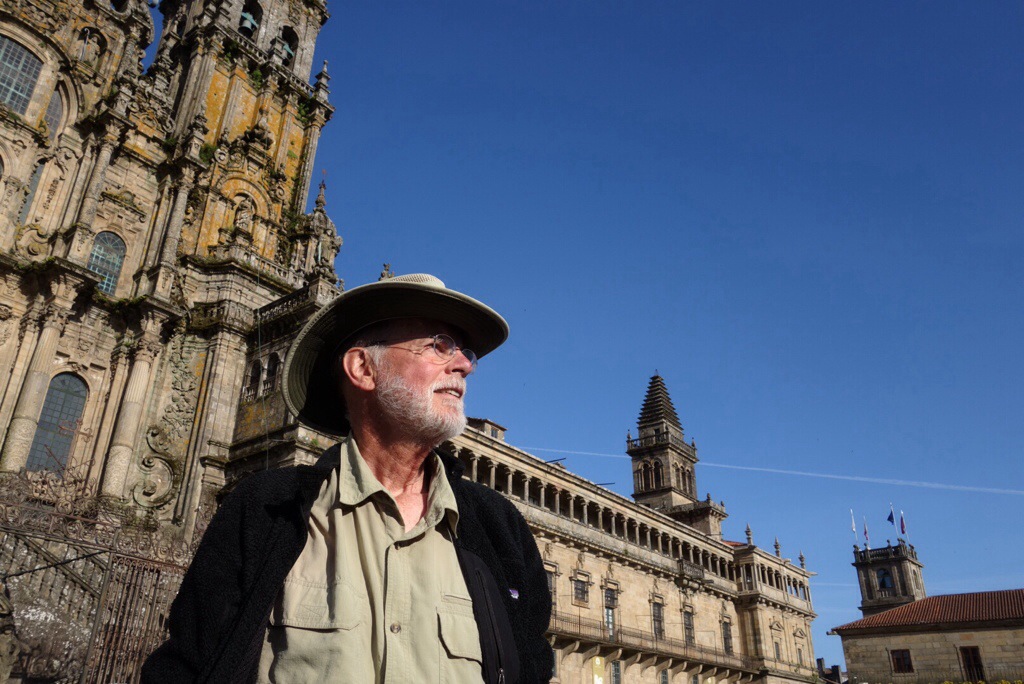
It was still dark Sunday morning when I first stepped into the Prazo Obradoiro – the wide plaza in front of Santiago cathedral. It was deserted but not silent. A taxi sat motionless in the far corner, idling its engine, waiting for what? After ten minutes it finally departed. The new day began to light the spectacular west facade, but one of its towers was hidden by scaffolding – had I walked 500 miles only to see its glory veiled?

I had told myself along the way to have no script for this moment, no expectations for my journey’s end. But this first glimpse of the cathedral, if not exactly disappointing, was at least bewildering. Where were the tears of joy, the flood of emotions? The cathedral’s great bell struck seven, deep and resonant like the voice of a god, but in a language dark and alien, not addressed to me.

Before the crowds arrived, I drifted around the quiet interior. I placed my hand in the Tree of Jesse, the carved central pillar of the Portico de Gloria, my fingers sinking into the deep handprint left in the stone by the caress of countless pilgrims. I descended to the crypt to kneel before the silver casket containing James’ bones. But I was granted little sense of arrival or completion.

Returning to the plaza, now bright with sunlight, I saw a large group of Portuguese pilgrims, singing, clapping and dancing in a great circle. “Resucito!” they sang. “Alleluia!” Many other pilgrims had joined this joyous perechoresis , and I did the same. My heart began to lift, as I remembered – just in time – that the Camino experience is not a possession to be grasped, but a communion to be danced. Lord, I want to be in that number!

But as the day went on, my Camino still seemed unfinished. I felt rather disoriented, no longer walking toward certain goals, no longer sure how even to spend the afternoon. I went to the crowded pilgrim mass at noon, saw the celebrated “Botafumeiro” (gigantic thurible) swing back and forth between the transepts, exchanged “well done!” with a few pilgrims I recognized from the road. But most of my Camino family had either already arrived and departed, or were still a few days back. I felt a bit lonely.

Late afternoon, I wandered over to the little visited San Martino Pinario, and walking inside felt like falling in love. Set amid its plain walls was the most breathtaking altar, a Churrigueresque ensemble of golden sculpture and ornamentation that worked emotionally in a way that so many baroque altarpieces do not. The declining sun streaming through it from behind intensified the effect. This was not mere showy theatricality, but an overwhelming physical presence that didn’t just symbolize belief. It created it.

Back outside the church, I spent some time making camera studies of the fantastically dynamic staircase that leads down to the entrance from the street (an evocative reversal of the more typical ascent to holy places – here you descend to go deeper). And I suddenly realized I was happy. I would even call it a state of grace. I didn’t earn it, seize it, discover it. It discovered me.

After that, it was enough to wander the old streets and plazas around the cathedral, noticing the pilgrim joy in the faces of strangers, enjoying the sense of celebration that is perpetual in this city of arrivals. I dined with some companions of the road before ending the day as I had begun it, in the darkness of the Prazo Obradoiro. But now the moon shone down upon the ancient stones, and strains of Galician singers filled the air. What more could I ask?

This morning I performed the final Camino ritual: climbing the stairs behind the altar to hug the gleaming metal effigy of Santiago. Despite the cool hardness of the sculpture, it was strangely comforting. I whispered in the saint’s ear: “Thank you for the beautiful voyage.”

20140512-105407.jpg

20140512-105457.jpg

20140512-105635.jpg

20140512-105658.jpg

Songs to sing and tales to tell

And when my journey’s finally over,
when rest and peace upon me lie,
high o’er the roads
where we once traveled,
silently there my mind will fly.

– “Parting Friends”

This is one of the many shape note songs I sang along the Camino. I also sang hymns for Holy Week and Easter, made every tunnel and underpass echo with Kyries and Alleluias, and on a few evenings when a guitar got passed around in a hostel, taught choruses from Steve Earle’s “Pilgrim” (“we’ll meet again on some bright highway, songs to sing and tales to tell”) and Tom Russell’s “Guadalupe” (“I am the least of all your pilgrims here, but I am most in need of hope”). And several times a day I would break out with “Dum pater familias,” the medieval Latin song for St. James that rallied the spirits of the pilgrims who sang it as they walked. Prior to headphones, singing was an important part of the pilgrimage experience – shared voices imprinting the path with songlines.

On my penultimate day, the words of “Parting Friends” are especially apt. My mind indeed flies back over the roads I’ve traveled and the people I’ve met. Previous posts have mentioned some of these, but let me record three more who have embodied for me the spirit of the Camino.

The first is Janine, the hospitalera who welcomed me and six other pilgrims to a humble albergue in Calzadilla de los Hermanillos, a village lost in the vast Meseta like a small boat adrift at sea. In a place forgotten by time and history, this grandmotherly woman provided the most exquisite hospitality, as if we were her own family. The next morning, she saw me off with a blessing. Pointing to her “corazon” and mine, she indicated that we were connected. Then she made a walking motion with her fingers and said, “Buen Camino.” She repeated this touching ritual with each of us. Like saints of old doing good in lonely outposts for no earthly reward, she simply existed to love the stranger.

Then there is Tomas, who has occupied a tiny abandoned village in the mountains near the Camino’s highest point and created, in an eclectic assemblage of flags, signs, sculptures and makeshift structures akin to outsider art, a haven for pilgrims seeking a tranquil respite by day, one of his 35 mattresses by night, or shelter from the storm anytime it’s needed. Whenever he sees a pilgrim approaching, he rings a temple bell to greet and bless them. If a cloud covers the mountain with fog and darkness, he rings the bell to guide lost pilgrims to his safe haven. This is his life: to live as a hermit in order to serve the pilgrim.

Finally, on a shady trail through a eucalyptus grove yesterday, I saw a young man kneeling in the dust to pray before a wayside cross. I don’t know his name or his story, but the evident depth of his devotion reminded me how serious a matter the Camino can be.

And now I am at the outer edge of Santiago, in a quiet albergue with very few occupants. Most pilgrims who get this far simply continue on to the great cathedral less than an hour’s walk from here. But I didn’t want to drag myself to the finish late in the day, wearied and worn by ten miles of walking. I want to arrive fresh and renewed, to finish my Camino in the light of the rising sun on the day of Resurrection. So like Jacob of old, who camped just short of his destination in order to collect himself for the morrow’s big encounter, I shall rest and reflect and – who knows? – maybe wrestle with angels till daybreak.

20140510-190017.jpg

Surrender

Yesterday morning, having walked a couple of hours as the rising sun burned away the fog, I stopped for breakfast in a serene cafe setting of lawn and trees. Soon David, an Irishman I bunked with a couple of weeks ago, came by, followed by an American (from Seattle!) who slammed his pack down and whined loudly, “Why did they make us take that pissy little trail when we could have stayed on the road?” He was referring to a steep shortcut that took pilgrims safely off a blind curve. It wasn’t long, but the footing was tricky.

David replied softly, “The Camino wants you to go its way, not your own.” And I chimed in, “The Camino is all about surrender.” The poor man had no reply. He was a newbie, one of the many who had only recently joined the trail to rack up the minimum 100 final kilometers required to earn a “Compostela” – the treasured certificate of completion. He hadn’t yet put in enough mileage to have the willfulness walked out of him.

But can I, having now trod 478 miles in 31 days, really claim any kind of illumination or transformation as a result? I still get annoyed by the loud and incessant talkers who mar the tranquility, I still get angry when a speeding truck comes close to knocking me into a ditch. I have yet to perfect the pilgrim equanimity urged by my guidebook, which sees every irritation as the sand that produces the pearl. But at least I try to make these things part of my walking prayer. As the monks say of life in the monastery, “We fall down and get up, fall down and get up …”

Speaking of which, I took a fall today. After a month without a mishap, now but a day’s walk from Santiago, I tripped on a root and did a spectacular face plant: bloody nose, minor nicks and scratches, and broken sunglasses. A French woman and an American student stopped to help, and walked with me to the next town, where I found a room and cleaned up. I am fine, but it was odd that this occurred only minutes after I had paused at a touching trailside memorial for Guillermo Watt, a man exactly my age who had died there in 1993, just one day short of completing his pilgrimage.

These final stretches of walking have been especially lovely, reminiscent of the English countryside of the Romantics – low stone walls dividing leaf-shaded paths from sunny green pastures, as wandering clouds drift lazily overhead. While the degree of my spiritual surrender to the Camino may be difficult to measure, I have wholly surrendered to its beauty.

20140509-215039.jpg

20140509-215207.jpg

20140509-215227.jpg

The movement of hearts and souls

“We were … like travelers pondering the road ahead who send their souls on while their bones delay.”
– Purgatorio ii:10-12

58 miles – nearly 100 kilometers – in three days, with a wearying amount of elevation gain and loss, have made this portion the most physically demanding portion of my Camino. But whenever my spirit slackened, or knees complained, I only had to look around me. What splendid countryside! What fortunate walking!

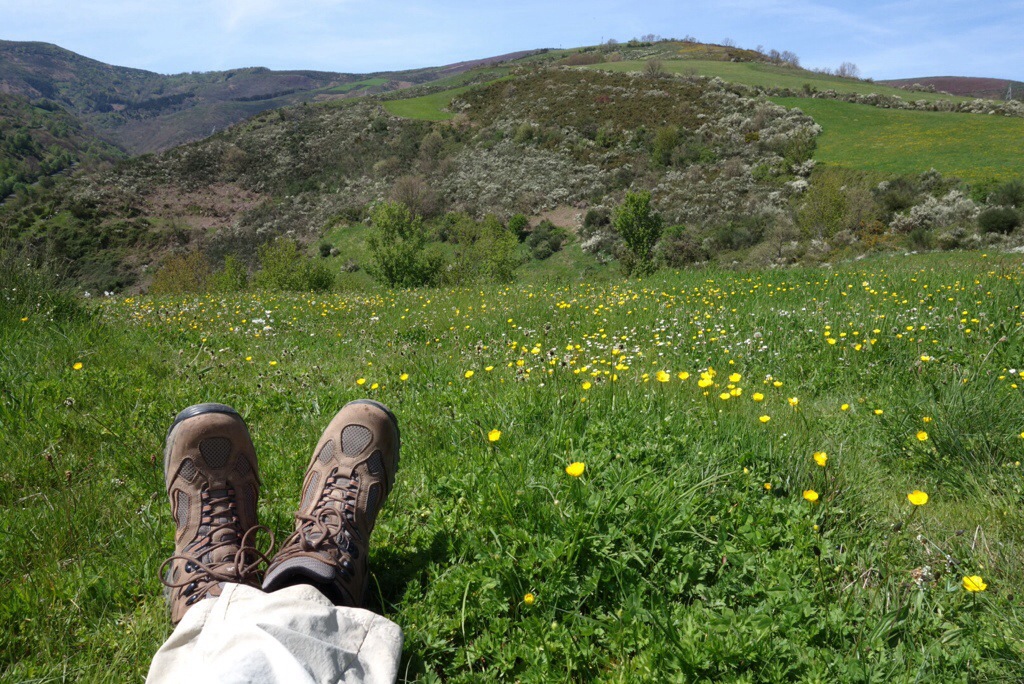
On the first long day, I began at sunrise in sight of snowy peaks, navigated (barely) a busy city, traversed a wide plain to the rolling wine country of El Bierzo, and finished in the picturesque river town of Villafranca. The next day took me up and down, then up again, steep-sided ridges of red and white flowering shrubs and the fresh spring green of chestnut groves. After the last hard climb, I lay down in a high meadow of buttercups and daisies to read Wordsworth’s lines about “the calm existence that is mine when I am worthy of myself.” A few more steps put me in the Celtic region of Galicia, land of stone houses, damp weather, and lingering traces of premodern spirituality and culture. I spent the night in the quaint mountaintop village of O’Cebreiro.

My third 20 mile day was a charming medley of rivers , woods and birdsong, until I reached the monastery of Samos, one of the oldest and largest in the western world. Situated in an isolated valley reminiscent of Shangri-La, the imposing collection of buildings, plain and austere on the outside, contains a magnificent Baroque church, an immense garden cloister in the classical style and, covering three long walls of an upper portico, a 1960 mural of obscure saintly miracles. Its wild, unsettling intensity seemed to contradict the ideal of monastic balance, as if the community’s shadow side had been somehow consigned to these painted walls, a la Dorian Gray. In any case, the monks, sans shadow, sang a lovely vespers to restore the body and soul of weary pilgrims.

And tonight, the third Tuesday of Easter, I am writing in a “casa rural,” a traditional stone farmhouse accommodation where I hung my laundry among grazing cows and am enjoying a spacious bedroom overlooking the chickens – a restful change from last night’s monastic dorm with 40 people. Over dinner with the other three guests in the house, all of them Americans who have worked for good in Third World countries, we immediately discovered a number of remarkable connections between us. With the rapport, even intimacy, of old friends, we spent the next three hours conversing about the meaning of our own Caminos. When I had trudged an extra two kilometers past the last town, up a steep hill in the middle of nowhere, hoping I could just find a bed at this place, I did not know I was being led to such a holy meeting, such a convergence of thoughtful and passionate souls. Grace happens.

Halfway to Santiago, a Camino friend was feeling some pain and discouragement on a particularly demanding stretch. But then he saw a handwritten sign: “Don’t give up before the miracle.” As far as I know, he is still on the Camino, along with his vision-impaired son, though they have fallen a few days behind me. May they find, as I have, that there may be more than one miracle along this Way. Tonight was one of them.

As I myself draw near the goal, now less than 100 kilometers from Santiago, my thoughts turn to those who were unable to complete their intended journey. I have seen many memorials on the Camino to pilgrims who died at a particular spot. These crosses, cairns and fading photographs have signified the precariousness of every journey, the preciousness of each day we are given to walk in beauty. I have also shared the path with pilgrims who had to drop out due to physical problems. In Dante’s expressive image, their hearts reached for Santiago, but their bones delayed.

One of these was Monty, a devout Catholic from Nebraska, who walked with severe foot pain every day for two weeks until he finally had to give up. He always started before dawn, while the rest of us slept, so he could match our progress at a slower pace. Monty is one of my Camino heroes, not only for his determination and grit, but for the way he valued the community he had fallen in with. He suffered in order to maintain the connection.

He was able to take a train to Santiago before flying home, where his doctor told him that continuing to walk would have been disastrous. Some might regard his journey as incomplete, but not Monty. Here’s what he wrote to what he called his “Camino family”:

“With sleep apnea, asthma, one artificial knee, and one arthritic knee, I knew from the beginning that my chances of walking the enire distance were slim. I could have started someplace else, but then I wouldn’t have met you. Each of you, in your own way, made my Camino special, and I am grateful. It was never about the paper, and if I finished by train I still walked about 200 miles.

“A friend of mine who is also one of my favorite priests said this: ‘A pilgrimage is not measured by the movement of the feet, but by the movement of hearts and souls.’ By that standard, I had an outstanding pilgrimage, and I walked long enough to find what I didn’t even know I was looking for.”

20140507-110913.jpg

20140507-110959.jpg

20140507-111058.jpg

A mountain day

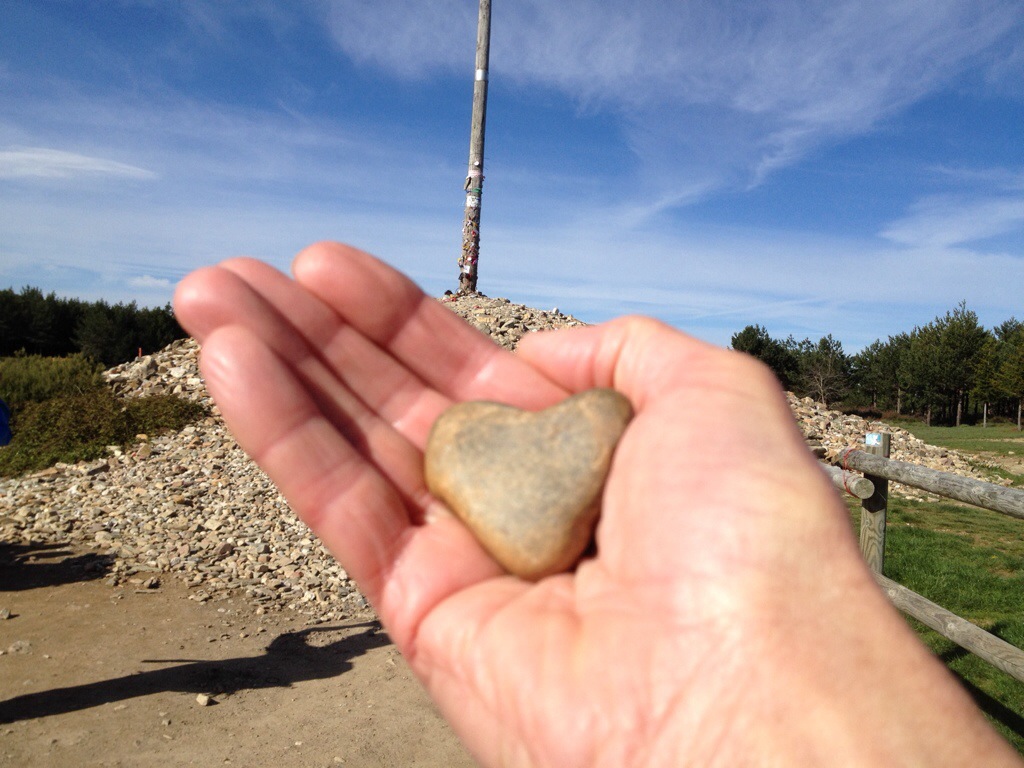
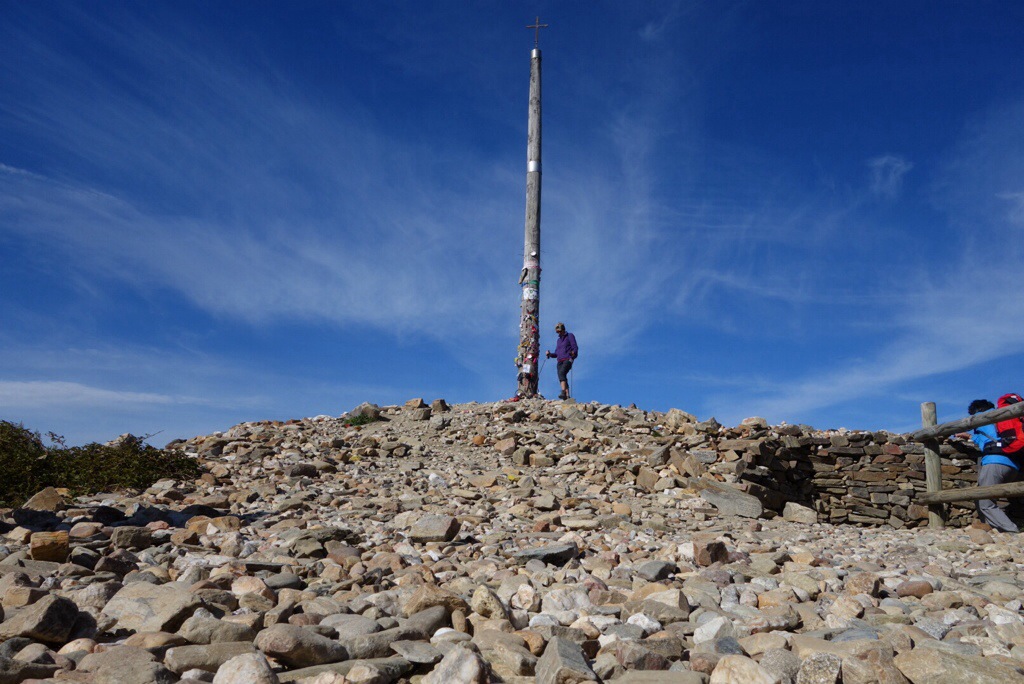
I climbed the mountain this morning to add my stone to the great pile left by pilgrims past at the foot of the Cruz de Ferro. Everyone was taking a turn on top of the rocks, striking a pose for the camera. Someone offered to take my picture, but I declined. To me the ritual of offering was not a matter of the public self, but of disappearing, at least for a moment, into something larger.

And from there it was the most strikingly beautiful day of the Camino so far – brilliant light, a profusion of spring color, a backdrop of snowy peaks, and grand views of where I have been and where I am headed.

20140502-212527.jpg

20140502-212556.jpg

20140502-212639.jpg