Season of mists and mellow fruitfulness, Close bosom-friend of the maturing sun; Conspiring with him how to load and bless With fruit the vines that round the thatch-eves run; To bend with apples the moss’d cottage-trees, And fill all fruit with ripeness to the core …
— John Keats, “To Autumn”
October light! October color! Ripeness to the core! We share the poet’s pleasure in this season of earthly delight. But we know it will not last. As one of the earliest English poets put it over a millennium ago:
A little while the leaves are green; then they fallow again, fall to the earth, and die, turn to dust.
The falling leaf is an ancient trope for decline and fall, and we mortals tend to take it personally. “I have lived long enough,” lamented Shakespeare’s Macbeth:
… my way of life Is fall’n into the sere, the yellow leaf; And that which should accompany old age, As honour, love, obedience, troops of friends, I must not look to have.
Yes, of course. We know where this autumnal existence is headed. Even the finest October day contains the seeds of melancholy. The cold and the dark draw near. But if we can take the long view, these too shall pass.
Pamela Steed Hill says this so poignantly in her poem, “September Pitch”:
Mama, the autumn is deep. Its pitch is only beginning, and will brighten before the end. Brighten into darkness, or into spring.
Here in America, the darkness is already here. As we approach the most consequential—and potentially catastrophic—election of our lifetime, we wonder whether our present world can in fact brighten into spring. If there ever were a time to keep the faith, it is now.
A few days ago I happened to hear on the radio a beautiful autumn song by Jennifer Cutting, encouraging us to move into the unknown with a trusting spirit, come what may.
To know the joy of letting go The giddy flight of falling Surprise at softly landing so Among the leaves of autumn
And though the last refuse to fall And cling for fear of changing October overcomes our song Among the leaves of autumn
O bitterness can shrivel dead What gratitude made rosy The brown leaves curl beside the red Among the leaves of autumn
What was will never be again What will be is uncharted What’s now is change, so let’s begin Among the leaves of autumn
I have set the song link between autumnal images, which I invite you to contemplate as you listen. Grace and peace to you in this season of change.
On November 5th, Guy Fawkes Day, the citizens of Great Britain will celebrate the defeat of a conspiracy to overthrow the political order in 1605. Thirty-six barrels of gunpowder hidden beneath the House of Lords were discovered before they could blow King and Parliament to kingdom come, and the plotters were brought to justice.
Also on November 5th, the citizens of the United States will vote whether to thwart or assist the overthrow of their own political order. Democracy itself is on the ballot, and the party of insurrection is determined to blow it up. If the latest polls are accurate, they have a fair chance of success.
Seventeenth-century England and twenty-first century America are dissimilar in countless ways, but the Gunpowder Plot of 1605 and the Presidential election of 2024 have one crucial thing in common: the toxic social effect of equivocation.
When the seventeenth century began, “equivocation” was a neutral, rarely used term for statements deemed ambiguous. But in the aftermath of the Gunpowder Plot, it became a widespread byword for deceitful speech. The term’s sudden prominence was triggered by the discovery of the plotters’ handbook, A Treatise of Equivocation, which detailed various ways for persecuted Roman Catholics to lie under oath without endangering their conscience.
When Catholic worship and practice were being suppressed after the English Reformation, the Roman faithful needed to conceal from the authorities the presence of priests and the saying of masses in their private homes. If asked, they could equivocate: give ambiguous or incomplete answers, or practice “mental reservation”—speaking aloud partial truths, while retaining in their minds any bits which might get them into trouble. As long as you speak the whole truth in your mind, where God can hear it, leaving your inquisitor in the dark is not a sin. In other words, the Treatise argued, it is possible to lie without guilt.
In a time when Roman priests were being hunted down and threatened with prison or the gallows, such equivocation was understandable. We do not fault the Dutch family who lied about Anne Frank hiding in their secret annex. But as the Gunpowder Plot made clear, social stability was not a given in the early days of King James’s reign. However, neither factions, plots, religious difference or the clash of ideas seemed the greatest threat to common life in Britain. The greatest threat was thought to be equivocation, the solvent of bad faith which dissolves communal trust. As an English court put it a few years after the insurrection was foiled:
“The commonwealth cannot possibly stand if this wicked doctrine be not beaten down and suppressed, for if it once take root in the hearts of people, in a short time there will be no faith, no truth, no trust … and all civil societies will break and be dissolved.” [2]
The Earl of Salisbury, responding to A Treatise of Equivocation with a book of his own, An Answer to Certain Scandalous Papers, warned against “that most strange and gross doctrine of equivocation,” which would “tear in sunder all the bonds of human conversation.” [3]
A similar anathema was issued from a London pulpit:
“He that lyeth doth deprive himself of all credit among men (for they will also suspect him to be a liar), so that he that once deceiveth his neighbor by equivocation, shall always be suspected to equivocate … If deceit by equivocation be used, then all covenants and contracts between man and man must cease, and have an end, because all men will be suspicious of one another … So, no commonwealth can stand, no civil society can be maintained.” [4]
The nightmarish world of Shakespeare’s Macbeth, written just after the Gunpowder Plot, dramatizes the dread of social disintegration, as even the more admirable characters find themselves “unspeaking” truth. “Fair is foul and foul is fair,” cry the weird sisters at their cauldron of deconstruction. Once language begins to mean anything and nothing, civil discourse is mortally wounded, and it is not just Macbeth who begins “to doubt th’ equivocation of the fiend / That lies like truth.” [5]
Shakespearean scholar James Shapiro notes that the moral chaos of the play is draining not just for the characters but for the audience as well:
“Equivocation makes following Macbeth’s dialogue a mentally exhausting experience, for playgoers—much like those conversing with equivocators—must decide whether a claim should be accepted at face value, and, if not, must struggle to construct what may be suppressed through mental reservation. But with equivocators, one never knows what, if anything, is left unspoken.” [6]
In the American election of 2024, we are well acquainted with the fiend that lies like truth. “Fair is foul, and foul is fair,” cry the weird brothers Trump and Vance, poisoning our national speech and our common life like there’s no tomorrow. The lying is in their natures—it’s who they are: hollow men without principles, shapeless hulks of impulse and ambition. But their lying, a weapon as destructive as gunpowder, is also an instrument of power. If truth and trust can be blown to bits, the weird brothers will be free to soar beyond accountability into a realm of naked, unfettered tyranny.
It will not go well for them. As Dante assures us, the lowest place in Hell is reserved for the fraudulent, because fraud is the polar opposite of love. Love nurtures community. Fraud disintegrates it. Dorothy Sayers’ eloquent notes on Dante’s Inferno describe the bleak endgame for the ones who are only in it for themselves:
“Beneath the clamor, beneath the monotonous circlings, beneath the fires of Hell, here at the center of the lost soul and the lost city, lie the silence and the rigidity and the eternal frozen cold. It is perhaps the greatest image in the whole Inferno … A cold and cruel egotism, gradually striking inward till even the lingering passion of hatred and destruction are frozen into immobility—that is the final state of sin.” [7]
Gustave Doré, Dis frozen in the lake of ice (1861). Immobilized in the pit of hell, the prince of lies is trapped in wordless solitude, dis-connected from every form of relation.
The evils of Trumpworld have multiplied ceaselessly over the years: tens of thousands of unnecessary Covid deaths, families torn apart at the border, political violence, the abuse of immigrants and women, the corruption of the Supreme Court, the stoking of anger, racism and hate, the relentless erosion of social bonds, the corrosive degradation of the rule of law, et cetera, et cetera. And so much lying. J. D. Vance’s gleeful admission that he invented the terrible stories about immigrants eating pets is just the latest example of a shamelessly destructive addiction to untruth. These people don’t care how many people they hurt.
It’s exhausting. That too is part of the Trump/Vance strategy. We’re supposed to grow weary and discouraged in the face of their unrelenting and senseless chaos. I find an apt metaphor for this moment of American politics in Washington Irving’s account of a transatlantic voyage in the early nineteenth century. Traveling by land, he said, keeps us connected with a sense of where we are and where we’ve come from.
“But a wide sea voyage severs us at once. It makes us conscious of being cast loose from the secure anchorage of settled life, and sent adrift upon a doubtful world. It interposes a gulf not entirely imaginary, but real, between us and our homes—a gulf subjected to tempest and fear and uncertainty, rendering distance palpable, and return precarious.” [8]
Winslow Homer, The Gulf Stream (1899/1906).
Irving’s harrowing journey took about as many weeks as we have left until the election. Sail on, friends, sail on. It is my hope that come November 5th, we will anchor once again in safe harbor, put the chaos behind us, and begin to mend the torn fabric of our common life.
In the meantime, citizens, we all have some serious work to do.
[1] Dante Alighieri, Inferno xxxi, 55-57, translated by Mary Jo Bang. Dante is explaining why the Creator made large creatures like elephants and whales, but abandoned the making of giants. Intelligence, granted too much size and power, could do great damage if corrupted.
[2] James Shapiro, The Year of Lear: Shakespeare in 1606 (New York: Simon & Schuster, 2015), 158.
[7] Dorothy Sayers, commentary on her translation of Inferno, quoted in Helen Luke, Dark Wood to White Rose: Journey and Transformation in Dante’s Divine Comedy (New York, Parabola Books, 1989), 41.
[8] Washington Irving, The Sketch Book of Geoffrey Crayon (1819-1820), quoted in David McCullough, The Greater Journey: Americans in Paris (New York: Simon & Schuster, 2011), 12.
William Blake, Oberon, Titania, Puck & Fairies Dancing (1786)
“The tables outside the cantina were full of beautiful laughing men and women. I didn’t like the cantina at night: it was hard to book a table, and everyone who sat there looked on display, the women in their lovely summer dresses, the men with their hair oiled back on their heads, their tanned bare feet resting proprietorially on top of their Gucci loafers. One wanted to applaud them for presenting such a successful vision of life: you could almost believe they had lived their whole lives, had been reared and groomed from birth, for this one particular night: that this was the pinnacle, this golden summer evening they had all reached simultaneously.
“Yet it made me a little sad to see them there, laughing and drinking champagne, for you knew it was all downhill from here.”
The beautiful laughing men and women in Cameron’s cantina do not arouse our envy. Their self-display seems shallow, narcissistic and unreal. They appear ignorant of time. Golden summer evenings do not last forever. Having achieved the pinnacle, what Wallace Stevens called “the barrenness of the fertile thing that can attain no more,”[ii] they have nowhere to go but down.
The traditional lore of Midsummer Eve shares this suspicion. To mark the year’s longest day, bonfires were lit on British hilltops to assist and encourage the sun at the outset of its long inevitable decline into the winter dark. And “Midsummer Night”—blessedly short—was said to be a time of both mischief and danger, when chaotic pressures cracked open the stability of the world and wild spirits were abroad.
In A Midsummer Night’s Dream, Shakespeare explores these themes with a complicated plot in which the normal order of the world is unraveled for a night, and confusion rules until the dawn. Rulers find their commands thwarted. Lovers aim their desire at mistaken targets. The beautiful queen of the fairies falls madly in love with a low-born mortal who, by magic spell, has the monstrous head of an ass. Puck, the fairy trickster, multiplies the mischief by both design and error. And even words of dialogue take on altered and contradictory meanings.
All this takes place in an enchanted forest, a wild, liminal state outside the civilized order, where societal assumptions and rules are suspended or reversed, hierarchies are overturned, and identities become fluid and changeable. As Bottom says to Titania, “reason and love keep little company together these days.”
In Shakespeare, such liminal spaces serve a critical purpose. Their disorder offers a freedom to reshuffle and reconsider accepted realities, inviting transformation at both a personal and social level. Removed for a time from the customary rules and roles, characters discover new possibilities for themselves and society before returning to “reality.”
However, once you leave your given world for a time, you can never again accept its reality as absolute. You realize that there is more than one way to do both the self and the world. Any single version of reality is but an alternative. In this sense, life itself is but a dream. This refusal to absolutize the given world is the foundation of social justice: we can live better lives and make a better world. It also, however, can open the door to irrationality and madness, exemplified by the millions who live, happily and hatefully, in the fact-free world of American fascism..
At the end of Shakespeare’s play, Puck delivers an epilogue to the audience, those “who have slumbered here, / While these visions did appear.” It’s all been a dream, he assures us, as if we had never really crossed the boundary into the transformative space of a visionary world.
But can we be so sure? Have we not ourselves been touched, perhaps even transformed? Within A Midsummer Night’s Dream, there is a play-within-a-play (the comically performed tragedy of Pyramus and Thisbe). The actors in Midsummer watch the actors playing actors in Pyramus, just as we the audience watch all these permutations from our safe position outside the “fourth wall” which separates the stage from reality. But are we so different from the players on the stage? As Shakespeare scholar Marjorie Garber writes,
“A play is a fiction, art is an illusion, ‘no more yielding but a dream.’ Can we be blamed if we wonder—now that we have been told that we are reality—when someone will wake and recognize that we are only a dream? Can we be blamed for looking over our shoulders, and wondering who is watching the play in which we are acting, while we watch, onstage, actors watching actors who play actors performing a play?” [iii]
Two weeks after Midsummer Eve, I saw a magical outdoor production of A Midsummer Night’s Dream at the Bloedel Reserve, an Arcadian refuge of woods and meadows on my island. Beginning before sunset, it utilized the fading of the day to intensify our immersion into the dreamworld. By play’s end, it was almost night. The narrow path across a rolling meadow to the exit prevented an immediate return to reality. For a few precious minutes more we lingered in the dream, making our ghostly procession of shadows in the twilight.
Every play comes to an end. Every actor must make an exit. I have no plans to do so any time soon (God willing). There are more lines to deliver! However, since I begin my ninth decade tomorrow, time may not be on my side—but it’s on my mind.
Medieval thinkers divided a human lifetime into “ages.” Some had just four: Childhood, Youth, Maturity, and Old Age. Isadore of Seville (c. 560-636) expanded that to six: infancy (up to 7), childhood (7-14), adolescence (14-28), youth (28-50), gravitas (50-70), and, for anything beyond 70, senectum (the same root as senior and senility).
[Of course, senectum is a hot topic in this election year. Is the President too old to govern? Perhaps a better question would be: Why can’t the other guy act his age? As the Bible says, “Woe to you, land, if your king is a child!” (Ecclesiastes 10:16). But I digress.]
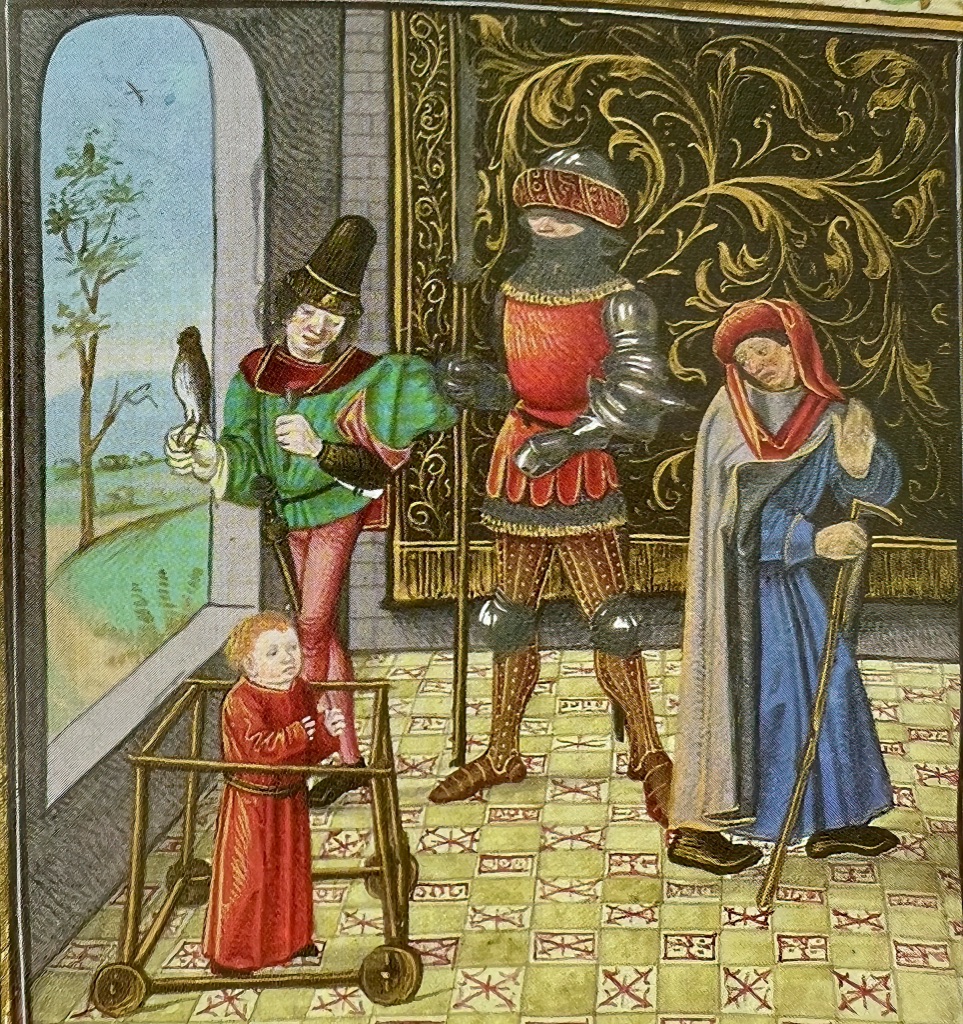
Bartholomaeus Anglicus, The Four Ages (1467-1475)
In this fifteenth-century illumination by Bartholomaeus Anglicus, the four ages of the human life-cycle stand in the same room, as if each of us is all the ages we have ever been. Childhood is clothed in red, the color of sanguinity (eager hopefulness). Youth is into fashion and sports, while Maturity dresses for battle. Old Age, warmly attired for the wintry years, glances back at all his past selves, hopefully with gratitude rather than regret.
Bartholomaeus Anglicus, The Seven Ages (1482)
A later image by the same artist depicts seven ages standing in two groups. On the right, Childhood plays with a stick and ball, Adolescence clasps his schoolbooks, and Youth carries a spear, perhaps dreaming of competitive glory. The first three stages of Maturity are not radically distinct from one another, but Old Age, shorter and bearded, is starting to separate his body from the group. Yet he still keeps an eye on the Child he once was.
Idleness, Dunois Book of Hours (c. 1439-50)
Time is a gift, and I am truly grateful for my years so far—the dreams as well as the realities. Je ne regrette rien. As for the road ahead (even if it’s all downhill), I wish not to be the man on the donkey, idly dozing along the pilgrim way. Like the figure gazing at the view from the bridge, I want to keep taking it all in. As an old man advised a younger friend in Henry James’ The Ambassadors:
“Live all you can; it’s a mistake not to.”
[i] Peter Cameron, Andorra (New York: Farrar Strauss Giroux, 1997), 149-150.
I just saw King Lear at the National Theater of London – via an HD broadcast at a Seattle cinema. Directed by Sam Mendes, with Simon Russell Beale in the lead, it had some fresh approaches, with mixed success. But for all that worked or didn’t work for this playgoer, the power of the text remained intact, just as the validity of the mass is independent of the presider’s worthiness.
The play’s opening crisis turns on Cordelia’s refusal to join in her sisters’ ‘glib and oily’ flatteries of their father the king. Lear, sensing the imminent waning of his vitality and power, has an insatiable need for reassurance, but the one daughter who truly loves him refuses to play that hypocritical game. The filial bond, she insists, goes without saying. In fact, no words can do it justice. Better to remain silent than say something inadequate or inexact. If only she had compromised a bit, tossed some verbal meat to her famished parent, she might never have come ‘between the dragon and his wrath.’ But she is as proud and stubborn as her sire, and so the dysfunctional Lear family begins to implode, plunging the kingdom – and all sense of stable, coherent reality – into the abyss.
Clare Asquith, in her controversial book Shadowplay, finds Shakespeare’s dramas full of pro-Catholic allusions and references to the political and religious situation of his time. The figure of an unwise ruler offered a salutary warning to James I, whose stern policies of religious conformity endangered English unity; Lear’s need for his daughters’ professions of loyalty mirrored the judicial interrogations of suspect Catholics and Puritans; the virtuous Edgar’s flight into wilderness and disguise suggested the plight of the Jesuit priests preserving the persecuted old faith in secret hiding places. Mendes’ version contains its own timely references, from the waterboarding torture of Gloucester to the implicit diagnosis of Lear’s madness as Lewy dementia.
But if the play were only “contemporary,” whether for a seventeenth-century audience or a twenty-first, it would not have the same power to haunt and trouble us. King Lear, in Martin Esslin’s words, provides “an image of aging and death, the waning of powers, the slipping away of our hold on our environment.” These are universals of the human condition, the dark foundation upon which any spirituality must be constructed. But even when we try to salvage something from the wreckage (Did Lear learn and grow from his suffering? Does it matter that two good men, Edgar and Kent, outlived the tragedy to bear witness?), the apocalyptic storm on the heath, reducing all our certainties to ‘nothing’ (a word repeated many times throughout the play), continues to echo long after the curtain falls.
But in the National Theater broadcast, there was no time for the themes to resonate once the play was done. After Edgar’s mournful speech (“The weight of this sad time we must obey, / Speak what we feel, not what we ought to say…”), the stage went black. But before we could even begin to measure the weight of tragedy, the London audience began to applaud, the lights came up again, and the players, now smiling, returned to the stage to take their bows. Their characters had vanished, replaced by the contemporary personalities of the actors themselves. Such hasty return to ordinary life felt unseemly. Could we not linger in Lear’s universe a moment longer, let the emotion begin to settle and subside before politely pretending we had not just been ripped apart by the howling storm of Shakespeare’s text?
When, years ago, I saw Theatre du Soleil’s legendary production of Richard II, such a transition was in fact provided, for which I have always been grateful. The French company had performed in whiteface, with costumes and ritualized movements drawn from Japan’s kabuki theater. The ceremonial strangeness of the production utterly removed us from any sense of the familiar or natural. If we were not actually transported to a medieval Neverland of ritual and transcendent constraints, it certainly felt like it. And after the play’s stunning, tragic conclusion, the company took care not to wake us too quickly from that dream.
They did it by remaining in character. The whiteface still veiled their personalities, as any kind of mask does. While wearing a mask, you are not yourself, but the role. And their whitened faces remained intense and unsmiling, even as the applause thundered our Amen to the experience they had given us. It was still Richard and Bolingbroke on that stage, not some modern imposters. Even their bows, formal and liturgical rather than personal and spontaneous, prolonged the sense of gravity.
Performing arts, like religious ritual, strive to take us somewhere else, to give us something we might not receive in any other way. But too little attention is given to the transitions between ordinary life and the concentrated/consecrated space of a performance, whether artistic or liturgical. How does the environment we enter help us prepare for what is to come? And when the “play” is over, is there a way to linger, absorb, and reflect before it melts into thin air? I once saw Zubin Mehta, after conducting an emotional performance of Mahler’s “Resurrection Symphony” (even the musicians were wiping their eyes) keep his arms raised for a full 20 seconds after the last notes subsided, finally lowering them ever so slowly, in order to preserve a proper silence just long enough. But most performances – and liturgies – simply end with a jump cut (no slow dissolve!) back into whatever we were calling reality. As though nothing had transpired. As though we had not been changed.
What if (as I witnessed after a screening of Robert Bresson’s heartbreaking Au Hasard Balthasar) an audience just sat in stunned silence, not talking or moving for several minutes? What if (as at every Sunday mass with the radiant monks and nuns of Paris’ St. Gervais) you arrived at church twenty minutes early to find a hundred people already there, engaged in silent prayer? What if (as is common after Holy Week liturgies) the congregation exited the church without a word, still wrapped in the mystery of divine presence?







 The religious imagineer