The Journey Ends: Durham Cathedral

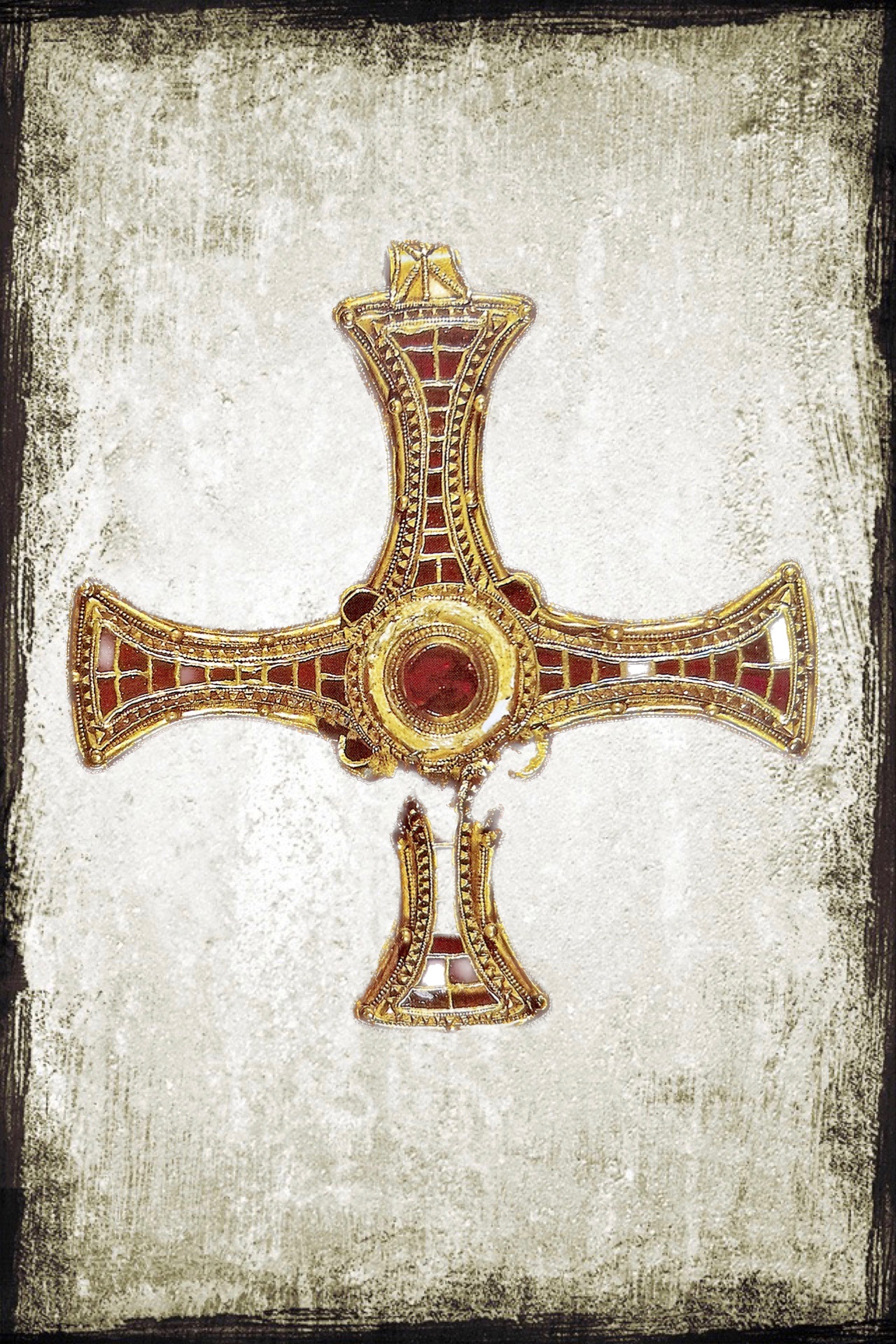
St. Cuthbert’s Cross (late 7th century). This pectoral cross of gold and garnet was found in St. Cuthbert’s coffin in 1827. It was hung around his neck, but whether he wore it in life is uncertain.

This is the third and final part of my pilgrimage account from St. Cuthbert’s Way and beyond. 
The previous installments can be found at these links: 

Walking St. Cuthbert’s Way

Grace and Beauty on Holy Island

The Journey, Fenwick Lawson (2008).
The original wooden sculpture of the Lindisfarne monks carrying Cuthbert’s coffin to safety is in St. Mary the Virgin on Holy Island. This bronze version is in Durham’s Millennium Square, below the cathedral where Cuthbert’s long journey ended at last. It seems a bit lost in the bleak vacancy of the square’s secular space (an effort to move the 2.5 ton sculpture to the cathedral grounds failed), but that makes it a parable of the Church in an age of religious displacement, wandering in search of an abiding home. The change-ringing bells were sounding from a nearby church when I shot this video.

“By faith … he set out without knowing where he was going … 
He looked forward to a city with firm foundations, 
whose architect and builder is God.” (Hebrews 11:9-10)

After the peripatetic St. Cuthbert died in his island hermitage, his body continued to wander for nearly nine centuries: to the mainland for burial in the monastery church (687) … into a newly built sepulcher (698) … inland to various temporary hiding places during 8 years of Viking terror (875-883) … under the protection of a new regional king, to Cuncasestre (Chester-le-Street), where a new church held his shrine for 112 years (883-995) … fleeing new Norse threats, south to Ripon for 4 months (995) … north to Wrdelau, near the River Wear, where the coffin-bearing cart broke down, as if the saint himself were refusing to go any further (995, for 3 days of prayer for guidance) … spurred by a vision (or was it the assistance of a dairymaid searching for her cow?), the saint’s entourage moved his remains to the nearby Dunholme (“Hill Island”), a naturally protected peninsula rising above a loop in the river, where they built a rough shelter (995-999) … then into a succession of more permanent structures on Dunholme (999-1069) … after 70 years, under threat from William the Conqueror, the Norman king who was “harrying the north,” a brief return to his old monastery at Lindisfarne (1069-1070) … back to the church on Dunholme, where Durham was becoming a major English settlement (1070-1104) … translated into a shrine behind the high altar in the completed east end of the great Norman cathedral-in-progress (1104) … moved into a more richly embellished shrine set upon a raised floor (1280) … after the stripping and destruction of the shrine under Henry VIII, reburied in an unadorned vault in the same location (1542), where it remains to this day.
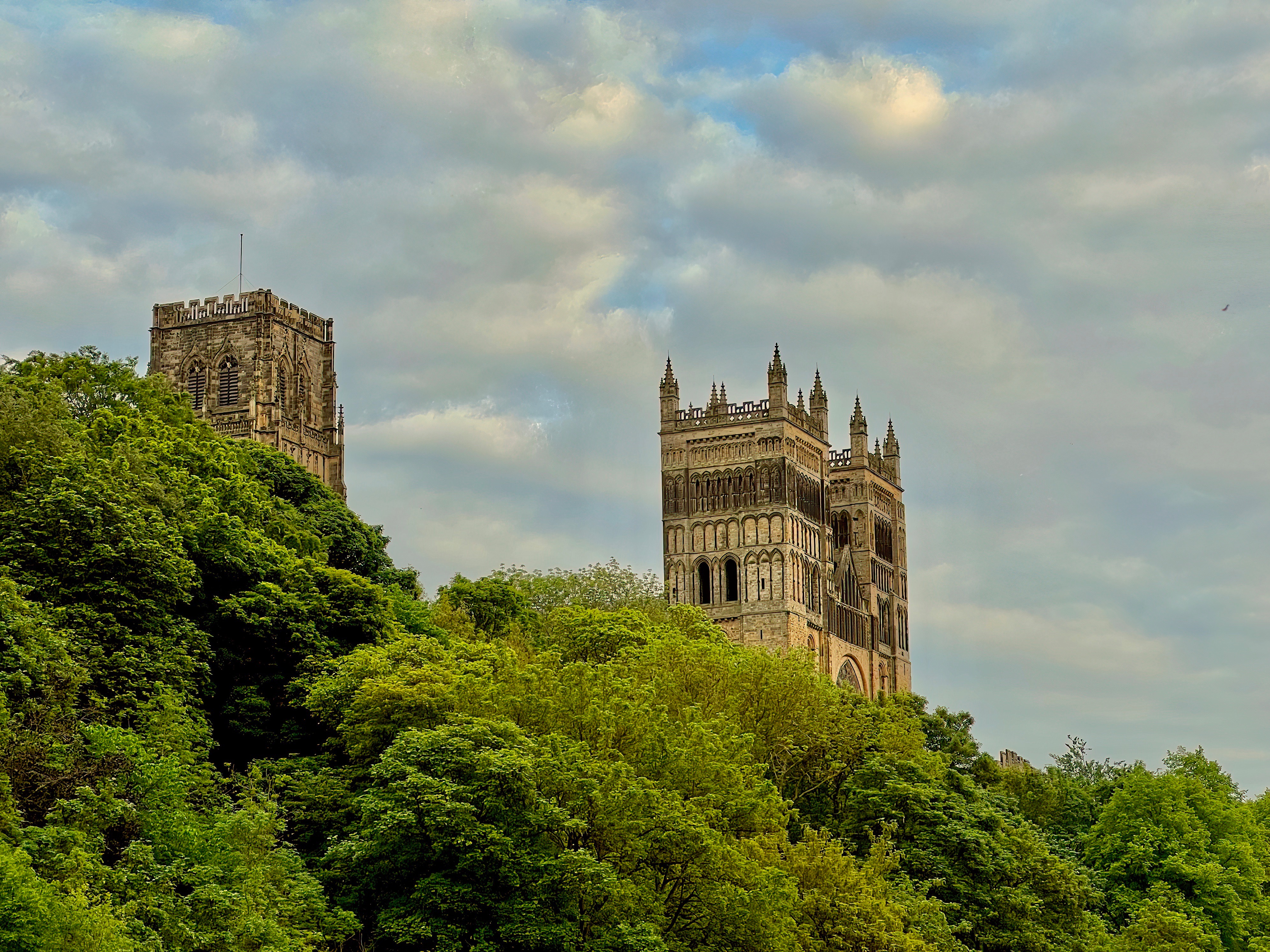
“The towers are the preachers and prelates: who are her wards and her defense.”
— Hugh of St. Victor, The Mystical Mirror of the Church

How awesome is this place! 
Truly, this is none other than the house of God; 
it is the gate of heaven. 

— Genesis 28:17

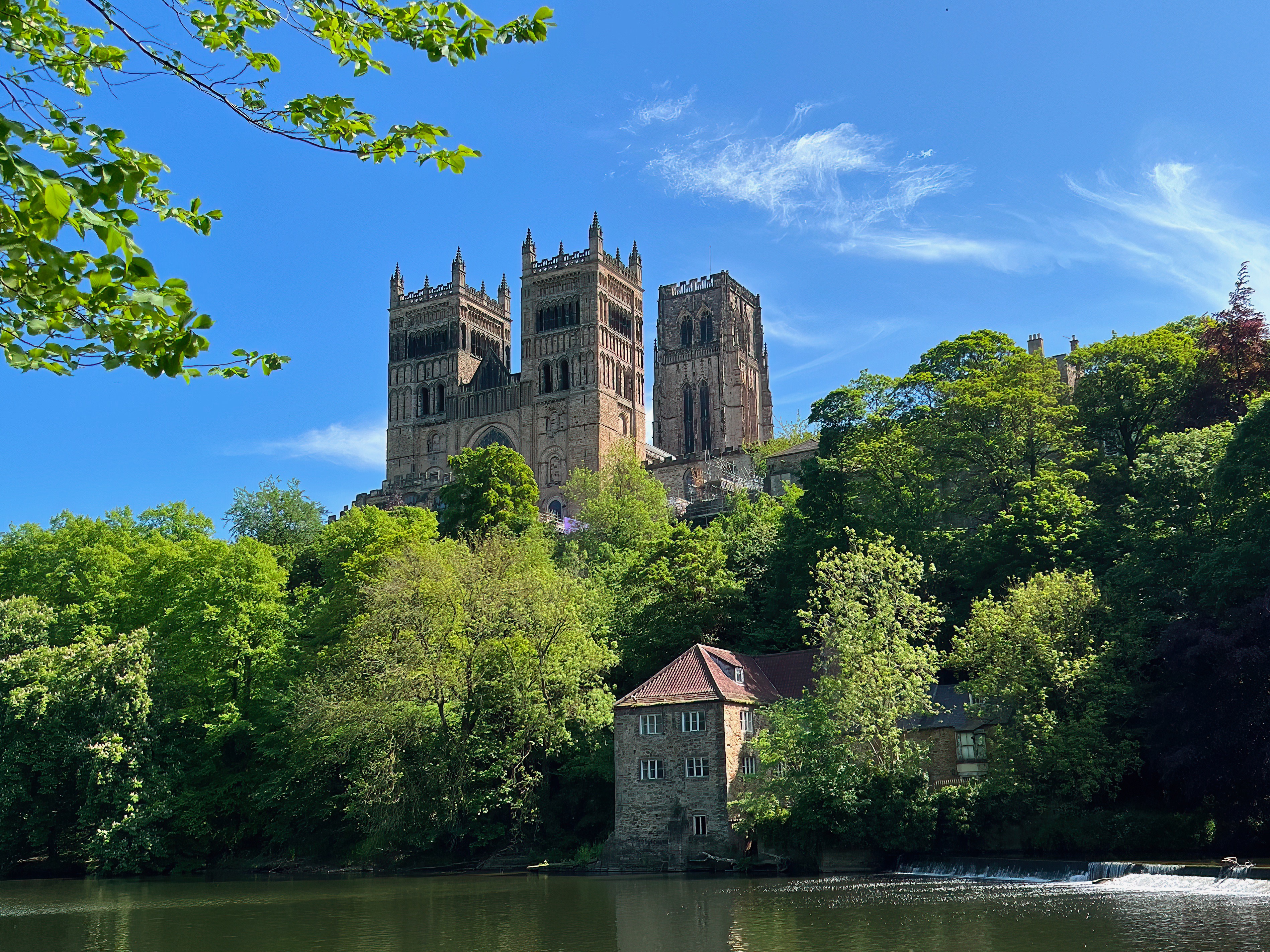
The cathedral raised to shelter Cuthbert’s shrine is one of the world’s most magnificent buildings. Set high on the rock of Dunholme, its dominant presence is softened by the lush foliage veiling its base. A Romantic might imagine it a miracle of stone, springing up supernaturally from the forest primeval. In fact, its monumental architecture was part of a dramatic upwelling of energy, intellect and confidence surging throughout Europe at the dawn of the twelfth century. Cities and universities, trade and travel, churches and cathedrals all burst into bloom in that sudden quickening of western civilization. 
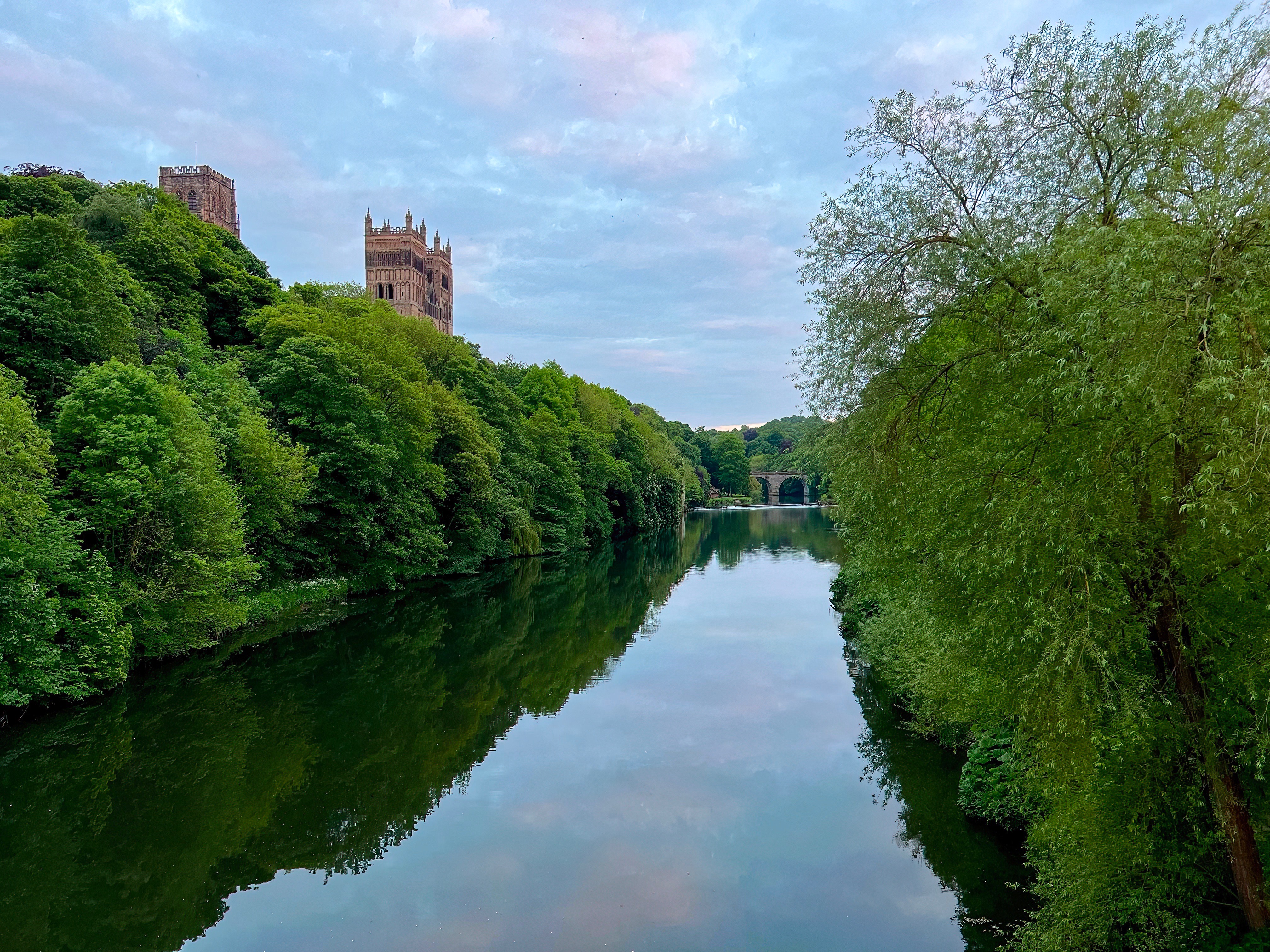
Durham Cathedral rises from a peninsula formed by a loop in the River Wear.
“Who shall ascend the hill of the Lord? And who shall stand in God’s holy place?” — Psalm 24:3
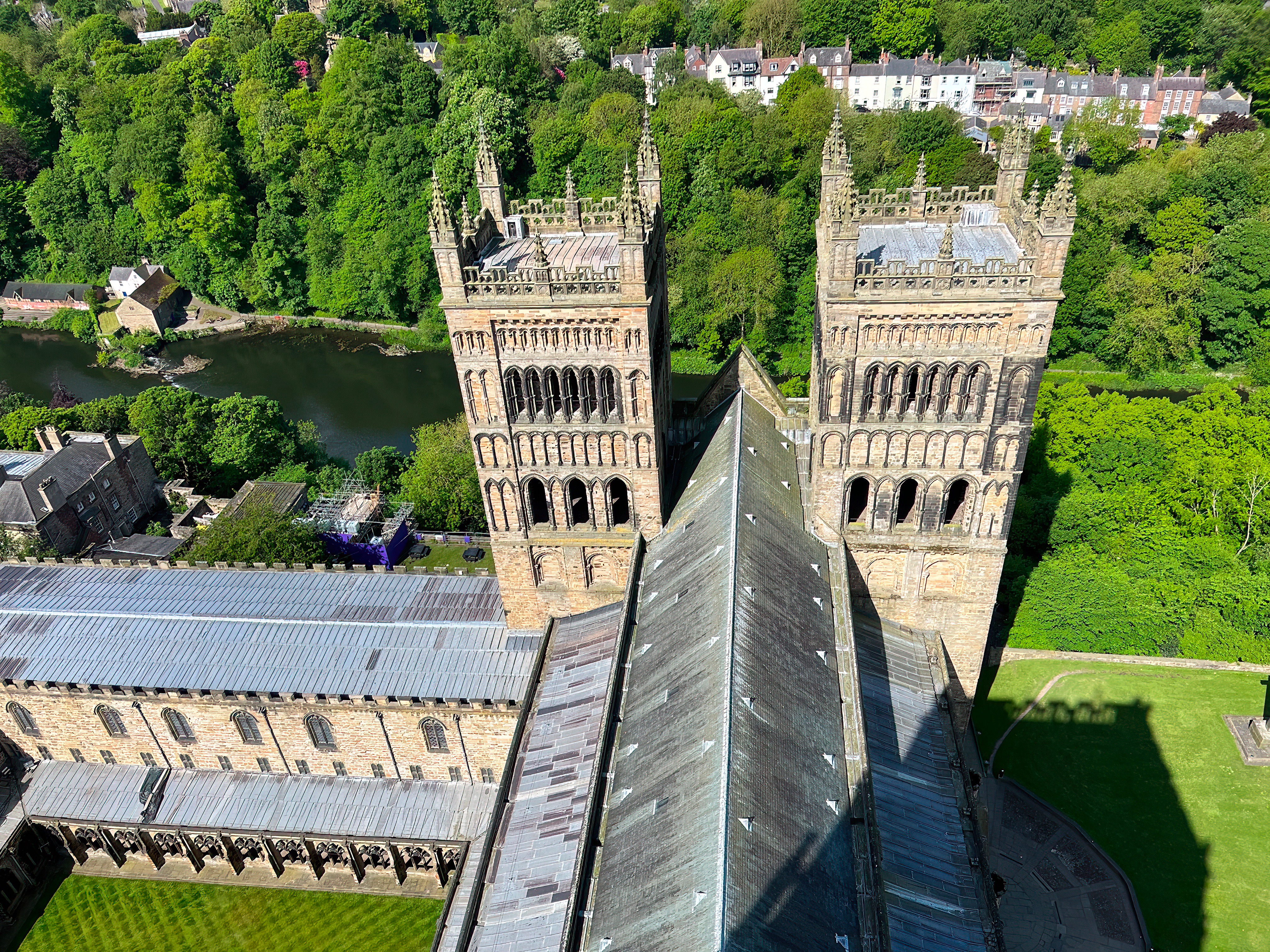
The western towers seen from the 218-foot crossing tower.

In England, the first cathedrals were begun in the Romanesque style imported from Normandy. Durham Cathedral is the only one to retain the purity of its original Norman craftsmanship and design, although the western towers reflect the emerging Gothic style, and the fifteenth-century crossing tower, replacing a previous tower damaged by lightning, is late Gothic. 
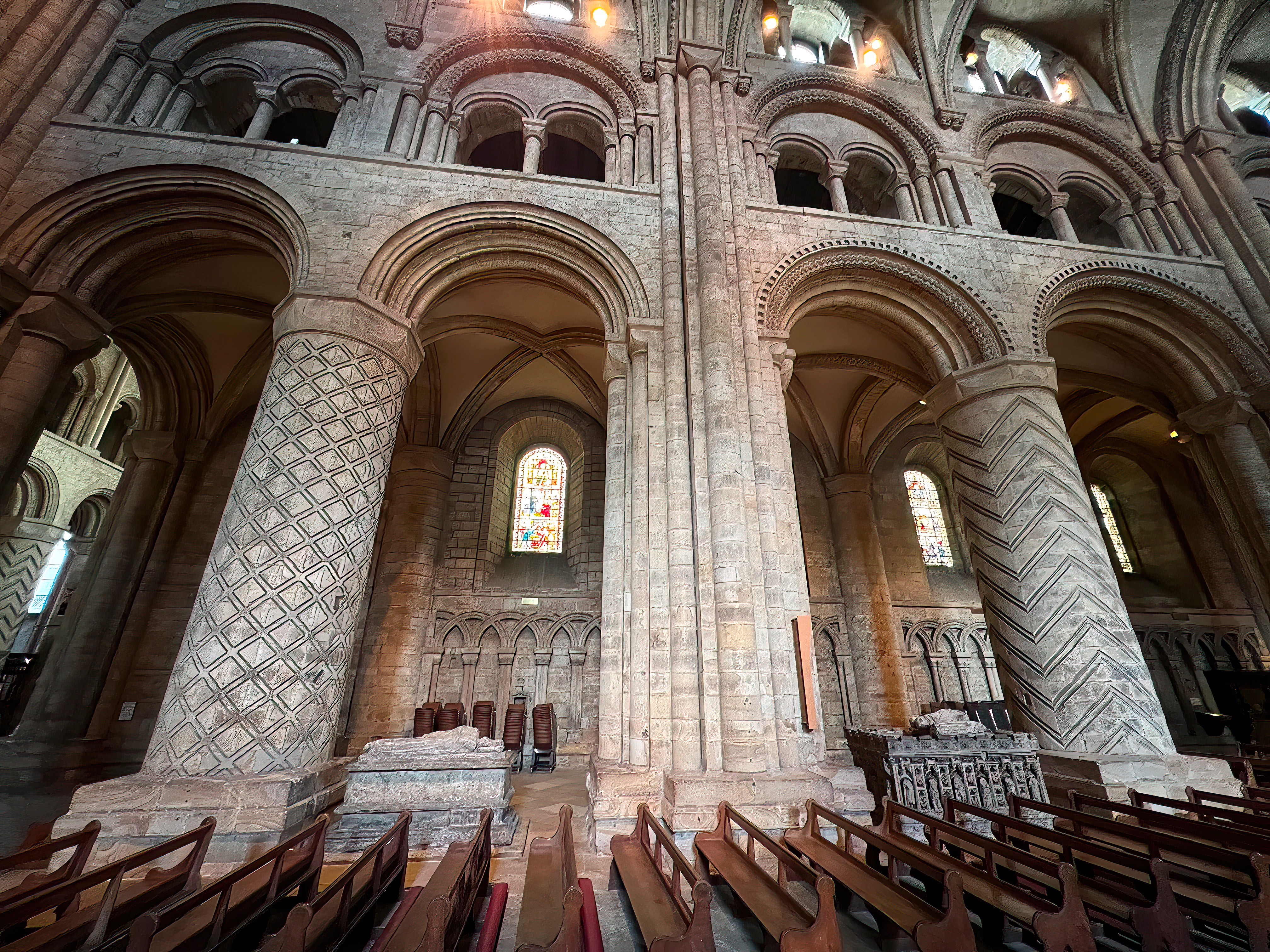
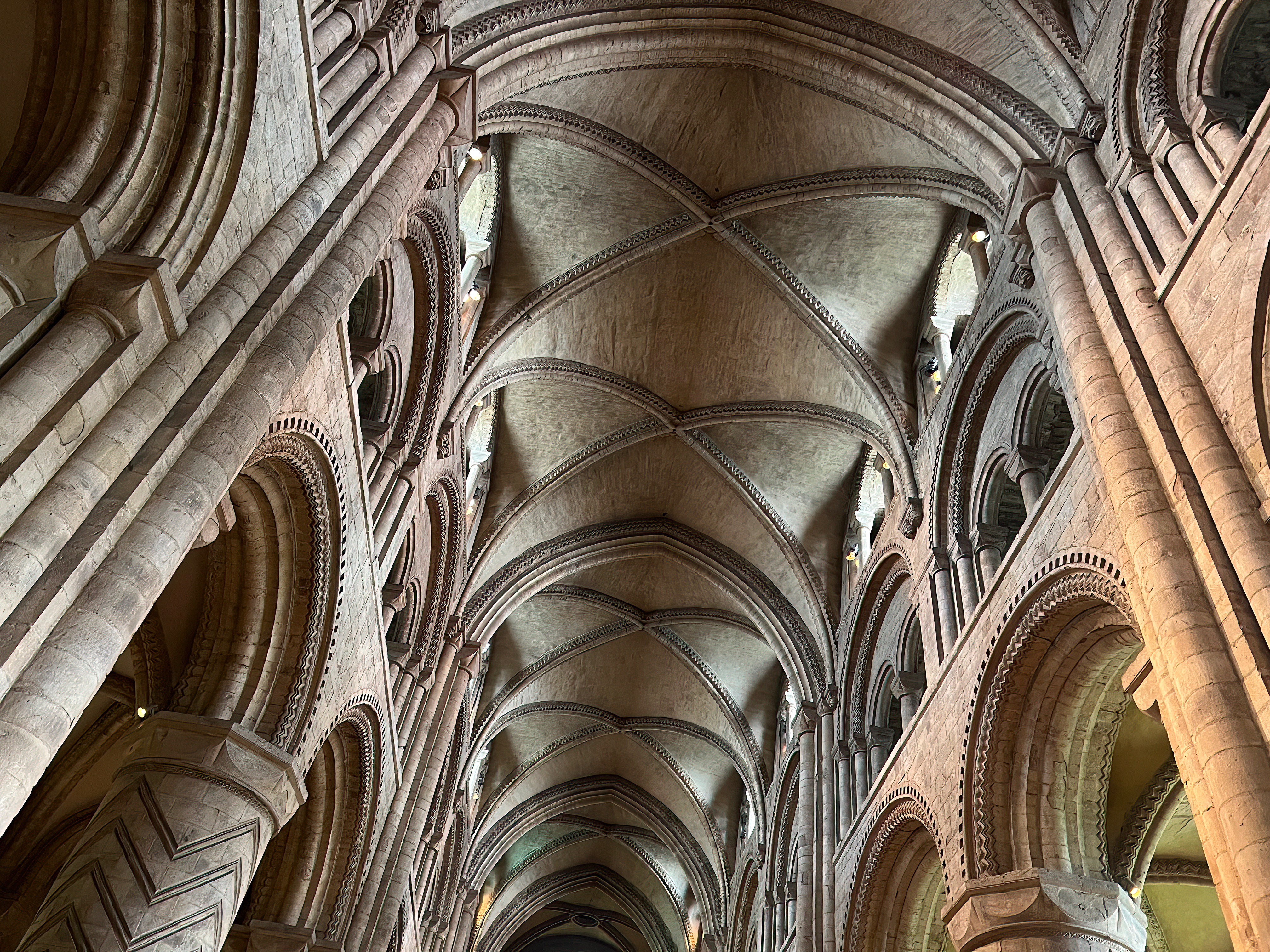
In the nave, the alternating rhythm of round columns and compound piers divides the linear flow into bays.
Each bay, marked on the ceiling by two x-shaped pairs of diagonal ribs, is bounded at its edges by pointed transverse arches springing from a pier on either side. The introduction of rib-vaulting in the nave was unprecedented.

Some large churches employ a repetition of identical columns, topped by horizontal bands of wall, windows or arches, sweeping us forward toward the altar. But Durham Cathedral created an alternating system of columns and piers, dividing the horizontal space into bays. This structural rhythm affects the way our bodies move through the space. As theologian J. G. Davies explains,

“The consequence is that equal strophes, following each other down the vista of the nave, have given way to alternating strong and weak stresses, i.e., of piers alternating with columns … The nave walls are now a linear sequence of individualized parts that retard any rapid flow towards the sanctuary.” [i] 
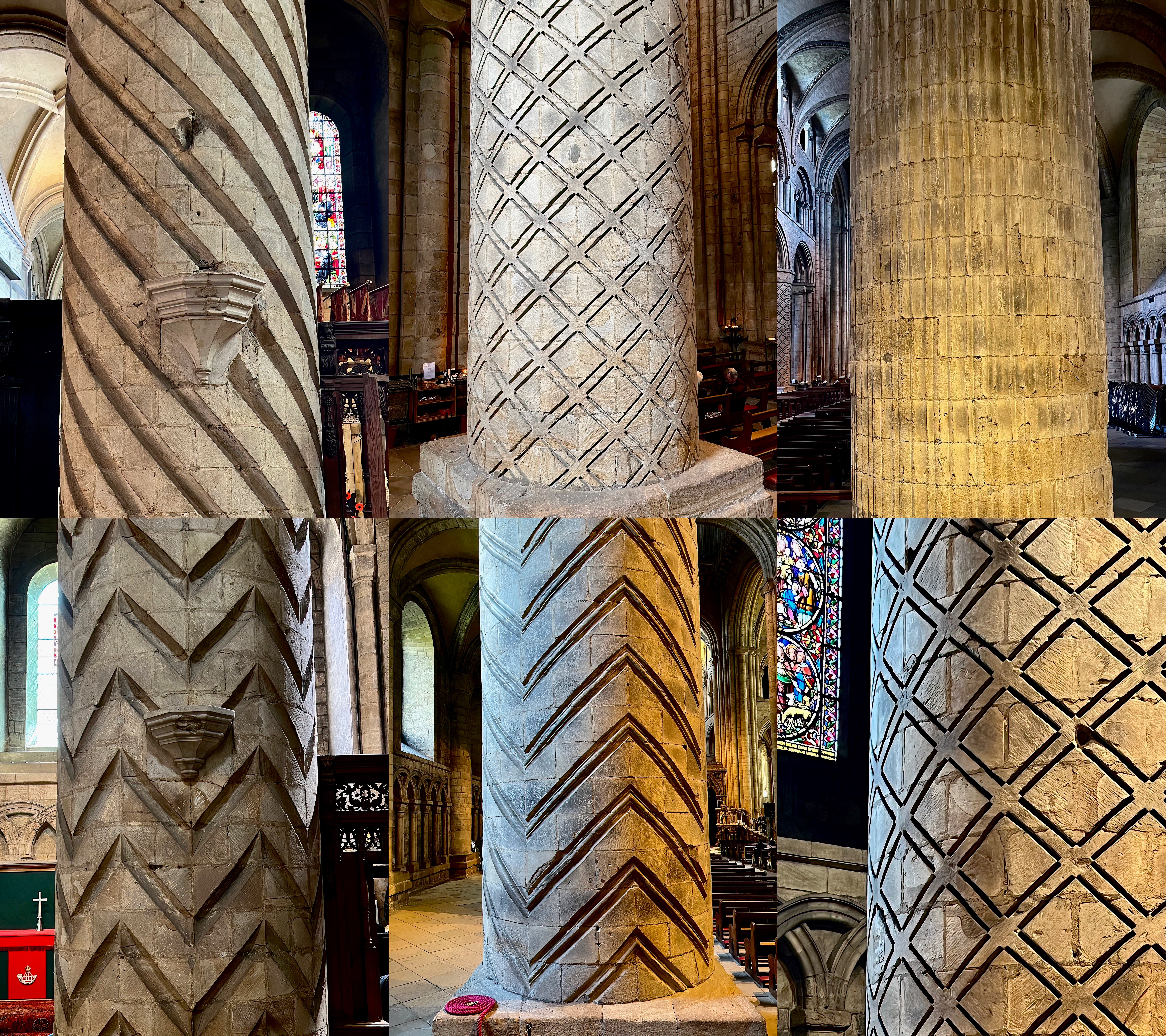
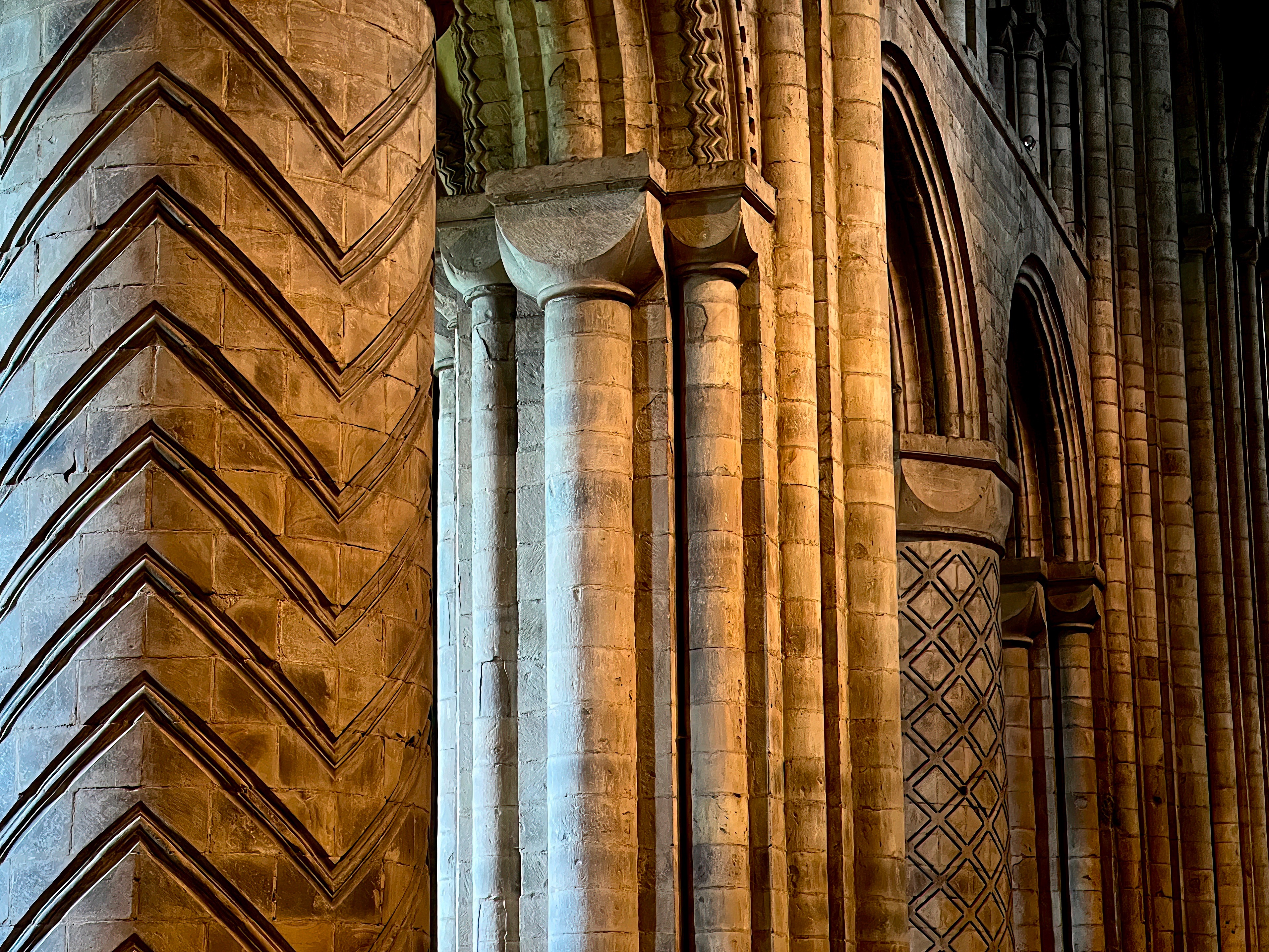
The massive columns (27′ high, 7′ in diameter) are deeply grooved with geometric patterns, creating a striking ensemble of variations unique to Durham Cathedral. They leaven the brute monumentality of thickness and weight with an almost whimsical sense of play.
The dense stone forest of columns and compound piers makes visible the symphonic array of colossal forces poised here in perfect balance. Being in their midst produces both humility and awe.

 While later cathedrals would pursue the Gothic dematerialization of the built structure, with walls becoming thinner and transparent with glass, and ceilings reaching toward the sky, Durham exudes a sense of solidity and weight. Thick walls and massive pillars, supporting the heavy stone roof, signify permanence and strength. Although such features can feel oppressive in more primitive Romanesque churches, nothing here feels inert or stifling. The articulation of details, such as rib vaults, geometric patterns, variations in column design, blank arcades, and a recessed series of arch moldings, all serve to enliven and animate the whole without compromising the overall simplicity, austerity and calm befitting its origins as a monastic enclosure. 
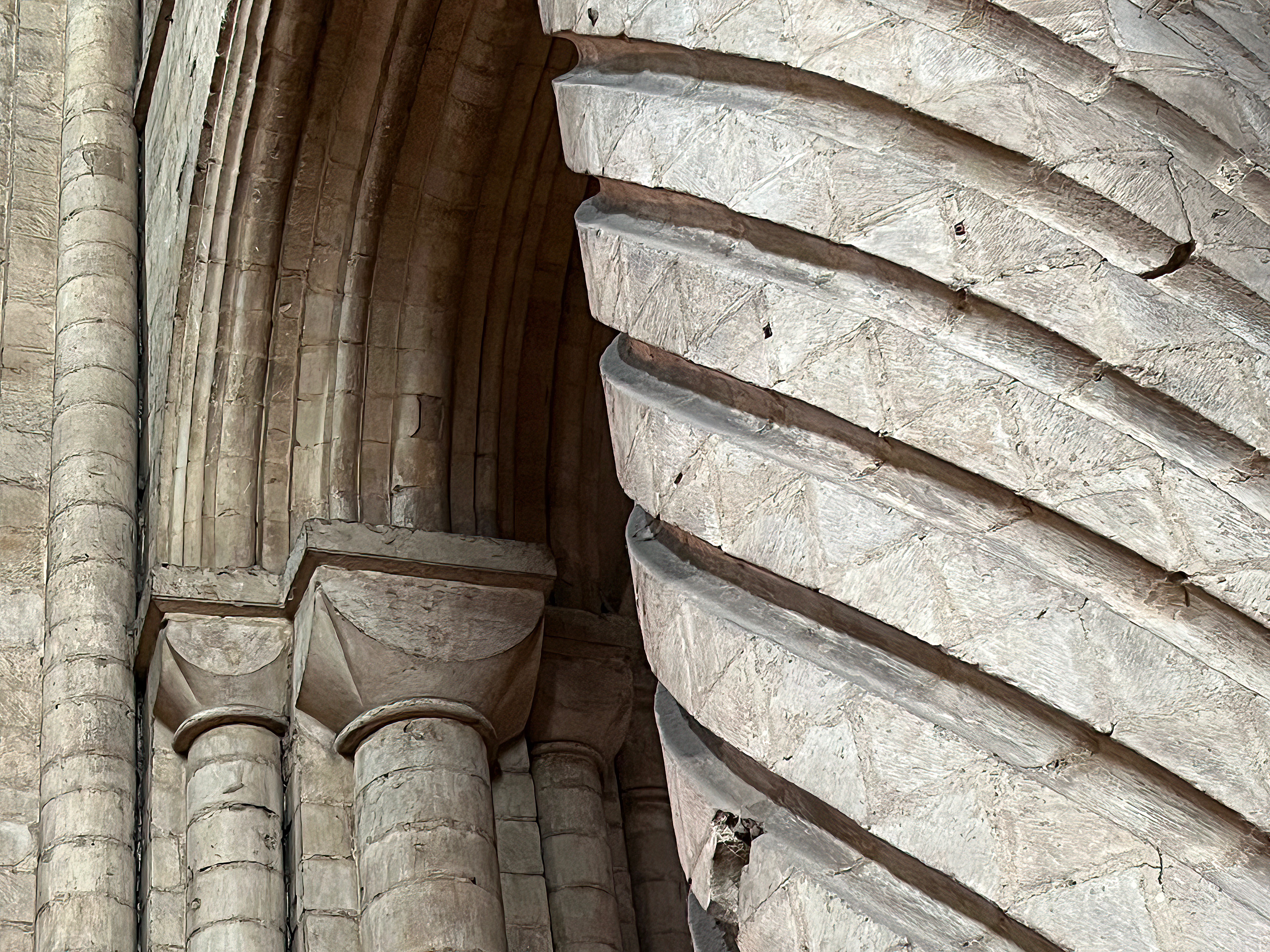
The skill and scale of the spiral grooving was a striking innovation in Romanesque architecture.

“The architect can work with the empty space—the cavity—between the solids, and consider the forming of that space as the real meaning of architecture.” 

— Steen Eiler Rasmussen [ii]

The cathedral is not simply a collection of solid parts. It is also the empty space shaped by its physical components. Length (horizontality) and height (verticality) are the fundamental dimensions of this space. The path between entrance and altar (or shrine) signifies life as a pilgrimage: there is a distance to be traversed, but the goal may yet be reached. At the same time, an interior that soars above our heads keeps us mindful of the Transcendent: it cannot be grasped or possessed, but it awakens our aspiration for a greater, higher reality. And throughout the whole, the interplay of light and shadow, immensity and intimacy, flow and obstacle, openness and containment, hiding and revealing lures us deeper into the Mystery beyond words. 
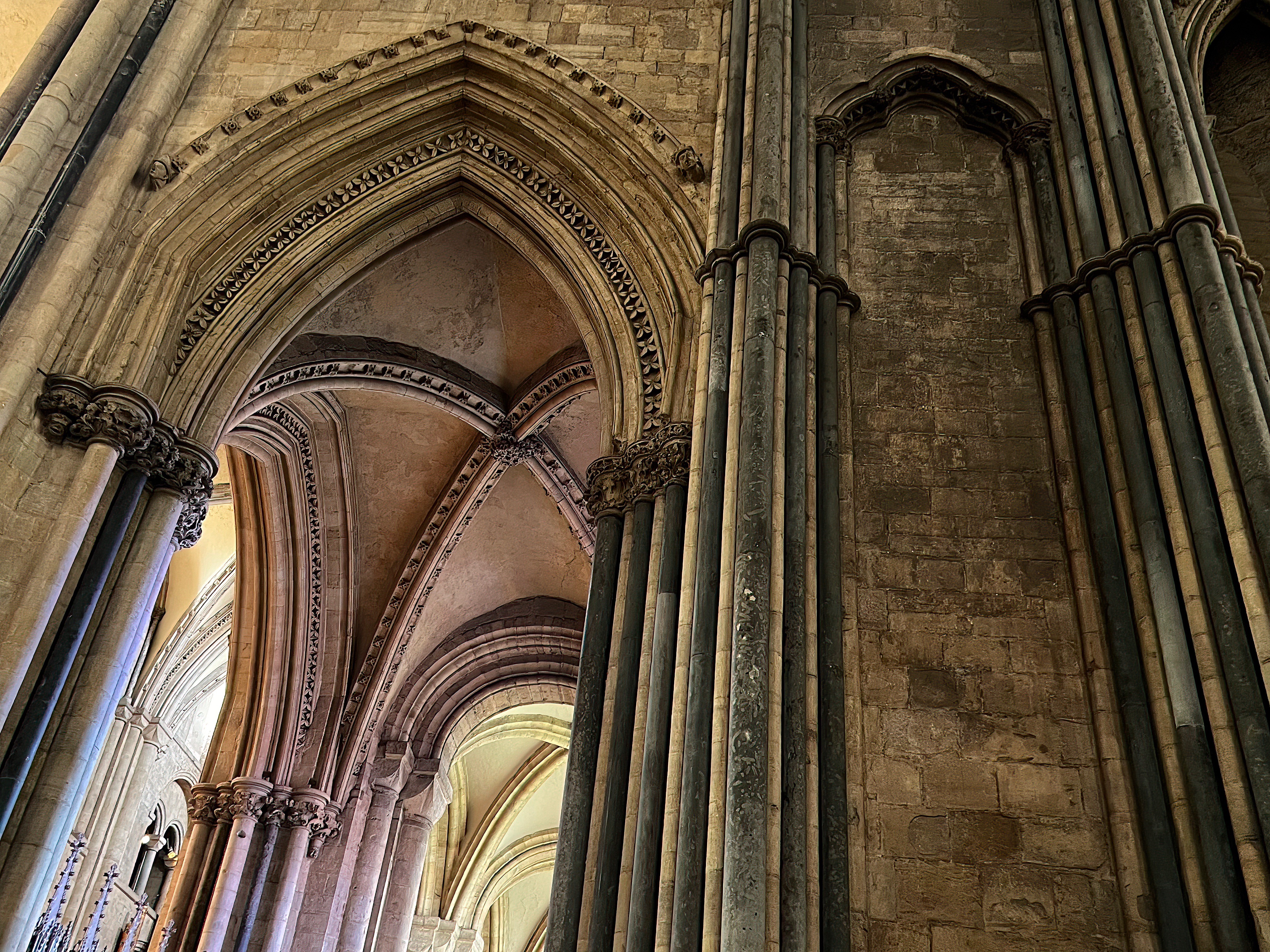
View from the north transept into the north aisle and the nave beyond. The multiple intersections of solid shapes and empty spaces generate a continuous play of hiding and revealing. You can’t see it all from just one place. The whole must be experienced through movement.

“[When] work reaches a maximum of intensity, when it has been made with the best quality of execution, when it has reached perfection … When this happens, the places start to radiate. They radiate in a physical way and determine what I call ‘ineffable space,’ that is to say, a space that does not depend on dimensions but on the quality of its perfection. It belongs to the dimension of the ineffable, of that which cannot be said.” — Le Corbusier [iii]
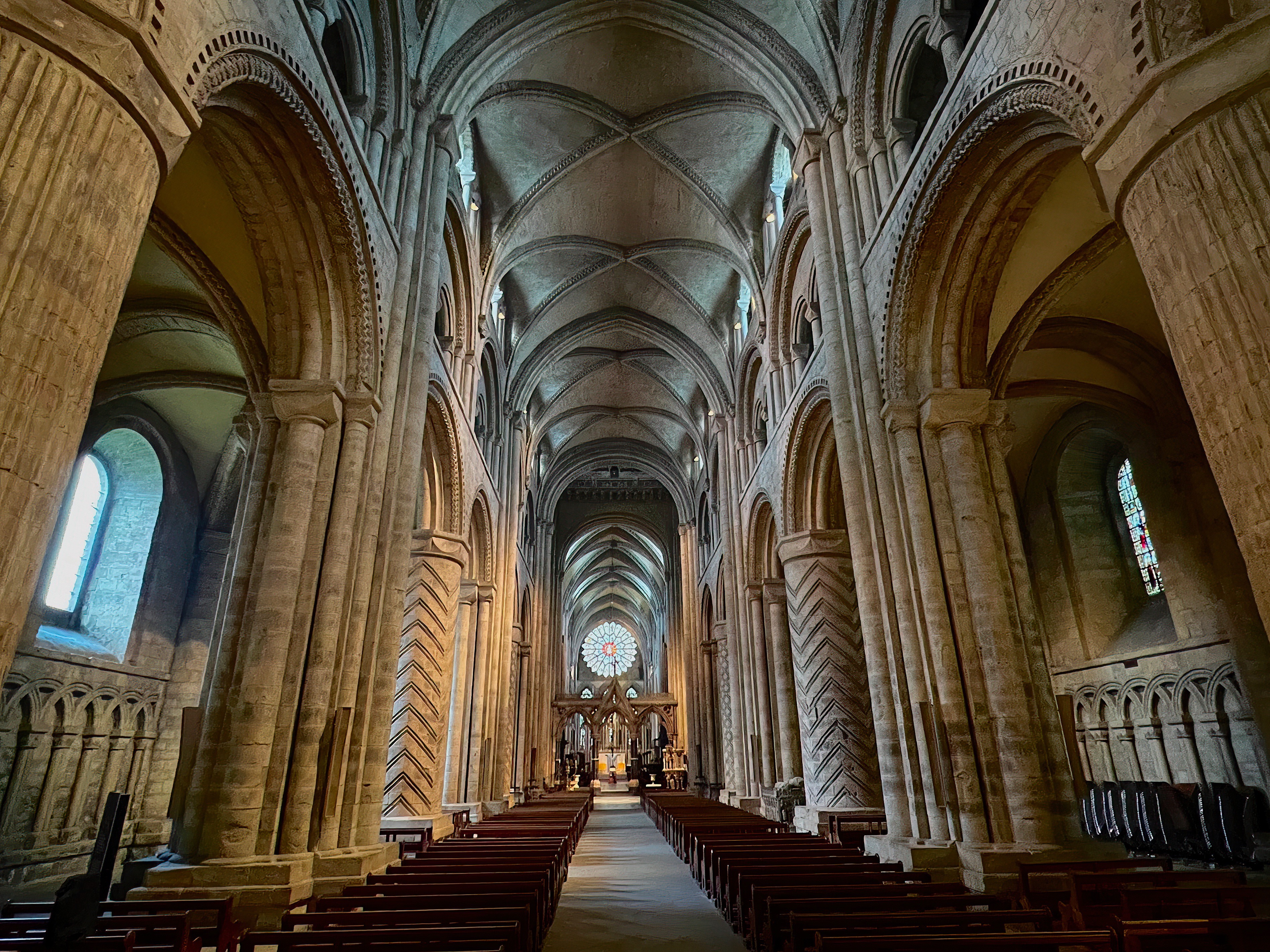
“Walk about Zion, go all around it. count its towers, admire its walls, scale its heights, that you may tell generations to come that such is God.” (Psalm 48:12-14)

Some have argued that a church is not a place for a casual visitor to have a worship experience. It is not a shelter for an altar or holy object, but for an assembly, and it has no meaning or symbolic power apart from its liturgical function. At the other end of the spectrum is Joseph Campbell’s assertion that one can be “reborn spiritually by entering and leaving a church.” 

For me, Durham Cathedral is both/and, not either/or. Many of its 700,000 annual visitors may not share the symbols, narratives, and rituals which have shaped its construction and history, but only the deadest of souls would remain unaffected by this sacred space. We all need “places which allure us with their beauty, which call us to a halt, which refresh us with their charm and are a positive ease and delight for the spirit.” [iv]  We all need rooms that care.
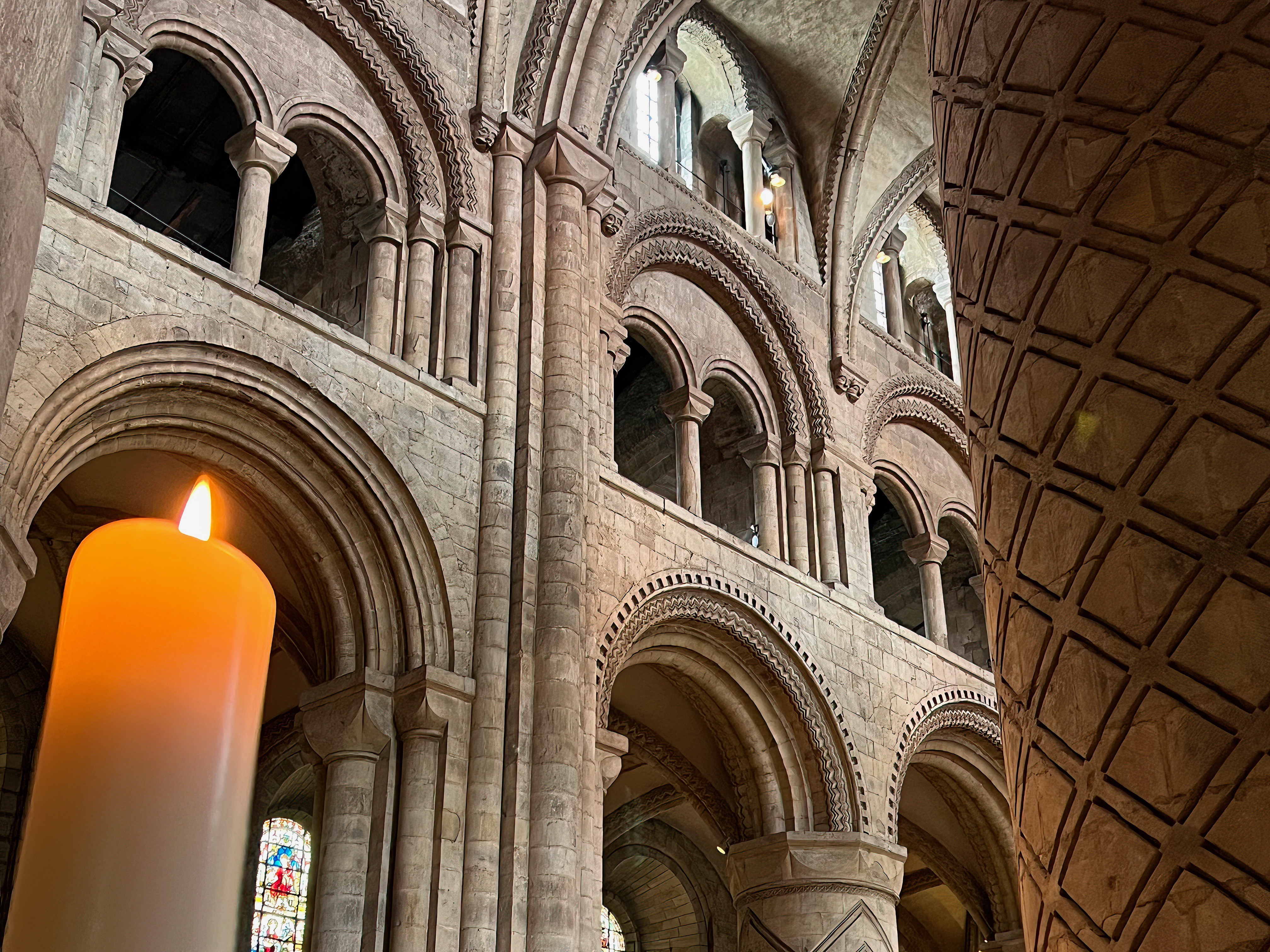
Lighted candles remind us this is a house of prayer. The three elevations of arcade, gallery, and clerestory have balanced proportions rarely achieved in the Norman style. The predominant height of the arcades gives the vertical an edge—but not too much—over the horizontal. The recessed moldings of the arches enhance the sense of depth, while the zigzag detail enlivens the stone. The undecorated arch on the left predates the craze for zigzags.

G. K. Chesterton said that the Church is “the only thing which saves a man from the degrading slavery of being a child of his age.” [v]  Cathedrals are no longer centers around which whole cities or cultures are organized, nor do they hold an exclusive copyright on the sacred, but they remain indispensable preserves of experiences and perspectives necessary for the health of our souls and the life of the world. When our medieval predecessors entered their cathedrals, “they were the enraptured witnesses of a new way of seeing.” [vi]  And, I would add, participants in a new way of being. May it be ever so.

The physical act of wandering through Durham Cathedral exerts a formative effect on body, heart, and intellect, deepening the sense of life as pilgrimage and passage. As our eyes and our feet move through the cathedral along its system of paths and enclosures, we feel the pull toward a goal, be it altar or shrine. At the same time, the way is strewn with burning bushes, inviting us to turn aside for a moment—or pause to look up—that we may receive and ponder their wordless message of holy presence. 
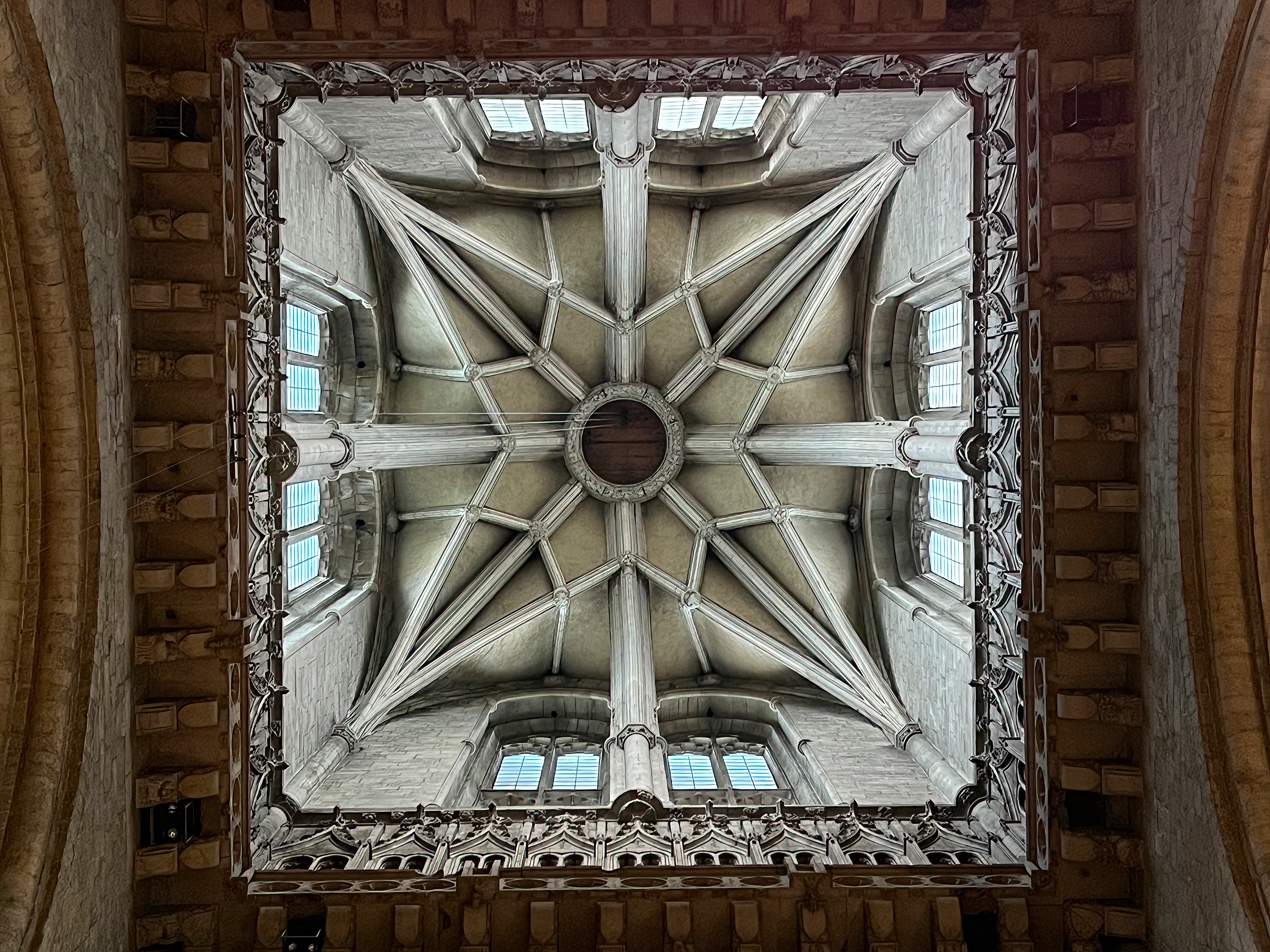
The star-shaped vaulting of the central tower above the crossing glows with the light of 8 clear windows. A 15th-century replacement for a damaged tower, it soars to a very un-Norman height. As you walk up the nave, the sudden expanse of luminous space overhead is thrilling.
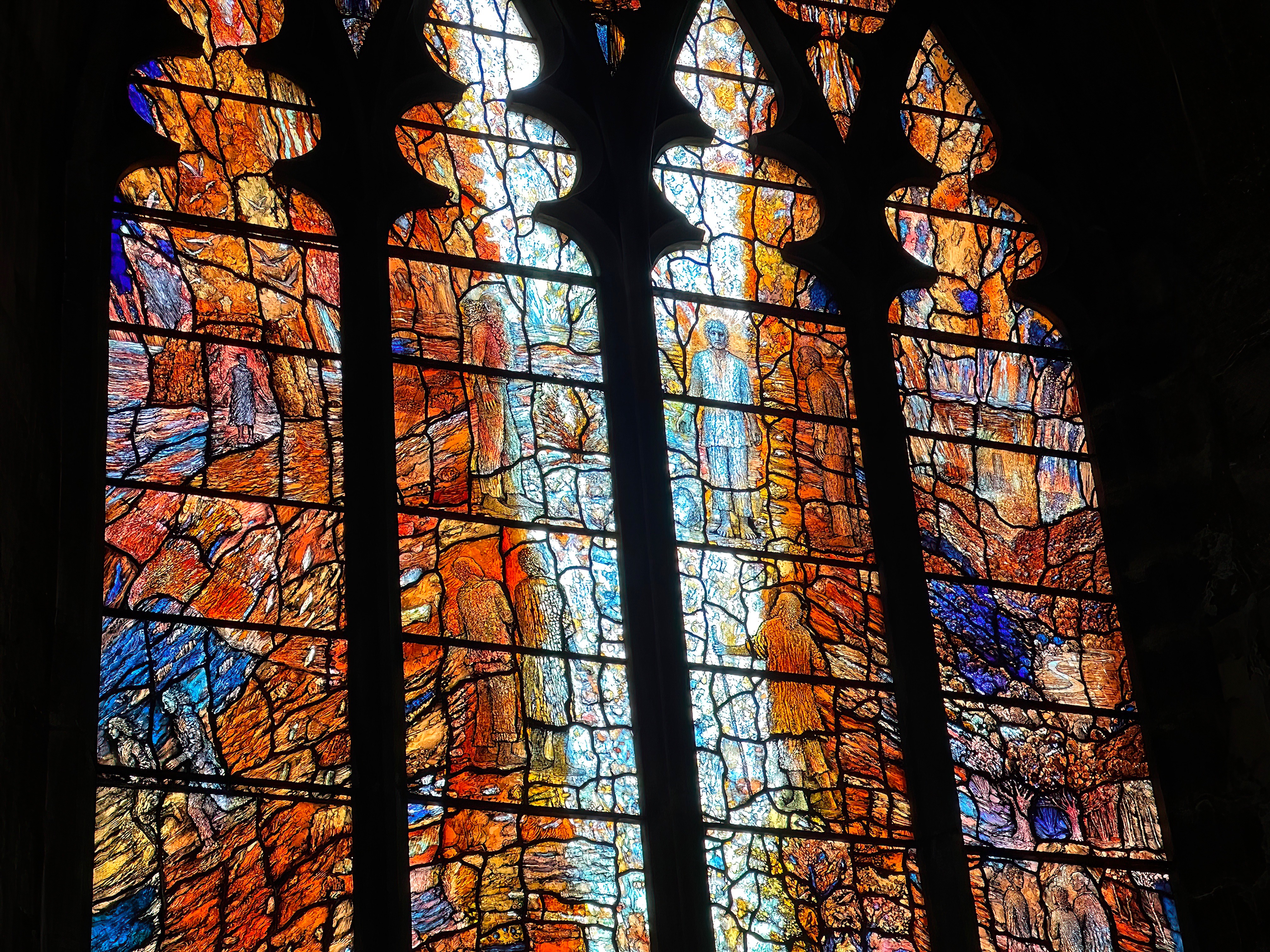
Transfiguration window, south choir aisle (Tom Denny, 2010). Christ and the disciples are in the two central panels. Cuthbert, praying with outstretched arms on an island, is in the middle of the left panel.
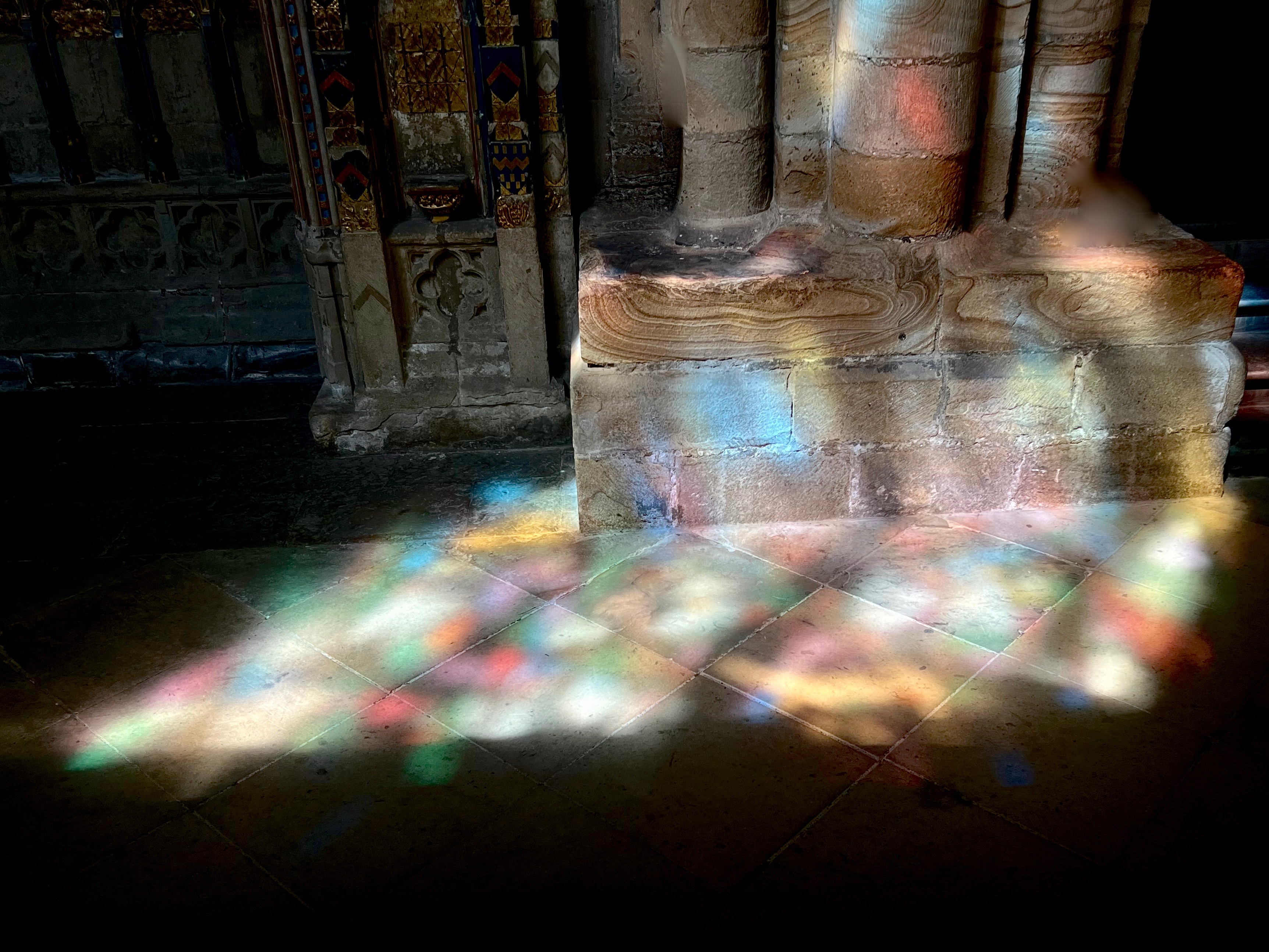
Stained glass window light paints the south chancel aisle near the steps to St. Cuthbert’s tomb.
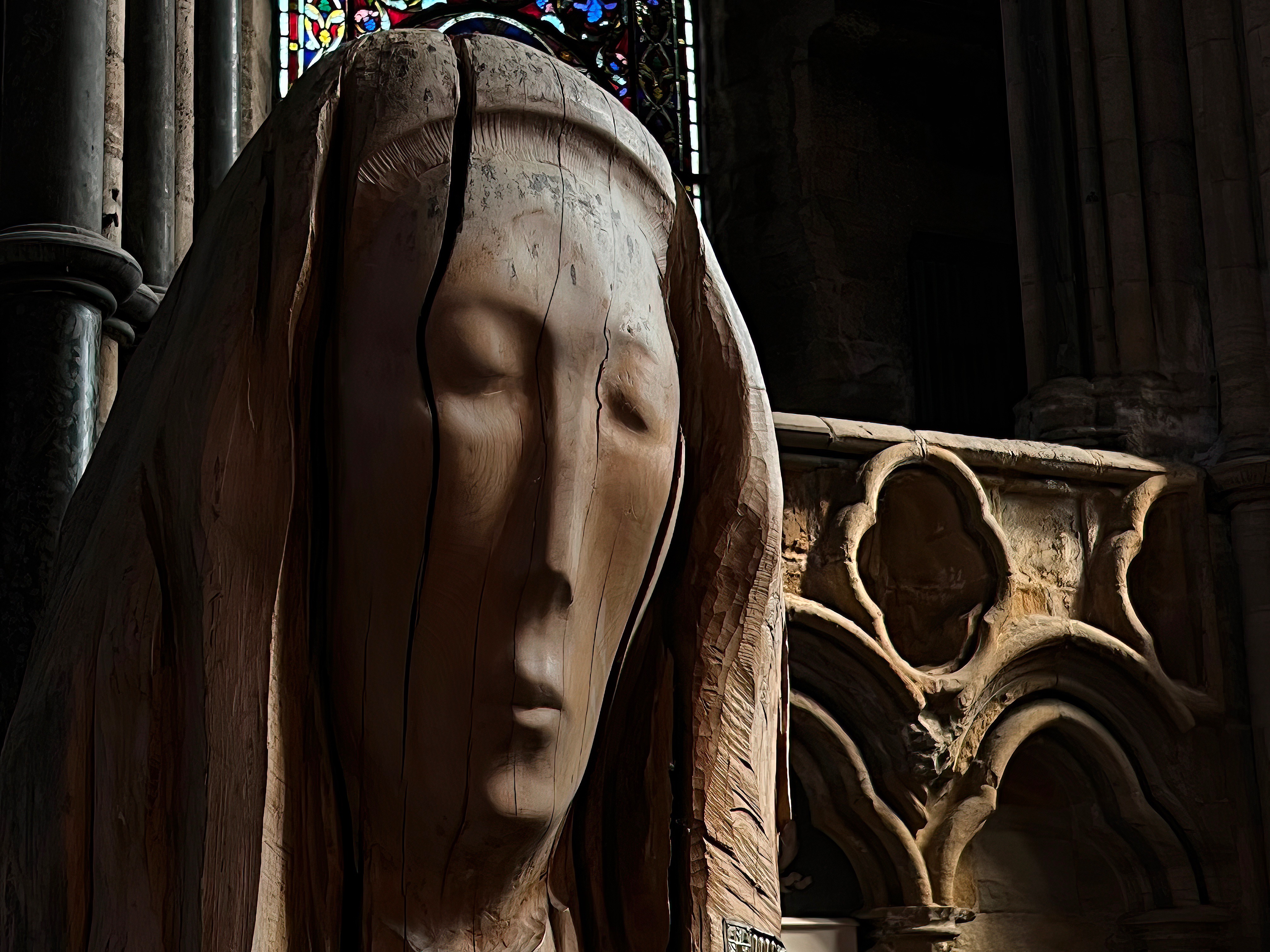
The Sorrowful Mother, part of Fenwick Lawson’s Pieta (1974-1981), in the east end of Durham Cathedral. When the beech wood sculpture was on loan to York Minster in the 1980s, a fire in the transept rained molten lead upon Christ and Mary. The artist accepted that wounding of the figures as a deepening of the Passion image.

At the east end of the cathedral, behind the high altar, is the tomb of St. Cuthbert. Stripped of its once lavish adornments by the decline of medieval pilgrimage and the predatory greed of Henry VIII, its quiet simplicity seems much more suited to the spirit of the humble saint who preferred bare and wild places. 
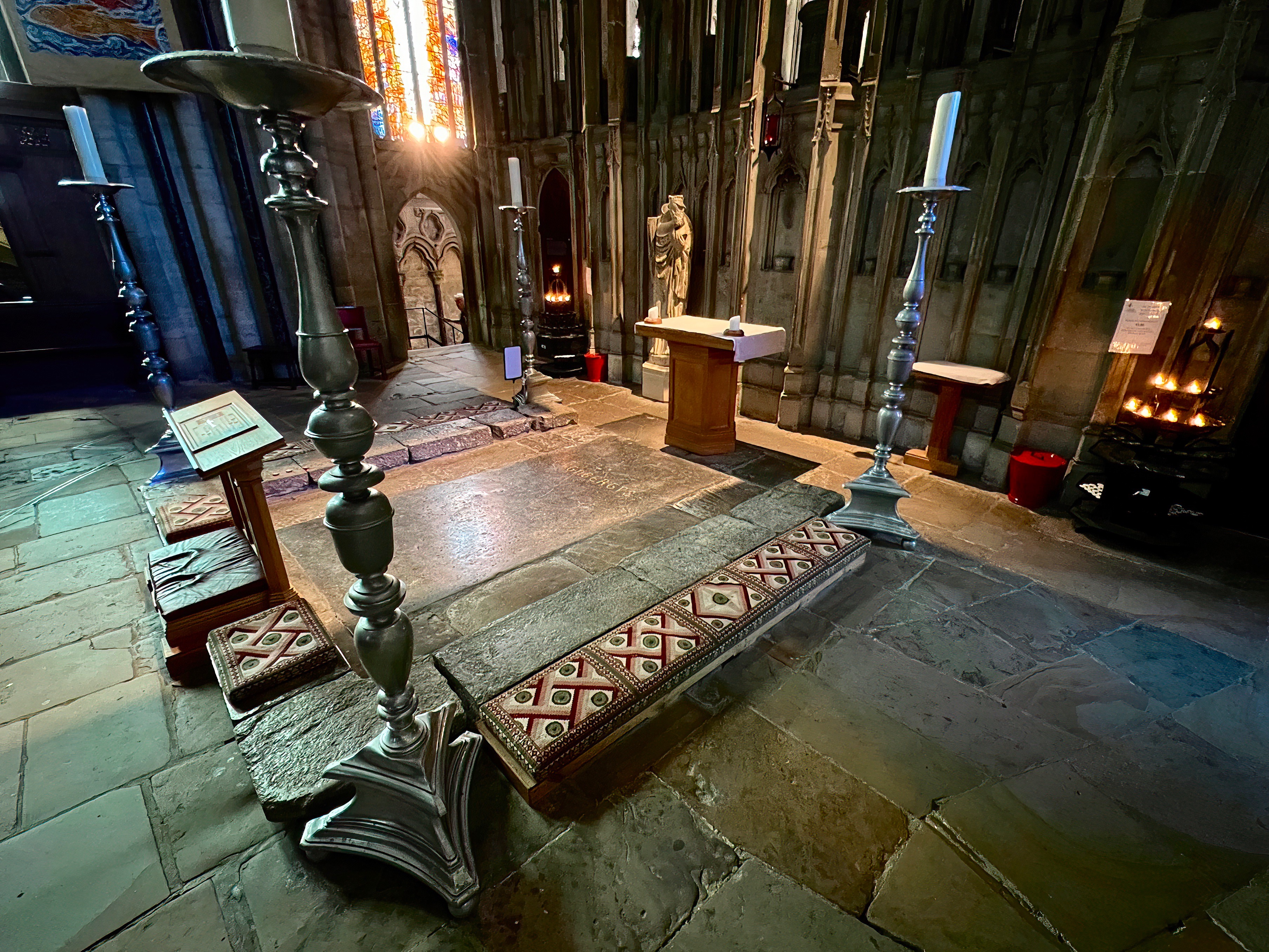
Cuthbert’s tomb, in a raised feretory behind the high altar. After his remains came to rest here in 1104, it became a great pilgirmage site and one of England’s most sumptuous shrines. By the 16th century, interest had dwindled, and after Henry VIII’s men plundered its riches, this simple slab replaced its elaborate predecessor. Cuthbert, known for his humility, would not have minded.

When I reached the feretory, I ascended the steps to the tomb. Here was my journey’s end. As T. S. Eliot said of another holy place, 

You are not here to verify,
Instruct yourself, or inform curiosity 
Or carry report. You are here to kneel 
Where prayer has been valid. [vii]

And so I did. I gave thanks to God and his saint for the beautiful pilgrimage, remembering the beauty of the people and the wonders all along the way from Melrose to Holy Island to Durham. I reflected on the stories of Cuthbert and his times, his warm spirit and faithful heart, feeling gratitude for the gift of saints who show us how. But I did not linger. What the angel said on Easter morning applies to every tomb: He is not here. Cuthbert still walks the paths of memory which I traced in homage. And he also goes before us—into the human future, deeper and deeper into God. 
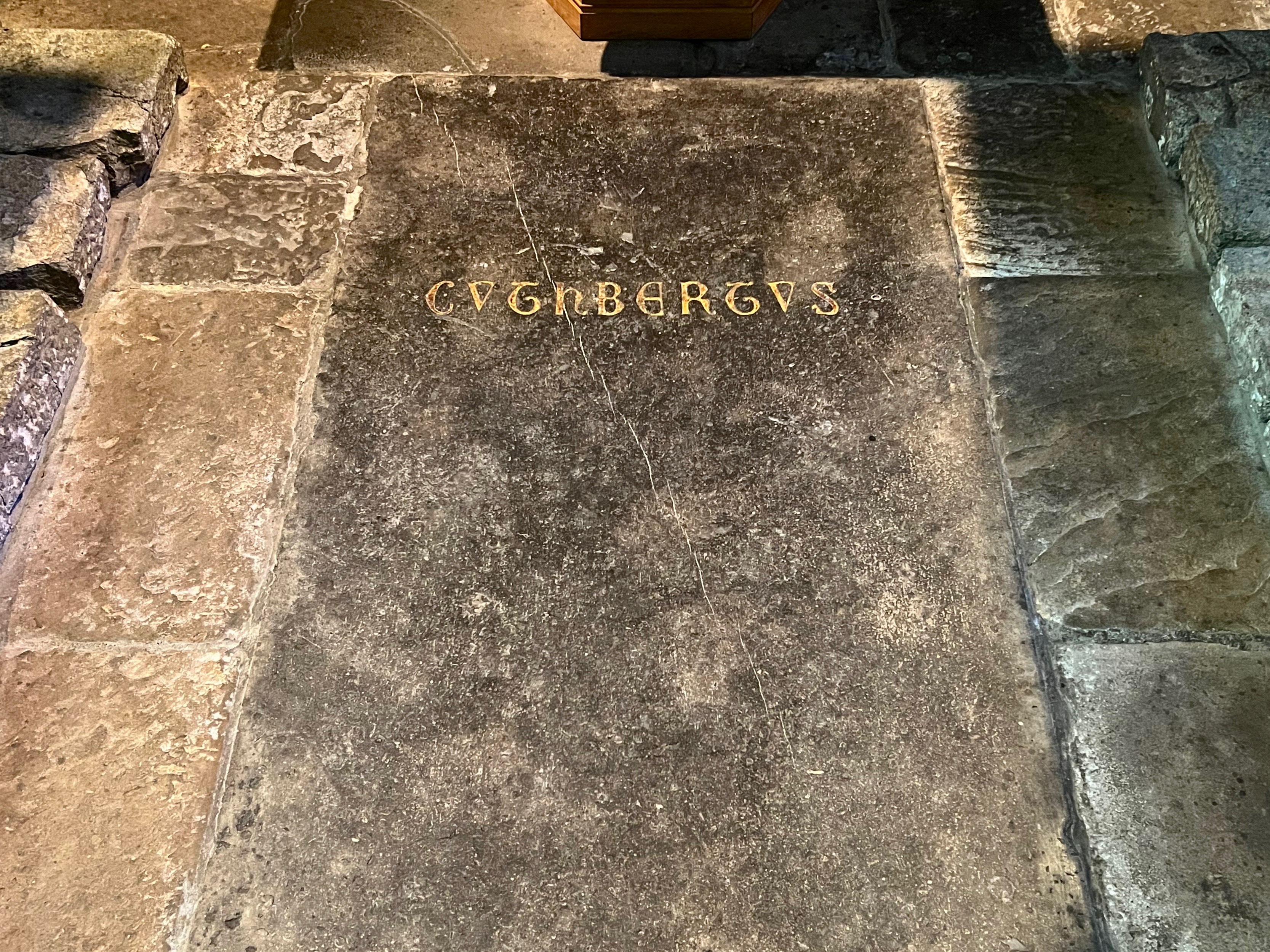
Happy from now on are those who die in the Lord. So it is, says the Spirit, for they rest from their labors. (Book of Common Prayer)

Much of what we know about St. Cuthbert is due to the eighth-century writings of the Venerable Bede, the great scholar-monk of the Early Middle Ages. A teenager when Cuthbert died, Bede remains linked to Cuthbert by more than his writing. His own remains, enclosed in a silk bag, were housed with Cuthbert’s at Durham for 348 years, until given their own separate shrine in 1370. After the English Reformation put an end to shrines, Bede’s remains were reburied in the floor of Durham’s Galilee Chapel, at the opposite end of the cathedral from Cuthbert’s tomb. To walk the length of the interior, from Bede in the west to Cuthbert in the east, felt like a recapitulation in miniature of my entire pilgrimage. Every step a prayer.
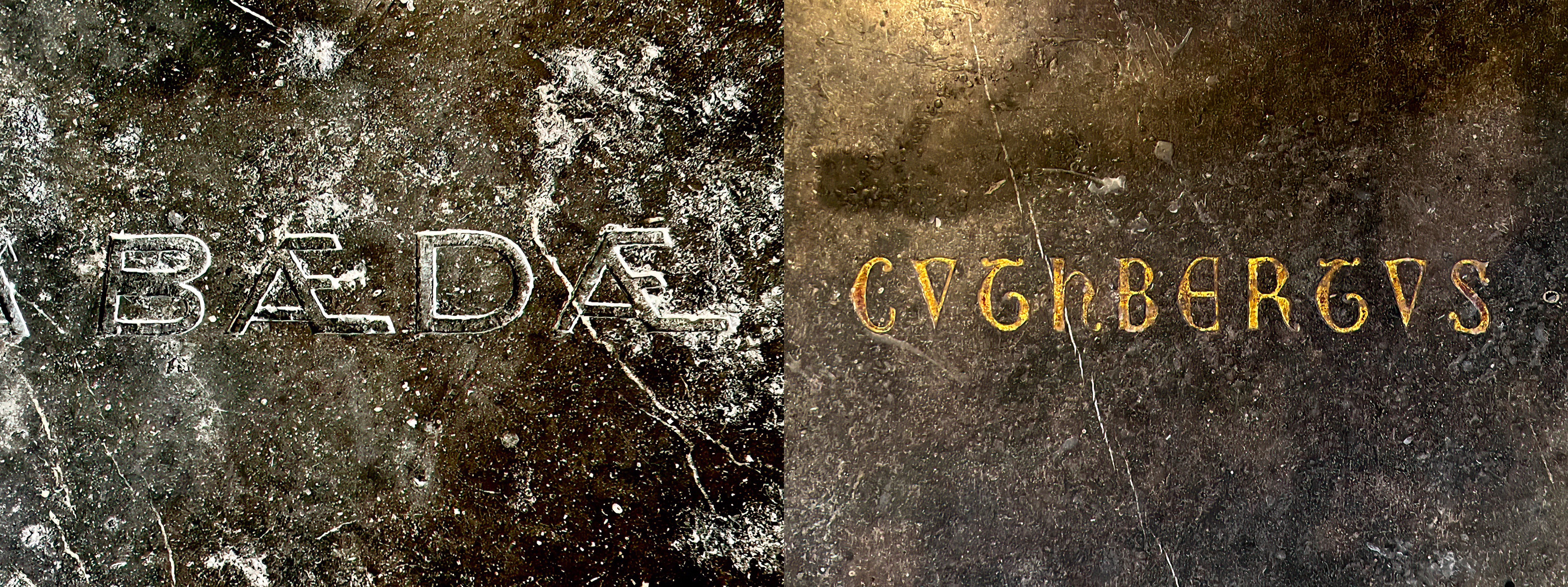
The Latin names of Bede and Cuthbert, inscribed on their tombs.

When I made my plans to visit Durham after St. Cuthbert’s Way, I neglected to check my liturgical calendar, so it was a wonderful surprise to learn I had arrived on the very eve of Bede’s feast day and—to my further amazement—in the thousandth year since the Translation of his Relics into Cuthbert’s tomb. What a glorious conclusion to my pilgrimage! It was pure gift, not something I had thought up in advance. That evening I joined a sung eucharist, celebrated at Bede’s final resting place in the Galilee Chapel. His simple stone tomb served as the altar. As incense drifted through the forest of stone columns, the choir sang William Byrd’s exquisite Mass for Four Voices, and the congregation added our own voices in exuberant hymnody.
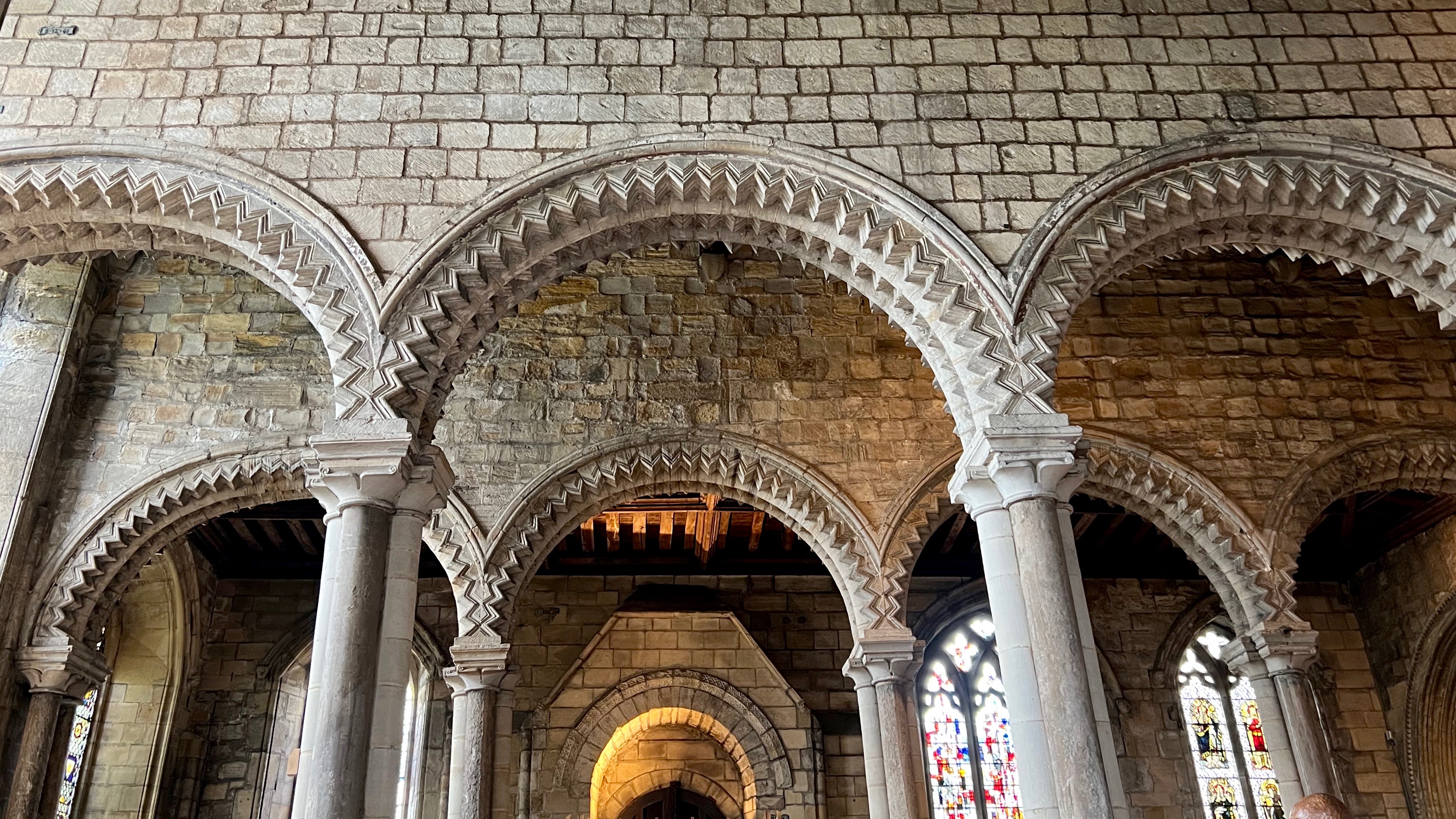
The Galilee Chapel was added to the cathedral’s west end, taking the cathedral too close to the edge of the bluff to allow a traditional west front (the entrance is on the north side). Built later in the 12th century than the main church, it displays a lightness more akin to Gothic than the weighty structures of Romanesque. Its multiple rows of graceful arches on slender columns may have been influenced by Andalusian architecture such as the mosque at Cordoba.
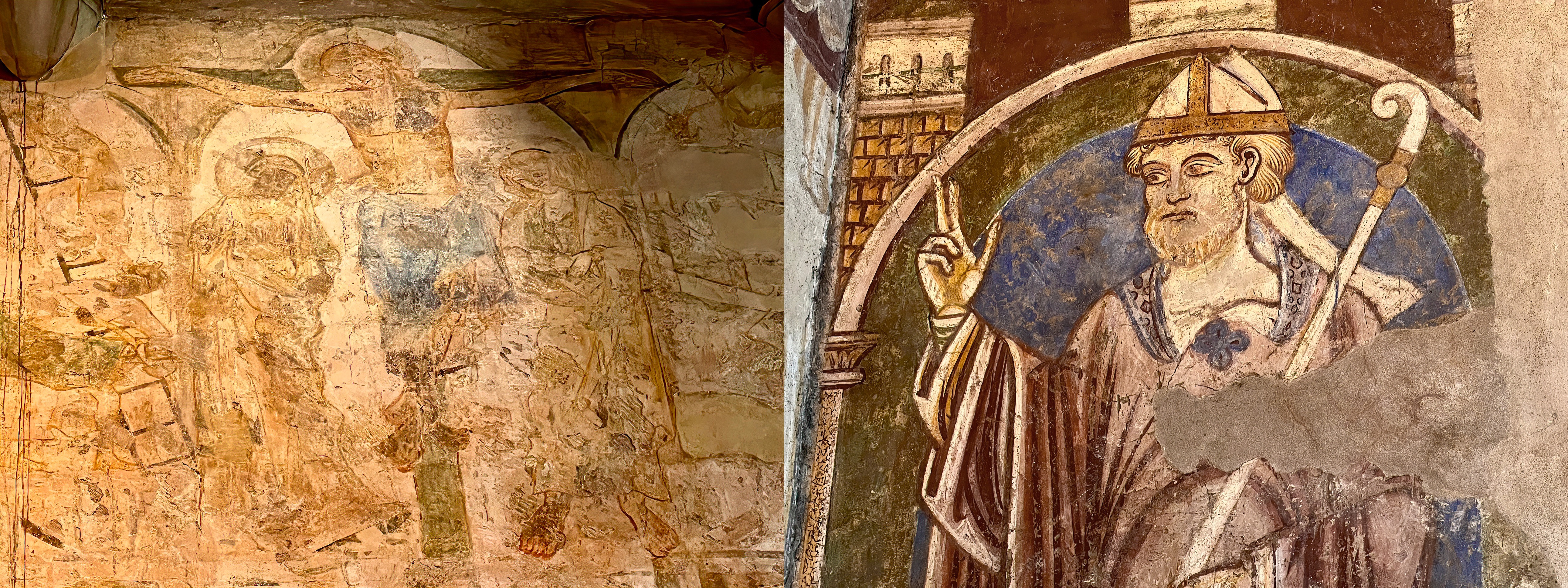
In the Middle Ages, murals were painted on the cathedral walls, but Reformation iconoclasts covered them with whitewash. Victorian restorers tried to scrape off the white, but destroyed most of the murals in the process. These surviving images in the Galilee Chapel show Christ crucified and a bishop in 12th-century vestments, possibly meant to be Cuthbert.
The tomb of the Venerable Bede in the Galilee Chapel became the holy table for the eucharist on the eve of his feast day.

Recalling Bede’s significance as “the father of English learning,” we prayed for “all biblical scholars and writers and all who translate and interpret your word in every part of the world.” Praising God for Bede the historian, we prayed for “church historians and all who interpret the past to strengthen witness in the present.” And we sang,

For his example we give thanks,
His zeal to learn, his skill to write;
Like him we long to know God’s ways
And in God’s word drink with delight …

Teach us, O Lord, like Bede to pray,
To make the word of God our joy,
Exult in music, song and art,
in worship all your gifts employ. [viii]

The next evening, on the feast itself (May 25), a beautiful Evensong was held in the main church, followed by a procession of clergy, choir and people to the Galilee Chapel. Since I was sitting at the front of the nave, I was the first to leave my pew to trail the choir. For a moment I wondered if I had misunderstood the instructions in the bulletin. No one else seemed to be joining me. Uh-oh, I thought, worrying that this bumbling priest from the Colonies was violating liturgical decorum. Then, to my relief, others began to step into the aisle, and together we made our way to Bede’s tomb, singing a hymn to the glorious tune of Westminster Abbey

Here in England, through the ages,
While the Christian years went by,
Saints, confessors, martyrs, sages,
Strong to live and strong to die,
Wrote their names upon the pages
Of God’s blessèd company. [ix]

The Galilee Chapel was soon packed with worshippers. I was herded into a spot in front of the tomb, just three feet from the lead boy soprano. Though his body was small and willowy, it produced sounds of astonishing amplitude and soaring clarity in anthems by Palestrina, Tallis, and Edwin George Monk. I’ve never stood so near a voice so beautiful. The nineteenth-century Anglican cleric Sidney Smith said that his idea of heaven was eating pâté de foie gras to the sound of trumpets. For me, heaven would be standing three feet from the angel choir. I could skip the goose liver. 

At one point in the liturgy, one of Bede’s most memorable stories was read aloud: the Anglo-Saxon parable of the sparrow in the banqueting hall, to my mind one of the best existential arguments for places like Durham Cathedral to exist—they nourish and perpetuate a way of knowing that is the alternative to despair. Here’s how Michael York tells the story in a video I made in 1988, The Story of Anglicanism

Michael York tells Bede’s story of the sparrow in the banqueting hall.

The morning after Bede’s feast, I took a train to London. As a coda to my Cuthbert pilgrimage, I wanted to see the two books at the British Library with close connections to the saint. One was a pocket-size copy of John’s Gospel, discovered in Cuthbert’s coffin four centuries after his death. It may have been his personal copy, or a posthumous tribute placed near his body by a fellow monk. It is the oldest European book still in its original binding.
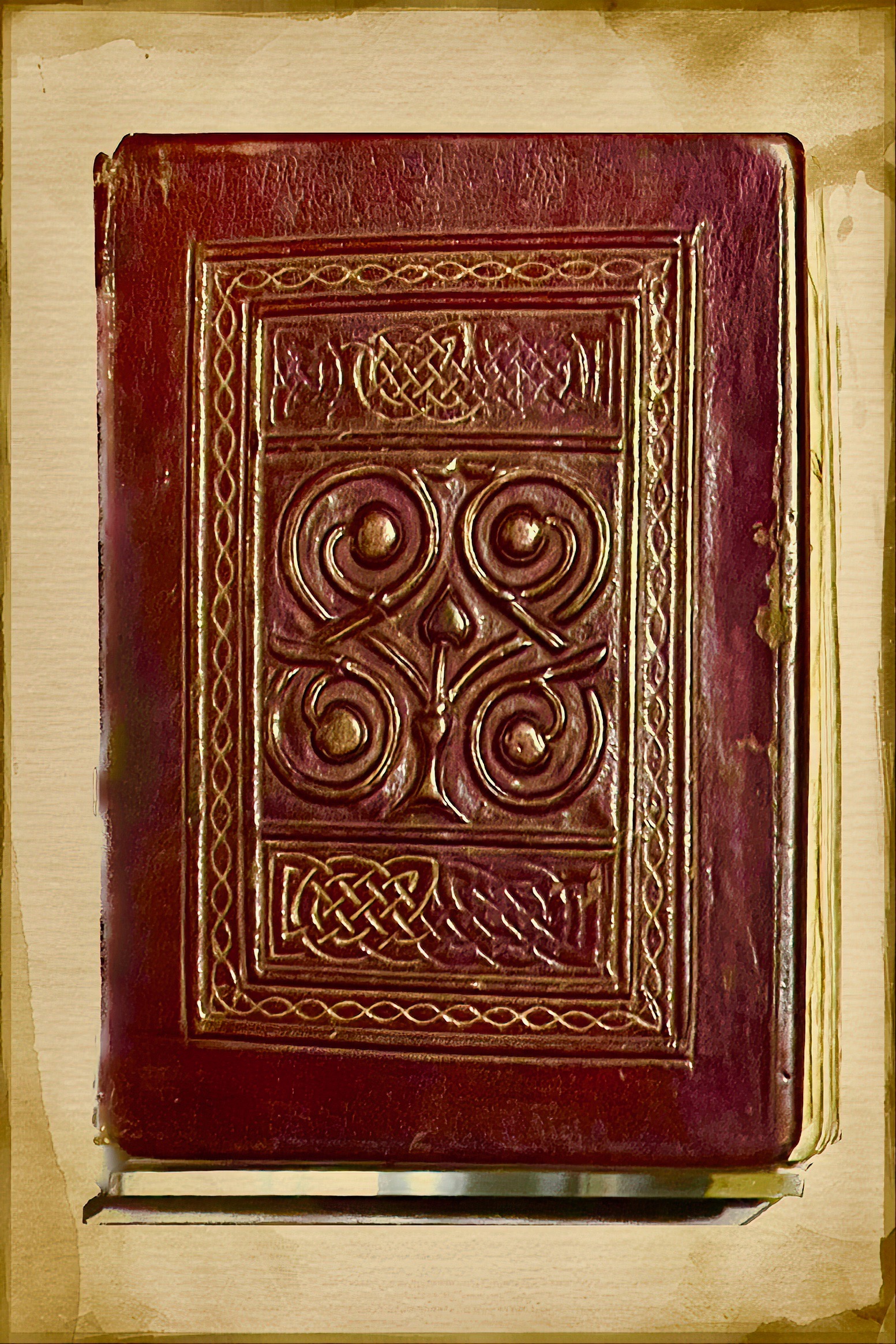
The St. Cuthbert Gospel of John (early 8th century) is the earliest intact European book, still in its original binding. It was kept in the coffin with his body for over 400 years. Passing into private hands during Henry VIII’s Dissolution of the monasteries, it was purchasd by the British Library in 2012.

Cuthbert loved the Fourth Gospel. When Boisil, his old monastic mentor, told him he expected to die within seven days, Cuthbert asked him, “Which book would it be best to read if we only have a week?” Boisil replied, “The Evangelist John.” And for the next seven days, until Boisil’s death, the two monks did Bible study together. Bede, who recorded this story for posterity, added a comment: “They dealt with only the simple things of the faith which worketh by love and not deep matters of argument.” [x]
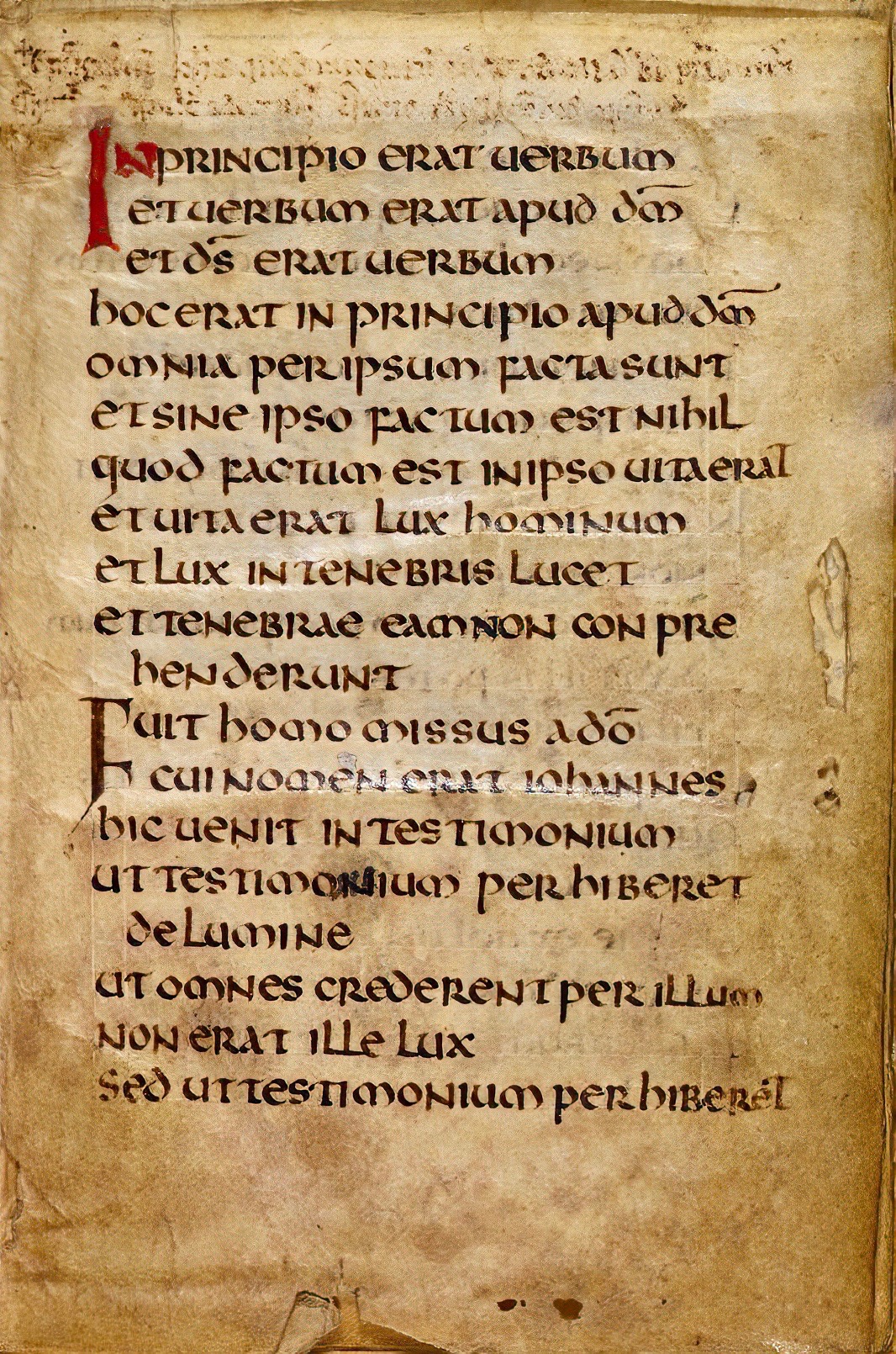
The first page of St. Cuthbert’s Gospel: In principio erat verbum (In the beginning was the Word).

The other treasure I had to see was the Lindisfarne Gospels, one of the most beautiful books ever made. Thought to be the work of a single man, Eadfrith, third bishop of Lindisfarne after Cuthbert, it was laboriously produced a few decades after the saint’s death, “for God and St. Cuthbert and all the holy people who are on the island.” It was probably displayed for veneration at the saint’s shrine at Lindisfarne until the ninth-century Viking incursions. When Cuthbert’s remains and relics began the long exodus that ended in Durham, the Lindisfarne Gospels went with them. 
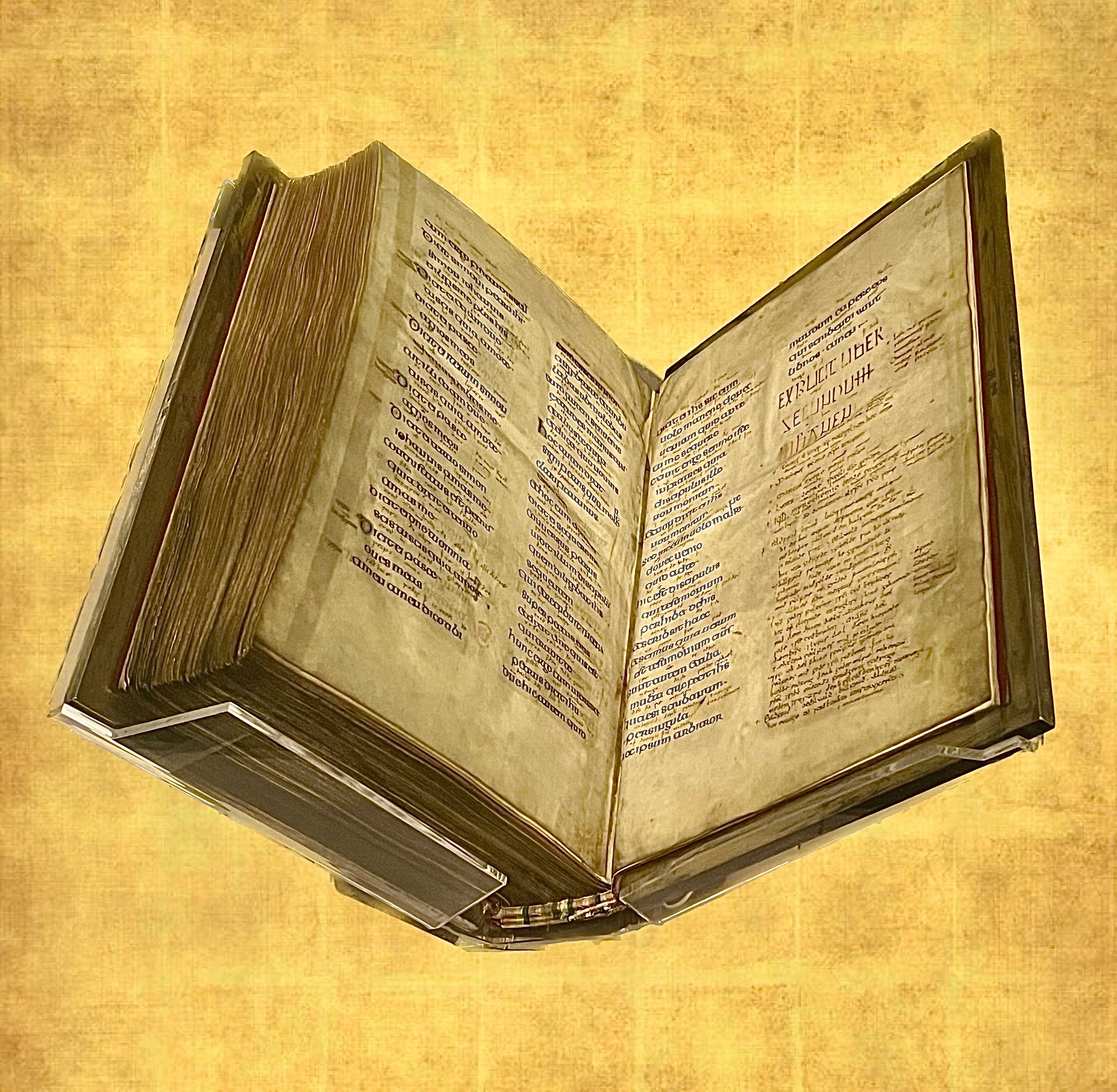
The LIndisfarne Gospels (c. 720), now at the British Library. It took Bishop Eadfrith an estimated 5-10 years to produce by hand.

Alas, the two pages on view during my visit contained no images, only text. The Latin was written in the handsome “Insular half-uncial” script. Between the lines is a word-by-word translation into a Northumbrian dialect of Old English, added in the tenth century by a priest named Aldred. Although librarians may shudder at the thought of a book being defaced by a reader, Aldred, I presume, was trying to make the gospels more readable. In any case, his scribbles have the honor of being the earliest surviving translation of the gospels into English. 
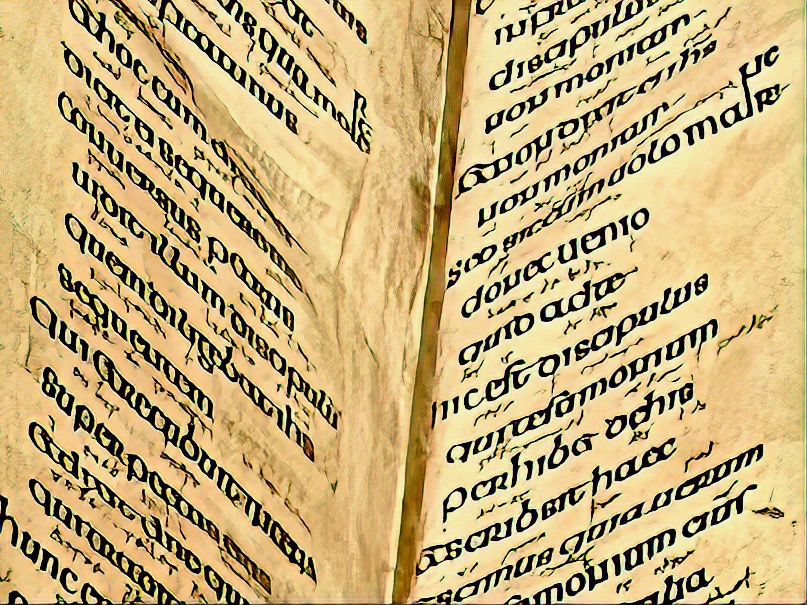
Latin text of the Lindisfarne Gospels, with Aldred’s Old English translation between the lines.

What I had most hoped to see was one of this book’s celebrated illuminations, particularly the “carpet pages,” a suite of four variations on the symbol of the Cross, embedded within mesmerizing patterns, both abstract and zoomorphic. Michelle P. Brown, a longtime curator of the Lindisfarne Gospels, calls these pages “[painted] labyrinths of prayer, prefiguring the devotional pavement-mazes of Chartres and other of the Gothic cathedrals by half a millennium or more.” [xi]  Although my eyes had not seen the glory of those magic carpets of colored ink, I departed the British Library in peace. A glimpse of the book itself was enough—for now. 

Each of the four carpet pages in the LIndisfarne Gospels has a distinctly different design (clockwise from upper left: Matthew, Mark, Luke, John). They may have been inspired by decorative 7th-century prayer rugs used in Rome and Constantinople for kneeling before the cross on Good Friday.

On my last day in Durham, there had been a splendid noonday choral concert in the cathedral by students from southern California’s Pomona College. That school is near a parish where I once served, and the connection delighted me—a taste of home in a faraway land. With St. Cuthbert’s Way behind me and God knows what before me, their final song spoke a word of grace and blessing to my pilgrim heart.

I’ll be on my way, I’ll be on my way; 
I’ll have laid my frown and all my burdens down,
I’ll be putting on my crown,
I’ll be on my way.

When I am gone, don’t you look for me in the places I have been;
I’ll be alive but somewhere else, I’ll be on my way again!  [xii]

To this temple, where we call thee, come, O Lord of Hosts today;
With thy wonted loving-kindness hear thy servants as they pray,
And thy fullest benediction shed within its walls alway.

Photographs and videos are by the author.


[i] J. G. Davies, Temples, Churches and Mosques: A Guide to the Appreciation of Religious Architecture (New York: The Pilgrim Press, 1982), 152-153.

[ii] Steen Eiler Rasmussen, quoted in Thomas Barrie, Spiritual Path, Sacred Place: Myth, Ritual, and Meaning in Architecture (Boston, MA: Shambhala Publications, 1996), 46.

[iii] Le Corbusier (1887-1965), designed one of the landmark examples of modern religious architecture, Notre Dame du Haut at Ronchamp, France. Though not a Christian believer, he believed in the power of architecture to create a spiritual environment. Quoted in James Pallister, Sacred Spaces: Contmporary Religious Architecture (New York: Phaidon Press, 2015), 9.

[iv] T. J. Gorringe, A Theology of the Built Environment: Justice, Empowerment, Redemption (Cambridge: Cambridge University Press, 2002), 258.

[v] G. K. Chesterton, quoted in Steven J. Schloeder, Architecture in Communion: Implementing the Second Vatican Council through Liturgy and Architecture (San Francisco: Ignatius Press, 1998), 227.

[vi] Michael Camille, quoted in Philip Sheldrake, Spaces for the Sacred: Place, Memory, Identity (Baltimore, MD: The Johns Hopkins University Press, 2001), 58.

[vii] T. S. Eliot, “Little Gidding” (1942) in Four Quartets.

[viii] “We sing to God in praise of Bede,” text by Rosalind Brown. 

[ix] “God, whose city’s sure foundation,” text by C. A. Alington.

[x] From Bede’s Life of St. Cuthbert, quoted in Philip Nixon, St. Cuthbert of Durham (Gloucestershire, UK: Amberly Publishing, 2012), 28.

[xi] Michelle P. Brown, The Lindisfarne Gospels: Society, Spirituality & the Scribe (London: The British Library, 2003), 77-78. Brown curated a 2003 exhibition, “Painted Labyrinths: The World of the Lindisfarne Gospels,” so I added “painted” to the citation from her book.

[xii] Shawn Kirchner, “I’ll Be On My Way,” can be heard on his album, Meet Me on the Mountain (2006). The Pomona College Glee Club is under the direction of Donna M. Di Grazia. Their entire program was inspiring and beautifully sung—one of the highlights of my journey.

The Increase of Existence: The Poetry of Marilyn Robertson

Deschutes River, Oregon, April 2121 (Jim Friedrich)

Poetry’s work is the clarification and magnification of being. Each time we enter its word-woven and musical invocation, we give ourselves over to a different mode of knowing: to poetry’s knowing, and to the increase of existence it brings, unlike any other. 

— Jane Hirshfield[i]    

Spirituality and poetry share a common task: “the increase of existence.” This is holy work, and much of it involves coming to terms with time. Whether we waste it, use it, lose it or save it, it is never ours to keep. It is a gift that comes and goes. Whatever is meant by the increase of existence, it cannot be a matter of longevity. That would deny the fullness of time to those who die too soon, and I believe the universe to be kinder than that. No, the increase of existence is not in its length, but in its depth, what T. S. Eliot called “a lifetime burning in every moment.” [ii]

Russian theologian Sergei Bulgakov described this depth as a relationship with the eternal: 

“For [the human person], eternity is not a specially qualified time that will arrive after temporal life, as an event in time itself; rather, it is the depth of [our] own being, a depth known in time and ceaselessly revealing itself. Eternity is [our] rootedness in God, and this eternal life both begins and is accomplished in temporal life.”[iii]

In a recent New Yorker cartoon, a small boy tells his bemused parents, “You’re just lucky you don’t have your whole life looming in front of you.” I wonder if that becomes funnier, the older you get. Certainly the nature of time feels different when it starts to run out. Some of us would not mind a little more looming in our later years.

Marilyn Robertson, Santa Cruz, California, January 2018 (Jim Friedrich)

My oldest sibling, Marilyn Robertson, is a poet. In her latest collection, “Small Birds Passing,” time is on her mind. “I like the moreness of time at low tide,” she writes. “Time for a stretch, a sigh. / Time for nothing perfect.[iv] But the stillness of the unhurried moment, the sense of “moreness,” is not inherent to time itself. It is rather the product of our own attentive awareness.

Days won’t wait for us. 
Hours drift away.
Time never got the hang of lingering.

Yet what if we dropped everything,
Stood still.
Looked around.

That red leaf.
Those cloud-sheep.
All the small birds passing.[v]  

In the first hour and the last, and all the moments in between, pay attention. Sink into the depth of things. Increase existence. Such temporal depth does not come naturally to a society obsessed with speed and surface. We need teachers. 

Animals keep trying to tell me 
how to live: 

cat, sunning herself 
on the grape arbor, 

dog, bouncing along the path, 
in love with everything, 

and rabbit, 
the ardent listener, 

her soft antenna ears 
always tuned to the present.[vi]

In “One Thing,” Moon joins Rabbit in modeling a spiritual practice:

One thing about a rabbit, or the moon,
is that they don’t waste time fretting about
what to do with the rest of their days.

They are living them, one after another,
those tidy packages of hours with their beginnings,
their middles and their ends.

Rabbit, hopping along a path through woods,
into briars and out again without so much
as a scratch on its soft jumpy body,

and Moon, sailing across the infinite ocean of sky,
spilling her poetry of light
into every window she can find. 

And yet, no matter how adept at sounding the depths of the given moment, poets and pilgrims of a certain age cannot help glancing toward life’s horizon. There are too many goodbyes in our latter days, too many deaths, to let us forget the “tears of things.”[vii] 

All the farewells in a lifetime.
All the ships that sail away, becoming pinpoints.
Becoming specks.

“You just missed her.”
“He said to say goodbye.”

All the clicks of latches, shutting of lids.
“Stand back. The doors are closing.”

There are roads. We have feet.
What we leave behind will soon forget our names.

All the losses. All the last words.
The telephone ringing, ringing in the night.[viii]

The last line could signify the news of death, received by phone at an untimely hour, but I hear it as a call to someone who is no longer there to pick up. The unanswered phone is a heartbreaking image of disconnection—the permanent loss of a precious voice. And then what? Is everything, in the end, gone for good? Or does the eternity we experience in the “depth known in time” persist for us beyond the grave?  In “After,” the poet admits our essential unknowing in this matter.  

After the fire,
what will I be?

A thing with feathers?
Or that little pile of ashes

just there, where
the water heater used to be.

And though the poet in her reticence prefers to let the “Thick pages of theology fly / out the window,”[ix] she nevertheless intimates the possibility of resurrection. The title of the collection’s last poem, “The Story So Far,” locates the octogenarian poet in the middle, not the end, of her divine comedy:

old flowers 
tossed on the compost

doorway of loss
blown open by a sudden wind

water jar broken three times
still beautiful

in the heart of the mother
one hundred poems

we are not dying
we are just waking up


For more of Marilyn Robertson’s poetry, see my 2017 post, Running on Fast Forward.

[i] Jane Hirshfield, Nine Gates: Entering the Mind of Poetry (New York: Harper Collins, 1997), vii.

[ii] T. S. Eliot, “East Coker” in Four Quartets. The poet goes on to say, “We must be still and still moving / Into another intensity / For a further union, a deeper communion …” In other words, deeper and deeper into God.

[iii] Sergei Bulgakov (1877-1944), The Lamb of God (Grand Rapids, MI: Eerdman’s, 2008), 135. This classic in Christology was originally published in 1933.

[iv] Marilyn Robertson, “Low Tide,” in Small Birds Passing (2020). All her poems and excerpts are from this chap-book.

[v] “Taking Time.” 

[vi] “How to Live.”

[vii] This poignant phrase is from Virgil’s Aeneid, Book I.462. The Latin, lacrimae rerum, lacks the preposition which English requires, creating the ambiguity in translation of “tears for things” vs. “tears of things.” Seamus Heaney’s rendering speaks to the immensity of our grief in this time of pandemic: “There are tears at the heart of things.”

[viii] “Endings.”

[ix] “You Say”

Backpacking with the Saints (Part 2)

Death Valley National Park, Holy Week 2005

You do not go into the desert to find identity but to lose it, to lose your personality, to become anonymous. You make yourself void. You become silence. It is very hard to live with silence. The real silence is death and this is terrible. It is very hard in the desert. You must become more silent than the silence around you. And then something extraordinary happens: you hear silence speak.

–– Edmond Jabés

In Part 1 of my commentary on Belden C. Lane’s book about “wilderness hiking as spiritual practice,” we explored his first two themes: Departure and Discipline. Here we shall look at his third theme.

The Philosophical Promenade, Keith Beckley / Dennis Evans (Seattle’s I-90 Trail, March 17. 2014)

Descent (When the Trail Gets Rough)

As a longtime backpacker, Lane knows that not every hike is a victory march. In fact, if you don’t encounter obstacles, setbacks, tribulations and the occasional failure, you’re kind of missing the point. Dante, history’s most famous trekker, discovered on his very first day in the wild that the experience of “descent” is not only inevitable, but necessary. Over the years, Lane has learned to welcome the hard parts as his teachers.

“Backpacking as a spiritual practice is about making yourself vulnerable in order to be stretched into something new. It’s the need to recognize your limits, to be taken to the end of yourself where resources are exhausted and you stumble in blind faith toward that which is more than you. In the beauty-mixed-with-terror of a backcountry wilderness, you begin to discover that for which the mystics had no language.”

Fear, failure, and death are Lane’s categories of descent. As with his other subjects, he chooses appropriate saints to guide him. His companion in the way of fear is John of the Cross, the sixteenth-century Spanish mystic who spent nine months locked in a dark space too small to stand up in. Abused by his ecclesiastical captors and frequently beaten, he struggled with boredom, doubt and despair. When he was close to death, he made a miraculous escape in the dead of night. But his cruel experience of confinement ultimately clarified and deepened his praise of the soul’s “dark night” as the passage into the place where love abides.

To reach the place you know not, John realized, you must go by a way which you know not. Satisfaction, assurance––even divine presence––will seem to go missing in the dark night, because whatever you “know” and the consolations you’re attached to are being stripped away to make room for something unimaginably greater. As T. S. Eliot would put it four centuries later, “wait without hope, for hope would be hope for the wrong thing.” Only thus did the suffering saint become the passionate singer of divine love.

When you are in the dark night, you don’t yet know it to be a passage into the light. The darkness feels real and absolute, full of terror. You are not yet the future self who has made it through. When Lane hiked the Maze, a bewildering and dangerous array of interlocking canyons in Utah, its confusing paths and frequent dead ends triggered an unsettling engagement with his personal demons. A confined, horizonless space where you can get permanently lost, or washed away by a flash flood, was the perfect place to descend to one’s inner depths.

The suicide of a father when Lane was thirteen, his mother facing death with Alzheimer’s, a mentor taken by cancer, the heart attack of a close friend––all the terrible losses came to visit in that arid canyon, whispering their ancient fears. But that’s not where the story ends, because the dark night doesn’t just take away. It also gives, and as John of the Cross discovered, it seems to know exactly what you need. Lane’s own story bears witness:

“There in the dark night, wandering through a maze, the impossible may happen. You find yourself moving beyond the fear and confusion you’ve been carrying for years. It’s no longer necessary to ‘fix’ what was unresolved in your parents’ lives. You can leave the past––there at the canyon wall, on the floor of the Maze, finally and for good.”

Mt. Whitney summit, 30 minutes before lightning and snow (September 5, 1998)

Failure is the next layer in Lane’s archaeology of descent. His pilgrimage to climb the highest American peak outside Alaska came short by 1700 vertical feet. California’s Mt. Whitney (14,505’) may not pose the same technical challenges as the glacial summits of higher or more northerly mountains. In summer the trail can be snow-free all the way. But the air is thin, the way steep, and the weather fickle. When I climbed Whitney twenty-one years ago, the sky went from sunshine to lightning to snow in half an hour.

Lane ascended Whitney with a friend in late spring, when lingering snow made footing unsure and an enveloping cloud reduced visibility to zero. He could barely see his own feet, and a sudden panic about falling into an unseen abyss forced him to turn back. His friend continued on, and later reported on the stunning views Lane had missed. To make it worse, some 12-year-old boy scouts back at base camp regaled him with their own tales of reaching the top. “Failure,” Lane writes, “felt like an indictment of my own worth as a person, confirmation of a deeper defect in character.”

His unsuccessful climb has stuck with him as a vivid metaphor for his own struggles to prove himself. Whether he was feeling out of place in a demanding graduate school, or worrying about being good enough as a teacher or writer, he felt the pressure of high expectations. Whether we’re trying to live up to our own ideas of perfection or somebody else’s, the pinnacle of “success” is a killer climb. What happens when you just can’t go all the way?

Martin Luther is Lane’s companion on this particular trail. Tortured by angst, guilt and a damaging penitential system, the great reformer learned the hard way that when we come short, when we mess up, we remain the beloved of God. “All of his life, Luther had feared an angry, demanding God, only to discover in the end that God had been wanting to love and forgive all along.” The life of grace has nothing to do with striving for perfection. It is, rather, an economy of perpetual forgiveness and compassion. God’s love is not earned, nor is it ever withdrawn. All we have to do, as Paul Tillich said, is to “accept our acceptance.”

For Lane, the most important mountains are the ones we don’t climb. “Every failure is an invitation to growth. Mistakes are occasions for grace, opportunities to choose a different path. They make forgiveness possible. Only in the absence of success can you know yourself to be loved without cause.”

Banff National Park, Alberta, Canada (August 21, 2012)

Lane’s trajectory of descent concludes with death, the point of no return. The literal end of our mortal span is not the only death we face. We all experience many little deaths throughout our life, as one stage or condition ends and another takes its place. And for the spiritually adventurous, there is the hardest death of all: the annihilation of the inauthentic self.

Letting go of the old life, the old self, or the old story is always challenging. Sometimes we have to be dragged kicking and screaming into the new life, even if it’s infinitely better. What Lane calls “the wild and reckless beauty” of untamed places can help us transcend our limiting self-descriptions and receive an identity far more luminous and vast.

“Inherently we sense that the uncaring majesty of wilderness has the potential of breaking us open to love. Each passage to a new self begins with an allurement that threatens to kill, even as it ignites a new fire within.”

A few years before his retirement from thirty years of university teaching, in the company of his dog and the anonymous author of The Cloud of Unknowing, Lane ascended a wild section of Missouri’s Ozark Plateau to undergo a ritual death, releasing his hold on an identity which was passing away. On Mudlick Mountain, named for some of the oldest exposed rock in the world, he chose a primitive stone shelter as his “death lodge”––a place to bid farewell to the old life and prepare himself for the new.

“My hope was to trade the mind of the scholar for the heart of a vagabond poet. . . In my backpack I’d brought along the last few pages of a scholarly book I’d been writing. I read these to the dog and the hickory trees, offered thanks for the work I’d been given, and then burned the pages in the fireplace.”

Finally, like the prophet Ezekiel, he shaved his head to welcome old age and celebrate his imminent freedom from “impression management.” It’s a poignant image. The aging scholar consenting to vanish. The ashes of his writings now cold in the fireplace. His faithful dog––whose  last breath would come during Lane’s drafting of the death chapter––quietly living in the moment.

It’s like a quatrain from Li Po, an 8th-century poet cited in Lane’s book. On a mountain overlooking China’s Shuiyan River, Li Po wrote:

The birds have vanished into the sky,
and now the last cloud drains away.
We sit together, the mountain and I,
until only the mountain remains.

Sunrise view of Mt. Whitney from Trail Camp at 12,000′ (September 5, 1998)


Except for the epigraph, all quotations are from Backpacking with the Saints: Wilderness Hiking as Spiritual Practice by Belden C. Lane (Oxford University Press, 2015).

All photographs were taken on my own hikes.

 Lane’s final theme, Delight (Returning Home with Gifts), will be the subject of my next post.