
Whose World Is It?—Rethinking the Problem of Evil

The Last Judgment (detail), Tympanum of the Abbey of Sainte-Foy, Conques, France (c. 1107).

God isn’t the prime mover of every natural catastrophe and human ill; inexplicable tragedies are never a so-called act of God. Life is more complicated than that; so is the universe; so is God. 

— Gary Commins

Lord, if you had been here, my brother would not have died (John 11:21).

In Son of Man, a 2006 film retelling the Jesus story in a 21st-century African country, Jesus and Satan are sitting side by side atop a tall sand dune. After putting up with the three temptations, an exasperated Jesus turns suddenly toward his adversary and gives him a hard shove. As Satan tumbles down the dune, Jesus shouts after him, “This is my world!” But Satan is unbowed. When he reaches the bottom, he picks himself up, dusts himself off, and cries up to Jesus, “NO! THIS IS MY WORLD.” The film cuts to the country’s ongoing civil war, where a mass shooting of schoolchildren proves Satan’ point. 

One night last week, a drunken man was shooting a gun in his front yard—reportedly a form of recreation in his Texas neighborhood. But his next-door neighbor had a baby who was trying to sleep. He asked the shooter to stop. The shooter refused. Instead, he fetched a deadlier weapon—an assault rifle—took it into his neighbor’s house, and slaughtered five people, including a nine-year-old boy. The police found a few survivors—children shielded beneath the bodies of their mothers—uninjured, but covered with maternal blood.  

Such unspeakable evil has become a regular occurrence in my country. Mass shootings are setting a record pace this year. Twenty years ago, there were 200 million guns in America. Now there are 400 million. Twenty years ago, assault rifles were 2% of the market. Now they are 25%[i] The man who pulled the trigger in Texas is not alone in his guilt. He is joined by the gunmakers who make themselves rich from the carnage, the right-wing lawmakers who fetishize guns to get votes, the cable propagandists who stoke fear, rage and hate, and a dysfunctional society incapable of exorcising its legion of demons.
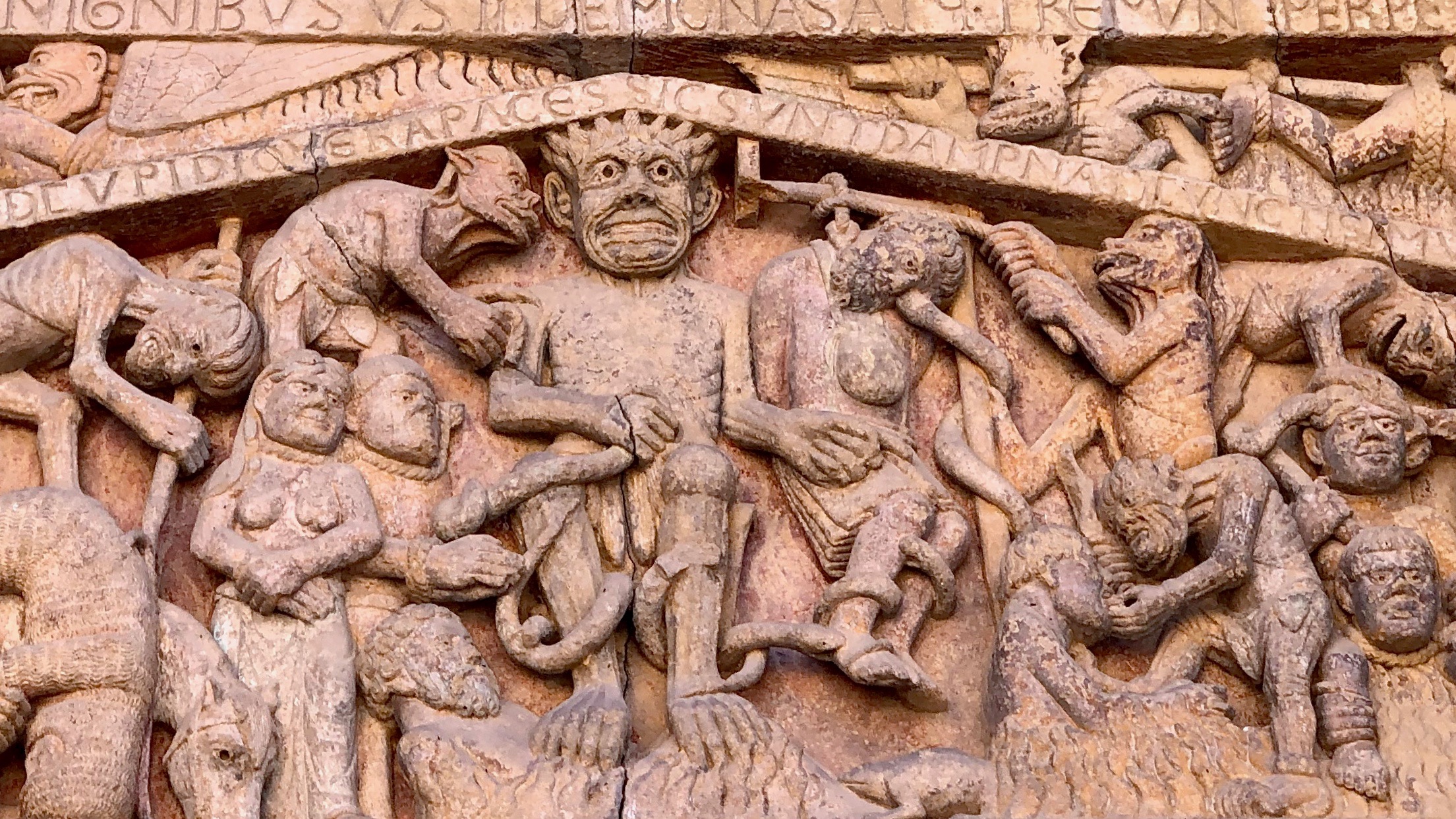
The Last Judgment (detail), Tympanum of the Abbey of Sainte-Foy, Conques, France (c. 1107).

I have written about our capacity for denial in “The Murderous Hypocrisy of ‘Thoughts and Prayers.’” If we say we have no sin, we deceive ourselves, and the truth is not in us (I John 1:8). Or as a modern theologian puts it, “It is only when our capacity for evil has been rendered explicit that we have a realistic basis for understanding that transformation or metanoia, that healing, which constitutes our salvation.” [ii]

Zooey Zephyr, a representative in the Montana state legislature, recently provided a perfect image of the cognitive dissonance inherent in pious self-deception. She was speaking against a Republican anti-trans bill which she believes will increase suicide among the young; but her words could apply to every political misuse of “thoughts and prayers”: “If you vote yes on this bill and yes on these amendments, I hope the next time there’s an invocation when you bow your heads in prayer, you see the blood on your hands.” [iii]

The Republican majority, like Pilate washing his hands of innocent blood, voted to silence Zephyr. They expelled her from the house. It’s easy to mock their fear of truth-telling, but when we look at our own hands, what do we see? 

Evil is woven not only into the fabric of the world, but into each and every soul. In Terrence Malick’s great (anti)war movie, The Thin Red Line, we are shown the violence and death of a terrible battle, but the realistic sounds of gunfire, grenades and human screams are muted beneath the elegiac music of Charles Ives’ “The Unanswered Question,” as though we are watching human evil through an impartial God’s tear-stained eyes. Then we hear the voice-over questions of an American soldier, seeking to penetrate the surface of the visible: 

“This great evil, where does it come from? How does it still enter the world? What seed, what root did it grow from? Who’s doing this, who’s killing us, robbing us of life and light, mocking us with the sight of what we might have known? Does our ruin benefit the earth? Is this darkness in you too?” [iv]

Who’s doing this? Who’s killing us? Is this darkness in you, too? The problem of evil is not only an unanswered question; it is unanswerable as well. In his valuable and insightful new book, Evil and the Problem of Jesus, Episcopal priest and theologian Gary Commins invites us to set aside the philosophical conundrums, engaging evil not as a theoretical puzzle but as a practical challenge.  

Since ancient times, the existence of evil has raised unsettling questions about the nature of God. If God is good, why is so much evil allowed to happen? Is God indifferent to our suffering, or somehow powerless to eliminate it? Can divine purpose ever justify evil, turning it to the good? Or must we conclude that a good God, or any God at all, is a logical impossibility, given the prevalence and persistence of evil?

Theodicy is the philosophical or theological attempt to reconcile the goodness of God with the existence of evil. It has produced a vast amount of profound intellectual reflection over the centuries. But Commins, drawing on his own pastoral experience, calls the whole enterprise into question. It’s not just that a rational explanation for evil offers little real comfort to its victims (Who wants to hear “It’s God’s will” at a funeral?). It also strips both God and evil of their complexity. The sources of evil are multifarious and impossible to trace with precision. And the activity of God within our temporal, finite existence is not a unilateral and unfettered exercise of power. The self-emptying God chooses to work within incarnational limits. The vulnerable babe in the manger grows up to die on a cross, and in between does what he can to address evil, not always successfully. 

“Traditional Western theodicy,” says Commins, “jams billions of people, or the planet, millions of millennia, and the infinite intricacy of subatomic matter into a solitary, simplistic enigma of God-and-evil. By tapering all its energy into one worn-out query, it diverts us away from more illuminating questions. Not only does it boil down a myriad of meanings into one conundrum of divine power or love. It concentrates on what is, in all likelihood, the least fruitful of many mysteries.” [v]

Instead of defending God’s honor or solving the ancient enigma of good and evil, we should accept the sheer givenness of “a wild, wondrous, chaotic creation [we] can’t comprehend or control.” [vi]  Instead of wondering why the world is so, we should devote our energies to the divine project of making it better. 

“The causes of evil and suffering are personal, social, structural, and cosmic: human delusions, collective misbehaviors, institutional grandiosity, and spiritual malice .… Until the End, suffering and evil will neither cease nor desist—they are inherent in creation and intensified by social ills; we can decrease them by aligning ourselves with God’s will.” [vii]

We may never understand why the world must be an unstable mixture “of storms and stillness, gloom and brightness,” where “suffering, evil, and chaos commingle with glory, love, and joy.”[viii]  But it’s the world we’ve got, and what we really need to figure out is how to live in it.

And for that, Commins says, we must turn to Jesus, who shows us “what it means to be human.” If we seek a Christian understanding of God’s response to evil, we should start not with metaphysics, but with the gospel.

“Jesus never waxes philosophical. Rather than offering an ‘explanation’ for evil, he gives his followers ‘a charge and a benediction’: the charge to stand in solidarity with the oppressed, the benediction to empower his followers to resist evil.” [ix]

“Nowhere does Jesus construct a system of ethics or author a theology of evil. In broad terms, what we can do to undo evil is clear—act on his words, treat all as equals, seek the kingdom, go and do likewise, repent, follow, forgive, and love—but unless we face the evils within us, we won’t have a positive influence on the world around us and, even then, nothing is a sure thing.” [x]

At the same time that Jesus is showing us how to be fully human, he is revealing who God is and what God does. Jesus’ own responses to evil are “epiphanies into God’s relationship with evil.… what Jesus does in time, God does in eternity; the ways Jesus responds to evil in his lifetime—confronting, undoing, and erasing it; bending, circling, and transforming it—are ways God always engages evil.” [xi]

No metaphysical speculation needed. Just keep an eye on Jesus, and the Way will show itself. In a beautifully succinct summation of this Way, Commins says that “Jesus embodies compassion, challenges judgments, reverses fates, levels inequalities, frees from demons, forgives sins, tells truths, and plants seeds of shalom.” [xii]

So whose world is it, after all? We wonder every time we watch the news. But ultimately, it’s a question to be answered not within our minds, but in the activity of our lives. As the song says, “It may be the devil or it may be the Lord, but you’re gonna have to serve somebody.”[xiii]

The late German theologian Dorothee Soelle (1929-2003) found this paradigm of Christian discipleship perfectly expressed in The Brothers Karamazov, where Ivan and his younger brother Alyosha are earnestly discussing theodicy. Both agree that no long-range divine purpose could ever justify the torture of children in the here and now. Where the brothers differ is in their personal response to evil. Ivan blames and rejects a God who consents to the immense sufferings of history. But Alyosha, notes Soelle, does not shake his fist at heaven. He is too busy attending to the needs of earth, just like the God who became one of us.

“[Alyosha] directs his attention not to the power above but to the sufferers. He puts himself beside them. He bears their pain with them. He listens with agony as Ivan introduces examples of suffering he had assembled against the compassion of God … He is silent, he shares the suffering, he embraces the others.” [xiv]

Compassion’s embrace: from Alexander Sokurov’s “Lc. 15:11-32” (Prodigal Son installation,Venice Biennale 2019). Sculptures by Vladimir Brodarsky & Katya Pilnikova.

Photographs by the author. For more on the Tympanum at Conques, including a video of what the original painted colors might have been: https://www.tourisme-conques.fr/en/en-conques/the-tympanum

[i] These statistics were cited in a televised interview with Fred Guttenberg, speaking about the new book he has co-authored with Thomas Gabor: American Carnage: Shattering the Myths That Fuel Gun Violence. 

[ii] Kenneth Surin, Theology and the Problem of Evil (Oxford & New York: Basil Blackwell Ltd., 1986), 157.

[iii] https://apnews.com/article/montana-trans-lawmaker-silenced-zooey-zephyr-d398d442537a595bf96d90be90862772

[iv] The Thin Red Line (1998), adapted by Terrence Malick from James Jones’ 1962 novel. 

[v] Gary Commins, Evil and the Problem of Jesus (Eugene, Oregon: Cascade Books, 2023), 14. Full disclosure: Gary is an old friend. We meet up periodically in Eugene for national track & field championships, but never discuss evil during the meets. His new book not only offers a fresh and timely take on a central theological question, it does so through an illuminating method of reading Scripture and tradition in general.

[vi] Commins, 68.

[vii] Ibid., 194.

[viii] Ibid., 155, 194.

[ix] Ibid., 41. The quoted phrases are from Susan R. Garrett’s article, “Christ and the Present Evil Age,” Interpretation 57 (2003), 370-383.

[x] Ibid., 129-130.

[xi] Ibid., 159.

[xii] Ibid., 149.

[xiii] Bob Dylan, “Gotta Serve Somebody,” on Slow Train Coming (1979). 

[xiv] Dorothee Soelle, Suffering (London: Darton, Longman and Todd, 1975), 175.
What Will the Cross Make of Us? — A Good Friday Sermon

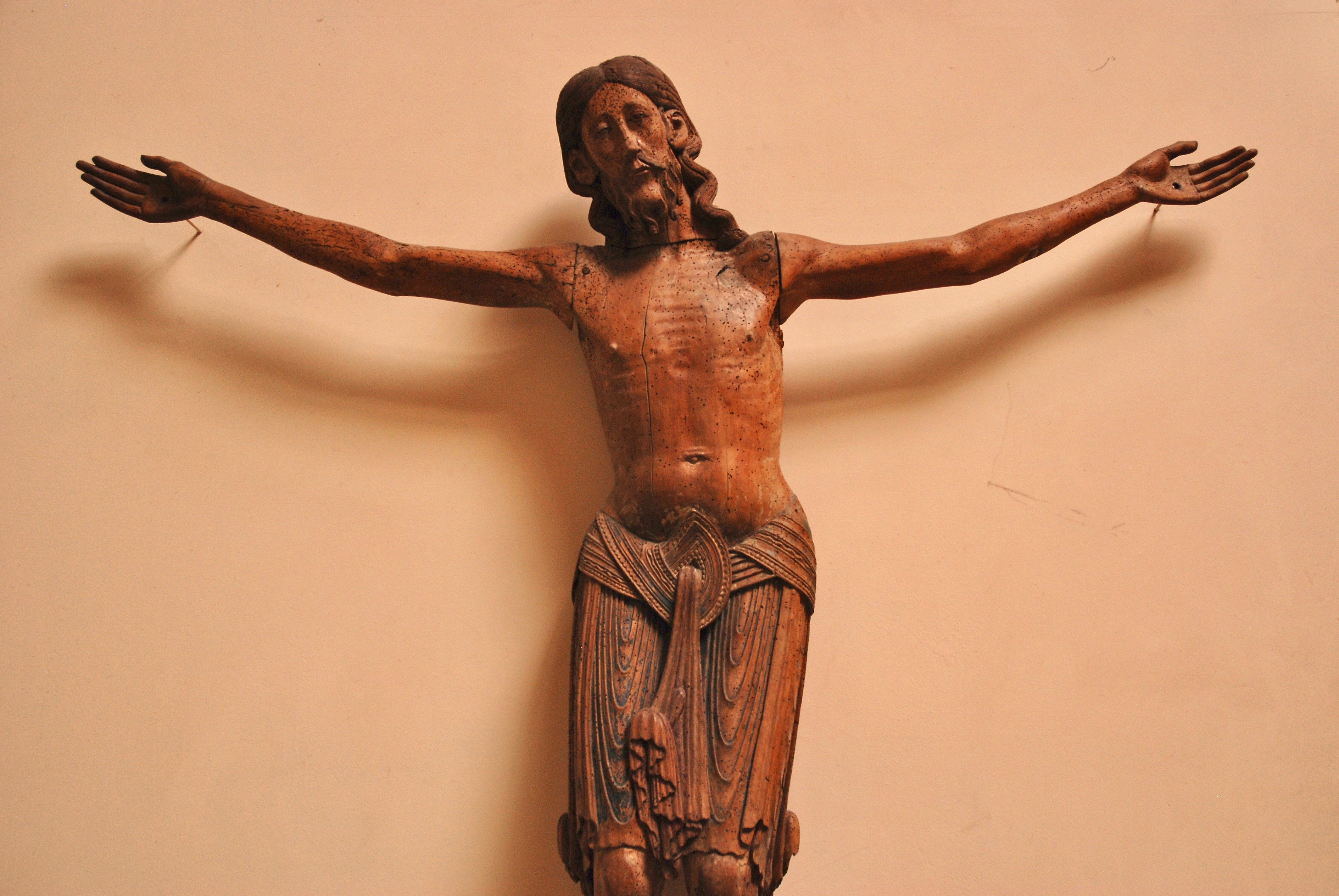
Christ on the Cross (Auvergne, 12th century), Cluny Museum, Paris.

A sermon preached on Good Friday at St. Barnabas Episcopal Church, Bainbridge Island, WA

I’m going to ask you some questions, 
and the answer you will give is, “I am here”.

Judas, slave of jealousy, where are you?…
Peter, slave of fear, where are you?…
Thomas, slave of doubt, where are you?…
Men and women of Jerusalem,  enslaved by mob violence, where are you?…
Pilate, slave of expediency, where are you?…

You’re all here, then. Good. 
Because the crucified God has something to say to you: 

Mercy.

Let us pray.

God, we pray you, look upon your family 
for whom our Lord Jesus Christ was willing to undergo 
the torture of the cross. Amen.

I find this opening Collect for Good Friday so moving, because it doesn’t make any requests for particular outcomes. It simply asks God to look at us—just look at us—with the loving gaze of mercy. In the middle of a terrible war, with a million dead from COVID in this country alone, and a pandemic of hate and racism and sheer folly leaving us dispirited and exhausted: Lord, have mercy. That’s our prayer at the foot of the cross. Lord, have mercy

In the 1965 Jesus movie, The Greatest Story Ever Told, the Holy Family is returning from Egypt after the death of Herod. And when they’re back in their own country, on their way home, they come up over a rise, and there before them are dozens of crosses along the road, with a man dying on every one—human billboards advertising Roman justice and the cruel fate awaiting anyone who might trouble the tranquility of the empire. In those days, it was an all too common sight.

The camera gives us a good look at those suffering victims, anonymous in their pain, and then cuts to a closeup of the two-year-old Jesus, riding on a donkey in his mother’s arms, looking at those crosses with wide and wondering eyes. 

Thirty years later, another donkey would bring Jesus toward his own cross, and there he would be cradled one last time in the arms of his grieving mother.

Can’t we have a better story? Why couldn’t the people have been transformed and the authorities converted and the Anointed Son of God lived to a ripe old age teaching and healing and wisely overseeing the first generation of God’s Kingdom on earth as it is in heaven?

That’s what the disciples expected of the Messiah. Of course, you and I know better. We expect the good to die young. We’ve seen enough of it in our own day. As someone says in an A.S. Byatt novel: “There will always be people who will slash open the other cheek when it is turned to them. In this life love will not overcome, it will not, it will go to waste and it is no good to preach anything else.” 

But it could have been otherwise. Everyone had choices. That was the problem, of course. God let everybody choose, and God’s own choices were limited by the choices that his creatures made. When Jesus fell upon the ground and begged for an alternative to the cross, God remained silent. There was no reversing the choices already made by Judas and the clergy and the police who were already closing in on the garden.

But God never stopped working to bring good out of the situation, to accomplish the purpose for which Christ was sent into the world. An illuminating perspective on this can be found in that notable theological work, The Joy of Cooking, In its advice to the host of a party, it says, 

“Satisfy yourself that you have anticipated every possible emergency…Then relax and enjoy your guests….If, at the last minute, something does happen to upset your well-laid plans, rise to the occasion. The mishap may be the making of your party…[As the Roman poet] Horace observed, ‘ A host is like a general: it takes a mishap to reveal genius.” 

The mishap of sin revealed God’s genius. O felix culpa, as Augustine said. O happy fault. God never gave up on the party we call the Kingdom. But since God refused to control others’ free will, God had to improvise, to work with whatever hand God was dealt by the choices made by human beings. And the hand God was dealt was the cross. But God said, “The cross will not foil my plan. In fact, I will make of it the cornerstone of salvation.” And so it was that Jesus could say with his dying breath: “It is accomplished.”

A century ago, Russian theologian Sergei Bulgakov described the accomplishment of the cross this way: 

God tells His creation: you are created by My hands. You are my work, and you would not exist if I did not will it. And, since I am responsible for you, I take upon Myself the responsibility for your guilt. I forgive you; I return your glory to you, for I take your sin upon Myself; I redeem it with My suffering.[i]

There are those who recoil at the idea that the death of one innocent man somehow atones for humanity’s collective guilt. But the death of Jesus was not a crude transaction where Jesus just picks up the check for our feast of follies when we prove unable to pay the debt ourselves. Admittedly, there is some language in our tradition which might prompt such a misreading of the cross. For example, in the beautiful Easter Vigil chant, the Exultet, there is the line, 

“O blessed iniquity, for whose redemption such a price was paid by such a Savior.”

That may be true poetically, but not theologically. There’s plenty of guilt to atone for, no doubt. Just watch the news. And by ourselves we can never hope to set it right. But redemption has nothing to do with accounting. It has to do with love. For God so loved the world, and there is no love without vulnerability—and sacrifice. Anyone who has ever suffered because of their love for another knows the truth of this.

Christ’s death didn’t just happen on Golgotha. It took place in God’s own heart. And the salvation wrought on the cross wasn’t because somebody named Jesus got punished for our crimes, but because love proved greater than sin and death. 

The powers of hell have done their worst to God this day, but Christ their legions hath dispersed. The victory didn’t have to wait for Easter. Love wins today—on the cross—because it absorbs every evil without returning the violence, and it refuses to give up on any of us—not even the killers who know not what they do. 

David Bentley Hart, a contemporary Orthodox theologian, sums this up beautifully:

“The only true answer to the scandal of this blood-soaked cosmos is the restoration of the very One who was destroyed … the only horizon of hope is that of the humanly impossible; and the only peace for which [we] can now properly long is not that which can be bought by a victim’s blood, which is a plentifully available coin, but that which can be given solely by that One who has borne the consequences of human violence and falsehood all the way to the end and then miraculously returned, still able and willing to forgive …”[ii]

Therefore, kind Jesus, since I cannot pay thee,
I do adore thee, and will ever pray thee,
Think on thy pity, and thy love unswerving,
Not my deserving.[iii]

One of my Facebook friends, an Episcopal priest in Delaware, posted a story this week about a young woman, a newcomer to her parish, who asked her, “What are the qualifications to carry the cross in church? Because, you know, well, see? I was homeless for about five years. Yeah, and you know, see? I did some things I’m not proud of, but it was really the best choice between some really bad choices. So, I’m kinda embarrassed and I don’t want a lot of people asking a lot of questions so, you know, am I qualified?” 

“Oh, sweetheart,” said the priest, “I don’t know anyone in this congregation who is more qualified than you are to carry the cross. I have no doubt that you will be one of the best-qualified crucifers in the history of crucifers in The Episcopal Church.”

“Well, I don’t know about that,” she said. “But thank you. Just one more question: Do I get to wear white gloves?”

“Absolutely, my friend. Let’s go find you a pair.”[iv]

That’s such a perfect story because Jesus made his own cross an act of solidarity with people just like her—with the outcast, the homeless, the powerless, and the survivors of bad choices. He shared their condition and he suffered their pain. He bore their griefs and carried their sorrows. He made the sin, alienation, and brokenness of the world his own, so that no human experience would ever be alien to God. 

As a Franciscan scholar has written: 

“The Crucified is the diffusing center of God’s love in the world whereby he reaches down to that which is furthest from [God] to draw all into [the divine] goodness and thus into the love of the Trinity.” [v]

And an Anglican theologian puts it this way: 

“In [God’s] own Trinitarian history of suffering, God opens [Godself] to include the uproar of all human history; oppressed and forsaken people can find themselves within the situation of a suffering God, and so can also share in [God’s] history of glorification.”[vi]  

I love the image of that young woman carrying the cross as she herself, I would say, is being drawn into the divine goodness and sharing in the history of Christ’s glorification. And it being an Episcopal church, she got to do it with white gloves!

So here we are on God’s Friday, at the foot of the holy cross, puzzling over its multiple meanings. Why did Jesus have to die? How exactly has that death broken the power of sin and death? What does the cross tell us about God’s love for us? 

These are all profound questions, but I will let the liturgy’s hymns and prayers speak to those questions rather than my trying to reduce the mystery of Good Friday to a few paragraphs. Just open your heart and the liturgy will speak the word you need to hear today. It may come in a hymn, or when you venerate the cross, or receive Sacrament. But it will come.

So rather than explore what we make of the cross, I will conclude with a few thoughts about what the cross wants to make of us

On Palm Sunday, we heard St. Paul urge us to “Let the same mind be in you that was in Christ Jesus … who humbled himself and became obedient to death—even death on a cross” (Philippians 2:8). This isn’t telling us to try harder, but to see differently, or as Paul says in Romans, “be transformed by the renewing of your minds so that you may discern what is the will of God—what is good and acceptable and perfect” (Romans 12:2).

When we start to put on the mind of Christ Jesus, when we begin to think God’s thoughts instead of our own, not only will the world become different, but we will begin to live differently—not in fear of death, despairing over the uproar of the times, or retreating into our fortress egos—but in self-diffusive love, offering all that we have and all that we are for the sake of others, as we move deeper and deeper into the holy communion with God and one another that is our destiny. The cross proves that Jesus lived that way until his last breath. And the cross invites us to do the same.

The gospels never tell us what’s going on in the mind of Christ. They simply show us what kind of life that mind produced. But if I were to venture a glimpse into Christ’s mind, I might choose a passage from The Brothers Karamazov, where young Alyosha, the most saintly of those memorable siblings, is out looking at the stars when he is suddenly seized, as it were, by the mind of Christ: 

The silence of the earth seemed to merge with the silence of the heavens, the mystery of the earth touched the mystery of the stars. . . Alyosha stood gazing and suddenly, as if he had been cut down, threw himself to the earth.

He did not know why he was embracing it, he did not try to understand why he longed so irresistibly to kiss it, to kiss all of it, but he was kissing it, weeping, sobbing, and watering it with his tears, and he vowed ecstatically to love it, to love it unto ages of ages. “Water the earth with the tears of your joy, and love those tears. . . ,” rang in his soul. 

What was he weeping for? Oh, in his rapture he wept even for the stars that shone on him from the abyss, and “he was not ashamed of this ecstasy.” It was as if threads from all those innumerable worlds of God all came together in his soul, and it was trembling all over, “touching other worlds.” He wanted to forgive everyone and for everything, and to ask forgiveness, oh, not for himself! but for all and for everything. . .[vii]


[i] Sergius Bulgakov, The Lamb of God (Grand Rapids, MI: Eerdmans, 2008), 364.

[ii] David Bentley Hart, Theological Territories: A David Bentley Hart Digest (Notre Dame, IN: Notre Dame University Press, 2020), 23.

[iii] “Ah, holy Jesus,” verse 5, text by Johann Herrmann, tr. Robert Seymour Bridges.

[iv] Thanks to the Rev. Elizabeth Kaeton for letting me use her story.

[v] Ilia Delio, Crucified Love: Bonaventure’s Mysticism of the Crucified Christ (Fransciscan Media, 1999), 165.

[vi] Paul Fiddes, The Creative Suffering of God (Oxford: Oxford University Press, 1988), 151.

[vii] Fyodor Dostoevsky, The Brothers Karamazov, tr. Richard Pevear & Larissa Volokhonsky (New York, Vintage Classics, 1990), 362.

One Year Later: 7 Spiritual Practices for the Time of Trial

Albrecht Dürer, Knight, Death and the Devil (1513)

And though this world, with devils filled,
should threaten to undo us;
we will not fear, for God hath willed
his truth to triumph through us;
the prince of darkness grim,
we tremble not for him;
his rage we can endure,
for lo! his doom is sure,
one little word shall fell him.

— Martin Luther

Save us from the time of trial . . .

— The Lord’s Prayer


One year ago today, the United States did the unthinkable. The ugliest impulses of the American psyche, abetted by Russian meddling, delusional propaganda and a broken electoral process, handed the presidency to a seething cauldron of vanity and malice. This is not just a national embarrassment; it is inflicting enormous and lasting harm on our people, our natural resources, our democracy and our planet. Everything I wrote in a pre-election post, Ten Reasons to Stop Trump Now, is proving depressingly accurate.

After picking myself up off the floor last November, I composed a list of Seven Spiritual Practices for this dark and threatening time. It is not so much a guide to personal survival as it is a call to action, with due attention to the self-care necessary to sustain our collective Resistance without burning out, or succumbing to anger and despair.

So I am posting it again, in the hope that it may still prove relevant and helpful. And I would welcome your own feedback about the practices which have sustained and empowered you over the last year.

In thinking about what images to select for this re-posting, two came immediately to mind. The first is Dürer’s Knight (above), riding steadfastly through a “world with devils filled.” It seems a perfect image for today’s resister, and may well have been inspired by Erasmus’ advice to the faithful soul, written nine years before Dürer’s engraving:

“In order that you may not be deterred from the path of virtue because it seems rough and dreary … and because you must constantly fight three unfair enemies—the flesh, the devil, and the world—this third rule shall be proposed to you: all of those spooks and phantoms which come upon you as if you were in the very gorges of Hades must be deemed for naught after the example of Virgil’s Aeneas … Look not behind thee.”

My second image for our “time of trial” is Theodore Géricault’s “The Raft of the Medusa,” depicting the aftermath of a shipwreck in 1816, when 147 sailors were set adrift on a makeshift raft with little hope for rescue. Only 15 survived the ordeal. When I look at this painting, I see the Trumpian future, unless we can find the resolve––and the means––to end this nightmare.

Theodore Géricault, The Raft of the Medusa (1818-1819)

So here again is my post from November 18, 2016, offered in a spirit of hope:

Last week’s question was, What happened? This week, we are beginning to ask, What now? After the tears and the shock, the heartache and the nausea, how do we pull ourselves together and begin to resist the downward spiral of hate, fear, and planetary suicide?

As I was refilling the birdfeeders in our backyard on 11/9, choruses of chickadees and juncos signaled their pleasure. The beauty of the natural world provided welcome solace on a grim morning, and for a moment I imagined myself an insular neutral in a remote Swiss valley during World War II, or a cloistered monk during the Dark Ages, quietly tending my little Eden while chaos raged somewhere far away.

But retreat isn’t really an option. It’s not just love of country that makes me unwilling to concede our future to “the power of the dog” (Psalm 22:19). The fate of the entire world is at stake. This country has enormous influence and impact. If the American heart gets painted black, the suffering will be universal.

A friend in Virginia sent me a Mexican proverb after the election: “They thought they’d buried us, but they didn’t know we were seeds.” Exactly! We carry the power of springtime within us, to outlast the darkest winter and “restore earth’s own true loveliness once more.”[i]

Thinking about where to begin, I have reflected on seven verbs of spiritual practice. It’s a small offering to our ongoing collective conversation, and comments, arguments, and shares are welcome.

Pray

When evil threatens and courage fails, prayer remembers a greater power, the life-giving Source enabling us to endure and flourish. Both privately and in community, let us make daily intercession for our country, its leaders, and all who work to make it better. Let us also ask for the strength, patience, wisdom and courage to navigate the next four years. Our fiercest energies, anxieties, longings and passions are cries that will pierce the heavens. God support and save us!

But the prayerful life is not just a matter of words and devotional practices. It is a way of being, an all-consuming relationship of deep trust in the infinite and unconquerable Love who loves us. Even in times of suffering and doubt, the prayerful ones speak as if they are being heard. “Thy will be done,” cry the prisoners of hope. And, as Scripture promises, God provides.

If we are seeds, faith makes the best soil. We are not alone. It’s not entirely up to us. God will outwit our worst failings. Resurrection has the last word.

Fast

I have had to fast from the news since the election. The awfulness of the presidential appointments, the childish tweets, the widespread outbreaks of bigotry and bullying, the sneering of the haters and the fears of the vulnerable—it is all so ugly and maddening. Many of the discussions on social media are equally distressing. So many trolls, so much ignorance and bitterness. If I drink too much of the stuff, I’m soon spinning down the rabbit hole into a dystopian Wonderland. Curiouser and curiouser, to say the least.

But the peace of my soul is not the only reason for a news fast. Evil is like Medusa’s face. Gaze too long and you turn to stone, transfixed by horror. How do we hate hate without becoming hateful ourselves? The rage provoked by repugnant beliefs, bad behavior and delusional assertions can become addictive. It feels good to denounce the rascals and villains. It’s even entertaining to watch others do it. We think we are resisting evil, only to discover we are actually increasing its power as we succumb to its mesmerizing grammar.

Of course we need stay informed if we are to resist effectively. But bad news, whether fact or fiction, is like a plague. We should be mindful of its infectious toxicity. Remember to fast from evil and feast on goodness.

Repent

Every day ought to include honest self-examination: Where and how have I impeded or ignored the divine project of transforming lives and sanctifying the universe? How can I change my life to cooperate more fully with Love’s unfolding future?

Righteous indignation is natural right now, but it is also dangerous, because it may fail to “include itself in the problem against which it reacts. It judges in a divisive way, pitting ‘me’ against the rest . . .”[ii]

It is very tempting to point fingers and call people names, but that is not a constructive path to addressing the pain and anger festering in the American psyche. I’m not sure exactly how to pursue that path in a divided nation, but believe that the repentance of the “righteous” is an important step. Whatever injustices, slights, resentments or pathologies may underlie this election, we all have all played some part, even if only by passivity and default. However noble our intentions or wishes may be, we are all participants in a society where suffering is unequally distributed and great damage to people and planet is done every day in our name.

As Simon Tugwell writes in his book on the Beatitudes, even the “innocent” and the “good” are implicated in “the whole situation of wrongness, in which we and everybody else are caught up from the very moment of our birth.”

The saving image that comes to mind for me is the scene in The Brothers Karamazov when that dysfunctional K family is arguing and posturing in the monastic cell of Father Zossima. Their loud bickering, as bullying and shameless as a Trump rally, is especially shocking in the presence of such a holy and gentle man. The elder remains silent, making no attempt to intervene. Then, suddenly, he stands up, steps forward to one of the brothers—the one he intuits to be suffering the most—and kneels before him. Bowing his forehead to touch the ground, he says, “Forgive me! Forgive me, all of you!”[iii]

Prophesy

The practice of forgiveness and compassion does not mean we remain silent about what is wrong, unjust, or destructive in our common life. And we must never allow Trump’s behavior or crazy talk to be normalized. His promised actions, from mass deportations to torture to environmental destruction, are not the customary swing of the pendulum. And his proto-fascist attack on democracy has no precedent in our history. Such things are evil-minded folly, “leading us straight to tragedy.”[iv]

Like the biblical prophets and their American successors like Martin Luther King, Dorothy Day and the Berrigans, we must denounce evil, confront the powers, envision the good, and exhort the better angels of our nature. Over the next four years, the unemployment rate among prophets should reach an all-time low.

That a majority of white Christians voted for Trump does raise troubling questions about the efficacy of religious teaching. As Clarence Jordan said fifty years ago, the biggest lie told in America today is, “Jesus is Lord.” But God is surprisingly resourceful, and the Trump years may be a refiner’s fire, forging a more faithful witnessing Church out of the flames. In any case, Jesus’ friends do not have the luxury of an uninvolved, privatized religion. We are being called most urgently to raise our voices, practice our faith, and minister to the vulnerable in the public square, whatever the cost.

As Thomas Merton wrote when the national conscience was being seriously tested in the 1960s, Christians must either “face the anguish of being a true prophet” or “enjoy the carrion comfort of acceptance in the society of the deluded by becoming a false prophet and participating in their delusions.”[v]

Love

In times of great calamity or loss, the need to connect intensifies and conversations multiply. In recent days, many of us have engaged with friends and strangers over coffee, on social media, at worship and in the streets, seeking comfort, encouragement, shared concern and collective wisdom. As labor activist Joe Hill told his supporters just before he was murdered by the state of Utah, “Don’t mourn. Organize!”

But Love won’t let us stay huddled in circles of the like-minded. In a 1969 BBC production of the gospel story, many are bewildered when Jesus commands them to love their enemies. They start to grumble at such a hard teaching. “It is easy to love only those who love you,” Jesus tells them. “Would I come to tell you easy things? Do you want me to tell you easy things?”[vi]

How do I love my enemies even as I reject and resist the harm they inflict? As hard as it may be to cross the divide between ourselves and those who offend or outrage us, God will not let us do otherwise. There is no “us” and “them” in the Kingdom. Simon Tugwell puts this as well as any:

“It is theologically and philosophically disastrous to envisage heaven and hell sitting side by side forever, each bearing witness to the failure of the other . . . According to the classic Christian ascetic tradition, it is always futile to squander our anger on one another. That is a waste of anger. Anger is made to be directed against the demonic, not against our fellow men and women.”[vii]

Let it begin with our crazy relative at Thanksgiving dinner, but eventually, like it or not, we’ll have to work our way up to loving Steve Bannon and Abu Bakr al-Baghdadi as well. Unimaginable? Jesus never said it would be easy.

Serve

In the Book of Common Prayer, the newly baptized commit to a lifetime of service, to “persevere in resisting evil … to seek and serve Christ in all persons, loving your neighbor as yourself . . . to strive for justice and peace among all people, and respect the dignity of every human being.”[viii]

In all my post-election conversations, my friends have expressed a fresh resolve to be changemakers, to take on some new commitment that will make a difference. Episcopal priest Bill Teska, a friend in Minneapolis, offered a longtime activist’s suggestions on Facebook:

“It is time to get busy. Go to meetings. Go to demonstrations. Give whatever you can to organized non-violence resistance. I would say that qualifies as almsgiving, because the end is the defense of the poor and helpless.”

And another priest-friend, Gary Hall, posted this on his blog:

“We must, like the earliest Christians, be prepared to present ourselves as a counter-force and counter-culture to imperial values and norms… As alienated as we may now feel, we will find our antidote to depression in civic engagement on behalf of the gospel, confident that a new day is coming to be born.”[ix]

There are countless ways to light candles in this darkness. Find yours.

Hope

 Last weekend many of us were wondering how the first post-election Saturday Night Live would find anything funny in what America had just done. But instead of the expected opening comedy skit, the brilliant Kate McKinnon simply sang Leonard Cohen’s aching lament:

… And even though
It all went wrong
I’ll stand before the Lord of Song
With nothing on my tongue but Hallelujah

Thanks be to God, history’s outcome is not up to us. Whatever follies we commit in sin or ignorance, God’s kindnesses are never exhausted. Should heaven and earth pass away, the Love who loves us remains. Kill the Author of life and she will rise again. This is our radical, wild hope. It is why we sing Hallelujah even at the grave. Even in the deepest hell.

Practice this hope every day, every hour. And pass it on.


[i] From an Advent hymn, “On Jordan’s bank the Baptist’s cry”, words by Charles Coffin, tr. Charles Winfred Douglas after John Chandler. The Episcopal Hymnal 1982, #76

[ii] Simon Tugwell, The Beatitudes: Soundings in Christian Traditions (Springfield, IL: Templegate Publishers, 1985), 87

[iii] Fyodor Dostoevsky, The Brothers Karamazov, tr. Richard Pevear & Larissa Volokhonsky (New York: Vintage Classics, 1991), 74-5

[iv] Marty Kaplan,” Taking Our Country Back,” Moyers and Company website, Nov. 15, 2016: http://billmoyers.com/story/taking-country-back/

[v] Thomas Merton, Faith and Violence (68), q. in The Thomas Merton Encyclopedia(Maryknoll, NY: Orbis Books, 2001), 374

[vi] Son of Man (BBC Television, 1969) With an interesting script by Dennis Potter, this can be found on YouTube: https://www.youtube.com/watch?v=9atVsTh4C-0

[vii] Tugwell, 87-9

[viii] Rite of Holy Baptism, Episcopal Book of Common Prayer (New York: (Oxford University Press, 1979), 304-5

[ix] Gary Hall, “Responding to the Election” (Nov. 15, 2016): http://figbag.blogspot.com/2016/11/responding-to-election-paper-for-madres.html

7 Spiritual Practices: A To-do List for the Time of Trial

Chi-Rho, ancient monogram for Christ (wall of Greek monastery in Meteora)

Chi-Rho, ancient monogram for Christ (wall of Greek monastery in Meteora)

And though this world, with devils filled,
should threaten to undo us;
we will not fear, for God hath willed
his truth to triumph through us;
the prince of darkness grim,
we tremble not for him;
his rage we can endure,
for lo! his doom is sure,
one little word shall fell him.

— Martin Luther

Save us from the time of trial . . .

— The Lord’s Prayer


Last week’s question was, What happened? This week, we are beginning to ask, What now? After the tears and the shock, the heartache and the nausea, how do we pull ourselves together and begin to resist the downward spiral of hate, fear, and planetary suicide?

As I was refilling the birdfeeders in our backyard on 11/9, choruses of chickadees and juncos signaled their pleasure. The beauty of the natural world provided welcome solace on a grim morning, and for a moment I imagined myself an insular neutral in a remote Swiss valley during World War II, or a cloistered monk during the Dark Ages, quietly tending my little Eden while chaos raged somewhere far away.

But retreat isn’t really an option. It’s not just love of country that makes me unwilling to concede our future to “the power of the dog” (Psalm 22:19). The fate of the entire world is at stake. This country has enormous influence and impact. If the American heart gets painted black, the suffering will be universal.

A friend in Virginia sent me a Mexican proverb after the election: “They thought they’d buried us, but they didn’t know we were seeds.” Exactly! We carry the power of springtime within us, to outlast the darkest winter and “restore earth’s own true loveliness once more.”[i]

Thinking about where to begin, I have reflected on seven verbs of spiritual practice. It’s a small offering to our ongoing collective conversation, and comments, arguments, and shares are welcome.

Pray

When evil threatens and courage fails, prayer remembers a greater power, the life-giving Source enabling us to endure and flourish. Both privately and in community, let us make daily intercession for our country, its leaders, and all who work to make it better. Let us also ask for the strength, patience, wisdom and courage to navigate the next four years. Our fiercest energies, anxieties, longings and passions are cries that will pierce the heavens. God support and save us!

But the prayerful life is not just a matter of words and devotional practices. It is a way of being, an all-consuming relationship of deep trust in the infinite and unconquerable Love who loves us. Even in times of suffering and doubt, the prayerful ones speak as if they are being heard. “Thy will be done,” cry the prisoners of hope. And, as Scripture promises, God provides.

If we are seeds, faith makes the best soil. We are not alone. It’s not entirely up to us. God will outwit our worst failings. Resurrection has the last word.

Fast

I have had to fast from the news since the election. The awfulness of the presidential appointments, the childish tweets, the widespread outbreaks of bigotry and bullying, the sneering of the haters and the fears of the vulnerable—it is all so ugly and maddening. Many of the discussions on social media are equally distressing. So many trolls, so much ignorance and bitterness. If I drink too much of the stuff, I’m soon spinning down the rabbit hole into a dystopian Wonderland. Curiouser and curiouser, to say the least.

But the peace of my soul is not the only reason for a news fast. Evil is like Medusa’s face. Gaze too long and you turn to stone, transfixed by horror. How do we hate hate without becoming hateful ourselves? The rage provoked by repugnant beliefs, bad behavior and delusional assertions can become addictive. It feels good to denounce the rascals and villains. It’s even entertaining to watch others do it. We think we are resisting evil, only to discover we are actually increasing its power as we succumb to its mesmerizing grammar.

Of course we need stay informed if we are to resist effectively. But bad news, whether fact or fiction, is like a plague. We should be mindful of its infectious toxicity. Remember to fast from evil and feast on goodness.

Repent

Every day ought to include honest self-examination: Where and how have I impeded or ignored the divine project of transforming lives and sanctifying the universe? How can I change my life to cooperate more fully with Love’s unfolding future?

Righteous indignation is natural right now, but it is also dangerous, because it may fail to “include itself in the problem against which it reacts. It judges in a divisive way, pitting ‘me’ against the rest . . .”[ii]

It is very tempting to point fingers and call people names, but that is not a constructive path to addressing the pain and anger festering in the American psyche. I’m not sure exactly how to pursue that path in a divided nation, but believe that the repentance of the “righteous” is an important step. Whatever injustices, slights, resentments or pathologies may underlie this election, we all have all played some part, even if only by passivity and default. However noble our intentions or wishes may be, we are all participants in a society where suffering is unequally distributed and great damage to people and planet is done every day in our name.

As Simon Tugwell writes in his book on the Beatitudes, even the “innocent” and the “good” are implicated in “the whole situation of wrongness, in which we and everybody else are caught up from the very moment of our birth.”

The saving image that comes to mind for me is the scene in The Brothers Karamazov when that dysfunctional K family is arguing and posturing in the monastic cell of Father Zossima. Their loud bickering, as bullying and shameless as a Trump rally, is especially shocking in the presence of such a holy and gentle man. The elder remains silent, making no attempt to intervene. Then, suddenly, he stands up, steps forward to one of the brothers—the one he intuits to be suffering the most—and kneels before him. Bowing his forehead to touch the ground, he says, “Forgive me! Forgive me, all of you!”[iii]

Prophesy

The practice of forgiveness and compassion does not mean we remain silent about what is wrong, unjust, or destructive in our common life. And we must never allow Trump’s behavior or crazy talk to be normalized. His promised actions, from mass deportations to torture to environmental destruction, are not the customary swing of the pendulum. And his proto-fascist attack on democracy has no precedent in our history. Such things are evil-minded folly, “leading us straight to tragedy.”[iv]

Like the biblical prophets and their American successors like Martin Luther King, Dorothy Day and the Berrigans, we must denounce evil, confront the powers, envision the good, and exhort the better angels of our nature. Over the next four years, the unemployment rate among prophets should reach an all-time low.

That a majority of white Christians voted for Trump does raise troubling questions about the efficacy of religious teaching. As Clarence Jordan said fifty years ago, the biggest lie told in America today is, “Jesus is Lord.” But God is surprisingly resourceful, and the Trump years may be a refiner’s fire, forging a more faithful witnessing Church out of the flames. In any case, Jesus’ friends do not have the luxury of an uninvolved, privatized religion. We are being called most urgently to raise our voices, practice our faith, and minister to the vulnerable in the public square, whatever the cost.

As Thomas Merton wrote when the national conscience was being seriously tested in the 1960s, Christians must either “face the anguish of being a true prophet” or “enjoy the carrion comfort of acceptance in the society of the deluded by becoming a false prophet and participating in their delusions.”[v]

Love

In times of great calamity or loss, the need to connect intensifies and conversations multiply. In recent days, many of us have engaged with friends and strangers over coffee, on social media, at worship and in the streets, seeking comfort, encouragement, shared concern and collective wisdom. As labor activist Joe Hill told his supporters just before he was murdered by the state of Utah, “Don’t mourn. Organize!”

But Love won’t let us stay huddled in circles of the like-minded. In a 1969 BBC production of the gospel story, many are bewildered when Jesus commands them to love their enemies. They start to grumble at such a hard teaching. “It is easy to love only those who love you,” Jesus tells them. “Would I come to tell you easy things? Do you want me to tell you easy things?”[vi]

How do I love my enemies even as I reject and resist the harm they inflict? As hard as it may be to cross the divide between ourselves and those who offend or outrage us, God will not let us do otherwise. There is no “us” and “them” in the Kingdom. Simon Tugwell puts this as well as any:

“It is theologically and philosophically disastrous to envisage heaven and hell sitting side by side forever, each bearing witness to the failure of the other . . . According to the classic Christian ascetic tradition, it is always futile to squander our anger on one another. That is a waste of anger. Anger is made to be directed against the demonic, not against our fellow men and women.”[vii]

Let it begin with our crazy relative at Thanksgiving dinner, but eventually, like it or not, we’ll have to work our way up to loving Steve Bannon and Abu Bakr al-Baghdadi as well. Unimaginable? Jesus never said it would be easy.

Serve

In the Book of Common Prayer, the newly baptized commit to a lifetime of service, to “persevere in resisting evil … to seek and serve Christ in all persons, loving your neighbor as yourself . . . to strive for justice and peace among all people, and respect the dignity of every human being.”[viii]

In all my post-election conversations, my friends have expressed a fresh resolve to be changemakers, to take on some new commitment that will make a difference. Episcopal priest Bill Teska, a friend in Minneapolis, offered a longtime activist’s suggestions on Facebook:

“It is time to get busy. Go to meetings. Go to demonstrations. Give whatever you can to organized non-violence resistance. I would say that qualifies as almsgiving, because the end is the defense of the poor and helpless.”

And another priest-friend, Gary Hall, posted this on his blog:

“We must, like the earliest Christians, be prepared to present ourselves as a counter-force and counter-culture to imperial values and norms… As alienated as we may now feel, we will find our antidote to depression in civic engagement on behalf of the gospel, confident that a new day is coming to be born.”[ix]

There are countless ways to light candles in this darkness. Find yours.

Hope

 Last weekend many of us were wondering how the first post-election Saturday Night Live would find anything funny in what America had just done. But instead of the expected opening comedy skit, the brilliant Kate McKinnon simply sang Leonard Cohen’s aching lament:

… And even though
It all went wrong
I’ll stand before the Lord of Song
With nothing on my tongue but Hallelujah

Thanks be to God, history’s outcome is not up to us. Whatever follies we commit in sin or ignorance, God’s kindnesses are never exhausted. Should heaven and earth pass away, the Love who loves us remains. Kill the Author of life and she will rise again. This is our radical, wild hope. It is why we sing Hallelujah even at the grave. Even in the deepest hell.

Practice this hope every day, every hour. And pass it on.


[i] From an Advent hymn, “On Jordan’s bank the Baptist’s cry”, words by Charles Coffin, tr. Charles Winfred Douglas after John Chandler. The Episcopal Hymnal 1982, #76

[ii] Simon Tugwell, The Beatitudes: Soundings in Christian Traditions (Springfield, IL: Templegate Publishers, 1985), 87

[iii] Fyodor Dostoevsky, The Brothers Karamazov, tr. Richard Pevear & Larissa Volokhonsky (New York: Vintage Classics, 1991), 74-5

[iv] Marty Kaplan,” Taking Our Country Back,” Moyers and Company website, Nov. 15, 2016: http://billmoyers.com/story/taking-country-back/

[v] Thomas Merton, Faith and Violence (68), q. in The Thomas Merton Encyclopedia (Maryknoll, NY: Orbis Books, 2001), 374

[vi] Son of Man (BBC Television, 1969) With an interesting script by Dennis Potter, this can be found on YouTube: https://www.youtube.com/watch?v=9atVsTh4C-0

[vii] Tugwell, 87-9

[viii] Rite of Holy Baptism, Episcopal Book of Common Prayer (New York: (Oxford University Press, 1979), 304-5

[ix] Gary Hall, “Responding to the Election” (Nov. 15, 2016): http://figbag.blogspot.com/2016/11/responding-to-election-paper-for-madres.html