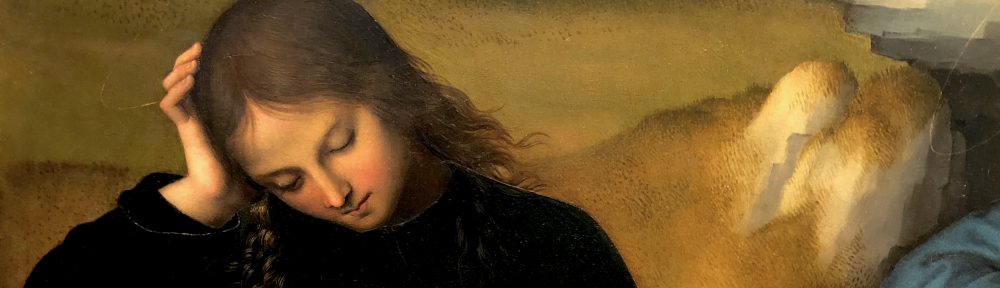
Whose World Is It?—Rethinking the Problem of Evil

The Last Judgment (detail), Tympanum of the Abbey of Sainte-Foy, Conques, France (c. 1107).

God isn’t the prime mover of every natural catastrophe and human ill; inexplicable tragedies are never a so-called act of God. Life is more complicated than that; so is the universe; so is God. 

— Gary Commins

Lord, if you had been here, my brother would not have died (John 11:21).

In Son of Man, a 2006 film retelling the Jesus story in a 21st-century African country, Jesus and Satan are sitting side by side atop a tall sand dune. After putting up with the three temptations, an exasperated Jesus turns suddenly toward his adversary and gives him a hard shove. As Satan tumbles down the dune, Jesus shouts after him, “This is my world!” But Satan is unbowed. When he reaches the bottom, he picks himself up, dusts himself off, and cries up to Jesus, “NO! THIS IS MY WORLD.” The film cuts to the country’s ongoing civil war, where a mass shooting of schoolchildren proves Satan’ point. 

One night last week, a drunken man was shooting a gun in his front yard—reportedly a form of recreation in his Texas neighborhood. But his next-door neighbor had a baby who was trying to sleep. He asked the shooter to stop. The shooter refused. Instead, he fetched a deadlier weapon—an assault rifle—took it into his neighbor’s house, and slaughtered five people, including a nine-year-old boy. The police found a few survivors—children shielded beneath the bodies of their mothers—uninjured, but covered with maternal blood.  

Such unspeakable evil has become a regular occurrence in my country. Mass shootings are setting a record pace this year. Twenty years ago, there were 200 million guns in America. Now there are 400 million. Twenty years ago, assault rifles were 2% of the market. Now they are 25%[i] The man who pulled the trigger in Texas is not alone in his guilt. He is joined by the gunmakers who make themselves rich from the carnage, the right-wing lawmakers who fetishize guns to get votes, the cable propagandists who stoke fear, rage and hate, and a dysfunctional society incapable of exorcising its legion of demons.
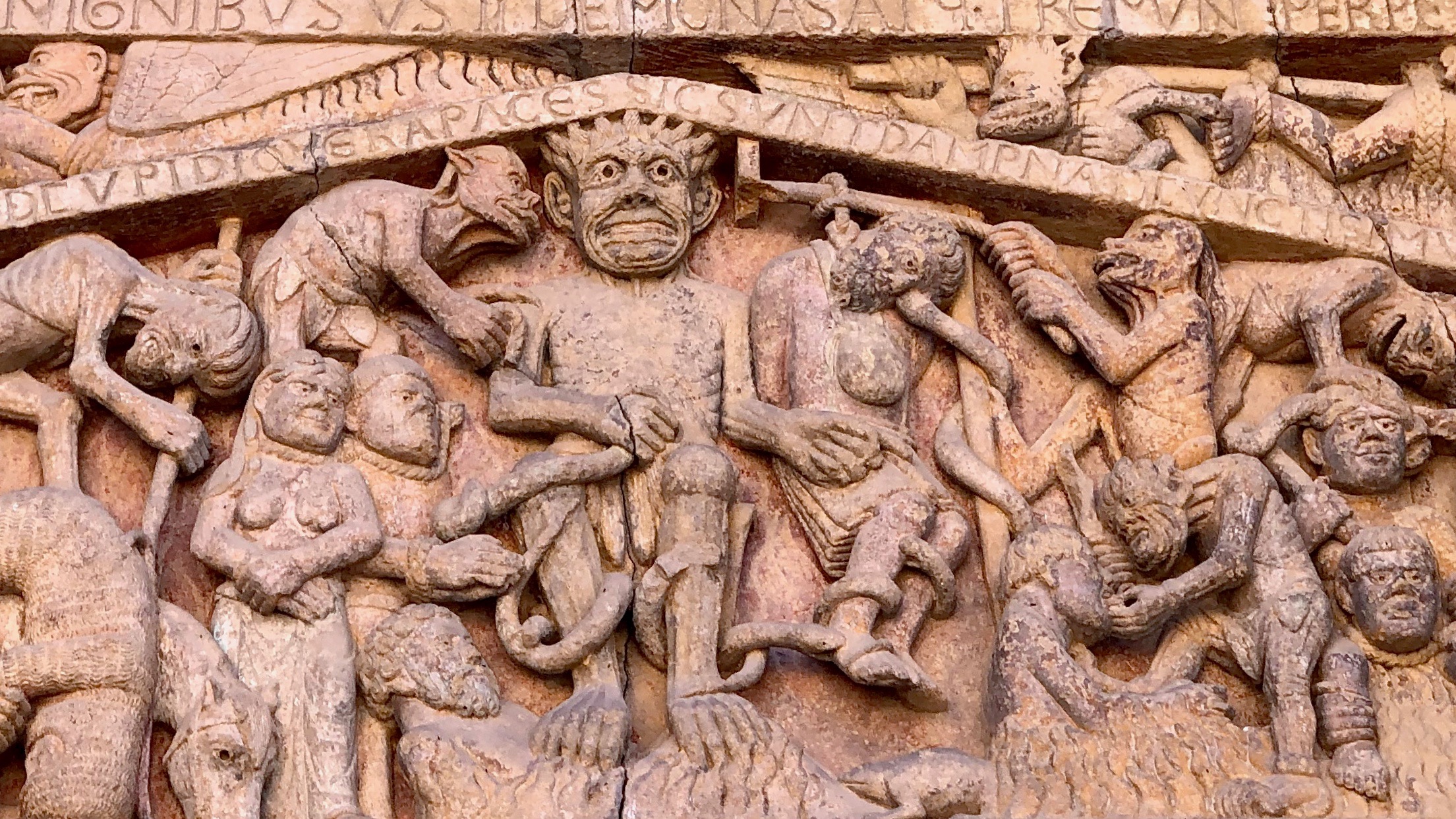
The Last Judgment (detail), Tympanum of the Abbey of Sainte-Foy, Conques, France (c. 1107).

I have written about our capacity for denial in “The Murderous Hypocrisy of ‘Thoughts and Prayers.’” If we say we have no sin, we deceive ourselves, and the truth is not in us (I John 1:8). Or as a modern theologian puts it, “It is only when our capacity for evil has been rendered explicit that we have a realistic basis for understanding that transformation or metanoia, that healing, which constitutes our salvation.” [ii]

Zooey Zephyr, a representative in the Montana state legislature, recently provided a perfect image of the cognitive dissonance inherent in pious self-deception. She was speaking against a Republican anti-trans bill which she believes will increase suicide among the young; but her words could apply to every political misuse of “thoughts and prayers”: “If you vote yes on this bill and yes on these amendments, I hope the next time there’s an invocation when you bow your heads in prayer, you see the blood on your hands.” [iii]

The Republican majority, like Pilate washing his hands of innocent blood, voted to silence Zephyr. They expelled her from the house. It’s easy to mock their fear of truth-telling, but when we look at our own hands, what do we see? 

Evil is woven not only into the fabric of the world, but into each and every soul. In Terrence Malick’s great (anti)war movie, The Thin Red Line, we are shown the violence and death of a terrible battle, but the realistic sounds of gunfire, grenades and human screams are muted beneath the elegiac music of Charles Ives’ “The Unanswered Question,” as though we are watching human evil through an impartial God’s tear-stained eyes. Then we hear the voice-over questions of an American soldier, seeking to penetrate the surface of the visible: 

“This great evil, where does it come from? How does it still enter the world? What seed, what root did it grow from? Who’s doing this, who’s killing us, robbing us of life and light, mocking us with the sight of what we might have known? Does our ruin benefit the earth? Is this darkness in you too?” [iv]

Who’s doing this? Who’s killing us? Is this darkness in you, too? The problem of evil is not only an unanswered question; it is unanswerable as well. In his valuable and insightful new book, Evil and the Problem of Jesus, Episcopal priest and theologian Gary Commins invites us to set aside the philosophical conundrums, engaging evil not as a theoretical puzzle but as a practical challenge.  

Since ancient times, the existence of evil has raised unsettling questions about the nature of God. If God is good, why is so much evil allowed to happen? Is God indifferent to our suffering, or somehow powerless to eliminate it? Can divine purpose ever justify evil, turning it to the good? Or must we conclude that a good God, or any God at all, is a logical impossibility, given the prevalence and persistence of evil?

Theodicy is the philosophical or theological attempt to reconcile the goodness of God with the existence of evil. It has produced a vast amount of profound intellectual reflection over the centuries. But Commins, drawing on his own pastoral experience, calls the whole enterprise into question. It’s not just that a rational explanation for evil offers little real comfort to its victims (Who wants to hear “It’s God’s will” at a funeral?). It also strips both God and evil of their complexity. The sources of evil are multifarious and impossible to trace with precision. And the activity of God within our temporal, finite existence is not a unilateral and unfettered exercise of power. The self-emptying God chooses to work within incarnational limits. The vulnerable babe in the manger grows up to die on a cross, and in between does what he can to address evil, not always successfully. 

“Traditional Western theodicy,” says Commins, “jams billions of people, or the planet, millions of millennia, and the infinite intricacy of subatomic matter into a solitary, simplistic enigma of God-and-evil. By tapering all its energy into one worn-out query, it diverts us away from more illuminating questions. Not only does it boil down a myriad of meanings into one conundrum of divine power or love. It concentrates on what is, in all likelihood, the least fruitful of many mysteries.” [v]

Instead of defending God’s honor or solving the ancient enigma of good and evil, we should accept the sheer givenness of “a wild, wondrous, chaotic creation [we] can’t comprehend or control.” [vi]  Instead of wondering why the world is so, we should devote our energies to the divine project of making it better. 

“The causes of evil and suffering are personal, social, structural, and cosmic: human delusions, collective misbehaviors, institutional grandiosity, and spiritual malice .… Until the End, suffering and evil will neither cease nor desist—they are inherent in creation and intensified by social ills; we can decrease them by aligning ourselves with God’s will.” [vii]

We may never understand why the world must be an unstable mixture “of storms and stillness, gloom and brightness,” where “suffering, evil, and chaos commingle with glory, love, and joy.”[viii]  But it’s the world we’ve got, and what we really need to figure out is how to live in it.

And for that, Commins says, we must turn to Jesus, who shows us “what it means to be human.” If we seek a Christian understanding of God’s response to evil, we should start not with metaphysics, but with the gospel.

“Jesus never waxes philosophical. Rather than offering an ‘explanation’ for evil, he gives his followers ‘a charge and a benediction’: the charge to stand in solidarity with the oppressed, the benediction to empower his followers to resist evil.” [ix]

“Nowhere does Jesus construct a system of ethics or author a theology of evil. In broad terms, what we can do to undo evil is clear—act on his words, treat all as equals, seek the kingdom, go and do likewise, repent, follow, forgive, and love—but unless we face the evils within us, we won’t have a positive influence on the world around us and, even then, nothing is a sure thing.” [x]

At the same time that Jesus is showing us how to be fully human, he is revealing who God is and what God does. Jesus’ own responses to evil are “epiphanies into God’s relationship with evil.… what Jesus does in time, God does in eternity; the ways Jesus responds to evil in his lifetime—confronting, undoing, and erasing it; bending, circling, and transforming it—are ways God always engages evil.” [xi]

No metaphysical speculation needed. Just keep an eye on Jesus, and the Way will show itself. In a beautifully succinct summation of this Way, Commins says that “Jesus embodies compassion, challenges judgments, reverses fates, levels inequalities, frees from demons, forgives sins, tells truths, and plants seeds of shalom.” [xii]

So whose world is it, after all? We wonder every time we watch the news. But ultimately, it’s a question to be answered not within our minds, but in the activity of our lives. As the song says, “It may be the devil or it may be the Lord, but you’re gonna have to serve somebody.”[xiii]

The late German theologian Dorothee Soelle (1929-2003) found this paradigm of Christian discipleship perfectly expressed in The Brothers Karamazov, where Ivan and his younger brother Alyosha are earnestly discussing theodicy. Both agree that no long-range divine purpose could ever justify the torture of children in the here and now. Where the brothers differ is in their personal response to evil. Ivan blames and rejects a God who consents to the immense sufferings of history. But Alyosha, notes Soelle, does not shake his fist at heaven. He is too busy attending to the needs of earth, just like the God who became one of us.

“[Alyosha] directs his attention not to the power above but to the sufferers. He puts himself beside them. He bears their pain with them. He listens with agony as Ivan introduces examples of suffering he had assembled against the compassion of God … He is silent, he shares the suffering, he embraces the others.” [xiv]

Compassion’s embrace: from Alexander Sokurov’s “Lc. 15:11-32” (Prodigal Son installation,Venice Biennale 2019). Sculptures by Vladimir Brodarsky & Katya Pilnikova.

Photographs by the author. For more on the Tympanum at Conques, including a video of what the original painted colors might have been: https://www.tourisme-conques.fr/en/en-conques/the-tympanum

[i] These statistics were cited in a televised interview with Fred Guttenberg, speaking about the new book he has co-authored with Thomas Gabor: American Carnage: Shattering the Myths That Fuel Gun Violence. 

[ii] Kenneth Surin, Theology and the Problem of Evil (Oxford & New York: Basil Blackwell Ltd., 1986), 157.

[iii] https://apnews.com/article/montana-trans-lawmaker-silenced-zooey-zephyr-d398d442537a595bf96d90be90862772

[iv] The Thin Red Line (1998), adapted by Terrence Malick from James Jones’ 1962 novel. 

[v] Gary Commins, Evil and the Problem of Jesus (Eugene, Oregon: Cascade Books, 2023), 14. Full disclosure: Gary is an old friend. We meet up periodically in Eugene for national track & field championships, but never discuss evil during the meets. His new book not only offers a fresh and timely take on a central theological question, it does so through an illuminating method of reading Scripture and tradition in general.

[vi] Commins, 68.

[vii] Ibid., 194.

[viii] Ibid., 155, 194.

[ix] Ibid., 41. The quoted phrases are from Susan R. Garrett’s article, “Christ and the Present Evil Age,” Interpretation 57 (2003), 370-383.

[x] Ibid., 129-130.

[xi] Ibid., 159.

[xii] Ibid., 149.

[xiii] Bob Dylan, “Gotta Serve Somebody,” on Slow Train Coming (1979). 

[xiv] Dorothee Soelle, Suffering (London: Darton, Longman and Todd, 1975), 175.

“We must love one another or die”—What Does the Iliad Tell Us about the Invasion of Ukraine?

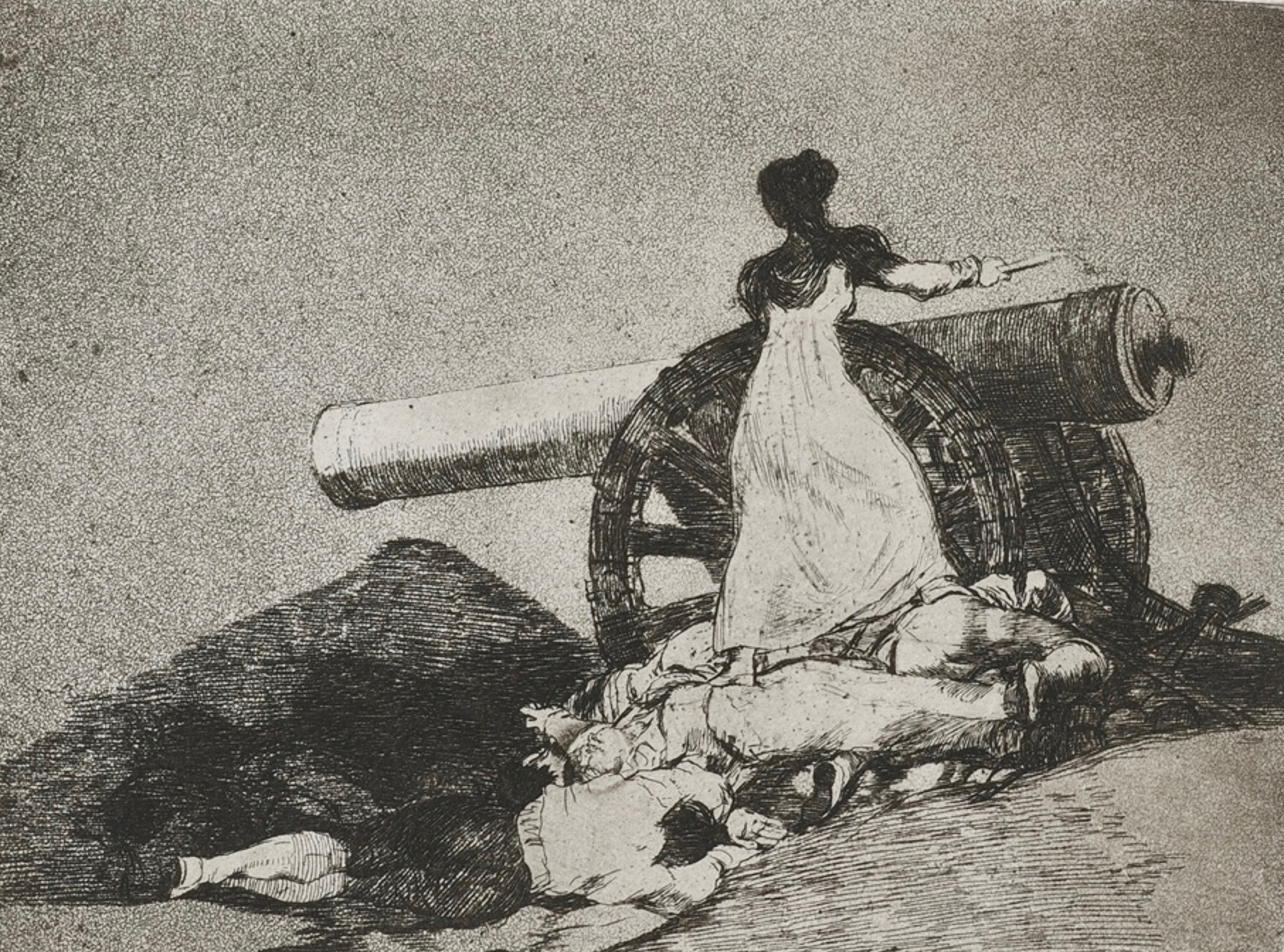
Francisco de Goya, “Ya no hay tiempo” (There isn’t time now), from The Disasters of War (1810-1820).

It is true that our weakness could prevent us from defeating the force that threatens to overwhelm us. But this does not prevent us from understanding it. Nothing in the world can stop us from being lucid.

— Simone Weil

Humility before the real, before untamable existence, is what we learn from the grief and supplications of the tragic poets and the exhortations and lamentations of the prophets.

— Rachel Bespaloff

In the summer of 1939, two women visited an exhibition of Goya’s The Disasters of War at the Geneva Museum of Art and History.[i] Goya’s 82 etchings, graphic depictions of the human cost of war, impressed each of them deeply, especially in the shadow of looming European conflict. The day after the exhibition closed, Hitler’s troops invaded Poland.

Rachel Bespaloff.
Simone Weil.

Rachel Bespaloff and Simone Weil did not know each other. They saw the Goyas in Geneva on different days. But they had many things in common. Both were of Jewish descent, and both were French, although Bespaloff had been born in Ukraine. Both were philosophers, consumed by the questions of affliction and human suffering. Both would die too soon—Weil at 34 from malnutrition and heart failure in 1943, and Bespaloff at 53 by suicide in 1949. And both responded to the outbreak of World War II with influential essays on the Iliad

Homer’s tragic epic, the founding work of European literature, bears impartial witness to the creative and destructive forces at work in the finite historical world. The poet sings of war, but his underlying theme is the complexity of human nature and human experience. There is rage in the Iliad, and cruelty, but wisdom and compassion as well. 

With the Russian invasion of Ukraine, the reflections of Weil and Bespaloff on this ancient epic provide a timely lucidity. For example, Weil’s analysis of wrathful Achilles pinpoints the ultimate futility of force. In the Iliad, the harder Achilles tries to enforce his will, the more resistance he generates. Weil could have been describing Vladimir Putin: 

“Homer shows us the limits of force in the very apotheosis of the force-hero. Through cruelty force confesses its powerlessness to achieve omnipotence. When Achilles falls upon Lycaon, shouting ‘death to all,’ and makes fun of the child who is pleading with him, he lays bare the eternal resentment felt by the will to power when something gets in the way of its indefinite expansion. We see weakness dawning at the very height of force. Unable to admit that total destruction is impossible, the conqueror can only reply to the mute defiance of his defenseless adversary with an ever-growing violence. Achilles will never get the best of the thing he kills: Lycaon’s youth will rise again, and Priam’s wisdom and Ilion’s beauty.” [ii]   

Weil argued that the Iliad’s true subject was not any one figure, but the fateful dynamics of force to which both Greeks and Trojans were subject: “Force employed by man, force that enslaves man, force before which man’s flesh shrinks away. In this work, at all times, the human spirit is shown as modified by its relations with force, as swept away, blinded, by the very force it imagined it could handle, as deformed by the weight of the force it submits to.” [iii]

In her opening paragraph of her essay, Weil sees both the victors and the vanquished as dehumanized and uncreated by powers not of their own making. The victors are “swept away” when force goes its own way, generating consequences they can’t control. The vanquished are turned into “things,” stripped of the capacity to think, or act, or hope. Even if a victim’s life is spared, he or she is as good as dead. Force “makes a corpse out of [them]. Somebody was here, and the next minute there is nobody here at all.” [iv]

Francisco de Goya, “Que Valor!” from The Disasters of War (1810-1820).

Goya’s war images convey this truth. They grant no wider picture of strategy or purpose, but only offer snapshots of an ambient violence, which seems to exist independently of the anonymous actors caught up in war’s depersonalizing horror. “What courage!” reads the artist’s caption, “Que Valor!” Was Goya being ironic? One might interpret this etching as an image of resistance—a brave woman standing on the bodies of her fallen comrades to reach the cannon’s fuse and repel the oppressors. But I can’t help seeing a pile of indistinguishable corpses, and a faceless figure whose own subjection to the laws of force has but one future. 

As Weil put it, “for those whose spirits have bent under the yoke of war, the relation between death and the future is different than for other men. For other men death appears as a limit set in advance on the future; for the soldier death is the future, the future his profession assigns him.” [v] In his classic novel of the American Civil War, Stephen Crane said the same thing even more chillingly: War is “like the grinding of an immense and terrible machine.” Its “grim processes” are designed to “produce corpses.” [vi]

This pair of photos posted last week by a young Ukrainian couple on social media feels both stirring and sad. Scheduled to be married in May, they realized they might not live that long. So they rushed the wedding. As sirens sounded the Russian attack on Kyiv, they made their vows of lifelong fidelity. Then they took up arms to defend their city. Their courage is inspiring, like the man before the tank in Tiananmen Square. But their vulnerability is heartbreaking. May God protect them.

Weil describes the immutable laws of force, which has no regard for such “perishable joys.” [vii] “To the same degree,” Weil says, “though in different fashions, those who use it and those who endure it are turned to stone.” In battle, thought and choice and hope are swept away. “Herein lies the last secret of war,” Weil says, “a secret revealed by the Iliad in its similes, which liken the warriors either to fire, flood, wind, wild beasts, or God knows what blind cause of disaster, or else to frightened animals, trees, water, sand, to anything in nature that is set into motion by the violence of external forces.” [viii]

In other words, everyone involved is a victim of war. That is why neither Homer nor Goya seem to take sides. The unflinching visual witness of The Disasters of War may have been undertaken in protest against the brutality of Napoleon’s army in Spain, but as the series evolved it became harder to distinguish the nationality of perpetrators and victims in the images. We only see human beings equally deformed by the workings of force. There is no great cause in these pictures, only suffering. 

Attribution: Nexta TV

For me, one of the most disturbing images of the war’s first week was this video of a Russian soldier taking evident pleasure in the firing of missiles into Ukraine. As a Christian, I am obligated to see Christ in his arrogant face, but it is not easy. He is smiling at the death of his fellow beings. The patch on his uniform reads: “They will die and we will go to heaven.” Nevertheless, understanding this man to be himself a victim of force plants a seed of compassion in me. He has lost his humanity to the machinery of war. I must pray for him as well. 

In writing about the Iliad, Weil was repeating Goya’s message that “violence obliterates anybody who feels its touch. It comes to seem just as external to its employer as to its victim. And from this springs the idea of a destiny before which executioner and victim stand equally innocent, before which conquered and conqueror are brothers in the same distress. The conquered brings misfortune to the conqueror, and vice versa.[ix]

Francisco de Goya, “Las mujeres dan valor” (The women are courageous) from The Disasters of War (1810-1820).

Rachel Bespaloff, writing during the Nazi invasion of France, attributes the Iliad’s impartiality to the seeming impartiality of life itself: 

“With Homer there is no marveling or blaming, and no answer is expected. Who is good in the Iliad? Who is bad? Such distinctions do not exist; there are only men suffering, warriors fighting, some winning, some losing. The passion for justice emerges only in mourning for justice, in the dumb avowal of silence. To condemn force, or absolve it, would be to condemn, or absolve, life itself. And life in the Iliad (as in the Bible or in War and Peace) is essentially the thing that does not permit itself to be assessed, or measured, or condemned, or justified, at least not by the living. Any estimate of life must be confined to an awareness of its inexpressibility.” [x]

The impartiality of Homer and Goya is echoed in one of the most remarkable battle scenes in the history of cinema. In Terence Malick’s The Thin Red Line, U.S. marines are trying to take a Japanese position on a Pacific island in World War II. But instead of encouraging the viewer to take sides, the director presents both the Americans and the Japanese as common victims of force, as if we were seeing war through God’s eyes. On the soundtrack the gunfire and explosions remain faint, barely there, while a slow elegiac score, like the music of weeping angels, allows us to reflect on the tragedy of violence instead of stirring our partisan emotions. One of the soldiers, a kind of Christ figure, speaks in voice-over: 

This great evil, where does it come from? How does it still enter the world? What seed, what root did it grow from? Who’s doing this, who’s killing us, robbing us of life and light, mocking us with the sight of what we might have known? Does our ruin benefit the earth? Is this darkness in you too? [xi]

Impartiality is not the same as indifference. Although she favored pacifism, Weil wrote her essay after joining the fight against fascism in Spain (the near-sighted and clumsy intellectual had to be sent home after accidentally stepping into a pot of boiling oil). She spoke out in favor of struggles for independence in the French colonies, and worked for the French Resistance. Similarly, Bespaloff renounced her own pacifist sympathies when Hitler seized France. Both women felt their ideals constrained by the “yoke of necessity.” [xii] Sometimes force simply won’t let you abstain. Bespaloff would later lament that history had forced her entire generation “to live in a climate of violent death,” amid “the smoke of crematories.” [xiii]

To see everyone as a victim is to realize the limits of force and begin to discover the power of compassion. “Those who live by the sword die by the sword,” said Jesus. And Weil, who got to know Jesus pretty well in her final years, urged us to “learn that there is no refuge from fate, learn not to admire force, not to hate the enemy, nor to scorn the unfortunate.” [xiv]  

This is not a prescription for passivity in the face of naked aggression. Along with most of the world, including many of Russia’s own people, I support the Ukrainian resistance, but it’s not enough just to take sides in the ancient game of force. Even as we are swept up in the necessities of conflict, we must strive to imagine a better way and a better world. 

In late 1942, when Weil was working in the London office of the French Resistance, she proposed a plan to parachute hundreds of white-uniformed nurses onto battlefields, not only to tend to the wounded but also to provide an image of self-sacrificial goodness in the midst of cruelty and violence. She herself wanted to be in the first wave of this non-violent invasion. In submitting her plan to the Free French authorities, she made a visionary argument:

“There could be no better symbol of our inspiration than the corps of women suggested here. The mere persistence of a few humane services in the very center of the battle, the climax of inhumanity, would be a signal defiance of the inhumanity which the enemy has chosen for himself and which he compels us also to practice … A small group of women exerting day after day a courage of this kind would be a spectacle so new, so significant, and charged with such obvious meaning, that it would strike the imagination more than any of Hitler’s conceptions have done.” [xv]

Charles de Gaulle thought her quite mad, and her plan of course went nowhere. But I always find myself inspired by “impossible” visions which refuse the seductions and delusions of force. When Hitler invaded Poland, W. H. Auden wrote a poem, “September 1, 1939,” calling upon the lovers of justice to “show an affirming flame” in the night of “negation and despair.” As we now weigh our best measures against the worst possibilities, Auden’s key line is more urgent than ever:

“We must love one another or die.” 

Käthe Kollwitz,”The Mothers,” from Seven Woodcuts on the War (1924)

[i] After Madrid was bombed in the Spanish Civil War, the Prado’s art treasures were moved to the League of Nations in Geneva in early 1939. The museum exhibition with the Goya etchings ended on August 31 of that year. The invasion of Poland began on September 1, 1939.

[ii] Simone Weil, in Simone Weil & Rachel Bespaloff, War and the Iliad (New York: New York Review of Books, 2005), 54. Thanks to NYRB for publishing these essays together for the first time.

[iii] Ibid., 3.

[iv] Ibid., 3.

[v] Ibid., 21-22.

[vi] Stephen Crane, The Red Badge of Courage, ch. 8, quoted in War and the Iliad, p. xi.

[vii] The term is Bespaloff’s, referring to Hector’s recitation of everything the war is about to take from him: his city, his family, his comrades, his very life (War and the Iliad, 43).

[viii] War and the Iliad, 26.

[ix] Ibid., 20.

[x] Ibid., 50.

[xi] The Thin Red Line (1998), written and directed by Terence Malick, based on the novel by James Jones (1962). Released by Twentieth Century Fox. A beautiful blu-ray edition is available from The Criterion Collection. Jim Caviezel, whose other-worldliness rose above the warring world to intimations of the Transcendent, spoke the voice-over. He would eventually play the role of Jesus in Mel Gibson’s Passion of the Christ (2004).

[xii] War and the Iliad, 21. The phrase is Weil’s.

[xiii] Ibid., 23.

[xiv] Ibid., 37.

[xv] Simone Weil, quoted in Robert Zaretsky, The Subversive Simone Weil: A Life in Five Ideas (Chicago: University of Chicago Press, 2021), 155.