

God isn’t the prime mover of every natural catastrophe and human ill; inexplicable tragedies are never a so-called act of God. Life is more complicated than that; so is the universe; so is God.
— Gary Commins
Lord, if you had been here, my brother would not have died (John 11:21).
In Son of Man, a 2006 film retelling the Jesus story in a 21st-century African country, Jesus and Satan are sitting side by side atop a tall sand dune. After putting up with the three temptations, an exasperated Jesus turns suddenly toward his adversary and gives him a hard shove. As Satan tumbles down the dune, Jesus shouts after him, “This is my world!” But Satan is unbowed. When he reaches the bottom, he picks himself up, dusts himself off, and cries up to Jesus, “NO! THIS IS MY WORLD.” The film cuts to the country’s ongoing civil war, where a mass shooting of schoolchildren proves Satan’ point.
One night last week, a drunken man was shooting a gun in his front yard—reportedly a form of recreation in his Texas neighborhood. But his next-door neighbor had a baby who was trying to sleep. He asked the shooter to stop. The shooter refused. Instead, he fetched a deadlier weapon—an assault rifle—took it into his neighbor’s house, and slaughtered five people, including a nine-year-old boy. The police found a few survivors—children shielded beneath the bodies of their mothers—uninjured, but covered with maternal blood.
Such unspeakable evil has become a regular occurrence in my country. Mass shootings are setting a record pace this year. Twenty years ago, there were 200 million guns in America. Now there are 400 million. Twenty years ago, assault rifles were 2% of the market. Now they are 25%[i] The man who pulled the trigger in Texas is not alone in his guilt. He is joined by the gunmakers who make themselves rich from the carnage, the right-wing lawmakers who fetishize guns to get votes, the cable propagandists who stoke fear, rage and hate, and a dysfunctional society incapable of exorcising its legion of demons.
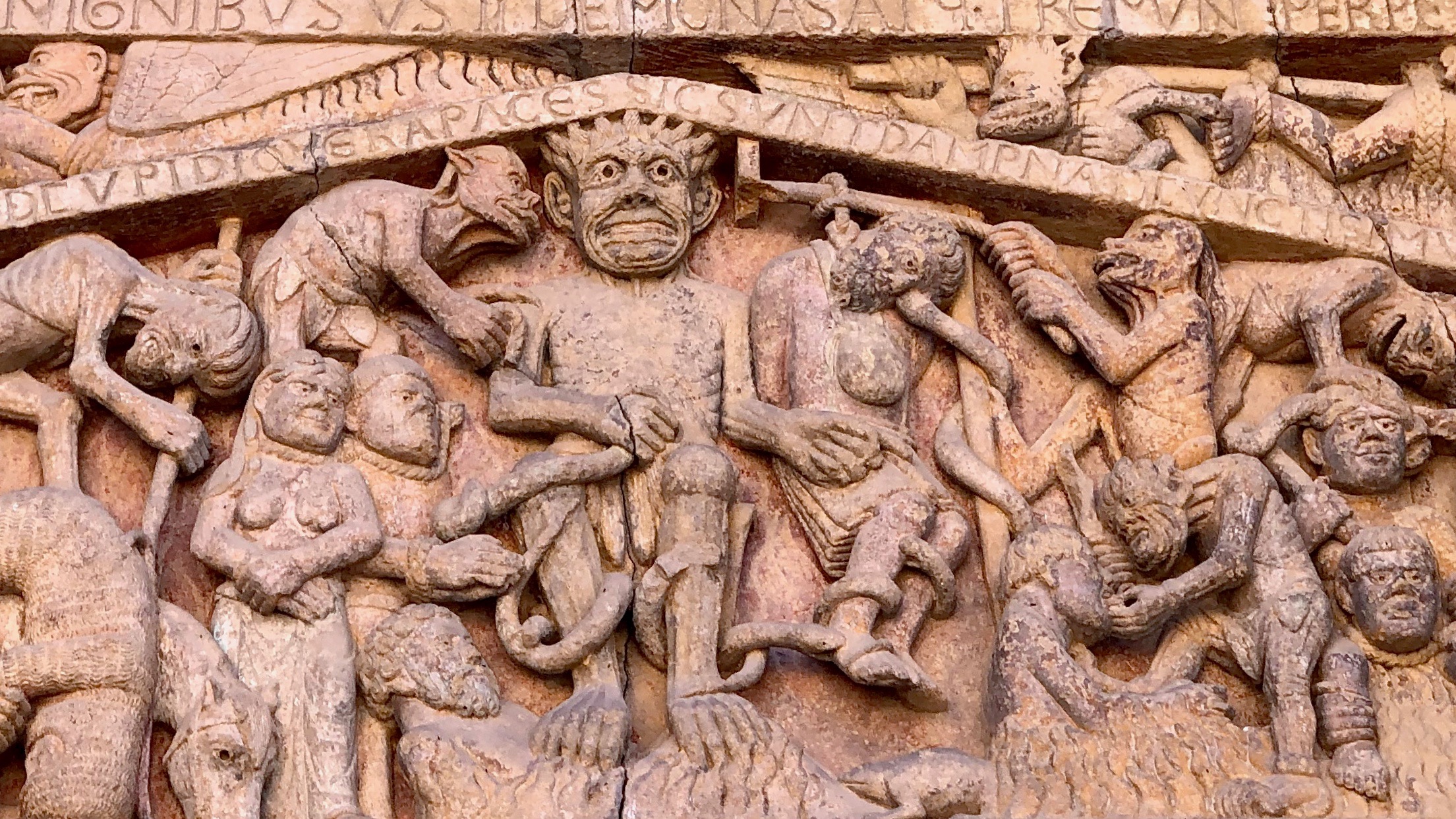
I have written about our capacity for denial in “The Murderous Hypocrisy of ‘Thoughts and Prayers.’” If we say we have no sin, we deceive ourselves, and the truth is not in us (I John 1:8). Or as a modern theologian puts it, “It is only when our capacity for evil has been rendered explicit that we have a realistic basis for understanding that transformation or metanoia, that healing, which constitutes our salvation.” [ii]
Zooey Zephyr, a representative in the Montana state legislature, recently provided a perfect image of the cognitive dissonance inherent in pious self-deception. She was speaking against a Republican anti-trans bill which she believes will increase suicide among the young; but her words could apply to every political misuse of “thoughts and prayers”: “If you vote yes on this bill and yes on these amendments, I hope the next time there’s an invocation when you bow your heads in prayer, you see the blood on your hands.” [iii]
The Republican majority, like Pilate washing his hands of innocent blood, voted to silence Zephyr. They expelled her from the house. It’s easy to mock their fear of truth-telling, but when we look at our own hands, what do we see?
Evil is woven not only into the fabric of the world, but into each and every soul. In Terrence Malick’s great (anti)war movie, The Thin Red Line, we are shown the violence and death of a terrible battle, but the realistic sounds of gunfire, grenades and human screams are muted beneath the elegiac music of Charles Ives’ “The Unanswered Question,” as though we are watching human evil through an impartial God’s tear-stained eyes. Then we hear the voice-over questions of an American soldier, seeking to penetrate the surface of the visible:
“This great evil, where does it come from? How does it still enter the world? What seed, what root did it grow from? Who’s doing this, who’s killing us, robbing us of life and light, mocking us with the sight of what we might have known? Does our ruin benefit the earth? Is this darkness in you too?” [iv]
Who’s doing this? Who’s killing us? Is this darkness in you, too? The problem of evil is not only an unanswered question; it is unanswerable as well. In his valuable and insightful new book, Evil and the Problem of Jesus, Episcopal priest and theologian Gary Commins invites us to set aside the philosophical conundrums, engaging evil not as a theoretical puzzle but as a practical challenge.
Since ancient times, the existence of evil has raised unsettling questions about the nature of God. If God is good, why is so much evil allowed to happen? Is God indifferent to our suffering, or somehow powerless to eliminate it? Can divine purpose ever justify evil, turning it to the good? Or must we conclude that a good God, or any God at all, is a logical impossibility, given the prevalence and persistence of evil?
Theodicy is the philosophical or theological attempt to reconcile the goodness of God with the existence of evil. It has produced a vast amount of profound intellectual reflection over the centuries. But Commins, drawing on his own pastoral experience, calls the whole enterprise into question. It’s not just that a rational explanation for evil offers little real comfort to its victims (Who wants to hear “It’s God’s will” at a funeral?). It also strips both God and evil of their complexity. The sources of evil are multifarious and impossible to trace with precision. And the activity of God within our temporal, finite existence is not a unilateral and unfettered exercise of power. The self-emptying God chooses to work within incarnational limits. The vulnerable babe in the manger grows up to die on a cross, and in between does what he can to address evil, not always successfully.
“Traditional Western theodicy,” says Commins, “jams billions of people, or the planet, millions of millennia, and the infinite intricacy of subatomic matter into a solitary, simplistic enigma of God-and-evil. By tapering all its energy into one worn-out query, it diverts us away from more illuminating questions. Not only does it boil down a myriad of meanings into one conundrum of divine power or love. It concentrates on what is, in all likelihood, the least fruitful of many mysteries.” [v]
Instead of defending God’s honor or solving the ancient enigma of good and evil, we should accept the sheer givenness of “a wild, wondrous, chaotic creation [we] can’t comprehend or control.” [vi] Instead of wondering why the world is so, we should devote our energies to the divine project of making it better.
“The causes of evil and suffering are personal, social, structural, and cosmic: human delusions, collective misbehaviors, institutional grandiosity, and spiritual malice .… Until the End, suffering and evil will neither cease nor desist—they are inherent in creation and intensified by social ills; we can decrease them by aligning ourselves with God’s will.” [vii]
We may never understand why the world must be an unstable mixture “of storms and stillness, gloom and brightness,” where “suffering, evil, and chaos commingle with glory, love, and joy.”[viii] But it’s the world we’ve got, and what we really need to figure out is how to live in it.
And for that, Commins says, we must turn to Jesus, who shows us “what it means to be human.” If we seek a Christian understanding of God’s response to evil, we should start not with metaphysics, but with the gospel.
“Jesus never waxes philosophical. Rather than offering an ‘explanation’ for evil, he gives his followers ‘a charge and a benediction’: the charge to stand in solidarity with the oppressed, the benediction to empower his followers to resist evil.” [ix]
“Nowhere does Jesus construct a system of ethics or author a theology of evil. In broad terms, what we can do to undo evil is clear—act on his words, treat all as equals, seek the kingdom, go and do likewise, repent, follow, forgive, and love—but unless we face the evils within us, we won’t have a positive influence on the world around us and, even then, nothing is a sure thing.” [x]
At the same time that Jesus is showing us how to be fully human, he is revealing who God is and what God does. Jesus’ own responses to evil are “epiphanies into God’s relationship with evil.… what Jesus does in time, God does in eternity; the ways Jesus responds to evil in his lifetime—confronting, undoing, and erasing it; bending, circling, and transforming it—are ways God always engages evil.” [xi]
No metaphysical speculation needed. Just keep an eye on Jesus, and the Way will show itself. In a beautifully succinct summation of this Way, Commins says that “Jesus embodies compassion, challenges judgments, reverses fates, levels inequalities, frees from demons, forgives sins, tells truths, and plants seeds of shalom.” [xii]

So whose world is it, after all? We wonder every time we watch the news. But ultimately, it’s a question to be answered not within our minds, but in the activity of our lives. As the song says, “It may be the devil or it may be the Lord, but you’re gonna have to serve somebody.”[xiii]
The late German theologian Dorothee Soelle (1929-2003) found this paradigm of Christian discipleship perfectly expressed in The Brothers Karamazov, where Ivan and his younger brother Alyosha are earnestly discussing theodicy. Both agree that no long-range divine purpose could ever justify the torture of children in the here and now. Where the brothers differ is in their personal response to evil. Ivan blames and rejects a God who consents to the immense sufferings of history. But Alyosha, notes Soelle, does not shake his fist at heaven. He is too busy attending to the needs of earth, just like the God who became one of us.
“[Alyosha] directs his attention not to the power above but to the sufferers. He puts himself beside them. He bears their pain with them. He listens with agony as Ivan introduces examples of suffering he had assembled against the compassion of God … He is silent, he shares the suffering, he embraces the others.” [xiv]

Photographs by the author. For more on the Tympanum at Conques, including a video of what the original painted colors might have been: https://www.tourisme-conques.fr/en/en-conques/the-tympanum
[i] These statistics were cited in a televised interview with Fred Guttenberg, speaking about the new book he has co-authored with Thomas Gabor: American Carnage: Shattering the Myths That Fuel Gun Violence.
[ii] Kenneth Surin, Theology and the Problem of Evil (Oxford & New York: Basil Blackwell Ltd., 1986), 157.
[iii] https://apnews.com/article/montana-trans-lawmaker-silenced-zooey-zephyr-d398d442537a595bf96d90be90862772
[iv] The Thin Red Line (1998), adapted by Terrence Malick from James Jones’ 1962 novel.
[v] Gary Commins, Evil and the Problem of Jesus (Eugene, Oregon: Cascade Books, 2023), 14. Full disclosure: Gary is an old friend. We meet up periodically in Eugene for national track & field championships, but never discuss evil during the meets. His new book not only offers a fresh and timely take on a central theological question, it does so through an illuminating method of reading Scripture and tradition in general.
[vi] Commins, 68.
[vii] Ibid., 194.
[viii] Ibid., 155, 194.
[ix] Ibid., 41. The quoted phrases are from Susan R. Garrett’s article, “Christ and the Present Evil Age,” Interpretation 57 (2003), 370-383.
[x] Ibid., 129-130.
[xi] Ibid., 159.
[xii] Ibid., 149.
[xiii] Bob Dylan, “Gotta Serve Somebody,” on Slow Train Coming (1979).
[xiv] Dorothee Soelle, Suffering (London: Darton, Longman and Todd, 1975), 175.

 The religious imagineer