The Journey Ends: Durham Cathedral

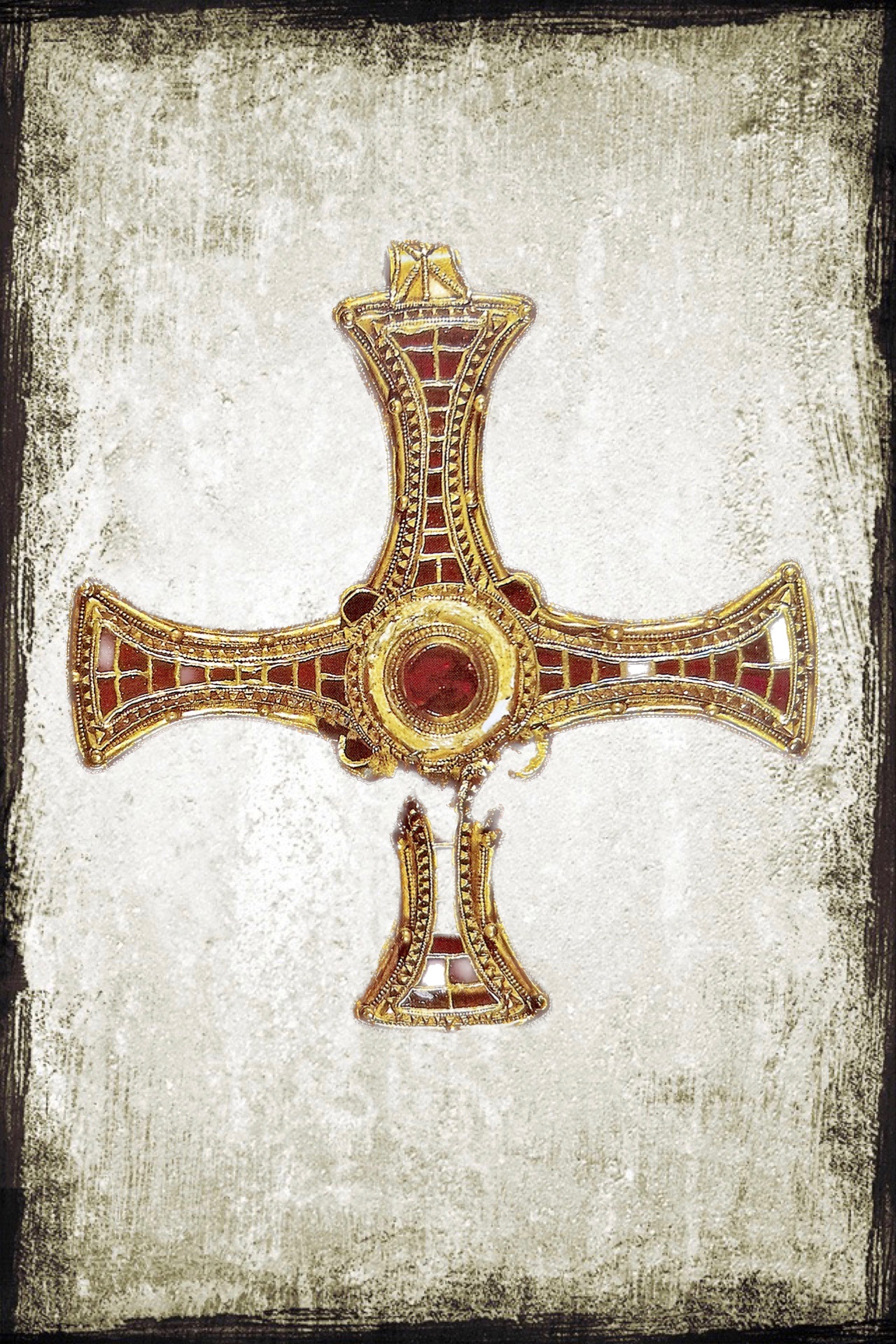
St. Cuthbert’s Cross (late 7th century). This pectoral cross of gold and garnet was found in St. Cuthbert’s coffin in 1827. It was hung around his neck, but whether he wore it in life is uncertain.

This is the third and final part of my pilgrimage account from St. Cuthbert’s Way and beyond. 
The previous installments can be found at these links: 

Walking St. Cuthbert’s Way

Grace and Beauty on Holy Island

The Journey, Fenwick Lawson (2008).
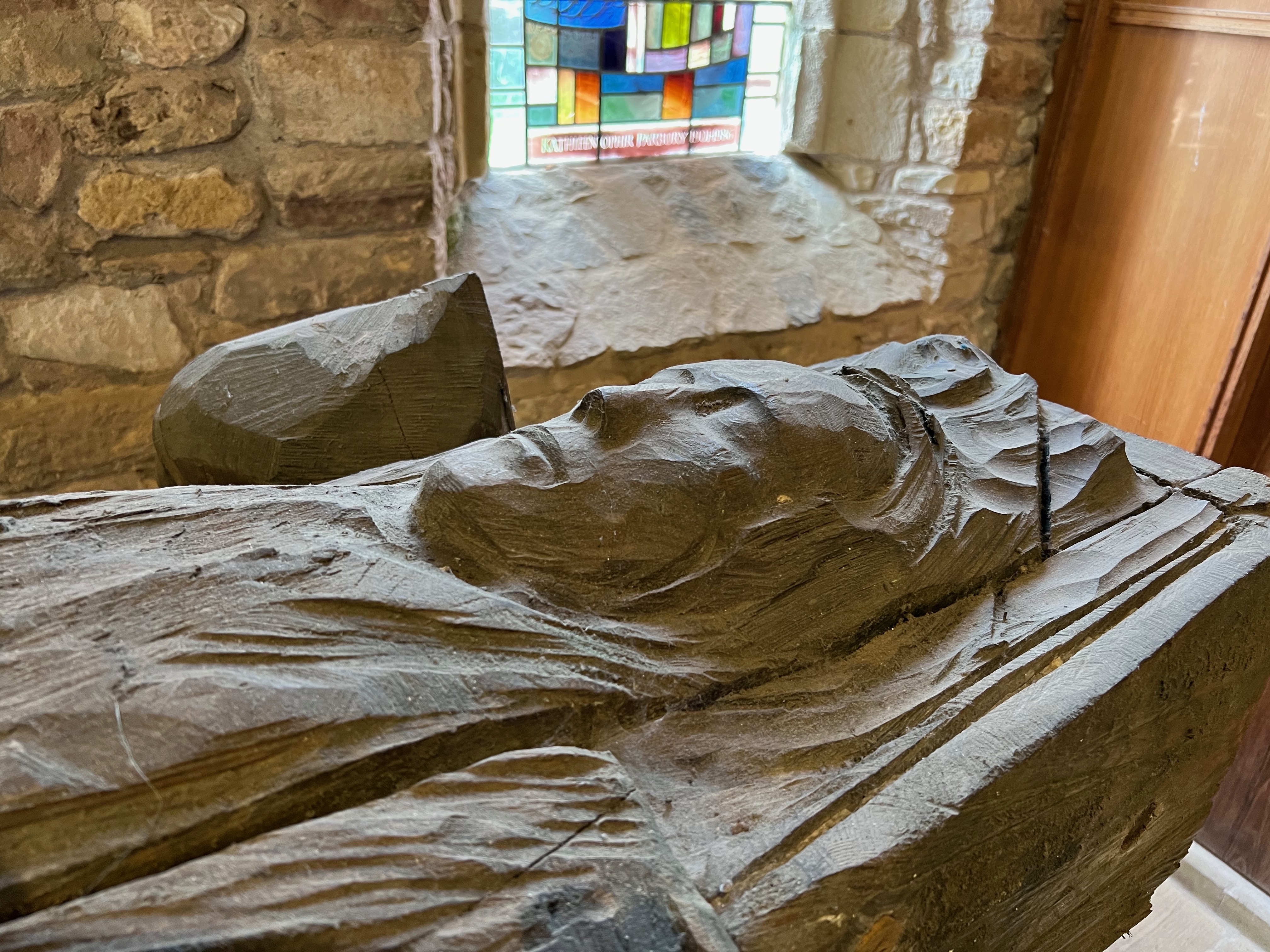
The original wooden sculpture of the Lindisfarne monks carrying Cuthbert’s coffin to safety is in St. Mary the Virgin on Holy Island. This bronze version is in Durham’s Millennium Square, below the cathedral where Cuthbert’s long journey ended at last. It seems a bit lost in the bleak vacancy of the square’s secular space (an effort to move the 2.5 ton sculpture to the cathedral grounds failed), but that makes it a parable of the Church in an age of religious displacement, wandering in search of an abiding home. The change-ringing bells were sounding from a nearby church when I shot this video.

“By faith … he set out without knowing where he was going … 
He looked forward to a city with firm foundations, 
whose architect and builder is God.” (Hebrews 11:9-10)

After the peripatetic St. Cuthbert died in his island hermitage, his body continued to wander for nearly nine centuries: to the mainland for burial in the monastery church (687) … into a newly built sepulcher (698) … inland to various temporary hiding places during 8 years of Viking terror (875-883) … under the protection of a new regional king, to Cuncasestre (Chester-le-Street), where a new church held his shrine for 112 years (883-995) … fleeing new Norse threats, south to Ripon for 4 months (995) … north to Wrdelau, near the River Wear, where the coffin-bearing cart broke down, as if the saint himself were refusing to go any further (995, for 3 days of prayer for guidance) … spurred by a vision (or was it the assistance of a dairymaid searching for her cow?), the saint’s entourage moved his remains to the nearby Dunholme (“Hill Island”), a naturally protected peninsula rising above a loop in the river, where they built a rough shelter (995-999) … then into a succession of more permanent structures on Dunholme (999-1069) … after 70 years, under threat from William the Conqueror, the Norman king who was “harrying the north,” a brief return to his old monastery at Lindisfarne (1069-1070) … back to the church on Dunholme, where Durham was becoming a major English settlement (1070-1104) … translated into a shrine behind the high altar in the completed east end of the great Norman cathedral-in-progress (1104) … moved into a more richly embellished shrine set upon a raised floor (1280) … after the stripping and destruction of the shrine under Henry VIII, reburied in an unadorned vault in the same location (1542), where it remains to this day.
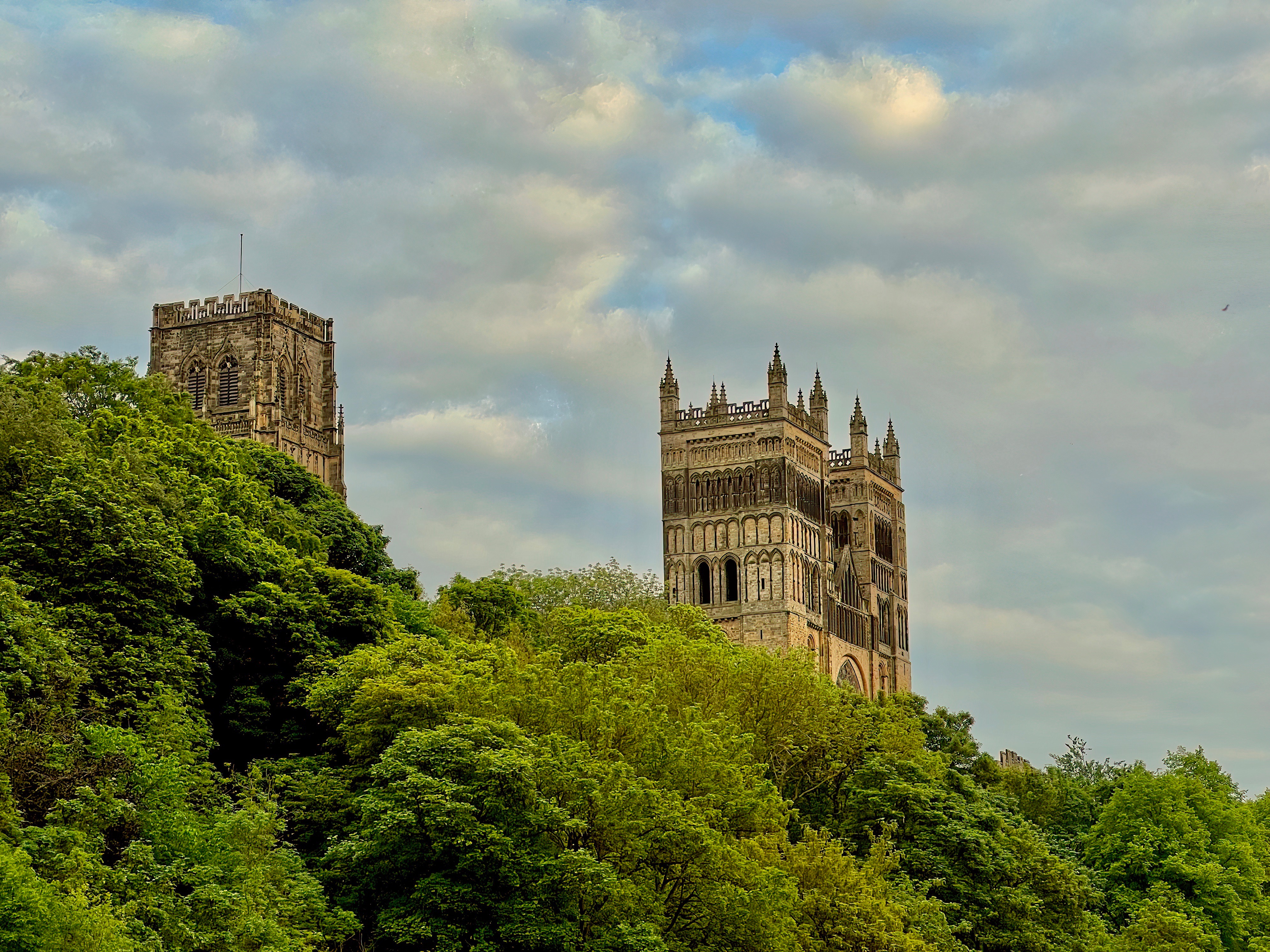
“The towers are the preachers and prelates: who are her wards and her defense.”
— Hugh of St. Victor, The Mystical Mirror of the Church

How awesome is this place! 
Truly, this is none other than the house of God; 
it is the gate of heaven. 

— Genesis 28:17

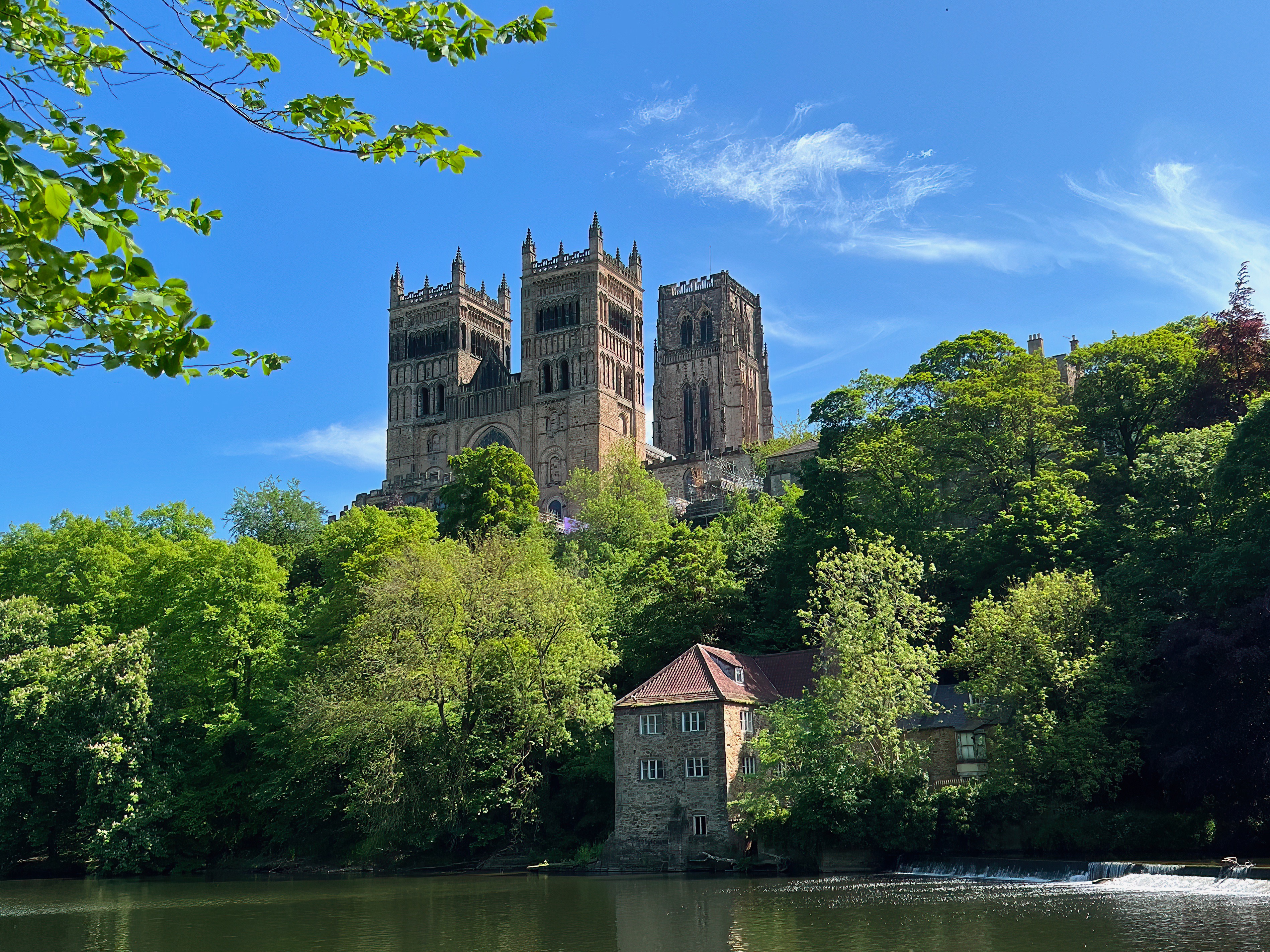
The cathedral raised to shelter Cuthbert’s shrine is one of the world’s most magnificent buildings. Set high on the rock of Dunholme, its dominant presence is softened by the lush foliage veiling its base. A Romantic might imagine it a miracle of stone, springing up supernaturally from the forest primeval. In fact, its monumental architecture was part of a dramatic upwelling of energy, intellect and confidence surging throughout Europe at the dawn of the twelfth century. Cities and universities, trade and travel, churches and cathedrals all burst into bloom in that sudden quickening of western civilization. 
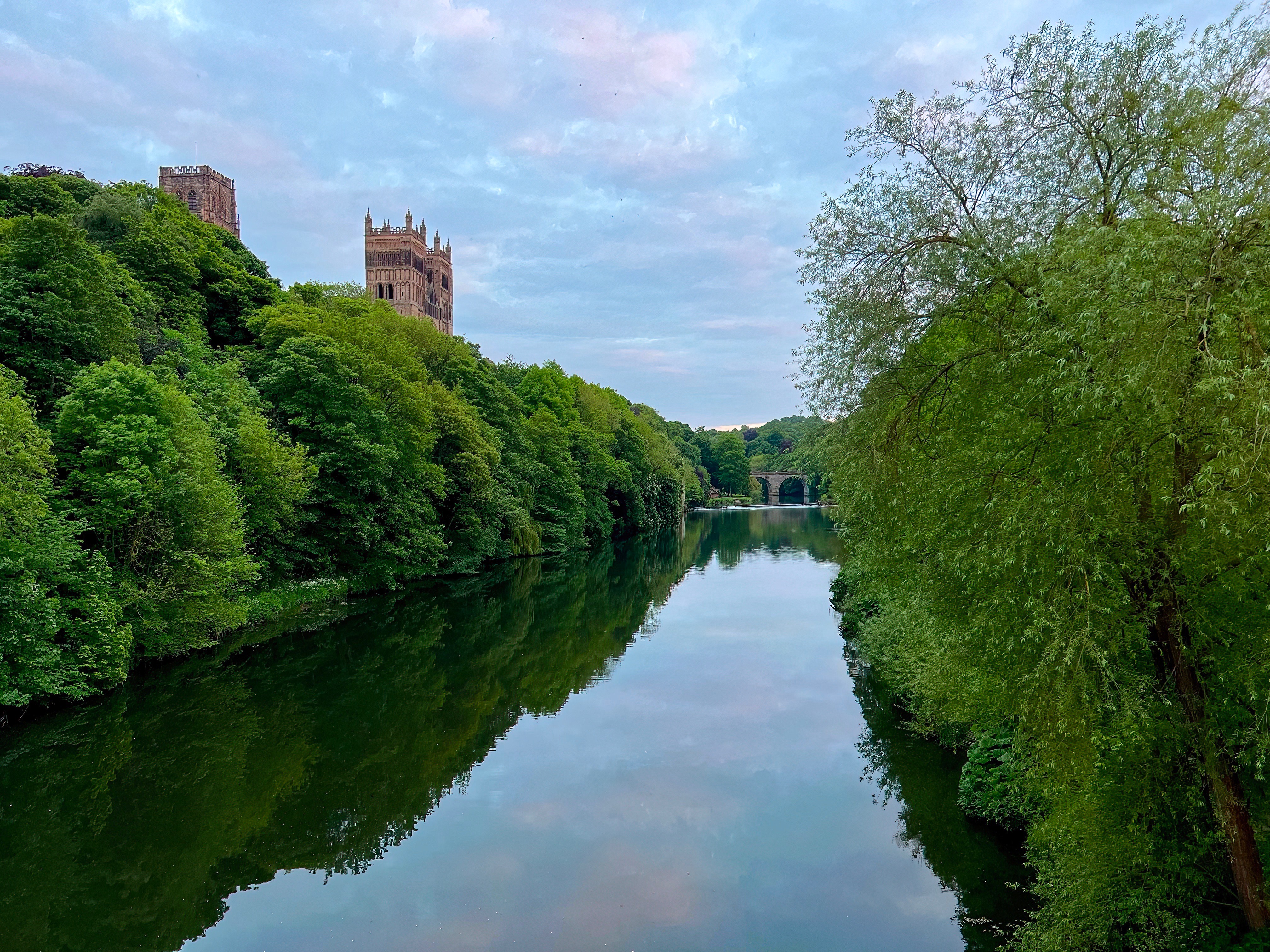
Durham Cathedral rises from a peninsula formed by a loop in the River Wear.
“Who shall ascend the hill of the Lord? And who shall stand in God’s holy place?” — Psalm 24:3
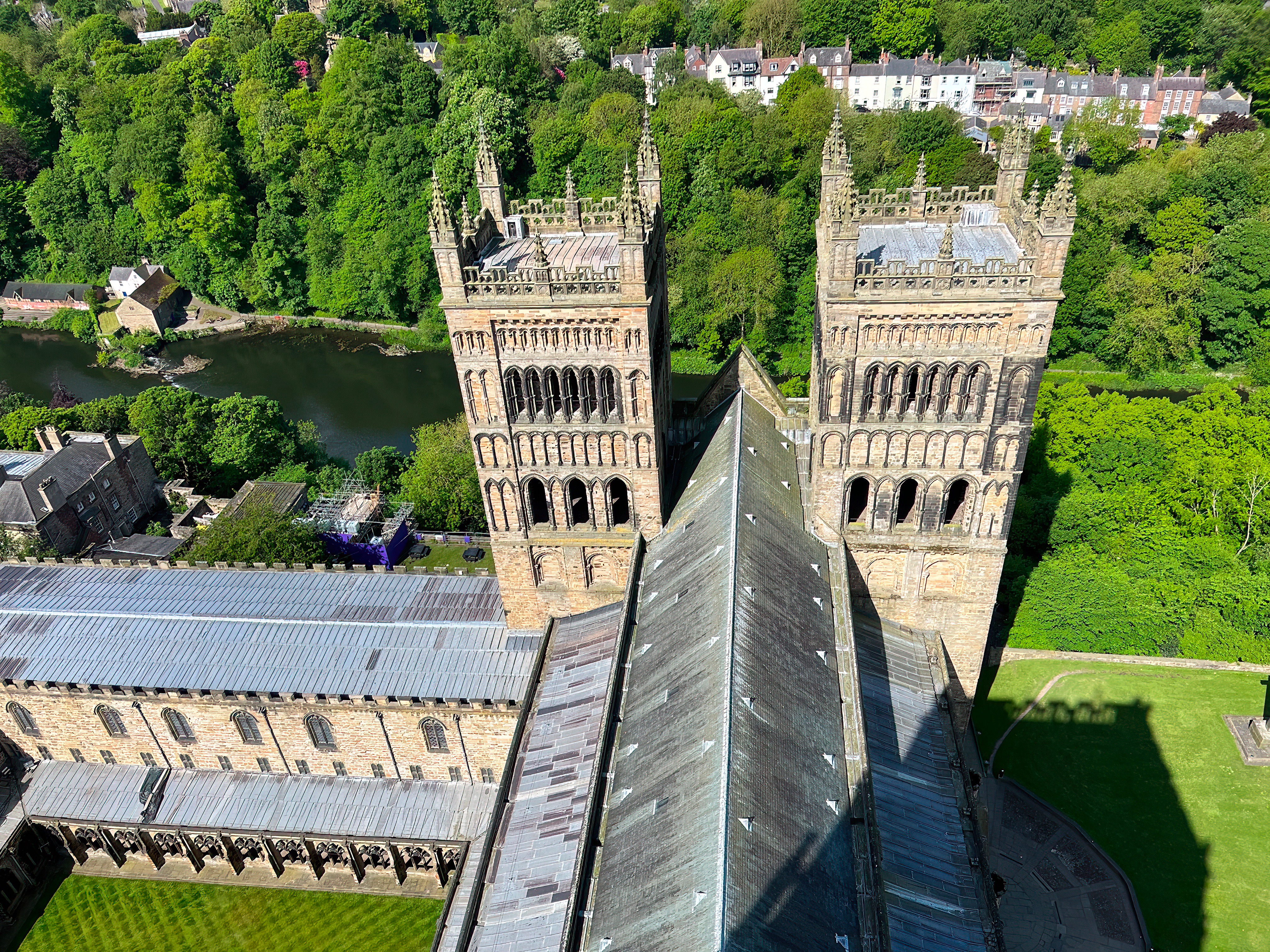
The western towers seen from the 218-foot crossing tower.

In England, the first cathedrals were begun in the Romanesque style imported from Normandy. Durham Cathedral is the only one to retain the purity of its original Norman craftsmanship and design, although the western towers reflect the emerging Gothic style, and the fifteenth-century crossing tower, replacing a previous tower damaged by lightning, is late Gothic. 
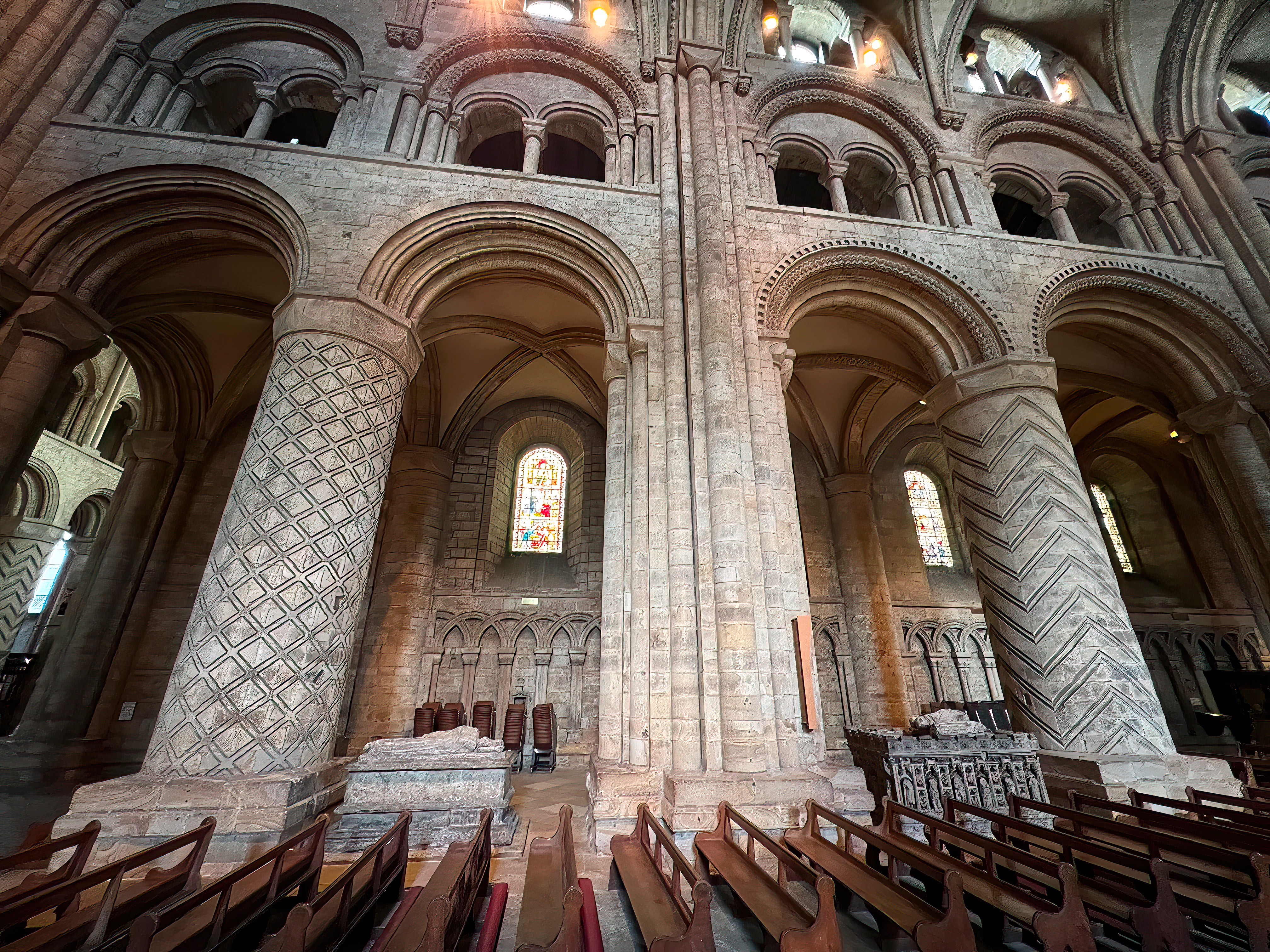
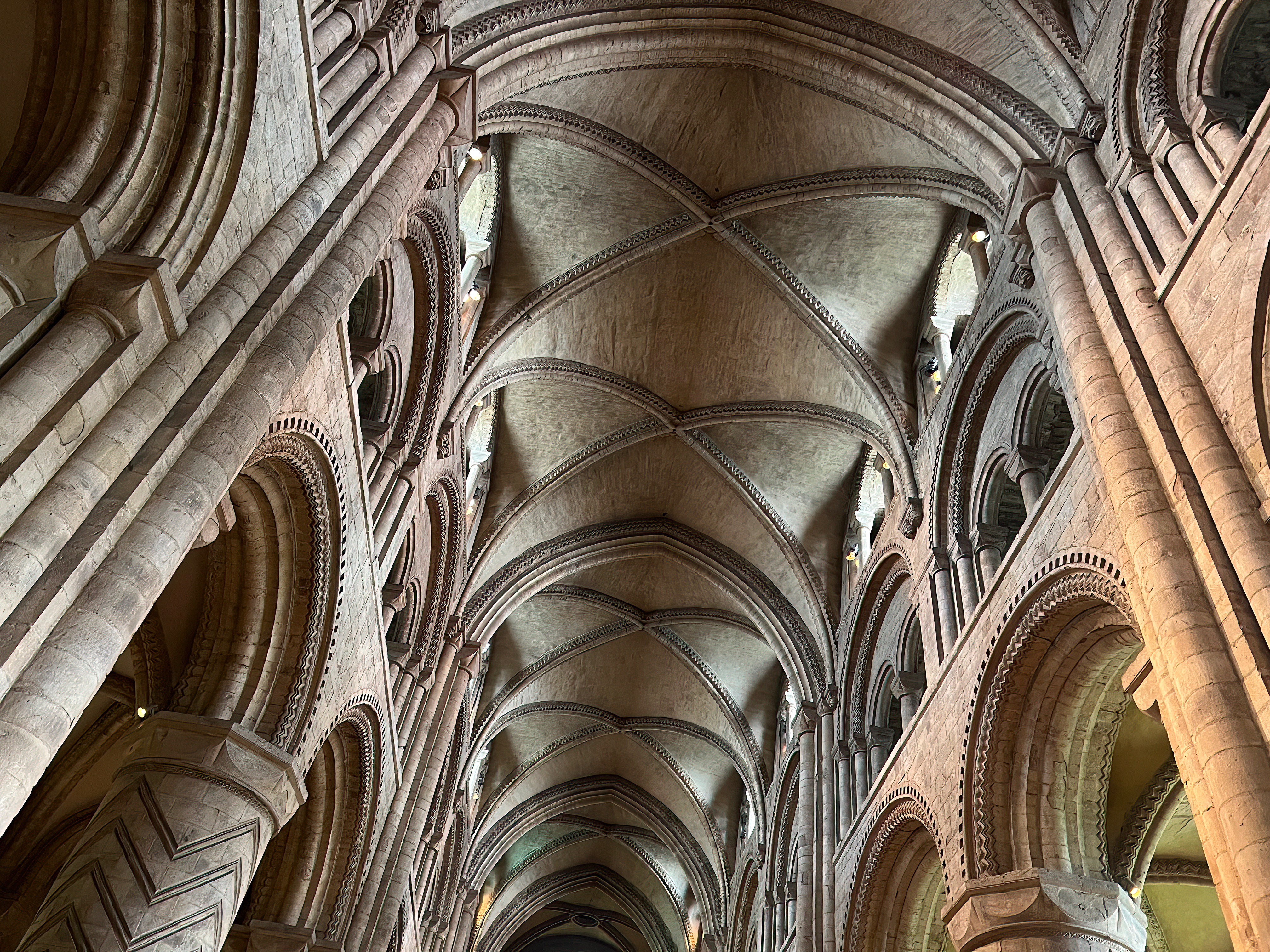
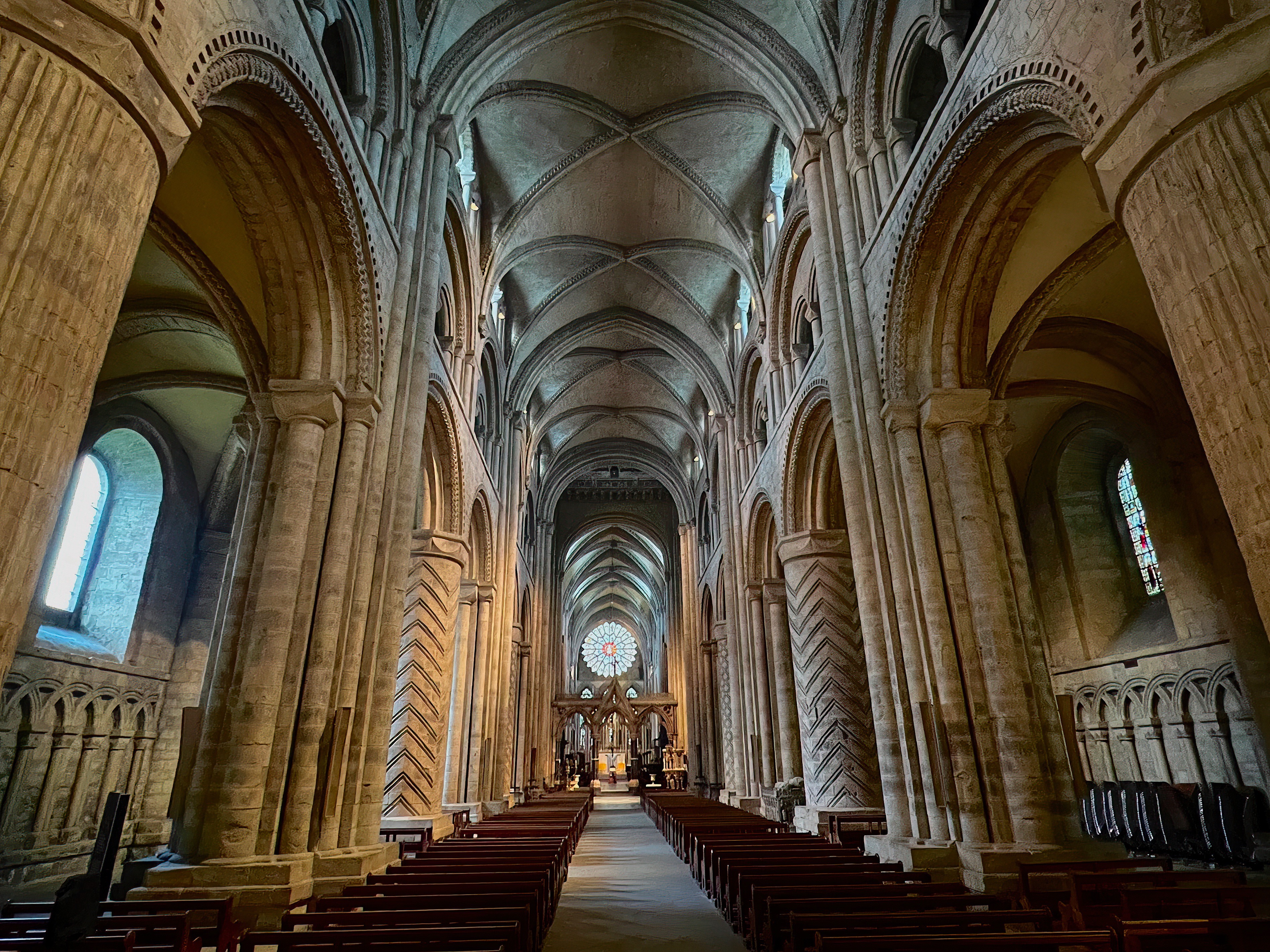
In the nave, the alternating rhythm of round columns and compound piers divides the linear flow into bays.
Each bay, marked on the ceiling by two x-shaped pairs of diagonal ribs, is bounded at its edges by pointed transverse arches springing from a pier on either side. The introduction of rib-vaulting in the nave was unprecedented.

Some large churches employ a repetition of identical columns, topped by horizontal bands of wall, windows or arches, sweeping us forward toward the altar. But Durham Cathedral created an alternating system of columns and piers, dividing the horizontal space into bays. This structural rhythm affects the way our bodies move through the space. As theologian J. G. Davies explains,

“The consequence is that equal strophes, following each other down the vista of the nave, have given way to alternating strong and weak stresses, i.e., of piers alternating with columns … The nave walls are now a linear sequence of individualized parts that retard any rapid flow towards the sanctuary.” [i] 
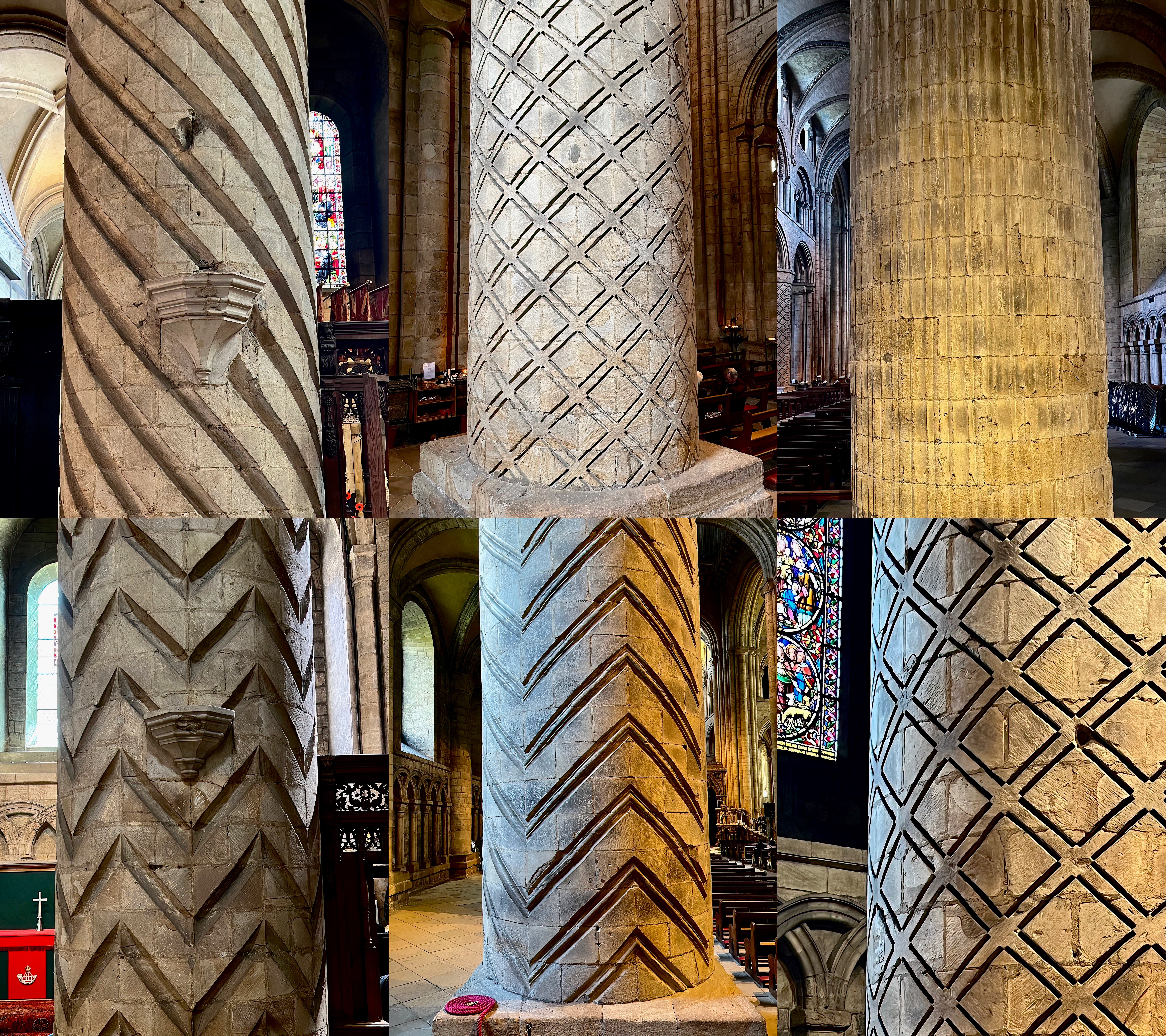
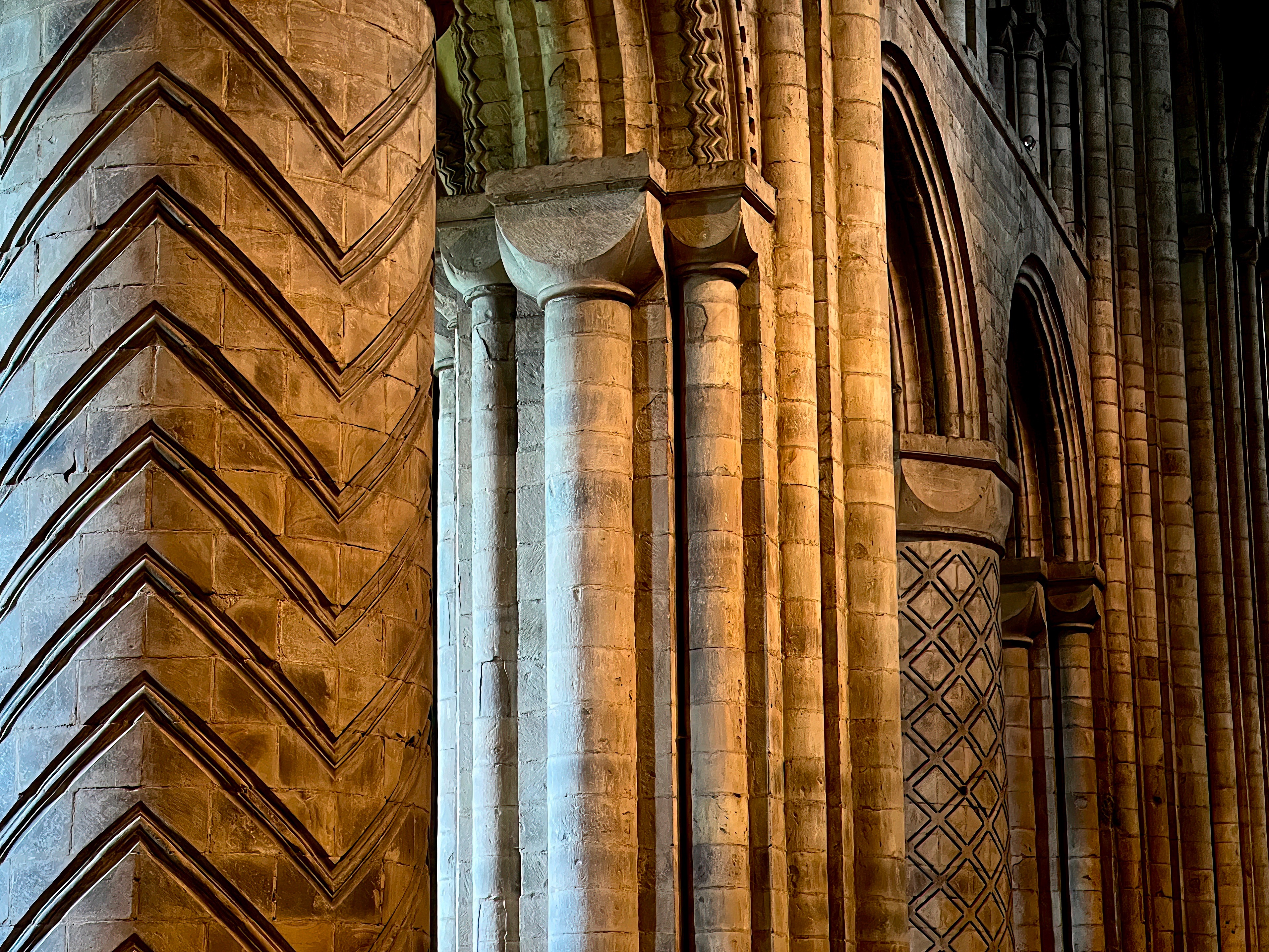
The massive columns (27′ high, 7′ in diameter) are deeply grooved with geometric patterns, creating a striking ensemble of variations unique to Durham Cathedral. They leaven the brute monumentality of thickness and weight with an almost whimsical sense of play.
The dense stone forest of columns and compound piers makes visible the symphonic array of colossal forces poised here in perfect balance. Being in their midst produces both humility and awe.

 While later cathedrals would pursue the Gothic dematerialization of the built structure, with walls becoming thinner and transparent with glass, and ceilings reaching toward the sky, Durham exudes a sense of solidity and weight. Thick walls and massive pillars, supporting the heavy stone roof, signify permanence and strength. Although such features can feel oppressive in more primitive Romanesque churches, nothing here feels inert or stifling. The articulation of details, such as rib vaults, geometric patterns, variations in column design, blank arcades, and a recessed series of arch moldings, all serve to enliven and animate the whole without compromising the overall simplicity, austerity and calm befitting its origins as a monastic enclosure. 
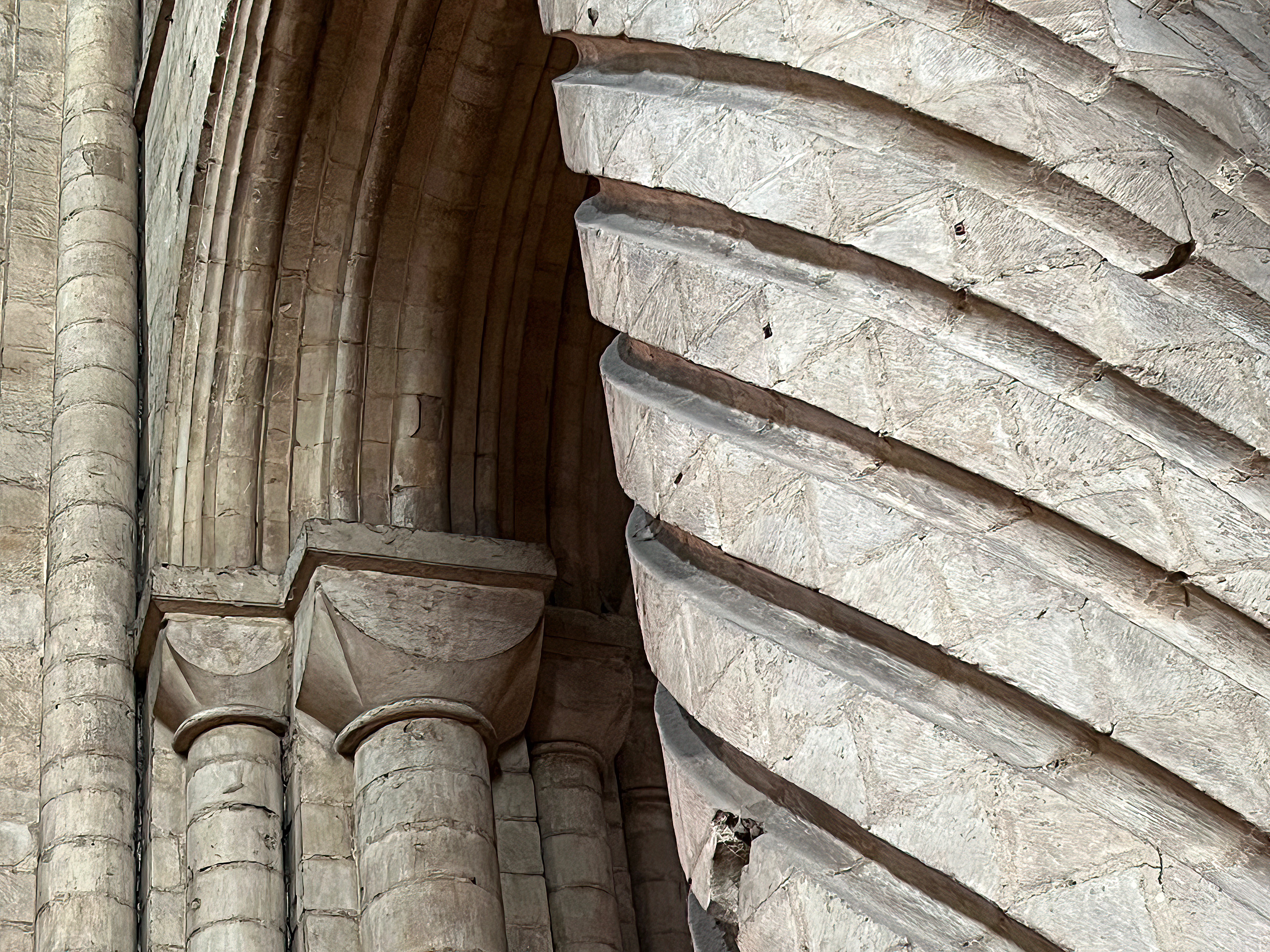
The skill and scale of the spiral grooving was a striking innovation in Romanesque architecture.

“The architect can work with the empty space—the cavity—between the solids, and consider the forming of that space as the real meaning of architecture.” 

— Steen Eiler Rasmussen [ii]

The cathedral is not simply a collection of solid parts. It is also the empty space shaped by its physical components. Length (horizontality) and height (verticality) are the fundamental dimensions of this space. The path between entrance and altar (or shrine) signifies life as a pilgrimage: there is a distance to be traversed, but the goal may yet be reached. At the same time, an interior that soars above our heads keeps us mindful of the Transcendent: it cannot be grasped or possessed, but it awakens our aspiration for a greater, higher reality. And throughout the whole, the interplay of light and shadow, immensity and intimacy, flow and obstacle, openness and containment, hiding and revealing lures us deeper into the Mystery beyond words. 
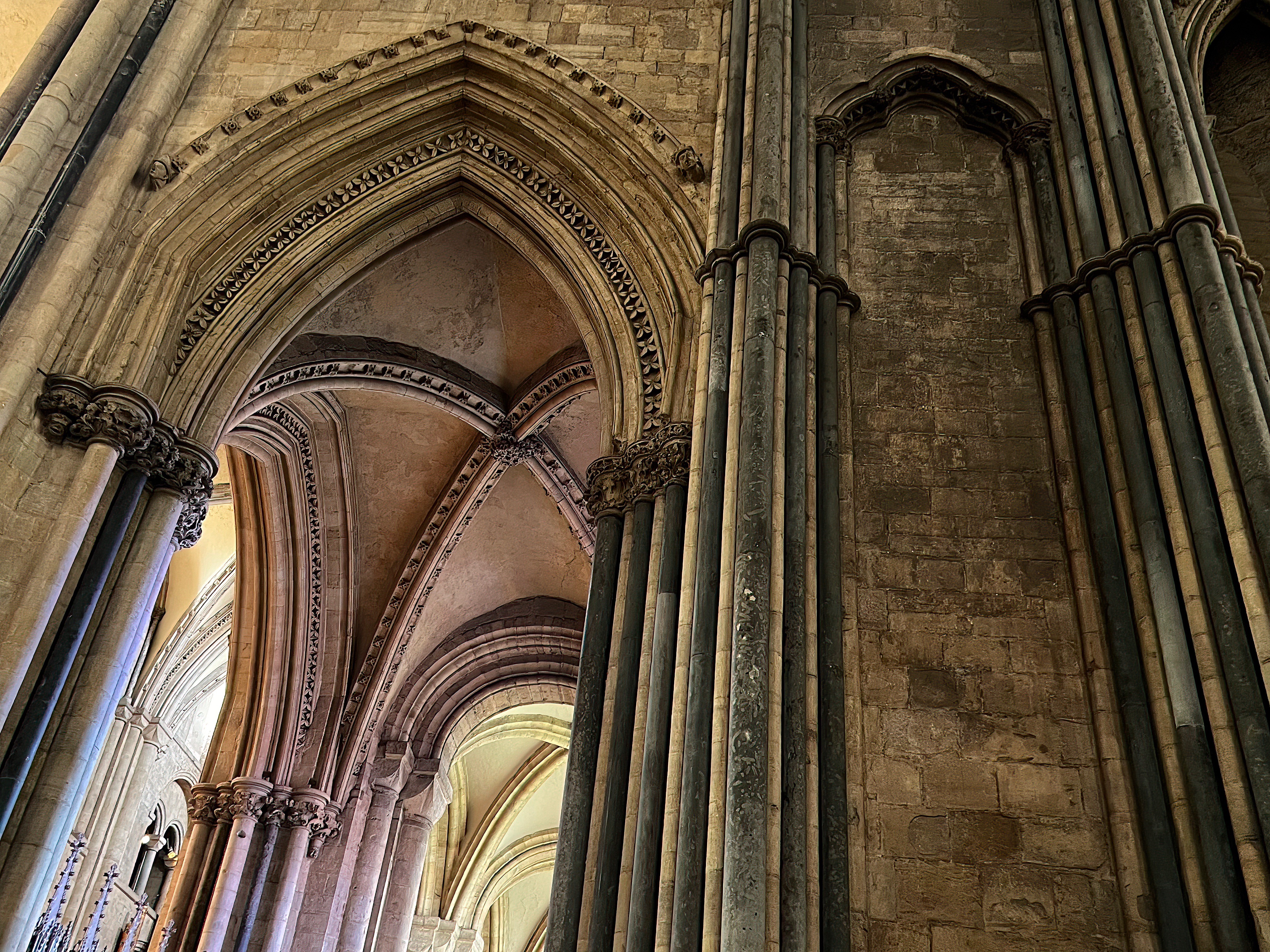
View from the north transept into the north aisle and the nave beyond. The multiple intersections of solid shapes and empty spaces generate a continuous play of hiding and revealing. You can’t see it all from just one place. The whole must be experienced through movement.

“[When] work reaches a maximum of intensity, when it has been made with the best quality of execution, when it has reached perfection … When this happens, the places start to radiate. They radiate in a physical way and determine what I call ‘ineffable space,’ that is to say, a space that does not depend on dimensions but on the quality of its perfection. It belongs to the dimension of the ineffable, of that which cannot be said.” — Le Corbusier [iii]
“Walk about Zion, go all around it. count its towers, admire its walls, scale its heights, that you may tell generations to come that such is God.” (Psalm 48:12-14)

Some have argued that a church is not a place for a casual visitor to have a worship experience. It is not a shelter for an altar or holy object, but for an assembly, and it has no meaning or symbolic power apart from its liturgical function. At the other end of the spectrum is Joseph Campbell’s assertion that one can be “reborn spiritually by entering and leaving a church.” 

For me, Durham Cathedral is both/and, not either/or. Many of its 700,000 annual visitors may not share the symbols, narratives, and rituals which have shaped its construction and history, but only the deadest of souls would remain unaffected by this sacred space. We all need “places which allure us with their beauty, which call us to a halt, which refresh us with their charm and are a positive ease and delight for the spirit.” [iv]  We all need rooms that care.
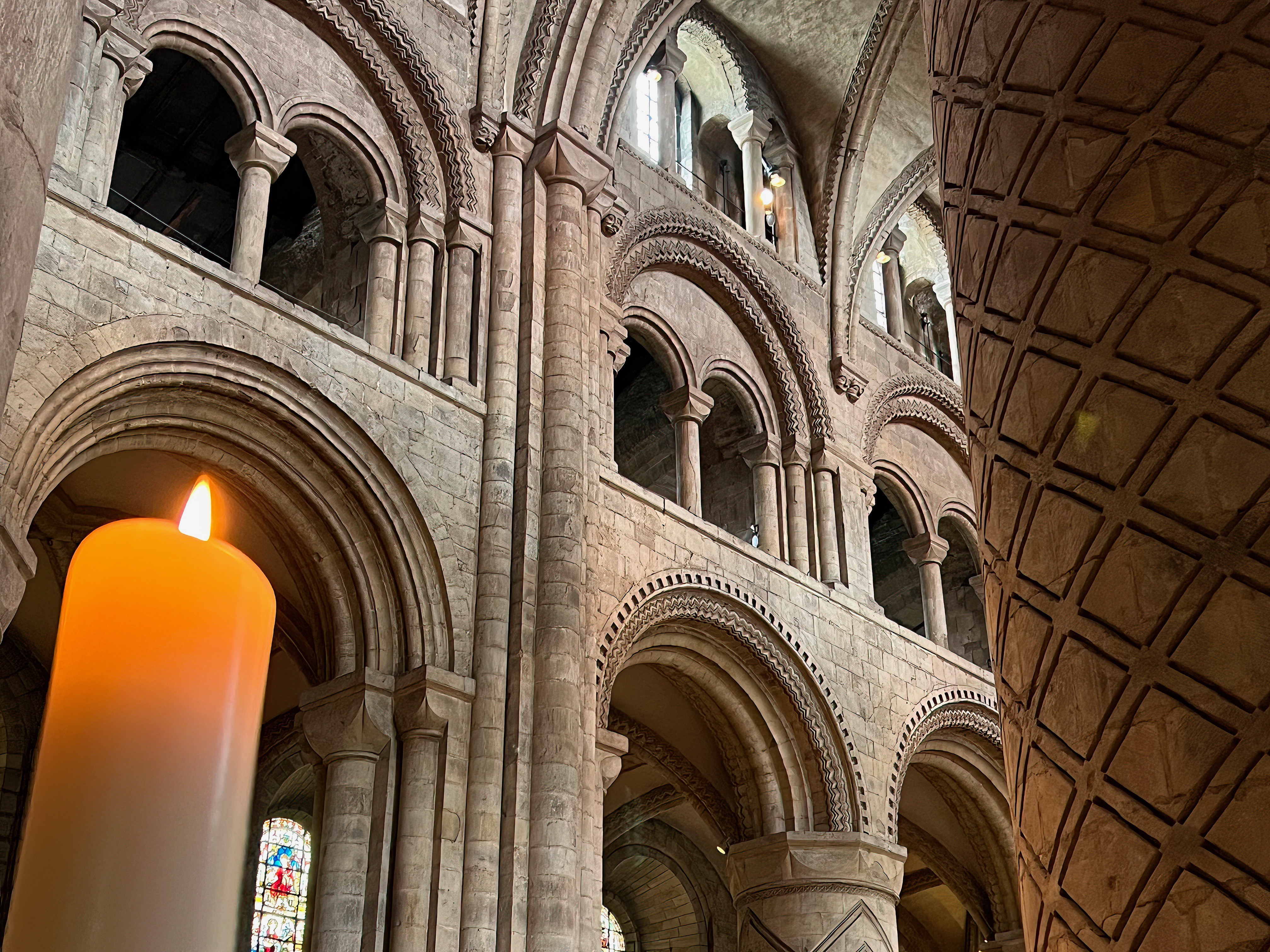
Lighted candles remind us this is a house of prayer. The three elevations of arcade, gallery, and clerestory have balanced proportions rarely achieved in the Norman style. The predominant height of the arcades gives the vertical an edge—but not too much—over the horizontal. The recessed moldings of the arches enhance the sense of depth, while the zigzag detail enlivens the stone. The undecorated arch on the left predates the craze for zigzags.

G. K. Chesterton said that the Church is “the only thing which saves a man from the degrading slavery of being a child of his age.” [v]  Cathedrals are no longer centers around which whole cities or cultures are organized, nor do they hold an exclusive copyright on the sacred, but they remain indispensable preserves of experiences and perspectives necessary for the health of our souls and the life of the world. When our medieval predecessors entered their cathedrals, “they were the enraptured witnesses of a new way of seeing.” [vi]  And, I would add, participants in a new way of being. May it be ever so.

The physical act of wandering through Durham Cathedral exerts a formative effect on body, heart, and intellect, deepening the sense of life as pilgrimage and passage. As our eyes and our feet move through the cathedral along its system of paths and enclosures, we feel the pull toward a goal, be it altar or shrine. At the same time, the way is strewn with burning bushes, inviting us to turn aside for a moment—or pause to look up—that we may receive and ponder their wordless message of holy presence. 
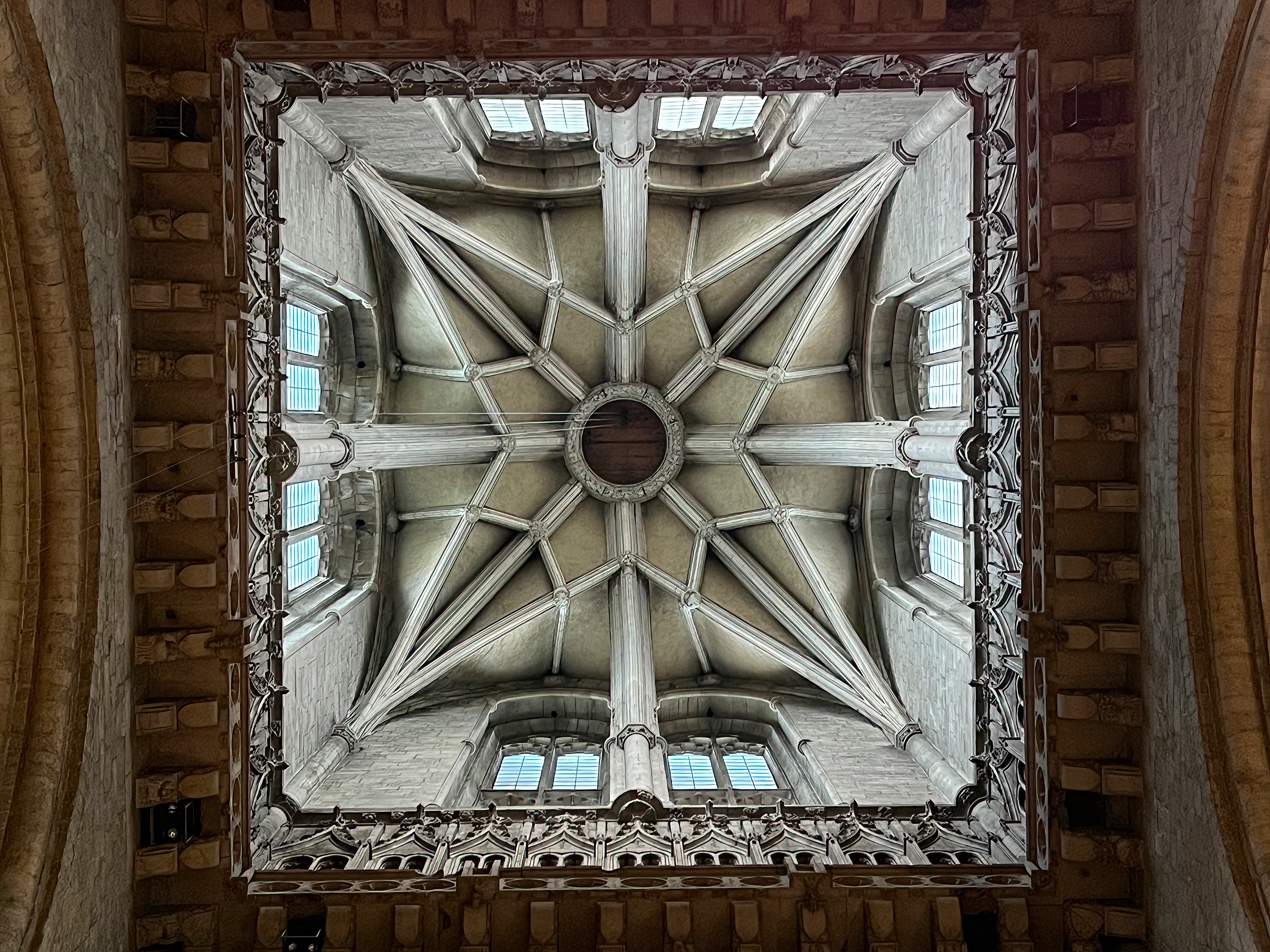
The star-shaped vaulting of the central tower above the crossing glows with the light of 8 clear windows. A 15th-century replacement for a damaged tower, it soars to a very un-Norman height. As you walk up the nave, the sudden expanse of luminous space overhead is thrilling.
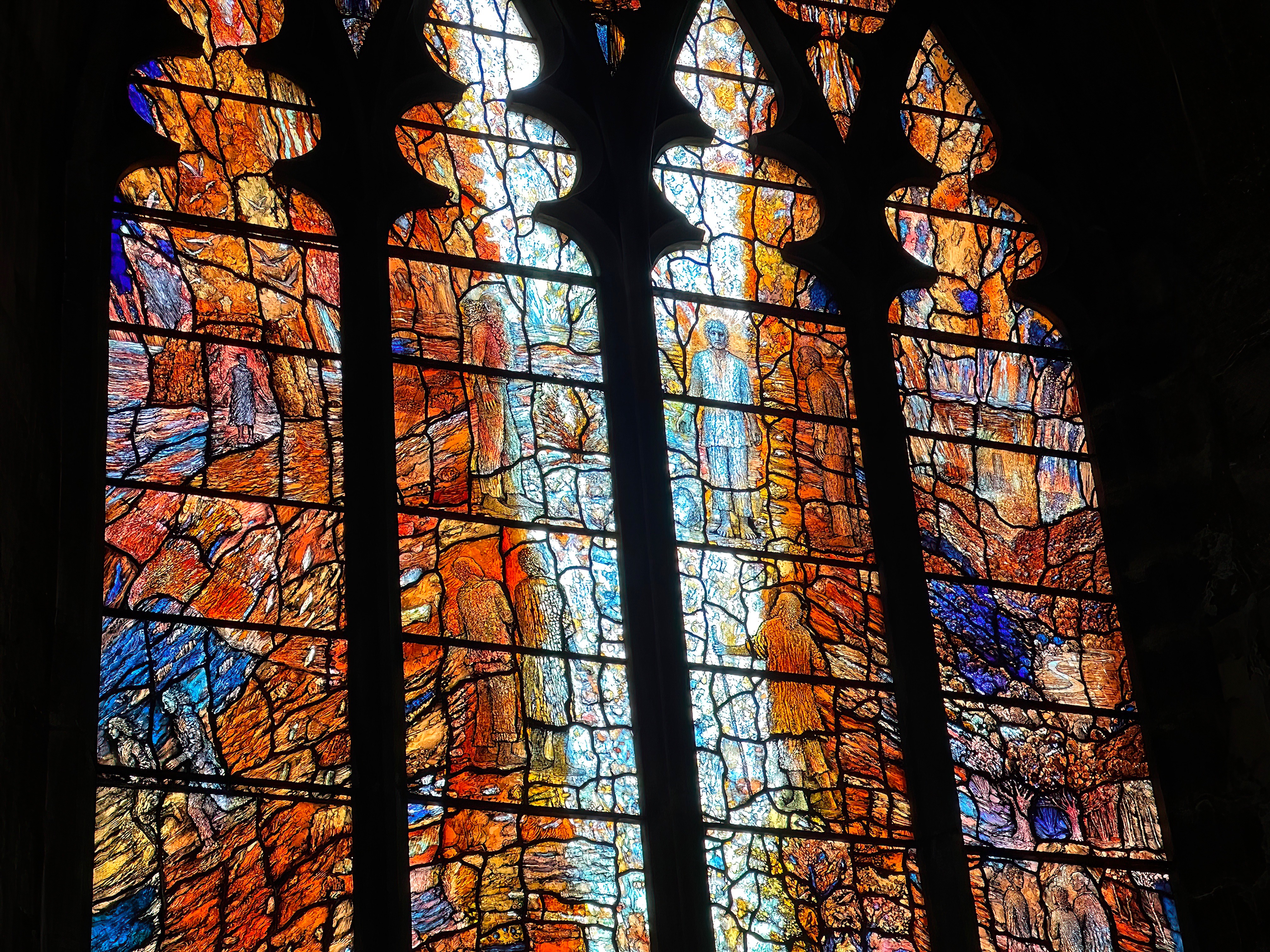
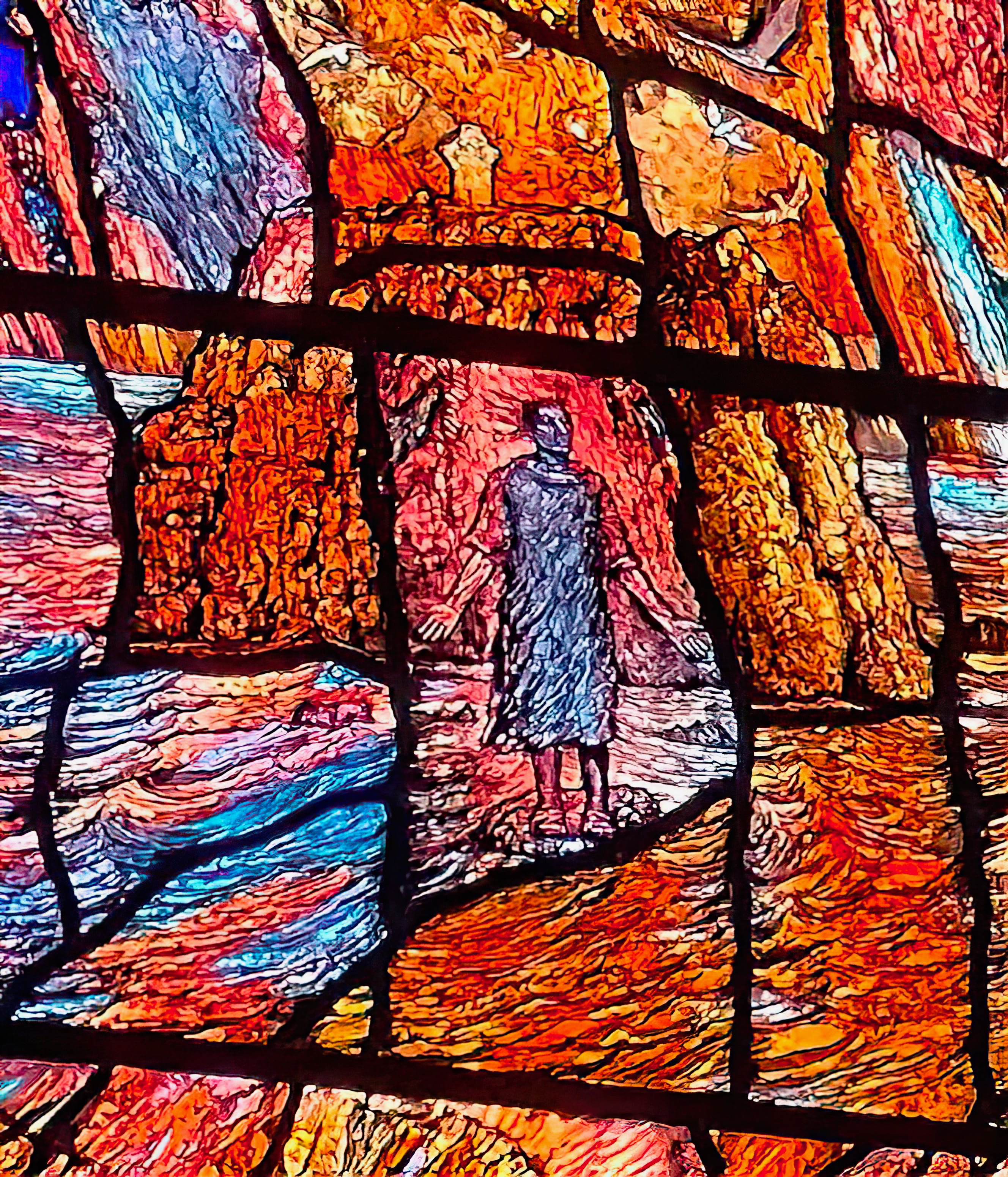
Transfiguration window, south choir aisle (Tom Denny, 2010). Christ and the disciples are in the two central panels. Cuthbert, praying with outstretched arms on an island, is in the middle of the left panel.
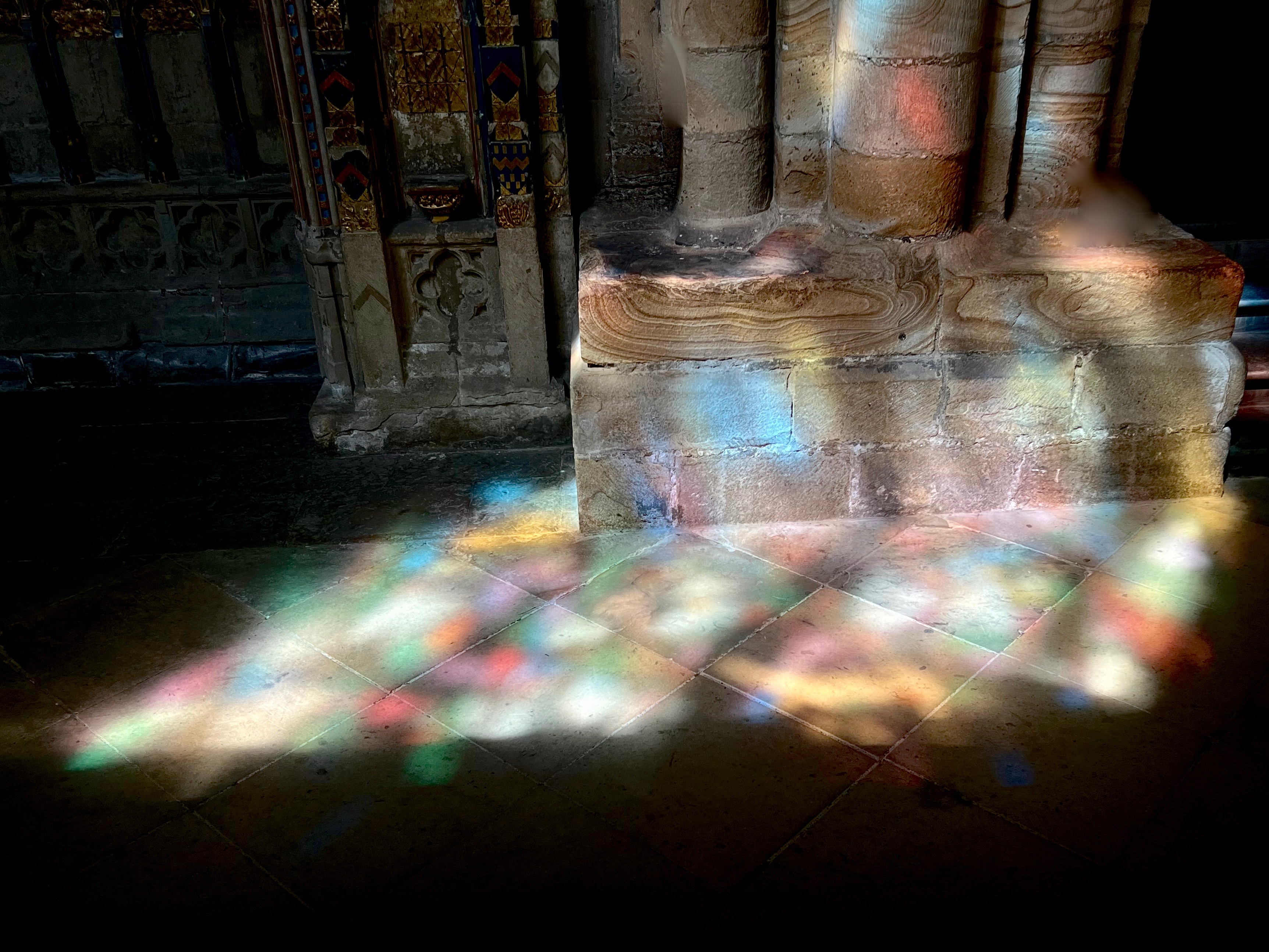
Stained glass window light paints the south chancel aisle near the steps to St. Cuthbert’s tomb.
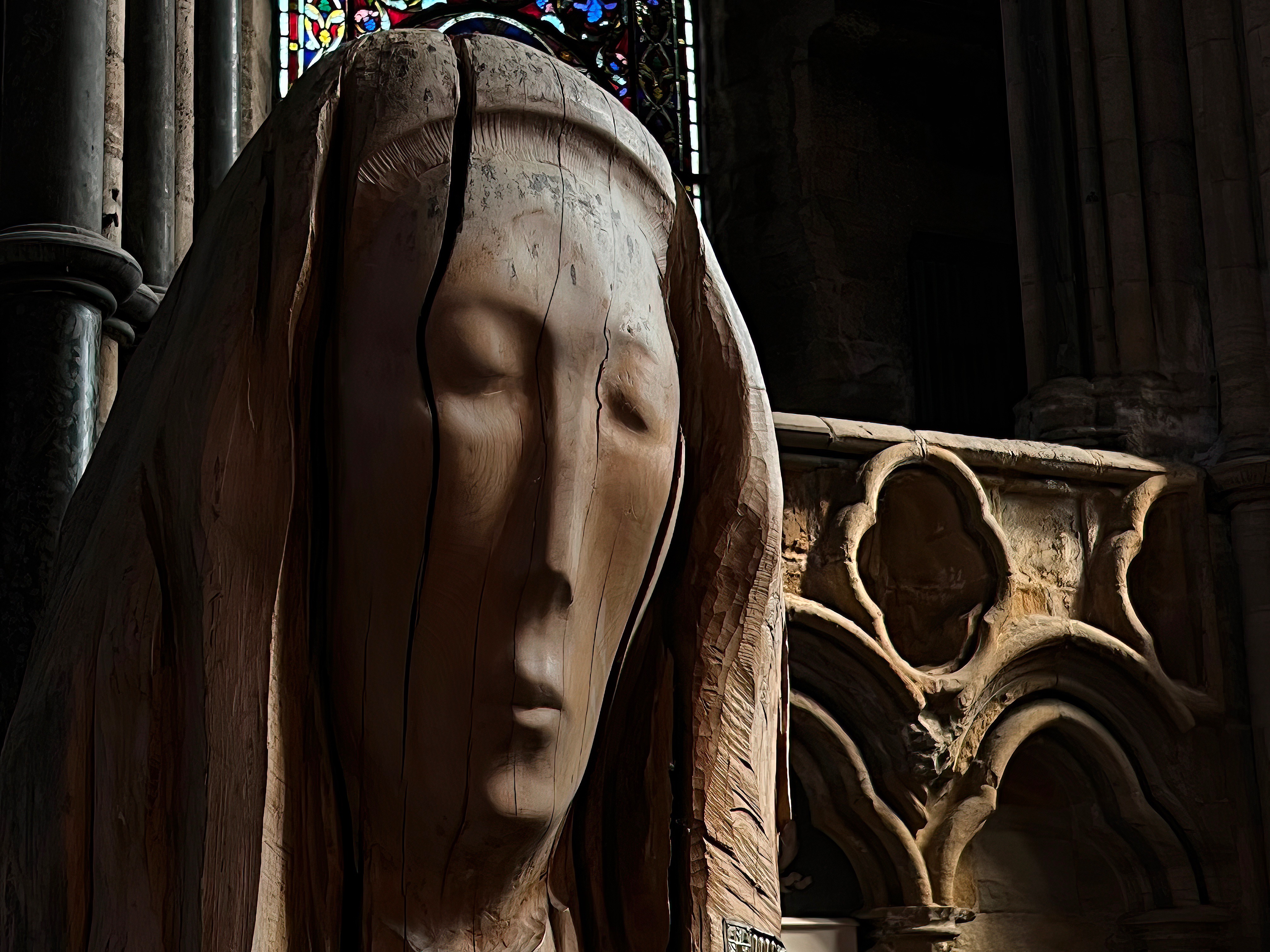
The Sorrowful Mother, part of Fenwick Lawson’s Pieta (1974-1981), in the east end of Durham Cathedral. When the beech wood sculpture was on loan to York Minster in the 1980s, a fire in the transept rained molten lead upon Christ and Mary. The artist accepted that wounding of the figures as a deepening of the Passion image.

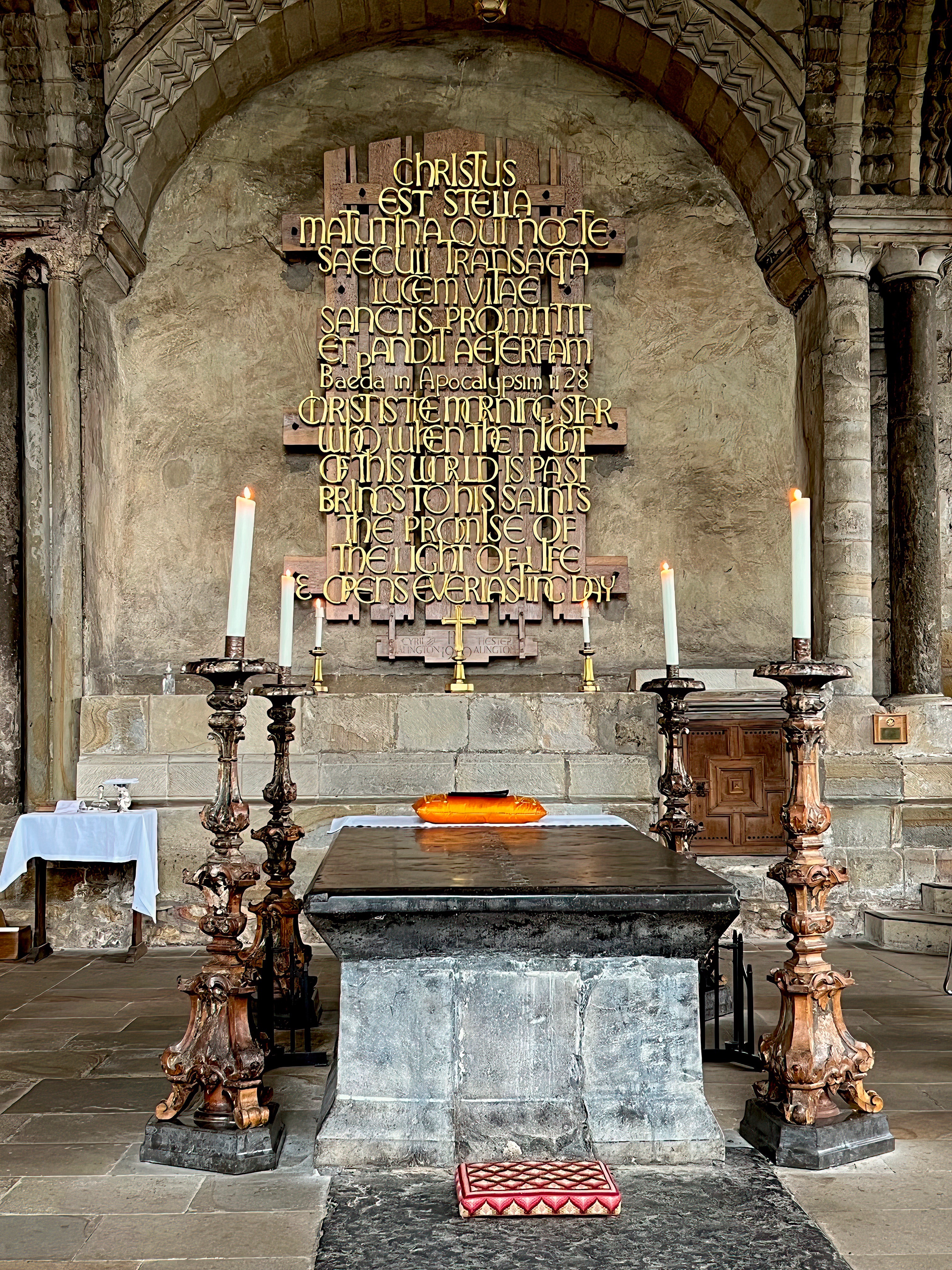
At the east end of the cathedral, behind the high altar, is the tomb of St. Cuthbert. Stripped of its once lavish adornments by the decline of medieval pilgrimage and the predatory greed of Henry VIII, its quiet simplicity seems much more suited to the spirit of the humble saint who preferred bare and wild places. 
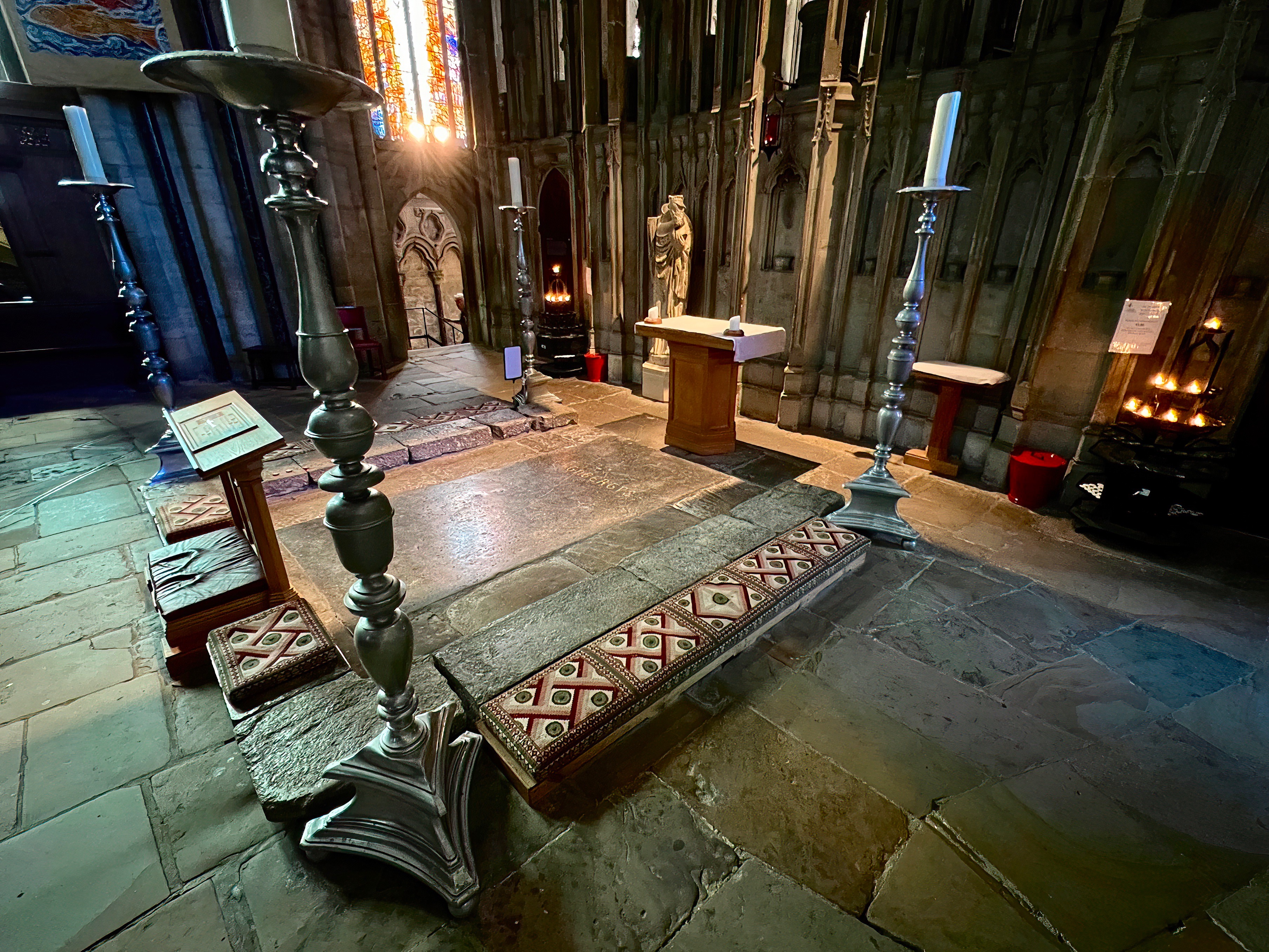
Cuthbert’s tomb, in a raised feretory behind the high altar. After his remains came to rest here in 1104, it became a great pilgirmage site and one of England’s most sumptuous shrines. By the 16th century, interest had dwindled, and after Henry VIII’s men plundered its riches, this simple slab replaced its elaborate predecessor. Cuthbert, known for his humility, would not have minded.

When I reached the feretory, I ascended the steps to the tomb. Here was my journey’s end. As T. S. Eliot said of another holy place, 

You are not here to verify,
Instruct yourself, or inform curiosity 
Or carry report. You are here to kneel 
Where prayer has been valid. [vii]

And so I did. I gave thanks to God and his saint for the beautiful pilgrimage, remembering the beauty of the people and the wonders all along the way from Melrose to Holy Island to Durham. I reflected on the stories of Cuthbert and his times, his warm spirit and faithful heart, feeling gratitude for the gift of saints who show us how. But I did not linger. What the angel said on Easter morning applies to every tomb: He is not here. Cuthbert still walks the paths of memory which I traced in homage. And he also goes before us—into the human future, deeper and deeper into God. 
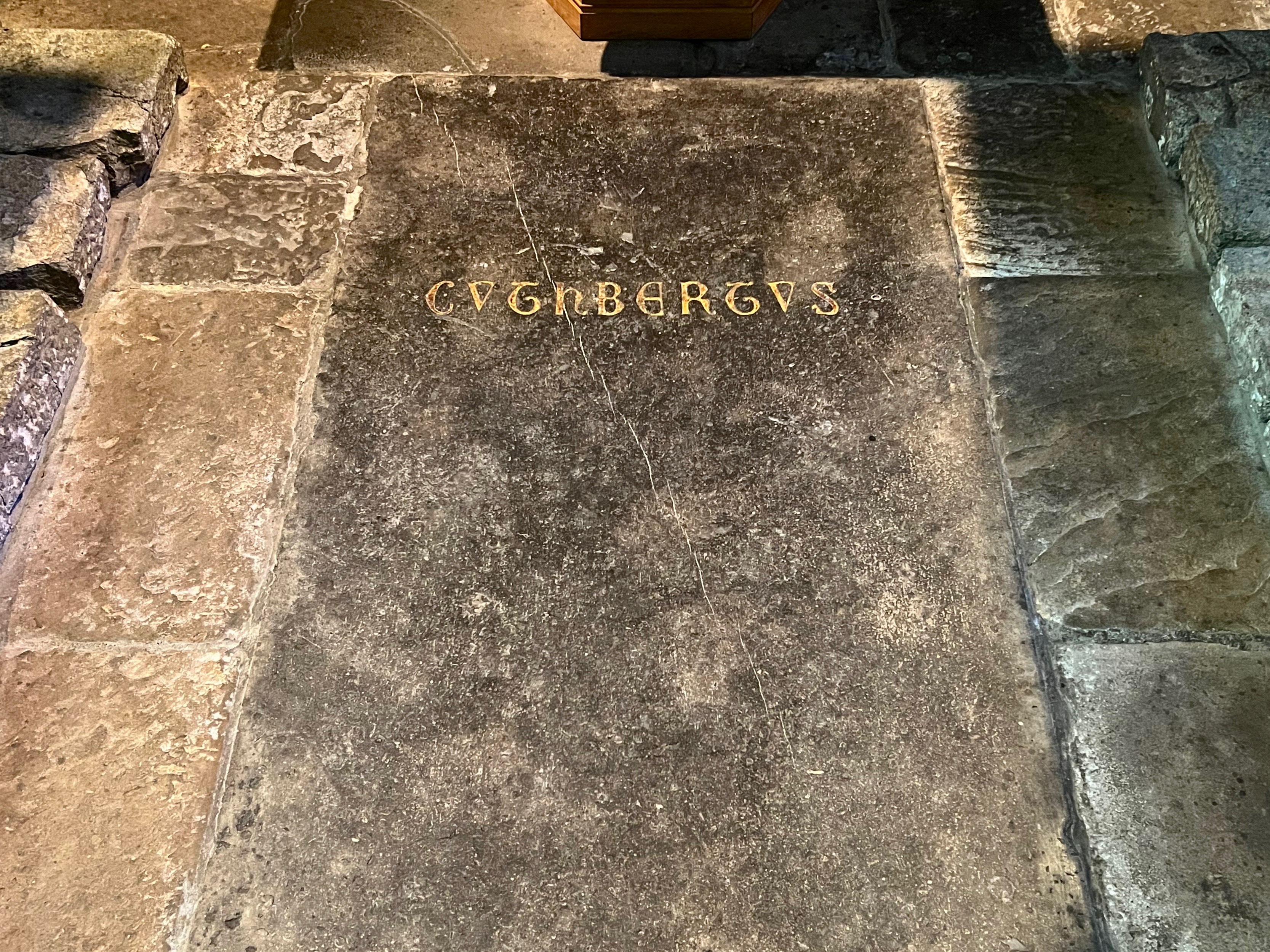
Happy from now on are those who die in the Lord. So it is, says the Spirit, for they rest from their labors. (Book of Common Prayer)

Much of what we know about St. Cuthbert is due to the eighth-century writings of the Venerable Bede, the great scholar-monk of the Early Middle Ages. A teenager when Cuthbert died, Bede remains linked to Cuthbert by more than his writing. His own remains, enclosed in a silk bag, were housed with Cuthbert’s at Durham for 348 years, until given their own separate shrine in 1370. After the English Reformation put an end to shrines, Bede’s remains were reburied in the floor of Durham’s Galilee Chapel, at the opposite end of the cathedral from Cuthbert’s tomb. To walk the length of the interior, from Bede in the west to Cuthbert in the east, felt like a recapitulation in miniature of my entire pilgrimage. Every step a prayer.
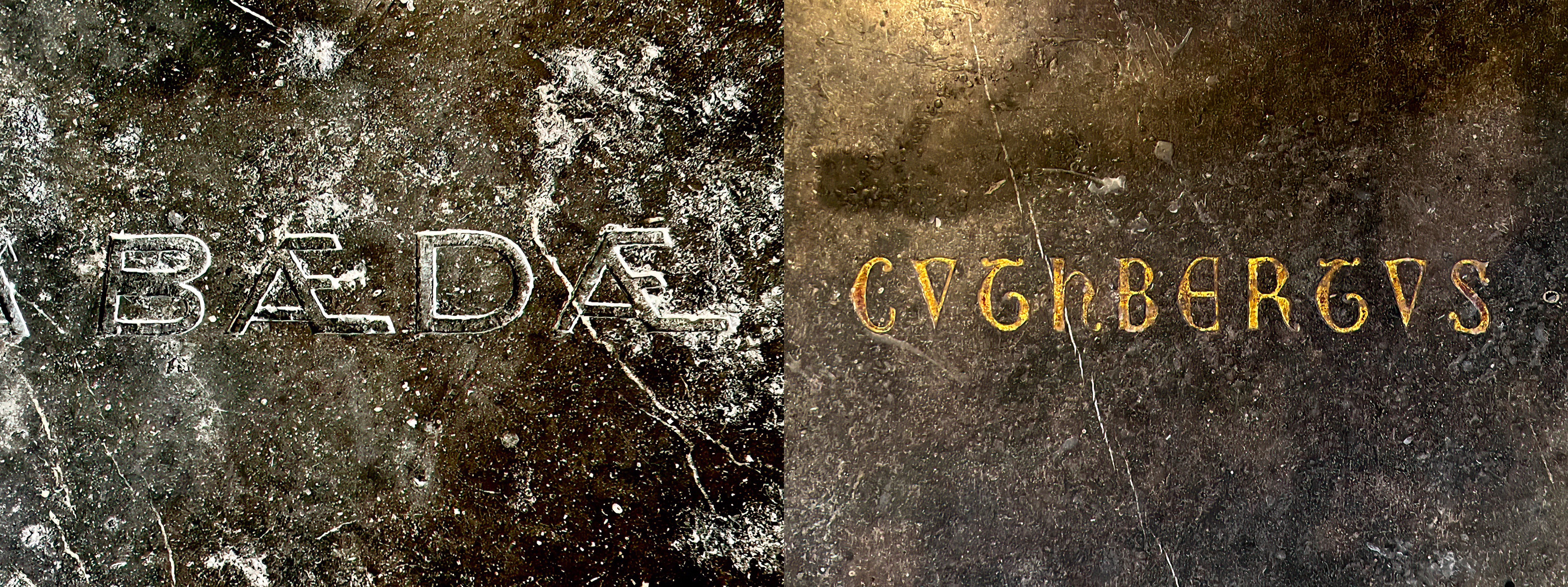
The Latin names of Bede and Cuthbert, inscribed on their tombs.

When I made my plans to visit Durham after St. Cuthbert’s Way, I neglected to check my liturgical calendar, so it was a wonderful surprise to learn I had arrived on the very eve of Bede’s feast day and—to my further amazement—in the thousandth year since the Translation of his Relics into Cuthbert’s tomb. What a glorious conclusion to my pilgrimage! It was pure gift, not something I had thought up in advance. That evening I joined a sung eucharist, celebrated at Bede’s final resting place in the Galilee Chapel. His simple stone tomb served as the altar. As incense drifted through the forest of stone columns, the choir sang William Byrd’s exquisite Mass for Four Voices, and the congregation added our own voices in exuberant hymnody.
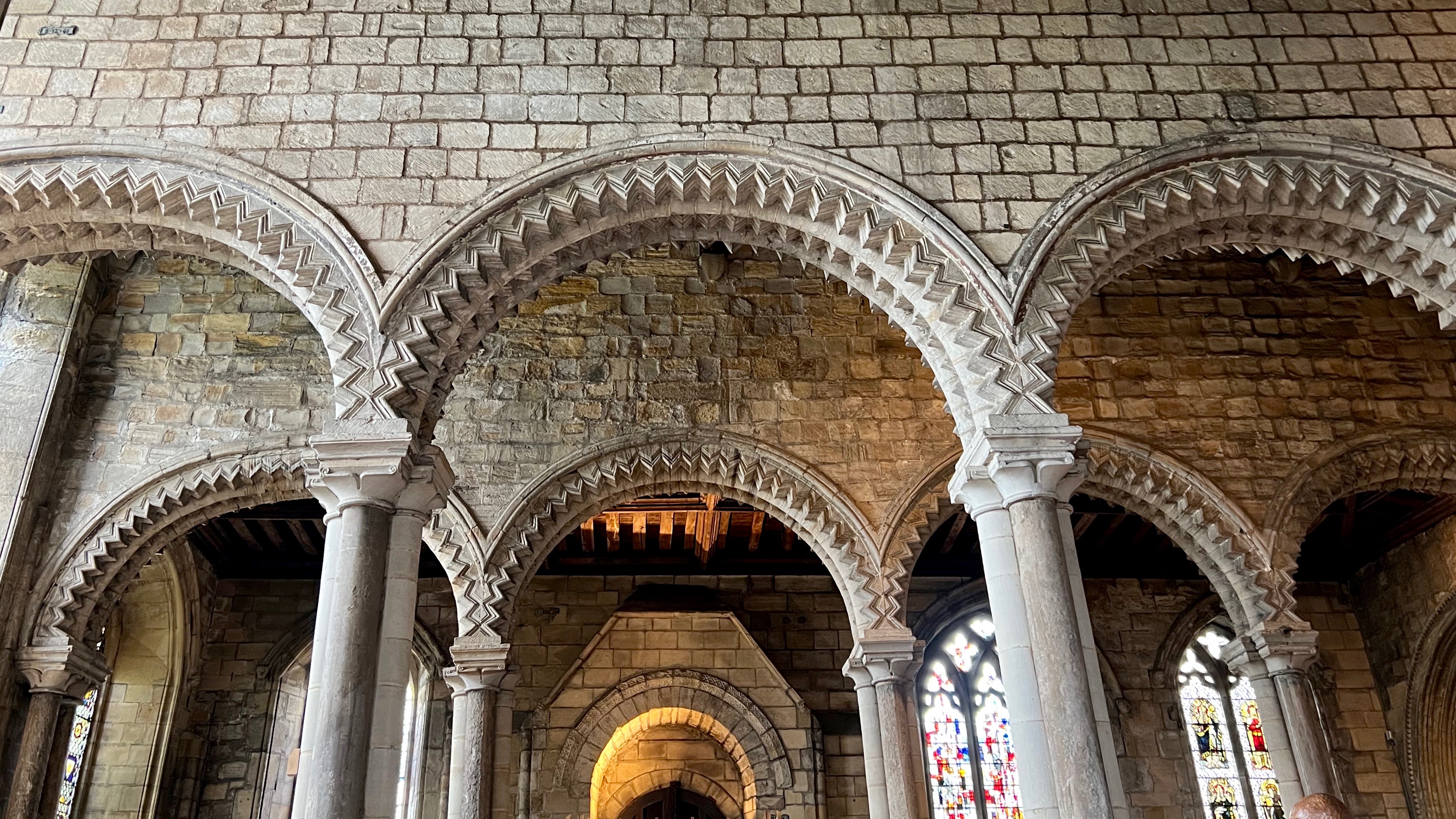
The Galilee Chapel was added to the cathedral’s west end, taking the cathedral too close to the edge of the bluff to allow a traditional west front (the entrance is on the north side). Built later in the 12th century than the main church, it displays a lightness more akin to Gothic than the weighty structures of Romanesque. Its multiple rows of graceful arches on slender columns may have been influenced by Andalusian architecture such as the mosque at Cordoba.
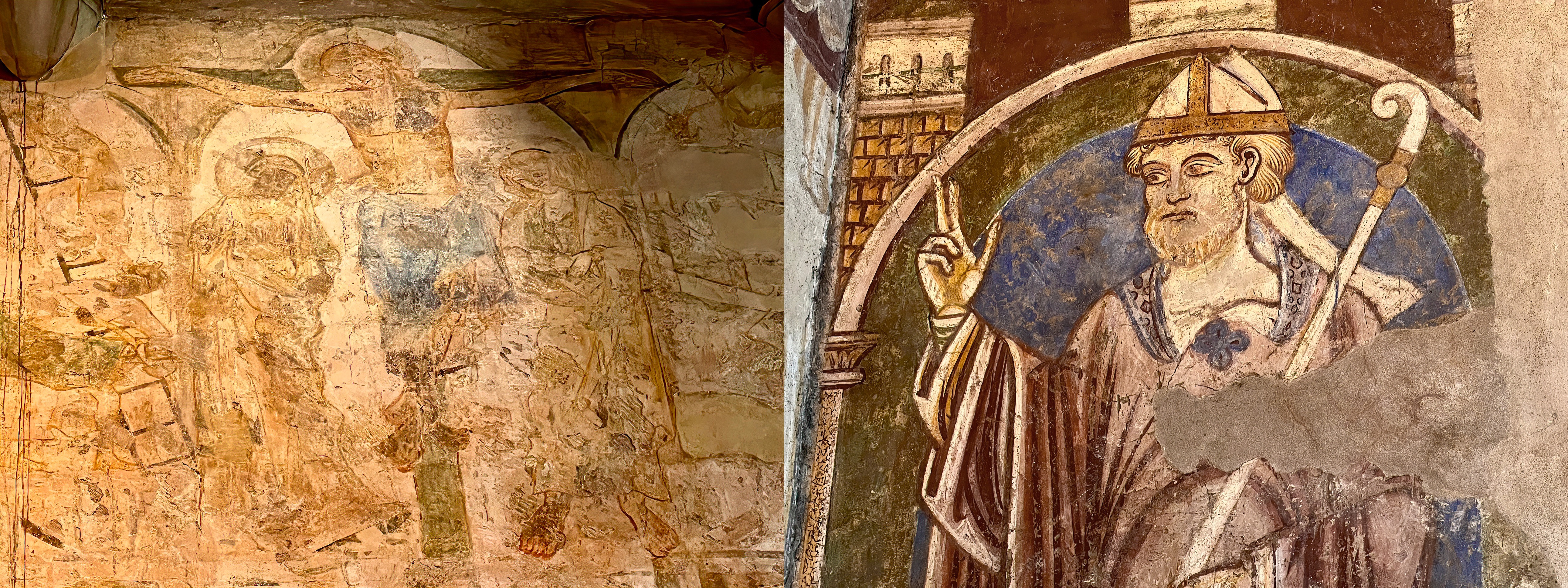
In the Middle Ages, murals were painted on the cathedral walls, but Reformation iconoclasts covered them with whitewash. Victorian restorers tried to scrape off the white, but destroyed most of the murals in the process. These surviving images in the Galilee Chapel show Christ crucified and a bishop in 12th-century vestments, possibly meant to be Cuthbert.
The tomb of the Venerable Bede in the Galilee Chapel became the holy table for the eucharist on the eve of his feast day.

Recalling Bede’s significance as “the father of English learning,” we prayed for “all biblical scholars and writers and all who translate and interpret your word in every part of the world.” Praising God for Bede the historian, we prayed for “church historians and all who interpret the past to strengthen witness in the present.” And we sang,

For his example we give thanks,
His zeal to learn, his skill to write;
Like him we long to know God’s ways
And in God’s word drink with delight …

Teach us, O Lord, like Bede to pray,
To make the word of God our joy,
Exult in music, song and art,
in worship all your gifts employ. [viii]

The next evening, on the feast itself (May 25), a beautiful Evensong was held in the main church, followed by a procession of clergy, choir and people to the Galilee Chapel. Since I was sitting at the front of the nave, I was the first to leave my pew to trail the choir. For a moment I wondered if I had misunderstood the instructions in the bulletin. No one else seemed to be joining me. Uh-oh, I thought, worrying that this bumbling priest from the Colonies was violating liturgical decorum. Then, to my relief, others began to step into the aisle, and together we made our way to Bede’s tomb, singing a hymn to the glorious tune of Westminster Abbey

Here in England, through the ages,
While the Christian years went by,
Saints, confessors, martyrs, sages,
Strong to live and strong to die,
Wrote their names upon the pages
Of God’s blessèd company. [ix]

The Galilee Chapel was soon packed with worshippers. I was herded into a spot in front of the tomb, just three feet from the lead boy soprano. Though his body was small and willowy, it produced sounds of astonishing amplitude and soaring clarity in anthems by Palestrina, Tallis, and Edwin George Monk. I’ve never stood so near a voice so beautiful. The nineteenth-century Anglican cleric Sidney Smith said that his idea of heaven was eating pâté de foie gras to the sound of trumpets. For me, heaven would be standing three feet from the angel choir. I could skip the goose liver. 

At one point in the liturgy, one of Bede’s most memorable stories was read aloud: the Anglo-Saxon parable of the sparrow in the banqueting hall, to my mind one of the best existential arguments for places like Durham Cathedral to exist—they nourish and perpetuate a way of knowing that is the alternative to despair. Here’s how Michael York tells the story in a video I made in 1988, The Story of Anglicanism

Michael York tells Bede’s story of the sparrow in the banqueting hall.

The morning after Bede’s feast, I took a train to London. As a coda to my Cuthbert pilgrimage, I wanted to see the two books at the British Library with close connections to the saint. One was a pocket-size copy of John’s Gospel, discovered in Cuthbert’s coffin four centuries after his death. It may have been his personal copy, or a posthumous tribute placed near his body by a fellow monk. It is the oldest European book still in its original binding.
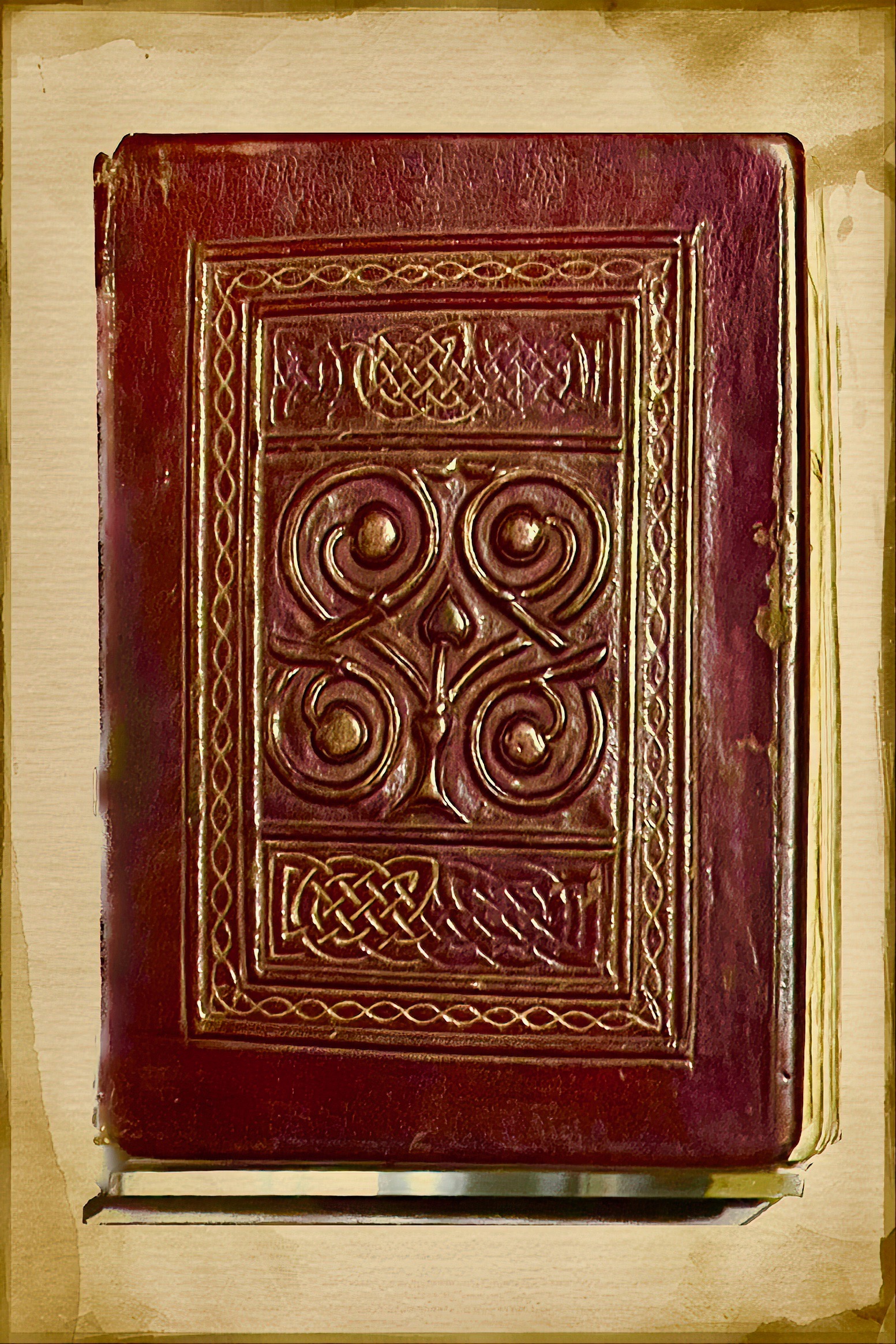
The St. Cuthbert Gospel of John (early 8th century) is the earliest intact European book, still in its original binding. It was kept in the coffin with his body for over 400 years. Passing into private hands during Henry VIII’s Dissolution of the monasteries, it was purchasd by the British Library in 2012.

Cuthbert loved the Fourth Gospel. When Boisil, his old monastic mentor, told him he expected to die within seven days, Cuthbert asked him, “Which book would it be best to read if we only have a week?” Boisil replied, “The Evangelist John.” And for the next seven days, until Boisil’s death, the two monks did Bible study together. Bede, who recorded this story for posterity, added a comment: “They dealt with only the simple things of the faith which worketh by love and not deep matters of argument.” [x]
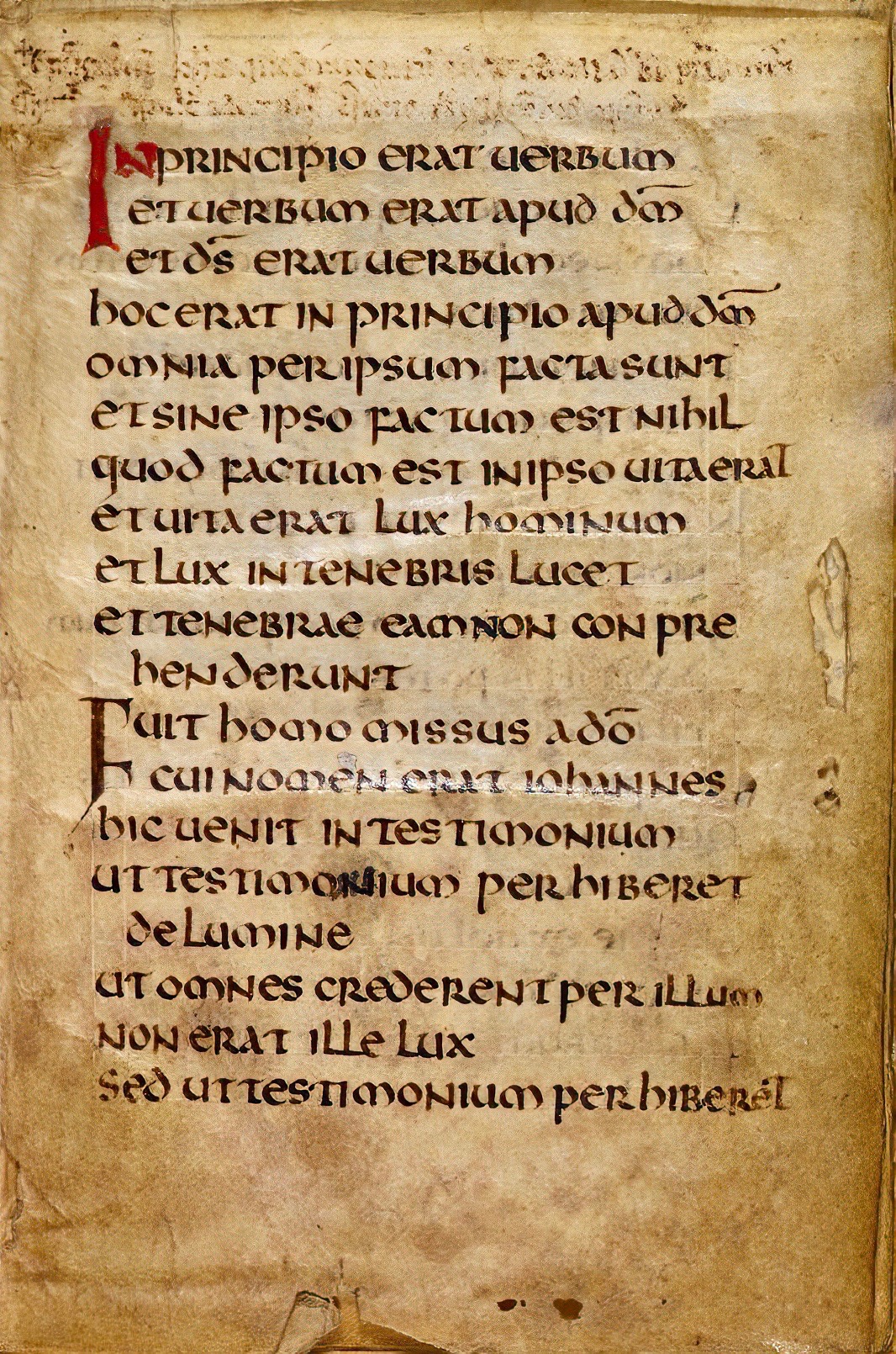
The first page of St. Cuthbert’s Gospel: In principio erat verbum (In the beginning was the Word).

The other treasure I had to see was the Lindisfarne Gospels, one of the most beautiful books ever made. Thought to be the work of a single man, Eadfrith, third bishop of Lindisfarne after Cuthbert, it was laboriously produced a few decades after the saint’s death, “for God and St. Cuthbert and all the holy people who are on the island.” It was probably displayed for veneration at the saint’s shrine at Lindisfarne until the ninth-century Viking incursions. When Cuthbert’s remains and relics began the long exodus that ended in Durham, the Lindisfarne Gospels went with them. 
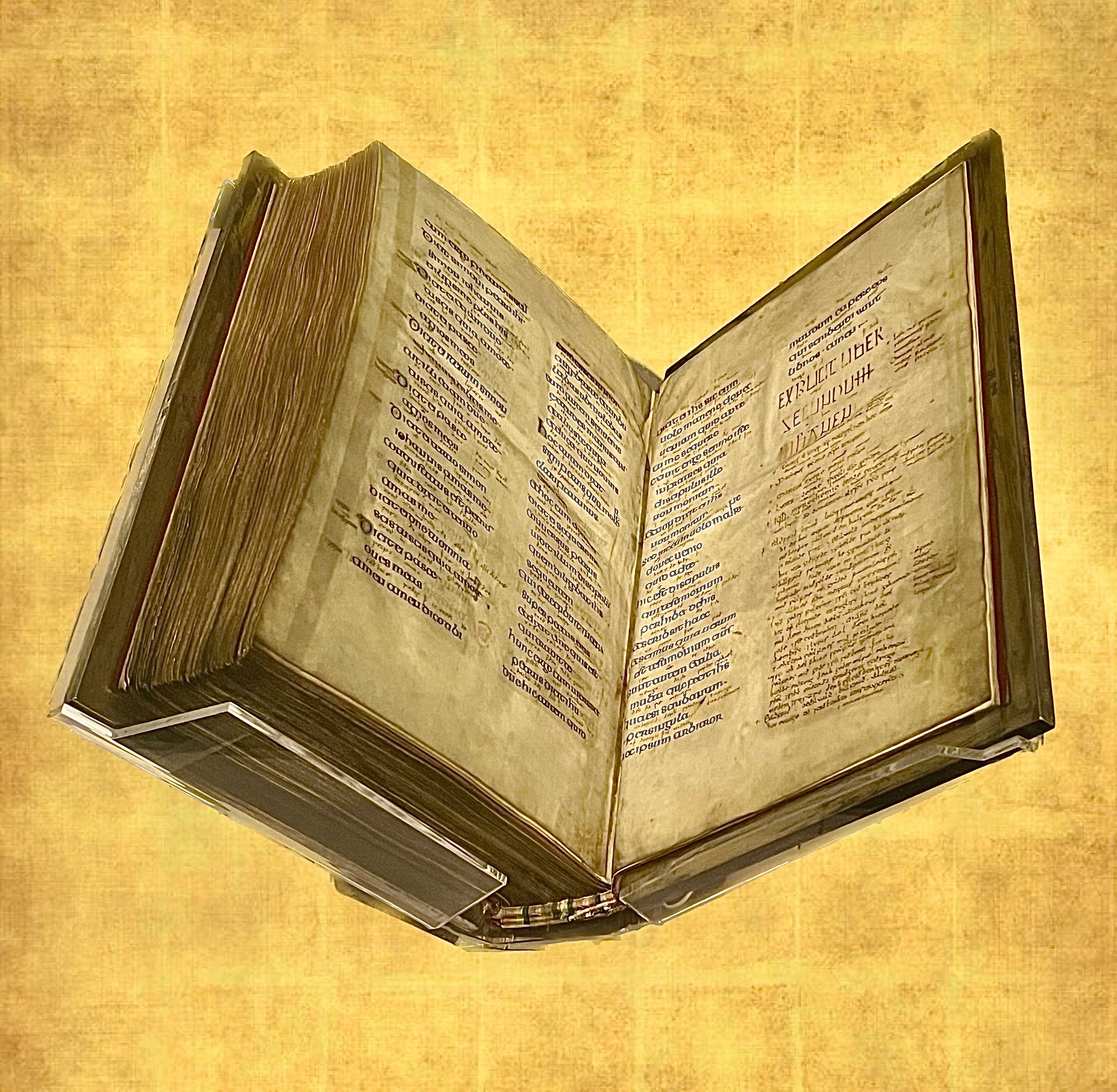
The LIndisfarne Gospels (c. 720), now at the British Library. It took Bishop Eadfrith an estimated 5-10 years to produce by hand.

Alas, the two pages on view during my visit contained no images, only text. The Latin was written in the handsome “Insular half-uncial” script. Between the lines is a word-by-word translation into a Northumbrian dialect of Old English, added in the tenth century by a priest named Aldred. Although librarians may shudder at the thought of a book being defaced by a reader, Aldred, I presume, was trying to make the gospels more readable. In any case, his scribbles have the honor of being the earliest surviving translation of the gospels into English. 
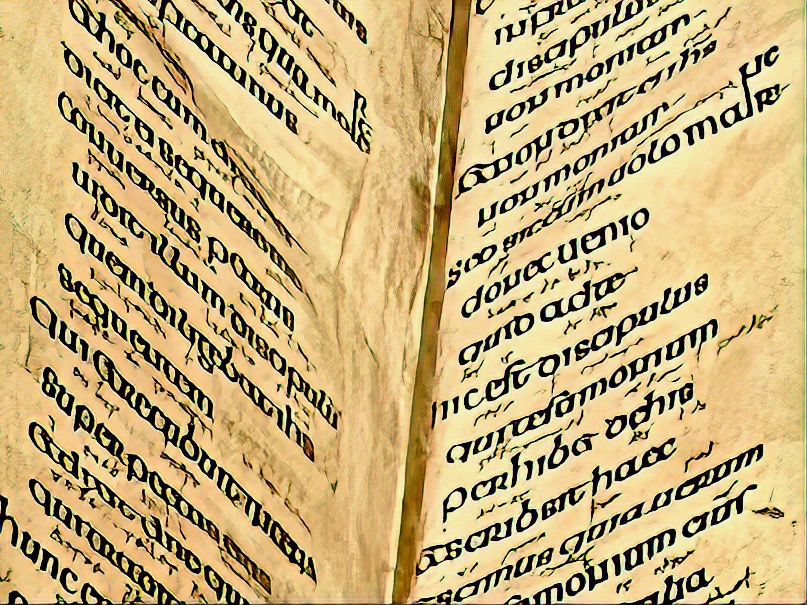
Latin text of the Lindisfarne Gospels, with Aldred’s Old English translation between the lines.

What I had most hoped to see was one of this book’s celebrated illuminations, particularly the “carpet pages,” a suite of four variations on the symbol of the Cross, embedded within mesmerizing patterns, both abstract and zoomorphic. Michelle P. Brown, a longtime curator of the Lindisfarne Gospels, calls these pages “[painted] labyrinths of prayer, prefiguring the devotional pavement-mazes of Chartres and other of the Gothic cathedrals by half a millennium or more.” [xi]  Although my eyes had not seen the glory of those magic carpets of colored ink, I departed the British Library in peace. A glimpse of the book itself was enough—for now. 
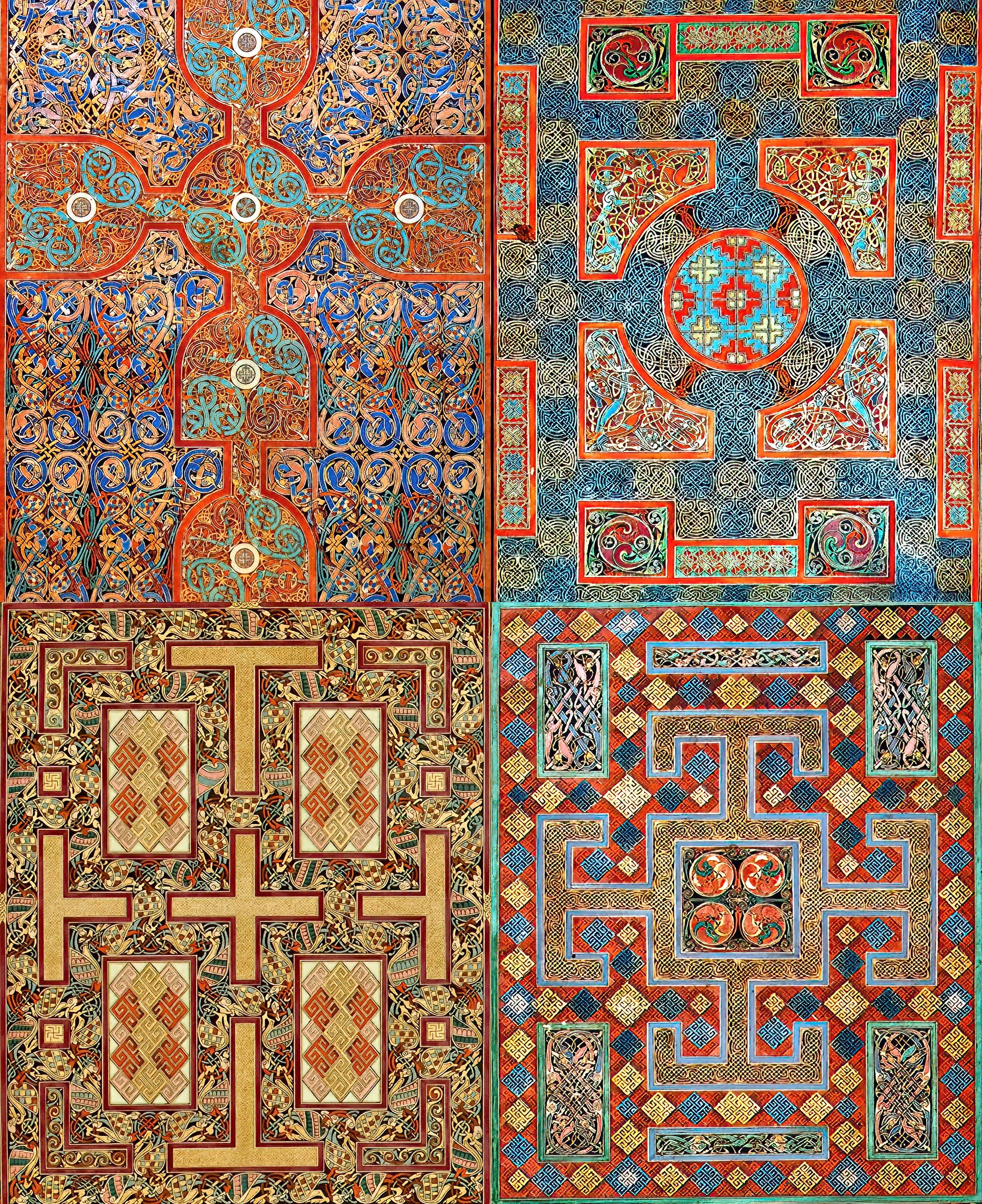
Each of the four carpet pages in the LIndisfarne Gospels has a distinctly different design (clockwise from upper left: Matthew, Mark, Luke, John). They may have been inspired by decorative 7th-century prayer rugs used in Rome and Constantinople for kneeling before the cross on Good Friday.

On my last day in Durham, there had been a splendid noonday choral concert in the cathedral by students from southern California’s Pomona College. That school is near a parish where I once served, and the connection delighted me—a taste of home in a faraway land. With St. Cuthbert’s Way behind me and God knows what before me, their final song spoke a word of grace and blessing to my pilgrim heart.

I’ll be on my way, I’ll be on my way; 
I’ll have laid my frown and all my burdens down,
I’ll be putting on my crown,
I’ll be on my way.

When I am gone, don’t you look for me in the places I have been;
I’ll be alive but somewhere else, I’ll be on my way again!  [xii]

To this temple, where we call thee, come, O Lord of Hosts today;
With thy wonted loving-kindness hear thy servants as they pray,
And thy fullest benediction shed within its walls alway.

Photographs and videos are by the author.


[i] J. G. Davies, Temples, Churches and Mosques: A Guide to the Appreciation of Religious Architecture (New York: The Pilgrim Press, 1982), 152-153.

[ii] Steen Eiler Rasmussen, quoted in Thomas Barrie, Spiritual Path, Sacred Place: Myth, Ritual, and Meaning in Architecture (Boston, MA: Shambhala Publications, 1996), 46.

[iii] Le Corbusier (1887-1965), designed one of the landmark examples of modern religious architecture, Notre Dame du Haut at Ronchamp, France. Though not a Christian believer, he believed in the power of architecture to create a spiritual environment. Quoted in James Pallister, Sacred Spaces: Contmporary Religious Architecture (New York: Phaidon Press, 2015), 9.

[iv] T. J. Gorringe, A Theology of the Built Environment: Justice, Empowerment, Redemption (Cambridge: Cambridge University Press, 2002), 258.

[v] G. K. Chesterton, quoted in Steven J. Schloeder, Architecture in Communion: Implementing the Second Vatican Council through Liturgy and Architecture (San Francisco: Ignatius Press, 1998), 227.

[vi] Michael Camille, quoted in Philip Sheldrake, Spaces for the Sacred: Place, Memory, Identity (Baltimore, MD: The Johns Hopkins University Press, 2001), 58.

[vii] T. S. Eliot, “Little Gidding” (1942) in Four Quartets.

[viii] “We sing to God in praise of Bede,” text by Rosalind Brown. 

[ix] “God, whose city’s sure foundation,” text by C. A. Alington.

[x] From Bede’s Life of St. Cuthbert, quoted in Philip Nixon, St. Cuthbert of Durham (Gloucestershire, UK: Amberly Publishing, 2012), 28.

[xi] Michelle P. Brown, The Lindisfarne Gospels: Society, Spirituality & the Scribe (London: The British Library, 2003), 77-78. Brown curated a 2003 exhibition, “Painted Labyrinths: The World of the Lindisfarne Gospels,” so I added “painted” to the citation from her book.

[xii] Shawn Kirchner, “I’ll Be On My Way,” can be heard on his album, Meet Me on the Mountain (2006). The Pomona College Glee Club is under the direction of Donna M. Di Grazia. Their entire program was inspiring and beautifully sung—one of the highlights of my journey.
Grace and Beauty on Holy Island

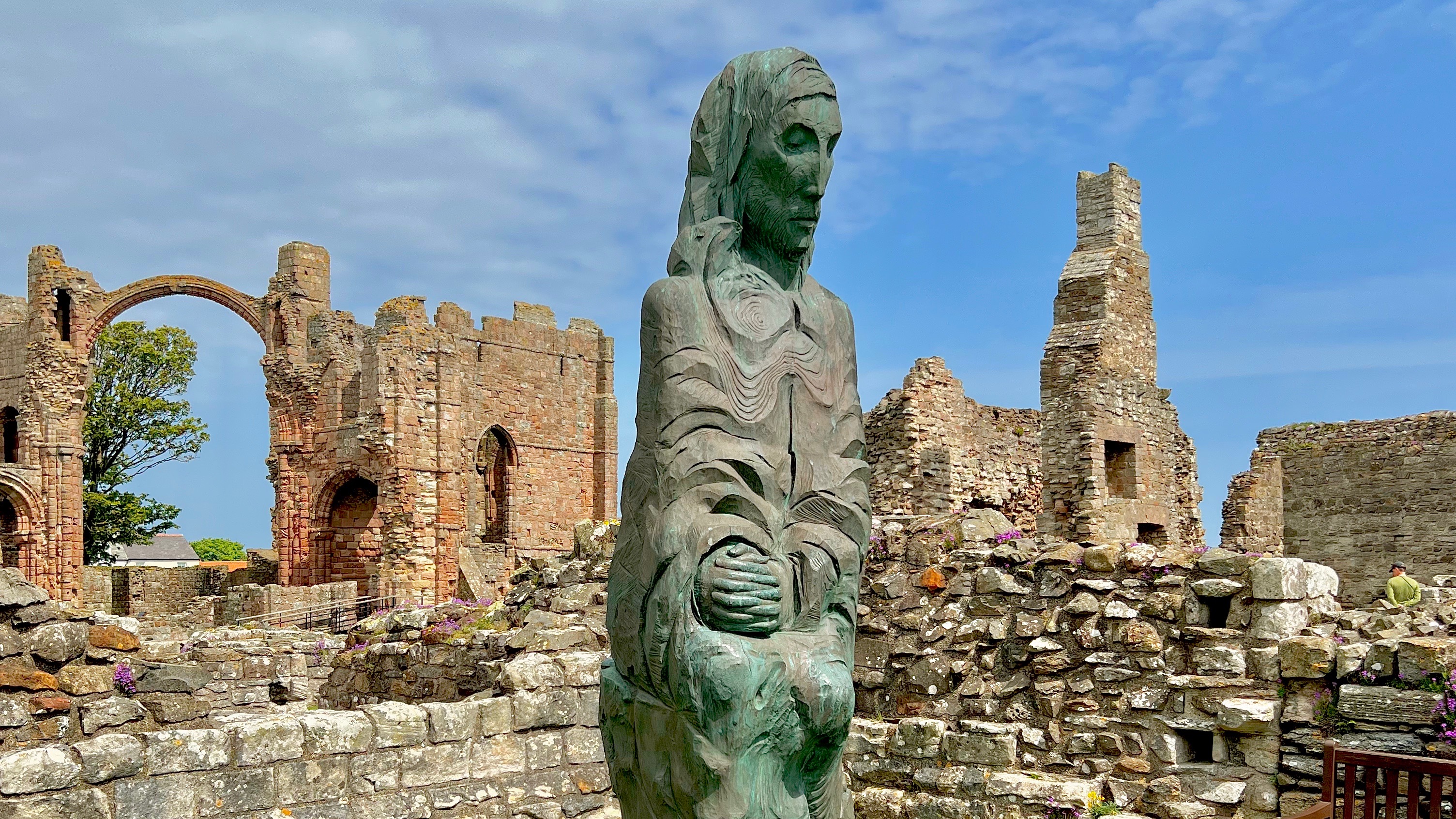
St. Cuthbert among the ruins of the 12th-century LIndisfarne Priory. Durham sculptor Fenwick Lawson carved the original from an elm tree in 1983. This bronze casting was installed in 1999.

In my recent post, Walking St. Cuthbert’s Way (7/28/2023), I described my 100-kilometer pilgrimage walk to the Northumbrian coast, where I had my first glimpse of Holy Island, where Cuthbert had been prior and bishop in the seventh century. In this installment, I cross over the tidal flats to reach my goal and discover why I had come. 

I’ve always been fascinated by the open-ended wanderings of the Dark Age Celtic monks. They journeyed without maps, trusting the way would be shown in due time. They got into little boats without oars or rudders, letting the wind and the currents be the agents of Providence. And where did they end up? Wherever it might be, they believed it was a place appointed for them by God. “The place of resurrection,” they called it. The place where they would meet Christ, the one “who knows you by heart.”[i]

But the arrival was, in a way, beside the point. The journey was the thing—the way of total abandonment and radical trust. Unlike ourselves, who think we already know who we are and where we should go, they traveled without preconception. In their eyes, you don’t know who you really are before you go on pilgrimage. Only the way of abandonment and unknowing will bring you home to your truest self. 

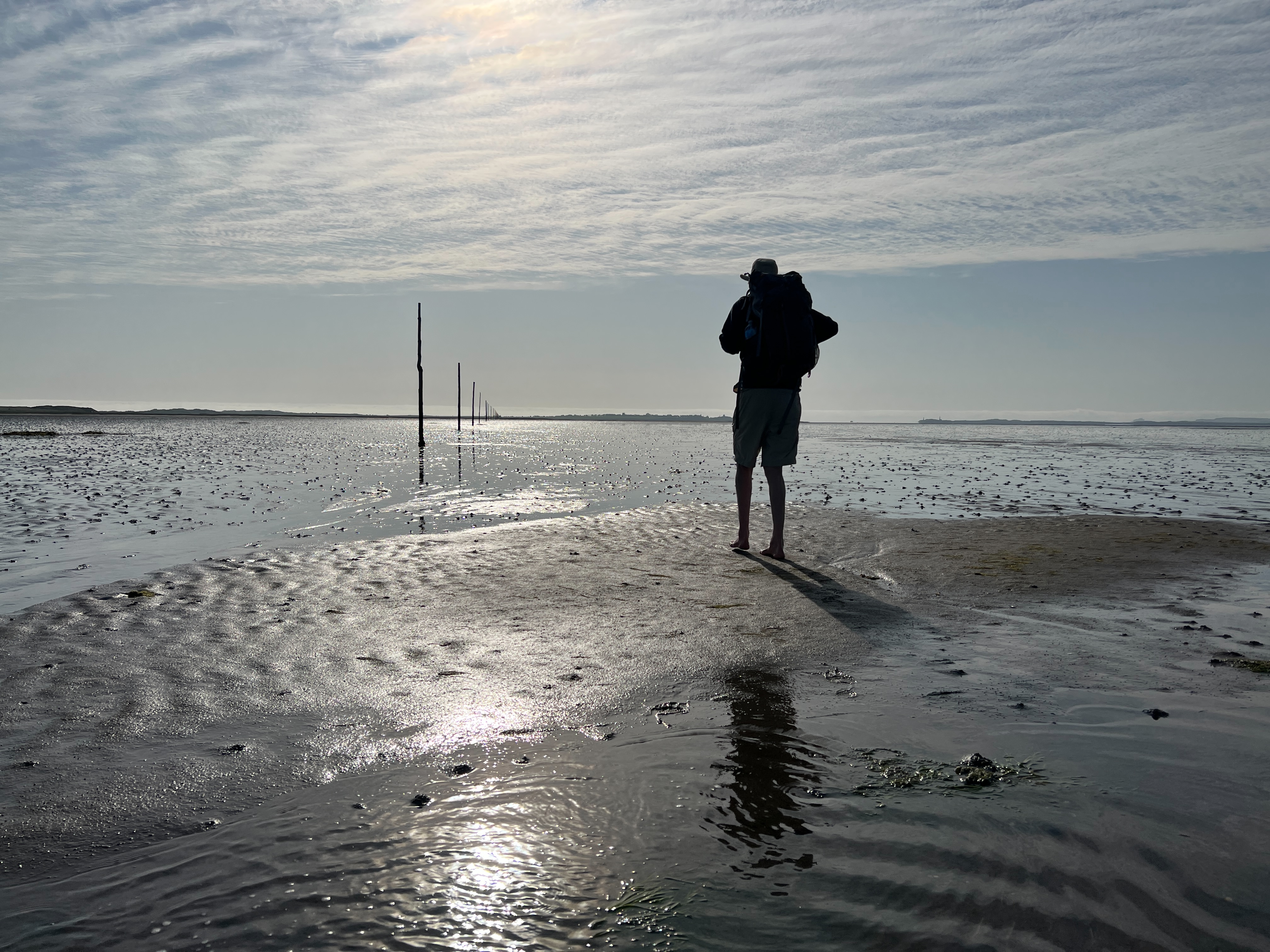
The author begins the final two miles of St. Cuthbert’s Way across the tidal sands to Holy Island.

“As a man dies many times before he’s dead,
so does he wend from birth to birth until, by grace, he comes alive at last.” 

— Frederick Buechner, Godric [ii]

Holy Island is only a part-time island. When the tide goes out, you can walk across the exposed sands, or drive over the causeway. Pilgrims properly go on foot, timing their two-mile passage to coincide with low tide. You don’t want to be caught in the middle when the waters return, swallowed like the Egyptians of old. Yes, the Red Sea comes to mind here, and the river Jordan—those great baptismal archetypes of crossing over from bondage to freedom, old to new, death to life. As I took my first steps on the wet sand, I sang one of my favorite shape note hymns:

Filled with delight, my raptured soul would here no longer stay;
Though Jordan’s waves around me roll, fearless I’d launch away.
I am bound for the Promised Land …[iii]

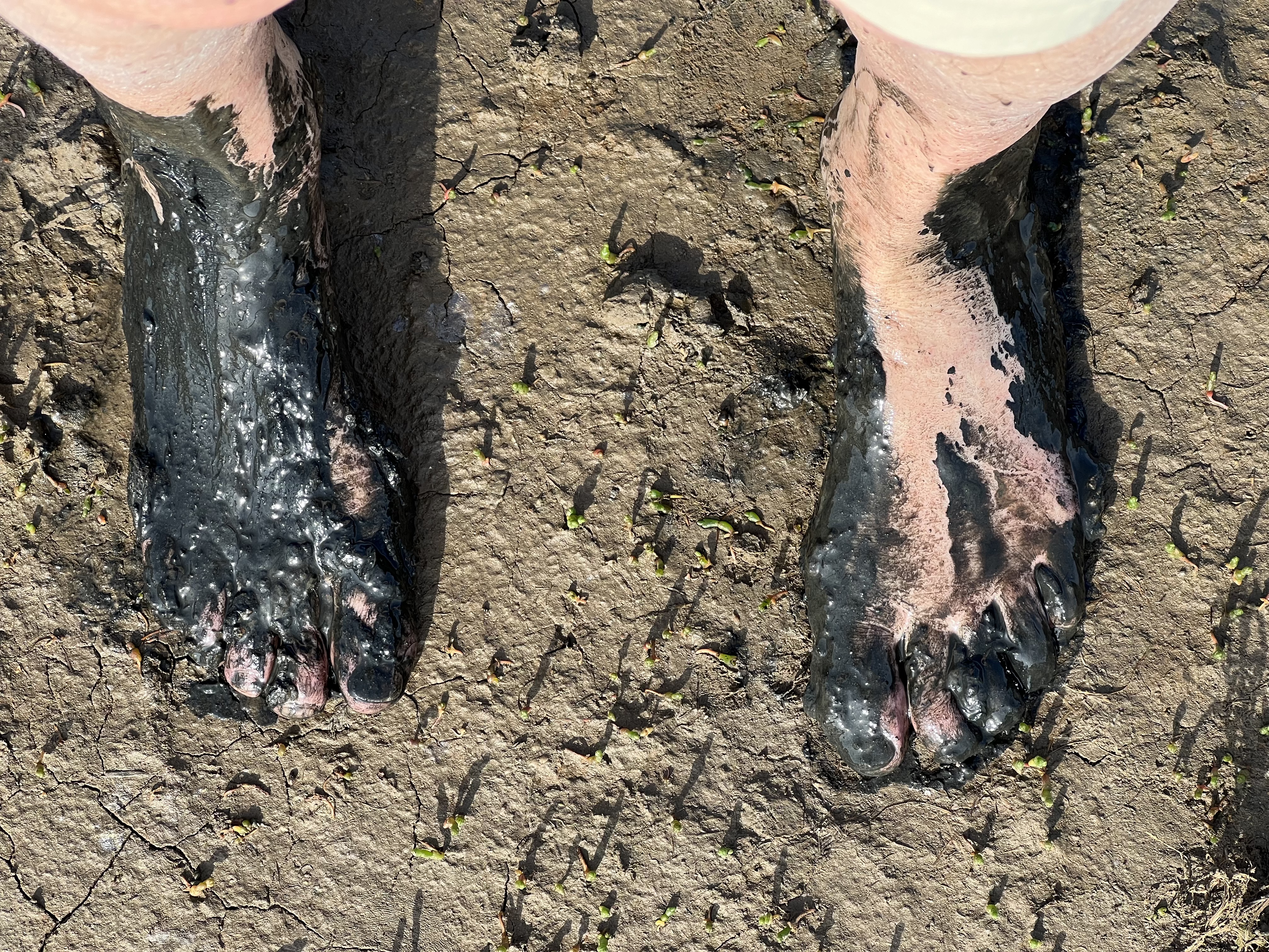
I had brought some rubber beach slippers, thinking I might need a barrier against cold water or sharp objects, but the sand immediately sucked them off my feet. I got the message: pilgrimage abhors self-protection. When you walk on holy ground, no shoes! 

“God lifted me out of the mire and clay, set my feet upon a rock, and put a new song in my mouth.”
Psalm 40:2-3

I was the only pilgrim on the sands in the early morning. The blessed solitude sanctified my final steps on St. Cuthbert’s Way. Halfway across, I began to hear an eerie keening sound, like wind through a broken wall. But that made no sense out on the tidal flat. After looking about with binoculars, I spied a dark mass at least a mile away. It was, I realized, hundreds of beached seals, pining for their absent sea.  

The seals of Holy Island.

It took me seventy-five minutes to reach the other side, and another ten to find the parish church of St. Mary the Virgin, where I lit a candle to give thanks for the beautiful journey. 
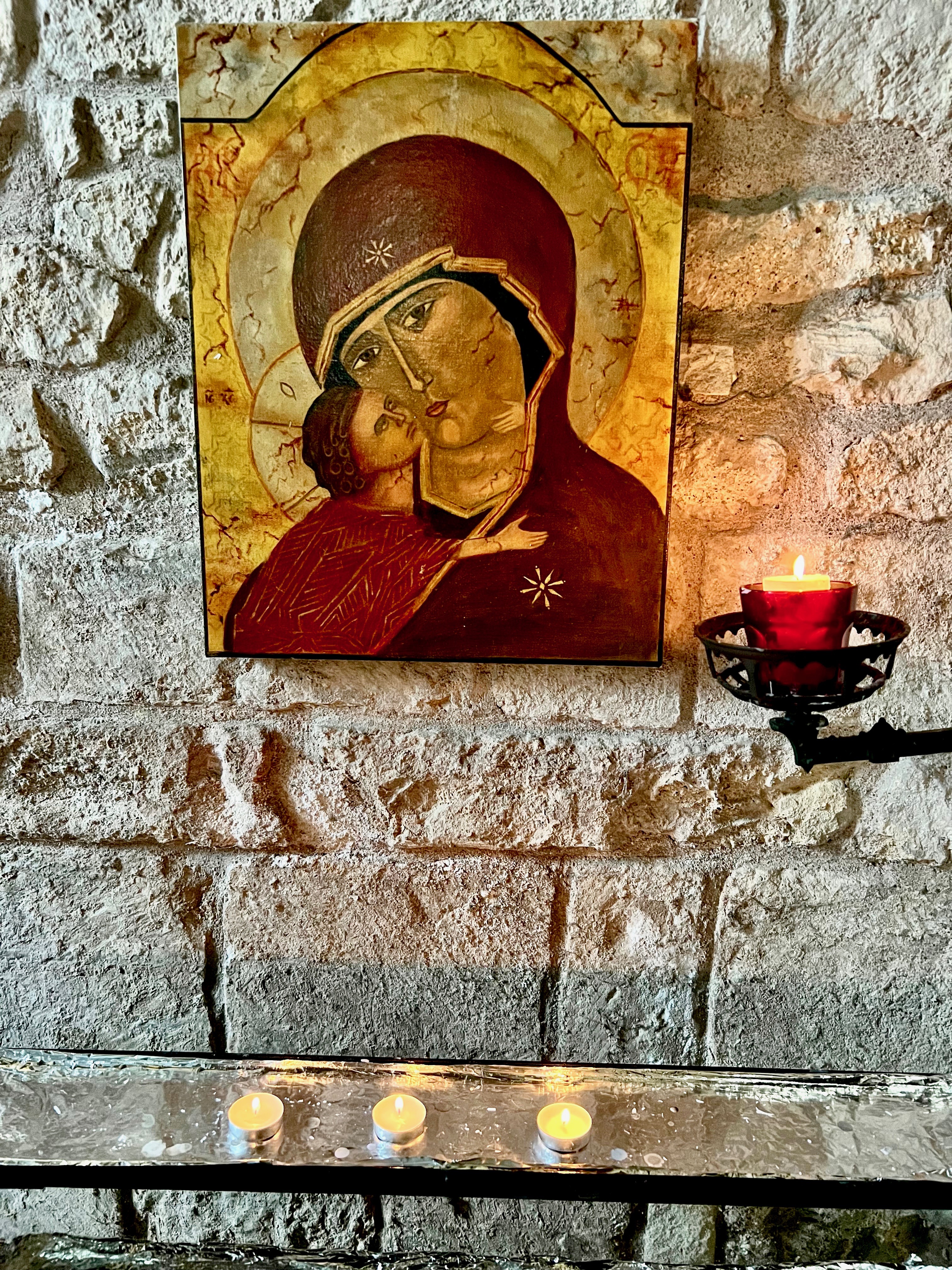
Prayer station in St. Mary’s. Public liturgies are offered daily in this (mostly) 13th-century church adjacent to the Priory ruins.
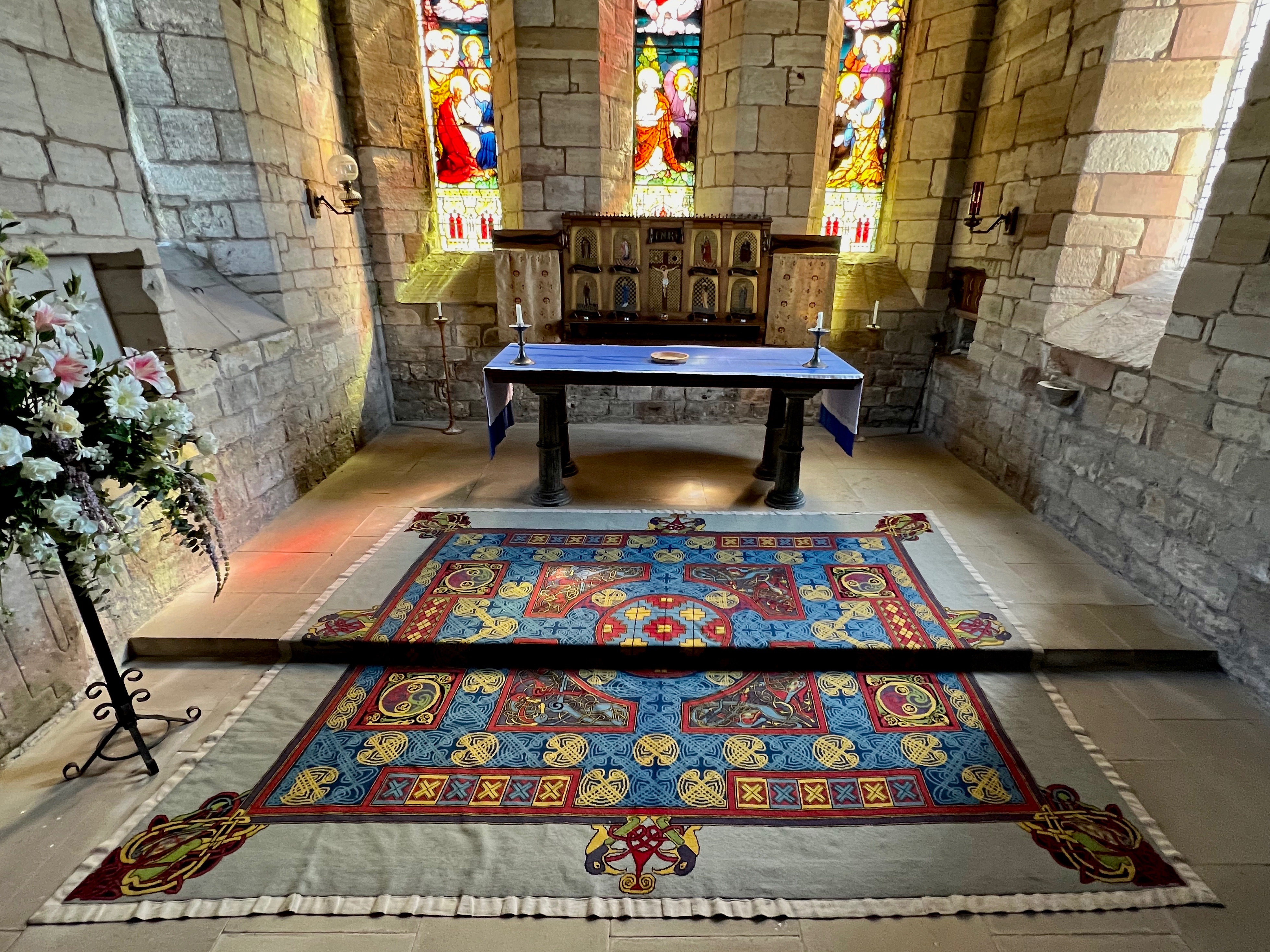
Chancel of St. Mary the Virgin, Lindisfarne’s parish church. Most of the structure is 13th century (restored in the 19th century), but some portions of an earlier building remain. The carpet, copied from a page in the Lindisfarne Gospels, was embroidered by 18 women of the parish in 1970.

The Anglican parish church stands adjacent to the ruins of the twelfth-century Lindisfarne Priory, erected on the site of the seventh-century monastery founded by St. Aidan and nurtured by St. Cuthbert. I would return to this peaceful sanctuary again and again during my three-day sojourn on Holy Island. Sarah Hills, the gracious vicar, invited me to read Scripture at Morning and Evening Prayer. One of those passages was the comic narrative of Balaam and his recalcitrant speaking donkey, perhaps the oddest story in the Bible (Numbers 22:1-39). It was a very long text, so I tried to give each character a distinctive quality to sustain interest. The donkey’s voice got a few laughs.  

On Ascension Sunday, the eucharist was crowded with pilgrims from many lands. I passed the Peace with Africans, Asians, Europeans, North and South Americans. The singing was spirited—no half-hearted voices after such a journey. Our harmonious sound enveloped me in the embrace of communal faith, and for a blessed hour my “I” became “we.” The offertory hymn happened to be “Lord of all hopefulness,” which celebrates the daily round of prayerful living: Be there at our waking … be there at our labors … be there at our homing … be there at our sleeping. I memorized it long ago in my teens, and I had sung it at the start of every day along Cuthbert’s Way. To repeat it now at Lindisfarne, with all the company of heaven, wasn’t just coincidence; it was grace. I received its gift with tears.
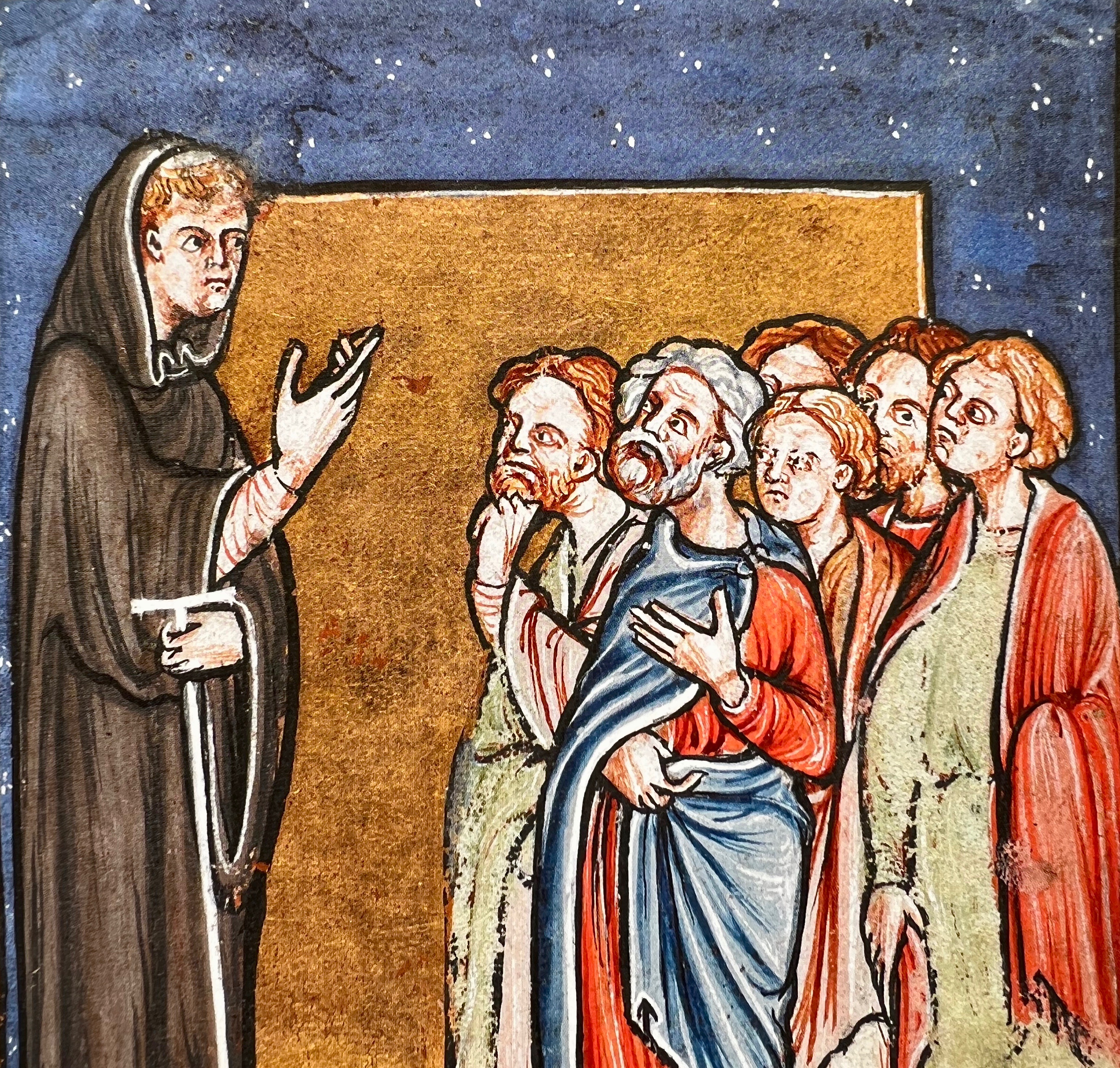
St. Cuthbert preaching to the Northumbrians (late 12th-century illustration for Bede’s Life of St. Cuthbert).

“They confessed their sins, confided in him about their temptations, and laid open to him the common troubles of humanity they were laboring under … Spirits that were chilled with sadness he could warm back to hope again … Those beset with worry he brought back to thoughts of the joys of heaven .…” [iv]   

— The Venerable Bede, Life of St. Cuthbert

Cuthbert has, through the ages, been the most beloved of Britain’s northern saints. Although he left no writings of his own, his biographers describe a humble and prayerful man, full of charm, a citizen of heaven who devoted his life to the needs of earthly folk. He had a compassionate spirit, and was a gifted listener. When the responsibilities of leadership were thrust upon him, he accepted them in a spirit of obedience. But he had a hermit’s heart, and no thirst for power. 

At age thirty, he became Prior of Lindisfarne in 664, and was assigned the difficult task of introducing the forms and practices of the Roman church to his resistant Celtic community. In a momentous decision at the recent Synod of Whitby, the Celtic churches in Britain had agreed to adopt the more universal—and hierarchical—norms of western Catholicism, surrendering the eccentricities of their more local traditions. But religious practices are hard to change, and Christian changemakers in every age have heard the same complaint, “But that isn’t the way we’ve always done it!” The seventh-century monks of Lindisfarne were no different than the Christians of our own time who fought women’s ordination or new forms of worship. They were uncomfortable. And they raised a fuss.

In Lindisfarne’s case, Cuthbert’s patient sweetness won the day. As the Venerable Bede tells the story,

“When he was wearied by the sharp contentions of his opponents he would rise up suddenly and with placid appearance and demeanor he would depart, thus dissolving the Chapter, but nevertheless on the following day, as if he had suffered no opposition the day before, he would give the same exhortations again to the same company until he gradually converted them to his own views.” [v]

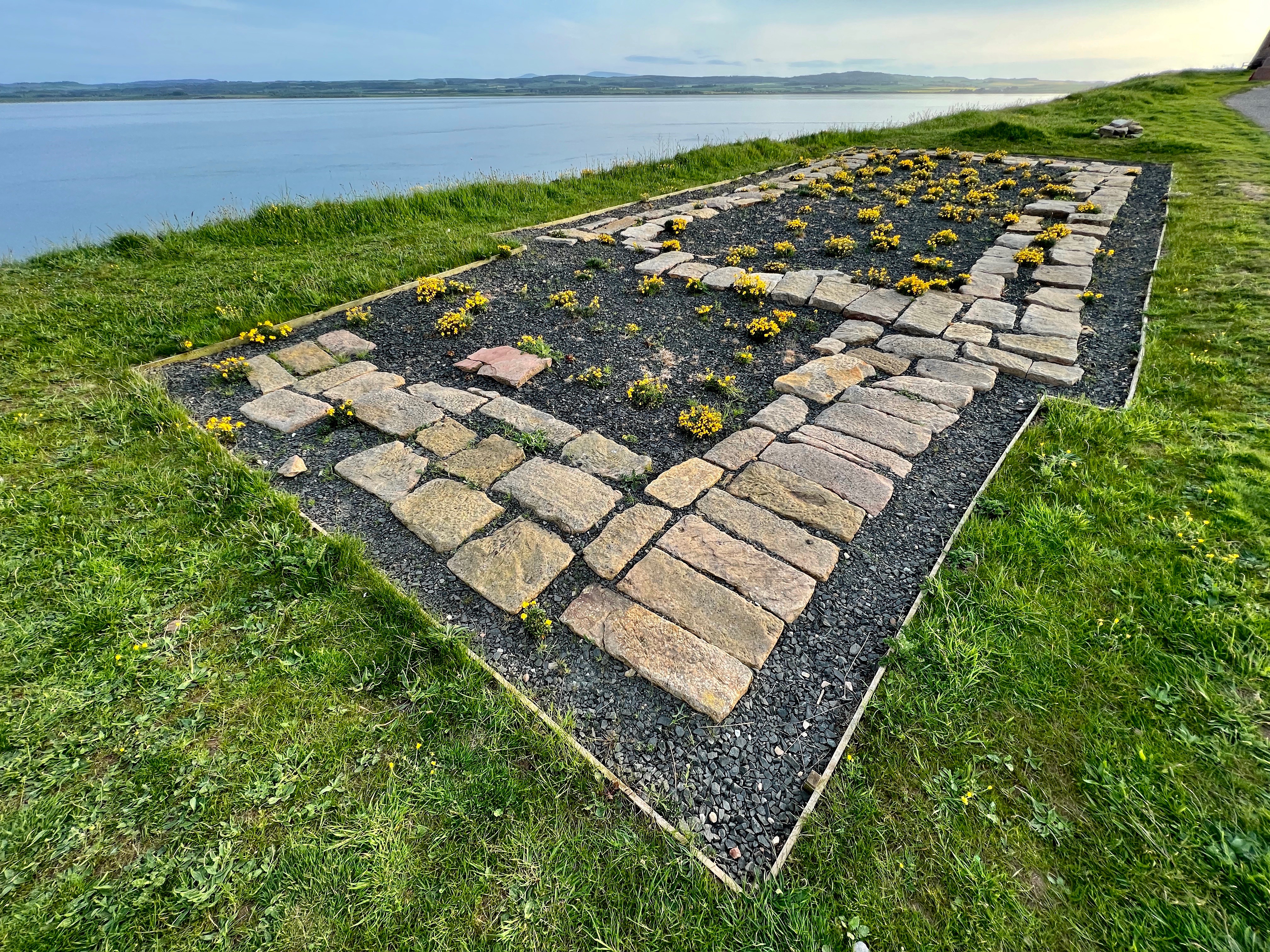
Foundation of an Anglo-Saxon church on the Heugh, the rocky ridge above the 12th-century ruins of Lindisfarne Priory. Discovered in recent excavations (2016-2018), this may have been part of the original monastery founded by St Aidan in 635.
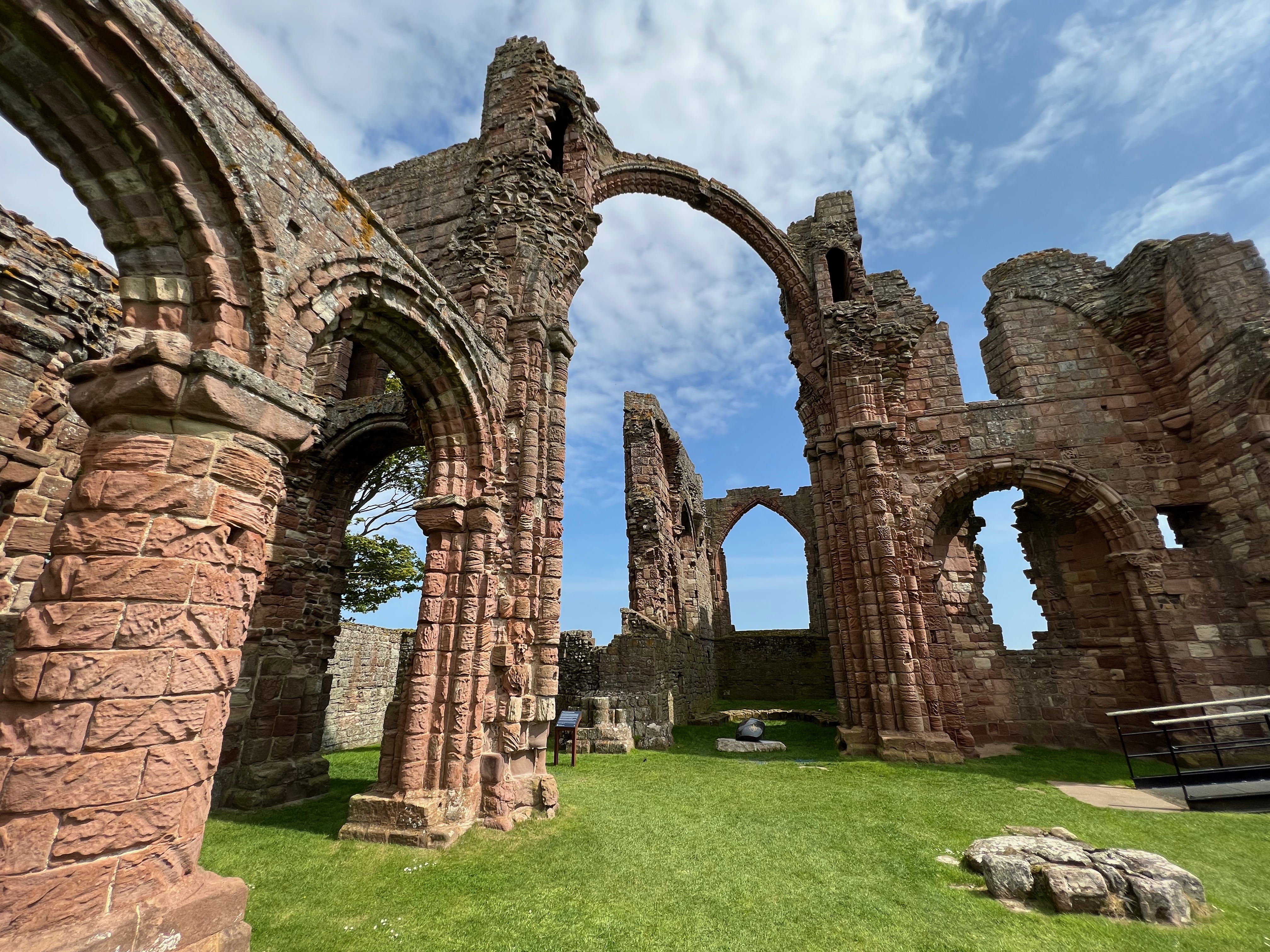
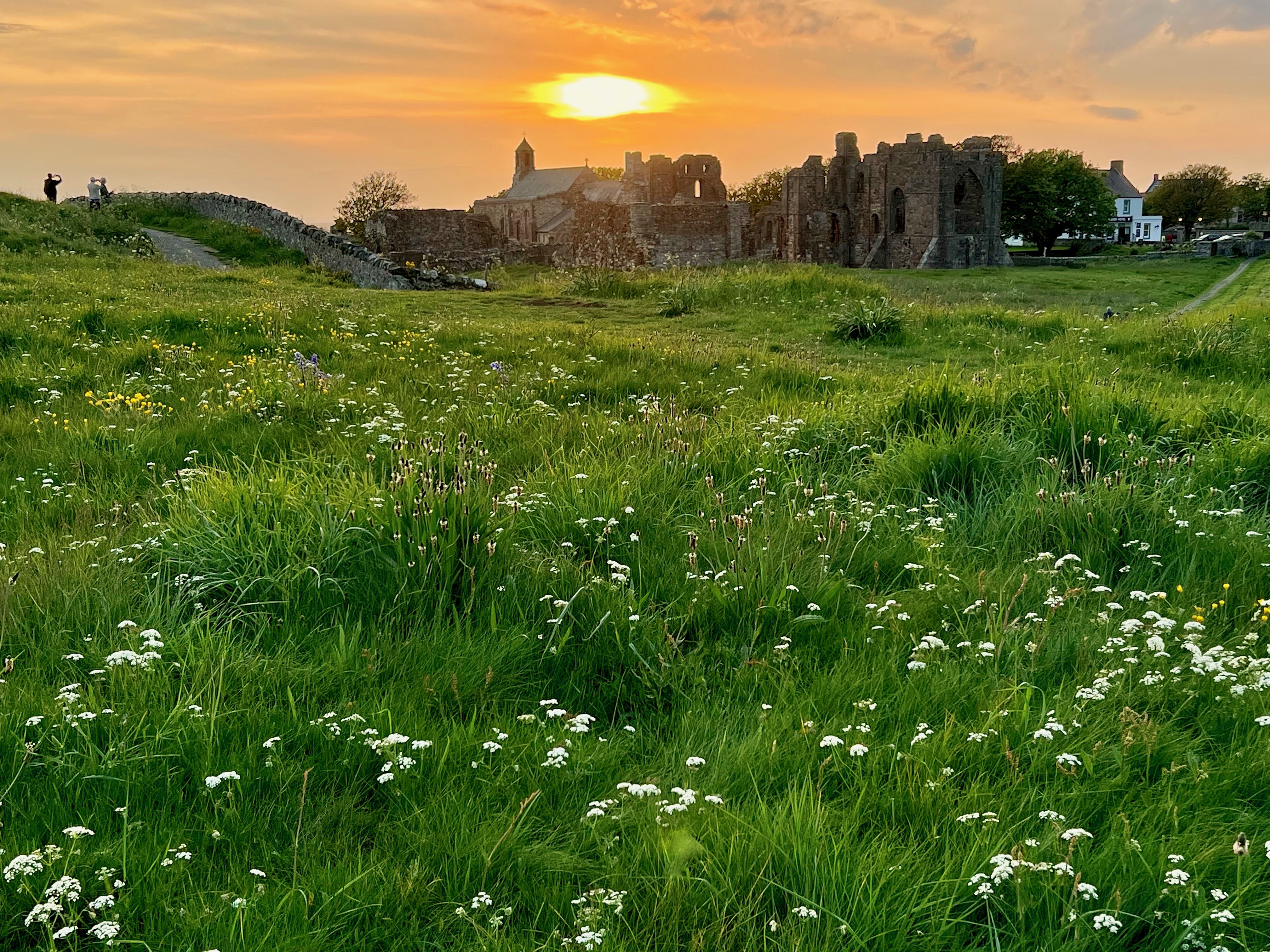
View from the nave of Lindisfarne’s Priory church (12th century, with modifications over the next 200 years). The north wall and arcade remain largely intact. The rainbow arch, a rib from the crossing vault, survived the collapse of the central tower in the 18th century. The pointed arch at the east end of the presbytery apse is a 14th-century Gothic touch.
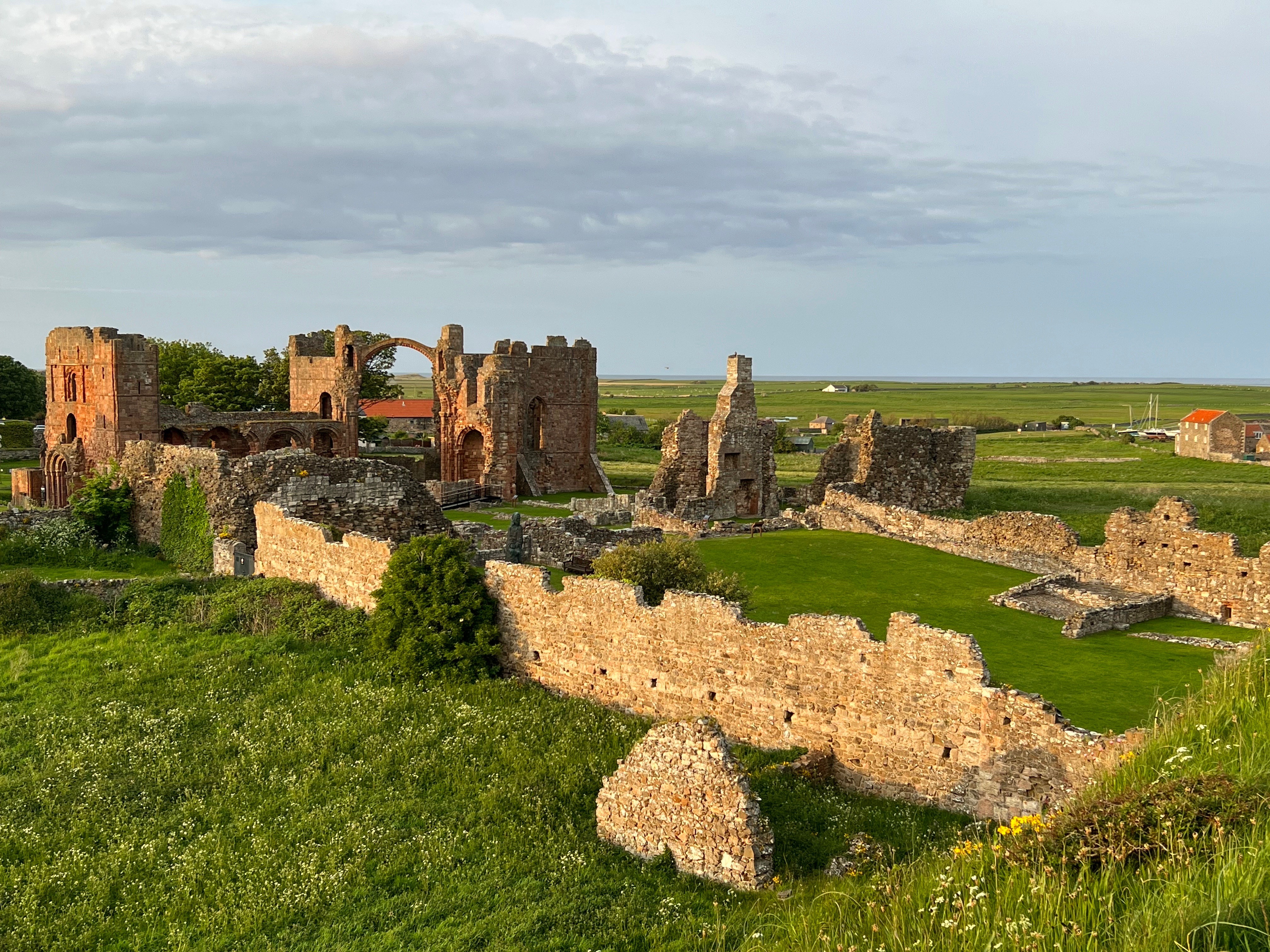
Lindisfarne Priory (12th century). The church was built first with pink sandstone.
The domestic complex was constructed later using greyer stones.
St.Cuthbert’s Isle, St. Mary’s Church, and Lindisfarne Priory from the Watchtower on the Heugh.

Time has erased the physical traces of Cuthbert’s Lindisfarne, but the impressive ruins of the Priory’s later structures still bear witness to his indelible legacy. After his death, pilgrims flocked to his shrine, thought to have been somewhere within the perimeter of the church built 500 years later. This video takes us through the ruins to the most likely spot.

Lindisfarne Priory from the north aisle to the presbytery.
The black stone marks the possible site of Cuthbert’s first burial.

After twelve years as prior here, Cuthbert felt an increasingly insistent call to solitude. For a time, he moved just offshore to a tiny island to seek the “green martyrdom” mentioned in the seventh-century Irish text, the Cambrai Homily

Precious in the eyes of God:
The white martyrdom of exile
The green martyrdom of the hermit
The red martyrdom of sacrifice.[vi]

In other words, there are different ways to take up your cross. If your faith doesn’t literally kill you or drive you into exile, you can still withdraw from the world to wage without distraction the interior struggle for authenticity, what St. Benedict called the “single-handed combat of the wilderness.” Inspired by the desert hermits of Late Antiquity, many British ascetics took flight to wild and lonely places in the early Middle Ages. 

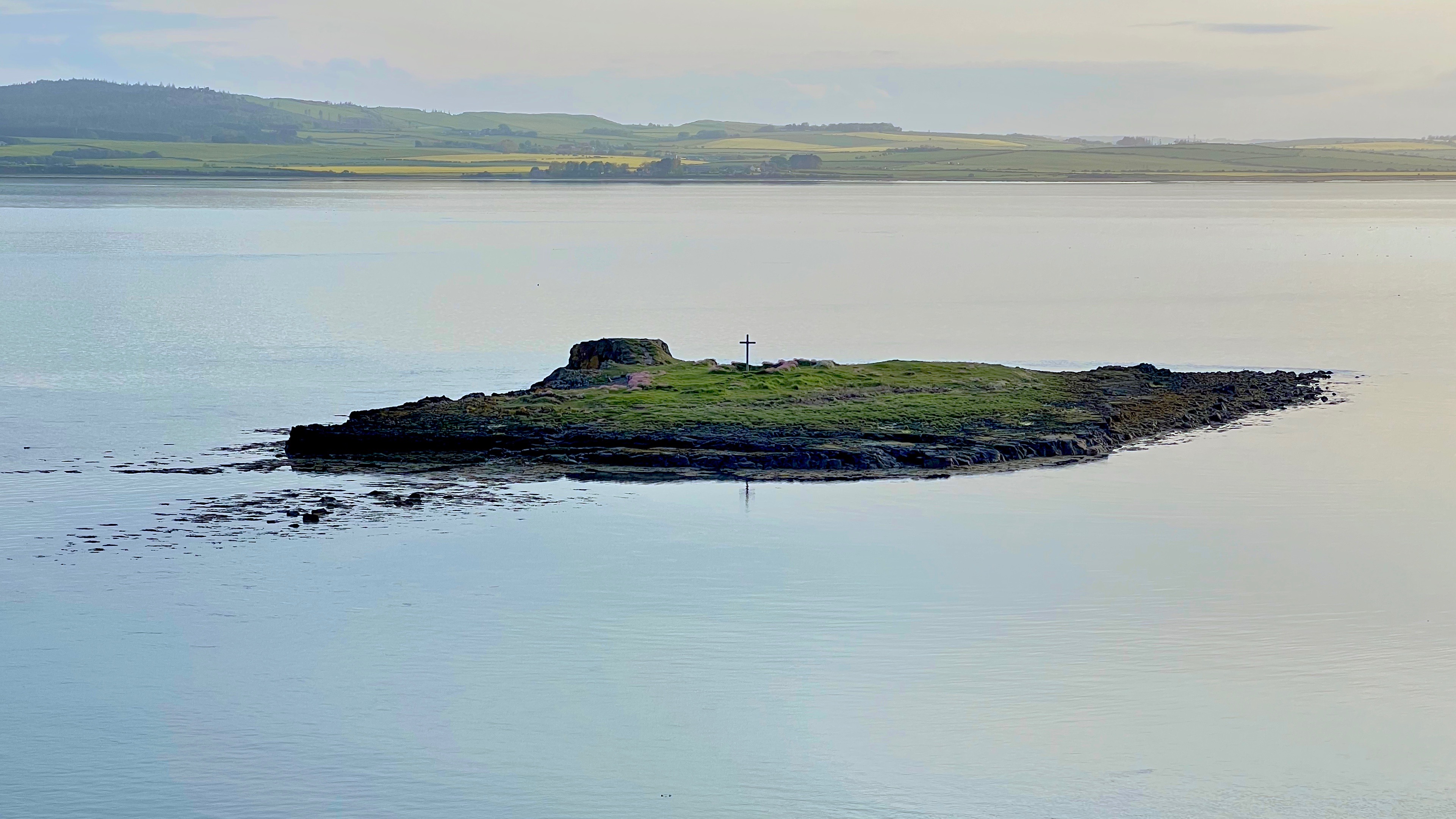
St. Cuthbert’s Isle, just offshore from Holy Island, where the saint sought prayerful solitude.
You can walk to it at low tide.

It wasn’t long before Cuthbert moved further away, to the island of Inner Farne, a seven mile row from Lindisfarne. Its rocky terrain had sparse vegetation, but was teeming with birdlife: puffins, guillemots, terns, kittiwakes, eider ducks, and numerous other species. Cuthbert loved the natural world, and there are many charming stories of his interactions with birds and animals. Here is my favorite, told by Michael York in a video I made years ago about early British Christianity: 

St. Cuthbert and the otters
From The Story of Anglicanism: Early and Medieval Foundations
Cathedral Films, 1988

What was life like for an island hermit? Was it an escape from interdependence, or could it be a way of going deeper and deeper into the world? A twelfth-century Irish poem conveys a vivid sense of belonging to a sacred ecology: 

Delightful I think it to be in the bosom of an isle, on the peak of a rock,
that I might often see there the calm of the sea.

That I might see its heavy waves over the glittering ocean,
as they chant a melody to their Father on their eternal course.

That I might see its splendid flocks of birds over the full-watered ocean;
that I might see its mighty whales, greatest of wonders…

That contrition of heart should come upon me as I watch it;
that I might bewail my many sins, difficult to declare.

That I might bless the Lord who has power over all,
Heaven with its pure host of angels, earth, ebb, flood-tide.

That I might pore on one of my books, good for my soul;
a while kneeling for beloved Heaven, a while at psalms.

A while gathering seaweed from the rock, a while fishing, 
a while giving food to the poor, a while in my cell.

A while meditating on the Kingdom of Heaven, holy is the redemption!
a while at labor not too heavy; it would be delightful! [vii]

The presbytery apse at the east end of the Lindisfarne Priory church. The high walls and absent roof, like Cuthbert’s cell on Inner Farne, block any view of the surrounding world, concentrating attention on what the saint called “higher things.”

Despite his affection for the created world, Cuthbert constructed his stone cell on Farne with high walls and no windows. His only view was through an opening in the roof. The design was intended to focus his attention on the higher things of “heaven,” not just as a concept, but as a physical, sensory experience. That strikes me as similar to what contemporary Light and Space artist James Turrell achieves with his “Skyspaces,” windowless rooms with a rectangular or elliptical opening cut into the ceiling. 

“My art deals with light itself,” Turrell says. “It’s not the bearer of revelation—it is the revelation.” [viii]  Instead of looking at material objects, you gaze up though the opening, taking in the sky’s color and light during the day and the stars at night. Over time this perceptual asceticism, screening out the world of things, quiets and deepens the eye, making it more receptive to the immaterial, more open to the infinite. Could the same thing have happened to Cuthbert in his stone enclosure? “It’s not about earth. It’s not about sky. It’s about our part in the luminous fabric of the universe.” [ix]   

Cuthbert prays on an island in a turbulent sea (detail of Tom Denny’s Transfiguration window, Durham Cathedral (2010). “That I might bless the Lord who has power over all: Heaven with its pure host of angels, earth, ebb, flood-tide.”

We can only speculate about the experiential nature of Cuthbert’s solitude, but Frederick Buechner, imagining the thoughts of another Northumbrian hermit, gives an honest appraisal of its challenges:

What’s prayer? It’s shooting shafts into the dark. What mark they strike, if any, who’s to say? It’s reaching for a hand you cannot touch. The silence is so fathomless that prayers like plummets vanish in the sea. You beg. You whimper. You load God down with empty praise. You tell him sins that he already knows full well. You seek to change his changeless will. Yet Godric prays the way he breathes, for else his heart would wither in his breast. Prayer is the wind that fills his sail. Else waves would dash him on the rocks, or he would drift with witless tides. And sometimes, by God’s grace, a prayer is heard.[x]

St. Cuthbert (detail from The Journey by Fenwick Lawson,1999).

One of Cuthbert’s early hagiographers described the saint’s inner life as being free of struggle, anxiety or doubt. We are assured that “in all conditions he bore himself with unshaken balance.” [xi]  But balance is hardly a prime directive for pilgrims of the Absolute. We may assume that Cuthbert knew his share of demons and dark nights on Farne. Nevertheless, the continuing stream of seekers to his island retreat found no solipsist lost in dreams or madness, but a compassionate listener who still had the gifts of a pastor. He always sent them away with lighter hearts than when they came.

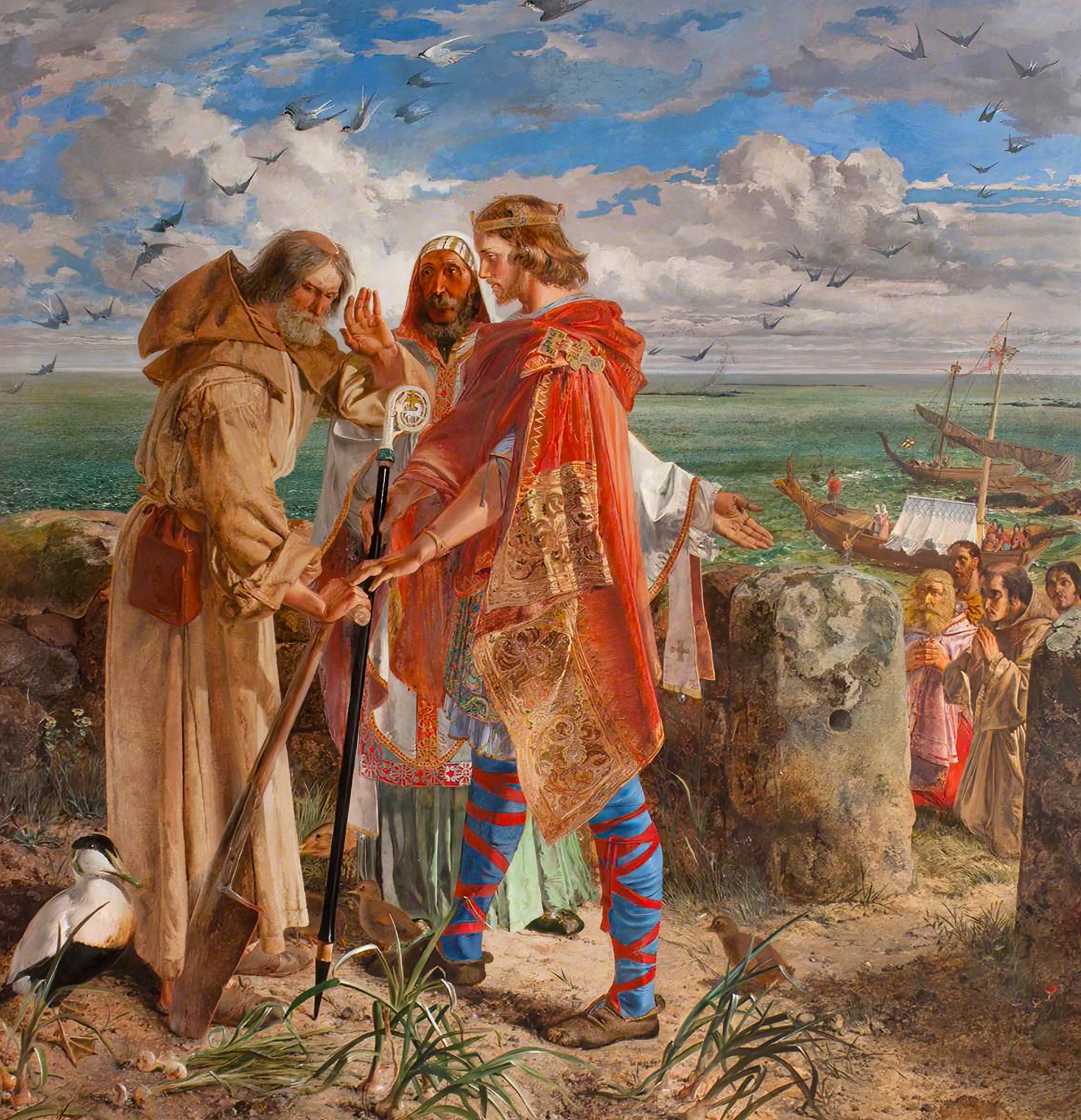
King Egfrid and Bishop Trumwine visit Inner Farne to persuade a reluctant Cuthbert to be made Bishop. (William Bell Scott, 1856)

Cuthbert spent nine years as a hermit, but in 685 the King of Northumbria and the Archbishop of Canterbury, hoping that this renowned holy man could help heal the divisive rivalries in the English Church, elected him to be the bishop of Hexham. The thought of leaving his “hiding place” on Farne made him sad, but when a distinguished delegation visited his hermitage to seek his consent, he yielded to the call. At least he managed to swap dioceses with another bishop, granting him oversight of his own beloved Lindisfarne. Whatever he lost in returning to the active life, it was not his soul. His anonymous biographer assures us that “he maintained the dignity of a bishop without abandoning the ideal of a monk.” [xii]

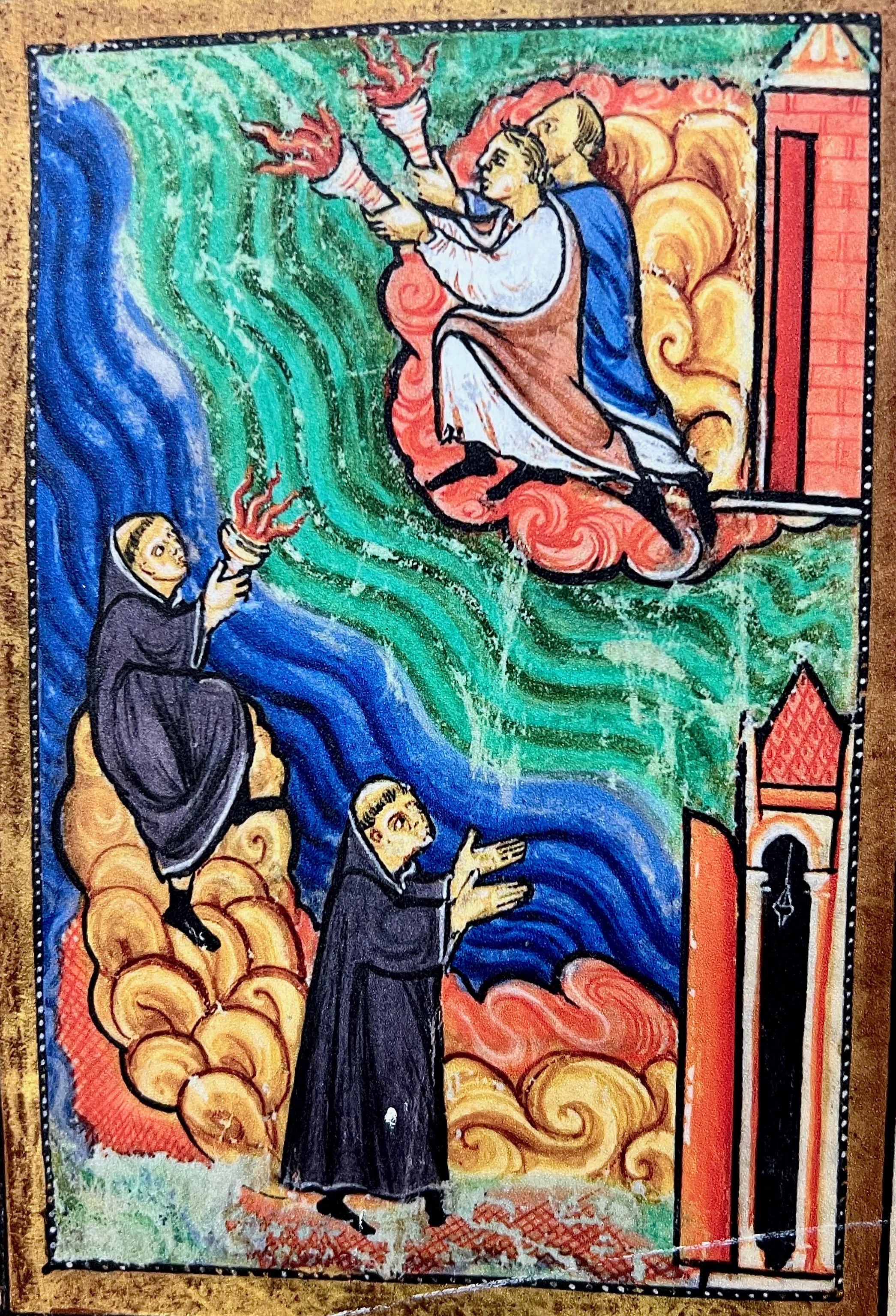
Two years later his health began to fail. At 51, he knew his days were numbered. He resigned his episcopate just after Christmas 686, then returned to his hermitage to die amidst the sound of seabirds, seals and crashing waves. He departed this life two weeks before Easter 687. The monks keeping vigil at his deathbed lit torches to signal his brothers at Lindisfarne that he had fallen asleep in Christ. His body was returned to the Priory for burial.

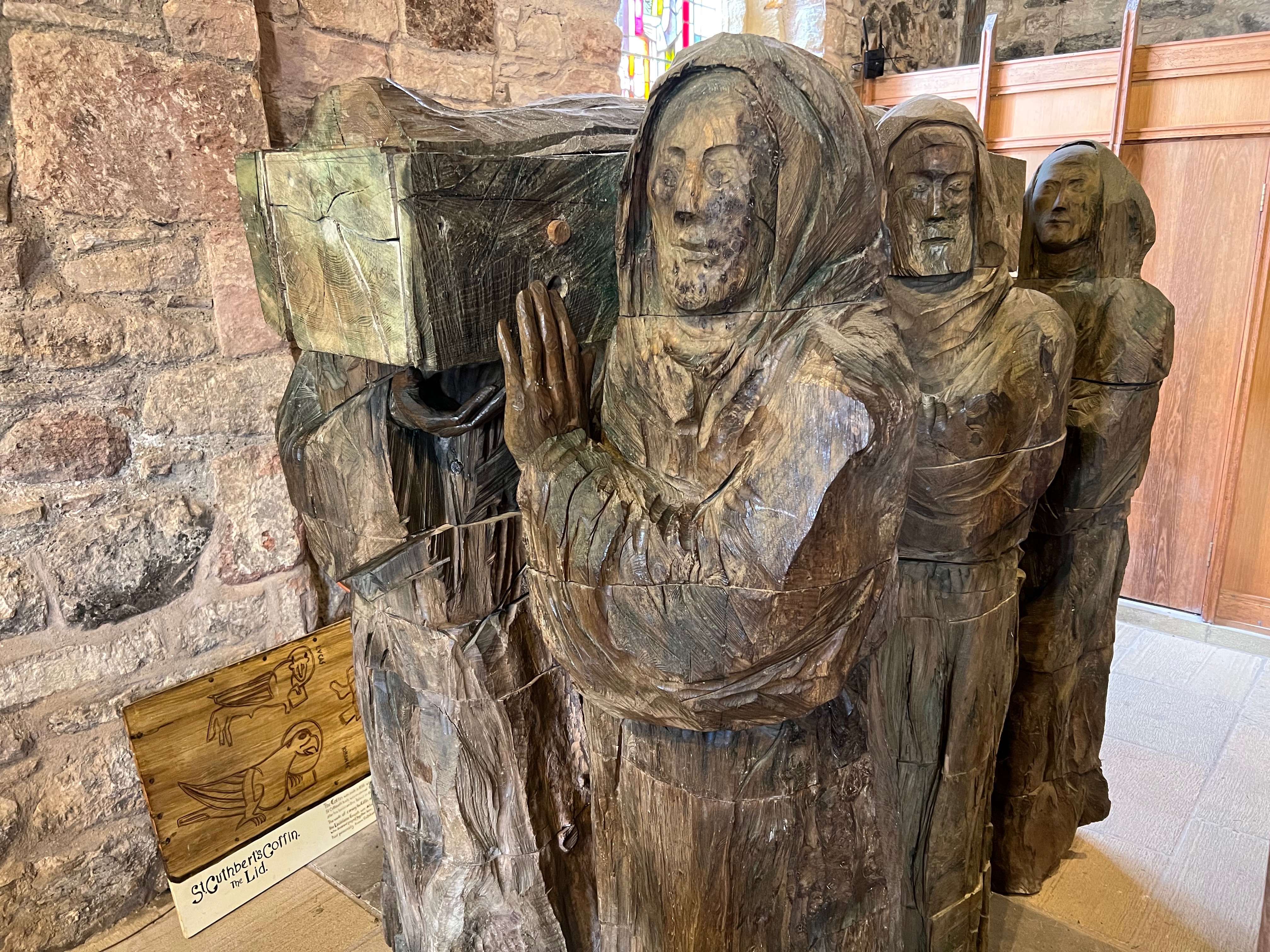
Cuthbert, who fell asleep in Christ in 687, is movingly depicted in Fenwick Lawson’s The Journey, which has been in St. Mary’s church since 2005.
In an illustration for Bede’s Life of St. Cuthbert, monks on Inner Farne use torches to signal news of the saint’s death to their brothers at Lindisfarne.

I wasn’t able to visit Inner Farne. Landings were suspended by an outbreak of Avian Flu. But the peace of Holy Island itself was blessing enough. Once the daytrippers flee back to the mainland before the tide returns, a profound calm settles in. It seemed almost deserted during the afternoons. In my days there, I sank into the solitude of grassy dunes, rambled through fields of spring color, enjoyed the tuneful chants of countless birds. Perhaps there was more Wordsworth than Cuthbert in the pleasure I took here—I suffered no rigorous austerities—but I hope that my bodily appreciation of Holy Island did honor to the saint’s own love for this place.

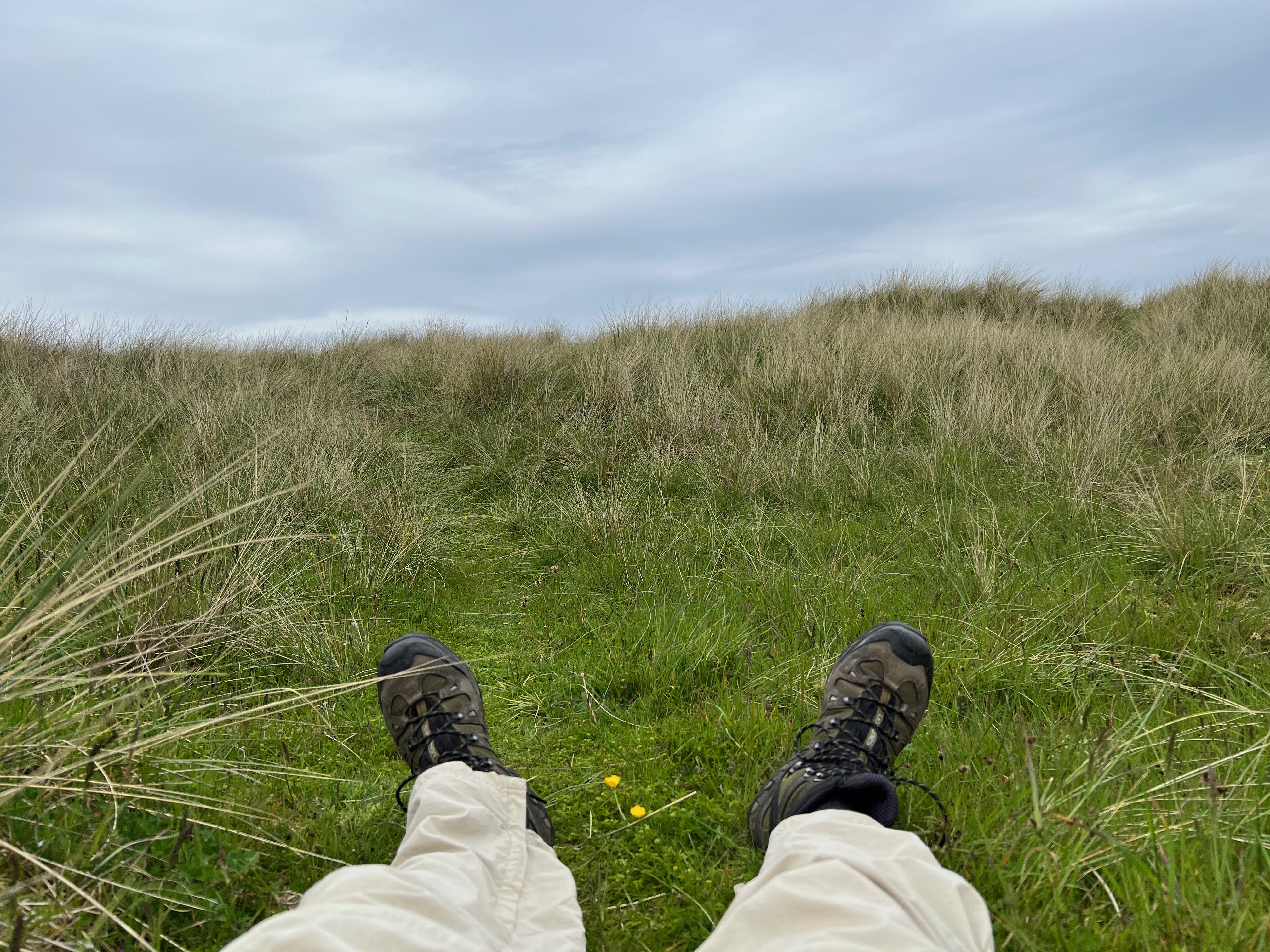
The grassy dunes of Holy Island are a refuge from the clamor of the world. If you lie down in a hollow, neither wind nor wave breaks the profound silence.
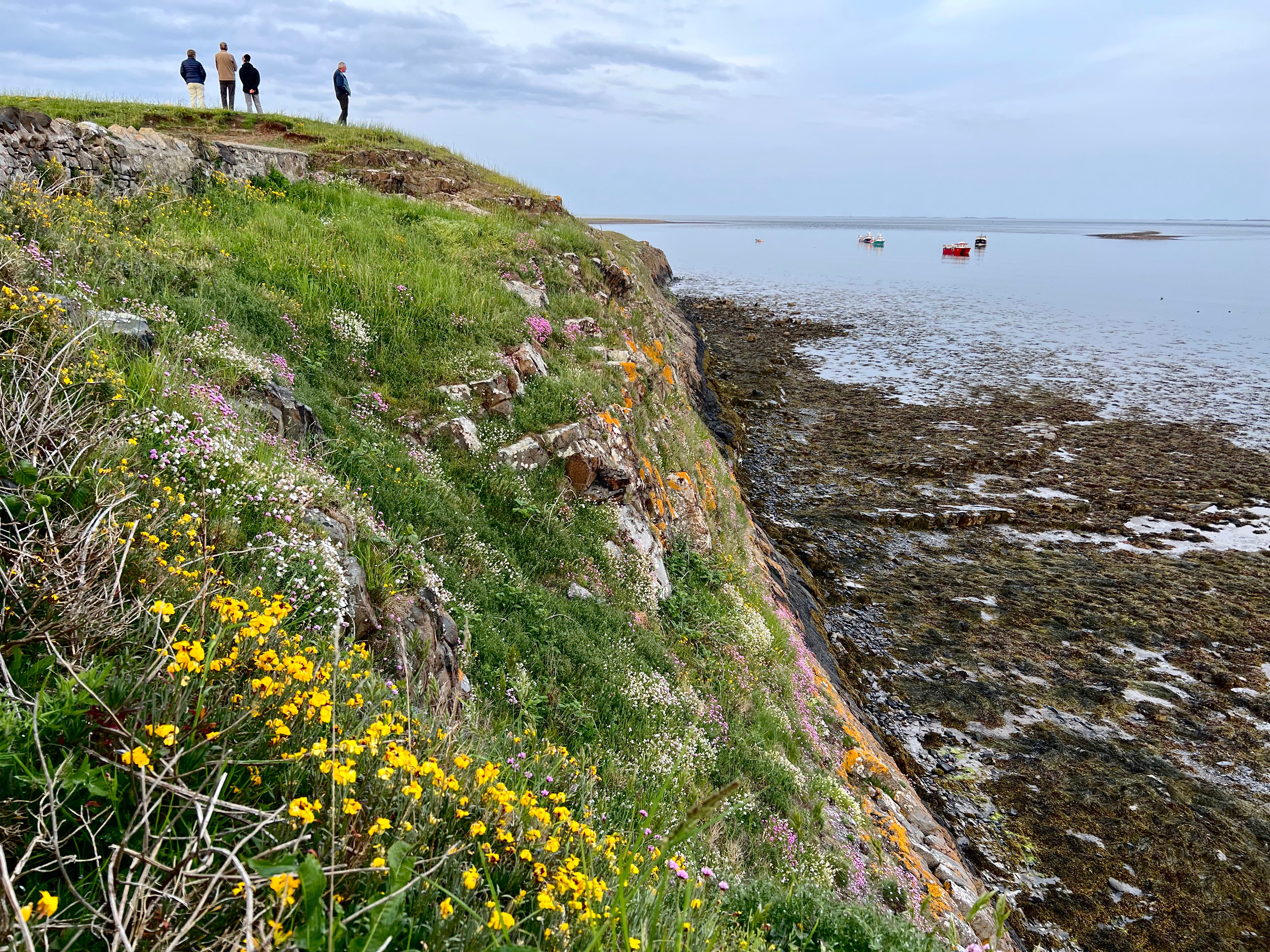
The elevated Heugh (“hee-uff”) between the Priory and the sea was formed from magma 295 million years ago. The thin soil developed on the hard whinstone grassland hosts an exceptional variety of wildflowers.
Vespers at Lindisfarne. “Now as we come to the setting of the sun, and our eyes behold the vesper light, we sing your praises, O God.”

Holy Island is a busy hub for migratory flights between Britain, Scandinavia, southern Europe, even the Arctic and Africa. Some 337 different avian species have been identified here. The following audio was recorded around the site of Lindisfarne Priory in the early evening. If you want to spend two and a half minutes on Holy Island, close your eyes and listen.

Birds of Holy Island.

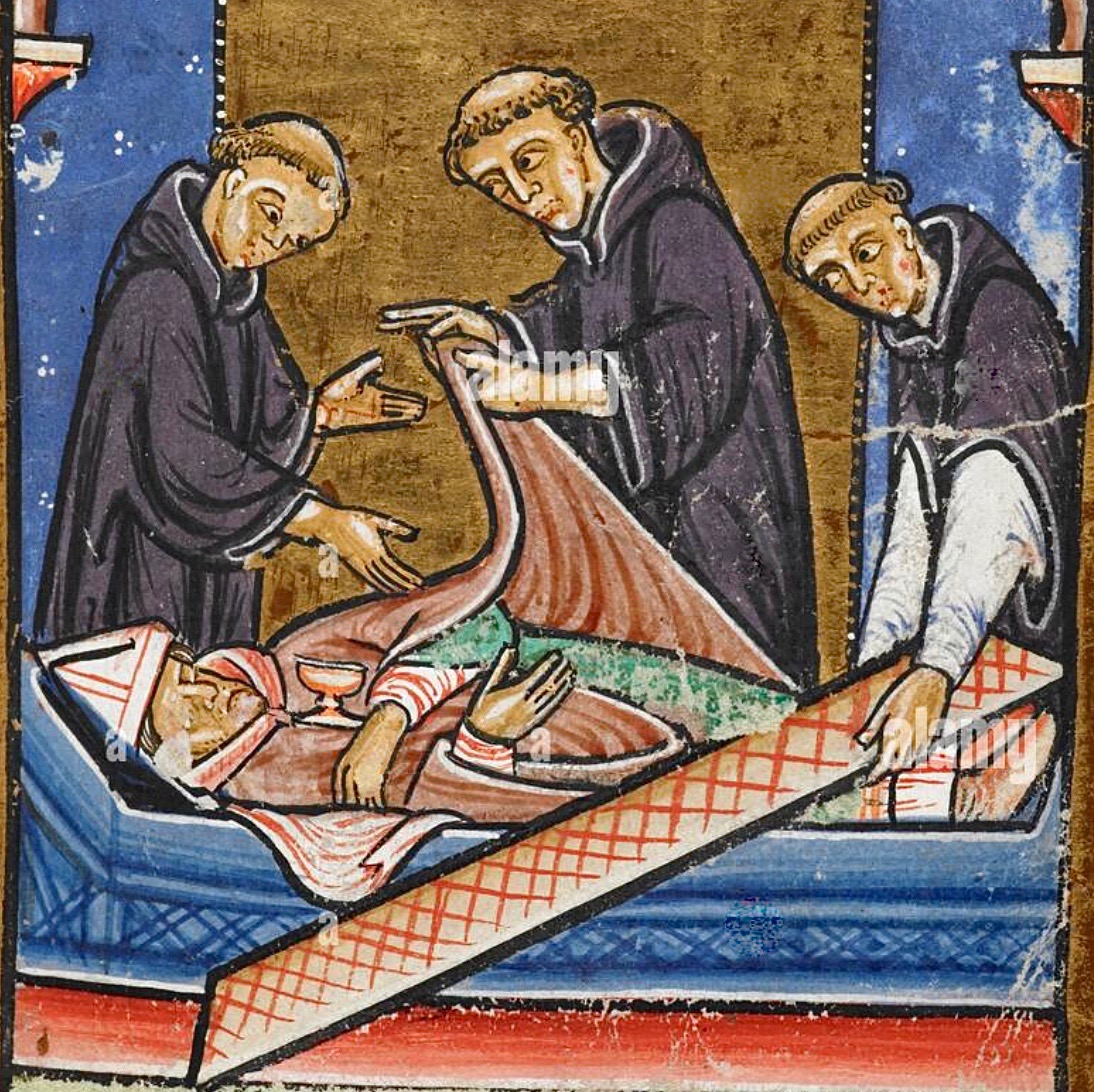
According to medieval custom, the remains of saints would be exhumed ten to twenty years after their death, so that their bones could be washed, wrapped reverently in silk or linen, and placed in a shrine for veneration. 

When the monks of Lindisfarne opened Cuthbert’s coffin 11 years after his death to wash his bones, they were astonished to find his body still intact (12th-century illustration for Bede’s Life of St. Cuthbert).

But when the monks of Lindisfarne opened Cuthbert’s coffin in 698, they found his body “uncorrupted” and still intact. When news of this wonder spread, the stream of pilgrims grew to a flood. Sadly, Cuthbert’s body would not rest in peace here for long. Not on a defenseless coastline in the age of the Vikings.

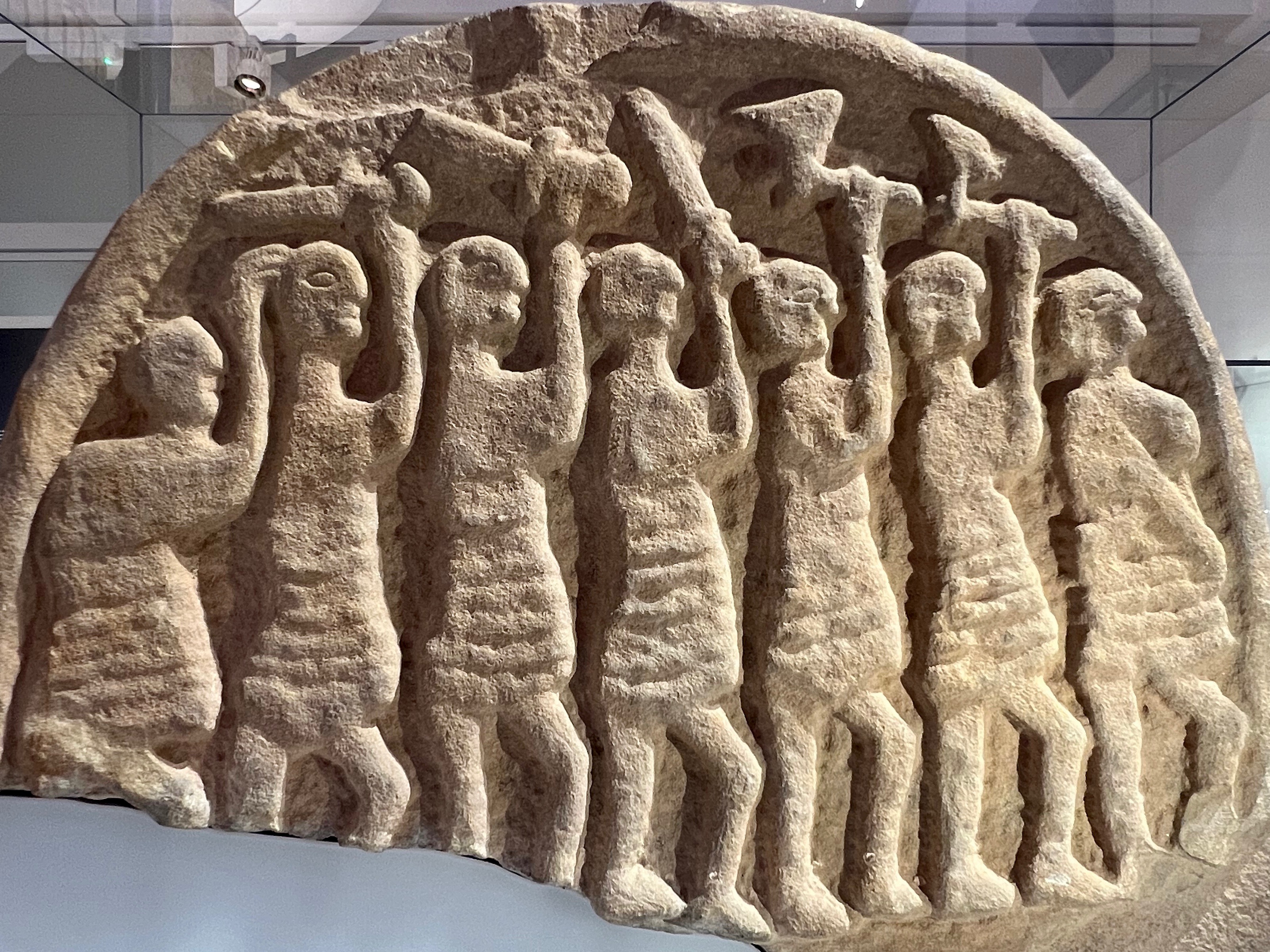
This 9th-century “Judgment Day” stone found at Lindisfarne is thought to commemorate the Viking raids, when “heathen men miserably destroyed God’s church at Lindisfarne with plunder and slaughter.”

In 793, the peace of Lindisfarne was shattered when Viking marauders sacked the Priory. Remarkably, Cuthbert’s shrine survived the damage. Eighty years later, there was a second raid. It was even worse.

“And they came to the church of Lindisfarne and laid everything waste with grievous plundering, trampled the Holy Places with polluted feet, dug up the altars and seized all the treasures of the Holy Church. They killed some of the brothers, they took some of them away in fetters, many they drove out naked and loaded with insults and some they drowned in the sea …” [xiii]

It was the end of an era for Lindisfarne, but Cuthbert’s own story had one more chapter. Just before the second Viking invasion, the saint made his getaway from Holy Island when a small band of brothers lifted his wooden coffin from the Priory shrine and carried it across the tidal flats to the mainland. Thus began two centuries of wandering in exile for Cuthbert’s remains, until he finally came to rest in the newly built cathedral at Durham in 1104. 

The Journey (Fenwick Lawson, 1999, now in St. Mary’s church).
Monks carry Cuthbert’s coffin away from Holy Island to protect it from Viking raiders.

On my third morning at Holy Island, I rose early to cross back over the sands. My own wandering was not yet done. I would follow the saint to Durham. 

The path I walk, Christ walks it. 
May the land in which I am be without sorrow.
May the Trinity protect me wherever I stay…
May bright angels walk with me — dear presence — in every dealing…
May every path before me be smooth. 
Well does the fair Lord show us a course, a path. [xiv]

Crossing the Holy Island Sands to the mainland.

THE ST. CUTHBERT SERIES CONCLUDES:

The Journey Ends: Durham Cathedral

Photographs, videos and nature recordings are by the author.

“For All the Saints” is sung by the choir and congregation of St. Barnabas Episcopal Church, Bainbridge Island, Washington, with Paul Roy on organ.

The first installment of this pilgrimage account, Walking St. Cuthbert’s Way, may be found at https://jimfriedrich.com/2023/07/28/walking-st-cuthberts-way/

For more on James Turrell: https://jimfriedrich.com/2015/08/06/the-woven-light-reflections-on-the-transfiguration/


[i] The line is from Derek Walcott’s poem, “Love After Love.”

[ii] Buechner’s fine novel is about a 12th century hermit saint in the north of England. It made excellent reading on St. Cuthbert’s Way.

[iii] #128 in The Sacred Harp, with lyrics by Samuel Stennet (1787).

[iv] Bede, Life of St. Cuthbert, 22, quoted in Mary Low, St. Cuthbert’s Way: A Pilgrim’s Companion (Glasgow: Wild Goose Publications, 2019). The great historian of early English Christianity is a key source for Cuthbert’s life. Born 14 years before the saint’s death, he was able to interview some who had known Cuthbert in life when he wrote his biography. 

[v] Bede’s Life of Cuthbert, quoted in Philip Nixon, St. Cuthbert of Durham (Gloucestershire: Amberly Publishing, 2012), 33.

[vi] Isabel Colgate, A Pelican in the Wilderness: Hermits, Solitaries and Recluses (New York: Counterpoint, 2002), 104. The Cambrai Homily (7th or 8th century) is the earliest known Irish homily. The “green” martyrdom refers to rigorous ascetic practice not requiring either a pilgrimage journey or a complete disconnection from the world. The Irish word glas may be translated as blue as well as green, perhaps referring to turning blue after praying the Psalter all night in a cold river, or developing a sickly complexion from too much austerity.

[vii] In a Penguin anthology of Celtic writings I had years ago. 

[viii] James Turrell, quoted in Jan Butterfield, The Art of Light and Space (New York: Abbeville Press, 1993), 73.

[ix] E. C. Krupp, writing about Turrell in James Turrell: A Retrospective (Los Angeles: County Museum of Art, 2013), 246.

[x] Frederick Buechner, Godric (New York: Harper One, 1980), 142.

[xi] Anonymous Life of Cuthbert, 3.7, quoted in Low, 47. 

[xii] Anonymous Life, quoted in Nixon, 47.

[xiii] Simeon of Durham (d. circa 1129) was an English chronicler and monk at Durham Priory. Quoted in Nixon, 59.

[xiv] Ireland, 6th century.

Walking St. Cuthbert’s Way

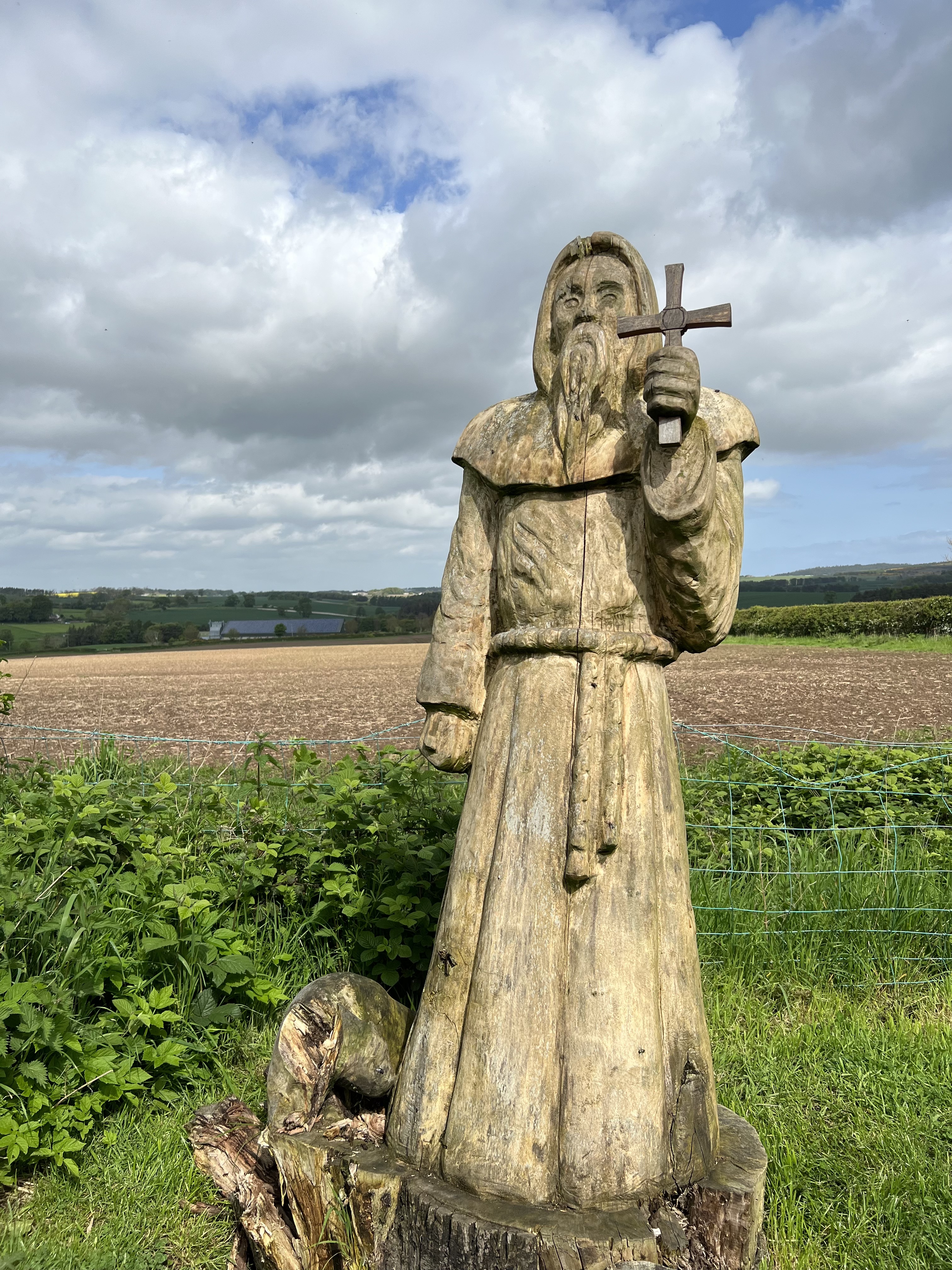
St. Cuthbert, by local sculptor Tom Fiddes (2017), blesses the wayworn traveler. The saint stands opposite a country house offering shade and water to weary pilgrims.

They confessed their sins, confided in him about their temptations, and laid open to him the common troubles of humanity they were laboring under … Spirits that were chilled with sadness he could warm back to hope again … Those beset with worry he brought back to thoughts of the joys of heaven. (The Venerable Bede, Life of Cuthbert)

Nine years ago I walked the 500-mile Camino de Santiago to the shrine of St. James. This spring I made another pilgrimage, 100-kilometers along St. Cuthbert’s Way in the north of Britain. I haven’t managed to write about it since returning home, but when this week’s Feast of St. James (July 25) brought to mind that 2014 Camino (when I first began this blog), I knew it was high time to tell my new pilgrim’s tale.  

Chaucer began his celebrated pilgrimage narrative with an eloquent praise of springtime as an awakening: not only of the dormant earth, but also of the soul’s longing for transformative journeys. After three years of staying close to home in pandemic hibernation, the call of the road felt especially urgent. 

Then people think of holy pilgrimages,
Pilgrims dream of setting foot on far-off
Lands, or worship at distant shrines, their thoughts
Reaching for grace …[i]

Some pilgrimages have no map or known destination; they are undertaken with the conviction—or at least the hope—that the act of wandering far from the familiar, along the way of unknowing, will lead to what Dark Age monks called “the place of resurrection,” where an illumination might be given or a purpose revealed. 

Another kind of pilgrimage takes a well-worn route to a specific destination such as Jerusalem, Rome, or Santiago, the most popular destinations in the Middle Ages. Both the journey and the arrival are still full of unknowns—hardships, obstacles, surprises, chance meetings, moments of grace—but their ultimate location and length are determined in advance. Both kinds of pilgrimage involve some combination of leaving behind (penance), letting go (trust), receptivity (grace), and spiritual desire (love).

My pilgrimage in May, from the Scottish Borders south of Edinburgh to Holy Island off the Northumbrian coast, traced a line across the varied landscapes of Cuthbert’s holy life. It was a popular route for two centuries after the saint’s death in 687, until the threat of Viking plunderers prompted the removal of Cuthbert’s remains from Holy Island to a safer inland site. And Cuthbert’s own travels, mostly on foot, would have ranged widely over the same terrain. 

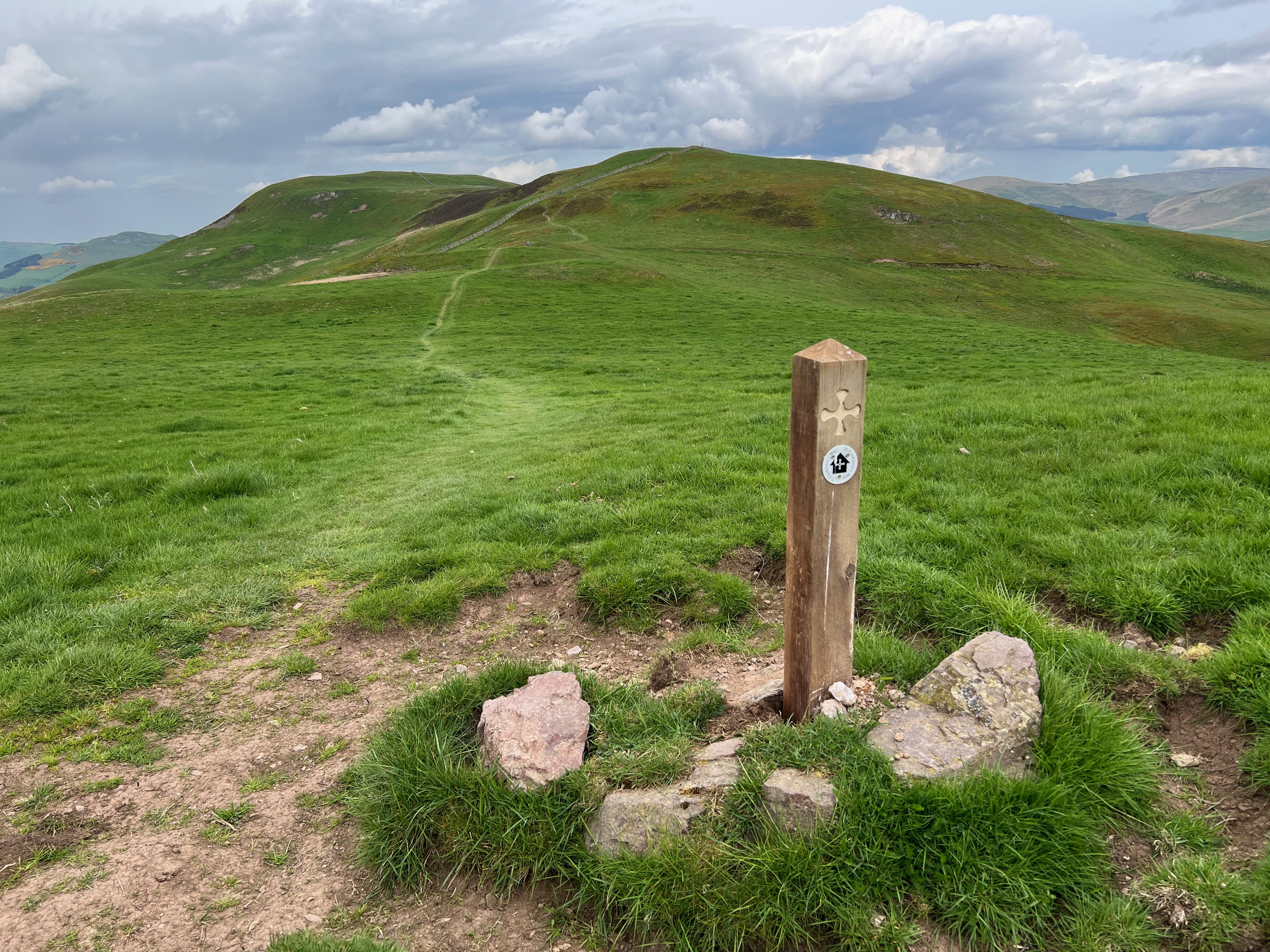
In response to the contemporary revival of pilgrimage as a spiritual practice, St. Cuthbert’s Way, with plentiful waymarks and well-tended paths, was created in 1996. Although passing through occasional towns and villages, it offers abundant solitude and beautiful countryside both pastoral and wild. Before I left, a friend who knew the trail said, “I hope you like sheep.”

Cuthbert’s birth in 634 coincided with a turning point British religion, when King Oswald took control of Northumbria and initiated the conversion of the pagan north to Christianity by importing Celtic missionaries from Iona. Although Cuthbert’s family was Anglo-Saxon, he would be shaped by the distinctive Celtic way—earthier, more idiosyncratic, less tightly organized and less hierarchical than the universalizing Roman system which would assert its dominance in British Christianity within Cuthbert’s lifetime.

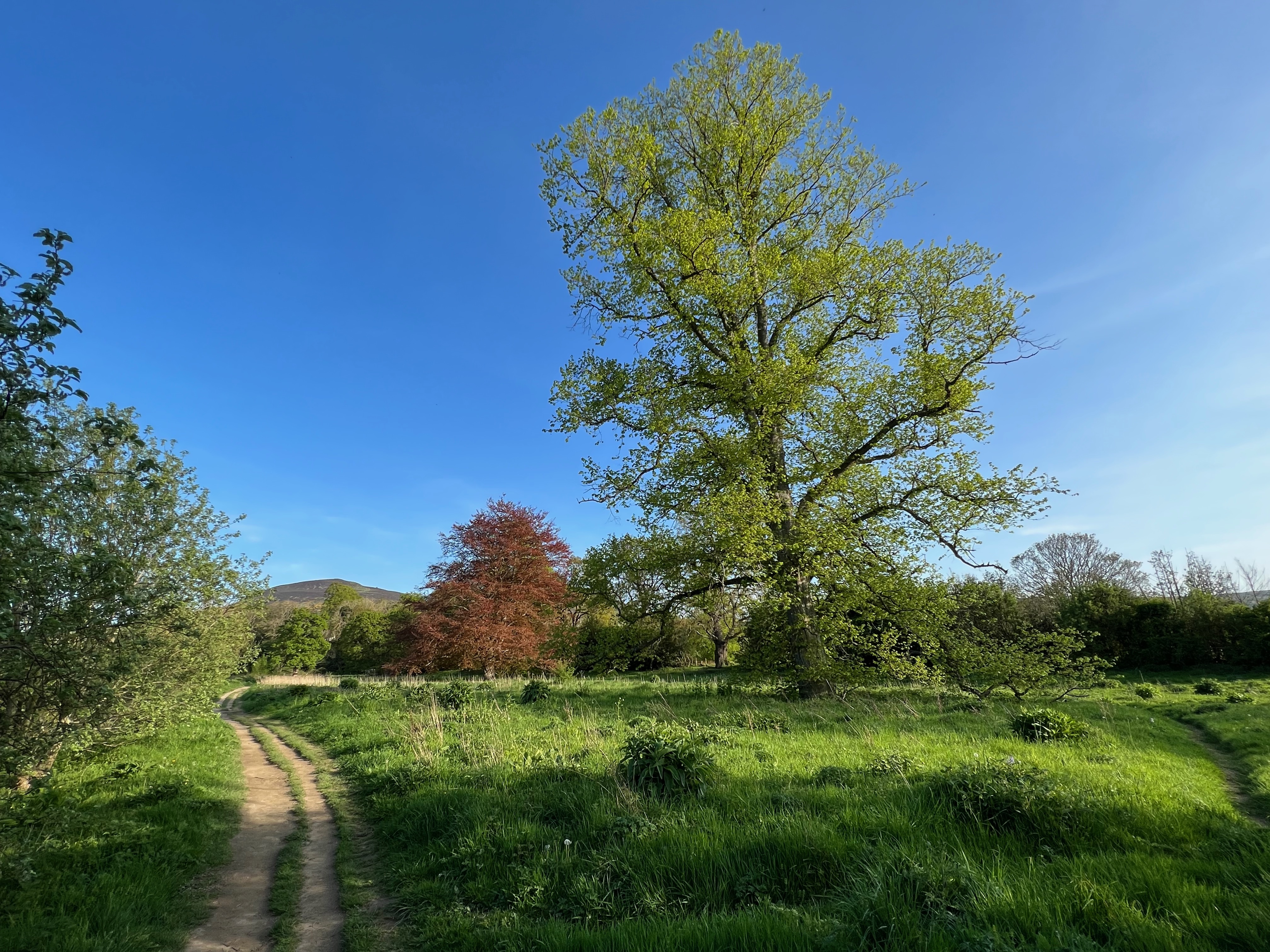
My walk began along this riverside trail from the train station into Melrose. Someone had offered me a ride in their car, but look what I would have missed! Even as a bishop, Cuthbert chose the humility of walking over the luxury of horseback, so I started my pilgrimage in the same spirit.

My pilgrimage began in Melrose, Scotland, where the River Tweed courses through the fields and hills of Cuthbert’s youth. Even as a boy he had a deeply religious sensibility. His biographers spoke of angels and miracles being part of his growing years.  Whatever we ourselves may think about the facts behind those stories, they suggest a spirit alive to ineffable encounters with the transcendent. One night, while keeping watch over a flock of sheep, the sixteen-year-old Cuthbert had a vision of a dazzling light streaming down from above as angelic hosts descended to fetch a single mortal into heaven. When the vision faded, he woke his sleeping companions to tell them what they had missed. He was convinced that some holy person must have died that night. 

The very next day, he learned that Aidan, the beloved Celtic bishop who spurred the conversion of Northumbria, had departed this life at the time of his vision. I might dismiss this tale as pious embellishment, had I not had my own dream, at age 30, of a close friend at the very moment of his tragic death. In the dream, he had moved to an island off the coast. I asked him if he were all right. He looked me in the eye and assured me he was. The dream came to me deep in a mountain wilderness. Only when I returned to the world two days later did I learn of his death by less mysterious means. Because of that profound experience, I must say that Cuthbert’s vision rings true for me.

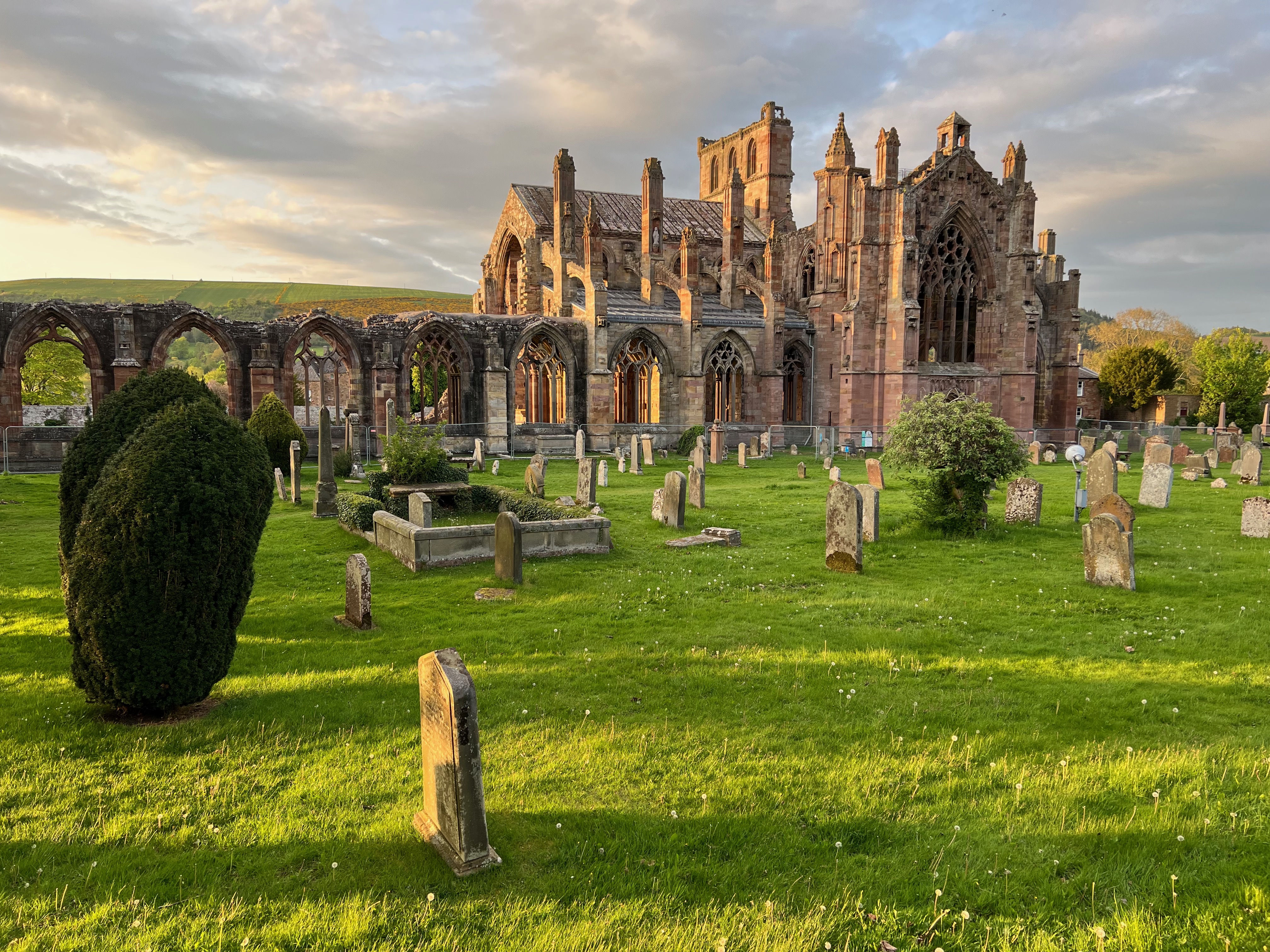
Cuthbert’s experience prompted a decision which had been long in the making: to enter the monastic life and devote his heart and soul to prayer and service. He was soon welcomed into the community of monks near present-day Melrose. He would eventually become their prior, a role he would later assume on Holy Island. His first monastery’s seventh-century wooden structures on a grassy bend in the River Tweed are long gone, but the impressive ruins of the twelfth-century Cistercian abbey made a fitting place to begin my pilgrimage on St. Cuthbert’s Way. 

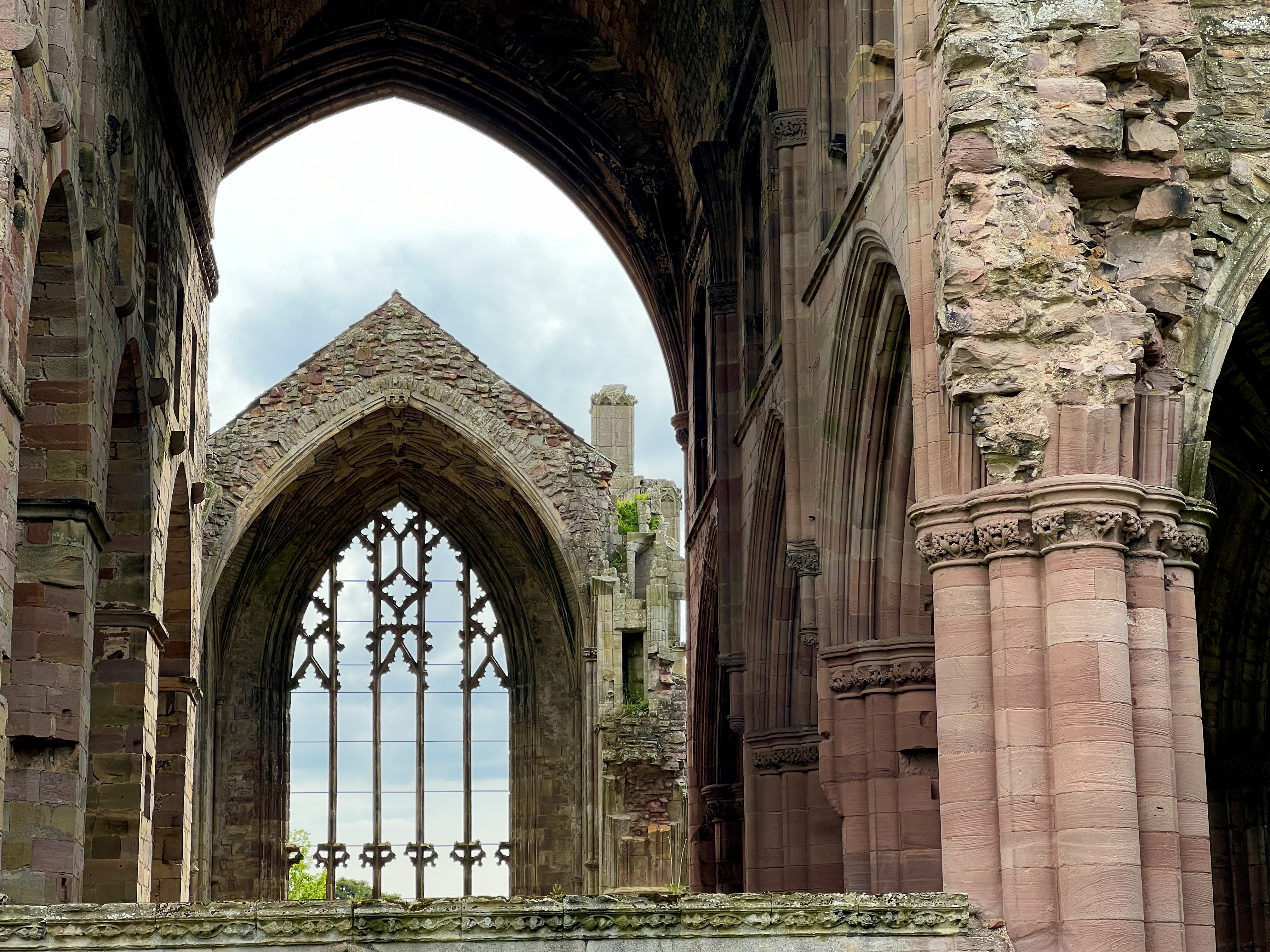
Melrose Abbey, founded by Cistercians from Rievaulx, Yorkshire, in 1136.
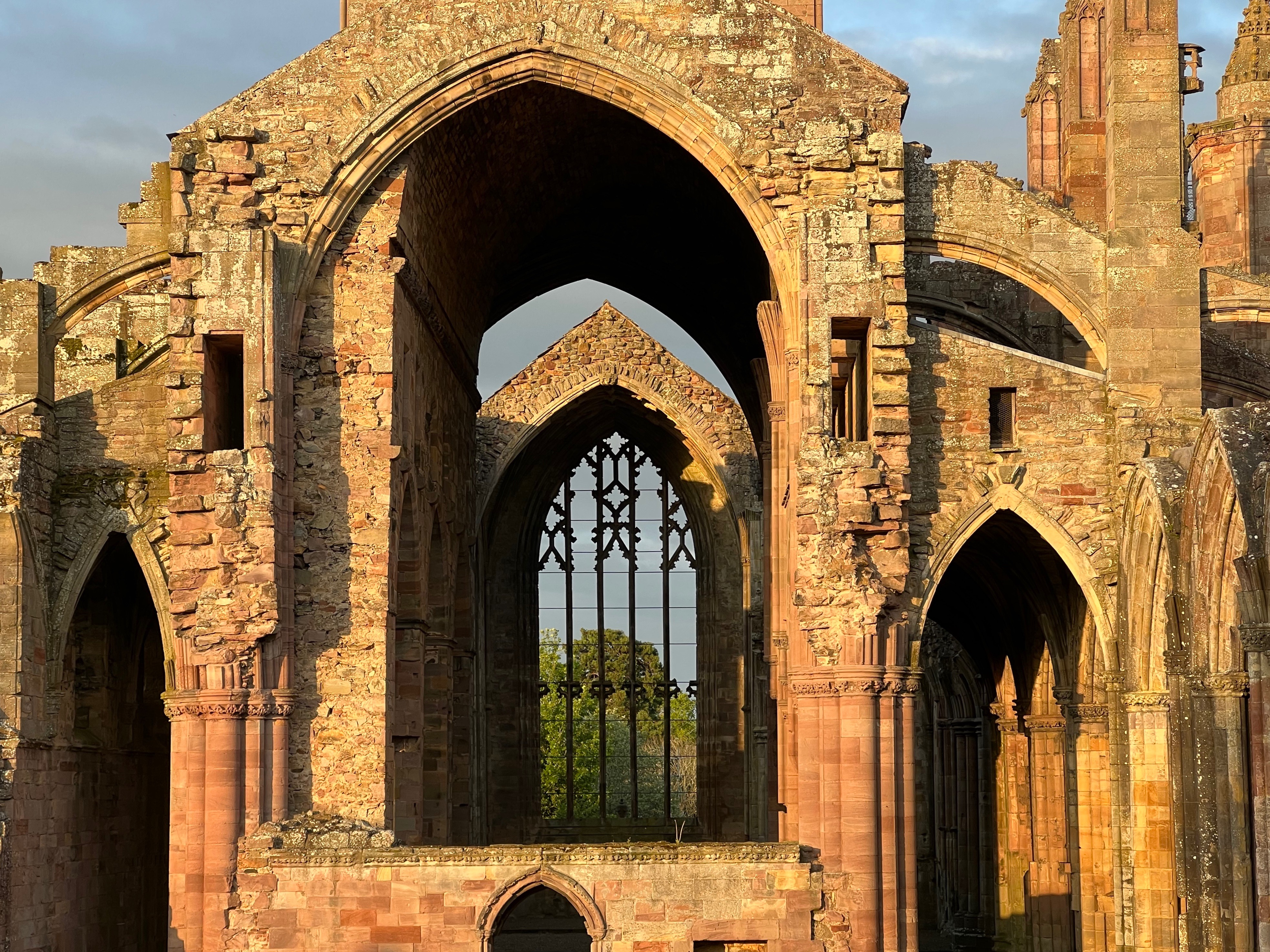
Melrose Abbey at sunset.
“My soul is like a house … It is in ruins, but I ask Thee to remake it.” — St. Augustine, City of God

Melrose Abbey was founded in the 12th century, and at its height there were a hundred monks, who wielded great influence in the Scottish Borders. But like the other Borders abbeys (Dryburgh, Jedburgh, and Kelso), the building suffered greatly in the conflicts between England and Scotland. Richard II (14th century), Henry VIII (16th century), and Oliver Cromwell (17th century) all had a hand in its destruction. The Reformation and modernity finished off its religious life, leaving only the beautiful ruins to testify to what had been. As Susan Stewart writes, “Ruined places are often haunted, and learning to read them involves managing encounters with their resident spirits.” [ii]

I was there on the Sixth Sunday of Easter. After eucharist at the local parish, I visited the abbey under the muted light of a graying sky. In the evening I went back for another look. As I arrived, the setting sun suddenly pierced the clouds to bathe the stones in gold. Pulling up my digital Book of Common Prayer, I sang Compline, adding my voice to the echoes of vanished monks. “The Lord grant us a peaceful night and a perfect end.…” By the time I was done, the gold had faded to dusk.

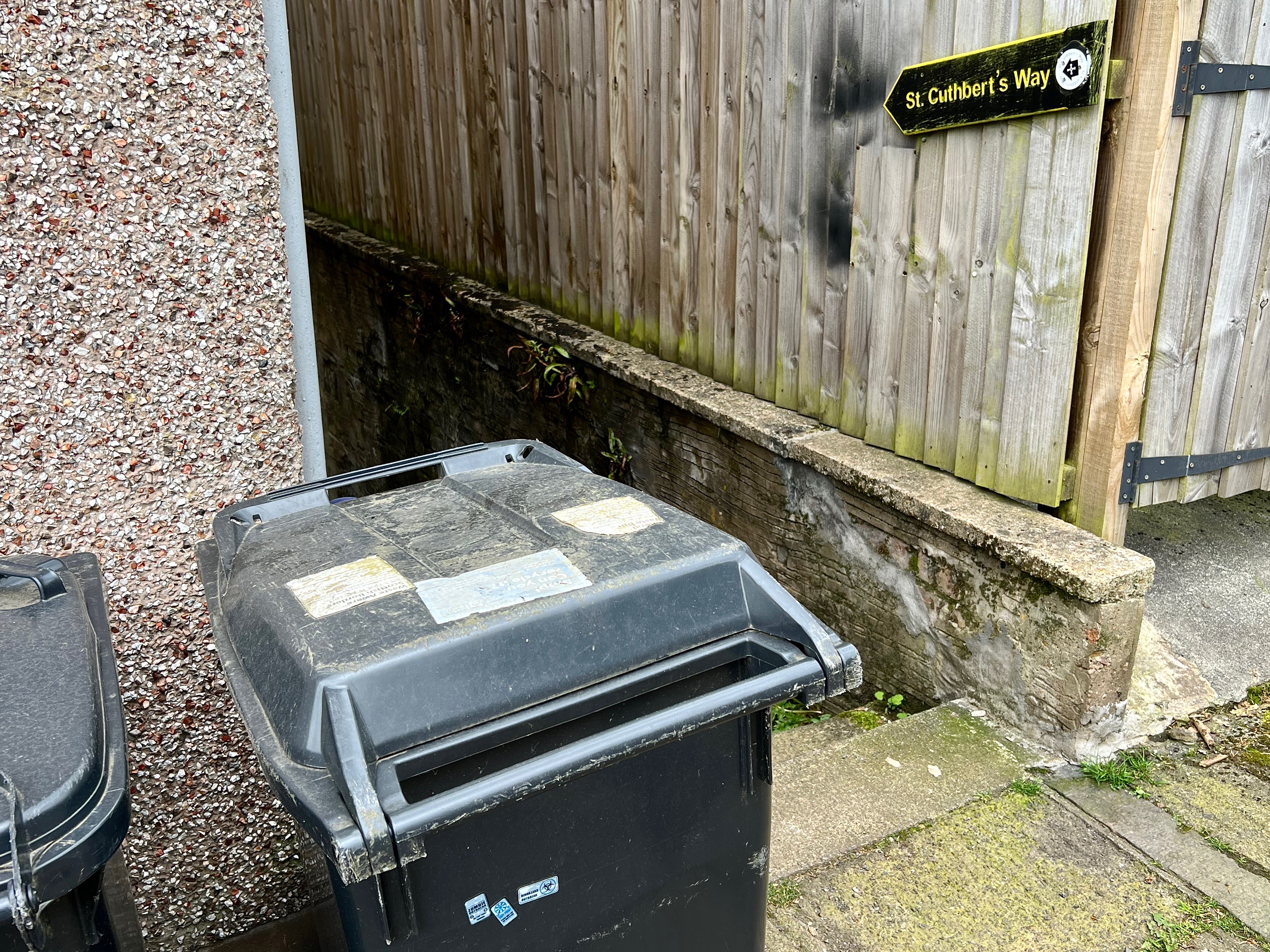
The obscure trailhead leading out of town gave no hint of the glories ahead.

When I found this nondescript passage from a Melrose street to St. Cuthbert’s Way, it did not seem inviting. The White Rabbit came to mind—how curious a plunge!—and Dante, for whom the way down was the only way up. Before the pilgrim poet can ascend to Paradise, he is driven “down to where the sun is silent.” [iii] Thankfully, my descent into darkness was brief, and I soon found myself climbing toward the light.

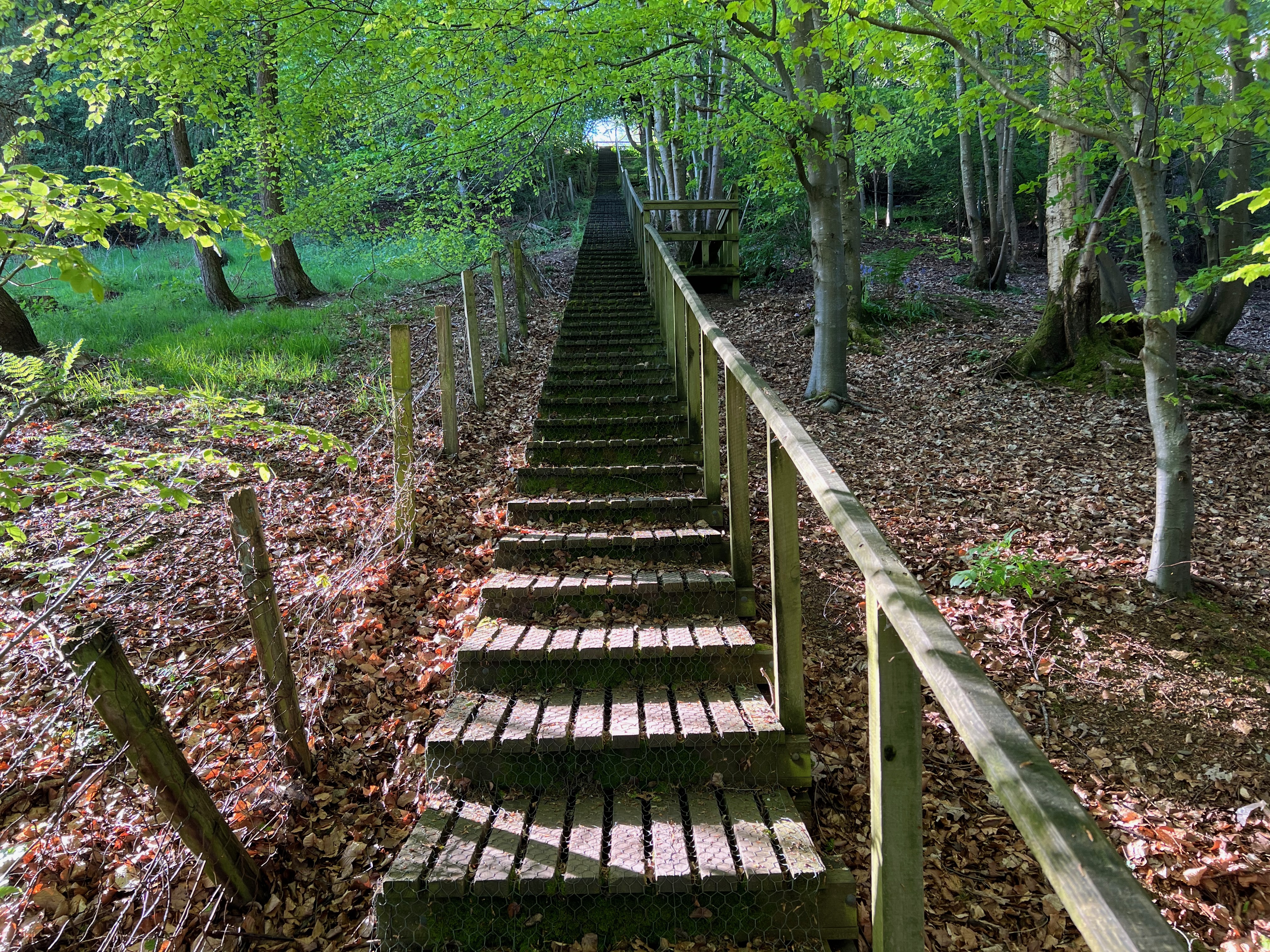
Stairway to heaven.
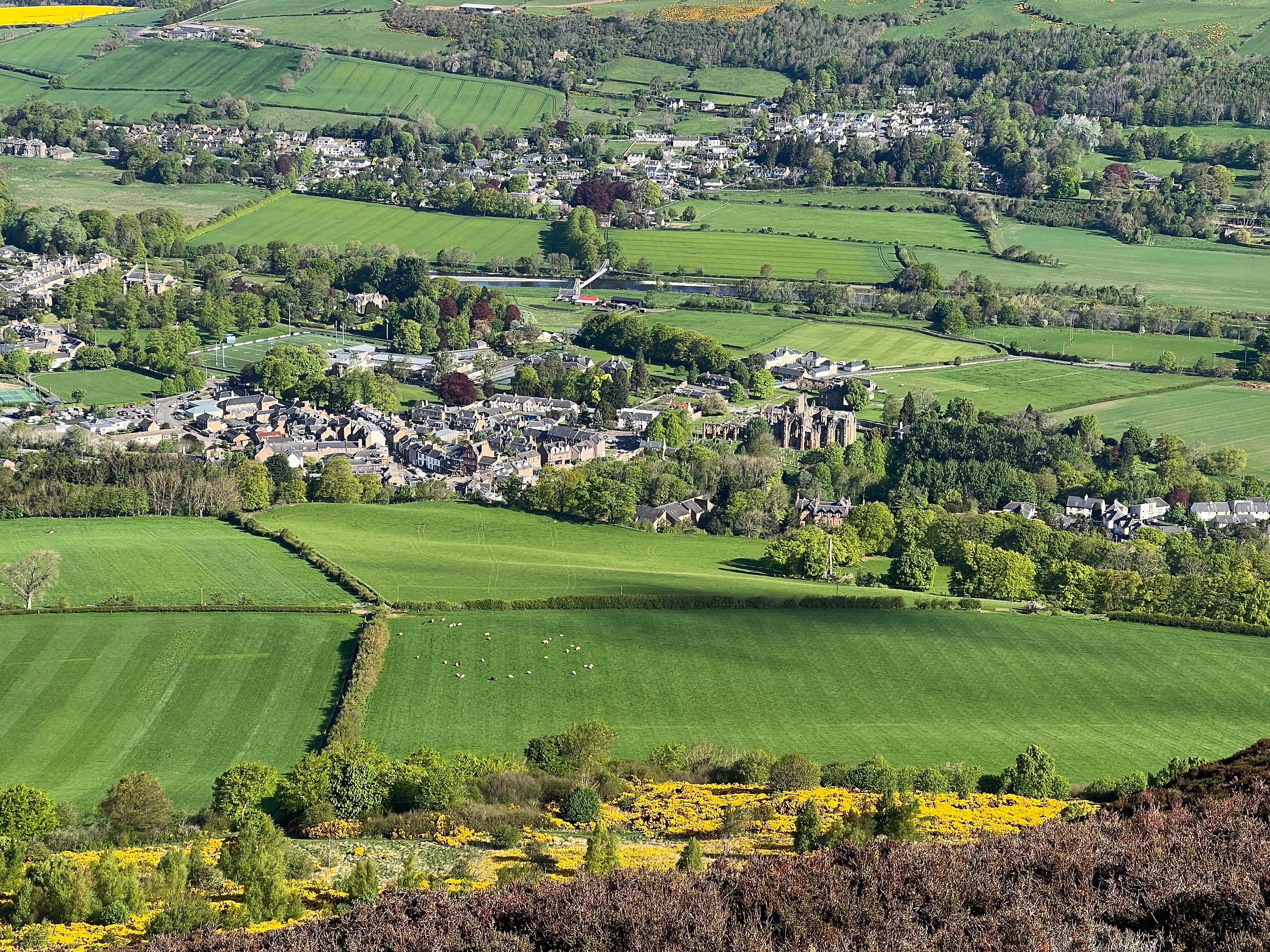
On a bright morning, I climbed up from Melrose to traverse the Eildon Hills. The abbey can be seen at the right edge of the town.
Eildon Hill North, seen from the saddle.

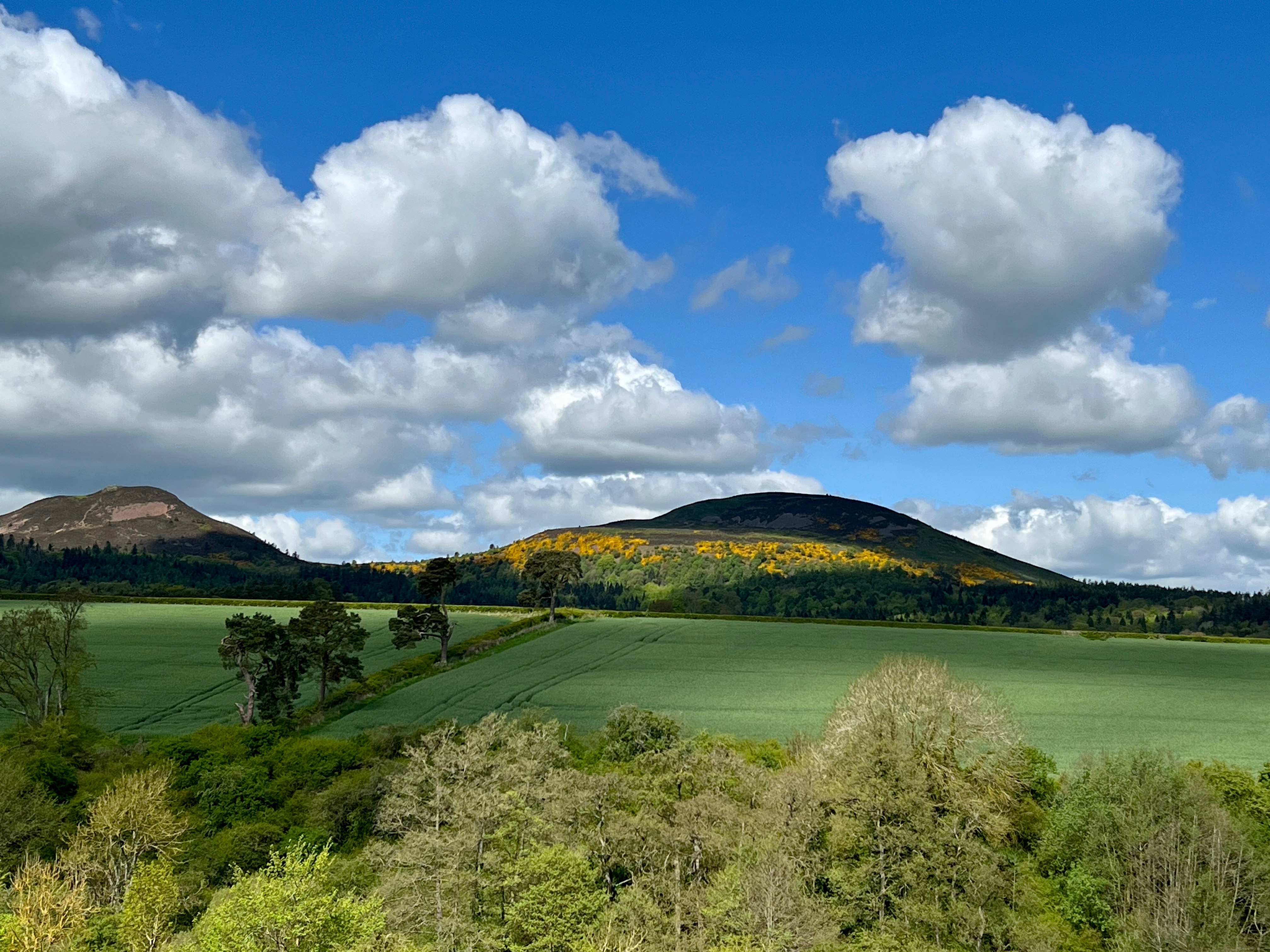
The Eildon Hills, a trio of rounded summits, dominate the surrounding landscape. From the saddle, I scrambled up the North Hill, a sacred ceremonial site in the Bronze Age. The Romans, before their inevitable retreat from the barbarous north, used it as a watchtower. King Arthur was said to be buried here. In the 12thcentury, monks quarried stones for Melrose Abbey on its slopes. Even into the modern era, local legends populated these hills with fairies and imagined a gateway to the Otherworld beneath them. For me the Eildons were an imposing portal to pilgrimage.

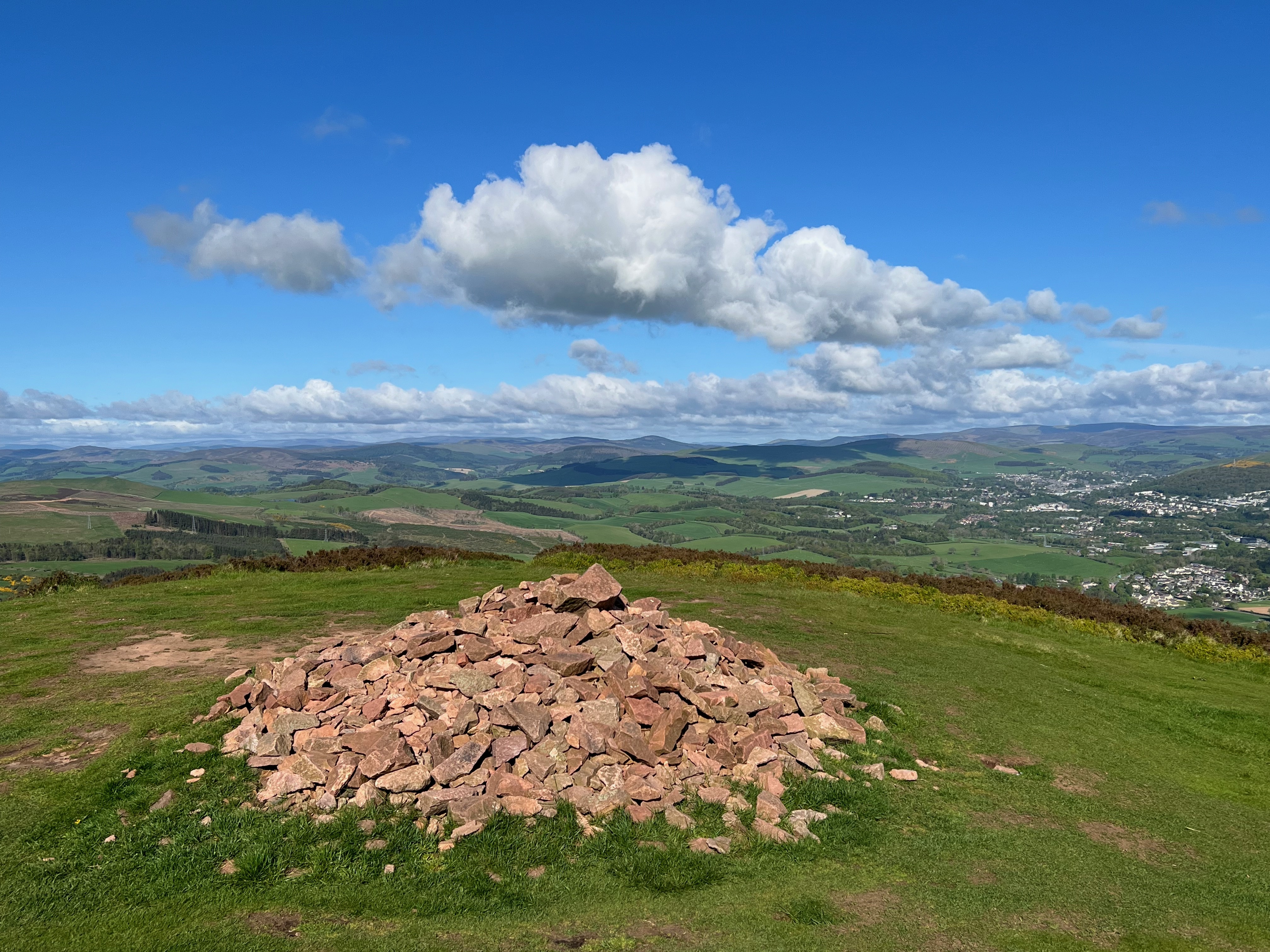
A cairn on the summit of Eildon Hill North. This has been a sacred “thin place” since pre-Christian times.
The Eildon Hills seen from the southeast. I had crossed the low saddle when I left Melrose. These distinctive peaks would remain visible for the next two days, until I passed the halfway point at 31 miles.
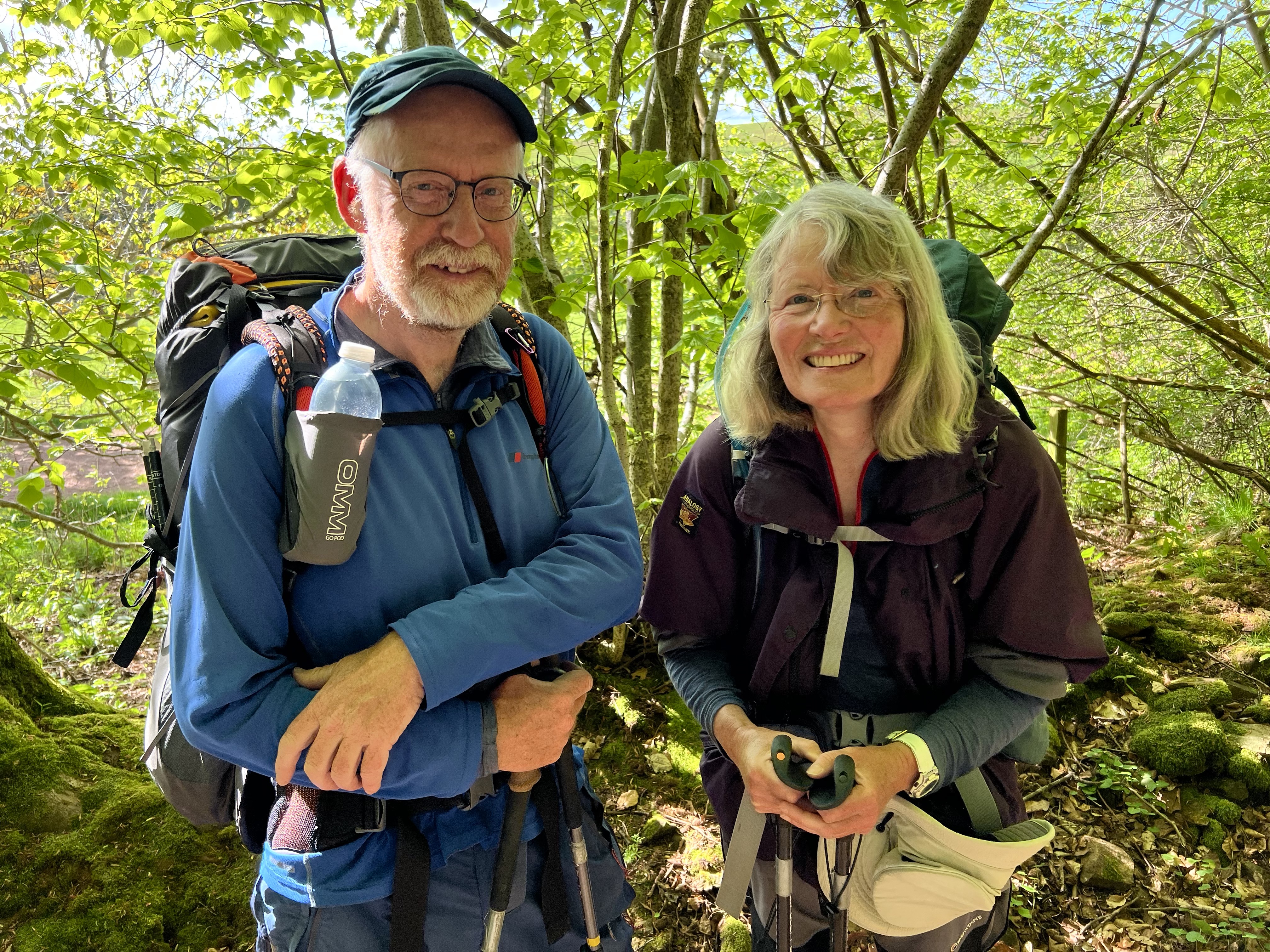
David and Julie, whom I met on my first day, were on their way to the Firth of Forth to complete a thousand-mile trek across the length and breadth of Britain.
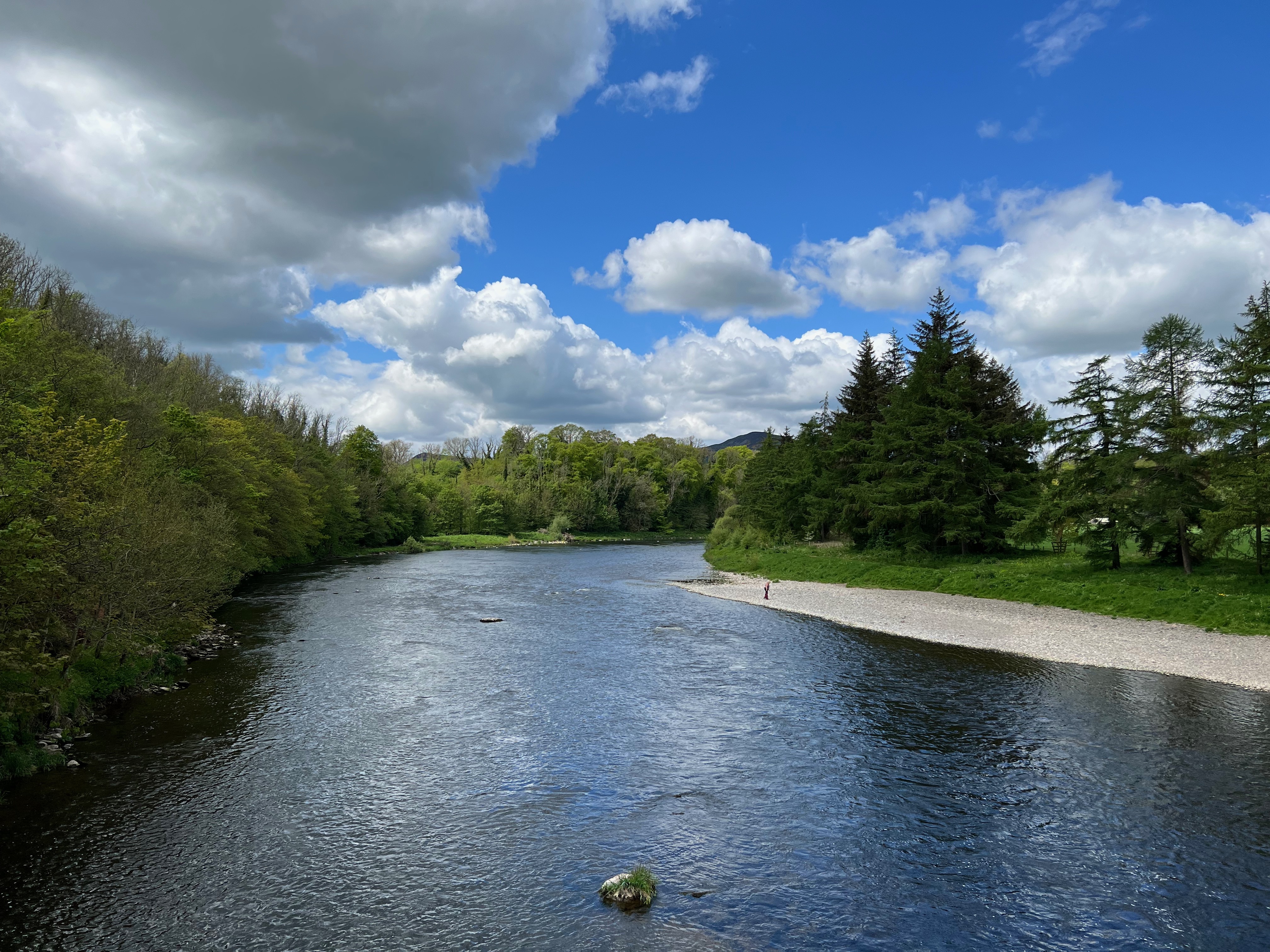
Constable, the supreme painter of clouds, said that the sky is “the chief organ of sentiment,” but rivers also touch us deeply. The River Tweed runs for 97 miles through the border country of Scotland and England. Two miles upriver from here was the site of Cuthbert’s Melrose monastery.

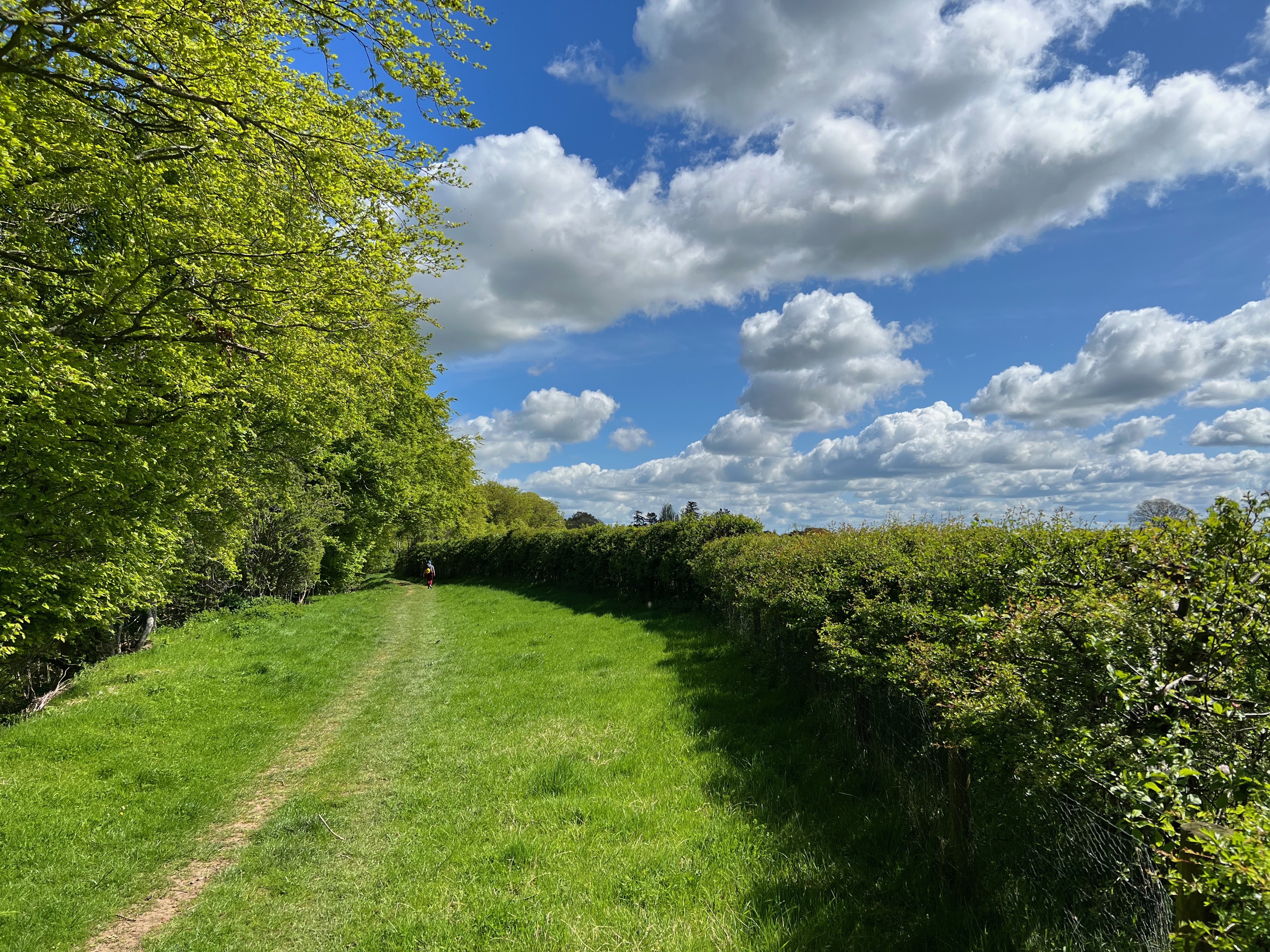
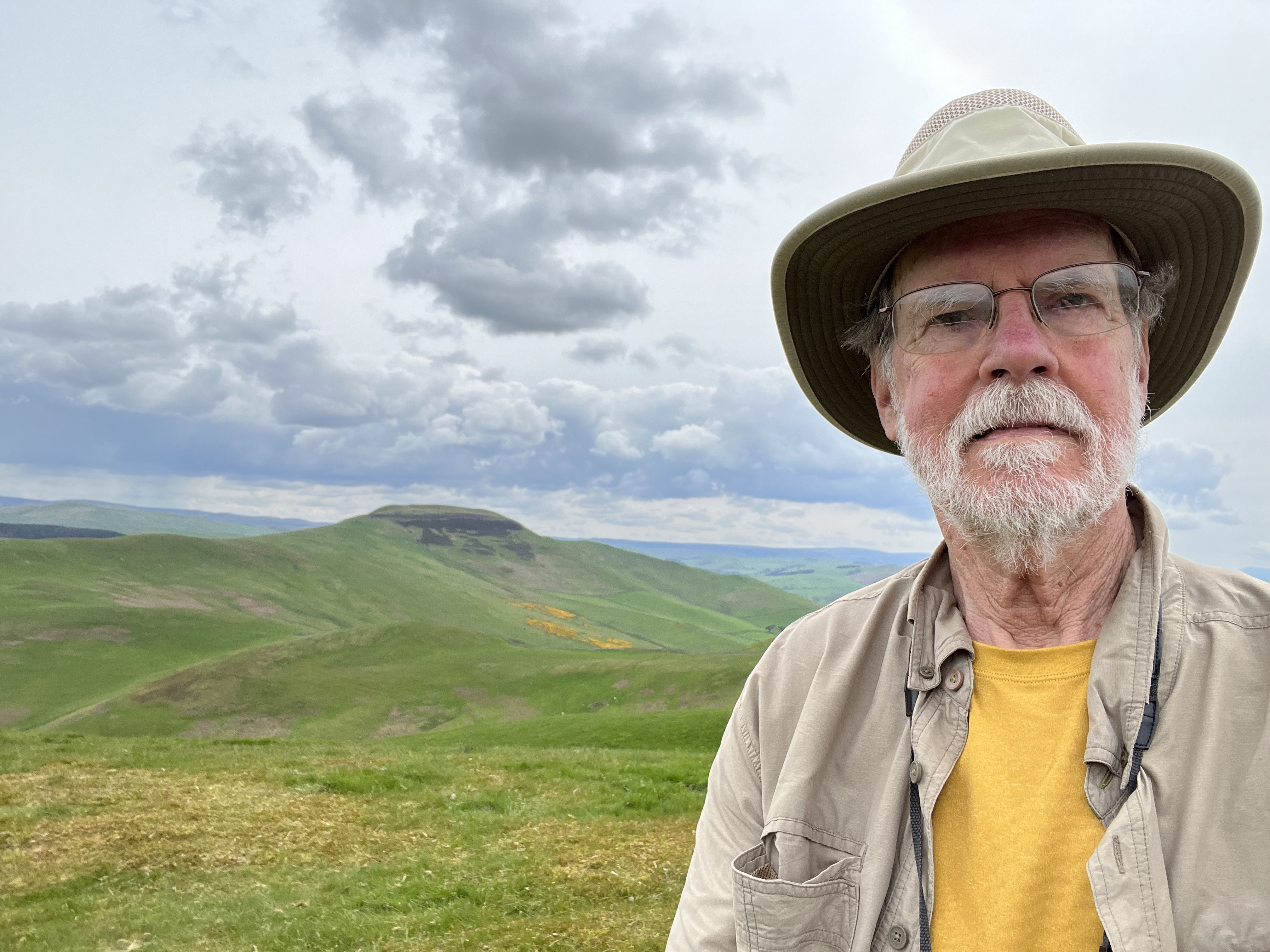
It would be a six-day walk to Holy Island, mostly in splendid weather—not a drop of rain, Constable skies, and only one day without sun. I felt a Wordworthian exhilaration as the road went ever on.

The earth is all before me. With a heart 
Joyous, nor scared at its own liberty,
I look about, and should the chosen guide 
Be nothing better than a wandering cloud, 
I cannot miss my way. I breathe again! [iv]

“I wandered lonely as a cloud.” — Wordsworth
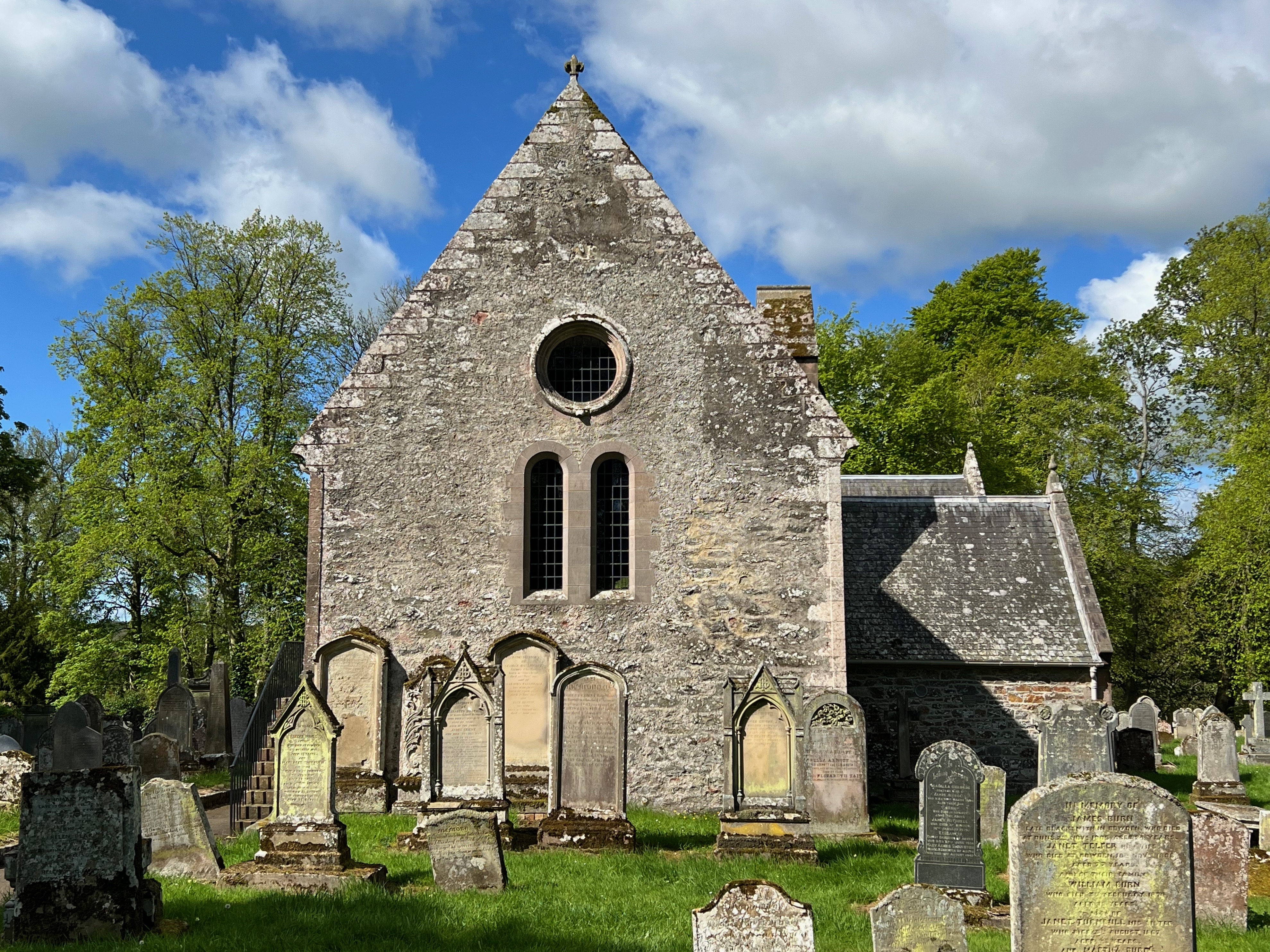
Portions of Bowden Kirk date back to the 12th century, but there have been major changes and additions over subsequent centuries. Originally Cistercian, it has been Protestant since the 16th century.

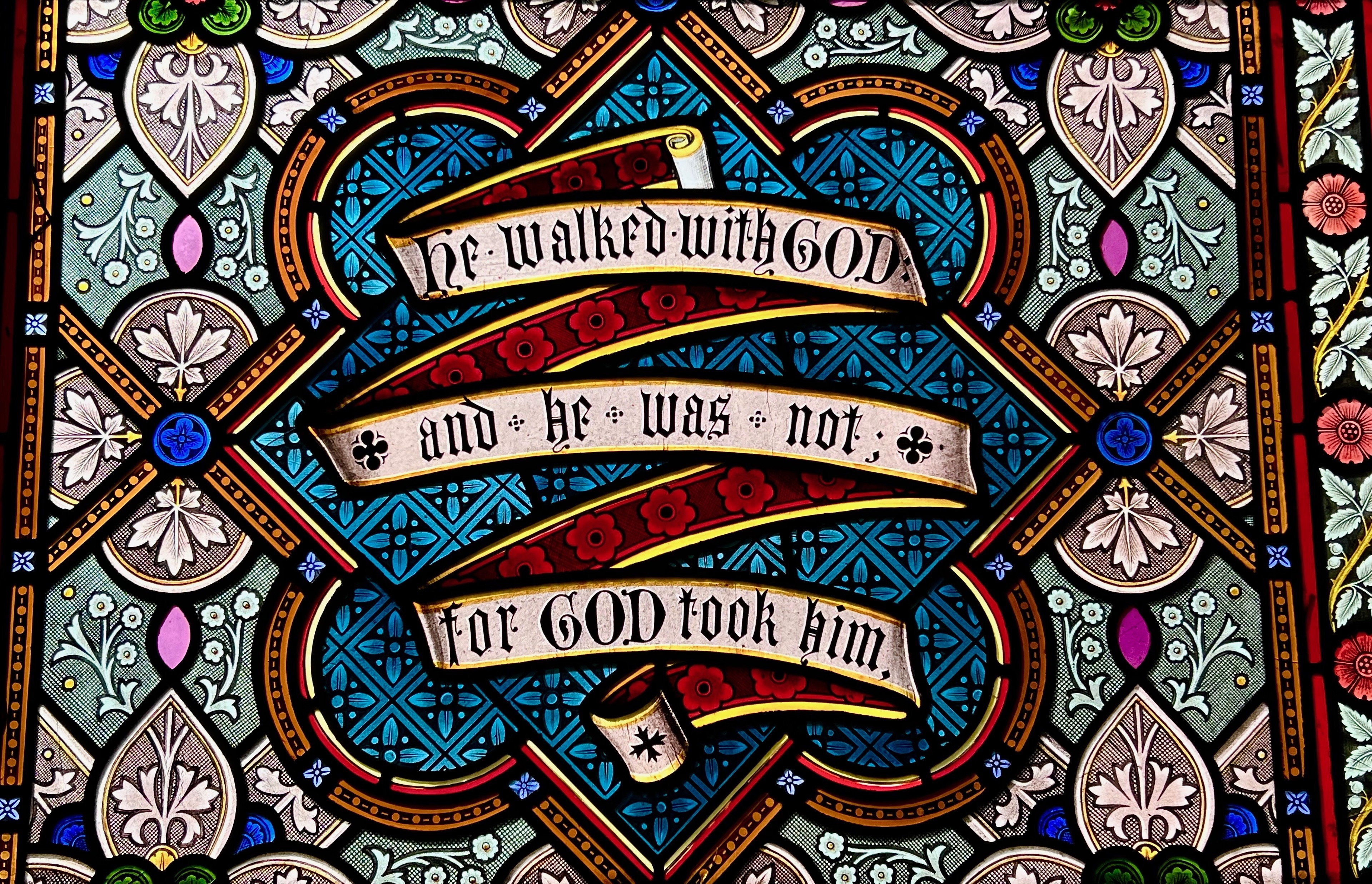
At peaceful Bowden Kirk, a medieval foundation much remodeled over the centuries, I found a window with a text from Genesis. 

Window in Bowden Kirk with text from Genesis 5:24.

This cryptic verse has been interpreted to mean that Enoch, an ancestor of Noah, was somehow taken directly to God without passing through death. To say he “was not,” or “was no more,” could mean that he simply “disappeared” from human sight without suffering an interval of nonexistence. Perhaps the window was put in Bowden Kirk as a cipher of resurrection hope, but to me it suggested the essential spirituality of pilgrimage. As we walk away from “not-God”—deeper and deeper into the divine communion—the isolating egoistic self is diminished and emptied, until it is “no more,” translated by God into its truer self: a relational participant in the divine life of self-diffusive love. That may not be achievable in this life (I certainly didn’t get there in 6 days!), but I believe it is the horizon toward which we are all headed. 

As St. John of the Cross put it:

To come to be what you are not,
you must go by a way in which you are not. [v]

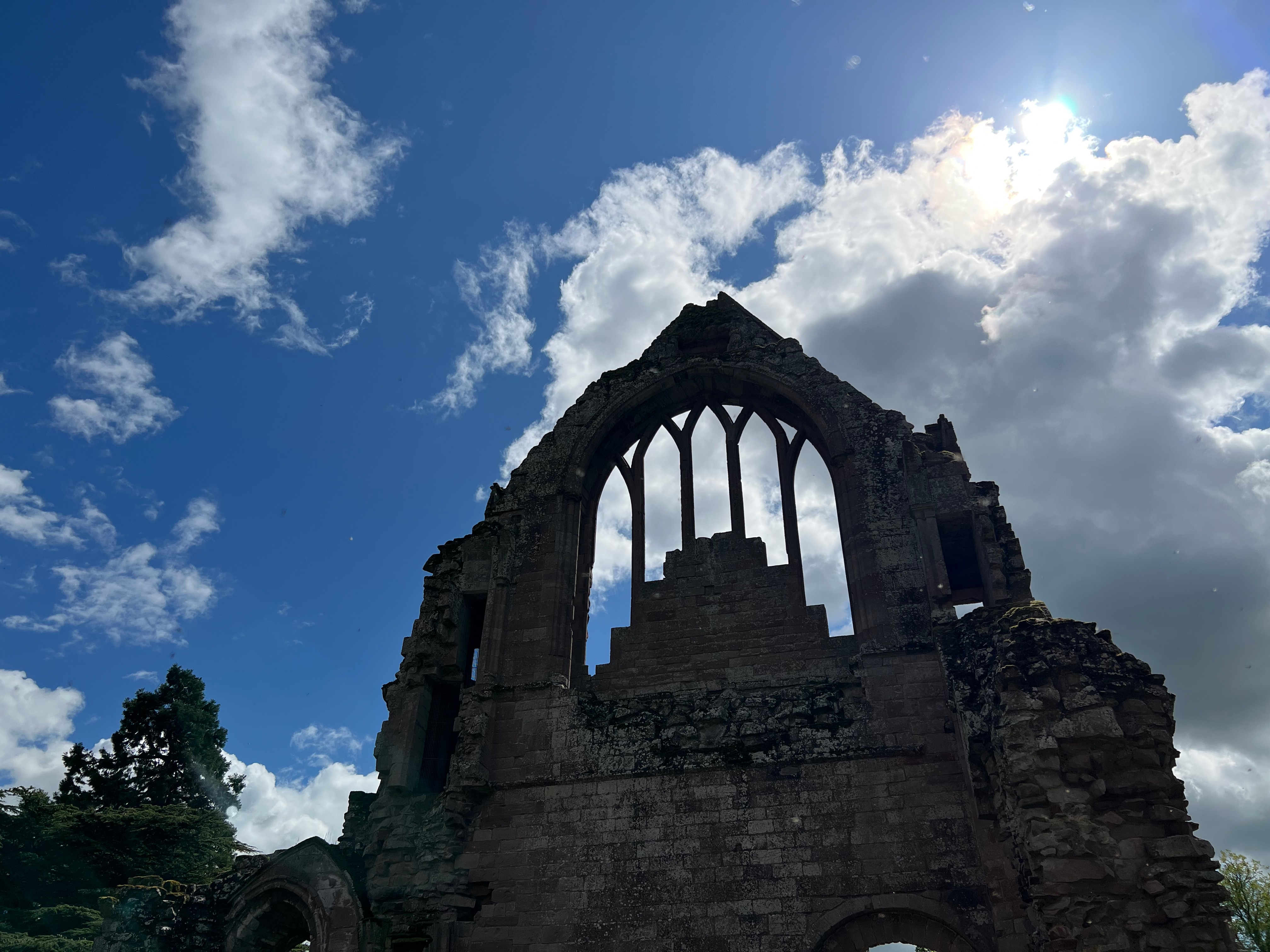
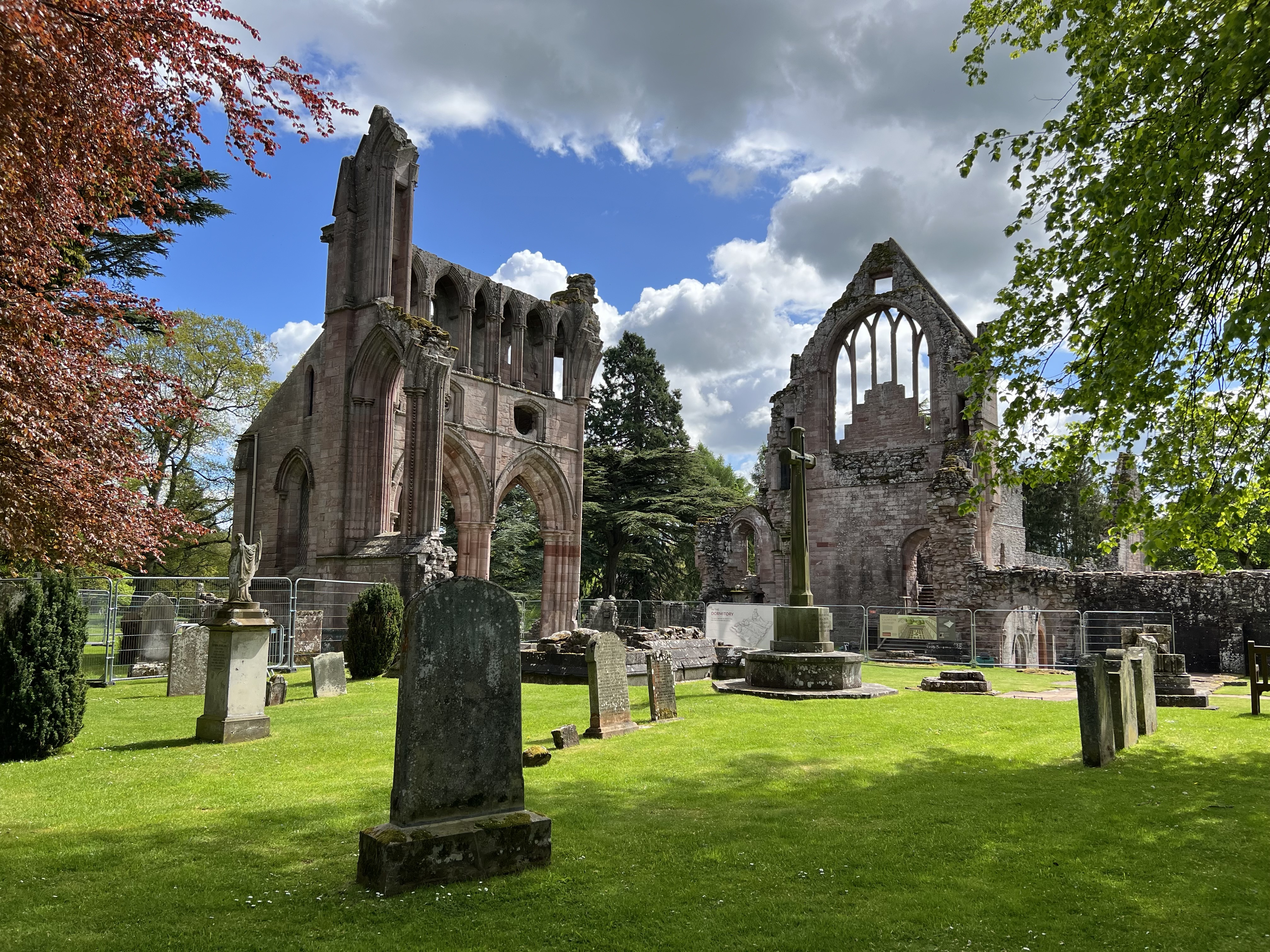
Dryburgh Abbey (12th century). Sir Walter Scott, who died on the last day of summer, 1832, is buried in the ruins of the north transept.
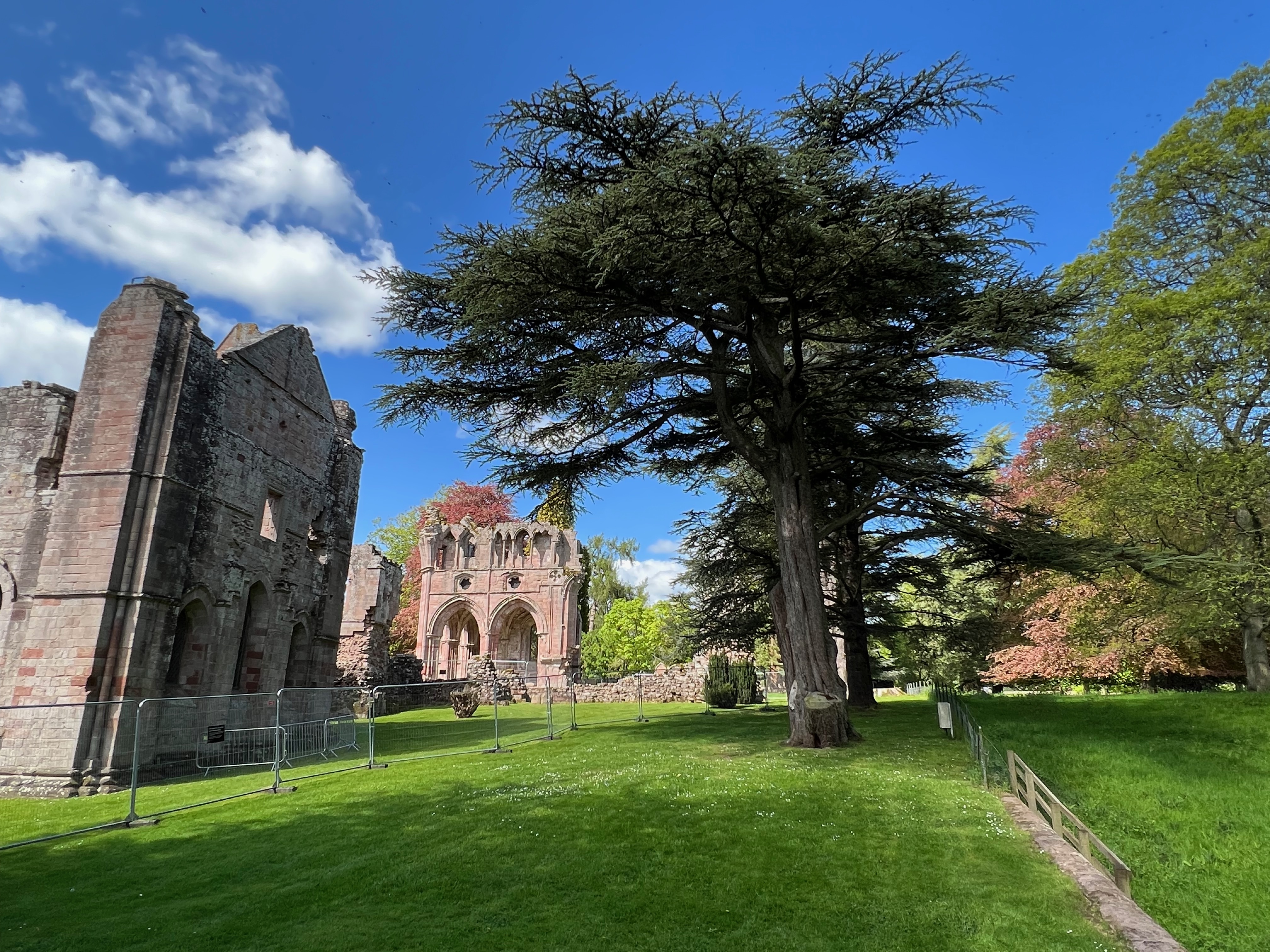
Dryburgh Abbey is surrounded by exotic trees, like this Cedar of Lebanon, planted by the Earl of Buchan over 200 years ago.
“Bare ruin’d choirs where late the sweet birds sang” (Shakespeare, Sonnet 73).

Dryburgh Abbey is the second of three Borders abbeys on St. Cuthbert’s Way. Far from any town, surrounded by a beautiful park next to the River Tweed, it is the most serene of the three. 

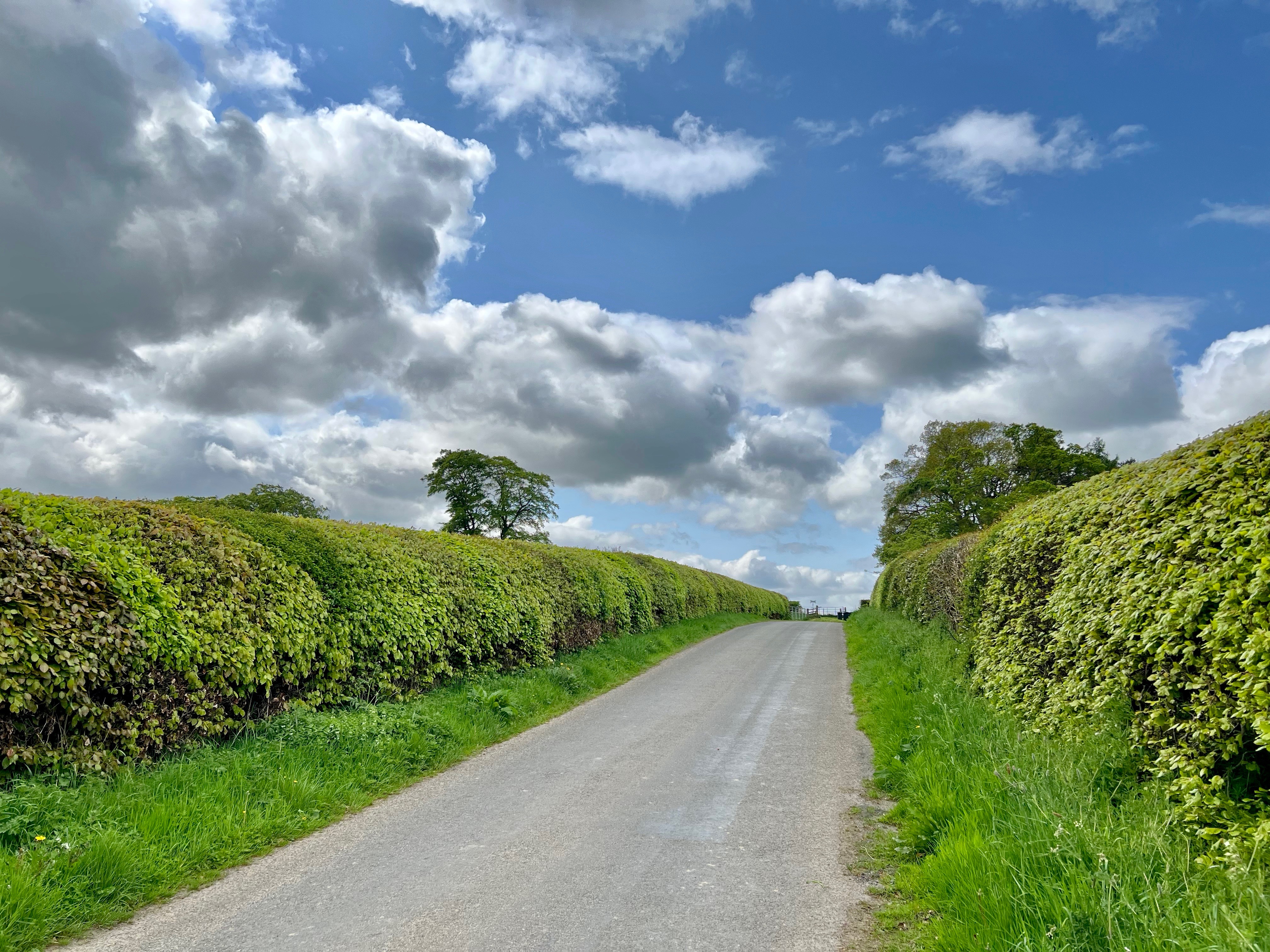
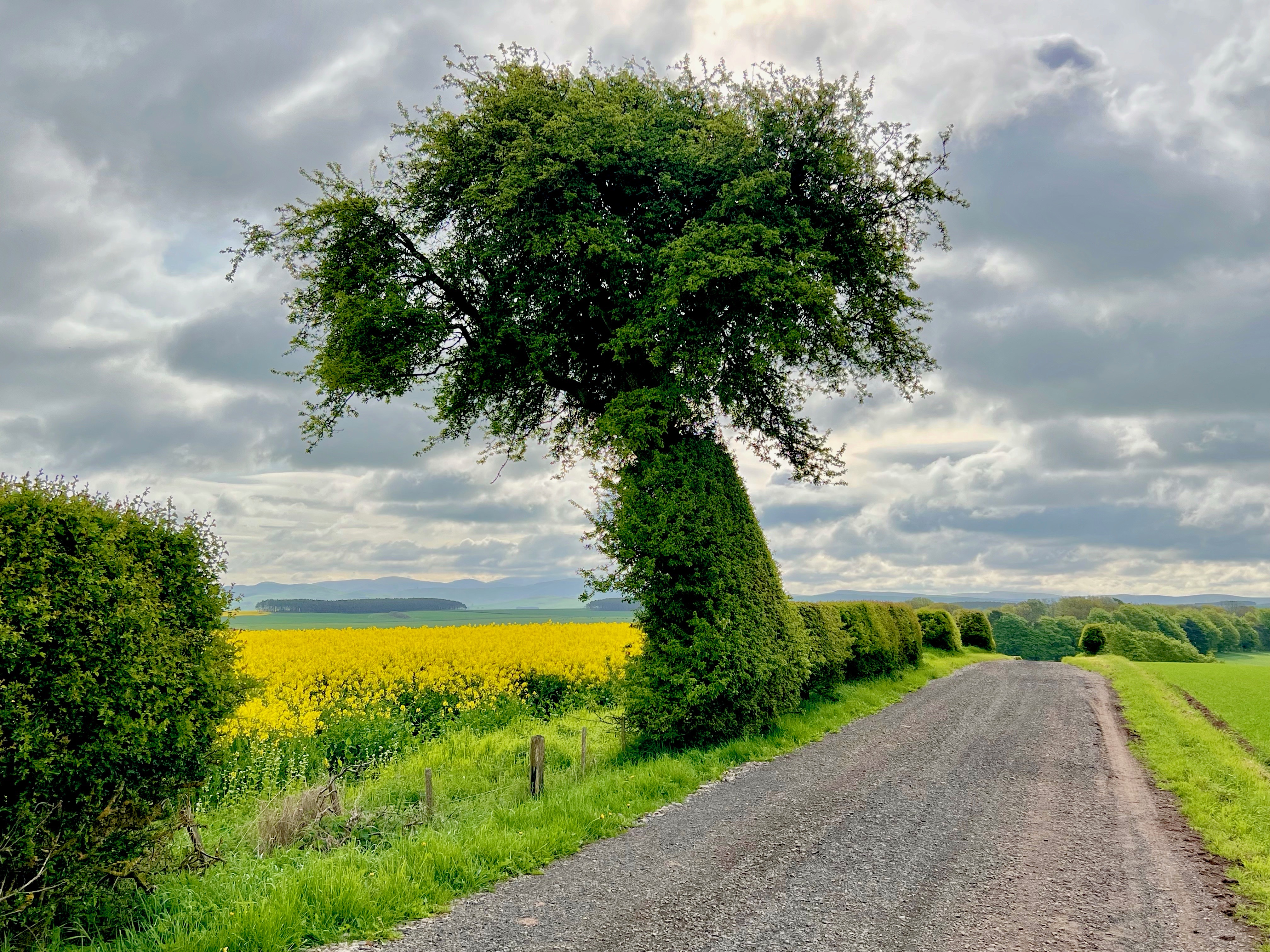
The occasional paved stretches of the Way were mostly empty.
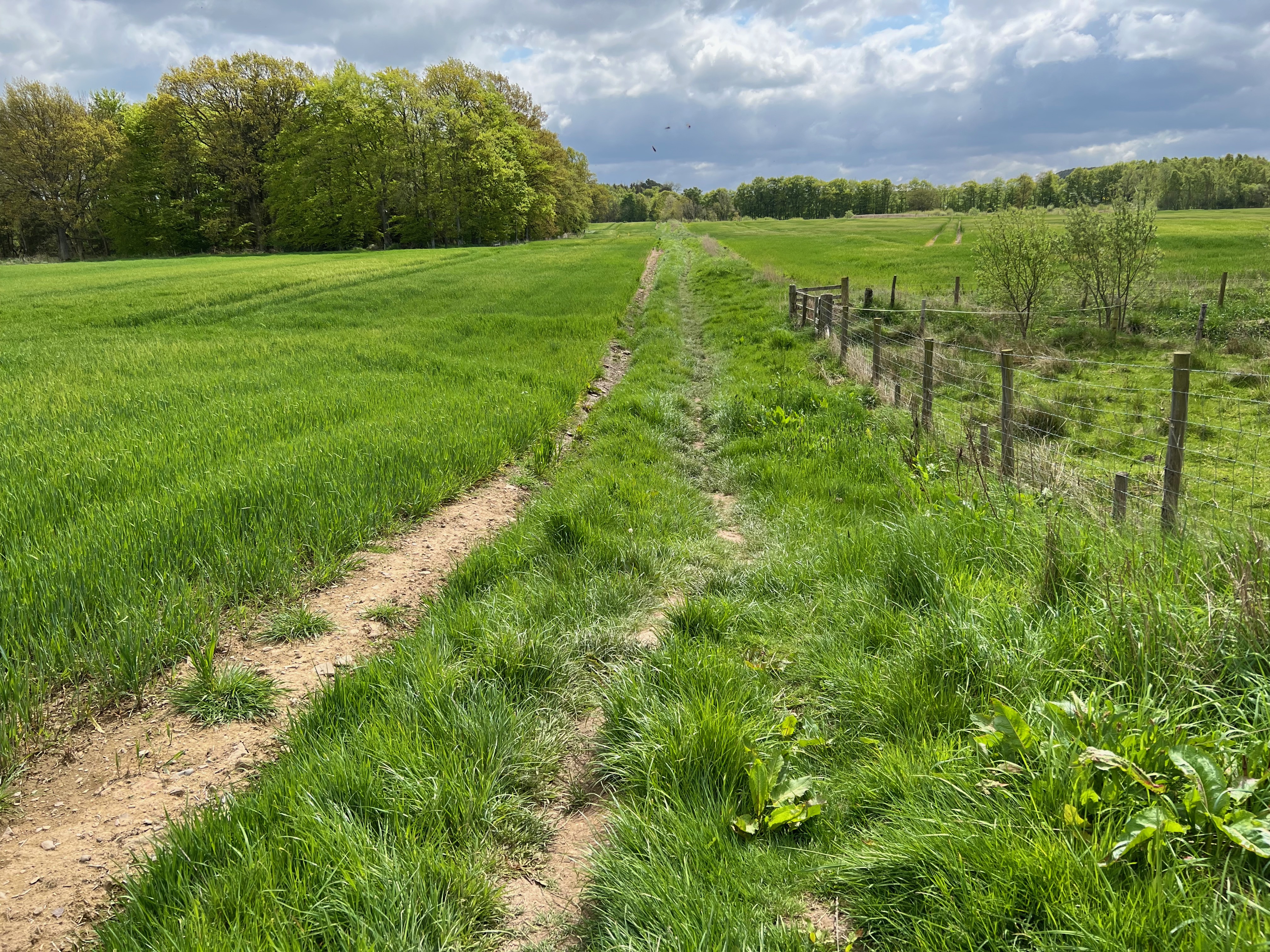
This straight path, called Dere Street, follows part of a first-century Roman road which ran from York to Scotland’s Firth of Forth.
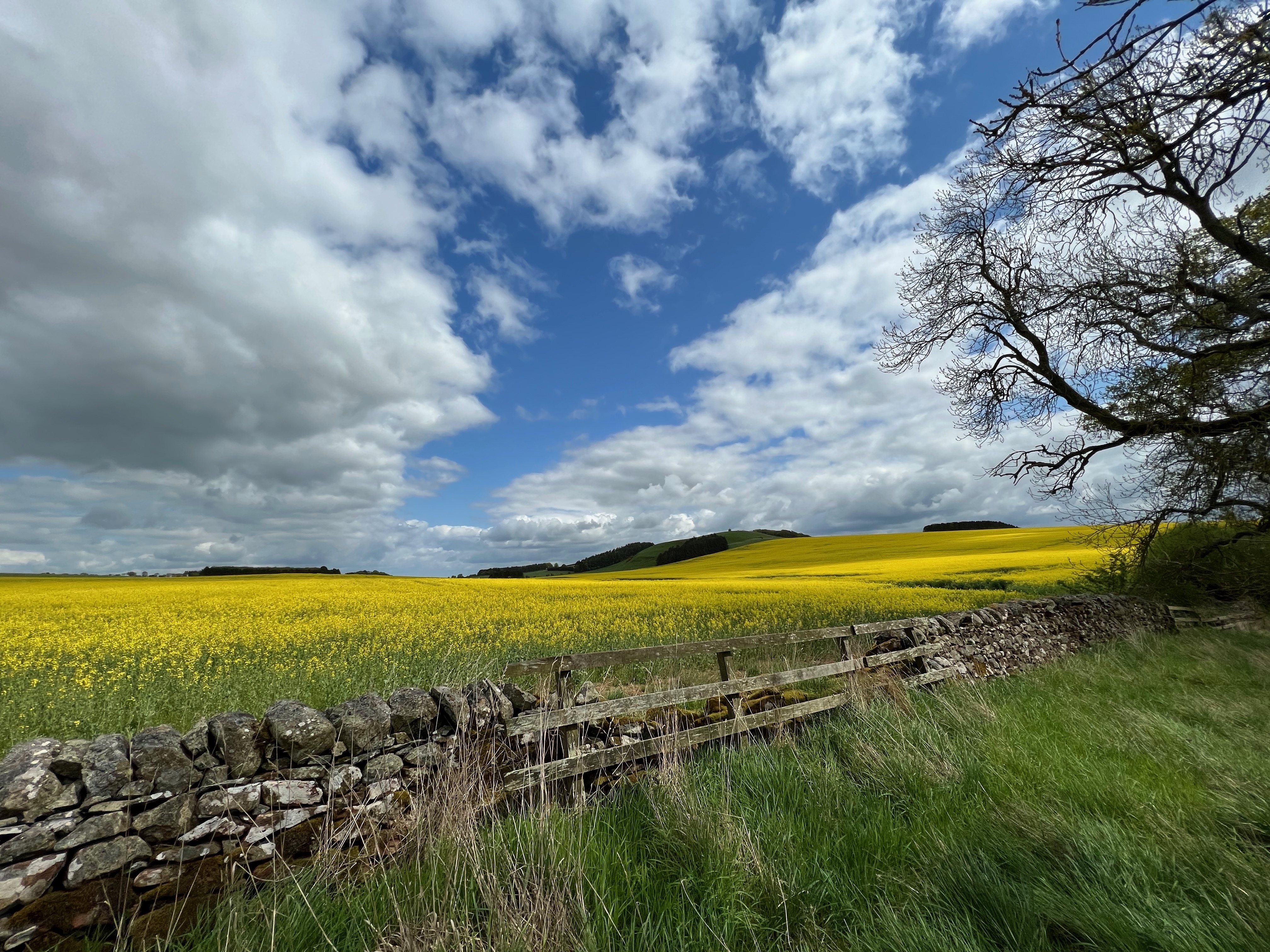
Fields of blooming rapeseed parallel the Roman road.

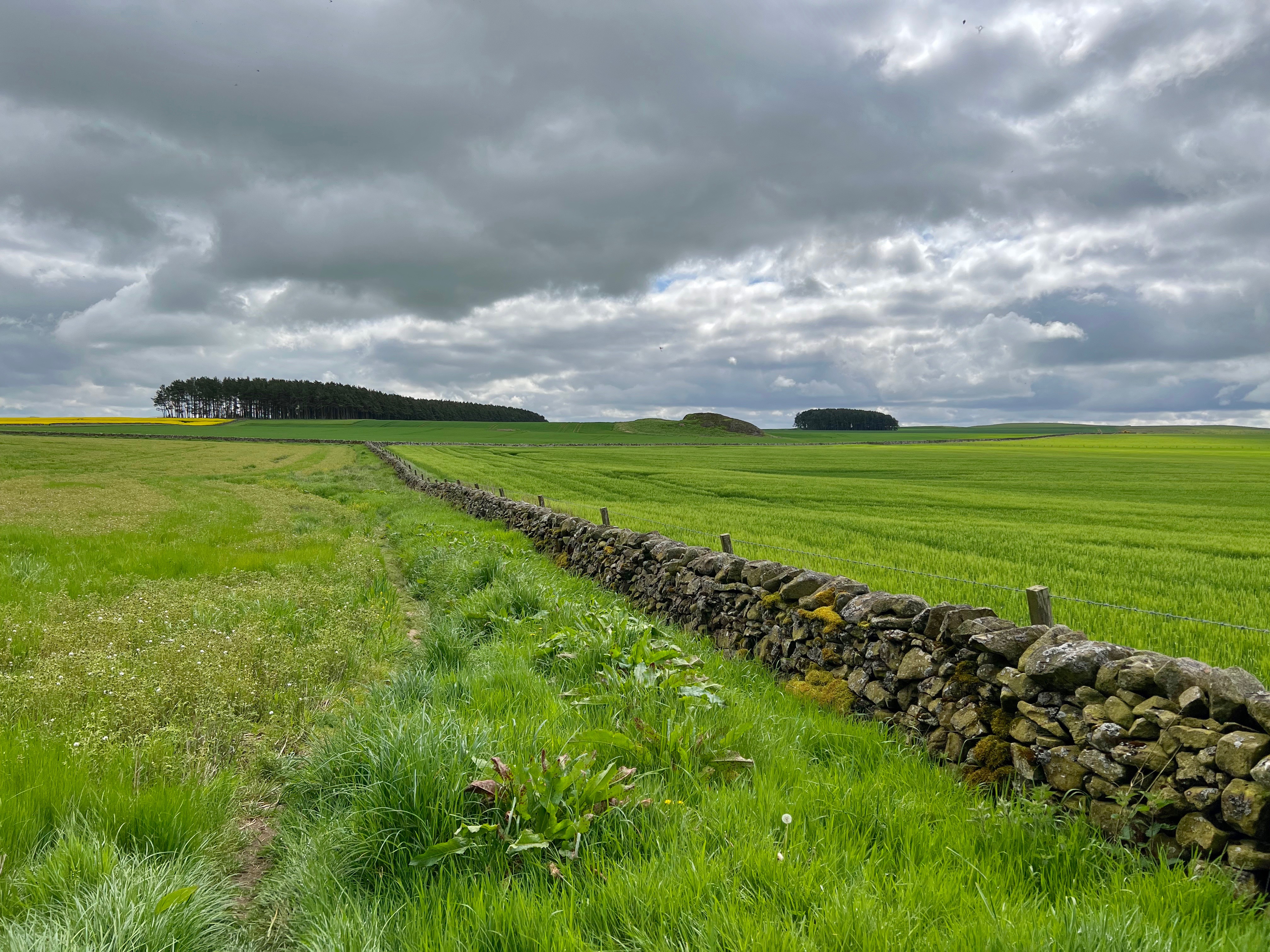
One day I trod the remnant of a Roman road, a faint trace of their 400-year occupation of Britain. As Gibbon observed, history “spares neither man nor the proudest of his works [and] buries empires and cities in a common grave.” [vi]

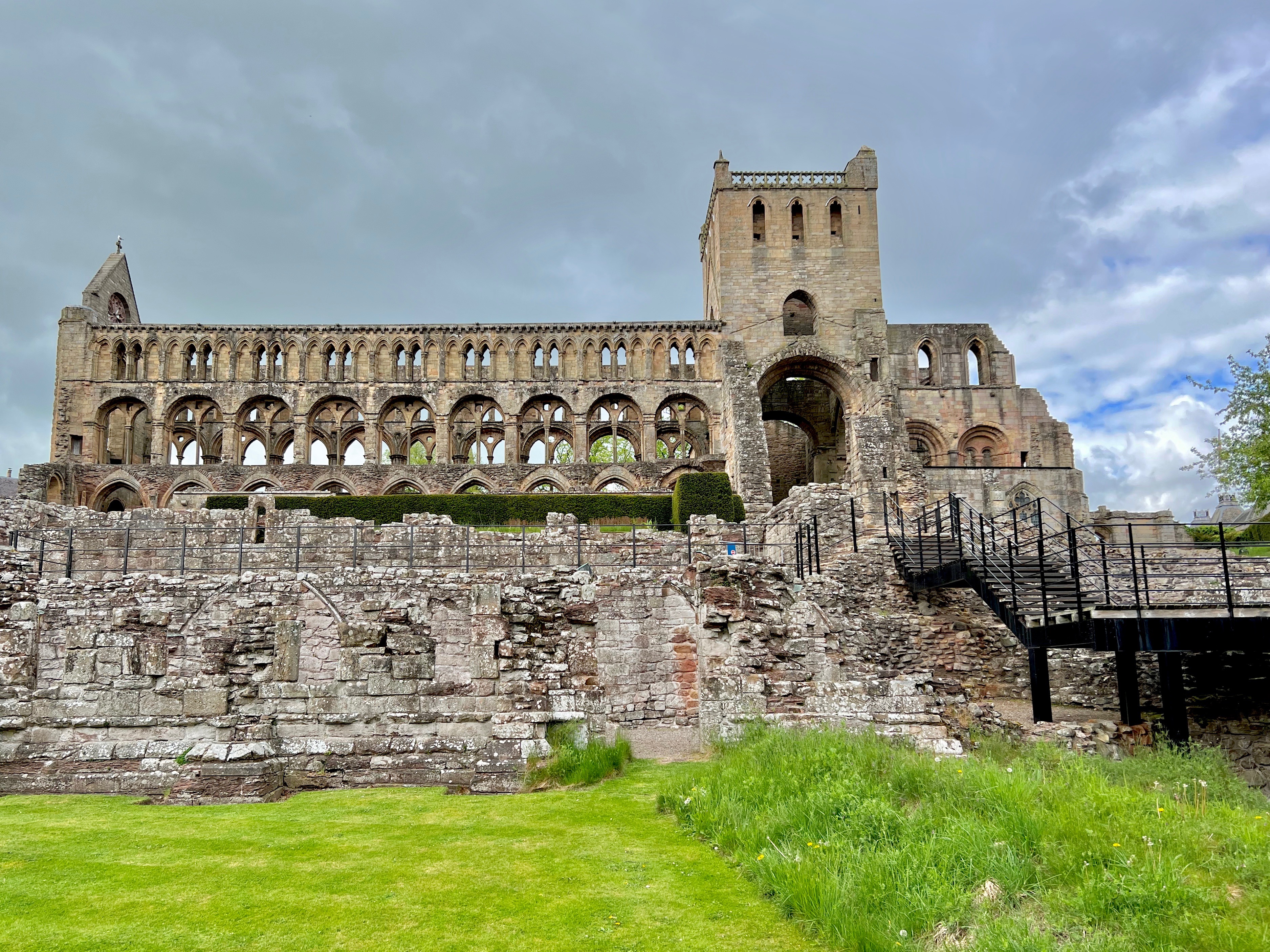
Jedburgh Abbey (12th century).
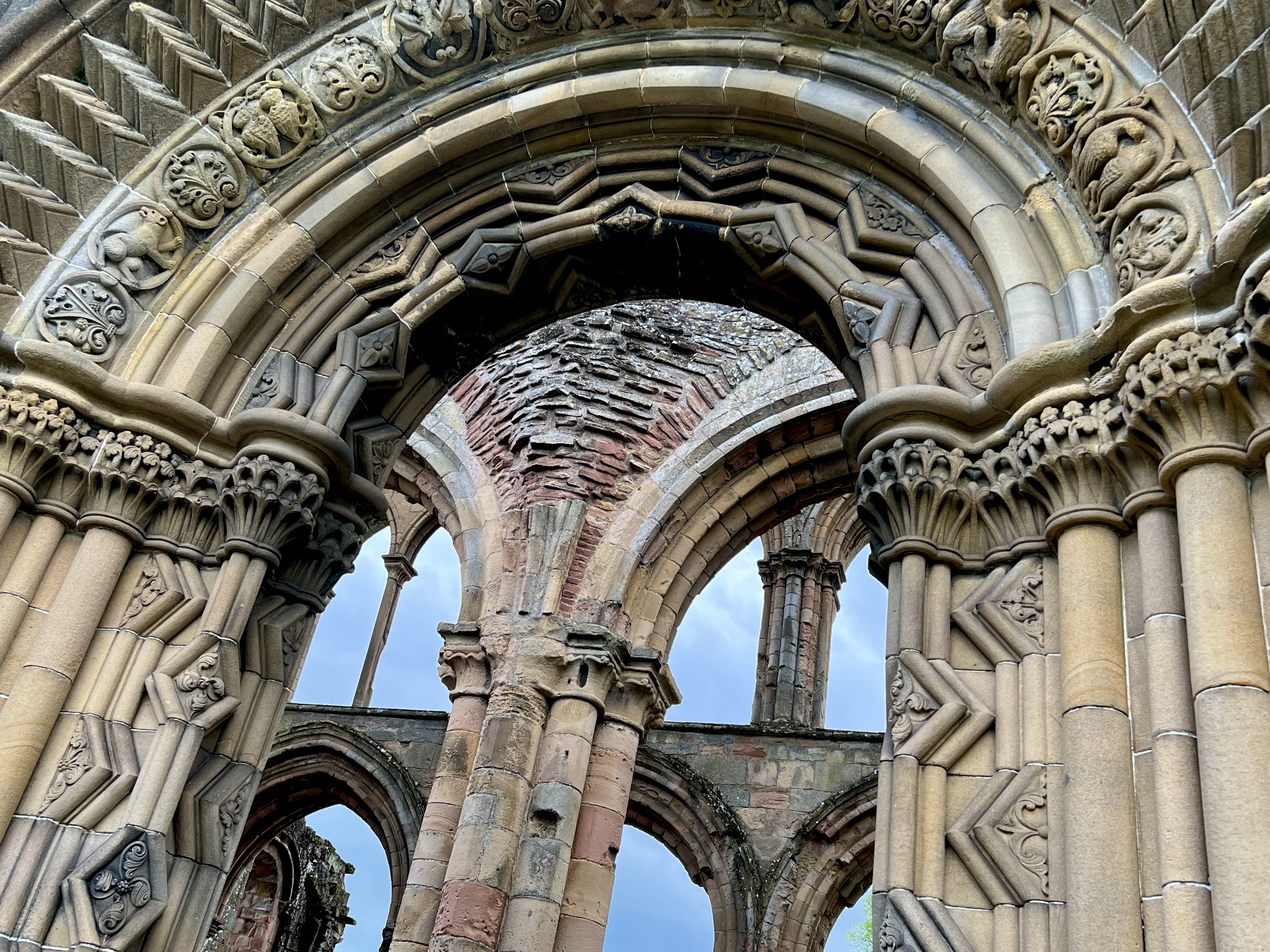
South door, Jedburgh Abbey.
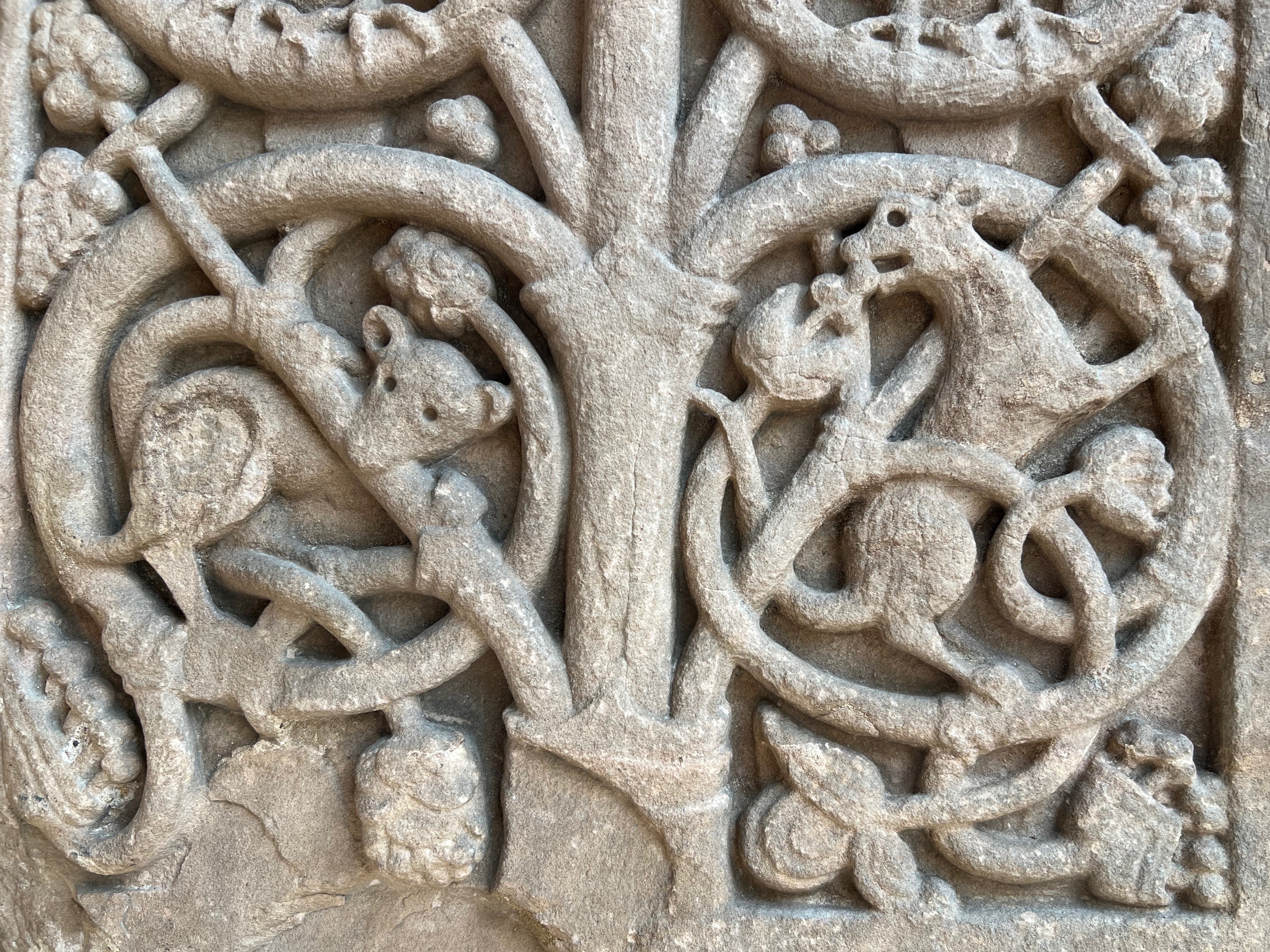
Vine-scroll panel from a saint’s shrine (8th-century, Jedburgh).

In Jedburgh (locals say “Jeddart”), the church of St. Mary the Virgin is the best preserved abbey in the Borders. Built during the shift from Romanesque to Gothic styles, it is a blend of both. And its carved stone “vine-scroll” is one of the finest examples of Anglo-Saxon art. Like the other Borders abbeys, it did not survive the Reformation, and was abandoned in 1560.

My first view of the Cheviot Hills in the distance.
When I was lost, Brian appeared to show me the way.
My first glimpse of the distant (and challenging) Cheviot Hills distracted me, and I missed a waymarked turn in the trail. Ten minutes later, I reached a road with no idea where to go. Like one of the angelic guides who appear out of nowhere to help Dante navigate obstacles in the Inferno, a local farmer drove up behind me to point the way. When he heard my American accent, he mentioned that his daughter was a professional golfer in California and “doing quite well.” I told him he was a gift from God. He looked bemused. Soon I was back on track, traversing broad fields of yellow and green until I reached the foot of the Cheviots, where the elevation gain got more demanding.
The path climbs toward Wideopen Hill, the halfway point of St. Cuthbert’s Way.
View from Wideopen Hill, the highest point on St. Cuthbert’s Way (1207 ft./ 368 m.).
I reached the highest point of the trail on Ascension Eve.

When I reached the top of Wideopen Hill, the highest point on St. Cuthbert’s Way, it occurred to me that it was Ascension Eve. What better way to celebrate than climb toward the sky!

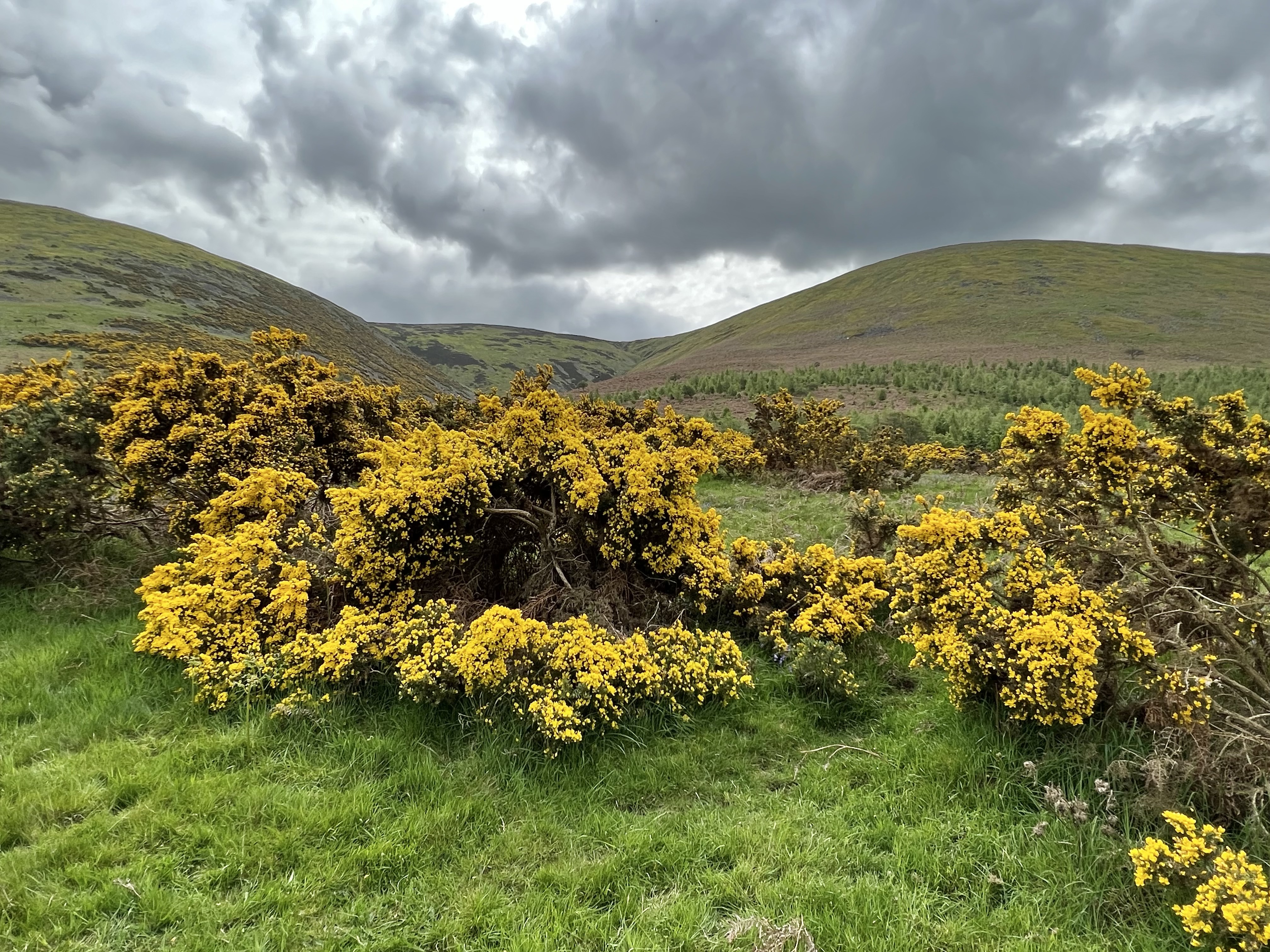
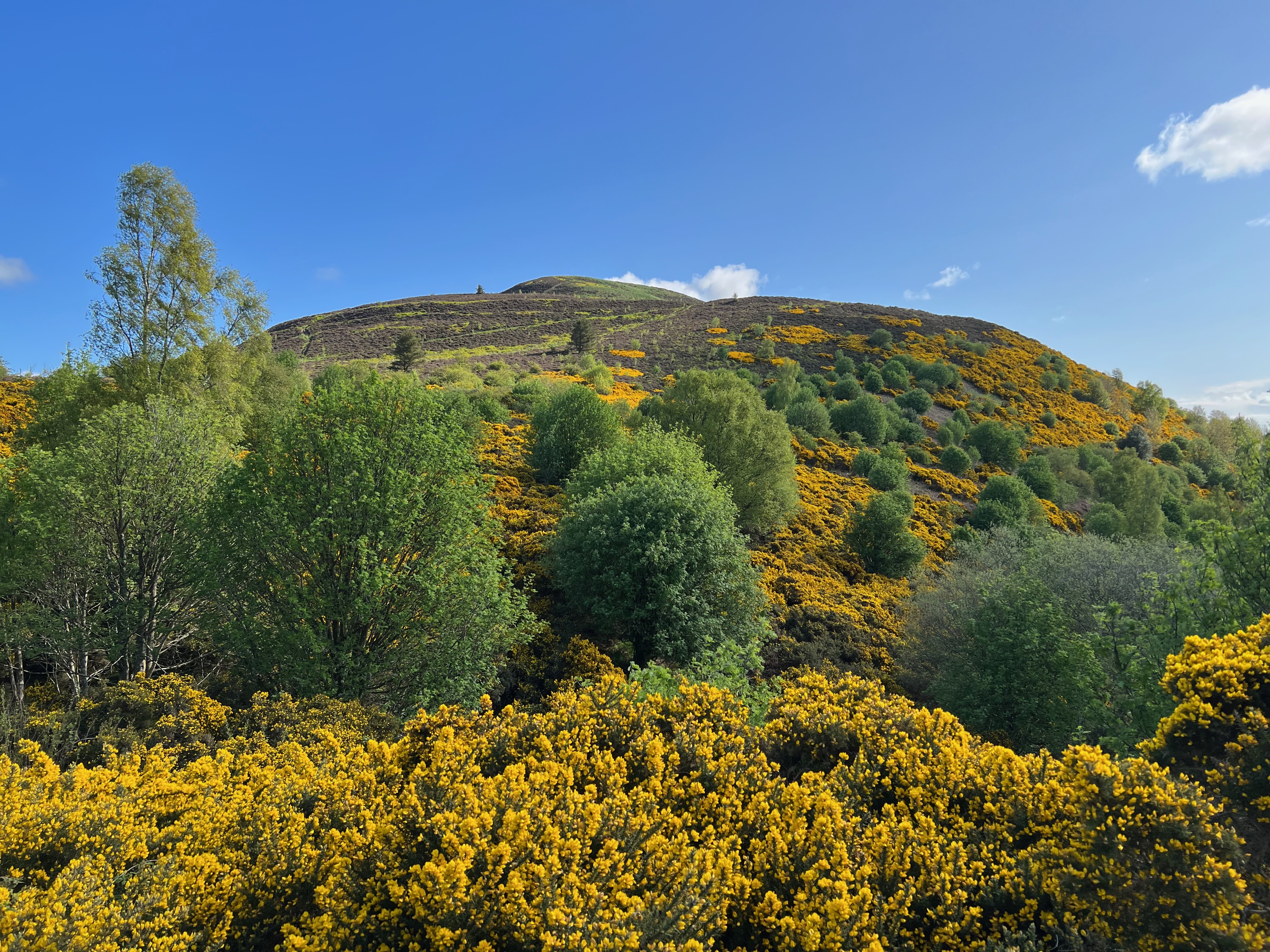
Scotch broom in the Cheviot Hills.
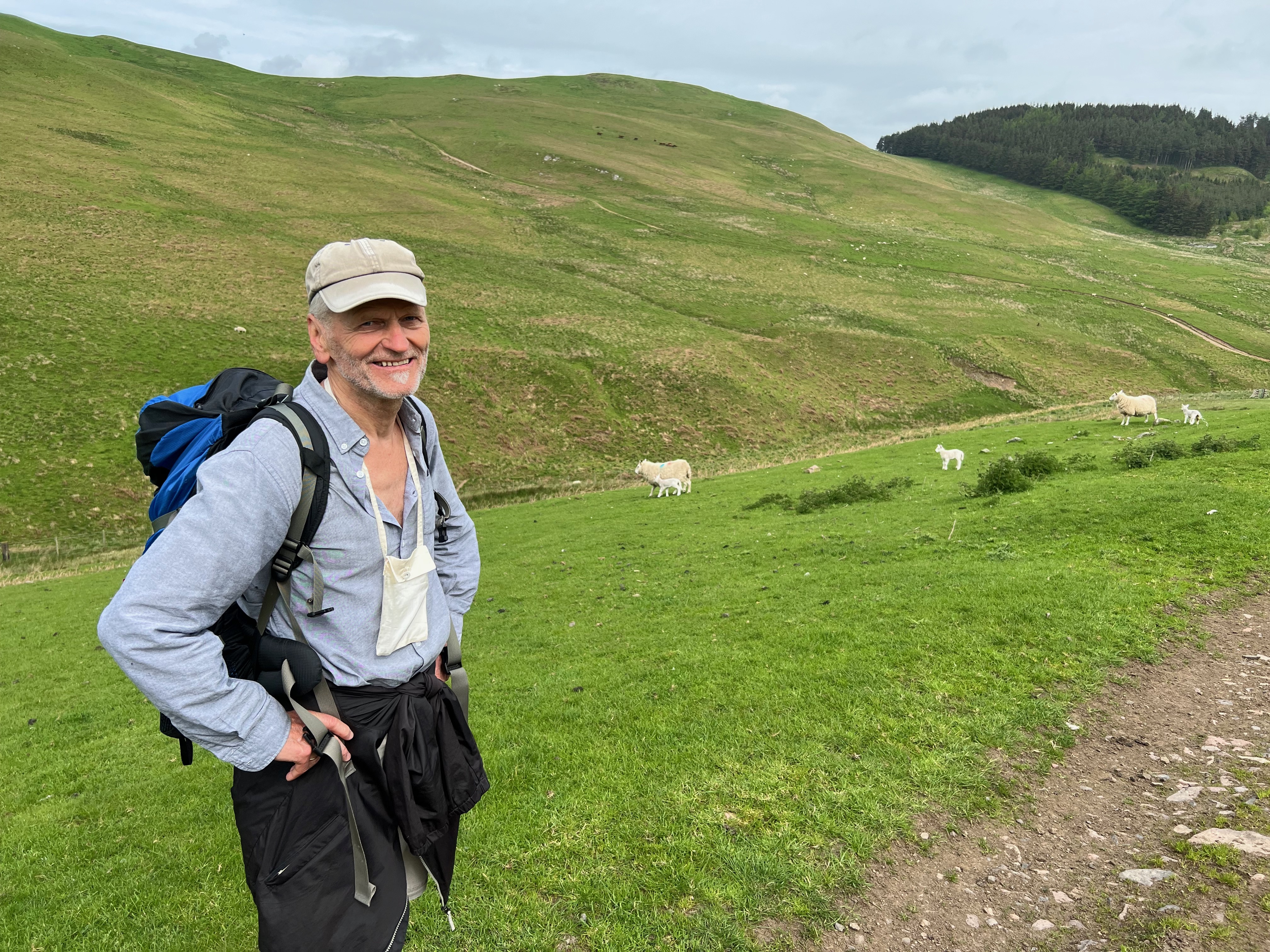
Dagfinn, a Norwegian pilgrim in the Cheviot Hills.
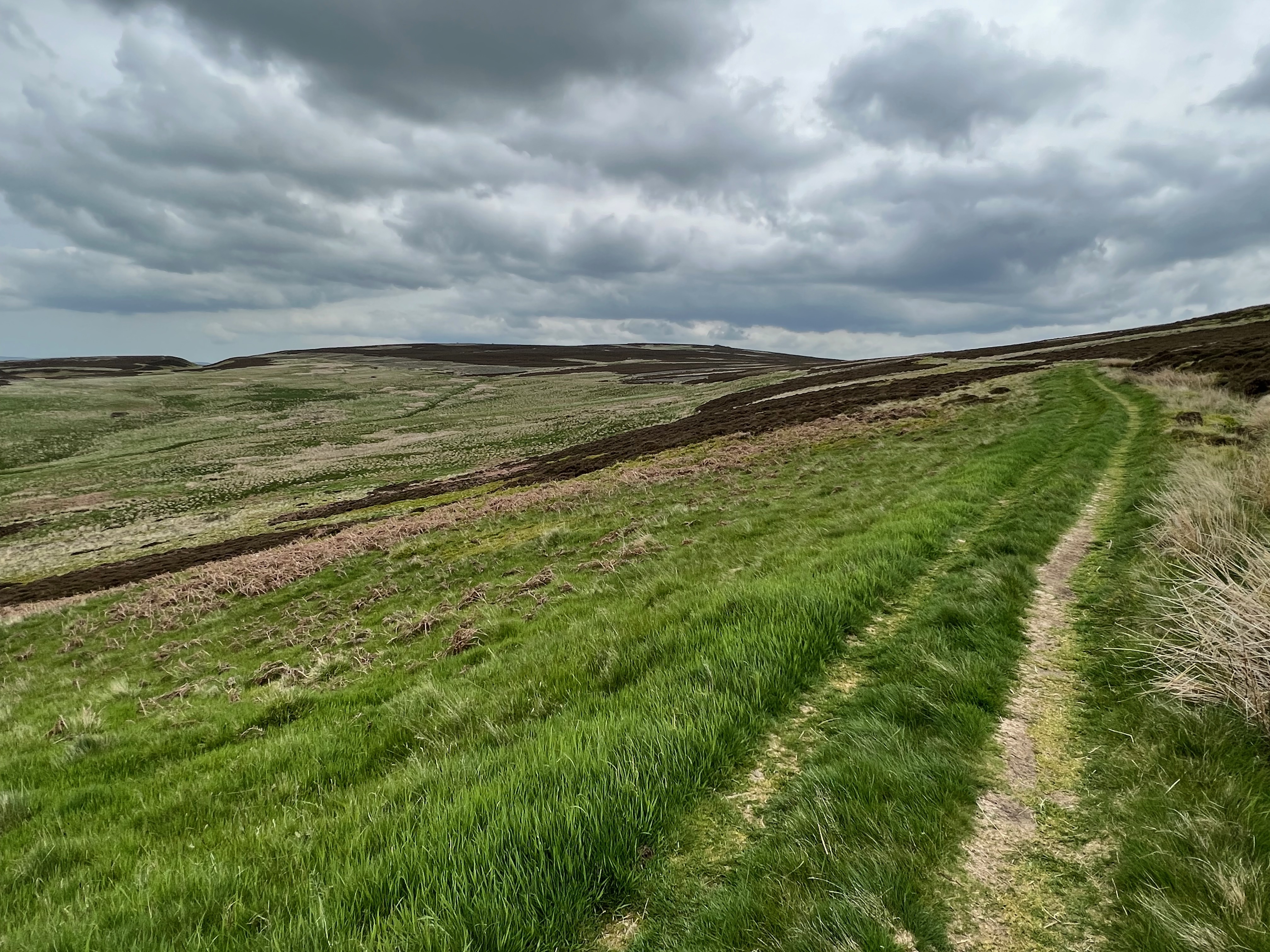
Ascending the moorland of the Cheviot Hills.

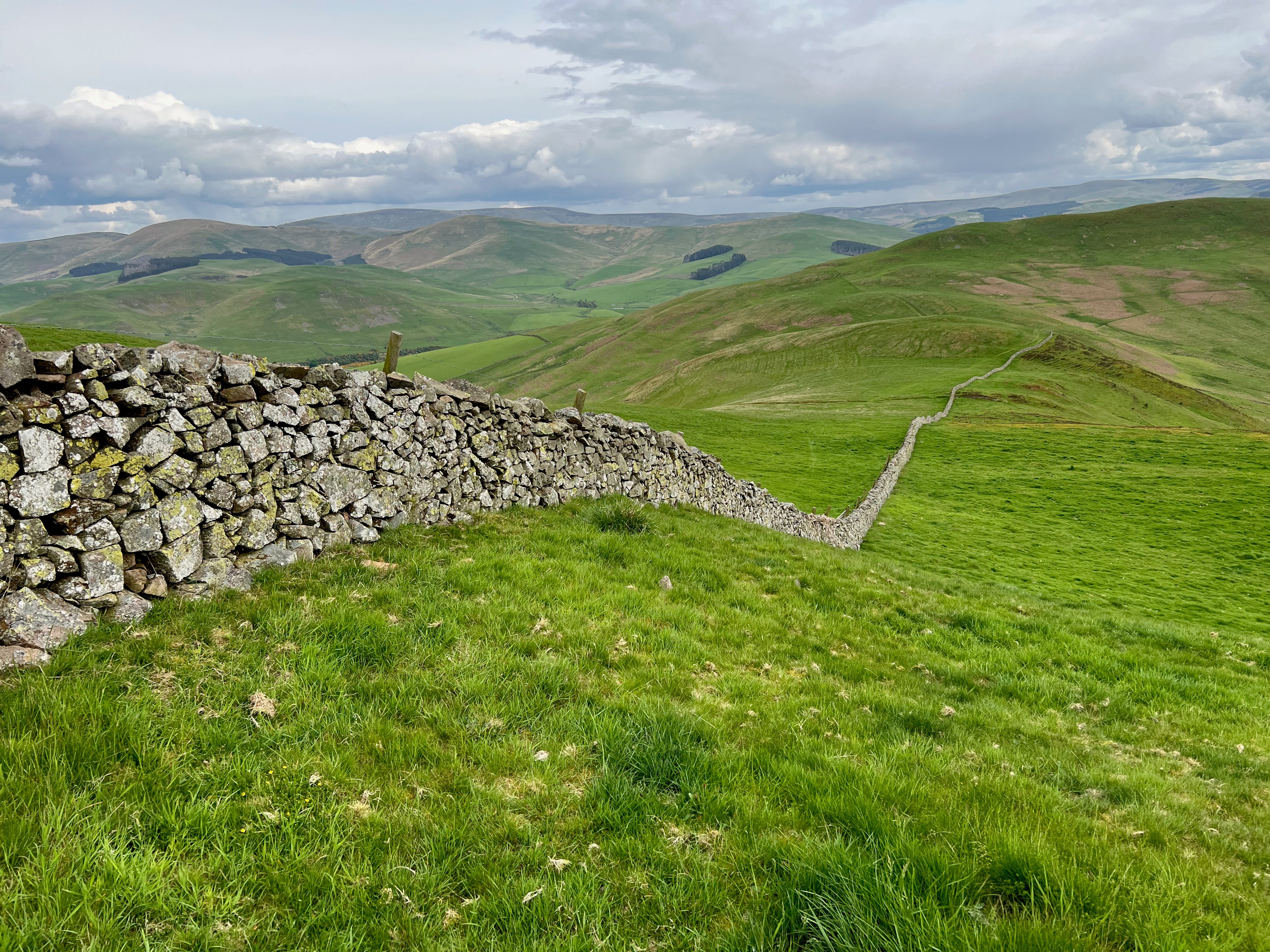
The whole next day was up and down through the Cheviots. The high country has feral goats, Iron Age forts, and a couple of crashed planes that lost their way in World War II. I didn’t see any of that. I was focused on dragging my tired body over the hump. The bleak sky and the treeless summits dampened my spirits a bit (Praise God when the road is easy! Praise God when the road is hard!). But it was still thrilling to hear the long, slowly rising whistle of the Eurasian curlews as they swooped across the heather. 

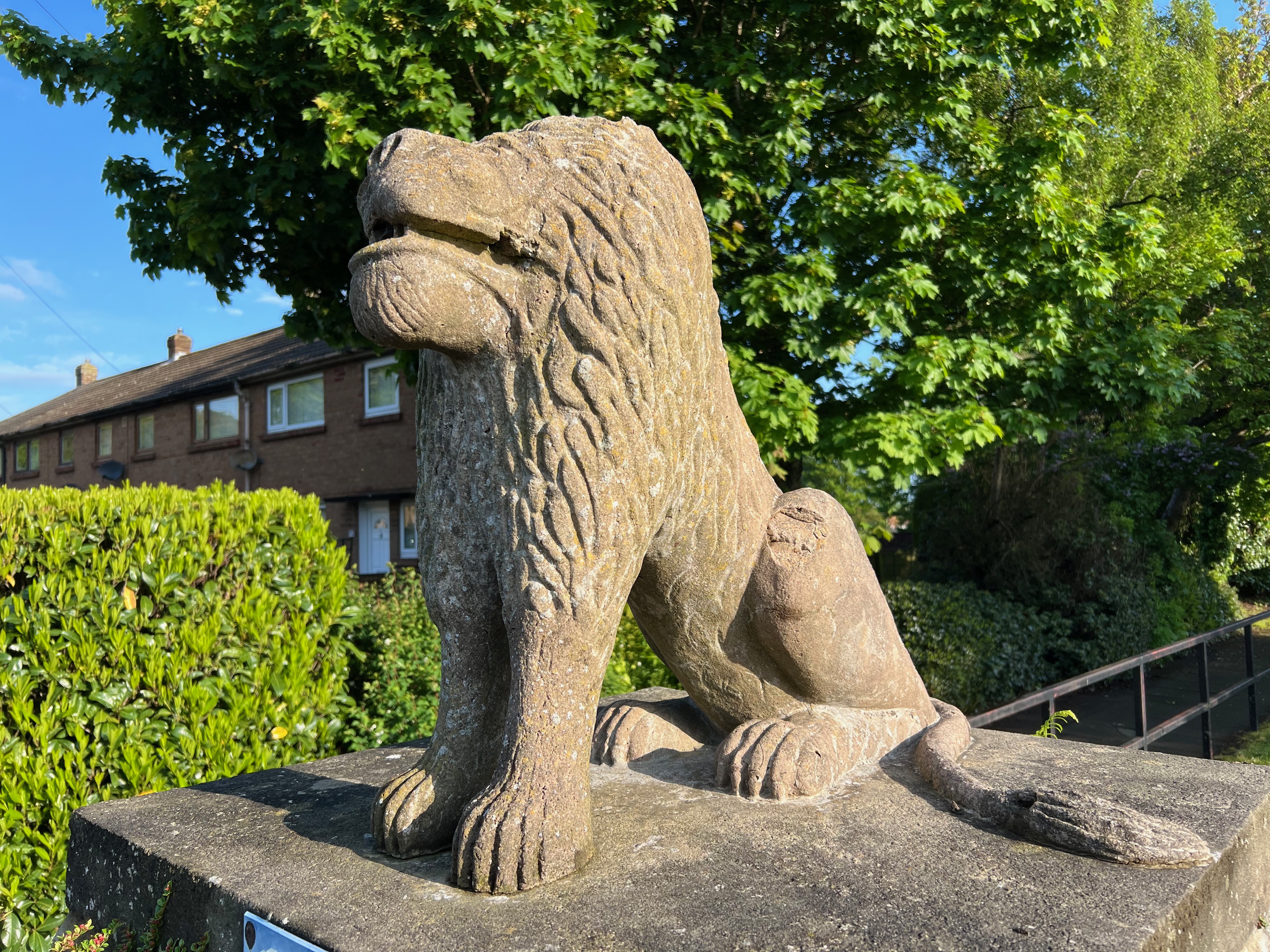
Gatepost lion in Wooler.

After a gloomy day in the Cheviot Hills, my final miles to the coast were brilliantly lit and my heart was high. This stone lion at a schoolyard entrance was carved by an Italian prisoner of war during World War II, when the facility was a POW camp. It looks like something you’d find in Venice. Thinking of that prisoner managing to make art amid the chaos of war, I’m tempted to say that art is long and war is short, but in these days of perpetual conflict I’m not so sure.

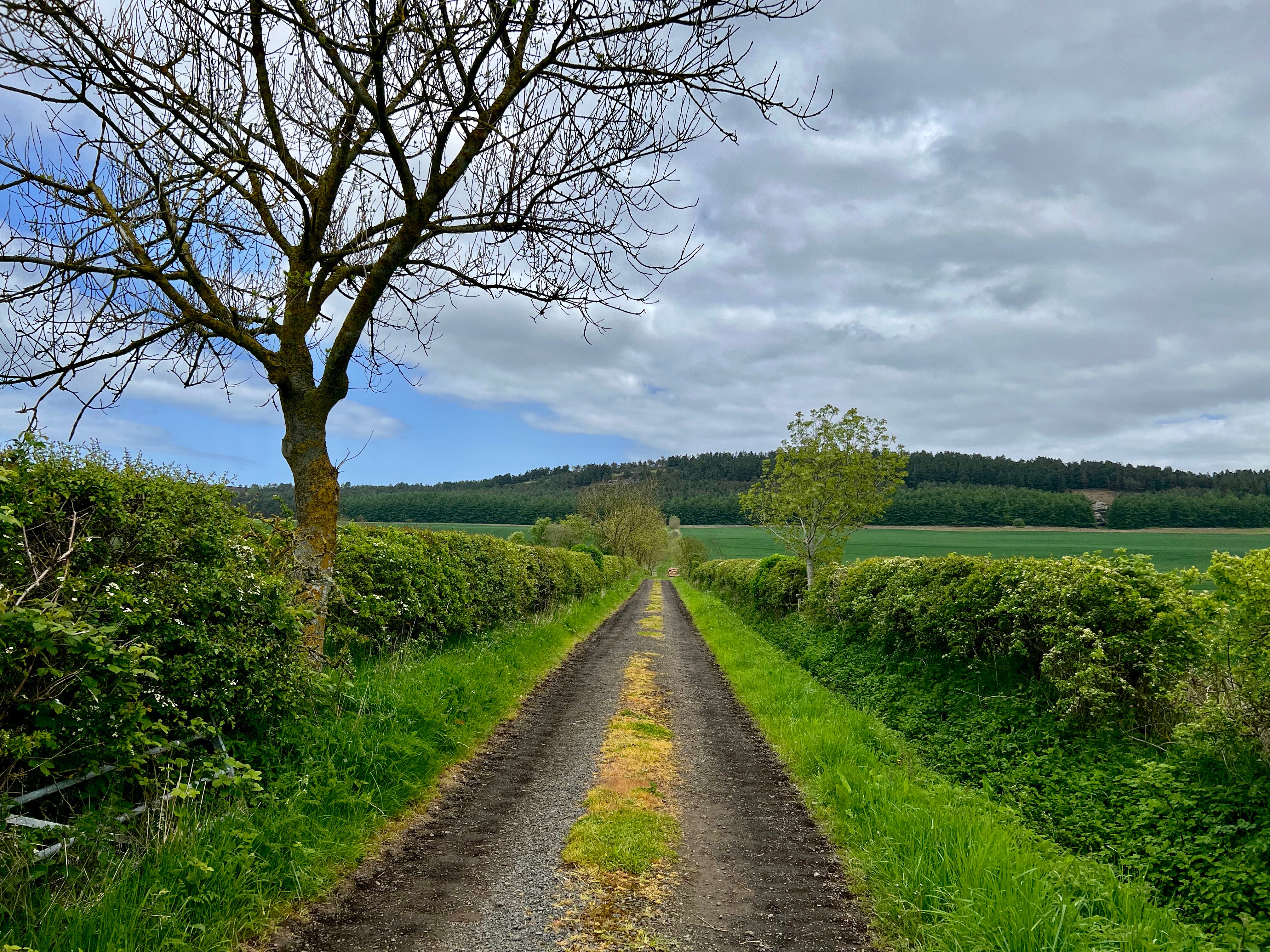
Toward the final ridge before the coast.
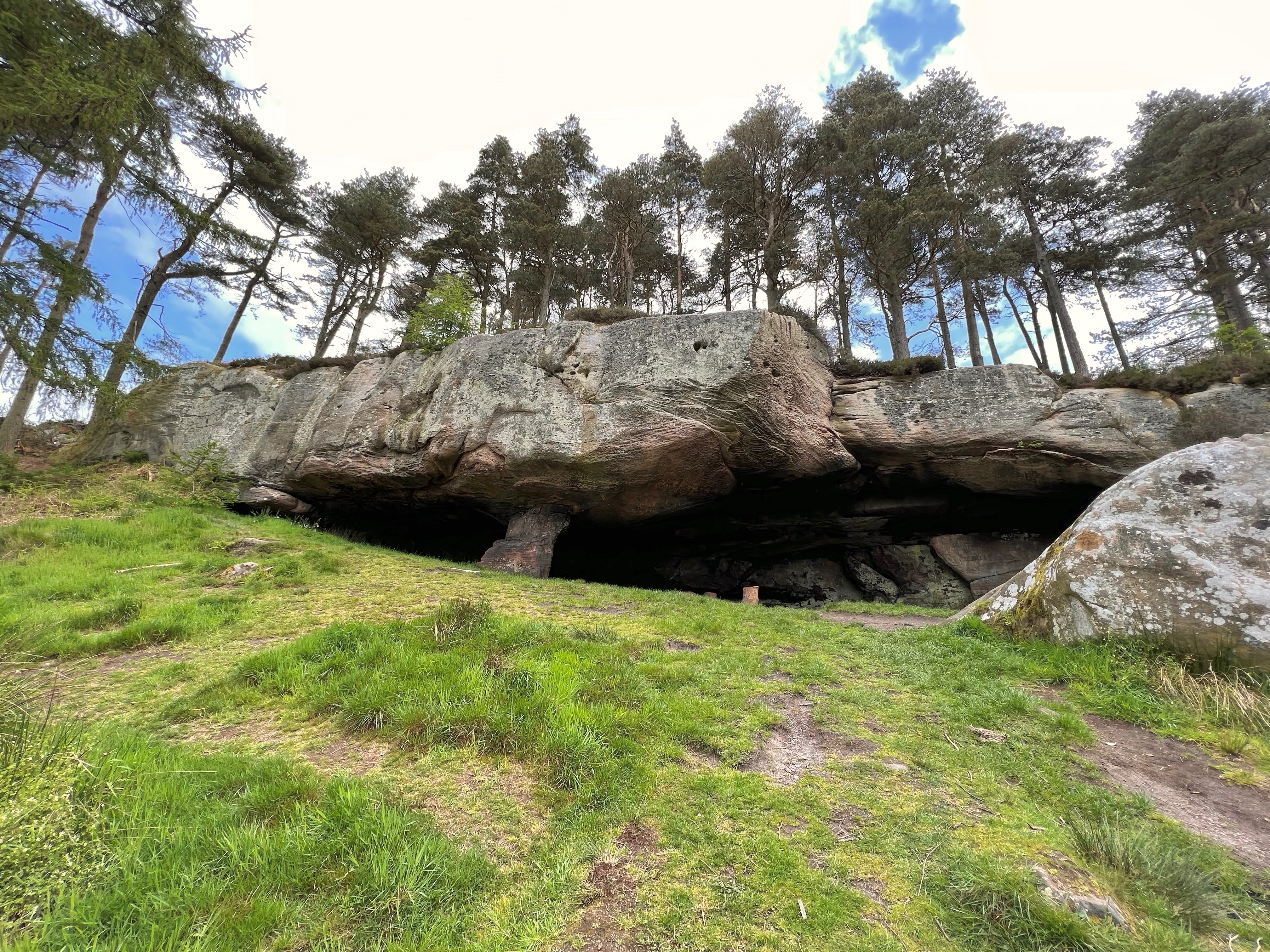
St. Cuthbert’s Cave.

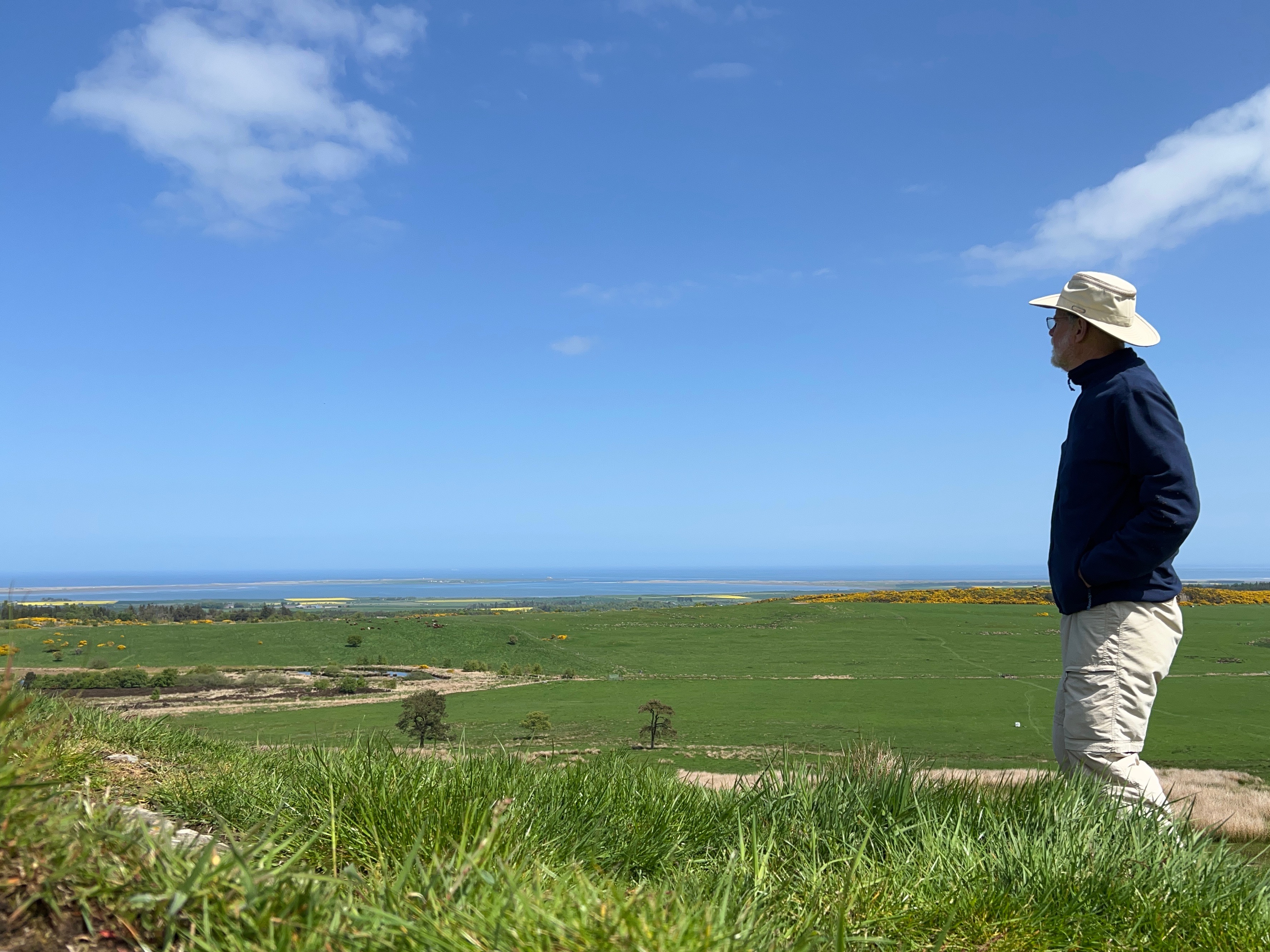
The first sign that I was nearing the sea was a flock of gulls circling above me. Just one more forested ridge, and the coast would be visible. After marveling at the massive sandstone overhang of St. Cuthbert’s Cave (where monks carrying his remains are said to have sheltered while fleeing Viking raiders), I climbed to the rise just above it. And there I saw my Promised Land: Holy Island, refulgent beneath the noonday sun.

When Lewis and Clark got their first glimpse of the Pacific after 18 months crossing the American continent, Clark recorded their delight in his journal: “Ocian in view! O the joy.” When I reached that ridge above the Northumbrian sea, I spoke those words out loud.

My first view of Holy Island.
Ocean in view!

“To walk there is to earn it, through laboriousness and through the transformation that comes during a journey … We are eternally perplexed by how to move toward forgiveness or healing or truth, but we know how to walk from here to there, however arduous the journey…. In pilgrimage, the journey is radiant with hope … geography has become spiritualized.”

— Rebecca Solnit [vii]       

Walking St. Cuthbert’s Way


THE ST. CUTHBERT SERIES CONTINUES:

Grace and Beauty on Holy Island

The Journey Ends: Durham Cathedral

All photographs and video are by the author.

For links to my posts on the Camino de Santiago: https://jimfriedrich.com/2020/07/25/seek-ye-first-scenes-from-the-camino-de-santiago/


[i] Geoffrey Chaucer, The Canterbury Tales (Prologue, 11-18), trans. Burton Raffel (Modern Library, 2008).

[ii] Susan Stewart, The Ruins Lesson: Meaning and Material in Western Culture (Chicago: University of Chicago Press, 2020), 238.

[iii] Dante, The Inferno 1.60, trans. Robert Hollander & Jean Hollander (Doubleday, 2000).

[iv] William Wordsworth, The Prelude (1.14-18).

[v] John of the Cross, The Ascent of Mt. Carmel.

[vi] Edward Gibbon, from the closing chapter of History of the Decline and Fall of the Roman Empire.

[vii] Rebecca Solnit, Wanderlust: A History of Walking (Penguin, 2001).