“For God so loved our stories” — Tales from the Easter Vigil

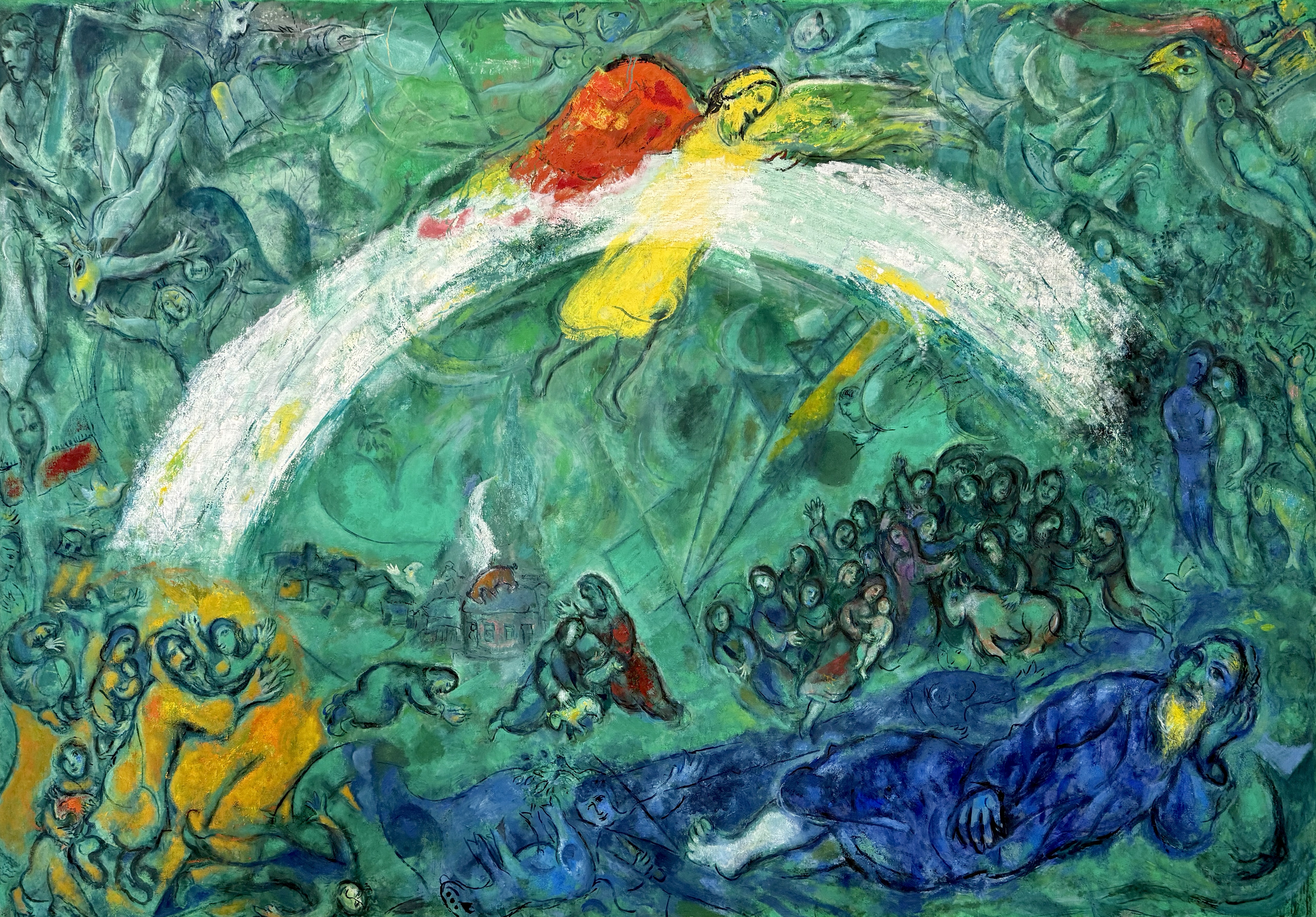
Marc Chagall, Noah and the Rainbow (1961-66)

How blessed is this night, when earth and heaven are joined …

— The Exultet [i]

The Easter Vigil is the molten core of Christian worship: a multisensory passage from darkness to light, death to life. With fire and water, stories and prayers, hymns and chants, candles and incense, bread and wine, it is the most luminous and wondrous of liturgies. The morning rites of Easter Sunday celebrate Resurrection, but the Easter Vigil on the night before feels almost like Resurrection itself. When it’s over, you come away a little dazed, wondering “oh what is that beautiful thing that just happened?” [ii]

After the New Fire is lit at sunset on Holy Saturday, one of the first things that happens at the Easter Vigil is the recitation of narratives and prophetic texts [iii] from the Hebrew Scriptures, beginning with the Creation story (Genesis 1:1—2:4a). In most churches, the texts are read from a lectern, but for nearly four decades, in a dozen different West Coast churches, I have curated the performance of the Vigil lectionary using drama, storytellers, music and projected media.

There’s nothing wrong with a well-read passage of canonical text—I’m quite fond of a good reading by a practiced and thoughtful voice—but sometimes a telling or dramatization can reach places which a reading cannot. Instead of a reader as a passive, transparent window for a sacred text to pass through without inflection or distortion, a teller embodies the text in breath, intonation, gesture and movement, making it alive and present and urgent in the moment of its speaking. And a dramatization can make a familiar story be freshly encountered. A story told or performed rather than read has a unique kind of authority, coming from the heart instead of a book.

The Easter Vigil is the Christian dreamtime, and we try to engage its lectionary accordingly. Biblical stories aren’t just memories about the past. They are living words meant to guide and shape our own responses to the present. As we become steeped in the stories, they begin to dwell in us, and we in them.

When we hear of the world drowning in its own evil, while a faithful remnant tries to navigate the sea of chaos, we recognize ourselves aboard the ark. When we hear of an evil regime trying to crush the ones who are “not like us,” the deliverance of the oppressed at the Red Sea encourages our own struggle to break free of the dark. When we hear of dry bones resurrected by divine breath, our own dead hopes begin to breathe again.  

In the darkest days of the Second World War, W. H. Auden wrote a “Christmas Oratorio” [iv] which had no illusions about the world into which God was made flesh:

The evil and the armed draw near;
The weather smells of their hate
And the houses smell of our fear …

Such days are upon us again, and we truly need our sacred stories—the ones that remember divine intention and a habitable future—more than ever. At our Episcopal parish of St. Barnabas on Bainbridge Island, Washington, where my wife is the rector, I’ve been developing fresh versions of the stories, listening carefully for whatever they want to say to us in the year of our Lord 2025.

We will begin with a pair of texts projected on a screen after the ancient Exultet is chanted. The first says, For God so loved our stories. This is of course a blend of Elie Wiesel’s “God made man because he loves stories” and John 3:16’s “For God so loved the world …” The theology of Incarnation says that God’s own self entered fully into the human story. And the theology of salvation says that we in turn are meant to participate in the divine story. Both meanings are implied in the preface to our Vigil story time, grounding the performed narratives in the conviction that we can meet God in them.

The second text is a verse from Jeremiah (29:11): For surely I know the purpose I have for you, says the Holy One: plans for peace and not for evil, to give you a future and a hope. At a time when our future is in question and hope is stretched thin, God invites us to sit around the Paschal fire and let the stories of promise speak to our hearts once more.

Here is how the telling will go at this year’s Paschal fire:

The Creation: After the voice of e.e. cummings says, “When God decided to invent everything, he took one breath bigger than a circus tent, and everything began,” a big screen lights up with spectacular footage of the natural world, taking us through the first seven days in seven minutes. In response, the congregation is urged “to pray fervently for all the people of the earth, and for ourselves, that we may repent of our careless and arrogant abuse of creation, and find our proper and constructive place within its fragile and balanced harmonies.”

The Flood: Four people at a table engage in Bible study. Some of them resist the story (“Why do we even tell this story? No one wants to believe in an angry God” … “In the beginning, God says everything’s so great. Then suddenly he wants to call the whole thing off?”). Others see a kind of learning going on—God learning to live with an imperfect creation. Then somebody argues that the story is not really about God’s choices or God’s emotional life. It’s about the ark.

“The people who first told this story were just like us. They were adrift in a sea of chaos. Everything they had hoped and believed was underwater, washed away in the blink of an eye, and they wanted to know if they still had a future.”

As the discussion winds down, someone says, “Well, I’d better go feed the animals.” Wild waves appear on the screen behind them. It turns out that they have been on their own ark the whole time. The story they were discussing was happening to them. That’s often true of Bible stories.

The exhortations to prayer that follow each story reiterate the themes of the narrative. After The Flood, the Presider reminds the assembly that “God remains deeply committed to our story … God will not forget us, though we be sinking in a sea of chaos.” And the Deacon bids us pray for victims of natural disasters, all whose lives are beset by chaos, those drowning in the dark waters of doubt and fear, and those who cling to the precious ark of faith.

The Red Sea:

Noirish images of anonymous figures (from a bleak Hungarian film) shuffle through an imprisoning corridor on the screen, while three dancers on the stage express the experience of oppression with their bodies. A narrator explains:

Three thousand years ago, in the land of Egypt,
there were people who had no name.
They were the faceless many,
exploited by the powerful,
forgotten by the privileged: slaves, immigrants, the poor,
the homeless, the vulnerable, the invisible, the outcast.

Then dismissive terms for the oppressed appear on the screen in stark animated graphics: Not like us … worthless … horrible people … trash … less than human. More images of “the faceless many” are shown as the dancers writhe in despair and an offstage choir sings a verse of “Go down, Moses.”

Suddenly, the divine breaks into this dark world: the screen flashes red, and we see the words from Psalm 68 that are always used in Orthodox Paschal liturgies:

Let God arise!
Let the foes of Love be scattered!
Let the friends of justice be joyful!

Then we hear a verse of a Civil Rights song: “They say that freedom is a constant struggle … Oh Lord, we’ve struggled so long, we must be free.” The dancers’ bodies shift from oppression to liberation, while the screen shows powerful footage of crowds on the march for justice. As we hear a repeating loop of Martin Luther King saying “We cannot walk alone,” the dancers begin their own march across the stage to the “Red Sea,” where they halt while the narrator declares:

This too is a creation story:
On this day, God brought a new people into existence.
On this day, God became known as the One who delivers the oppressed,
the One who remembers the forgotten and saves the lost ,
the One who opens the Way through the Sea of Impossibility,
leading us beyond the chaos and the darkness into the Light.
When the world says No, the power of God is YES!

As the dancers begin to cross the Sea, the choir sings, “We are not alone, God is with us …”
After the song, the bidding to prayer begins:

Pray now for the conscience and courage
to renounce our own complicity
in the workings of violence, privilege and oppression.
Pray in solidarity with all who are despised, rejected,
exploited, abused, and oppressed.
Pray for the day of liberation and salvation.

The Fiery Furnace: This story from the Book of Daniel is borrowed from the Orthodox lectionary for the Paschal Vigil, and its humor (yes, the Bible can be funny) provides some comic relief after the Red Sea. The story’s mischievous mockery of a vain and cruel king, outwitted in the end by divine intention, feels quite timely. The idol shown on the screen is a golden iPhone, which will be destroyed by a cartoon explosion from Looney Tunes. The humorously tedious repetition of the instruments signaling everyone to bow is performed with the following (admittedly unbiblical) instruments: bodhran, bicycle horn, slide whistle, chimes, train whistle, and Chinese wind gong. The Song of the three “young men” in the furnace is recited by three women in an abbreviated rap version. At the end, the cast of twelve exit happily, singing the old Shape Note chorus, “Babylon is fallen, to rise no more!”

The Fall of Babylon, Tapestry of the Apocalypse, Angers, France (1377-1382).

Then we give thanks “for the saints who refuse to bow down to the illusions and idolatries of this world” and pray for “the grace and courage to follow their example, resisting every evil, and entrusting our lives wholeheartedly to the Love who loves us.”

Valley of Dry Bones: Unlike the embellished retellings of the other stories, this one sticks closely to the biblical text, but is delivered in a storytelling mode by a single teller (me) in a spooky atmosphere of dim blue light. The voice of God is a college student on a high ladder. The sound of the bones joining together is made by an Indonesian unklung (8 bamboo rattles tuned to different pitches). When the story describes the breath coming into the lifeless figures sprawled across the valley, I get everyone in the assembly to inhale and exhale audibly a few times so that we can hear the spirit-breath entering our own bodies. Then I move among them, bidding one after another to rise until everyone is standing, completing the story with their own bodies: the risen assembly itself becomes a visible sign of hope reborn.

Then the Presider says,

Dear People of God: There are those who tell our story as a history of defeats and diminishments, a narrative of dashed hopes and inconsolable griefs. But tonight we tell a different story, a story that inhales God’s own breath and sings alleluia even at the grave. By your baptism, you have been entrusted with this story, to live out its great YES against every cry of defeat.

And then, with our sacred stories of faith and hope freshly written on our hearts, we will process from the Story Space to the church for the Renewal of Baptismal vows, followed by the festive first eucharist of Easter, replete with Alleluias. And God willing, by the time it’s all done, none of us will be the same.

May all of you who make the Paschal journey this weekend come to “see and know that things which were cast down are being raised up, and things which had grown old are being made new, and that all things are being brought to their perfection by the One through whom all things were made, our Savior Jesus Christ.” [v]

Resurrection of Christ, Brittany (c. 1425-1430).


All liturgical texts, unless otherwise cited, are by the author.
The Easter Vigil at St. Barnabas Episcopal Church (Bainbridge Island, WA) is on April 19, 2025.

[i] The Exultet (“rejoice”) is a chanted praise sung before the Paschal Candle at the Easter Vigil. Dating back to the 7th or 8th century, it is one of the most beautiful chants in the western rite, and its text is packed with striking images and metaphors of Christ’s passage through death to resurrection, and its implications for our own salvation. Singing it at the Vigil has been one of my greatest priestly joys over the years.

[ii] The line is taken from Mary Oliver’s poem, “At Blackwater Pond.”

[iii] The Vigil lectionary is not all stories. Beautiful texts from Isaiah, Baruch, Ezekiel, and Zephaniah are options as well. During the “Story Time” of the Vigil, we stick to the narratives. The non-narrative texts are then recited by readers along the way between the Story Space and the church, so that the people process through a corridor of continuous audible texts on their way to the font of rebirth.  

[iv] W. H. Auden began writing For the Time Being: A Christmas Oratorio in the autumn of 1941. It was published in September, 1944). Dark times indeed.

[v] Quoted from the collect (prayer) that concludes the Old Testament readings in the Episcopal Book of Common Prayer.

Seeking the Good at the End of the World (Homily for Advent 1)

Extra! Extra! Read all about it.
SUN GOES OUT!
STARS FALL FROM HEAVEN!
THOUSANDS FAINT FROM FEAR!

On the first day of the Christian Year, do we break out the champagne and shout “Happy New Year.” No we do not. What we say is, “The end is near!”

We don’t get all Fundamentalist about it. We don’t walk around wearing signboard warnings. We don’t declare a fixed date for the end of history. We prefer to keep our end time theology more metaphorical than literal. Worlds end all the time. Personal worlds. Public worlds.

Still, this year, from Gaza and Ukraine to Washington, D.C., the end of the world feels closer to being literal than any other time in my 80 years on the planet. To borrow some lines from W. H. Auden’s Good Friday poems, lately it feels as if the world we know has been “wrecked, / Blown up, burnt down, cracked open, / Felled, sawn in two, hacked through, [and] torn apart.”

For Christians, the end of the world should not come as a total surprise. Every gospel on the First Sunday of Advent includes a forecast of the apocalypse—the end of the world as we know it. It’s not that uncommon, actually. Who has not experienced apocalypse on a personal level—the exit from childhood, the loss of a job or a loved one, a scary diagnosis? And throughout history, apocalyptic episodes have periodically disrupted the stability of humanity’s collective life: the fall of empires, economic crashes, military invasions, revolutions, authoritarian nightmares, environmental crises, and the like.

In the Humphrey Bogart movie, Beat the Devil, a ship is floundering on a stormy sea. In his typical wise-cracking manner, Bogie says to a panicky passenger, “What have you got to worry about? We’re only adrift on an open sea with a drunken captain and an engine that’s liable to explode at any moment!”

A crewman chimes in: “Perfectly ordinary situation. It happens every day.”

Like it or not, we’re all on board that sinking ship at the close of 2024, praying desperately with the Psalmist, “Save me, O God! The water has risen up to my neck; I’m sinking into the mire” (Psalm 69:1-2) Perfectly ordinary situation. It happens every day.

Angel blowing the 2nd trumpet as the sea swallows ships and sailors (Revelation 8:8). The Apocalypse Tapestry of Angers (1373-1382). Photograph by the author.

When I was younger, I had a crushing experience of my personal world coming undone. A spiritual director summed up my situation as being washed overboard into a wild sea, where I’m flailing to keep my head above water.” “Sounds about right,” I said mournfully. “Well, congratulations!” he told me. “You’re exactly where you need to be.” I had to laugh at the aptness of his metaphor. My apocalypse had indeed revealed the unsustainability of my former state, even as it hurled me into the formless chaos from which my new world would be born.

Saint Michael weighing souls (c. 1180), Saint-Trophime, Arles, France. Photograph by the author.

Apocalypse can be an unwelcome judgment on the way things are. It weighs the world in the scales of justice and finds it wanting. The judgment is not punitive, simply accurate. As a 14th-century English poem on the end of the world put it, the apocalypse judges “without revenge or pity.” It just tells it like it is. Still, it’s a hard thing to face the truth about our flawed condition. However, the end of an old reality can also be life-giving, freeing us to discover a better version of self and world.  

But where can we put our feet when the ground is crumbling beneath us?  We stand on God’s word, God’s promise, God’s hope. “Heaven and earth will pass away,” Jesus says, “but my words will not pass away.” Let the Savior’s words guide us. Let them encourage us. As he told his disciples,

“When the chaos comes, keep your heads high and stand your ground. Your liberation is on its way.  Don’t be distracted by thoughtless living, or get weighed down with worry,” he says. “Be alert at all times, and pray that you’ll have the strength to get through all this craziness.” [i]

This is my 55th year of preaching in Advent. It’s my favorite season, so rich with resonant and stirring themes: endings and beginnings, light and darkness, waiting and preparing, watching and hoping, expectation and, in the end, marvelous birth. But this year Advent feels decidedly more urgent and more serious to me than ever before. We aren’t just reading about a people who sit in darkness. We are those people.

We could weep and moan about being stuck in this particular moment in history. But what if the Lord of history is telling us, “Congratulations! You are just where you need to be—in the wild baptismal sea of rebirth. Come, take up your cross. Following me is about to get really real and really intense. Costly? Yes. Suffering? Yes. Dying? Yes. Rising? Yes! Start to live the risen life like you mean it!

Okay, Lord. But what exactly is that going to entail? This question came up when I ran into friend from church on the ferry last week. “What are we supposed do if they begin to round up the most vulnerable in our midst?” she asked. “Join hands to block their way with our bodies?” The strangeness of such a hypothetical even being asked in our peaceful corner of the world prompted a helpless shrug.

Seeking some guidance from my library, I pulled out a book published a few years ago: The Year of Our Lord 1943: Christian Humanism in an Age of Crisis. The author, Alan Jacobs, examins the responses of Christian intellectuals to the violent chaos of the Second World War. What did some of the most articulate of God’s friends have to say about being faithful in a dark and dangerous time?  

When the war broke out in 1939, Anglican poet W. H. Auden put the case bluntly: We must love one another or die. A year later, he wrote New Year Letter (January 1, 1940), a long poem considering “what is possible and what is not” in such a time.

Most of the poem is addressed to Elizabeth Mayer, a supportive maternal figure who was a key source of peace and happiness in Auden’s life.

We fall down in the dance,” he wrote. “We make
The old ridiculous mistake,
But always there are such as you
Forgiving, helping what we do.
O every day in sleep and labour
Our life and death are with our neighbor.

In other words, we are all in this together. The end of New Year Letter is addressed to God, asking for divine help in making a better world, since we humans are too muddled to do it on our own.

“Send strength sufficient for our day,” he wrote. “And point our knowledge on its way.”[ii]

His friend C. S. Lewis worried about the Church endorsing the violence in its prayers. On September 10, 1940, he wrote to his brother, “In the litany this morning we had some extra petitions, one of which was ‘Prosper, O Lord, our righteous cause.’ I ventured to protest against the audacity of informing God that our cause was righteous—a point on which He may have His own view.” [iii]

Lewis preferred the wartime collect of Thomas Cranmer, the Archbishop of Canterbury who made the first Book of Common Prayer. During hostilities with Scotland in 1548, Cranmer wrote this extraordinary collect:
“Most merciful God, the Granter of all peace and quietness, the Giver of all good gifts, the Defender of all nations, who hast willed all men to be accounted as our neighbours, and commanded us to love them as ourself, and not to hate our enemies, but rather to wish them, yea and also to do them good if we can: … Give to all us desire of peace, unity, and quietness, and a speedy wearisomeness of all war, hostility, and enmity to all them that be our enemies; that we and they may, in one heart and charitable agreement, praise thy most holy name, and reform our lives to thy godly commandments.” [iv]

In other words, in times of conflict, Christians must take care not to mirror the violence we oppose. We must find a way toward peace and reconciliation. But what if there are no good choices available?

The German theologian Dietrich Bonhoeffer knew how bitter conflict corrodes the human heart. In a 1942 letter to fellow members of the German resistance, he wrote:

“Unbearable conflicts have worn us down or even made us cynical. Are we still of any use? We will not need geniuses, cynics, people who have contempt for others, or cunning tacticians, but simple, uncomplicated and honest human beings.” [v]

In the desperate hope of derailing the Nazi horror, Bonhoeffer reluctantly joined a conspiracy to assassinate Hitler. The plot failed and he was executed for his role in it. A new film about him depicts him going to the gallows confident in his own purity of heart, but the fact is he never stopped feeling guilty for his participation the way of violence. He felt corrupted by the whole milieu of bloody conflict: shooting, wrecking, bombing—none of it is untainted by evil.

Simone Weil, French philosopher and activist, agreed that everyone is a victim of war. No one involved in the application of force escapes its toxicity. “To the same degree,” she said, “though in different fashions, those who use it and those who endure it are turned to stone.” When the Second World War started, Weil warned that

“We should not think that because we are less brutal, less violent, less inhuman than those we are confronting, we will prevail.” We must find a way, she insisted, to exercise the opposing virtues.

In late 1942, when Weil was working in the London office of the French Resistance, she proposed a plan to parachute hundreds of white-uniformed nurses onto battlefields, not only to tend to the wounded but also to provide an image of self-sacrificial goodness in the midst of cruelty and violence. She herself wanted to be in the first wave of this non-violent invasion. In submitting her plan to the Free French authorities, she made a visionary argument:

A small group of women exerting day after day a courage of this kind would be a spectacle so new, so significant, and charged with such obvious meaning, that it would strike the imagination more than any of Hitler’s conceptions have done.” [vi]

Charles de Gaulle thought her quite mad, and her plan of course went nowhere. But her saintly resistance to the application of force was a bright candle in the wind of war.

I am moved by all the stories of faithful people trying to follow the light in an age of shadows. Their wsdom can guide us. Their endurance can encourage us.

Now saintly virtues may not be the way of the world, but as Thomas Merton liked to say, we are not called to be successful. We are called to be faithful. “Perfect hope,” he wrote, “is achieved on the brink of despair when, instead of falling over the edge, we find ourselves walking on air.” [vii]

Remember those old Sherlock Holmes movies with Basil Rathbone> In 1942, when the outcome of the war was still uncertain, Universal Studios modernized Holmes, recruiting the Victorian detective for the war effort in Sherlock Holmes and the Voice of Terror. After a successful takedown of Nazi spies, Holmes and Watson walk to edge of Dover’s cliffs to gaze across the English Channel. Watson begins the conversation that concludes the film:

—“It’s a lovely morning, Holmes.”
—“There’s an east wind coming, Watson.”
—“Oh, I don’t think so. It looks like another warm day.”
—“Good old Watson. The one fixed point in a changing age. There’s an east wind coming, all the same. Such a wind as never blew in England yet. It will be cold and bitter, Watson. And a good many of us may wither before its blast. But it’s God’s own wind, none the less. And a greener, better, stronger land will lie in the sunshine when the storm has cleared.”

That bit of wartime propaganda, pep talk for a battered nation, came to mind as I pondered on today’s apocalyptic theme. “A cold and bitter wind … many of us may wither before its blast.” An accurate forecast. But beyond that, a glorious spring, when a “greener, better, stronger land will lie in the sunshine.”

God, bring that day closer. In the meantime, we pray with Emily Dickinson (#131):

Grant me, O Lord, a sunny mind—
Thy windy will to bear!  

So—How exactly do we cultivate a sunny mind in a gloomy time? We’ve all been working that problem this fall. Over the past month, I’ve found myself focusing on three spiritual practices: Do not let your hearts be troubled … Don’t get lost in the dark … Remember beauty.

First thing: Do not let your hearts be troubled. Step away from the screen. Don’t obsess on worst case scenarios, fretting over every potential bad outcome. There are too many to count, and it will only discourage and exhaust you. Sufficient unto the day is the evil thereof.

As Palestinian-American poet Naomi Shihab Nye reminds us, we must “Break the Worry Cocoon”—

To live with what we are given—
graciously, as if our windows open wide as our
neighbors’, as if there weren’t insult at every turn.
How did you do that? … 

How did you survive so much hurt and remain gracious,
… how did you believe,
then and forever, breaking out
of the endless worry cocoon,
something better might come your people’s way? [viii]

Second thing: Don’t get lost in the dark. Don’t get mesmerized by the horror. Evil is like Medusa’s face. Gaze too long and you turn to stone. How do we hate hate without becoming hateful ourselves? The rage provoked by repugnant beliefs, bad behavior and delusional assertions can become addictive. It feels good to denounce the deplorable scoundrels. It’s even entertaining to watch others do it. We think we are resisting evil, but our hate only serves to feed the beast.

Third thing: Remember beauty.

During the American Civil War, landscape painting was very popular. It offered tranquil scenes of an American Eden, unspoiled by the tragedies of history. There wasn’t the slightest hint of the violence raging in the land. When I was looking through reproductions of those works the other day, I was particularly struck by Alfred Thompson Brecher’s “Up the Hudson.” The broad river is absolutely still. The misty atmosphere glows with amber light. One tiny figure drifts quietly in his canoe. It is a picture of absolute calm and peace. I was taken by its beauty, but what really hit me was the year it was painted: 1864, the same year the painter’s brother died in one of the war’s bloodiest battles.

Alfred Thompson Brecher, Up the Hudson (1864).

And I wondered: Did Brecher paint it before or after he got the terrible news? I’d like to think it was after, as if the artist were resisting despair by pledging his allegiance to the harmonizing beauty of God’s creation, a beauty that transcends every evil.

Remember beauty. In October, 1967, 100,000 people gathered at the Lincoln Memorial in the nation’s capital for the first national demonstration against the war in Vietnam. I was there with a number of fellow seminarians. There were speeches and songs during the day, but around sunset about half the crowd marched across the Potomac to the Pentagon, which was surrounded by soldiers in gas masks holding rifles with fixed bayonets. They stood frozen like statues when young women stuck flowers in their gun barrels. I had a camera, and took some dramatic closeups of the soldiers.

Paratroopers guard the Pentagon during the first national protest against the war in Vietnam (Octobver 21, 1967). Photograoph by the author.

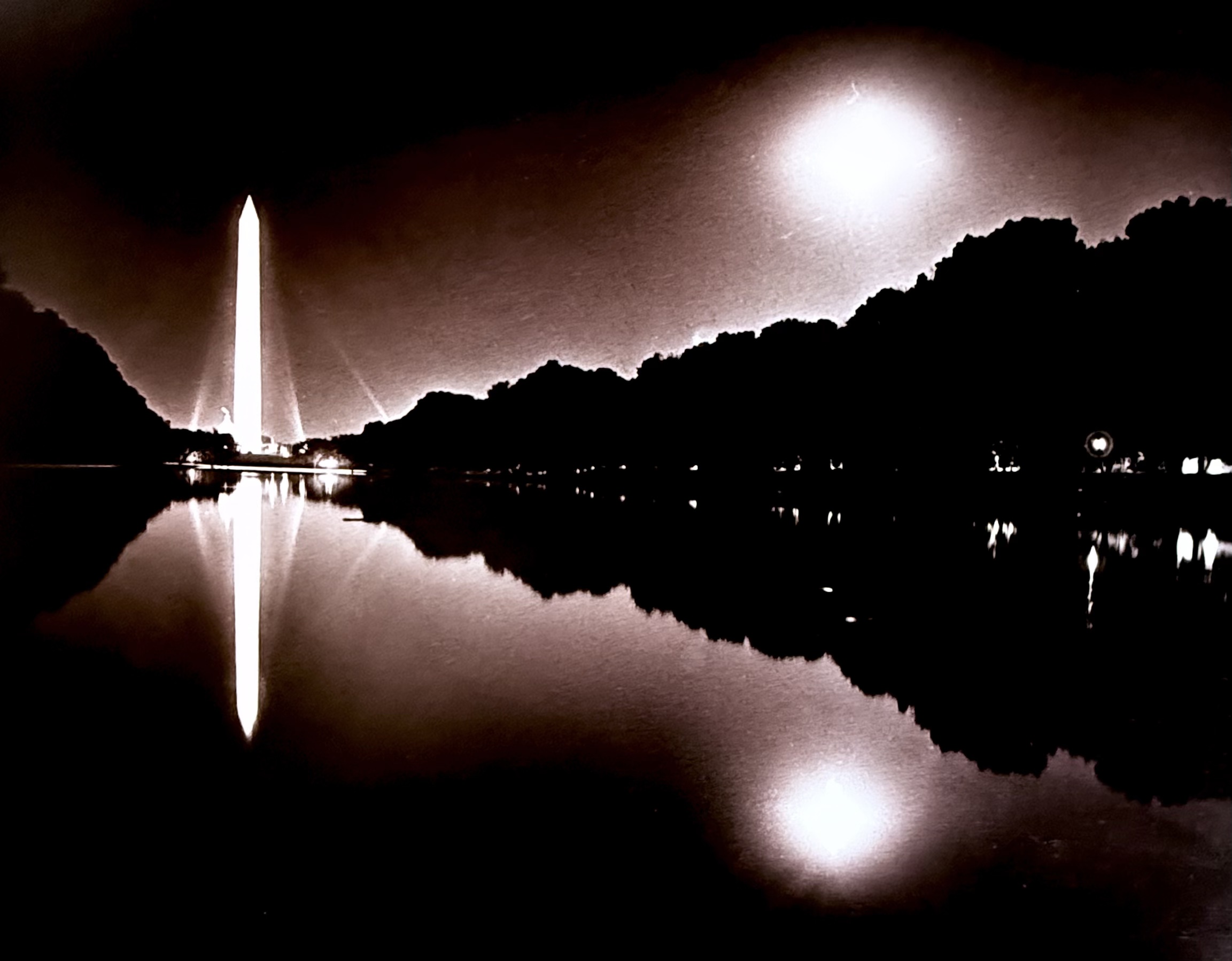
As the evening progressed, tensions grew, and a riot broke out, with lots of tear gas and hundreds of arrests. But I missed all that violence, because I had left early in order see the full moonrise over the reflecting pool in the National Mall. It was absolutely beautiful. I still have the photograph.

The full moonrise at the National Mall in Washington, D.C., on October 21, 1967. Across the Potomac at this moment, demonstators are clashing with paratroopers at the Pentagon. Photograph by the author.

On that day I had done my part in a public witness for peace; but when night came, the very best thing I could do was to notice the beauty of the moonrise. I like to think that both those things got recorded in the Book of Life. Come, labor on; but don’t forget the Sabbath moments.

Dear friends in Christ, let us cast away the works of darkness and put on the armor of light. Keep the faith. Fear not. Embody hope. Love one another. Trust divine intention. This is the holy work God has given us to do.

A few hundred years ago, Turlough O’Carolan, the blind harper and last of the Irish bards, was sitting in a tavern with his friend, the poet Charles McCabe. McCabe said, “Your music, sir, is grand and lovely stuff, but too light-hearted. This is a dark time we live in, Mr. Carolan, and our songs should reflect that.”

And the harper replied, “Tell me something, McCabe. Tell me this: Which do you think is harder—to make dark songs in the darkness, or to make brilliant ones that shine through the gloom?” [ix]

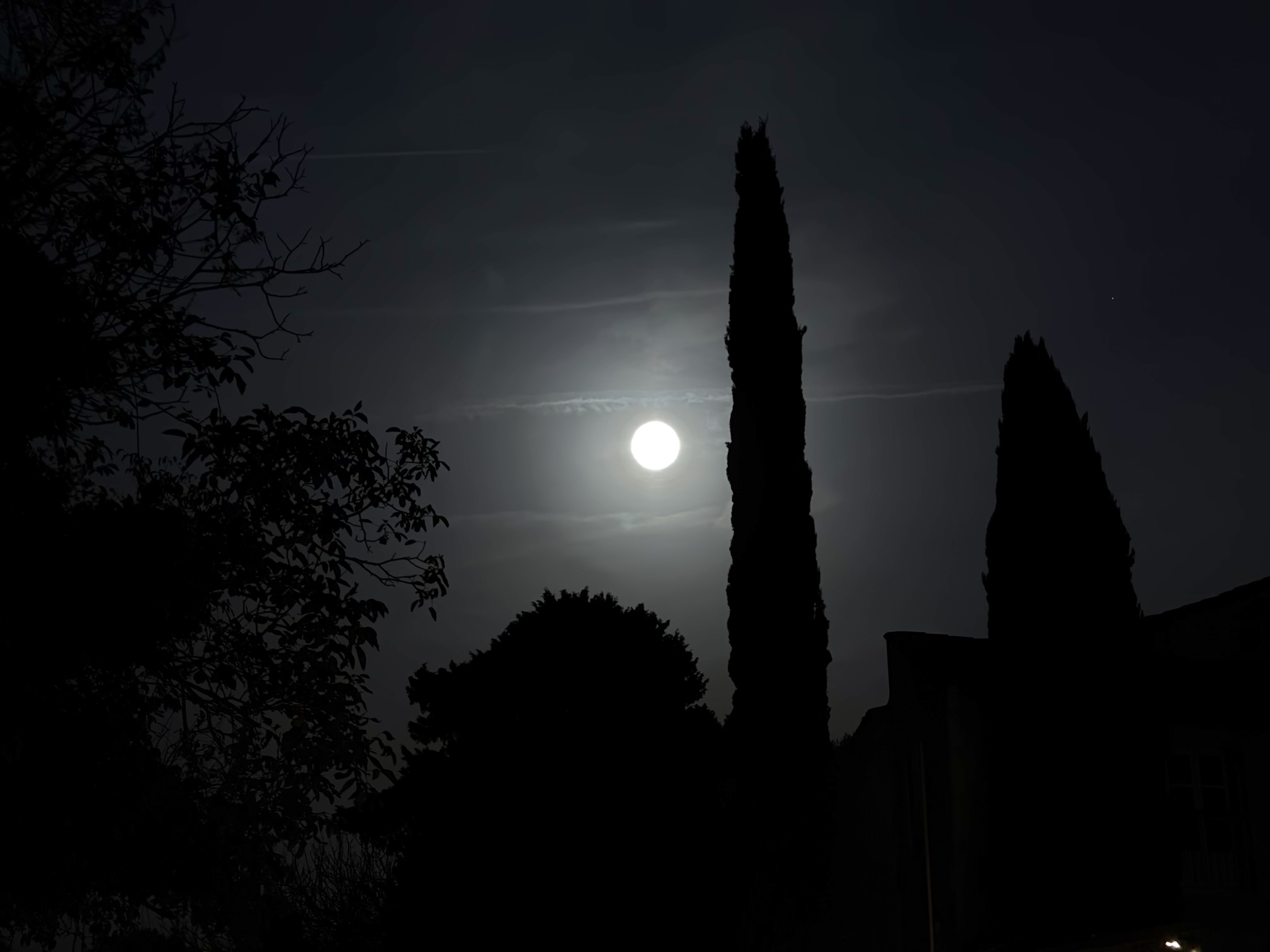
Provencal moon. Photograph by the author.

A homily for the First Sunday of Adven at Saint Barnabas Episcopal Church, Bainbridge Island, Washington.

The images of the Apocalypse are from the Tapestry of the Apocalypse in Angers, France. Originally 140 meters long, over time it has been reduced by a third. Woven in the late 14th century, it offers spectacular illustrations of the Book of Revelation.

[i] My free translation of Luke 21:28, 34-36.

[ii] W. H. Auden, New Year Letter (January 1, 1940).

[iii] q. in Alan Jacobs, The Year of Our Lord 1943: Christian Humanism in an Age of Crisis (Oxford: Oxford University Press, 2018), 10.

[iv] Ibid., 11.

[v] Dietrich Bonhoeffer, “After Ten Years” in Letters and Papers from Prison (Minneapolis: Fortress Press, 2010). Translated by Barbara and Martin Rumscheidt.

[vi] Simone Weil, quoted in Robert Zaretsky, The Subversive Simone Weil: A Life in Five Ideas (Chicago: University of Chicago Press, 2021), 155.

[vii] Thomas Merton, No Man Is an Island (206), q. in The Thomas Merton Encyclopedia (Maryknoll, NY: Orbis Books, 2002), 213.

[viii] Naomi Shihab Nye, “Break the Worry Cocoon,” Voices in the Air: Poems for Listeners (New York: Greenwillow Books, 2022), 96-97.

[ix] From the play, O’Carolan’s Farewell to Music by Patrick Ball and Peter Glazer, on the California Revels CD, Christmas in an Irish Castle (2001).

“We must learn to forget revenge”—Thinking about Gaza

Palestinian Christian girl in Ramallah (May 1989). I photographed her on Easter Monday 34 years ago. Does she have children? Are they safe? If we could see every face as an icon of God, peace would come.

“[A] contemplative politics will be one that is capable (as seems so unthinkable in public life at the moment) of recognizing and naming our own failure, the hurt done as well as received, and the perpetual slippage toward violence.”

— Rowan Williams [i]

“It is not easy / To believe in unknowable justice / Or pray in the name of a love / Whose name one’s forgotten: / … spare / Us in the youngest day when all are / Shaken awake, facts are facts, / (And I shall know exactly what happened / Today between noon and three) …”

— W. H. Auden [ii]   

After the unspeakable savagery of October 7, how can anyone think? The violence is too visceral, the wound too deep. Dispassionate discourse on causes and solutions risks sounding cold and inhuman amid our “tears of rage, tears of grief.”  Susan Sontag tried it after 9/11: “Let’s by all means grieve together,” she wrote in The New Yorker. “But let’s not be stupid together. A few shreds of historical awareness might help us understand what’s happened.” [iii] Sontag’s cool detachment was widely criticized for being tone deaf to the moment. I will try not to be; forgive me if I fail. I have wept and prayed over this violence, but here I want to reach toward lucidity. And hope.

I’m admittedly no expert on the complex region and its conflicts. I was in the “Holy Land” for 40 days and 40 nights in 1989 and for 3 weeks in 1991, primarily on pilgrimage. But I spent some memorable time with Palestinians, and had an illuminating day with human rights advocates in Gaza—it looked like a war zone even then, with overturned trucks and ruined buildings. The Anglican Al Ahli Arab Hospital had performed 79 surgeries in a single day that month. But the day I visited the number was only 4: two for gunshots, two for beatings. I still can’t imagine the effect of living with so much death and violence year after year.

My only personal intifada moment came when I was videotaping a burning tire in an empty square in Ramallah. Two armed soldiers appeared out of nowhere, demanding to see what I’d shot, in case I’d caught the protesters on tape. Fortunately, my footage only showed the tire. I did not want to be the cause of anyone’s arrest.  

President Biden called Hamas’ sadistic violence “an act of sheer evil.” Only the heartless could disagree. The question now is: What do we—Israel, the United States, the Arab states, the whole human race—do about it? South Carolina Senator Lindsey Graham said, “Level the place” (meaning Gaza). He might as well have said, “Let’s be stupid together.” There are two million inhabitants in Gaza (half of them are children), and the indiscriminate mass slaughter of innocent and guilty alike would not eliminate terror, but only metastasize it. For terrorists, the blood of the “martyrs” is the seed of future violence. 

Sabir was 12 years old when I photographed him in 1989 at the Anglican Al-Ahli Arab Hospital in Gaza. He had a plastic bullet in his chest, but his spirit was strong, perhaps defiant. He would be 46 now. Was he destined to become a warrior, or did he find another path?

Many of us think of terrorism as an interruption of a normally peaceful world. Terrorists see conflict as a perpetual condition, and insist that their violence, whatever its methods and goals, is in response to something they didn’t start. For a very long time, the Middle East has suffered a seemingly endless cycle of violence and vengeance. To call the attack of October 7 “unprovoked” or “out of the blue” is a case of willful ignorance. It is in fact a particularly monstrous continuation of the cycle. Recognizing historical context in no way justifies the sickening barbarism of specific cruelties, but if we want to find a way forward we need to do better than just point fingers. As the Bible warns, “If we say we have no sin we deceive ourselves” (I John 1:8). 

The human rights consensus is that Netanyahu’s years-long blockade of Gaza has been a form of apartheid, an attempt to confine Hamas, whose declared aim is the destruction of Israel, within the Gaza Strip’s narrow boundaries. Tareq Baconi, president of the board of a Palestinian think-tank, believes that October 7 has undermined any illusions about the sustainability of that approach:

“The scale of the offensive and its success, from Hamas’s perspective, mean that we’re actually in a new paradigm, in which Hamas’s attacks are not restricted to renegotiating a new reality in the Gaza Strip, but, rather, are capable of fundamentally undermining Israel’s belief that it can maintain a regime of apartheid against Palestinians, interminably, with no cost to its population.” [iv]

Ruth Ben-Ghiat, an expert on authoritarianism, sees the malign ineptness of Netanyahu’s “strongman” regime as playing its own part in the crisis by oppressing Palestinians and weakening Israeli consensus. Many Israelis wish him gone. The Prime Minister, she writes,

“did not seem to care that empowering his far-right extremist partners (his Minister of National Security, Itamar Ben-Givr, has been convicted of supporting terrorism) to try and realize their fantasies of a Jewish ethno-state and West Bank annexation could have dangerous consequences for the nation. 

“With a two-state solution off the table for Netanyahu, repression of Palestinian human and political rights has been the default solution, along with giving Palestinians some limited economic benefits. That this was not tenable did not interest him. That typical authoritarian rigidity and hubris is why former Shin Bet head Ami Ayalon told Le Figaro that Netanyahu’s government bears ‘a large part of the responsibility’ for creating a climate that Hamas judged propitious for an attack.” [v]

Rob Rogers, “Innocent Civilians” (TinyView.com, Oct. 12, 2023)

Israel, of course, is not alone in its need to reassess the policies and paradigms of power for the sake of justice and lasting peace. As former Archbishop of Canterbury Rowan Williams says, we all need to come to terms with “our own failure, the hurt done as well as received, and the perpetual slippage toward violence.” Or as Auden put it, we need to be “shaken awake” and forced to face facts. It is simply not possible to unremember “what happened between noon and three” (the Crucifixion) and what will happen again and again until we choose a better way. 

During last week’s terror, the latest issue of the New York Review of Books arrived in my mailbox. The first article I saw, Suzy Hansen’s discussion of writer Phil Klay, opened with a paragraph that seemed made for the moment: 

“The act of killing people was once taken so seriously, Phil Klay writes in Uncertain Ground: Citizenship in an Age of Endless, Invisible War, that after the Battle of Hastings in 1066, a Penitential Ordinance was imposed on Norman knights: ‘Anyone who knows that he killed a man in the great battle must do penance for one year for each man that he killed.’ Klay, a forty-year-old veteran of the war in Iraq, considers such rituals beneficial not only for the psychological health of soldiers but also for their communities, because after a war the traumatized perpetrators ‘must reconstruct a view of faith, society, and ethics that will not merely collapse into the emptiness of the evil they have faced.’ A nation left flailing in the emptiness of evil becomes one in which that evil never ends.” 

Whether we are Israelis, Palestinians, Ukrainians, Russians, or citizens of the American empire, we are implicated, directly or by proxy, in perpetual global conflict, where the only true winner is the technology of violence—along with the few who profit by it. In Hansen’s words, the rest of us are “prisoners of that global technological warship that is always on the move.” 

How do we say no? How do we jump that warship? As Hansen reminds us, 

“The war on terror devastated entire countries, caused the deaths of millions of people, and turned tens of millions into refugees; countless more people were imprisoned, maimed, tortured, or impoverished.”

We might add to that distressing number the 30,177 American soldiers and veterans of the war on terror who have committed suicide over the last 20 years. A soldier quoted in Klay’s Uncertain Ground suggests a cause for such despair when he wonders, “Have I done an evil thing?” [vi]

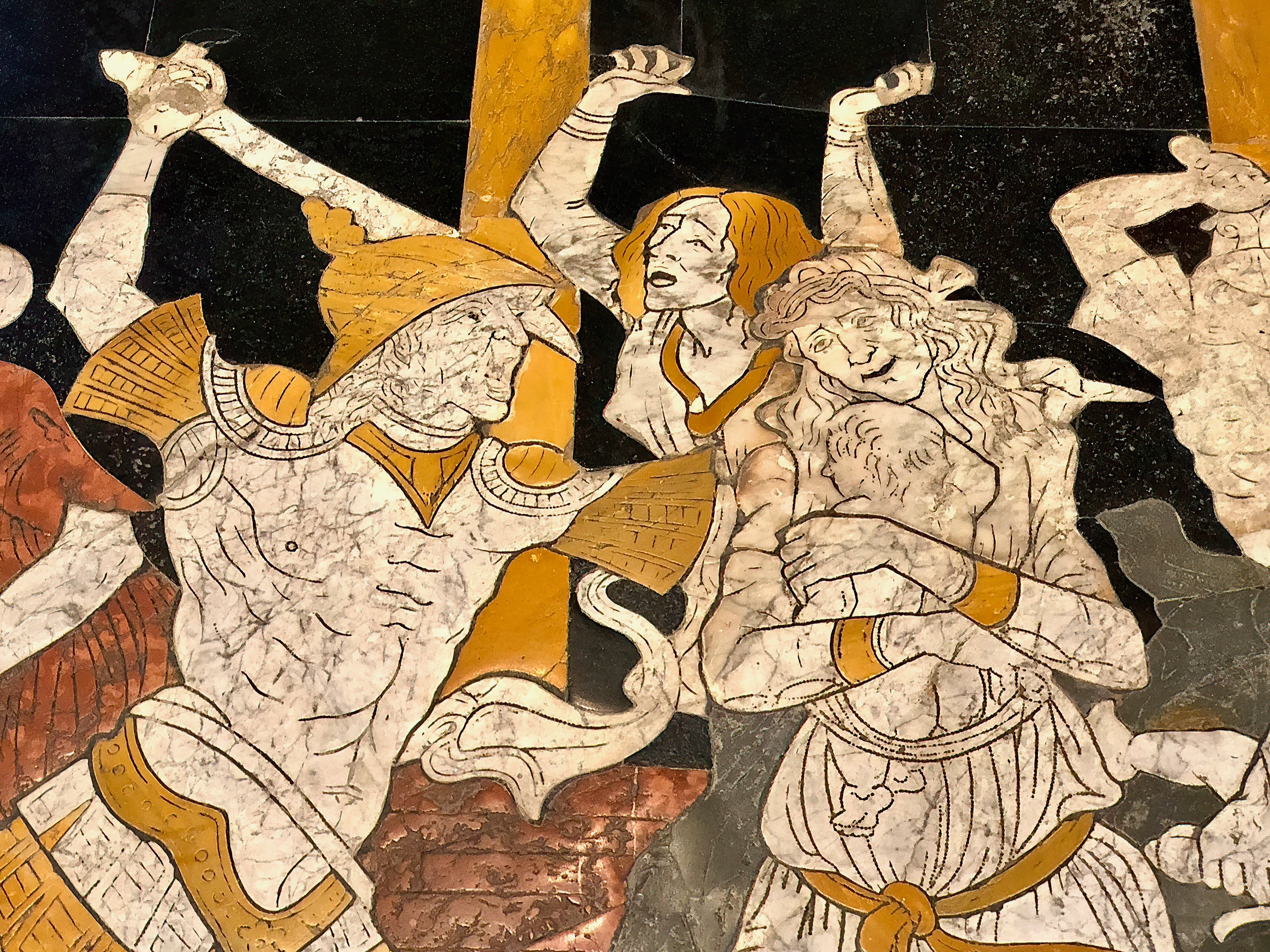
Are the policy-makers and war-makers similarly troubled? Do they ever have PTSD after the harm they do? Auden’s “Epitaph on a Tyrant” is doubtful on this point. The poem’s last line exemplifies the fatal disconnect between the performative emotions of the powerful and the suffering they either cause or ignore. Whether or not the tyrant weeps, the children go on dying. 

Perfection, of a kind, was what he was after,
And the poetry he invented was easy to understand;
He knew human folly like the back of his hand,
And was greatly interested in armies and fleets;
When he laughed, respectable senators burst with laughter,
And when he cried the little children died in the streets. [vii]

Matteo di Giovanni, The Slaughter of the Innocents (Siena Cathedral floor,1481)

In recent days, thousands of bombs have been dropped on Gaza, which is under a state of siege. The severing of access to food, water and electricity is in itself a death sentence for many, especially those in hospitals. Al Ahli Arab Hospital, where I photographed 12-year-old Sabir in 1989, was struck by a bomb as I was writing this. It has been sheltering people displaced by the war, and the number of dead is thought to be around 500.

Israeli forces are preparing for a bloody invasion of Gaza, but there is a glimmer of hope in recent diplomatic moves to secure humanitarian aid and evacuation of civilians, and to win release for hostages. Even so, many more innocents are going to die, along with countless combatants. This war will win nothing but more rage and more tears.

Pete Seeger once said, “We must learn to forget revenge.” In a New York Times op-ed last Sunday, “What Does Destroying Gaza Solve?”, Nicholas Kristof told of meeting “a woman named Sumud Abu-Ajwa, whose home had been damaged by bombing in 2014 and whose husband had been injured and whose children were hungry.

“Do you want Israeli mothers to suffer like you?” I asked.

“Of course not,” she answered. “I hope God won’t let anyone taste our suffering.” [viii]

Jacopo Pontormo, The Deposition from the Cross (Santa Felicita, Florence, 1528). “The Christian’s response to the pain of another is as instinctive and non-negotiable as the mother’s involvement in the child’s suffering. And in this light, sin becomes a refusal to be touched by the pain of others.”
— Rowan Williams

Nothing but evil can come from feasting on revenge. Any further slaughter of the innocents will only produce more rage, more retaliation. So what to do? In the short term, work to free the hostages and aid the desperate. For the long term, practice justice, renounce oppression, and work for peace. Make space for one another. Trade tribalism for human solidarity. See God in every face.

As we approach All Hallows (November 1), the creative folly of saints comes to mind. Keeping their eyes on the prize, they refused the well-worn schemes of a death-haunted world in favor of practices shaped by divine love: self-forgetting and self-offering. Take St. Francis, for example, who went to Palestine during the Crusades. Making his way to the war zone, he crossed the battle line, unarmed, to seek out the Muslim leader, Malek el-Kamil. The sultan received him courteously, they had a friendly conversation about God and, it is said, Francis took time to say prayers in a mosque. “God is everywhere,” he told the sultan. 

I wish I could say that the example of St. Francis so moved the hearts of the adversaries that they laid down their swords and shields to live happily ever after. Alas, not so. But we still treasure that story for the day when the world might actually be ready for such holy wisdom. 

During World War II, when the Christian intellectual and activist Simone Weil was working in the London office of the French Resistance, she proposed a plan to parachute hundreds of white-uniformed nurses onto battlefields, not only to tend to the wounded but also to provide an image of self-sacrificial goodness in the midst of cruelty and violence. She herself wanted to be in the first wave of this non-violent invasion. In submitting her plan to the Free French authorities, she made a visionary argument:

“There could be no better symbol of our inspiration than the corps of women suggested here. The mere persistence of a few humane services in the very center of the battle, the climax of inhumanity, would be a signal defiance of the inhumanity which the enemy has chosen for himself and which he compels us also to practice … A small group of women exerting day after day a courage of this kind would be a spectacle so new, so significant, and charged with such obvious meaning, that it would strike the imagination more than any of Hitler’s conceptions have done.” [ix]

Charles de Gaulle thought her quite mad, and her plan of course went nowhere. What would happen if we tried such a thing in Gaza? God only knows. 

Yes, I can imagine what you’re thinking. But if I haven’t lost you by now, let me offer one final example of holy folly. 

In the 1990s, a community of eight French Catholic monks lived in the mountains of Algeria in a time of civil war and terrorist violence. Their monastery was at the edge of a poor Muslim village, where they lived in harmony with their neighbors, providing the only accessible health care. As the surrounding political violence escalated, the monks were warned by the government to leave the country. But they felt called to remain among the people they served, despite the high probability of martyrdom. Despite their own fears.

Their abbot, Dom Christian, wrote a letter to his family in Advent, 1993, two years before he and his brother monks were beheaded by terrorists. Anticipating his own martyrdom, he insists to his loved ones that he is not exceptional, since so many others in that land were also at risk.

“My life,” he wrote, “is not worth more than any other — not less, not more. Nor am I an innocent child. I have lived long enough to know that I, too, am an accomplice of the evil that seems to prevail in the world around, even that which might lash out blindly at me. If the moment comes, I would hope to have the presence of mind, and the time, to ask for God’s pardon … and, at the same time, to pardon in all sincerity him who would attack me…”

What an extraordinary thing to say: Here is a good and humble and holy man confessing his own complicity in the evils of the world. And what does he hope for? He hopes for the presence of mind, in the very moment of being murdered, to ask forgiveness. Forgiveness not only for himself, but for his killer as well. 

The end of his letter is addressed not to his family, his loved ones, but to the stranger who will one day kill him, the stranger whom he calls “my friend of the last moment.” 

“And to you, too, my friend of the last moment, who will not know what you are doing. Yes, for you, too, I wish this thank-you, this “A-Dieu,” whose image is in you also, that we may meet in heaven, like happy thieves, if it pleases God, our common Father.” [x]

Dear reader, imagine that!

Palestinian Christian girl, Ramallah (May 1989). “The Lord is my light and my salvation; whom then shall I fear?” (Psalm 27:1)

[i] Rowan Williams, Looking East in Winter: Contemporary Thought and the Eastern Christian Tradition (London: Bloomsbury Publishing, 2021), 194. Williams, former Archbishop of Canterbury, goes on to say that “we can perhaps begin to understand why Evagrios can say that apatheia, our liberation from defensive and aggressive instinct, is the gateway to love—as well as to a justice that has some claim to be a little more transparent to the just vision that God has for the creation.”  

[ii] From “Compline,” the penultimate poem of Auden’s Horae Canonicae (the Canonical Hours, which take us through successive portions of one particular day: Good Friday).

[iii] Susan Sontag, The New Yorker, September 24, 2001.

[iv] Bariq’s organization is Al-Shabaka, the Palestinian Policy Network. He was interviewed for The New Yorker by Isaac Chotiner: “Where the Palestinian Political Project Goes from Here” (Oct. 11, 2023):  

https://www.newyorker.com/news/q-and-a/where-the-palestinian-political-project-goes-from-here

[v] Ruth Ben-Ghiat, “What Will Be the Destiny of Netanyahu?” (Oct. 12, 2023): 

https://lucid.substack.com/p/what-will-be-the-destiny-of-netanyahu

[vi] Suzy Hansen, “Twenty Years of Outsourced War,” New York Review of Books (October 19, 2023), 26-28.

[vii] Auden’s “Epitaph on a Tyrant” is rendered in a plaintively sung version by Tom Rapp under the title “Footnote” (Pearls Before Swine, These Things Too). That’s where I first discovered it 50 years ago, and that last line still haunts me.

[viii] Nicholas Kristof, “What Does Destroying Gaza Solve?”, New York Times (Oct. 15, 2023)

[ix] Simone Weil, quoted in Robert Zaretsky, The Subversive Simone Weil: A Life in Five Ideas (Chicago: University of Chicago Press, 2021), 155. For more on Weil and war: https://jimfriedrich.com/2022/03/01/we-must-love-one-another-or-die-what-does-the-iliad-tell-us-about-the-invasion-of-ukraine/

[x] The full story and its texts may be found in Bernard Olivera, How Far to Follow? The Martyrs of Atlas (Petersham, MA: St. Bede’s Publications, 1997). The story is also beautifully and movingly told in the film, Of Gods and Men (2010), directed by Xavier Beauvois.

Gaudete!—The Advent Dance of Honesty and Hope

Our Lady of the Angels (Robert Graham, Los Angeles cathedral, 2002)

Gaudete! Gaudete! Christus est natus 
Ex Maria Virgine. Gaudete!

Rejoice! Rejoice! Christ is born of the Virgin Mary. Rejoice!

So goes the joyful refrain of a late medieval carol, and even though the celebration of the Divine Birth is still two weeks away, the note of rejoicing (GaudeteGaudete!) is already beginning to dispute the wintry gloom in our Scripture readings, our hymns, and our expectant hearts. 

For many centuries, the Third Sunday of Advent has been called Gaudete Sunday—Rejoice Sunday. In the Advent wreath, the somber blue is replaced by a brighter, warmer shade of rose. Churches lucky enough to have rose vestments will be using them today. And in the Common Lectionary cycle of readings, the word “rejoice” turns up in each of the three years. 

In Year C, the prophet Zephaniah exhorts his disheartened people, “Rejoice and exult with all your heart, O daughter Jerusalem” (Zephaniah 3:14). And St. Paul, overflowing with the Spirit, urges the first Christians to make joy a constant spiritual practice: “Rejoice in the Lord always,” he said. “Again I will say, Rejoice (Philippians 4:4)

In Year B, Isaiah tells us, “I will greatly rejoice in the Lord; my whole being shall exult in my God; for God has clothed me with the garments of salvation” (Isaiah 61:10), while Mary’s heart pours out the Magnificat’s ode to joy: “My spirit rejoices in God my Savior (Luke 1:47).

And now, in Year A, Isaiah promises that even the most barren and forsaken places will become a paradise in God’s future: “The desert shall rejoice and blossom,” he assures us. “God’s ransomed exiles shall return …Gladness and joy shall come upon them, while sorrow and sighing shall flee away” (Isaiah 35:10).

Such hopeful refrains lift up our hearts and light a bright candle in the dark. But we also heed the voice of St. James, who curbs our enthusiasm with his “Not so fast! The Kingdom doesn’t come all at once. We’ve got to be patient” (James 5:7). 

And we know he’s right. We still abide in a severely damaged history which seems to repeat itself rather than make real progress toward the horizon of God’s future. We have been shocked in recent years to see such seemingly outdated sins as overt racism and anti-Semitism come roaring back, like the alarming return of “conquered” diseases like polio and measles. 

The French thinker Jean Baudrillard wrote about the myth of human progress just before the Millennium, critiquing the optimistic talk of a New World Order by reminding us that humanity continues to have a serious waste disposal problem (theologians would call this Original Sin, the persistent flaw that burdens and bedevils every human endeavor).   

As Baudrillard put it, “The problem becomes one of waste. It is not just material substances, including nuclear ones, which pose a waste problem but also the defunct ideologies, bygone utopias, dead concepts and fossilized ideas which continue to pollute our mental space. Historical and intellectual refuse pose an even more serious problem than industrial waste. Who will rid us of the sediment of centuries of stupidity?” [i]

I ask that question every day when I see the news! But the genius of Advent is its ability to perform the difficult dance of honesty and hope. It doesn’t deny the darkness, but it also refuses to accept the black hole of unredeemed history as an inescapable fate. “Give us grace to cast away the works of darkness,” we pray, “and put on the armor of light”—not just in some distant utopian future, but “now, in the time of this mortal life.”

Now, now, now. But also not yetGaudete, but also Kyrie eleison. Rowan Williams, borrowing an image from Diadochus, a fifth-century bishop, describes Advent spirituality as the practice of “looking east in winter.” 

“Looking east in winter we feel the warmth of the sun on our faces, while still sensing an icy chill at our backs. Our divided and distorted awareness of the world is not healed instantly. But we are not looking at the phenomenon from a distance: we do truly sense the sun on our faces; and we have good reason to think that the climate and landscape of our humanity can indeed be warmed and transfigured.” [ii]

The next time there is a sunny morning, go stand somewhere on our island’s eastern shore. Feel the chill at your back, and the warming sunlight on your face. Do it without words. Let those contrary sensations of cold and warmth be your Advent prayer. 

Not every morning brings a bright sun, of course. Sometimes the warmth of hope is a matter of faith, not immediate experience. Yet even when we can’t feel it, God is redeeming the time and preparing the dawn. And when we pray, “Stir up your power, O Lord, and with great might come among us,” the Holy One is listening. 

“Stir up your power” is such a striking prayer, a bold cry of the heart to the One who saves. [iii] And because it is always the Collect-prayer for this day, Gaudete Sunday is also known as “Stir up” Sunday. But what do we mean when we call upon divine power? What does the power of God look like in the world we inhabit? 

Well, it looks a lot like what happened when Jesus arrived: “The blind see, the lame dance, the deaf hear, the dead are raised, and the poor receive good news” (Matthew 11:5). It’s not a violent head-on clash with the powers of this world—meeting them on their own bloody terms—but the liberation of the faithful into a new form of being, enabling the friends of God to “plant the seeds of resurrection amid the blind sufferings of history.” [iv]

In Roberto Rossellini’s film, Europe ‘51 (1952), Ingrid Bergman plays a wealthy woman who gives up all her privilege to serve the poor and vulnerable. Rossellini, who had made a joyful film about St. Francis two years earlier, wanted to explore what would happen if someone behaved like St. Francis in the contemporary world. As it turns out in Europe ‘51, Irene (Bergman’s character) is judged to be insane by her husband, her social class, her doctors, and her Church, and the film ends with her locked away in an asylum. The powers-that-be have decided that there is no place in the world for the impracticality of unconditional love. 

But even as Irene suffers this sad fate, we see her continue to be who she is, embodying God’s compassion for her fellow inmates. Like the incarnate God enclosed within the finite space of the Virgin’s womb, she can still practice heaven within the confines of the asylum. As she comforts a despairing woman who has tried to commit suicide, we see Irene, in a close-up reminiscent of an icon, speaking the words of Christ: “You are not alone. Don’t worry. I am with you. I will not leave you.” She becomes, in that moment, what we are all invited to become: an image of Christ for others.

“I am with you,” Irene (Ingrid Bergman) tells a distressed woman in Roberto Rossellini’s Europe ’51.

Stir up your power, O Lord, and with great might come among us. But God’s idea of “great might” is not the way the world understands it. No lightning bolts. No legions of angels. Just a babe in a manger, a tortured man on a cross, a disciple locked in an asylum. As W. H. Auden said in the Advent portion of his Christmas Oratorio: “The Real is what will strike you as really absurd.” Or as an old carol puts it, “Weakness shall the strong confound.” [v]

In another of his poems, “In Memory of W. B. Yeats,” Auden suggests that poetry operates much like divine power. Poetry “makes nothing happen,” he says. In other words, poetry doesn’t force its will upon the world, but in offering an alternate perspective for engaging reality, it makes the world different nonetheless. Auden describes poetry as if it were a stream, making its own way through the landscape. 

For poetry makes nothing happen: it survives
In the valley of its making where executives
Would never want to tamper, flows on south
From ranches of isolation and the busy griefs,
Raw towns that we believe and die in; it survives,
A way of happening, a mouth. 

In his analysis of this poem, John Burnside notes that poetry’s work is “to survive—not in some dogged but enfeebled fashion, hanging on, though barely noticed, in an indifferent world, but actively, on its own terms—that is, ‘in the valley of its own making.’” The ‘executives’—the powers-that-be—take no notice. It means nothing to them. But “poetry flows on, through and away from ‘the busy griefs’ and the ‘raw towns that we believe in and die in,’ its business is more fundamental, its true nature more elemental” than the ‘executives’ can imagine.[vi]

And just so does the power of God flow through the world. Not to force anything to happen in a blunt cause-and-effect way, but to exist, like the waters of baptism, as an inviting and life-giving reality: “It survives, / A way of happening, a mouth.” 

We find this same image of the flowing, living water in today’s passage from Isaiah: “For waters shall break forth in the wilderness, and streams in the desert; the burning sands shall become a pool, and the thirsty ground springs of water” (Isaiah 35:6-7).

The concluding words of Auden’s stanza, “a mouth,” may strike our ears jarringly after the metaphor of a quietly flowing stream, but both poetry and God are given to speech: In the beginning was the Word

And in the same way that the “Stir up” prayer beseeches the God who saves, Auden’s poem, written on the eve of World War II, calls upon the poet to speak a word against all the dark sorrows of the world: 

In the nightmare of the dark
All the dogs of Europe bark,
And the living nations wait,
Each sequestered in its hate …

Follow, poet, follow right
To the bottom of the night,
With your unconstraining voice
Still persuade us to rejoice … [vii]

There’s that word again: rejoice. We have prayed for a word of power today, and what we are given is: Gaudete! Rejoice! God’s power will never compel us to rejoice, or to hope, or to love. But it will always seek to persuade us, until the end of time. 

Maddy Prior and Steeleye Span sing my favorite version of Gaudete.

[i] Jean Baudrillard, The Illusion of the End, trans. Chris Turner (Stanford, CA: Stanford University Press, 1994), 26

[ii] Rowan Williams, Looking East in Winter: Contemporary Thought and the Eastern Christian Tradition (London: Bloomsbury Publishing, 2021), 8.

[iii] The Collect for the Third Sunday of Advent in the Book of Common Prayer: “Stir up your power, O Lord, and with great might come among us; and, because we are sorely hindered by our sins, let your bountiful grace and mercy speedily help and deliver us; through Jesus Christ our Lord, to whom, with you and the Holy Spirit, be honor and glory, now and for ever. Amen.”

[iv] I can’t locate the source of this quote from an old homily, but it may be from either Paul Evdokimov or Olivier Clément. 

[v] Auden’s line is from “For the Time Being: A Christmas Oratorio” (Collected Poems, Random House, 1976, p. 274). The carol line is from Gabriel’s Message (trans. J. M. Neale). Like Gaudete, it is in the famous Piae Cantiones collection of 1582.

[vi] John Burnside, The Music of Time: Poetry in the Twentieth Century (Princeton: Princeton University Press, 2020), 23.

[vii] W. H. Auden, “In Memory of W. B. Yeats” (Collected Poems, 197-198).

The Fullness of Time

Fiona Hall installation, Australian pavilion, Venice Biennale 2015

But when the fullness of time had come, God sent the Son, born of a woman … 

— The Letter of Paul to the Galatians (4:4)

In my six years of blogging, I have always posted a reflection on New Year’s Eve. The symbolic border between old and new prompts the big questions: Where have we been? Where are we going? If “Time is our choice of How to love and Why,”[i] are we using it well? Here are links to all my past posts dated December 31, followed by some thoughts at the end of a year like no other.  

The Angel of Possibility (2014)     Fresh starts nurture fresh hopes, but the turning of the year is of itself not enough to save us. The only sustainable new birth is rooted in the Nativity’s marriage of earth and heaven, finite and infinite, temporal and eternal, human and divine, and I am grateful that our passage into the New Year falls in the middle of the Christmas feast, enriched by faith’s larger hopes. We are not alone. As the Psalmist cries to the Holy One, “My times are in your hand; deliver me.” (Psalm 31:15)

Tick, Tock: Thoughts for New Year’s Eve (2015)     On the one night of the year when countless human beings devote collective awareness to the vanishing Now (at least for the last 10 seconds of the 12th month), time is on everyone’s mind. And though there may be little consensus on the theoretical nature of time, we are all immersed in its flow, or what Susan Sontag called “time’s relentless melt.” We feel keenly the effects of beginnings, transitions, losses and endings. At year’s end, we pause on the razor’s edge between old and new, memory and expectation, regret and hope. When we dance our welcome to the New, may that narrow boundary prove wide enough for our joyful steps.  

Foolishness and Hope on the Eve of 2017 (2016)      At the outset of our 4-year political and social nightmare, I beheld my country teetering on the brink of insanity and ruin. The New Year brought more dread than hope. It demanded a sturdier and steadier kind of moral resolve than the customary pledges of self-improvement. It required that we renounce despair. “We would do well,” I wrote, “not to be mesmerized by the abyss, but to focus on the greater power already and always at work amid the blind sufferings of history. God neither causes nor prevents those sufferings, but divine ingenuity always outwits them in the end.” 

At the Mercy of the Future (2017)      My title came from Didier Maleuvre: So long as one hopes, one puts oneself at the mercy of the future. 2017 was a painful year to be a person of hope, but I found consolation in Maleuvre’s study of ancient sculpture, contrasting the “readiness” of Greek statuary with the blank visages of Egyptian figures, who appear to expect nothing from the world, their minds closed to wonder, risk, or surprise. I myself am partial to the Greeks. “We are creatures of longing and hope,” I wrote, “and it is our fate to wade into the stream of time, come what may. But as the biblical God tells us at the beginning of every journey, Do not be afraid. I will go with you.”

On New Year’s Eve, My Inner Clown is Full of Hope (2018)     Midway through the Trumpian hell, I hear the voices of three poets tending the flame of hope. In “O Esperanza,” Catherine Barnett cites one of her teachers, the philosopher Richard Rorty: “Just before he died, Rory said his sense of the holy was bound up with the hope / that someday our remote descendants will live in a global civilization / in which love is pretty much the only law.” 

Farewell to a Decade. And then? (2019)     The strain of these evil times was taking its toll on everyone as the decade ended. I recalled how Thoreau ignored the outbreak of the Civil War in his voluminous journal while continuing to register the doings of nature in extensive detail. When asked how he could remain silent on such a momentous national subject, Thoreau said that refusing to let our attention be consumed by the hypnotic gaze of chaos “is just the most fatal, and indeed the only fatal weapon you can direct against evil.” In that same spirit, I wrote: “2020 promises an immense struggle requiring the best of us, and I am grateful for those who plan to welcome the New Year with their most prayerful attention, keeping their eye on the Light rather than being transfixed by the dark abyss of malevolence.”

Harold Lloyd, Safety Last (1923).

As for 2020, does anyone expect it to go quietly, to cease at midnight from doing further harm? Though we may find catharsis in shouting our “good riddances!” tonight, this year’s manifold ills will linger a while longer, and fresh starts will take time. Tomorrow morning the world will look much the same. “A change is gonna come,”[ii] but not in an instant. 

Yet with the woes of sin and strife 
the world has suffered long;
Beneath the heavenly hymn have rolled 
two thousand years of wrong. [iii]

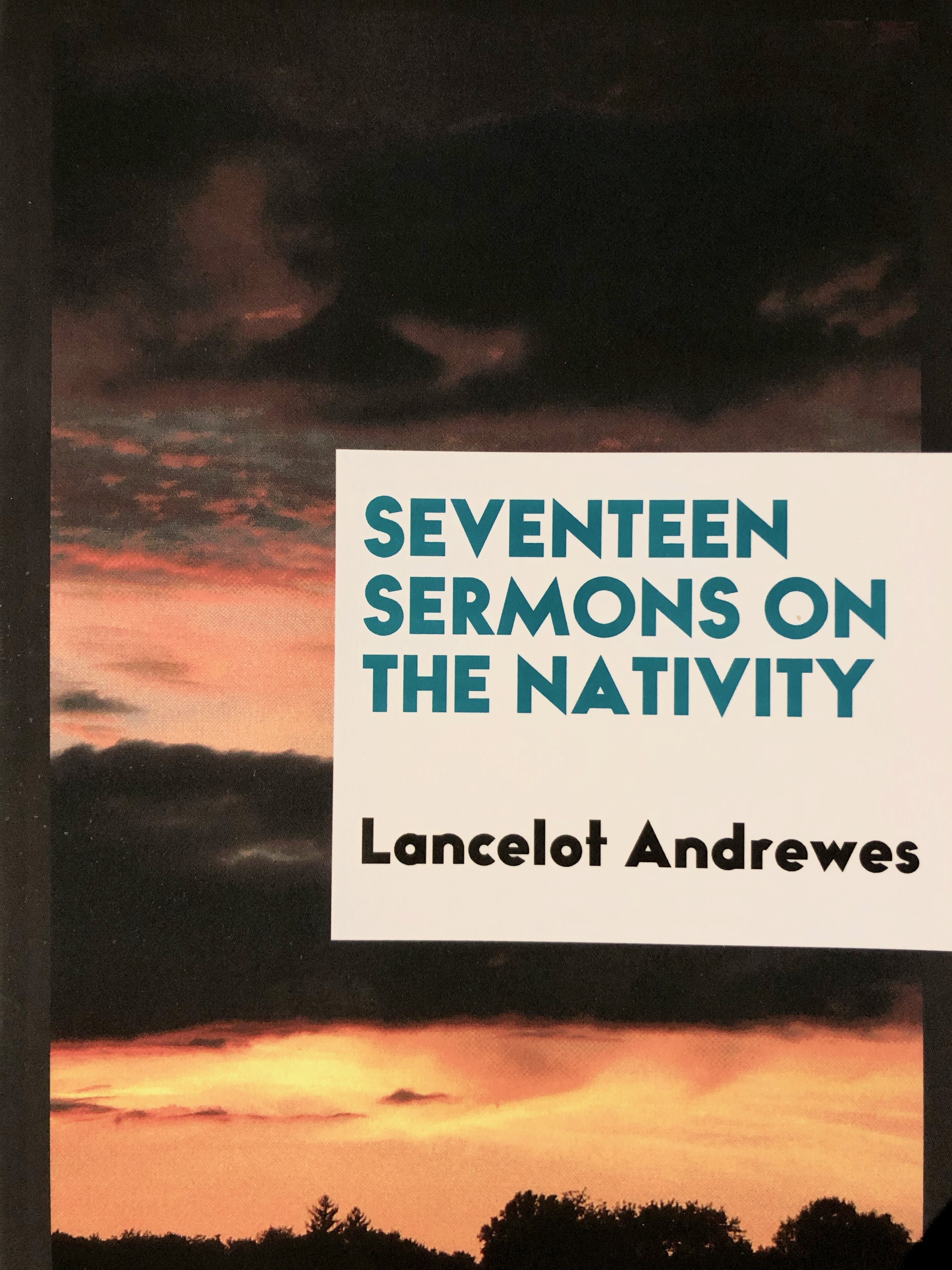
Lancelot Andrewes, a 17th-century English bishop, preached seventeen Christmas Day sermons before King James in the Chapel Royal. Preachers who struggle to come up with fresh Nativity sermons year after year must stand in awe of Andrewes’ inexhaustible richness of expression and range of thought. “He cuts and polishes a text, like a jeweler a diamond,” wrote a later editor of those sermons, “and the rays of truth from its heart of light flash from every facet.” [iv]

The bishop’s Christmas sermon of 1609 explored St. Paul’s verse (Galatians 4:4) about the “fullness of time.” For Andrewes, St. Paul’s phrase itself is full, generating a surplus of meanings and implications. It suggests a condition of completeness, where nothing essential is lacking. More specifically, it designates the pivotal moment of history’s ripening, producing the Incarnate Word, the crown of creation. But the fullness is not just a property of time. It is an attribute of God: the overflowing fullness of Divine Love pouring itself endlessly into the world. The birth of Christ, said Andrewes, entails “the full measure of [God’s] sending.” 

At the same time, there is a receptive dimension to the term, which Andrewes called “the fullness of the benefit we receive” from the Incarnation—not just redemption from sin but the means of union with God—and the joy which fills us in consequence. Fullness is not just divine gift; it is something that happens within us, a grace in which we participate. 

“And after our joyfulness or fullness of joy, our fullness of thanks or thankfulness is to ensue; for with that fullness we are to celebrate it likewise. Our minds first, and then our mouths, to be filled with blessing, and praise, and thanks to Him, that hath made our times not to fall into those empty ages of the world, but to fall within this “fullness of time,” which “so many Kings and Prophets desired to have lived in …”

Adoration of the Christ Child, follower of Jan Joest of Kalkar, c. 1515.

But the fullness comes and goes, ebbs and flows. What do we do in its absence? At the end of W. H. Auden’s Christmas Oratorio, For the Time Being, the poet laments the relative emptiness of time once the Vision fades:

To those who have seen 
The Child, however dimly, however incredulously,
The Time Being is, in a sense, the most trying time of all.

Once we have experienced “the stable where for once in our lives / Everything was a You and nothing was an It,” how can we go back to the way we were? How can we settle for anything less than “the fullness of time?”[v] We don’t. Instead, we make our longing an instrument of change, energizing us—by the grace of the Spirit—to manifest and embody the fullness in our own stories, whenever and however we can.

Ring out the want, the care, the sin,
The faithless coldness of the times;
Ring out, ring out my mournful rimes,
But ring the fuller minstrel in.[vi]

When we beat our gongs, bang our drums, and blow our whistles on the porch at midnight, I will recite these lines of Tennyson. But when we go back inside, I’ll put on Rachel Platten’s “Soldiers”—a rousing response to 2020’s time of trial—and we will dance to the fullness of time.

We’re at the end of the road
We’re all soldiers on our own
Trying to find our way back home
And at the end of the day
Nothing matters anyway
Just the love that we have made

So let’s let go of our mistakes
We’ve all got hearts that easily break

No matter how the light may fade
We’ll carry on, it’s how we’re raised
We might fall
But we won’t break
Yeah, we won’t break …

And now our hearts will beat, now they’ll beat as one
We made it through, and after all, came the sun
And now our hearts will beat, now our hearts will beat as one

— Rachel Platten, “Soldiers” [vii]


Happy New Year, dear Reader! Thank you for reading and sharing through this challenging year. “We made it through!” I am grateful for your thoughtful attention to things that matter. I wish you much joy, health, love and peace in the days to come. Great joy to the New!

[i] W. H. Auden, For the Time Being: A Christmas Oratorio, ed. Alan Jacobs (Princeton, NJ: Princeton University Press, 2013), 46.

[ii] Sam Cooke wrote his great song, “A Change is Gonna Come” (1964), in support of the Civil Rights movement.

[iii] Edmund H. Sears (1810-1876), “It Came Upon a Midnight Clear.”

[iv] The Editor is uncredited and the date, probably early 20th century, is not given in my reprinted volume of Lancelot Andrewes Seventeen Sermons on the Nativity (Collingwood, Victoria, Australia: Trieste Publishing, 2017). All the Andrewes citations are from Sermon IV (Dec. 25, 1609), pp. 44-62.

[v] For the Time Being, 64-65.

[vi] Alfred, Lord Tennyson, “In Memoriam.” Emphasis mine. The “fuller minstrel” is the Christ, embodying the fullness of our humanity united with divinity, singing Possibility into being.

[vii] Rachel Platten, “Soldiers” (2020). Platten recently explained her commitment to speaking out through her songs: “We need to use our art right now, because I truly believe beauty can save the world.”

Praying the Hours (5): Sext and None

This is the fifth in a series on the canonical hours, the ancient Christian practice for living a mindful day. The first, “Reclaiming My Time,” gives a general introduction, with a list of helpful resources for your own practice of prayer and meditation. This reflection considers Sext and None, the hours of midday and mid-afternoon.

Midday sun near the Summer Solstice (Eugene, Oregon: June 25, 2011)

Bumper to bumper, the days stream past the day-old baked goods store though sometimes a Sunday morning pulls in, driven by some old man who stops in the present for a moment to buy a little bag of yesterdays. But mostly the days, by the dozens, dry out and get thrown to the birds, sparrows and starlings to whom each hour is as tasty as the last.

— Ted Kooser, The Wheeling Year

What are days for?
Days are where we live.
They come, they wake us
Time and time over.
They are to be happy in:
Where can we live but days?

— Philip Larkin, “The Whitsun Weddings”

Sext

The “sixth hour” after Prime is the midpoint of the solar day. At the highest point of its arc, the sun concludes its ascent by crossing the meridian, passing over from the sky’s eastern half (ante meridian) into its western half (post meridian). From there until sunset, it’s all downhill. 

As the summit of the solar journey, when all shadows shrink toward nothingness, noon shares the refulgence of the summer solstice: the sky’s luminosity is at the full, and time pauses to linger. “Here the sun, / Sleepless, inhales his proper air, and rests,” said Wallace Stevens, celebrating the annual moment of “arrested peace, / Joy of such permanence, right ignorance / Of change still possible.”[i] An earlier American poet, Emily Dickinson, celebrated noon as a daily symbol of fullness and ripeness. It was a momentary taste of eternity, a glorious timeout from the temporal flow. 

The soul has moments of Escape—
When bursting all the doors—
She dances like a Bomb, abroad,
And swings upon the Hours,

As do the Bee—delirious borne—
Long Dungeoned from his Rose—
Touch Liberty—then know no more,
But Noon, and Paradise— [ii]

The whimsical Douglas Adams (The Hitchhiker’s Guide to the Galaxy) recommends proper enjoyment of the midday pause. “Just as lunch was at the center of man’s temporal day, and man’s temporal day could be seen as an analogy for his spiritual life, so lunch should (a) be seen as the center of man’s spiritual life, and (b) be held in jolly nice restaurants.”[iii]

But midday can be more than a pleasant break in the action. However busy the day, monastic communities take time out to give thanks for the morning, reflect on its challenges and its gifts, and invite grace and wisdom for the afternoon. And so too may we uncloistered believers, immersed in the secular world, profitably recollect, reorient, and recommit in the middle of the day’s story. What is time for? What is this day for? What is it trying to tell me? What is it asking of me?  “We harvest what the morning sowed,” says a noonday hymn. “Now grant us undiminished strength / to stand and do what still remains.”[iv]

For the mystic, the noonday surplus of earthly light both images and ignites an inner fire. “Be ablaze with enthusiasm,” said Hildegard of Bingen. “Let us be an alive burning offering before the altar of God.”[v] And it was beneath the midday sun that St. Paul was brought to his knees by “a bright light from heaven” (Acts 22:6). To borrow another line from Emily Dickinson, I imagine Paul’s transformative glimpse of divinity to have been “As much of Noon as I could take / Between my finite eyes.”[vi]

But even in the brightest noon, there lurks the shadow of crisis, “the barrenness / Of the fertile thing that can attain no more.”[vii] Just as the sun’s zenith is the beginning of its descent into night, the soul at noon must reckon with its own temporality. Our escape into the “arrested peace” of Paradise is but a moment. Like the sun, we too must decline toward the Night. And the sense of an ending, the pressure of time running out, afflicts the present moment with doubt. Have I done my best with this day so far? Will I have time to complete the work I have been given to do? Does it matter?

In their meditations on the Canonical Hours, David Steindl-Rast and Sharon Lebell point out the spiritual duality of the noonday hour:

“Sext comes right in the middle of the day, in the middle of everything. It is the middle of our life each day, the time of opportunity and the time of crisis … At this turning point in time we decide the fate of our day, and cumulatively the fate of our lives. Do we renew our fervor and commitment, or do we let the forces of entropy drain our resolve?”[viii]

The Latin word for noon (meridiem) and its European derivatives (mezzogiornomediodiale midi) are simply descriptive: “the middle of the day.” But the English term, confusingly derived from None, the canonical hour for mid-afternoon (3 p.m.), holds negativity in its heart. As a palindrome, it reads “no” from either direction. This double no evokes refusal, but is it the refusal of time—noon as a taste of timeless eternity—or something more dire: refusal of the temporal flow of life itself?

Fritz Lang’s Metropolis (1927).

In her poem, “A Clock stopped,” Dickinson sees a death image in the cessation of a ticking clock at exactly 12 p.m.—called “Degreeless noon” by the poet because the overlapping of hour and second hands, both pointing to XII, leaves no intervening angle between them. Their stilled hands no longer circle the hours. Their “dial life” is at an end. Does that signify eternity or oblivion? This question haunts many of Dickinson’s writings. The word “no” permeates this poem, not only in “noon” but also in “not,” “snow,” “nods,” and, most chillingly, “concernless No”—conveying the indifference of death and nothingness to human fate.[ix]

A Clock stopped – 
Not the Mantel’s –  
Geneva’s farthest skill 
Can’t put the puppet bowing –  
That just now dangled still –  

An awe came on the Trinket! 
The Figures hunched, with pain –  
Then quivered out of Decimals –  
Into Degreeless Noon –  

It will not stir for Doctors –  
This Pendulum of snow –  
This Shopman importunes it –  
While cool – concernless No –  

Nods from the Gilded pointers –  
Nods from the Seconds slim –  
Decades of Arrogance between 
The Dial life –  
And Him –

The word for midday occupies the exact middle of the poem: noon is the 38th word out of 75. And the poet makes it rhyme with pain. That’s a slant rhyme: the vowels disagree but the hard sound of the final consonants match. The pairing of noon and pain is unsettling, expressing the ambivalent nature of the hour—the solar zenith where the day begins its decline. Significantly, it was at this very moment that the Lord of life was nailed to the cross, as every noonday liturgy recalls.

Blessed Savior, at this hour you hung upon the cross, stretching out your loving arms: Grant that all the peoples of the earth may look to you and be saved; for your tender mercies’ sake. Amen. (Book of Common Prayer: Service for Noonday).[x]

Mortality is not noon’s only shadow. The Psalmist warns of “the sickness that lays waste at noonday” (Psalm 91:6). The Greek term for this malady is acēdia, variously translated as listlessness, restless boredom, discouragement, despondency. At its extreme is the suicidal ennui of Herman Melville’s “Bartleby the Scrivener,” who descends into total inaction with his perpetual refrain of refusal: “I prefer not to.” John Cassian (c. 350-435), whose 5th-century writings on desert spirituality would be a wellspring for later monastics, rendered acēdia in Latin as taedium cordis (“tedium of the heart”). The desert saints, who struggled with acēdia beneath the enervating Egyptian sun, gave it a more personal title: “the noonday demon.”

Desert Sext (Baja California, 12:05 p.m., October 1, 2005).

Cassian’s desert mentor, Evagrius Ponticus (c. 360-399), described acēdia as a chronic inability to be present:

“The eyes of the listless monk gaze out the window again and again, and his mind imagines visitors. A sound at the door, and he jumps up .… When he reads, the listless monk yawns plenty and easily falls asleep. He rubs his eyes and stretches his arms. His eyes wander from the book. He stares at the wall and then goes back to his reading for a little. He then wastes his time hanging on to the end of words, counts the pages, ascertains how the book is made, finds fault with the writing and the design. Finally he just shuts it and uses it as a pillow. Then he falls into a sleep not too deep, because hunger wakes his soul up and he begins to concern himself with that.”[xi]

I’ve met that noonday demon, and I suspect you have too. All the more needful, then, to transit the daily meridian with a prayer on our lips, and trust in our heart. “Today I place before you death and life,” says the Holy One. “Choose life!”[xii]

None

You sweep us away like a dream;
we fade away suddenly like the grass. (Psalm 90:5)

By mid-afternoon, lengthening shadows measure the lateness. With each day’s passing, we think about endings and rehearse our own finality. The daily theater of impermanence may provoke in us wistfulness or melancholy. But it can also teach the art of letting go. This day has bestowed its gifts and it blessings. We have received them as best we could. We are grateful. But we don’t hold on. We don’t worry about the morrow. We entrust ourselves to the Giver, without clinging to the gift. 

At None, the day’s labors are winding down. We might wish for more time, or more energy, to complete them gracefully, and we may not have the option to set them down unfinished. But if one has any choice in the matter, would it be better to honor the hour rather than the task? Late afternoon, the hour of None, calls us to work of a more inward kind. How can we make space for the questions, and the prayers which they prompt in us? 

What has this day taught me? What could I do differently tomorrow? What requires mending before the sun sets? What burdens can I lay down? Who needs my forgiveness? What must I forgive in myself? What am I grateful for? What precious moments did I forget to sanctify with my deepest attention? Where did I remember God?

Shadows deepen at None (York Minster, UK: October 21, 2015).

The light of a waning afternoon is the sweetest kind. It is warmer and softer, purged of glare and harshness, suffused with fondness. It invites stillness, contemplation, tranquility, rest. It makes the world glow for weary eyes. It is honey for the soul. In these latter days, most of us lack tower bells to announce a pause for mindfulness, or muezzins in minarets calling us to prayer. But afternoon light remains omnipresent, inviting us all to sink into the mystery of the moment, wherever we may be.

W. H. Auden wrote a cycle of poems on the canonical hours: Horae Canonicae. As the poems take us through the diurnal passage from Prime to Compline, we soon realize the poet is talking about Good Friday. The poem for None—the hour when Christ died—imagines the waning of that most singular day.

It is barely three,
Mid-afternoon, yet the blood
Of our sacrifice is already 
Dry on the grass; we are not prepared 
For silence so sudden and so soon; 
The day is too hot, too bright, too still,
Too ever, the dead remains too nothing.
What shall we do until nightfall?

These lines register something of my own feelings over a lifetime of Good Fridays, when I exit the church at None into “silence so sudden and so soon.” How does one move on from the death of God? What shall we do until nightfall?

Soon cool tramontana will stir the leaves, 
The shops will re-open at four,
The empty blue bus in the empty pink square
Fill up and depart: we have time 
To misrepresent, excuse, deny,
Mythify, use this event,
While, under a hotel bed, in prison,
Down wrong turnings, its meaning 
Waits for our lives …[xiii]

I think every disappearing afternoon shares something of this mood. Most days, the doings will be far less dramatic or significant, but there still remains a sense of aftermath, of carrying on under the influence of events now past, trying to make sense of them—or not—while somewhere up ahead, a fuller accounting “waits for our lives.” In any case, every day changes us, and discerning how is part of our prayer life. 

But if the weight of Auden’s subject seems too much to carry with you into the average evening, let me leave you with a poem by William Stafford, a gem of self-compassion for the late afternoon:

Nobody cares if you stop here.  You can
look for hours, gaze out over the forest.
And the sounds are yours too—take away
how the wind either whispers or begins to
get ambitious.  If you let the silence of
afternoon pool around you, that serenity
may last a long time, and you can take it
along.  A slant sun, mornings or evenings,
will deepen the canyons, and you can carry away
that purple, how it gathers and fades for hours.
This whole world is yours, you know.  You can
breathe it and think about it and dream it after this
wherever you go.  It’s all right.  Nobody cares.[xiv]


[i] Wallace Stevens, “Credences of Summer,” Collected Poetry and Prose (New York: The Library of America, 1997), 323.

[ii] Emily Dickinson, “The Soul has Bandaged moments”— F360 (1862) 512.

[iii] Douglas Adams, Life, the Universe, and Everything (1980), cited in Mark Barrett, OSB, Crossing: Reclaiming the Landscape of Our Lives (Harrisburg, PA: Morehouse Publishing, 2008), 9.

[iv] Charles P. Price, “The fleeting day is nearly gone,” Episcopal Hymnal 1982, # 23.

[v] Hildegard of Bingen (1098-1179), cited in Macrina Wiederkehr, Seven Sacred Pauses: Living Mindfully Through the Hours of the Day (Notre Dame, IN: Sorin Books, 2008), 111.

[vi] Emily Dickinson, “Before I got my eye put out”— F 336 (1862) 327.

[vii] Wallace Stevens, “Credences of Summer.”

[viii] Brother David Steindl-Rast & Sharon Lebell, Music of Silence: A Sacred Journey Through the Hours of the Day (Brooklyn, NY: Ulysses Press, 2001).

[ix] Emily Dickinson, “A Clock stopped” — F259 (1861) 287.

[x] Episcopal Book of Common Prayer (New York: Oxford University Press, 1979), 107.

[xi] Evagrius Ponticus, On the Eight Spirits of Evil, cited in William Harmless, S.J., Desert Christians: An Introduction to the Literature of Early Monasticism (Oxford/New York: Oxford University Press, 204), 326.

[xii] Deuteronomy 30:19.

[xiii] W. H. Auden, “Nones,” Horae Canonicae, in Collected Poems, ed. Edward Mendelson (New York: Random House, 1976).

[xiv] William Stafford, “Nobody Cares,” Crossing Unmarked Snow (Ann Arbor, MI: University of Michigan Press, 1998).

May my heart’s truth still be sung

Seattle Times, July 16, 1995 (50th anniversary of the first atomic bomb).

Strange things happen in life––a ticket here, a ticket there, and twenty, thirty, forty years later the destination.

–– William McPherson, Testing the Current

Follow Him through the Land of Unlikeness;
You will see rare beasts, and have unique adventures.

–– W. H. Auden, For the Time Being

Grant us the grace of your Holy Spirit, that we may be devoted to you with our whole heart, and united to one another with pure affection.

––– Collect for the first Sunday in July, Book of Common Prayer


Today I turned 75. I’ve seen it coming for a long time, but I’m still surprised! I took my first breath early in the evening of July 16, 1944, at the Hospital of the Good Samaritan in Los Angeles. Twenty-two years later, four days before my birthday, my father would take his last breath in the same place.

Every birth date collects an assortment of associations and memories. My favorite film noir, Double Indemnity, begins with a doomed Fred MacMurray speaking into a Dictaphone, beginning with the date: “July 16, 1938” (the film was released in 1944, and co-star Barbara Stanwyck’s birthday was July 16). On my 7th birthday, Catcher in the Rye was published. I saw Paris for the first time when I turned 17. On my 29th  birthday, Alexander Butterfield revealed to the Senate Watergate Committee the existence of the Nixon tapes.

My hometown paper on my 25th birthday.

When I turned one year old, the first atomic bomb was exploded in New Mexico. On my 25th birthday, Apollo 11 blasted off for the moon. And on my 50th, a comet crashed into Jupiter, creating the largest explosion ever witnessed in the solar system.

If those explosive bursts of heat and light were some kind of sequence (1…25…50…), what was in store for 75? Apocalypse? Thankfully, on this 50th anniversary of the moon launch, the iconic phenomenon proved both gentle and fitting. No great event, no big bang. But not a whimper either. What happened tonight was this: a full moon rose in silence over a collapsed volcano (whose supposed similarity to the moon’s surface had provided a valuable training ground for the lunar astronauts). The tranquil orb shed its luminous blessing, the close of a perfect day. O gracious Light!

Rising moon above Newberry Crater, Oregon, July 16, 2019.

From 1956 to 1962, I attended an Episcopal boys’ school in Los Angeles. In my class of sixty-five, three of my best friends had, like me, been born in July of 1944. After sharing a formative passage through adolescence and being collectively imprinted––or cursed––with the high expectations fostered by a privileged education, we maintained our bonds into adulthood. In the month of our thirtieth birthdays, we gathered at a California beach house for a weekend of celebration and memory. Toward the end, there was a midnight toast. “Hey Jude” came on the stereo as we lifted our glasses to past and future selves. Take a sad song and make it better. We were not yet where we wanted to be, but we still feasted on dreams and a sense of promise. In ten years, we pledged, our forty-year-old selves would gather again to trade stories of the journey.

O may my heart’s truth
Still be sung
On this high hill in a year’s turning.

Dylan Thomas wrote these hopeful words when he turned thirty. But it doesn’t always work that way. A year after our glad toasts by the sea, on the last day before our birthday month, one of the four committed suicide. We three who remained gathered to sing him home in our old school chapel. We could only guess at the pain that took him from us.

When Jon died, I was deep in the mountain wilderness of the Sierra Nevada. Just before sunrise he came to me in a dream, assuring me that he was all right. I awoke and looked at my watch––6:00 am. It was, I learned later, the hour of his death.

A week after his funeral, on the day of my 31birthday, I rose early to take a long walk in the hills above Los Angeles, where pockets of wildness and quiet still thrive in the heart of the teeming metropolis. Jon and I had both been runners in high school, and we loved training together in these hills. Our school was situated along their lower slope, so it only took a few minutes of running to leave the cityscape behind.

As I walked these same hills so soon after his death, Jon was very much in my thoughts, and one particular workout came to mind. Just behind the school chapel, a 150-yard stretch of road climbed steeply to a crest. During our senior year, in a pouring rain, Jon and I challenged each other to run a series of all-out sprints up this grade, one after another, until we both collapsed, utterly exhausted and sick to our stomachs.

We made it back to the gym to recover. Jon stretched out on a bench and closed his eyes. He lay there a long time, not saying a word. When he finally spoke, he said he’d had it with running. He was going to quit the team. The feeling soon passed, and he would go on to win the southern California half-mile championship in a time of 1:53.1. But I remember feeling genuine alarm in the presence of his momentary despair. It was like a black hole, sucking up all the light around it. Jon was made for running, and his powerful spirit made the rest of us faster. To see that spirit falter, if only for a moment, was unsettling, like witnessing a saint’s crisis of faith and wondering about the fragile poise of your own soul.

After my birthday walk, I put this recollection in a letter to an east coast friend. But I prefaced it with a report of what I had seen around me on that particular day––not darkness and death, but the beauty of a summer morning in the hills of home:

“The intensely blue panicles of a ceanothus shrub arched across the path like an enchanted boundary, a gate back to Eden. Near a jocular little stream, a California thrasher poked its long, curved bill into the debris beneath an oak tree. A solitary yellow leaf, suspended by a long spider’s thread against a background of dark mist, spun ecstatically in a ray of sunlight. The path unfolded before me like a narrative––meandering through the hush of sheltering thickets, emerging onto a golden slope of drying grasses, climbing upward into the enfolding blankness of a beclouded ridge, dipping downward to become a gentle country lane, purple-strewn with eucalyptus leaves, and finally spilling out into the alluvial plain of houses, lawns and swimming pools.”

It was as if an essential part of my response to loss and grief was to pay close attention to the gifts of one summer day, offered so generously to my receptive heart. To pay attention as if my own life depended on it.

“How shall the heart be reconciled / to its feast of losses?” asked the poet Stanley Kunitz, who lived to an even 100 years. The longer you live, the more the losses mount up––but also the beauties, the graces, the affectionate motions of the heart. I like what another poet, Vera Pavlova, says about this:

If there is something to desire,
there will be something to regret.
If there is something to regret,
there will be something to recall.
If there is something to recall,
there was nothing to regret.[i]

In one of Bill Watterson’s Calvin & Hobbes cartoons, the boy gets a letter from his past self. It reads: “Dear future Calvin, I wrote this several days before you will receive it. You’ve done things I haven’t done. You’ve seen things I haven’t seen. You know things I don’t know. You lucky dog! Your pal, Calvin.”

Calvin sniffles a bit and says, “I feel so sorry for myself two days ago.” To which his tiger friend, Hobbes, responds, “Poor him. He wasn’t you.”

Stanley Kunitz could sympathize. “I have walked through many lives,” he wrote, “some of them my own, / and I am not who I was . . .” So who am I now? Hmm. But ever since my baptism in November of 1944, the more critical question has always been, Whose am I?. As we say at the end of every mortal life, “whether we live or die, we are the Lord’s possession.” Is it possible to live in the light of that truth, come what may?

After my mother died in 2010, I found a prayer she had written on the flyleaf of her Daily Office book. It’s something she would have said almost every day: “God, whatever . . . Thanks.”

On my twenty-first birthday, my father, a priest, celebrated eucharist in our living room with my mother and me. Afterward, he presented me with a letter he had composed for the occasion. “Happiness is not found in security,” he reminded me, “nor can it be bought with money, but it is a holy mystery that is a gift from God, found only in serving Him.”

When I turned 40, my sister Marilyn sent me a list of questions.

What would you like to accomplish in your work? In your personal life?
How long do you think you will live?
What would you like to begin?
What would you like to end?
Name a physical risk you’d like to take.
Name an emotional risk you’d like to take.
Of what might you be afraid?
What do you want to mend?
What song describes your life at 40?
What writer touches you deeply at 40?
What would you like to create for yourself? For the world?
What are 3 things you are most satisfied with so far in your life?

These remain searching questions for me today, despite the somewhat eroded sense of future produced by thirty-five additional birthdays. I’ll start to ponder my answers tomorrow (God willing). Meanwhile, what Stanley Kunitz says, that is what I say:

Though I lack the art
to decipher it,
no doubt the next chapter
in my book of transformations
is already written.
I am not done with my changes.[ii]

Twenty-five years ago, on my 50th birthday, I made a 9-mile pilgrimage through English countryside to an old church cemetery in the Lake District. Arriving just after sunset, I laid a pair of California wildflowers on the grave of William Wordsworth. A waxing crescent moon hung suspended over a nearby hill. Shining very close to it was Jupiter, where the comet was making its cosmic crash. But here on earth, in this quiet churchyard, nothing but peace. I had pressed the two flowers––California poppy and Farewell-to-Spring––in my copy of Wordsworth’s Prelude, whose buoyant embrace of the human journey––rejecting the melancholy “wandering steps and slow” at the end of Paradise Lost––I claimed for myself at the beginning of my sixth decade. In these latter days, I do so again:

The earth is all before me. With a heart
Joyous, nor scared at its own liberty,
I look about; and should the chosen guide
Be nothing better than a wandering cloud,
I cannot miss my way. I breathe again!

Laying wildflowers on Wordsworth’s grave on my 50th birthday.


Related post: Grace Me Guide

[i] Vera Pavlova, “Four Poems,” translated from the Russian by Steven Seymour, The New Yorker, July 30, 2007, 37.

[ii] Stanley Kunitz excerpts are from “The Layers,” The Collected Poems of Stanley Kunitz(New York: W. W. Norton & Co., 2002). Poetry Foundation link: https://www.poetryfoundation.org/poems/54897/the-layers