Remember

We the People (Latina) poster

Artist: Shepard Fairey; Photographer: Arlene Mejorado

“Send them back! Send them back!” So shout the stony-hearted xenophobes in response to the unprecedented wave of Central American children entering the United States without documentation. The irony of this hateful war cry in a nation first forged by immigrants is breathtaking. Were such things screamed from the shore at Plymouth Rock?

Historical memory, never America’s strong suit, has become seriously eroded in recent years, due in large part to what Canadian scholar Henry A. Giroux has called the “violence of organized forgetting.” In a provocative essay (http://truth-out.org/news/item/24550-data-storms-and-the-tyranny-of-manufactured-forgetting), Giroux traces the sources and consequences of “the emergence of a profoundly anti-democratice culture of manufactured ignorance and social indifference.” He begins with a resonant epigraph from a book about history and memory by Yose Hayim Yerushalmi:

For in the world in which we live it is no longer merely a question of the decay of collective memory and declining consciousness of the past, but of the aggressive [assault on] whatever memory remains, the deliberate distortion of the historical record, the invention of mythological pasts in the service of the powers of darkness.

While solutions to the current humanitarian crisis on our southern border may not be entirely clear, perhaps we should begin by remembering that we are all pilgrims and refugees in this life, that welcoming the stranger is a biblical imperative, and that everything is gift before it is possession, including “native” soil. So as an aid to memory and perspective, we might listen to some voices from the immigrant experience. An excellent collection may be found in Unsettling America: An Anthology of Contemporary Multicultural Poetry (ed. Maria Mazziotti Gillan & Jennifer Gillan; Penguin 1994). Here are a few of my own favorites, from a florilegium I once compiled for a celebration of cultural diversity in the Episcopal Diocese of Chicago.

Carlos Bulosan came from the Phillippines to settle in Seattle, becoming active in the labor movement. In his book, America is in the Heart, he wrote:

America is the nameless foreigner, the homeless refugee, the hungry boy begging for a job, the illiterate immigrant… All of us, from the first Adams to the last Filipino, native born or alien, educated or illiterate – We are America!

Armenian-born Gregory Djanikian emigrated to the United States as a child. His poem, “In the Elementary School Choir,” describes the experience of absorbing a new culture at a young age:

“This is my country,” we sang,
And a few years ago there would have been
A scent of figs in the air, mangoes,
And someone playing the oud along a clear stream.

But now it was “My country ’tis of thee”
And I sang it out with all my heart…
“Land where my fathers died,” I bellowed,
And it was not too hard to imagine
A host of my great uncles and -grandfathers
Stunned from their graves in the Turkish interior
And finding themselves suddenly
On a rock among maize and poultry
And Squanto shaking their hands.

Wing Tek Lum, born in Hawaii of Chinese-American parents, resolves the melting pot vs. salad bowl debate with a distinctively Chinese meal. The biblical image of the redeemed gathered for a sacred feast is clearly echoed in “Chinese Hot Pot,” which is not surprising for a poet who attended New York’s eminent Union Seminary.

My dream of America
is like da bin louh
with people of all persuasions and tastes
sitting down around a common pot
chopsticks and basket scoops here and there
some cooking squid and others beef
some tofu and watercress
all in one broth
like a stew that really isn’t
as each one chooses what she wishes to eat
only that the pot and fire are shared
along with the good company
and the sweet soup
spooned out at the end of the meal.

God forbid that the shouting mob at the border (and in Congress and the right-wing echo chamber) should have their way in the end, reducing the refreshing tributaries from other cultures to a trickle, condemning America to the parched national sameness described by Annie Proulx in Accordion Crimes, where a Polish immigrant is forced to conclude that “to be foreign, … not to be American, was a terrible thing and all that could be done about it was to change one’s name and talk about baseball.”

May we all recover our immigrant memory and our sojourner mind, and celebrate the inclusive richness praised by Native American Joy Harjo in “Remember:”

Remember that you are all people and that all people are you.
Remember that you are this universe
and that this universe is you.

Remember that all is in motion, is growing, is you.
Remember that language comes from this.
Remember the dance that language is, that life is.
Remember.                             

Fourth of July

Eugene fireworks 2016 (1)

July 4th fireworks (Eugene, Oregon, 2016)

I love the Fourth of July. After beginning the day in the company of Charles Ives and Emily Dickinson, I will run a 5K, watch the ragtag town parade, take in some local baseball, gather with friends for croquet, barbecue and American folk tunes sung around an outdoor fire, and join the annual procession of neighbors to the end of our street for fireworks over the harbor. This in itself is enough to honor the day – life and community affirmed with our fellow citizens as we sound the resonant notes of tradition.

But the liturgist in me wonders if we might do something more consciously formative with our American holiday, as our forebears did. Throughout the nineteenth century and well into the twentieth, the Fourth of July was an occasion not only to celebrate our ideals, but also to educate the public in the habitual virtues of public life by which those ideals might continue to be realized. A central part of this educative function was the Fourth of July oration, a long-winded address that recalled the great deeds of the past, tabulated the growth and progress achieved over the years, and exhorted the listener toward the same zeal for liberty and the common good that had inspired our founders.

The speakers all tried to tune their themes to the situation of their time. An oration given in 1838 before an abolitionist society noted the ironies of church bells and cannons sounding in celebration of liberty while in the same land could be heard the clanking of chains on the limbs of a million slaves. Another, given on the eve of World War I, called upon America to lead the way in the overthrow of war as an instrument of policy.

As a longtime lover of California’s mountains, I am especially fond of Thomas Starr King’s oration of 1860, delivered to the Episcopal Sunday School Mission Celebration in San Francisco, celebrating the fact that California had not seceded from the Union. “Thank heaven,” he declared, “there is no doubt of our geography. The Sacramento is an American river. The San Joaquin is not held by traitors. San Diego is an American port…” King then described the red alpenglow and azure shadows on the white glacier of Mt. Shasta as Nature’s emphatic salute to the Red, White and Blue!

The one thing these orations have in common is their assumption of a people, a public, who are committed to working together to implement the ideals that gave us birth. “We swear,” cried a young John Quincy Adams on July 4, 1793, “we swear by the precious memory of the sages who toiled and of the heroes who bled in her defense, that we will prove ourselves not unworthy of the prize which they so dearly purchased; that we will act as the faithful disciples of those who so magnanimously taught us the instructive lesson of republican virtue.”

In other words, keep your eyes on the prize. The watchwords of the Revolution – liberty and the common good – are powerful ideas. Even the most corrupt and cynical among us must still give them lip service if they aspire to political power. As Daniel Ellsberg once said, the best thing that you can say about the American people is that you have to lie to us.

The American experiment is not over. We no longer conduct it with the illusion that we are innocent of the old corruptions, that humanity’s darker impulses are somehow absent from the American heart. Holden Caulfield and Daisy Miller have grown older and wiser. And yet there are many among us who refuse to give up, who refuse to retreat from public life and the common good. There are many among us who continue to dream, continue to strive, continue to believe that we shall overcome, that “America the beautiful” is still a possibility.

I do not imagine that Americans will ever again submit to the custom of lengthy orations under a hot sun, but might there be other ways to mark the day with experiences, images and rituals which reconnect us with our ideals and with each other? I wouldn’t put any politicians on that planning committee, or preachers either. Instead, I would entrust the task to artists, musicians, poets and activists. My vote to head the enterprise would be the 8-year-old Hopi girl whose recurring daydream of a redeemed public life is recorded in Robert Coles’ The Spiritual Life of Children:

All the people are sitting in a circle, and they are brothers and sisters, everyone! That’s when all the spirits will dance and dance, and the stars will dance, and the sun and moon will dance and the birds will swoop down and they’ll dance, and all the people, everywhere, will stand up and dance, and then they’ll sit down again in a big circle, so huge you can’t see where it goes, or how far, if you’re standing on the mesa and looking into the horizon, and everyone is happy. No more fights. Fights are a sign that we have gotten lost, and forgotten our ancestors, and are in the worst trouble. When the day comes that we’re all holding hands in the big circle – no, not just us Hopis, everyone – then that’s what the word ‘good’ means…and the whole world will be good when we’re all in our big, big circle. We’re going around and around until we all get to be there!

After the play is over

I just saw King Lear at the National Theater of London – via an HD broadcast at a Seattle cinema. Directed by Sam Mendes, with Simon Russell Beale in the lead, it had some fresh approaches, with mixed success. But for all that worked or didn’t work for this playgoer, the power of the text remained intact, just as the validity of the mass is independent of the presider’s worthiness.

The play’s opening crisis turns on Cordelia’s refusal to join in her sisters’ ‘glib and oily’ flatteries of their father the king. Lear, sensing the imminent waning of his vitality and power, has an insatiable need for reassurance, but the one daughter who truly loves him refuses to play that hypocritical game. The filial bond, she insists, goes without saying. In fact, no words can do it justice. Better to remain silent than say something inadequate or inexact. If only she had compromised a bit, tossed some verbal meat to her famished parent, she might never have come ‘between the dragon and his wrath.’ But she is as proud and stubborn as her sire, and so the dysfunctional Lear family begins to implode, plunging the kingdom – and all sense of stable, coherent reality – into the abyss.

Clare Asquith, in her controversial book Shadowplay, finds Shakespeare’s dramas full of pro-Catholic allusions and references to the political and religious situation of his time. The figure of an unwise ruler offered a salutary warning to James I, whose stern policies of religious conformity endangered English unity; Lear’s need for his daughters’ professions of loyalty mirrored the judicial interrogations of suspect Catholics and Puritans; the virtuous Edgar’s flight into wilderness and disguise suggested the plight of the Jesuit priests preserving the persecuted old faith in secret hiding places. Mendes’ version contains its own timely references, from the waterboarding torture of Gloucester to the implicit diagnosis of Lear’s madness as Lewy dementia.

But if the play were only “contemporary,” whether for a seventeenth-century audience or a twenty-first, it would not have the same power to haunt and trouble us. King Lear, in Martin Esslin’s words, provides “an image of aging and death, the waning of powers, the slipping away of our hold on our environment.” These are universals of the human condition, the dark foundation upon which any spirituality must be constructed. But even when we try to salvage something from the wreckage (Did Lear learn and grow from his suffering? Does it matter that two good men, Edgar and Kent, outlived the tragedy to bear witness?), the apocalyptic storm on the heath, reducing all our certainties to ‘nothing’ (a word repeated many times throughout the play), continues to echo long after the curtain falls.

But in the National Theater broadcast, there was no time for the themes to resonate once the play was done. After Edgar’s mournful speech (“The weight of this sad time we must obey, / Speak what we feel, not what we ought to say…”), the stage went black. But before we could even begin to measure the weight of tragedy, the London audience began to applaud, the lights came up again, and the players, now smiling, returned to the stage to take their bows. Their characters had vanished, replaced by the contemporary personalities of the actors themselves. Such hasty return to ordinary life felt unseemly. Could we not linger in Lear’s universe a moment longer, let the emotion begin to settle and subside before politely pretending we had not just been ripped apart by the howling storm of Shakespeare’s text?

When, years ago, I saw Theatre du Soleil’s legendary production of Richard II, such a transition was in fact provided, for which I have always been grateful. The French company had performed in whiteface, with costumes and ritualized movements drawn from Japan’s kabuki theater. The ceremonial strangeness of the production utterly removed us from any sense of the familiar or natural. If we were not actually transported to a medieval Neverland of ritual and transcendent constraints, it certainly felt like it. And after the play’s stunning, tragic conclusion, the company took care not to wake us too quickly from that dream.

They did it by remaining in character. The whiteface still veiled their personalities, as any kind of mask does. While wearing a mask, you are not yourself, but the role. And their whitened faces remained intense and unsmiling, even as the applause thundered our Amen to the experience they had given us. It was still Richard and Bolingbroke on that stage, not some modern imposters. Even their bows, formal and liturgical rather than personal and spontaneous, prolonged the sense of gravity.

Performing arts, like religious ritual, strive to take us somewhere else, to give us something we might not receive in any other way. But too little attention is given to the transitions between ordinary life and the concentrated/consecrated space of a performance, whether artistic or liturgical. How does the environment we enter help us prepare for what is to come? And when the “play” is over, is there a way to linger, absorb, and reflect before it melts into thin air? I once saw Zubin Mehta, after conducting an emotional performance of Mahler’s “Resurrection Symphony” (even the musicians were wiping their eyes) keep his arms raised for a full 20 seconds after the last notes subsided, finally lowering them ever so slowly, in order to preserve a proper silence just long enough. But most performances – and liturgies – simply end with a jump cut (no slow dissolve!) back into whatever we were calling reality. As though nothing had transpired. As though we had not been changed.

What if (as I witnessed after a screening of Robert Bresson’s heartbreaking Au Hasard Balthasar) an audience just sat in stunned silence, not talking or moving for several minutes? What if (as at every Sunday mass with the radiant monks and nuns of Paris’ St. Gervais) you arrived at church twenty minutes early to find a hundred people already there, engaged in silent prayer? What if (as is common after Holy Week liturgies) the congregation exited the church without a word, still wrapped in the mystery of divine presence?


That summer feeling

Toward the end of her life, Emily Dickinson made her short list of the things that truly matter: “First – Poets – then the Sun – / Then Summer – Then the Heaven of God. / And then – the List is done – ”

Although death threw its shadow across many of her poems, Dickinson could be a sublime singer of summer – timeless land of perpetual noons, the practical heaven of the perfect moment. And when I rose early this morning to welcome the season on our sunny island in Puget Sound, I too embraced the necessary fiction of capacious days, green and golden, time enough for everything – the swim in the lake, the unexplored trail, the dulcimer in the corner, the hammock under the willow, campfire nights, a pile of expectant books, slow meals with friends.

The poets have long dreamt of a refuge beyond the reach of decay and sorrow. A medieval Spanish lyric finds healing in a summer meadow:

On occasion, whenever
I wake among flowers,
I scarcely remember
my numberless sorrows,
soon wholly forgotten
as I peacefully doze,
and life is restored
by the murmuring leaves:
in their shade, to the sound of
their rustling, I sleep.

Mary Oliver, recalling her American childhood, locates the gate of Paradise at the classroom door when the final bell rings.

I went out of the schoolhouse fast
and through the gardens and to the woods,
and spent all summer forgetting what I’d been taught

And Wallace Stevens, in his “Credences of Summer,” which I peruse like Scripture every Summer Solstice, captures perfectly the radiant calm of the longest day:

This is the last day of a certain year
Beyond which there is nothing left of time…
Postpone the anatomy of summer…
And fill the foliage with arrested peace,
Joy of such permanence, right ignorance
of change still possible…

Exquisite ripeness. The end of longing. Be. Here. Now. Or to quote the flag that flies over the old family cottage on Minnesota’s Lake Pepin, “Doing nothing is always an option.” It is a fiction, of course, a paradise more imagined than lived. Leisure, and the means to enjoy it, are not equally shared. The very notion of hiatus is endangered in a world where information never sleeps. And now climate change has injected a note of dread into our once happy anticipation of warmer days.

Yet summer remains a necessary fiction, which we abandon at our peril. Without its Sabbath rest, without an unhurried interval of play, adventure, refreshment and renewal, our lives would be poor indeed.

Sometimes, on the longest day, I gather a group of friends to await the sunset. Seated in a circle, we each share a story, memory or sensory image that evokes something of summer for us. Though each recollection is personal and particular, it always brings nods of recognition from the group. We all have our own variations on swimming holes and sandy beaches, road trips and mountain cabins, blackberry pies and corn on the cob, a cold drink from a garden hose, the scent of barbecue and suntan oil, street games at dusk, bare feet on the lawn, kisses beneath the stars. No one forgets that summer feeling.

What are the sacraments and memories of summer for you?

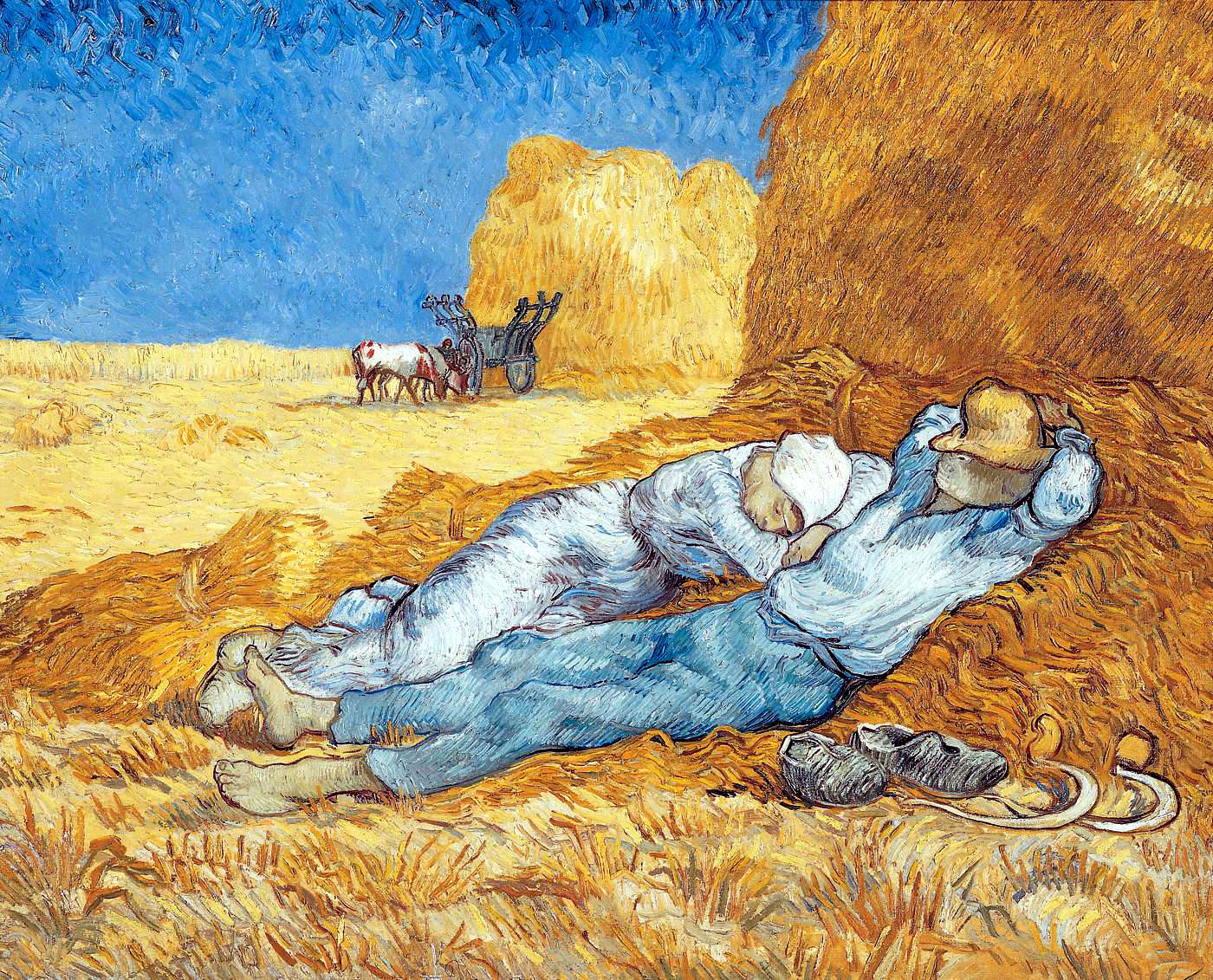
Van Gogh - La Meridienne


Behind the veil

When you arrive in Santiago de Compostela, they say, then your real Camino begins. Or continues, since the vast traverse between where we’ve been and where we’re headed is ongoing, never finally completed – not even by death, say the theologians. We are always “on the way,” deeper and deeper into the mystery of the world. Just so, this blog will itself travel on, exploring the permutations of that mystery within the wide categories of God, Nature, and Art, which are my three great passions. The subjects will be diverse, but all will pursue my guiding theme: where the fire and the rose are one.

This richly suggestive phrase, the last line of T. S. Eliot’s Four Quartets, harmonizes seemingly incompatible energies: the wild, consuming flame, the serene, soft and self-possessed bloom. As traditional symbols of the Holy Spirit and the Virgin Mary, they recall the fruitful incongruity of the Incarnation, but even without this theological overlay, on a strictly sensory level, their union comprises a highly charged coincidence of opposites. The interplay of radically different entities – matter and spirit, sensation and meaning, fact and imagination – and the expanded sense of reality that such unlikely dance partners can produce, will be the subject of my inquiry. John Muir, rhapsodic apostle of the California mountains, described nature as “opening a thousand windows to show us God.” The Religious Imagineer exists to look for those windows – not only in nature, but also in the arts, literature, cinema, theology, and ritual practice. The terrain is immense, my maps are few. But like Wordsworth, I pray that “should the guide I choose / Be nothing better than a wandering cloud / I cannot miss my way.”

So let me begin my new “camino” with Bill Viola, whose video art installations explore big questions: Who am I? Where am I? Where am I going? I have admired his work for years, and was delighted that the first retrospective of his work in France coincided with my arrival in Paris en route to the Camino in April. The notes to the exhibition related his aesthetic to religious contemplation: “For the artist, the camera is that second eye that ‘re-teaches us how to see’ and addresses the world beyond, or beneath, appearances.” And in fact the multiple rooms of the gallery, cave-like spaces lit only by the high-definition images projected on large surfaces, seemed more church than museum. People stood or sat on the floor in rapt attention to the visions unfolding all around them.

I was struck by one room in particular, where the four walls were covered by simultaneous projections of five different 35 minute scenes of mortality and resurrection. One of these was a fixed wide shot of a man dying in a tiny house perched on a bluff (a cutaway wall lets us see inside) as a boat is loaded with household goods on the beach below. When the man dies, we see him appear on the beach (while his lifeless body remains in the house) and get into the boat, which ferries him slowly across the wide expanse of water toward an unknown shore. In another scene, a rescue crew is packing up at the edge of receding floodwaters, while a distraught mother keeps watch in the desperate hope that her drowned son might still be rescued. After a long vigil, mother and paramedics, exhausted, fall asleep on the shore. It is only then that the son’s resurrected body rises out of the water and into the sky beyond the frame. The sleepers miss it, but the viewer is given a privileged glimpse of the crossing between this world and the next. Water dripping from the man’s ascending feet turns into a downpour once he is out of sight. The sleepers are awakened by the deluge, and they exit the scene, never suspecting the rain to be a sign connecting earth and heaven. The mystery of resurrection remains hidden from them, though not from us. The largest image, covering the entirety of a long wall, was an endless procession of people, seen from the side like a Parthenon frieze, moves in slow single file through a forest. As Viola intended, these walkers, wrapped in a silence that seems neither anxious nor eager, suggest souls who have left this world, on their way to whatever world awaits them. I would recall this image a few days later, when I took my own place in the Camino’s great procession of pilgrims, all making our way toward God knows where.

It would be hard to imagine a casual encounter with this installation, whose title was Going Forth By Day (a term for dying taken from the Egyptian Book of the Dead). It seemed too concerned about our own fate for us to pass it by with only a glance. Viola’s work always invites us deeper, soliciting, in his words, “faith in that other thing, that something else dimly felt behind the veil of daily life.” (David Morgan, “Spirit and Medium,” in The Art of Bill Viola, p. 101)

We could use more of such conviction – and poetic persuasiveness – in the rites and imagery of our churches, which sometimes seem at a loss in the task of making the sacred tangible or even thinkable in a culture saturated by secular assumptions. I was delighted to hear that St. Paul’s cathedral in London recently unveiled a permanent Viola video installation in its Martyrs chapel. You can find images of this new work at http://www.billviola.com/

You can view a short montage of excerpts from Going Forth by Day here: http://www.bing.com/videos/search?q=Bill+Viola+Going+forth+by+day&FORM=VIRE1#view=detail&mid=38964FC4118E53E2F6B938964FC4118E53E2F6B9

You can also watch an excellent lecture which I heard Viola give at UC Berkeley in 2010. It is 90 minutes long, includes examples of his work, and is well worth it for his discussion of “technology and revelation.” The link is at: http://www.youtube.com/watch?v=t0RCkNugozU

Viola flood res


Where did Jesus go?

Ascension has always been a favorite feast for me. This is what I preached this morning at St. Thomas Episcopal Church in Medina, Washington.

Ascension for blog

In the 1960’s, the Italian journalist Oriana Fallaci interviewed
the American astronaut Wally Schirra:

“How does it feel to be up there?” she asked him.
“How does it feel to be floating weightlessly up there?”

He shook his head slowly. “Feeling weightless… I don’t know… You feel exquisitely comfortable, that’s the word for it, exquisitely… You feel comfortable and you feel you have so much energy, such an urge to do things, such ability to do things.  And you work well, yes, you think well, you move well, without sweat, without difficulty, as if the biblical curse, “in the sweat of thy face and in sorrow,” no longer exists. As if you’d been born again.”

“And when you come back to Earth, Mr. Schirra? …
how does it feel … to come back to Earth?  What’s it like?”

“For me it’s a great feeling of regret, a great sorrow. It starts when the retro rockets are about to fire and the time indicator shows how much time you still have left, and you’re no longer weightless, and the dropping needle takes away your joy and restores your weight, your biblical curse… Zero zero; three zero minutes and zero zero seconds… Zero zero; one zero minute and zero zero seconds… It’s robbing you of … your exquisite lightness, … and you can’t do anything about it, and while you are still thinking, you can’t do anything about it, there it’s nearly at an end, there it’s ending, there it’s ended.  While you’re thinking that, you’re back here on the Earth. No, returning isn’t a sigh of relief.  You can love the Earth with all the love in the world: Returning is regret, is sorrow.”

I have always loved this intriguing testimony someone who was able, for a time,
to escape the bonds of earth, to shed the weight of gravity
and experience the levity of the heavens.

Do you think the Ascension was like that?
Do you think it was a relief for Jesus to shed the weight of earthly existence,
to finally leave it all behind: the sweat and thirst, the labor and sorrow,
of embodied life?

Sometimes, when life gets hard, it is tempting to think so, and there is no lack of theological endorsements for a strict dualism between heaven and earth, between human and divine. But the whole point of the incarnation, the embedding of God into the human condition, is to affirm the union of heaven and earth, not their separation.

Christ did not come among us only to leave us behind in the end.
And the Resurrection, far from dismissing embodied life as a prison house,
something we need to escape from,
shows it to be worthy of eternal preservation and affirmation.

Then what is the meaning of this mysterious Ascension story, which is told only by Luke, by the way? None of the other gospel writers found it necessary to paint a literal picture of Jesus’ departure from the visible world. Since they did not go beyond the story of Jesus, they could conclude their account with him still around, not yet departed. Unlike Luke, they didn’t go on to tell the story of what happened next, when Jesus was no longer present in the way he had been in his earthly ministry, or in the resurrection appearances, which themselves also came to an end.

But once those unique experiences did cease to occur, the early Church had to adjust to the physical absence of Jesus. And in order to tell that story, Luke needed to remove Jesus from the stage. So he showed him ascending into a cloud. It is a lovely image, that expressive and resonant vertical metaphor for transcendence.

But in his Ascension story, Luke doesn’t provide the kind of detail expected of realistic narrative. He doesn’t try to make us believe Jesus went away just so. No special effects required. It’s simply “now you see him, now you don’t.”
We’ve all watched the sun go away on a cloudy day. Maybe it was like that.

Luke might have had Jesus disappear around a corner, or over a hill.
Or the disciples might have looked away for a moment, or blinked,
missing the exact moment of vanishing.
But the cloud is a nice touch. Artists have always loved it.
In any event, Jesus is suddenly gone.

The essential part of Luke’s story is not the means of Jesus’ departure,
but the meaning of his absence:
Where is he now, and will we ever see him again?

In a sense, Jesus is always going away.
Jesus never remains where we leave him.
Not in the tomb. Not in the sky. Not in the Bible.
Jesus comes to us out of the future, not the past.

It may take time to recognize the way his body will look the next time we see him.
It may look like a homeless man pushing his cart down the sidewalk,
the exhausted mother carrying her baby,
the victims of disaster and war on our televisions.
It may look like the face in the mirror,
or the ragtag band sharing bread and wine on a Sunday morning.
It may look like the whole wide world.

If the Incarnate One had clung to the body of a first century Jewish male,
God could have never become the rest of us.
Without that body to keep us fixated on past appearances,
we learn to see Christ everywhere.
The absence following the Ascension creates an emptiness
which God can fill with a new, expanded “body.”

British theologian Graham Ward celebrates the Ascension as an image of the “transcorporeal” nature of Christ’s body, which is always becoming something else, something larger, something more.

It can’t be comprehended, grasped, pinned down or exhausted.
Always pouring itself out, always being transfigured,
it does not remain a discreet, locatable object that is “here” or “not here,”
lost from sight behind a cloud or kicking back in some place called heaven
where we may venerate it from afar.

“The specificity of his body is unstable from the beginning,” writes Ward. “Jesus’ body is extendible, can expand to incorporate other bodies, make them extensions of his own.”

In other words, his body is not erased by the cross, the tomb or the ascension.
It is expanded.
We ourselves become part of it, as we discover that our own bodies,
instead of being the self-enclosure of solitary egos living in and for ourselves,
are part of a larger, permeable, interdependent existence.
Never complete in ourselves,
we are inseparable from what is outside us and beyond us.

Christ before us, Christ behind us, Christ under our feet,
Christ within us, Christ over us, let all around us be Christ.

If you want to see Jesus, don’t stand looking up into the heavens.
Just look around right where you are.

I read a story in The Christian Century magazine about a regional gathering of Lutherans that happened to fall on Ascension Day. The planning committee was trying to think of ideas for the liturgy, and someone suggested blowing out the Paschal Candle after the Ascension story was read.

The Paschal Candle is first lit at the Easter Vigil. A cantor sings, “The Light of Christ,” and everyone responds, “Thanks be to God!” This great candle then burns as a symbol of the risen Christ at every liturgy throughout the fifty days of Easter, ending with Pentecost Sunday. To blow it out at the Ascension would certainly be dramatic, but to make such a literal representation, as if the Easter presence were somehow being extinguished, would be not only be a little depressing but also very misleading.

Jesus did not vanish like smoke, never to return.
He came again in the fire of empowering Spirit.
And in the meantime, in the space between the Ascension and Pentecost,
in that time of absence and waiting which every believer knows all too well,
there is room to discover the new ways Christ is being manifested in our life together
as the community and communion of God’s friends..

W. H. Auden said that when a writer dies, he becomes his readers.
So we might say that when Jesus ascended, he became the Church.

And what about those Lutherans? What did they finally decide to do in that liturgy? The Paschal Candle was indeed extinguished after the reading of the Ascension gospel. But before this happened, just when the reader finished, a dancer entered, moving among the people with a collection of hand candles, lighting them one by one from the Paschal Candle, and offering them to each of the worshippers. Once everyone had a lighted candle, the dancer bowed before the Paschal Candle, and put it out. The smoke rose up and disappeared into the air. But the room remained full of light, as all those little flames flickered in the hands of the people.

The Light of Christ was not something they had watched disappear.
The Light of Christ was something they themselves had become.


Footwashing

After nearly five hours exploring the immense cathedral in Sevilla, Karen and I emerged into its large cloister, known as the Court of the Orange Trees when a mosque occupied the site over six hundred years ago. A lovely citrus grove still provides pools of deep shade in the bright Andalusian sunlight, and at its very center stands the round fountain where medieval Muslims cleansed hands, face and feet before going inside to pray. Making impromptu homage to this ancient practice, we removed our shoes and sank our feet into the cool water. It wasn’t long before a cathedral guard hurried over to tell us this was forbidden. “Malo!” she said, pointing to the fountain. The water didn’t appear toxic, so we assumed it was not the water that was bad, but the fact of bathing our feet. Stepping out of the water, we picked up our shoes and started walking toward a bench where we could put them on more easily. No, no, no, she said, indicating that we were not allowed even to walk on the courtyard bricks in bare feet. We don’t speak Spanish, but we gathered that it was deemed disrespectful to go barefoot on church property, even outside the walls of the worship space. Though there is ample precedent for bare feet as the preferred option for standing on holy ground, that was clearly an untranslatable argument in this particular instance, so I stooped over to pull on my Keens. At that point another cathedral official, a man who spoke English, came to see what all the fuss was about. He explained that we were in a church, not a park. I replied that we meant no disrespect, and that in fact footwashing, even in such a casual situation, always had a ritual dimension to it. His brow furrowed, and he gave us a scrutinizing look. “Are you Muslim?” he asked.

I can’t say for sure, but his question seemed more than simple curiosity, as if we had, however innocently, transgressed a boundary that has haunted Spanish history ever since the first North African Muslims landed at Gibralter in 711. Over the next seven centuries, Christians and Moors fought fierce battles for control of the Iberian peninsula, but there were also many instances of peaceful coexistence, as well as intermarriage, mingled interests, and mutual influence. While the ideology of the “Reconquista” – the reassertion of Christian primacy – finally won out with the complete expulsion of Islam from Spain in 1492, significant traces of the Moorish soul remained, just as Islamic motifs persisted in Christian architecture and the plaintive prayers of the minaret reemerged as flamenco. You can’t expel what has become part of you. A long and complicated history of conflict and coexistence may have created a confusion of opposed identities, more than it ever achieved a clear separation. As Gees Nooteboom has written in his wonderful ‘Roads to Santiago’, “in that very long period there had been so much intermingling, so much exchange, that each party had in a sense become the other. Each had caused the other to suffer, but alliances had also been formed and links established. Conversions, tolerance, mixed marriages, syncretism, all those factors spread out over such a long period had made Spain different from all the other countries in Europe – as it remains to this day.”

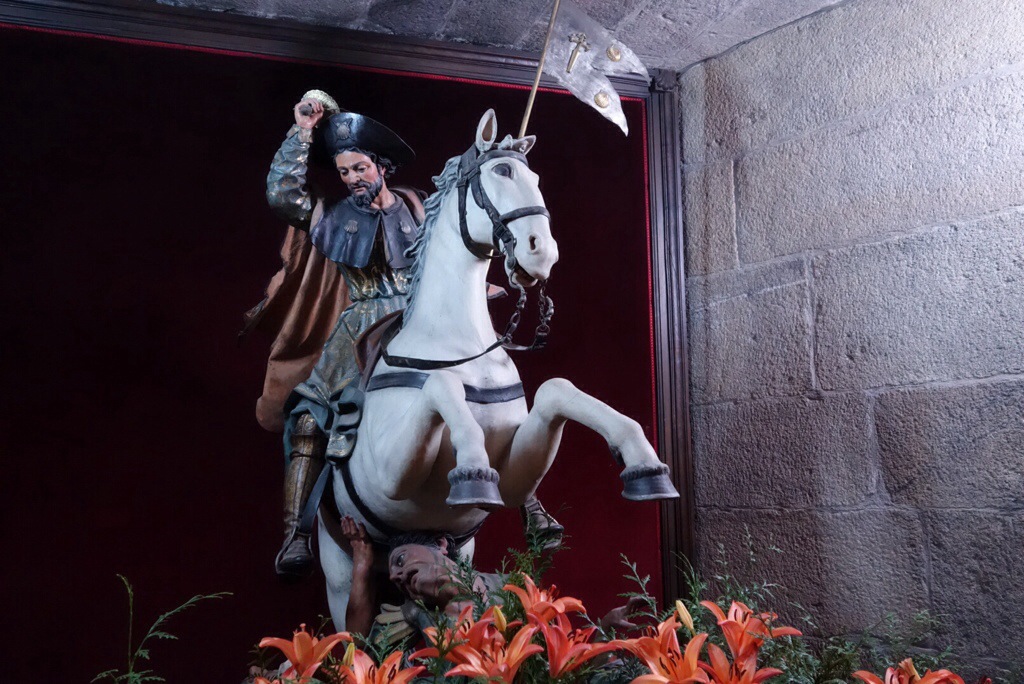
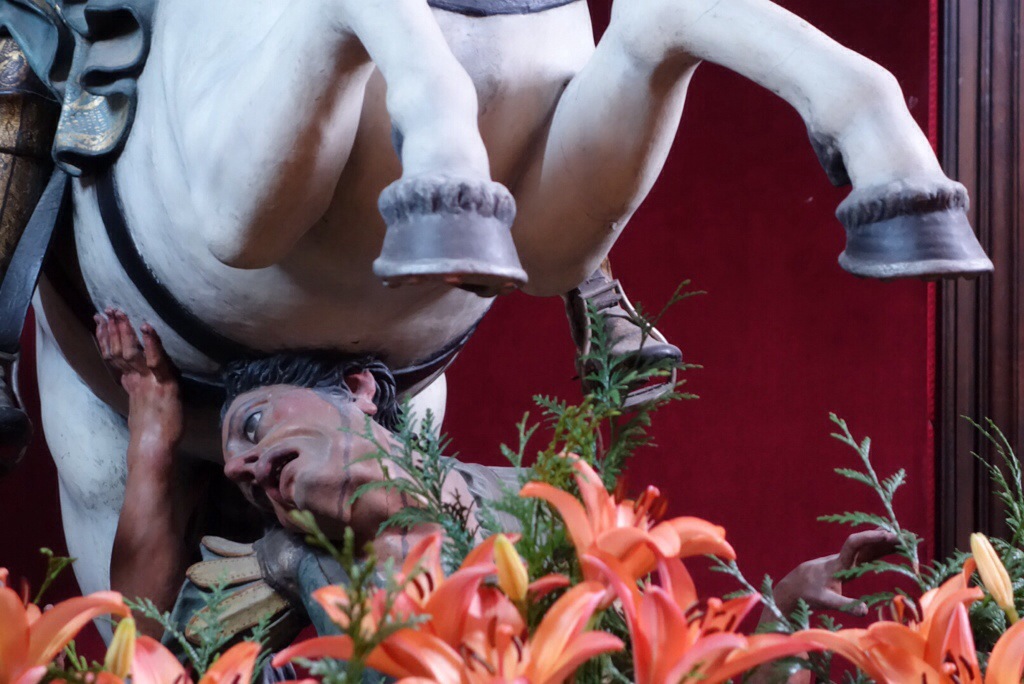
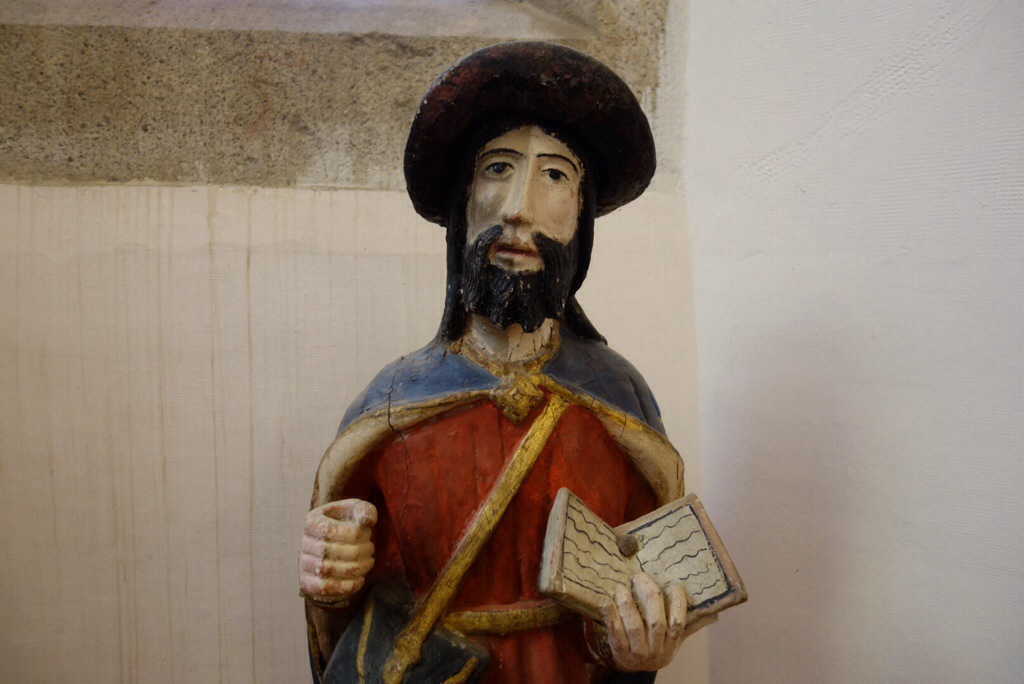
So if I had been a Muslim when I dipped my feet into the water of a former mosque upon whose ruins a great church has been constructed, would I have been makings a symbolic challenge to the Reconquista, a small retaking of place lost so long ago? Or had I, even though a Christian, simply touched a wound still sensitive, still unhealed? I’ll never know for sure. The whole incident may have been nothing more than a matter of manners: they just don’t like bare feet on church grounds! But having seen countless paintings and sculptures of Santiago Matamoros (“St. James the Moor-slayer”) in churches along the Camino de Santiago, I do wonder about the lingering significance of images which define cultural or religious identity at the expense of the “other.” All those depictions of Santiago as warrior were put up long ago, of course. At the cathedral of Santiago de Compostela, they have attempted to hide the trampled Muslims behind big flowers, hoping to soften the disturbing iconography. Nevertheless, though I claim no expertise on Spanish history and identity, I did get a sense of something deep and unresolved in that official’s question at the fountain.

20140524-221243.jpg

20140524-221303.jpg

The end of the world

[Note to my readers: many thanks for joining me in this journey. I am so appreciative of all the good and supportive comments you have contributed along the way. I wish I could have made individual replies, but the nature of the Camino made necessary some limitation to my online time. And if you have enjoyed these posts, know that while my Camino has ended, the Religious Imagineer will continue, with reflections and provocations concerning theology and religion, the arts, liturgy, imagination, and the beauty of the world: wherever “the fire and the rose are one.” Stay tuned.]

How do I write an ending to the Camino? Certainly with no summary remarks, for such reductions would do disservice to the complex flavors of the journey. I feel like the pianist who was asked to explain the composition he had just played. Without a word, he sat down and played it again.

On Monday afternoon, I continued on from Santiago to Finisterre (“the end of the world”), an extension of the Camino that predates the Christian shrine at Santiago. For the ancient Celts, and many pilgrims since, the natural place to make an ending is where the land is swallowed by the sea and the sun disappears over the edge of the known. Some make this journey on foot (54 miles west from Santiago), but I, alas, took a bus, needing some rest for weary legs.

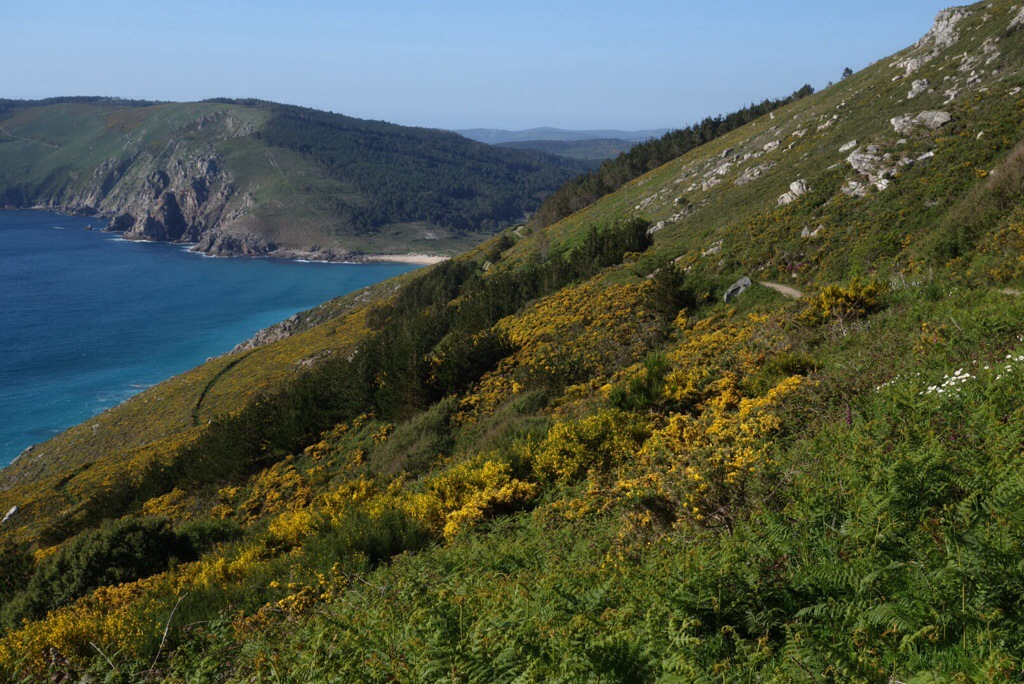
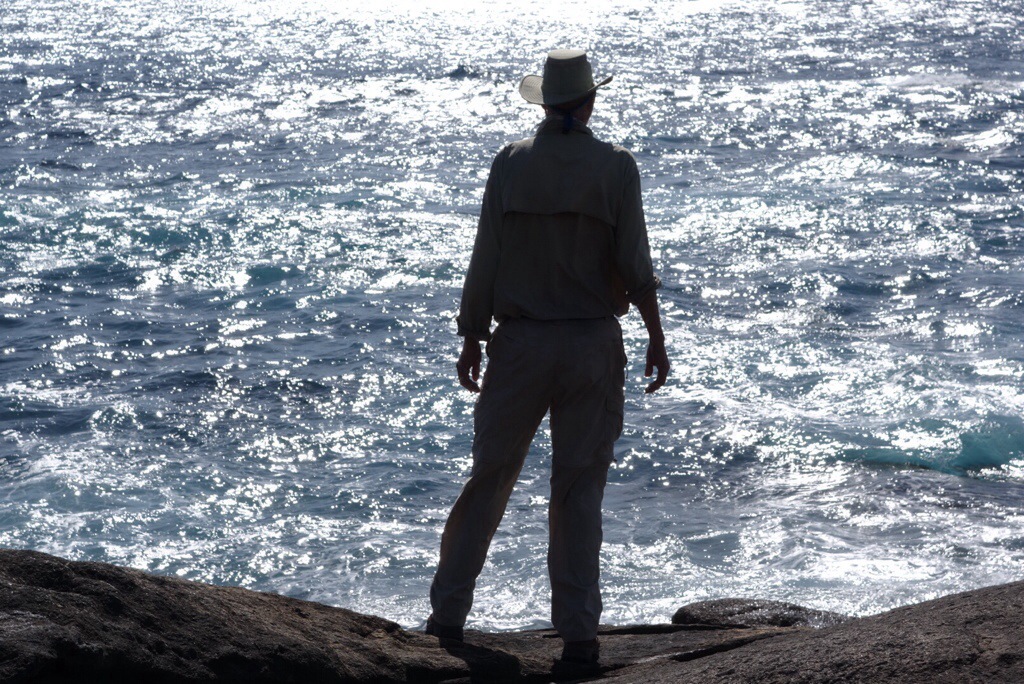
Finisterre is a high headland with a charming harbor town, wild hills and dramatic shoreline. I made the obligatory walk to the lighthouse at the southern tip, where the last Camino marker reads 0.00 K, and pilgrims can leave or even burn a symbolic offering (shirts, boots, and walking poles were among the abandoned items). But the souvenir stand and tourist buses were not contemplative aids, so I took the spectacular trail along the western side, high above the sea, bright with yellow flowers, descending finally to an isolated beach. In my own act of letting go, I wrote PEREGRINO (pilgrim) in the sand, and watched the tide erase it. Then I climbed to the rocks on the cape’s highest point to watch the edge of the world erase the sun.

I still had one more walk to do, from Finisterre north to Muxia: 18 miles of pine and eucalyptus woods, pastures and crop land, remote stone villages, flowered meadows, an estuary brimming with fish, and white sand beaches. I wanted to make this final trek not only to make intimate acquaintance with a remote corner of Galicia, but also to end my Camino just as I had begun it – on foot.

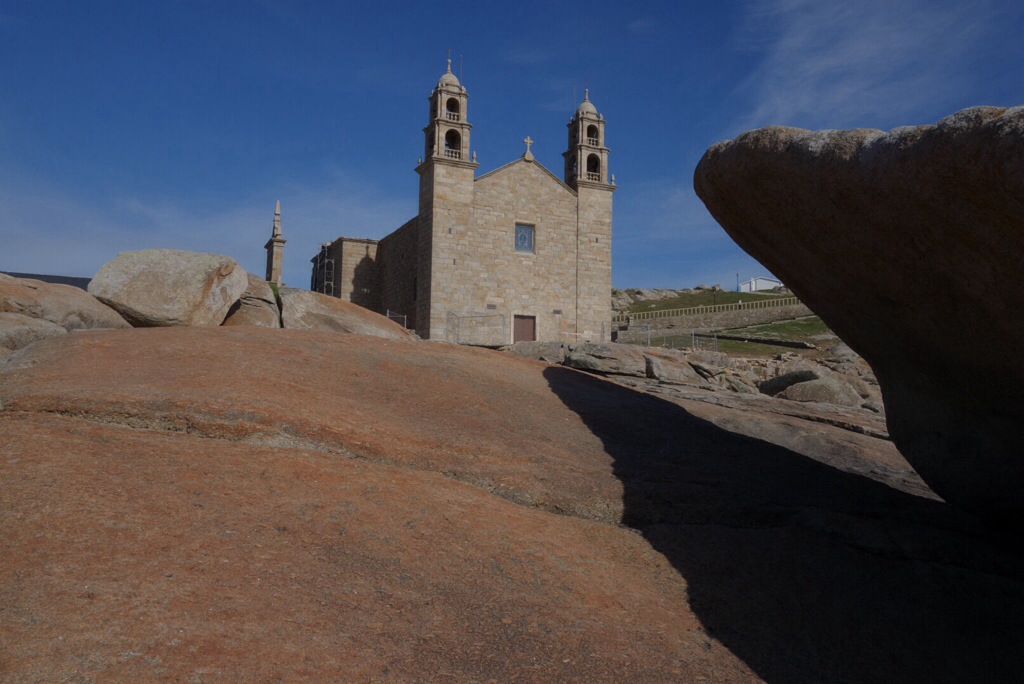
It was a hot and demanding day, but when I reached the fishing village of Muxia, I didn’t stop to shower or rest, but continued the final 800 meters to the furthest point, where massive stone slabs slide into the surf, and the Santuario da Virxe da Barca (Virgin of the Boat) faces the setting sun.

Here my Camino came to an end.

20140515-194750.jpg

20140515-194955.jpg

20140515-195019.jpg

20140515-195233.jpg

Arrival

Always keep Ithaca fixed in your mind.
To arrive there is your ultimate goal.
But do not hurry the voyage at all.
It is better to let it last for many years;
And even to anchor at the island
when you are old,
rich with all you have gained
on the way,
not expecting
that Ithaca will offer you riches.

Ithaca has given you
the beautiful voyage.
Without her you would have never
set out on the road.
But she has nothing more to give you.

– Constantine Cavafy

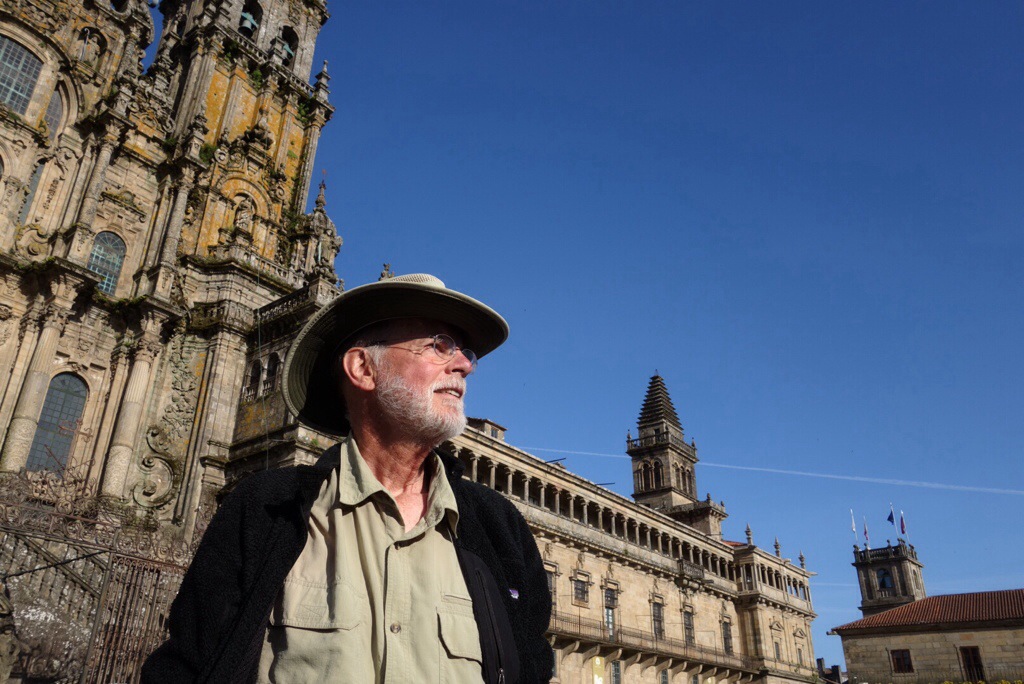
It was still dark Sunday morning when I first stepped into the Prazo Obradoiro – the wide plaza in front of Santiago cathedral. It was deserted but not silent. A taxi sat motionless in the far corner, idling its engine, waiting for what? After ten minutes it finally departed. The new day began to light the spectacular west facade, but one of its towers was hidden by scaffolding – had I walked 500 miles only to see its glory veiled?

I had told myself along the way to have no script for this moment, no expectations for my journey’s end. But this first glimpse of the cathedral, if not exactly disappointing, was at least bewildering. Where were the tears of joy, the flood of emotions? The cathedral’s great bell struck seven, deep and resonant like the voice of a god, but in a language dark and alien, not addressed to me.

Before the crowds arrived, I drifted around the quiet interior. I placed my hand in the Tree of Jesse, the carved central pillar of the Portico de Gloria, my fingers sinking into the deep handprint left in the stone by the caress of countless pilgrims. I descended to the crypt to kneel before the silver casket containing James’ bones. But I was granted little sense of arrival or completion.

Returning to the plaza, now bright with sunlight, I saw a large group of Portuguese pilgrims, singing, clapping and dancing in a great circle. “Resucito!” they sang. “Alleluia!” Many other pilgrims had joined this joyous perechoresis , and I did the same. My heart began to lift, as I remembered – just in time – that the Camino experience is not a possession to be grasped, but a communion to be danced. Lord, I want to be in that number!

But as the day went on, my Camino still seemed unfinished. I felt rather disoriented, no longer walking toward certain goals, no longer sure how even to spend the afternoon. I went to the crowded pilgrim mass at noon, saw the celebrated “Botafumeiro” (gigantic thurible) swing back and forth between the transepts, exchanged “well done!” with a few pilgrims I recognized from the road. But most of my Camino family had either already arrived and departed, or were still a few days back. I felt a bit lonely.

Late afternoon, I wandered over to the little visited San Martino Pinario, and walking inside felt like falling in love. Set amid its plain walls was the most breathtaking altar, a Churrigueresque ensemble of golden sculpture and ornamentation that worked emotionally in a way that so many baroque altarpieces do not. The declining sun streaming through it from behind intensified the effect. This was not mere showy theatricality, but an overwhelming physical presence that didn’t just symbolize belief. It created it.

Back outside the church, I spent some time making camera studies of the fantastically dynamic staircase that leads down to the entrance from the street (an evocative reversal of the more typical ascent to holy places – here you descend to go deeper). And I suddenly realized I was happy. I would even call it a state of grace. I didn’t earn it, seize it, discover it. It discovered me.

After that, it was enough to wander the old streets and plazas around the cathedral, noticing the pilgrim joy in the faces of strangers, enjoying the sense of celebration that is perpetual in this city of arrivals. I dined with some companions of the road before ending the day as I had begun it, in the darkness of the Prazo Obradoiro. But now the moon shone down upon the ancient stones, and strains of Galician singers filled the air. What more could I ask?

This morning I performed the final Camino ritual: climbing the stairs behind the altar to hug the gleaming metal effigy of Santiago. Despite the cool hardness of the sculpture, it was strangely comforting. I whispered in the saint’s ear: “Thank you for the beautiful voyage.”

20140512-105407.jpg

20140512-105457.jpg

20140512-105635.jpg

20140512-105658.jpg

Songs to sing and tales to tell

And when my journey’s finally over,
when rest and peace upon me lie,
high o’er the roads
where we once traveled,
silently there my mind will fly.

– “Parting Friends”

This is one of the many shape note songs I sang along the Camino. I also sang hymns for Holy Week and Easter, made every tunnel and underpass echo with Kyries and Alleluias, and on a few evenings when a guitar got passed around in a hostel, taught choruses from Steve Earle’s “Pilgrim” (“we’ll meet again on some bright highway, songs to sing and tales to tell”) and Tom Russell’s “Guadalupe” (“I am the least of all your pilgrims here, but I am most in need of hope”). And several times a day I would break out with “Dum pater familias,” the medieval Latin song for St. James that rallied the spirits of the pilgrims who sang it as they walked. Prior to headphones, singing was an important part of the pilgrimage experience – shared voices imprinting the path with songlines.

On my penultimate day, the words of “Parting Friends” are especially apt. My mind indeed flies back over the roads I’ve traveled and the people I’ve met. Previous posts have mentioned some of these, but let me record three more who have embodied for me the spirit of the Camino.

The first is Janine, the hospitalera who welcomed me and six other pilgrims to a humble albergue in Calzadilla de los Hermanillos, a village lost in the vast Meseta like a small boat adrift at sea. In a place forgotten by time and history, this grandmotherly woman provided the most exquisite hospitality, as if we were her own family. The next morning, she saw me off with a blessing. Pointing to her “corazon” and mine, she indicated that we were connected. Then she made a walking motion with her fingers and said, “Buen Camino.” She repeated this touching ritual with each of us. Like saints of old doing good in lonely outposts for no earthly reward, she simply existed to love the stranger.

Then there is Tomas, who has occupied a tiny abandoned village in the mountains near the Camino’s highest point and created, in an eclectic assemblage of flags, signs, sculptures and makeshift structures akin to outsider art, a haven for pilgrims seeking a tranquil respite by day, one of his 35 mattresses by night, or shelter from the storm anytime it’s needed. Whenever he sees a pilgrim approaching, he rings a temple bell to greet and bless them. If a cloud covers the mountain with fog and darkness, he rings the bell to guide lost pilgrims to his safe haven. This is his life: to live as a hermit in order to serve the pilgrim.

Finally, on a shady trail through a eucalyptus grove yesterday, I saw a young man kneeling in the dust to pray before a wayside cross. I don’t know his name or his story, but the evident depth of his devotion reminded me how serious a matter the Camino can be.

And now I am at the outer edge of Santiago, in a quiet albergue with very few occupants. Most pilgrims who get this far simply continue on to the great cathedral less than an hour’s walk from here. But I didn’t want to drag myself to the finish late in the day, wearied and worn by ten miles of walking. I want to arrive fresh and renewed, to finish my Camino in the light of the rising sun on the day of Resurrection. So like Jacob of old, who camped just short of his destination in order to collect himself for the morrow’s big encounter, I shall rest and reflect and – who knows? – maybe wrestle with angels till daybreak.

20140510-190017.jpg