Unknown's avatar

About jimfriedrich

I am an Episcopal priest, liturgical creative, filmmaker, writer, musician, teacher and retreat leader. My itinerant ministry is devoted to religious imagination and holy wonder. My blog is a space where diverse ideas and perspectives - theology and culture, liturgy and spirituality, arts and religion - can meet and converse with one another.

Keeping the faith in a time of terror

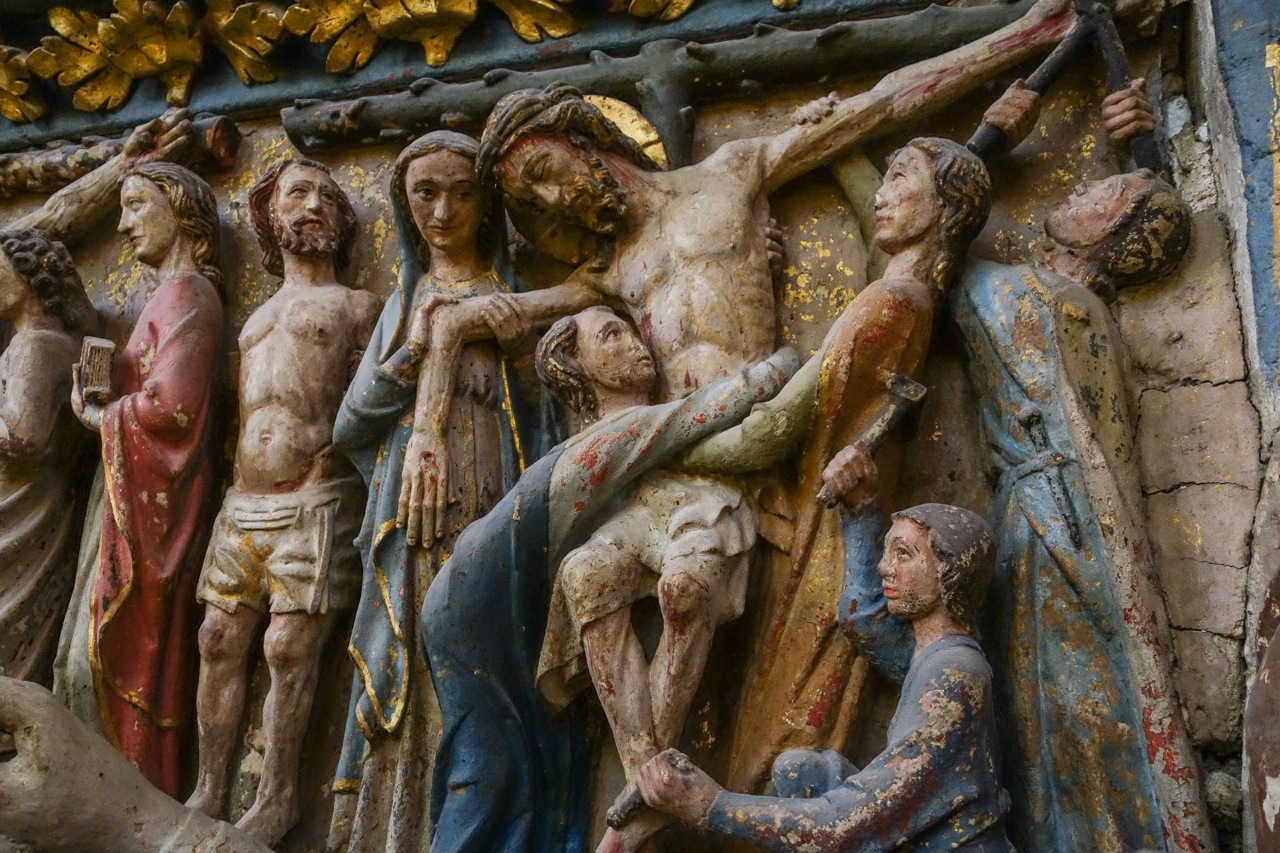
The Deposition (early Gothic; Leon cathedral on the Camino de Santiago)

The Deposition (early Gothic; Leon cathedral on the Camino de Santiago)

Keep your mind in hell, and despair not.

— Staretz Silouan[i]

Ah, children, ah, dear friends, do not be afraid of life!

— Fyodor Dostoevsky[ii]

How do we sing the Lord’s song in the shadow of terror? In solidarity with all the victims of Brussels and the whole human family this week, I protest, I rage, I grieve, I pray. But I must also try to think.

Indiscriminate terror has long been a scourge on this earth, but its globalization through television and social media has now made it emotionally inescapable. Were I to dwell in the uttermost parts of the sea, I could not flee from its presence.[iii]

So as we try to absorb the terrible news from Brussels, how do we “despair not” even in the face of monstrous evil? No simple task, and easy answers seem disrespectful in the time of weeping. But I do believe the antidote to despair is to keep the faith. We must never forget the sacred story we belong to. Even at the grave we make our song: Alleluia, alleluia, alleluia.[iv]

The terrorist, on the other hand, belongs to a story which for most of us in inconceivable. Terror is “the language of being noticed,”[v] a kind of performative rhetoric designed to bring a neglected or disregarded worldview into the open by subjecting others to the violent norms of its alternate reality. They see themselves as global victims, in search of a global audience for their cruel narrative. Mark Juergensmeyer, in his study of religious violence, explains this terrorist rationale:

If the world is perceived as peaceful, violent acts appear as terrorism. If the world is thought to be at war, violent acts may be regarded as legitimate. They may be seen as preemptive strikes, as defensive tactics in an ongoing battle, or as symbols indicating to the world that it is indeed in a state of grave and ultimate conflict.[vi]

In the minds of many terrorists, the war they are so eager to wage is apocalyptic, a cosmic conflict of good and evil in which there is no compromise or bridging of differences. They are, in Don DeLillo’s term, “lethal believers.” And the very worst thing we could do in response would be to play the part they have written for us: satanic enemies in a cosmic struggle. The proposals of certain American presidential candidates to “bomb the hell out of them,” or bring back the good old days of torture, would play perfectly into the terrorists’ hands, conceding the primacy of their deadly story.

However, I choose to belong to a better story, the one enacted and embodied in the powerful liturgies of Christ’s Passion. Step by step on the Way of the Cross this Holy Week, Christians will bring to mind and heart the saving journey which Jesus made, without weapons, into the abyss of suffering and death.

Renouncing all violence and hatred, Jesus remained faithful to the end. After pouring his whole life into a ministry of healing, forgiveness, and reconciliation, he continued to show us the face of love even as he was tortured on the cross. “Father, forgive,” he said with his dying breath. To the last moment, in his most bitter hour, he remained the human who shows us God by doing what God does.

Which story do we choose to live in? The story of terror and violence, or the story of self-diffusive love? Both are costly in the end, but only one leads to new and unconquerable life. Even after Brussels, the word remains: Be not afraid! Love makes the abyss into a Way.

The cross shows us how it is possible to absorb evil and neutralize its effects, rather than pass on the anger and live in bitterness. Turning the other cheek, going the extra mile, giving away your coat to the robber who steals your shirt, loving enemies, doing good to those who hate, blessing those who curse us – all this turns out to be an intelligent and intelligible Christian way of living.[vii]

When medieval women mystics contemplated the cross in prayer and vision, they saw not death’s triumph but a kind of birth. The crucified Jesus was like a woman in labor, enduring pain and travail in order to bring us all to birth: Ah! Sweet Lord Jesus Christ, who ever saw a mother suffer such a birth! For when the hour of your delivery came you were placed on the hard bed of the cross and … in one day you gave birth to the whole world.[viii]

To see such a death and call it birth is the central act of Christian imagination. It is why we declare victory at the cross. We don’t wait for Easter Sunday. We declare victory at the cross, because the Passion isn’t just a story about violent powers that always trample the weak and kill the prophets. It’s also a story about the Realm of God, where dry bones breathe and lost hopes dance, where the prodigal is welcomed home and the tears are wiped from every eye. The Love that makes such a realm was nailed to a cross, but was not consumed by it. Death did what death does, and God did what God does.

And on the outcome of that story, I stake everything.


Related posts

We are the singers of life, not of death

After Paris and Beirut, what story shall we tell?

Beyond Punch and Judy: The art of nonviolent resistance


[i] Staretz Silouan (1866-1938) was a Russian monk on Mt. Athos in Greece. Appearing as an epigraph to Gillian Rose’s book, Love’s Work, I found this provocative saying in Andrew Shanks’ Against Innocence: Gillian Rose’s Reception and Gift of Faith (London: SCM Press, 2008), 9. Rose herself added this typically intense comment: “What Staretz Silouan is talking about is the subjective experience of God-forsakenness,” and even there finding God. “I want to sob and sob and sob,” she says, “until the prolonged shrieking becomes a shout of joy.”

[ii] From Alyosha Karamazov’s final speech in Dostoevsky’s The Brothers Karamazov, trans. Richard Pevear and Larissa Volokhonsky (New York: Vintage Classics, 1991), 776

[iii] cf. Psalm 139:6, 8

[iv] Burial of the Dead, Episcopal Book of Common Prayer, 499

[v] Don DeLillo, quoted in Mark Juergensmeyer, Terror in the Mind of God: The Global Rise of Religious Violence, (Berkeley: University of California Press, 2000 ), 139

[vi] Juergensmeyer, 10

[vii] David Wood, in Consuming Passion: Why the Killing of Jesus Really Matters, eds. Simon Barrow & Jonathan Bartley (London: Darton, Longman and Todd, 2007), 118

[viii] Marguerite d’Oingt (d. 1310)

Beyond Punch and Judy: The art of nonviolent resistance

image

In Faith and Violence, a book published amid the political turbulence of 1968, Thomas Merton told an old Hasidic story about two men, one drunk and one sober, who were beaten and robbed as they traveled through the forest. Asked later about what had happened, the sober one described the violent encounter in vivid detail, but the drunken one seemed quite placid. “We’re all right,” he said. “Everything is fine.” Merton went on to observe that for some, faith “seems to be a kind of drunkenness, an anesthetic, that keeps you from realizing and believing that anything can ever go wrong.” But, he asked, is faith a “narcotic dream” or is it “an awakening”? Then he delivered his punch line: “What if we were to awaken to discover that we were the robbers, and our destruction comes from the root of hate in ourselves.”[i]

At a time when a brutal war was raging in the jungles of Vietnam, police and protestors were clashing in the American street, and leaders who spoke out for justice and peace were being assassinated, a monk dedicated to contemplative retreat from the world felt compelled to explore the theology of love in an age of violence, one which would “deal realistically with the evil and injustice of the world.”[ii] How do we resist the violence in our society without adding our own anger and demons into the mix? How do we resist systemic and social sin while harboring no illusions about our own capacities to do harm?

In recent days there have been numerous conversations about the escalating political violence surrounding the Trump campaign. My own post (March 12) on the topic has generated heartfelt responses of shared concern. Many of us are wondering what we can do about the situation without defaulting to our own versions of anger or fear. We need experienced guides through such tricky terrain, and Thomas Merton is one of the best.

“We no longer communicate,” Merton said. “We abandon communication in order to celebrate our own favorite group-myths in a ritual pseudo-event.”[iii] He wrote that in the Sixties, but he could have been describing a Trump rally, which, in the absence of substantive content, is mostly a ritual acting out of a group-myth, reaching its crescendo in the anticipated expulsion of protesters. As Rachel Maddow showed in a recent montage of those expulsions, Trump repeatedly asks the crowd, “Isn’t this exciting?” Roughing up protesters may express anything from personal rage to fascist methodology, but it is also entertainment. As Neil Postman has noted, Americans like “amusing ourselves to death.”[iv] When the anti-Trump signs come out, the crowd gets happy, knowing the real fun is about to begin.

This is all contemptible and sad. But I wonder: how do protestors avoid becoming unwitting collaborators in Trump’s entertainments? Even if they don’t hit back or give the crowd the finger, how do they escape complicity in a political Punch and Judy show? How do they avoid getting their own group-myths stuck in the futility of an endless ritualized dualism of “us versus them”?

Blessed are the peacemakers, for they shall be called the children of God. The peacemaker is committed to communion as the nature and destiny of humankind. As Martin Luther King said in a speech I remember from my college days, we must see the face of Christ even in the police who are attacking us with dogs and fire hoses. Or as Jesus himself taught, we must love our enemies. That does not mean capitulating to evil, or abstaining from the tainted ambiguities of political conflict. But it does mean that we ultimately belong to a much better story, where one day the tears will be wiped from every eye, the lion will lie down with the lamb, and the prodigal will be welcomed home. It means that our highest commitment is not to defeat our enemies but to make the divine love story of amazing grace come true for everyone.

As Merton wrote, “Christian nonviolence is not built on a presupposed division, but on the basic unity of [humankind]. It is not out for the conversion of the wicked to the ideas of the good, but for the healing and reconciliation of … the human family.”[v] This isn’t sentimental benevolence or passive submission. It’s a very tough form of love, as Jesus, Gandhi, King and many others have demonstrated in their costly commitment to a wider, more generous perspective than the self-righteous justifications of partisan interests. Our struggles must always reject the ultimacy of division in favor of communion. “The key to nonviolence,” Merton reminds us, “is the willingness of the nonviolent resister to suffer a certain amount of accidental evil in order to bring about a change of mind in the oppressor.”[vi]

But how do we apply this wisdom to the specific challenges of our own day? How can we respond creatively to the upwelling of anger, fear, racism and nativism poisoning our public life? In 1968, Merton compiled a list of principles for nonviolent resisters which is worth considering. While he admitted that the complexity and fluidity of events in that turbulent year could make any opinion lose its value in a matter of weeks, I believe his prescriptions retain an enduring value:

1) “be free from unconscious connivance with an unjust and established abuse of power”

2) “be not for [oneself[ but for others, that is for the poor and underprivileged”

3) “dread a facile and fanatical self-righteousness and refrain from being satisfied with dramatic self-justifying gestures”

4) demonstrate “a desirable alternative” to violence and injustice

5) use means which embody and manifest the emergent way of being which Christians call the Kingdom of God

6) be “willing to learn something from the adversary”

7) be grounded in hope and humility – what we strive for is a gift from God’s future: not of our own making, and not yet fully here [vii]

I particularly like Number 4 (demonstrate a desirable alternative) and Number 6 (embody and manifest the Kingdom of God). It is what we do in the eucharist, where everyone is welcome, everyone practices reconciliation, and everyone shares the bread of heaven. But can we take such countercultural vision into the street?

Yes we can. There are various ways (many of which have yet to be invented!). Even into her nineties, my mother joined the “women in black” every Friday in silent vigil against the Iraq war on the streets of Santa Barbara. Their faithful witness was impossible to ignore, while at the same time it perfectly embodied the peace for which they stood.

A very different display of visionary resistance occurred at the World Trade Organization (WTO) protests in Advent of 1999. Those who watched the news only saw the Punch and Judy show of untrained police and young provocateurs turning a shoving match into a tear-gassed conflict. But the most important things that happened were not on television. This is what I myself witnessed on the day of the big rally and march[viii]:

There was a large banner which read, AN INJURY TO ONE IS AN INJURY TO ALL. It seemed a perfect summary of the gospel: “If you do it to one of the least of my brothers and sisters, you do it to me.” All in Christ, Christ in all. Solidarity forever. We were there to speak for all those whom the WTO would rather silence or forget – voices crying in the wilderness, “Prepare the way of the Lord.”

At 12:30 pm, we took to the streets, marching up Fourth Avenue. to join the thousands more who were already downtown. It was a wonderfully diverse procession: there were people dressed as Santa Claus, sea turtles, trees, and even death. But it was not some crazy fringe out there. As one writer put it, “These were the kids at UW, the ladies from church, the guys at Boeing. It was Seattle that was marching this week.”

As in all street rituals, there was a playful, carnival atmosphere. As Richard Shechner observes in his book, The Future of Ritual:

“When people go into the streets en masse, they are celebrating life’s fertile possibilities…They put on masks and costumes, erect and wave banners, and construct effigies not only to disguise or embellish their ordinary selves, or to flaunt the outrageous, but also to act out the multiplicity each human life is…They protest, often by means of farce and parody, against what is oppressive, ridiculous and outrageous…Such playing challenges official culture’s claims to authority, stability, sobriety, immutability and immortality.”[ix]

In other words, we were exhibiting the same spirit – dare I say “holy spirit”? – of playfulness, camaraderie, irony and subversion that was seen ten years ago at Tiananmen Square and the Berlin Wall and, during biblical times, at the Red Sea and the Triumphal Entry on Palm Sunday. And as faith tells us, the powers don’t stand a chance against the foolishness of God.

There were people on stilts, people carrying giant puppets, babies in carriages and elders with canes and walkers. I stuck close to the Anti-Fascist Marching Band, which played soulful New Orleans versions of “America the Beautiful”, “Battle Hymn of the Republic” and Bob Dylan’s “Masters of War.” We all just danced up Fourth Avenue …

So, my friends, how shall we do the Kingdom dance in the year of grace 2016?


[i] Thomas Merton, Faith and Violence: Christian Teaching and Christian Practice (Notre Dame, Indiana: Indiana University Press, 1968) ix-x (All quotes from Faith and Violence are in The Thomas Merton Encyclopedia (New York: Orbis Books, 2002) under the entry on Merton’s book, but I have listed the original volume’s page numbers in the footnotes.)

[ii] ibid., 9

[iii] ibid., 159

[iv] Neil Postman, Amusing Ourselves to Death: Public Discourse in the Age of Show Business (New York: Penguin, 2005)

[v] Merton, 15

[vi] ibid., 27-28

[vii] ibid., 21-25

[viii] From a sermon I preached the following Sunday at St. Augustine’s-in-the-Woods Episcopal Church, Whidbey Island, WA (Advent II, 1999))

[ix] Richard Schechner, The Future of Ritual: Writings on Culture and Performance (London & New York: Routledge, 1993), 46

How far can we sink? – Donald Trump and the vortex of rage

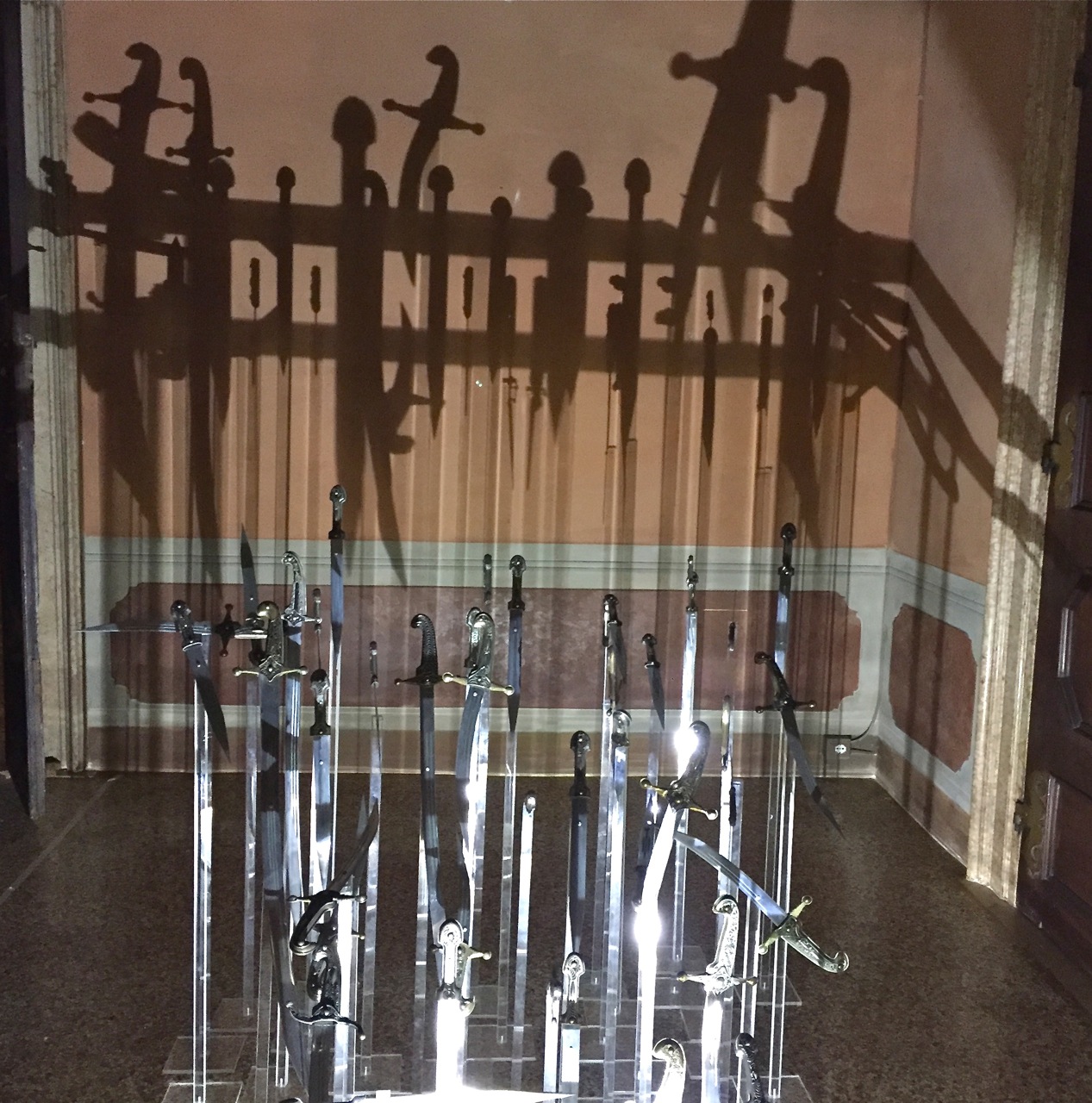
Rashad Alakbarov, "Do Not Fear," installation at Venice Biennale 2015

Rashad Alakbarov, “Do Not Fear,” installation at Venice Biennale 2015

We must love one another or die.

— W. H. Auden, “September 1, 1939”

In the early 1930s, about a hundred communists crashed a Nazi meeting in Bremen, Germany, determined to break it up. One of them, Richard Krebs, rose to interrupt a speech by Herman Göring, head of the notorious SA stormtroopers, a paramilitary group dedicated to political intimidation and violence. Krebs only got out a few words before the “brownshirts” rushed toward him. As Krebs later wrote,

“A terrifying mêlée followed. Blackjacks, brass knuckles, clubs, heavy buckled belts, glasses and bottles were the weapons used. Pieces of glass and chairs hurtled over the heads of the audience. Men from both sides broke off chair legs and used them as bludgeons. Women fainted in the crash and scream of battle. Already, dozens of heads and faces were bleeding, clothes were torn as the fighters dodged about amid masses of terrified but helpless spectators. The troopers fought like lions. Systematically they pressed us on towards the main exit. The band struck up a martial tune. Hermann Göring stood calmly on the stage, his fists on his hips.”[i]

A political life fraught with such violent thuggery once seemed unimaginable in contemporary America. What happened in Germany could never happen here, we tell ourselves. Physical violence as a routine form of political expression is not something we expect our leaders to tolerate, much less encourage. What, then, are we to make of the violent anger which has become a common feature of Donald Trump rallies?

At one such gathering, a man held up a sign, “Make America hate again!” The crowd happily obliged, ripping up the sign and roughing up the protester. At another rally, on March 10, a 78-year-old man in the crowd sucker-punched a young activist as he was being escorted out of the arena by Trump’s security guards. “He deserved it,” the man told a reporter. “Next time, we might have to kill him.”[ii]

In Ashley Parker’s excellent New York Times piece on this phenomenon, she sees the crowd’s violent reaction as “almost biological”:

“Trump supporters typically begin shouting, pointing, jeering — and sometimes kicking or spitting — at the protester, surrounding the offender in a tight circle, like antibodies trying to isolate and expel an unwanted invader from the bloodstream.”[iii]

Is Trump to blame for the passions of his followers? He has made some cursory disclaimers after the fact, but when the anger erupts he does little to discourage it.

On February 1, he told an Iowa crowd to be on the lookout for protesters with tomatoes. “If you see somebody getting ready to throw a tomato, knock the crap out of ‘em, would you? Seriously. Okay? Just knock the hell – I promise you, I will pay for the legal fees, I promise, I promise.” Later that month, as a protester was being ejected from another rally, Trump said, “I’d like to punch him in the face.”[iv] It is hard to listen to this stuff without thinking of Göring in Bremen, standing “calmly on the stage, his fists on his hips.”

When asked by reporters about the violence, Trump talks about “the good old days” when America wasn’t “weak,” and you were able to dish out a well-deserved pummeling. “This country has to toughen up,” he says. “These people are bringing us down.”[v]

Such scapegoating is one of the hallmarks of fascism. Instead of the hard work of developing concrete policies and building support for them, the leader simply invokes fear and hatred of “the other” to unite his followers. Trump repeatedly demonizes protesters as “nasty people” and blames them for initiating the violence, even though no reporter or camera has seen anything to support his claim, except for one thrown tomato that is said to have missed the mark.[vi] This one-sidedness may change, of course, for violence can be highly contagious.

Trump has argued that his supporters are not really angry people, but that they “do get angry when we see the stupidity with which our country is run and how it’s being destroyed.”[vii] His rhetoric bears a chilling resemblance to the Nazi justifications for Kristallnacht: “an expression of the people’s rage” …. “ “a just measure of indignation”… “our patience is exhausted.”[viii]

A few days ago, Trump described an incident at an earlier rally. “He was a rough guy and he was punching. And we had some people – some rough guys like we have right in here – and they started punching back. It was a beautiful thing.”[ix]

In this week’s Republican presidential debate, the three other candidates were given the opportunity to condemn the political violence of Trump’s mob, but they kept silent. Maybe they were hoping it would all just go away, without their having to risk the loss of any votes from “the base.” But silence in the face of evil is just endorsement by default.

We hear God invoked repeatedly in presidential campaigns by candidates who claim to be good Christians. But a “Christianity” so enamored of what theologian John Milbank calls the “ontology of violence” feels unrecognizable to me. Whether it is the manipulation of anger at a rally or policies of aggression against everyone who is “other,” such a politics is anathema to the transformative project of conforming the social body to the divine desire for justice, forgiveness, and peace.

Last October I had a conversation about American politics with a few British shape note singers in a London pub. They wanted to know what on earth the Trump spectacle was all about. I muttered the common wisdom of the moment about a clownish celebrity who would soon fade away. “Watch out,” warned one of the Brits, the daughter of an Anglican priest. “A single dumb candidate can make the whole process dumber, and drag everyone down to his level. That happened here when we elected our mayor. It could happen in America.”

She was right, as we now know, although “dumb” is the least of it. How far can we still sink? In Richard Evans’ acclaimed trilogy on the Third Reich, he describes Germany on the eve of the Nazi takeover in one disturbing sentence: “Years of beatings and killings and clashes on the streets had inured people to political violence and blunted their sensibilities.”[x]

The blunting of our own sensibilities should be worrying us. But how can we resist the downward pull of fear, hatred and violence without ourselves being corrupted by it, or sucked into its vortex of rage? How may we give concrete political form to the better angels of our nature?

The day after Martin Luther King was assassinated, Senator Robert Kennedy spoke against the violence permeating American culture in the 1960s:

“Some look for scapegoats, others look for conspiracies, but this much is clear: violence breeds violence, repression brings retaliation, and only a cleansing of our whole society can remove this sickness from our soul.”[xi]

Two months later, Bobby Kennedy himself would be cut down by the political violence he had so earnestly lamented. As for the rest of us, the day of our collective cleansing still remains sadly distant.


[i] Richard J. Evans, The Coming of the Third Reich (New York: Penguin Books, 2003), 270

[ii] Ashley Parker, “Riskiest Political Act: Protesting at Rallies for Donald Trump” (New York Times, March 10, 2016)

[iii] ibid.

[iv] Philip Bump, The Fix, Washington Post online, March 10, 2016

[v] Jim Salter & Jill Colvin, Associated Press, March 11, 2016

[vi] Daniel White, “Donald Trump Tells Crowd”, Time online, February 1, 2016

[vii] Salter & Colvin

[viii] Walter Laqueur & Judith Tydor Baumel, eds., The Holocaust Encyclopedia (New Haven: Yale UP 2001). 390

[ix] Jill Colvin & Michael Tarm, Associated Press, March 11, 2016

[x] Evans, 348

[xi] Robert F. Kennedy, Remarks to the Cleveland City Club, April 5, 1968

The Return of the Prodigal Son

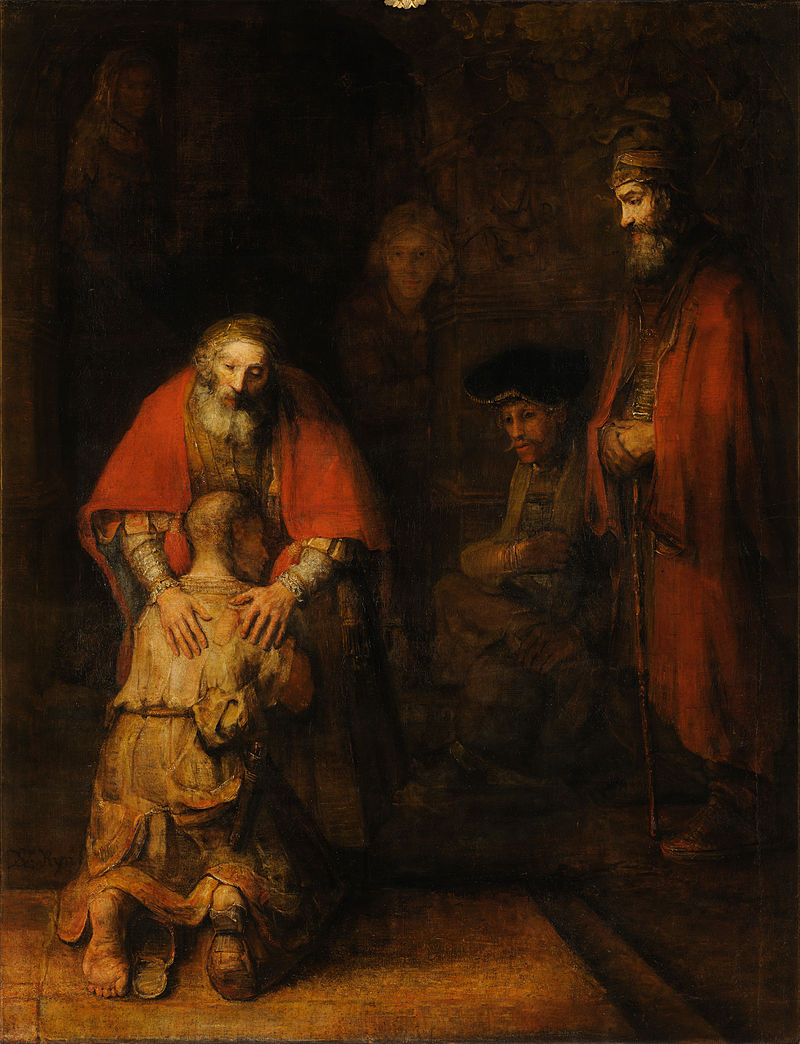
Rembrandt van Rijn, The Return of the Prodigal Son, c. 1661–1669 (Hermitage Museum, Saint Petersburg)

Rembrandt van Rijn, The Return of the Prodigal Son, c. 1661–1669 (Hermitage Museum, Saint Petersburg)

Sometimes I lead retreats to explore correlations between biblical narratives and our own stories. It’s not just a matter of putting ourselves in a given Bible story as a method of interpreting it. We also need to let it interpret us, as we discover the biblical motifs which are playing out in the particular circumstances of our own lives. What is my creation story, what is your exodus story, what is each one’s death and resurrection story?

At one such retreat, we considered Jesus’ parable of the Prodigal Son. After studying the text, we tried out various ways of retelling it in our own words. Then we divided into three groups: Fathers, prodigal sons, and elder brothers. Membership in each group was determined by chance, although it turned out that the “elder brothers” consisted mostly of firstborn children.

Each group was asked to wrestle with their assigned character. What do you feel about this character? What does the story tell you about him? What does the story leave unsaid? Then they were invited to share a related story from their own lives. Tell about the struggles of being a parent, a child, or a sibling. Tell about a time you were forgiven, or needed to forgive. Tell about a time you felt neglected or ignored, envious or resentful.

One man said he had been disappointed at first to draw the father’s group, because he always related more strongly to the elder brother. As the oldest child in his family, he had some of the issues common to that role. He knew the burden of wanting to live up to his parents’ expectations, to be “perfect,” obedient, one who pleases by getting everything right. He had also experienced some envy and resentment of younger siblings who seemed more carefree and less responsible.

But as he listened to others in the group engage with the father’s side of the story, it occurred to him that he himself had actually been a father for as long as he had been only a son and brother. Maybe, he said, it was time to rethink his own story and who he was in it.

In the early nineties, Henri Nouwen wrote “a meditation on fathers, brothers, and sons” using the parable of the Prodigal Son along with Rembrandt’s famous painting of the moment when the errant child is welcomed home. Like the people in my retreat, he found critical insights into his own life in each of the characters. And in doing so, he realized that there were two sons, not just one, who went astray from their father’s will, into “a distant country,” the place of alienation.[i]

The younger son’s sins may have been more dramatic and colorful, but the elder brother’s bitter and jealous heart grieved his father just as much. Both sons are lost. Both need to be welcomed “home.” As Rembrandt’s painting shows, the elder stands in the shadows, separated from the radiant light surrounding the father and his youngest child.

“There is not only the light-filled reconciliation between the father and the younger son, but also the dark, resentful distance of the elder son. There is repentance, but also anger. There is communion, but also alienation. There is the warm glow of healing, but also the cooling of the critical eye; there is the offer of mercy, but also the enormous resistance against receiving it.”[ii]

Whether the elder brother will be able to step out of his darkness into love’s radiance remains unknown in both the painting and the original parable. But the father has made it clear that his parental love will never be withdrawn. Like the loving mercy of God, his welcoming arms remain ever extended and expectant, now and forever. As Nouwen writes, “The heart of the father burns with an immense desire to bring his children home.”[iii]

Nouwen describes the differences between the father’s hands in Rembrandt’s painting. His left hand is strong, masculine, gripping his son encouragingly. His right hand seems more refined, almost feminine, offering the caress of consolation. The father’s red cloak also conveys shelter and protection, like the enfolding wings of a mother bird.

Love so amazing, so divine, has a cost. It does not always produce happy endings. In the “fathers” group at the retreat, one woman told us about her own prodigal son, a forty-year old man who had struggled for years with his own lostness. “I welcomed him home every time,” she said, “and then he would just break my heart all over again.” Six months before our retreat, he had committed suicide.

When we hear the parable, it is natural to focus on the prodigal’s experience of unconditional, unmerited welcome. We all long to hear the word of mercy for ourselves: weary pilgrim welcome home. But Nouwen won’t let us stay there. Although we each need to make our way on the difficult journey home, in the end we are called to claim the role of the father as well. Forgiven so much, may we also become the ones who forgive, whatever it costs.

“His outstretched hands are not begging, grasping, demanding, warning, judging, or condemning. They are hands that only bless, giving all and expecting nothing … As I look at my own aging hands, I know that they have been given to me to stretch out toward all who suffer, to rest upon the shoulders of all who come, and to offer the blessing that emerges from the immensity of God’s love.”[iv]


[i] Henri J. M. Nouwen, The Return of the Prodigal Son: A Meditation on Fathers, Brothers, and Sons (New York: Doubleday, 1992)

[ii] ibid., 126-7

[iii] ibid., 89

[iv] ibid., 127-8, 130

The voice that allows us to remain human

Moses before the Burning Bush, 13th century icon, Monastery of St. Catherine, Mt. Sinai

Moses before the Burning Bush, 13th century icon, Monastery of St. Catherine, Mt. Sinai

Even in the darkest hours of mankind, there might be a voice within us that allows us to remain human.

– László Nemes, director of Son of Saul, accepting the Oscar for Best Foreign Film

These words, spoken last night at the Academy Awards, struck me with particular force, since one of the most famous accounts of that voice had just been told in the morning liturgy. Although Exodus 3: 1-15, the story of the burning bush, does not describe a voice coming from “within,” I believe that the voice which Moses heard at the foot of God’s mountain was the same voice which the Hungarian filmmaker longs to hear, the same voice we all long to hear in a dark time when the humanity of our country, our world, and ourselves is being called into question.

Whether it speaks in an interior whisper, or calls to us from an exterior source, the voice “that allows us to remain human,” to remember (or discover) our true humanity, is the voice which has been speaking us into being since the beginning of the world. It is the voice of revelation.

Revelation, in the words of Ashton Nichols, is “a moment when the soul of the recipient is filled with something outside the self. A literal inspiration occurs. Consciousness finds itself flooded, or breathed into, or simply filled, by a force it ascribes to an external agency. The metaphoric agent may be a wind, a flash of light, or a disembodied voice. Divine grace descends; the voice of God is heard in the whirlwind; a spirit inspires the prophet or poet with a truth that comes from outside the self and is incorporated into the soul of the recipient.”[i]

The sense of a truth coming from “outside the self” may seem a contradiction to Nemes’ “voice within us,” but only if we understand ourselves as separate, autonomous beings more or less self-contained and complete. If we are made in the image of the Trinitarian God, then we are part of a larger, interdependent flow of self-diffusive love in which outside and inside, or divine and human, are not strict opposites, but partners in a dance. We are constituted by a process of receiving our being from somewhere else, and in turn giving ourselves away. We “lose” our life to find it, as Jesus said. Like that bush in the Sinai, we burn with divine fire, yet are not consumed.

The first time I went to the Holy Land, in 1989, I saw a burning bush. It happened to be Ascension Day. I was visiting the Anglican sisters in Ramallah, with whom my mother had once worked to teach and care for Palestinian Christian children. Since a border closing prevented us from going to mass at a Benedictine church known for its beautiful chanting, a couple of the sisters took me for a walk in the local hills. As we descended a ravine, we encountered a shepherd with his small flock. And behind him, a little further on, I saw, with considerable astonishment, a burning bush. Why it was on fire, I never learned. If it spoke, I did not hear. Sometimes the voice is for the shepherd’s ears only. But I never forgot the wonder of it.

The bush which will burn and speak to you, or me, is out there somewhere, waiting for the proper moment of holy meeting. Anglican poet/priest R. S. Thomas described his own encounter in “The Bright Field.”

I have seen the sun break through
to illuminate a small field
for a while, and gone my way
and forgotten it. But that was the pearl
of great price, the one field that had
the treasure in it. I realize now
that I must give all that I have
to possess it. Life is not hurrying

on to a receding future, nor hankering after
an imagined past. It is the turning
aside like Moses to the miracle
of the lit bush, to a brightness
that seemed as transitory as your youth
once, but is the eternity that awaits you.

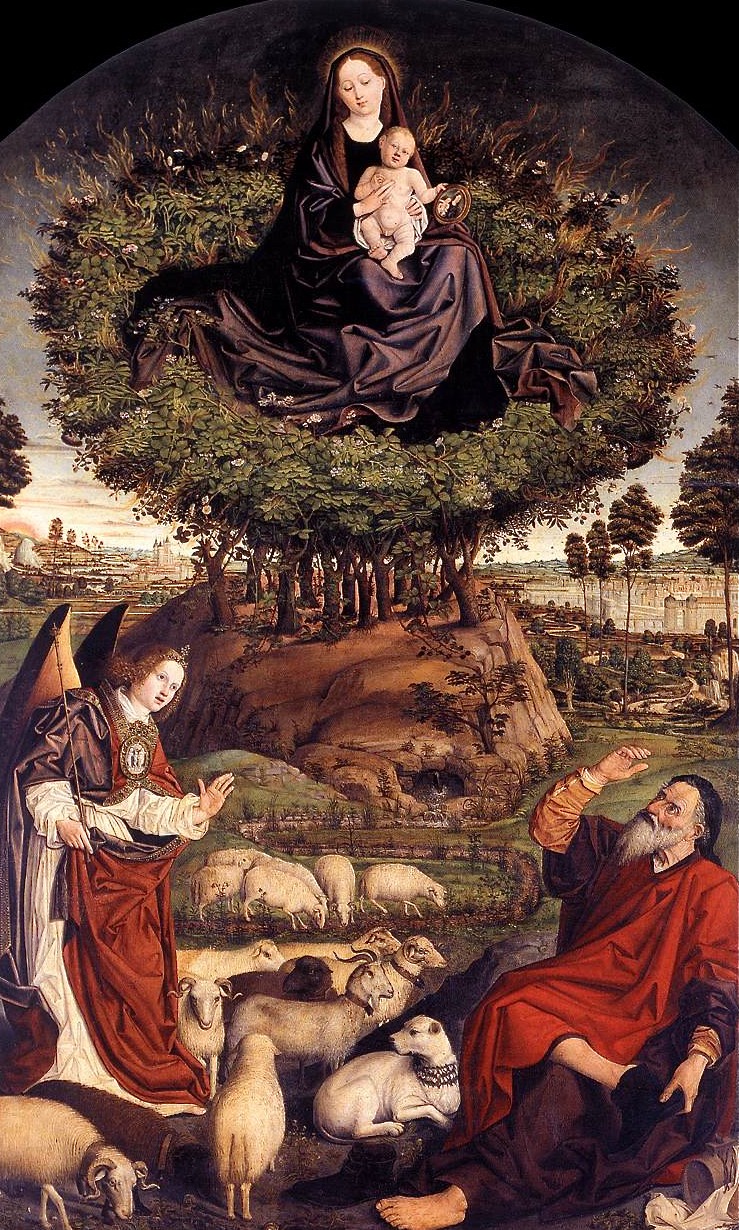
Mary in The Burning Bush, Nicolas Froment (1475-6)

Mary in The Burning Bush, Nicolas Froment (1475-6)

In an exquisite fifteenth-century tryptich by Nicolas Froment, Moses beholds the Madonna and Christ Child in the “burning” bush. There are no prominent flames. The Word made flesh is both voice and fire. God incarnate is the ultimate revelation by whom and through whom and in whom we may, at last, become fully human.


[i] Ashton Nichols, The Poetics of Epiphany: Nineteenth Century Origins of the Modern Literary Movement

Is holiness a Lenten obligation?

Bench carving, Cathedral of Seville, Spain

Bench carving, Cathedral of Seville, Spain

In the liturgical rite for Ash Wednesday, the priest stands up before the people and invites them “to the observance of a holy Lent.” It is a solemn and noble custom. But is it a serious proposal? And if so, what is actually being asked of the faithful?

When people hear the word “holy,” they often think “devout” or “virtuous,” but qodesh, the word for holiness in the Hebrew Bible, is not a moral or behavioral term. It means “apartness,” conveying an inherent, critical difference between what is holy and what is not.

The word itself is set apart. Unlike other divine attributes like power, justice and love, holiness has no analogue in the everyday life of Israel. It doesn’t refer to a common experience and then say God is like that. Instead, it evokes the one quality of God which is unlike anything we know.

In ancient Judaism, holiness meant the radical otherness of God, the Holy One. The divine presence is not to be approached easily or casually, either by our bodies or by our language. God dwells in a sacred zone which is highly charged, difficult and risky to enter.

Israel’s worship practices grew up around this strict sense of separation. At the center of cultic life was a holy of holies, a space set apart from contamination by the world. And only priests, who were themselves set apart and highly trained in the intricacies of access, were allowed to have contact with this sacred center. There was a sense that if the sphere of holiness were to be contaminated or carelessly regarded, the presence of the Holy One might withdraw from Israel, and that would be disastrous.

Leviticus, not a book I spend a lot of time with, contains a long section known as the Holiness Code because of its repeated use of holy and holiness, as well as related terms like sanctify, hallow, consecrate, dedicate, and sacred. It is filled with detailed prescriptions ranging from ritual practice to sexual behavior. Many of these seem archaic and largely inapplicable today. But may we still find something valid in the impulse to preserve the “holy” from profanation or inattention?

The sacred is made present by the attention we give to it. For example, if you come to a labyrinth occupying an open space, do you just walk straight across it, or do you go around it, acknowledging it as a space set apart for prayerful activity? Or does it only become holy space when it is put to its intended use, rather than just lying there as a decorative floor pattern?

I once led a weeklong family retreat for a Nevada parish on the eastern shore of Lake Tahoe. There was a beautiful stone church, with a large window looking across the water to the high peaks of the Sierra mountains. The space around the altar was large enough to hold all of us, so we did most of our worship there, in the intimacy of a circle.

I asked everyone to do two things each time they came inside the altar rails. One was to remove their shoes, like Moses at the Burning Bush. The other was to perform an action of their choice to mark their entrance into holy space: they could lift their hands in prayer, bow, genuflect, cross themselves, kiss the altar, or prostrate themselves on the floor. Most of the children, being the enthusiastically embodied creatures they are, opted for prostration! The effect of these physical observances was tangible. The attention we gave changed the quality of being there. It became for us holy ground.

But what Leviticus is after, and what a holy Lent is about, is more than the quality of a space or the attention we pay to it. Holiness is meant to be something contagious, something which gets inside us and changes us forever.

You shall be holy, for I your God am holy (Leviticus 19:2). God is not content to limit holiness to Godself. God’s people are invited to be holy as well. Not just our sanctuaries, but ourselves, are made to be set apart, consecrated, sanctified, hallowed. Biblical theologian Walter Brueggemann has called this the “obligation tradition,” where “the purpose of Israel’s life is to host the holiness of Yahweh.”[i]

As biblical people gradually figured out, hosting divine holiness means more than maintaining ritual purity or devotional piety. It means embodying justice and peace as well, uncontaminated by the dehumanizing, violent and oppressive practices of the dominant culture. Such holiness requires the consecration and dedication of every aspect of life to the will and purpose of God.

Leviticus 19:9-18 provides some excellent guidelines for our own time:

  • Don’t keep all your food for yourselves
  • Remember the poor and the immigrant
  • Don’t steal, lie, or defraud one another
  • Don’t exploit your workers
  • Be mindful of those with special needs
  • Be fair and just in your dealings with others
  • Don’t slander, seek revenge, or carry grudges
  • Love your neighbor as yourself

The nice thing about such a list is that these are all things we can do. They are not perfections only achievable in a messianic future. We can perform them right now. Jesus offered a similar list. Is somebody hungry? Feed them. Is anybody thirsty? Get them some water. And if curing the sick or setting the prisoner free seems beyond you, surely you can at least visit them. This is not impossible stuff.

Holiness, an attribute of God, becomes for us a practice.
Not something we are, but something we do.

Of course the specific obligations of holiness are not always clear. It is one thing to separate yourself by going to the desert, the monastery, or a countercultural refuge. It is quite another to live in contemporary society with its inevitable complicity in the evils by which the system maintains itself: militarism, consumerism, economic injustice and violence against the planet. How do we say no to the evil and yes to the good in a world of such complex interdependence?

And yet, Scripture remains insistent that we continue to strive for sanctification, dedicating our lives to God and separating ourselves from whatever is not of God.

  • God chose us in Christ to be holy and blameless, full of love (Ephesians 1:4)
  • Clothe yourselves with the new self, created according to the likeness of God in true righteousness and holiness (Ephesians 4:24)
  • Surrender your bodies to righteousness in order to create a holy life (Romans 6:19)

Surrender. Is this too much to ask? Is a holy life too much to ask? Does it set the bar so high that we just abandon the field to an elite corps of ethical heroes: the few, the proud, the saints?

Even worse, does a religion of obligation veer us toward “works righteousness,” overestimating our powers and denying the need for grace? Well, even Calvin admitted the possibility of making progress in personal goodness. He echoed the purity language of Leviticus when he wrote:

Ever since the Holy Spirit dedicated us as temples to the Lord, we should make it our endeavor to show forth the glory of God, and guard against being profaned by the defilement of sin. Ever since our soul and body were destined to heavenly incorruptibility and an unfading crown, we should earnestly strive to keep them pure and uncorrupted against the day of the Lord.[ii]

But where do we begin? Thomas Aquinas outlined three stages of holiness: First, distance yourself from sin and wrong inclinations (holiness as an act of separation, turning your back on sin and turning toward God). Second, work on cultivating the virtues in your life (holiness as a daily practice). Finally, rest in loving union with God (holiness as communion with the Holy One).

This triptych of holiness is echoed in my favorite collect in the service of Morning Prayer:

  • drive far from us all wrong desires (separation)
  • incline our hearts to keep your law, and guide our feet into the way of peace (practice)
  • that, having done your will with cheerfulness during the day, we may, when night comes, rejoice to give you thanks (communion)

Or to put this in the simplest terms:

  • What do I need to let go of?
  • What do I need to acquire and cultivate?
  • In whose reality do I want to dwell?

It’s not about effort, of course. Sola fide, sola gratia, soli Deo. Only faith, only grace, only God. As Augustine knew, “When God crowns our merits, God crowns nothing but God’s own gifts.”[iii]

And it’s never done, this holiness business. It’s an open-ended process of continual striving. Gregory of Nyssa said, “The perfection of human nature consists perhaps in its very growth in goodness.”[iv] In other words, holiness isn’t something we achieve, it’s a commitment to growth.

And as an old eucharistic prayer suggests, the time to start is now:

And here we offer and present unto thee, O Lord,
our selves, our souls and bodies,
to be a reasonable, holy, and living sacrifice unto thee.[v]

What if, every day during Lent, each of us were to make such a prayer?
Here I offer and present to you, O God, my ________.

Just fill in the blank with whatever the time and place requires.


Related posts

Grace me guide

Heart work and heaven work


[i] Walter Brueggemann, Theology of the Old Testament: Testimony, Dispute, Advocacy (Minneapolis: Fortress Press, 1997), 428

[ii] John Calvin, Institutes 3.6.3

[iii] Augustine, Epistle 154, 5.16

[iv] Gregory of Nyssa, Life of Moses 10

[v] Thomas Cranmer, Book of Common Prayer (1549), based on Romans 12:1, in the Episcopal Book of Common Prayer (1979), 336.

Ash Wednesday: A time for self-compassion


Alleluia ashes 2sm

There is a really deep well inside me. And in it dwells God. Sometimes I am there too. But more often stones and grit block the well, and God is buried beneath. Then he must be dug out again.

– Etty Hillesum[i]


Hillesum’s evocative image expresses the duality of the Lenten season. On the one hand, God is not the end product of spiritual attainment, something brought closer through our own efforts. The deep well of divinity is already present within us, “more intimate to me than I am to myself.”[ii] We don’t have to go somewhere else to find it. Lent is a time to tune in, go deep, and pay heightened attention to the Presence we often miss.

At the same time, our awareness of – and relationship with – this Presence may be hindered or obstructed by any number of things, requiring some real digging on our part. The trouble is, that digging can quickly become a self-improvement project, with Lent’s success judged by the quality and success of our efforts. We imagine a more spiritually heroic self, and strive to make it come true.

The ancient Desert Fathers and Mothers, who fled the corruption and distractions of their culture to seek a holier life in the wastelands beyond Empire, might seem at first glance to be overflowing with heroic aspiration. A typical regimen would be to “get up early every day and acquire the beginning of every virtue and commandment of God. Use great patience, with fear and long-suffering, in the love of God, with all the fervor of your soul and body. Exercise great humility, bear with interior distress, be vigilant and pray often with reverence and groaning, with purity of speech and control of your eyes… Do your work in peace. Persevere in keeping vigil, in hunger and thirst, cold and nakedness, and in sufferings.”[iii]

Such rigorous spiritual practice wasn’t for the halfhearted. But it risked the competitive sin of pride. Paul of Pherme, for instance, undertook the project of “continual prayer” – 300 prayers per day, keeping count with a pile of 300 pebbles in his lap. After each prayer, he tossed away one pebble. But he was crestfallen to learn of a certain woman who had been saying 700 prayers per day for thirty years! He would never catch up. Another desert father, Macarius the Alexandrian, warned Paul that his spiritual life lacked both balance and humility. But Macarius was no moderate. He once did penance for swatting a mosquito by moving to a swamp to endure six months of insect bites, without ever raising a hand in defense.[iv]

Thankfully, the extremists were not the norm. More prevalent was a spirit of deep humility about one’s capacities. John Climacus was a seventh-century monk at Mt. Sinai. His image of the spiritual life as a “Ladder of Divine Ascent” was later pictured in a famous twelfth-century icon.

Ladder of Divine Ascent, St. Catherine's Monastery, Mt. Sinai (12th century)

Ladder of Divine Ascent, St. Catherine’s Monastery, Mt. Sinai (12th century)

If you have ever climbed a very tall ladder, or done any rock-climbing, you know the degree of both effort and risk involved. John’s image makes it very clear that the spiritual life is strenuous and challenging. “We need to exercise ourselves greatly,” he wrote, “to lay upon ourselves many hidden labors after a life of negligence.” But then he said,

Be of good heart. If the passions lord it over us and we are weak, let us with great confidence offer to Christ our spiritual weakness and our impotence . . . He will help us irrespective of what we deserve, on the sole condition that we descend continually to the bottom, into the abyss of humility.[v]

So we don’t have to be heroes after all. What a relief! Humility, not heroism, is the way up the ladder. As the Rule of Saint Benedict teaches us, “by trying to climb we descend, and by humility we ascend.”[vi] That’s why Ash Wednesday strikes just the right note for the beginning of Lent. It brings us down to earth as creatures of ashes, dust and mud, undermining any pretensions of Promethean heroism. The Lenten journey is come-as-you-are.

Mary Oliver puts this perfectly: “You do not have to be good. / You do not have to walk on your knees / for a hundred miles through the desert, repenting. / You only have to let the soft animal of your body love what it loves.”[vii] Or as Simone Weil suggested, self-compassion means to “accept what one is, at a given moment, as a fact – even one’s shame.”

In the 1988 Winter Olympics, American speed skater Dan Jansen was favored in the 500 and 1000 meter events. On the morning of the 500 final, he learned his sister had just died from leukemia. His focus clearly elsewhere, he fell on the first turn of his race and never finished. He would also fall and fail in the 1000 meters. At the 1992 Olympics, he again failed to win the medals expected of him. The 1994 Oympics offered him one last chance, and he came to the line of the 500 meter race as the clear favorite, the only skater ever to break 36 seconds, which he had done four times. But after one slight slip on the ice, he finished out of the medals yet again.

Ash Wednesday came just after that race, and I reflected on Jansen’s story in my homily. Although Jansen would finally win a gold medal a few days later (in the one race where he was an underdog), it was his “failures” that resonated with people. After the liturgy, a therapist in the congregation told me that many of her clients that week had talked with her about Jansen’s story, and how much it moved them. If the world’s greatest skater could fall, then maybe it was all right for them to fall as well. You don’t have to be a hero, only yourself, letting the soft animal of your body love what it loves.

In his youth, the poet David Whyte was hiking in the Himalayas when he came to a deep chasm. The only way across was a rickety old rope bridge with many missing slats. Although he was a confident, experienced mountaineer, he suddenly froze at the prospect of traversing the abyss on so treacherous a path. He sat down on the ground and stared at the bridge for hours, unable to proceed. “There are times when the hero has to sit down,” he said later. “At some bridges in life the part of you that always gets it done has to sit down.” Then an old Tibetan woman came along, gathering yak dung for fuel. She walked with a limp. “Namaste,” she said with a smile. Then she turned and limped across the bridge. Immediately, without thinking, he rose up and followed. Sometimes, he realized, it is “the old interior angel,” the unheroic, limping, unequipped part of ourselves, that gets us to the other side.[viii]

Remember that you are dust, and no hero. Whether your Lent will be a time of giving up, going deep, or reaching out, may it always be done with a generous measure of self-compassion.

As Mary Gauthier sings so beautifully, we could all use a little mercy now.


Related posts

George Herbert: Heart work and heaven work

Solitude (Part 1)

Solitude (Part 2)


[i] Etty Hillesum, An Interrupted Life (New York: Henry Holt and Company, 1996), August 25, 1941 (two years before she died in Auschwitz)

[ii] St. Augustine, Confessions III.

[iii] The Apophthegmata (Sayings of the Desert Fathers), in William Harmless, S.J., Desert Christians: An Introduction to the Literature of Early Monasticism (Oxford and New York: Oxford University Press, 2004), 199-200

[iv] ibid., 288

[v] John Climacus, Ladder of Divine Ascent, 1st Step, 17, in Olivier Clement, The Roots of Christian Mysticism (New York: New City Press, 1993), 152

[vi] ibid., 156 (Rule of St. Benedict VII)

[vii] Mary Oliver, “Wild Geese,” New and Selected Poems (Boston: Beacon Press, 1992), 110

[viii] From a talk given by David Whyte in the 1990’s


The light we may not see: Thoughts on dust and transfiguration

"Beauty": Olafur Eliasson (1993)

“Beauty”: Olafur Eliasson (1993)

Tomorrow is Candlemas, celebrating the presentation of the baby Jesus in the Jerusalem temple. In liturgical tradition it is the final feast day in the sequential narrative of Christ’s birth. A great procession of candles is its distinctive feature, but few churches observe this lovely ritual of light anymore. In the United States, the second day of February is better known for a groundhog and his shadow.

An old English carol, “Candlemas Eve,” describes the practice of replacing the Christmas greens in homes to bring the midwinter celebrations to a close:

Down with the rosemary and bay,
Down with the mistletoe,
Instead of holly now up-raise
The greener box for show.

The final verse will resonate with anyone who feels a little wistful when they take down the Christmas decorations.

Thus times do shift, thus times do shift,
Each thing its time doth hold;
New things succeed, new things succeed,
As former things grow old.

You can hear Kate Rusby’s lovely rendition of the carol here.

After Candlemas, the season of Incarnation is not quite done. In next Sunday’s Epiphany finale, the lectionary readings will see it out with a blaze of glory. In complementary stories from the two Testaments, the divine is made brilliantly manifest in a sensory manner. On the summit of Mt. Sinai, Moses enters the “cloud of unknowing” to speak with God. And at the top of Galilee’s Mt. Tabor, Jesus’ own divinity is seen to shine with a visible brilliance in his “Transfiguration.”

In a course I teach on “Jesus and the Movies,” one of the questions we consider is how both the divinity and the humanity of Jesus are represented cinematically. Is it something the actor shows with his face or his body language? Is it an action he performs, or the way he is lit, or a certain music cue played whenever his divinity comes to the fore? An affectionate conversation with his mother, a flash of irritation, or a playful water fight with his disciples at a village well show him as recognizably human. Miraculous power and a commanding presence suggest the divine, though it is often the lighting, the music, and the reactions of others – in other words, acts of interpretation rather than disinterested observation – which make this clear.

The ecumenical councils of the early church struggled for centuries with how to avoid emphasizing either the humanity or the divinity of Jesus at the expense of the other. The fifth-century formulation of “fully human and fully divine” did not exactly settle the question. It continues to be a paradox – a “possible impossible” – which rightly resists comfortable appropriation. It is especially difficult when there is so little consensus about the nature of either humanity or divinity. God is largely unthinkable for secular culture, and the last hundred years have confused and darkened our understanding of humanity. How then can we even state the paradox when we have lost the language for both of its terms?

From its very beginning, Christianity has had to wrestle with a disturbing question: If God is the power and the beauty and the glory, how can a disgraced, disfigured, and crucified human bear any resemblance to the divine? I like Reinhold Niebuhr’s approach. Instead of figuring out how to explain “Jesus is God,” better to say that “God is like Jesus.” Once God owns the vulnerability and the suffering of self-diffusing love, fully divine and fully human start to look much more alike.

But what about the way Jesus shines in his Transfiguration? Doesn’t that indicate the presence of something utterly “other” at work in Jesus, transcending the strictly human? I have written elsewhere about the symbolic dimensions of this strange story. Whatever the facts behind the text, it seems to ring true both psychologically and spiritually. Even if, as the gospels tell us, the divinity of Jesus was always in him, not everyone saw it, and no one saw it all the time.

The Transfiguration isn’t just a story about Jesus. It is a sign of the light desiring to break forth from within each of us. Contemplation isn’t a spectator sport. It demands participation. The Epistle reading for Last Epiphany insists that the divine light is not just something we may see, but something that we are also made to reflect:

All of us, with our unveiled faces like mirrors reflecting the glory of the Lord, are being transformed into the image that we reflect in brighter and brighter glory. (II Cor. 3:18)

St. Paul’s metaphor was inspired by the story of Moses descending the slopes of Mt. Sinai after being in God’s presence. As Exodus relates, “Moses did not know that the skin of his face shone because he had been talking with God.” (Exodus 34:29) I love this detail. Moses shone with God’s reflected light, but he didn’t know it. Yet it would be quite evident to his friends when he returned to them. Let your light so shine.

We ourselves have been made to receive divine light, to partake of it, to shine and dazzle with its holy beauty, until our own bodies become “the luminous seeds of resurrection planted amid the blind sufferings of history.”[i]

Robert Bresson, the French film director, shunned professional actors. He hated what actors usually do in films, which is to explain their characters and link their actions to understandable motivations, thus denying the elusive mystery of being human, a mystery whose secret is ultimately beyond us. “The important thing, said Bresson, “is not what they show me, but what they hide from me, and above all what they do not know is in them.”[ii] Claude Laydu, the protagonist in Diary of a Country Priest, said that he did not realize he was playing a saint until he saw the finished film.

In nine days many of us will kneel to be anointed with ashes. We will be told to remember that we are dust. But after that we will undertake the long journey to Easter in the faith that our dust is mixed with a Light which we ourselves may not yet see or even know.


Related posts

The Woven Light: Reflections on the Transfiguration

Ten questions to ask about your own picture of Jesus

Delightful! Wonderful! Incomparable!


[i] Although I can’t find the source for this quote, I believe it comes from Olivier Clement, an Orthodox theologian in France.

[ii] Quoted in Keith Reader, Robert Bresson (Manchester and New York: Manchester University Press, 2000), p. 5, n. 12.

The holy grail of cinema: Jacques Rivette’s “Out 1”

Emilie/Pauline (Bulle Ogier) in Jacques Rivette's Out 1 (1971)

Emilie/Pauline (Bulle Ogier) in Jacques Rivette’s Out 1 (1971)

We are all rehearsing parts of which we are as yet unaware (our roles). We slip into characters which we do not master (our attitudes and postures). We serve a conspiracy of which we are completely oblivious (our masks).

— Gilles Deleuze[i]


Last weekend I watched a nearly 13-hour film on the big screen at the Seattle Film Center. Jacques Rivette’s Out 1: Noli me tangere (1971) has been called the “holy grail of cinema” — made infinitely precious by the rarity of its appearance. Only in recent months have art-house screenings and a home video release[ii] made it accessible to wider veneration.

Critic B. Kite has written about this fabled film as an object of longing: “Out 1 grew in darkness, secret and seemingly made of secrets, and due to this unavailability … it joined that pantheon of broken and vanished objects [e.g., von Stroheim’s Greed or Brian Wilson’s Smile] … in which, even against our better judgment, we place some unspecified hope of a definitive experience, maybe a bit too good for the world, as indicated by the fact that they live in a half-light, next door to oblivion.”[iii]

As soon as I heard about the Seattle screening, I bought my ticket. A thirteen-hour movie? Can’t miss that! I have a penchant for immersive experiences, long-form retreats from everyday reality into alternative worlds. Among the most memorable were a 72-hour science-fiction film marathon, an all-night Epiphany liturgy in a circus tent, Peter Brook’s 11-hour staging of the Mahabharata, Masaki Koybayashi’s 10-hour film epic, The Human Condition, the 500-mile Camino de Santiago, and Christian Marclay’s 24-hour video, The Clock.

But unlike any of these, Out 1 is not so clearly shaped by a sense of plot or structure. It does not set out from a premise or question toward a place of arrival or resolution. Instead, it begins and ends in media res, adrift in a sea of occurrences and characters whose connections or meanings remain perpetually elusive.

There was no original script. Rivette, one of the most experimental of the French New Wave filmmakers, sought the same freedom as the Abstract Expressionist painters, whose process was largely free from the constraints of predetermined outcomes. His actors, provided with various situations, simply improvised their lines throughout the six weeks of shooting. Since much of the action takes place in the streets and cafes of Paris, the actors at times enlisted unsuspecting Parisians in their scenes.

The first hours feel like a documentary as two separate experimental theater companies engage in warm-up exercises, acting games and psychodrama designed to break down barriers, loosen inhibitions, and spark creativity. One exercise, bordering on hysteria, is shown in a single 45-minute shot as the hand-held camera moves restlessly among writhing, clamorous bodies. In a 13-hour film, you can do this sort of thing, and still have plenty of time left over to attend to the story.

However, if this film does have a story, it consists only of hints and speculations whose reality is always in doubt. Documentary and fiction, imagination and reality, the written and the improvised, are intertwined, inseparable, often indistinguishable.

Halfway through the film, a troubled loner named Colin, played by New Wave icon Jean-Pierre Leaud, begins to piece together fragments of Balzac and Lewis Carroll as if they are clues to a great conspiracy involving a secret society called The Thirteen, formed to subvert the social order with a radical utopian vision. But it may be that The Thirteen is no more than a long-dormant idea some of the other characters once dreamed but never enacted. When told that the object of his obsessive quest may be a hoax, Colin replies, “But that would mean that the magical, mysterious world I’ve been living in is nothing but illusion. And that,” he insists, “is impossible!”

To live in a world without underlying connections or purposeful ends is a bleak, even terrifying prospect, as Thomas Pynchon notes in Gravity’s Rainbow:

If there is something comforting-religious, if you want — about paranoia, there is still also anti-paranoia, where nothing is connected to anything, a condition not many of us can bear for long.[iv]

Is there a middle way between the fictions of paranoia and the despair of anti-paranoia? Colin’s quest proves a dead end: there is nothing to find. He stops searching for answers and resumes his original persona as a (pretended) deaf-mute passing out envelopes at sidewalk cafes. Inside the envelopes are “messages of destiny” — pages ripped at random from paperback novels.

The two theater groups, meanwhile, are pursuing their own path toward meaning as they each grapple with a tragedy from Aeschylus. One of these, Prometheus Bound, provides a text perfectly descriptive of the obstacles to coherence in our personal and social narratives:

…they had eyes, but sight was meaningless;
Heard sounds but could not listen; all their length of life
They passed like shapes in dreams, confused and purposeless.

 In stealing fire from Zeus, Prometheus became humanity’s great benefactor, the bringer of light, technology and civilization. He would also be credited with securing us meaning, purpose, and future. But he paid the highest price for this gift. Chained to a rock in a ritual of perpetual sacrifice, he would be devoured and regenerated daily. His sacrificial suffering on behalf of humanity has drawn comparisons with Christ. And while Noli me tangere (“Touch me not”), may have been no more than Rivette’s joke about his film being something that few would ever see, its direct quote of the risen Savior (John 20:17) may be an intended link between Prometheus and Christ.

At the end of the film, Thomas (Michael Lonsdale), who assumes the role of Prometheus in his troupe’s improvisations on Aeschylus, lies forsaken on a beach, arms outspread in a crucifixion pose. After a time, he gets up and walks along the shore toward the rising sun. But this seems only a parody of resurrection. We sense no renewal, no passage to a place of transformation and new life. All the heaven-storming, psyche-delving exertions of the Aeschylus project have led precisely nowhere. Thomas has not been transposed into a higher key. He remains as “confused and purposeless” as ever.

But as we take our leave of him, after twelve hours and forty-one minutes, Thomas is still moving, not yet done, like the protagonist in Samuel Beckett’s The Unnamable: “You must go on. I can’t go on. I’ll go on.”

As the intrepid audience of eighteen men and four women exited the theater sometime after midnight, we were awarded with a button for our labors. I wore it proudly on the 2 a.m. ferry home.

New Wave button

The film ended as it began: in media res. It had not delivered us to a resting place of resolution or catharsis, but it would continue to haunt me in the days that followed. As the many online essays about the film attest, recovering from the experience may take some time. It’s not just that cinema’s magic carpet whisked me off to the Paris of 1970 for thirteen hours, or that the actors were infinitely watchable, or that Rivette’s audacious play with form was deeply fascinating.

What moved me most about Out 1 was its immense sympathy for the human condition as something more to be lived than solved. Comedy and tragedy, laughter and tears, are equally at home in Rivette’s film, as the actors rehearse “the parts of which we are as yet unaware” and “slip into characters which we do not master.”


Related post: Jacques Rivette’s “Around a Small Mountain”


[i] Gilles Deleuze, Cahiers du Cinema, no. 416, February 1989. Reprinted in Two Regimes of Madness (MIT Press, 2006): p. 355-8, and available online at http://www.jacques-rivette.com

[ii] Available from Carlotta Films

[iii] B. Kite, “Jacques Rivette and the Other Place,” Cinema Scope, no. 30 (Spring 2007), p. 12. The article, along with many other essays about the film, may be found at http://www.jacques-rivette.com

[iv] Thomas Pynchon, Gravity’s Rainbow, p. 434

Ten questions to ask about your own picture of Jesus

"I was a teenage Jesus" - Jeffrey Hunter as Jesus in Nicholas Ray's King of Kings (1961)

“I was a teenage Jesus” – Jeffrey Hunter as Jesus in Nicholas Ray’s King of Kings (1961)

Are you the Expected One, or should we look for someone else? (Matthew 11:3)

Who do you say that I am? (Mark 8:29)

I’m teaching a course this month on “Jesus and the Movies” at the Graduate Theological Union in Berkeley, California. We are examining nineteen feature films on Jesus, made between 1912 and 2014, through the lenses of biblical criticism, Christology, film theory, and cultural contexts.

But we are also considering our own personal perspectives on the protagonist of “the greatest story ever told.” What influences have shaped our own image(s) of Jesus? How do we picture Jesus? What do we expect him to do? How do we expect him to be? How is our understanding of Jesus enlarged, challenged, confirmed, contradicted or disappointed by what we see on the screen?

Robert Powell, whose portrayal of Jesus in Franco Zefferelli’s Jesus of Nazareth (1977) was generally well received by the public, said some years later that “No one can play Jesus. Not really.” And many critics have agreed. The casting of boyish teen heartthrob Jeffrey Hunter (who was actually 33 when he played the part) elicited sneers of “I Was a Teenage Jesus.” Max von Sydow, praised by some for restoring virility to the role, was ripped by others for “an aphorism-spouting, Confucius-say edge to his speech, an overtone of pomposity.” Jesus Christ Superstar’s Ted Neely was dismissed as “a droopy little fellow with sad eyes and long hair, followed by nondescript young people without any particular place to go.” And Willem Dafoe’s troubled and uncertain Jesus caused NPR’s Tom Shales to say that “this Jesus wonders, wonders, wonders who — who wrote the book of love?”

My take on the subject is that no actor has to be the Jesus, and that no single film needs to be definitive. They only need to show us the “old, old story” in some fresh way, to reveal some dimension we might otherwise have missed. But any claim to have finally gotten it “right” would be idolatry. As Rowan Williams has noted:

If you think representation is copying or reproducing, quite clearly, there is no way you can do this as a religious believer. Not even if you think you are reproducing what Jesus looked like when he was on earth. If on the other hand you think ‘I need to find some kind of vehicle which will put me in touch with the action that underlies and sustains these events’, then of course you won’t necessarily look for a realistic picture… No, you don’t want to represent just the human facts, nor do you want to take refuge in abstract representations … you are put in touch with something, but you mustn’t think it’s a copy.[i]

So the actors and filmmakers are freed of the burden of factual replication. They merely have to put us in touch with that certain something contained in the Jesus story. And in provoking our own responses, both positive and negative, they make us reexamine the nature and history of our own images and ideas for Jesus.

From the Internet, definitely a "not-Jesus".

From the Internet, definitely a “not-Jesus.”

That being said, here are ten preliminary questions to consider when Jesus asks the big one: “Who do you say that I am?”

  1. Where did your first images of Jesus come from? Have any of those become obsolete?
  2. What later images, experiences, and understandings caused those first images to grow, develop, change?
  3. What are your criteria for authenticity? Scripture, theological presuppositions, historical probability, psychological plausibility, inner experience, worship, moral resonance, etc.?
  4. Then vs. Now: Is Jesus only in the past, or can we encounter him in the present? Can faith communities receive information about Jesus that adds to the picture (as in the Fourth Gospel or the Book of Revelation)? Can individuals, such as Julian of Norwich in her visions of the Passion, be shown “new” things about the Jesus story? Can a painter, or a filmmaker, show us something new about Jesus? How can such new insights. assertions, or revelations be tested?
  5. Is historical investigation enough to reach the “real” Jesus? Is faith enough? Or do they shape and influence each other?
  6. What is the role of art, including film, in showing us Jesus? Can different images/actors/styles add to our understanding and experience of Jesus? What are the criteria that affect our receptivity?
  7. If a particular movie Jesus or scene doesn’t fit our own ideas. images, or understandings, do we reject it entirely, or do we engage with it, let its difference be a way to explore and test our presuppositions? Do we say, “That’s not Jesus,” and move on? Or do we wrestle till dawn with that stranger to see whether it might bless us?
  8. All language is difference: this is not that. Can even the not-Jesuses help define who Jesus is?
  9. Ontological Christology vs. functional Christology (being vs. doing): Do the identity of Jesus, and the authenticity of his representations, lie in who he is: a person in whom both human and divine are perfectly integrated (and then manifested in personality, charisma, appearance, and the way he feels to us)? Or does it lie in what he does, what he says, and how the story goes, regardless of our affective responses to his manner of being?
  10. If a particular representation of Jesus makes you uncomfortable, can that be a good thing?


Related Posts

The Ten Best Jesus Movies

My 10 Favorite Jesus Movie Moments


[i] “Faith and Image,” a conversation between Rowan Williams and Neil MacGregor, Art and Christianity 75 (Autumn 2013), 3