Unknown's avatar

About jimfriedrich

I am an Episcopal priest, liturgical creative, filmmaker, writer, musician, teacher and retreat leader. My itinerant ministry is devoted to religious imagination and holy wonder. My blog is a space where diverse ideas and perspectives - theology and culture, liturgy and spirituality, arts and religion - can meet and converse with one another.

Sauntering

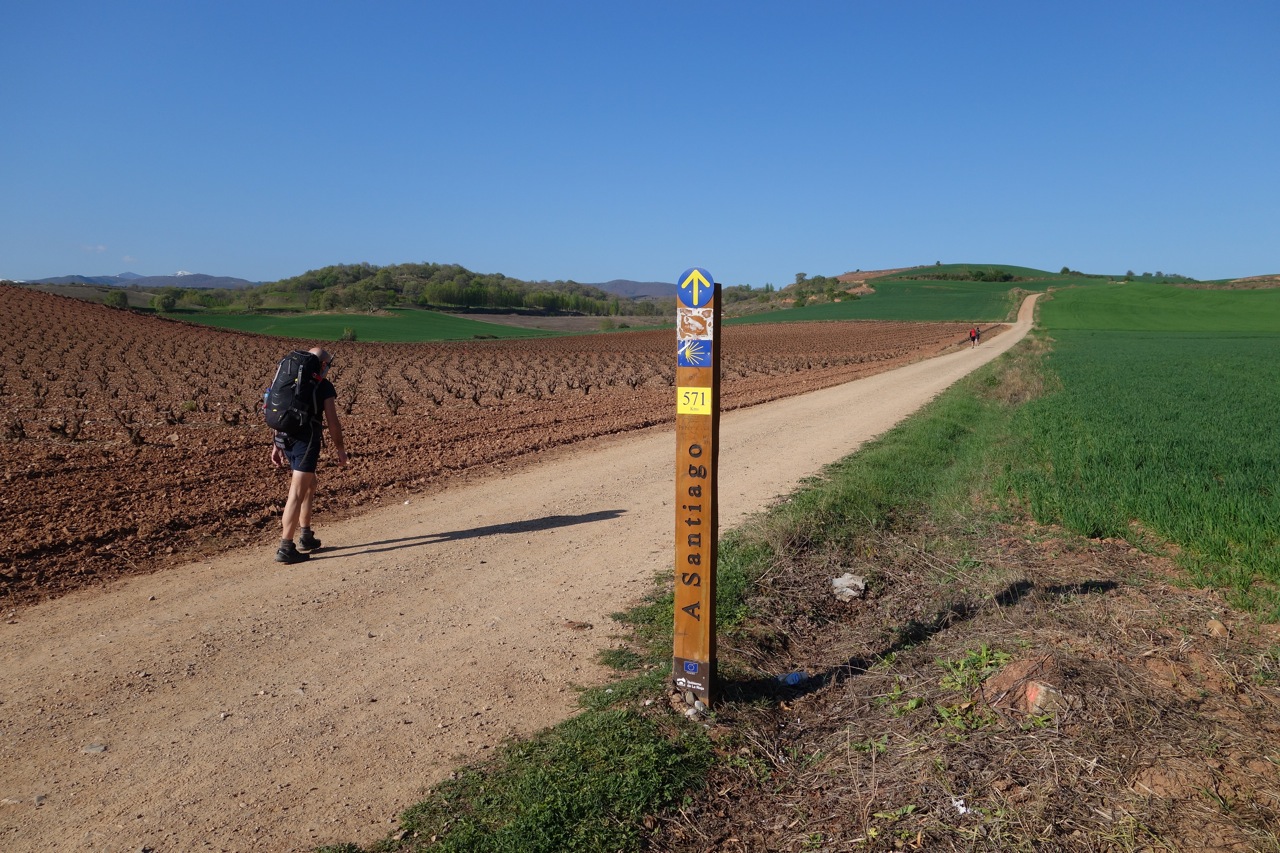
Early morning on the Camino de Santiago

Early morning on the Camino de Santiago

To walk [somewhere] is to earn it, through laboriousness and through the transformation that comes during a journey … We are eternally perplexed by how to move toward forgiveness or healing or truth, but we know how to walk from here to there, however arduous the journey…. In pilgrimage, the journey is radiant with hope … geography has become spiritualized.  – Rebecca Solnit[i]

Henry David Thoreau, reflecting on the verb “to saunter,” suggested two possible word origins. Sans terre, meaning “without land or a home,” describes those who are perpetually on the road, literally or metaphorically. Sainte Terre, meaning “Holy Land,” was applied in the Middle Ages to pilgrims with a specific destination, on their way to the place where the Sacred has uniquely showed itself. Anyone who has been on pilgrimage, or who understands life itself to be one great pilgrimage, would acknowledge both meanings at work in their own sauntering.

As the Bible says, we are all “strangers and aliens on this earth,” ever “in search of a homeland.”[ii] The first humans exiled from Eden; Abraham called to abandon country, home and kindred; the Hebrews wandering in the wilderness; the displaced Israelites weeping by the rivers of Babylon; Jesus having no place to lay his head; Paul continuously on the move or on the run: so many biblical stories display an abiding sense of being on the way to God knows where.

The actual place of arrival often remains beyond the horizon and over the rainbow – distant, unknown, unattained, not here, not yet. The Dark Age Celtic monks adopted this biblical outlook in their own far flung travels. Setting out on wild seas in little rudderless boats, they entrusted their journey to the (providential) vagaries of wind and currents. They had no idea where they would finally land. They simply set out “away from here” and left the rest to God.

I once told a fellow priest what I had read about those monks, and he liked their example so much he tried preaching about them to an upscale congregation of economically empowered people enjoying a high degree of control their own lives. They hated his sermon. Those crazy Celts, consenting to be swept away by larger, unpredictable forces, made them very uncomfortable.

But the monks, like their ancestors in the faith, were never headed for nowhere in particular. They were always looking for the Promised Land, wherever and whenever that might be for them. The last book of the Bible calls this place the new Jerusalem, a new heaven and a new earth, paradise restored. The Celtic wanderers called it “the place of resurrection.”

It is the place we were made for. We’ll know it when we get there. As Frederick Buechner famously describes it, “The place God calls you to is the place where your deep gladness and the world’s deep hunger meet.”[iii] This sense of ultimate destination and purpose, however indeterminate in time or space, made those seafaring monks more than sans terre. They were Sainte-Terrers as well, Holy-Landers bound for glory.

And so are we all. Even though Thoreau claimed to have met “but one or two persons” in his life who had a “genius” for sauntering, his exhortation to the “faint-hearted” majority expresses the hope that we may all hear – and obey – the call to pilgrimage.

We should go forth on the shortest walk, perchance, in the spirit of undying adventure, never to return – prepared to send back our embalmed hearts only as relics to our desolate kingdoms. If you are ready to leave father and mother, and brother and sister, and wife and child and friends, and never see them again, – if you have paid your debts, and made your will, and settled all your affairs, and are a free man, then you are ready for a walk.[iv]

I keep a walking stick by our front door as a perpetual reminder that the pilgrimage road always begins just outside the house. For years it was a pine branch I first used to traverse the Sierra Nevada mountains of California in 1976. Now it is the sturdy staff I acquired last April in St. Jean Pied-de-Port for my 500-mile pilgrimage on the Camino de Santiago (dispatches from that journey may be found in this blog’s April and May archives).

In Lord of the Rings, Bilbo Baggins began his fateful journey out of the Shire with a song: “The Road goes ever on and on, / Down from the door where it began … Until it joins some larger way / Where many paths and errands meet. / And whither then? I cannot say.”[v] But Bilbo already knew the risks of setting out into the unknown and unfamiliar: “It’s dangerous business, Frodo, going out of your door.” But he went anyway. It’s what pilgrims do. To refuse the journey is to refuse our story.

We may not always know where the road leads or what will happen along the way. But with the best and longest journeys, that kind of knowledge can fade to insignificance. For every saunterer, the road itself, with its perpetual motion “away from here” toward the land of promise, provides a greater sense of belonging than whatever we left behind. I walk, therefore I am. As Catherine of Siena put it, “All the way to heaven is heaven, because Jesus said, ‘I am the Way.’”

For many years I worked with a wonderful storyteller, Angela Lloyd, on creative variations of the Exodus narrative performed at the Easter Vigil liturgy. And one year she played an Israelite who was starting to wonder how long they would have to wander before they finally arrived at the place God had prepared for them. She pulled out a battered postcard and held it up. “I’ve been carrying this postcard a long time,” she said, “I was planning to mail it when we got to the Promised Land. But now I think I should just mail it from here. And you know, maybe it doesn’t matter where I mail it from. Maybe everywhere we stand is already holy ground.”

[i] Rebecca Solnit, Wanderlust: A History of Walking (NY: Viking Penguin, 2000) 50

[ii] Hebrews 11:13-14

[iii] Frederick Buechner, Wishful Thinking: A Theological ABC (NY: Harper & Row, 1973)

[iv] Henry David Thoreau, “Walking,” The Natural History Essays (Salt Lake City: Peregrine Smith, Inc., 1980) 94

[v] J.R.R. Tolkien, The Fellowship of the Ring (London: The Folio Society, 1977) 51

Simple gifts

Shakers dance

Who will bow and bend like a willow
Who will turn and twist and reel
In the gale of simple freedom …

– Shaker spiritual

John Ciardi said that the poet is known by the valor of his refusals. So too the saint. But the austerity of self-limitation is not what we might have expected from the Wooster Group, the edgy New York City troupe long known for its Dionysian blends of experimental theater and multimedia technologies. Their latest production, however, not only reincarnates the music of the Shakers, it does so with a minimalist restraint worthy of that nearly extinct American sect.

Early Shaker Spirituals: A Record Album Interpretation presents all 20 songs from side A of a 1976 LP recorded at the dwindling Shaker community in Sabbathday Lake, Maine. After the liner notes for each song are read aloud, four women in plain 19th century dress sing along with the actual spinning record as it is transmitted to them through wireless receivers. The voice of Suzzy Roche is especially haunting, lean and lonesome and saturated with pastness like a faded tintype. While we listen to these contemporary reproductions of long departed voices, we sometimes hear the faint traces of the original recorded sound leaking into the room from the women’s earpieces. As the New York Times has written: “The aural effect is subtle and eerie, suggesting a kind of phantasmal possession of the present by the past or, if you prefer, the eternal.”[i]

Sitting quietly, passive and still, replicating out loud what they are hearing in their ear, the singers seem to be channeling something not of their own making, a transcendent voice entering the present world by first passing through their own souls and bodies. It feels like the spiritual ventriloquism of biblical prophecy. What shall I sing? Sing this. How fitting for a repertoire which the Shakers often attributed to the gifts of unseen spirits or divine inspiration.

The contrast of the singers’ personal inexpressiveness with such passionate, ecstatic and sometimes eschatological song texts (“with leaping and with dancing / we’ll hail the jubilee”) only strengthens the sense of otherness. What they sing does not come from them, but through them. It is not a spontaneous construct whipped up by emotional display. Such unassertive transparency achieves a strange oracular force. We hear a message from beyond.

Even when the singers rise from their chairs to approximate the original Shaker dances, it is not an exaltation of the self, but a yielding to the higher rhythms of divine choreography. As they reel, turn and twist to “shake out all the starch and stiffening,” they do not express. They surrender.

When I saw this compelling performance the other night in Los Angeles’ Redcat Theater, I was transported – whether to the past, or to the eternal, who can say? But I came away touched by a larger world than my ordinary domain. Voices distant in time had spoken to me. And is this not analogous to the eucharistic liturgy? We listen to ancient voices as if they were here and now, and speak their words from our own lips. Transparent presiders at the altar reproduce actions first performed in Jerusalem 2000 years ago. If we manage to keep our ego out of the way in the liturgy, the eternal Word, like that 1976 Shaker recording, may be heard and received in the fresh particularity of the now.

Some of the Wooster Group might take issue with my theological interpretation. Frances McDormand, the ensemble’s best-known actress, has resisted the religious dimensions of the Shaker tradition, preferring to stress the communal qualities of their musical environment. “It’s not religiously based,” she said in an interview. “It’s more poetic. There are parables to it, but it’s not about Jesus so it’s a little bit easier to take.”[ii]

Such indifference to Christian theology and practice is the common currency of secular modernity, the default position posing a perpetual challenge to those who would speak of faith. Many people think of Jesus and Christianity as something over and done, at least for them.

And yet, here is a cutting edge theater troupe performing religious songs without irony or ridicule, in a creative simulacrum of the otherness of the music’s reputedly transcendent source. While I won’t presume to baptize the Wooster Group, or attribute overt belief where it is explicitly denied, I still wonder whether there might yet be something larger at work in the world than any of us are able either to understand or admit. Whatever the Wooster Group actually thinks about what they are doing, and whatever ideas I might have about it, the “simple gifts” of love and delight go on being given and being received. Whether the mechanism of that exchange can be adequately described or named is perhaps the least important part of the whole thing. Experience trumps the language we put to it. In the end, you don’t need to possess the perfect map before you can dwell in “the valley of love and delight.” You’re already there. Its song is already whispering in your ear.

[i] Ben Brantley, The New York Times, May 29, 2014

[ii] James Kim interview with Frances McDormand, KPPC radio, Jan. 21, 2015


A musical tsunami

A musical tsunami. The heavy metal of the 19th century. That’s how some have tried to convey the volcanic eruption of sound known as shape note singing. It’s already loud as you walk from your car toward the meeting room where over a hundred singers are gathered for an all-day singing. When you open the door to come inside, it blasts and sears you like heat from a forge.

Shape note singing, like jazz, is a uniquely American form. It began in New England churches of the late 18th century, but soon proved too raucous and untamed for that staid ecclesiastical environment, and had to migrate to the free-form churches of the South. When more fashionably modern gospel music began to displace it in the early 20thth century, shape note’s habitat shrank to scattered pockets of entrenched tradition, until it was “rediscovered” in the mid-20th century folk music revival. While there are still southern singers whose shape note heritage goes back many generations, there are many more who have entered this musical fold on their own, not only in the United States and Canada, but in the UK, Germany and Poland as well. Shape note singing has a way of grabbing hold of you and never letting go.

People gather weekly or monthly to sing for a couple of hours in small groups all over the United States, but the annual regional conventions – Saturday and Sunday all-day singings of a hundred or more from many states, singing about 95 songs per day – are the molten core of the tradition. These marathons of massed voices take everything you’ve got. By late Sunday afternoon, your voice is gone but your heart is full.

The musical notation uses (usually four) different shapes for the notes – triangle, rectangle, diamond, and the familiar oval. Representing the solfège syllables (fa-sol-la-mi), they provide a guide to the intervals between the notes, making sight-reading easier for untrained singers. Since the shapes are sung once prior to the actual words, the first time through a tune makes a strange syllabic murmur, like an incantation in a forgotten tongue.

The singing style is raw, nasal, straight-tone (no vibrato), full-throttle all the way. “If you can hear the person next to you, you’re not singing loud enough,” they like to say. Each voice-part sits together on one side of the “hollow square,” facing inward toward the leader (anyone who wishes takes a turn in the center, picking the next song and beating time for all to follow). There are slow songs, fast songs, and fugueing tunes with staggered entrances. And whether you are racing through an exhilarating major key or dragging out a slow, mournful minor key song about death and dying, you feel great when you’re done. There’s always something deeper at work than either text or tune in the performance of this strange and wonderful music.

Singers consist of Christians and non-Christians, theological progressives and traditionalists, seekers and unbelievers. No one, including me, embraces all the lyrics, some of which come out of a 19th century Protestant mindset and language not in fashion today. But theology is never discussed at a singing, and no one suggests changing the lyrics. That would be poor manners toward those who created the tradition. Shape note singing is not about doctrine but about relationships – with those who have gone before us, with the music they have given us, and with each other.

So a shape note gathering is not a community of shared faith. There is no creed or sustained reflection on the meaning of what we sing together. But when singers are asked about their experience, they usually invoke words like power, spirit, joy, catharsis, community, love, even transformation. So while there is no theology, ecclesiology or missiology in shape note singings, they are, is some ways, not so unlike what we hope for from church. As the (not shape note) hymn says:

How often, making music, we have found
a new dimension in the world of sound,
as worship moved us to a more profound “Alleluia!”

In my own Episcopal tradition, congregational singing is often tepid, even anemic. There are any number of reasons for this. We are products of our American culture, where communal singing is a lost art. We still have some English church heritage in our blood, so expressiveness and emotion are often repressed in worship. We lead hymns with loud pipe organs that won’t let us hear our own voices. And our hymnal melodies are written in the soprano line, which means that men either don’t even try to sing those high notes or else pitch them an octave lower, making their voices inaudible (in shape note, the melody is in the tenor). My father, an Episcopal priest and an enthusiastic man, could not bear weak singing. He was never afraid to stop a hymn in the middle to exhort people to sing louder. He would have loved shape note singing!

How I wish our church liturgies could always embody the spirit, power and energy of a shape note convention. Every liturgist and church musician needs to go to an all-day singing and then think very hard about the contrasts of what they experience in the hollow square with whatever happens back in their own worship gatherings.

At last weekend’s All-California Shape Note Convention, I was the chaplain at the Saturday session, responsible for the prayers at the beginning and end of the day. This was my opening prayer:

Come, Holy Spirit, breath of life eternal,
and occupy this hollow square,
that in these precious hours together
we may be united in holy sound and tuneful praise,
our souls and bodies resounding
with all that is deep and rich within us.
Draw us together with the bonds of affection;
let no one be a stranger here.
And send us a blessing today,
lift up our voices today,
make us your Sacred Harp today.
We pray this in your holy Name. Amen.

My 10 favorite Jesus movie moments

My father, the Rev. James K. Friedrich, with Joanne Dru on the set of "Day of Triumph" (1954).

My father, the Rev. James K. Friedrich, with Joanne Dru on the set of “Day of Triumph” (1954).

In my last post, I listed my “ten best Jesus movies.” Here now are my ten favorite moments, scenes which not only succeed cinematically but also provide fresh and resonant images of the Christ who, as the Jesuit poet said, “plays in ten thousand places.” But my ultimate criterion is that each of these scenes, after countless viewings, never fails to engage and move me.

No single image can capture the mystery of the Word made flesh. No actor will make you think he has become the perfect movie Jesus. But whenever the gospel story is retold and re-experienced, we may yet see something we had previously missed. We may even partake of a new revelation that has been waiting all these years to be received.

1927: The little blind girl (The King of Kings)

Most of the Jesus films invent dialogue to fill the gaps, but the incidents involving Jesus remain mostly Scriptural. But this scene, performed with silent cinema’s eloquent language of faces and gestures, is entirely invented. And it’s marvelous. A boy just healed by Jesus wants to share his blessing with a blind girl. “Take my hand – let me lead thee to him.” He guides her to a window and gives her a boost. Inside, the mother of Jesus gently receives the girl, who feels Mary’s face with her hands. “Please, I have come to find Jesus.” In the original score, the string section plays “Fairest Lord Jesus” here, imploring every sentiment. Mary takes the girl to stand before her son, who has not yet appeared on screen. “Lord, I have never seen the flowers nor the light. Wilt thou open my eyes?” The pleadingly expressive girl (played unforgettably by Muriel McCormack) stands in for all of us who long to see the Light of the world. The air around her grows luminous, and then, through her own eyes, we see a blurry glow gradually become the loving face of Christ, whom we, like her, now see for the first time. It perhaps the grandest entrance in the genre, and the perfect metaphor for a medium trying to bring the reality of Christ to light.

1954: The Lost Sheep (Day of Triumph)

I admit special affection for this film because my father produced it and I got out of school for a week to play an extra (who ended up on the cutting room floor). And this sequence, employing the traditional (though unbiblical) conflation of Mary Magdalene with repentant female sinners, has moved me ever since I first saw it as a child. Magdalene, a wealthy courtesan (played by the beautiful Joanne Dru), happens to hear Jesus teaching in Jerusalem. When he tells the parable of the Lost Sheep, he looks pointedly at her. Back in her house, she asks her servant – an early follower – what she knows about Jesus, masking her spiritual longing as idle curiosity. As the conversation unfolds, something in Magdalene breaks, and we cut to a Pharisee’s house, where Jesus has been invited to dine. A repentant Magdalene, now in humble attire, arrives to wash Jesus’ feet with her tears. The Pharisee is shocked, the disciples bewildered. When Jesus speaks the words of forgiveness over her, we get the first close-up of Mary Magdalene’s tear-stained face. Every close-up in effect isolates the face from the external particularities of body, environment and social context, conveying something both universal and purely inward. For me, this intimate view of Mary’s magnified face as she raises her downcast eyes toward Jesus evokes salvation history in a single glance.

1965: The Annunciation to Joseph (The Gospel According to St. Matthew)

How do you tell the story of Joseph coming to terms with Mary’s pregnancy when you are restricted to Matthew’s actual text, which provides neither dialogue nor psychological description? Pasolini begins his film with a close-up of Mary, then of Joseph, each face suggesting an unresolved tension between them. After two more awkward close-ups, we finally see a full shot of a pregnant Mary (full of dis-grace) and the problem becomes clear. The scene moves toward resolution through entirely visual means, like silent cinema, omitting even Matthew’s sparse narration. When speech (the angel’s “annunciation” to Joseph) finally does intrude into this silent world, it feels like the shock of the transcendent. In the beginning was the Word.

1969: Jesus the teacher (Son of Man)

The Jesus in this rarely seen British television production is neither meek nor mild. In his Sermon on the Mount, he moves energetically among the crowd, prodding and challenging them to think in new and uncomfortable ways. First he invites them to embrace the kinfolk around them as a sign of love. “That’s nice, isn’t it?” he says, noting how easy it is to love those who love you. It’s nothing extraordinary. “Do you want me to congratulate you for that?” Then he delivers the kicker: “Love your enemy!” As he lists specific examples of the enemies they should love, the crowd begins to murmur its dissent, to which Jesus responds emphatically: “Did I come to tell you easy things? Do you want me to tell you easy things?”

1973: Resurrection? (Godspell)

The dead Jesus is taken down from the chain link fence where he hangs suspended. As his followers carry his body through the strangely empty streets of New York, their song turns from sorrow to joy. Some begin to dance while they process, as if Jesus has risen anew in the bodies of his disciples. As for the body which had once called “Jesus,” it is taken around a corner, out of our sight. When the camera itself finally rounds that corner, the disciples and the body they carried are gone. Instead, we see hundreds of people walking toward us – the people you would see any day on a busy city street. The body we knew has “ascended” out of our sight, and Jesus returns in the form of everyone.

1977: The Prodigal Son (Jesus of Nazareth)

Jesus invites himself to a party at Matthew’s house. The disciples are shocked that he would dine with sinners. Peter, who really hates the “blood-sucking” tax collector, tries to stay away entirely, but curiosity finally brings him to stand just outside the door. When Jesus spots him peering in, he decides to tell a parable about two sons. Not only is this scene cinema’s best example of Jesus as storyteller, it makes the parable contextual, aimed directly at Peter (the “elder brother”) and Matthew (the “prodigal”). Both get the point; both are changed by it. The whole scene is perhaps the most moving “resurrection story” in the entire genre.

1988: Christ before Pilate (The Last Temptation of Christ)

David Bowie plays a blasé, sardonic Pilate in his interrogation of Jesus, whom he dismisses as just another Jewish troublemaker. This is not a conflicted, timorous official afraid of the crowd or hesitant to condemn an innocent man, but a cold-eyed realist who knows how the world works. When Jesus explains that he wants to bring change through love, not violence, Pilate recites the creed of the status quo: “Killing or loving, it doesn’t matter how you want to change things. We don’t want them changed.”

1998: Jesus returns (The Book of Life)

The only Jesus movie about the Second Coming begins with a shabbily dressed man outside a New York airport terminal, speaking in a loud voice to no one in particular: “Forgive me, Jesus, for I have sinned. Have mercy on us now and at the hour of our death.” Over and over he cries out in the flat, mechanical tone of a mind in disarray. Passersby give him a wide berth. Suddenly a man in a nice suit enters the frame to put a hand on the vagrant’s shoulder, silencing his repetitive plea with a touch and a look. This healing stranger turns out to be Jesus, who has just flown in – on New Year’s Eve, 1999 – to judge the living and the dead (though it later turns out he just wants to forgive everyone). Then Jesus moves on to catch a taxi, followed by Mary Magdalene, who in passing reassures the stunned vagrant. “It’s OK,” she says, before hurrying on to the apocalypse.

2004: The Agony in the Garden (The Passion of the Christ)

While many find this film unwatchable for its excessive violence and uncritical use of Passion Play caricatures, it begins with a memorably haunting Gethsemane sequence. Dimly lit in the olive grove, Jesus shows real agony. “I’ve never seen him like this,” whispers a worried disciple. The horror movie tropes – full moon, deep shadows, the anxious expectancy of a camera in motion – contribute to the sense of something beyond the ordinary taking place, as though we are in a supernatural thriller. And when Jesus falls to the ground to beg the cup of suffering to pass him by, we see Satan watching him closely. Together they enact a mythic prologue to the Passion narrative: Gethsemane becomes the Garden of Eden, but this time the human will not fall to the demonic. The snake will be crushed beneath the Savior’s foot. When Satan leans down over the anguished Jesus praying to his Father, he asks him, “Who is your Father?” This seems less like a taunt than a perfect expression of evil’s blindness. Not only is it unable to see the good; it is unable even to conceive it.

2006: The Annunciation (Son of Man)

This South African film’s prologue is a Temptation scene where Jesus rebukes Satan by saying, “This is my world.” “No!” Satan replies, “This is my world.” As if to prove Satan’s point, the film cuts to a 21st-century African country torn by violent civil strife. In a small town, armed guerillas are killing everyone in sight. A young woman, fleeing the violence, hides in a schoolroom, where she is horrified to find a pile of murdered students. She lies down among them to play dead until the killers pass by. When she finally opens her eyes, there is the angel Gabriel (a shirtless boy adorned with white feathers), announcing the birth of the Savior. Mary responds with the Magnificat, sung in a powerful South African idiom. Here is the gospel absolutely in the present tense.

The ten best Jesus movies

Enrique Irazoqui and Pier Paolo Pasolini on location for "The Gospel According to St. Matthew"

Enrique Irazoqui and Pier Paolo Pasolini on location for “The Gospel According to St. Matthew”

The Feast of the Epiphany, recalling the journey of the Magi to adore the Christ child, ultimately celebrates the “showing” of Christ to the world. It seems the perfect day to post my list of the “ten best” Jesus movies, a genre which has fascinated me ever since I was a child extra in my father’s production of “Day of Triumph.” Surprisingly, that independent film by an Episcopal priest was the only Jesus film produced in the 1950’s, a decade packed with every other kind of biblical film.

For the last twenty-five years, I have taught “Jesus and the Movies” in seminaries, churches and retreat centers. I use clips from 19 feature films made between 1912 and 2014. The films always provoke rich conversations about biblical studies, Christology, religious art and film studies. Perennial issues of representation and interpretation are both repeated and transformed by the film medium, and the Jesus films, for all their limitations and imperfections, ask each viewer: “Who do you say that I am?” Even you don’t like a particular movie Jesus, you are compelled to think about the Jesus movie in your own head, your own heart. How does it differ from (or resonate with) what is on the screen?

As I noted in a prior post on the ten best religious films, top ten lists are subjective, revisable and always questionable, which is what makes them fun. And the Jesus film genre, burdened by religious expectations, commercial considerations, artistic pretensions and cultural controversies, has not produced any completely great films (each has its flaws, and the gospels themselves resist translation into perfect narratives), but it has given us many great scenes. I’ll list my favorite scenes in another post, but for now, in chronological order, here are my ten recommendations for your Epiphany binge-watching.

King of Kings (1961) Nicholas Ray’s uneven, studio-butchered epic was savaged by reviewers (“Incontestably the corniest, phoniest, ickiest and most monstrously vulgar of all the big Bible stories,” thundered Time Magazine). Blue-eyed fan-mag cover boy Jeffrey Hunter, although 33 years old, was dismissed as the “teenage Jesus,” though other saw echoes of JFK, inspiring and youthful, or “James Dean without the delinquency” (Ray had also made Rebel Without a Cause). And religious critics found too much humanity, not enough divinity. So what’s it doing on my list? Well, Ray was a terrific director, and the film is very watchable. It is also a prime example of cultural context shaping both the making and the reception of a Jesus film. Released at a time when both the biblical epic and the dominant Protestant metanarrative were on the wane in America, it failed for interesting reasons. At the same time, a Jesus constantly preaching “peace and love” reflected the ongoing anxieties of the Cold War era. And where else can you get narration by Orson Welles, a marvelous epic score by Miklos Rozsa (of Ben Hur fame), and the longest traveling shot in film history (160 feet of track on a steep Spanish hillside)?

The Gospel According to St. Matthew (1965) Pasolini’s black & white, hand-held, documentary “you are there” style, the rough-hewn faces of Italian non-actors, and the first dark-eyed Jewish Jesus all created an illusion of realism that instantly overthrew the conventions of biblical cinema. It is the first Jesus movie not to blend all four gospels or invent new dialogue and narration, though it significantly edits Matthew’s text (apocalyptic sayings, the Transfiguration, and some miracles are omitted). The director treats Jesus as a “revolutionary whirlwind” sweeping through Palestine. For some the protagonist is too strident, humorless and emotionally remote, but his relentless otherness nicely resists our domestication.

Jesus Christ Superstar/Godspell (1973) Permit me to link the Jesus musicals together: they came out in the same year, each is dated in its own way (singing and dancing on top of the World Trade Center, for example), and both remain strangely affecting, at least for persons of a certain age. In breaking the conventions of literal treatments, they not only opened new options for the genre, but influenced a rising generation of liturgists who brought street theater, comic play and contemporary music into the churches. Some critics glowered from the other side of a generational divide (“Jesus is just a teeny-bopper stoned on himself”), but there were more substantial controversies as well (in Superstar, a black Judas, an erotic Magdalene, Jewish villains caricatured as vultures, and a doubting Jesus). But each film provides a lively retelling with some very moving scenes.

Jesus of Nazareth (1977) Franco Zefferelli’s beautiful 6-hour miniseries on NBC, while shunning the artificial grandeur of Hollywood sets for a humbler, dustier Palestine, is suffused with its own pictorial conventions: Catholic iconography and Italian painting. Robert Powell’s engaging and self-assured Jesus, whose divine nature is clearly on display in key scenes, gives one of the most popular portrayals, though the film has been criticized for an overly interior spirituality that leaves the sociopolitical world untouched. Rather than trying to make Powell carry the entire burden of his character’s significance, Jesus of Nazareth focuses on the faces, reactions and emotions of his followers. Peter and Mary Magdalene, standing in for all of us who hear and follow, are unforgettable.

The Last Temptation of Christ (1988) The most controversial film of the genre prior to Mel Gibson’s Passion, Scorcese’s energetic, visceral take on the Kazanzakis novel is really a mashup of three bible characters: Jonah (the reluctant prophet resisting his inevitable vocation), Jesus of the gospels (creatively retold with a few quirky additions), and the Prodigal Son (who leaves the cross for the “far country” of a long, ordinary life, only to return “home” to Calvary at the end). This flawed but fascinating film has many firsts: the interior thoughts of Jesus, New York accents, sexuality, a restless camera always on the move, Peter Gabriel’s world music soundtrack, women at the Last Supper, and a novelistic source that exacerbates the confusions of fact and fiction.

Jesus of Montreal (1989) Denys Arcand’s postmodern play within a play furthered the transformation of a genre freeing itself from the restrictive conventions of piety and/or box-office caution. A group of contemporary actors, invited to reinvigorate a staid annual Passion Play, do so in wonderfully imaginative ways. At the same time, they find their personal lives starting to embody the characters they play. Earnest, clever and compelling, the film asks us to consider what it might mean to “play” Jesus in our own place and time.

Jesus (1999) This 4-hour television special offers a Jesus who seems quite modern in manner, speech and outlook. Jeremy Sisto is a “California slacker” type whose identity quest seems very American. This is often effective in putting us in the story, as if it’s something that could happen to us. But does it also reflect our own cultural selves so much that we can no longer believe we are seeing anything resembling history? An unprecedented use of special effects for the miraculous and mythic elements of the gospels is visually interesting, but it does create significant questions about what we are being asked to believe, since a special effect is transparently fictional, undermining the real but unseen content of faith.

The Miracle Maker (2000) Fresh, creative and often moving, this film uses claymation figures by Russian orthodox artists. Parables, dreams and inner experience are contrastingly rendered in two-dimensional animation. The engaging script, written by an Anglican, tells the Jesus story through the eyes of a child. The clay Jesus, resembling an eastern Christian icon (but with a ready smile) is more charismatic than many of his live-action brethren. The voice of Ralph Fiennes is part of the reason, but the animation itself engages us directly with the story in a way that real human faces do not. A dramatic film is always both a scripted fiction and also a kind of documentary about what the actors themselves are doing while the camera is rolling. With animation, you see only the story, not the actors, and that works beautifully here.

The Gospel of John (2003) This film gave itself a uniquely challenging task. Most Jesus movies invent dialogue to fill gaps in the narrative or articulate meanings left unsaid in gospel texts, but such a strategy is renounced here. The script uses only the words of the Fourth Gospel (in modern translation), forcing ingenious, if occasionally labored, strategies to keep the story moving and the viewer involved. The long speeches of the “Farewell Discourses” (John 13-17) are the supreme example. Ian Cusick’s Jesus is warm and passionate. You may never again hear “I am the bread of life” without seeing his smile.

Son of Man (2006) Produced in South Africa, it sets the Jesus story within a fictional 21st century African country beset by the horrendous legacy of colonialism, corporate exploitation, and factionalism. The first black movie Jesus is deeply embedded in contemporary times, teaching nonviolence to his disciples while speaking out against corrupt and evil powers. But we never lose sight of the original gospel story. The stunning depictions of Annunciation, Pieta and Resurrection will knock you flat. And the singing! So exhilarating. Here is a film where you really “meet Jesus again for the first time.”

The Angel of Possibility

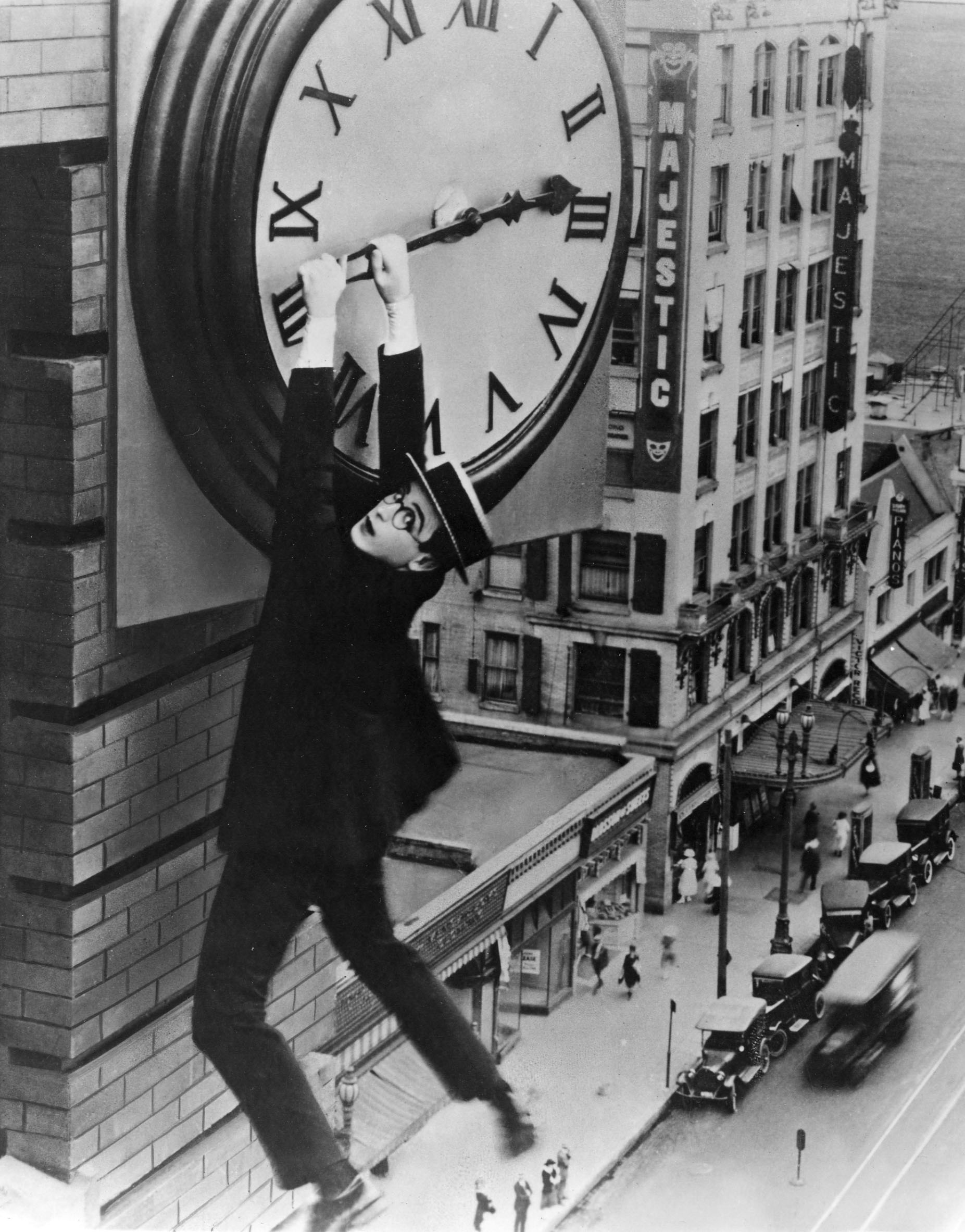
Harold Lloyd clock

My times are in your hand; deliver me.  (Psalm 31:15)

“Let me be the first to wish you a happy and blessed 1984.” This first salutation of the New Year was given, two minutes after midnight, by Bishop Desmond Tutu to several hundred Episcopal college students and campus ministers gathered at a snowy retreat center in the Rocky Mountains. He was preaching at a eucharist begun in the final moments of 1983. The gospel reading, spanning the stroke of midnight, accompanied our entry into the year of Orwellian dread, 1984. Then the bishop’s genial greeting at the start of his homily broke the fatalistic spell cast by the 1949 novel. Orwell’s terrible future had not come to pass. Instead, a man stood before us speaking eloquently and authentically about hope and possibility. A few weeks later he would win the Nobel Peace Prize. The God of history is yet capable of surprise.

But it remains an act of faith to believe this in earnest. Walter Benjamin, a German thinker in the darkest of times, gave a chilling description in 1940 of the “angel of history,” who can see nothing but the terrible past as he is swept backward into the future:

His eyes are staring, his mouth is open, his wings are spread. This is how one pictures the angel of history. His face is turned toward the past. Where we perceive a chain of events, he sees one single catastrophe, which keeps piling wreckage upon wreckage and hurls it in front of his feet. The angel would like to stay, awaken the dead, and make whole what has been smashed. But a storm is blowing from Paradise; it has got caught in his wings with such violence that the angel can no longer close them. This storm irresistibly propels him into the future to which his back is turned, while the pile of debris before him grows skyward. This storm is what we call progress. [i]

As we contemplate the wreckage of 2014, we might well share Benjamin’s despair. But there is another angel, the angel of possibility, who knows better. This angel says: Do not be afraid. Whatever twists and turns the story may take, it is in the end a story of life, not death.

And every New Year’s Eve, we ritually renew our faith in that story. There is an element of carnival this night, as we throw off the tyranny of good order for a bit of wild excess, declaring independence from the way things are in the name of things to come. But the night’s underlying theme is not chaos but renewal, as expressed in the traditional English carol:

The old year now away is fled, the new year it is entered…
Now, like the snake, your skin cast off… and so let the year begin.

This festival of rebirth, ringing out the old, ringing in the new, reflects an abiding human rhythm. Whether it’s every morning or every December 31st, we bid farewell to our flawed efforts and bad habits, resolving to do better this time around. Taken in isolation, New Year’s Eve has a whiff of doubt if not desperation. We know that the midnight noise and kisses will soon fade into the hangovers and broken resolutions of January’s new morning.

But New Year’s Day is also the eighth day of Christmas, the festival of Incarnation. What wants to be born is not a project of our own making, doomed to wither in the wintry blast of time. The Babe of Bethlehem is not the cartoon baby draped in the banner of “2015,” deposing the old man of “2014” in a melancholy preview of its own ultimate fate 365 days hence.

The holy Child is the Lord of the Dance “that will never, never die.” Yes, this new person will share our mortal condition; he will live and die as one of us. But in so doing he will accomplish what we can never do on our own. He will make our own stories part of the divine Dance. He will guide our own steps into the way of peace.

People often fuss about whether Christmas is pagan or Christian, secular or sacred. But the whole point of Christmas is that it is now impossible to tell the two apart. Ever since “the great angel-blinding Light” shrank “His blaze, to shine in a poor shepherd’s eye,”[ii] what George Herbert termed “Heaven in ordinarie”[iii] is the way this Dance goes. When the Christmas festival fades like Scrooge’s transformative dream, we will all return to habitual place and ordinary time. But if we have paid any attention at all, nothing will be quite the same again: neither ourselves, nor the world, nor the flow of time.

God with us. This changes everything.

On this last day of the year I rose early and went outside to see the stars. Orion, winter’s dominant constellation, had already left the stage. Leo, who rules the western sky on spring evenings, now roared in his place. To gaze on the night sky before dawn is to behold the future. Standing in the cold of winter, I looked upon the constellations of spring. And to complicate the metaphor, the starlight itself was a message from the distant past.

Time is a mysterious gift. Past, present and future keep changing partners in the everlasting whirl of the Dance. Breathless, we do our best to keep up. As W. H. Auden put it, “if there when grace dances, I should dance.”[iv]

The poet also wrote perhaps the best New Year’s Eve line of all, which I commend to you with my wishes for a most happy and blessed 2015:

Time is our choice
of How to love
and Why.[v]

[i] Walter Benjamin, Theses on the Philosophy of History, q. in Hugh Rayment Pickard, The Myths of Time: From Saint Augustine to American Beauty (London: Darton, Longman and Todd Ltd, 2004), 75

[ii] Richard Crashaw, “Satan’s Sight of the Nativity,” in The Roads From Bethlehem: Christmas Literature from Writers Ancient and Modern, ed. Pegram Johnson III and Edna M. Troiano (Louisville, KY: Westminster/John Knox Press, 1993) 148

[iii] George Herbert, “Prayer I”, George Herbert: The Country Parson & The Temple, ed. John N. Wall, Jr. (Mahwah, NJ: Paulist Press, 1981)

[iv] W.H. Auden, “Whitsunday in Kirchstetten,” Collected Poems, ed. Edward Mendelson (New York: Random House, 1976), 559

[v] “For the Time Being: A Christmas Oratorio,” Collected Poems p. 297. This remarkable work, a must-read for the Christmas season, was performed live before the New Year’s Eve eucharist mentioned at the beginning of this post. Auden reminds us that, once we have seen the Child of Incarnation, our challenge is to redeem the “Time Being” from insignificance.

How can this be?

Cathedral Films producer James K. Friedrich on the set of Child of Bethlehem (1940)

Cathedral Films producer James K. Friedrich on the set of Child of Bethlehem (1940)

My mother Elaine, pregnant with her firstborn child Marilyn, rode to Bethlehem on a donkey (in 1936 around Jerusalem, cars weren’t safe – they attracted gunfire). My father, the Rev. James K. Friedrich, made biblical films, including several on the birth of Jesus. In Holy Night (1949), I was a shepherd boy at the manger, with a stupefied look on my face from the blinding lights behind the camera. But no one could top my sister Martha, who played the baby Jesus in Child of Bethlehem (1940). You could say the Nativity story runs in our family. Even the Episcopal parish church of my childhood was a converted stable.

The thing about Christmas, though, is that everyone gets to be in it. By virtue of the Incarnation, our human nature, our human stories, have become the place where God chooses to dwell. Meister Eckhart put this claim most vividly in the fourteenth century:

“There is only one birth – and this birth takes place in the being and in the ground and core of the soul…Not only is the Son of the heavenly Creator born in this darkness – but you too are born there as a child of the same heavenly Creator. and the Creator extends this same power to you out of the divine maternity bed located in the Godhead to eternally give birth.”

Of course I have been reminded by women friends that only a male could find the sublime in a labor lasting for eternity. But Eckhart’s image makes us uneasy in other ways, for in these disturbing times it may be hard to imagine ourselves as worthy vessels for divinity. Everywhere we turn, we see human life devalued and held in contempt. The poor, the weak, the wounded are marginalized and forgotten. Abuse, violence, cruelty and self-loathing are rampant. Overt racism is making a comeback. Even torture has its shameless defenders.

But Christmas tells a counter-story, about a God who remembers the glory for which we were made, who yearns to speak the word of Love in the vocabulary of human flesh. The seventeenth-century metaphysical poet Henry Vaughan expressed his astonishment at this fact in a memorable line:

Brave worms, and Earth! that thus could have
A God enclosed within your Cell…

Oh, we are brave worms indeed, to believe our frail flesh made for the Incarnation, for the union of time and eternity, finite and infinite, flesh and Word. “God became human,” said St. Athanasius, “in order that humans might become godlike.” And St. Paul told the Corinthians that “all of us, with our unveiled faces like mirrors reflecting the glory of the Lord, are being transformed into the image we reflect in brighter and brighter glory.” (II Cor. 3:18)

In the face of such a wonder, we find ourselves repeating Mary’s old question: “How can this be?” And the best answer I know was given by the medieval mystic, Mechthild of Magdeburg: “Insofar as we love compassion and practice it steadfastly, to that extent do we resemble the heavenly Creator who practices these things ceaselessly in us.”

As we kneel before the Mystery this night, may we know how beloved of God we mortals are, and how very much the Glory wants to be born in us.

To you, dear readers, I wish the merriest and holiest of Christmastides.
God bless us every one!

Advent Adventures in Worship (Part 2: Homecoming)

%22Journey%22 sm

In Part 1, I explained the rationale for cultivating innovation and surprise in Advent liturgies, and described a multimedia preaching “performance” in 1968. The subject of Part 2 is an experiential journey taken by the congregation through a very early example of a worship installation, curated at a Los Angeles church on the Third Sunday of Advent, 1972.

St. John’s Episcopal Church, situated between downtown Los Angeles and the University of Southern California, is one of the most beautiful churches in the city. Modeled after a late 12th century Romanesque Italian church, it is a cathedral-sized longitudinal space with a high ceiling (it would later become the Pro-cathedral of the Diocese of Los Angeles). The interior walls are plain concrete, but the chancel is adorned with colorful marble and mosaics, drawing the eye of worshippers from the monotone of the nave toward the alluring colors surrounding the high altar, where a spectacular carving of the risen Christ is the terminus that completes and fulfills the spatial momentum.

Built by a prosperous white congregation in the 1920’s, St. John’s in 1972 was multicultural, with African-Americans comprising the majority, along with Anglicans of Belizean descent and a sizeable contingent of white liberals. For many of the members it was a destination church, known for both its liturgy and its social witness. I had attended seminary with its new rector, Bill Persell, who brought me in to start a monthly evening liturgy called The Third Sunday, a “liturgy lab” developing cutting edge experiential eucharists, grounded in the arts and organized around themes ranging from the liturgical year to politics and the environment. Every month about 200 people, many driving an hour or more, made a pilgrimage to those unusual and compelling evening liturgies.

For the Advent liturgy, people stood in the back of the nave, facing away from the distant altar, for spoken choruses from W. H. Auden’s Christmas oratorio, For the Time Being, interwoven with sung verses from the hymn, Sleepers Wake. After several Scripture readings, people were taken “eastward” (toward the altar) in small groups to begin a multi-sensory journey through the ambulatory, a long enclosed passageway circling behind the chancel.

The journey began in the baptistry, where each person (let’s call them “pilgrims”) was sprinkled with water from the font as the priest said, “Awake, O sleeper. Rise from the dead, and Christ will be your light.” (Ephesians 5:14) From there the pilgrims proceeded through a succession of sounds (mostly recordings of poetry) and images (projected film and slides). The first poem was the beginning of Dante’s Inferno, recited in the doleful voice of John Ciardi (“Midway in my life’s journey I went astray in a dark wood …”). Beyond that the path descended into the claustrophobic space of the boiler room, where “hell” consisted of seeing only your own image played back on several closed-circuit video monitors.

Ascending back into the ambulatory, the journey continued through a succession of projected images of a broken and longing world. At the halfway point an audio loop played Matthew Arnold’s “Dover Beach” (“the Sea of Faith was once, too, at the full … But now I only hear its melancholy, long, withdrawing roar …”). Beyond that bleak utterance the path entered a section of total darkness, where the pilgrims had to feel their way along the walls toward a dim blue light somewhere beyond the curve. It was an experiential analogy of faith’s “dark night.”

Near the far end of the U-shaped passage, the voice of T. S. Eliot intoned the end of his Four Quartets (“And the end of all our exploring will be to arrive where we started and know the place for the first time”). Leading the group to a curtained doorway, the guide then spoke words from Auden’s For the Time Being:

For the garden is the only place there is,
but you will not find it until you have looked for it everywhere
and found nowhere that is not a desert.[i]

Passing through the curtain, the pilgrims exited the cramped space of the ambulatory into the luminous openness of a candlelit chapel with golden mosaic walls, where they waited to welcome those who came after them. The luminous environment and the loving smiles seemed an apt icon for the future being prepared for the friends of God. Advent indeed.

Once everyone had made the journey, we gathered round the altar in the main church for the eucharist. My faded copy of the mimeographed bulletin provides a quote from Andre Hamman, D.F.M. as the epigraph for this “homecoming” section of the liturgy:

“The terminus of the Exodus is the reassembly of the people of God to celebrate the definitive and universal Pasch … The baptized can quit everything, lose everything, but [s]he has found the family where the living God resides.”[ii]

The ritual journey we made that night was a pioneering incorporation of installation art into liturgical practice. As Claire Bishop has written, installations, by being ‘theatrical’, ‘immersive’, or ‘experiential’, make the participation of the ‘viewer’ an inherent part of the work:

“… it addresses the viewer directly as a literal presence in the space [rather than] a pair of disembodied eyes that survey the work from a distance … Instead of representing texture, space, light and so on, installation art presents these elements directly for us to experience. This introduces an emphasis on sensory immediacy, on physical participation (the viewer must walk into and around the work), and on a heightened awareness of other visitors who become part of the piece.”[iii]

By disrupting the usual patterns of worship (starting the liturgy facing “backward,” getting out of the pews to explore the building’s “residual” spaces normally unused during worship), and initiating a journey of discovery, we allowed the worshippers to enter the ritual in a more embodied and attentive way. As I wrote at the time, “The one who journeys, discovers, overcomes ordeals and finally attains a center where he or she can dwell [becomes] more aware of what it means to be somewhere, to leave it and arrive somewhere else. “ Even if it is the same place “known for the first time”.

My influences in the design of this worship installation were the biblical Exodus, Dante’s 3-stage journey of Inferno – Purgatorio – Paradiso, and the major Advent theme of endings becoming beginnings. It was all about movement away from, passage through, arrival at … “The James Joyce Memorial Liquid Theater,” an experimental work created by Los Angeles’ brilliant Company Theater, also had significant impact on my thinking about ritual experience. In that play, each member of the audience was gently guided by actors through a series of mysterious spaces and multi-sensory experiences.

My conception was also shaped by childhood memories of the funhouse on the pier at Santa Monica’s Ocean Park, where I had loved the harrowing thrill of passing through narrow, zigzagging corridors (some of them totally dark), as the muffled sound of surf leaked through the floorboards. For me, the Advent installation was a kind of “theological funhouse.”

In the 1970’s, installation art was becoming a conscious practice, but I am not sure how early it began to be explored by liturgists. Worship installations are now a staple of alternative worship, but I suspect that what we did at St. John’s in 1972 was pretty rare. This is how I summed it up afterward:

The journey was a dying (baptismal figure, narrowing of space, sounds and images of a yearning world, an unknown way, darkness) and a rising (emergence into an open, “transcendent” space, and being gathered into the community of the eucharist). It was a losing (leaving the original assembly and the main space) and a finding (rediscovering the community and the original space).

In other words, our Exodus had brought us home.

[i] W. H. Auden, For the Time Being: A Christmas Oratorio, Collected Poems, ed. Edward Mendelson (New York: Random House, 1976), 274

[ii] Alas, I no longer have the source for this.

[iii] Claire Bishop, Installation Art: A Critical History (New York: Routledge, 2005)

Praying the O Antiphons

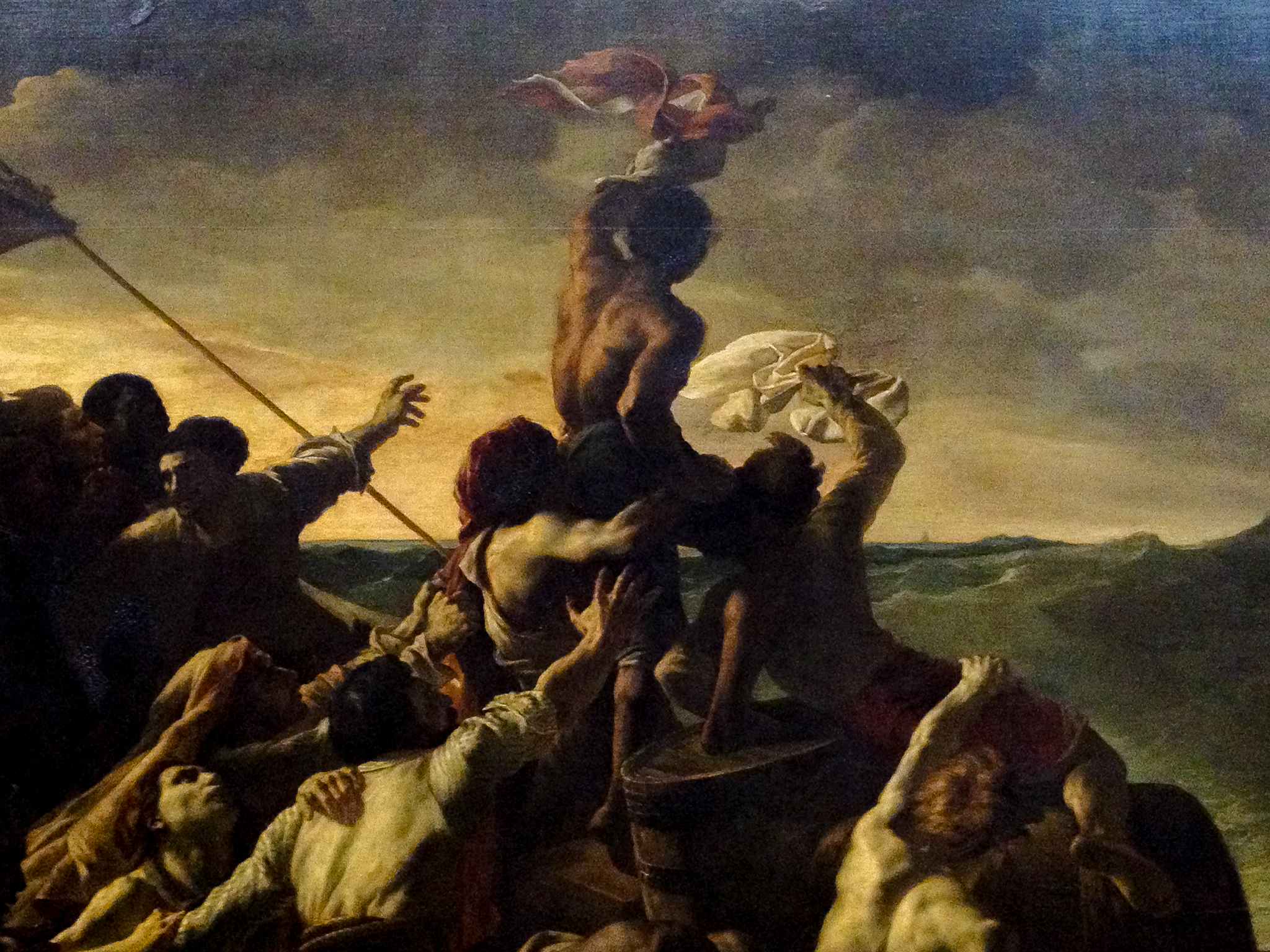
Théodore Géricault, The Raft of the Medusa (1818-19). Paris, Musée du Louvre.

Théodore Géricault, The Raft of the Medusa (1818-19). Paris, Musée du Louvre.

Today the O Antiphons begin. Part of the Church’s Advent prayer for at least12 centuries, they employ seven images from the prophet Isaiah to engage us with the names and attributes of the Holy One whose coming (‘Advent’) we await. Originally sung before and after the Magnifcat at Vespers, I find them to be a marvelous way to pray during these final days before Christmas.

There is one antiphon for each day from December 17 to December 23. Copy them on seven slips of paper, and put each day’s antiphon on a mirror, refrigerator, dashboard, screen or bedpost. Carry it with you during the day. Pray it at dawn, noon, sunset and night, in the midst of activity and the midst of quiet, in solitude and in the company of others.

Each antiphon is both greeting and supplication to the God who comes to save us:

O Sapientia, O Adonai, O Radix Jesse, O Clavis David,
O Oriens, O Rex Gentium, O Emmanuel … O … O … O …

O is such an evocative word. We use it when we come upon something outside ourselves, often unexpected; something that engages us face to face.

  • “O” can be an inhalation, a gasp, the cry of astonishment at the heart of every encounter with the Holy. If our place of prayer were suddenly filled with smoke and angels, or if the Holy called to us out of a burning bush, our first response might well be “O!”
  • There is also the O of understanding, or recognition: O, now I see, now I get it. Or even: O, it’s you!
  • And then there is the ecstatic O, expressing delight, wonder, the sigh of surrender: Ohhhhhhhh!

Each of these is a fitting response when we meet the divine:

Astonishment
Recognition
Surrender

You can find both the original Latin texts and English translations online. The best known paraphrase of the Antiphons is the hymn, “O come, O come, Emmanuel.” The following are my own variations. Use whatever version suits you best, or write your own.

(Dec. 17)          O Sophia, you are the truth of harmonious form, the pattern of existence, the shapeliness of love. Come: illumine us, enable us, empower us to live in your Wisdom, your Torah, your Way.

(Dec. 18)         O Adonai, ruler of time and history, manifestation of divine purpose to your chosen people, may your presence be our burning bush. Come: bring justice to the poor, food to the hungry, shelter to the homeless, protection to the vulnerable, freedom to the prisoner.

(Dec. 19)         O Root of Jesse, coming to flower in Jesus, who in turn bears fruit in all who  are grafted into the royal line of God’s family. Come: let us never be severed from the roots and branches that nourish us in every moment.

(Dec. 20)         O Key of David, you open, and none can shut; you shut, and none can open. Come: lead us out of the prisons that oppress body, mind and soul; welcome us into the open space of possibility; let us breathe again.

(Dec. 21)         O Rising Dawn, bright splendor of the light eternal, illumining all things with Love’s radiance. Come: enlighten those who sit in darkness, who dwell in the shadow of death.

(Dec. 22)         O Desire of all nations and peoples, you are the strong force that draws us toward you, the pattern which choreographs creation to Love’s bright music. Come: teach us the steps that we may dance with you.

(Dec. 23)         O Emmanuel, you show us the face of divinity; you reveal the fullness of our humanity. Come: enable us to become who we are.

Advent adventures in worship (Part 1: The Electric Eschaton)

Multimedia liturgy at Greenbelt Festival in 2006

Multimedia liturgy at Greenbelt Festival in 2006

When I engage in worship design, there is usually some kind of balance – or tension – between tradition and innovation. Tradition is valued for its accumulated wisdom, its hard-won knowledge of what works and what is fitting or ‘true.’ Tradition grounds worship in a shared language and culture by which we are deeply formed over time. And the stability of tradition as something familiar and repeated makes it a repository of meaningful associations, memories and feelings for the community.

Innovation is equally valuable, not only as an antidote for rigidity, staleness, and the idolatry of accustomed forms, but also as a welcoming of divine surprise and the freshening winds of the Spirit. Whenever we enter a new environment, our senses go on heightened alert until we get our bearings. We need to pay close attention. You can’t sleepwalk through strange territory. And so it is with innovative worship. As Jesus counseled, it is imperative to ‘stay awake,’ and even slight shifts in the forms and practices of worship can help this happen.

As the liturgical season when the old is judged and found wanting and the new is never quite what anyone expects, Advent seems particularly suited to a disruption of routine and the intrusion of novelty into the worship experience. Unusual texts and music, film clips, drama, choral readings, dance, and generous silences are among the options. I once showed up as John the Baptist, walking barefoot up the aisle of a congregation who (except for the rector who planned this surprise) did not know my face. I shouted about broods of vipers, warned them to repent, and urged them to keep watch for the One who is coming. Then I left as suddenly as I had arrived. Reviews were mixed!

The two most adventurous Advent liturgies I have curated were both a long time ago, when experiment was in the air for both the culture and the church. Whether such experiences now seem merely aberrant curiosities, relics of a vanished past, or pioneering models with continuing resonance for emerging forms of church, others can judge. But if you will indulge me, I would like to read them into the record, for what it’s worth.

The first took place in 1968 at the chapel of the Episcopal Theological School in Cambridge, Massachusetts, where I was in my last year of seminary. Every senior was required to preach once to the community, and my turn came in the third week of Advent. Since I was experimenting at the time with both 16mm film and audiotape collage, I decided to do a multi-media sermon, which I called The Electric Eschaton.

1968 was a year of apocalyptic turbulence, so there was no shortage of material for Advent preaching. During the summer and fall I gathered hours of audio from television and radio: news, commercials, fragments of movie dialogue and TV shows, as though they were pieces of a great cultural puzzle that could collectively convey the dynamics of a world in upheaval. There was no Internet for searching and downloading. There weren’t even VCRs. Anything I taped was acquired during live broadcasts, using a cassette recorder with a microphone placed near the television or radio.

As a child I had been fascinated by the random sampling of sounds produced by the continuous slow turning of an AM radio dial late at night. Pulled out of context and juxtaposed with one another by pure chance, these slices of voice, music and static together created their own kind of coherence, both familiar and strange, like utterances from a Delphic oracle or the collective unconscious.

When an old school friend, John White, played me his own experiment with sound collage in June of ‘68, I was hooked by this fascinating art form. I would return to seminary in the fall with a box of tapes to begin the construction of The Electric Eschaton, mixing my collected sounds with bits of rock and roll, hymnody, and poetry recordings. From Wolfman Jack to Humphrey Bogart, Mick Jagger to Soupy Sales, E. E. Cummings to Frank Zappa, The Wizard of Oz to Johnny Guitar, the voices are wildly diverse. And the juxtapositions are often intense. A choir sings “O come, O come, Emmanuel” while a jazz singer screams in anguish. The sounds of police beating demonstrators at the Democratic Convention is accompanied by an ad for “the cleaning breakthrough of the century … with fantastic power to break down and disintegrate dirt and stains.” The collage begins with the blustering of a faux deity, the “great and powerful” Wizard of Oz, and ends with a plaintive supplication for deliverance to whoever might be listening (“please don’t be long, please don’t be long”).

You can listen to The Electric Eschaton (20:25) here (headphones recommended):

Is this all just sound and fury, signifying nothing, or as the postmodernists have it, an endless play of signifiers with no final meaning? Some may think so. But to me it was an explicitly theological project, where human longing and divine reality were foundational assumptions, though much of the work was a product of intuition and chance rather than formal design. It felt, like all art (and prayer?), both playful and serious.

Recently I read about a 1951 John Cage performance (“Imaginary Landscape No. 4”) where 12 people each sat by a radio on stage, turning the dials according to a “score” created in advance purely by chance (the throwing of coins). And whatever came out of each radio was in itself a matter of chance. For Cage it was an effort to erase all will and let the combinations of sound happen without his control. In doing so, Cage said, “I saw that all things are related. We don’t have to bring about relationships.”[i] The Electric Eschaton was not as random as Cage’s work, but it perhaps shared with him a sense of pattern underlying the flux of things.

In the laborious assembly of so many fragments, I kept hearing key Advent themes: “I am waiting” … “I can’t reach you” … “what took you so long?” … “it’s so hard loving you” … “so tired, tired of waiting” … “please answer the stupid phone” … “I hear you calling my name” … “here it comes.” A Dantean sense of humanity lost in a dark wood was also pervasive: “my burden is heavy” … “can’t we have something to feel” … “I see a golden calf pointing back at me” … “he could not live much longer with that poison in his system.” And there were echoes of Isaiah in all of it: The people that walked in darkness… What shall I cry? All flesh is grass …. Comfort, comfort my people.

The sermon was performed in a packed chapel at Evening Prayer. There was no one in the pulpit, only a silent, flickering television – a bit of subversive parody, challenging my own apparently absent authority as preacher. Slide and film images were projected on large screens while the sound collage filled the space. When the last strains of “please don’t be long” faded out, the projectors shut down and a jazz drummer began to improvise in total darkness while several female voices shouted out phrases from the liturgy (Lighten our darkness!). After a minute or two of this, drummer and voices ceased, and “Also Sprach Zarathustra” (the famous theme from the year’s trippiest film, 2001) came on full volume, followed by the joyous ‘na-na-na’ chorus of “Hey Jude.” The chapel lights were switched back on for the Beatles song. Most of the people began to dance and sing in a great spiral. The scheduled benediction and closing hymn seemed superfluous at that point, so the presiding minister just let the dance play out as the liturgical finale.

So what happened that night? The sound collage had been a great Advent cry in the darkness, often painful and stricken. What could a preacher have said at the end to counter the cumulative force of that collage? Beautiful words by one person to a seated congregation would not have sufficed. The divine “answer” had to be nonverbal and eventful: first the Strauss, then the dance. As it turned out, a community united in embodied joy proved unimaginably eloquent. The dance was not a rebuttal of the darkness, locked in the dualism of perpetual combat. It was rather an ecstatic overflow of being that the darkness could never comprehend.

[Part 2 will appear in my next post]

[i] q. in Kay Larson, Where the Heart Beats: John Cage, Zen Buddhism, and the Inner Life of Artists (New York: The Penguin Press, 2012), 175