Unknown's avatar

About jimfriedrich

I am an Episcopal priest, liturgical creative, filmmaker, writer, musician, teacher and retreat leader. My itinerant ministry is devoted to religious imagination and holy wonder. My blog is a space where diverse ideas and perspectives - theology and culture, liturgy and spirituality, arts and religion - can meet and converse with one another.

Ten ways to keep a holy Advent

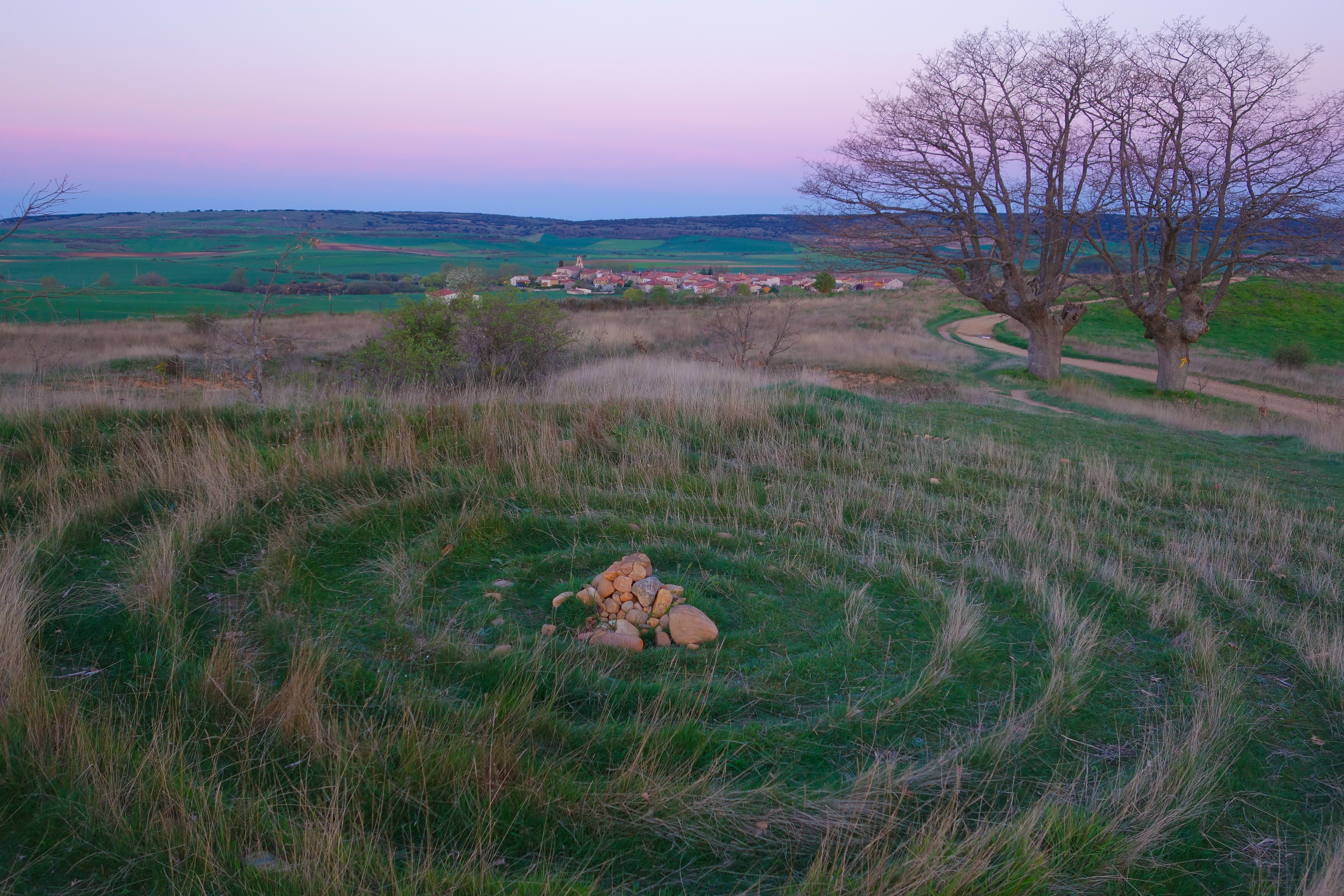
Camino de Santiago near Atapuerca

Camino de Santiago near Atapuerca

Advent is a time to keep watch for the unexpected comings of God, to prepare our own hearts to make room for the Blessed One, and to be ourselves signs to the world around us of divine compassion and justice.

Here is a list of ten general practices, each with some specific suggestions for the keeping of this holy season.

In a month that is already far too busy and rushed, these are not offered as one more to-do list to work through, but as ways to slow down, take a breath, pay attention, and make room in our lives for the birth of the Holy. These practices do not begin to exhaust the possibilities, but I hope they may stimulate your own thoughtful and prayerful responses. If anything here speaks to you, or prompts your own variation, try it out – for a minute, an hour, a day, and leave the rest to God.

Let every heart prepare him/her room.

1) Interrupting

Breaking the flow of habitual patterns can prompt new kinds of noticing and stimulate awareness. Once a week, or once a day, practice difference, welcome surprise.

Take a route to work/school/errands you have never used before. What do you see?

Take a walk in a place or a time that is not customary, and pay attention, trying to notice details of color, movement, and shape before words and labels start to fill your head.

Wear your watch on the “wrong” wrist, or not at all. Every time you look at the time and feel the interruption of automatic behavior, turn your attention to God’s presence in the here and now.

2) Silencing

Schedule a fixed time each day (between 1 and 10 minutes) for wordless silence in the presence of God.

Unplug yourself from all media one day a week, or at least for an evening. Pay attention to how your soul wants to use that quiet time.

Spend one whole evening during Advent, or at least one hour, in total stillness and silence. Turn everything off, light a candle or a fire, abstain from books and music, stop talking in your head. Listen. Who is knocking at the door of your heart? What does your deepest desire want to tell you?

3) Waiting

Make every experience of waiting in daily life a time of prayerful attention to the hope and desire within you. What are all the things your are waiting for? But what are you really waiting for?

Practice attentive and patient waiting. Sit or lie by a window where you can see only the sky. Wait for something to pass by: a cloud, a plane, a bird, an angel…

Wait for the full moon to rise (tonight). Wait for the first star to appear on Christmas Eve.

4) Listening

When you are out in the world, pause and close your eyes sometimes. What do you hear? Make those sounds the subject of a prayer.

Spend some time each day in a place of stillness where you can listen to your heart, and listen for God.

In conversations with friends, family, spiritual director, or stranger, listen for what wants to be heard.

Spend some time each day with music that awakens your heart and evokes the beauty of holiness for you.

5) Watching

Rise early one morning to watch night turn to day. Fit your prayer to the slow rhythm of dawning.

Pick a day to watch both the sunrise and the sunset, from a viewpoint that is unusual for you.

Notice the faces of strangers. Can you see in them icons of the holy?

Take a photograph of something that catches your prayerful eye. Write an Advent reflection, poem or haiku to go with it, and post on social media.

Watch a film that focuses your attention on the traces of God in our world or in our lives.

6) Praying

For at least part of one day each week, every time you enter a new space or begin a new activity, say this prayer: “Maranatha, come Lord Jesus.”

Four times a day (rising, midday, evening, bedtime), face the horizon and pray, “Maranatha, come Lord Jesus.”

Four times a day (rising, midday, evening, bedtime) say the Collect-prayer for the week from the Sunday liturgy.

Cultivate a daily prayer practice, at a set time if possible, and keep it faithfully, even when (or especially when) you are pressed or distracted.

7) Reflecting

Select a book for daily spiritual reading. Don’t skip a single day.

Meditate on the daily readings for Advent (Year 2) provided in lectionaries, Advent books, or online sources.

Journal at least a few times each week. Try beginning with “I am waiting for…” or “I am longing for…” and write what comes to mind.

8) Loving

Visit the sick, the lonely, the sad, the prisoner.

Practice random acts of kindness. Pray that you may be a sign of Christ to everyone you meet.

Pray every day for the person who is hardest for you.

Whenever you are in public space, spend some time praying for everyone you see around you.

For one day, or at least one hour, make a conscious act of seeing Christ in every face.

9) Giving

Do an act of volunteering which you have never done before.
Do something to make more justice and peace.
Send money to a good cause.
Take something to a food bank.

Make a change in your own way of living that will be a vote for “a new heaven and a new earth.”

Pick one social concern that engages your energetic attention, and pray every day that God’s will be done. You don’t have to list possible solutions – they are usually beyond our own imagining. Just entrust the object of your concern to God’s mercy and God’s imagination.

Give yourself to deep conversation with family and friends about the Advent season, the feelings it brings, the action it inspires.

10) Receiving

Pay attention.
Stay awake.
Be ready.

Open the door of your heart
to welcome
the Stranger who knows you by heart.

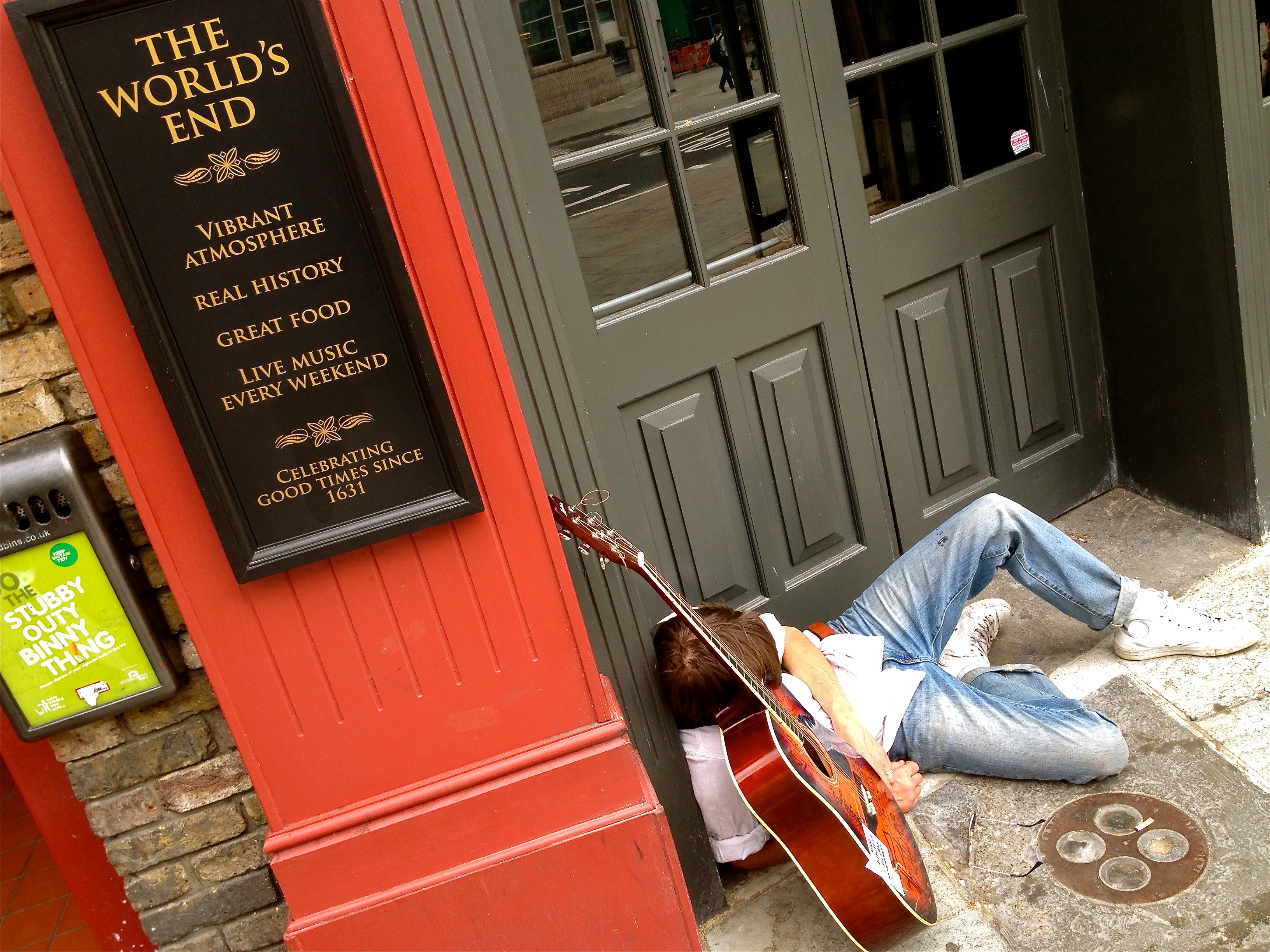
The World’s End

The World's End

When I was 8 years old, I read in LIFE magazine that in so many millions of years, the sun would burn out and life on earth would cease. This worried me, so I asked my parents, “If the world is going to end, how come we say “world without end” when we pray?” And they told me what the Bible says, that heaven and earth may pass away, but God remains. That relieved some of my anxiety, but I still wasn’t sure I liked the idea of the world ending, even if God was in charge.

Of course the world ends all the time. When I moved from California to Puget Sound in the 1990’s, my first Northwest winter felt like today’s gospel: the sun was darkened and the moon gave no light.

Who among us has not seen their world end? Adolescents exiled from childhood. Black teenagers robbed of their future. Elders deprived of their health. Unemployment …retirement …divorce … the death of a parent, a spouse, a child — in every one of these, a world comes to an end.

For anyone who has known serious loss, this is more than metaphor. The experience of grief can be so total and unrelenting that you can’t see anything beyond it. You can’t imagine the future. It feels like the end of the world.

The stars are not wanted now: put out every one;
Pack up the moon and dismantle the sun;
Pour away the ocean and sweep up the wood;
For nothing now can ever come to any good. [i]

W.H. Auden was invoking apocalyptic metaphors to express personal loss, but shared, public worlds also come to an end. As in 1789, or 1914. The Holocaust. Hiroshima. 9/11. My Lord, what a morning, when the stars begin to fall.

But why bring up such dreary stuff on this first day of the new Christian year? Shouldn’t we be breaking out the party hats, blowing horns and shouting “Happy New Year?” The wisdom of the Advent season is that it never begins with “A Holy Trinity Production,” or “The Creator of the World Presents.” No, it always opens with “The End.” Advent knows that every beginning involves some kind of ending. In this season’s Scripture, preaching and prayers, the present arrangements of collective and personal life are judged and found wanting. God’s imagination is far too rich and fertile to settle for our barren and diminished versions of human possibility.

Selfishness, greed, consumerism? Fear, racism and violence? Poverty, militarism, war, environmental degradation? That’s the best we can do? Really? God must be saying, “Come on, people. I made you a little lower than the angels, and this is what you came up with?”

George Eliot said “it is never too late to become what you might have been.” But to get to that “might have been” requires an Exodus into the wilderness beyond the way things are; an Exodus beyond even the best we can imagine for ourselves, into a place of unknowing, where only God possesses the language to speak our future into being.

So much of what we hear and pray and sing in Advent is profoundly disruptive. Bob Franke’s great Advent song, “Stir up your power,” gets right to it in the first line: This world may no longer stand. We are meant to be unsettled, to be driven beyond our narrow boundaries, our constricted realities, toward a beckoning horizon. The Christian life is a perpetual series of departures for a better place.

The world as it is – the world of racial hatred and toxic violence and economic injustice and perpetual war and addictive consumerism and pollution for profit and all the other evils which poison our common life – this world has no future in the emergent Kingdom of God. This world may no longer stand.

But the story doesn’t stop there. In my end is my beginning.[ii] Even when we have gone far astray, even when our story seems over, God remains deeply present in the processes of creation, tenderly leading and luring us into newness of life, making a way where there is no way, opening doors that none can shut.

Advent people do not just wring their hands or shake their heads over the latest news from Ferguson or the Middle East. We work and pray for something better. What we can do on our own is limited, but when we offer our priorities and energies to the larger purposes of God, Love will have its way with us.

As the Christian mystic Hadewijch put it in the thirteenth century:

Since I gave myself to Love’s service,
Whether I lose or win,
I am resolved:
I will always give her thanks,
Whether I lose or win;
I will stand in her power. [iii]

It is not always easy to stand in Love’s power and keep the faith. In some situations it is almost unimaginable. Forty years ago the African-American author James Baldwin wrote:

To be an Afro-American, or an American black, is to be in the situation, intolerably exaggerated, of all those who have ever found themselves part of a civilization which they could in no wise honorably defend – which they were compelled, indeed, endlessly to attack and condemn – and who yet spoke out of the most passionate love, hoping to make the kingdom new, to make it honorable and worthy of life. [iv]

This passionate mixture of protest and love sounds a lot like the Old Testament prophets who permeate our Advent lectionary. The very first reading of the season begins with a prophetic plea for history to be broken open by divine justice:

O that you would tear open the heavens and come down …
to make your name known to those who resist you,
so that the nations might tremble at your presence! [v]

Advent is not just a season of quiet waiting. It is also a time of protest and vision. Advent announces an insurgency against the way things are, a revolution to scatter the proud, cast down the mighty, raise the lowly, gather the lost, free the captive, and bind up the brokenhearted. Advent re-imagines the world as paradise restored, a new heaven and new earth suffused with the peace of God.

this is the day of broken sky
this is the space of conflagration-breath
speaking border-trespass
this is the feathered swoop of heaven
on the wing of now …
forking lightning into language …
breaking god into prison …
breaking the truth from jail! …

This is the fire-tongued fork of holy-ghost howl
making love on the tongue …
spitting flames of reconciliation
in the sky of war
making messiah-praise out of the air itself!

this is pentecost in your head
like becoming what you never dared
for the first time and forever

This ecstatic prophecy is from a poem by Jim Perkinson. [vi] He was talking about Pentecost, but his theme fits Advent as well:

“the day of broken sky”
the earth in conflagration
God breaking into the prisons
the truth being set loose at last
and “the fire-tongued fork of holy-ghost howl
making love on the tongue …
making messiah-praise out of the air itself!”

And each of us, all of us, becoming what we never dared.

When Jesus tells us to stay awake, he is warning us not to sleep through the day of God’s coming. Stay alert. Pay attention. Don’t miss it! Become what you never dared. Shake off the sleep of complacency, the sleep of complicity, the sleep of despair. Awake and greet the new dawn.

Jan Richardson describes this dawning reality in her beautiful poem, “Drawing Near.” [vii]

It is difficult to see it from here,
I know,
but trust me when I say
this blessing is inscribed
on the horizon.
Is written on
that far point
you can hardly see…

Richardson accurately expresses the sense of distant horizon that prevents the dominant reality of the moment from closing in on us and locking us in. That reality wants to be believed as fixed and final, permanent and stable. But the horizon calls every finality into question, disrupting its stability with the boundlessness of divine possibility. The horizon draws our attention from what is given to what may yet be. Keeping our eye on the horizon, feeling its pull, is the spiritual practice of Advent. Richardson’s poem expresses the deep longing produced by the distance between the already and the not-yet.

And then the poet discovers what every pilgrim knows: the goal of our long journey is something that has already been inscribed deep within us even before our journey began. Even before the day we were born, we were marked as God’s own forever.

And that is where Advent ultimately leaves us – finding that the thing we have been seeking so long has been with us all the time – within us, and all around us. While we have been walking our Camino to the Promised land, our feet have already been on holy ground, every step of the way. And the God of the far horizon turns out to be the path as well, keeping us company as we stride deeper and deeper into the world.

So when Advent people talk about the end of the world, we are speaking about end in the sense of purpose rather than termination. The word “apocalypse” means “unveiling,” and the apocalypse in our future will not be an annihilation, but a revealing of the world’s ultimate purpose and destiny.

Yes, all the inadequate, incomplete versions of world will come to an end (some of them kicking and screaming!), but creation as it was intended will be restored, not discarded. Like a poet who creates a new language out of old words, Love will remake the ruins and recover the lost. And the Holy One who is the mystery of the world will be its light and its life forever.

This Advent faith is expressed memorably in a short story by British writer Carol Lake, “The Day of Judgment.” On the Last Day of the world, God sails into England aboard a new Ark. But instead of bringing history to a close and pronouncing judgment on everyone, God leaves the Ark to enter the city of Derby. Heading for the run-down inner city neighborhood of Rosehill, he joins the crowd at a local pub, a multi-ethnic mix of the working poor and the unemployed. And there God gets so caught up in being with these people that he loses track of time, and the Ark sails away without him, heading off for the horizon of eternity. As the story describes it:

The Ark is on the edge of the horizon now, its destination the heartlessness of perfection. Most of the inmates already know what they are going to find – endless fruit, endless harmony, endless entropy, endless endless compassion, black and white in endless inane tableaux of equality. It sails off to a perfect world; the sky has turned into rich primary colors and in the distance the Ark bobs about on a bright blue sea.” [viii]

Meanwhile, God is still in that Rosehill pub, in the very heart of imperfection. If you had walked in there, you would have had a hard time picking him out. He blended right in. But if you were paying attention, you might notice that there was now something different about Rosehill. The old non-descript streets and dilapidated buildings had taken on a strange beauty. Maybe it was the warm slant of afternoon light, but people were beginning to see their neighborhood in a new way. And their own faces, too, seemed to glow with an inner radiance, as if they were carrying a wonderful secret, tacitly shared with everyone around them, as if they suddenly knew there was more to life than meets the eye.

They were still poor, the world was still a mess, but something new was in the air, a spirit of change was awakening. And from that day on, the people of Rosehill found themselves becoming what they’d never dared, for the first time and forever.

[i] W.H. Auden, “Twelve Songs (ix)”, Collected Poems, ed. Edward Mendelson (NY: Random House, 1976), 120

[ii] T.S. Eliot, “East Coker,” Collected Poems 1909-1962 (London: Faber and Faber Ltd, 1974), 191

[iii] Hadewijch: The Complete Works, trans. Mother Columba Hart, Classics of Western Spirituality (Mahwah, NJ: Paulist Press, 1980), 213

[iv] James Baldwin, No Name in the Street (NY: Dell, 1972), 194

[v] Isaiah 64:1-2

[vi] Jim Perkinson, “tongues-talk,” q. in Catherine Keller, On the Mystery: Discerning God in Process (Minneapolis: Fortress Press, 2008), 157-8

[vii] Jan Richardson, “Drawing Near” (http://adventdoor.com/2012/11/25/advent-1-drawing-near)

[viii] Carol Lake, Rosehill: Portraits from a Midlands City (London: Bloomsbury, 1989), 119
No place like home

Over the rainbow photo

We didn’t have enough eggs this morning to make the walnut pie, so I headed out at dawn for the village grocery. On the way, I played Charles Ives’ “Thanksgiving Day”, a tone poem permeated with fragments of American hymnody. Ives said that the clashing moods of major and minor chords represented “the sternness and strength and austerity of the Puritan character, and it seemed to me that any of the major, minor, or diminished chords used alone gave too much a feeling of bodily ease, which the Puritan did not give in to.” [i]

The irony of driving my car to the store while contemplating Puritan rigor did not escape me, but I did pass a solitary runner braving the cold drizzle, and joined my spirit to his propitiatory sacrifice.

Ives’ cacophony of broken tunes resolves in the end with the choral singing of a New England hymn:

O God, beneath thy guiding hand
Our exiled fathers crossed the sea;
And when they trod the wintry strand,
With prayer and psalm they worshipped Thee.

We are all exiles: from the Garden of Eden, from our mother’s womb, from the homes we grew up in, from ancestral lands, from pasts best abandoned and futures that never happened. Longing for home is the human condition.

As Dorothy knew, clicking her red shoes, “There’s no place like home.” And on the fourth Thursday of November, millions of Americans go wandering in search of that place, real or imagined, where they were always welcomed and known and understood.

Frank Baum, author of the Oz books, was never quite satisfied with Dorothy’s choice of Kansas over Oz. In his sixth book of the series, Dorothy moves back to Oz, dragging Auntie Em and Uncle Henry with her. As Salman Rushdie notes, “Oz finally became home; the imagined world became the actual world.”

The real secret of the ruby slippers is not that “there’s no place like home,” but rather that there is no longer any such place as home: except, of course, for the home we make, or the homes that are made for us, in Oz; which is anywhere, and everywhere, except the place from which we began. [ii]

Whether you celebrate today in Oz, or in Kansas, or out there somewhere along the Yellow Brick Camino, may it be with a grateful heart and blessed community. And if you need directions home and don’t have your ruby slippers, you might try Raymond Carver:

Left off the highway and
down the hill. At the
bottom, hang another left.
Keep bearing left. The road
will make a Y. Left again.
There’s a creek on the left.
Keep going. Just before
the road ends, there’ll be
another road. Take it
and no other. Otherwise,
your life will be ruined
forever. There’s a log house
with a shake roof, on the left.
It’s not that house. It’s
the next house, just over
a rise. The house
where trees are laden with
fruit. Where phlox, forsythia,
and marigold grow. It’s
the house where the woman
stands in the doorway
wearing sun in her hair. The one
who’s been waiting
all this time.
The woman who loves you.
The one who can say,
“What’s kept you?” [iii]

[i] Liner notes by Paul C. Echols, Charles Ives Holidays Symphony, Chicago Symphony Orchestra and Chorus conducted by Michael Tilson Thomas (CBS 1986)

[ii] Salman Rushdie, The Wizard of Oz (London: British Film Institute, 1992), p. 57

[iii] “Waiting,” by Raymond Carver, from All of Us: The Collected Poems (Alfred A. Knopf)

Whose world is it?

GTU Jesus icon face

I teach a course on “Jesus and the Movies,” examining nineteen features made on the life of Jesus between 1912 and 2014. And one of my favorites is a South African production, Son of Man (2006), which sets the gospel story in a fictional twenty-first century African country.

It begins in the desert, with Jesus and Satan sitting side by side atop a tall sand dune. There Satan offers Jesus the familiar temptations: use your power, dazzle the world, bow down to me and I will give you everything you desire.

Jesus listens for a while in silence. Suddenly he turns to Satan and shoves him off the ridge. As Satan tumbles downward – Milton’s fall of Lucifer comes to mind – Jesus shouts after him: “This is my world!”

Satan comes to a stop at the foot of the dune. He picks himself up and looks back defiantly at Jesus. “No,” he cries. “It’s my world!”

The film cuts abruptly to a village caught in the crossfire of a civil war. Terrible atrocities are taking place, making Satan’s point perfectly. It’s his world after all.

Tomorrow is the Feast of Christ the King, created by Pope Pius XI in 1925. Originally observed at the end of October as a prelude to All Saints Day, it was later moved to the last Sunday of the liturgical year, where it provides both a grand finale to the calendrical Christ narrative and a dramatic overture to Advent. In 1970 it was adopted by other churches using the Common Lectionary, including Anglicans, Lutherans, Methodists, and Presbyterians.

The pope was responding to the apocalyptic violence of World War I, where evil and madness seemed to have seized control of the world. He wanted to establish a clear reminder that it is Christ to whom the future belongs; it is Christ whom we must follow and serve.

Or in the words of Bob Dylan, “It may be the devil or it may be the Lord, but you gotta serve somebody.”

While the imagery of Christ as Lord of all may require some unpacking for interfaith dialogue, the pope’s original encyclical was clearly focused on Christian practice. If we profess Christ as our way, our truth, our life, then, in the pope’s words, “none of our faculties is exempt from his empire.”

But what do we do when Christ’s “empire” is in conflict with our other allegiances? How much do we give to Jesus, and how much do we hold back? Jesus gets Sunday mornings; does he get the working week? He gets our spiritual life; does he get our worldly affairs? Does he get our relationships, or our stewardship of time? Does Jesus get our politics, our economics?

Clarence Jordan was a Baptist preacher, New Testament teacher, and farmer in rural Georgia. In his celebrated Cotton Patch Gospels, he translated the Jesus story into a southern idiom, explaining that “the Scriptures should be taken out of the classroom and stained-glass sanctuary and put out under God’s skies where people are toiling and crying and wondering; where the mighty events of the good news first happened and where they alone feel at home.” [i]

In the 1940’s, in the middle of “the Good War,” in the heart of the segregated South, Jordan founded Koinonia, an interracial, pacifist farming collective using a communitarian model more like early Christianity than late capitalism. For his faithfulness to the dominion of Christ, he and his community were harassed, shot at, and bombed. The local church expelled him.

He was often invited to speak to groups around the country, and he would ask them, “What’s the biggest lie told in America today?” He’d let the question sink in for a bit, and then he’d say, “The biggest lie told in America today is: Jesus is Lord.”

I first heard this story when I visited Koinonia in 1980 and had a long conversation with his widow Florence (Clarence died in 1969). And in these latter days his words ring truer than ever.

Last year the Ohio legislature, hoping to derail the Affordable Care Act, blocked an expansion of Medicaid that would provide health care to 275,000 people who had no coverage. But the governor, John Kasich, made an end run around the legislature and got it done anyway.

As he said at the time: “For those who live in the shadows of life, for those who are the least among us, I will not accept the fact that the most vulnerable in our state should be ignored.”

The lawmakers howled. How dare he put the needs of the poor above our political agenda! So this is how the governor explained it to one those legislators, whom he knew to be a fellow Christian:

“Now when you die and get to the meeting with St. Peter, he’s probably not going to ask you much about what you did to keep government small; but he is going to ask you what you did for the poor. Better have a good answer.”

Governor Kasich, himself a Republican, was denounced by many in his party for appealing to a power higher than their ideology. The Wall Street Journal, wanting to make it clear that Jesus, lover of the poor, was not in fact Lord in America, offered a tart response: “Republicans get a vote before St. Peter.”

In Matthew’s gospel, the last parable Jesus tells before his arrest and crucifixion pictures all of humanity gathered before the glorified ‘Son of Man’ – the Lord of history – who reveals that he has always been among them in the bodies of the poor and needy: “I was starving … I was naked … I was an undocumented alien … I had AIDS … I was a convict …”

Everyone is of course quite surprised. But they all take his point. When you kneel before Christ the King, it won’t be at the foot of a mighty throne, but before the holy icons of “the least of these” – the vulnerable, the marginalized, the broken, the forgotten.

Well you kneel to the Lord and you will bless yourself…
Ain’t no need to kneel to no one else. [ii]

[i] G. McCleod Bryan, “Theology in Overalls: The Imprint of Clarence Jordan”, Sojourners (Dec. 1979, vol. 8, no. 12)

[ii] Bob Franke, “Trouble in This World (It’ll Be All Right),” on Heart of the Flower (Daring DR3016), © Telephone Pole Music, 1995

Dies Irae

Biblical prophet at Moissac Abbey on Le Chemin de St. Jacques

Biblical prophet at Moissac Abbey on Le Chemin de St. Jacques

Mr. McCleery, my seventh grade Latin teacher, had us memorize verses of the Dies Irae, a medieval chant describing the Last Judgment in strikingly lurid language. Most boys in junior high do not walk around chanting Latin poetry about the end of the world, but I rather enjoyed it. The tune was catchy, and those terse rhyming triplets beat time like the sensuous energy of a drum circle.

Dies irae, dies illa, 
Solvet saeclum in favilla,
Teste David cum Sibylla.

Day of wrath, O day of mourning,
See fulfilled the prophet’s warning,
Heav’n and earth in ashes burning.

The text of Dies Irae is inspired by the first chapter of Zephaniah, which was one of the eucharistic readings last Sunday. I sometimes wonder what churchgoers think about when asked to consider “a day of wrath, a day of distress and anguish, a day of ruin and devastation, a day of darkness and gloom.” In Syria or Ukraine, it’s just the latest news. But for those of us not living in one of history’s infernos, Zephaniah might be dismissed as a colorful crank carried away by the thrill of his own hyperbole.

The effect of the Bible’s more fiery rhetoric is often muted by the flat, inexpressive way it is usually read – or worse, mumbled – in the typical liturgy, as though no one really means it. Readers of prophetic texts should be given bullhorns. They should walk among the people as they shout, looking them in the eye.

I will bring such distress upon people
that they shall walk like the blind;
because they have sinned against the LORD,
their blood shall be poured out like dust,
and their flesh like dung.[i]

The church growth people might have something to say about that sort of messaging, but there is no denying that the prophets are working hard to get our attention. And in these last weeks of the Christian year, both the Sunday lectionary and the daily liturgical readings resound with the trumpet blasts of biblical warnings. People get ready. History’s chickens are coming home to roost.

Those prophetic rants have sometimes been read as endorsements of sacred violence – angry outbursts of a moody and unpredictable god – but God’s best friends have long rejected that crude picture as a tragic misreading of the divine. Nevertheless, there is no denying the violent imagery woven into some biblical texts, and we must find a way to make sense of it.

Walter Brueggemann explains that the prophets “speak in images and metaphors that aim to disrupt, destabilize, and invite to alternative perceptions of reality … [They] speak in outrageous and extreme figures because they intend to disrupt the ‘safe’ construals of reality, which are sponsored and advocated by the dominant opinion makers.”[ii] In other words, prophets blow up the old paradigms in order to make room for the new. They take seriously the power of language both to enslave and to liberate.

Zephaniah targets those “who rest complacently on their dregs,” who are blinded by their illusions, who assume divine indifference to the damage they do to the poor, the vulnerable, and the whole interdependent system of life on earth. We can find similar voices in our own time.

German writer W. G. Sebald’s apocalyptic poem, After Nature, is as harrowing as anything in the Bible. As he contemplates the dark and barren landscape of Matthias Grünewald’s Crucifixion, painted in 1505, Sebald finds a predictive warning of the planet’s own death unless we change our ways.

Here in an evil state of erosion
and desolation the heritage of the ruining
of life that in the end will consume
even the very stones has been depicted.[iii]

Today the United States Senate came just one vote shy of approving the Keystone XL pipeline, a massive fossil fuels project to enrich a few people at the expense of the whole earth. The effects of exploiting the Canadian tar sands, according to climate scientist James Hansen, could well be of biblical proportions.

Canada’s tar sands, deposits of sand saturated with bitumen, contain twice the amount of carbon dioxide emitted by global oil use in our entire history. If we were to fully exploit this new oil source, and continue to burn our conventional oil, gas and coal supplies, concentrations of carbon dioxide in the atmosphere eventually would reach levels higher than in the Pliocene era, more than 2.5 million years ago, when sea level was at least 50 feet higher than it is now. That level of heat-trapping gases would assure that the disintegration of the ice sheets would accelerate out of control. Sea levels would rise and destroy coastal cities. Global temperatures would become intolerable. Twenty to 50 percent of the planet’s species would be driven to extinction. Civilization would be at risk.[iv]

Hansen concludes that Keystone and its aftermath “will be game over for the climate.” The apocalypse was defeated today in the Senate, but there will be another vote early next year, when many of the “no” votes will be out of office. Alarmingly, the next head of the Senate Committee on Environment and Public Works will be a climate change denier who believes in a god who would never allow earth’s climate to be affected by the actions of mortals. If the senior senator from Oklahoma were to study his Bible, he might find that God takes human freedom far more seriously than he does. We do have the power to destroy God’s creations and disrupt the fragile balances of life.

The prophets are trying to make us renounce that power before it is too late. When Zephaniah warns of “a terrible end” he isn’t simply condemning us; he’s trying to save us. The “day of wrath” will not be an arbitrary vengeance from the sky, but the sum of innumerable bad choices here on earth. Zephaniah and his fellow prophets hold before us a chillingly graphic picture of where those choices are headed. What has been called the wrath of God is really something bearing our own signature.

Will God ride to the rescue? In a poem called “Emmanuel’s Nightmare,” African-American poet Gwendolyn Brooks wonders what it might be like if we were simply left to our own devices. She imagines the Second Coming of a Christ who would “clean the earth / of the dirtiness of war.” But the Savior finds himself thwarted. Humans love war too much. It is “what they lived for.” So God’s Son gives up and goes home. Mission not accomplished. “He had not the heart / To take away their chief sweet delectation.”[v] 346

The prospect of being abandoned to our own suicidal impulses is not a happy one, but – thankfully – it is not in fact the story we tell. God has destined us not for wrath but for salvation.[vi] The means of that better destiny will turn out to be quite surprising, not at all like the terrible clamor of the Dies Irae. But that is a tale for another day.

[i] Zephaniah 1:17

[ii] Walter Brueggemann, Theology of the Old Testament: Testimony, Dispute, Advocacy (Minneapolis: Fortress Press, 1997), 625

[iii] W.G. Sebald, After Nature, q. in Colin Riordan, “Ecocentrism in Sebald’s After Nature,” in W.G. Sebald – A Critical Companion, eds. J.J. Long & Anne Whitehead (Seattle: University of Washington Press, 2004), 51

[iv] New York Times, May 9, 2012

[v] Robert Atwan, George Dardess, Peggy Rosenthal, eds., Divine Inspiration: The Life of Jesus in World Poetry (New York: Oxford University Press, 1998), 346

[vi] I Thessalonians 5:9

Two hours in heaven

Musicians in the Pôrtico de la Gloria (12th century), cathedral of Santiago de Compostela

Musicians in the Pôrtico de la Gloria (12th century), cathedral of Santiago de Compostela

Belief is hard – at least when you dwell within the bubble of secular modernity, where reality seems to function well enough without invoking divinity as a causal mechanism. As long as there is money in the bank and a storm hasn’t knocked down the local power lines, as long as I am healthy and not spending any time in foxholes, it might slip my mind that life is a gift rather than a possession. God doesn’t make it any easier by being invisible or in disguise, and preferring to be subtle when it comes to manifesting presence.

In The Poetic Imagination: An Anglican Spiritual Tradition, William Countryman sees the ebb and flow of divine presence as “the central rhythm of Anglican spirituality.” Like the elusive behavior of waves and particles, the Holy seems to leap unpredictably between available and unavailable, known and unknown, intimate and distant, withheld and given. This can be hard on believers.

Oh that thou shouldst give dust a tongue
To cry to thee,
And then not hear it crying! all day long
My heart was in my knee,
But no hearing.
Therefore my soul lay out of sight,
Untun’d, unstrung:
My feeble spirit, unable to look right,
Like a nipt blossom, hung
Discontented.

– George Herbert (“Denial”)

There is no other sound
In the darkness but the sound of a man
Breathing, testing his faith
On emptiness, nailing his questions
One by one to an untenanted cross.

– R. S. Thomas (“In Church”)

When Herbert or Thomas felt God’s absence, they still remained in relationship with divinity. They missed its nearness. They longed for an intimacy lost. For the totally secularized, God is not merely absent. God is not even missed. The sense of longing inherent to the human condition has been transferred to more tangible, less ultimate objects. For those who do not reside within the practices and discourses of a faith community, is a relationship with the transcendent recoverable? The arts have been proposed as a substitute for religion. But instead of replacing God, the arts often seem to incarnate the divine, even for those who would never think to describe their experience theologically.

In A Natural History of the Arts: Imprint of the Spirit, Anthony Monti cites Sir Thomas Browne on the way music restores us to a spiritual mode of awareness:

There is something in it of Divinity more than the ear discovers: it is an Hieroglyphical and shadowed lesson of the whole World, and creatures of God; such a melody to the ear, as the whole World, well understood, would afford the understanding. In brief, it is a sensible fit of that harmony which intellectually sounds in the ear of God.[i]

In more contemporary language, Frank Burch Brown writes that the Sanctus of Bach’s Mass in B Minor “so shines and overflows with the musical manifestation of divine plenitude that in the experience of many a listener heaven and earth seem to converge, revealing the ultimate reality of their ecstatic union/communion.” [ii]

Image Journal, an exquisitely produced quarterly exploring the intersection of “art, faith and mystery,” employs both beauty and thought to counter the modernist dogma of belief’s imminent extinction. And at last weekend’s Seattle concert in celebration of the magazine’s 25th anniversary, I experienced the “musical manifestation of divine plenitude.” For two glorious hours, four choirs and a reader of poems pushed back the veil of doubt and distance so that a fortunate crowd of listeners could dwell – effortlessly, ecstatically – in the radiance of holy presence.

The design of the program had a litugical structure. There were seven sections – a sacred number – conducting us through the stages of spiritual journey: Cloud of Unknowing, After Paradise, The Contemplative Life, Longing for the Messiah, Mothering God, Blessed Are Those Who Mourn, and From Darkness into Light. Each section’s theme was introduced by a contemporary poem wrestling with the presence/absence of what Denise Levertov calls “the Other, the known / Unknown, unknowable.” [iii] And each poem was followed by a triptych of choral pieces from medieval to modern, from Hildegard and Palestrina to Arvo Pärt and John Tavener. Seattle Pro Musica, Opus 7 Vocal Ensemble, the Medieval Women’s Choir, and the Women of St. James Schola took turns lifting their voices in the resonant space of St. James Cathedral.

Sometimes the presence entered gently, as in the lyric by Jeanne Murray Walker: “Listen! Already God descends, waking us, / with his new breath, from sleep, / … like a mother.” [iv] Sometimes it clapped like thunder, as when the supplicating harmonies of Tavener’s “God is with us” were met with the sudden roar of the organ in heaven’s unambiguous reply.

The most stunning moment for me came at the end of James MacMillan’s Christus Vincit. The triumphant text – “Christ conquers, Christ is King, Christ is Lord of All” – started quietly with the sopranos, joined by the basses rumbling a rhythmic plainsong like breaking waves. The interplay of high and low, feminine and masculine, was punctuated by generous silences, allowing us to savor the fading reverberations. Then a single soprano began to rise above the other voices, with melismatic ornaments resembling the grace notes of Celtic song. Alleluia, she sang, over and over, her voice rising in a vocal mimesis of the ascending Christ. The other singers fell away as she soared on: Alleluia! Alleluia! And then, reaching a high B that seemed beyond the reach of mortals, she sang “All-le – “, but instead of the final syllables, there was sudden silence, as if she had vanished into eternity before the word could be finished.

In such an atmosphere, it was unbelief that became impossible. No more weeping by the rivers of exile, no hiding of faces from an alien Creator, no wandering in the wilderness of doubt and loss. We were home at last. God was not a dubious idea, but an immediate experience.

Alas, we are never permitted to linger long around the throne of presence. Once the vision fades, we must go forth to redeem the time being from insignificance.[v] But those two blessed hours provided a rich and lasting sustenance for those of us who continue along the pilgrim way.

[i] Anthony Monti, A Natural Theology of the Arts: Imprint of the Spirit (Burlington, VT: Ashgate Publishing Company, 2003) 121

[ii] Ibid., 122

[iii] Denise Levertov, “Sanctus,” from concert program

[iv] Jeanne Murray Walker, “And He Shall Dwell With Them,” from concert program

[v] W.H. Auden, For the Time Being: A Christmas Oratorio in Collected Poems, ed. Edward Mendelson (New York: Random House, 1976) 308

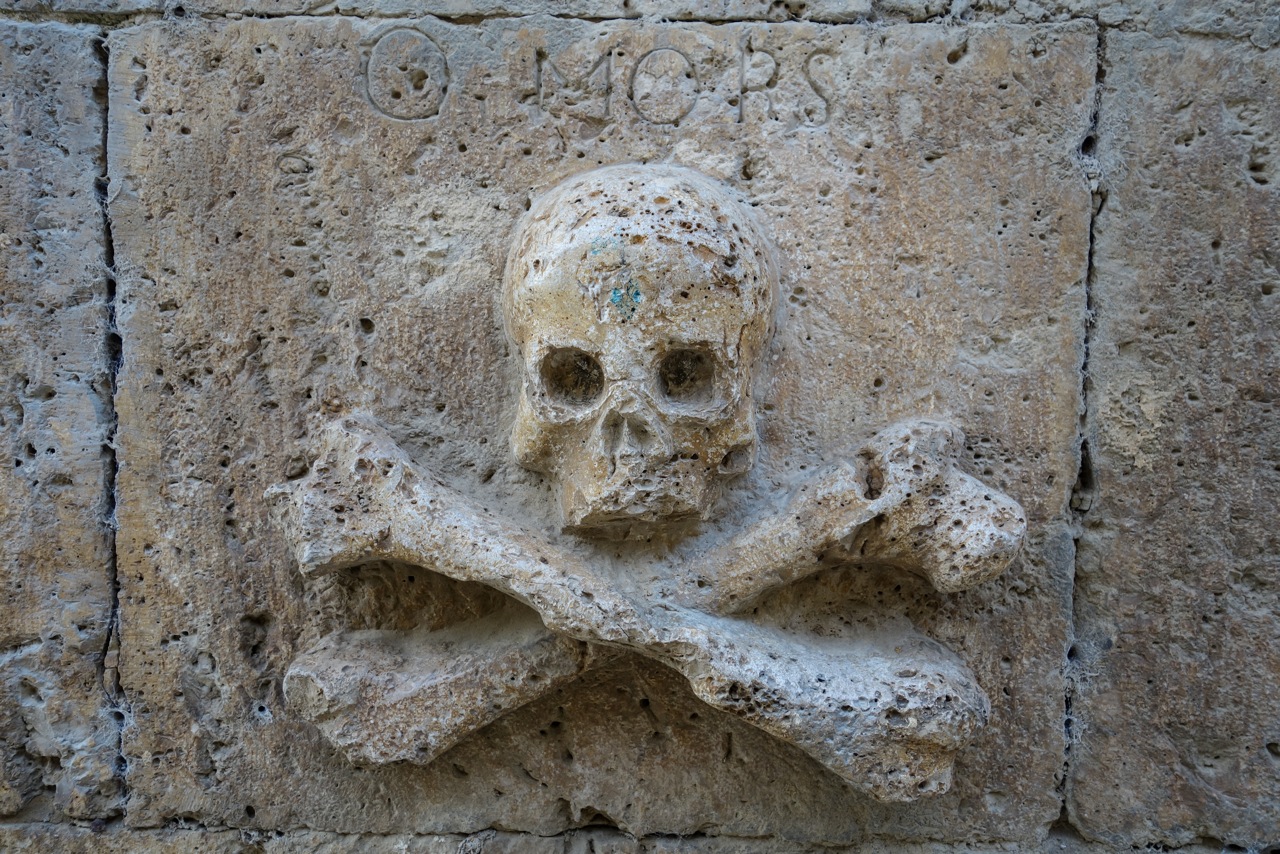
Memento mori

Wall relief in Castrojeriz on the Camino de Santiago

Wall relief in Castrojeriz on the Camino de Santiago

I tell my pupils to live each day as if it were their last… I don’t want children to fear death; I want them to respect life… It’s good for children to confront the idea of death, and… of their own mortality. Sometimes a child feels squeamish about death… skulls and skeletons. When this happens, I tell my pupils to touch themselves. “Why are you afraid?” I ask, “when each of you owns a skull and skeleton. We all carry death within us.” They feel themselves, and they say: “Yes it’s true, we too are made of bones.”

– María Antonieta Sánchez de Escamilla, a kindergarten teacher in Mexico (The Skeleton at the Feast: The Day of the Dead in Mexico, Elizabeth Carmichael & Chloë Sayer)

No leaves, no flowers, no light, no warmth, November. The eleventh month, as the year begins to slip away, evokes mortality like no other. Though it begins with the festivity of All Saints Day, celebrating the friends of God now radiant with the light of heaven, it immediately shifts to the more shadowy realm of All Souls, the Day of the Dead. Death itself, rather than what lies beyond it, becomes our focus. We visit graves, light candles, speak names, gaze at old photographs, tell stories of vanished presences.

In Mexico, death is playfully treated in comic skeleton images and candy skulls, but it is not mocked. A resigned acceptance of mortality pervades the festivities. The living remember not only the dead, but the skeleton inside themselves. They too are “made of bones.”

In American culture, we are not so adept with death. We always seem a little surprised by it. We avoid speaking its name. Memento mori is not a common spiritual practice. Few of us keep skulls on our desk, or sleep in coffins while we still have breath.

Forty-five years ago this month, I had my closest brush with death. I was sleeping in the back of a Volkswagen bus hurtling down a New York thruway at 65 miles per hour. A friend and I had been traveling all night, and it was my turn to rest. Suddenly the bus went out of control and flipped sideways, rolling over and over six times until finally coming to a stop upside down on the grassy median.

I remember two things about that long roll. My mind sped up to make everything appear in slow motion. It was like being inside the giant rotating barrel at an old amusement park. It carries you up and up until gravity kicks in and you are dropped back to the bottom to begin all over again. Slide up, drop. Slide up, drop. But slowed down, so I could observe it all in detail. Meanwhile, guitars, suitcases and croquet balls were flying around in similar motion experiments.

The other thing I remember is how familiar death seemed. I was not thinking, “This can’t be happening.” I was thinking, “Oh, so this is where we finally meet.” I’m sure the words were not so precise in the moment, but the sense of recognition was. When the rolling finally stopped, I lay face down on the ceiling of the inverted bus. I probably blacked out for a moment. Then I heard a voice, “All you all right?” I wasn’t sure how to answer – not until I actually tried to move. What if I couldn’t? I hesitated a moment, delaying the verdict. At last I tested my hands; my arms; my legs. They still worked. I rose slowly to my feet. Thankfully, nothing was broken. My friend was unharmed as well. Life was never so sweet.

The bus itself was totaled, and one of the guitars, my grandfather’s Gibson “Roy Smeck Stage Deluxe” Hawaiian guitar from the 1940’s, was pretty smashed up as well. Its broken body still hangs in our garage, my own memento mori.

In the predominant secular imaginary, a peek through death’s door finds no stairway to heaven, but only darkness. Termination. Void. A terrible forgetting. Emptiness.

This is a reasonable outlook, especially after the charnel house of the past century, but it’s not much to live by. And it is no more provable than belief’s alternative. None of us knows for sure. It’s a gamble either way.

In the 1950’s, Sylvia Plath summarized the modern formulary in her journal:

You don’t believe in God, or a life-after-death, so can’t hope for sugar-plums when your non-existent soul rises… Cats have nine lives, the saying goes. You have one; and somewhere along the thin, tenuous thread of your existence there is … the stopped heartbeat that spells the end of this particular individual which is spelled ‘I’ and ‘You’ and ‘Sylvia.’

John Donne, who himself never took death lightly, saw the outcome differently:

All mankind is of one Author and is one volume; when one man dies, one chapter is not torn out of the book, but translated into a better language; and every chapter must be so translated.

Just a month before his death from cancer in 1631, Donne preached his final sermon, Death’s Duell, at St. Paul’s, London. “That which we call life is … spent in dying,” he wrote, but “a gate into heaven I shall have.” Then, though weak from illness, he posed for a sketch that would be used to make the sculpture for his tomb. After having a fire lit in his study (it was February), he stripped naked and wrapped himself in a burial shroud with only his face showing. Rather than lie down in the traditional sleeping position, he stood erect for the sketch. The resulting statue, the only monument to survive the Great London Fire of 1666, resides in the south choir aisle of St. Paul’s. Donne is standing to greet the resurrection. His eyes are not yet open, but he is smiling with expectant delight. His epitaph reads:

He lies here in the dust
but beholds Him whose name is Rising.

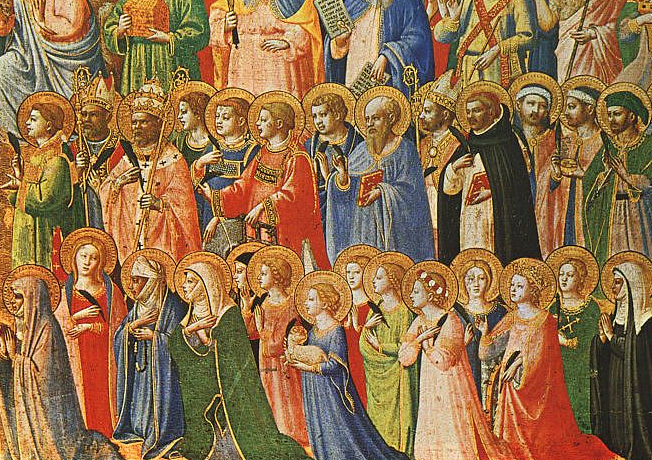
For all the saints

Fra Angelico saints

Dorothy Day, the feisty co-founder of the Catholic Worker movement, has been called the most interesting and significant figure in the history of American Catholicism. Deeply nourished by a discipline of liturgy and prayer, she devoted her life not only to serving the poor on a daily basis, but also to challenging the very forces that create poverty in the first place. She was a pacifist and activist who sometimes practiced civil disobedience to resist militarism. racism and systemic greed. For her faithful witness to the way of Jesus, she was investigated, jailed, and even shot at. Basically, she understood that the Christian life not only produces thoughts, feelings, and beliefs; it also produces actions that make a difference. It produces people who make a difference.

But “don’t call me a saint,” she warned. “When they call you a saint, it means basically that you’re not to be taken seriously.”

The same sort of neglect has been applied to the Beatitudes, and all the other teachings of Jesus: they are dismissed as unattainable ideals rather than guides to the way we might actually live our lives.

And what do you say? Is it enough for the friends of Jesus, the friends of God, to sit on the sidelines and cheer on the great athletes of sanctity whom we ourselves could never hope to imitate? Or is it about time for the rest of us to get in the game?

When we gather for worship, we may be consoled, we may be inspired, we may be refreshed. Sometimes some of those things happen, sometimes all of them happen, sometimes none of them happen.

But what always happens is, God speaks to us in Word and Sacrament, and then sends us out into the world with an assignment: to do the work we have been given to do.

So what exactly is our assignment, on this Feast of All Saints, 2014? It’s right there in the gospel. First of all, Jesus says, you need to turn the world’s values upside down. You need to look at everything in a new way.

The poor will be blessed with the gift of the kingdom,
while the rich will have to learn the hard way that life can’t be owned.

Everyone who weeps will find out what grace and comfort mean,
while those who are smug and self-satisfied
will be unable to grasp their deepest need.

And if you are marginalized and scorned because you follow me, says Jesus,
you are in such good company,
for that is exactly how the saints were treated.

Jesus never gives easy assignments. Discipleship isn’t kindergarten. It’s graduate school. And if you want to get your PhD, here’s the deal:

Love your enemies, do good to those who hate you,
bless those who curse you, pray for those who abuse you.
If anyone needs something, give it to them;
and if anyone should relieve you of your attachments,
don’t make a fuss.
Just let it all go.

When Jesus says such things, is he really talking to us? The saints have always thought so, and they have responded accordingly.

So many of their biographies begin with them giving all their money to the poor, and then the rest of the story tells how they keep giving themselves away to God. Saints are the ones whose discipleship knows no limits. They can seem extravagant, immoderate, audacious, even a little weird.

Risking everything. Pouring out everything. Holding nothing back.
Trusting completely the One they follow, even when the way is rough and steep.
No longer looking out for number one,
but giving themselves away in works of love and mercy.

And you mean to be one too, don’t you?

You never know when you’re going to get the call. It could come in a sudden flash of revelation, or it could come on the freeway when someone cuts you off and you must decide whether to respond with anger or with love.

But when the call does come, you know what to say.
People in the Bible said it all the time.
The saints said it all the time.
Here I am.

Here I am. At your disposal. Your will be done.

Martin Luther King, Jr. wrote about how the call came to him: “Almost out of nowhere I heard a voice. ‘Martin Luther, stand up for righteousness. Stand up for justice. Stand up for truth. And lo, I will be with you, even until the end of the world.’” After that, King said, “I was ready to face anything.”

And some of you will remember Dag Hammarskjöld, elected Secretary-General of the United Nations in 1953, who was a tireless worker for world peace. In 1961 he died in a plane crash on his way to deal with a crisis in Africa, and it was only after his death that the world learned that he was not just a famous and effective public figure, but a Christian mystic as well, with a profound and faithful inner life.

Hammarskjöld wrote this about his own call:

I don’t know Who – or what – put the question. I do not know when it was put. I don’t even remember answering. But at some moment I did answer Yes to Someone – or Something – and from that hour I was certain that existence is meaningful and that, therefore, life, in self-surrender, had a goal.

Most of us don’t get such a definitive summons. Sometimes it comes as gradually as the dawn, making its way slowly into our awareness. But wherever we are in that process of awakening, we are being called every day, every hour, to sanctify the moment with a word or an action that makes God visible to others, and plants another seed of resurrection in the soil of ordinary time.

It doesn’t always have to be extraordinary or monumental. Henri Nouwen, in a short list of questions, shows just how simple the work of a saint can be:

Did I offer peace today?
Did I bring a smile to someone’s face?
Did I say words of healing?
Did I let go of my anger and resentments?
Did I forgive?
Did I love?

But you may be thinking: What’s it going to cost me to follow Jesus?
Well, that’s the tricky part. It will cost no less than everything.
But it will also bring perfect joy.

Whatever saints need to give up, whatever their ordeals, whatever their sufferings, saints are not, by and large, a gloomy lot. Even under the most extreme duress, they manage to sound a note of joy.

Sheila Cassidy, a British physician, forged a striking image for this saintly joy in her own experience in a Chilean prison in the 1970’s. She had been imprisoned for treating a wounded revolutionary, and for a while she was tortured. When the torture finally stopped, and she was able to collect herself, her first impulse was to scream out to God for deliverance, begging to be released.

But then another response rose up in her. In her words, it was “to hold out my empty hands to God, not in supplication, but in offering. I would say, not ‘Please let me out’ but ‘Here I am, Lord, take me. I trust you. Do with me what you will….’ In my powerlessness and captivity there remained to me one freedom: I could abandon myself into the hands of God.”

And the image that emerged for her from that moment was of a bird in a cage, which could either “exhaust itself battering its wings against the bars, or else learn to live within the confines of its prison, and find, to its surprise, that it has the strength to sing.”

And how does it go – the song of the caged bird?
I believe it sounds something like this:

I see God in … the marks of … love in every visible thing and it sometimes happens that I am seized by a supreme joy which is above all other joys.

These are the words of a Dutch priest. He wrote them in the concentration camp at Dachau, before he was killed for preaching in defense of the Jews. Such profound joy under duress is not unique among the friends of Jesus. Saints and martyrs have sung this song in every age. Even in the hour of trial, even at the brink of the grave, they have sung this song, because they knew the secret.

They knew that beneath everything, within everything, beyond everything,
there is a Love which is stronger than suffering,
stronger than evil, stronger than death.
It has brought all things into being
It sustains us on our journey
It will guide us safely home.

This Love calls us in every moment – indeed, it is calling right here, right now – to follow, to serve, to embody, to manifest, to surrender. All the saints before us said yes to this call, over and over again. And they are cheering us on to do the same.

Will you say yes to Jesus, yes to God?
Will you stand with the saints today?
Will you join their song?
Will you share their work?
Will you bear their sacrifice?
Will you embrace their perfect joy?

The ambush of the marvelous

Jacob wrestling

Come, O Thou traveler unknown,
Whom still I hold, but cannot see;
My company before is gone,
And I am left alone with Thee.
With Thee all night I mean to stay,
And wrestle till the break of day.

The Sacred Harp

A century ago, Scottish theologian P.T. Forsyth described prayer as a kind of spiritual tempest blowing away all our complacencies. While giving a nod to the contemplative and aesthetic dimensions of spirituality, he was blunt about its capacity to rupture the settled proportions of daily life:

We do need more reverence in our prayer, more beauty in our praise, less dread of tried and consecrated form. But still more do we want the breathless awe, and the stammering tongue, and the solemn wonder, and the passionate gratitude, which are the true note of grace, and the worship of a soul plucked from the burning and snatched by a miracle from the abyss.

Prayer is not for the timid. Better wear a crash helmet, as Annie Dillard advised. But the fierce energies of prayer are not God’s alone. We must bring the strong force of our own desire to the encounter, pressing God to keep the ancient promise of a world made new. Every prayer may inevitably end with “thy will be done,” but it often begins in a place of struggle, if we are honest. “Hear my voice when I complain,” prayed the Psalmist. Even Jesus argued vehemently for an alternative to the cross. We were not made to go quietly. God wants us to put up a good fight. “Prayer is wrestling with God,” wrote Forsyth. “It is a resistance that God loves.”

The Bible never names the stranger who jumps Jacob in the dark and wrestles him till daybreak (Genesis 32), but interpreters have always suspected his divinity. Delmore Schwartz, in his poem “Jacob,” describes the assault as “the ambush of the marvelous, / unknown and monstrous, / at the very heart of surprise.” Jacob couldn’t see his opponent’s face, but all his inner conflicts must have risen up to give him a name:

– It is the ghost of my father Isaac, from whose deathbed I stole the blessing, and he’s come to take the blessing back.

– No. It is the spirit of my brother, with whom I wrestled in my mother’s womb, with whom I must fight in the flesh tomorrow.

– No. It is my own shadow, the unloved child and desperate trickster, here to unmask the pretense of my so-called success.

– No. It is the angel of death come to mock all God’s promises of protection and future.

– No. It is God’s own self, that merciless opponent who will not let me be until I am broken open and made new.

All night long, Jacob fought against this stranger, this Other. The stranger wounded him, dislocating the socket of his thigh, but Jacob would not give up. When dawn came, the stranger tried to flee, but Jacob held on tight.

“Let me go,” said the stranger. “I do not live in the glare of your well-lit thoughts, but only in the shadows of your intuitions.”

“I will not let you go until you bless me.”

“What is your name?” asked the stranger.

“Jacob.”

“It is Jacob no more. Your name shall be Israel – the one who wrestles with God.”

“Then what is your name?” asked Jacob.

“Ah!” said the stranger. Then he gave Jacob the blessing, and vanished.

The sun began to rise as Jacob limped away from the river, forever wounded, but ready at last to meet his future.

I once led a workshop on this story at a church retreat. After digging into the passage for a while, participants were invited to retell it in their own way. One young woman, who was differently abled and emotionally troubled, did exactly what the Bible wants us to do with its narratives. She put herself into the story.

Jacob was having a lot of problems with his family. He needed to get away from them, to get his head together. He felt a great struggle inside himself. “Why can’t I deal with my anger and frustration?” After a while he began to realize that he was wrestling with God.

He wrestled with God all night long, but when dawn came he began to think God must be pretty tired of him by now, that God must be so sick of listening to his problems that he was just going to go away. Jacob felt afraid and alone but he didn’t give up. He held on tight and wouldn’t let go. He begged God to stay and to bless him.

“What is your name,” God asked him.

“Jacob.”

“I don’t think so,” God said. “I think it’s Israel, because you’ve had the guts to face up to your problems.”

Then the sun came up and God was gone. And as Jacob began to walk away from that place, he noticed he was limping. Suddenly he remembered that he had always had this limp, but it didn’t bother him anymore. It was okay. It was just part of who he was.

God and the imagination are one

HS dove

Following this blog’s inaugural series of dispatches from the Camino de Santiago last spring, readers of The Religious Imagineer may have noticed a curious diversity of topics: saints, seasons, nature, culture, theology, Scripture, liturgy, art, theater, circus, classic cars and cinema. And perhaps they wonder, what ties all this stuff together?

The fox knows many things, but the hedgehog knows one big thing. When Isaiah Berlin explored the implications of this ancient Greek saying in his celebrated 1953 essay, he argued that Tolstoy was by nature a fox but by conviction a hedgehog. His interests were wide and his eye for the particular was acute, but he sought to contain the world’s multiplicity within a single defining idea.

I can relate. And the one big thing for this blog is found in a line from Wallace Stevens:

We say God and the imagination are one …
How high that highest candle lights the dark.

This might be taken as a secular celebration of the human mind, reducing God to one of its creative fictions. But if I read Stevens with the hermeneutic of a believer, “God and the imagination are one” is not necessarily a matter of either-or. It might also mean both-and. God dwells both in the mind and outside it. Imagination is both a way we reach beyond ourselves, and a means by which the transcendent finds a home in us, enabling us to see with the eyes of God and the mind of Christ, and to act accordingly. To say that God and the imagination are does not mean for me that they are identical, but that they participate deeply in one another.

The Creator’s “Let there be light!” and Jesus’ refusal of the tomb’s finality are the supreme biblical examples of divine imagination. But there have been countless imagineers engaged in the work (or is it play?) of bringing the new heaven and new earth into being. The activist imagining peace, the oppressed imagining justice, the forgiver imagining reconcilation, the mourner imagining joy, the saint imagining a new way of being, the theologian and the artist imagining the beauty of the infinite in the particular, are all practitioners of the holy and transformative task of conforming the world more closely to God’s image.

When Jesus quoted Isaiah 61 in his hometown sermon, he embraced such prophetic imagination as his own vocation.

The Imagination of God is upon me,
for she has sent me to bring good news to the poor.
She has sent me to proclaim release to the captives
and recovery of sight to the blind;
to let the oppressed go free,
to proclaim the year of divine favor.

So to return the original question about The Religious Imagineer’s diversity of topics, I would say that imagination is the unifying subject of this blog. How do we say the unsayable, see the invisible, dance the impossible in our images, rituals and stories? How do we attend to the traces of God amid the chronic unknowing of secular modernity? How do we imagine the really Real and the not-yet?

Video artist Bill Viola, the subject of an earlier post, has observed that “in the Middle Ages they painted the sky gold in the paintings … It was realism they were after – reality of the divine effused through everything in the physical world.” That is my theme as well.

As ever, thanks for reading.