Unknown's avatar

About jimfriedrich

I am an Episcopal priest, liturgical creative, filmmaker, writer, musician, teacher and retreat leader. My itinerant ministry is devoted to religious imagination and holy wonder. My blog is a space where diverse ideas and perspectives - theology and culture, liturgy and spirituality, arts and religion - can meet and converse with one another.

Call of the wild

Tomorrow I take a trail into the Beartooth Mountains, just north of Yellowstone, for a 6 day backpack, so my blog will be silent for a little while. Meanwhile, here is what I know about the high country, in the words of one of my favorite saints:

Oh, these vast, calm, measureless mountain days, inciting at once to work and rest ! Days in whose light every- thing seems equally divine, opening a thousand windows to show us God. Nevermore, however weary, should one faint by the way who gains the blessings of one mountain day ; whatever his fate, long life, short life, stormy or calm, he is rich forever.” – My First Summer in the Sierra”, John Muir (1911)

Experiments in worship

Sleepers Wakehttps://jimfriedrich.com/wp-content/uploads/2014/08/sleepers-wake.jpg

Last month’s 40th anniversary of the first Episcopal ordinations of women to the priesthood evoked a wide sharing of memories and stories about a church breaking from inherited ways to make a significant rewrite of its identity and practice. That break did not happen without resistance and struggle, but the shift was irreversible. A less complete priesthood is now unimaginable.

But there was also another revolution underway in 1974, a campaign for liturgical renewal being carried out on many fronts. Scholars had been making the case for change for decades, leading to such major revisions as Vatican II and the 1979 Book of Common Prayer. At the grassroots level, early experiments in “indigenous” youth culture masses laid the foundations for “alt.worship” and “fresh expressions.”

My first year of ordained ministry was at Canterbury House in Ann Arbor, a campus ministry known for its coffeehouse concerts (Neil Young and Joni Mitchell played there) and its innovative worship. At the end of the Sixties, our congregation of college youth valued meaning over form, allowing us the freedom to re-imagine the way we worshipped on a Sunday by Sunday basis. Sometimes the results were sublime and indelible, while there were also some abysmal flops. But that was okay. Everyone understood that our liturgical mission was to experiment: it was as important to know what didn’t work as what did.

In the Seventies, I became liturgical artist-in-residence at St. John’s, Los Angeles, a gorgeous cathedral-sized church with a progressive multi-cultural congregation. Under prophetic rectors Larry Carter and then Bill Persell, it had become a well-known site of conscientious witness against war, poverty and injustice (Cesar Chavez and the Berrigans thundered from St. John’s pulpit). Although the traditional Sunday morning liturgy was satisfyingly rich, we instituted a monthly Sunday evening series of alternative eucharists (“The Third Sunday”) to explore a wider range of themes and experiential models.

It wasn’t simply a matter of utilizing contemporary texts or plugging in unexpected kinds of music (although bagpipes and synthesizers each provided amazing sounds). We also explored different ways to structure the entire underlying form of the rite. Sometimes we employed worship templates drawn from mythic literary motifs like the Book of Revelation, the Divine Comedy, or the Harrowing of Hell. On Palm Sunday, two “carpenters” (one of whom is now the dean of the National Cathedral) built a cross near the altar throughout the liturgy, occasionally discussing the morality of capital punishment. During the Words of Institution (“This is my body … This is my blood”), their hammers pounded nails into the cross.

My favorite Third Sunday liturgy was a very early example of installation worship: an Advent journey, in groups of six, through a long enclosed corridor circling behind the chancel. The dark, narrow space was filled with projections and recorded poetry (“Inferno,” “Dover Beach,” “Four Quartets”). There was even a descent into a solipsistic hell (a dismal basement room with only live TV images of your own face). But in the end, you emerged into a candlelit chapel of shimmering gold mosaics and exquisite chant, taking your place with those who had made the journey before you, as if you were being welcomed into heaven.

The year 1974 began with the grandest alternative worship experience of my life, at a national gathering of 400 Episcopal college students, professors, and campus ministers during the first week of January. This was a few months after the Episcopal General Convention had once again rejected women’s ordination, and replaced the progressive Presiding Bishop with a southern conservative. It felt like a double slap in the face for progressives. The collegiate Episcopalians, restless and discontented, were having serious doubts about the institution. Some expressed their anger by questioning the value of the all-night liturgy planned for Epiphany. Wasn’t it being designed by three white males (Bill Teska, Mark Harris, and myself)? Down with elitism and sexism!

They had a point. We were just three friends with particular skills who had volunteered to design something memorable. We hadn’t really thought through inclusivity issues. All our attention was on the product, not the process, and we got called on it. There was talk of staging a protest to bring the liturgy to a halt, but artful negotiation transformed the proposed rupture into small group discussions that would be an official part of the liturgy.

The gathering was in Florida, where the temperature would remain comfortable through the hours of darkness. The “Great Liturgy” of Epiphany began at midnight beneath the full moon, with the congregation singing and processing three times around the worship space – a circus tent with its sides rolled up, in the middle of an empty field. When we finally entered the tent, people broke into small groups to share their hopes and fears for the church. Once these conversations were reported to the whole assembly, the liturgy began in earnest.

A simple Compline was followed by a cosmo-political Penitential Rite: a ninety-minute trip through Creation, History and Apocalypse, using 12 projectors, sampled sounds from the news, pop music, poetry, movie dialogue and Bach’s St. Matthew Passion. Then the Seven Seals in the Book of Revelation were opened by means of participatory theater games, climaxing with a ritual “dying” (falling to the ground) by the people, and then a rising up again, led by three Magi (one of them female). “We have come looking for the Holy One,” the Magi declared. And one by one we rose to our feet, crying “He is here!” and “She is here!” and “We are here!”

It was now about 3 am, time for a half hour pause of silent meditation, ending with a grand entrance procession of the eucharistic ministers preceded by six thurifers, filling the tent with incense. A jazz matins enlivened the Service of the Word, then a ninety-minute Offertory presented the gifts of the community before the altar – heartfelt testimonies, dance, a Navajo healing chant, a gospel quintet. By now the full moon, overhead when we began, was setting into the trees beyond the tent.

During the eucharistic prayer, a revolving mirror sphere painted the interior with kinetic light, and pulsing strobes flashed upon the bread and wine during the Words of Institution, making an almost hallucinatory intensification of the elements (definitely more Baroque than Cistercian!). After communion, we all processed out of the tent into the light of the rising sun, singing an Appalachian spiritual:

Bright morning stars are rising,
Day is a-breaking in my soul.”

Seven and a half hours from beginning to end,
moonlight to sunrise,
a Christian dreamtime.

It is the nature of liturgy – and language – to consist of mediating symbols. We aren’t allowed to see God face to face. As Isaiah realized in his Temple vision, such an encounter would obliterate us, swallow up our particularity, which is only made possible through the degree of separation we are given from the All. We don’t get to grasp “total presence” in this life, but only the words, images and sacraments that connect us with that (absent) presence. And yet there are times when the divine leaps across the gap, the bush burns bright before our eyes, and we hear the Voice calling our name. That Epiphany in a circus tent was one of those times.

So when I think of the church of 1974, I not only remember how we began to embrace a more inclusive priesthood, but also how free we were to explore both the means and the meaning of our deepest rituals. May it be so again.


“Have you heard the news?”

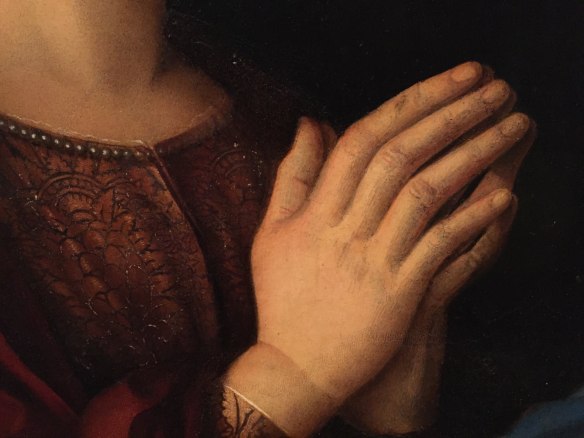
Bellini praying hands sm

Giovanni Bellini, Madonna and Child with Saints Catherine and Magdalene (detail), c. 1500, Accademia, Venice

“Have you heard the news?” That’s the first thing the driver said when a friend and I hitched a ride out of Yosemite’s Tuolumne Meadows after hiking 150 miles from Lake Tahoe. We’d been in the wilderness for 20 days, so pretty much anything would be news to us. We shook our heads. What had we missed? “Nixon’s going to resign tonight!” he said, clearly savoring the pleasure of bearing glad tidings to fresh ears. That was August 8, 1974 (the President made the announcement that night on national television; his official resignation took place the next morning).

The sealing of Nixon’s fate wasn’t the only news I had missed in the Sierra wilderness forty years ago. Ten days earlier, when I was about halfway to Yosemite, three Episcopal bishops sped up the grinding wheels of ecclesiastical change by ordaining eleven women to the priesthood in a Philadelphia church. The ordination of women had failed to secure majority approval when the Episcopal General Convention gathered in 1973, and the next vote wouldn’t be taken again until the next convention in1976. The Spirit and the institution were clearly on different timetables. So the Philadelphia Eleven, and the bishops who ordained them, did what prophets do: they imagined an alternative future, which would remain contested and uncertain until the whole church could embrace its implications.

When the General Convention convened in Minneapolis in the summer of 1976, the ordination of women, along with a radical revision of the Prayer Book, topped the agenda. On the day the deciding vote was taken in the House of Deputies, ten thousand observers packed the hall. I was among them, and as the session unfolded I was struck by its overriding liturgical quality. This was not just another meeting with the usual amount of tedious verbosity and soul-sucking detail, but a solemn performance of a drama reimagining our collective identity. As in every liturgy, larger realities had to be contained within the imperfect significations of human language and ritual. And somehow – miracle of miracles! – a church convention became a place of theophany. I saw the Holy Spirit at work, not in spite of parliamentary procedure, but within and through that procedure.

The crucial session seemed to follow the shape of the eucharist. Once the assembly had gathered, the stories that brought us together were told. This “reading of the lessons” consisted of a long succession of speakers who had two minutes each to make the case for or against women’s ordination. This 90-minute “debate” was itself a kind of ritual, summarizing the now familiar arguments which had led to this moment. No new insights were expected – certainly no conversions – but it seemed important, before the vote, to tell the story of who we were – including our conflictedness – and the nature of the larger story we belonged to. Some told that story in terms of dwelling (tradition), while others described it as pilgrimage (innovation). But there was a sense that the story itself always exceeded our understanding of it. Many viewpoints, but still one church.

In the eucharist, the lessons are followed by the Prayers of the People, and so it was here. The resolutions committee, which had earlier reported its recommendation in favor of the motion that “no one shall be denied access” to ordination on the basis of gender, had reserved the right to present the final portion of its report just before the vote was cast. And that portion, we discovered, consisted of five minutes of silent prayer – fifteen thousand people filling the hall with a profound stillness. A large convention was the last place I would expect to experience prayer so fervent or so intense, but there it was.

Next in the eucharistic rite is the Offertory, where the gifts of the people are brought forward to the altar along with bread and wine. In this case, the gifts were the ballots filled out by the deputies. While their votes were being collected and counted, there was a Passing of the Peace. The presiding chair of the House of Deputies, the Rev. John Coburn, thanked the voting members for the courtesy with which they had treated each other in this potentially divisive process. The throng of observers rose to applaud them. Then Coburn thanked the observers for their courteous demeanor. We had refrained from any partisan displays of cheering or booing. The deputies rose to give us a standing ovation. Finally, everyone gave a standing ovation to the chair, who had so graciously guided the assembly through uncharted waters. In that moment, at least, we loved one another more than we loved our causes.

Something of that spirit remained when the results were finally announced. There was no outburst of applause or cheering. There were some quiet hugs, heads bowed in thanks, eyes moist with emotion. But as the multitude began to make its way out of the hall, most of the faces I saw appeared thoughtful, solemn, even stunned, like communicants returning from the altar, or Moses descending the mountain, glowing like fire.

For my part, when I first heard the tally and realized the motion had carried, I felt an inward elation, for this was a great and necessary moment. But mixed inextricably with my joy was a deep sense of the burden assumed by the losers in this long struggle. I couldn’t just exult in victory. I had to make room in my heart for the pain and disappointment of the defeated as well. This was surprising to me, for I have been too much a man of principle in my life, finding it hard sometimes to sympathize with incompatible perspectives and practices. That is one reason I am convinced that the Holy Spirit was blowing where she will that day. I couldn’t have come up with such sympathetic breadth on my own. Many of those I talked to later reported a similar experience.

Sympathy. Dora Greenwell, a single Anglican woman in Victorian times, wondered whether women have more capacity for sympathy than men. She had perhaps seen too many male clergy not in touch with their feminine side. She wrote about sympathy as an essential form of knowledge, without which any ministry is incapacitated.

… it is this ability to feel with others, as well as for them, that takes all hardness or ostentation from instruction and counsel – all implied superiority from pity and consolation. The woman, or man, of true feeling does not come down upon the sinner or sufferer, from another region, but is always, for the time being, on a level with those that are addressed – even able to see things as they see them.

Whether in sympathy or anything else, the Episcopal Church has been made incomparably richer by the gifts of its women clergy. I might add that I am privileged to witness this richness firsthand as the husband of a parish priest, whose singular gifts teach me about priesthood – and discipleship – every day.

Faith’s endangered habitat

Teton presider

American Christianity is in numerical decline – no news to the inhabitants of graying churches. According to a recent survey by the Pew Research Center, 20% of the population has no religious affiliation. Just five years ago, that number was 15%. Among adults under thirty, 32% are unaffiliated, with little prospect that they will become more religious as they grow older. According to the study, affiliation does not increase as a particular generation advances through the life cycle. The younger generations will remain less affiliated even as they age. If each succeeding generation continues the trend of rejecting institutional religion, will churchgoers become an endangered species?

The habitat for practicing believers has certainly been compromised. The inanities and hypocrisies of media evangelists, the ignorant ravings of fundamentalists, the hatred and violence of religious extremists have all marred and polluted the public landscape of religion. But that in itself need not be fatal. Christianity has a venerable history of toxic clean-up campaigns, with saints and prophets leading the way. A far more serious threat is the steady shrinkage of habitable environments for faith communities, as individualism, materialism and secularization encroach steadily upon the perceptions and behaviors that make religion sustainable. How can the community of God’s friends persist when God has become, for so many, not just unnecessary but virtually unthinkable?

Modernity has, over the last 500 years, gradually detached western culture from transcendent necessities. God is no longer assumed to be the creator and sustainer of every moment, the all-encompassing reality in whom we live and move and have our being. While individuals might retain a strong personal connection with God, the social world is seen as a self-governing reality, not requiring reference to anything “higher” or “beyond” in order to function or develop. Once the sacred dimension was expunged from the world, and “the last king had been strangled with the entrails of the last priest,” human life could achieve full independence from the constraints of any sacred order or transcendent reality beyond itself.

With God demoted from the ever-present sustainer of life to its original but now absent designer, it was not long before God seemed no longer necessary at all for the construction of meaning or purpose. As Charles Taylor writes in The Secular Age, “The modern social imaginary no longer sees the greater trans-local entities as grounded in something other, something higher, than common action in secular time.” In other words, the inherited modern culture in which we live and move and have our being has no apparent or practical need of God to explain things or provide the sources of human flourishing.

When Christians worship or pray or converse among themselves, they radically contradict such premises of modernity, but in the largely unconscious, ingrained, or automatic behaviors of everyday living, it is hard not to find ourselves reverting to the default position of the culture: simply acting without God in mind. Or in our bones. In the words of German theologian Eberhard Jüngel, “It would appear, then, that God has no place in our thought and thus has no place in our language. [God] does not occur, has no topos (place, position).”

This “placelessness” of God is what I mean by the erosion of sustainable habitat for communities of faith. If God has no place in the behavior or even the thought of so many people, why would religion make any sense at all to them, except as a provider of purely human benefits such as community or charity? No wonder the churches dwindle.

Then what do we make of these statistics: 68% of the unaffiliated say they believe in God, 58% feel a deep connection with nature and the earth, 37% call themselves “spiritual but not religious,” 30% have had religious or mystical experience, and 21% say they pray every day. Evidently many are still trying to retain a connection with something deeper than the everyday, with a necessary mystery beyond themselves. However, only 10% of them are interested in seeking religious community. Most would rather be spiritual but not religious.

I’m not sure that’s really possible. We might wish to declare independence from the limitations and messiness of human institutions and opt for the purity of personal practice, but “bowling alone” (to cite Robert Putnam’s famous term for the erosion of civic and communal engagement in America) misses the point of engaging our deeper selves.

Christians say we are made in the image of a Trinitarian (= social and interdependent) God, and we best praise and contemplate and grapple with that communally complex divine reality in the company of others: not only joining with the local worship assembly or even the wider Church on earth, but with the friends of God in every age who cry “Holy!” for all eternity, dancing with the Triune Love Who Loves Us. You can’t worship by yourself anymore than you can be in love by yourself. Worship needs a choir.

Even in private prayer, you use words and images supplied by tradition, and reinforce deep connections with others now absent from you. Even beholding the beauty of a sunset, you do it in company with the poets and painters and photographers who have given you an eye for the beauty of things.

The difference between solo spirituality and religious belonging is like the difference between a lion in the zoo and a lion on the savannah. You need a broad and healthy habitat to flourish. Can the habitat of faith and worship survive and be restored? Will things which were cast down be raised up, and things which have grown old be made new?

God only knows.

Border crossing

An hour before the 1960’s ended, I left a noisy party in L.A. and headed for the ocean, craving some solitude where I could reflect on a memorable and formative decade before it passed. I drove into a large asphalt lot next to the beach, parking in a pool of light beneath a street lamp. There were no other cars around. The surf broke faintly in the blackness beyond the sand. Just before midnight I would walk out far enough to peer beyond the waves into the horizonless dark and wait for the future to roll on in. But for the moment, I propped my journal against the steering wheel and began to write.

I wasn’t alone for long. After about twenty minutes, a police car pulled up beside me. The patrolman got out and walked over to my window. He asked me whether I had heard of the Zodiac serial killer, who had been terrorizing northern California for the past year. Police were on statewide alert, and a single male, parked alone in a deserted spot around midnight, had aroused his suspicion. He wanted to know what I was doing there. I told him I was journaling. He asked, politely, if he could take a look. Instead of asserting my First Amendment rights, I was delighted to have found a reader! I handed over my notebook, and he began to murmur aloud from the first entry, written months earlier when the Clyde Beatty–Cole Brothers Circus came to Ann Arbor, Michigan.

The magic of that circus – a tent of wonders suddenly erected in an empty field, only to disappear and move on the next day – had been, for those of us doing campus ministry at an Episcopal coffeehouse, a vision of the Kingdom of God. It arrived with little advance warning, defied the dominant order of gravity, hierarchy and death, then moved on to somewhere else before we could possess it for ourselves.

And so it was that on a bare asphalt stage at the edge of the sea at the end of the Sixties, a policeman performed aloud my whimsical musings on a day at the circus:

And those still endowed with the gift of longing caught another glimpse of the darkness and the dance. But the kingdom is not yet … The circus priests of pain and laughter remain on the other side, though for a day and a night they seemed near enough to touch.

These were not, in his judgment, the ravings of a serial killer, so he wished me ‘Happy New Year’ and departed in peace.

That surreal night comes to mind because I now find myself at the end of another sixties – my own. Tomorrow I turn 70. That seems officially old in a way that 65 did not. Of course I don’t feel old in the way my younger self once imagined life’s third act to be. “Old age isn’t for sissies,” my mother and her friends would joke in their nineties, as they struggled bravely with failing bodies. But I’m not there yet. No one rises to give me their seat on a crowded bus. I can walk 500 miles in a month. My work isn’t done. I am not tired of life.

But “70” feels like a border crossing, though the change may not be immediately apparent. When you travel Highway 5 from California into Oregon, the rainy land of evergreens is still far up the road. The dark green oaks scattered across the arid grasslands of southern Oregon look just like the landscape in your rearview mirror. It’s easy to imagine that you haven’t really gone anywhere. But somewhere up the road it will finally hit you: you aren’t in California anymore.

It still seems premature to brood on mortality. The question posed by one’s seventies (at least while good health lasts) is not so much about death as it is about time. How much time do I have left? How shall I spend it?

“Have you lived here all your life?” asks the Arkansas traveler in the old folk song. “Not yet,” the farmer replies. Exactly. My story is not yet done. But the number of pages preceding “the bookmark of Now” are far greater than the ones remaining. As always happens when the unread portion of a novel shrinks to a fraction of an inch, I wonder how much incident can possibly be crammed into the remaining pages. How will the author tie up all the loose ends in so brief a space?

I could panic over the ceaseless erosion of future; I could rue my wasted past. Or I could just keep on walking (as in this video from my Camino), thankful for a refulgent sun and fruitful earth, mindful of the privilege, for a time, of casting one’s own shadow upon this sweet old world.

Remember

We the People (Latina) poster

Artist: Shepard Fairey; Photographer: Arlene Mejorado

“Send them back! Send them back!” So shout the stony-hearted xenophobes in response to the unprecedented wave of Central American children entering the United States without documentation. The irony of this hateful war cry in a nation first forged by immigrants is breathtaking. Were such things screamed from the shore at Plymouth Rock?

Historical memory, never America’s strong suit, has become seriously eroded in recent years, due in large part to what Canadian scholar Henry A. Giroux has called the “violence of organized forgetting.” In a provocative essay (http://truth-out.org/news/item/24550-data-storms-and-the-tyranny-of-manufactured-forgetting), Giroux traces the sources and consequences of “the emergence of a profoundly anti-democratice culture of manufactured ignorance and social indifference.” He begins with a resonant epigraph from a book about history and memory by Yose Hayim Yerushalmi:

For in the world in which we live it is no longer merely a question of the decay of collective memory and declining consciousness of the past, but of the aggressive [assault on] whatever memory remains, the deliberate distortion of the historical record, the invention of mythological pasts in the service of the powers of darkness.

While solutions to the current humanitarian crisis on our southern border may not be entirely clear, perhaps we should begin by remembering that we are all pilgrims and refugees in this life, that welcoming the stranger is a biblical imperative, and that everything is gift before it is possession, including “native” soil. So as an aid to memory and perspective, we might listen to some voices from the immigrant experience. An excellent collection may be found in Unsettling America: An Anthology of Contemporary Multicultural Poetry (ed. Maria Mazziotti Gillan & Jennifer Gillan; Penguin 1994). Here are a few of my own favorites, from a florilegium I once compiled for a celebration of cultural diversity in the Episcopal Diocese of Chicago.

Carlos Bulosan came from the Phillippines to settle in Seattle, becoming active in the labor movement. In his book, America is in the Heart, he wrote:

America is the nameless foreigner, the homeless refugee, the hungry boy begging for a job, the illiterate immigrant… All of us, from the first Adams to the last Filipino, native born or alien, educated or illiterate – We are America!

Armenian-born Gregory Djanikian emigrated to the United States as a child. His poem, “In the Elementary School Choir,” describes the experience of absorbing a new culture at a young age:

“This is my country,” we sang,
And a few years ago there would have been
A scent of figs in the air, mangoes,
And someone playing the oud along a clear stream.

But now it was “My country ’tis of thee”
And I sang it out with all my heart…
“Land where my fathers died,” I bellowed,
And it was not too hard to imagine
A host of my great uncles and -grandfathers
Stunned from their graves in the Turkish interior
And finding themselves suddenly
On a rock among maize and poultry
And Squanto shaking their hands.

Wing Tek Lum, born in Hawaii of Chinese-American parents, resolves the melting pot vs. salad bowl debate with a distinctively Chinese meal. The biblical image of the redeemed gathered for a sacred feast is clearly echoed in “Chinese Hot Pot,” which is not surprising for a poet who attended New York’s eminent Union Seminary.

My dream of America
is like da bin louh
with people of all persuasions and tastes
sitting down around a common pot
chopsticks and basket scoops here and there
some cooking squid and others beef
some tofu and watercress
all in one broth
like a stew that really isn’t
as each one chooses what she wishes to eat
only that the pot and fire are shared
along with the good company
and the sweet soup
spooned out at the end of the meal.

God forbid that the shouting mob at the border (and in Congress and the right-wing echo chamber) should have their way in the end, reducing the refreshing tributaries from other cultures to a trickle, condemning America to the parched national sameness described by Annie Proulx in Accordion Crimes, where a Polish immigrant is forced to conclude that “to be foreign, … not to be American, was a terrible thing and all that could be done about it was to change one’s name and talk about baseball.”

May we all recover our immigrant memory and our sojourner mind, and celebrate the inclusive richness praised by Native American Joy Harjo in “Remember:”

Remember that you are all people and that all people are you.
Remember that you are this universe
and that this universe is you.

Remember that all is in motion, is growing, is you.
Remember that language comes from this.
Remember the dance that language is, that life is.
Remember.                             

Fourth of July

Eugene fireworks 2016 (1)

July 4th fireworks (Eugene, Oregon, 2016)

I love the Fourth of July. After beginning the day in the company of Charles Ives and Emily Dickinson, I will run a 5K, watch the ragtag town parade, take in some local baseball, gather with friends for croquet, barbecue and American folk tunes sung around an outdoor fire, and join the annual procession of neighbors to the end of our street for fireworks over the harbor. This in itself is enough to honor the day – life and community affirmed with our fellow citizens as we sound the resonant notes of tradition.

But the liturgist in me wonders if we might do something more consciously formative with our American holiday, as our forebears did. Throughout the nineteenth century and well into the twentieth, the Fourth of July was an occasion not only to celebrate our ideals, but also to educate the public in the habitual virtues of public life by which those ideals might continue to be realized. A central part of this educative function was the Fourth of July oration, a long-winded address that recalled the great deeds of the past, tabulated the growth and progress achieved over the years, and exhorted the listener toward the same zeal for liberty and the common good that had inspired our founders.

The speakers all tried to tune their themes to the situation of their time. An oration given in 1838 before an abolitionist society noted the ironies of church bells and cannons sounding in celebration of liberty while in the same land could be heard the clanking of chains on the limbs of a million slaves. Another, given on the eve of World War I, called upon America to lead the way in the overthrow of war as an instrument of policy.

As a longtime lover of California’s mountains, I am especially fond of Thomas Starr King’s oration of 1860, delivered to the Episcopal Sunday School Mission Celebration in San Francisco, celebrating the fact that California had not seceded from the Union. “Thank heaven,” he declared, “there is no doubt of our geography. The Sacramento is an American river. The San Joaquin is not held by traitors. San Diego is an American port…” King then described the red alpenglow and azure shadows on the white glacier of Mt. Shasta as Nature’s emphatic salute to the Red, White and Blue!

The one thing these orations have in common is their assumption of a people, a public, who are committed to working together to implement the ideals that gave us birth. “We swear,” cried a young John Quincy Adams on July 4, 1793, “we swear by the precious memory of the sages who toiled and of the heroes who bled in her defense, that we will prove ourselves not unworthy of the prize which they so dearly purchased; that we will act as the faithful disciples of those who so magnanimously taught us the instructive lesson of republican virtue.”

In other words, keep your eyes on the prize. The watchwords of the Revolution – liberty and the common good – are powerful ideas. Even the most corrupt and cynical among us must still give them lip service if they aspire to political power. As Daniel Ellsberg once said, the best thing that you can say about the American people is that you have to lie to us.

The American experiment is not over. We no longer conduct it with the illusion that we are innocent of the old corruptions, that humanity’s darker impulses are somehow absent from the American heart. Holden Caulfield and Daisy Miller have grown older and wiser. And yet there are many among us who refuse to give up, who refuse to retreat from public life and the common good. There are many among us who continue to dream, continue to strive, continue to believe that we shall overcome, that “America the beautiful” is still a possibility.

I do not imagine that Americans will ever again submit to the custom of lengthy orations under a hot sun, but might there be other ways to mark the day with experiences, images and rituals which reconnect us with our ideals and with each other? I wouldn’t put any politicians on that planning committee, or preachers either. Instead, I would entrust the task to artists, musicians, poets and activists. My vote to head the enterprise would be the 8-year-old Hopi girl whose recurring daydream of a redeemed public life is recorded in Robert Coles’ The Spiritual Life of Children:

All the people are sitting in a circle, and they are brothers and sisters, everyone! That’s when all the spirits will dance and dance, and the stars will dance, and the sun and moon will dance and the birds will swoop down and they’ll dance, and all the people, everywhere, will stand up and dance, and then they’ll sit down again in a big circle, so huge you can’t see where it goes, or how far, if you’re standing on the mesa and looking into the horizon, and everyone is happy. No more fights. Fights are a sign that we have gotten lost, and forgotten our ancestors, and are in the worst trouble. When the day comes that we’re all holding hands in the big circle – no, not just us Hopis, everyone – then that’s what the word ‘good’ means…and the whole world will be good when we’re all in our big, big circle. We’re going around and around until we all get to be there!

After the play is over

I just saw King Lear at the National Theater of London – via an HD broadcast at a Seattle cinema. Directed by Sam Mendes, with Simon Russell Beale in the lead, it had some fresh approaches, with mixed success. But for all that worked or didn’t work for this playgoer, the power of the text remained intact, just as the validity of the mass is independent of the presider’s worthiness.

The play’s opening crisis turns on Cordelia’s refusal to join in her sisters’ ‘glib and oily’ flatteries of their father the king. Lear, sensing the imminent waning of his vitality and power, has an insatiable need for reassurance, but the one daughter who truly loves him refuses to play that hypocritical game. The filial bond, she insists, goes without saying. In fact, no words can do it justice. Better to remain silent than say something inadequate or inexact. If only she had compromised a bit, tossed some verbal meat to her famished parent, she might never have come ‘between the dragon and his wrath.’ But she is as proud and stubborn as her sire, and so the dysfunctional Lear family begins to implode, plunging the kingdom – and all sense of stable, coherent reality – into the abyss.

Clare Asquith, in her controversial book Shadowplay, finds Shakespeare’s dramas full of pro-Catholic allusions and references to the political and religious situation of his time. The figure of an unwise ruler offered a salutary warning to James I, whose stern policies of religious conformity endangered English unity; Lear’s need for his daughters’ professions of loyalty mirrored the judicial interrogations of suspect Catholics and Puritans; the virtuous Edgar’s flight into wilderness and disguise suggested the plight of the Jesuit priests preserving the persecuted old faith in secret hiding places. Mendes’ version contains its own timely references, from the waterboarding torture of Gloucester to the implicit diagnosis of Lear’s madness as Lewy dementia.

But if the play were only “contemporary,” whether for a seventeenth-century audience or a twenty-first, it would not have the same power to haunt and trouble us. King Lear, in Martin Esslin’s words, provides “an image of aging and death, the waning of powers, the slipping away of our hold on our environment.” These are universals of the human condition, the dark foundation upon which any spirituality must be constructed. But even when we try to salvage something from the wreckage (Did Lear learn and grow from his suffering? Does it matter that two good men, Edgar and Kent, outlived the tragedy to bear witness?), the apocalyptic storm on the heath, reducing all our certainties to ‘nothing’ (a word repeated many times throughout the play), continues to echo long after the curtain falls.

But in the National Theater broadcast, there was no time for the themes to resonate once the play was done. After Edgar’s mournful speech (“The weight of this sad time we must obey, / Speak what we feel, not what we ought to say…”), the stage went black. But before we could even begin to measure the weight of tragedy, the London audience began to applaud, the lights came up again, and the players, now smiling, returned to the stage to take their bows. Their characters had vanished, replaced by the contemporary personalities of the actors themselves. Such hasty return to ordinary life felt unseemly. Could we not linger in Lear’s universe a moment longer, let the emotion begin to settle and subside before politely pretending we had not just been ripped apart by the howling storm of Shakespeare’s text?

When, years ago, I saw Theatre du Soleil’s legendary production of Richard II, such a transition was in fact provided, for which I have always been grateful. The French company had performed in whiteface, with costumes and ritualized movements drawn from Japan’s kabuki theater. The ceremonial strangeness of the production utterly removed us from any sense of the familiar or natural. If we were not actually transported to a medieval Neverland of ritual and transcendent constraints, it certainly felt like it. And after the play’s stunning, tragic conclusion, the company took care not to wake us too quickly from that dream.

They did it by remaining in character. The whiteface still veiled their personalities, as any kind of mask does. While wearing a mask, you are not yourself, but the role. And their whitened faces remained intense and unsmiling, even as the applause thundered our Amen to the experience they had given us. It was still Richard and Bolingbroke on that stage, not some modern imposters. Even their bows, formal and liturgical rather than personal and spontaneous, prolonged the sense of gravity.

Performing arts, like religious ritual, strive to take us somewhere else, to give us something we might not receive in any other way. But too little attention is given to the transitions between ordinary life and the concentrated/consecrated space of a performance, whether artistic or liturgical. How does the environment we enter help us prepare for what is to come? And when the “play” is over, is there a way to linger, absorb, and reflect before it melts into thin air? I once saw Zubin Mehta, after conducting an emotional performance of Mahler’s “Resurrection Symphony” (even the musicians were wiping their eyes) keep his arms raised for a full 20 seconds after the last notes subsided, finally lowering them ever so slowly, in order to preserve a proper silence just long enough. But most performances – and liturgies – simply end with a jump cut (no slow dissolve!) back into whatever we were calling reality. As though nothing had transpired. As though we had not been changed.

What if (as I witnessed after a screening of Robert Bresson’s heartbreaking Au Hasard Balthasar) an audience just sat in stunned silence, not talking or moving for several minutes? What if (as at every Sunday mass with the radiant monks and nuns of Paris’ St. Gervais) you arrived at church twenty minutes early to find a hundred people already there, engaged in silent prayer? What if (as is common after Holy Week liturgies) the congregation exited the church without a word, still wrapped in the mystery of divine presence?


That summer feeling

Toward the end of her life, Emily Dickinson made her short list of the things that truly matter: “First – Poets – then the Sun – / Then Summer – Then the Heaven of God. / And then – the List is done – ”

Although death threw its shadow across many of her poems, Dickinson could be a sublime singer of summer – timeless land of perpetual noons, the practical heaven of the perfect moment. And when I rose early this morning to welcome the season on our sunny island in Puget Sound, I too embraced the necessary fiction of capacious days, green and golden, time enough for everything – the swim in the lake, the unexplored trail, the dulcimer in the corner, the hammock under the willow, campfire nights, a pile of expectant books, slow meals with friends.

The poets have long dreamt of a refuge beyond the reach of decay and sorrow. A medieval Spanish lyric finds healing in a summer meadow:

On occasion, whenever
I wake among flowers,
I scarcely remember
my numberless sorrows,
soon wholly forgotten
as I peacefully doze,
and life is restored
by the murmuring leaves:
in their shade, to the sound of
their rustling, I sleep.

Mary Oliver, recalling her American childhood, locates the gate of Paradise at the classroom door when the final bell rings.

I went out of the schoolhouse fast
and through the gardens and to the woods,
and spent all summer forgetting what I’d been taught

And Wallace Stevens, in his “Credences of Summer,” which I peruse like Scripture every Summer Solstice, captures perfectly the radiant calm of the longest day:

This is the last day of a certain year
Beyond which there is nothing left of time…
Postpone the anatomy of summer…
And fill the foliage with arrested peace,
Joy of such permanence, right ignorance
of change still possible…

Exquisite ripeness. The end of longing. Be. Here. Now. Or to quote the flag that flies over the old family cottage on Minnesota’s Lake Pepin, “Doing nothing is always an option.” It is a fiction, of course, a paradise more imagined than lived. Leisure, and the means to enjoy it, are not equally shared. The very notion of hiatus is endangered in a world where information never sleeps. And now climate change has injected a note of dread into our once happy anticipation of warmer days.

Yet summer remains a necessary fiction, which we abandon at our peril. Without its Sabbath rest, without an unhurried interval of play, adventure, refreshment and renewal, our lives would be poor indeed.

Sometimes, on the longest day, I gather a group of friends to await the sunset. Seated in a circle, we each share a story, memory or sensory image that evokes something of summer for us. Though each recollection is personal and particular, it always brings nods of recognition from the group. We all have our own variations on swimming holes and sandy beaches, road trips and mountain cabins, blackberry pies and corn on the cob, a cold drink from a garden hose, the scent of barbecue and suntan oil, street games at dusk, bare feet on the lawn, kisses beneath the stars. No one forgets that summer feeling.

What are the sacraments and memories of summer for you?

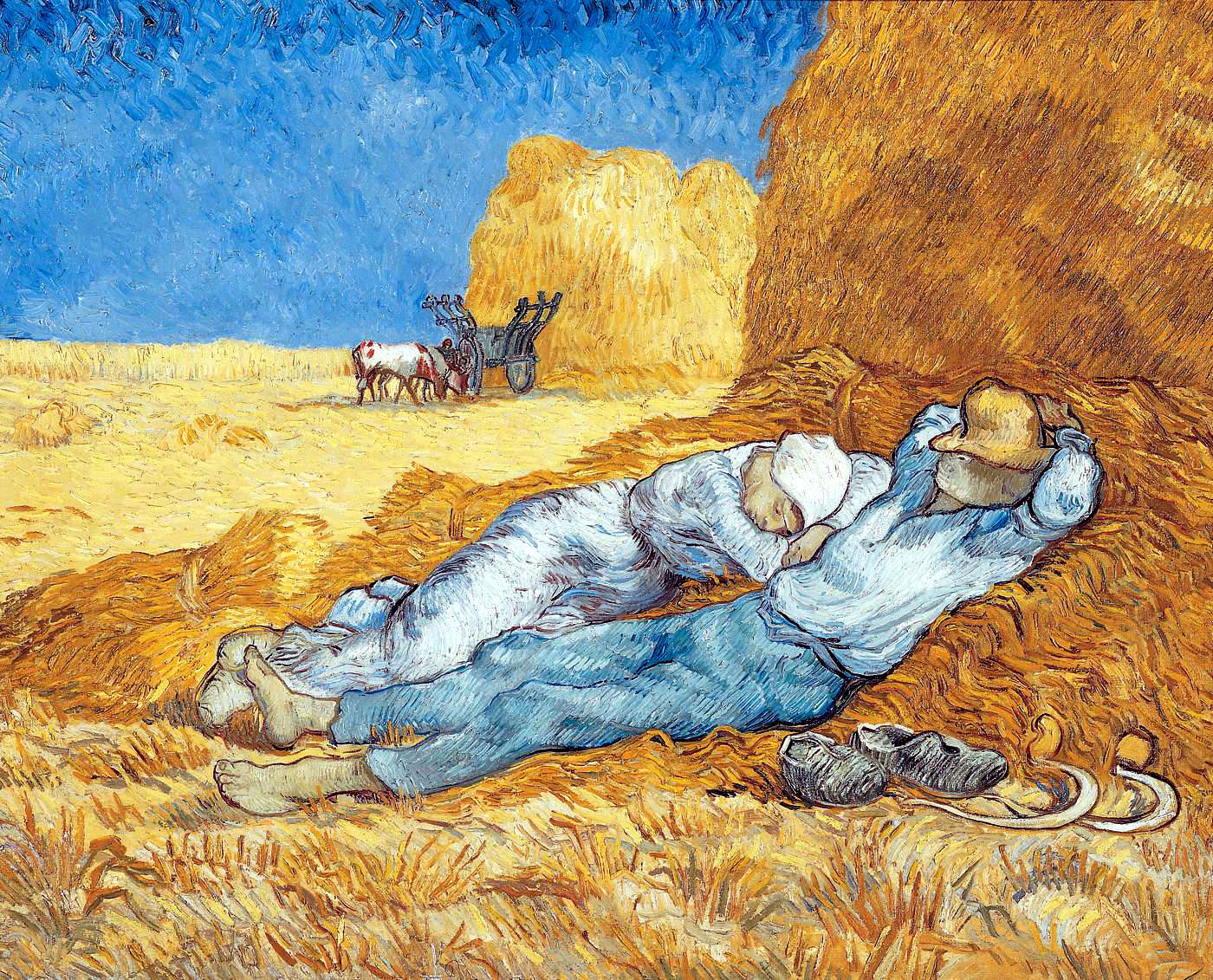
Van Gogh - La Meridienne


Behind the veil

When you arrive in Santiago de Compostela, they say, then your real Camino begins. Or continues, since the vast traverse between where we’ve been and where we’re headed is ongoing, never finally completed – not even by death, say the theologians. We are always “on the way,” deeper and deeper into the mystery of the world. Just so, this blog will itself travel on, exploring the permutations of that mystery within the wide categories of God, Nature, and Art, which are my three great passions. The subjects will be diverse, but all will pursue my guiding theme: where the fire and the rose are one.

This richly suggestive phrase, the last line of T. S. Eliot’s Four Quartets, harmonizes seemingly incompatible energies: the wild, consuming flame, the serene, soft and self-possessed bloom. As traditional symbols of the Holy Spirit and the Virgin Mary, they recall the fruitful incongruity of the Incarnation, but even without this theological overlay, on a strictly sensory level, their union comprises a highly charged coincidence of opposites. The interplay of radically different entities – matter and spirit, sensation and meaning, fact and imagination – and the expanded sense of reality that such unlikely dance partners can produce, will be the subject of my inquiry. John Muir, rhapsodic apostle of the California mountains, described nature as “opening a thousand windows to show us God.” The Religious Imagineer exists to look for those windows – not only in nature, but also in the arts, literature, cinema, theology, and ritual practice. The terrain is immense, my maps are few. But like Wordsworth, I pray that “should the guide I choose / Be nothing better than a wandering cloud / I cannot miss my way.”

So let me begin my new “camino” with Bill Viola, whose video art installations explore big questions: Who am I? Where am I? Where am I going? I have admired his work for years, and was delighted that the first retrospective of his work in France coincided with my arrival in Paris en route to the Camino in April. The notes to the exhibition related his aesthetic to religious contemplation: “For the artist, the camera is that second eye that ‘re-teaches us how to see’ and addresses the world beyond, or beneath, appearances.” And in fact the multiple rooms of the gallery, cave-like spaces lit only by the high-definition images projected on large surfaces, seemed more church than museum. People stood or sat on the floor in rapt attention to the visions unfolding all around them.

I was struck by one room in particular, where the four walls were covered by simultaneous projections of five different 35 minute scenes of mortality and resurrection. One of these was a fixed wide shot of a man dying in a tiny house perched on a bluff (a cutaway wall lets us see inside) as a boat is loaded with household goods on the beach below. When the man dies, we see him appear on the beach (while his lifeless body remains in the house) and get into the boat, which ferries him slowly across the wide expanse of water toward an unknown shore. In another scene, a rescue crew is packing up at the edge of receding floodwaters, while a distraught mother keeps watch in the desperate hope that her drowned son might still be rescued. After a long vigil, mother and paramedics, exhausted, fall asleep on the shore. It is only then that the son’s resurrected body rises out of the water and into the sky beyond the frame. The sleepers miss it, but the viewer is given a privileged glimpse of the crossing between this world and the next. Water dripping from the man’s ascending feet turns into a downpour once he is out of sight. The sleepers are awakened by the deluge, and they exit the scene, never suspecting the rain to be a sign connecting earth and heaven. The mystery of resurrection remains hidden from them, though not from us. The largest image, covering the entirety of a long wall, was an endless procession of people, seen from the side like a Parthenon frieze, moves in slow single file through a forest. As Viola intended, these walkers, wrapped in a silence that seems neither anxious nor eager, suggest souls who have left this world, on their way to whatever world awaits them. I would recall this image a few days later, when I took my own place in the Camino’s great procession of pilgrims, all making our way toward God knows where.

It would be hard to imagine a casual encounter with this installation, whose title was Going Forth By Day (a term for dying taken from the Egyptian Book of the Dead). It seemed too concerned about our own fate for us to pass it by with only a glance. Viola’s work always invites us deeper, soliciting, in his words, “faith in that other thing, that something else dimly felt behind the veil of daily life.” (David Morgan, “Spirit and Medium,” in The Art of Bill Viola, p. 101)

We could use more of such conviction – and poetic persuasiveness – in the rites and imagery of our churches, which sometimes seem at a loss in the task of making the sacred tangible or even thinkable in a culture saturated by secular assumptions. I was delighted to hear that St. Paul’s cathedral in London recently unveiled a permanent Viola video installation in its Martyrs chapel. You can find images of this new work at http://www.billviola.com/

You can view a short montage of excerpts from Going Forth by Day here: http://www.bing.com/videos/search?q=Bill+Viola+Going+forth+by+day&FORM=VIRE1#view=detail&mid=38964FC4118E53E2F6B938964FC4118E53E2F6B9

You can also watch an excellent lecture which I heard Viola give at UC Berkeley in 2010. It is 90 minutes long, includes examples of his work, and is well worth it for his discussion of “technology and revelation.” The link is at: http://www.youtube.com/watch?v=t0RCkNugozU

Viola flood res