Unknown's avatar

About jimfriedrich

I am an Episcopal priest, liturgical creative, filmmaker, writer, musician, teacher and retreat leader. My itinerant ministry is devoted to religious imagination and holy wonder. My blog is a space where diverse ideas and perspectives - theology and culture, liturgy and spirituality, arts and religion - can meet and converse with one another.

Grace and Beauty on Holy Island

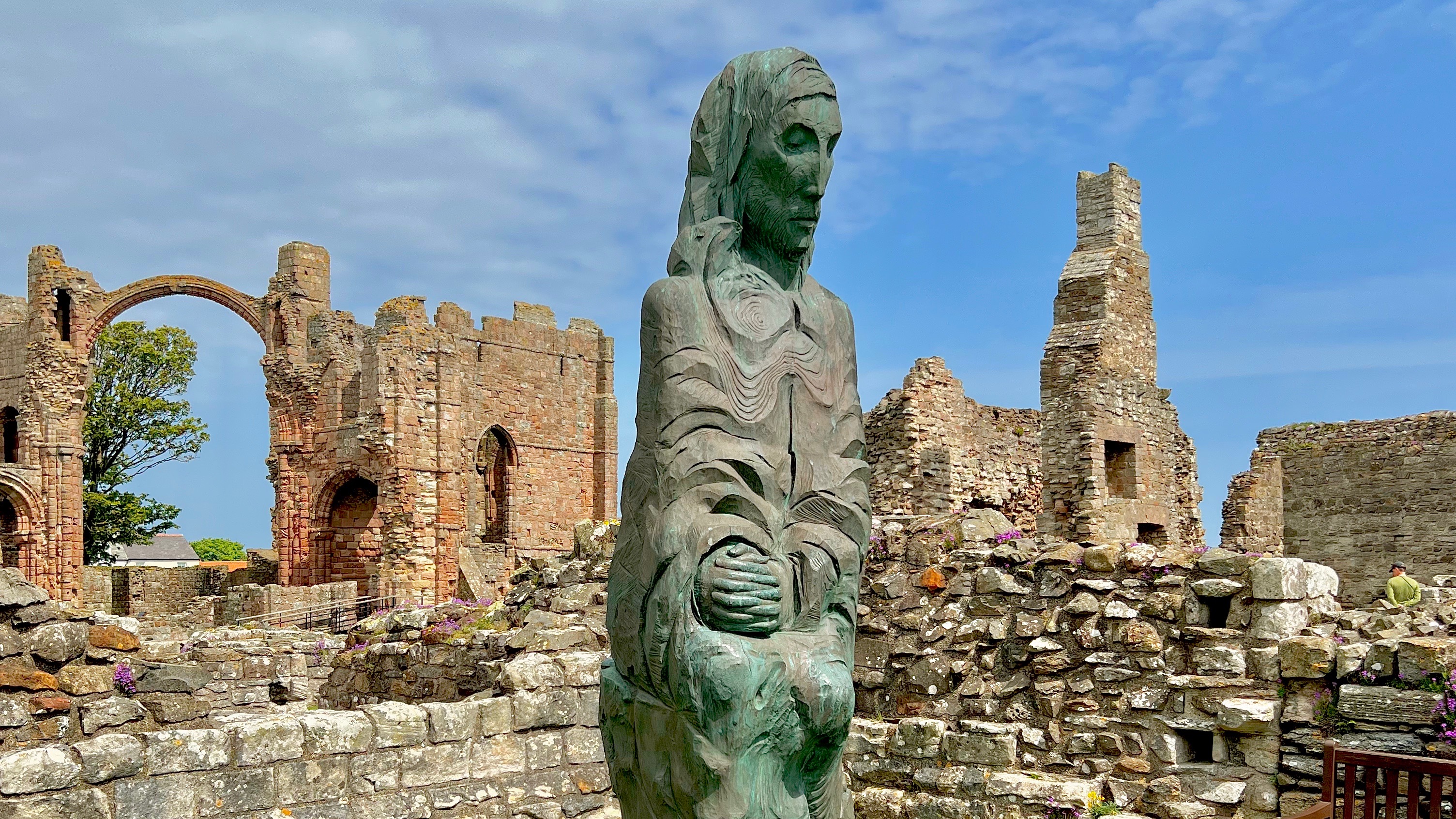
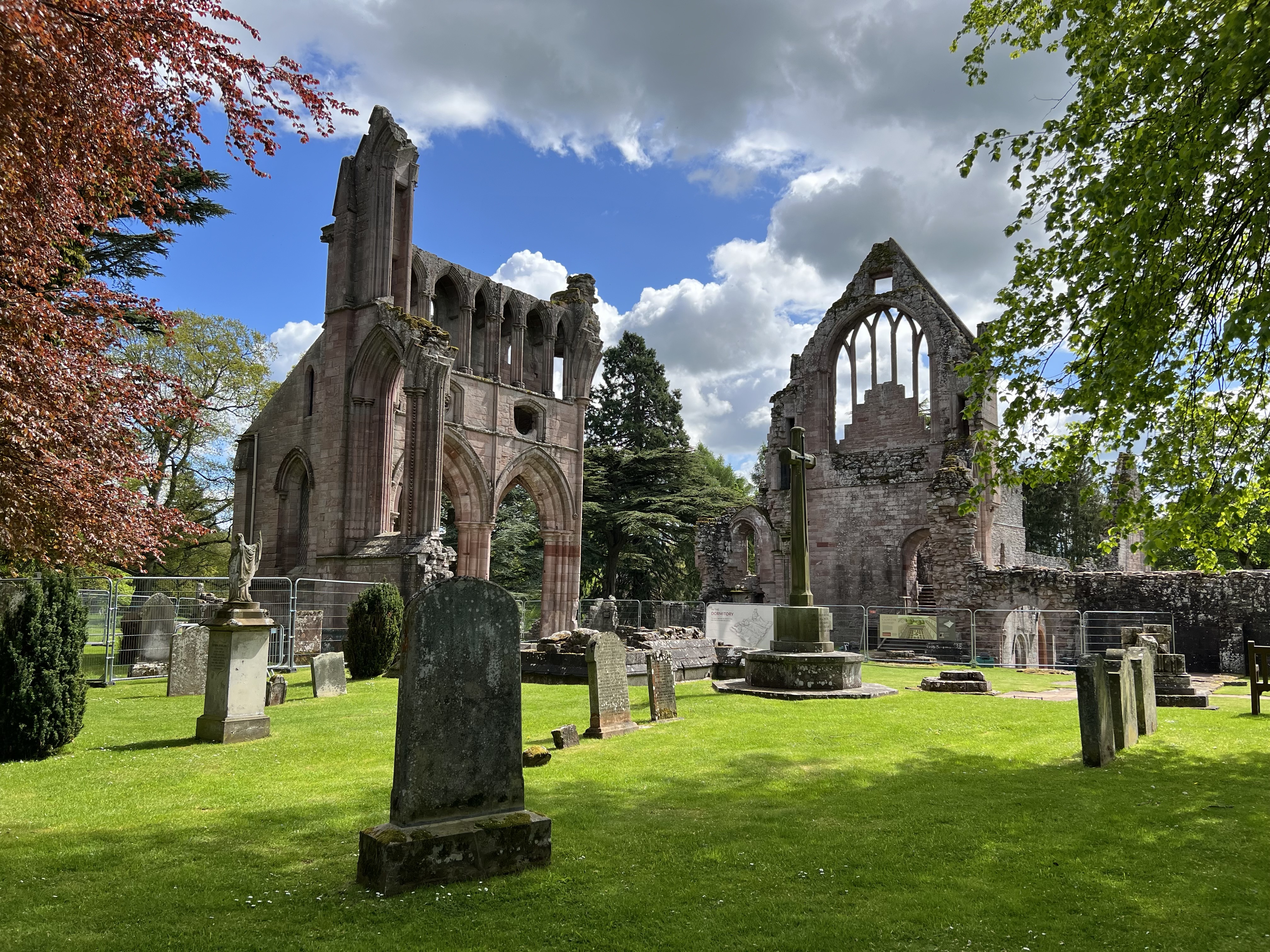
St. Cuthbert among the ruins of the 12th-century LIndisfarne Priory. Durham sculptor Fenwick Lawson carved the original from an elm tree in 1983. This bronze casting was installed in 1999.

In my recent post, Walking St. Cuthbert’s Way (7/28/2023), I described my 100-kilometer pilgrimage walk to the Northumbrian coast, where I had my first glimpse of Holy Island, where Cuthbert had been prior and bishop in the seventh century. In this installment, I cross over the tidal flats to reach my goal and discover why I had come. 

I’ve always been fascinated by the open-ended wanderings of the Dark Age Celtic monks. They journeyed without maps, trusting the way would be shown in due time. They got into little boats without oars or rudders, letting the wind and the currents be the agents of Providence. And where did they end up? Wherever it might be, they believed it was a place appointed for them by God. “The place of resurrection,” they called it. The place where they would meet Christ, the one “who knows you by heart.”[i]
But the arrival was, in a way, beside the point. The journey was the thing—the way of total abandonment and radical trust. Unlike ourselves, who think we already know who we are and where we should go, they traveled without preconception. In their eyes, you don’t know who you really are before you go on pilgrimage. Only the way of abandonment and unknowing will bring you home to your truest self. 

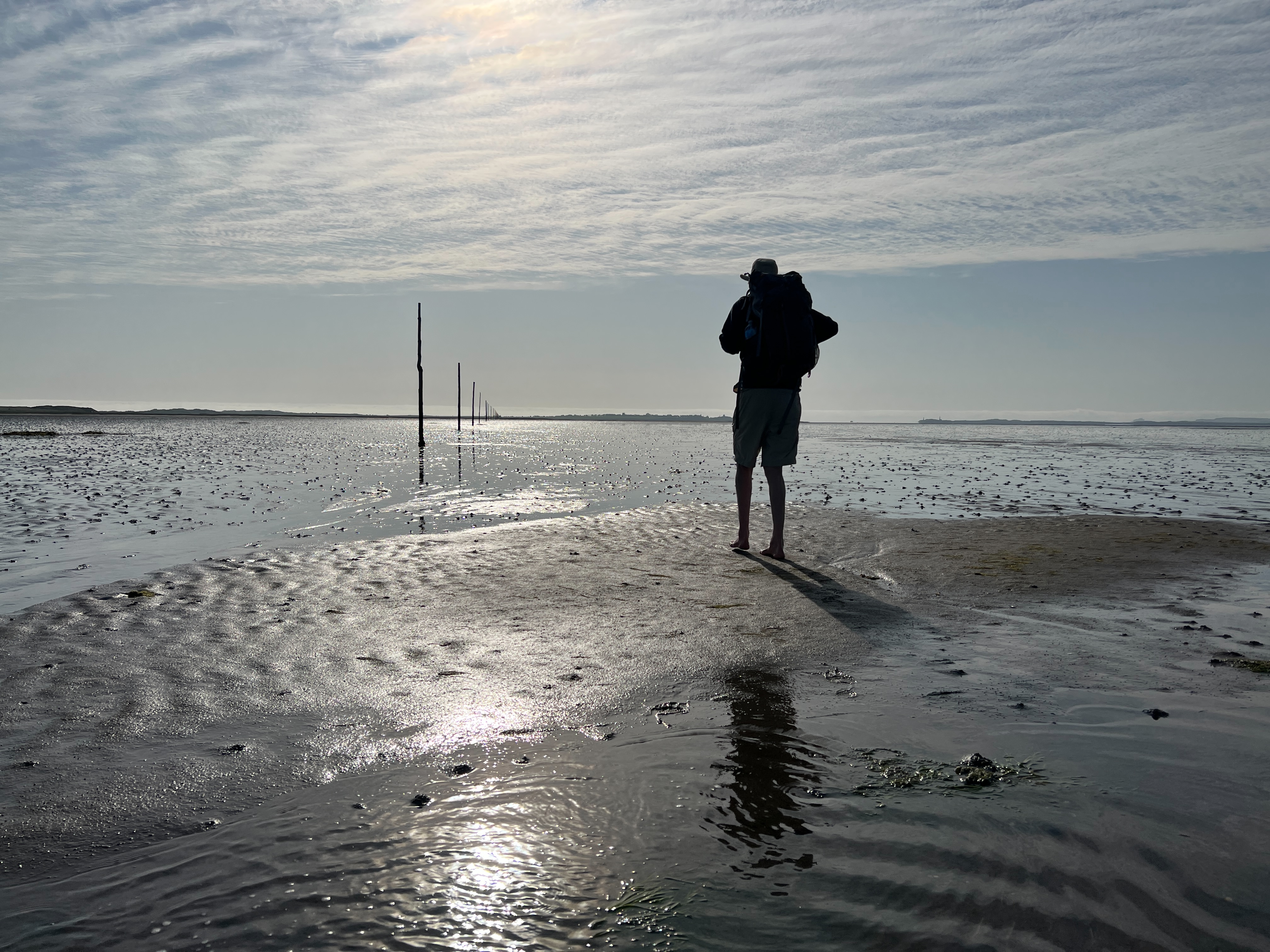
The author begins the final two miles of St. Cuthbert’s Way across the tidal sands to Holy Island.

“As a man dies many times before he’s dead,
so does he wend from birth to birth until, by grace, he comes alive at last.” 

— Frederick Buechner, Godric [ii]

Holy Island is only a part-time island. When the tide goes out, you can walk across the exposed sands, or drive over the causeway. Pilgrims properly go on foot, timing their two-mile passage to coincide with low tide. You don’t want to be caught in the middle when the waters return, swallowed like the Egyptians of old. Yes, the Red Sea comes to mind here, and the river Jordan—those great baptismal archetypes of crossing over from bondage to freedom, old to new, death to life. As I took my first steps on the wet sand, I sang one of my favorite shape note hymns:

Filled with delight, my raptured soul would here no longer stay;
Though Jordan’s waves around me roll, fearless I’d launch away.
I am bound for the Promised Land …[iii]

I had brought some rubber beach slippers, thinking I might need a barrier against cold water or sharp objects, but the sand immediately sucked them off my feet. I got the message: pilgrimage abhors self-protection. When you walk on holy ground, no shoes! 

“God lifted me out of the mire and clay, set my feet upon a rock, and put a new song in my mouth.”
Psalm 40:2-3

I was the only pilgrim on the sands in the early morning. The blessed solitude sanctified my final steps on St. Cuthbert’s Way. Halfway across, I began to hear an eerie keening sound, like wind through a broken wall. But that made no sense out on the tidal flat. After looking about with binoculars, I spied a dark mass at least a mile away. It was, I realized, hundreds of beached seals, pining for their absent sea.  

The seals of Holy Island.

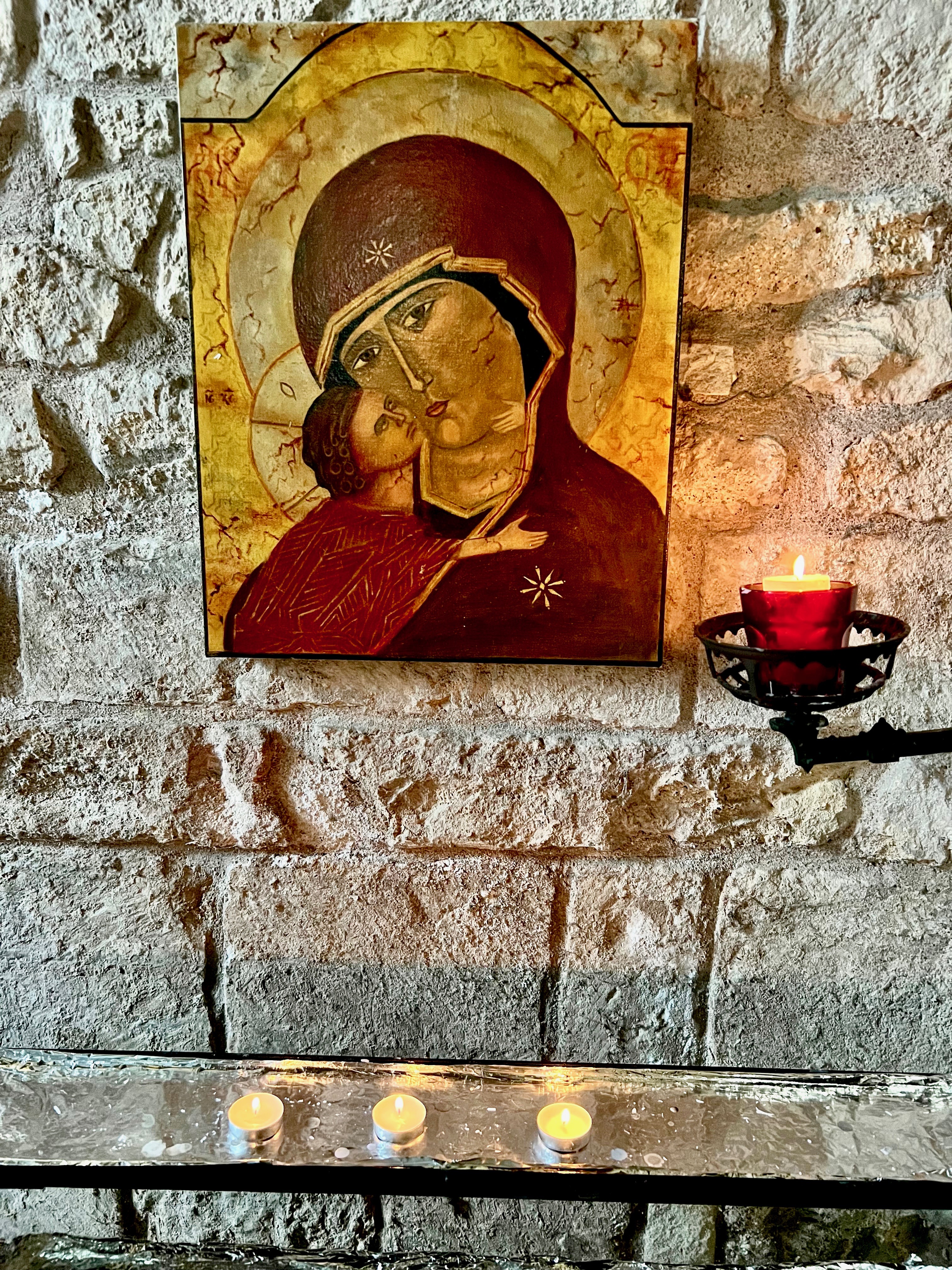
It took me seventy-five minutes to reach the other side, and another ten to find the parish church of St. Mary the Virgin, where I lit a candle to give thanks for the beautiful journey. 

Prayer station in St. Mary’s. Public liturgies are offered daily in this (mostly) 13th-century church adjacent to the Priory ruins.
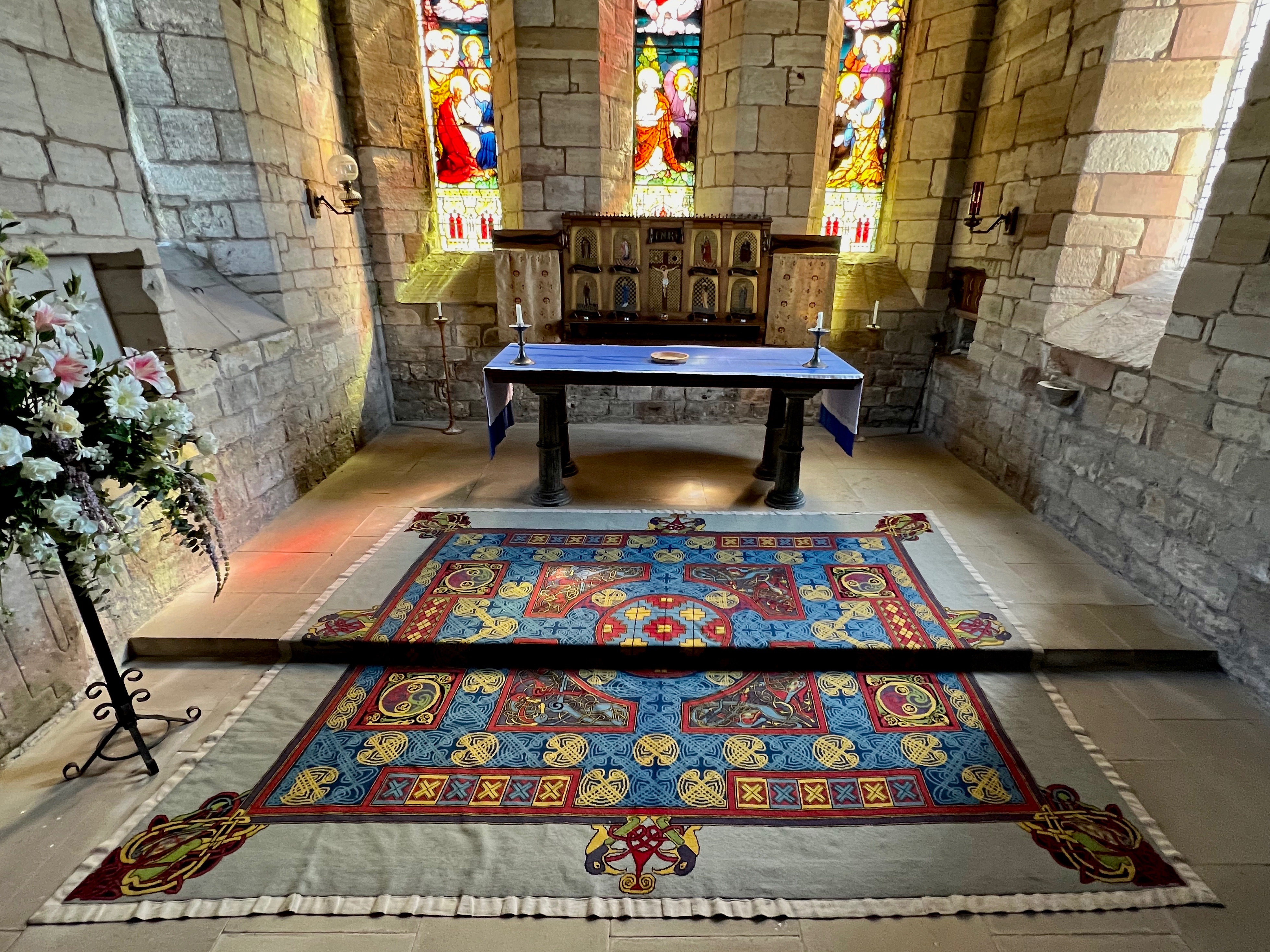
Chancel of St. Mary the Virgin, Lindisfarne’s parish church. Most of the structure is 13th century (restored in the 19th century), but some portions of an earlier building remain. The carpet, copied from a page in the Lindisfarne Gospels, was embroidered by 18 women of the parish in 1970.

The Anglican parish church stands adjacent to the ruins of the twelfth-century Lindisfarne Priory, erected on the site of the seventh-century monastery founded by St. Aidan and nurtured by St. Cuthbert. I would return to this peaceful sanctuary again and again during my three-day sojourn on Holy Island. Sarah Hills, the gracious vicar, invited me to read Scripture at Morning and Evening Prayer. One of those passages was the comic narrative of Balaam and his recalcitrant speaking donkey, perhaps the oddest story in the Bible (Numbers 22:1-39). It was a very long text, so I tried to give each character a distinctive quality to sustain interest. The donkey’s voice got a few laughs.  

On Ascension Sunday, the eucharist was crowded with pilgrims from many lands. I passed the Peace with Africans, Asians, Europeans, North and South Americans. The singing was spirited—no half-hearted voices after such a journey. Our harmonious sound enveloped me in the embrace of communal faith, and for a blessed hour my “I” became “we.” The offertory hymn happened to be “Lord of all hopefulness,” which celebrates the daily round of prayerful living: Be there at our waking … be there at our labors … be there at our homing … be there at our sleeping. I memorized it long ago in my teens, and I had sung it at the start of every day along Cuthbert’s Way. To repeat it now at Lindisfarne, with all the company of heaven, wasn’t just coincidence; it was grace. I received its gift with tears.

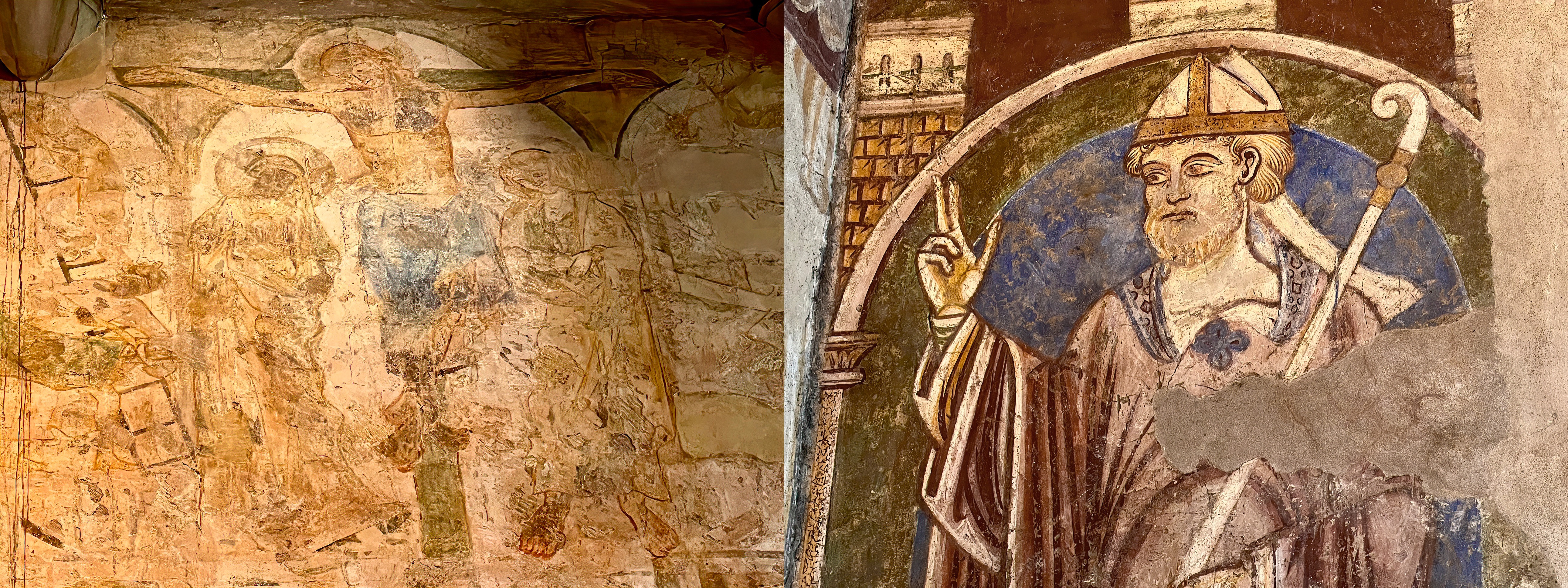
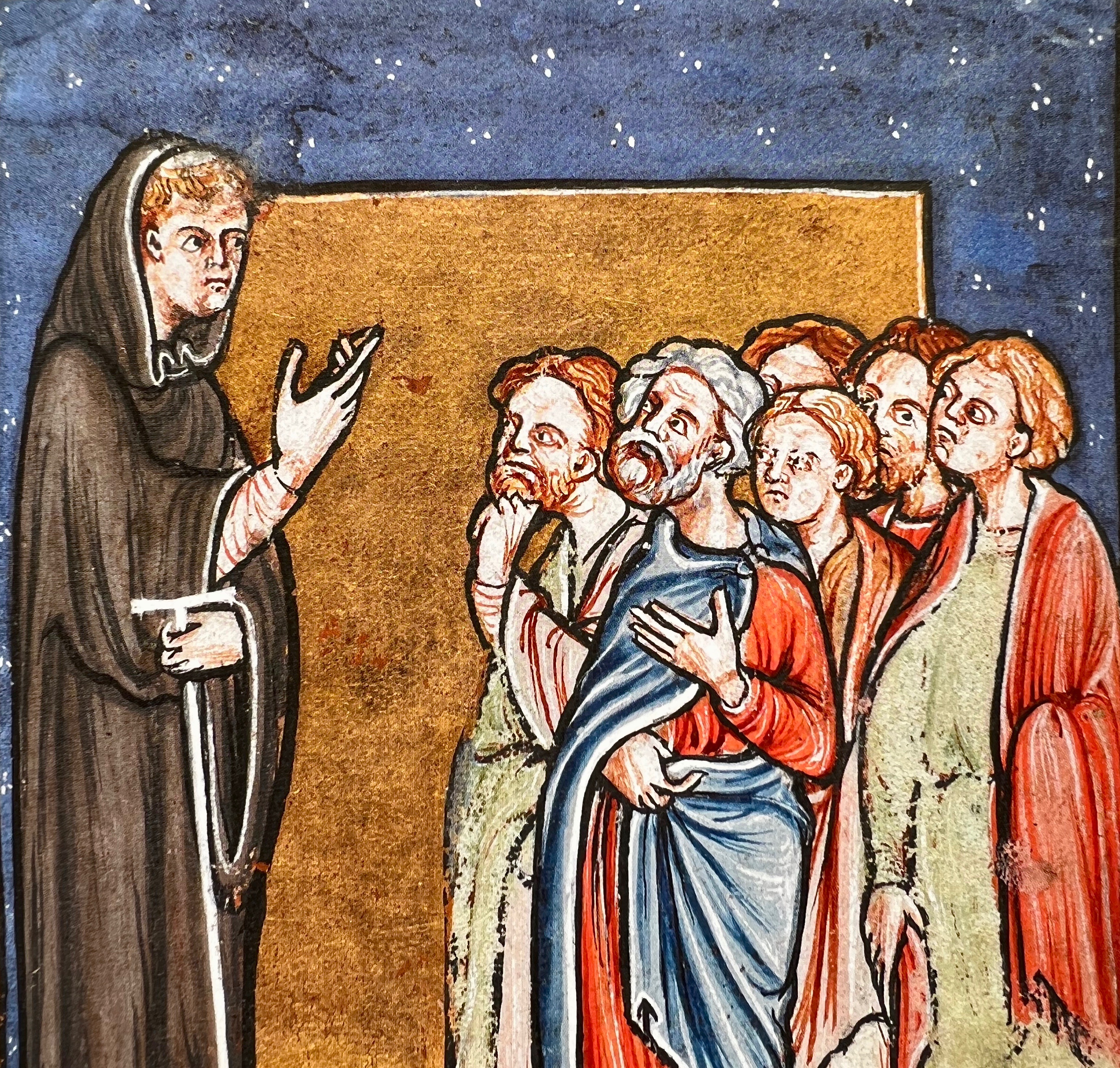
St. Cuthbert preaching to the Northumbrians (late 12th-century illustration for Bede’s Life of St. Cuthbert).

“They confessed their sins, confided in him about their temptations, and laid open to him the common troubles of humanity they were laboring under … Spirits that were chilled with sadness he could warm back to hope again … Those beset with worry he brought back to thoughts of the joys of heaven .…” [iv]   

— The Venerable Bede, Life of St. Cuthbert

Cuthbert has, through the ages, been the most beloved of Britain’s northern saints. Although he left no writings of his own, his biographers describe a humble and prayerful man, full of charm, a citizen of heaven who devoted his life to the needs of earthly folk. He had a compassionate spirit, and was a gifted listener. When the responsibilities of leadership were thrust upon him, he accepted them in a spirit of obedience. But he had a hermit’s heart, and no thirst for power. 

At age thirty, he became Prior of Lindisfarne in 664, and was assigned the difficult task of introducing the forms and practices of the Roman church to his resistant Celtic community. In a momentous decision at the recent Synod of Whitby, the Celtic churches in Britain had agreed to adopt the more universal—and hierarchical—norms of western Catholicism, surrendering the eccentricities of their more local traditions. But religious practices are hard to change, and Christian changemakers in every age have heard the same complaint, “But that isn’t the way we’ve always done it!” The seventh-century monks of Lindisfarne were no different than the Christians of our own time who fought women’s ordination or new forms of worship. They were uncomfortable. And they raised a fuss.

In Lindisfarne’s case, Cuthbert’s patient sweetness won the day. As the Venerable Bede tells the story,

“When he was wearied by the sharp contentions of his opponents he would rise up suddenly and with placid appearance and demeanor he would depart, thus dissolving the Chapter, but nevertheless on the following day, as if he had suffered no opposition the day before, he would give the same exhortations again to the same company until he gradually converted them to his own views.” [v]

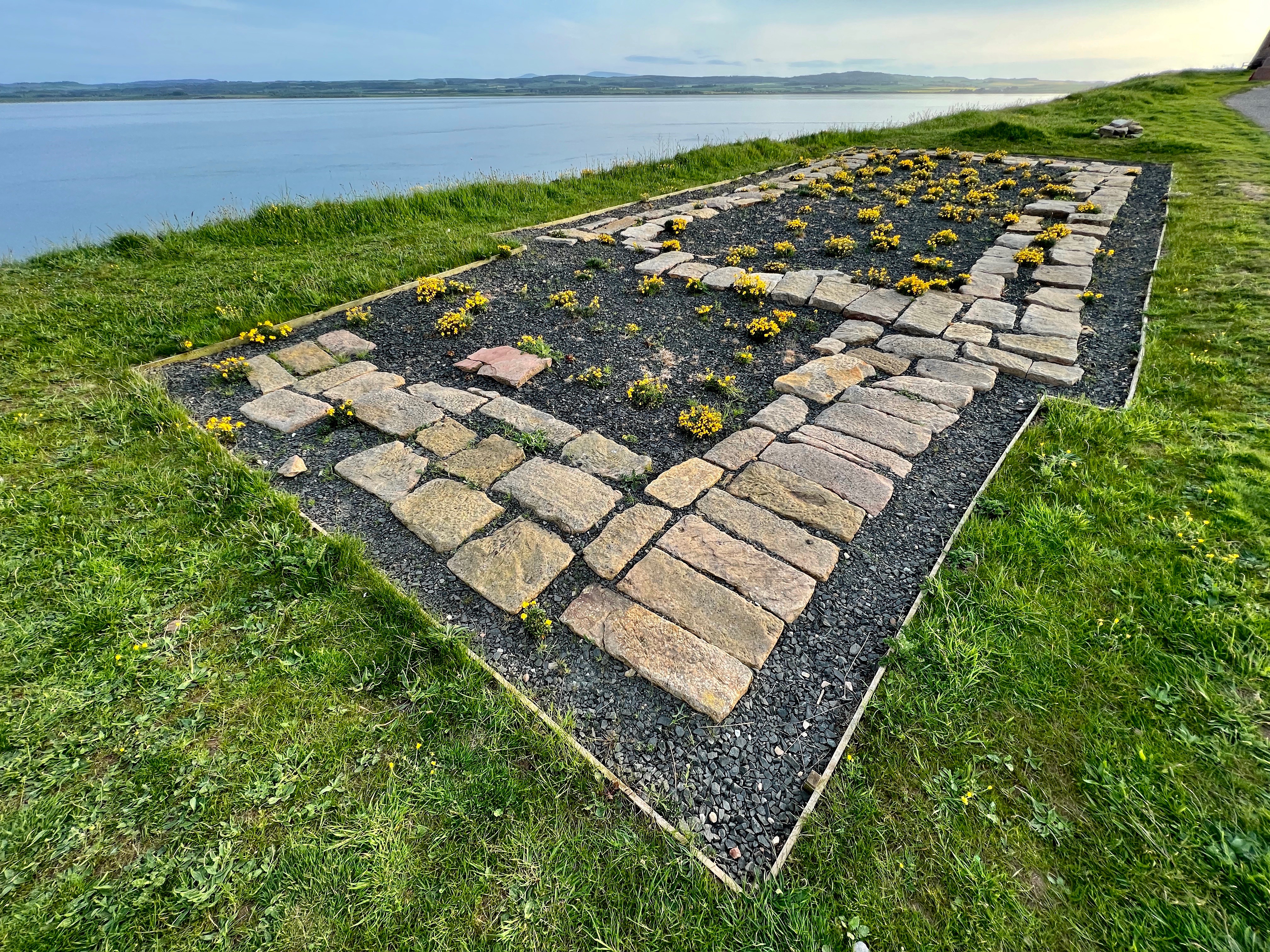
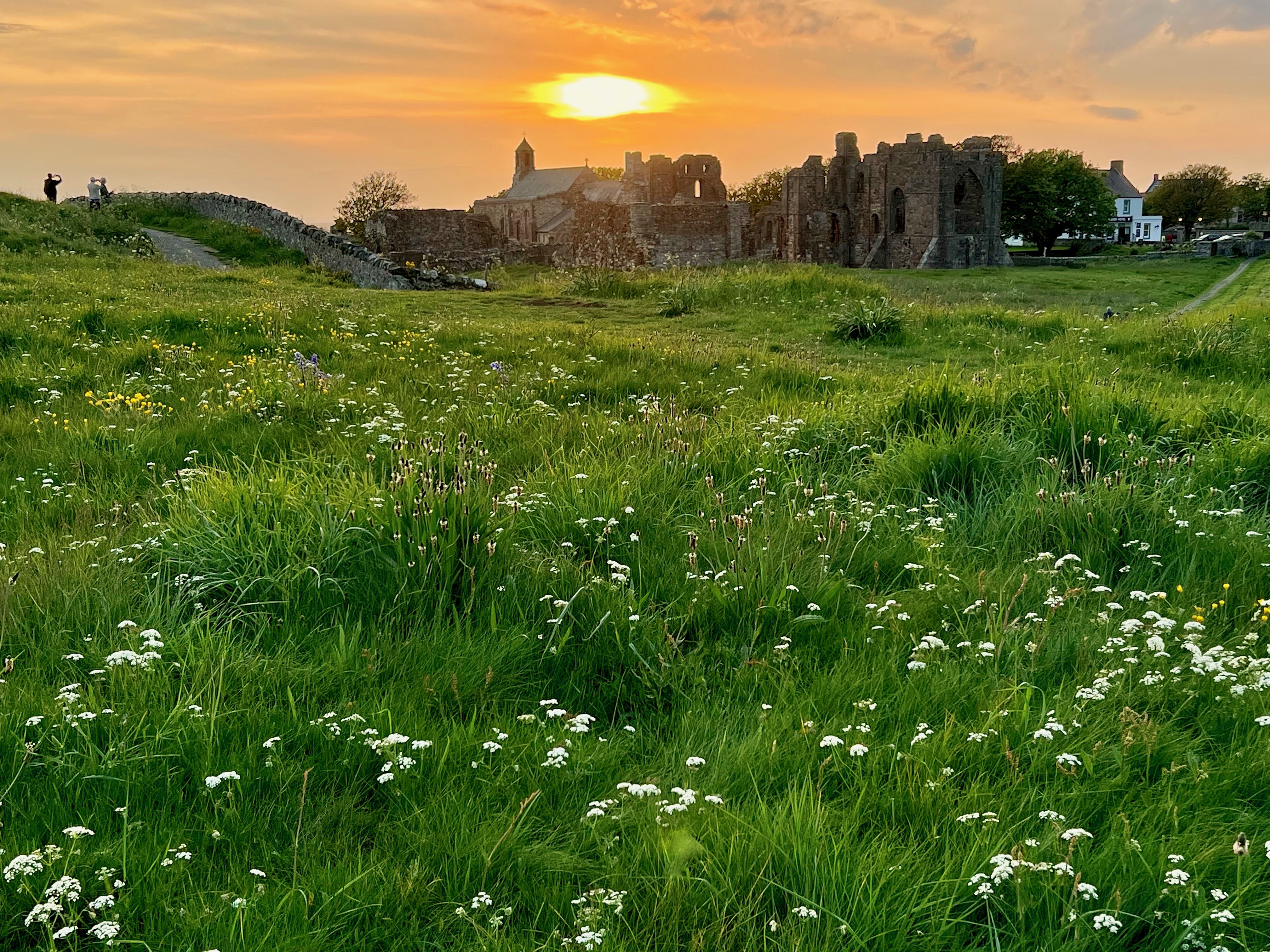
Foundation of an Anglo-Saxon church on the Heugh, the rocky ridge above the 12th-century ruins of Lindisfarne Priory. Discovered in recent excavations (2016-2018), this may have been part of the original monastery founded by St Aidan in 635.
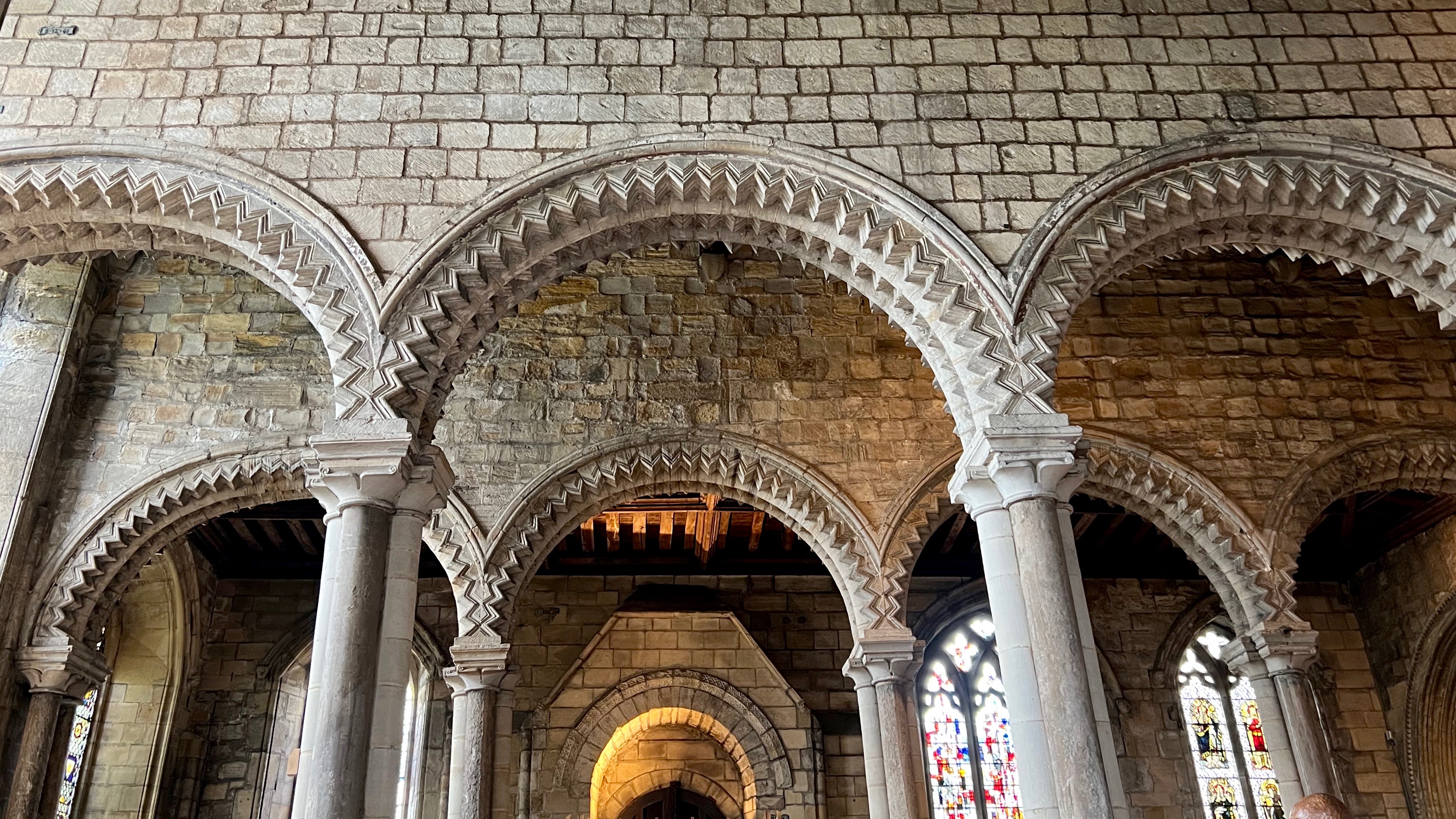
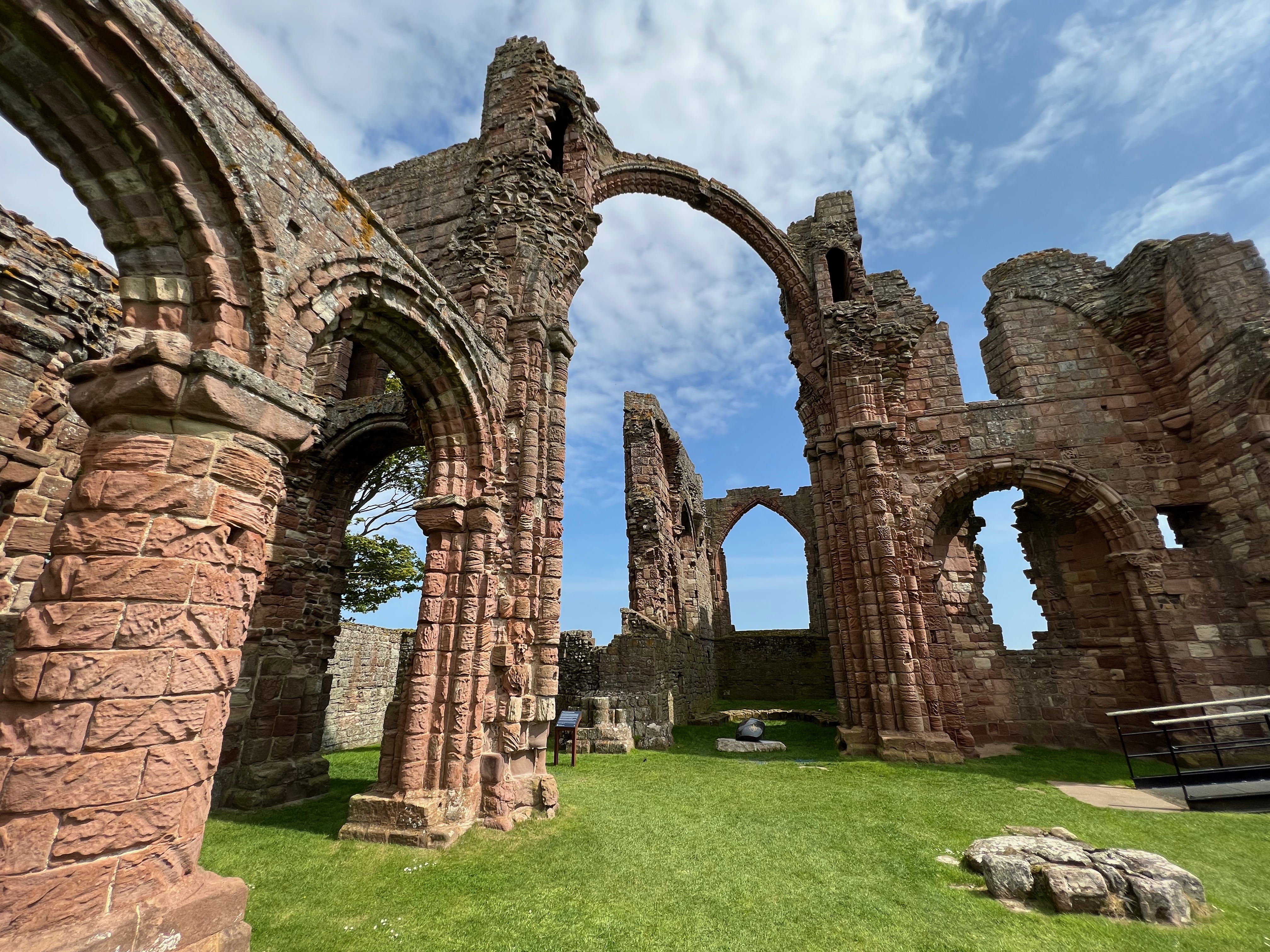
View from the nave of Lindisfarne’s Priory church (12th century, with modifications over the next 200 years). The north wall and arcade remain largely intact. The rainbow arch, a rib from the crossing vault, survived the collapse of the central tower in the 18th century. The pointed arch at the east end of the presbytery apse is a 14th-century Gothic touch.
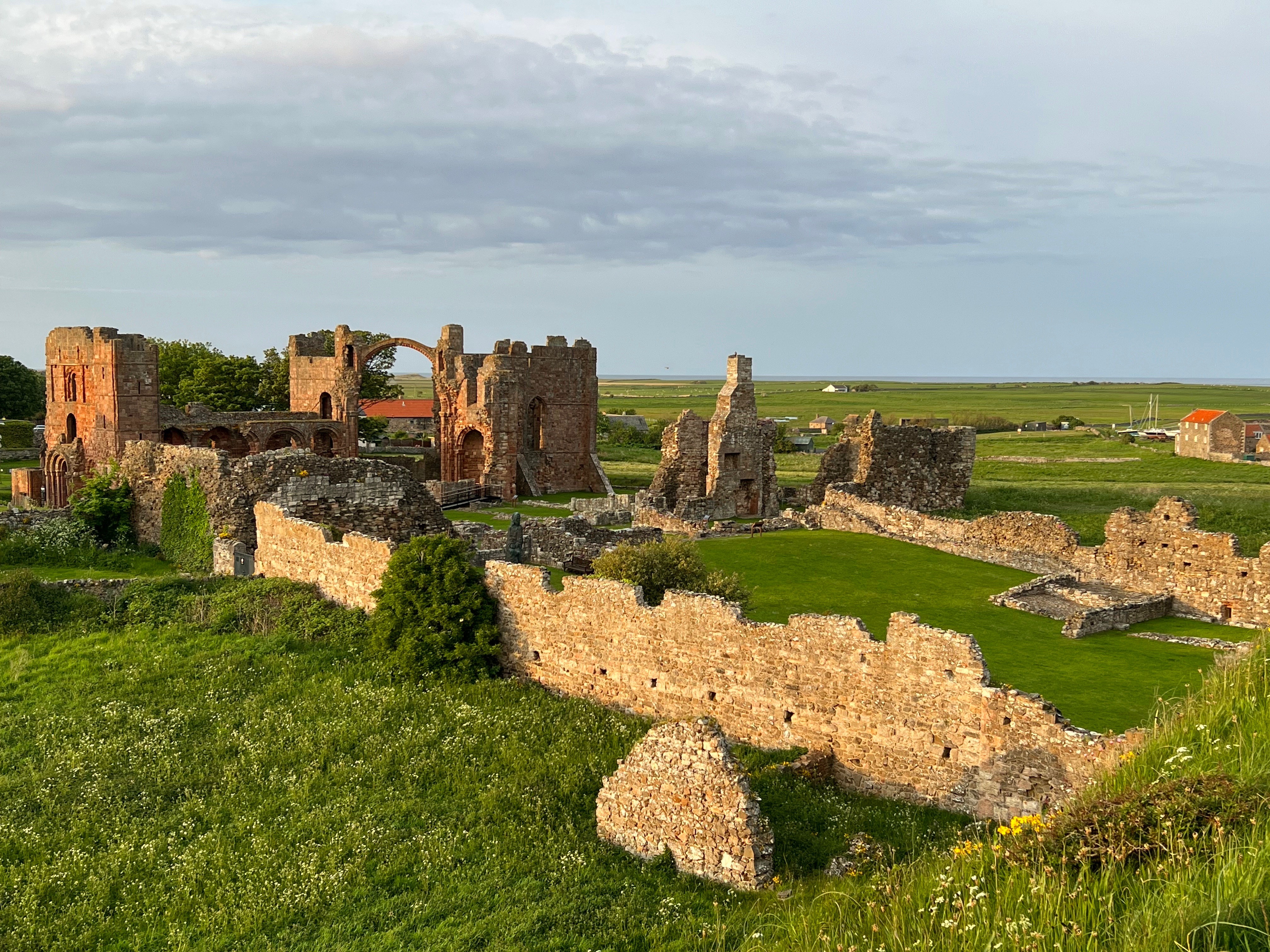
Lindisfarne Priory (12th century). The church was built first with pink sandstone.
The domestic complex was constructed later using greyer stones.
St.Cuthbert’s Isle, St. Mary’s Church, and Lindisfarne Priory from the Watchtower on the Heugh.

Time has erased the physical traces of Cuthbert’s Lindisfarne, but the impressive ruins of the Priory’s later structures still bear witness to his indelible legacy. After his death, pilgrims flocked to his shrine, thought to have been somewhere within the perimeter of the church built 500 years later. This video takes us through the ruins to the most likely spot.

Lindisfarne Priory from the north aisle to the presbytery.
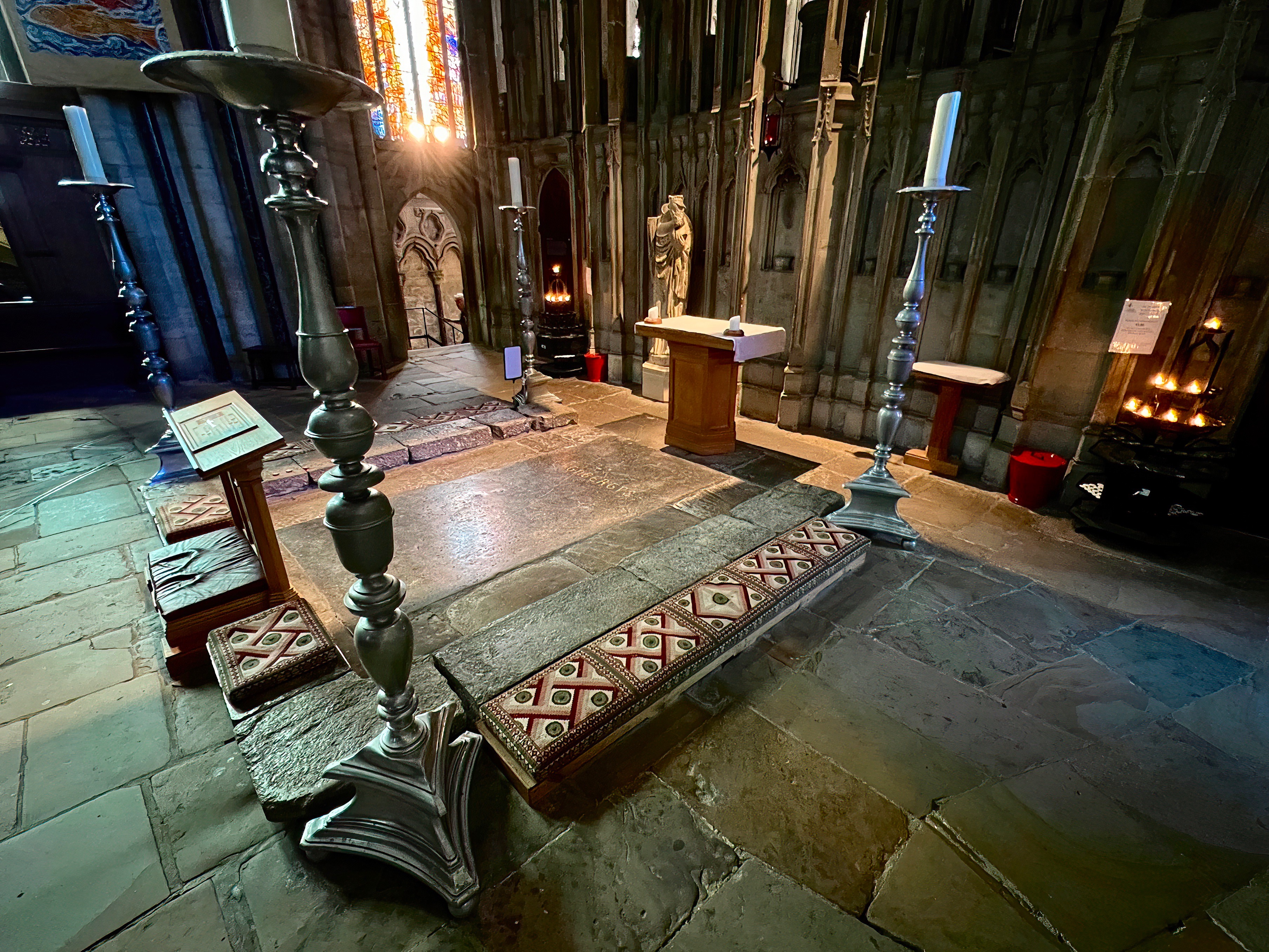
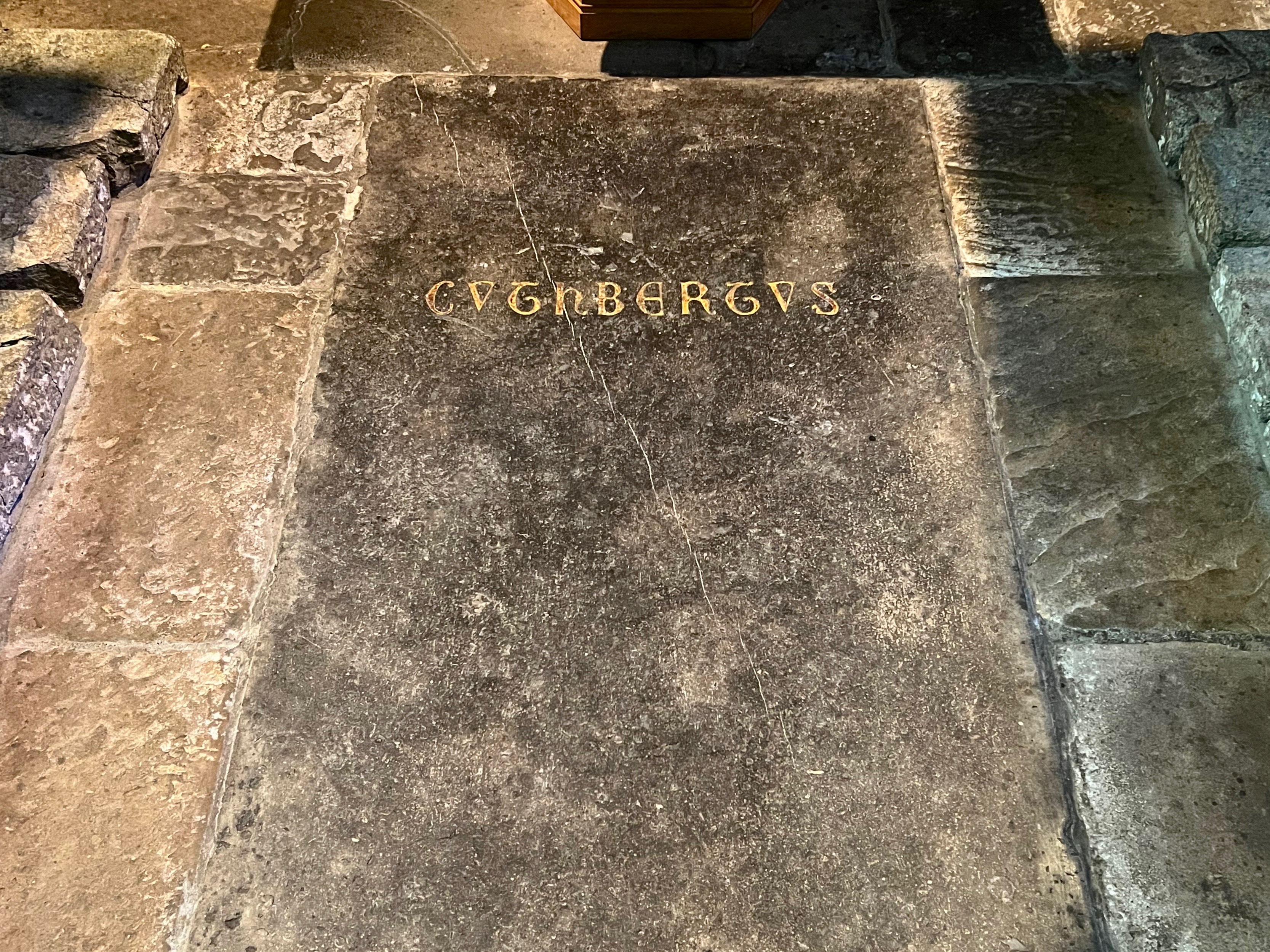
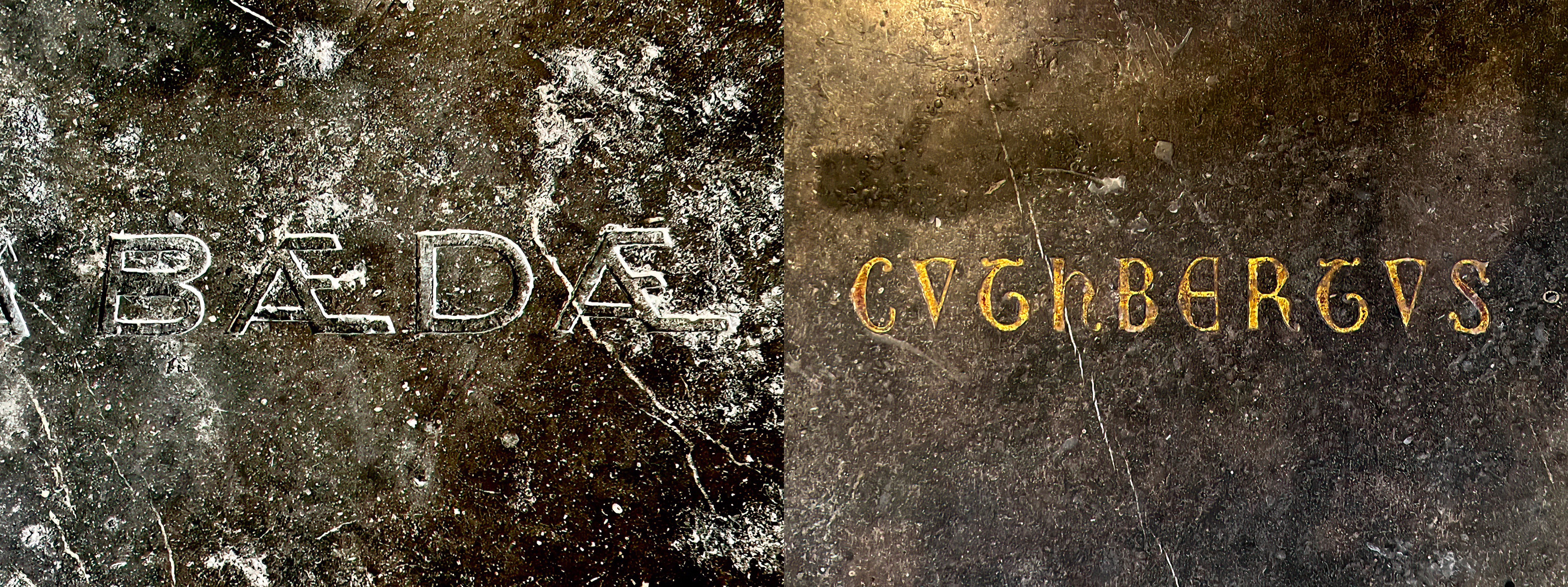
The black stone marks the possible site of Cuthbert’s first burial.

After twelve years as prior here, Cuthbert felt an increasingly insistent call to solitude. For a time, he moved just offshore to a tiny island to seek the “green martyrdom” mentioned in the seventh-century Irish text, the Cambrai Homily

Precious in the eyes of God:
The white martyrdom of exile
The green martyrdom of the hermit
The red martyrdom of sacrifice.[vi]

In other words, there are different ways to take up your cross. If your faith doesn’t literally kill you or drive you into exile, you can still withdraw from the world to wage without distraction the interior struggle for authenticity, what St. Benedict called the “single-handed combat of the wilderness.” Inspired by the desert hermits of Late Antiquity, many British ascetics took flight to wild and lonely places in the early Middle Ages. 

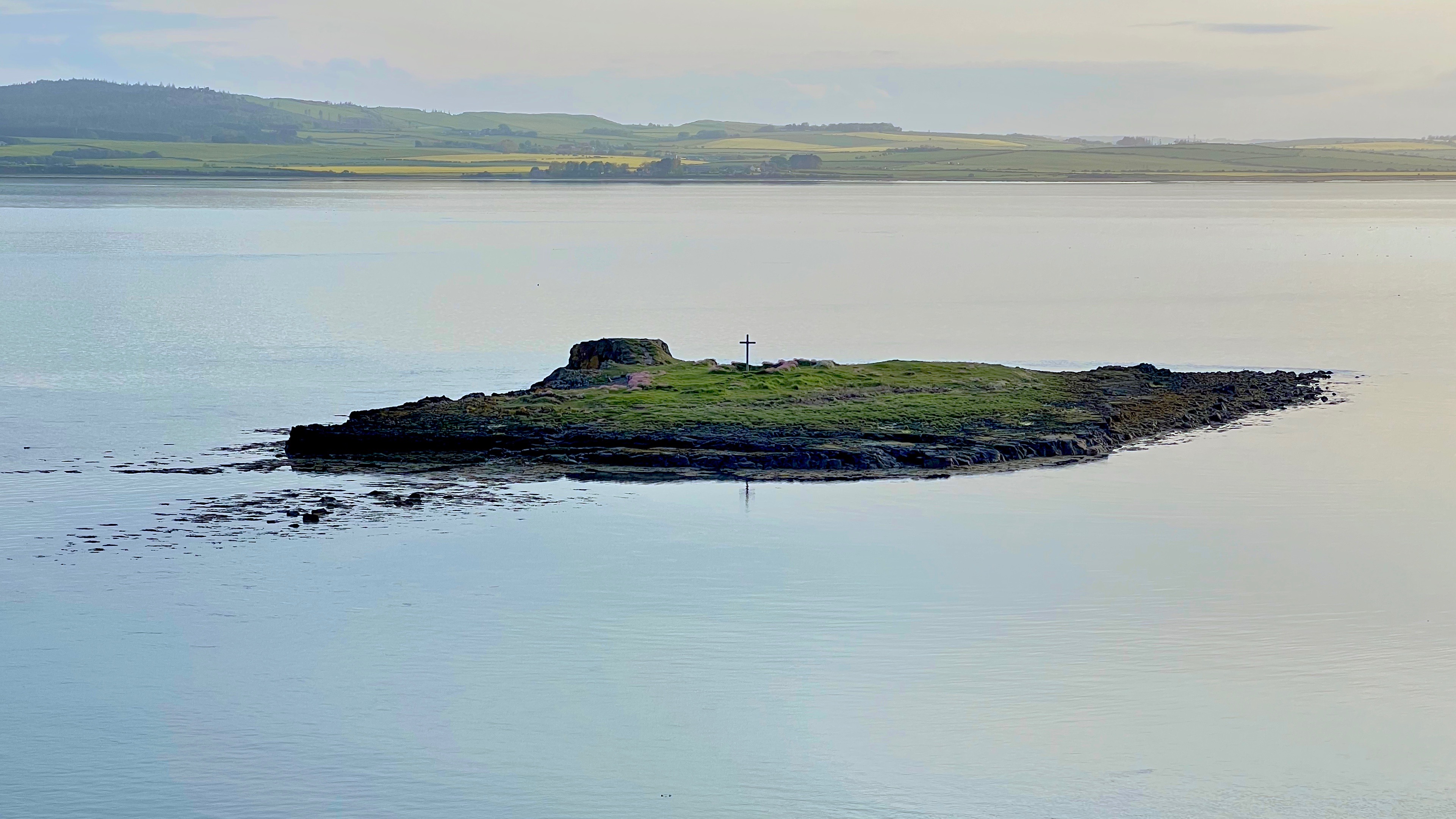
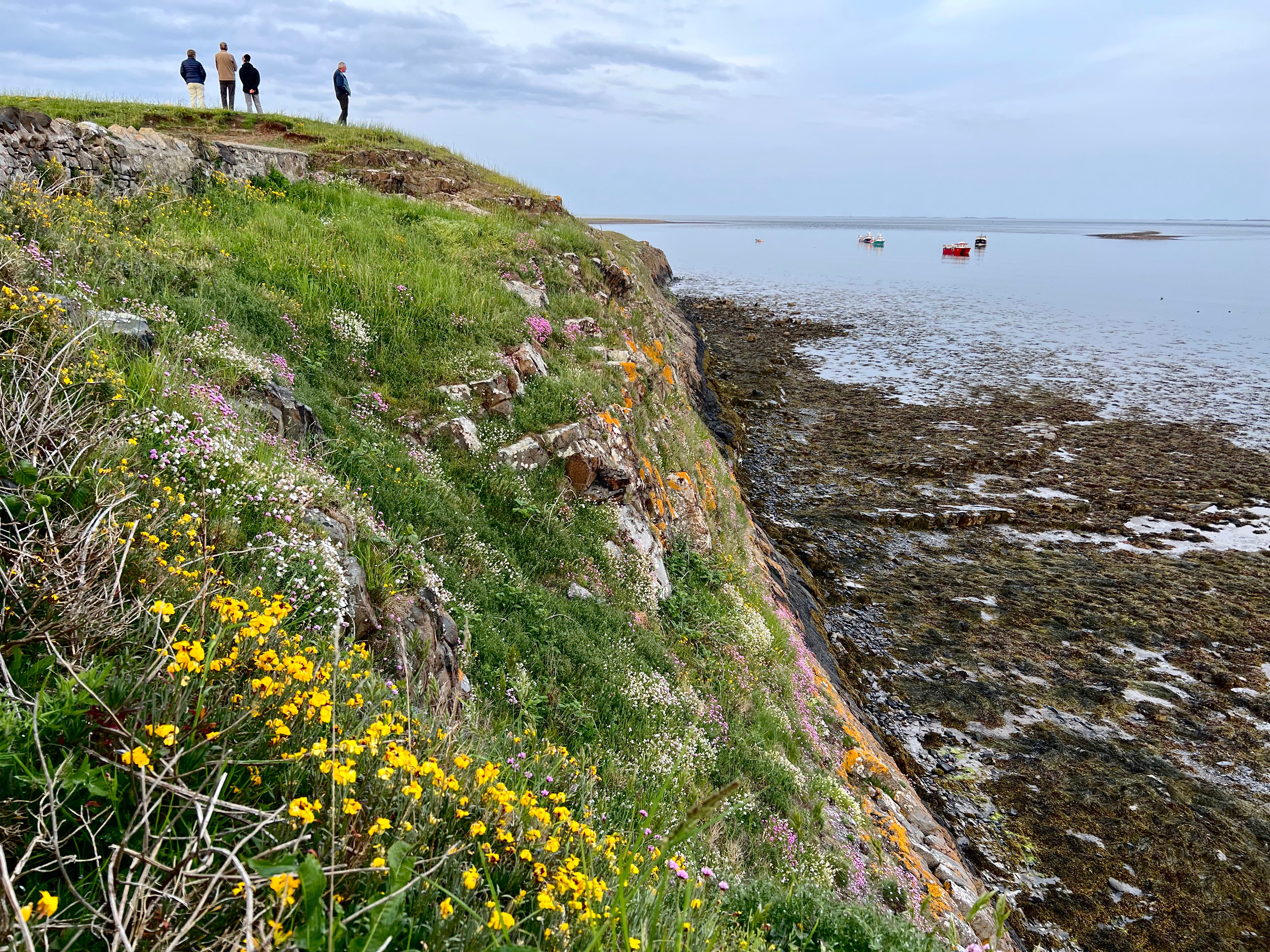
St. Cuthbert’s Isle, just offshore from Holy Island, where the saint sought prayerful solitude.
You can walk to it at low tide.

It wasn’t long before Cuthbert moved further away, to the island of Inner Farne, a seven mile row from Lindisfarne. Its rocky terrain had sparse vegetation, but was teeming with birdlife: puffins, guillemots, terns, kittiwakes, eider ducks, and numerous other species. Cuthbert loved the natural world, and there are many charming stories of his interactions with birds and animals. Here is my favorite, told by Michael York in a video I made years ago about early British Christianity: 

St. Cuthbert and the otters
From The Story of Anglicanism: Early and Medieval Foundations
Cathedral Films, 1988

What was life like for an island hermit? Was it an escape from interdependence, or could it be a way of going deeper and deeper into the world? A twelfth-century Irish poem conveys a vivid sense of belonging to a sacred ecology: 

Delightful I think it to be in the bosom of an isle, on the peak of a rock,
that I might often see there the calm of the sea.

That I might see its heavy waves over the glittering ocean,
as they chant a melody to their Father on their eternal course.

That I might see its splendid flocks of birds over the full-watered ocean;
that I might see its mighty whales, greatest of wonders…

That contrition of heart should come upon me as I watch it;
that I might bewail my many sins, difficult to declare.

That I might bless the Lord who has power over all,
Heaven with its pure host of angels, earth, ebb, flood-tide.

That I might pore on one of my books, good for my soul;
a while kneeling for beloved Heaven, a while at psalms.

A while gathering seaweed from the rock, a while fishing, 
a while giving food to the poor, a while in my cell.

A while meditating on the Kingdom of Heaven, holy is the redemption!
a while at labor not too heavy; it would be delightful! [vii]

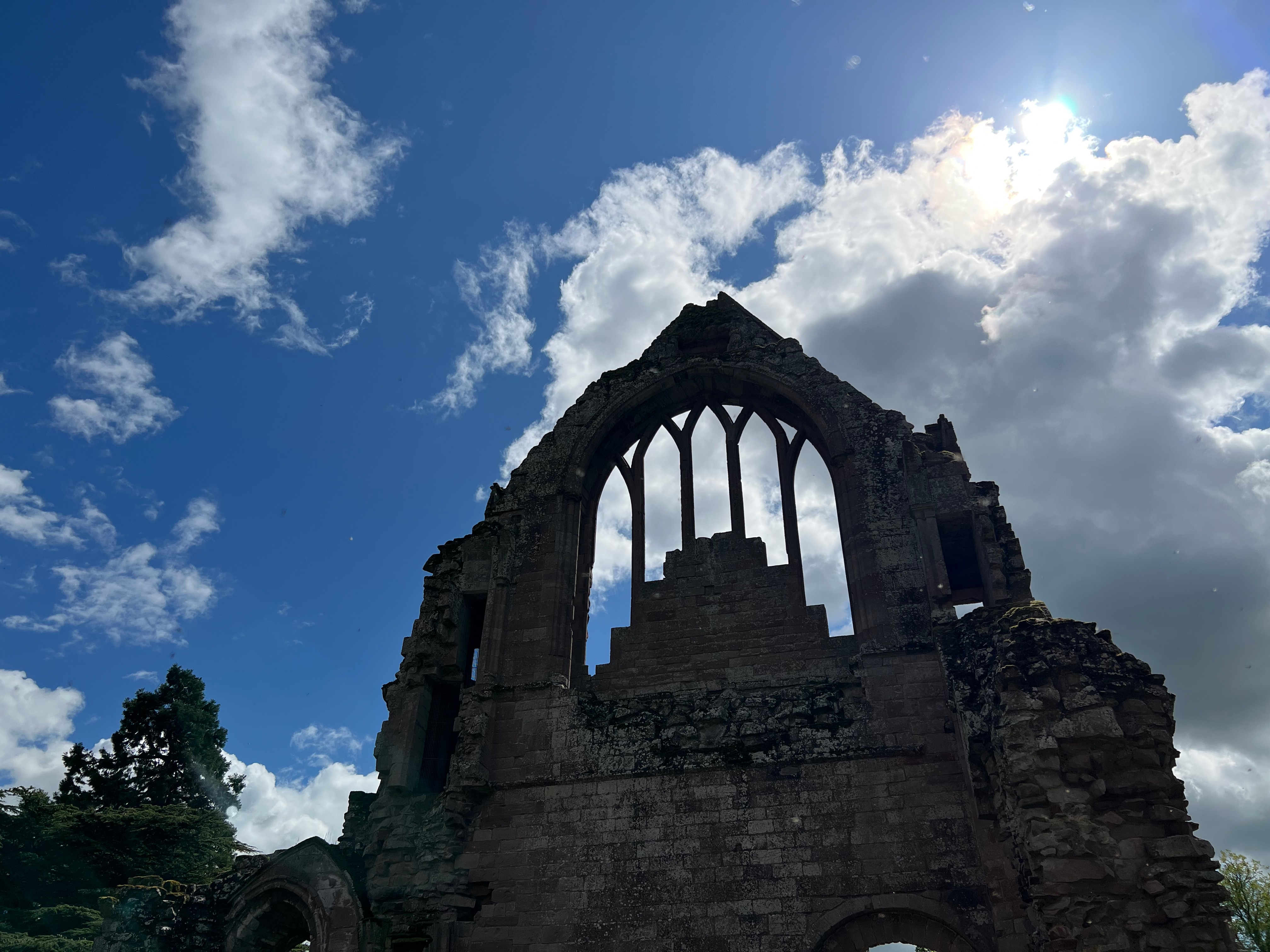
The presbytery apse at the east end of the Lindisfarne Priory church. The high walls and absent roof, like Cuthbert’s cell on Inner Farne, block any view of the surrounding world, concentrating attention on what the saint called “higher things.”

Despite his affection for the created world, Cuthbert constructed his stone cell on Farne with high walls and no windows. His only view was through an opening in the roof. The design was intended to focus his attention on the higher things of “heaven,” not just as a concept, but as a physical, sensory experience. That strikes me as similar to what contemporary Light and Space artist James Turrell achieves with his “Skyspaces,” windowless rooms with a rectangular or elliptical opening cut into the ceiling. 

“My art deals with light itself,” Turrell says. “It’s not the bearer of revelation—it is the revelation.” [viii]  Instead of looking at material objects, you gaze up though the opening, taking in the sky’s color and light during the day and the stars at night. Over time this perceptual asceticism, screening out the world of things, quiets and deepens the eye, making it more receptive to the immaterial, more open to the infinite. Could the same thing have happened to Cuthbert in his stone enclosure? “It’s not about earth. It’s not about sky. It’s about our part in the luminous fabric of the universe.” [ix]   

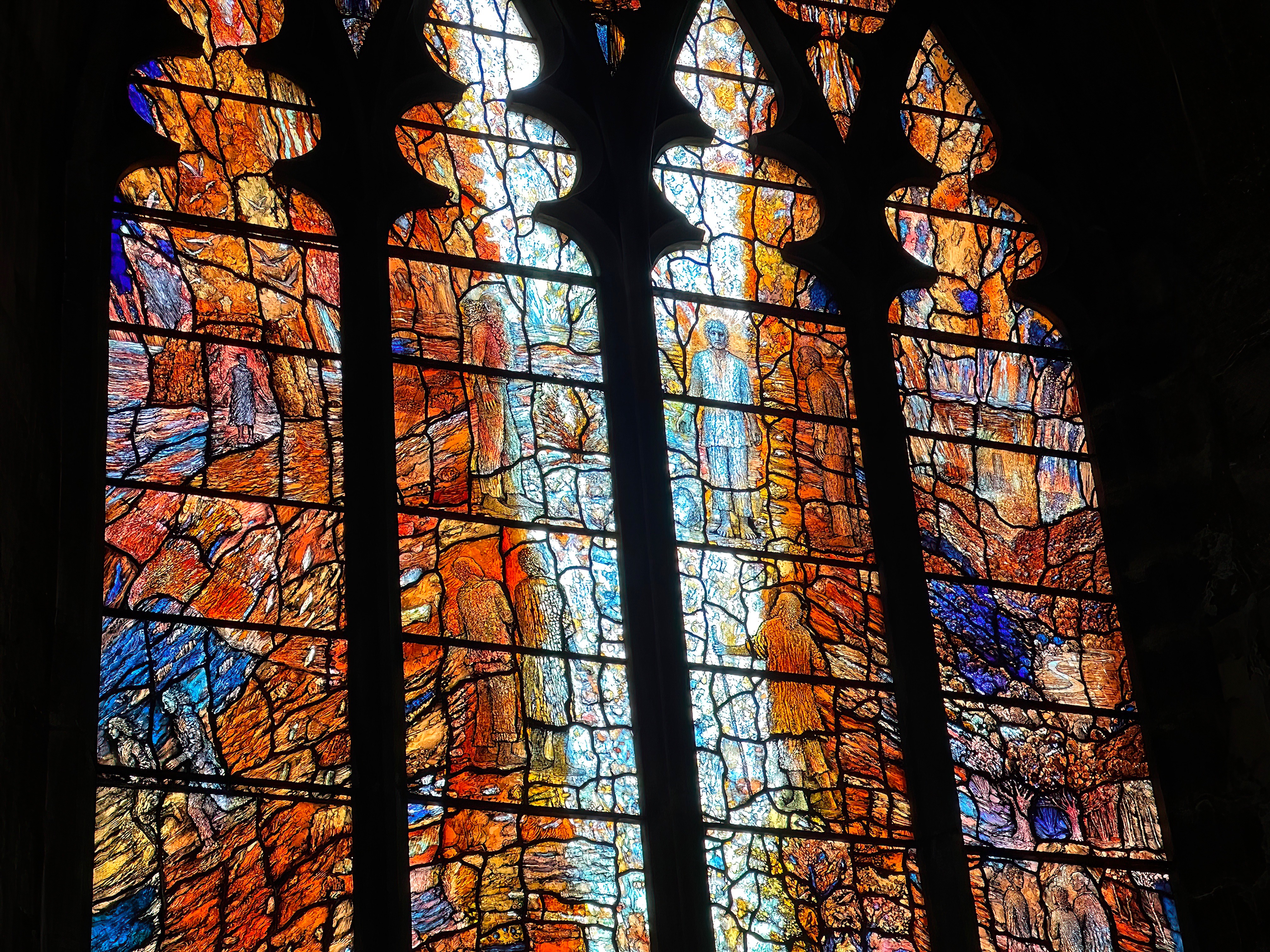
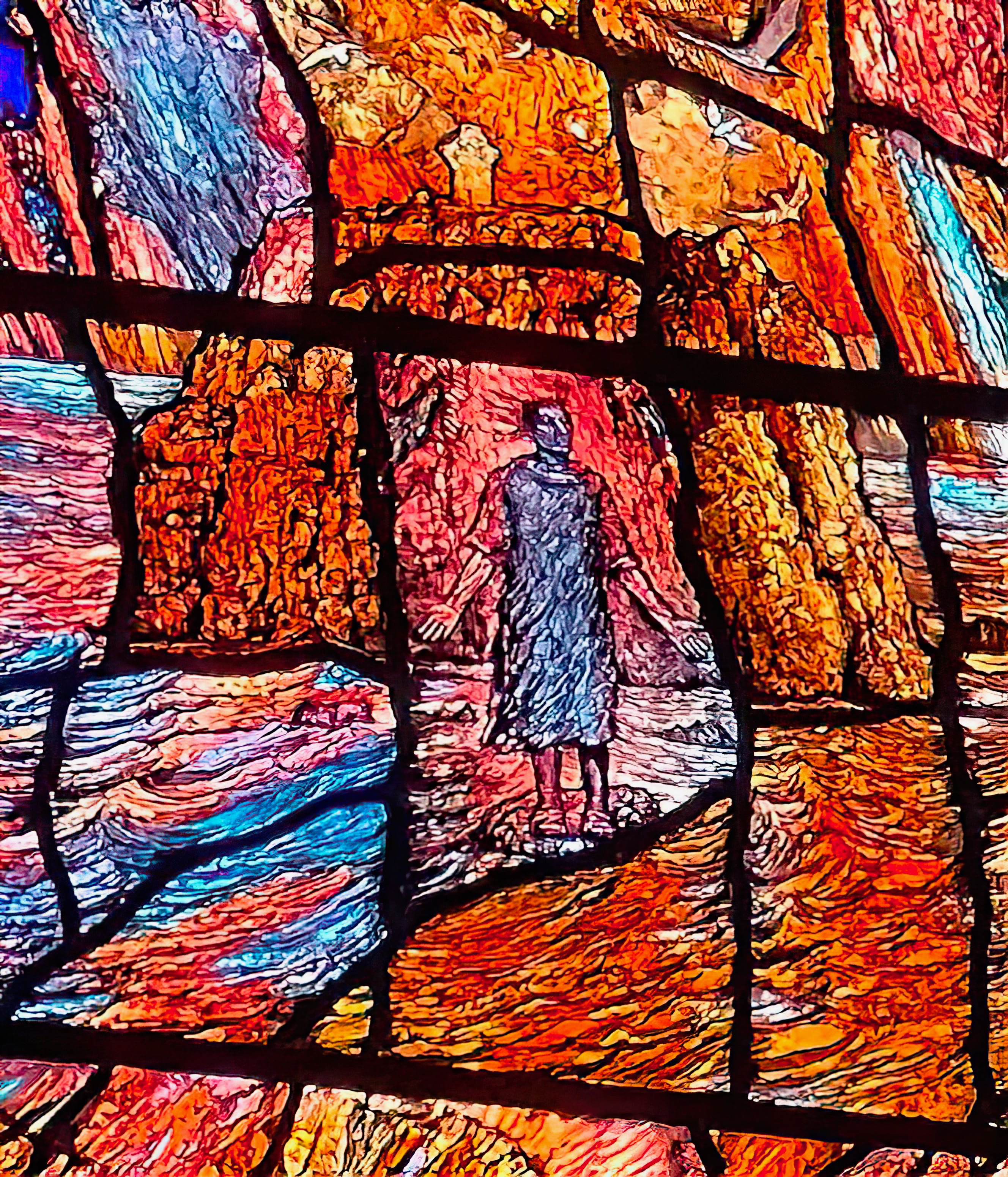
Cuthbert prays on an island in a turbulent sea (detail of Tom Denny’s Transfiguration window, Durham Cathedral (2010). “That I might bless the Lord who has power over all: Heaven with its pure host of angels, earth, ebb, flood-tide.”

We can only speculate about the experiential nature of Cuthbert’s solitude, but Frederick Buechner, imagining the thoughts of another Northumbrian hermit, gives an honest appraisal of its challenges:

What’s prayer? It’s shooting shafts into the dark. What mark they strike, if any, who’s to say? It’s reaching for a hand you cannot touch. The silence is so fathomless that prayers like plummets vanish in the sea. You beg. You whimper. You load God down with empty praise. You tell him sins that he already knows full well. You seek to change his changeless will. Yet Godric prays the way he breathes, for else his heart would wither in his breast. Prayer is the wind that fills his sail. Else waves would dash him on the rocks, or he would drift with witless tides. And sometimes, by God’s grace, a prayer is heard.[x]

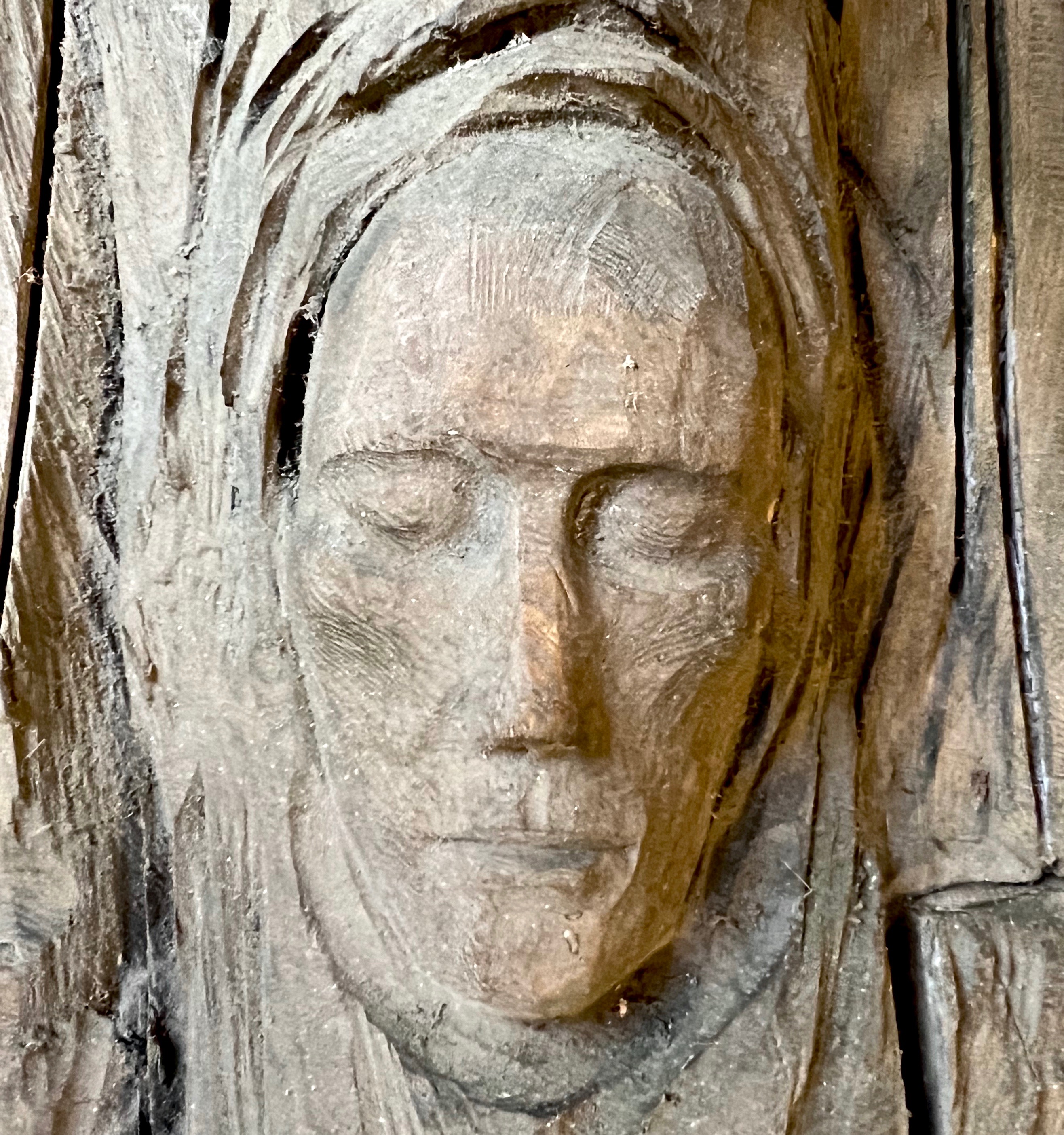
St. Cuthbert (detail from The Journey by Fenwick Lawson,1999).

One of Cuthbert’s early hagiographers described the saint’s inner life as being free of struggle, anxiety or doubt. We are assured that “in all conditions he bore himself with unshaken balance.” [xi]  But balance is hardly a prime directive for pilgrims of the Absolute. We may assume that Cuthbert knew his share of demons and dark nights on Farne. Nevertheless, the continuing stream of seekers to his island retreat found no solipsist lost in dreams or madness, but a compassionate listener who still had the gifts of a pastor. He always sent them away with lighter hearts than when they came.

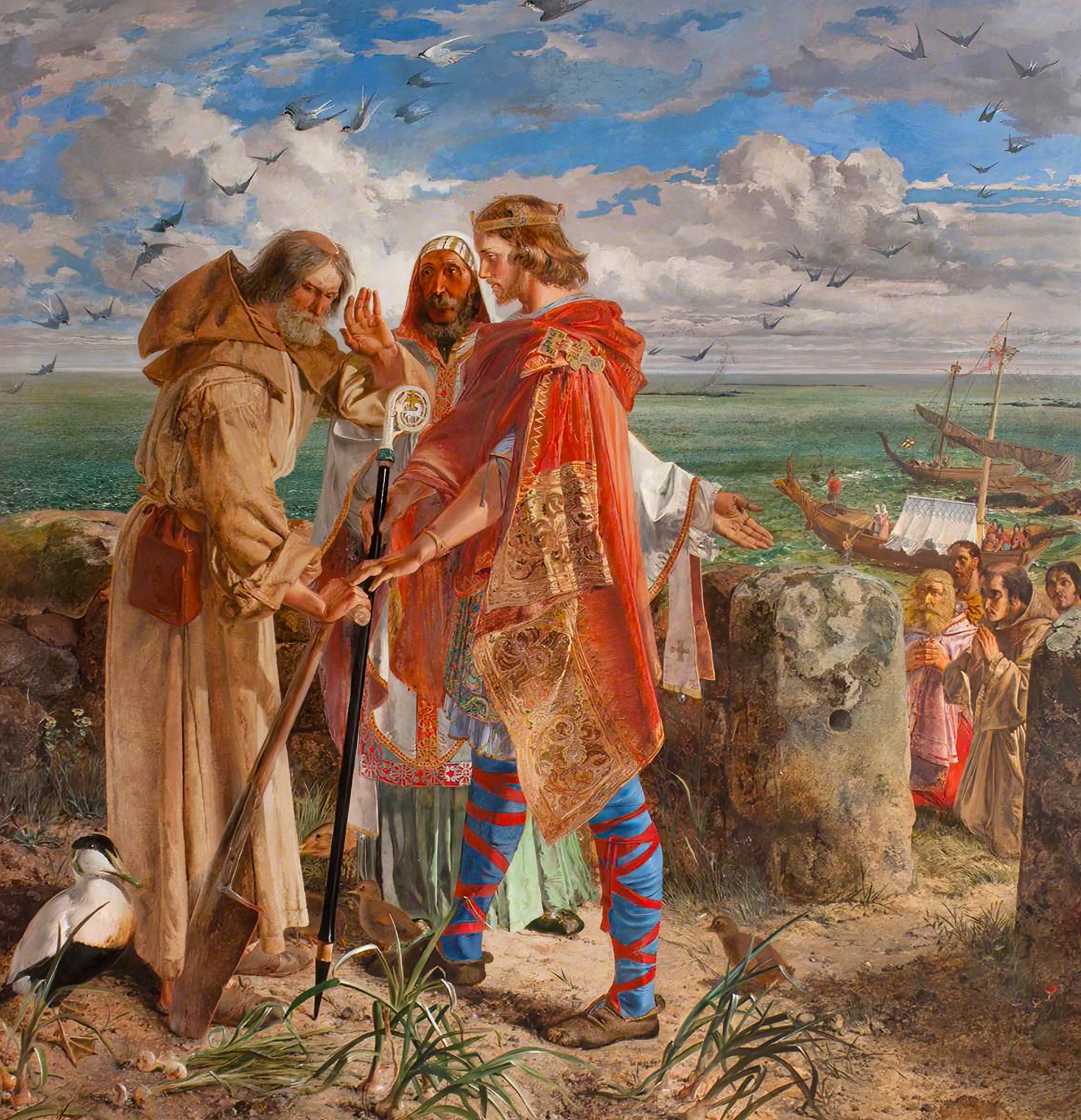
King Egfrid and Bishop Trumwine visit Inner Farne to persuade a reluctant Cuthbert to be made Bishop. (William Bell Scott, 1856)

Cuthbert spent nine years as a hermit, but in 685 the King of Northumbria and the Archbishop of Canterbury, hoping that this renowned holy man could help heal the divisive rivalries in the English Church, elected him to be the bishop of Hexham. The thought of leaving his “hiding place” on Farne made him sad, but when a distinguished delegation visited his hermitage to seek his consent, he yielded to the call. At least he managed to swap dioceses with another bishop, granting him oversight of his own beloved Lindisfarne. Whatever he lost in returning to the active life, it was not his soul. His anonymous biographer assures us that “he maintained the dignity of a bishop without abandoning the ideal of a monk.” [xii]
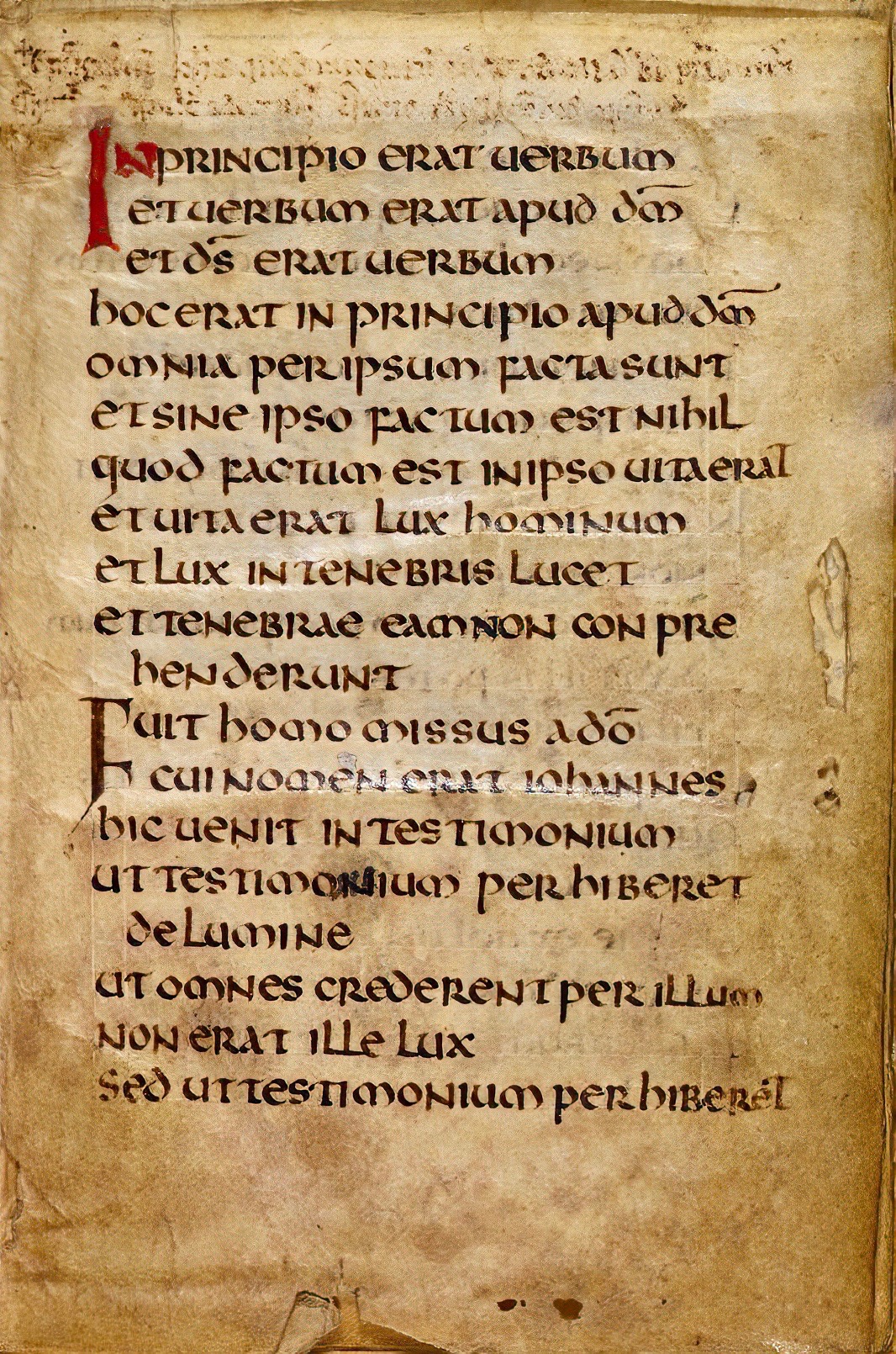
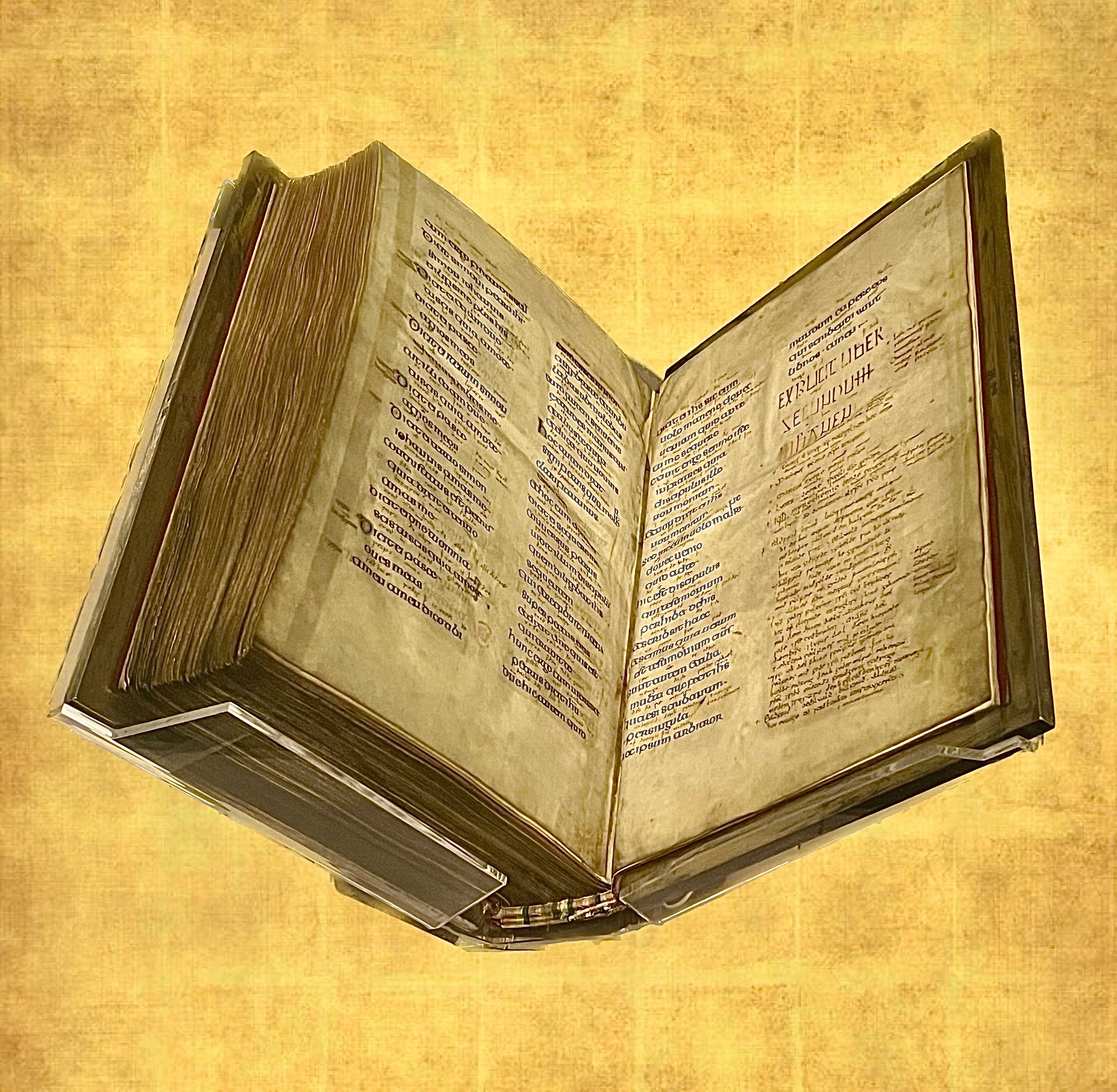
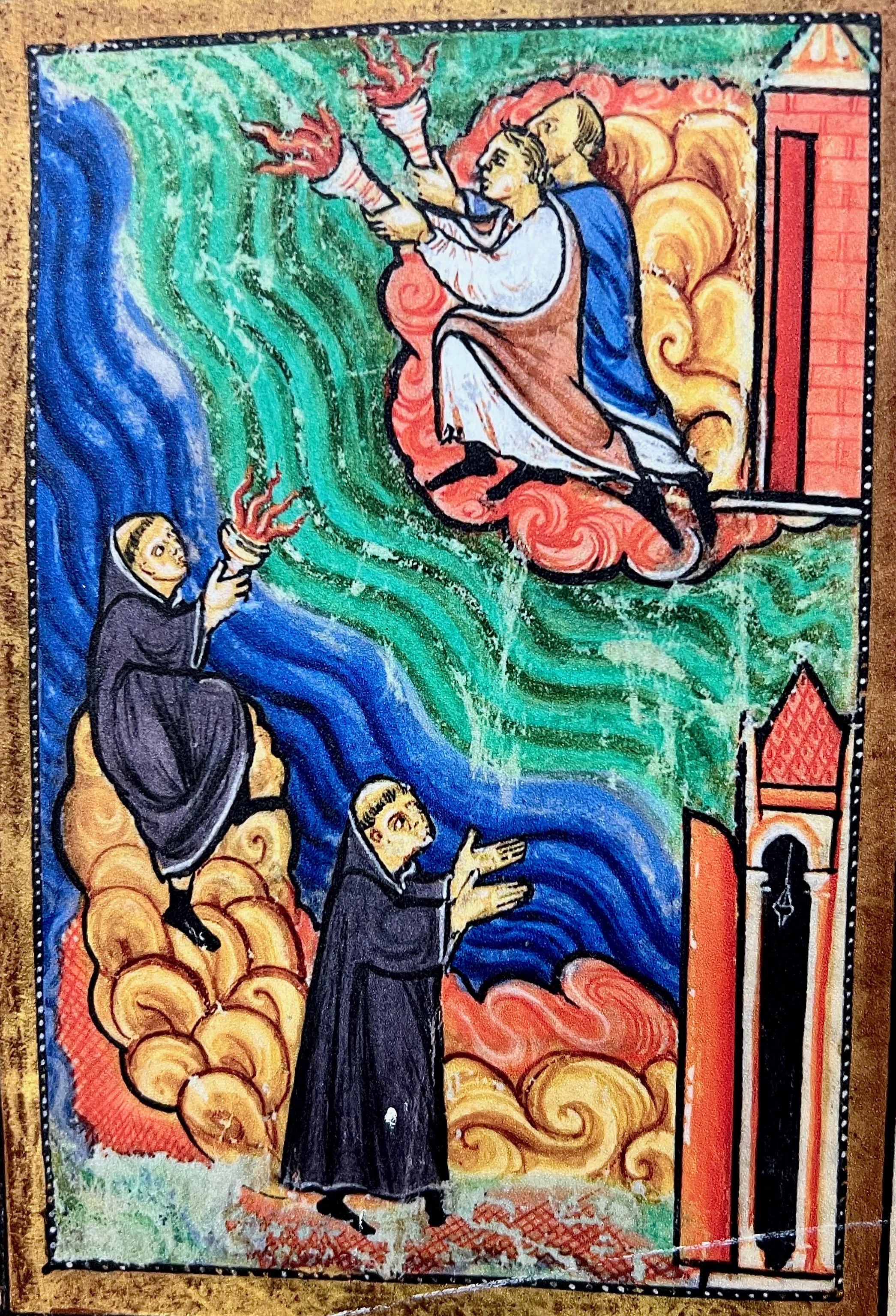
Two years later his health began to fail. At 51, he knew his days were numbered. He resigned his episcopate just after Christmas 686, then returned to his hermitage to die amidst the sound of seabirds, seals and crashing waves. He departed this life two weeks before Easter 687. The monks keeping vigil at his deathbed lit torches to signal his brothers at Lindisfarne that he had fallen asleep in Christ. His body was returned to the Priory for burial.

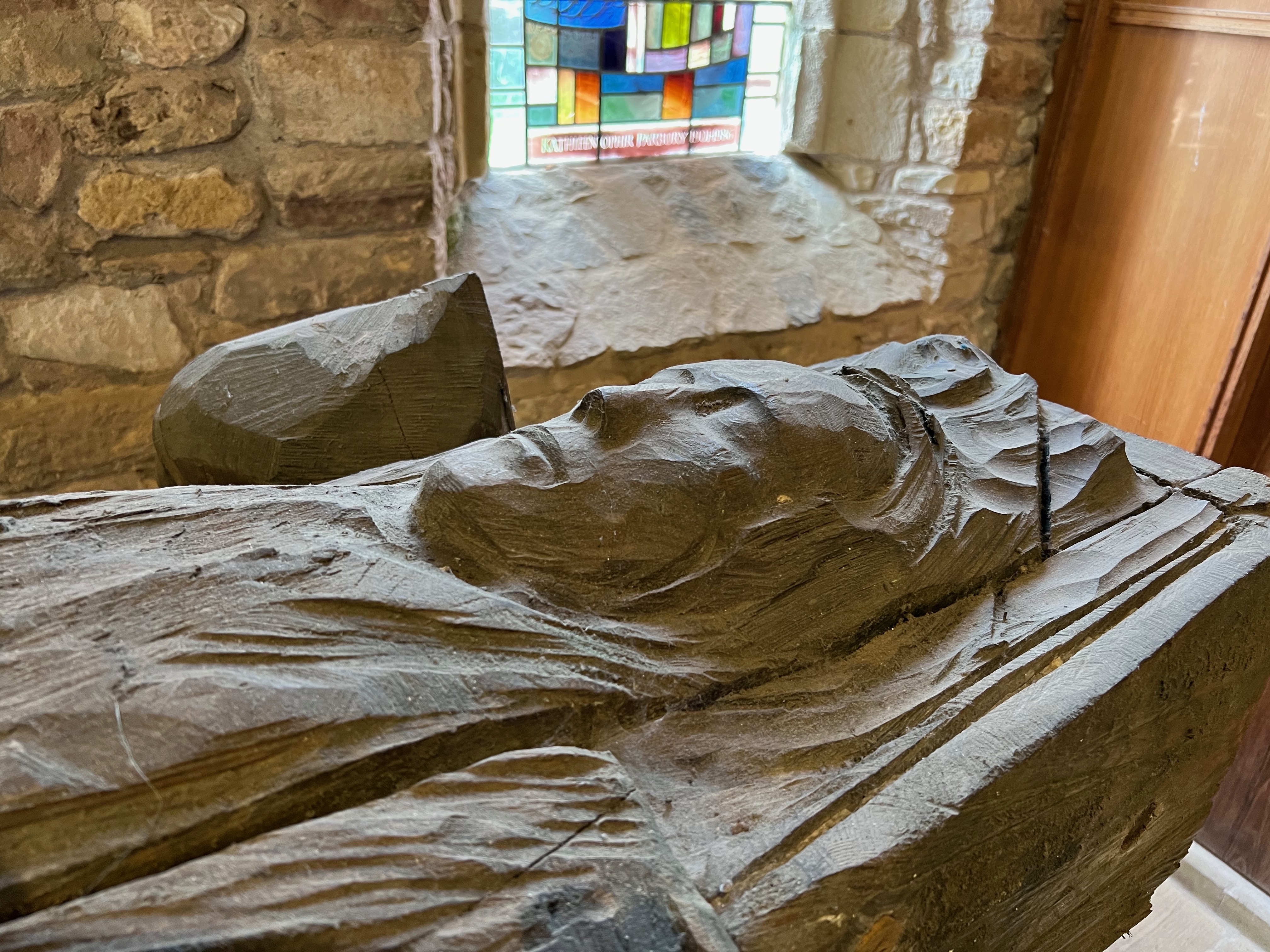
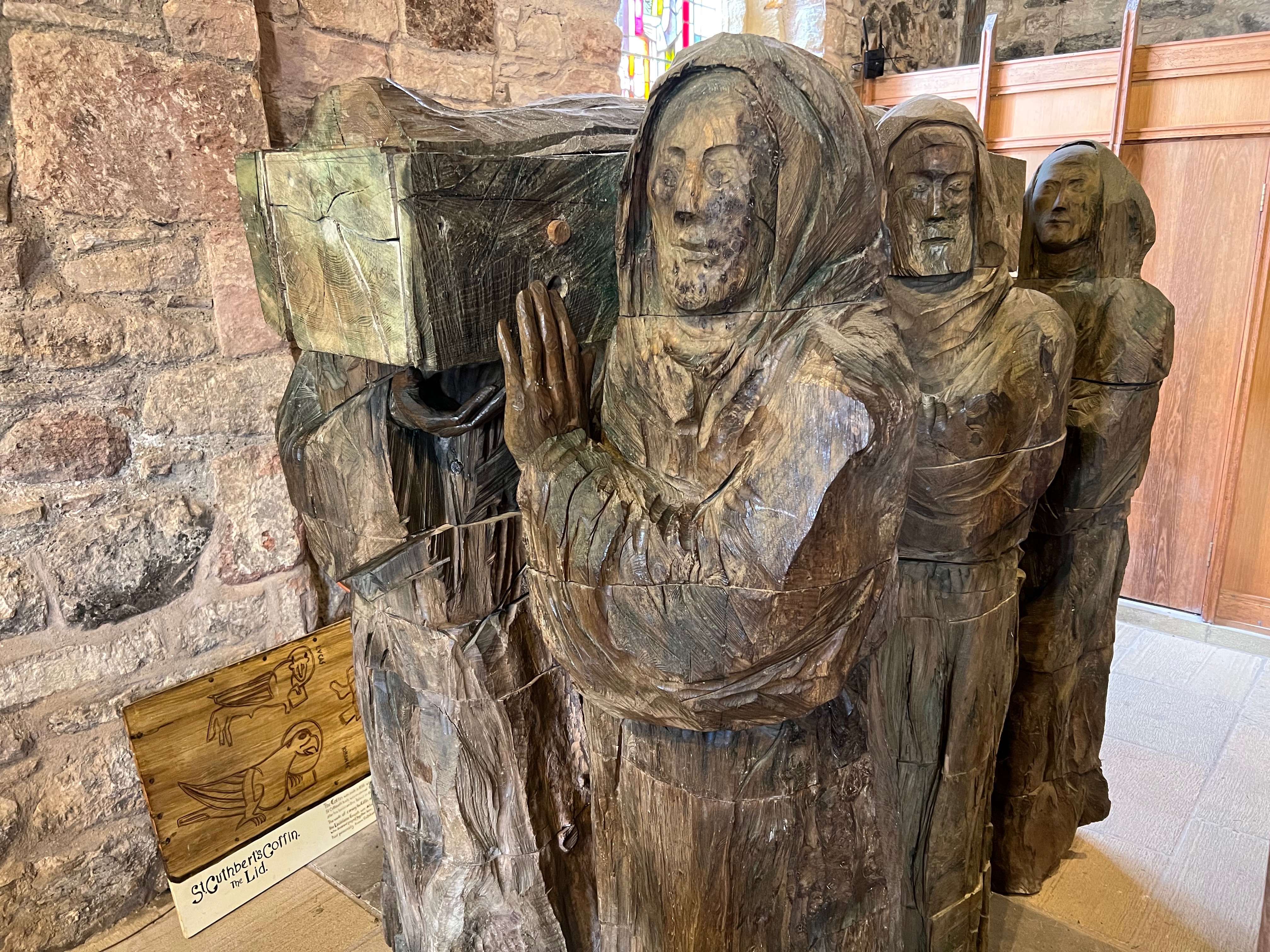
Cuthbert, who fell asleep in Christ in 687, is movingly depicted in Fenwick Lawson’s The Journey, which has been in St. Mary’s church since 2005.
In an illustration for Bede’s Life of St. Cuthbert, monks on Inner Farne use torches to signal news of the saint’s death to their brothers at Lindisfarne.

I wasn’t able to visit Inner Farne. Landings were suspended by an outbreak of Avian Flu. But the peace of Holy Island itself was blessing enough. Once the daytrippers flee back to the mainland before the tide returns, a profound calm settles in. It seemed almost deserted during the afternoons. In my days there, I sank into the solitude of grassy dunes, rambled through fields of spring color, enjoyed the tuneful chants of countless birds. Perhaps there was more Wordsworth than Cuthbert in the pleasure I took here—I suffered no rigorous austerities—but I hope that my bodily appreciation of Holy Island did honor to the saint’s own love for this place.

The grassy dunes of Holy Island are a refuge from the clamor of the world. If you lie down in a hollow, neither wind nor wave breaks the profound silence.
The elevated Heugh (“hee-uff”) between the Priory and the sea was formed from magma 295 million years ago. The thin soil developed on the hard whinstone grassland hosts an exceptional variety of wildflowers.
Vespers at Lindisfarne. “Now as we come to the setting of the sun, and our eyes behold the vesper light, we sing your praises, O God.”

Holy Island is a busy hub for migratory flights between Britain, Scandinavia, southern Europe, even the Arctic and Africa. Some 337 different avian species have been identified here. The following audio was recorded around the site of Lindisfarne Priory in the early evening. If you want to spend two and a half minutes on Holy Island, close your eyes and listen.

Birds of Holy Island.

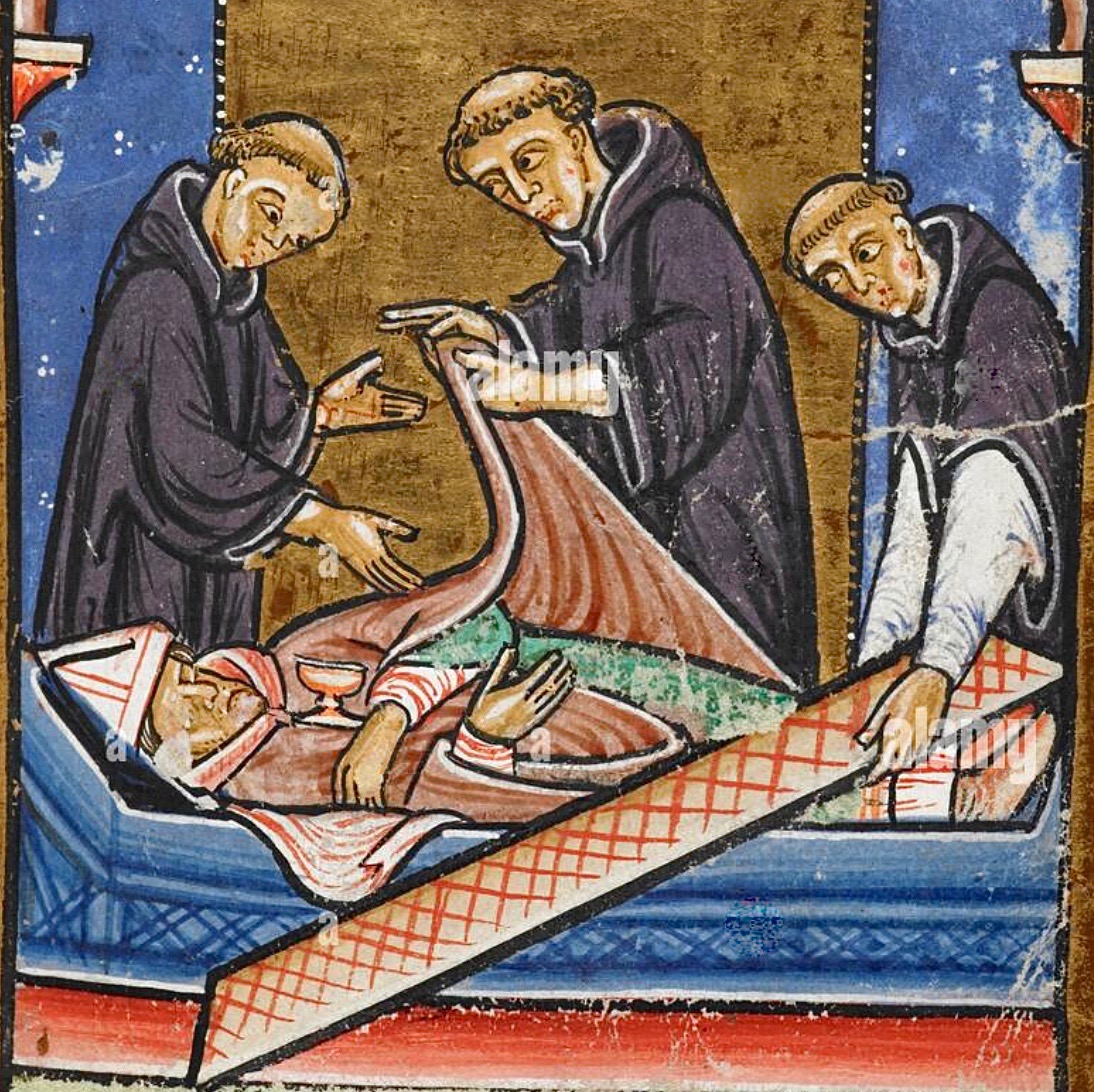
According to medieval custom, the remains of saints would be exhumed ten to twenty years after their death, so that their bones could be washed, wrapped reverently in silk or linen, and placed in a shrine for veneration. 

When the monks of Lindisfarne opened Cuthbert’s coffin 11 years after his death to wash his bones, they were astonished to find his body still intact (12th-century illustration for Bede’s Life of St. Cuthbert).

But when the monks of Lindisfarne opened Cuthbert’s coffin in 698, they found his body “uncorrupted” and still intact. When news of this wonder spread, the stream of pilgrims grew to a flood. Sadly, Cuthbert’s body would not rest in peace here for long. Not on a defenseless coastline in the age of the Vikings.

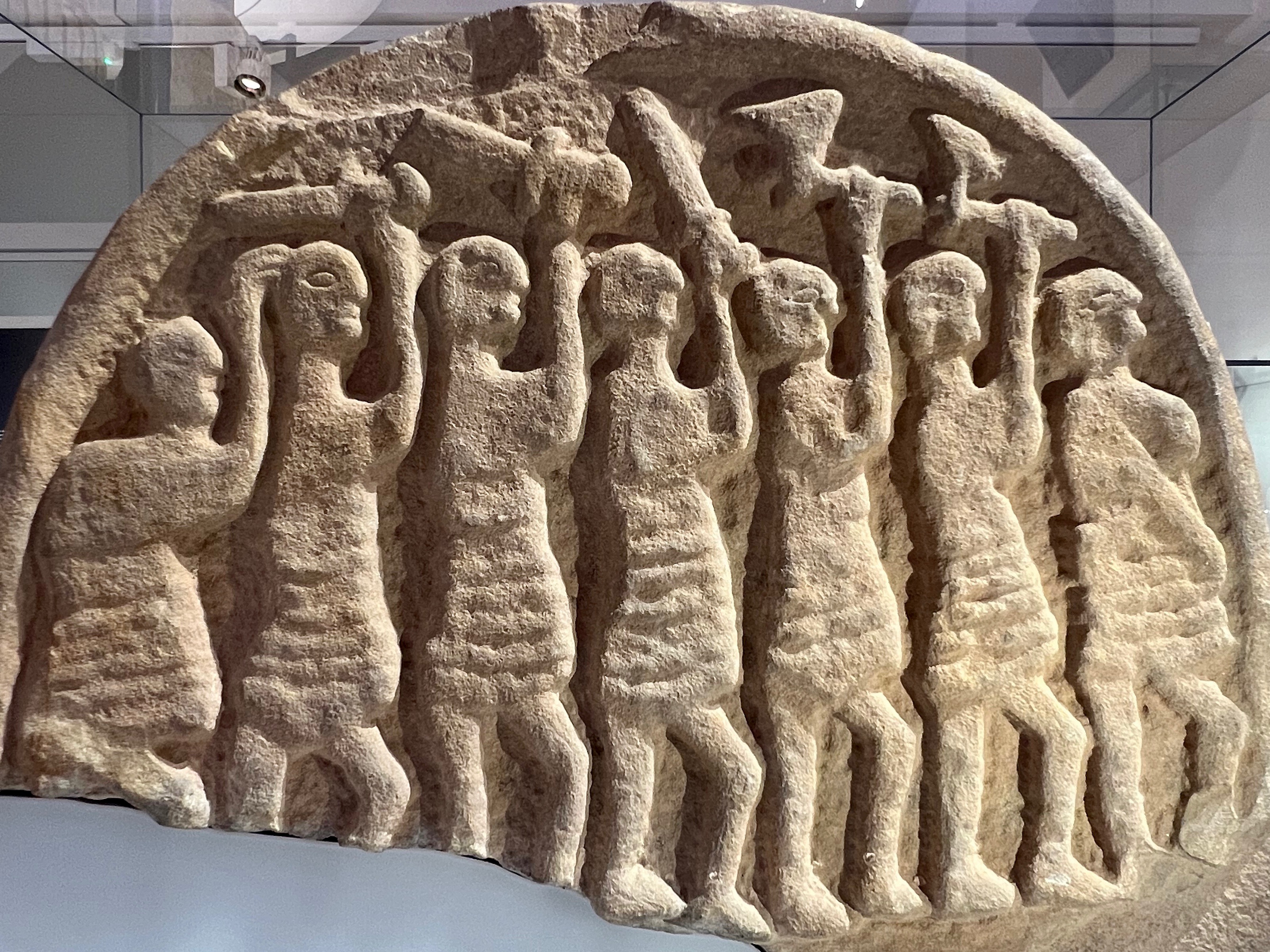
This 9th-century “Judgment Day” stone found at Lindisfarne is thought to commemorate the Viking raids, when “heathen men miserably destroyed God’s church at Lindisfarne with plunder and slaughter.”

In 793, the peace of Lindisfarne was shattered when Viking marauders sacked the Priory. Remarkably, Cuthbert’s shrine survived the damage. Eighty years later, there was a second raid. It was even worse.

“And they came to the church of Lindisfarne and laid everything waste with grievous plundering, trampled the Holy Places with polluted feet, dug up the altars and seized all the treasures of the Holy Church. They killed some of the brothers, they took some of them away in fetters, many they drove out naked and loaded with insults and some they drowned in the sea …” [xiii]

It was the end of an era for Lindisfarne, but Cuthbert’s own story had one more chapter. Just before the second Viking invasion, the saint made his getaway from Holy Island when a small band of brothers lifted his wooden coffin from the Priory shrine and carried it across the tidal flats to the mainland. Thus began two centuries of wandering in exile for Cuthbert’s remains, until he finally came to rest in the newly built cathedral at Durham in 1104. 

The Journey (Fenwick Lawson, 1999, now in St. Mary’s church).
Monks carry Cuthbert’s coffin away from Holy Island to protect it from Viking raiders.

On my third morning at Holy Island, I rose early to cross back over the sands. My own wandering was not yet done. I would follow the saint to Durham. 

The path I walk, Christ walks it. 
May the land in which I am be without sorrow.
May the Trinity protect me wherever I stay…
May bright angels walk with me — dear presence — in every dealing…
May every path before me be smooth. 
Well does the fair Lord show us a course, a path. [xiv]

Crossing the Holy Island Sands to the mainland.

THE ST. CUTHBERT SERIES CONCLUDES:

The Journey Ends: Durham Cathedral

Photographs, videos and nature recordings are by the author.

“For All the Saints” is sung by the choir and congregation of St. Barnabas Episcopal Church, Bainbridge Island, Washington, with Paul Roy on organ.

The first installment of this pilgrimage account, Walking St. Cuthbert’s Way, may be found at https://jimfriedrich.com/2023/07/28/walking-st-cuthberts-way/

For more on James Turrell: https://jimfriedrich.com/2015/08/06/the-woven-light-reflections-on-the-transfiguration/


[i] The line is from Derek Walcott’s poem, “Love After Love.”

[ii] Buechner’s fine novel is about a 12th century hermit saint in the north of England. It made excellent reading on St. Cuthbert’s Way.

[iii] #128 in The Sacred Harp, with lyrics by Samuel Stennet (1787).

[iv] Bede, Life of St. Cuthbert, 22, quoted in Mary Low, St. Cuthbert’s Way: A Pilgrim’s Companion (Glasgow: Wild Goose Publications, 2019). The great historian of early English Christianity is a key source for Cuthbert’s life. Born 14 years before the saint’s death, he was able to interview some who had known Cuthbert in life when he wrote his biography. 

[v] Bede’s Life of Cuthbert, quoted in Philip Nixon, St. Cuthbert of Durham (Gloucestershire: Amberly Publishing, 2012), 33.

[vi] Isabel Colgate, A Pelican in the Wilderness: Hermits, Solitaries and Recluses (New York: Counterpoint, 2002), 104. The Cambrai Homily (7th or 8th century) is the earliest known Irish homily. The “green” martyrdom refers to rigorous ascetic practice not requiring either a pilgrimage journey or a complete disconnection from the world. The Irish word glas may be translated as blue as well as green, perhaps referring to turning blue after praying the Psalter all night in a cold river, or developing a sickly complexion from too much austerity.

[vii] In a Penguin anthology of Celtic writings I had years ago. 

[viii] James Turrell, quoted in Jan Butterfield, The Art of Light and Space (New York: Abbeville Press, 1993), 73.

[ix] E. C. Krupp, writing about Turrell in James Turrell: A Retrospective (Los Angeles: County Museum of Art, 2013), 246.

[x] Frederick Buechner, Godric (New York: Harper One, 1980), 142.

[xi] Anonymous Life of Cuthbert, 3.7, quoted in Low, 47. 

[xii] Anonymous Life, quoted in Nixon, 47.

[xiii] Simeon of Durham (d. circa 1129) was an English chronicler and monk at Durham Priory. Quoted in Nixon, 59.

[xiv] Ireland, 6th century.

August 6: Light Eternal or Light Infernal?

The Transfiguration of Christ (Sr. Abraham, Ethiopian community in Jerusalem, 1990)

I spent only one year in a world without nuclear weapons. My first birthday fell on July 16, 1945, the day of the initial atomic bomb test in New Mexico. A few weeks later, my country used the bomb to extinguish countless human lives on the Feast of the Transfiguration. With Transfiguration falling on a Sunday as Oppenheimer is playing in the theaters, a few comments are in order.

In an interpretive retelling of the Transfiguration by a 17th-century Anglican bishop, Moses and Elijah discuss the paradoxical mixture of evil and glory that permeates the Way of the Cross:

A strange opportunity … when [Jesus’] face shone like the sun, to tell him it must be blubbered and spat upon;… and whilst he was Transfigured on the Mount, to tell him how he must be Disfigured on the Cross! [i]

In the twentieth century, that paradox was tragically deepened when we dropped the atomic bomb at Hiroshima on the Feast of the Transfiguration. Two kinds of light, diabolic and divine, contending forever after for the soul of this world. Whose world is it, anyway? To which light do we belong? To which light do we pledge our allegiance?

In his novel Underworld, Don DeLillo chillingly mixes and confuses the primal images of divine and diabolical light when a nun, swept out of her conscious self into the informational totality of the Internet, has a visionary experience on a website devoted to the H-bomb:

She sees the flash, the thermal pulse . . . . She stands in the flash and feels the power. She sees the spray plume. She sees the fireball climbing, the superheated sphere of burning gas that can blind a person with its beauty, its dripping christblood colors, solar golds and red. She sees the shock wave and hears the high winds and feels the power of false faith, the faith of paranoia, then the mushroom cloud spreads around her, the pulverized mass of radioactive debris, eight miles high, ten miles, twenty, with skirted stem and platinum cap.

The jewels roll out of her eyes and she sees God . . . . 

No, wait, sorry. It is a Soviet bomb she sees . . . . [ii]

Seattle Times, July 16, 1995 (50th anniversary of the first atomic bomb).

I’ve not yet seen Oppenheimer, the film about the creator of the atomic bomb. But I was struck by this paragraph in a review by Adam Mullins-Khatib:

Oppenheimer … is a searing portrait of a man plagued by visions of a world that can’t be seen, a theoretical world composed of the literal particles of his ideas. Driven by an unyielding need to bring his visions to light, J. Robert Oppenheimer (Cillian Murphy) struggles with the notion of bringing theory into practice … It’s a film about the creation of something not before seen and the consequences this entails.” [iii]

Something not before seen and the consequences this entails. That could describe both the coming of Christ and the invention of the Bomb: each brought into the world something not before seen, manifested in a moment of blinding brilliance. And each has had enormous consequences which are still very much with us. But only one of them is the Light eternal, pure brightness of the everlasting Love who loves us. 

To paraphrase the divine Voice in Deuteronomy 30:19, 

This day I set before you life and death, blessing and curse, 
the light eternal and the light infernal. 
Choose life. 
Or else. 

In 1944, one year before Hiroshima, Orthodox theologian Vladimir Lossky, wrote these words: 

“We live in a world of suffering, a world broken and disintegrated, in which Christ’s Transfiguration uncovers reality and reveals to our skeptical minds a new humanity that has either entered into the light of the Risen One or is still called to do so … [W]e need to put on a robe of light, the apparel of those who live without fear, since they have already conquered death and the multiple anxieties associated with it.” [iv]

In this troubled and darkened age, that is exactly how the friends of God must live. 

Let us put on the robe of light, 
and live without fear.

.


[i] Bishop Hall Joseph Hall, Contemplations upon the principal passages of the Old and New Testaments, 1612-28, found on Google Books, p. 383.

[ii] Don DeLillo, Underworld (New York: Scribner, 1997), 825-6.

[iii] Adam Mullins-Khatib, Chicago Reader, July 26, 2003: https://chicagoreader.com/film/review-oppenheimer/

[iv] Vladimir Lossky, The Mystical Theology of the Eastern Church (Crestwood, NY: St. Vladimir’s Seminary Press, 2002, Originally published in French in 1944)), 151, 244.

Walking St. Cuthbert’s Way

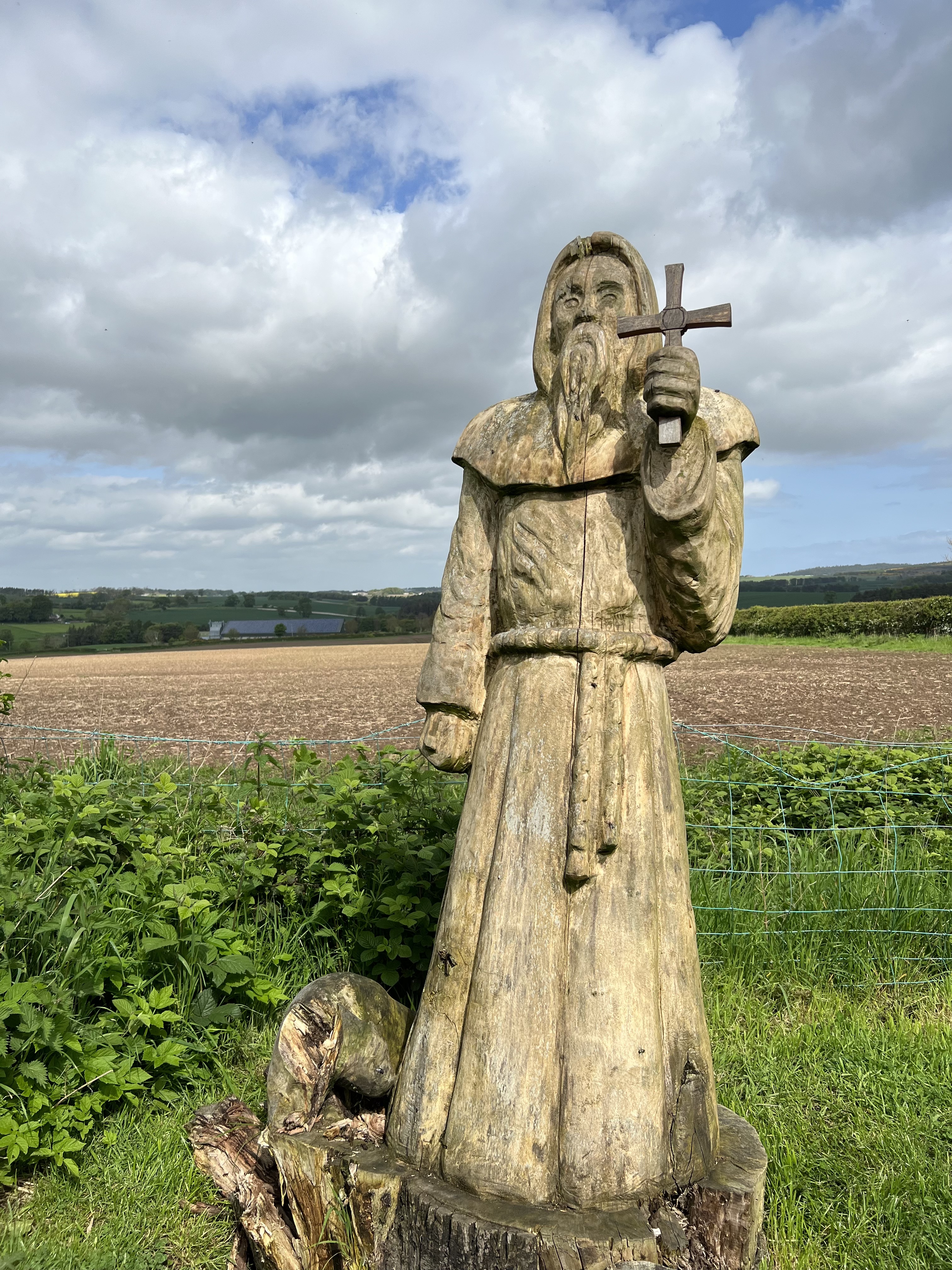
St. Cuthbert, by local sculptor Tom Fiddes (2017), blesses the wayworn traveler. The saint stands opposite a country house offering shade and water to weary pilgrims.

They confessed their sins, confided in him about their temptations, and laid open to him the common troubles of humanity they were laboring under … Spirits that were chilled with sadness he could warm back to hope again … Those beset with worry he brought back to thoughts of the joys of heaven. (The Venerable Bede, Life of Cuthbert)

Nine years ago I walked the 500-mile Camino de Santiago to the shrine of St. James. This spring I made another pilgrimage, 100-kilometers along St. Cuthbert’s Way in the north of Britain. I haven’t managed to write about it since returning home, but when this week’s Feast of St. James (July 25) brought to mind that 2014 Camino (when I first began this blog), I knew it was high time to tell my new pilgrim’s tale.  

Chaucer began his celebrated pilgrimage narrative with an eloquent praise of springtime as an awakening: not only of the dormant earth, but also of the soul’s longing for transformative journeys. After three years of staying close to home in pandemic hibernation, the call of the road felt especially urgent. 

Then people think of holy pilgrimages,
Pilgrims dream of setting foot on far-off
Lands, or worship at distant shrines, their thoughts
Reaching for grace …[i]

Some pilgrimages have no map or known destination; they are undertaken with the conviction—or at least the hope—that the act of wandering far from the familiar, along the way of unknowing, will lead to what Dark Age monks called “the place of resurrection,” where an illumination might be given or a purpose revealed. 

Another kind of pilgrimage takes a well-worn route to a specific destination such as Jerusalem, Rome, or Santiago, the most popular destinations in the Middle Ages. Both the journey and the arrival are still full of unknowns—hardships, obstacles, surprises, chance meetings, moments of grace—but their ultimate location and length are determined in advance. Both kinds of pilgrimage involve some combination of leaving behind (penance), letting go (trust), receptivity (grace), and spiritual desire (love).

My pilgrimage in May, from the Scottish Borders south of Edinburgh to Holy Island off the Northumbrian coast, traced a line across the varied landscapes of Cuthbert’s holy life. It was a popular route for two centuries after the saint’s death in 687, until the threat of Viking plunderers prompted the removal of Cuthbert’s remains from Holy Island to a safer inland site. And Cuthbert’s own travels, mostly on foot, would have ranged widely over the same terrain. 

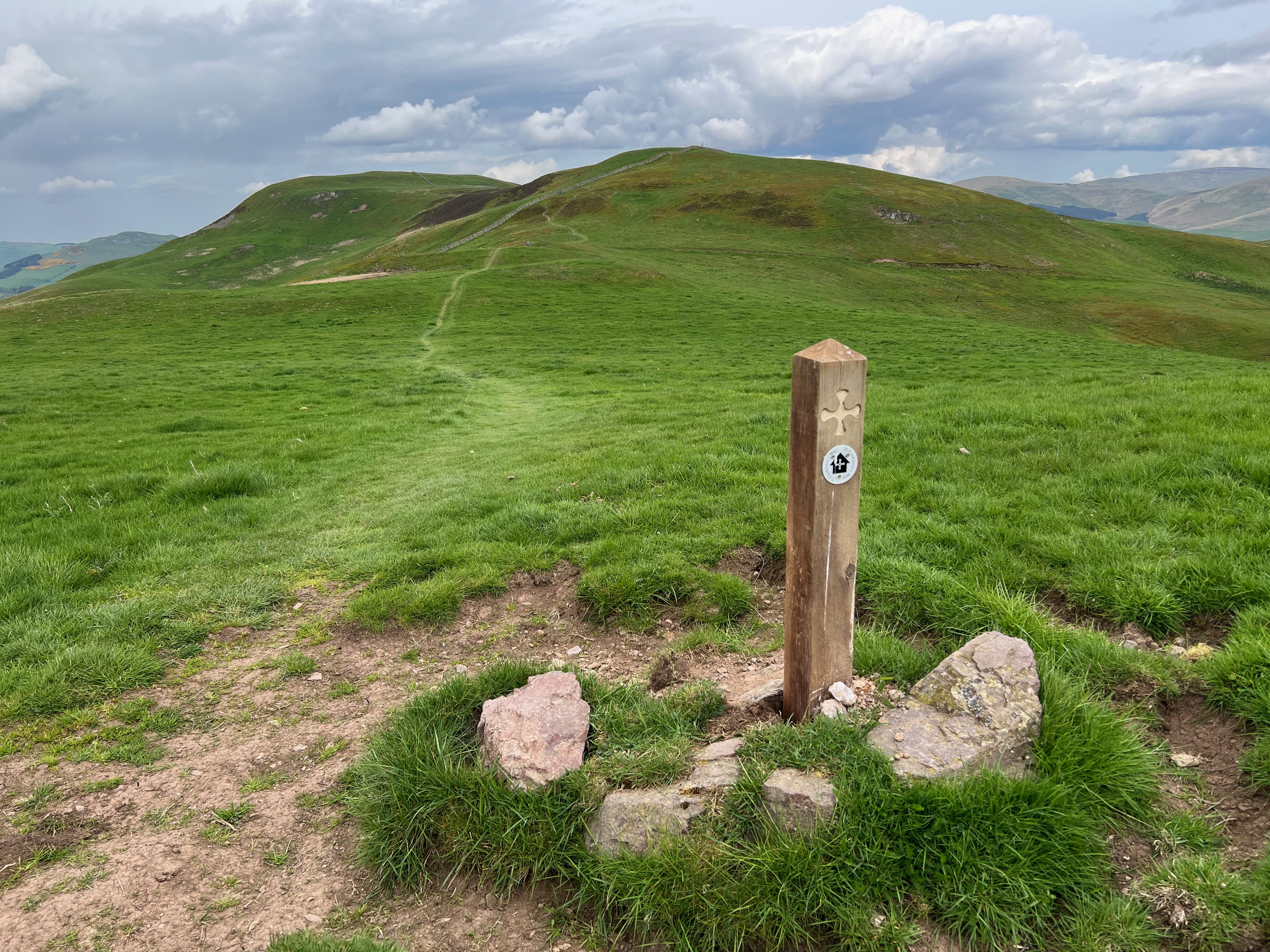
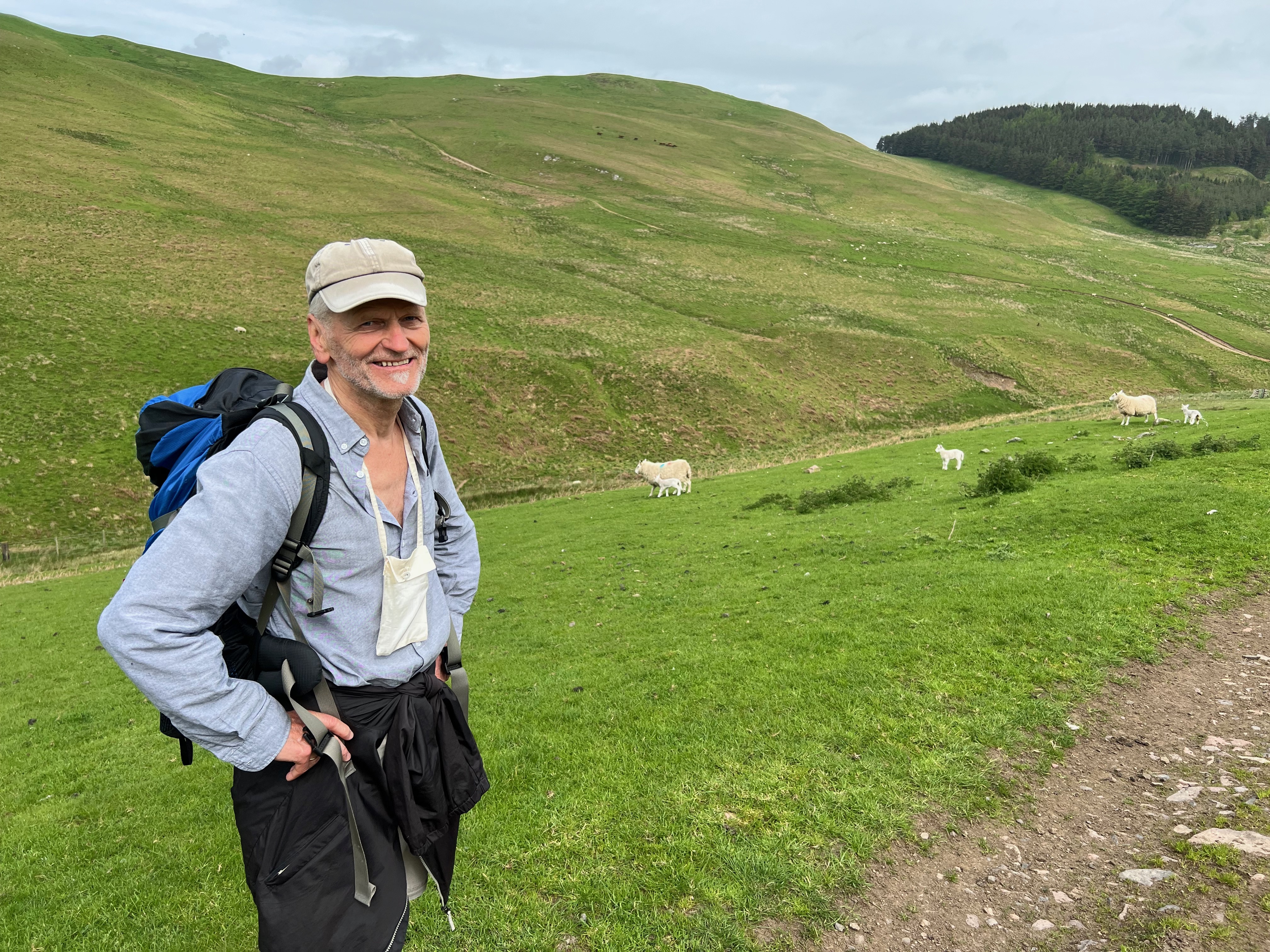
In response to the contemporary revival of pilgrimage as a spiritual practice, St. Cuthbert’s Way, with plentiful waymarks and well-tended paths, was created in 1996. Although passing through occasional towns and villages, it offers abundant solitude and beautiful countryside both pastoral and wild. Before I left, a friend who knew the trail said, “I hope you like sheep.”

Cuthbert’s birth in 634 coincided with a turning point British religion, when King Oswald took control of Northumbria and initiated the conversion of the pagan north to Christianity by importing Celtic missionaries from Iona. Although Cuthbert’s family was Anglo-Saxon, he would be shaped by the distinctive Celtic way—earthier, more idiosyncratic, less tightly organized and less hierarchical than the universalizing Roman system which would assert its dominance in British Christianity within Cuthbert’s lifetime.
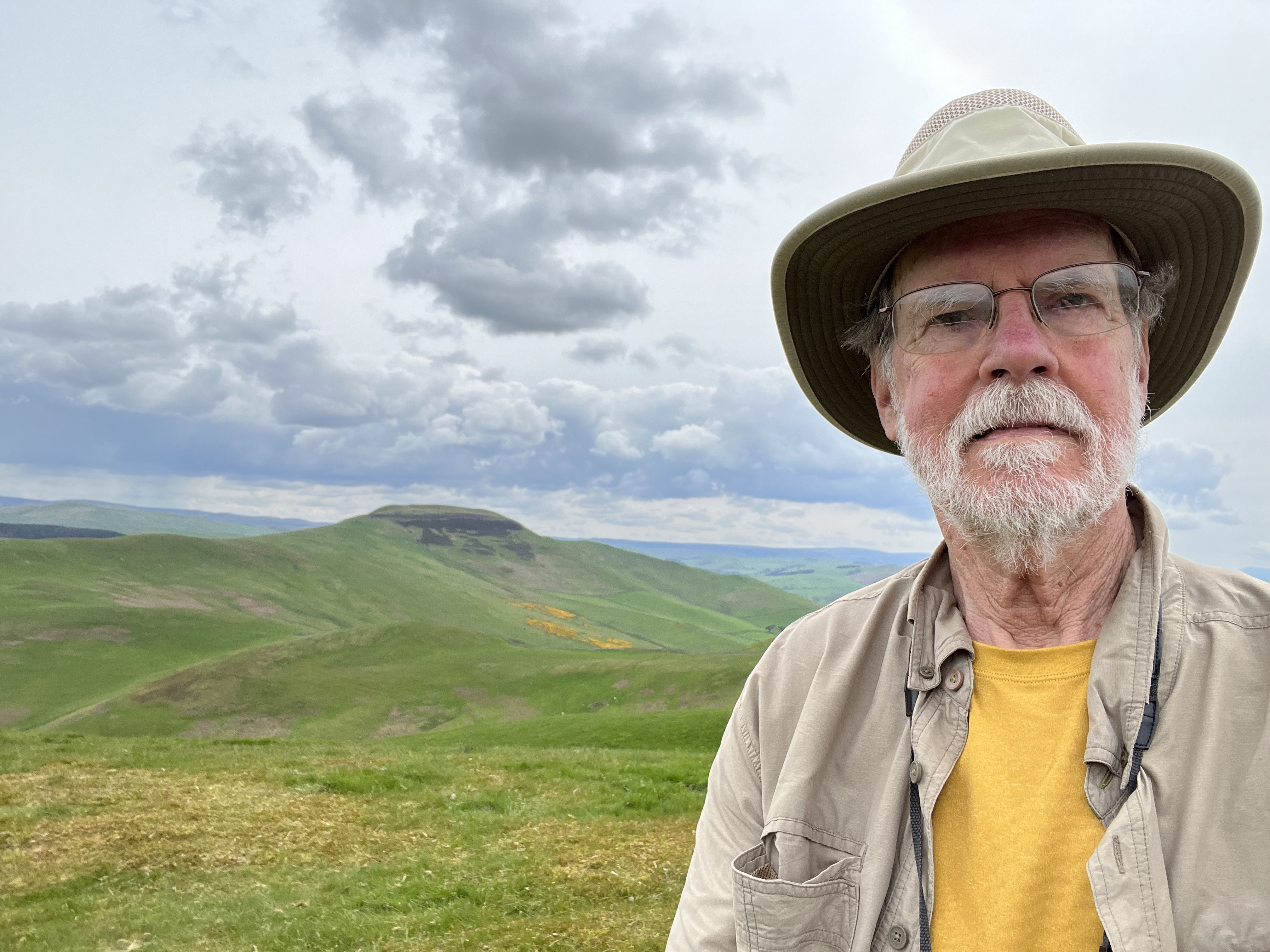
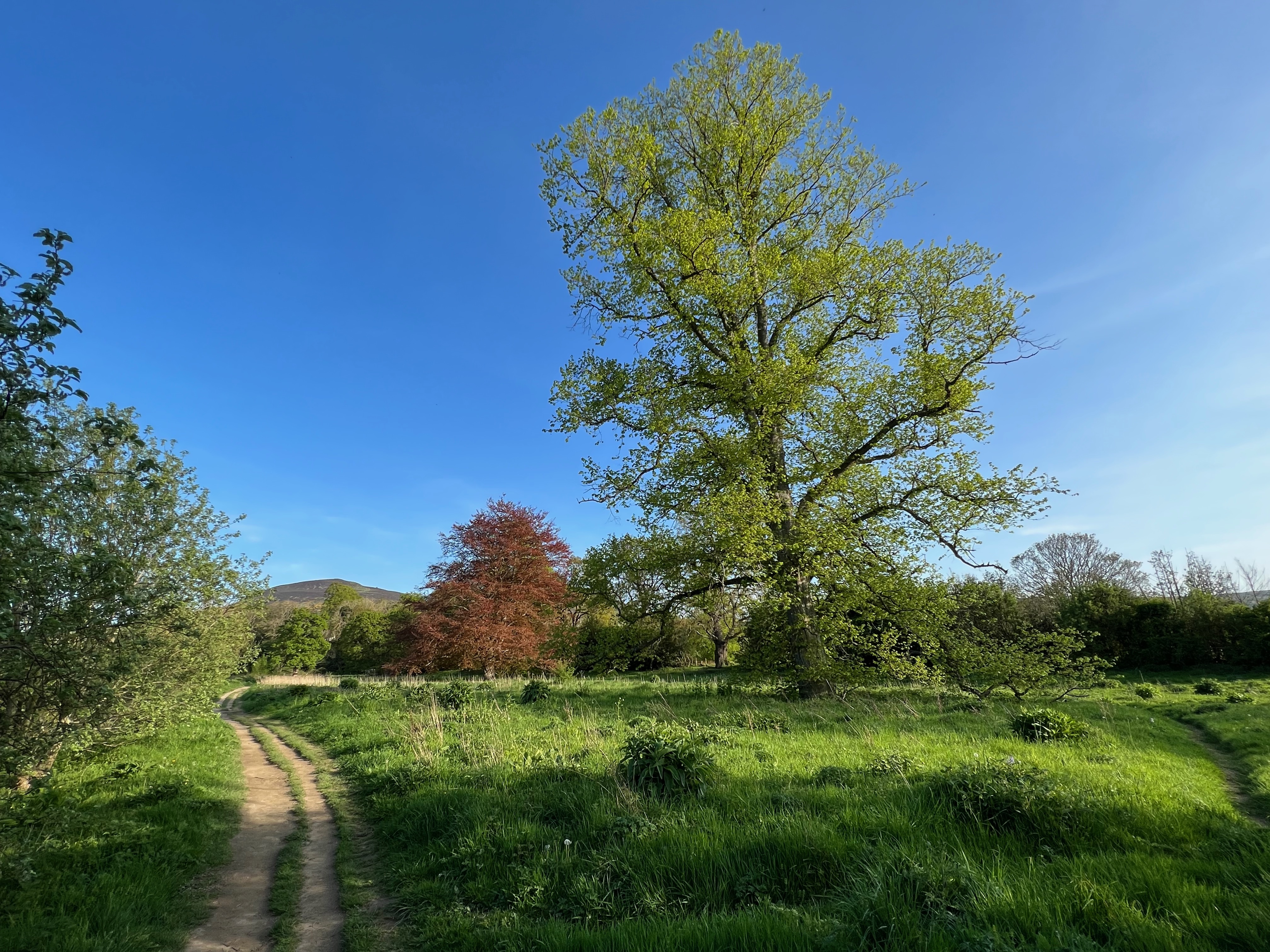
My walk began along this riverside trail from the train station into Melrose. Someone had offered me a ride in their car, but look what I would have missed! Even as a bishop, Cuthbert chose the humility of walking over the luxury of horseback, so I started my pilgrimage in the same spirit.

My pilgrimage began in Melrose, Scotland, where the River Tweed courses through the fields and hills of Cuthbert’s youth. Even as a boy he had a deeply religious sensibility. His biographers spoke of angels and miracles being part of his growing years.  Whatever we ourselves may think about the facts behind those stories, they suggest a spirit alive to ineffable encounters with the transcendent. One night, while keeping watch over a flock of sheep, the sixteen-year-old Cuthbert had a vision of a dazzling light streaming down from above as angelic hosts descended to fetch a single mortal into heaven. When the vision faded, he woke his sleeping companions to tell them what they had missed. He was convinced that some holy person must have died that night. 

The very next day, he learned that Aidan, the beloved Celtic bishop who spurred the conversion of Northumbria, had departed this life at the time of his vision. I might dismiss this tale as pious embellishment, had I not had my own dream, at age 30, of a close friend at the very moment of his tragic death. In the dream, he had moved to an island off the coast. I asked him if he were all right. He looked me in the eye and assured me he was. The dream came to me deep in a mountain wilderness. Only when I returned to the world two days later did I learn of his death by less mysterious means. Because of that profound experience, I must say that Cuthbert’s vision rings true for me.
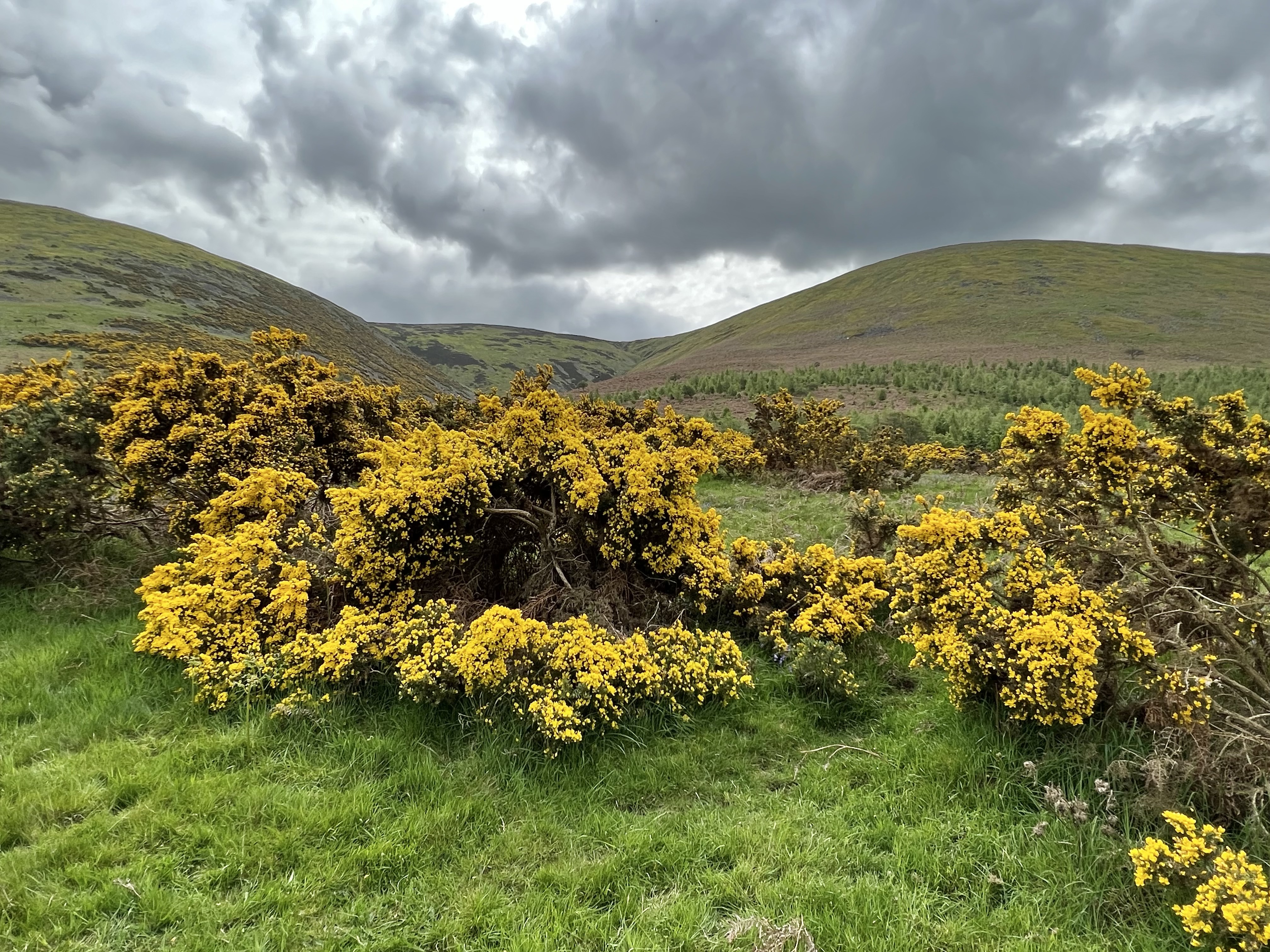
Cuthbert’s experience prompted a decision which had been long in the making: to enter the monastic life and devote his heart and soul to prayer and service. He was soon welcomed into the community of monks near present-day Melrose. He would eventually become their prior, a role he would later assume on Holy Island. His first monastery’s seventh-century wooden structures on a grassy bend in the River Tweed are long gone, but the impressive ruins of the twelfth-century Cistercian abbey made a fitting place to begin my pilgrimage on St. Cuthbert’s Way. 
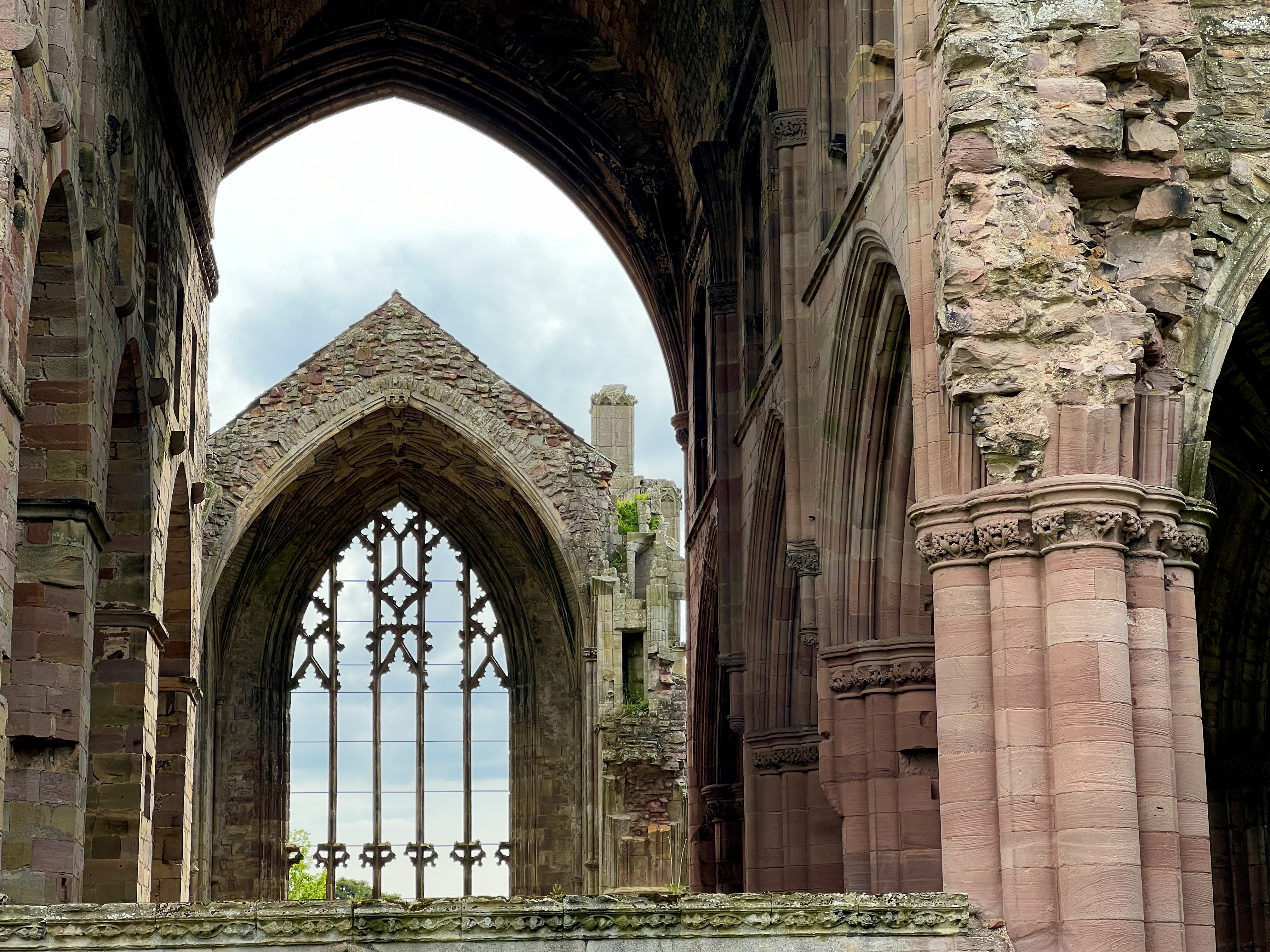
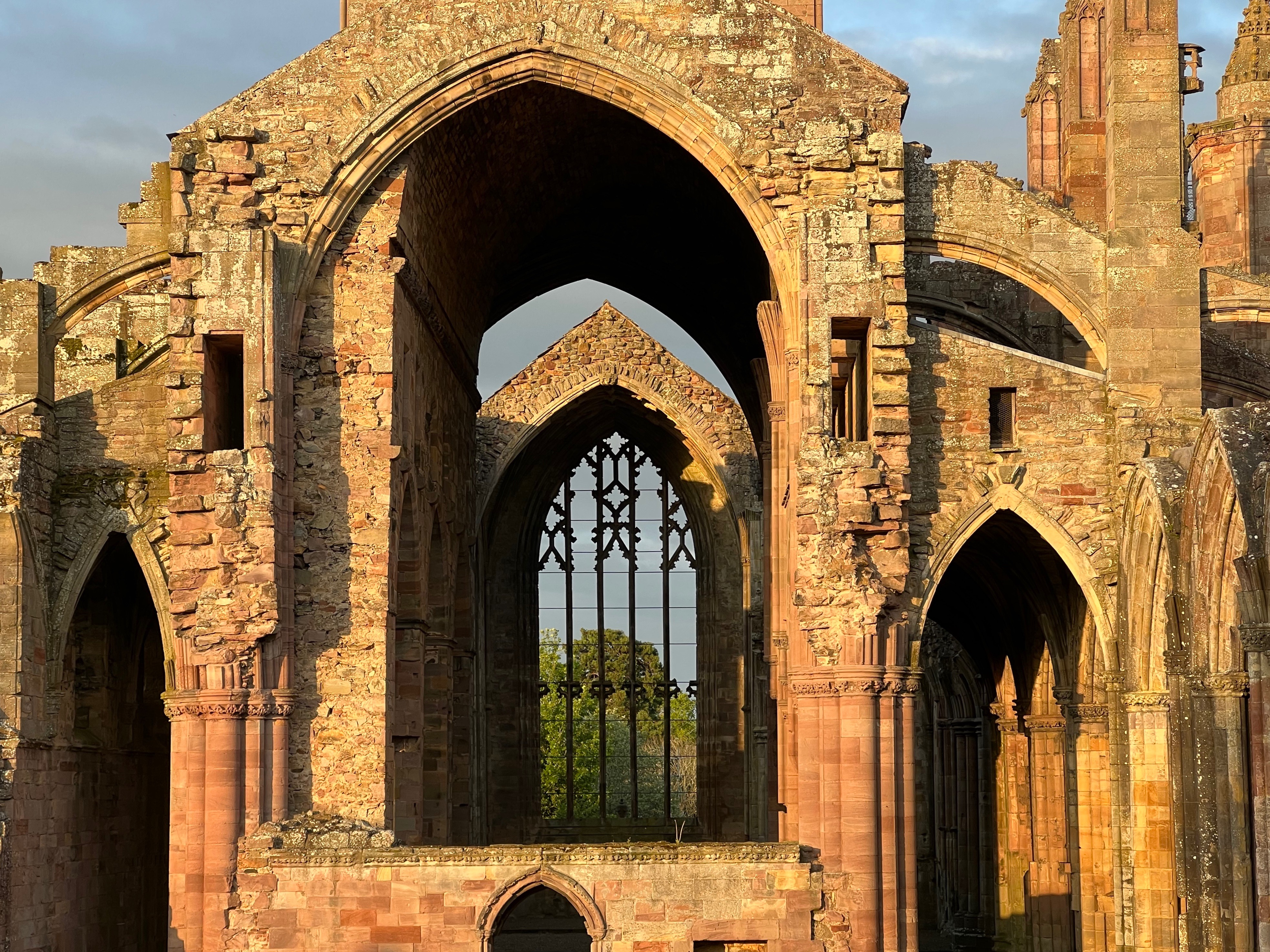
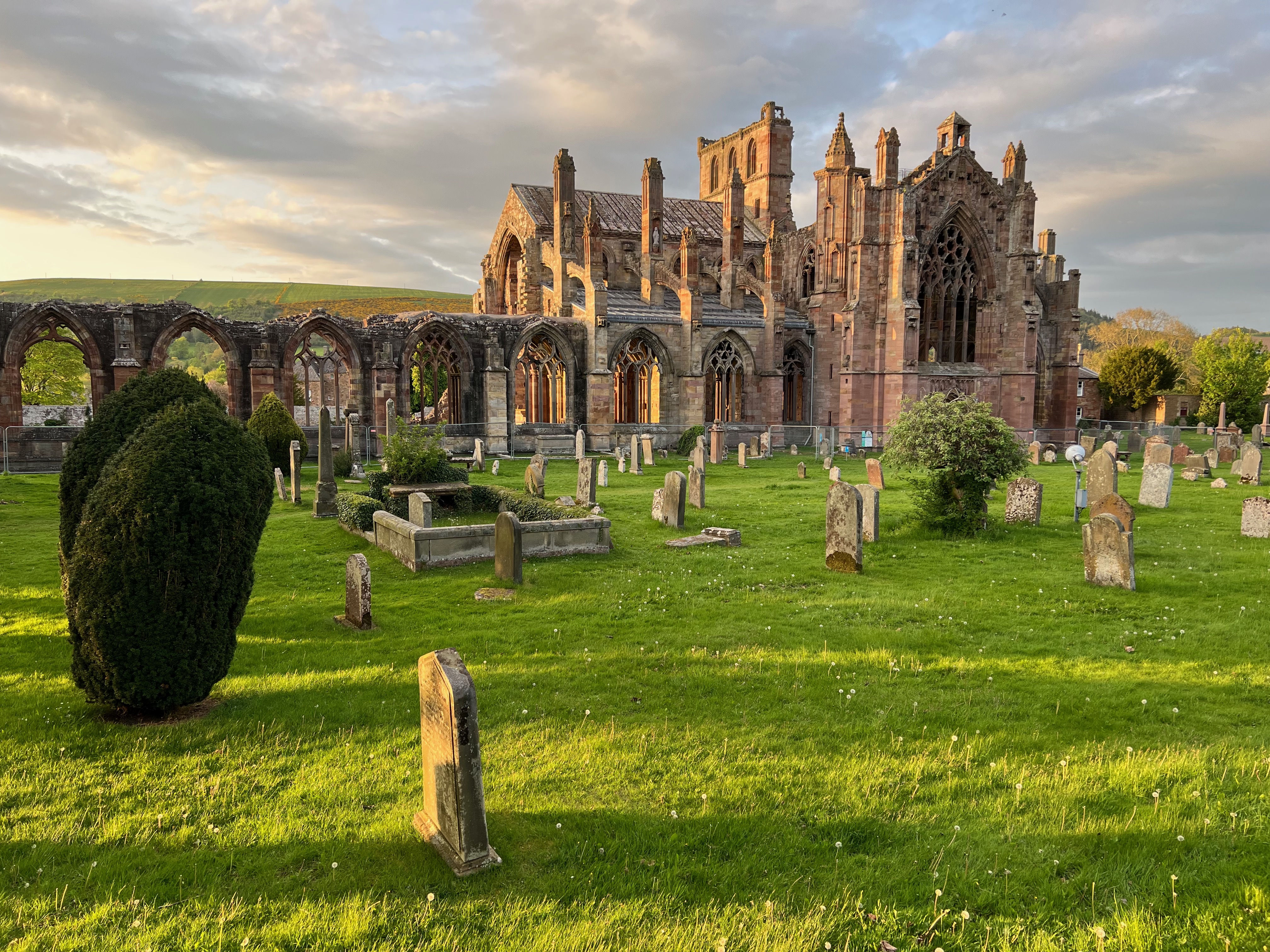
Melrose Abbey, founded by Cistercians from Rievaulx, Yorkshire, in 1136.
Melrose Abbey at sunset.
“My soul is like a house … It is in ruins, but I ask Thee to remake it.” — St. Augustine, City of God

Melrose Abbey was founded in the 12th century, and at its height there were a hundred monks, who wielded great influence in the Scottish Borders. But like the other Borders abbeys (Dryburgh, Jedburgh, and Kelso), the building suffered greatly in the conflicts between England and Scotland. Richard II (14th century), Henry VIII (16th century), and Oliver Cromwell (17th century) all had a hand in its destruction. The Reformation and modernity finished off its religious life, leaving only the beautiful ruins to testify to what had been. As Susan Stewart writes, “Ruined places are often haunted, and learning to read them involves managing encounters with their resident spirits.” [ii]

I was there on the Sixth Sunday of Easter. After eucharist at the local parish, I visited the abbey under the muted light of a graying sky. In the evening I went back for another look. As I arrived, the setting sun suddenly pierced the clouds to bathe the stones in gold. Pulling up my digital Book of Common Prayer, I sang Compline, adding my voice to the echoes of vanished monks. “The Lord grant us a peaceful night and a perfect end.…” By the time I was done, the gold had faded to dusk.

The obscure trailhead leading out of town gave no hint of the glories ahead.

When I found this nondescript passage from a Melrose street to St. Cuthbert’s Way, it did not seem inviting. The White Rabbit came to mind—how curious a plunge!—and Dante, for whom the way down was the only way up. Before the pilgrim poet can ascend to Paradise, he is driven “down to where the sun is silent.” [iii] Thankfully, my descent into darkness was brief, and I soon found myself climbing toward the light.

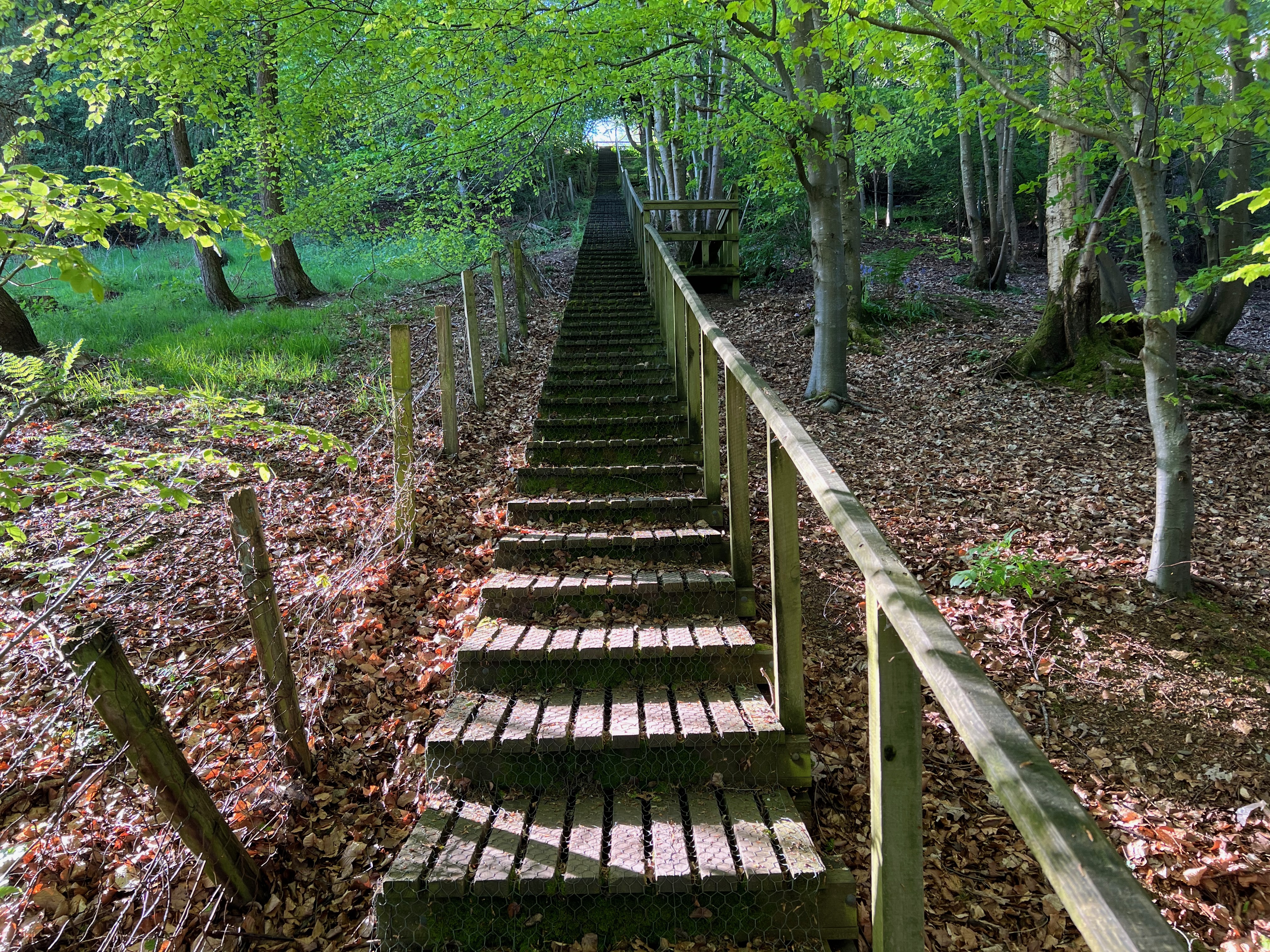
Stairway to heaven.
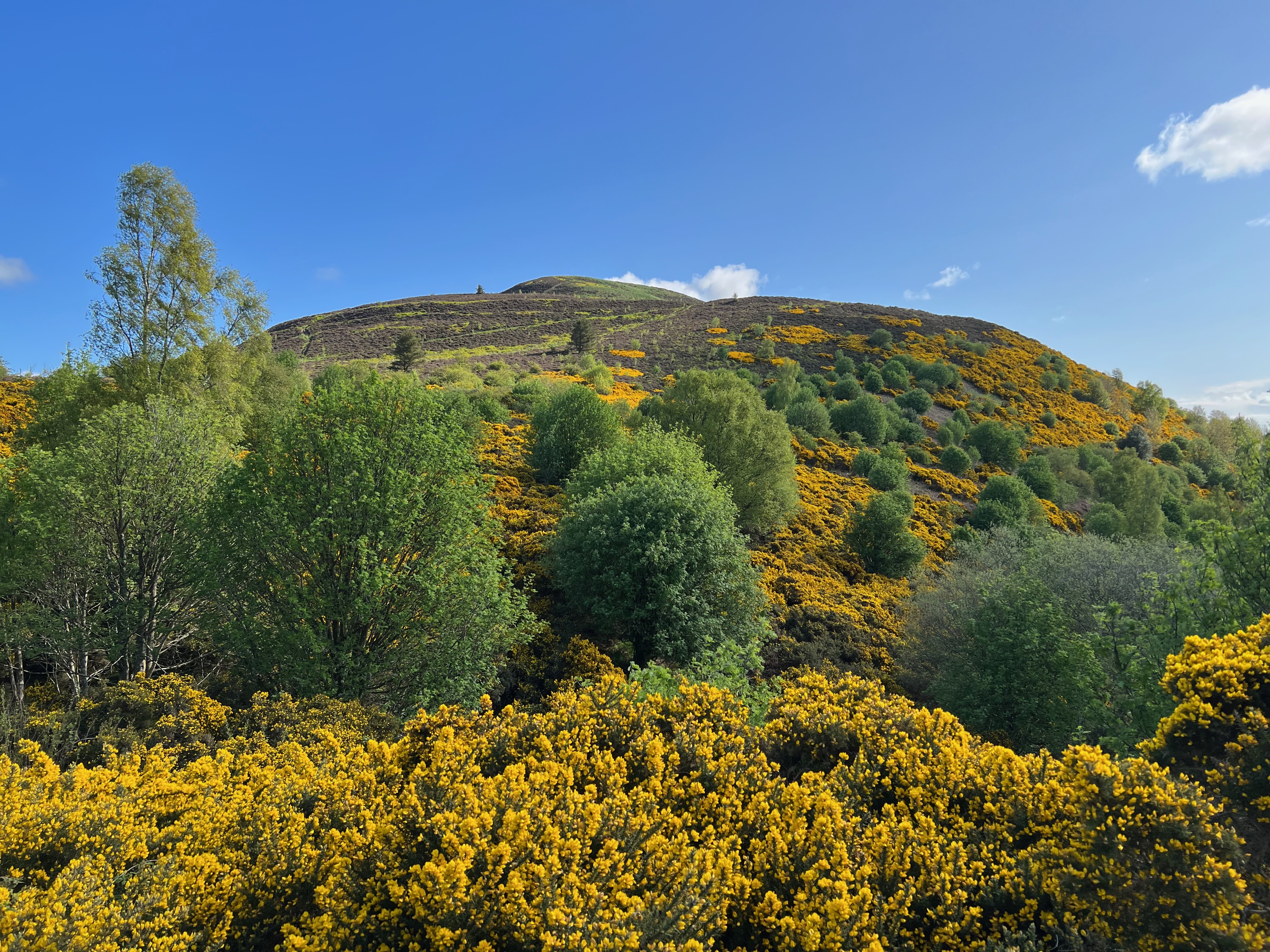
On a bright morning, I climbed up from Melrose to traverse the Eildon Hills. The abbey can be seen at the right edge of the town.
Eildon Hill North, seen from the saddle.

The Eildon Hills, a trio of rounded summits, dominate the surrounding landscape. From the saddle, I scrambled up the North Hill, a sacred ceremonial site in the Bronze Age. The Romans, before their inevitable retreat from the barbarous north, used it as a watchtower. King Arthur was said to be buried here. In the 12thcentury, monks quarried stones for Melrose Abbey on its slopes. Even into the modern era, local legends populated these hills with fairies and imagined a gateway to the Otherworld beneath them. For me the Eildons were an imposing portal to pilgrimage.

A cairn on the summit of Eildon Hill North. This has been a sacred “thin place” since pre-Christian times.
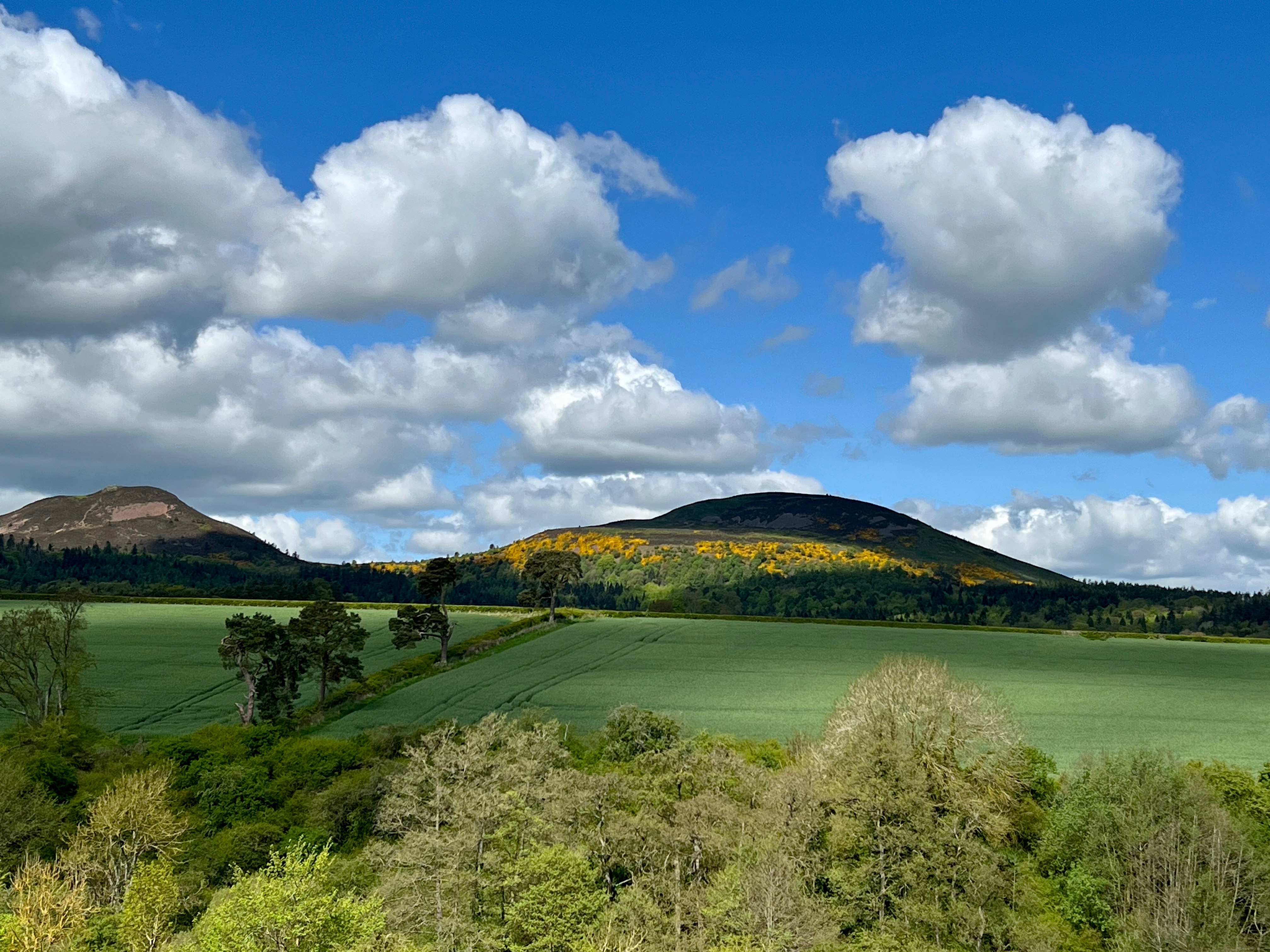
The Eildon Hills seen from the southeast. I had crossed the low saddle when I left Melrose. These distinctive peaks would remain visible for the next two days, until I passed the halfway point at 31 miles.
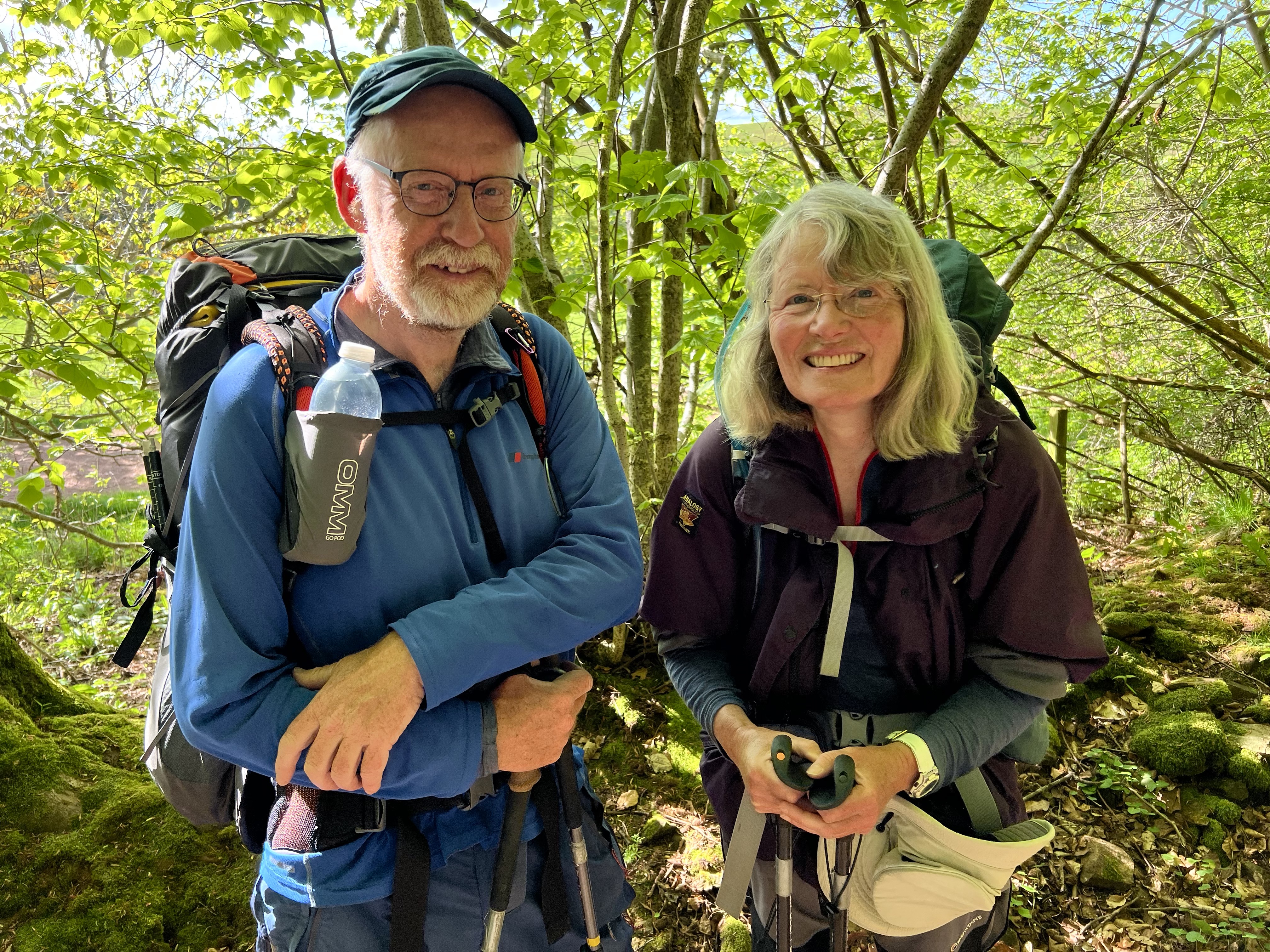
David and Julie, whom I met on my first day, were on their way to the Firth of Forth to complete a thousand-mile trek across the length and breadth of Britain.
Constable, the supreme painter of clouds, said that the sky is “the chief organ of sentiment,” but rivers also touch us deeply. The River Tweed runs for 97 miles through the border country of Scotland and England. Two miles upriver from here was the site of Cuthbert’s Melrose monastery.

It would be a six-day walk to Holy Island, mostly in splendid weather—not a drop of rain, Constable skies, and only one day without sun. I felt a Wordworthian exhilaration as the road went ever on.

The earth is all before me. With a heart 
Joyous, nor scared at its own liberty,
I look about, and should the chosen guide 
Be nothing better than a wandering cloud, 
I cannot miss my way. I breathe again! [iv]

“I wandered lonely as a cloud.” — Wordsworth
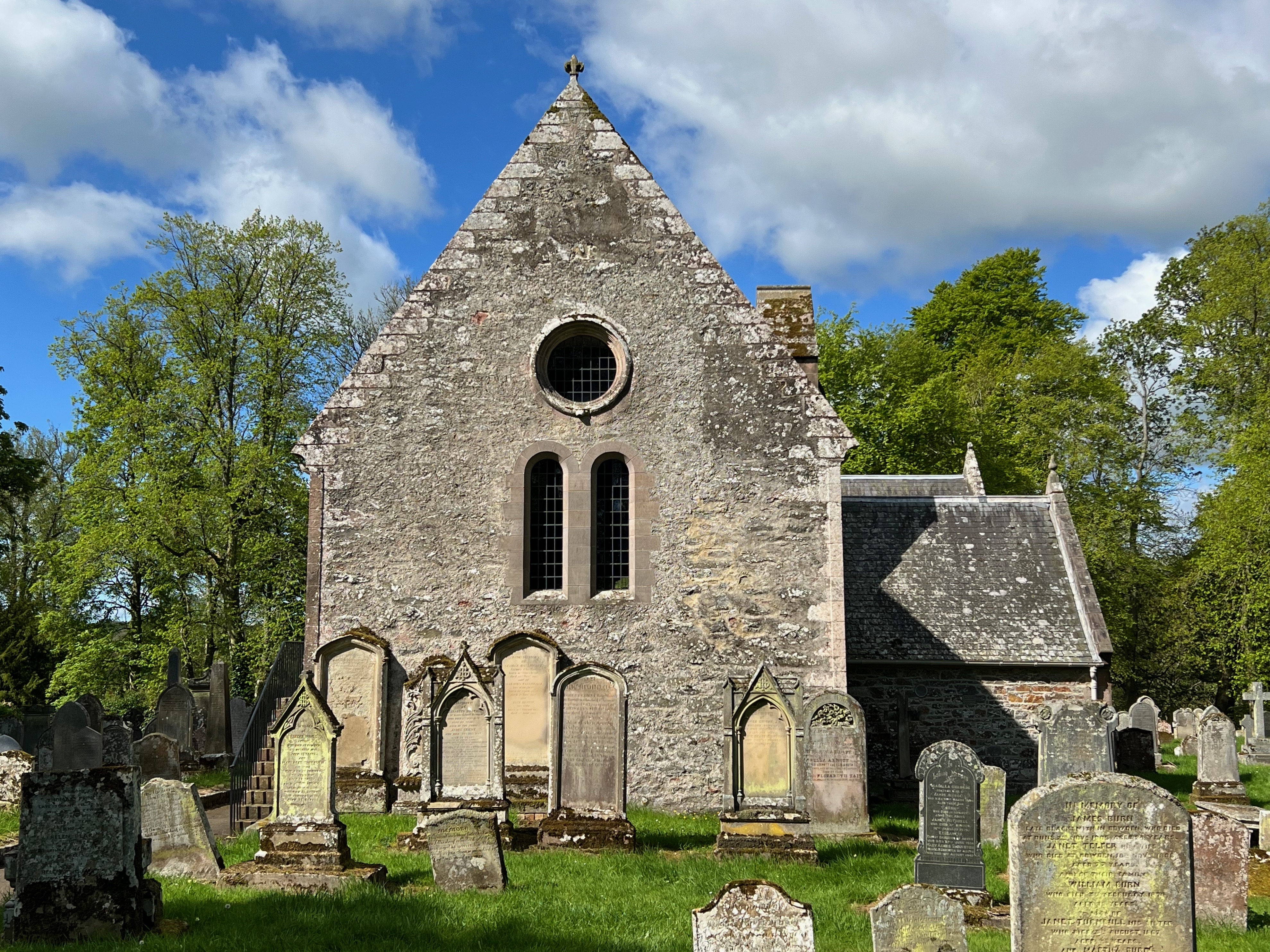
Portions of Bowden Kirk date back to the 12th century, but there have been major changes and additions over subsequent centuries. Originally Cistercian, it has been Protestant since the 16th century.

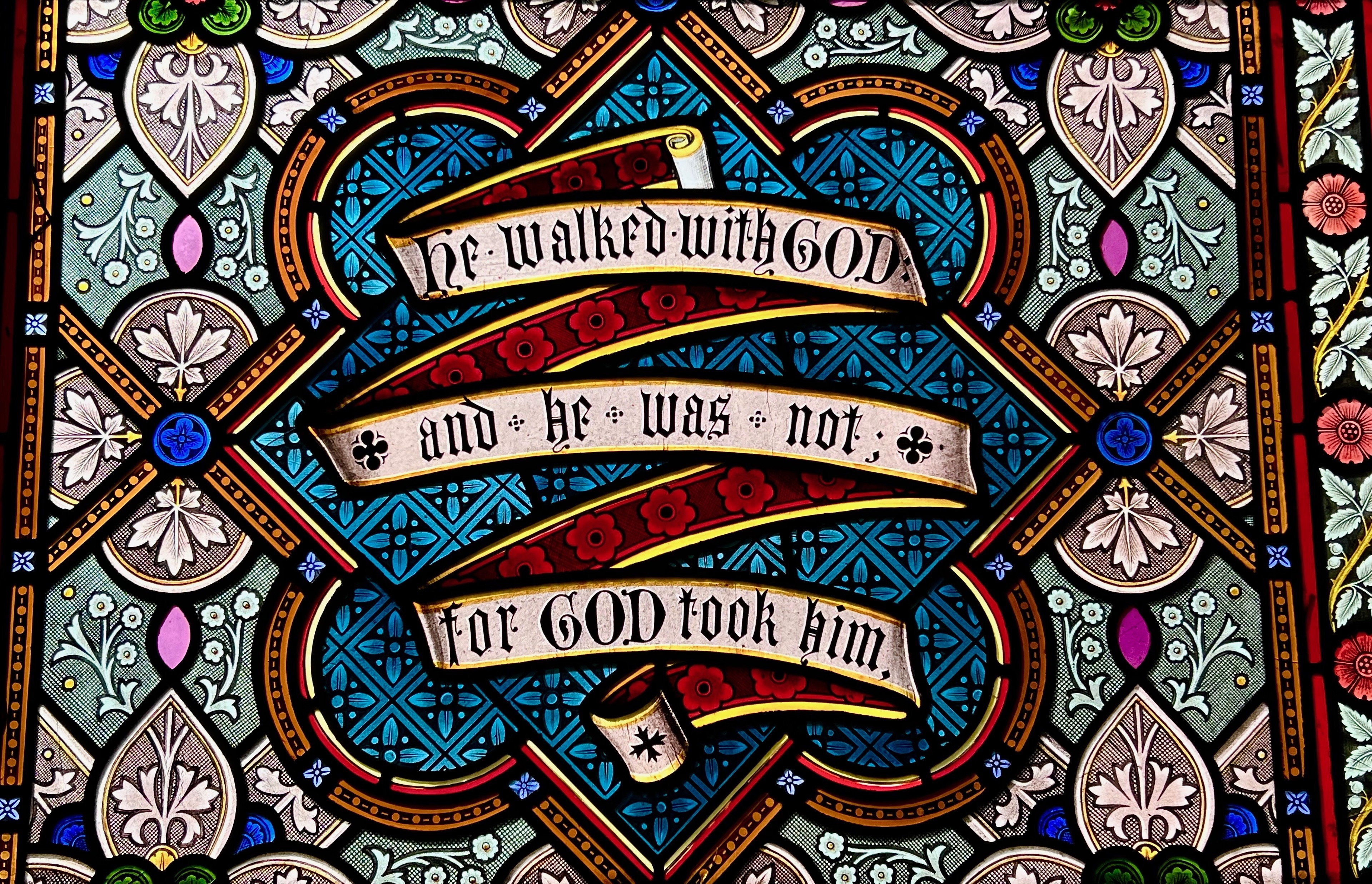
At peaceful Bowden Kirk, a medieval foundation much remodeled over the centuries, I found a window with a text from Genesis. 

Window in Bowden Kirk with text from Genesis 5:24.

This cryptic verse has been interpreted to mean that Enoch, an ancestor of Noah, was somehow taken directly to God without passing through death. To say he “was not,” or “was no more,” could mean that he simply “disappeared” from human sight without suffering an interval of nonexistence. Perhaps the window was put in Bowden Kirk as a cipher of resurrection hope, but to me it suggested the essential spirituality of pilgrimage. As we walk away from “not-God”—deeper and deeper into the divine communion—the isolating egoistic self is diminished and emptied, until it is “no more,” translated by God into its truer self: a relational participant in the divine life of self-diffusive love. That may not be achievable in this life (I certainly didn’t get there in 6 days!), but I believe it is the horizon toward which we are all headed. 

As St. John of the Cross put it:

To come to be what you are not,
you must go by a way in which you are not. [v]

Dryburgh Abbey (12th century). Sir Walter Scott, who died on the last day of summer, 1832, is buried in the ruins of the north transept.
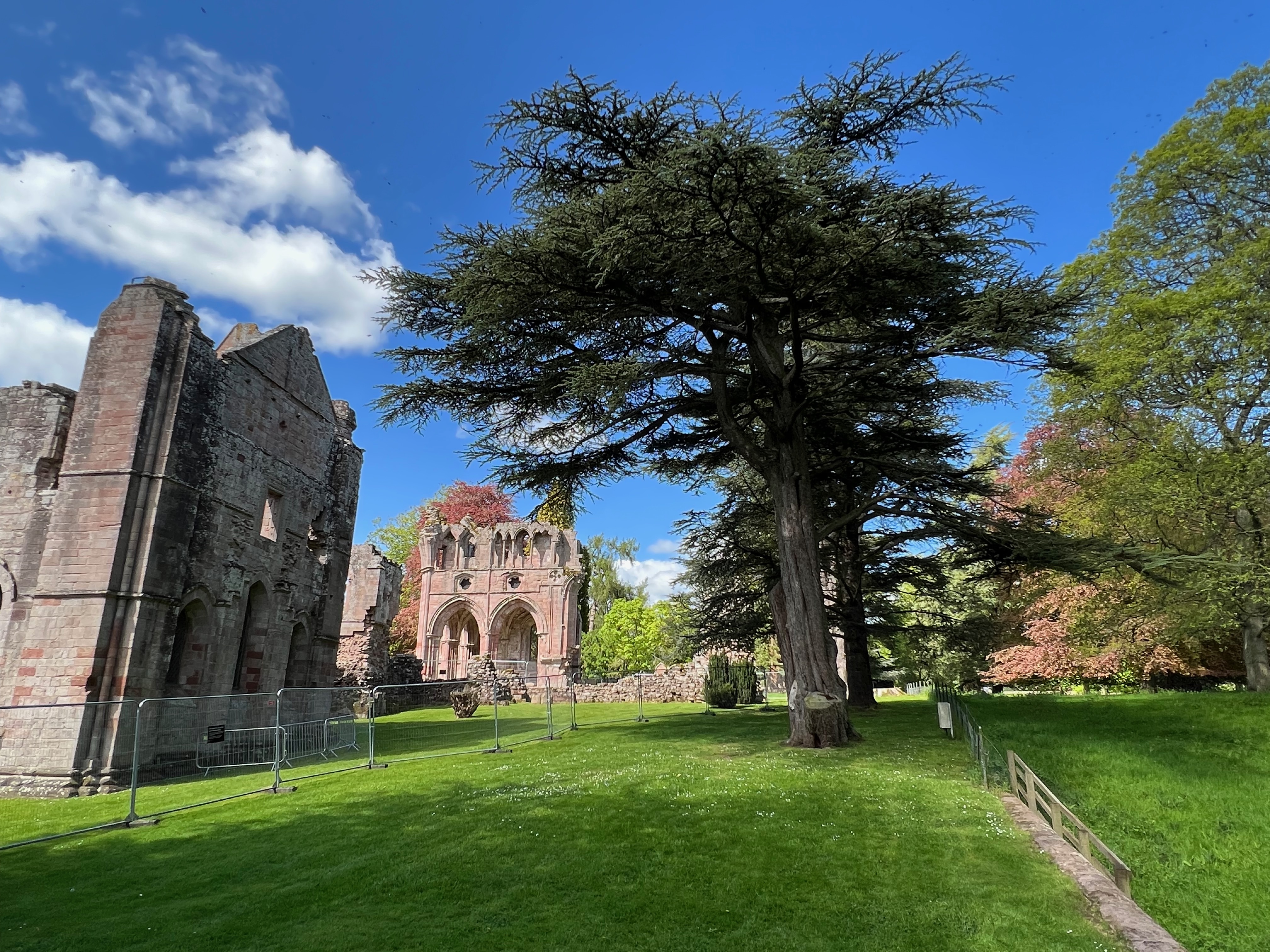
Dryburgh Abbey is surrounded by exotic trees, like this Cedar of Lebanon, planted by the Earl of Buchan over 200 years ago.
“Bare ruin’d choirs where late the sweet birds sang” (Shakespeare, Sonnet 73).

Dryburgh Abbey is the second of three Borders abbeys on St. Cuthbert’s Way. Far from any town, surrounded by a beautiful park next to the River Tweed, it is the most serene of the three. 

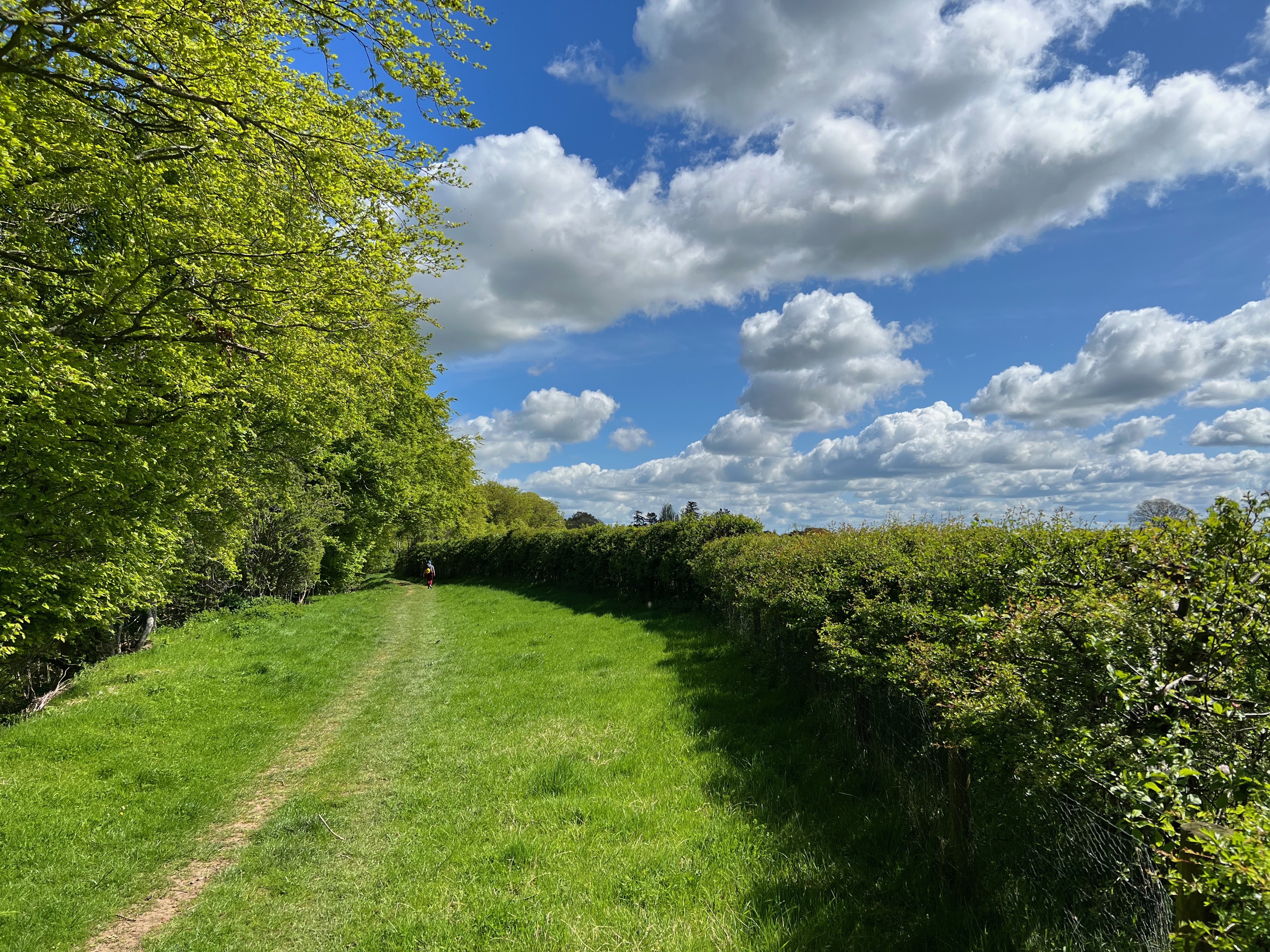
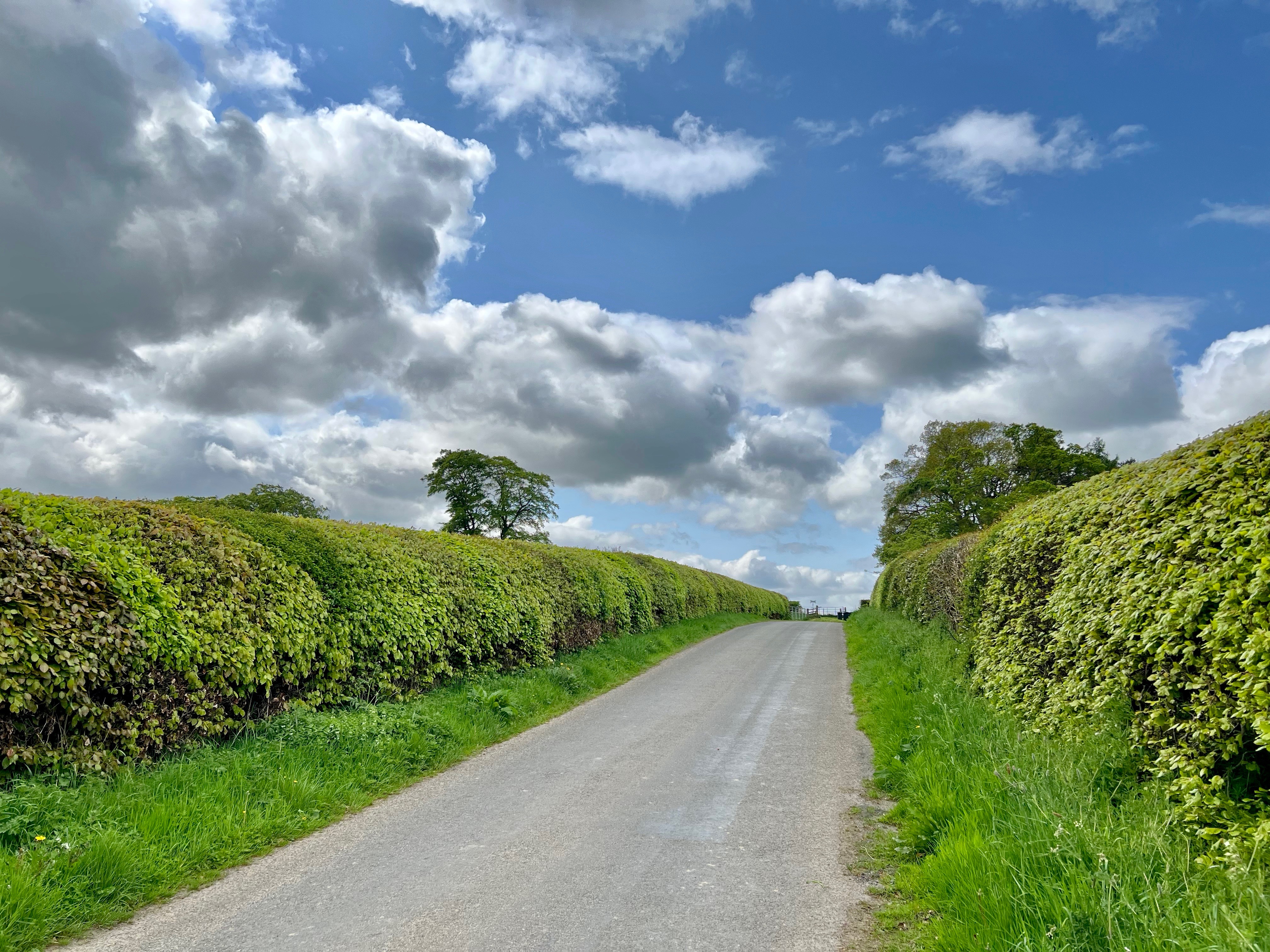
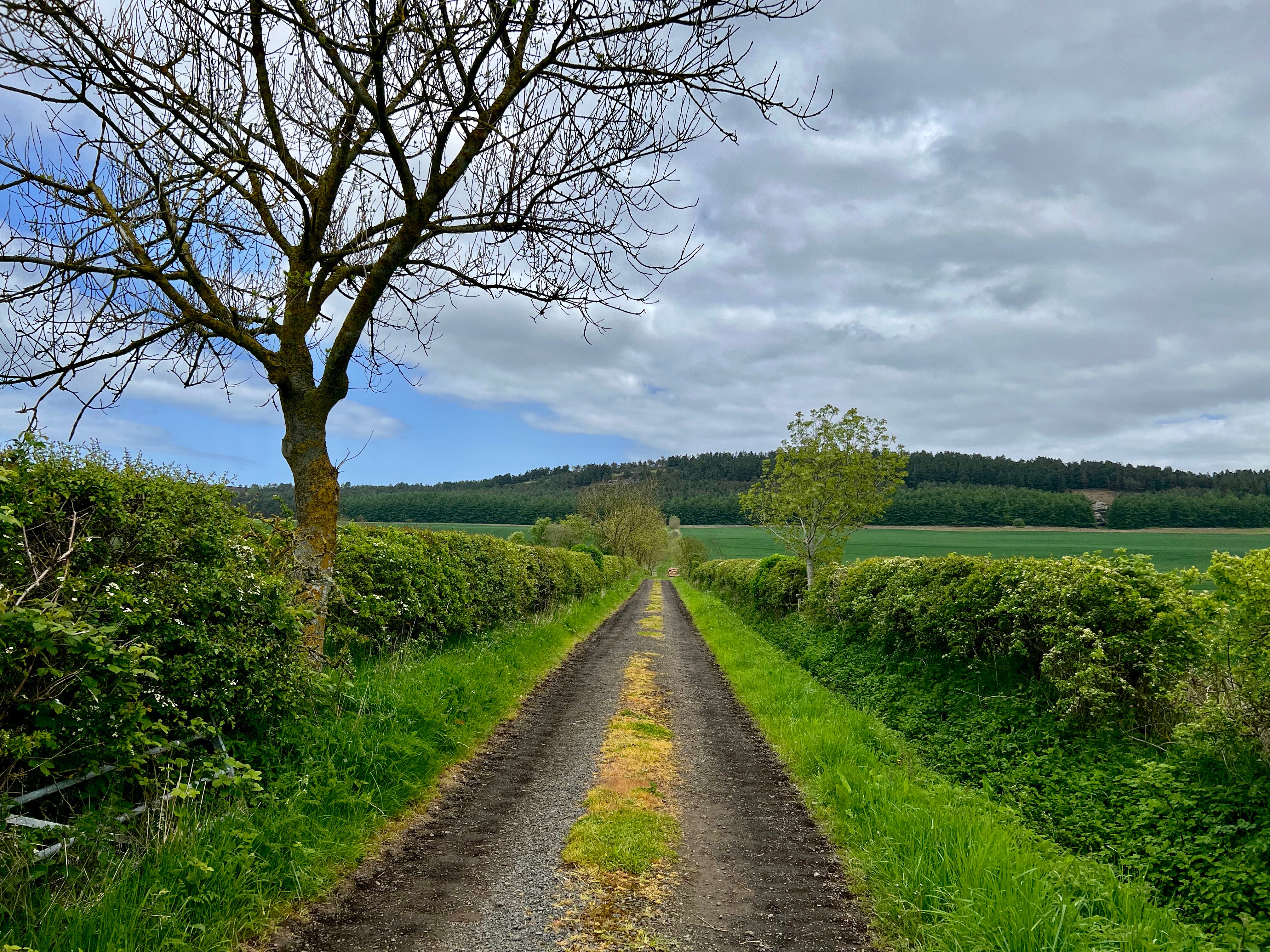
The occasional paved stretches of the Way were mostly empty.
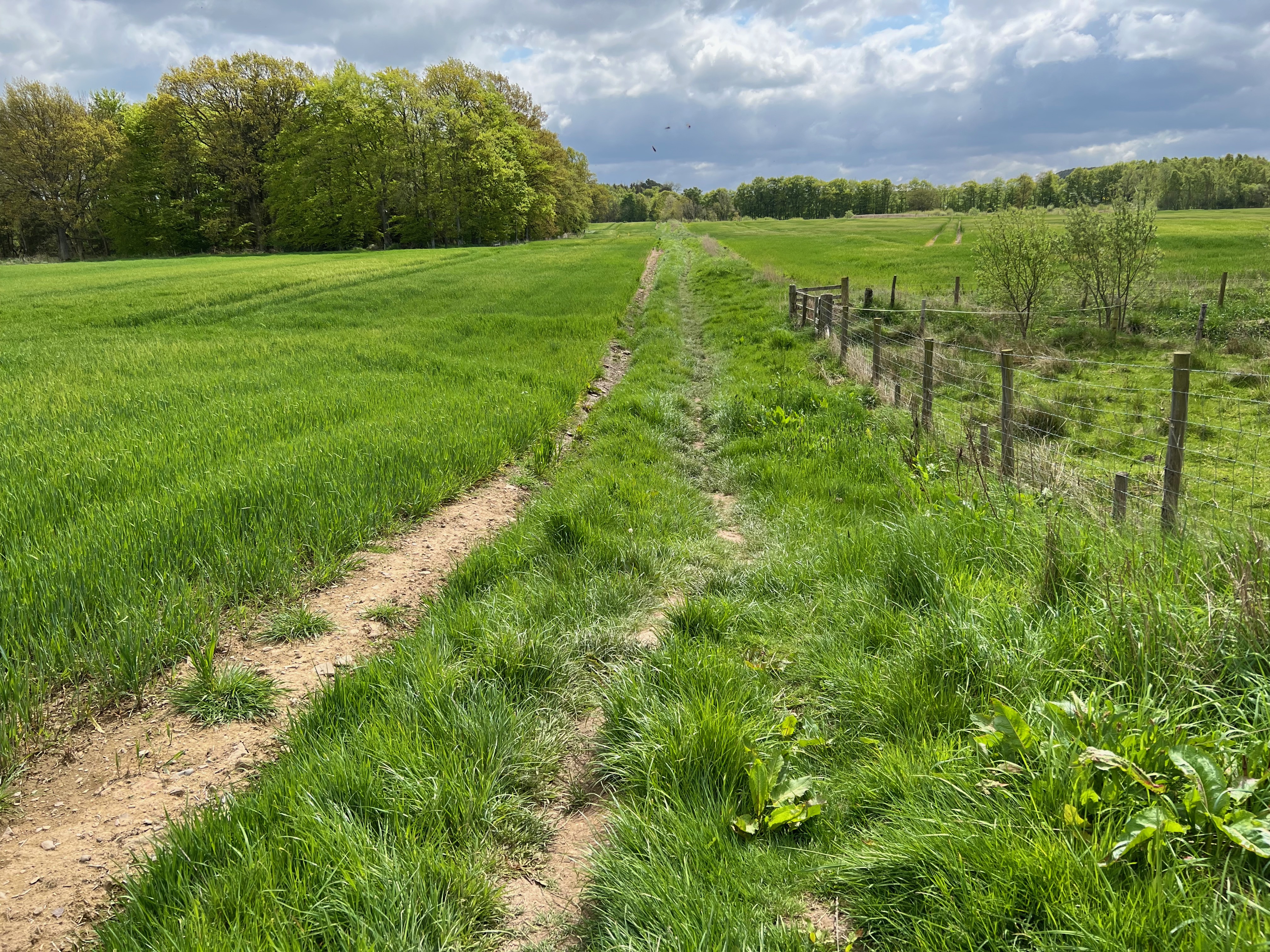
This straight path, called Dere Street, follows part of a first-century Roman road which ran from York to Scotland’s Firth of Forth.
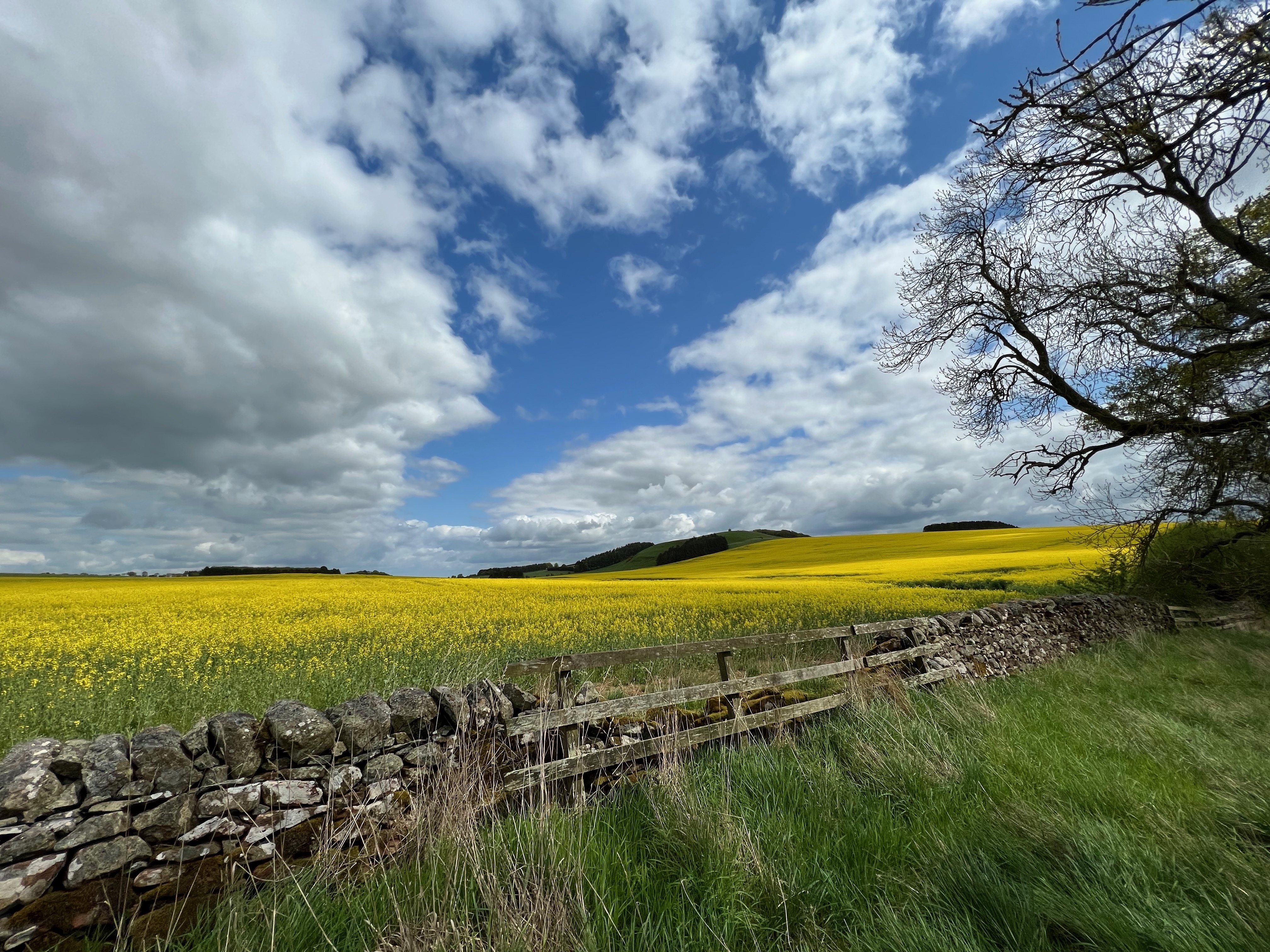
Fields of blooming rapeseed parallel the Roman road.

One day I trod the remnant of a Roman road, a faint trace of their 400-year occupation of Britain. As Gibbon observed, history “spares neither man nor the proudest of his works [and] buries empires and cities in a common grave.” [vi]

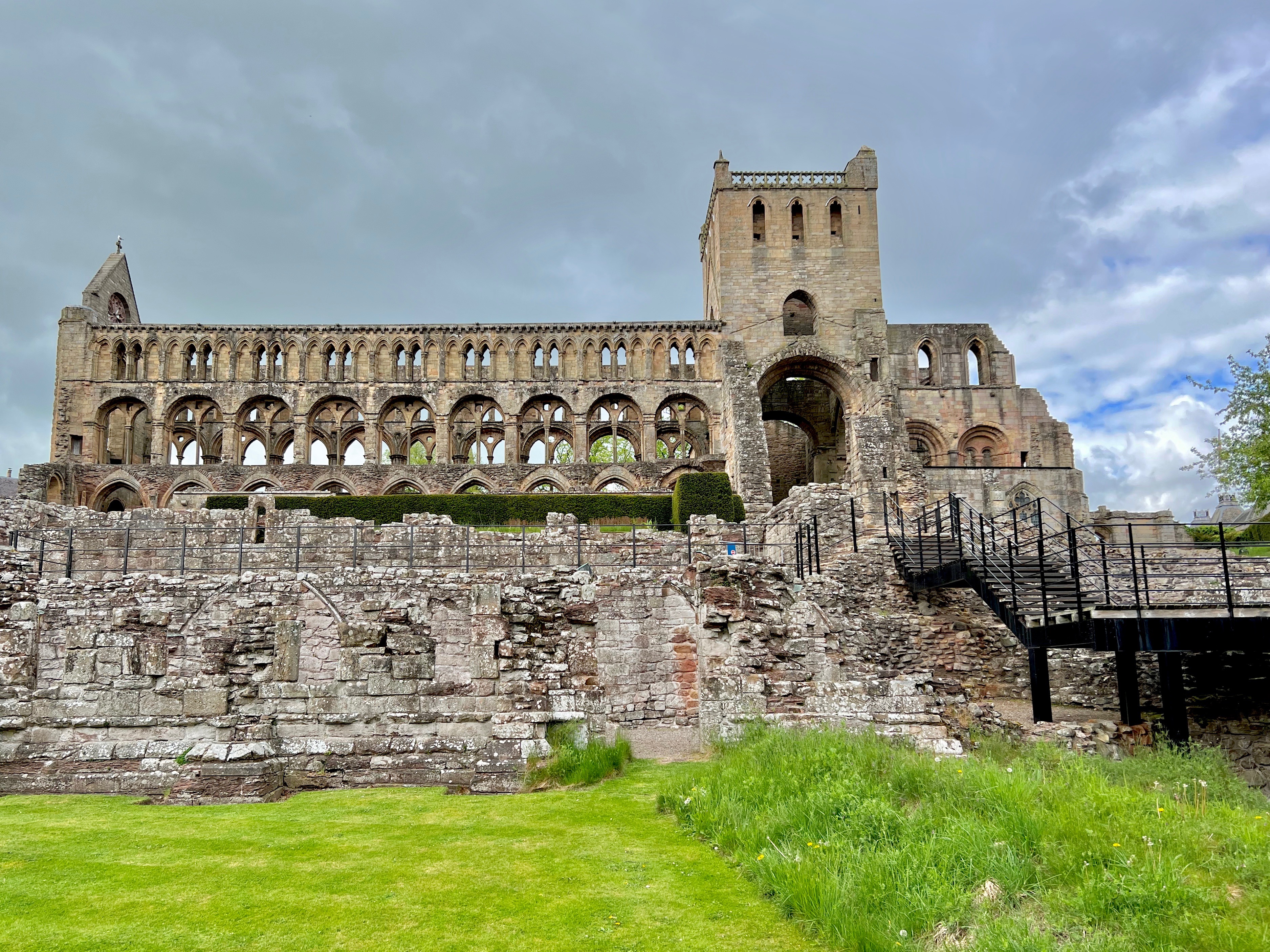
Jedburgh Abbey (12th century).
South door, Jedburgh Abbey.
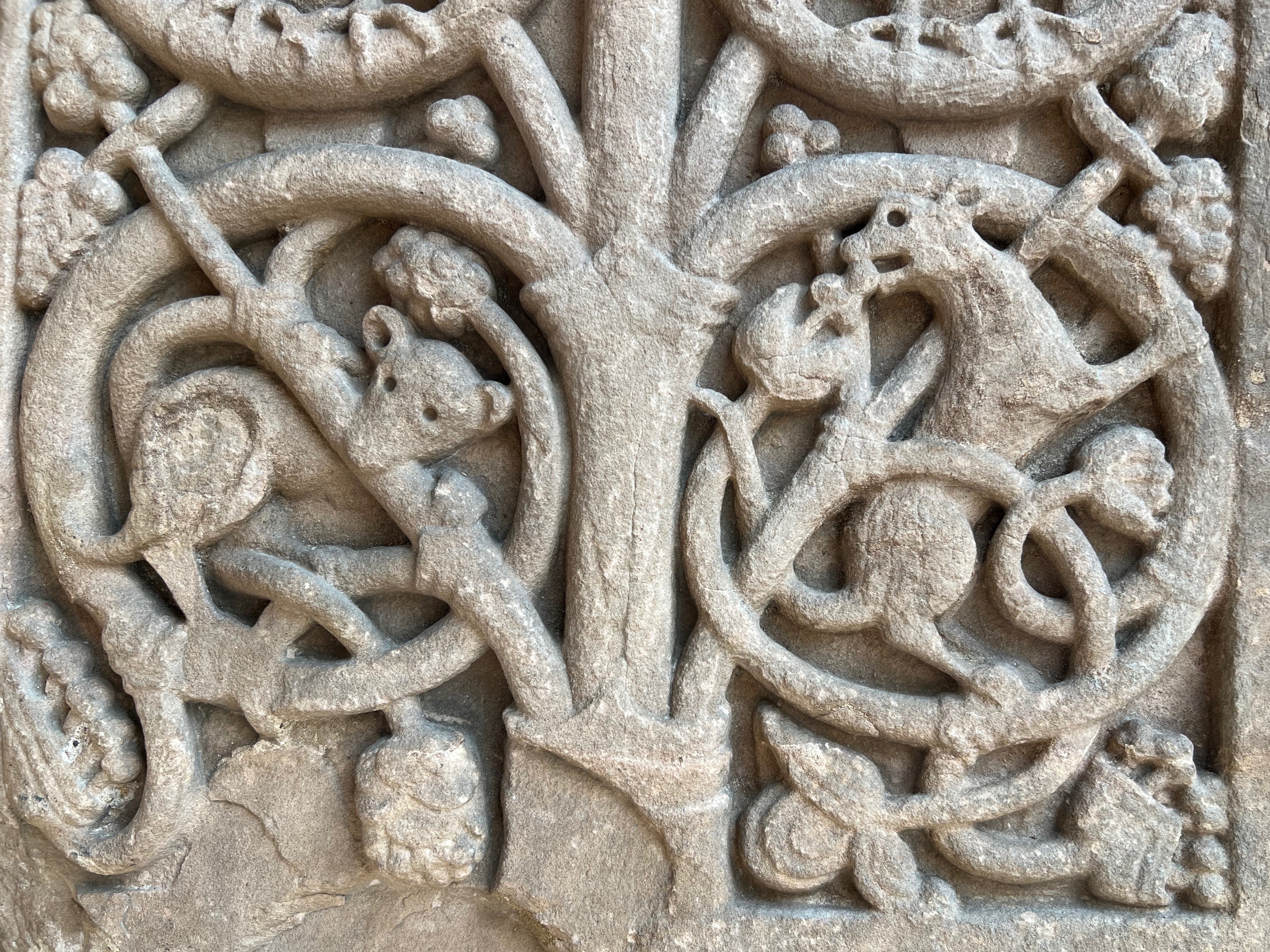
Vine-scroll panel from a saint’s shrine (8th-century, Jedburgh).

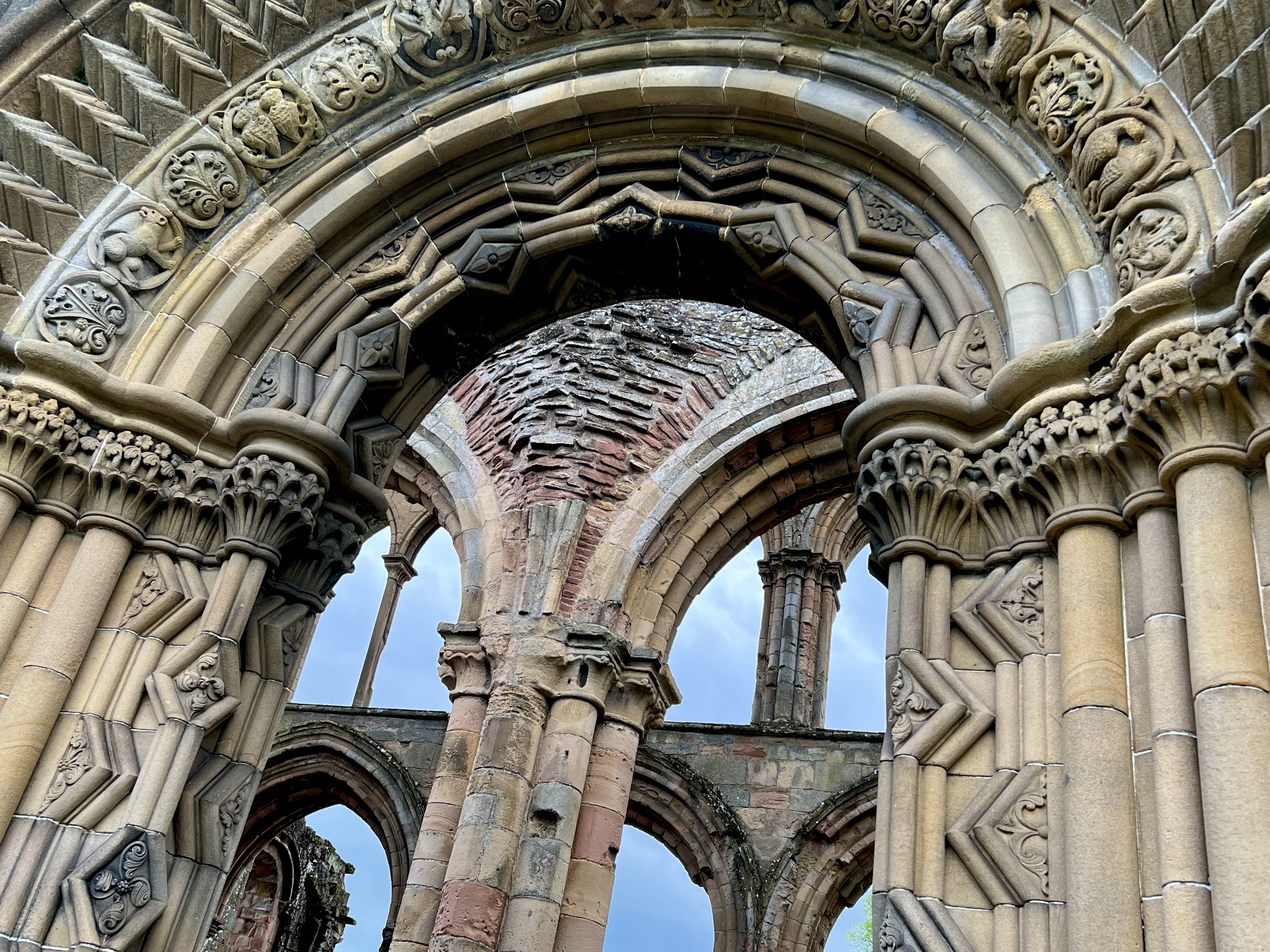
In Jedburgh (locals say “Jeddart”), the church of St. Mary the Virgin is the best preserved abbey in the Borders. Built during the shift from Romanesque to Gothic styles, it is a blend of both. And its carved stone “vine-scroll” is one of the finest examples of Anglo-Saxon art. Like the other Borders abbeys, it did not survive the Reformation, and was abandoned in 1560.

My first view of the Cheviot Hills in the distance.
When I was lost, Brian appeared to show me the way.

My first glimpse of the distant (and challenging) Cheviot Hills distracted me, and I missed a waymarked turn in the trail. Ten minutes later, I reached a road with no idea where to go. Like one of the angelic guides who appear out of nowhere to help Dante navigate obstacles in the Inferno, a local farmer drove up behind me to point the way. When he heard my American accent, he mentioned that his daughter was a professional golfer in California and “doing quite well.” I told him he was a gift from God. He looked bemused. Soon I was back on track, traversing broad fields of yellow and green until I reached the foot of the Cheviots, where the elevation gain got more demanding.

The path climbs toward Wideopen Hill, the halfway point of St. Cuthbert’s Way.
View from Wideopen Hill, the highest point on St. Cuthbert’s Way (1207 ft./ 368 m.).
I reached the highest point of the trail on Ascension Eve.

When I reached the top of Wideopen Hill, the highest point on St. Cuthbert’s Way, it occurred to me that it was Ascension Eve. What better way to celebrate than climb toward the sky!

Scotch broom in the Cheviot Hills.
Dagfinn, a Norwegian pilgrim in the Cheviot Hills.
Ascending the moorland of the Cheviot Hills.

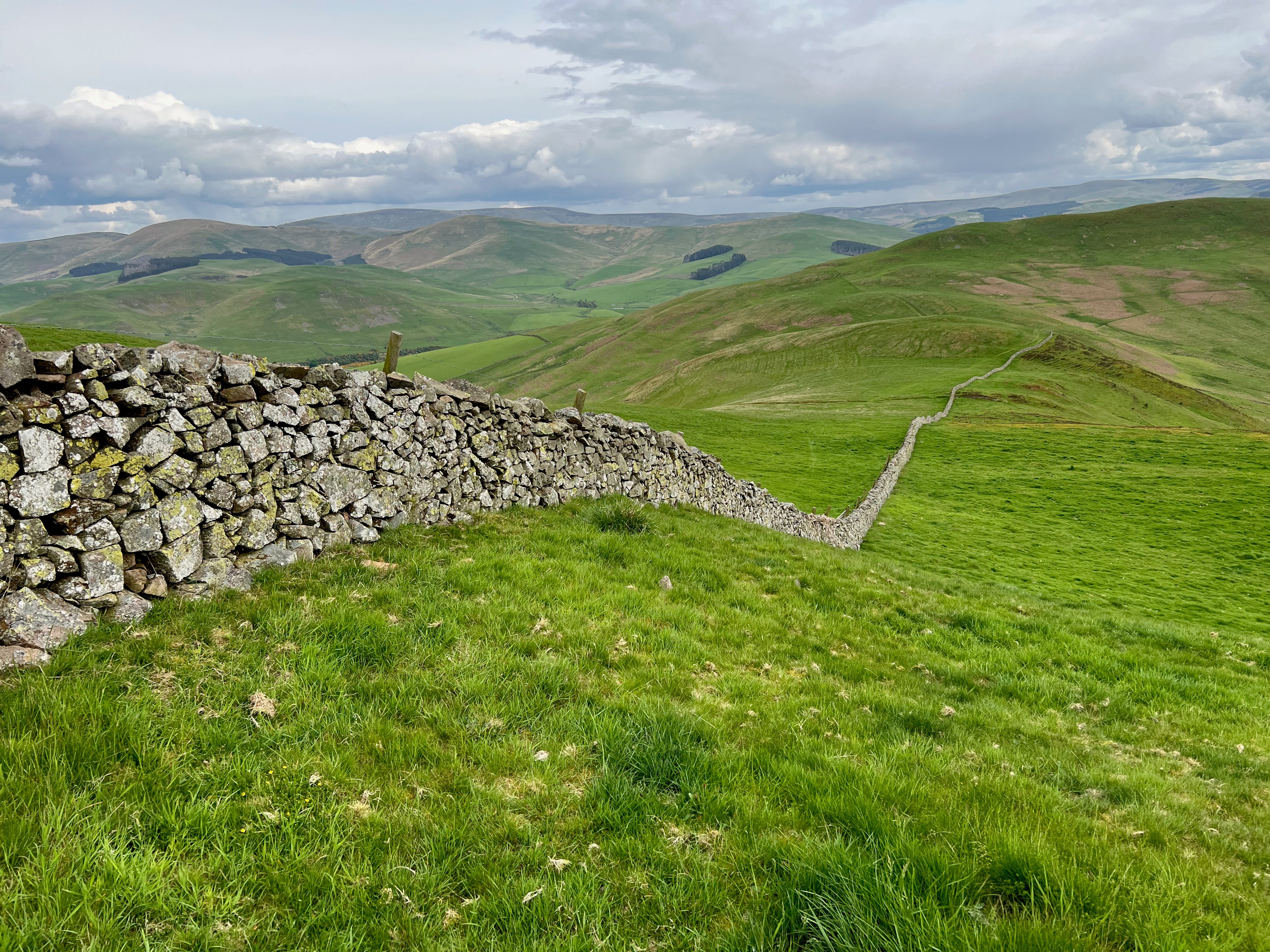
The whole next day was up and down through the Cheviots. The high country has feral goats, Iron Age forts, and a couple of crashed planes that lost their way in World War II. I didn’t see any of that. I was focused on dragging my tired body over the hump. The bleak sky and the treeless summits dampened my spirits a bit (Praise God when the road is easy! Praise God when the road is hard!). But it was still thrilling to hear the long, slowly rising whistle of the Eurasian curlews as they swooped across the heather. 

Gatepost lion in Wooler.

After a gloomy day in the Cheviot Hills, my final miles to the coast were brilliantly lit and my heart was high. This stone lion at a schoolyard entrance was carved by an Italian prisoner of war during World War II, when the facility was a POW camp. It looks like something you’d find in Venice. Thinking of that prisoner managing to make art amid the chaos of war, I’m tempted to say that art is long and war is short, but in these days of perpetual conflict I’m not so sure.

Toward the final ridge before the coast.
St. Cuthbert’s Cave.

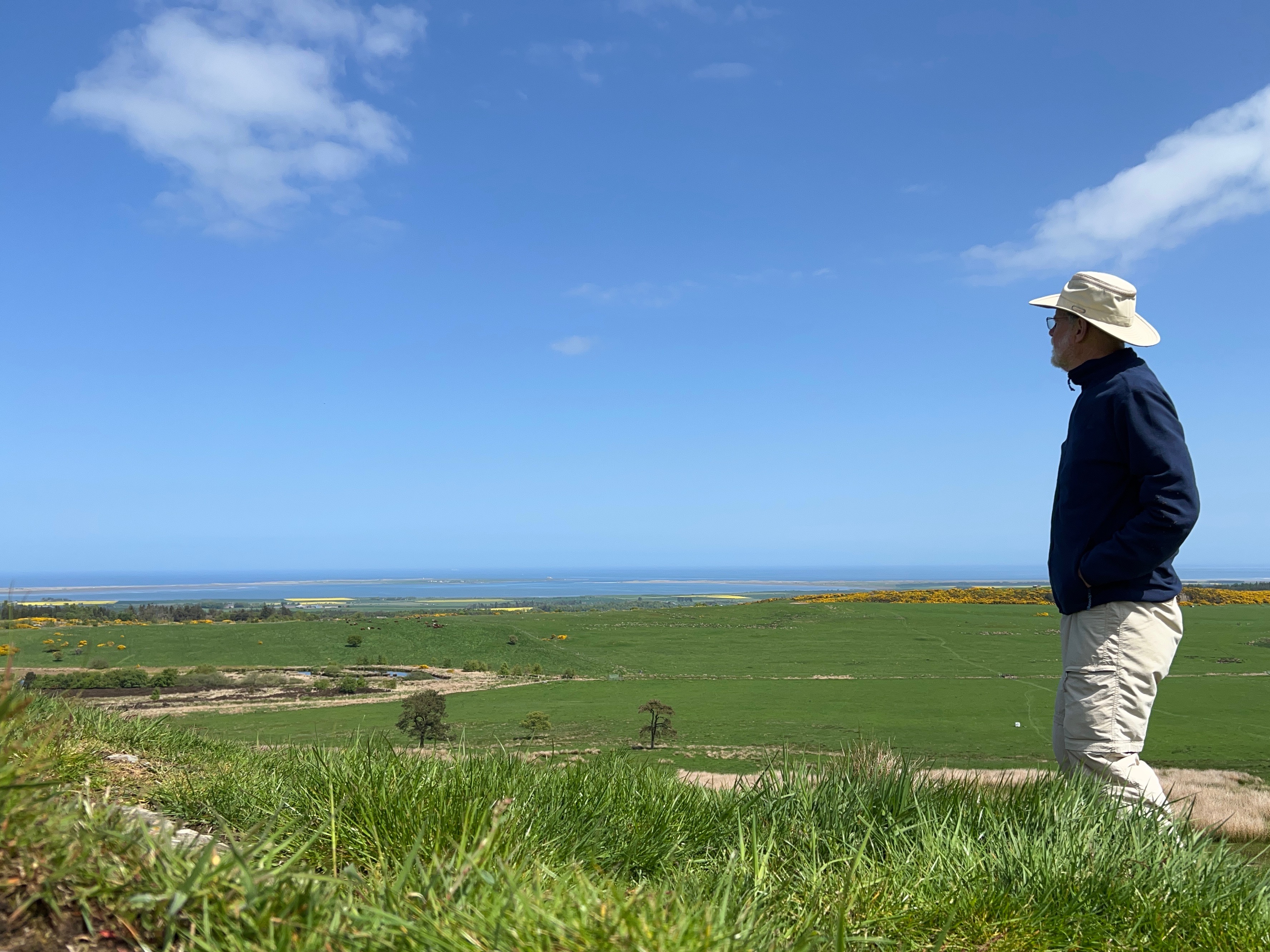
The first sign that I was nearing the sea was a flock of gulls circling above me. Just one more forested ridge, and the coast would be visible. After marveling at the massive sandstone overhang of St. Cuthbert’s Cave (where monks carrying his remains are said to have sheltered while fleeing Viking raiders), I climbed to the rise just above it. And there I saw my Promised Land: Holy Island, refulgent beneath the noonday sun.

When Lewis and Clark got their first glimpse of the Pacific after 18 months crossing the American continent, Clark recorded their delight in his journal: “Ocian in view! O the joy.” When I reached that ridge above the Northumbrian sea, I spoke those words out loud.

My first view of Holy Island.
Ocean in view!

“To walk there is to earn it, through laboriousness and through the transformation that comes during a journey … We are eternally perplexed by how to move toward forgiveness or healing or truth, but we know how to walk from here to there, however arduous the journey…. In pilgrimage, the journey is radiant with hope … geography has become spiritualized.”

— Rebecca Solnit [vii]       

Walking St. Cuthbert’s Way


THE ST. CUTHBERT SERIES CONTINUES:

Grace and Beauty on Holy Island

The Journey Ends: Durham Cathedral

All photographs and video are by the author.

For links to my posts on the Camino de Santiago: https://jimfriedrich.com/2020/07/25/seek-ye-first-scenes-from-the-camino-de-santiago/


[i] Geoffrey Chaucer, The Canterbury Tales (Prologue, 11-18), trans. Burton Raffel (Modern Library, 2008).

[ii] Susan Stewart, The Ruins Lesson: Meaning and Material in Western Culture (Chicago: University of Chicago Press, 2020), 238.

[iii] Dante, The Inferno 1.60, trans. Robert Hollander & Jean Hollander (Doubleday, 2000).

[iv] William Wordsworth, The Prelude (1.14-18).

[v] John of the Cross, The Ascent of Mt. Carmel.

[vi] Edward Gibbon, from the closing chapter of History of the Decline and Fall of the Roman Empire.

[vii] Rebecca Solnit, Wanderlust: A History of Walking (Penguin, 2001).

Imitating the Trinity in Our Common Life

Windows, south nave of León Cathedral on the Camino de Santiago.

I was walking instead of writing in May, on pilgrimage along St. Cuthbert’s Way from the Scottish Borders to Holy Island in Northumbria. More on that soon. Meanwhile, I’m preaching the following for Trinity Sunday at my home parish, St. Barnabas Episcopal Church on Bainbridge Island, Washington. Some of it has appeared before on this blog, but the ending is entirely new.

Part of the fun of Trinity Sunday is getting to watch the preacher attempt to explain the most formidable mystery of Christian faith in less than 20 minutes. It can’t be done! We all know that—the preacher knows it too—and the fun part is seeing how he or she is going to fail this time. 

Of course, we could just say that a mystery is not meant to be explained, and leave it at that. Let’s just adore the mystery, not investigate it.

But if, as the theologians insist, “the nature of the church should manifest the nature of God,”[i] then we need to know enough about the nature of God to understand how to be a church whose own way of being reflects and manifests that divine nature. 

And if investigating the nature of God seems like a daunting task best left to the professionals, those who have the aptitude and training to navigate levels of complexity and nuance which would make our own heads explode, we must remember that the doctrine of the Trinity is not a math problem (How can one be three and three be one?), nor is it an abstract, highly technical construction of the metaphysical elite who spent centuries sorting out differences between Arians, Monophysites, Monothelites, Monarchians, Modalists, Ebionites and Sabellians.

Trinitarian thought isn’t made of thin air or abstract speculation. It is produced and nourished by the concrete, tangible history of Christian experience. Whatever we can actually say about the Trinity is first of all grounded in experience, both the experience of our spiritual ancestors, encoded in Scripture and tradition, and the contemporary, ongoing revelations of our own communal and personal life.

Ever since the first Easter and the first Pentecost, Christians have been trying to make sense of the concrete, experiential data of salvation. Based on our collective and personal experience of being “saved” (or, if you prefer: healed, forgiven, reborn, renewed, resurrected, empowered), what can we say about the God who has done this? 

Trinitarian reflection began within an ancient community deeply grounded in the monotheism of Judaism, which had, over the centuries, found ultimate reality to be not a plurality of disconnected or contradictory energies—what the ancients called “the gods”—but a coherent unity, understood to be the “one God.” However, once the early Christians began to attribute divinity to both Jesus and the Holy Spirit, a simple self-contained oneness was no longer sufficient to describe the Reality.

Without losing the unity of God, how could they account for the divine diversity revealed in the saving activities of Christ and the Spirit? Once they began to call Jesus Kyrios (Lord), which happened very early in their worship and their storytelling, traditional monotheism was radically destabilized. The growing perception of the Holy Spirit as a guiding and empowering presence of deity in their communities only compounded the problem.

There were various attempts to solve the problem by downgrading Jesus and Spirit to subordinate, derivative, or semi-divine realities, by no means equal to the eternal and uncreated God. Such “heresies” were popular with those who wanted to keep God simple. But “orthodoxy” was unwilling to deny the fullness of divinity to either Christ or the Spirit. For them the bottom line was this: 

Only God can save us. Christ and Spirit, in the biblical revelation and Christian experience, are integral and essential to salvation. Therefore, they must be equally integral to the Holy One who is the Creator and Redeemer of all things

As a consequence, the doctrine of God became trinitarian: Three in one and one in three. In other words, God is relational. God is social. God is a communion of Persons. 

If we have difficulty with “God in three Persons,” it is because we think of a person as defined by his or her separateness. I’m me and you’re you! We may interact and even form deep connections, but my identity does not depend upon you. I am a self-contained unit. You can’t live in my skin and I can’t live in yours. That’s the cultural assumption, which goes back at least as far as Descartes in the seventeenth century, and continues today in such debased forms as rampant consumerism and economic selfishness, where my needs and my desires take precedence over any wider sense of interdependence, community, or ecology.

But what we say about the Persons of the Trinity is quite different. Each Person is not an individual, separate subject who perceives the other Persons as objects. The Trinitarian persons experience one another not from the outside, but from the inside. They indwell each other in a mutual interiority.

Is this image of trinitarian indwelling difficult to conceive? Or is it something like the old John Lennon lyric?: “I am he as you are she as you are me and we are all together.” A French mystic put it this way: “it’s a case of un ‘je’ sans moi” (an “I” without a me). Subjectivity, yes, a distinct consciousness within my own body, particular and unique, yes; but a consciousness deeply permeated by the otherness of interdependent reality.

But if the divine Persons are all inside each other, commingled, “of one being,” as the Creed says, what makes each Person distinct? To put it succinctly: the Persons are distinct because they are in relation with one another.

As Jewish theologian Martin Buber observed, we are persons because we can say “Thou” to someone else. To be a person is to experience the difference – and the connection – that forms the space between two separate subjects. My consciousness is not alone in the universe. There are other centers of consciousness: Thou, I… Thou, I… The fact that you are not I is what creates self-consciousness, the awareness of my own difference from what is outside myself.

If we apply this to the Trinity, we say that there are Three Persons because there is relation within God, relation between the Source who begets, the Word who is begotten, and the Spirit who binds the two together and carries them—and the love between them—outward in ever widening circles.

These relations are not occasional or accidental. They are primordial. They are eternal. There is an eternal sending within God, an eternal self-giving within God, an eternal exchange by which God is both Giver and Receiver simultaneously.

Trinitarian faith describes a God who is not solitary and alone, a God who is not an object which we can stand apart from and observe. The Trinity is an event of relationships: not three separate entities in isolation and independence from one another, but a union of subjects who are eternally interweaving and interpenetrating.

The early Church had a word for this: perechoresis. It means that each Person penetrates the others, each contains the other, and is contained by them. Each fills the space of the other, each is the subject, not the object of each other. As Jesus says in the Fourth Gospel: I am in the Father and the Father is in me.

The word perechoresis literally means “to dance around,” and the ancient theologians quickly seized on that image as an accessibly concrete description of a complex process. The Trinity is a dance, with Creator, Christ and Spirit in a continuous movement of giving and receiving, initiating and responding, weaving and mingling, going out and coming in. And while our attention may focus at times on a particular dancer, we must never lose sight of the larger choreography to which each dancer belongs: the eternal perichoresis of Three in One, One in Three.

Wallace Stevens made a poem about the process of giving ourselves over to a larger whole. He calls it “the intensest rendezvous,” where we find ourselves drawn out of isolation “into one thing.” He wasn’t writing about the Trinity, but his words come as close as any to describing the essential dynamic of the divine Persons:

Here, now, we forget each other and ourselves.
We feel the obscurity of an order, a whole,
A knowledge, that which arranged the rendezvous.[ii]

This divine relationality is not something which an originally solitary God decided to take up at some point. God is eternally relational. Before there was an external creation to relate to, God’s own essential self was and is an event of perpetual relation. There was never simply being, but always being-withbeing-forbeing-in. To be and to be in relation are eternally identical.

When the Bible says, “God is love” (I John 4:16), it means that love is not just something God has or something God does; love is what God is. As Orthodox theologian John D. Zizoulas says in his influential text, Being as Communion, “Love as God’s mode of existence … constitutes [divine] being.”[iii] Feminist theologian Elizabeth Johnson echoes this when she says, “being in communion constitutes God’s very essence.”[iv]

In other words, God is Love giving itself away—self-emptying, self-diffusing, self-surrendering—and in so doing finds itself, receives itself, becomes itself.

For those of us made in God’s image, who God is matters deeply, both for our own self-understanding and for our engagement with the world. The Trinity isn’t just a doctrine or an idea. It’s a practice, a way of life, the shape of every story, the deep structure of the church, and indeed of all reality.

The mystics can help us out here. Early in the twelfth century, a German monk named Rupert of Deutz went into a church where mass was being said by a white-haired bishop. At the offertory procession he experienced a vision of the Holy Trinity:

“On the right at the edge of the altar stood three persons of such revered bearing and dignity that no tongue could describe them. Two were quite old, that is, with very white hair; the third was a beautiful youth of royal dignity …”[v]

A century later, Hadewijch of Antwerp, one of those remarkable women mystics who flourished in the late Middle Ages, also had a vision of the Trinity. But instead of three white males, what she saw was a dark whirlpool, which she described as “divine fruition in its hidden storms.” Hovering over this whirlpool was a spinning disc, on which sat a figure wearing the countenance of God – the face of God – on whose breast were written the words, “The Most Loved of All Beloveds.”

We may find Hadewijch’s vision more congenial: it is genderless, and less crudely specific than Rupert’s. And the tempestuous whirlpool, a flood of energy ceaselessly flowing through the universe, conveys a dynamic image of divinity that resembles the postmodern cosmologies of process theology and quantum physics. It’s probably easier for most of us to believe in a divine whirlpool than in three white guys.

But the crucial difference between Rupert and Hadewijch is not in the relative resonance of their imagery, but rather in what happens next. Rupert remains an observer, one who stands apart and sees God as an object. But Hadewijch does not remain separate from what she sees:

“Then I saw myself received in union by the One who sat there in the whirlpool upon the circling disc, and there I became one with him in the certainty of union… In that depth I saw myself swallowed up. Then I received the certainty of being received, in this form, in my Beloved, and my Beloved also in me.”

Rupert’s knowledge of God remained conceptual. Hadewijch’s knowledge of God became experiential. She was gathered into the circulating current of divinity. She became part of its flow, and that divine flow became part of her.

The language she uses for this experience is not mathematical or philosophical. Her language is the language of the heart. She describes being “swallowed up… in my Beloved, and my Beloved also in me.” Love, she discovered, is the way the soul knows. Love is the way the soul sees.[vi]

And what Love knows, what Love sees, is this: God is not a simple, static substance but an event of relationships. That’s why we say that God is love. “To be” has no ontological reality apart from “to be in relationship.” In the words of Anglican priest John Mbiti of Kenya, expressing the strongly communal mindset of African theology, “I am because we are, and since we are, therefore I am.”[vii]

Each Person contains the others and is contained by them in a shared communion of self-offering and self-surrender. But that continuous self-offering is never a one-way transaction, either one of self-emptying or one of being filled. It is always both at once – giving and receiving – as we ourselves know from our own mutual experience of love at its best. 

As Jesus said, “losing” yourself and “finding” yourself are equivalent and simultaneous. In giving ourselves away, we receive ourselves back. This may be counterintuitive to the modernist mindset of autonomous individual self-possession, but it is the essence of communion: “a giving of oneself that can only come from the ongoing and endless reception of the other.”[viii] 

As God’s friends, we are not merely observers of this divine life of self-offering and self-surrender. We are participants.

If God is communion, the eternal exchange of mutual giving and receiving, then the Church must live a life of communion as well. When Love’s perechoresis becomes our way of being in the world—as believers, as church—the Trinity is no longer just doctrine or idea. It is a practice, begetting justice, peace, joy, kindness, compassion, reconciliation, holiness, humility, wisdom, healing and countless other gifts. As theologian Miroslav Volf has said, “The Trinity is our social program.”[ix]

The Church exists to participate in the life of God, and to enable others to do the same. We exist to make divine communion not just an inner experience but a public truth. We don’t just feel God’s perichoresis. We don’t just feel Love’s eternal dance. We embody it. We live it. We show it. We share it.  

Church isn’t something we decide to do—or not do—on a Sunday, when we’re not otherwise occupied. It’s not a consumer item, just one of many options competing for our individual time and attention. Nor is it like a fire hose safely stored in a glass case, for emergency use only. And it is certainly not an antiquarian society preserving quaint rituals, or a museum to display our nostalgia for a lost past.  

No! The Church is the society of God’s friends—resurrection people, animated by divine breath—striving to imitate the triune communion of divine life in our human life together. By showing up, by committing to the shared vocation of worshipping, witnessing and serving together, by tending the holy flame of faith in a heedless world, we offer ourselves, our souls and bodies, as vessels of that communion—not only in our sacramental life, but wherever we happen to live and move and have our being. 

Is that too hard for us? Are we up to it? My friend Bob Franke once wrote a song about the various ways he showed love for his daughter when she was a little girl. He didn’t do it perfectly, of course. No one does. But he gave it everything he had. And a line from that song, I think, speaks to our own calling as a community of faith to imitate the divine communion of the Trinity in our common life, to practice trinitarian love on earth as it is in heaven:

It may not be the thing we do best, but it’s the best thing that we do.[x] 

May the grace of our Lord Jesus Christ, the love of God, and the communion of the Holy Spirit, be with us all, now and forever. Amen.


[i] Catherine LaCugna, God for Us: The Trinity and the Christian Life (San Francisco: Harper San Francisco, 1991), 403.

[ii] Wallace Stevens, “Final Soliloquy of the Interior Paramour,” Collected Poetry and Prose (New York: Library of America, 1997), 444.

[iii] John D. Zizoulas, Being as Communion: Studies in Personhood and the Church (Crestwood, NY: St. Vladimir’s Seminary Press, 1993), 46.

[iv] Elizabeth Johnson, She Who Is: The Mystery of God in Feminist Theological Discourse (NY: Crossroad, 1993), 227.

[v] Bernard McGinn, The Growth of Mysticism: Gregory the Great Through the 12thCentury (New York: The Crossroad Publishing Company, 1994), 330.

[vi] ibid., The Flowering of Mysticism (New York: The Crossroad Publishing Company, 1998), 212-16.

[vii] q. in Veli-Matti Kärkkäinen, The Trinity: Global Perspectives (Louisville: Westminster John Knox Press, 2007), 352.

[viii] Graham Ward, “The Schizoid Christ,” in The Radical Orthodoxy Reader, ed. John Milbank and Simon Oliver (NY: Routledge, 2009), 241.

[ix] Miroslav Volf, “‘The Trinity is Our Social Program’: The Doctrine of the Trinity and the Shape of Social Engagement,” Modern Theology 14, no. 3 (July 1998).

[x] Adapted from Bob Franke, “Boomerang Pancakes,” on For Real (1986). The original line is in the first person singular.  

Whose World Is It?—Rethinking the Problem of Evil

The Last Judgment (detail), Tympanum of the Abbey of Sainte-Foy, Conques, France (c. 1107).

God isn’t the prime mover of every natural catastrophe and human ill; inexplicable tragedies are never a so-called act of God. Life is more complicated than that; so is the universe; so is God. 

— Gary Commins

Lord, if you had been here, my brother would not have died (John 11:21).

In Son of Man, a 2006 film retelling the Jesus story in a 21st-century African country, Jesus and Satan are sitting side by side atop a tall sand dune. After putting up with the three temptations, an exasperated Jesus turns suddenly toward his adversary and gives him a hard shove. As Satan tumbles down the dune, Jesus shouts after him, “This is my world!” But Satan is unbowed. When he reaches the bottom, he picks himself up, dusts himself off, and cries up to Jesus, “NO! THIS IS MY WORLD.” The film cuts to the country’s ongoing civil war, where a mass shooting of schoolchildren proves Satan’ point. 

One night last week, a drunken man was shooting a gun in his front yard—reportedly a form of recreation in his Texas neighborhood. But his next-door neighbor had a baby who was trying to sleep. He asked the shooter to stop. The shooter refused. Instead, he fetched a deadlier weapon—an assault rifle—took it into his neighbor’s house, and slaughtered five people, including a nine-year-old boy. The police found a few survivors—children shielded beneath the bodies of their mothers—uninjured, but covered with maternal blood.  

Such unspeakable evil has become a regular occurrence in my country. Mass shootings are setting a record pace this year. Twenty years ago, there were 200 million guns in America. Now there are 400 million. Twenty years ago, assault rifles were 2% of the market. Now they are 25%[i] The man who pulled the trigger in Texas is not alone in his guilt. He is joined by the gunmakers who make themselves rich from the carnage, the right-wing lawmakers who fetishize guns to get votes, the cable propagandists who stoke fear, rage and hate, and a dysfunctional society incapable of exorcising its legion of demons.

The Last Judgment (detail), Tympanum of the Abbey of Sainte-Foy, Conques, France (c. 1107).

I have written about our capacity for denial in “The Murderous Hypocrisy of ‘Thoughts and Prayers.’” If we say we have no sin, we deceive ourselves, and the truth is not in us (I John 1:8). Or as a modern theologian puts it, “It is only when our capacity for evil has been rendered explicit that we have a realistic basis for understanding that transformation or metanoia, that healing, which constitutes our salvation.” [ii]

Zooey Zephyr, a representative in the Montana state legislature, recently provided a perfect image of the cognitive dissonance inherent in pious self-deception. She was speaking against a Republican anti-trans bill which she believes will increase suicide among the young; but her words could apply to every political misuse of “thoughts and prayers”: “If you vote yes on this bill and yes on these amendments, I hope the next time there’s an invocation when you bow your heads in prayer, you see the blood on your hands.” [iii]

The Republican majority, like Pilate washing his hands of innocent blood, voted to silence Zephyr. They expelled her from the house. It’s easy to mock their fear of truth-telling, but when we look at our own hands, what do we see? 

Evil is woven not only into the fabric of the world, but into each and every soul. In Terrence Malick’s great (anti)war movie, The Thin Red Line, we are shown the violence and death of a terrible battle, but the realistic sounds of gunfire, grenades and human screams are muted beneath the elegiac music of Charles Ives’ “The Unanswered Question,” as though we are watching human evil through an impartial God’s tear-stained eyes. Then we hear the voice-over questions of an American soldier, seeking to penetrate the surface of the visible: 

“This great evil, where does it come from? How does it still enter the world? What seed, what root did it grow from? Who’s doing this, who’s killing us, robbing us of life and light, mocking us with the sight of what we might have known? Does our ruin benefit the earth? Is this darkness in you too?” [iv]

Who’s doing this? Who’s killing us? Is this darkness in you, too? The problem of evil is not only an unanswered question; it is unanswerable as well. In his valuable and insightful new book, Evil and the Problem of Jesus, Episcopal priest and theologian Gary Commins invites us to set aside the philosophical conundrums, engaging evil not as a theoretical puzzle but as a practical challenge.  

Since ancient times, the existence of evil has raised unsettling questions about the nature of God. If God is good, why is so much evil allowed to happen? Is God indifferent to our suffering, or somehow powerless to eliminate it? Can divine purpose ever justify evil, turning it to the good? Or must we conclude that a good God, or any God at all, is a logical impossibility, given the prevalence and persistence of evil?

Theodicy is the philosophical or theological attempt to reconcile the goodness of God with the existence of evil. It has produced a vast amount of profound intellectual reflection over the centuries. But Commins, drawing on his own pastoral experience, calls the whole enterprise into question. It’s not just that a rational explanation for evil offers little real comfort to its victims (Who wants to hear “It’s God’s will” at a funeral?). It also strips both God and evil of their complexity. The sources of evil are multifarious and impossible to trace with precision. And the activity of God within our temporal, finite existence is not a unilateral and unfettered exercise of power. The self-emptying God chooses to work within incarnational limits. The vulnerable babe in the manger grows up to die on a cross, and in between does what he can to address evil, not always successfully. 

“Traditional Western theodicy,” says Commins, “jams billions of people, or the planet, millions of millennia, and the infinite intricacy of subatomic matter into a solitary, simplistic enigma of God-and-evil. By tapering all its energy into one worn-out query, it diverts us away from more illuminating questions. Not only does it boil down a myriad of meanings into one conundrum of divine power or love. It concentrates on what is, in all likelihood, the least fruitful of many mysteries.” [v]

Instead of defending God’s honor or solving the ancient enigma of good and evil, we should accept the sheer givenness of “a wild, wondrous, chaotic creation [we] can’t comprehend or control.” [vi]  Instead of wondering why the world is so, we should devote our energies to the divine project of making it better. 

“The causes of evil and suffering are personal, social, structural, and cosmic: human delusions, collective misbehaviors, institutional grandiosity, and spiritual malice .… Until the End, suffering and evil will neither cease nor desist—they are inherent in creation and intensified by social ills; we can decrease them by aligning ourselves with God’s will.” [vii]

We may never understand why the world must be an unstable mixture “of storms and stillness, gloom and brightness,” where “suffering, evil, and chaos commingle with glory, love, and joy.”[viii]  But it’s the world we’ve got, and what we really need to figure out is how to live in it.

And for that, Commins says, we must turn to Jesus, who shows us “what it means to be human.” If we seek a Christian understanding of God’s response to evil, we should start not with metaphysics, but with the gospel.

“Jesus never waxes philosophical. Rather than offering an ‘explanation’ for evil, he gives his followers ‘a charge and a benediction’: the charge to stand in solidarity with the oppressed, the benediction to empower his followers to resist evil.” [ix]

“Nowhere does Jesus construct a system of ethics or author a theology of evil. In broad terms, what we can do to undo evil is clear—act on his words, treat all as equals, seek the kingdom, go and do likewise, repent, follow, forgive, and love—but unless we face the evils within us, we won’t have a positive influence on the world around us and, even then, nothing is a sure thing.” [x]

At the same time that Jesus is showing us how to be fully human, he is revealing who God is and what God does. Jesus’ own responses to evil are “epiphanies into God’s relationship with evil.… what Jesus does in time, God does in eternity; the ways Jesus responds to evil in his lifetime—confronting, undoing, and erasing it; bending, circling, and transforming it—are ways God always engages evil.” [xi]

No metaphysical speculation needed. Just keep an eye on Jesus, and the Way will show itself. In a beautifully succinct summation of this Way, Commins says that “Jesus embodies compassion, challenges judgments, reverses fates, levels inequalities, frees from demons, forgives sins, tells truths, and plants seeds of shalom.” [xii]

So whose world is it, after all? We wonder every time we watch the news. But ultimately, it’s a question to be answered not within our minds, but in the activity of our lives. As the song says, “It may be the devil or it may be the Lord, but you’re gonna have to serve somebody.”[xiii]

The late German theologian Dorothee Soelle (1929-2003) found this paradigm of Christian discipleship perfectly expressed in The Brothers Karamazov, where Ivan and his younger brother Alyosha are earnestly discussing theodicy. Both agree that no long-range divine purpose could ever justify the torture of children in the here and now. Where the brothers differ is in their personal response to evil. Ivan blames and rejects a God who consents to the immense sufferings of history. But Alyosha, notes Soelle, does not shake his fist at heaven. He is too busy attending to the needs of earth, just like the God who became one of us.

“[Alyosha] directs his attention not to the power above but to the sufferers. He puts himself beside them. He bears their pain with them. He listens with agony as Ivan introduces examples of suffering he had assembled against the compassion of God … He is silent, he shares the suffering, he embraces the others.” [xiv]

Compassion’s embrace: from Alexander Sokurov’s “Lc. 15:11-32” (Prodigal Son installation,Venice Biennale 2019). Sculptures by Vladimir Brodarsky & Katya Pilnikova.

Photographs by the author. For more on the Tympanum at Conques, including a video of what the original painted colors might have been: https://www.tourisme-conques.fr/en/en-conques/the-tympanum

[i] These statistics were cited in a televised interview with Fred Guttenberg, speaking about the new book he has co-authored with Thomas Gabor: American Carnage: Shattering the Myths That Fuel Gun Violence. 

[ii] Kenneth Surin, Theology and the Problem of Evil (Oxford & New York: Basil Blackwell Ltd., 1986), 157.

[iii] https://apnews.com/article/montana-trans-lawmaker-silenced-zooey-zephyr-d398d442537a595bf96d90be90862772

[iv] The Thin Red Line (1998), adapted by Terrence Malick from James Jones’ 1962 novel. 

[v] Gary Commins, Evil and the Problem of Jesus (Eugene, Oregon: Cascade Books, 2023), 14. Full disclosure: Gary is an old friend. We meet up periodically in Eugene for national track & field championships, but never discuss evil during the meets. His new book not only offers a fresh and timely take on a central theological question, it does so through an illuminating method of reading Scripture and tradition in general.

[vi] Commins, 68.

[vii] Ibid., 194.

[viii] Ibid., 155, 194.

[ix] Ibid., 41. The quoted phrases are from Susan R. Garrett’s article, “Christ and the Present Evil Age,” Interpretation 57 (2003), 370-383.

[x] Ibid., 129-130.

[xi] Ibid., 159.

[xii] Ibid., 149.

[xiii] Bob Dylan, “Gotta Serve Somebody,” on Slow Train Coming (1979). 

[xiv] Dorothee Soelle, Suffering (London: Darton, Longman and Todd, 1975), 175.

Extravagant Sacrifice: A Holy Week Reflection

Jan van Scorel (c. 1530)

Mary took a pound of costly perfume made out of pure nard, anointed Jesus’s feet, and wiped them with her hair. The house was filled with the fragrance of the perfume. But Judas Iscariot, one of his disciples (the one who was about to betray him) said, “Why was this perfume not sold for three hundred denarii and the money given to the poor?” — John 12:3-5  

Judas raises a troubling question for everyone who is not destitute. As long as there is human need, how dare we spend our money on anything else? And Jesus’ answer—“The poor are always with you”—might seem equally troubling, if taken to accept economic inequality as inevitable. But Jesus was never complacent about the status quo. In both word and deed he lifted up the lowly—the ones either ignored or shamed by their culture—declaring them worthy of blessing and honor. As Jesus himself put it, he came to bring good news to the poor: Injustice has no future. God’s kingdom of loving interdependence is at hand. 

Here’s how I read this text: “You can help the destitute any time you want, Judas. If your concern is sincere, they’ll still be around after I’m gone. But I won’t be. So don’t be so quick to judge this woman. If you could only understand what’s going on here, it would save your life.”

So what is going on here? A woman, Mary of Bethany, whose brother Lazarus had recently been rescued from death by Jesus, pours very expensive oil over the feet of her Lord, and then wipes those feet with her hair. It’s an extravagant gesture of devotion, gratitude and love. The oil, worth a year’s wages for a common laborer, may have cost Mary most of her wealth, while letting down her hair to do the work of a towel was, in that culture, a shocking display of abasement and vulnerability. In other words, she was offering all that she had and all that she was to honor Jesus. 

This act, both sensory and symbolic, overflowed with meanings. Anointing with oil was a way to mark the special vocation and identity of authoritative figures, whether powerful rulers or holy persons. It consecrates them as chosen and set apart. The title of “Messiah” or “Christ” means “the anointed one.” It was revolutionary to have a woman be the one to anoint Jesus as priest and ruler, but so was the kingdom he came to manifest and embody. 

Anointing was also part of the culture’s preparation of a body for burial. Performed in the week before Jesus’ death, Mary’s gesture inaugurates the sequence of sacrificial acts culminating with her Lord’s burial in the stone-cold tomb. The feet she anoints will walk the Way of the Cross for the salvation of the world. This was his chosen destiny. 

The story’s third meaning is in its foreshadowing of the foot-washing, when Jesus, on the night before he died, knelt at the feet of his friends to perform the work of a servant, surrendering his power for love’s sake. He was teaching by showing: This is how we must be with one anotherThis is exactly how God is with us. Just a few days before Jesus taught this explicit lesson at the Last Supper, Mary of Bethany had performed it instinctively, offering all she had, holding nothing back. 

At the time, the disciples did not grasp the full significance of Mary’s act. Nor did Mary herself. How could they? As we like to say about Holy Week, the journey is how we know. The disciples had to follow Jesus all the way to the cross—and beyond—before they could begin to understand—through memory and reflection—what it was all about. 

One of the strongest triggers for memory is our sense of smell. When John’s gospel tells us that “the house was filled with the fragrance of the perfume,” it sounds like a vivid personal memory. Recalling the fragrance, the disciples could revisit that moment to absorb all the meanings which had escaped them at the time. 

As we make our own personal and communal journey through Holy Week, may we too immerse ourselves extravagantly in the sensory images and sounds of the Passion narratives and rituals, allowing them, by our faithful participation, to take us deeper and deeper into the Paschal Mystery of dying and rising in Christ. 

As for Judas’ sour complaint, Sydney Carter’s Passion carol, “Said Judas to Mary,” nicely disposes of its false premise of either/or. Devotion to Jesus and loving service to “the least” of God’s family are not opposed. They are inseparable:

Said Jesus to Mary, “Your love is so deep, 
 today you may do as you will. 
Tomorrow, you say, I am going away, 
but my body I leave with you still.”

“The poor of the world are my body,” he said,
“to the end of the world they shall be.
The bread and the blankets you give to the poor
 you’ll know you have given to me.”

Here is a lovely rendition of Carter’s Holy Week carol sung by Fiona Dunn:


“Though the whole world turn to coal”—George Herbert’s “Virtue”

“Only a sweet and virtuous soul, / Like season’d timber, never gives …”

Today is the feast day of George Herbert (1593-1633), one of my favorite poets. It is fitting that we remember him at the beginning of Lent, for his poems are imbued with the season’s themes of repentance and renewal. He was a student of what the Book of Common Prayer calls our “unruly wills and affections,” and could be brutally honest about his own need for divine grace. 

I have posted reflections on his life and work before. In Heart Work and Heaven Work (2016), I wrote: 

The Herbert whom we meet in his poems is a person very much in process: unfinished, imperfect, always aspiring to something higher. He cared deeply about formation and growth – his own as well as that of his congregation. As poet and priest he used all possible art to move those with ears to hear.

And in “Flie with angels, fall with dust”—Appreciating George Herbert (2019), I celebrated the way he perceived the spiritual richness of the world:

Herbert’s spiritual environment seems so alive with correspondences between visible things and deeper, invisible realities. The Mystery of the world is met in the humblest of circumstances. The burning bush flashes through the surface of the ordinary. Everyday phenomena are saturated with significance.

This year let us honor “the holy Mr. Herbert” (as his parishioners called him) by examining a single poem. Perhaps we will make this an annual tradition on February 27. For today, the poem is “Virtue.”

Sweet day, so cool, so calm, so bright, 
The bridal of the earth and sky; 
The dew shall weep thy fall to-night, 
For thou must die. 

Sweet rose, whose hue angry and brave 
Bids the rash gazer wipe his eye; 
Thy root is ever in its grave, 
And thou must die. 

Sweet spring, full of sweet days and roses, 
A box where sweets compacted lie; 
My music shows ye have your closes, 
And all must die. 

Only a sweet and virtuous soul, 
Like season’d timber, never gives; 
But though the whole world turn to coal, 
Then chiefly lives. 

“Sweet rose … thy root is ever in its grave.”

The poem has been called “one of the purest lyrics in the language.” [i] The predominance of one-syllable words exemplifies its “fine poetic thrift.” [ii]  The sixteen short lines, divided into four quatrains, overflow—almost miraculously—with diverse images, references and meanings. For example, “The bridal [wedding] of the earth and sky“ invokes the Easter Vigil’s ExultetHow blessed is this night, when earth and heaven are joined. “Thy root is ever in its grave” describes the paradox of mortal life with stunning brevity: even at our liveliest, we are dying creatures. Or as we say on Ash Wednesday: Remember that you are dust. 

The poem’s opening line establishes rhythmic beat of successive iambs (short-long): “Sweet day, so cool, so calm, so bright.” This pattern is more or less followed in the first three lines of the first three quatrains, but each fourth line slams on the brakes with its sober message of mortality, delivered in a series of strong beats like the striking of a drum or the tolling of a bell: For thou must die … And thou must die … And all must die.

Although an apocalyptic wisdom throughout the poem reminds us that days end, flowers wither, seasons pass and worlds burn (“turn to [char]coal”), the first three quatrains seem more celebratory than melancholy. The word “sweet” occurs six times. The inevitable terminations of temporal existence need not diminish whatever pleasures and joys we experience in the moment. However, as the poem’s conclusion insists, the “soul”—our innermost self or enduring identity—can partake of something deeper and more lasting, an essential and enduring stability at its core.  

The governing images of the final quatrain, “season’d timber” and “turned to coal,” each call up a constellation of meanings. Timber suggests both the cedars of Lebanon and the cross. And the seasoning of wood represents the testing of the soul, which, by God’s grace, “never gives”—never gives in, never gives up. As Herbert scholar John Drury explains, “Timber is seasoned by being left to dehydrate out of doors undercover for several years, enduring, like the soul, the extremes of weather and the seasons. After that it is stable and strong.” [iii]

But wood is flammable, and the doomsday image of a world-ending fire takes us to the brink of ancient fears of annihilation. But Herbert deftly steers us instead into a place of hope and promise. Wood tested by fire can become a glowing ember, an image of liveliness. Likewise can the tested soul become “a quick [living] coal / of mortall fire,” as Herbert says in another poem, “Employment (II).” And even should the world’s last embers cool and turn to dust, the soul which belongs to God will “chiefly” live. “Chiefly” means particularly, or mostly, but it may also reference Christ, the Chief of history, in whom all are made alive.

Unlike the last line of the first three quatrains, with their percussive stresses hammering out our doom, the stresses of the very last line, reduced from four to three, seem gentler and, aided by the use of a two-syllable word, more lilting: “Then chief-ly lives.” Try reading just the fourth line of each quatrain in succession, and notice the difference in tone at the last.

As it always is with God, life has the last word.


[i] Arnold Stein, George Herbert’s Lyrics (Johns Hopkins, 1968), cited in Helen Wilcox, The English Poems of George Herbert(Cambridge: Cambridge University Press, 2007), 81. I am indebebted to Professor Wilcox for her richly annotated collection of Herbert’s English poems, each of which also includes summaries of the best Herbert criticism over the years. Since his poetry can be difficult and many of his terms archaic, her book is indispensable.

[ii] John Drury, Music at Midnight: The Life and Poetry of George Herbert (Chicago: Chicago University Press, 2014), 59. A must-read if you want to go deeper.

[iii] Ibid., 59.

What’s Going On at the Asbury Revival?

Asbury University Revival (February 2023).

True religion, in great part, consists in holy affections.

— Jonathan Edwards

“After Thursday, I was like, okay, I’m going to go sleep. But [God] was like, ‘No, I have more for you.’”

— Lauren, Asbury University student

On February 8 the morning chapel service at Kentucky’s Asbury University concluded, as usual, with a spiritual song. Then most of the students filed out to go to class, but the band kept playing, and a few stayed behind to sing along around the altar. What happened next has startled the world.

“I was like, all right, we’re just going to be around here for one or two more songs, and we’re going to go to class,” said Lena, an Asbury student. “But there was like something in my soul that said no-no-no, we’ve just got to stay here. So I just stayed. A little while later I thought I had only been there like maybe an extra 20 minutes. It had been like 3 hours. It just started turning into something bigger and crazier.” 

Word spread through the campus that people were still singing and praying in the chapel. Classrooms and dorms began to empty, and by the end of the day the 1500-seat worship space was packed with students and faculty, singing, praying, and testifying to the power of God in their lives. Two weeks later, it’s still happening, day and night without ceasing.

Live video on social media quickly went viral. People from all over North America began to converge on Asbury to join in. Still others flew in from faraway places like Finland, New Zealand, and Indonesia. University officials estimate that tens of thousands of pilgrims have shared in the experience. The line to get inside can be hours long.

It’s been called the Asbury Revival, but some are wary of this designation. Too many have been wounded or betrayed by manipulative gatherings and domineering evangelists in the name of “revival.” Some prefer to call it an “outpouring” (the university’s preference), a “renewal,” or an “awakening.” One student said she was switching from “revival” to “encounter” because the divine presence, not the internal experience of the worshipper, was the central meaning here. 

Whatever is happening, the watchword has been “radical humility.” Student Asher Braughton says, “I truly believe that the revival has been built on humility; that this revival isn’t focused just on one person—not one worship leader, not one pastor, not one speaker, not one student. It’s focused solely and only on Jesus Christ.” Or as one of the event’s speakers put it: “The only celebrity in this house is Jesus.”

During the “Great Awakening” in the eighteenth-century, the emotional excesses of the revivals worried the church establishment. Was it sincere? Was it of God? Historian George M. Marsden summarizes the criticisms in vivid terms: “Using vulgar appeals to sentiment, they would generate mass hysteria that they encouraged people to regard as evidence of the work of the Holy Spirit. Scores or even hundreds of people would shriek, swoon, or fall into fits.” 

Although one student leader, mindful of the building’s aging fabric, had to announce that there would be “no jumping allowed in the balconies,” the tone in the room has been generally mellow. A youth minister described it as walking into “a holy hush.” There have been moments of exuberant cheering and clapping, but much of the music and prayer invites a tranquil surrender to the spiritual flow. Watching it online, I thought of Thomas Merton’s gently fervent plea: “Sink from your shallows, soul, into eternity.”

On the first day, Asbury professor Clint Baldwin was having lunch in the cafeteria when someone stopped at his table to say, “You know, the students are still in there, and they’re still worshipping the Lord. You should go over and see what’s happening. It’s a sweet, sweet thing.” Baldwin soon joined the awakening and saw that it was good. “This was just people saying we’re going to stay on and sit in the presence of the Lord and see what the Lord would have for us.”

Lauren, the student quoted in the epigraph, described the worship as all-consuming: “Nothing else matters anymore except being in the presence of Jesus and worshipping him for the rest of my life.” She acknowledged the hyperbole of this—she would of course continue with the life of a student—but her perspective on everything had been transformed. “Ways I have of viewing people negatively—it doesn’t matter anymore. Anxieties and worries that I have, it doesn’t even matter.… Whenever you can just let go and surrender and forgive, then, you’re just set free.”

The majority of worshippers are under 25. Living through a time of immense stress, they hunger for the healing peace of God. In spontaneous prayer groups around the chapel, or in testimonials from the stage, many have openly shared their deepest griefs and heaviest burdens. Their vulnerability has been met with tenderness and love. When a young woman shared her story of attempted suicide before the whole assembly, a multitude of women came forward to lay their hands on her. “An hour later she was dancing and smiling with a joy on her face that I had never seen before,” said one witness. 

“God is moving through this generation that has been so affected by mental health,” says Asher. “Once this revival ends, we can carry this message of goodness and forgiveness … The chains of suicide, the chains of depression, the chains of anxiety can be broken in Jesus.” Many of the songs reflect this hope in their melodic repetitions of heartfelt cries: 

Jesus, Jesus, you make the darkness tremble— 
your name is a light the shadows can’t deny …
You’re never gonna let, you’re never gonna let me down … 
He is for you, He is for you, He is for you …

There are of course critics and skeptics. All religious experience is bewildering, even suspect, for those who stand outside it. It is a reality both given and received, not grasped or possessed. Its truth abides in its own domain of experience. You can’t judge it at a distance, as a spectator. You have to go inside it, open your heart to it, be in loving relationship with it. As the mystics testify, certainty is only found within the experience.

Among believers, there is certainly a proper concern about delusion and self-deception. “Even Satan disguises himself as an angel of light” (2 Cor. 11:14). But religious experience can be tested by its fruits. Asbury’s president, Kevin J. Brown, is an encouraging witness to the Outpouring’s authenticity:

“Since the first day, there have been countless expressions and demonstrations of radical humility, compassion, confession, consecration, and surrender unto the Lord. We are witnessing the fruit of the Spirit: love, joy, peace, patience, kindness, generosity, faithfulness, gentleness and self-control.”

Some may worry that the strongly personal nature of the Asbury Outpouring excludes concerns beyond the self like racism, social justice, global conflict, and the fate of the planet. However, nothing I have seen or read so far suggests that these young people disconnect personal transformation from social change. Surrendering to God is inseparable from a lifetime of service to neighbor and world. One’s own soul is too small a kingdom for the Lord of history. The collective witness and shared compassion of the Outpouring bears witness to that truth. 

As for the abundance of deep feeling, vulnerability, open-heartedness, and the ecstatic willingness to be swept away, we need more, not less of that in the Christian life. Those kids are singing and praying and testifying as if their lives depend on it; as if God matters more than anything; as if Jesus will wipe away the tears from every eye; as if a new reality is breaking through the cracks of our broken world. 

But can it last? The particular happening in Asbury’s chapel is winding down this week. The university needs to resume its institutional mission, and the town of Wilmore, hospitable as it has been, can’t handle the crowds forever. “It is not ours to hold alone,” Brown says. “We are not the keepers of this movement … Pray that what is happening here will spread.” 

Although it seems a bit sad that this foretaste of heaven—singing around the throne for all eternity—must come to an end in the temporal world, the Holy Spirit blows where it will. Outbreaks of public Christian fervor and collective spiritual passion may turn up elsewhere, take new forms, or return to a dormant state until the next eruption. Revelation, not longevity, is the point of epiphanies. They have their moment and vanish, but their impact—and the truth they manifest—endures in hearts and minds and communities.

I have no doubt that many of those who are living through this experience will be forever changed by it, as will the worlds they inhabit and the people they touch. Professor Baldwin, recalling similar revivals at Asbury in the 1950s and 1970s, notes that “people still talk about those [past] moments in revival that shaped the trajectory of how they chose to live for the sake of the Lord onward from that. That’s a hope that we would have for this.”

Even watching online from afar, I have found myself deeply moved by the Spirit-filled assembly. I especially love the heartfelt singing and the manifestation of shared joy. One of my favorite parts was today’s invitation for people to come forward and recite their favorite verses from Scripture. When a small African-American boy read from the prophet Joel (2:28), delivering that luminous text with his boyish voice—innocent as Eden—I was blown away: 

Then I will pour out my spirit on all flesh; 
your sons and your daughters shall prophesy, 
your old ones shall dream dreams,
and your young ones shall see visions …

Joel’s prophecy has taken flesh at Asbury, day after day since the eighth of February—all those beautiful young faces, shining with God’s future. Like the rest of us, they will lose it and find it again and again. But they have set their feet upon the sacred Way. God bless them.


The Outpouring will continue to be streamed by Asbury University through Thursday, February 23, at https://www.asbury.edu/outpouring/

The words of Clint Baldwin, Asher Braughton, Lauren, Lena and Kyle (the youth minister) are taken from a February 12 conversation with Shane Claiborne on his YouTube channel, Red Letter Christians: “Update from the Asbury University Revival”

The words of Asbury President Kevin J. Brown can be found at the Outpouring link above.

Candlemas—Because We Hope to Turn Again

The Presentation of Christ ( Luttrell Psalter, 14c) links the gospel story to the candle rituals of February 2.

[On Candlemas] we keep the feast of Mary,
mother of the King, because she on that day
brought Christ, the Ruler’s child, to the temple.
Then after five nights winter is
carried out of the dwellings. 

The Menologium (English, 10th century) [1]

The first day of February is Candlemas Eve, and the second is Candlemas Day. As the fortieth day after the Nativity, Candlemas marks the final event in the Infancy narratives, when, in accordance with Jewish custom, Mary and Joseph presented the baby Jesus to be blessed in the Jerusalem temple. You can find a reflection on that gospel story in my 2019 post, “Consumed by Love: The Flames of Candlemas.” 

In medieval Europe, people would bring a candle to the church to be blessed on Candlemas. Then they would make a communal candlelight procession in honor of the Christ, whom Simeon, in the Presentation narrative, called “a light to enlighten the nations” (Luke 2:32). A Candlemas prayer beseeches the Light of the world “to pour into the hearts of your faithful people the brilliance of your eternal splendor, that we, who by these kindling flames light up this temple to your glory, may have the darkness of our souls dispelled.”

In the northern hemisphere, this celebration of light coincides with the lengthening of days. We’ve all begun to rejoice that the days are starting a little earlier, lasting a little longer. Sceptics who dismiss Christian festivals as hostile takeovers of pagan celebrations miss the point. The truth of the Incarnate Logos as the deep structure of creation does not compete with the patterns and rhythms of nature; it completes them. In Old English, sunne(“sun”) and sunu (“son”) are nearly identical, allowing a perfect theological pun: Christ is both sodfaesta sunnan leoma (“radiance of the true sun”) and sunu soþan fæder (“Son of the true Father”).

An early Anglo-Saxon poem on the winter solstice, beautifully translated by medieval scholar Eleanor Parker, celebrates the return of the light as Christological: 

As you, God born of God long ago,
Son of the true Father, eternally existed
without beginning in the glory of heaven,
so your own creation cries with confidence
to you now for their needs, that you send 
that bright sun to us, and come yourself
to lighten those who long have lived
surrounded by shadows and darkness, here
in everlasting night, who, shrouded by sins,
have had to endure death’s dark shadow. [2]

Winter’s cold and dark are not quickly undone. Poised midway between winter solstice and vernal equinox, Candlemas is a transitional feast—the last of winter, the first of spring. It will take time for spring to come: now still contends with not yet. “How long the winter has lasted,” lamented New England poet Jane Kenyon, “—like a Mahler / symphony, or an hour in the dentist’s chair.”[3] My friends in Minnesota, Iowa and Nebraska echo this seasonal weariness in their Facebook posts. But for those who are faithful and alert, Candlemas marks the turning point, reawakening the hope that spring is on its way.  

Long-term weather forecasts in early February have been going on for centuries, but they always hedge their bets. A sunny Candlemas is but a brief glimpse of future glory, more of a promise than a gift in hand. If the groundhog or the bear emerges from its burrow and sees its shadow, back it goes into hibernation, for spring is still six weeks away. Hope’s object will not be rushed, as traditional wisdom reminds us: 

If Candlemas Day is fair and clear,
There’ll be two winters in one year. (Scotland)

If Candlemas Day be sunny and warm,
Ye may mend yer auld mittens and look for a storm. (Cumbria)[4]

In other words, as T. S. Eliot put it, “wait without hope / For hope would be hope for the wrong thing.”[5] But for Ukrainians shivering in the shadow of war; for the homeless huddled in our frigid cities; for the abused and the outcast suffering storms of violence; for African-Americans terrorized by a nation that walks in darkness—Spring can never come soon enough. 

Let us keep the feast: 
Light a candle;
Trust the radiance;
Become the Spring.


[1] The Menologium, translated from Old English by Eleanor Parker in her fascinating and poetic book, Winters in the World: A Journey Through the Anglo-Saxon Year (London: Reaktion Books Ltd., 2022), 88-89. The “five nights” refers to the Anglo-Saxon reckoning of February 6 as the last day of winter before it is “carried out” to make room for spring.  

[2] Ibid., 71-72.

[3] Jane Kenyon, “Walking Alone in Late Winter,” in Collected Poems (Saint Paul, MN: Graywolf Press, 2005), 77. Personally, I will take Mahler over the dentist every time.

[4] Charles Kightly, The Customs and Ceremonies of Britain: An Encyclopedia of Living Traditions (London: Thames and Hudson, 1986), 66.

[5] T.S. Eliot, “East Coker, III” in Four Quartets (1943). The poet goes on to say, “Wait without thought, for you are not yet ready for thought: / So the darkness shall be the light, and the stillness the dancing.” Until it fully arrives, God’s future exceeds adequate description and cannot be grasped. The reader will note that this essay’s title is a positive reversal of the opening line of Eliot’s “Ash Wednesday.”

Celebrating the Holy Name on New Year’s Day

To the Name that brings Salvation
Honour, worship, laud we pay.

— John Mason Neale

Aelfric of Eynsham, an Anglo-Saxon monk around the turn of the first millennium, thought January 1 a poor choice for New Year’s Day because it lacked the inherent significance worthy of time’s annual renewal. The birthday of Jesus on December 25, or late March, when the land starts to wake from Winter’s sleep, seemed more propitious, and were each widely observed in the Middle Ages as the year’s true beginning. In the Church calendar, the year began in late autumn, on the First Sunday of Advent. In Britain, the First of January did not become the officially accepted New Year’s Day until 1752.

As Eleanor Parker explains in Winters in the World, her charming study of early English understandings of the seasons, monastic writers like Aelfric “wanted to read and interpret the natural world, to learn to recognize the meaning God had planted in it. They saw time and the seasons, from the very first day of the world, as carefully arranged by God with method and purpose—so they believed it should be possible to organize the calendar not according to the randomness of custom and inherited tradition, but in a way that reflected that divine plan.” [i]

But January 1 did mark a singular event in the life of Jesus. As the octave, or eighth day of Christmas, it was the date of the Christ Child’s circumcision, based on Luke’s description of the timing (“When the eighth day came …”— Luke 2:21). The Feast of the Circumcision was celebrated in Spain and Gaul as early as the 6thcentury, but Rome, reluctant to associate with the chaotic excess of popular New Year celebrations, waited until the 11th century to adopt the feast. While modernity has found the circumcision of Jesus a peculiar choice for liturgical celebration (it was finally suppressed in the Roman Catholic calendar revisions of 1969), the Middle Ages saw significance in the first shedding of the Savior’s sacred blood. It not only proved his fully vulnerable humanity; it also foreshadowed the sacrificial offering of Calvary. 

St. Paul’s spiritualization of the physical ritual, making it an interior, metaphorical image of severing ourselves from the old body of death (“circumcision of the heart”—Romans 2:29), helped perpetuate the liturgical observance beyond the Middle Ages, but our own era has found more profitable meaning in the other thing that happened on the octave of the Nativity: Jesus got his name. 

When the eighth day had come and the child was to be circumcised, they gave him the name Jesus, the name the angel had given him before his conception (Luke 2:21).

The Feast of the Holy Name of Jesus is celebrated on various dates in early January, but the Episcopal calendar, following Luke’s account, puts it properly on New Year’s Day. And while many of us usually spend January 1 watching the Rose Parade and bowl games instead of keeping the sacred feast, whenever the year begins on a Sunday, the secular traditions are transferred to January 2, leaving Episcopalians free to gather on January 1 to observe Holy Name.

Although the Hebrew name “Yeshua” (“Iesus” in the 4th-century Latin Bible, becoming “Jesus” in the 17th-century Geneva Bible) was fairly common in 1st-century Palestine, it was given special weight by divine authority (both Mary and Joseph were told by God’s messenger, “You must name him Jesus.”) And its literal meaning, “Yahweh is salvation,” became fully embodied and expressed in the life, death and resurrection of the son of Mary. Jesus is the one who saves.   

St. Paul defined Christians as “those who in every place call upon the name of our Lord Jesus Christ” (I Cor. 1:2). The whole New Testament attributed great power to the name of Jesus. The first Christians prayed in his name (John 14:14), baptized in his name (Romans 6:3), and healed in his name (Acts 3:6). The Prologue to the Fourth Gospel declares that “to all that received him, who believed in his name, he gave power to become children of God” (John 1:12). And in Paul’s famous tribute in Philippians, no other name can compare:

Therefore God also highly exalted him and gave him a name that is above every name, so that at the name of Jesus every knee should bend, in heaven and on earth and under the earth, and every tongue should confess that Jesus Christ is Lord, to the glory of God the Father” (Philippians 2: 9-11),

Medieval theologians sang exuberant praises of the Holy Name. St. Bernard wrote: “The name Jesus is food. Are you not strengthened every time you recall it? What else builds up the spirit of the one pondering it as this name does? What so refreshed the tired heart, strengthens the virtues, fosters chaste loves?” Richard of St. Victor said that “Jesus is a sweet name, a name of delight, a name that comforts the sinner, a name of blessed hope. Therefore Jesus, be to me Jesus!” And Peter of Ravenna equated the name with the effects of salvation: “You shall call his name Jesus—the name that gave sight to the blind, hearing to the deaf, walking to the lame, speech to the mute, life to the dead; and the power of this name drove all the might of the devil from the bodies of the possessed.” [ii]

Eastern Christianity developed a repetitive recitation of the Holy Name into the transformative practice of centering prayer.[iii] And countless hymn writers have hailed “the power of Jesus’ name.” 

John Newton (1725-1807), author of “Amazing Grace,” celebrated the Holy Name’s healing power:

How sweet the name of Jesus sounds
In a believer’s ear!
It soothes his sorrows, heals his wounds,
And drives away his fear.[iv]

Even at our end, he believed, “the music of thy name” will “refresh my soul in death.” An expanded list of the Name’s effects was given by John Mason Neale (1818-1866):

Name of gladness, Name of pleasure,
By the tongue ineffable,
Name of sweetness passing measure,
To the ear delectable.

‘Tis our safeguard and our treasure,
‘Tis our help ‘gainst sin and hell.
‘Tis the Name for adoration,
‘Tis the Name of victory;

‘Tis the Name for meditation
In the vale of misery:
‘Tis the Name for veneration
By the Citizens on high.

‘Tis the Name that whoso preaches
Finds its music in his ear:
‘Tis the Name that whoso teaches
Finds more sweet than honey’s cheer …[v]

Such praises of the Holy Name do not mistake its invocation as a magic charm detached from any concrete meaning. When we say “Jesus” with prayerful, sacred attention, we call up a vast array of transformative forces, from the salvific events of the gospels to the abiding energies of divine presence. As a young Palestinian woman put it to me once, in her imperfect but brilliantly accurate English: 

Jesus is a big word. You can never come to the end of it.”

Episcopal theologian William Porcher Dubose (1836-1918) made the same point this way:

“Jesus Christ is to me, not a name, or a memory or tradition, nor an idea or sentiment, nor a personification, but a living and personal reality, presence, and power. He is God for me, to me, in me, and myself in God … And ‘in His name’ means ‘in Him,’ and ‘in Him’ means ‘in his death and resurrection.’” [vi]

The attempt to grasp the reality represented by the Holy Name is vividly imagined by Charles Wesley (1707-1788) in the figure of Jacob wrestling with the Divine stranger whose name he struggles to know:

Come, O thou Traveller unknown,
Whom still I hold, but cannot see! …

I need not tell thee who I am,
My misery or sin declare;
Thyself hast called me by my name,
Look on thy hands, and read it there.

But who, I ask thee, who art thou?
Tell me thy name, and tell me now.…

Art thou the Man that died for me?
The secret of thy love unfold:
Wrestling, I will not let thee go
Till I thy name, thy nature know.…

The wrestling with the nameless Transcendent continues, and even though its ungraspable essence departs with the dawn, there is a personal, relatable presence that remains, and can be named. 

I know thee, Savior, who thou art—
Jesus, the feeble sinner’s friend.
Nor wilt thou with the night depart,
But stay, and love me to the end …

And in this abiding, enfolding presence, the poet discovers yet another name behind (within?) the name of Jesus. It is the Holy Name above all others:

Thy nature, and thy name, is LOVE. [vii]


[i] Eleanor Parker, Winters in the World: A Journey Through the Anglo-Saxon Year (London: Reaktion Books, 2022), 76.

[ii] The quotations are cited in the 13th-century collection by Jacobus de Voragine, The Golden Legend, Volume 1, trans. William Granger Ryan (Princeton, NJ: Princeton University Press, 1993), 73.

[iii] The “Jesus Prayer” (Lord Jesus Christ, Son of God, have mercy on me) is often synchronized in its repetitions with a pattern of slow, deep breathing. 

[iv] John Newton, “The Name of Jesus.”

[v] John Mason Neale, “The Name of Jesus.”

[vi] Wiliam Porcher Dubose, The Reason of Life (London 1911), cited in Love’s Redeeming Work: The Anglican Quest for Holiness, eds. Geoffrey Rowell, Kenneth Stevenson, & Rowan Williams (Oxford: Oxford University Press, 2001), 493.

[vii] Charles Wesley, “Wrestling Jacob.” The original biblical story is in Genesis 32:24-33.