July 4th and the Pursuit of Happiness

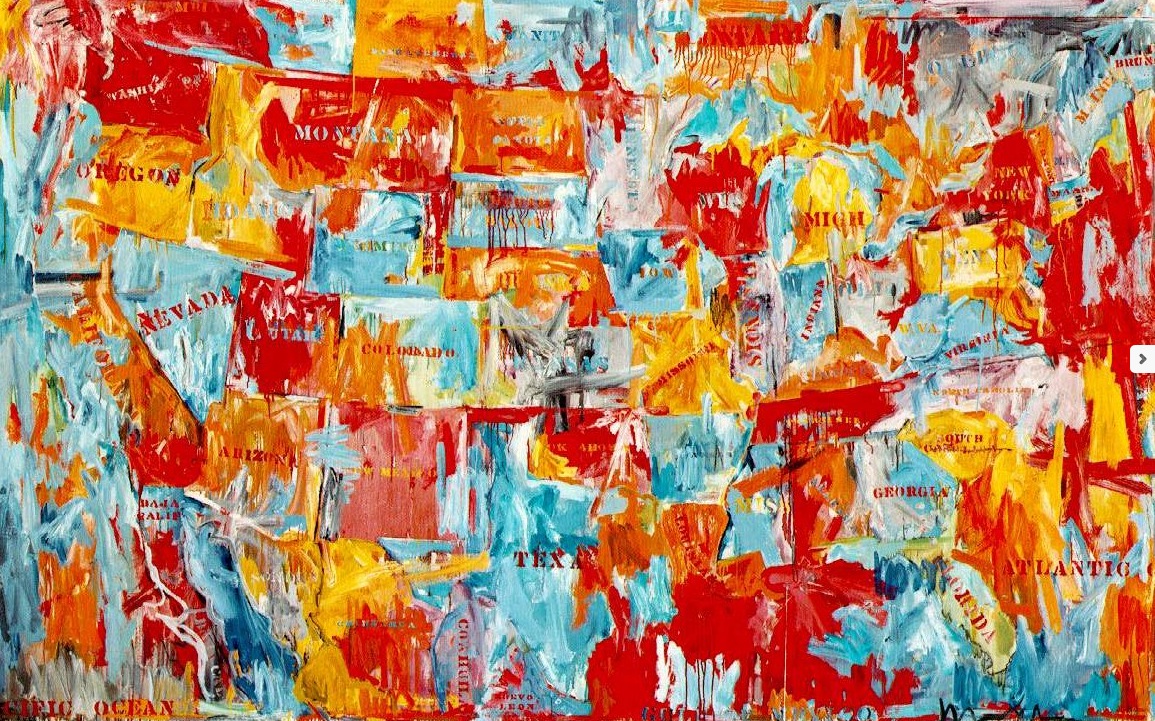
Map (Jasper Johns, 1961)

Map (Jasper Johns, 1961)

On July 4, 1776, Thomas Jefferson rose before dawn, recorded the temperature at 6 a.m. (68 degrees), had some tea and biscuits, and made his way to Independence Hall. Sixty-nine years later, Henry David Thoreau chose the day to begin his sojourn at Walden Pond. On July 4, 1863, Lee’s Confederate army began its decisive retreat from Gettysburg, and on the same date in 1895 Katherine Lee Bates published “America the Beautiful”. Nathaniel Hawthorne, Stephen Foster, Louis B. Mayer and Obama’s oldest daughter were all born on July 4, and both Jefferson and John Adams died on the 50thth anniversary of the Founders’ Declaration. So what do the rest of us have planned for Independence Day?

It was Adams who predicted that the Fourth would be “celebrated by succeeding generations as the great anniversary festival” and “solemnized with pomp and parade, with shows, games, sports, guns, bells, bonfires, and illuminations, from one end of this continent to the other, from this time forth for evermore.”[i] We have more or less fulfilled the externals of Adams’ vision, but the mindfulness with which we keep the feast is subject to question. In 1975, just before the American Bicentennial, a Gallup poll revealed that 28% of Americans were unable to identify what significant event happened in 1776.

What should we remember as a people? Do we create simplifying myths that unite us with some intoxicating blend of nostalgia and amnesia? Sanitizing and depoliticizing the past is a way to reduce conflict, as in the efforts to heal sectional division after the Civil war. But that can leave grievous social ills unaddressed and unhealed. The current debate about the Confederate battle flag shows how deeply embedded such sanitizing mythology can be. Preserving “heritage,” we discover, is a massive process of forgetting where, in Joan Didion’s memorable phrase, “no one is bloodied by history.”[ii]

Some governments try to supervise the formation of collective memory. The late Soviet Union is a notorious example, but there are also more benign forms of cultivating shared cultural identity (mais oui!). But in America, as Michael Kammen has noted, “people forget and remember largely on their own.”[iii] We have no ministry of culture, and national memory is contested without official referees.

But few of us will give much thought to either politics or culture tomorrow. As a radio talk show guy put it in his summary of America’s military mission: “Those guys are fighting so we can have barbecues and drink beer.”[iv] Pursuit of happiness indeed. But as Daniel Webster noted, it has always been so. “The tavern,” he said, “was the headquarters of the Revolution”[v] – a gathering place where ideas were exchanged and debated. In these latter days we have retained the conviviality of the tavern while dispensing with the ideas. The long-winded orations of old-time Fourths are long gone. There will be little thoughtful discussion of liberty and the common good around the barbecue. No radical challenges to tyranny and oppression will be issued. We’ll just enjoy a day off with our families, friends and neighbors as we pursue happiness together. And in a society fraught with so much division and disconnection, being together in peace and play and joy may be as good a way as any to keep the American feast.

One of the moments when I feel community most vividly is after the last fireworks fade to black above our local harbor. All of us who have watched from the beach begin to make our way along a forest path back to the road. It is too dark to see faces, or anything else that distinguishes one from another. We are an egalitarian procession of shadows, walking together. No longer pursuing happiness, we seem to have found it. Being there together in the night, for a few lovely minutes, is the most important fact about us.

The wonder I feel in the holiday’s concluding moment is beautifully expressed in Samuel Hynes’ memoir of his childhood in the 1930s. Although he grew up in a very different America, his description touches on something timeless:

The last rocket is always the best of all – burst after burst, the echoes rebounding, and then another burst just when you think it is all over. And then it is. The families rise slowly in the sudden silence and fold their blankets, and walk home through the dark, still streets, not talking much, purged by the high splendors they have seen, satisfied that another Fourth is over, another summer has been celebrated with a proper hullabaloo.[vi]

[i] Benson Bobrick, Angel in the Whirlwind: The Triumph of the American Revolution (New York: Penguin Books, 1998), 203

[ii] Michael Kammen, Mystic Chords of Memory: The Transformation of Tradition in American Culture (New York: Vintage Books, 1993), 667

[iii] ibid., 700

[iv] Overheard on a Montana roadtrip a few years ago.

[v] Angel in the Whirlwind, 494

[vi] Samuel Hynes, The Growing Seasons: An American Boyhood Before the War (New York: Penguin Books, 2003), 111

Simple gifts

Shakers dance

Who will bow and bend like a willow
Who will turn and twist and reel
In the gale of simple freedom …

– Shaker spiritual

John Ciardi said that the poet is known by the valor of his refusals. So too the saint. But the austerity of self-limitation is not what we might have expected from the Wooster Group, the edgy New York City troupe long known for its Dionysian blends of experimental theater and multimedia technologies. Their latest production, however, not only reincarnates the music of the Shakers, it does so with a minimalist restraint worthy of that nearly extinct American sect.

Early Shaker Spirituals: A Record Album Interpretation presents all 20 songs from side A of a 1976 LP recorded at the dwindling Shaker community in Sabbathday Lake, Maine. After the liner notes for each song are read aloud, four women in plain 19th century dress sing along with the actual spinning record as it is transmitted to them through wireless receivers. The voice of Suzzy Roche is especially haunting, lean and lonesome and saturated with pastness like a faded tintype. While we listen to these contemporary reproductions of long departed voices, we sometimes hear the faint traces of the original recorded sound leaking into the room from the women’s earpieces. As the New York Times has written: “The aural effect is subtle and eerie, suggesting a kind of phantasmal possession of the present by the past or, if you prefer, the eternal.”[i]

Sitting quietly, passive and still, replicating out loud what they are hearing in their ear, the singers seem to be channeling something not of their own making, a transcendent voice entering the present world by first passing through their own souls and bodies. It feels like the spiritual ventriloquism of biblical prophecy. What shall I sing? Sing this. How fitting for a repertoire which the Shakers often attributed to the gifts of unseen spirits or divine inspiration.

The contrast of the singers’ personal inexpressiveness with such passionate, ecstatic and sometimes eschatological song texts (“with leaping and with dancing / we’ll hail the jubilee”) only strengthens the sense of otherness. What they sing does not come from them, but through them. It is not a spontaneous construct whipped up by emotional display. Such unassertive transparency achieves a strange oracular force. We hear a message from beyond.

Even when the singers rise from their chairs to approximate the original Shaker dances, it is not an exaltation of the self, but a yielding to the higher rhythms of divine choreography. As they reel, turn and twist to “shake out all the starch and stiffening,” they do not express. They surrender.

When I saw this compelling performance the other night in Los Angeles’ Redcat Theater, I was transported – whether to the past, or to the eternal, who can say? But I came away touched by a larger world than my ordinary domain. Voices distant in time had spoken to me. And is this not analogous to the eucharistic liturgy? We listen to ancient voices as if they were here and now, and speak their words from our own lips. Transparent presiders at the altar reproduce actions first performed in Jerusalem 2000 years ago. If we manage to keep our ego out of the way in the liturgy, the eternal Word, like that 1976 Shaker recording, may be heard and received in the fresh particularity of the now.

Some of the Wooster Group might take issue with my theological interpretation. Frances McDormand, the ensemble’s best-known actress, has resisted the religious dimensions of the Shaker tradition, preferring to stress the communal qualities of their musical environment. “It’s not religiously based,” she said in an interview. “It’s more poetic. There are parables to it, but it’s not about Jesus so it’s a little bit easier to take.”[ii]

Such indifference to Christian theology and practice is the common currency of secular modernity, the default position posing a perpetual challenge to those who would speak of faith. Many people think of Jesus and Christianity as something over and done, at least for them.

And yet, here is a cutting edge theater troupe performing religious songs without irony or ridicule, in a creative simulacrum of the otherness of the music’s reputedly transcendent source. While I won’t presume to baptize the Wooster Group, or attribute overt belief where it is explicitly denied, I still wonder whether there might yet be something larger at work in the world than any of us are able either to understand or admit. Whatever the Wooster Group actually thinks about what they are doing, and whatever ideas I might have about it, the “simple gifts” of love and delight go on being given and being received. Whether the mechanism of that exchange can be adequately described or named is perhaps the least important part of the whole thing. Experience trumps the language we put to it. In the end, you don’t need to possess the perfect map before you can dwell in “the valley of love and delight.” You’re already there. Its song is already whispering in your ear.

[i] Ben Brantley, The New York Times, May 29, 2014

[ii] James Kim interview with Frances McDormand, KPPC radio, Jan. 21, 2015